"Allison Bain" (continued 4)
Reading edition
Mrs Hume ceased suddenly. For a moment a strong temptation assailed her. If ever man and wife were perfectly one in heart and thought and desires, these two were. As for the wife, no thought or wish of hers, whether of great things or of small, seemed quite her own till she had also made it his. Seeing the look which had come to her face, her husband waited for her to say more. But she was silent. She had no right to utter the words which had almost risen to her lips. To tell another’s secret—if indeed there were a secret—would be betrayal and a cruel wrong. Even to her husband she might not tell her thoughts, and indeed, if she had but known it, there was, as far as Allison Bain was concerned, no secret to tell.
But Robin, who was in the way of sharing with his mother most things which greatly interested himself, had told her about his morning run over the hills after John Beaton, and how he had found him “looking at nothing” on the very spot where, the day before, he had got his first look at Allison Bain, and how he had turned and run home again without being seen. Robin only told the story. He drew no inference from it, at least he did not for his mother’s hearing.
His mother did that for herself. Remembering John’s dazed condition at worship on the first night of his homecoming, it is not surprising she should have said to herself that “the lad’s time had come.”
And what of Allison? She had asked herself that question a good many times since John’s departure; but she owned that never, either by word or look, had Allison betrayed herself, if indeed she had anything to betray, and of that she was less assured as the days went on. But whether or not, it was evident, Mrs Hume assured herself, that Allison was “coming to herself” at last.
And so she was. Young and naturally hopeful, it is not to be supposed that Allison’s sorrow, heavy and sore though it was, could make all the future dark to her, and bow her always to the earth. She had lost herself for a time in the maze of trouble, into which death, and her enforced marriage, and her brother’s sin and its punishment, had brought her. But she was coming to the end, and out of it now. She was no longer living and walking in a dream. She was able to look over the last year of her life at home with calmness, and she could see how, being overwrought in mind and body, spent with work and watching and care, she had fallen under the mastery of blind terror for her brother’s safety, and had yielded where she ought to have stood firm.
She had no one to blame for what had befallen her. Her mother had hardly been in a state to know what was going on around her, except that her “bonny Willie”—as she called him in her prayers, and in her murmured longings for him—was faraway, and might not come home in time to see her die, or to help to lay her in her grave. Her father grieved for his son, but, angry at him also, had uttered no word either to help or to hinder the cause of the man who had made Allison’s promise the price of her brother’s safety. But he went about with bowed head, listening, and looking, and longing, ay longing, for the coming of the lad. So what could she do but yield for their sakes, and take what seemed the only way to bring him back again?
But one wrong was never righted by the doing of another, and her sacrifice had come to worse than naught. Though she had sinned blindly, she had suffered for her sin, and must suffer still. But gradually the despair which darkened all the year was passing. There was hope in her heart now, and a longing to throw off the dead-weight which had so long held her down. And the lightening of her burden showed now and then in eye, and voice, and step, so that all could see the change. But with all this the thought of John Beaton had nothing to do.
She had seen him just as she had seen other folk and he had come into her thoughts once or twice when he was not in her sight. But that was because of the good understanding there was between him and little Marjorie. The child had much to say about him when he was at home; and when she was carried out in Allison’s arms on those days, she was always wishing that they might meet him before they went home again.
One day they met, and Marjorie being gently and safely transferred to John’s arms, Allison turned and went back into the house without a word of explanation or apology.
“It’s ironing day,” explained Marjorie, a little startled at the look on John’s face.
“Oh! it’s ironing day, is it? Well, never mind. I am going to take you to the very top of Windhill to give you a taste of the fresh air, and then I shall carry you home to take tea with my mother and me.”
“That will be delightful,” said Marjorie with a sigh of pleasure.
No. In those days Allison was thinking nothing at all about John. When she went about the house, with no gloom, but only a shadow of softened sadness on her face, and a look of longing in her eyes, it was of her brother that she was thinking. She was saying in her heart:
“God help him in that dismal place—he who should be free upon the hills with the sheep, or following the plough on his ain land at home.”
And when a sudden smile came, or a bright glance, or a murmur of song, she was telling herself that his time was nearly over; that he would soon be free again to go faraway over the sea, where, with kind help from Mr Hadden, he would begin a new life, and all would be well with him once more. Yes, and they might be together again.
But this could not be for a long time. She must not even try to see her brother. For Brownrig would be sure to have a watch set on him when he was free. And Brownrig—having the law on his side, as he had said in the hearing of many, on the night of the dark day on which her father was buried, raising his voice that she too might hear him, the door being locked and barred between them—Brownrig would come and she would be found, and then lost forever.
“For,” said Allison to herself, “I should have to drown myself then, and make an end of it all.”
She was standing on the edge of Burney’s Pot, near the mill-dam, when she said this to herself, and she shuddered as she looked down into the grey water.
“But it will never come to that! Oh! no, mother, it will never come to that. But to save myself from that man, even to end all would surely be no sin.”
But these thoughts did not haunt and terrify her now, as her doubts and dreads had done during the winter. She had no time for brooding over the past. Every hour of the day was more than full with all she had to do, and there were no long, dark evenings, when she had only her wheel and her own thoughts for company.
And there was Marjorie. Marjorie had something to do with her thoughts through all the hours of the day. She was always there to lift or to lay down, to carry here or to carry there, to speak to or to smile upon. And she grew sweeter and dearer every day. Above all, the time was hastening, and Willie would soon be free. That thought made all the days bright to Allison.
And so she grew, not light-hearted, but reasonable and patient in her thoughts of all that had befallen them, and, at most times, hopeful as to all that might lie before them.
The neighbours who, at her first coming among them, had been inclined to resent her gloom and her silence, were ready now, for the sake of her friendly looks, to forgive the silence which she kept still. Even in the kirk she was like another woman, they said, and didna seem to be miles awa’, or dreaming, or in fear.
Of this change Allison herself was conscious, when she thought about it. The minister’s words did not seem “just to go by” her as they used to do. She listened and took her portion with the rest of the folk, and was moved, or glad, or doubtful, or afraid, as they were, and thought about all she had heard afterward, as doubtless some of the rest did also.
She was not desirous now, as she had been at first, for more than her own turn of staying at home from the kirk. This was partly because little Marjorie was sometimes able to go there; and when she went she was carried in Allison’s arms, where she rested, sometimes listening to her father’s voice, and sometimes slumbering through the time. But it was partly, also, because there came now and then a message to Allison there.
For some of the good words spoken must be for her, she thought, since the minister said they were for all. Allison was not good at remembering sermons, or even “heads and particulars,” as Robin was. For a long time she had heard nothing but the minister’s voice, and carried away no word of his, either for correction or instruction. His sermons were “beyond her,” as she said. They meant nothing to her. But now and then a good word reached her out of the Book; and sometimes a word of the minister, spoken, as was the way in those days, as a comment on the psalm that was to be sung, or on the chapter that was read, touched her, strangely enough, more even than the words of the Book itself, with which she had been familiar all her life.
One day in early summer she carried her wee Marjorie to the kirk with a sad heart. For the Sabbath-days were the worst to bear, since she had least to do, and more time for thinking. All the morning her thoughts had been with “her Willie,” shut in between stone walls, away from the sunshine and the sweet air, and she was saying to herself: Would the shame and the misery of it all have changed him, and would he come out, angry and reckless, a lost laddie? Oh! if she could only go to meet him at the very door, and if they could get away together over the sea, to that country so great and wide that they might easily lose themselves in it, and so pass out of the sight and out of the thoughts of all who had known them in their happy youth, before trouble had come! Might it not be? And how could it be? Might she not set Brownrig and his wicked wiles at naught, and go with her brother to save him?
And then the minister’s voice was heard: “Fret not thyself because of evildoers.” And so on: “Commit thy way unto the Lord. Trust also in Him and He shall bring it to pass.”
“Bring it to pass!” In the midst of her trouble and longing, Allison had almost uttered the words aloud, as though they had been spoken to her alone of all the listening people, and then Marjorie stirred in her slumber and brought her to herself again.
“Rest in the Lord. Wait patiently for Him. Fret not thyself because of him who prospereth in the way, because of the man who bringeth wicked devices to pass.”
Surely those words were for her! And she heard no more till he came to the good man whose “steps are ordered of God.”
“Though he fall, he shall not be utterly cast down, for the Lord upholdeth him with His hand.
“I have been young, and now am old; yet have I not seen the righteous forsaken, nor his seed begging bread.”
And then Robin touched his mother’s hand. For Allison had drawn her big black bonnet over her face to hide from the folk in the kirk the tears which were falling fast on the bright hair of the little sleeper. Mrs Hume made no sign that she saw them, but she prayed silently for the sorrowful woman who all the long winter had kept her sorrow to herself.
“Say nothing, Robin,” said she, when they rose to go out together. “She will be the better for her tears, or rather for that which made them flow.”
To herself Robin’s mother said:
“She will surely speak now, and open her heart to comfort.”
She had a while to wait for that, but a change came over Allison as the summer days went on. She was restless sometimes, and anxious and afraid. She had an air of expectation as though she were waiting for something, and sometimes she had the look of one eager to be up and away.
One night when Mrs Hume went up to see her little daughter in her bed, she found Allison writing. She said nothing to her and did not seem to see, and waited in expectation of hearing more. But she never did.
For Allison’s courage failed her and the letter was never sent. It was written to Dr Fleming, who had been kind to her in the infirmary, and it told him of her brother who was in prison, and asked him to visit him and to be kind to him, as he had been to her. But after it was written she was afraid to send it.
No. She must wait and have patience. Willie must go away alone over the sea, as they had agreed together in the only letters that had passed between them since he was a prisoner. Mr Hadden would befriend him as he had promised, and she would follow him when the right time came.
“But it is ill waiting,” said Allison to herself. “It is ill waiting.”
In those days many a word came to her as she sat in the kirk or in the parlour at worship-time, which set her thinking. Some of them strengthened her courage and gave her hope, and some of them made her afraid. For she said to herself:
“Are these good words for me?”
They we’re for the minister and for the minister’s wife, doubtless, every promise of them all, and for many more who heard them spoken. But were they for her?
“For,” said she, “‘if I regard iniquity in my heart, the Lord will not hear my prayer.’ And I’m no’ sure of myself. ‘Love your enemies,’ the Book says, and I doubt there’s hatred in my heart to one man.
“Or maybe it is only fear of him and anger. I think if I could only get well away from him, and safe from the dread of him, I would hate him no longer. I would pity him. I pity him now, even. For he has spoiled his own life as well as mine, and what with anger and shame, and the pity of some folk and the scorn of others, he must be an unhappy man. Yes, I am sorry for him. For the fault was partly mine. I should have stood fast whatever befell. And how is it all to end?”
Chapter Twelve.
“A man may choose to begin love, but not to end it.”
The spring passed quickly and summer came on, and then something happened which made a little stir of pleasure in the manse, and in the pleasure Allison shared, because of little Marjorie. Mrs Esselmont came home.
Mrs Esselmont had been, in former days, one of the great ladies of the shire, and, with a difference, she was one of its great ladies still. Marjorie had been “kirstened after her,” as they used to call it in that country. The child was “Marjorie Esselmont Hume,” and she was right proud of her name.
But Mrs Esselmont did not come back this time to Esselmont House, which had been the home of the Esselmonts for many a year and day. Her husband was dead and her sons also, and the great house, and the wide lands which lay about it, had passed to another Esselmont, a stranger, though of the same blood. She came back, as indeed she had gone away, a sorrowful woman, for she had just parted from her youngest and dearest daughter, who was going, as was her duty, to Canada with her soldier husband.
The acquaintance of Mrs Esselmont and the minister had commenced soon after the coming of Mr Hume—then little more than a lad—a “missioner” to Nethermuir. At the bedside of one whom the lady had long befriended, they met by chance—if one may so speak of a meeting which was the beginning of so much to them both. The poor woman in whom both were interested was drawing nigh to the end of all trouble, and these two did not meet again for years.
The next meeting was in no sense by chance. In a time of great sorrow Mrs Esselmont came to the minister for help, because she remembered how his words, spoken in God’s name, had brought peace to one who had sinned and suffered, and who was sore afraid as the end drew near. And that was the beginning of a lasting friendship between them.
They had not met often during the last few years. Mrs Esselmont had lived much in England with her daughters, and had only once returned to her own house during the summer. Now she said she must look upon Firhill as her permanent home, and she did not speak very cheerfully when she said it.
For though she was a good woman, she was not of a cheerful nature, and she had had many a trouble in the course of her life. Some of them had been troubles to which, at the time, it seemed wrong for her to submit, but which it was in vain, and worse than in vain, to resent. They were troubles which could only be ignored as far as the world was concerned, but which, she told herself, could never be forgotten or forgiven. They were all over now, buried in graves, forgiven and forgotten. But the scars were there still of wounds which had hurt sorely and healed slowly, and now she was looking sadly forward to a solitary old age.
She had been long away, but Marjorie had not been allowed to forget her. Gifts and kind wishes had come often to the child from her friend, and her name had often been named in the household. But her coming was a shock to Marjorie. What she had imagined of the writer of the letters which she had heard read, and of the giver of the gifts which she had received, no one could say. But the first glimpse which she got of the tall form, shrouded in trailing, black garments, and of the pale face, encircled by the border of the widow’s cap, and shaded by the heavy widow’s veil, struck her with something like terror, which must have ended in tears and sobs and painful excitement, if her mother had not seen the danger in time and carried her away.
“Poor darling! I fear she is no stronger as time goes on,” said the lady gently.
“Yes, we think her a little stronger. Indeed we think there is a decided change for the better since spring opened. She is able to stand now, and even to walk a little in the garden. But she is very frail still, our poor little girl,” said the mother with a sigh.
“What has helped her, do you think?”
“Nature, it must be, and Allison Bain. The doctor has done nothing for her for more than a year, but even he acknowledges that there is a change for the better, though he does not give us much reason to hope that she will ever be very strong.”
“It is God’s will,” said Mrs Esselmont with a sigh.
“We can only wait and see what God will send her. As it is, she is a blessing in the house.”
“Yes. Still with your large family and your many cares, she must be a constant anxiety to you both night and day.”
“Well, we get used with even care and anxiety. And she is a happy little creature naturally. Allison has helped us greatly with her. She is very kind and sensible in all her ways of doing for her.”
“And who is Allison?”
It was on Mrs Hume’s lips to say, “We do not know who she is,” but she did not say it.
“She came to fill Kirstin’s place. Poor Kirstin was called home to nurse her mother, who is lingering still, though she was supposed to be dying when her daughter was sent for.”
And then Mrs Hume went on to speak of something else.
Allison was “coming to herself,” growing “like other folk,” only bonnier and better than most. There was no need to call attention to her as in any way different from the rest. Allison had been good to Marjorie, and Marjorie was fond of Allison. That was all that need be said even to Mrs Esselmont. But the lady and Allison were good friends before all was done.
For many of Mrs Esselmont’s lonely days were brightened by the visits of the child Marjorie. And though the pony carriage was sometimes sent for her, and though she enjoyed greatly the honour and glory of driving away from the door in the sight of all the bairns who gathered in the street to see, she owned that she felt safer and more at her ease in the arms of “her own Allie,” and so when it was possible, it was in Allison’s arms that she was brought home.
If there had been nothing else to commend her to the pleased notice of Mrs Esselmont, Allison’s devotion to the child must have done so. And this stately young woman, with her soft voice, and her silence, and her beautiful, sorrowful eyes, was worth observing for her own sake. But Allison was as silent with her as with the rest of her little world, though her smile grew brighter and more responsive as the days went on.
Mrs Esselmont’s house stood on the hillside, facing the west. Behind it rose the seven dark firs which had given to the place its name. The tall firs and the hilltop hid from the house the sunshine of the early morning, but they stood a welcome shelter between it and the bleak east wind which came from the sea when the dreary time of the year had come.
The house was built of dull grey stone, with no attempt at ornament of any kind visible upon it. All its beauty was due to the ivy, which grew close and thick over the two ends, covering the high gables, and even the chimneys, and creeping more loosely about the windows in the front. Without the ivy and the two laburnums, which were scattering their golden blossoms over the grass when Allison saw it first, the place would have looked gloomy and sad.
But when one had fairly passed up the avenue, or rather the lane, lying between a hedge of hawthorn on one side and the rough stone dike which marked the bounds of the nearest neighbour on the other, and entered at the gate which opened on the lawn, it was not the dull grey house which one noticed first, but the garden.
“The lovely, lovely garden!” Marjorie always called it. She had not seen many gardens, nor had Allison, and the wealth of blossoms which covered every spot where the green grass was not growing, was wonderful in their eyes.
The place was kept in order by an old man, who had long been gardener at Esselmont House, and it was as well kept in the absence of the mistress as when she was there to see it. The garden was full of roses, and of the common sweet-smelling flowers, for which there seems little room in fine gardens nowadays, and it was tended by one who loved flowers for their own sake.
It was shut in and sheltered by a high stone wall on the east, and by a hawthorn hedge on the north, but the walls on the other sides were low; and sitting beneath the laburnums near the house, on the upper edge of the sloping lawn, one could see the fields, and the hills, and a farmhouse or two, and the windings of the burn which nearly made an island of the town. From the end of the west wall, where it touched the hawthorn hedge, one could see the town itself. The manse and the kirk could be distinguished, but not very clearly. Seen from the hill the place looked only an irregular group of little grey houses, for the green of the narrow gardens behind was mostly hidden, and even the trees along the lanes seemed small in the distance. But Marjorie liked to look down over it now and then, to make sure that all was safe there when she was away.
It was a strange experience for her to be for hours away from her own home, and even out of the town.
Poor little Marjorie had passed more time on her couch in her mother’s parlour, during her life of eleven years, than in all other places put together. She was happy in the change, and enjoyed greatly the sight of something new, and there were many beautiful things for her to see in Mrs Esselmont’s house. But she needed “to get used with it,” and just at first a day at a time was quite enough for her strength. The day was not allowed to be very long, and the pleasure of getting home again was almost as great as the pleasure of getting away had been. But the best of all was, that the child was getting a little stronger.
There was much besides this to make it a good and happy summer at the manse. The younger lads were busy at school under a new master, who seemed to be in a fair way to make scholars of them all, Robin was full of delight at the thought that at last he was to go to college, and he fully intended to distinguish himself there. He said “at last,” though he was only a month or two past sixteen, and had all his life before him.
“Ay, ye hae a’ ye’re life afore ye, in which to serve the Lord or the Deevil,” Saunners Crombie took the opportunity to say to him, one night after the evening meeting, when he first heard that the lad was to go away.
Robin looked at him with angry eyes, and turned his back on him without a word.
“Hoot, man Saunners! There is no fear o’ the laddie,” said his more hopeful crony, Peter Gilchrist.
“Maybe no, and maybe ay. It’ll be nae haflin course that yon lad will tak’. He’ll do verra well or verra ill, and I see no signs o’ grace in him so far.”
“Dinna bode ill o’ the lad. The Lord’ll hae the son o’ his father and mother in His good keeping. And there’s John Beaton, forby (besides), to hae an e’e upon him. No’ but that there will be mony temptations in the toon for a lad like him,” added Peter, desirous to avoid any discussion with his friend.
“John Beaton, say ye? I doubt he’ll need himsel’ all the help the Lord is like to give to ane that’s neither cauld nor het. It’s wi’ stumblin’ steps he’ll gang himsel’, if I’m no mista’en.”
But to this Peter had nothing to say. They had been over the ground before, and more than once, and each had failed to convince the other. Crombie went on:
“He carries his head ower-heich (over-high), yon lad. He’s nae likely to see the stanes at his ain feet, to say naething o’ being a help to the like o’ Robert Hume.”
“Hae ye had ony words wi’ him of late?” asked Peter gravely.
“Nae me! He’s been here often eneuch. But except in the kirk, where he sits glowerin’ straecht afore him, as gin there was naebody worthy o’ a glance within the four walls, I havena set my een upon him. It’s inborn pride that ails him, or else he has gotten something no’ canny upon his mind.”
“His mother’s no’ just so strong. It’s that which brings him hame sae often. His heart is just set on his mother.”
“It’s no’ like to do his mother muckle gude to be forced to leave her ain house, and take lodgin’s in a toon. But gin he be pleased, that’ll please her,” said Saunners sourly.
“Hae ye ony special reason for thinkin’ and sayin’ that the lad has onything on his mind? He’s dull-like whiles, but—”
“I’m no’ in the way o’ sayin’ things for which I hae nae reason,” said Saunners shortly. “As to special—it’s nae mair special to me than to yoursel’. Has he been the same lad this while that he ance was, think ye? Gude-nicht to ye.”
“Gude-nicht,” said Peter meekly. “Eh! but he’s dour whiles, is Saunners! He is a gude man. Oh! ay, he’s a gude man. But he’s hard on folk whiles. As for John Beaton—I maun hae a crack (a little talk) with himsel’.”
But Peter did not get his crack with John at this time, and if he had had, it is doubtful whether he would have got much satisfaction out of it.
John was not altogether at ease with regard to the state of his mother’s health, but it cannot be said that he was especially anxious. For though the last winter had tried her, the summer “was setting her up again,” she always told him cheerfully when he came. And she was always at her best when her son was with her.
Her little maid, Annie Thorn, to whom she had become much attached, and whom she had trained to do the work of the house in a neat and orderly manner, was permitted to do many things which had until now been done by the careful hands of her mistress. She was “little Annie” no longer, but a well-grown, sensible lass of sixteen, who thought: herself a woman, able to do all that any woman might do. She was willing even to put on the thick muslin cap of her class if her mistress would have consented that she should so disguise herself and cover her pretty hair.
No, John was not anxious about his mother. He was more at ease about her than he had been since he had been obliged to leave her so much at home alone. But he came home more frequently to see her. He had more time, and he could bear the expense better. Besides, the office work which he had to do now kept him closer, and made change and exercise more necessary for him, and so he came, knowing that he could not come too often for his mother’s pleasure.
This was what he said to her and to himself, but he knew in his heart that there was another reason for his coming; he called himself a fool for his pains, but still he came.
He knew now that it was the thought of Allison Bain which would not let him rest, which drew him ever to return. For the thought of her was with him night and day. Her “bonny een” looked up at him from his papers, and his books, and from the waves of the sea, when his restlessness urged him forth to his nightly wanderings on the shore.
But even when he turned his face toward Nethermuir, he scorned himself for his weakness. It was a kind of madness that was on him, he thought—a madness that would surely come to an end soon.
“Few men escape it, at one time or another of their lives, as I have heard said. The sooner it comes, the sooner it is over. It has gone ill with many a one. But I am a strong man, and it will pass. Yes! It shall pass.”
This was what he said to himself, and he said also that Allison’s indifference, which he could not but see, her utter unconsciousness of him and his comings and goings, his words and his ways, was something for which he might be glad, for all that would help him through with it and hasten his cure.
But he was not so sure after a while—sure, that is, that Allison’s indifference and unconsciousness of him and his feelings made it easier for him to put her out of his thoughts. There were times when with a sort of anger he longed to make her look at him, or speak to him, even though her words might hurt him. He was angry with her, and with himself, and with all the world; and there was truth in old Crombie’s accusation that he carried his head high and neglected his friends.
It was all that he could do sometimes to endure patiently the company of Robert Hume or his brothers. Even Davie, who was not exacting in the matter of response to his talk, missed something in his chief friend, and had serious misgivings about it.
And Davie’s mother had her own thoughts also, and she was not well pleased with John. That “his time was come” she knew by many a token, and she knew also, or guessed, the nature of the struggle that was going on in him. She acknowledged that his prudence was praiseworthy, and that it might not be the best wisdom for him to yield to impulse in a matter so important; but she also told herself scornfully that if his love were “true love,” he would never have waited for prudence or for ambition to put in a word, but would have gladly taken his chance whatever might befall.
“Though indeed he might have cause to repent afterward,” she acknowledged with a sigh.
And since Allison was not thinking at all about him, little ill would be done. The lad would get his discipline and go his way, and might never know what a chance of happiness he had let slip out of his hands.
“For he could make her learn to love if he were to try,” said Mrs Hume to herself. “But he must not try unless— And if he should say or do anything likely to bring watchful eyes or gossiping tongues upon Allison, I shall have something to say to the lad myself.”
Some one else was having her own thoughts about these two. Mistress Jamieson had seen the lad when “his een first lichted on the lass,” and she had guessed what had happened to him. Now she waited and watched with interest expecting more. She had not counted on the blindness or long-continued indifference of Allison.
Was it indifference on her part? Or was it prudence, or a proper pride? And the conclusion the mistress came to was this:
“She’s no’ heedin’ him. Ay, ye’re a braw lad, John Beaton, and a clever; but it’ll do ye nae ill to be neglecit for a wee while, or even set at naucht. Ye thocht to tak’ her captive wi’ a smile and a few saft words! And ye’ll do it yet, I daursay, since it’s the nature o’ woman to be sae beguiled,” added the mistress with a sigh.
But her interest was a silent interest. She never named their names together in a neighbour’s hearing.
It was of her brother that Allison was thinking all this time—of poor Willie, who, as she believed, had never seen the sunshine, or even the light of all these summer days. Every night and every morning she counted the days that must pass before he should be set free to go to his own house; and she rejoiced and suffered beforehand, as he must rejoice and suffer when that time came.
It would be November then. She knew just how Grassie would look to him under the grey sky, or the slanting rain, with the mist lying low in the hollows, and the wind sighing among the fir-trees on the height. She could see the dull patches of stubble, and the bare hedges, and the garden where only a touch of green lingered among the withered rose-bushes and berry-bushes, and the bare stalks of the flowers which they used to care for together.
She saw the wet ricks in the corn-yard, and the little pools left in the footmarks of the beasts about the door. She heard the lowing of the cows in the byre, and the bleating of the sheep in the fold, and she knew how all familiar sights and sounds would hurt the lad, who would never more see the face or hear the voice of kith or kin in the house where he was born. How could he ever bear it?
“Oh! God, be good to him when that day comes!” was her cry.
And since they had agreed that they must not meet on this side of the sea, was there no other way in which she might reach him for his good? She had thought of many impossible ways before she thought of John Beaton. It was in the kirk, one Sabbath-day, that the thought of him came.
The day was wet and windy, and Marjorie was not there to fill her thoughts, and they wandered away to Willie in the prison, and she fell to counting the days again, saying to herself: “How could he ever bear it?”
She was afraid for him. She strove against her fears, but she was afraid—of the evil ways into which, being left to himself, or to the guidance of evil men, he might be tempted to fall. Oh! if she might go to him! Or if she had a friend whom she might trust to go in her stead!
And then she lifted her eyes and met those of John Beaton. She did not start, nor grow red, nor turn away. But her whole face changed. There came over it a look which cannot be described, but which made it for the moment truly beautiful—a look hopeful, trustful, joyful.
Allison was saying to herself:
“Oh, Willie! if I might only dare to speak and bid him go to you.”
Chapter Thirteen.
“She wakened heavy-hearted To hear the driving rain, By noon the clouds had parted, And the sun shone out again. ‘I’d take it for a sign,’ she said, ‘That I have not prayed in vain.’”
That night while Mrs Beaton and her son sat by the fireside, exchanging a word now and then, but for the most part in silence, a knock came to the door. Allison had given herself no time to reconsider the determination to which she had come when she met John’s eyes in the kirk, being bent on abiding by it whatever might befall.
It had not come into her mind that her courage might fail her at the last moment. It was not that her courage was failing, she told herself, as she stood waiting. It was because she had run down the lane so quickly that her heart was beating hard. It was like the thud of a great hammer against her side; it frightened her, and she was tempted to turn and run away. But she did not.
“I would be sorry when it was too late,” thought she, and knocked again.
There was a pause of a minute or two, and then the door opened, and John Beaton appeared, carrying a light.
“I was wishing to say a word to Mrs Beaton, if she will let me,” said Allison, making a great effort to speak as usual.
“Surely,” said John. “Come in.”
“Come away in, Allison,” said Mrs Beaton’s kind voice out of the darkness.
When John had shut the door and come into the parlour with the light, he was surprised to see that the two women had clasped hands, and that on his mother’s face was the look which he had hitherto believed it had worn for him alone. He moved a chair forward from the wall.
“Sit down, Allison,” said he.
“No,” said she; “I will say first what I came to say.”
John set down the candle and turned to go. But Allison put out her hand to detain him.
“’Bide still,” said she. “I have to ask your mother to ask her son to do something for me—something which I cannot do for myself, but which must be done, or I think my heart will break.”
“’Bide still, John,” said his mother.
John moved the light again, so that it fell on Allison’s face, and then went and stood in the shadow, leaning on the back of his mother’s chair. Allison stood for a moment silent, and both mother and son regarded her with interest and with surprise as well.
This was quite a different Allison, Mrs Beaton thought, from the one who went up and down the street, heeding no one, seeing nothing unless the child Marjorie was in her arms to call her attention to whatever there might be to see. She seemed eager and anxious, full of determination and energy. She had not at all the air of one who had been accustomed to go and come at the bidding of other folk.
“It is the true Allison at last,” said John to himself.
“Her gown has something to do with it,” thought Mrs Beaton, and perhaps it had. Her gown was black, and hung in straight folds about her. A soft, white kerchief showed above the edge of it around her throat, and her Sunday cap, less voluminous and of lighter material than those which she wore about her work, let her shining hair be seen.
“A strong and beautiful woman,” John said to himself. His mother was saying it also; but with a better knowledge of a woman’s nature, and a misgiving that some great trouble had brought her there, she added:
“May God help her, whatever it may be. Allison, sit down,” she said after waiting a minute for her to speak.
“It is that my heart is beating so fast that I seem to be in a tremble,” said Allison, clasping her hands on her side.
“Sit down, my dear,” said Mrs Beaton kindly. “Not yet. It is only a few words that I must say, I have had great trouble in my life. I have trouble yet—that must be met. And it came into my mind when I was sitting in the kirk that you might maybe help me, and—keep my heart from breaking altogether,” said she; then lifting her eyes to John’s face she asked, “Have ye ever been in the tollbooth at Aberdeen? It is there my Willie is, whom I would fain save.”
John’s mother felt the start her son gave at the words. Even she uttered a word of dismay.
“I must tell you more,” said Allison eagerly. “Yes, he did wrong. But he had great provocation. He struck a man down. At first they thought the man might die. But he didna die. My mother died, and my father, but this man lived. Willie was tried for what he had done, and though all in the countryside were ready to declare that Brownrig had gotten only what he well deserved, they sentenced the lad to a long year and a half in the tollbooth, and there he has been all this time. A long time it has been to me, and it has been longer to him. It is near over now, thank God.”
“And have you never seen him nor heard from him since then?” asked Mrs Beaton.
“I wrote one letter to him and he wrote one to me. That was at the first. I wrote to him to tell him what I was going to do, and to warn him what he must do when his time was over. I dared not write again, for fear that—and even now I dare not go to him. When we meet it must be on the other side of the sea. But I must hear from him before then. He wasna an ill lad, though ye might think it from what I have told you. He was only foolish and ill advised.
“And think of him all these long days and months alone with his anger and his shame—him that had ay had a free life in the fields and on the hills. And there is no one to speak a kind word to him when he comes out of that weary place—”
“And you would like my John to go and see him?” said Mrs Beaton.
“Oh! if he only would! Think of him alone, without a friend! And he is easily led either for good or ill.”
“Is it likely that he would listen to anything that an utter stranger would say to him?” said John.
He spoke coldly, as his mother noticed with pain. Allison did not notice it.
“But you would not seem like a stranger to him if you came from me. And anyway, ye wouldna be strangers long. You would like Willie, or you would be the first one who didna, all his life. And oh! he needs one wise, and strong, and good like you. The very touch of your hand would give him hope, and would keep him from losing heart—and, it might be, from losing himself—”
She stood, bending slightly toward him, her eyes, which in spite of his will and his reason had all these months haunted him by night and by day, looking into his. She stood in utter unconsciousness of herself or of him, save as one whose strength might help the weakness of another who was in sore need. No spoken words could have made clearer to him that he—John Beaton—was not in all her thoughts, save as a possible friend to the unknown criminal, who, doubtless, had well deserved his fate.
And to think of the life which lay before this woman, with this weak fool to share it—a woman among ten thousand!
“She will need strength for two, and her love will give it to her,” thought John, a dull pain at his heart with which some self-contempt was mingled. But it was no time to consider himself with Allison’s eyes on his face.
“I could trust him to you,” said Allison, trying to smile, “because ye have a kind heart, though folk say ye’re a wee hard whiles. But I ken what you have been to the lads at the manse to win them, and to warn them, and to keep them out of mischief. It would be the saving o’ my Willie if you would but take him in hand.”
“I would gladly help him, or any one in trouble,” said John, “but how could I do it in secret?”
“But you needna do it in secret. It’s not Willie that needs to hide. When the prison-door opens to him he will be free to go where he likes—to his own house, and his own land, to bide there at his pleasure. But he will have a sore heart in going to a desolate house. And the thought of going alone to a far-off land will dismay him. The help of such a friend as you is what he needs, though it may seem a strange thing in me to ask it from you.”
“You have a right to all the help that I can give you, as has any one in trouble. But why should you not go to him yourself?”
“But that is what I cannot tell you. I would never be suffered to go with him if I were to be found. I have been asking you to help my Willie, but indeed it is myself that you will help most. I cannot go with him for both our sakes, but I will follow him. He will be watched through every step of the Way, and I would be brought back again from the ends of the earth. And then,” added Allison her face falling into the gloom of which John had seen but little, but which his mother had seen often during the first days of their acquaintance, “then I should just lie down and die.”
John made a sudden, impatient movement, and then he said:
“And what am I to say to this man from you?”
“Willie his name is—Willie Bain,” said Allison, smiling faintly. “Oh! ye’ll ken what to say to him when ye see him. And ye are not to let him know that ye are sent from me till ye are sure of him. He is a lad who is moved by the first thought that comes, and his first thought when he hears of me will be to try to see me. And he must not try,” repeated she, “for he will be watched, and then we will be parted forever.”
There was a pause, and then John said:
“I will go to him, at any rate, and do what I can. I will faithfully help him, if he will let me—so help me God.”
“I’m not feared for him now. You’re strong and wise, and you can do what you like with Willie.”
John did not seem to see the hand she held out to him. Allison went on:
“When he speaks of me, as he’ll be sure to do, just hear him and say nothing till you are sure that he’ll listen to reason—till he promises not to try to see me, but to have patience and wait. I can trust him to you, John Beaton, and I must go now.”
He could not this time refuse to see the hand she held out to him. He took it in his and held it fast, while she looked at him with eyes full of light and longing. “John,” said she softly, “ye’ll mind what is said in the Book: ‘I was in prison and ye came unto me.’” And then she turned to go.
It must be owned that was a sore moment to John Beaton. He neither spoke nor moved while she stood thus, nor when she bent down, kissed his mother’s hand, and then without a word went away. For a time, which he did not measure, but which seemed long to his mother, he stood leaning on the back of her chair. His face was hidden in his hands, but happily she did not know that, and she waited till the first word should be spoken by him. In a little he “pulled himself together,” and came forward into the light, which was but dim at the best. He snuffed the solitary candle, and then fell to stirring the fire, which, never very large, was in danger of disappearing under his hand. He added a dry peat, however, and it soon blazed up again.
“Yon’s a strange story, mother,” he said at last. “I hardly see the good of my meddling in it. I suppose I must go and see the man, anyway.”
“Yes, ye canna do less than that,” said his mother. “I’ll do more. I’ll do my best to help one who seems much in need of help, but I cannot say that I am very hopeful as to what may come of it.”
“Ye’ll see when ye go what can be done. Poor lassie. Her heart is in it.”
“Yes,” said John, “her heart is in it.” And then they sat silent till another knock came at the door.
It was Robin Hume this time, who had been sent to ask for Mrs Beaton, who had not been at the kirk, and no one had got a chance to speak to John.
“My mother said I wasna to stay,” said Robin. But he came forward into the room, now bright with firelight, and he stayed a good while, and had much to say about various matters, and the interest with which John seemed to listen and respond comforted Mrs Beaton concerning her son.
Of course there was something to be said about the coming winter and its work, and some other things came in as well. Then there was a little sparring and laughter between them, which, with a lightened heart, Mrs Beaton gently reproved, as not suitable for the Sabbath night. Then Robin rose to go, and John went with him to the door. But he did not linger there, or go out for a turn in the lane as he sometimes did, and as his mother thought he would be sure to do. He came in and fell to mending the fire again “for a last blaze,” as he said.
“And, mother, is not it near time that we were beginning to think of the flitting that is before us?”
“It’s early days yet, John,” said his mother.
“And you will be loth to leave your little home, mother dear?”
“It has been home to us both, John, and I like the place. But any place will be home to me where you are, and if you think it wise to go I’ll soon be ready. And so ye have made up your mind to go to the college, John?”
“I am not sure yet, but it is likely. Whether I do or not, I must be in Aberdeen all the winter, and I will be happier and safer in my mother’s house than anywhere else. But I am sorry to disturb you, mother. Ye have got used with the place and are happy here.”
“I can be happy anywhere where it is wise and right for you to be. But it is only August yet, and there is time enough to think about it.”
“Yes, there is no hurry. But there are arrangements to be made. And mother I have been thinking, how would it do for us to have Robin with us for the winter? It would be a satisfaction to his father and mother, and a safeguard to him.”
“Surely, if you wish it. It will make a difference, but only a cheerful difference. And it is a small thing to do for them who have been ay so friendly.”
“Well, that is settled then, and I will look out for rooms, or for a wee house—that will be better wouldna it, mother dear?”
He did not need to ask. Anything that would please him would please his mother also. But she was not so cheerful and eager about this as she generally was about new plans and arrangements, John thought, and after a little they fell into silence.
John woke his mother out of her morning sleep when he came to bid her good-bye. She had only a single word to say to him:
“Dinna be long in coming home again, John,” said she. And he promised that he would not be long.
He kept his promise, coming even sooner than he was expected, and when his mother saw his face she was glad. For there was on it no sign of either gloom or grieving. It was John, “at his best and bonniest,” she said to herself with a glad heart, as he sat for a little while beside her bed, for his coming was late, as usual. She asked no questions. It was well with him, that was enough for her. As he rose to go, she said:
“I hope you have good news for Allison Bain.” Then John sat down again.
There was not much to tell. John had not seen the man himself. He had been set at liberty before his time was out. As to what sort of a man he was, John had been told that after a month or two, when he had been first wild with anger and shame, and then sullen and indifferent, a change had come over him. A friend had come to visit him more than once, and had encouraged him to bear his trouble patiently, and had given him hope. But he had never spoken about himself or his affairs to any one else. The chances were he had gone home to his own place; but nothing, which his informant could repeat, had been heard from him since he went away.
“Poor Allison Bain!” said Mrs Beaton with a sigh.
“Surely it will be good news to her that he has been free all the summer days, and in his own house,” said John.
“Yes, but of her he can ken nothing. And he must go to America, if he should go, with only a vague hope of some time seeing her on the other side of the sea. And she kens his weak will, and must fear for him. She will likely be here in the Sabbath gloaming to hear what ye have to tell.”
But it was otherwise ordered. John rose early, as was his custom, intent on getting all the good from the country air which could be got in a single day. It was a fair morning, clear and still. Only a pleasant sound of birds and breeze was to be heard. There was no one visible in the street. Most of the tired workers of the place were wont to honour the day of rest by “a lang lie in the mornin’,” and the doors and windows of the houses were still closed. While he stood hesitating as to the direction he should take, out of the manse close sedately and slowly walked Fleckie and her companions, each dragging the long chain by which she was to be tethered; and after them limped cripple Sandy, whose Sunday duty at all times it was to see them safely afield.
John did not quicken his steps to overtake him, as he had now and then done at such times, for the sake of getting the news of all that had happened while he was away. He turned and went down the green, and round by the lane and the high hedge which sheltered the manse garden, and giving himself no time to hesitate as to the wisdom of his intention, stopped at last at one of the doors of the long, low outbuildings of the manse. He had been in the place before with the lads, and knew it well. There was no one there; but the foaming milk-buckets indicated that some one would be there soon, and he waited.
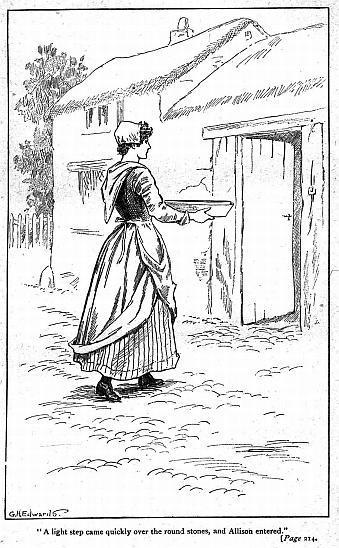
He did not wait long. A light step came quickly over the round stones of the causey, and Allison entered, carrying the great earthen milk-dishes in her arms. It was a dark little place, and she had set them safely down before she saw the intruder. Then she did not utter a word, but stood looking at him with all her heart in her eyes. John held out his hand and took hers in a firm clasp, and “like a fool,” as he told himself afterward, said that which it had never come into his mind to say until he saw her face.
“Allison,” said he, with his eyes on hers, “why did you not tell me that it was your brother for whom your heart was sore?”
Her look changed to one of wonder.
“Surely I told you it was my brother. Who else could it be but my Willie?”
She grew pale, and would have withdrawn her hand, but he held it fast.
“I did not see him, but I have good news for you. Your brother has been a free man for two months and more. It must have been that they repented of their hard sentence, and when the summer came again he wearied, and was like to fall sick, and they let him go home. The man I saw had only good words to say of him. After the first he was patient and quiet. It was hard on him at first.”
“My poor Willie!” said Allison.
“It seems that a friend went to see him in the early summer, a year ago, and he took heart after that and waited patiently.”
“That must have been Mr Hadden,” said Allison. “It was kind of him, and Willie would take hear when he heard that I had gotten safe away.”
“You have not heard from your brother since?”
“Oh! no. How could I hear? He does not even know where I am.”
“But you will write to him now?”
Allison’s face fell.
“I darena do it. No letter can reach him but may first pass through our enemy’s hand. He will be on the watch more than ever now. No, it will be ill waiting, but we can only wait.”
“Do you mean that you must wait till you see him in America?” said John wondering.
“Yes, that must be the way. He will go to Alexander Hadden, and I will find him there. Yes, it may be a long time,” and Allison’s eyes filled with tears. “But now that I have heard that he is free, and that it is well with him, I can wait. Oh! yes, I can wait.”
Allison held out her hand, and John knew it was time to go.
“I havena thanked you yet, but—”
“You have nothing to thank me for yet. If I only could do something for you!”
“You have done this. You have told me he is free and at his own home. I have all the summer days grudged myself the sweetness of the light and the air, because I thought of him sitting in the darkness. And he has had it all, and now he may be on the sea! It has happened well, and I take it for a sign that the Lord is on our side.”
“And you will not be troubled and anxious any more?”
“I will have hope now. And I thank you in my heart though I havena the words ready.”
And then John went away.
Allison sat in the kirk that day a happy woman. Every one there must have noticed the change in her looks, only she sat in the end of the seat near the door, and the little porch hid her from a good many of the folk, and the side of her big bonnet was mostly turned toward the rest. Little Marjorie saw her happy look, and raised herself up to ask her what she was thinking about that made her look so glad. Allison was thinking that her Willie might be sitting in the kirk at home listening to Dr Hadden’s kind, familiar voice, and that in the afternoon he might be walking over his own land with Uncle Sandy, to see the sheep and get the air of the hills. She bowed her head and whispered softly, “Whisht, my lammie”; but she “smiled with her een,” as Marjorie told her mother afterward, and the child was content.
Chapter Fourteen.
“Into the restful pause there came A voice of warning, or of blame, Which uttered a beloved name.”
More than once since she had first seen her, Mrs Esselmont had asked, “Who is Allison Bain?”
Mrs Hume had not much to tell her. Of her family and friends she knew absolutely nothing. Of Allison herself she knew only what she had seen since she became an inmate of the manse, except that she had been Dr Fleming’s patient in the infirmary, and afterward for a short time a nurse there. Dr Fleming probably knew more of her history than he had told to them.
“A good woman who had seen sorrow, he called her, and a good woman she is in every way, and a good servant, now that she seems to be growing content and cheerful. I own that she was a weight upon my mind at first. She is faithful, patient, true. Her only fault seems to be her reserve—if it can be called a fault to keep to herself what others have no right to ask her to disclose. She has greatly helped our Marjorie, and the child loves her dearly.”
“Yes, that is easily seen. As to her reserve, there are some troubles that can be best borne in silence,” said Mrs Esselmont. “And she has grown more cheerful of late.”
“Much more cheerful. She is always quiet, and sometimes troubled with anxious thoughts, as one can see, but there is a great change for the better since the spring. It is, of late, as though some heavy weight had been taken from her heart.”
In her lonely life, with little to interest her, either in her own home or in the neighbourhood, it was natural enough that the lady should give some thought to the strong, gentle, reticent, young woman, who seemed to her to be quite out of place as a servant in the manse. She would have greatly liked to win the girl’s confidence, so that she might be the better able to give her help and counsel if the time should come when she should acknowledge her need of them. Until that time came, she told herself, she could offer neither help nor counsel. It was not for her to seek to enter into the secret of another woman’s sorrow, since she knew from her own experience how vain are words, or even kindest deeds, to soothe the hurt of a sore and angry spirit.
“I might only fret the wound I fain would heal. And she is young and will forget in time whatever her trouble may be. And, when all is said, how can I think she is not in her right place, since she fills that place so well? God seems to be giving her the opportunity and the power to do for the child what has long seemed beyond hope, even to the mother, who is not one inclined to despond. I will not meddle in her concerns hastily, but oh! I would like if this Allison were ever in sore need of a friend, that she would come to me.”
It was astonishing to herself when she considered the matter, how many of the lady’s thoughts were given to this stranger.
“We are curious creatures,” she mused. “It is little to my own credit to say it, but I doubt if this Allison had been just a decent, plain lass like Kirstin, I might have been left to overlook her and her sorrows, though I might have helped her when I knew her need. I will bide my time, and when it comes I will do what I can for Allison Bain, whatever her need may be.”
Almost every week Marjorie spent a day at Firhill, and she was usually carried there, or home again, in the arms of Allison; but there could be no lingering there because of all that was to be done at home. Marjorie needed no one to stay with her. If it were “a garden day,” as she called it when it was fair and the wind blew softly, she was content to be quite alone for hours together. She could be trusted to walk no farther and make no greater exertion than was good for her.
In the house she had a book, or her doll, or the stocking she was knitting, to pass the time. In the garden she did not need these. She had the flowers first of all, the trees and the changing sky, the bees and the birds. The crows, which came and conversed together on the great firs beyond the wall, had much to say to her as well as to one another. She put their speech into words for her own pleasure, and looked with their eyes on the distant hilltops and into the valleys between, and saw what they saw there. A late laverock springing up now and then thrilled her with his song and set her singing also, or the cooing of the doves soothed her to peaceful slumber and happy dreams.
But there came a day when all did not go so well with the child. The sky was overcast and rain threatened; and Marjorie fretted and was “ill to do with,” while her mother hesitated as to the propriety of her going to Firhill. The coming of the pony carriage decided the matter, however, and the child went away, a little ashamed of herself, but never doubting that all would be as usual when she reached the garden.
But she did not have a happy day. The weather was warm and close, and as the afternoon wore on the sky darkened, so that it was gloomy even in the garden, and a sudden pang of homesickness smote the child when they carried her into the deeper gloom of the house. She struggled bravely against it for a while, telling herself how foolish she was, and how ungrateful Mrs Esselmont would think her if she were to cry, or even seem to wish to go home before the time.
Poor little girl! She was ill and uncomfortable, and did not know it. She thought herself only naughty and ungrateful; and when she could no longer keep back her tears, and in spite of a determination not to do so, cried out that she wanted her mother, she believed that the end of her happy days had come.
Into the confusion which all this caused, Allison came, earlier than usual, in the hope of getting the child home before the rain. At the sight of her, Marjorie’s tears flowed faster than ever, but not for long. Allison’s touch, and her firm and gentle words, soothed and quieted her. The broth which she had refused at dinner was brought her, and was eaten, and the worst was over.
But the rain was falling in torrents by this time, and while they waited, Marjorie fell asleep in Allison’s arms.
It had not been a very good day for Mrs Esselmont. She was not strong, the heat and gloom had depressed her, and she sighed now and then as she sat beside Allison and the child in the darkening room. Allison wondered whether she had any new sorrow to trouble her.
“She is nearly done with all sorrow now. She must be glad of that,” thought Allison.
“I hope they will not be anxious about you at home,” said Mrs Esselmont, speaking softly not to waken Marjorie.
“No, madam, I don’t think it. And Mrs Hume will be sure to send one of the lads with a lantern if the rain should keep on.”
“They know you are to be trusted with the child. You have done her much good, poor wee lammie.”
“She has done me much good,” said Allison.
“I am sure of it. In the way of kindness done, as in other ways, ‘It is more blessed to give than to receive.’ You are a good nurse, Allison.”
“I love the child. It is a great pleasure to do for her.”
“It is your love for her that makes you wise and firm in dealing with her. And you have been a sick-nurse, I hear.”
Mrs Esselmont was thinking of the time which Allison had passed in the infirmary, but Allison had for the moment forgotten that. Her thoughts had gone back to her home and her mother, who had needed her care so long.
“My mother was long ill, and there was no one but me to do for her. I learned to do many things to ease and help her first, and my father afterward.”
“Have they been long dead?” asked Mrs Esselmont gently.
“A long while it seems—but it is not so very long. There was little time between them, and all things seemed to come to an end when they were gone.”
Mrs Esselmont listened in wonder to the low, pathetic voice which told her this. Was this the girl who had never spoken of her past life in the hearing of any one—who had never named father or mother or home, except perhaps to little Marjorie? Mrs Esselmont was a wise woman. She would have liked well to hear more, but she asked no question to startle her into silence again. After a little she said:
“They were happy in having a loving daughter to close their eyes.” And she sighed, thinking of her own dearest daughter who was faraway.
Marjorie stirred in Allison’s arms, and there was no need to answer. By and by Jack came with the lantern, and it was time to go home.
After this, in their brief intercourse—during a few minutes in the garden, or by the parlour fire, while the child was being wrapped up to go home—Mrs Esselmont had many a quiet word with Marjorie’s faithful nurse and friend, and their friendship grew slowly but surely. Allison’s revelation of herself, and of her past life, was for the most part quite unconsciously made. Mrs Esselmont listened and made no comments; but in her own thoughts, when she “put this and that together,” she owned that not often in the course of a long life had she come into contact with one in whose character, strength and gentleness, firmness and patience, were more happily combined. Without being aware of it, she was beginning to regard this strong and silent young woman not as a mere maid-servant in the manse, who came and went, and worked for wages like the rest, but as one who, for reasons not to be revealed, had chosen, or had been forced by an untoward fate, to begin a new life in a sphere in which she had not been born. But much as she desired to know more about her, she waited for Allison herself to speak.
Summer passed all too quickly and the “dowie fall o’ the year” was drawing on. There was no more going through the lanes to follow or to flit the cows for Marjorie. The harvest was over, and the patient creatures had the range of all the narrow fields, and cripple Sandy had leisure to do his duty toward them without the help of any one. But whenever a bright day came, or even a gleam of sunshine when the day was dark, the child had still a turn in the lanes, or round the garden in Allison’s arms. All the days were busy days, but none of them were so full of work or care as to hinder Allison in this labour of love, which indeed was as good for herself as for Marjorie.
For there were times as the days began to grow dark and short when Allison needed all the help which her love for the child could give her to keep her thoughts from the cares and fears which pressed upon her. No word came from Willie, though she had written to Mr Hadden to tell him that her brother was free, and that she hoped he would soon be in America, and that he might safely write to her now.
It was time for a letter unless Willie had lingered longer at home than he had promised. Was he there still? or had any ill happened to him? She could wait with patience for the sight of him, even for years, if she could but be sure that he was safe and well. And she could only strive to wait with patience whether she heard or not.
She was saying something like this to herself as she sat in the silent house one night, when the kitchen-door opened and Saunners Crombie came in. The minister was not at home, and Mrs Hume, who was not very well, was up-stairs with her little daughter. All this Allison told him, and asked him to sit down, with no thought that he would do so, for few words had ever passed between them. He sat down, however, and leaned over the fire with his hands spread out, for “the nicht was cauld,” he said.
Allison brought dry peats and mended the fire, and then took to her stocking-mending again. It would not have been easy for her to begin a conversation with Crombie under any circumstances. It seemed impossible to do so now, for what could she say to him? Saunners had been in deep affliction. His wife was dead, and he had just returned from her burial in a distant parish, and it seemed to Allison that it would be presumption in her to utter a word of condolence, and worse still to speak about indifferent things.
She stole a glance at him now and then as she went on with her work. How old, and grey, and grim he looked! And how sad and solitary the little house at the edge of the moss must be, now that his wife was not there! His grey hair and his bowed head ’minded her of her father; and this man had no child to comfort him, as she had tried to comfort her father when her mother died. She was very sorry for him.
Her sympathy took a practical turn, and she rose suddenly and went out. The tea-kettle was singing on the hearth, and when she returned she went to the dresser and took the teapot down.
“Ye’re chilled and weary, and I am going to make you a cup of tea,” said she. Saunners looked up in surprise.
“There’s nae occasion. I’ll get my supper when I gae hame.”
He made a little pause before the word, as though it were not easy to say it.
“Ay, will ye. But that will be a while yet. And I must do as I am bidden. The mistress would have come down, but she’s no’ just very well the night, and is going to her bed. The minister may be in soon.”
So the tea was made and butter spread upon the bannocks, and then Allison made herself busy here and there about the kitchen and out of it, that he might have his tea in peace. When his meal was finished and the dishes put away, she sat down again, and another glance at the bowed head and the wrinkled, careworn face, gave her courage to say:
“I am sorry for your trouble.”
Saunners answered with a sigh.
“Ye must be worn out wi’ that lang road and your heavy heart.”
“Ay. It was far past gloaming o’ the second day ere I wore to the end o’ the journey. The langest twa days o’ a lang life they were to me. But it was her wish to be laid there wi’ her ain folk, and I bid to gie her that last pleasure. But it was a lang road to me and Girzzie, too, puir beast.”
“And had ye no friend to be with ye all that time?”
Saunners shook his head.
“Peter Gilchrist offered to go wi’ me. But he was ahind with his farm work, an’ I wasna needin’ him. Twa folk may shorten a lang day to ane anither, but it’s no ay done to edification. But the warst o’ a’ was coming hame to a forsaken hoose.”
The old man shivered at the remembrance and his grey head drooped lower.
“I’m sorry for your trouble,” repeated Allison. “It’s the forsaken home that at first seems the worst to bear.”
“Ay, do ye ken that? Weel, mine’s a forsaken hoose. She was but a feckless bodie, and no’ ay that easy to deal wi’, but she’s a sair miss in the hoose. And I hae but begun wi’t,” added Saunners with a sigh. Then there was a long silence. “It’s a bonny place yon, where I laid her down,” said he at last, as if he was going on with his own thoughts. “It’s a bonny spot on a hillside, lying weel to the sun, wi’ a brown burn at the foot. I got a glimpse over the wall of the manse garden. The minister’s an auld man, they say. I didna trouble him. He could hae dane nae gude either to her or to me. It’s a fine, quiet spot to rest in. I dinna wonder that my Eppie minded on it at last, and had a longing to lie there with her kin. It is a place weel filled—weel filled indeed.”
Allison’s work had fallen on her lap, and she sat with parted lips and eager eyes gazing at him as he went on.
“I saw the name o’ Bain on a fine new headstane there. An only son had put it up over his father and his mother, within a few months, they said. I took notice of it because o’ a man that came in and stood glowering at it as we were finishing our job. It was wi’ nae gude intent that he cam’, I doubt. He was ane that middled with maist things in the parish, they said. But I could hae proved that my Eppie belonged to the parish, and had a gude right to lie there wi’ her kin. We were near dane ere he took heed o’ us, and it was ower late to speak then. He only speired a question or twa, and then gaed awa’.”
Then there was a long pause. Saunners sat looking into the fire, sighing now and then, and clearing his throat as if he were ready to begin again. When he turned toward her, Allison took to her stocking-darning. She longed to ask him a question—but she dared not do it, even if she could have uttered the words. Saunners went on:
“I thocht it queer-like of the man, but I would hardly have heeded it but for that which followed. When his back was fairly turned there came a wee wifie out o’ the corner, where she had been watchin’, and shook her neive (fist) at him and ca’ed him ill names. It was like a curse upon him. And she bade him go hame to his fine house, where he would have to live his leefu’ lane a’ his days as a punishment for his wickedness. I had a few words with her after that. She was unco curious to hear about my Eppie, and how I came to lay her there. We gaed through among the stanes thegither, and she had plenty to say about ane and anither; and whiles she was sensible enough, and whiles I had my doubts about it. Many a strange thing she told me gin I could only mind.”
Then Saunners sat silent again, thinking. Allison turned her face away from the light.
Was the terrible old man saying all this with a purpose? Did he know more than he told, and did he mean it for a warning? For it must have been in the parish of Kilgower where he had laid down the body of his wife. And it must have been Brownrig whom the “wee bowed wifie” had cursed. She grew sick at the thought of what might be coming upon her; but she put force upon herself, and spoke quietly about other matters. Then the old man rose to go.
“I thocht maybe I might see John Beaton the nicht. Is he at hame, think ye?” Allison shook her head.
“I havena heard of his being here, but he may have come for all that.”
“Ye would be likely to ken,” said Saunners, and then he went away.
Allison listened till the sound of his footsteps died in the distance, then she rose and did what was still to be done in the house. She barred the door, and covered the fire, and put out the lights, and went softly up-stairs to the little room where Marjorie slumbered peacefully. Then she sat down to think of all that she had heard.
It was not much. Crombie had seen two names on a headstone in the kirkyard of Kilgower. That they were the names of her father and mother she did not doubt. She had been greatly startled by all she had heard, but she had not betrayed herself; and after all, had she not more cause to be glad and thankful than to be afraid? Willie had put up that stone! Was not that enough to make it sure that he had been at home, and that all had been well with him? He might be at home yet, on his own land. Or he might be on the sea—on his way to a new country which was to give a home to them both. Glad tears came to Allison’s eyes as she knelt down and laid her face on Marjorie’s pillow.
“I am glad and thankful,” she said, “and I will not vex myself thinking about what the old man said. It might just be by chance that he spoke with no thought about me, except that the name was the same. I will be thankful and have patience and wait. I am sure he would not wish to harm me. Only if he were to speak of all that in the hearing of other folk it might end in my having to go away again.”
But the thought of having to go away did not seem so terrible to her as it would have done a few months ago. Her courage had risen since then. She had “come to herself,” and she was reasonable both in her fears and her hopes, and so she repeated, as she laid her head on her pillow:
“I will be thankful and have patience and wait. And I will put my trust in God.”
Chapter Fifteen.
“She courtsied low, she spoke him fair, She sent him on his way; She said as she stood smiling there, You’ve wealth, and wiles, and wisdom rare, But I have won the day.”
Crombie did not leave the manse with an easy mind, and the more he thought of what he had said, and what he had not said there, the more uneasy he became. He was in a quandary, he told himself, putting the accent on the last “a.” To his surprise and consternation he found himself in doubt as to the course he ought to pursue.
He had gone to the manse with the full intention of asking the minister’s lass whether she were the wife of the man whom he had seen “glowering at the new headstane” in the kirkyard of Kilgower, and of putting it to her conscience whether she was not breaking the laws of God and man by keeping herself hidden out of his way.
But he had not asked her. He could not do it. He had come away without a word, and now he was saying to himself that the man who through soft-heartedness, or through the influence of carnal affection, suffered sin in another, thus being unfaithful to a sinful soul in danger, was himself a sinner. He ought to have spoken, he told himself. He could not be called upon to tell the story to another, but to Allison herself he should have spoken. If her conscience needed to be wakened, he sinned against her in keeping silence. It might have been to prepare him for this very work that he had been sent to lay his Eppie down in that faraway kirkyard.
Saunners stood still on the hillside when he got thus far. Ought he to go back again? He could not be sure. The thought of the first glimpse he had got that night of Allison sitting quiet and busy with her work, with a look of growing content upon her face that had once been so gloomy and sad, came back to him, and he moved on again.
“I’ll sleep on it,” said he, “and I’ll seek counsel.”
It was a wise resolution to which to come. Saunners was a good man, though, perhaps, he did not always do full honour to his Master or to himself in the sight of those who were looking on. He was “dour, and sour, and ill to bide,” it was said of him, even by some among his friends.
But there was this also to be said of Saunners. It was only when a life of struggle and disappointment and hard, wearing work was more than half over, that he had come to see the “True Light,” and to find the help of the Burden-Bearer. A man may forsake the sins of his youth and learn to hate the things which he loved before, and to love the things which he hated, and in his heart long, and in his life strive, to follow the Perfect Example in all things. But the temper which has been indulged for half a lifetime cannot be easily and always overcome, and habits which have grown through the years cannot be cast aside and put out of sight in a moment, like an ill-fitting garment which will never trouble more. Life was, in a way, a struggle to Saunners still.
But though he lost his temper sometimes and seemed to those who were too ready to judge him to fail in the putting on of that Charity which “thinketh no evil” and which is “the bond of perfectness,” he was still a good man, honest, conscientious, just, and he could never willingly have sought to harm or to alarm any helpless or suffering creature. But then neither would his conscience let him consent to suffer sin in one whom he might, through faithful dealing, save from loss and ruin, and whom he might bring back to the right way again.
“She doesna look like a sinfu’ woman,” he thought, recalling the glimpse he had got through the open door, of Allison sitting at peace and safe from harm. “She is like a woman who has seen sorrow, and who is winning through wi’t. And yon man had an evil look.
“And after a’, what hae I to go upon? A name on a headstane in a farawa’ kirkyard! A’ the rest came frae the wee wud wifie (the little mad woman), who micht have made up the story, or only believed it true because o’ the ill-will she bore to yon dark, angry-lookin’ man. And even if the story be true, what call have I to mak’ or meddle in it?
“No’ an ill word that ever I hae heard has been spoken of the lass since she came to the manse. She’s at peace, and she’s doing the duty that seems to be given her to do, and—I’ll bide a wee and seek counsel. And after a’, what hae I to go upon?” repeated Saunners.
But there was plenty to go upon, as he knew well, if he had only been sure that it would be wise to do anything, or meddle at all in the matter. He had only spoken a word to Allison; but the wee wifie, while they sat together on a fallen gravestone, had told him, not the whole story—she was hardly capable of doing that—but all of it that she had seen with her own eyes.
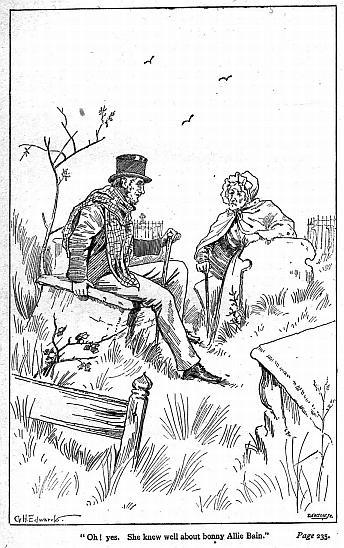
Oh! yes. She knew well about bonny Allie Bain. She was in the kirk when she was married—“sair against her will. It was like a muckle black corbie carrying off a cushat doo. But the cushat got free for a’ that,” said the wee wifie, with nods and smiles and shrill laughter.
But she said nothing of the brother’s part in that which followed, though she told with glee how Brownrig had gotten his deserts before all was done, and how the bride went one way and the bridegroom went another, “carried hame wi’ sair banes in his gig.” She told how first Allison’s mother, and then her father, were put in the grave, where they both lay with the new stone at their heads, and how “bonny Allie” had come to say farewell to them there. She grew eager and eloquent when she came to her own part in the story.
“I was here mysel’, as I am maist days, for it’s a bonny place and halesome, though ye mightna think it here among the dead folk. I like to hae a crack with them that’s been awa’ for mony a year and day. My mother lies ower in yon nook, and the man I should hae marriet. My father and my brother were lost at sea.
“Oh! ay—and about bonny Allie. Weel, she lay down wi’ her face upon the sod, and lay lang there, and when she lifted it again it was white as the snaw, but there wasna a tear upon it. Then there came the bark o’ a dog that I kenned weel. He was sent after me once, though Brownrig denies it. So I made free to go in by; and says I, ‘Miss Allie dear, I hear the bark o’ the black dog, Worry, and I doubt his maister’s nae farawa’.’
“She was speakin’ ower the wa’ to the minister’s son by that time, and after a minute or twa she came awa’, put her face down on the grave again, and then she followed me. And when we came near to the foot o’ the brae, I garred (made) her take off her hose and shoon, and wade doon the burn a bittie that the dog mightna follow the scent, and I laid doon peats that she might step on them a bit o’ the way between the burn and my ain door.
“When she came in she sat still like ane dazed and spent, and never a word spake she. But I stirred up the fire and boiled the kettle, and said I:—
“‘Did ye break your fast afore ye came awa’?’
“‘There wasna time,’ said she.
“‘And ye had nae heart for your supper yestreen, and ye forgot ye’re denner, and nae wonder. But if ye’re thinkin’ o’ winning awa’ to Aberdeen this day, or even the morn, ye’ll need to tak’ something to make ye strong for the journey.’
“So she ate her bread and drank her tea, and then she lay down in my bed and sleepit the hale day. I was unsettled mysel’ that day, and I thocht I would gang up the brae to the Meikles and get some buttermilk that the mistress had promised me. So I darkened the window and locket my door. But I didna leave my key in the thecking (thatch) as I do whiles, in case any o’ the neebors micht send a bairn wi’ a sup o’ milk, or a bit from a new cut cheese. It’s weel to gie them a chance to open the door.”