ALFRED AS A WRITER
Reading edition
By Rev. Professor Earle
ALFRED AS A WRITER

Our estimate of the literary achievements of King Alfred will depend very much upon what we are in the habit of thinking about his early education. If we are content to accept the story in Asser, that he had reached his twelfth year before he had learned to read, then we must reckon his literary career as a prodigy, a phenomenon which defies explanation. Or, if that will not satisfy us, we may liken him to his grandfather’s contemporary the great Charles, who, being illiterate, knew the value of learning, and surrounded himself with learned men. On this theory it would follow that the writings of King Alfred are his only in that sense in which all works and monuments are said to belong to the king who has ordered them and paid for them. He who refuses to be satisfied with either of these alternatives can hardly fail to question the story about Alfred and the picture-book.
The Saxon Chronicle says that Alfred was sent to Rome in the year 853, at which time he was a little boy. This statement naturally suggests that he was sent to reside at the English College in Rome for the benefit of his education. But this is blurred in Asser by the further statement that he went to Rome a second time in the very next year; which has the effect of reducing his travels to mere excursions. The second journey to Rome is not in the Chronicle, and it looks rather like an artifice, designed to parry the natural inference that the journey to Rome was for a prolonged and educational residence. Perhaps the author of “Asser’s Life” was minded to make his hero a prodigy, and to this end the picture-book story must by all means be protected and maintained. These variations had the effect of shaking the credibility of the narrative, and raising doubts as to whether Alfred ever went to Rome at all. The statement in the Chronicle got involved in that cloud of unreality which overshadows so much of Alfred’s history.
Happily this particular point is now quite cleared up. A letter has been discovered, written by Leo IV., the reigning Pope in the year 853, and addressed to King Æthelwulf, the father of Alfred, announcing the safe arrival of the boy. This discovery has added a new confirmation to the Chronicle, and has established it once for all as a firm historical fact, that Alfred was sent to Rome in the year 853. If now we interpret this step in the most natural manner, as designed by his father to send the child out of the way in dangerous times, and to occupy his tender years with liberal studies, we find the course of Alfred’s literary development well and reasonably accounted for. Indeed, it seems in every way most probable that Alfred enjoyed the best opportunities for study that the times afforded, and that he used them so far as was compatible with the vocation of a warrior. How many years he spent in Rome is not known; in the reign of Æthered he was at home and he made a conspicuous military figure while yet in his teens, and this seems to indicate that he had never in his book-learning forgotten that he would have to fight for his country against the northern invaders.
The first seven years of his own reign (871-878) were years of deadly struggle. In 877 his cause seemed to be lost, but in 878 the King of Wessex was victorious. He made peace with the conquered Danes, and their king, Guthrum, was baptized. And now he had to guide in peace the nation which he had guided in war. He had to reconstruct the social and political fabric which had been shattered by the devastations and panics of three generations. In all his reconstruction there is manifested a purpose not only of restoration, but also of improvement and reform. This is conspicuous in his revision of the West Saxon Laws. The Law-book then in use was that of King Ina (688-726). When Alfred’s code was published, that of Ina was not abolished, but it was re-edited in the same volume, after the manner of an appendix to Alfred’s Laws. That a new departure was purposed is indicated by the new feature of a Prologue composed of the Decalogue and kindred selections from Scripture. This is to be understood partly as a consecration of the new Law-book; but further, as the inauguration of a new principle, namely, that laws are founded in right reason and have their highest sanction in religion. Before Alfred’s time laws had rested upon tradition, deriving their force from the fact that they were ancestral, or if reasoned at all were based upon a stunted and barbaric type of reasoning. We happen to have an extant example in which we can compare a law of Ina’s with Alfred’s reform of it. In the case of damage to a wood, the old law drew a distinction between injury by fire and injury by the axe, and that by fire was punished far more heavily than the other, for this assigned reason—that fire is a thief and works silently, whereas the axe announces itself.
“In case any one burn a tree in a wood, and it come to light who did it, let him pay the full penalty, let him give sixty shillings, because fire is a thief. If one fell in a wood ever so many trees, and it be found out afterwards, let him pay for three trees, each with thirty shillings. He is not required to pay for more of them, however many they might be, because the axe is a reporter and not a thief (forðon seo æsc biþ melda, nalles ðeof).”
This contrast could be retorted: for it might be urged that if fire is a thief relatively to the owner of the wood, so is it also relatively to the defendant, for it had started up afresh when he had left the place thinking that all was safe. The worst that could be proved upon him was the want of sufficient caution. In fact, the law is only good as against arson, wanton or malicious; and for that case it is not severe enough. It may be assumed that in the bulk of cases damage by fire would be undesigned and accidental.
But where the axe is used there can be no doubt about the motive. The man who fells another man’s timber does so plainly with intent to steal, and the noise of the axe is not extenuating but rather aggravating by reason of its audacity.
In Ina’s law all such considerations were prevented by two venerable maxims which said, “Fire is a thief, but the axe is outspoken.” Jacob Grimm, in his Antiquities of Law, produced some parallels from old German codes, but he gave the palm to this of ours for its poetic tinge. Moreover, as an indication of the national instinct which is favourable to whatever is open and straightforward, it may be interesting; but the distinction was bad as law, and it was abolished by King Alfred. His new law equalised the penalty thus: “If a man burn or hew another man’s wood without leave, let him pay for every great tree with five shillings, and afterwards for each, let there be ever so many, with five pence;—and a fine of thirty shillings.”
The closing words of the king’s Prologue are as follows:—
“I, Alfred the King, gathered these (laws) together and ordered many to be written which our forefathers held, such as I approved, and many which I approved not I rejected, and had other ordinances enacted with the counsel of my Witan; for I dared not venture to set much of my own upon the statute-book, for I knew not what might be approved by those who should come after us. But such ordinances as I found, either in the time of my kinsman Ina, or of Offa, King of the Mercians, or of Ethelberht, who first received baptism in England—such as seemed to me rightest I have collected here, and the rest I have let drop.
“I, then, Alfred, King of the West Saxons, showed these laws to all my Witan, and they then said that they all approved of them as proper to be holden.”
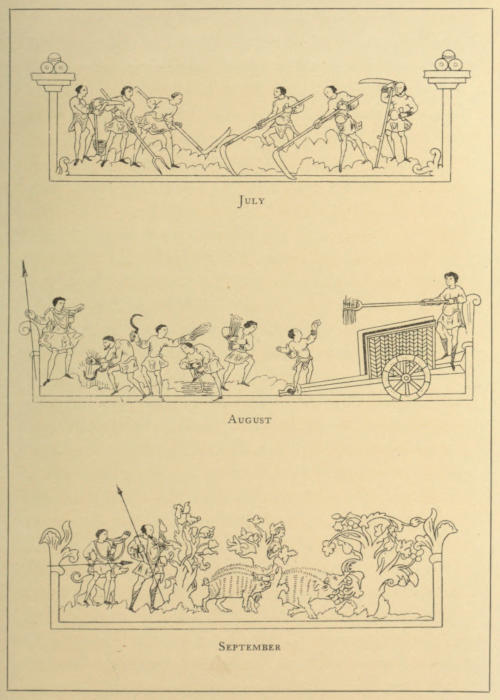
THE SEASONS—JULY TO SEPTEMBER
(Cottonian Library)
The same spirit of improvement and vigorous initiative is manifested in his famous translations. Either by his own knowledge or by the good advice which he knew how to obtain and appreciate, he selected from the books then accessible those which were calculated to be most generally useful to his people. The chief books were five, the productions of four authors: one by Orosius, written about A.D. 412; one by Boethius, of about A.D. 522; two by Gregory the Great, written towards A.D. 600; and one by the Venerable Bede, which was brought to a close in the year 731. It may be useful to add a few particulars about each of the works which appear to have constituted the select library of King Alfred.
Orosius was a young priest who came out of Spain into Africa to visit Augustine, Bishop of Hippo, at the time when that Father of the Latin Church was writing his greatest work, which he entitled the City of God. The occasion for this work arose out of the sack of Rome by Alaric the Goth in the year 410. A great outcry was made by the pagans against Christianity, as if it had been the cause of calamities which they attributed to the displeasure of the ancient gods for their neglected altars. In his City of God, which was conceived as an answer to this charge, Augustine constructed his argument upon a broad view of human history, urging that events must not be interpreted in an isolated manner, but must be taken with their connection and sequence; and then we shall discern signs of a great providential purpose guiding mankind in a progressive course of amelioration. The old dispensation prepared men for a fuller revelation, and the spread of Christianity has brought manifest improvement in the condition of human life. The heathen empires of the world, as Babylon in the East and Rome in the West, have been active though unconscious factors in this vast and beneficent process. The book is in fact a philosophy of history, with the Gospel for its pivot, and all events subordinated to this master principle. The thesis is developed with an extraordinary wealth of reasoning and illustration. To make this great argument the more complete, Orosius undertook, at Augustine’s request, to write a compendium of general history in the same spirit, and accordingly he loses no opportunity of showing up the calamities of the old heathen times, and indicating the tendency of Christianity to mitigate the horrors of war. This book of Orosius became the recognised manual of general history down to the sixteenth century.
The Consolation of Philosophy by Boethius was the chief if not the sole representative of the philosophy, the ethics, and the religious aspirations of the ancients during the Dark and early Middle Ages. The author is thus introduced by Gibbon: “The senator Boethius is the last of the Romans whom Cato or Tully could have acknowledged for their countryman.” Suspected by Theodoric, the Gothic King of Italy, of the crime of Roman patriotism, he was cast into prison, and a sentence of confiscation and death was pronounced against him, while he was denied the means of making his defence. Chained and in view of death he composed the Consolation of Philosophy, of which Gibbon says: “A golden volume, not unworthy of the leisure of Plato or Tully, but which claims incomparable merit from the barbarism of the times and the situation of the author.”[26]
Gregory the Great, who in A.D. 597 sent Augustine with his missionary band to the King of Kent, is a name which through the whole extent of Anglo-Saxon literature is mentioned with a peculiar veneration. From his writings the king took two books to be included in his library of English translations. The first was his Pastoral Care (Cura Pastoralis), a guide-book for the use of the priest, to instruct the consciences of those who come to him for spiritual counsel; and as it is the first, so it may safely be pronounced the best of all manuals of the kind. Gregory’s ideal is a world governed by conscience, and the spirit of the Cura Pastoralis would transform all men into worthy citizens of such a polity.
The other book of Gregory’s which Alfred took was of a different kind. The Dialogues are stories of a sensational or even grotesque character, with a religious moral. They are calculated for a childish level of intelligence, and were designed to compete with the degrading tales which were the entertainment of barbarian circles. This book, which enjoyed the highest popularity for centuries, and was among the earliest books to be printed, is now entirely neglected, and Alfred’s translation has not yet been edited.
Bede was born in the neighbourhood of Wearmouth in 672. In his seventh year he entered the abbey recently founded there by Benedict Biscop, who was the first abbot. In that and the sister house of Jarrow he continued to his death in 735. He wrote Historia Ecclesiastica Gentis Anglorum, the History of the Conversion of the Angles and Saxons and of their Earliest Ecclesiastical Institutions. No other national church possesses a history of equal merit.[27] This was the youngest book on Alfred’s list, and as Orosius was, what Pauli calls it,[28] a Chronicle of the World, so this was a History of England.
I have thus endeavoured to give some idea of the books chosen by Alfred, as regards their rank and place in general literature. Our next step is to consider how Alfred dealt with these books and what he made of them. In his mind the translator’s function was not to reproduce an ancient author, but to produce a useful work. How he treated Orosius may readily be seen by any one who will examine the latest edition of the translation, that by Dr. Sweet (Early English Text Society). He hit upon the admirable plan of printing opposite the translation the corresponding portions of the Latin text, using italics for such parts of the original as are not literally translated. How great was the freedom of adaptation is promptly seen by the swarms of italics with which the Latin pages are bespangled. Besides these adaptations there are substantial additions in the shape of original contributions by King Alfred to the knowledge of European geography. First there is a map-like description of the nations of Central and Northern Europe, which are comprised under the name of Germania. The author begins with a sketch of his area: by east and west, from the Don to the sea about Britain; by north and south, from the Danube and Euxine to the White Sea. Coming to details, he starts with the East Franks (whose land-mark and memorial now lives in Frankfort), and with these East Franks for a centre he gives the relative positions of Swabians, Bavarians, Bohemians, and Thuringians, to the north of whom lie the Old Saxons, who are bounded on the west by Elbe-mouth and Friesland. From this point the Old Saxons become the pivot of the description.
This new piece of geographical literature is followed by two narratives of northern voyagers: Oht-here, who had explored the coast of Norway from where is now Christiania to far round the North Cape; and Wulfstan, who explored the southern coasts of the Baltic, and describes the strange customs of the Esthonians.
These three pieces taken together constitute one homologous group of ninth-century geography, which fully justifies Reinhold Pauli’s estimate, that the “Germania” of Alfred is more extensive and better defined than the “Germania” of Tacitus.
Besides this large insertion there are several smaller ones in the course of the work, and these may easily be found by observing where blanks occur on the Latin page of Dr. Sweet’s edition. Where Orosius tells how M. Fabius refused a Triumph when it was offered to him by the Senate, the translator inserts two paragraphs, one describing a Roman Triumph, and the other relating the origin and functions of the Roman Senate. In Cæsar’s invasion of Britain, where Orosius tells how he reached the river Thames, which (says he) is fordable in one place only; the translator adds that the ford is now called Wallingford. In such occasional insertions we see the beginnings of that vast apparatus of modern learning which is now relegated to footnotes or to separate books of reference.
The conditions under which Boethius produced that unique work The Consolation of Philosophy may have tended to give the book a special attraction for the mind of the trouble-tossed king. He certainly seems to have made great use of the book as a text for his own reflections and meditations. “For although King Alfred professed to translate the work of Boethius, yet he inserted in various parts many of his own thoughts and feelings,” etc. These are the words of one who up to the moment of writing was the latest editor of Alfred’s Boethius;[29] but now he must share the ground with Mr. Sedgefield, whose new and greatly improved text has just issued from the Clarendon Press. On Alfred’s manner of dealing with his originals Mr. Sedgefield says: “Even in his most faithful translation, that of the Cura Pastoralis, King Alfred is by no means what in these days would be called literal; while in his Boethius it is the exception to find a passage of even a few lines rendered word for word.” And, we may add, it is precisely this free handling which gives to the king’s translations their personal interest, and nowhere is this peculiar attraction so strongly felt as in his adaptation of Boethius.
German research has somewhat modified the inference which ascribed to Alfred everything in his version which is not found in the text. Old Latin commentaries and scholia upon the De Consolatione have been discovered in continental libraries, which contain similar expansions, especially those in the direction of Christian doctrine. This discovery enlarges the literary interest, with small detraction from the work of the king. His glory is not of a kind to rise and fall by little gradations of more or less. The suggestions supplied by these commentaries are in their nature very obvious. For, as was observed by Mr. Stewart, the most casual reader of Boethius cannot fail to be struck with the strong theism which breathes through his pages, and invites the touch of paraphrase to give it the full Christian sound, as when the city of Truth, from which Boethius represents himself as exiled, becomes under the translator’s hand the heavenly Jerusalem; a thought which is expressed in the recently discovered scholia. But in Lib. ii. metr. 4, where the translator brings in the striking sentence, “Christ dwelleth in the vale of Humility and at the monumental stone of Wisdom,” the old Latin annotator contributes only this—“The stone is Christ.” Of the famous simile which likens the world to an egg, there is this much found in the scholia—“That the sky and the earth and the sea are in configuration like an egg.” See how this is developed by the poet:[30]—
Ðu gestaðoladest þurh þa strongan meaht, weroda wuldor cyning, wunderlice eorðan swa fæste þæt hio on ænige healfe ne heldeð, ne mæg hio hider ne þider sigan þe swiðor þe hio symle dyde. Hwæt hi þeah eorðlices auht ne haldeð, is þeah efn eþe up and of dune to feallanne foldan þisse: þæm anlicost þe on æge bið gioleca on middan, glideð hwæþre æg ymbutan. Swa stent eall weoruld stille on tille, streamas ymbutan, lagufloda gelac, lyfte and tungla, and sio scire scell scriðeð ymbutan dogora gehwilce; dyde lange swa.
Thou didst establish through strong might, glorious king of hosts, wonderfully the earth so fast that she on any side heeleth not, nor can hither or thither any more decline than she ever did. Lo nothing earthly at all sustains her, it is equally easy upwards and downwards that there should be a fall of this earth: likest in fashion to how in an egg middlemost is the yolk, and withal gliding free the egg round about. So standeth the world still in its place, while streaming around, water-floods play, welkin and stars, and the shining shell circleth about day by day now as it did long ago.
Book iii. metre 9; p. 182, ed. Sedgefield.
This simile occurs only in the poetical version of the Metres, for there are two versions, one in prose and another in verse, and it is agreed that the versification has been done after and from the prose; but there is a question (into which we cannot now enter) whether Alfred is the author of both, or only of the prose version.
But before we quit Alfred’s Boethius, we must notice his treatment of Lib. ii. prosa 7, where we may discover something more than free handling. In the first three lines of that section he found a profession of disinterestedness which he could honestly appropriate to himself. The Latin speaks thus: “Thou knowest, said I, that I was never governed by the ambition of transitory wealth. But material for action I did covet, that my talents might not rust in idleness.” Upon these lines for a text the king made his chapter xvii., in which it is evident that he forgets Boethius and speaks for himself and of himself throughout. Applying his author’s words to himself, he expands them into a veritable apology, explaining why a king needs a great revenue, and ending thus: “I resolved to live honourably as long as I lived, and after my time to leave to the men who should come after me my memorial in good works.”
Now we come to the translation of the Cura Pastoralis, a work of high and manifold interest.[31] A copy of it was sent to every bishop in England. The very copy which was addressed to Werferth, Bishop of Worcester, is still in our possession. It is preserved in the Bodleian Library, and may be seen under glass by every visitor. This wonderful relic, like the Alfred Jewel, seems to bring us into personal contact with the great king himself.
In Alfred’s Epistle to the bishops, which forms his Preface to the Pastoralis, the mind of the king is laid open in a very remarkable manner. Among the many precious evidences which time has spared for the perpetuation of a noble memory, the first place must certainly (on the whole) be accorded to this Preface. It exhibits in the clearest light the reflections of the king upon the past and present condition of his country, his deep sense of the vast losses that had been sustained, his meditation on the means of repair at his command, and the direction of his thoughts to that which is the only root of effective reform, an enlightened and instructed national conscience. In his contemplation of this vital principle, he perceives the value of religious education, and the necessity of beginning there. At this point his discourse enters more into detail, the practical drift of which is, that the Latin schools being lost, and being (for the present at least) irreplaceable, it will be necessary to institute a system of education through the medium of the English language. Some scholars thought that education could only be properly conducted through Latin, and that the vernacular would lower its dignity and value. They could not wholly approve of the method of translations. Here Alfred had nearly the same battle to fight as Jerome fought before him, and in his apology he drew materials from Jerome’s store, adding the further inference that if Scripture might be had in the vulgar tongue, why not other good books?
Children (he thought) should be taught to read English, and this elementary stage of education should be common to all of free birth. For the sons of those who could afford to prolong the education of their children, Latin studies should follow, and such boys should be trained for the higher offices. Here the English basis of education is propounded as a course which was dictated by necessity; but if ever it should be demonstrated that this course is absolutely the best, the credit of having been the first to open the right path must not on that account be denied to King Alfred. In the good old times, Wessex had been far behind Northumbria in the culture of the classics, but this had led to a fuller development of the vernacular, and Alfred found his mother tongue not inadequate to the occasion, and large specimens of Latin literature were rendered in West Saxon, and thus it happened that the dialect of Wessex became to the after literature of England what the Attic dialect was to the literature of Greece.
The king’s letter to the bishops begins thus:—
ÐEOS BÔC SCEAL TO WIOGORA CEASTRE
This Book is to go to Worcester
Alfred, king, commandeth to greet Wærferth, bishop, with his words in loving and friendly wise: and I would have you informed that it has often come into my remembrance, what wise men there formerly were among the Angle race, both of the sacred orders and the secular; and how happy times those were throughout the Angle race; and how the kings who had the government of the folk in those days obeyed God and His messengers; and they on the one hand maintained their peace and their customs and their authority within their borders, while at the same time they spread their territory outwards; and how it then went well with them both in war and in wisdom; and likewise the sacred orders, how earnest they were, as well about teaching as about learning, and about all the services that they owed to God; and how people from abroad came to this land for wisdom and instruction; and how we now should have to get them abroad if we were going to have them. So clean was it fallen away in the Angle race, that there were very few on this side Humber who would know how to render their services in English, or just read off an epistle out of Latin into English; and I wean that not many would be on the other side Humber. So few of them were there that I cannot think of so much as a single one south of Thames when I took to the realm. God Almighty be thanked that we have now any teachers in office.
Moreover, the king called also to mind what he had himself seen in his early days, before all the harryings and burnings of recent times: how the churches of England had been well stored with books, and the clergy were numerous, but they had profited little by the books, because they could not understand them, as they were not written in their own language. At this point his eloquence rises to a dramatic pitch, and “It is,” he breaks out, “as if they had said: ‘Our ancestors, who were the masters of these sacred places, they loved wisdom, and by means of it they acquired wealth and left it to us. Here may yet be seen their traces, but we are not able to walk in their steps, forasmuch as we have now lost both the wealth and the wisdom, because we were not willing to bend our minds to that pursuit.’” Remembering all this, he had marvelled very exceedingly at those good scholars who were once so frequent in England, men who had completely mastered the Latin books, that they had not been willing to translate any part of them into their own language. But he soon answered himself and said, that they never could have anticipated the present utter decay, and it was their very zeal for learning which caused them to abstain from translating, because they thought that the path of education and knowledge lay through the study of languages.
Then I remembered how the law of Moses was first known in Hebrew; and later, when the Greeks had learned it, they translated it into their own language, and all other books too. And later still the Latin people in the same manner, they by means of wise interpreters, translated all the books into their own speech. And so also did all the other Christian nations translate some portion of the books into their own speech.
Therefore to me it seemeth better, if it seemeth so to you, that we also some books, those that most needful are for all men to be acquainted with, that we turn those into the speech which we all can understand, and that ye do as we very easily may with God’s help, if we have the requisite peace, that all the youth which now is in England of free men, of those who have the means to be able to go in for it, be set to learning, while they are fit for no other business, until such time as they can thoroughly read English writing: afterwards further instruction may be given in the Latin language to such as are intended for a more advanced education, and are to be prepared for higher office. As I then reflected how the teaching of the Latin language had recently decayed throughout this people of the Angles, and yet many could read English writing, then began I among other various and manifold businesses of this kingdom to turn into English the book that is called Pastoralis in Latin, and Hierdebóc (Shepherding-Book) in English, sometimes word for word, sometimes sense for sense, just as I learned it of Plegmund my archbishop, and of Asser my bishop, and of Grimbald my priest, and of John my priest. After I had learned it so that I understood it and could render it with fullest meaning, I translated it into English; and to each see in my kingdom I will send one; and on each there is an “æstel” (ón ælcre bið án æstel), which is of the value of 50 mancuses. And I command in the name of God that no man remove the “æstel” from the book, nor the book from the minster. No one knows how long such learned bishops may be there, as now, thank God! there are in several places; and therefore I would that they (the books) should always be at the place; unless the bishop should wish to have it with him, or it should be anywhere on loan, or any one should be writing another copy.
It has never been satisfactorily decided what kind of object is meant by the “æstel” which accompanied every one of the presentation copies of the Hierdebóc. Dr. Sweet translates thus: “And on each there is a clasp worth fifty mancus. And I command in God’s name that no man take the clasp from the book, or the book from the minster.” Dr. Bosworth, in his Dictionary, explained æstel as a writing-tablet, and identified the word with “astula” in Du Cange. Now it is not easy to see the propriety of combining so personal a thing as a note-book with a volume designed for common use. Nor could such an object be a fixture upon the great book, which is what the king’s phrase (ón ælcre bið) seems to require. On the other hand, Dr. Sweet’s clasp is indeed a fixture, but of such a kind as to be a part of the book itself which could not be removed without wilful mutilation, and it does not appear that the king in his injunction is apprehensive of so flagrant an outrage as that.
My own impression is that the clue to the interpretation is furnished by a Glossary of the eleventh century, which gives “indicatorium” as the equivalent of æstel (Wright-Wülker, i. 327). I imagine a marker either of metal or of wood with metal fittings, so constructed as to be fixed upon the binding, and to bring a small plank across the page wherever desired. This would keep the parchment flat when apt to buckle, would mark the reader’s or transcriber’s place, and would minimise the risk of injury by fingering. It would be attached to one of the boards only in a movable way, perhaps with a screw, and consequently would require a strict and imperative rule to secure it from misplacement. The derivation might well be from “astula” (= assula).
This great epistolary Preface is followed by a second, of another theme and another type. The first is conceived in the statesmanlike spirit of a king who is meditating of civil order and education in a country that has almost lapsed into barbarism. The second is the utterance of the literary artist concerning the book he has translated, the author and his merits, and the weight of his authority, not disregarding the history and transmission of the very codex over which he has been at work. The first of these prefaces is in strong and ragged prose; the second is in heroic verse, which recalls the tradition that Alfred was fond of the old songs of his native land.
Þis ærendgewrit Agustinus ofer sealtne sæ suðan brohte ieg-buendum, swa hit ær fore adihtode drihtnes cempa Rome papa. Ryhtspell monig 5 Gregorius gleawmod gind wód ðurh sefan snythro searoðonca hord. Forðæm he monncynnes mæst gestriende rodra wearde, Romwara betest, monna módwelegost, mærðum gefrægost. 10 Siððan min on Englisc Ælfred kyning awende worda gehwelc, and me his writerum sende suð and norð; heht him swelcra má brengan bi ðære bisene, ðæt he his biscepum sendan meahte forðæm hi his sume ðorften, 15 ða ðe Lædenspræce læste cuðon.
I append an alliterative translation, which runs almost line for line:—
This epistle Augustine over salt sea brought from the south to us island-dwellers, just as it erst indited had been by Christ’s doughty soldier the Roman pontiff. Much right discourse 5. did Gregory of glowing wit give forth apace with skilful soul, a hoard of studious thought. He of mankind converted the most to the Ruler of heaven: he of Romans the best, of men the most learned and widest admired. 10. At length into English, Alfred the King wended[32] my every word: and me to his writers south and north sent out; more copies of such he bade them bring back, that he to his bishops might send, for some of them needed it, 15. those who with Latin speech had least acquaintance.
A few notes may be useful here. In the first line the expression “This epistle” applies to the entire work, because it is addressed by Gregory to John, Bishop of Ravenna, and opens with a dedication in epistolary form.
The poet has a warm feeling for the very manuscript he has been bending over, which he venerates as a sacred relic, because it was one of the books which were brought to this island by Augustine, Gregory’s chosen missionary.
In lines 8-10 is there not a reminiscence of the closing lines of the Beowulf?
At verse 11 there is an abrupt transition, and the after part is in an altered manner. The book itself becomes the speaker, and in the diction we recognise the manner of him who dictated to his goldsmith the now famous legend:
ÆLFRED MEC HEHT GEWYRCAN.
In line 12 we should particularly note the assertion which is couched in the words “awende worda gehwelc,” a marked and idiomatic phrase which may be represented in Latin thus: “vertit verborum quodque,” i.e. translated every word. This does not point to any rule or restriction in the manner of rendering, as if the translator had tasked himself to a verbal fidelity, for in his first preface, speaking of this very work, he had plainly said that he had sometimes rendered word by word and sometimes sense for sense (hwilum word be worde, hwilum andgit of andgite). But what he meant to say was this, that whereas in his other translations he had used his originals as passive material to be wrought upon and converted as his own design and purpose guided him, he had treated Gregory’s Pastoral Care as he would treat Scripture, wherein nothing could be added nor taken away.
To conclude the subject of Alfred’s Gregory’s Pastoral Care, let it be noted, that not only is it one of the books which are said to have been translated by the king, but the statement is made by himself speaking in the first person, and with a singular circumstantiality, and that besides this the book is distinguished by three peculiar incidents: (1) That the translation was entire; (2) that a copy of it was sent to every bishop; (3) that the king was pleased to celebrate the memorable history of the copy upon which he had worked.
As the chief of Alfred’s translations the Hierdebóc has naturally taken up much of our space, and we must now be brief on the Dialogues. And indeed we have the less to say because the Alfredian version has not yet been edited.[33] It exists in three manuscripts of the eleventh century, one in the Cotton Library, and the other two at Oxford and Cambridge. This translation is reputed to have been made by Werferth, Bishop of Worcester, but the authority for this statement is late and of doubtful value. There is no mention of it in the preface, where the king speaks in the first person, and acknowledges the services of friends who had acted as transcribers. It runs thus:—
“I, Alfred, by the grace of Christ, dignified with the honour of royalty, have assuredly understood, and through the reading of holy books have often heard, that we to whom God hath given so much eminence of worldly distinction, have peculiar need at times to humble and subdue our minds to the divine and spiritual law, in the midst of this earthly anxiety; and I accordingly sought and requested of my trusty friends that they for me, out of pious books about the conversation and miracles of holy men, would transcribe the instruction that hereinafter followeth: that I, through the admonition and love being strengthened in my mind, may now and then contemplate the heavenly things in the midst of these earthly troubles.”
Such is the preface in the two manuscripts at Oxford and Cambridge; but in lieu of this the Cotton manuscript has a preface in high-pitched archaic and stilted prose wherein the book speaks and sets forth that it was transcribed by order of a Bishop Wulfstan from a copy that was given him by King Alfred, whose name is glorified with romantic superlatives of eulogy. This is poor apocryphal stuff, but yet as a glimpse at the posthumous cultus of Alfred’s fame it is interesting and even valuable.[34]
Bede’s History was the most modern of the books on Alfred’s list. In this book the translator omitted considerable sections and added none. There is no contemporary record that the translator was King Alfred. The earliest extant statement of the kind is in Ælfric’s Homily on St. Gregory’s Day, where the preacher, referring to “Historia Anglorum,” as he calls it, adds, “which King Alfred translated out of Latin into English.” Though a hundred years later, this is nevertheless excellent testimony, and it has been supported both by later historians and until recently by modern critics.
But now the latest editor,[35] Mr. Thomas Miller, has pointed out some radical differences of dialect between the West Saxon of the Cura Pastoralis and the English of this translation, which he locates in the northern part of Mercia. He is further guided by certain ecclesiastical considerations (especially the contents of the parts omitted) to select Litchfield as the spot where the translation was probably made. The evidence is too multifarious to be stated here, but it seems worthy to receive a searching examination and discussion.
So far we have treated of the more conspicuous and better-known of the king’s writings; we must now make mention of his minor works. In “The Shrine: a Collection of Occasional Papers on Dry Subjects,” which appeared at irregular intervals from 1864 to 1870, the Rev. Oswald Cockayne published for the first time two works which claim to rank among Alfredian literature. These he entitled, King Ælfred’s Book of Martyrs and Blooms by King Ælfred.
The Blooms are a translation or adaptation of Augustine’s Soliloquies and his Epistle to Paulina on the Vision of God, intermingled with extracts from the City of God and from Gregory, and from Jerome, and withal many passages that appear to be original. The English of the book is a debased Saxon of the twelfth century. The title Blooms is a translation of “blostman,” which is repeatedly used of the work in the Anglo-Saxon text. There is a preface, in which the work is spoken of under another figure—that of collecting material to build a house. At the close we read, “Here end the sayings which King Alfred collected.” Lappenberg classed the book (then unprinted) among the apocryphal works of the king, and Pauli thought that some compiler of the twelfth century had used the name of the king whose memory was still dear to the people. But in 1877 Professor Wülker took it up, and he soon changed the aspect of the case. He showed, in a highly convincing manner, that this book has an intimate relation with Alfred’s Boethius, that it carries on an argument which was broached there, and that the two books must be from the same hand. His inference is that it was done after the Boethius, and that it was (apparently) the latest work upon which the king was engaged. In 1894 the affinity between the two books was further confirmed by Mr. Frank G. Hubbard in Modern Language Notes. Specially convincing are two brief touches in chapter xvii., which echo the argument of the similarly numbered chapter in Alfred’s Boethius which I have called an apology. The book is in an imperfect state.
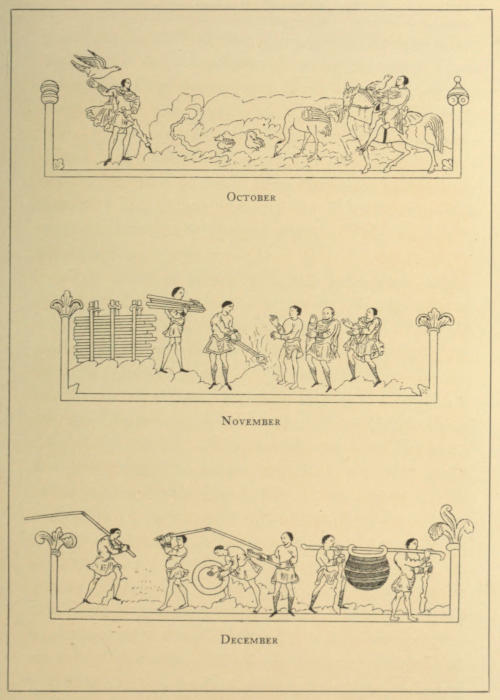
THE SEASONS—OCTOBER TO DECEMBER
(Cottonian Library)
The Book of Martyrs is also imperfect, beginning at December 31 with St. Columba, and ending with St. Thomas, December 21. The first day of January is called “the eighth Yule day” (se eahteða geohhel dæg). There are four manuscripts of this book, and one of them, a fragment of two leaves, appears to be of Alfred’s time. Moreover, of the saints which are recorded none are later than the ninth century. Another argument is that under November 15 is given a Life of St. Milus, which must (says Cockayne) have been brought direct from Syria to England, and probably from Helias, the patriarch of Jerusalem, with whom Alfred had a correspondence, according to the nearly contemporary Leech Book. These evidences appear to Wülker to justify the conclusion of Cockayne, “that the Martyr Book here presented was at least in use in Ælfred’s time, and was probably then composed.”
We must now mention some titles of books imputed to the king. By the third generation after Alfred the tradition of his literary activity had already assumed mythical proportions. The Latin historian Æthelweard says that nobody knows how many volumes he produced (volumina numero ignoto). William of Malmesbury says that at the time of his death he was working at a translation of the Psalter. There is a poetical work of maxims and proverbs in which each of the detached sentences begins with “Thus said Alfred.” This book opens with an assembly of notables at Seaford, presided over by King Alfred, the Shepherd and Darling of England. These Proverbs of Alfred appear to be a composition of the twelfth century. Moreover, he is said to have translated into English the Fables of Æsop. He is also credited with a treatise on Falconry.
But if in one direction the tradition has reached a fabulous extreme, it is possible, on the other hand, that there may still remain something of his which has been overlooked or has not been adequately recognised. I allude to the Saxon Chronicle, about the king’s relation to which there is doubtless more to be said than has yet found a place in literature. To speak but of one section—I never can read the annals of 893-897 without seeming to hear the voice of King Alfred. Among the illuminations of the approaching anniversary, we may hope that a clearer light will be shed upon this interesting question.
The Will of Alfred is a very remarkable document, and opens to us more than might be expected of family arrangements as to property. That coupling of the names of Æþered and Ælfred which has such a singular and conspicuous appearance in the Chronicle receives some very practical illustration. There were at that time no professional men to make Wills, and we have no cause to doubt that the diction is Alfred’s, as it purports to be, being indited in the first person. There is much in this document to provoke inquiry and research, and it would probably repay the diligent student for a closer investigation than it has hitherto received.
In our time when books are freely produced in great abundance, it is hard to appreciate the power and originality of King Alfred’s work in the field of literature. When we look about for his motives we find such as these: need of occasional retirement and solace in the midst of harassing affairs, desire for personal improvement and edification, strong intellectual appetites, etc.—but all these controlled by one chief and dominant purpose, that of national education. Looking at the external aspect of the king’s situation we might have judged it sufficient for him at that time to concentrate his energies upon the restoration of material prosperity and the strengthening of the national armaments. That the prior necessity of these was not overlooked, we have ample proof in the subsequent progress of Wessex. But this did not satisfy the kingly ambition of Alfred; he craved for his people the higher benefits of political life, their moral and intellectual and spiritual development. Curiosity may well prick us to ask from what source far-reaching aims like these so suddenly burst into our history, and that, too, at a time of exhaustion at home and apprehension from abroad. If King Alfred saw a connection between general education and the acquisition of wealth (as there is some indication that he did), this may partly explain the energy of his educational policy, but we still desiderate something more. If we might assume that being under a strong sense of what he had himself gained by his early education, he desired to impart the like advantages to his people, then and only then the problem would find its appropriate and adequate solution.
The beginnings of modern education in the seventh century were quickened with the sense that something had been lost, and the whole movement was coloured with the sentiment of retrieval and recovery. Two great historical exhibitions of this effort are displayed in the Latin schools of Anglia and of Charlemagne, which are in fact but two parts of one movement, linked together by the name of Alcuin.
King Alfred’s educational revival is isolated from the preceding by the wars and desolations of the Wicingas, and it starts with a new basis in the installation of the mother tongue as the medium of elementary teaching. To this innovation it is due that we alone of all European nations have a fine vernacular literature in the ninth and tenth and eleventh centuries. And the domestic culture of that era, I take it, was the cause why the great French immigration which followed in the wake of the Norman Conquest did not finally swamp the English language.