ALFRED AS A RELIGIOUS MAN AND AN EDUCATIONALIST
Reading edition
By the Bishop of Bristol
ALFRED AS A RELIGIOUS MAN AND AN EDUCATIONALIST
I HIS EARLY YEARS
Earliest years—Visits to Rome—Purpose of such visits—His father’s will—His education—Saxon poetry—His mother’s book—His religious interest—His desire for learning—Musical skill—His religious wars—He becomes king.

The original sources of information from which this chapter is drawn are fairly numerous. Asser’s Life of Alfred is of course the chief source; but Alfred’s laws, Alfred’s translations, Alfred’s will, all throw much light on his character as a religious man; and the translations tell us something of his views on education, besides what we learn from the record of his actions.
Alfred’s mother was Osburga; Asser tells us that she was a very religious woman, noble alike in family and by her own disposition. His father Ethelwulf gave him an early training in devotion to the faith of Christ. In the year 853, which Asser declares to have been the fifth year of Alfred’s life—though some say his eleventh year, which would seem more probable—Ethelwulf sent him to Rome with an honourable escort of nobles and commoners. Pope Leo IV. received him, anointed him for king, and adopted him as his spiritual son. This may mean that Alfred was confirmed in Rome; Ethelwerd, a descendant of Alfred, believed that it referred to baptism. Another account states that the Pope anointed him king of the Demetians; but that seems out of the question, as he had four brothers older than himself. The statement may be due to the fact that some years after Alfred became king, the kings and people of that part of Wales made submission to him.[1] Two years later Ethelwulf himself went to Rome, with great honour, and took with him Alfred, because he loved him more than his other sons. A long list of Ethelwulf’s gifts was given by Anastasius in his Lives of the Popes; they were very magnificent if the record is true. The father and son remained in Rome for a year. Alfred’s mother was, we must suppose, then dead, for Ethelwulf took a new wife home with him, Judith, the daughter of Charles the Bald.
We have in Ethelwulf’s will an interesting evidence of the impression made upon him by Rome. It is as well to state such of the provisions as have come down to us, for they are in themselves of importance, and they introduce us to important facts of the time; also, we shall then have something with which to compare Alfred’s will when the time comes to deal with it. The provisions show the kind of religious atmosphere in which Alfred was brought up as a young boy.
Ethelwulf ordered that the money he left behind him should be divided between his sons and the nobles for the good of his soul. Further, for the benefit of his soul, which from the first flower of his youth he had studied in all things to promote, he directed that in all his hereditary dominions one poor man for each ten hides of land, either a native or a foreigner,[2] should be provided with meat, drink, and clothing, by his successors, even to the day of judgment. And the curiously significant condition is imported, “if the country should continue to be inhabited by men and cattle, and not become deserted”: to such an extent had the ravages of the Danish pirates gone. Also, and still for the good of his soul, three hundred mancuses[3] were to go to Rome. Their destination explains to us the religious attraction which drew men in his time to the old capital of the Western world. The journey was dangerous;[4] it was also expensive.[5] King Canute spoke very strongly about this in his time. He thanked God that he had been able to visit the holy Apostles Peter and Paul. That was the aspect in which the purpose of the pilgrimage to Rome presented itself to his mind, it was to visit the tombs of the holy Apostles Peter and Paul.[6] But having thanked God for his visit, he proceeded to complain of the heavy demands upon “my archbishops” when according to custom they visited the holy see to receive the pall. “I complained in the presence of the lord Pope, and said I was much displeased on account of the immense sums of money which were demanded of them”; it was decreed that this should cease. In like manner he settled with the emperor and with the Frank king that the severity of the taxes by the way should be relaxed. In 688 and 728, two of Alfred’s predecessors, Cædwalla and Ina, kings of Wessex, wishing to visit Rome, resigned their kingdom to carry out their wish. Bede tells us precisely what their purpose was. It was that they might visit the tombs of the blessed Apostles. Ethelwulf, too, makes his object clear in his will. One hundred mancuses were to go to Rome in honour of St. Peter, specially to buy oil for filling all the lamps of his apostolic church on Easter Eve and at cock-crow; also, one hundred mancuses in honour of St. Paul, for the same purpose of providing oil for the Church of St. Paul the Apostle, to fill the lamps on Easter Eve and at cock-crow; and one hundred mancuses for the universal apostolic pontiff. William of Malmesbury states that these were to be annual gifts, but that is not supported by Asser, from whom William takes his account.
It is interesting to note the agreement of these gifts with the facts of the time. In 847 the Saracens had attacked Rome. The great basilicas of St. Peter and St. Paul were suburban churches, outside the walls, and they were plundered and desecrated. We are accustomed to the idea of St. Paul’s being fuori le mura, but St. Peter’s, as we know it, lies in a district surrounded by walls. This fortified district is called the Leonine City. It owes its existence and its name to Leo IV., who was Pope when Ethelwulf sent Alfred to Rome as a boy. A concise account of the eight years’ papacy of Leo IV. would state that he devoted himself to building the fortifications of the Leonine City, that St. Peter’s and the Vatican might no longer be suburban, and to restoring the plundered and desecrated churches of the two Apostles. Hence Ethelwulf’s gifts to the two churches and the papal purse. If the dates and periods given by Asser are correct, Pope Leo died while the Saxon king and prince were in Rome, and was succeeded by Benedict III. In that case Alfred witnessed in the autumn of 855 the significant spectacle of an antipope stripping the Pope of his pontifical robes and ruling for a time in the Lateran.
Under influences such as these Alfred was brought up. His brothers appear to have been sent out to great men of the kingdom to be educated, but Alfred was kept always at the king’s court, as the favourite son. He was specially noted for the attention with which he listened to the Saxon poems of earlier times, and the care with which he stored them up in an excellent memory. In after years he spoke of Aldhelm’s English songs and hymns as the best he knew;[7] and that was saying a great deal, for the national gift of song, both sacred and secular, was great. It would be difficult to find in the early records of any nation a sacred song more touching and beautiful than the stanzas of the “Dream of the Holy Rood,” incised in early Anglian runes upon the great cross-shaft at Ruthwell, itself a monument such as no other nation can show. The fuller form of this great song, embodying the earlier stanzas found on the Ruthwell cross, was discovered at Vercelli two generations ago, in the Wessex dialect of Alfred’s time. That Alfred knew by heart this among many other English songs may be taken as certain. That it made its religious mark on his mind cannot be doubted.
But, Asser remarks with a severe comment on the neglect in this respect by his parents, the boy Alfred had no book-learning at all. He was trained in all bodily exercises, and he especially learned and practised the art of hunting in all its branches with surprising success; an art so practical then that Asser believed skill and good fortune in hunting to be “among the gifts of God, as we have often witnessed.” But book-learning he had none.
It was his mother who gave him his first taste for book-learning. If we are to accept the dates and statements of Asser as on the whole correct, this must have been his step-mother, Judith, though one of the statements would refer it to Osburga’s time. Alfred was about thirteen when the event occurred; he remained illiterate, Asser says, till he was twelve years old or more. Those who take the other view make him almost four at the time of the following episode. There is no evidence that Osburga had any learning, though her love for Saxon ballad may be assumed. Judith, on the other hand, was the daughter of a house which paid much regard to learning and art. The beautiful Bibles of her father are in existence still, and we can well understand that she would try to win the affection of her step-sons by showing them treasures of a kind new to them. No one who has had the privilege of handling and examining the books in the Bibliothèque Nationale in Paris can ever forget the beauty of the manuscripts which belonged to Charles le Chauve, Judith’s father. The ivory covers of his Psalter and his Book of the Gospels, the beauty of the interior of those books, and the fineness of his St. Denis Bible and his Metz Bible (which is possibly the Bible prepared at Tours for Charlemagne under the care of Alcuin), abundantly convince us of the artistic taste of his family. Their evidence could be largely supplemented from the still-existing manuscripts of Charlemagne, Louis le Débonnaire, and Lothaire.
His mother, then, one day showed to Alfred and an older brother an ornamental manuscript of Saxon poems. To tempt them to begin to learn—again the act of one who had not been responsible for their ignorance of book-learning—she said she would give the book to the boy who could first learn to read it. Alfred was delighted with the beauty of the initial letter. He might well be delighted if it approached the beauty of the Lindisfarne gospels, wrought a century and a half before, or the very different style of beauty of the manuscript known as the Psalter of Athelstane, with its Byzantine type and Teutonic origin, parts of which Judith may well have seen and handled. The initial letter of the first Psalm in this Psalter would indeed have been a prize for which a boy might face the pain of learning to read, even a boy devoted to hunting.
Alfred spoke first, though the younger. “Will you really give it to the one who can most quickly understand and recite it before you?” She, glad and smiling, said, “To him I will give it.” He took it from her hand, went to his master and read it. When it was read, he brought it back and recited it. It is not at all improbable that Judith did not know of his power of memory, and that instead of learning to read it, in our sense of the word, he got his master to read it over till he knew it by heart and could point with his finger to the words as he recited them. John the Deacon, writing in the same century, said that Pope Gregory the Great (others ascribe it to Gregory III.) invented musical notation as a memoria technica to remind him of tunes he had learned by ear.
However that might be with Alfred, he had got the taste for written words, which never left him. He set to work to learn the daily course of the religious services of the several hours; and then certain of the psalms; and then a number of prayers. All this collection he had in a little book which he carried day and night in his bosom. Asser, who joined him many years later, often saw him use this little book to assist his prayers, amid all the bustle and business of a king’s life. But still there is a hint that when this collection was made it was only to him a representation of what he knew by heart; for Asser says he could not at that time gratify his most ardent wish to learn liberal art, because, as Alfred told him, there were then no good readers in all the kingdom of the West Saxons.[8] Indeed, he confessed to Asser with many lamentations and inmost sighs of his heart that the greatest of all the difficulties and impediments of his life had been that when he was young, and had the capacity for learning, he could not find teachers; and when he was more advanced in life, he was so harassed by a disease unknown to all the physicians of the island, as well as by anxieties of sovereignty, internal and external, and continual invasions of pagans, that there was no time for reading, even his masters and writers being to some extent disturbed in their occupations. But yet he never to the end of his life ceased from the insatiable desire of knowledge.
Asser makes no reference to his traditional skill as a harpist and minstrel. Probably it was a matter of course. Two hundred years before, Cædmon, in Northumbria, had fled the festive society of his labouring fellows, because he alone of them, when the harp was passed to him in turn, could not sing; and the sense of isolation in this respect wrought so strongly in his mind that in the dreams of the night he created song, and next morning he remembered the dignified and stately creation. Aldhelm was singing in Wessex in Cædmon’s time, sitting on the parapet of Malmesbury bridge, and beguiling people to sacred thought by the attraction of his secular lays.[9] We have no examples still surviving of English musical notation of Alfred’s time; but many examples exist of the next century, as, for instance, the manuscript written in Wessex about eighty years after Alfred’s death for Æthelwold, Bishop of Winchester, which includes the kyrie Rex Splendens, composed by Dunstan, who was born in 925. There can practically be little doubt that Alfred had a similar notation, consisting of very rudimentary musical notes, with guide-letters showing time and expression. It was, however, the century after his death that saw the great development of this principle in England. Up to that time the tradition of the plain-song introduced by Augustine had been handed down from ear to ear. The chief use of our musical notation was to guard against the loss or serious variation of the traditional plain-song and the more complicated additions made by Dunstan and other skilled musicians. The Wessex churchmen learned their rugged plain-song so well, that after the Norman Conquest the monks of Glastonbury suffered death at the hands of the Norman soldiers rather than abandon their insular use for the lighter graces of the plain-song of William of Fescamp.
Alfred’s warfare against the Danes began before he was king. It was in his eyes much more than a warfare against violent invaders of his territory; it was to him, above all, a religious war. That the enemy were pagans, and that part of their aim was to obliterate Christianity, that was his chief stimulus. To the Danes also it was a religious war. The Angles and Saxons and Jutes, whose lands they pillaged, were their own very distant cousins; they had in times past worshipped the same deities whom now the Danes worshipped. To the Danes they were renegades from the one religion which the Danes held for truth. Asser knew well the king’s feeling on this subject. He describes at some length the series of battles which brought Alfred into prominence, and he describes them from information received from Alfred. He never describes the combatants as English and Danes; he always speaks of them as Christians and pagans.
The first instance we have of the bent of Alfred’s mind after he came to maturity occurs in connection with this feeling on his part that to fight the Danes was a religious work. In 871, just before he came to the throne, the pagan army fought against the Earl of Berkshire at Englefield, and the Christians gained the victory. Four days later, Alfred and his brother King Ethelred attacked the pagans at Reading, where they had strong fortifications. They cut to pieces such of the pagans as they found outside the fortifications; but the main body of the pagans sallied forth, and the Christians fled. Four days after, the pagan army was on strong ground at Æscesdun, the hill of the ash, and the Christians, in shame and indignation, roused by the calamity at Reading, determined to attack them under Ethelred and Alfred.
Ethelred was a religious man, as Alfred was, but his religion took practically a different form. The king prepared for the fight by hearing mass, and the army waited for him. The pagans did not wait. Time pressed. Alfred, who was second in command, became very anxious. The king, who commanded the force arrayed against the pagan king, was still set in prayer. He declared he would not depart, alive, till the priest had done, nor leave the divine service. Alfred was to deal with the two pagan jarls; he must either retreat or charge without waiting for his brother. Relying on the divine counsels he charged, and after a long and severe fight, in which many of the leading pagans were killed, the Christians won the day. They strewed the whole plain of Æscesdun with pagans, slaughtered in their flight. Alfred himself, it should be observed, was from childhood a frequent visitor of holy places, for the sake of prayer and almsgiving. It was certainly not from any disregard of prayer or of God’s house and the public worship of God that he fought while Ethelred heard mass.
That same year, after another great fight at Basing in which the pagans got the victory, Alfred became king on the death of his brother; Ethelred’s son Ethelwold being too young to reign. A month later the pagans defeated him at Wilton. Eight pitched battles in one year, besides endless skirmishes by night and day in which Alfred and his chief men were engaged without rest or cessation against the pagans: that is Asser’s summary of the year which saw Alfred mount the throne of the West Saxons.
The same note of a religious war is struck in the campaign in which Alfred finally triumphed. He issued forth from his stronghold in the marsh of Athelney to make frequent assaults upon the pagans. In the seventh week after Easter, 878, he rode to Ecgbryht’s Stone (Brixton-Deverill) in the eastern part of the Selwood, or Great Wood, in British Coit Mawr, and on the third day reached Edington, where he fought with valour and persistence against the pagans and defeated them completely, killing all who were not within the earthworks. The survivors he hemmed in for fourteen days. At the end of that time the pagans were worn out, and begged for terms of peace. Their leader Guthrum proposed to become a Christian. It was agreed that those who would be baptized might settle in England; those who would remain pagan must leave the island.[10] In the final terms, as in every phrase of Asser’s story, it stands out as a religious war, and as a great religious victory it ended. From that time Christian Danes and Christian Saxons could agree.
II HIS REIGN
His early years as king—Communications with Rome—Education of his children and others—His own labours—Religious exercises—Introduction of learned men—Invention of candle-clocks—Distribution of income—Foundation of monasteries—Formation of his Manual—Embassies to foreign parts—Ecclesiastical laws.

In the early and distressful days of Alfred’s reign his position was almost unbearable. He would not listen to the appeals for help and protection pressed upon him by his subjects. What was there that he could do to help and protect them? He was maturing his plans; meanwhile, he repulsed his subjects, and paid, or seemed to pay, no heed to their requests. The holy man St. Neot, who was his relation—some say his father’s brother—often told him that he would suffer great adversity on this account, but Alfred turned, or seemed to turn, a deaf ear to the reproofs of the man of God. His sin, Asser tells us, did not go unpunished; Alfred fell into so great misery that sometimes none of his subjects knew where he was or what had become of him. If this is true, it is sufficiently accounted for by his grave anxieties, and the terrible and mysterious disease which seized him suddenly in the midst of his marriage feast in 868, three years before his accession, and never left him free from pain, or the threat of pain, from the twentieth to the forty-fourth year of his age. But most probably the episode is merely part of the legendary life of St. Neot, inserted after Asser’s time in his Life of Alfred.
Among other cares of the first ten or eleven years of his reign, he turned his attention to the English school in Rome, and persuaded Pope Martin to free it from tribute and tax. This is the Pope who absolved Bishop Formosus from his excommunication by Pope John VIII. and from his vow not to return to Rome; a reversal which led to the trial and condemnation of the dead body of Formosus, mentioned on a later page.
Alfred was now free to devote himself to the restoration of religion and learning. His own family management was a pattern to all. His youngest son, Ethelwerd, was sent to the schools which Alfred had by that time established. Here he was taught in company with the children of almost all the nobility of the kingdom, and many that were not noble. They learned to read both Latin and Saxon books, and they learned to write; so that by the time they were ready to practise the manly arts—hunting and such pursuits as befitted noblemen—they had become studious and clever in the liberal arts. His older children had been taught at home, and no less carefully. They learned the Psalms and read Saxon books, especially Saxon poems; at the time when Asser wrote, Edward and Ethelswith[11] were continually in the habit of making use of books.
The king himself led a laborious life. Invasions by pagans, and his constantly recurring and disabling bodily pain, did not prevent his carrying on the government with vigour. And he was full of other occupations. Hunting in all its branches he continued to practise. He taught his workers of gold,[12] one of whom no doubt had made in the earlier years of his reign the ornament of gold and enamel found at Athelney in 1693 and now in the Bodleian, with its legend speaking of his personal care, Alfred had me made. He trained artificers of all kinds; he trained his falconers, hawkers, and kennel-men. By his own mechanical inventions he was able to build houses beyond all precedent of his ancestors. He learned by heart the Saxon poems and made others learn them; he recited Saxon books; he alone never desisted from studying most diligently to the best of his ability. He attended mass and the other daily religious services; he was frequent in singing psalms and in prayer, at the day hours and the night hours; he went to the churches at night to pray secretly, unknown to his courtiers. He was in the habit of hearing the Divine Scriptures read by his own countrymen, or, if it so happened, in the company of foreigners. His bishops, too, and all ecclesiastics, his earls and nobles, his officers and friends, were loved by him with wonderful affection; their sons who were bred up in the royal household were as dear to him as his own; he had them instructed in all good morals, and never ceased to teach them letters day and night. And yet he complained to God, and to all who were admitted to intimacy with him, that the Almighty had made him ignorant of divine wisdom and of the liberal arts. He was affable and pleasant to all—that, we may depend upon it, was the truth, and not that other story of morose repulse of all who sought him—and he was curiously eager to investigate things unknown.
Determined to advance learning in his kingdom of Wessex, he invited out of Mercia four very learned men of that nation. They were Werefrith, Bishop of Worcester, who translated the dialogues of Gregory and Peter into Saxon; Plegmund, afterwards Archbishop of Canterbury, the founder of the Saxon Chronicle; and the priests Ethelstan and Werewulf. Night and day, whenever there was leisure, one of these four read to him; so that he possessed a knowledge of every book, though as yet he could not himself read his books.
Further, he sent to Gaul for teachers, and two especially are named. These were Grimbald, the provost of St. Omer, a good singer, prominent in ecclesiastical discipline and good morals, very learned in Holy Scripture, and John of Corbey, learned in all kinds of literature and skilled in many arts. Asser, who was of the greatest service to him, he persuaded to come to him out of South Wales; Asser’s own account of the bargaining is very quaint. Asser’s principal function was, as we have seen in the case of the four Mercians, to read to him night and day whenever there was time. Alfred carried his determination to have learned men in important places so far that he would rather keep a bishopric vacant than fill it with an unlearned man. That he had the income of vacant bishoprics has been made a charge against him. An examination of the dates of death of bishops in Alfred’s dominions and the dates of consecration of their successors fails to provide any serious ground for a charge of this kind.
The story of Alfred’s invention of candles to measure the time is well known. It is not so well known that his desire to measure time correctly came from a religious motive. His determination was to give to God half his time, day and night. So far as the day was concerned, if the sun was visible the division could be made; but clouds by day baffled him, and at night there was darkness. Hence the invention of the candles, which were measured to burn four hours each. Each candle was divided into twelve equal parts by lines on the surface. The invention of a lantern followed, for a reason which sets before us the discomforts of life in those times. The candles did not burn steadily and evenly, for the flame was blown about by the violence of the wind, which blew day and night without intermission through the doors and windows of the churches, the fissures of the divisions, the plankings, the walls, or the sides of the tents. Alfred made boxes for the lights, with doors of white ox-horn planed so thin that they were like glass. There are small niches in some of our churches now, with signs of doors, probably for protecting the lights at night from the draught.
And as he gave half of his time to God, so he gave half of his income. Ethelwulf, his father, had released from tribute to the king one-tenth part of the royal estates,[13] for the glory of God and his own eternal salvation. Alfred divided his income into two equal parts, for secular and for ecclesiastical expenditure. The secular half was divided into three equal parts. The first was for his soldiers and the nobles who attended at his court and performed divers functions; these latter were in three sets, each of which performed one month’s service in each quarter and spent two months at home. The next third went to the operatives whom he had collected from every nation, of great skill in every kind of construction; workers in gold are specially mentioned in another part of Asser’s description. The remaining third went to foreigners who visited him, whether they asked for money or not. So much for the secular half of his income.
The second half of each year’s income was all given to God. It was divided into four parts. The first part was for the poor of all nations.[14] It was to be discreetly bestowed; for the king said that, as far as could be, Pope Gregory’s saying should be fulfilled, give not much to whom you should give little, nor little to whom much, nor something to whom nothing, nor nothing to whom something. The second was for the two monasteries which Alfred had specially founded, at Athelney and Shaftesbury. The third went to his school, which he had studiously collected together, of many of the nobility of his own kingdom. The fourth was for all the neighbouring monasteries in all Saxony and Mercia, and in some years for monasteries in Wales, Cornwall, Gaul, Brittany, Northumbria, and sometimes Ireland. It is a remarkable fact that in this large expenditure for religious purposes, the purposes are at most only indirectly connected with the definitely spiritual work of ministering the Word of God and the Sacraments to the people at large.
Asser is not very clear in the sequence of his ideas. But we gather that the king’s desire to found monasteries was due to his own fixed purpose of holy meditation, to which he desired to invite others. But he could not find any one of his own nation, free by birth, who was willing to adopt the monastic life, except some who were mere children, too young to choose between good and evil. The love of the monastic life, once so strong in England, had died out. Asser theorises as to the reasons for this, and he produces two which seem to be mutually destructive: it was either because of the constant invasions by sea and land, or because people abounded in riches of every kind and so despised the monastic life. He had to get an old Saxon to act as Abbot of his new foundation of Athelney; and then some priests and deacons from across the seas; and then, as he had not nearly plenty of inmates, he got as many Gauls as he possibly could, including children, to be reared to the monastic life. Asser had himself seen a lad of pagan birth who was educated there, and who was by no means the hindmost of them all.
The formation of King Alfred’s Manual, which is not known to exist, may best be told something as Asser tells it. He says that it was in 887 or 888 that the king first formed the desire to interpret passages of Scripture to those who did not know Latin.
“We were talking together one day, and I read to him an extract from a certain book. He heard it with both his ears. He brought out his book with the daily courses and psalms and the prayers he had read in his youth, and commanded me to write there the quotation. I turned it over, and found it very nearly full. After some delay I said, had I not better find another sheet on which this might be entered apart; for perhaps some other quotation might occur, and if so we should be glad to have them kept together? ‘Your plan is good,’ he said. So I made haste and got a sheet and wrote the quotation. That same day no less than three other passages pleased him; and from that time we talked daily and wrote such things as pleased him till at last it was full, for he went on unceasingly collecting many flowers of Divine Scriptures. When the first quotation was copied onto the sheet, he at once became anxious to read and interpret it in Saxon, and to teach others. The book grew till it became almost as large as a Psalter. He called it his Manual, because he kept it carefully at hand day and night, and found, as he told me, no small consolation therein.”
It was not to Rome only that Alfred sent messengers and gifts. Asser speaks, with Celtic breadth, of daily embassies sent to foreign nations, from the Tyrrhenian sea to the farthest end of Ireland.[15] The English Chronicle goes further. Alfred vowed, it is said, when they were set against the enemy in London, to send embassies to St. Thomas and St. Bartholomew. The Chronicle, under the year 883, tells us that he sent gifts to India. William of Malmesbury informs us that Sigelm, Bishop of Sherborne, was sent as ambassador with the gifts to St. Thomas, and that he prosperously penetrated into India. Thus, Dean Hook remarks, the first intercourse between England and Hindustan consisted of this interchange of Christian feeling. It is, however, a little curious that Asser never mentions India, nor did Alfred interpolate any mention of his embassy when translating Orosius for his English people. Asser definitely mentions Judea, telling us that he had seen letters to Alfred which came with presents from Abel the Patriarch of Jerusalem. It may be worth mention that other MSS. of the English Chronicle read Iudia and Iudea instead of India. Still, the fact of the journey of Alfred’s messengers to some distant part which then bore the name of India, seems to be accepted on all hands. There is no very violent improbability about it. Christian missionaries from Persia had reached India and China more than three centuries before this, two of them bringing the silk-worm to the Greek empire in Justinian’s reign, about 550. The Egyptian merchant-monk Cosmas wrote his Christian Topography at that date. He found Nestorian Christians in Ceylon and Malabar, but the king and people of Ceylon were still heathens.
Alfred’s Ecclesiastical Laws have a long preface, apparently prepared by himself. It is an interesting piece of argument. First he gives the Ten Commandments in Saxon. Writers inform us that he omits the Second Commandment, in accordance with the evil practice which had already made considerable progress then; but probably these writers did not read to the end, for Alfred’s Tenth Commandment is, “Thou shalt not make to thyself golden gods nor silvern.” Then he points out that our Saviour, Christ, said He came not to break nor forbid these Commandments, but with all good to increase them, and mercy and humility He taught. Then he quotes the decisions of the church at Jerusalem as to the tenderness of the application of the law to the Gentile converts. When the English race became Christian, he proceeds, they held synods of holy bishops and great and wise men. They then ordained, out of that mercy which Christ had taught, that secular lords, by the synod’s leave, might without sin take for almost every misdeed, for the first offence, the money fine ordained by the synod. They then in many synods ordained a fine for many human misdeeds, and in many synod-books they wrote, at one place one doom, at another another.
The one offence to which they dared not assign any mercy, that is, any bot, or money fine, was treason to a lord; because God Almighty adjudged no mercy to those who despised Him, nor did Christ, the Son of God, adjudge any to him who sold Him to death, and He commanded that a lord should be loved as Himself.
This is a very interesting explanation of the Saxon system of money payments for offences of almost every description. It is not altogether unlike in principle to the modern magistrate-law that a dog has his first bite free. That application of the principle found no favour with King Alfred, in whose days dogs were great and dangerous beasts. If a dog tear or bite a man, for the first misdeed, 6s.; for the second, 12s.; for the third, 30s. If the dog do more misdeeds, the owner is to go on paying, or must repudiate the dog.
“These many dooms I, Alfred the king, gathered together; and commanded many to be written of those our forefathers held which to me seemed good; and many of those which seemed to me not good, I rejected them by the counsel of my wise men. I durst not venture to set down much of my own, for it was unknown to me what of it would please those who should come after us.”
Three characteristic dooms may be quoted. “He who steals on Sunday, or at Christmas or Easter, or on Holy Thursday,[16] or on Rogation days,[17] or during Lent, shall pay a twofold bot.” “If a man go to the church, and reveal an offence not revealed, and confess himself in God’s name, be it half forgiven.” For holidays,—“To all freemen, 12 days at Yule, and the day on which Christ overcame the devil, and the commemoration day of St. Gregory, and 7 days before Easter and 7 after, and one day at St. Peter’s tide, and one day at St. Paul’s tide, and in harvest the whole week before St. Mary-mass, and one day at the celebration of All Hallows, and the 4 Wednesdays in Ember weeks,”—forty-two days in all, making, with the addition of Sundays, just a quarter of the whole year.
III HIS TRANSLATIONS AND HIS WILL
His translations—Bede’s Ecclesiastical History of the English Race—The Pastoral Care—State of learning in Wessex, Mercia, and Northumbria—Ideal of a bishop’s life—Orosius—Boethius—Alfred’s religious opinions—John the Scot—Alfred’s will—Hyde Abbey—State of Rome—Religious references—Religious bequests—Slaves.
The general drift of Alfred’s opinion as to the sort of learning most needed by his people is to be gathered from his choice of books to be put before them in their native language. These were four. For general history, and for history and geography relating to their own race on the continent of Europe, he chose Orosius: for mental study, the Consolation of Boethius: for realisation of the true principles of the life and work of religion, the Pastoral Care: for the Church history of the English people, of course the great and priceless book of the Venerable Bede. Of this last we need say nothing. Nor need we dwell upon the fact that Alfred may be said to have created the continuity of early English history by his establishment of the Anglo-Saxon Chronicle under Plegmund.
The preface to Alfred’s translation into English from the Latin of Pope Gregory’s Pastoral Care, a treatise on the life and work of a bishop, gives us so clear an insight into the king’s mind, and such valuable information as to the state of learning in his time, that it deserves to be printed in full. Three of the copies of which the king speaks are in existence, one addressed to Archbishop Plegmund of Canterbury, one to Bishop Wulfsige of Sherborne, and the third to Bishop Werefrith of Worcester.
This Book is for Worcester
King Alfred greets Bishop Wærferth with loving words and with friendship. I let it be known to thee that it has very often come into my mind, what wise men there formerly were throughout England, both of sacred and secular orders; and how happy times there were then throughout England; and how the kings who had power over the nation in those days obeyed God and his ministers; and they preserved peace, morality, and order at home, and at the same time enlarged their territory abroad; and how they prospered both with war and with wisdom; and also the sacred orders how zealous they were both in teaching and learning, and in all the services they owed to God; and how foreigners came to this land in search of wisdom and instruction, and how we should now have to get teachers from abroad if we were to have them. So general was the decay in England that there were very few on this side of the Humber who could understand their rituals in English, or translate a letter from Latin into English; and I believe that there were not many beyond the Humber. There were so few of them that I cannot remember a single one south of the Thames when I came to the throne. Thanks be to God Almighty that we have any teachers among us now. And therefore I command thee to do as I believe thou art willing, to disengage thyself from worldly matters as often as may be, that thou mayest apply the wisdom which God has given thee wherever thou canst.[18] Consider what punishments would come upon us on account of this world, if we neither loved wisdom ourselves nor suffered other men to obtain it: we should love the name only of Christian, and very few of the virtues. When I considered all this I remembered also how I saw in my own early days, before all had been ravaged and burnt, how the churches throughout the whole of England stood filled with treasures and books, and there was also a great multitude of God’s servants. But they had very little knowledge of the books, for they could not understand anything of them because they were not written in their own language. As if they had said: “Our forefathers, who formerly held these places, loved wisdom, and through it they obtained wealth and bequeathed it to us. In this we can still see their tracks, but we cannot follow them, and therefore we have lost both the wealth and the wisdom, because we would not incline our hearts after their example.” When I remembered all this, I wondered extremely that the good and wise men who were formerly all over England, and had perfectly learnt all the books, did not wish to translate them into their own language. But again I soon answered myself and said: They did not think that men would ever be so careless, and that learning would thus decay; so they abstained from translating, and they hoped that wisdom in this land would increase, and our knowledge of languages. Then I remembered how the law was first known in Hebrew, and again, when the Greeks had learnt it, they translated the whole of it into their own language, and all other books besides. And again, the Romans, when they had learnt it, they translated the whole of it through learned interpreters into their own language. And also all other Christian nations translated parts of it into their own languages. Therefore it seems better to me, if ye think so, for us also to translate some books which are most needful for all men to know into the language which we can all understand. And I would have you do as we very easily can if we have tranquillity enough, that is, set all the youth now in England of free men, who are rich enough to be able to devote themselves to it, to learn, as long as they are not old enough for other occupations, until they are well able to read English writing. And let those be afterwards taught more in the Latin language who are to continue learning and be promoted to a higher rank. When I remembered how the knowledge of Latin had formerly decayed throughout England, and yet many could read English writing, I began, among other various and manifold troubles of this kingdom, to translate into English the book which is called in Latin Pastoralis, and in English Shepherd’s Book, sometimes word for word and sometimes according to the sense, as I had learnt it from Plegmund my archbishop, and Asser my bishop, and Grimbold my mass-priest, and John my mass-priest.[19] And when I had learnt it as I could best understand it and as I could most clearly interpret it, I translated it into English; and I will send a copy to every bishopric in my kingdom; and on each there is a [clasp and chain][20] worth fifty mancuses. And I command in God’s name that no man take the [clasp] from the book or the book from the minster. It is uncertain how long there may be such learned bishops as, thanks be to God, there now are nearly everywhere; therefore I wish these books always to remain in their place, unless the bishop wish to take them with him, or they be lent out anywhere, or any one make a copy from them.
Then the book itself is made to speak, as the Cross speaks in the early Anglian Dream of the Holy Rood:—
This message Augustine over the salt sea brought from the south to the islanders, as the Lord’s champion had formerly indited it, the Pope of Rome. The wise Gregorius was versed in many true doctrines through the wisdom of his mind, his hoard of studious thoughts. For he gained over most of mankind to the Guardian of heaven, best of Romans, wisest of men, most gloriously famous. Afterwards King Alfred brought every word of me into English, and sent me to his scribes south and north; ordered more such to be brought to him, that he might send them to his bishops, for some of them needed it, who knew but little Latin.
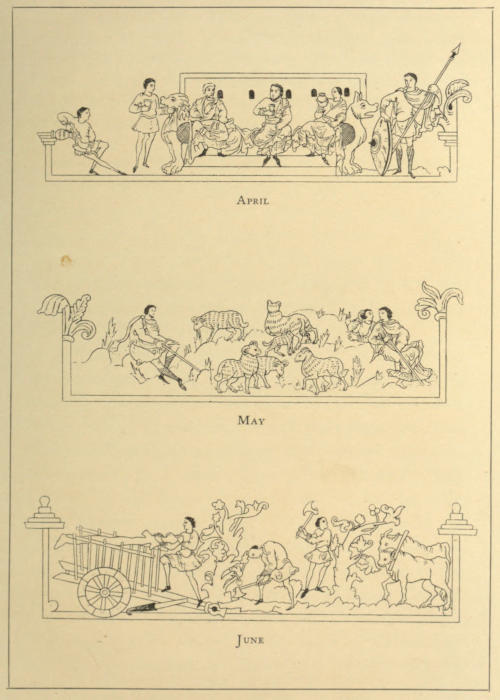
THE SEASONS—APRIL TO JUNE
(Cottonian Library)
It is not our business here to consider the contents of Pope Gregory’s treatise on the shepherding of the people. But the headings of two or three of the sixty-five chapters will show what the attraction for Alfred’s mind was. The first chapter argues “that unlearned men are not to presume to undertake teaching.” To prevent this was a purpose with Alfred; he faced obloquy, it is said, rather than fill bishoprics with unlearned men. The second chapter forbids even learned men to undertake to teach if they are not ready to live in accordance with their own precepts. The third and fourth chapters no doubt appealed to himself as a secular governor, though they related to spiritual government, “how he who governs must despise all hardships, and how afraid he must be of every luxury,” and “how often the occupations of power and government distract the mind of the ruler.” The sixty-fifth chapter brings the whole to a conclusion with an argument thoroughly after Alfred’s own heart: “When any one has performed all the duties of his pastoral charge, let him then consider and understand his own self, lest either his exemplary life or his successful teaching puff him up.”
In his translation of the history and geography of Orosius he does not interpolate information where we might not unnaturally have expected him to do so. Of his large and valuable interpolations of a geographical character, and in regard to the history of the Teutonic races, mention is no doubt made in another chapter. In the sixth book, to mention two cases where Orosius writes of the times of Constantius and Constantine, and makes references to Britain, he does not speak of Christianity here, and Alfred does not add anything. Orosius speaks of many martyrs under Diocletian, not localising any. Again, Alfred does not add anything. Two quaint phrases the king employs:—“In those days Arius the mass-priest was in error with regard to the right faith”;—“Constantine was the first emperor who ordered churches to be built, and locked up the devil’s houses.”
It is not to be wondered at that Alfred determined to translate into English the Consolation of Boethius, and his interpolations show how dear the book was to his heart and to his reason. King and people alike had gone through much trial and suffering, and such happiness and prosperity as they had was at best very precarious. The book of Consolation which Boethius wrote in the sad days when all his great prosperity had passed from him, and he waited in chains for the last fatal word of the tyrant, was well suited for men and women situated as the English then were. Boethius himself, who was executed in 524, was both a very learned Christian and a deeply-read student of classical philosophy. His Consolations are taken entirely from philosophy, but they have the Christian spirit. They thus supplement the help which the Christian religion gives to those in anxiety, and put into the troubled mind fresh and useful trains of thought. This is probably one main reason for the attraction which the book had in the Middle Ages, and we cannot doubt that Alfred had this in view in giving it to his people. Why he did not at the same time have the New Testament translated into English is not clear, for he himself pointed out, in his Preface to the Pastoral Care, that the law was first given in Hebrew, and then necessarily translated into Greek, and Latin, and the languages of the various nations which embraced Christianity. William of Malmesbury tells us that the king did as a matter of fact set about translating the Psalter, but died before the first part was done.
Besides the hint which his translation of Boethius gives, it is on another account probable that Alfred took a broad view of religious questions. If the evidence is to be accepted as sufficient, he was a patron of Johannes Scotus Erigena. John the Scot, that is, as we should now say, the Irishman, had made the Continent too hot to hold him by the breadth of his religious views. He refused to distinguish religion from philosophy, an attitude of mind which may have specially influenced Alfred, who had probably known him as a boy at the court of Charles the Bald, where John acted as tutor to Judith. He had maintained, too, that authority, when it is not confirmed by reason, is of no value. He had made a determined stand against the new and materialistic teaching on the Real Presence, known as transubstantiation. He found a refuge at the court of Alfred. This can scarcely have meant less than that Alfred, to some extent at least, shared his opinions; and if that was so, we see an additional reason for Alfred’s admiration of Boethius, and we have some explanation of the character of the provisions of the will by which the king disposed of his property.
In those days, and in days earlier still, to teach an unpopular opinion was a dangerous thing. Great violence was not unknown in schools of learning. Even in modern times we hear a good deal of the violence of students in Paris and in other universities of the Continent. When Archbishop Theodore came over to England in 664 and began to teach, there were very sharp passages at arms between the teacher and the Irish students who attended his lectures. Aldhelm was a student at Canterbury at the time, and he describes one of these encounters, where the Irish students baited their lecturer, Archbishop though he was. The old student and lecturer of the University of Athens was more than a match for them. “He treated them,” Aldhelm wrote to a friend, “as the truculent boar treats the Molossian hounds. He tore them with the tusk of grammar, and shot them with the deep and sharp syllogisms of chronography, till they cast away their weapons and hurriedly fled to the recesses of their dens.” In Wessex the students went further still. One John—almost certainly not the famous John of whom we are speaking, though mediæval writers took him to be the same—so irritated the students of the great school of Malmesbury, that they set on him with the sharp iron styles of the time, which represented our modern pens, and inflicted wounds of which he died. William of Malmesbury gives the epitaph of this John from a tomb on the left side of the altar at Malmesbury; he is described as the holy sophist John, and is said to have been a martyr. William does not absolutely identify him with Johannes Erigena, but he describes him as Johannes Scottus, and says that he had been at the court of Charles the Bald, and was attracted by the munificence of Alfred. We may fairly say that William believed their John to be the Erigena, and we may almost certainly say that in that belief he was wrong.
John the Erin-born is usually said to have died about 886. There is thus no difficulty on the score of dates in the way of his being at Alfred’s court. He must have been an oldish man, for he was a prominent controversialist as early as 854.
Alfred’s will is on all accounts a document of very great interest. We have noticed already the provisions of his father’s will, so far as they have been preserved for us, and with these we cannot but contrast the corresponding parts of Alfred’s disposition of his property. Many details of the will we must for our present purpose pass by, notwithstanding their general importance: they are no doubt dealt with in another chapter.
Alfred’s will exists in an Anglo-Saxon form and in a Latin form. It is preserved in the Register of Newminster, which Alfred founded at Winchester. This institution was afterwards moved to Hyde. The will was copied into the Register now known as the Register of Hyde Abbey, about the years 1028-1032.
Ethelwulf had bequeathed considerable sums to the Church of St. Peter and the Church of St. Paul at Rome, and to the Pope. Alfred had sent presents to Rome. From 883 to 890 there are four records of West Saxon gifts. But after 890 there is no record, and in Alfred’s will no mention is made of the chief city of the Western world or of the spiritual head of the Church of the West. One explanation may be that at his death the sad period had already begun which makes men of all Christian creeds hang their heads with shame that such things could be. King Alfred’s court was unique among secular courts in its purity and order; the papal court had entered upon one of those phases in its existence where it has stood out prominently among the most impure and disorderly spots on the face of the known earth. It is enough, for any one who knows the meaning of the references, to glance at the table of contents of a Church history for the years 896 and 897:—“Death of Pope Formosus; Pope Boniface VII.; trial and condemnation of the body of Formosus by Pope Stephen VI.; Pope Stephen strangled; Pope Romanus; Pope Theodorus II.; Pope John IX.; Pope Sergius IV.; Marquisate of Tusculum; Theodora and Marozia.” We can well understand that not all Alfred’s reverence for the place where lay the bodies of St. Peter and St. Paul could overcome the effect of a record so grievous as that.
Turning to those parts of Alfred’s will which have a directly religious bearing, it is impossible not to be struck by the obliqueness of the religious references. Of his reliance on divine help and his trust in divine assistance there is no doubt. He clearly regarded these as powers actually at work in the world, and as the one only means by which the actions of those who should follow him might be rightly guided. It is by God’s support that he trusts his will may be carried out. He is king by God’s grace. He has considered of his soul’s health, and of the inheritance which God and his ancestors did give; but he is reserved and allusive where other men of the time were detailed and definite. The air of reserve would almost seem to indicate that the teaching of John the Erin-born, while it had not in the least shaken the confidence of his faith and trust, had seriously indisposed him to speak in confident detail of the relations of man’s service to God’s help. “Let them distribute, for me and for my father and for the friends that he interceded for and I intercede for, 200 pounds; 50 to the mass-priests all over my kingdom, 50 to the poor servants of God, 50 to the distressed poor, 50 to the church where I shall rest.” “And I will that they do restore to the families at Domersham their land-deeds and their liberty to choose any man they will [i.e. to continue to live under that lord or to choose another], for me and for Ælflæd [his eldest daughter] and for the friends that she did intercede for and I do intercede for.” “And let them also seek with a living price[21] for my soul’s health so far as may be[22] and as is fitting and as ye to give me shall be disposed.” It has been clearly shown that on cwicum ceape was a recognised phrase for “with live stock.” The reserve of Alfred’s language in this, the most important part of his will in mediæval opinion, is worthy of note. Indeed, the absence of definite words which might have been expected is so marked that in another Latin copy, a very incorrect translation of part of the Anglo-Saxon will, they are added, but curiously enough are connected solely with the restoration of the land-books to the people at Domersham. The freeing of slaves was a religious work. It will be seen that as a religious work Alfred himself regarded it. “I beseech in God’s name and in the name of His Saints that no one of my relations or heirs obstruct the freedom of those whom I have redeemed. The West-Saxon Witan have pronounced it lawful that I may leave them free or bond as I will. But I, for God’s love and for my soul’s advantage, will that they be master of their freedom and of their will; and in the name of the living God I bid that none disturb them, neither by money exaction nor by any manner of means.”
It is a well-known fact that the Church set before men the duty of giving slaves their freedom. Late in the seventh century, Bishop Wilfrith released 250 men and women whom he found attached as slaves to his estate of Selsey; and Archbishop Theodore denied Christian burial to the kidnapper, and prohibited the sale of children by their parents after the age of seven. In the year 816, the archbishop and bishops of the southern province, thirteen in number, met in council at Celchyth (Chelsea), and bound themselves by canon to free at their death every Englishman, who, during their tenure of the lands of the bishoprics, had become a slave, the usual causes of enslavement in time of peace being poverty or crime. There is a canon of that council, directed against the abstraction of monastic charters and lists of landed property, which has a very modern sound about its title, “that monasteries be not deprived of their telligraphs.”
We cannot close this chapter better than with Alfred’s own right royal words. “I can assert this in all truth, that during the whole course of my existence I have always striven to live in a becoming manner, and at my death to leave to those who follow me a worthy memorial in my works.”