Front matter (continued 3)
Reading edition
The piece of money you yourself received as a twenty-piastre bit, he insists is worth only eighteen.
"See here," he says, "this swanzicker you give me has a hole through it; that diminishes its value by two paras." Two or three neighbours are called in to decide the question. Each has a different opinion on the subject.
The fact is that all money is acceptable here, and that, especially since Turkey's reduced circumstances, the currency consists of the old, semi-defaced coinage of a dozen nations at least, whose value is arrived at by guesswork. I met no one in Albania capable of telling off-hand how many piastres a given piece was worth.
We spent the three days Shouma had given us, in preparing for our journey, and seeing as much as we could of the habits and customs of the Scutarines.
As we had made up our minds to ride, we paid a visit to the bazaar to purchase two horses. All sorts of extraordinary animals were produced, and refused.
At last we came across one that struck our fancy—a long-legged, extremely lean creature, tall for the country, of a red-brick colour.
Brown, who is a horsey man, proceeded to examine him in a scientific manner, to the admiration of the Arnaut stablemen.
He pointed out the weak points of the animal by signs to the dealer, who was quite as sharp as any of his fraternity in England.
Brown, wishing to express his disapproval of the extremely emaciated condition of the horse, pointed to his ribs; whereon the man, misunderstanding his meaning, deliberately counted them before him—a very easy process in the case of this Albanian Rosinante—and indignantly signified to my companion that he was too much of a gentleman to offer for sale a horse that was not provided with a sufficient number of those necessary costal supporters.
The animal was then trotted out, down one of the crowded alleys of the bazaar. He found favour in Brown's critical eye, so the bargaining commenced.
"Sa paré?" (how much) I asked.
The dealer held up both his hands, and said, "napoleon Frank"—to signify that he wanted ten napoleons.
Brown expressed infinite disgust, and held up two fingers.
The dealer in his turn turned his back, with indignant gesticulations and exclamations at the ridiculously low offer.
At last a bargain was struck, the money counted out, and the purchase delivered to us.
We were mounted at the time on two horses Mr. Green had kindly lent us; so we led off Rosso—as we named our animal, in consequence of his rosy hue—with a rope behind us.
Through Mr. Green we managed to procure another steed, a younger animal, and of more robust habit than the lean and haggard Rosso. From his more gentlemanly appearance we gave him the name of Effendi.
We managed to pick up two saddles in the bazaar—one the regular Turkish saddle, at first so uncomfortable to the novice, but gaudy with flimsy metal ornament; the other was a secondhand Turkish officer's saddle, similar to that used in Europe, and provided with formidable-looking holsters.
We felt very proud of our purchases, and took a long ride the same afternoon over the plain, to a very fine old Venetian bridge that spans a branch of the Bojano, Mr. Green's son accompanying us.
Rosso and Effendi proved to be all that could be desired.
CHAPTER XI.
Our Lady of Scutari—A miracle—The fête—A funeral—A drunken Arnaut—Our escort—Two more Britons—Warm discussion—War—Marco.
The morrow (October 18th) was the great holiday of North Albania, the day of Our Lady of Scutari.
Long ago all this country was Christian. In this city there then stood a beautiful wooden image of the Virgin Mary. Thousands of the faithful were wont to flock hither year by year to offer their devotions at her feet, and to be healed of their infirmities; for no sick man that had faith was ever known to kiss the white feet of the image and not depart whole.
But it came to pass that a certain priest made himself very unpopular among the people. I do not quite know for what cause, but at any rate a large multitude came to the church one day, and declared that unless something that they desired was granted to them they would then and there abjure the religion of Christ and embrace Mohammedanism. Rightly or wrongly, the priest would not give in; whereupon the people tore their rosaries from their necks, and marched off to the nearest Mohammedan village, that the mollahs might receive the renegades into the fold of the Prophet; whereupon Our Lady of Scutari, sorrowful and angry at the desertion of those for whom she had wrought so many good things for so many years, left her shrine in this ungrateful land.
That night the wooden image disappeared. It was not heard of for months—when tidings came that on the very same night that this event happened, an image of the Virgin miraculously entered a church in a remote village of Italy, and there took up its abode. A loud voice was also heard, crying out over Scutari, that not till the last Turki (Mohammedan) had left Albania would Our Lady of Scodra be appeased and forgive her children: then, and not till then, would she return to her old shrine.
This day was the anniversary of the miraculous departure of the image, long ago; and an impressive service was held in the great ugly square church of the Christians in this city.
The interior of this building is almost entirely devoid of any ornament whatever, and bears no resemblance to any church elsewhere.
The priests that minister to the spiritual wants of the Albanians are Franciscans and Jesuits, all of whom are Italians. The Franciscan monks have a convent and schools. The Jesuits have tried their best to monopolize the education of the people, but are not much liked.
It was difficult, standing in this bleak building, in the midst of so wild and outlandish though very devout a congregation, to imagine oneself attending a Christian service.
The fierce-eyed shaven-headed Arnaut mountaineer jostled with the mild-looking Scutarine Christian and kilted Mussulman; for those of the other faith, curiously enough, offer their devotions on this day to the mother of the Christ whom they despise. Indeed though one half the Albanians call themselves Christians, and the other half profess to be Mohammedans, there is really little distinction between them. The Mohammedans worship the Virgin Mary; the Christians make pilgrimages to the sepulchres of Mussulman saints, and mingle all sorts of grotesque alien superstitions with their Christianity, which the priesthood in vain strive to eradicate.
I was told that even some relics of the old Greek paganism linger in these mountains.
I myself have seen the Arnauts attempt to read the future from the entrails of a sheep which they had slain for a feast.
Before the service we had an opportunity of witnessing a Christian funeral. The coffin was borne on the shoulders of men, while the women followed at a distance, crying and wailing, as is and has been the custom, in all the East, for all time:—
"He was strong in the chase, he was handsome, he was lovable, he was brave. Alas! no more will he be loved, no more will his swift feet carry him to the hunt. His enemies will rejoice, and throw away their fear. Alas! alas! he has gone from us! he will be hidden in the cold earth."
In the evening a band played outside the church, and the jolly Franciscan monks tucked up their gowns, and proceeded to amuse the crowd with several balloons, which they filled with hot air and liberated, to the great delight of all.
It was a good-humoured though savage-looking mob, and would set a good example to many a gathering of Western civilization. The streets were gaily lit with many-coloured Chinese lanterns. As we walked home after the termination of the proceedings, I noticed that there were one or two cases of drunkenness.
There was one man, an Arnaut, pretty far gone. As I consider the different effects of alcohol on the brains of different races to be a very interesting and curious study, I stood and watched the mountaineer for some time, at a safe distance; for he bristled with arms of course; and if a drunken man, carrying with him two loaded pistols, a gun, and yataghan, should run amuck, or conceive a sudden dislike to the English foreigners, the consequences might be unpleasant. However, he did nothing of the kind. The sole effect of the raki was to make him exceedingly devotional. He knelt down, raised his hands, and prayed in a loud voice, and with a most intense and passionate earnestness. He swung backwards and forwards—wrung his hands, as he worked himself into a phrenzy of religious excitement. Then he kissed the muddy ground over and over again with fervour, under the impression perhaps that he was still at the foot of the empty shrine of the Madonna.
Lastly, he fell prone, face down in the mud, dead drunk, when his friends raised him and carried him off, with looks of shame on their faces, for drunkenness is considered to be a beastly and degrading vice in this uncivilized country.
While we were breakfasting on the following morning, our friend the gendarme appeared, with a very downcast and despondent visage.
"The beasts!" he said. "O, these Turks! I cannot go with you, friends. I had obtained leave, as you know, to accompany you on your journey through Albania. Well, late last night I was sent for, and told that I must stay at Scutari. They had seen me often in your company, and, as is their custom, became jealous and suspicious; so they have got up some idle excuse to prevent my going with you. This is the way they treat us. They give us no pay; and when we do get a chance of making a little money, do their best to get in our way."
Our poor friend was very cut up, and naturally so, for to be guard of a party of Inglezi was a rare windfall for him, and very acceptable in these hard times.
The authorities sent us a passport, and a very strange-looking being, who was to be our escort on the morrow, one man being deemed a sufficient protection, for the first stage at any rate. He was a tall, miserable-looking zaptieh, in very ragged uniform. His face was of extraordinary length, and lantern-jawed. He was almost skeleton-like in his extreme thinness. He had evidently not known what a good meal meant for a very long time.
We discovered him to be an intensely stupid and unintelligent being. This did not promise well. Here we were, two Englishmen, utterly ignorant of Turkish or Albanian, about to ride right across the country in the company of a man who would not be of the slightest use to us in any way.
We gave him a good feed, in hopes that this might develop some traces of intelligence in his dense skull. All in vain. The only effect was, that after having thoroughly gorged himself, he closed his eyes, gave vent to a sort of choking sound, and fell fast asleep.
Everything was ready; we had bid adieu to our Scutarine friends, left orders that our horses should be brought round early on the morrow—then we retired to our beds among the sausages.
It was scarce dawn. There was a loud knock at our door—a rather violent knock. The door opened; we expected to see the smiling face of Toshli, who had come to announce the arrival of our ghostly zaptieh and our brave steeds; but to our astonishment there entered, boisterously, two bronzed and travel-stained Britons—in short, the long-lost Jones and Robinson, whom we had given up long ago.
They stood laughing before us; but Brown and myself considered it incumbent upon us to receive them in a slightly distant and dignified manner as we sat up in our beds. We asked them to give an explanation of their great dilatoriness in catching us up.
We found that they had started from England a fortnight after us, but had been delayed at Cattaro and other ports, in consequence of some extremely ingenious arrangement Robinson, the inventor, had made for receiving money at different places on the route.
They had followed in our footsteps exactly—had taken boat from Trieste to Cattaro, and thence walked, viâ Cettinje, to Rieka, where they had taken a londra for Scutari. We inquired where the white elephant and other Robinsoniana were.
They had left them at Cettinje, they said, and were going to return for them. This further delay was by no means pleasing to Brown and myself. We laid our programme before them, and expected that they would fall in with it at once. A very warm discussion ensued, very nearly resulting in a re-separation of our forces.
They had been very well received, it seems, by the Montenegrins, and had promised some of the chieftains at Cettinje that they would return to that capital as soon as they had seen Scutari.
The war between the principality and the Albanians, so long talked of, was, they said, now but a question of a few days. They had been invited to accompany the army of Prince Nikita, which was on the point of advancing on Gussinje, as the honoured guests of the general in command.
There are certainly two sides to every question. From the little we had seen of the two countries, Brown and myself had formed a decided preference for the Albanians over the Montenegrins; but we found that our two friends were full of praises of the Black Mountaineers, and abuse of the Skipitars. The Montenegrins have rather a knack of wheedling over strangers to their own views of the question. Jones and Robinson, however, to a great extent modified their opinions later on, when we had seen a little more of both sides.
The discussion progressed with considerable warmth. Our recently found friends insisted on returning to Montenegro. Brown and myself were very loth to give up our projected ride across the little-known countries of North Albania. We often wandered from the point into hot dispute as to the virtues or the reverse of the respective races. Ultimately a compromise was effected. We decided to convert Rosso and Effendi into baggage animals, and walk from Scutari to Podgoritza, an important town, acquired by Montenegro from Turkey during the late war, and which was but two days' march from Gussinje. Here the Montenegrin forces were to concentrate, before advancing against the enemy. If we found that war was really intended, we agreed to carry out the programme of our friends. If we found that it was being indefinitely delayed, we would return to Scutari, and march to Previso by the route Brown and myself had decided on.
Brown and myself gave in with great reluctance, feeling that our friends, after delaying us so long, were now about to take us on a wild goose chase after a phantom war. I do not think either of us recovered that sweetness of temper which distinguishes us until after the dinner we partook of that evening at the hospitable board of the British Consulate.
During the above discussion our ghostly zaptieh was announced. With the aid of our landlord we tried to explain to him that his services were no longer needed by us. This man, as I have said, was the incarnation of stupidity; as a Turkish soldier, he was also a model of obedience to those who were put in authority over him.
He had been ordered to conduct us to Priserin—so much had got into his head; and conduct us to Priserin he would, notwithstanding our insistence that we had now altered our intentions. "The Pasha told me to take you to Priserin," was all we could get out of him. He would have attempted to take us there by force, I believe, had we not quieted him with another full meal, which had the same soporific effect as that of the previous day.
When we told Mr. Green of our altered plans, in the evening, he remarked that at any rate our throats would be safe in Montenegro, which is more than they would be in this country. "But," he added, "if you visit Podgoritza you will not be able to return here and visit Priserin. They will have heard of your friendship with the Montenegrin general, and will inevitably take you as spies, and treat you as such in a very summary manner. If you return here and wish to travel to Janina, you must do so by the other route, which takes you through the cities of Tirana, Elbessan, and Berat."
The next day we made preparations for our journey.
As it was a doubtful question whether we should find food on the road to Podgoritza, an unfrequented track, with rather a bad reputation for Arnauts, we purchased a horse-hair saddle-bag, and laid up a good stock of rice bread, mutton, raki, and other necessaries. Robinson had brought his cooking apparatus with him to Scutari, and was very anxious to bring it into use on the earliest occasion.
The evening before our start we very luckily came across a man who had served as groom to Captain Sale, of the late frontier commission. He seemed to understand a word or two of English and Italian, and had a very good character from the Consulate. So we hired him for a month. A very useful fellow he turned out to be. He was dressed in full Arnaut costume, which never left his back during the whole of his stay with us—five weeks, and yet, in some mysterious manner, it ever appeared snowy and new, indeed, his appearance did us credit. He was a young fellow of pleasing countenance, the chief characteristic of which was a perpetual grin. Like all I met of his race, he was faithful and honest, and soon became attached to his masters. His preparations for the journey did not require much time, for his luggage consisted simply of a large gingham umbrella.
CHAPTER XII.
March to Podgoritza—An Albanian khan—Our cook—The Fund—Across the lake—Night visitors—The frontier—Podgoritza-The armourer—The war minister—Dobra Pushka.
Over our last glass of grog before turning in for the night, we had determined to start at daybreak this morning. So abominable was the weather, however, that we preferred to indulge in the comfort of our beds a little longer. An unbroken mass of cloud covered the whole sky, from which poured down a steady deluge, which had a deliberate look about it, as if it had no intention of ceasing for a month at least. Jones looked out of the window, scanned the horizon mournfully, and remarking that he thought the rainy season would soon begin, got into bed again.
At last we mustered courage enough to rise, ordered a substantial breakfast, and sent the faithful Marco to saddle Rosso and Effendi. When Rosso was brought in front of the hotel, he evidently objected to standing out there in the rain while we breakfasted in comfort within; so he walked into the room in which we sat, and made a very fair meal off a deal box that stood in the corner. Our saddle-bags and blankets were placed on the horses' backs, and the expedition started. Our gendarme and landlord saw us well out of the town, where a stirrup-cup was indulged in. We must have looked very imposing: first Marco in his Arnaut dress, sheltering himself with a huge umbrella, the only article of luggage he brought with him; then the two horses; and lastly, our four selves.
All in top-boots—Jones, Brown, and myself well protected with hooded military macintoshes we had bought in Turkey, while Robinson was enveloped in a ponderous English yeomanry great-coat, which must have weighed something when it was thoroughly soaked. Our rifles were slung to our shoulders. Jones was the proud bearer of an Arnaut gun, of which I shall have to say more anon. He also carried a pocket filter, slung to his shoulders.
This day's journey was certainly not a pleasant one. The road from Scutari to Podgoritza is not much of a road at the best of times; it is a mere track. For the first day's march it traverses the plain which borders the east shore of the lake.
This day it was difficult to know what was intended for lake, what for road; it was all the same. The lake had the advantage, if anything, of being the less muddy of the two. We were up to our knees in water all day. I endeavoured to enter into conversation with Marco, and was grieved to find he was a fraud. Yesterday, when we hired him, I spoke to him in Italian and French, curiously mixed together; for I was told he understood a little of both these languages. To everything I said he replied briskly, Ça bonne, monsor, ça bonne. This is the man for us, I said; he understands all I say. "Then he must, indeed, be a wonderful man," my friends replied; "let us have him."
But alas! I now discovered that Marco's linguistic powers were very limited. Give him an order; he never confessed to his absolute ignorance of what you were talking about, but blithely came out with his perpetual ça bonne, ça bonne, as if that was all that was required of him. However, by degrees I discovered what words he knew of French, what of Italian, and what of English (for he had even picked up some words of our tongue when in the service of the commissioners). With the addition of a few words of Sclav and Albanian, I then manufactured a mongrel tongue, which was common to Marco and myself, and utter gibberish to any one else. About midday we halted for lunch. We stood up to our knees in mud and water under the pouring rain, ate sausage, and each in turn made use of the filter, which was placed in the muddy water of the road, while the purified fluid was sucked through an indiarubber tube.
Marco was much astonished and pleased at this proceeding. A tot of rum all round completed our modest repast. On the way we were joined by a man who was also travelling to Podgoritza—a Montenegrin, on horseback. Being alone, he was glad to join our party, well armed as we were, for the Arnauts that inhabit the mountains that were to the right of us have a bad name, and are much given to plundering travellers.
At last a large house rose before us. "That is the khan of Coplik," said Marco. "We must pass the night here, for the next house of any kind is eight hours off."
We entered the khan, and found it to be a more luxurious place than we expected to find. An upper room was given to us for our use. It had no windows, but the rough stone wall and raftered roof admitted plenty of daylight, not to mention rain and wind. The floor was also well ventilated, as was the door that opened on the wooden gallery outside. As Jones remarked, our chamber combined the comforts of a home with the sanitary advantages of a hydropathic establishment. There was no furniture of any kind, and the whole of the elegant chamber was blackened with smoke. We soon spread our blankets, and made ourselves very comfortable. We had brought some provisions with us, but Marco was sent out in search of any dainty there might be in the establishment. In a Turkish khan you are supplied with shelter and firing; bedding and provisions you are supposed to bring with you.
The landlord, a grim-looking Arnaut, came in with Marco, and said he could let us have two fowls, but would be pleased if we came out and shot them. He evidently wished to see our weapons in use, so we gratified him. Our Nimrod, Robinson, blew one rooster to pieces. Brown was satisfied with knocking off the head of the other with a Winchester bullet. (We were charged 5d. each for them.) A brazier of charcoal was brought up to our room, and a large pot; whereupon Brown, taking upon himself the office of cook, commenced to prepare our meal, and very successful he was.
He cut up the fowls, and boiled them up with slices of sausage, macaroni, grease-meal, salt, pepper, all from our commissariat bag. I am not sure he did not even add some of the flea powder as seasoning. We watched him hungrily and anxiously. Awful would have been his end had he spoiled that dish. Wet through as we were, we thoroughly enjoyed the meal, which we washed down with the rum we had brought with us, and raki we bought from the khanji. Very contented and jovial I know we all felt afterwards as we squatted round the fire on our blankets, smoking our pipes and drinking our coffee. Marco too seemed to thoroughly appreciate our cookery, and grinned happily for the rest of the day.
Our retiring for the night did not involve much preparation. To take off one's boots and roll oneself up in one's blanket sufficed. Robinson suggested that the door should be left open, as the fumes of the charcoal fire might suffocate us in the night. Considering the number and size of the orifices in roof and wall we thought this would be excess of caution. The prudent Robinson had also heard many awful tales of Eastern khans, and suggested that some one should remain awake. In England, before starting on this expedition, we had determined to station regular watches every night. Here was a good opportunity to begin, but somehow no one seemed quite to see it; I think we were too sleepy. One good and useful suggestion was, however, made. This was, that when sleeping in perilous places we should keep Brown away from his flea-powder. He would then of a certainty keep an admirable watch. In the middle of the night a gruff and sleepy voice was heard to issue from the blanket in which Jones was enveloped, "Bother that crumb." "What is the matter?" we inquired. "There is a crumb in my bed," was the reply. "It got under my side, and woke me up." On searching for the crumb, Jones found it was his Colt revolver that had thus troubled his sleep. We slept very well in spite of rain, wind, and insects, and were up at daybreak, packing our baggage for the day's march.
As we gradually discovered each other's talents, we apportioned to each his particular duty on the march or in the camp. Brown had displayed such great culinary skill that we unanimously elected him chef to the expedition. As a branch of this important office, it was his province to decide what vegetables and other comestibles should be purchased when the commissariat bag was light. He was also a capital muleteer, and would urge on our steeds, when lazily inclined, with considerable results. Robinson was so occupied with the carriage of his weighty rifle, that none of his talents had scope for manifestation on the march. However, he was a wonderful man at packing the tent and baggage, and so made himself very useful every morning in getting things in order. Jones, the philosopher, was general supervisor of the others, saw that all went well, and pensively looked on while others worked. On me was inflicted the most arduous duty of all. I was dubbed the Fund—that is, I was banker and paymaster. This office was conferred on me in consideration of a certain smattering I had of the Latin tongues. French and Italian are far more useful in Turkey than are any other European languages. When we came across the Franciscan missionaries, in the mountains, I conversed with these fluently and rapidly, in dog Latin crossed with Italian—a language that would have much astonished my masters at Westminster in the olden time.
There was one advantage in being Fund. Having command of the wealth of the party, I was followed, flattered, and made much of by the others. Later on, on our return journey across Europe, the office changed hands. Brown became Fund, and the old Fund was neglected and forgotten for the new—such are men.
This was a hard day's march. Our route for many hours lay across the same little cultivated and monotonous plain. We saw but little game, and that we could not get at. We caught glimpses occasionally of the long line of the lake of Scutari, to the left of us; while on our right, behind the rolling plains, rose the huge bare mountains of Castrati. At last, as we approached the termination of the lake, the flat country came to an end, and the mountains fell down to the edge of the water. Our road now became exceedingly difficult, a mere goat-track up and down the rugged hill side, now across couloirs of débris, as they call them in the Alps, now through jungles of thorn, and now up almost perpendicular rocks. The rain had ceased, and the sun was uncomfortably hot for such work as this. Our Montenegrin fellow-traveller, who started with us this morning, dismounted from his horse, and was obliged to push him bodily over the worst parts. We had to keep a sharp eye on Rosso and Effendi; they slipped and stumbled incessantly. Rosso proved to be the best mountaineer of the two. Effendi was far less sure-footed. This little animal again was so well fed that his circumference was a mathematical circle in form. Thus, as he had none of the Rosinante-like angles of Rosso, which gave hold to the strappings, his pack was continually twisting round and rolling under him. At last, hot and thirsty, we reached a little plateau just over the lake, where were pitched three or four tents, the quarters of a small party of the most utterly miserable-looking Turkish soldiers I had ever cast eyes upon. All were in rags. Their uniforms were supplemented with some garments of the country. They were bare-footed, or wore the native punkoa.
"What important garrison town may this be, Marco?" said Jones.
"Ça bonne, monsor, ça bonne," replied our grinning domestic. I don't know whether the place has a name; I should say it had, being in this country, where three houses constitute a town. There were three officers here, who shared one miserable tent. The poor fellows had not seen pay for a very long time. One, a Crimean medallist, a defender of Kars, was down with fever badly. They invited us into their wretched quarters, and ordered coffee for us. They had no sugar, but this we were able to provide them with. We also had some cakes of chocolate, which we presented to them, and which they seemed very glad to get. They were fine-looking fellows, but all had that sad look which true Turks wear in these latter days. With the aid of Marco as interpreter, we were able to converse with them on various subjects. They seemed to despair of their country, and, like all I met, put all the blame on the evil system of government. They told us that a londra would be here soon, bearing provisions from the fortress of Helm for this post. The londra would then return, and we could go with it, thus saving ourselves a five hours' very rough march. We gladly availed ourselves of the offer, and waited for the arrival of the boat. We studied our maps, and tried to make out where we were, and what branch of the lake this might be which we were to traverse. The maps on this occasion, as on all others, gave no information on the subject. The fact of the matter is, there is no map of this part of the Turkish dominions. The rivers, lakes, and towns, are put in by guess-work.
The londra at last arrived. It was manned by six or seven disreputable and hungry-looking soldiers. The provisions were landed; these consisted of a few maize loaves and a small bag of rice.
We bid adieu to our friends the officers, with a little difficulty persuaded Rosso and Effendi to embark, and were soon gliding swiftly across the smooth lake. In about an hour we had reached the opposite side. Here were three or four houses, occupied by Turkish officers, while the men were camped out on the edge of the lake in tents, so ragged and torn that they must have been next to useless. In the background, a few miles from the lake, there was a steep mountain, on whose summit was a large fortress. This place we found is called Helm. We landed, and at once resumed our march, which lay under the mountain, and across a broad and lengthy plain which lies between Podgoritza and the lake. There was no sign of cultivation anywhere. The plain was a pebbly desert, scanty grass and a sort of prickly thorn being the sole vegetation.
The heavy rain had once more set in, and before we had marched very far, the waters, rushing down from the distant mountains, converted the plain into a lake, across which we waded, the muddy compound rising above our top-boots. Darkness at length came on, so as we should certainly have lost ourselves had we gone much further, we entered a khan, which turned up before us just in time. It was a rougher and less civilized khan than that of the previous evening. There was but one room in it; the floor was of clay; the walls, as usual, black with the smoke of ages; and the ventilation almost too perfect.
They had some goat's flesh here, so we were enabled to make an excellent meal. Being tired after our long march, we then retired to our beds.
Just by the bar, as we chose to call the corner of the room where the raki and wine were stored, there was a broad wooden slab against the wall, supported on logs, and sloping down outward at a slight angle.
This was to serve as our bed for the night. We lay side by side rolled up in our blankets. The neighbourhood was soon made aware of our arrival; the khan was filled with armed Arnauts, who came and stared at us inquisitively, while they whispered to each other in a mysterious manner.
There was something very comic in the situation. There we lay, stretched out in a row on that deal board, for all the world like the corpses lying side by side, in similar fashion, on the marble slab of the Paris morgue.
However, enveloped as we were in our voluminous blankets, nothing could be seen of us but four projecting nasal organs. But this was quite enough for our friends. Throughout the night they came and went through the open door: there were never less than a dozen admiring us at a time.
Towards the morning the bard of the district came in, tuned up his guzla, and favoured us with a dismal selection from his repertoire.
His voice was high and cracked, but he sang fiercely and energetically, while all the natives listened, spellbound and silent. I presume he was singing our praises—he was evidently chanting the doings of some great warriors.
Jones at last sneezed so violently in the middle of his song that the minstrel was quite disconcerted, and sadly laying down his instrument, stretched himself on the floor and slept. Being now at peace, we followed his example.
I might as well mention the fact that I have never seen a Montenegrin or Albanian take off his clothes before retiring for the night. I believe, except when one of these people buys a new suit, he never does, on any occasion whatever, undress. The poorer people, who never do indulge in new suits, merely patch up the old while on them.
The next morning, at daybreak, we swallowed some boiling coffee, and prepared for the march. Our toilet was simple enough: as Jones said, "All I have to do is to rub in dubbin on my boots, and sling on my pocket filter, and I am ready."
It was a bright, sunny morning. This change of the weather was very welcome to us, wet through as we had been, night and day, since we left Scutari. Half-way between Helm and Podgoritza a river crosses the plain. The rapid water has eaten for itself a deep, narrow channel with perpendicular sides. This forms the frontier between Turkey and Montenegro. We crossed this torrent on a well-made bridge, in whose centre was a stone, on one side of which were inscribed the arms of the mountain principality, on the other side the star and crescent of the Sublime Porte. From here we saw, far away over the plain, the minarets of Podgoritza, standing out white against a background of dark Montenegrin mountains.
It was not long before we were outside the town. It had been a dreary morning's march. The plain, which with care might return much to the agriculturist, was left bare and uncultivated. One need not search far for a reason. We were on the frontier, on the scene of perpetual border frays. He who sowed here would sow for the whirlwind only.
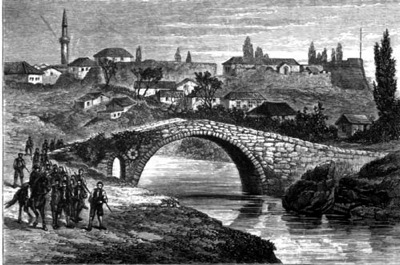
PODGORITZA. Page 177.
Close to the town was a rough sentry-box; out stepped a Montenegrin sentry, quite a boy, and challenged us. We amused him by showing him our passports, which he gravely considered, first upside down, then sideways; then he held one up to the sun, then shook his head and returned them. He questioned Marco as to what we were. "These are consuls Inglesi," replied the faithful one; "English consuls on the spree." This was sufficient. We were saluted and allowed to pass.
I believe that throughout our stay in Montenegro we were invariably taken for English Consuls, on a sort of happy-go-lucky holiday; anyhow, we were highly appreciated by all the natives we came across.
It was very amusing to hear Marco explain us to inquisitive people. Some passers-by would stalk by us—too polite and proud to stare or show any surprise at our appearance; but having passed us, they would stop Marco, and whisper to him, "What are these men?" "Great diplomatists," would reply Marco, with dignity. "Consuls Inglesi. That one in the spectacles is the head diplomatist. All great diplomatists wear spectacles, you know."
We passed through the ruined walls which surround Podgoritza, and marched down several badly-paved streets to the chief khan of the place.
Podgoritza is a considerable town, with a population, I should say, of 8000 at least. It is picturesquely situated on the east bank of the Moracha, a turbulent stream, and one of the chief feeders of the Lake of Scutari. A large proportion of the inhabitants are Mohammedans.
The treaty of Berlin handed over this important Albanian fortress to Montenegro. The Black Mountaineers had only occupied the place a short time before our arrival. But all seemed to be going on peaceably; the inhabitants appeared quite reconciled to their new government.
Our khan had been recently the house of a wealthy Mohammedan, and was quite an imposing building. An archway led through to a court-yard, surrounded by stables; above the stables run a wooden gallery, on to which opened the various apartments. It was exactly like some of the old-fashioned inns of the posting days, which one still comes across so frequently in Normandy.
We had a very pleasant chamber handed over to us for our use. A window filled one side of it. As this window was unglazed, this was rather a chilly residence at this time of the year, when the bora blew strong and fresh from the snow-capped mountains. In our honour, one half of the window was glazed. I suppose this exhausted all the glass in the town, for no effort was made to complete the work, though we were here for several days. A divan ran round the wall, on which we were to sleep. They cooked for us at this hotel, but there was little variety in the cuisine; one day stewed fowl and stewed mutton, the next stewed mutton and stewed fowl, and so on. We found there were some bottles of Cyprus wine downstairs, at the bar. We very soon exhausted these, for Cyprus wine seemed a great delicacy, after the rough Albanian wines and rakis.
After breakfast Robinson and Marco rode off to Cettinje, fifteen hours from here, to fetch the tent and the rest of their baggage.
While they were away we explored the town, and made the acquaintance of a very good fellow, Gospodina Milosh, the government armourer, who was now very occupied in putting into order the rifles which the mountaineers brought down to him, anticipating the invasion of Albanian territory, the orders to march being daily expected. This gentleman had been sent to Vienna to learn his trade, and spoke German well, so was a useful interpreter for us during our stay.
There was a large building adjoining our hotel, which was occupied by the minister of war for Montenegro. It was he who led the highlanders in those successful battles they fought with the Turks on the Herzegovinan frontier during the last war. His name I have forgotten. Every morning we saw him and a dozen chiefs, and others, stalk up and down the river side in front of our window, for it was out of doors he transacted his business, received his despatches, gave his orders, and formed plans for the investment of Gussinje.
The next morning we went outside the town with our landlord (who by the way was a sergeant in the army, as the metal eagle in his cap betokened), for a little practice with our rifles.
We easily beat the natives on this as on all other occasions, and gave them a very high idea of our skill as rifle shots.
I hit the target (a pocket handkerchief) at a 200 yards' range, at the first shot, which so pleased the spectators that they gave me the name of the "dobra Pushka."
There is a little bazaar in Podgoritza, through which we strolled. We purchased some of the native caps, for it is always advisable to wear these when in Montenegro; the people like one to assume their national head-covering, and have a strong dislike for European hats.
We tried to catch some fish in the river, but failed, so returned to our caravanserai for our usual mutton and fowl. A curious lad waited on us—he was very open-eyed and solemn, his dignity was not to be disturbed by any amount of chaff. We called him Johnny, and spoke to him in any language that came handy, "Asht hazer bouka, donno me hongr?" (Is the food ready? we want to eat) was a sentence—half of which, by the way, is Sclav and half Albanian—which was frequently inflicted on him. "Yest, yest, hazer" (Yes, yes, it is ready) was the welcome answer he vouchsafed to us on our entry this evening. Yest, which literally signifies "It is," is the affirmative in this language, and at first surprises an Englishman by its resemblance to his native "yes."
CHAPTER XIII.
War preparations—Our camp visitors—An impromptu ball—English Consul fashion—Robbers—Ruins of Douka—A dangerous bath—Bastinado—Karatag yok mir.
The following day we took a walk in the country, with our friend the armourer. The sheltered hollows literally swarmed with tortoises; one could count as many as sixty within the space of a few yards. A gap was pointed out in the distant hills behind the town, where was fought one of the most sanguinary battles of the last war—the battle of Medun—in which Prince Nikita gained a signal victory.
Our friend told us some wonderful story about a rich Turk who inhabited the present ministry of war some four years ago, before the war broke out. He was tyrant of Podgoritza, and forbade any one to bear arms in the town. This restriction seems to have excited the wrath of the Montenegrins, who were wont to come down to the Albanian city on market-day. Two of these daring highlanders came into the town one morning, concealing pistols on their persons. They met the aforesaid rich Turk in the bazaar, called him a dog and a thief, and thereupon blew his brains out.
The Mohammeddans then rose, and put every Montenegrin in the town to death—some twenty or thirty.
This, he said, was one of the causes which led to Prince Nikita's taking part in the Russo-Turkish war.
We had invited our new friend to sup with us. He seemed to appreciate fowl and mutton very well.
He gave us much interesting information as to the prospects of war and other matters. He said that artillery was already posted on the heights above Gussinje, and that the prince's troops would not be long in driving out the enemy. He told us he was not allowed to fight himself, his services as armourer being so exceedingly important. This was a source of great grief to him. In the last war he ran away from his work and joined the troops. The prince caught and rebuked him, sent him back to his forge, and told him to consider himself as a prisoner there. He once more sneaked down to the front during a great battle, his warlike ardour being too much for him. This time again the prince found him out, but could not refrain from laughing, and was obliged to pardon him.
The next day Robinson rode in with both horses. He had made rather a muddle of his errand, for having come down from Cettinje as far as Rieka, he then left Marco, to bring the tent and baggage on by londra to a place called Jabiak. It ultimately turned out that Jabiak was just as far from here as Rieka was. Brown rode off with a guide to this place, and then found the unhappy Marco sitting alone, disconsolate, tobacco-less, on the white elephant, mid the sedges by the shores of the lake, waiting till he should be called for. Brown described him as being an indescribably piteous object, as he meditated alone in that dismal swamp.
When, on the following day, Brown, Marco, the white elephant, and the two horses returned, we held a council; and though all unanimous in desiring to leave Podgoritza as soon as possible, could not decide as to whither we had best go until this dilatory war, which had been promised us by Robinson and Jones as an inducement to postpone our Albanian travels, should commence. As we discussed warmly the armourer came in, and said, "The minister of war wishes to see you as soon as you can give him an hour." "We can come now," we replied. So he ushered us into the reception-room of the war ministry, where sat the courteous and handsome old veteran, looking fully twenty years younger than he is. We sat on a divan, and were presented with coffee and cigarettes in the Turkish style. The armourer acted as interpreter, translating the general's words into German, which language both Jones and Robinson understood well. He said "he was exceedingly glad to see English travelling in his wild native country, and trusted we liked the people. Go all over it," he added; "you will be safe. Pilfering and highway robbery are quite unknown among us." On being questioned as to the preparations for war, he said, "It was to tell you about this I desired to see you. You wish to see the campaign: you shall do so. You shall come with me as my guests. My servants shall be yours. On no account leave the country just yet. What will be done will be worth your seeing." On being told that we were rather pressed for time, he went on to say, "Negotiations are pending at Constantinople. In four days we shall know all. Come to me then, and I can tell the very hour we march. That war will be, I am certain. The Albanians are sure to resist. Prince Nikita too has sworn to take Gussinje. It is his by treaty. We will take it, and no quarter will we give the dogs. Why should we? They are rebels. Turkey says she has given up the place to us, and that it is not her fault if the inhabitants resist. We will not spare one of them. If you wish to see something of the country before you see me again, go to Douka, where the great ruins are—they are worth visiting—then you can return here."
This proposal pleased us, so the commissariat was sent out to procure a large quantity of raki, mutton, flour, and other necessaries. Robinson was anxious to try the white elephant as soon as possible, so it was determined to take one of our horses to bear our impedimenta, and march out to as near Douka as we could manage this afternoon, and then camp for the night.
Douka is situated on the right bank of the river Moracha, some miles above Podgoritza.
Our landlord came with us, for as the sun was setting we did not expect to march for more than an hour, and he wished to see us comfortably settled for the night. Marco we left behind.
We marched on the left bank of the Moracha, thus cutting off a long loop which the stream formed here, and by sunset had arrived at a spot just opposite to the ruins of Douka, the broad and foaming river dividing us from it.
We pitched our tent in the plain not far from the precipitous edge of the river. The white elephant certainly looked very imposing, and was very comfortable. We unpacked the horse, and arranged all our property in an orderly manner in our new home. Then our landlord rode back to Podgoritza. The sun was now setting over the western hills, so we lost no time in cutting down some of the brushwood, and making a large fire some ten yards from the entrance of the tent; the pot was then put on, and a tasty stew prepared of mutton, grease-meal, onions, pepper, and salt.
I do not know whether, in Montenegro, to pitch a tent and light a fire signifies a general invitation to the country-side to come and make merry and carouse, but that was the result on this occasion. As night set in, first one and then another armed highlander would drop in, walk into our tent in the calmest manner, quite sans gêne, shake us by the hand, with a "Dobro Eutro Gospodina," then sit down, roll himself a cigarette, and commence smoking. At first we thought these people rather cool, but they were so polite that it was evident they did not imagine their conduct to be in any way extraordinary.
At last a large crowd had assembled round our tent—a very curious people. Where they came from we could not imagine. Houses there were none in sight. They seemed to have no homes, no occupation. It was a matter of utter indifference to them where they were at any time, or where they slept. We were at this encampment for two days: all the time they remained outside the tent in a most contented matter. They were just as well there as anywhere else. After dinner we provided coffee and raki for our visitors. Then an impromptu entertainment followed. Robinson and myself gave a conjuring entertainment for the amusement of the wild people. We sat at the remote end of the tent. About seventeen of the audience sat inside in a double row: these were the swells in the stalls. The gods outside filled up the open door and looked over each other's shoulders, in a compact and surging mass. The conjuring was much appreciated by our audience.
When we had exhausted our repertoire of tricks, all cleared out of the tent, which had become very stuffy. It was a magnificent night. The moon was rising over the distant mountains, and there was not a breath of air to stir the rising smoke. We piled up the fire and made up a glorious blaze, which threw a bright light on our fantastic visitors. They were all now very merry and boisterous. They wrestled, sang, and ran, like a lot of children. Why not get up a ball? proposed some one. It was a happy idea; every one fell into it with delight. With loud shouts and wild gestures they whirled round the fire hand-in-hand, treading energetically, almost fiercely, a measure of their own. There were two charming young ladies in the crowd, who were the decided belles of the ball—Neda and Zekitza. Zekitza made a great impression on Robinson's sensitive heart. She was a powerful young lady, for once she disagreed with one of her partners about something, and caught him a resounding slap, which felled him to the ground. She also wrestled with another youth, and easily laid him low. It was a curious scene; not the least curious object was the gallant Jones handing round refreshments—raw raki in a saucepan, which girls and all partook of freely.
"Verily," the Montenegrins must have thought, "these are consuls Inglesi, and they do things in right good English consul fashion."
It was rather difficult to get rid of our guests when we wished to turn in for the night. That any one should like privacy at times is incomprehensible to Montenegrin or Albanian highlanders. They walk into each other's huts, uninvited, at every hour of the night, to chat and drink coffee. They seem to need a very small amount of sleep. I found, in the cabins and khans we visited, it was the rule to turn in about twelve and be up again at two, jabbering and coffee drinking; for it is not that they have any work to do that these people are so early in rising. After all, when you have no dressing or washing to get through, getting up early becomes easier than when the complicated toilets and tubbings of the Anglo-Saxon are before you.
When we arose the next morning the cook was horrified to find that a saddle-bag, containing our mutton and tobacco, had disappeared in the night. A burglarious entrance must have been made into our tent while we slept. We remembered having seen two suspicious-looking young fellows prowling about the camp during the ball, who were evidently strangers to the rest of the Montenegrins present, and who seemed to be shunned by them as disreputable vagabonds. These doubtlessly were the thieves.
One of our visitors, seeing us searching for something, understood the state of affairs, and told us by signs he would soon recover our property. This we thought rather improbable; but he knew what he was promising, as events showed.
The peasantry kindly brought some provisions to our camp this morning. Tubs of veronica, a sort of sour milk, goat's-milk cheeses, and wheaten cakes.
As our tobacco had all been stolen, I mounted Rosso and galloped into Podgoritza, to procure some more. On my return to the camp we started for the ruins of Douka, all our new friends following us. Further up the stream an ancient man had a boat, in which he ferried us over, three or four at a time. The boat was very rickety, and over-grown with moss; the boatman of great age, ragged, and of exceeding ugliness. He and his craft irresistibly called up Charon and his Stygian ferry to our minds.
Douka was evidently a Roman city. The peasantry gave us several coins they had found among the ruins; these were of the time of Diocletian, and bore his effigy. There was not much to see—a few ruined walls, and some slabs bearing illegible inscriptions, were all we could find. The ruins were thickly overgrown with brushwood. However, I should say this place would repay the labours of an excavator, for it must have been a place of considerable importance once. We amused ourselves with some rifle practice, and then returned to camp.
This evening Brown did a very imprudent thing—he washed himself. He went down to the river, stripped, and jumped into a deep pool. We warned him, told him he might be misunderstood by the people; but he was obdurate.
Some Montenegrins on the other bank saw him. "What is it?" they said, for at first they could not believe it was a man. Who ever saw a man with his clothes off—in water, too?
They were about to fire at the mysterious object, when somehow they recognized it as a human being. They were evidently much puzzled to know what on earth he could be doing there. Was this a curious religious rite of the Inglezi church? Was it a mystic ceremony connected with witchcraft?
We were bound to make some explanation for Brown, for we found the people fought very shy of him when he came out of the bath, and looked upon him with evident suspicion and dislike, so we put our fingers to our foreheads, shook our heads sadly, and intimated to them that our poor friend was not quite right in his mind.
The next morning we were awoke early by the sound of voices outside our tent. On looking out we found an officer of some rank, and several armed men, bringing two prisoners to us. These were the very two men we had suspected of stealing our mutton. Our saddle-bag and its contents were restored to us by the captors. They had tracked the fellows up into the mountains during the night, with the assistance of a bloodhound. The officer stayed to converse with us awhile in very limited Italian.
As for the prisoners, he merely turned to them, pointed towards Podgoritza, and said "Go." They obediently skulked off in the given direction, and awaited him in the bazaar.
We found afterwards that the poor fellows were sentenced to be bastinadoed, thirty cuts on the sole of the foot each, and were then imprisoned for some days in a sort of open prison or cage.
We had exhausted the charms of Douka, so packed our baggage, and marched back to Podgoritza. Robinson superintended the lowering of the tent. This was the sole occasion during the whole tour on which the white elephant was brought into use. It was afterwards mildly suggested to its inventor that it might be a question whether all the tribulation and expense attending its carriage was made up for by these two nights' encampment on the plains of the Moracha. He was silent on the subject.
On arriving at Podgoritza we at once called on the minister of war, to learn the latest news of the war. He had heard of our little adventure with the mutton pilferers.
He was much amused at our account of it. "Ah!" he said, "and I had only just told you that robbers were unknown in Montenegro." As to the war, he had no news to tell us. Orders to advance might come to-day, might not come for a month. He knew no more than we did.
We left him, and retired to our chamber at the khan. After dinner we were smoking silently and sulkily, when Brown, addressing Jones and Robinson, sternly said, "This war of yours is a fraud, you have brought us out here under false pretences." I joined in to assist my ally, and laid stress on the delights of Brown's and my own projected march to Janina, which we had put off to hunt this phantom war all over this uninteresting country.
After a warm discussion it was decided to march back to Scutari on the morrow. I communicated our design to Marco. The worthy fellow's face broke into broad smiles, as he whispered hoarsely, "Good, monsor, good; Karatag yok mir. Montenegro no bonne, no bonne." He evidently did not feel comfortable among his hereditary enemies.
CHAPTER XIV.
An escort—A Turkish dinner-party—Brigands—Our sportsman—A chief of the League—Objects of the rebels—Achmet Agha—A meeting of the League—The Boulem-Bashi of Klementi—An Arnaut chieftain.
The next day (Saturday, November 1st), after our black coffee, and the usual bustle attending the packing of our animals, we shouldered our rifles, and made a start. Our landlord insisted on our pouring down numerous glasses of raki in his house, and, according to the general custom over here, accompanied us to about half a mile or more from the town, when a halt was called. Then he produced a glass, and a large bottle of mastic, which had to be finished by us ere bidding a final adieu. We all highly approved of this good old custom.
It began to rain soon after we commenced our march, and the plain assumed very quickly that lake-like appearance which we had observed the last time we crossed it.
On arriving at the khan where we had slept on our march to Podgoritza, we found in front of it a large encampment of Turkish soldiers. We entered the house to get some coffee, and were then pounced upon by some of the officers, who wished to see our passports, and learn who we were, and whither we were bound. They insisted on sending an escort of four men with us as far as Helm, for, as they told us, we were breaking through all the regulations laid down by the government for the security of travellers in journeying thus without zaptiehs. That travellers should be thus escorted we knew to be the rule throughout Turkey, but we evaded it whenever we could. In Albania such an escort is worse than useless. In the first place, the zaptiehs will not venture to go with you into the mountains, where the Arnauts would probably attack them for the sake of their arms; and on the other hand, their company is sure to make you very unpopular in every village you go through, for these defenders of the peace consider they have a legal right to requisition provisions, and all they want, without paying for them.
On reaching Helm we found that the provision boat had left, thus we were obliged to pass the night here. Robinson proposed that we should pitch our tent. While we were discussing the point a Turkish officer came up, and spoke to us in French. He pointed out a dismal stone house by the lake side, and told us that the commandant of the troops stationed here resided in it, and would be very glad if we would accept his hospitality for the night. We were all delighted, with the exception of Robinson, who sighed deeply—his beloved tent was not to be pitched after all.
We were shown into a rough, unfurnished room, and dinner was soon announced. We dined with the commandant and the French-speaking officer, Marco and a negro soldier waiting on us. It was a regular Turkish dinner—no chairs, no knives and forks. We had to squat down in Eastern fashion, and eat the savoury pilaf with our fingers. After dinner we entered into a lengthy conversation with the commandant, the other officer acting as interpreter. He hated Albania, and the Albanians. "Why," he said, "these dogs of Arnauts should be smoked out of their fastnesses. My soldiers dare not leave the camp; if a few of them stray a mile or two away, 'ping, ping,' a dozen bullets hiss about their ears. The beasts murder them for their rifles. We might as well be in an enemy's country at once. I advise you to be cautious in travelling among these mountains. It is really very unsafe."
The conversation turned on politics. The old soldier seemed very excited. "Ay!" he said, "all our friends have forsaken us; you English even are no longer allies of the Turk. And this being so, why should we do anything for you? why assist you? why listen any more to your counsels? I will tell you, by Allah! there is but one stick left that Turkey may lean on. Her only hope is in an alliance with the strong, with Russia; that is what it will come to, you will see."
"I am afraid you will find that Russia devours her allies."
The commandant laughed. "There is something in that," he said. "The truth is, that poor Turkey has no friends, and no hope. We shall have to leave your Europe, I fear; but I do not think you will find that Turkey, overrun by Sclavs, will be so much better than it is now."
The next morning our host ordered a special londra for us, and ordered his men to row us down to a point on the lake, whence we could march to Scutari before nightfall. Our crew of ragged soldiers, grim, half-starved, some of negro, some of Arab blood, brought us, in about two hours, to a sheltered little bay on the east shore of the lake. Our course had lain across a regular forest of half-submerged trees, which grew in fantastic shapes, and whose lower ends were thickly surrounded with sedge and water-plants. The effect was curious, not unlike those tropical swamps where vegetable life is so profuse and varied.
On landing we repacked Rosso and Effendi, and were just on the point of bidding adieu to our crew, and commencing our march, when an incident worthy of mention occurred.
With the exception of snipe, and such like small deer, we had come across little game in Albania. The feræ naturæ have little chance in this barren country, where war is frequent, peopled as it is too by men who never leave their thresholds without carrying their loaded guns with them. But now, however, the keen eye of Jones suddenly lighted upon a large and unknown bird, perched on a stump not fifteen yards from the shore. It was a curious and melancholy-looking creature, something like a mangy pelican with a moulting tail.
Now Jones, my readers will remember, had purchased an Arnaut gun at Scutari, an orthodox flint-locked pushka, with barrel as long as himself. This weapon had been strongly recommended by the vendor for sporting purposes. On inspecting it, Jones noticed the barrel was most decidedly bent. He pointed this out to the merchant. "Bent! Ah, that is nothing," said he; "easily remedied." So saying he inserted the barrel between two of the beams of his roof, bent it straight, squinted down it, and handed it back. "There you are! Excellent pushka!"
With this weapon Jones proceeded to slay the mysterious bird on the stump. Marco and the soldiers, on observing his intentions, became very alarmed. "Do not shoot here," said our follower. "The noise will bring down the Arnauts upon us; they will kill us."
But the sporting instinct of the Englishman was up. Slowly and warily, with the lengthy pushka held out at full-cock, with finger on the trigger, Jones crept nearer and nearer to the lake's edge. His reputation as a mighty Nimrod in the stubble of his native land was at stake. All our reputations were at stake as Inglesi, and therefore of a race of sportsmen.
Silently, yet excitedly, the soldiers watched. The eyes of Marco gleamed as he looked round. He was proud of us. "Now, you look out; you watch," he whispered to the men. He nodded his head with a knowing nod, that unmistakably said, "You will see." And "I told you so!" was ready to jump from his lips as soon as the report of the gun awoke the echoes of the wilderness. Our Nimrod crouched down; there was a pause; a great suspense. Then his finger pulled the trigger; the lock snapped! There was a fizzing sound, as of those "devils" the school-boy makes of damp powder. With the fizzing there rose a pale blue smoke from the pan. The bird heard the sound, looked round at the stranger and his fizzing instrument curiously for a time, then, having satisfied his curiosity, he deliberately shook himself, spread his rickety wings, and flew slowly and majestically over the lake. It was nearly out of sight when there was a report. The pushka went off with an imposing bang that awoke the echoes of the mountains. A roar of Homeric laughter burst from the assembly.
In the rainy season of Albania it becomes very difficult to preserve the powder in the pan of one's gun in a properly dry condition. After a few days it becomes a slow fuse. But Jones soon mastered the ways of his mighty pushka, and was fairly successful in his future sporting expeditions; for having carefully timed the fuse, his method was to take aim and fire at least ten minutes ere the game was even in sight.
It was pitch dark when we reached Scutari, and walked through the abominably roughly-paved streets to the Hotel Toshli, where the brothers received us with open arms.
The next morning we held a council, to decide whither we should wander next. We came to no immediate conclusion, as there was great diversity of opinion. As Robinson was expecting a remittance from London, we should most probably have to remain a few days at Scutari. Having nothing better to do, we persuaded our friend the gendarme to introduce us to a chief of the Albanian League, who was a friend of his.
The interview had to be arranged with caution, for, as our friend said, "They know here you have been to Montenegro, and may suspect your motives in wishing to question a member of the League."
It was settled that we should go to the gendarme's house in the afternoon; there the chief in question would meet us.
In the afternoon Jones and myself were shown by the gendarme's Miridite servant into a room, where, squatting on mats, coffee-drinking, were our friend and a shrewd-looking old Albanian Mussulman, with deeply-lined face, and anxious and restless eye. After the customary salutations I entered into conversation with him, the gendarme, as usual, acting as interpreter.
I told him the English wished to know what were the objects of the League.
"Our object," he said, "is to defend our countries against the enemies that surround us. The dogs of Montenegrin, the Servian and Greek swine, all wish to steal a portion of Albania; but, praise be to Allah, we are strong. The Albanians are brave; and guns and ammunition are not wanting."
He tried to sound me as to the views of England, for he thought this frontier dispute was absorbing all the attention of our countrymen. He said, "England is our friend. They all say here she has supplied the League with weapons and money."
That some power—most probably Turkey—has assisted the League in this way, is certain. But it is curious that all the Albanians I met were positive as to England being the friend in question.
The Government of Turkey does not find favour in the eyes of the Albanians. "The Turks!" cried out the chief, angrily, "what do they do for us? Tax us, rob us—that is all. These effeminate pashas, these farmers of customs, do nothing for us in return for what they steal. Can they defend us? protect us? No! They have sold us to the cursed giaours of the Karatag. I tell you we will have the Turk no more. The chiefs of the League have sworn it. Independence has been given to Montenegro—to Bulgaria. Albania shall have her independence, and the great powers shall recognize us. If not, we care not. Leave us alone; that is enough for us."
He had now worked himself up into a furious rage, and was almost choking with it; so he stopped, drank some sherbet, then turning suddenly to me, said, "What do you English think of Midhat Pasha?"
"He is much liked by us," I replied. "He is looked upon as one of the few honest and worthy Turkish officials."
He seemed very pleased at hearing this, and said, "What we wish is to create an independent Albanian principality, with this Midhat Pasha as our Prince—a principality under the protectorate of England. You will see we shall have it."
I asked him whether this League was a purely patriotic movement, or whether it was a religious one, confined to Mohammedans only.
"We are fighting for our independence," he replied. "There are as many Christians in the League as Mussulmen. You know the Christians here are of the Latin Church, and hate the Greek Christians as much as we Mohammedans do."
He told me that one party of the League were not averse to the occupation of Albania by some big power; not Russia, he said, nor Italy, nor Austria; but England or France. For his part he did not wish this.
With regard to the defence of Gussinje, he said, "We have 35,000 men there, who will fight to the death. The Montenegrins cannot take Gussinje. Why, they never yet have fought us in the plain. The beasts can fight well enough behind their own rocks, but they are cowards to attack. When the Skipitars raise their shout, and charge with the yataghan, the Karatags tremble; they turn, they fly. Then we pursue them, seize them by their long hair, and with a sweep of our blades cut off the beasts' heads. Ah! it is sweet to see." And turning sharply to me, "Why do not you go to Gussinje and see the fighting? Parties leave Scodra every night for the front. I will give you a letter to Ali Bey. He will welcome you as a brother."
The proposal was pleasing; Jones and myself at once agreed to accompany the next party to Gussinje. We knew that the expedition was rather a risky one. The garrison of Gussinje had been worked up to a high pitch of fanatical madness, and might treat us with little ceremony did they hear of our journey into the enemy's country. Under these circumstances we thought it better that two of our party alone should go to Gussinje, while the other two could make a sporting expedition into the mountains beyond the plains of Scutari.
The next morning accordingly, Brown and Robinson, taking Marco with them, shouldered their rifles, strapped their blankets on their shoulders, and marched off towards the Miridite mountains—a lofty and wild range, inhabited by the tribe of the same name, the most savage and desperate of all the Christian highland class, a race that has waged a perpetual war with the Turk for centuries. The Miridites are exceedingly poor, in a condition of half starvation, for bodies of Turkish troops ever and anon make incursions into the debouchures of their valleys, driving off their flocks, burning their villages, and compelling them to fly for safety into the cold and utterly barren highlands.
The gendarme brought to our room at Toshli's, the morning of our friends' departure, another member of the League, a chief of influence. He slipped off his shoes at our door, and shuffled in, a short-legged, stout, dropsical old fellow, with not over-clean festinelle, and a four days' beard: he had the fierce eye which is the characteristic of the Northern Albanians. The shaven head too of the Mussulman lent a peculiar ferocity to his expression. I never cast eyes upon a more blood-thirsty-looking old scoundrel. "Will your friend take some coffee or sherbet?" I asked the gendarme. "He likes raki best," was the reply, "when no one is looking on. He is not a very strict Mohammedan in this respect." I found few Albanians indeed had very delicate consciences when raki was in question.
This gentleman, who was introduced to us as Achmet Agha Kouchi, kept a coffee-house in the Mohammedan quarter of the town. He purposed going to Gussinje in a few days, and would be pleased if we would accompany him.
We were to visit him at his café in the afternoon, to arrange matters.
After lunch we traversed the dismal streets of the Turkish quarter till we reached the little café of our new friend. It was full of Leaguesmen, who had evidently come to inspect us. I wish I had taken a sketch of that interior. No slum of an Eastern city could show a group of more cut-throat-looking, fierce ruffians than those Scutarine conspirators.
They did not rise when we entered, but stared at us with savage, lowering looks, that betokened suspicion and hatred of the giaour.
Achmet Agha told us that a party would start the night after next for Gussinje; and that to-night there would be a meeting of the Scutarine Leaguesmen, in the mosque near the river, to decide whether we should be permitted to visit the besieged town.
In the morning he would let us know what had been decided.
In Toshli's this evening, I read an account in a Trieste paper of a battle which had been fought near Gussinje, in which the Albanians had been victorious. Rumours of all kinds had for days been flying about the bazaar; but though Gussinje is but a three days' march from here, nothing certain was known. Indeed the Scutarines were entirely without information on the progress of matters.
Some excitement was caused by the departure of Mr. Green to-day for Cettinje. He had of course gone thither to take a part in the negotiations now pending, the Turks having sent a representative to the Montenegrin capital, to try his utmost to arrive at an amicable solution of the difficulty. The Scutarines, however, were quite certain that Signor Green had gone off to threaten Prince Nikita with an immediate declaration of war on the part of England, did he not without delay withdraw his troops from the frontier.
The League met as usual at midnight, in the mosque, and till daybreak discussed Jones and myself. The meeting was described to us. Said some: "Let them not go; who knows that some of the men of Gussinje will not murder them as giaours? Then what difficulty we shall be in. We will have to avenge them, for they are our guests; there will be strife between the defenders of our country, and the dogs of Karatag will rejoice. Again, their blood will be upon our heads. Zutni Green will be wrath. The English will be our friends no longer."
However, the dissentients were in the minority. The League of Scutari gave its permission to our departure.
We were advised to wear the fez instead of our English hats, as this would reduce the risk of our irritating the intensely excited inhabitants of Gussinje: accordingly we purchased two of the orthodox head-coverings.
Achmet Agha again called on us; he seemed rather uncomfortable. We could see he had heard something about us, and did not like to carry out his promise. Said he: "Who are you? Why do you wish to go to Gussinje?" We replied: "In England we will write a book. The English wish to know what the Albanian League means, whether it is good. It is for that we wish to go to Gussinje, that we may see, and be able to tell our countrymen the truth." "Ah," he said, "so your 'krail,' your chiefs, have sent you for this. Mir, mir—it is good."
Then he paused, and said abruptly, "We shall not go to-morrow."
"Why not?"
"Because we know not how the other Leaguesmen will receive you. We must first send to inquire of our general, Ali Bey, if he will have you."
This did not sound very pleasant to us. Ultimately he agreed to take us on the morrow to a hut two hours distant from Gussinje; there he would leave us while he rode into the town, to acquaint the chieftains with our wishes, and obtain permission for us to visit Ali Bey.
The next morning we rose at daybreak, and found a strong "bora" was blowing, and the snow lay thick on the distant mountains.
We prepared for the start.
Luggage we took none, except one blanket; but as it promised to be exceedingly cold in the mountains, we each put on two flannel shirts and two pairs of socks.
Achmet Agha called two hours after his time; he seemed confused and troubled. Our host, Toshli, came forward as interpreter, for I managed to make out a good deal he said. With him I conversed in a strange mixture of Italian and Greek, one of the six compound tongues I had to invent in Albania in order to get on with the different people I met.
Said Achmet Agha, "I cannot go with you. I have been told by the authorities that if anything happens to you I shall be held responsible; my house and property will all be confiscated. Besides, I have to tell you that you are forbidden on any account to go to Gussinje; the pasha will not have it." This all seemed very strange. That the Turkish pasha and police authorities should have acted thus seemed improbable. We afterwards found they did not even know anything about our intended journey.
We did, however, hear something later on, which led us to very strongly suspect that the attempt to stop us originated in a certain foreign consulate at Scutari.
Naturally suspicious and jealous of English influence in Turkey, the representatives of this power concluded that our government had sent us here on some secret errand; and so, not being able to discover the object of our mission, attempted to frustrate it altogether in an underhand manner.
Jones and myself had now thoroughly made up our minds that we would go to Gussinje, in spite of an over-officious consul, so we proceeded to hunt about Scutari for a guide and dragoman.
No one could we find. Those we spoke to smiled grimly, drew their hands significantly across their throats, and emphatically objected to go anywhere near the hot little town.
One person, however, did volunteer to accompany us. This was the English Consul's cook. He was a plucky little Albanian, very vivacious and clever. He spoke two words of nearly every language in Europe, and in default of better, would make a very fair dragoman for us. He had adopted European costume, and wore jauntily on his head an English army forage cap, the gift of the British sergeant who accompanied the frontier commissioners last May. This cook was a man of some rank. In Albania, a calling such as was his is not derogatory to a gentleman. We had made his acquaintance at Toshli's, where he was famed for his skill as a billiard-player. He went to Mrs. Green, told her of our intended journey, and implored her to give him leave of absence, in order that he might guide and protect the Inglezi travellers. Alas! It could not be; his presence was indispensable in the consulate kitchen. Cooks are not to be picked up every day in Scutari, at any rate such cooks as this, for we had several opportunities of perceiving how skilled he was in his profession, under Mr. Green's hospitable roof.
No one to be found to come with us! This looked bad; we almost despaired of effecting our purpose, for to find our way alone across the roadless mountains would have been impossible. To have travelled among the savage Arnauts, without knowing ten words of their language—madness.
As we discontentedly discussed the question in our bedroom, the head cavasse of the English Consulate was announced. He brought with him a tall, handsome, and very pleasant-looking Albanian Mussulman, evidently a man of high rank, superbly dressed and armed. "This," said the cavasse, "is the Boulim-Bashi of Klementi. He will accompany you to Klementi, which is a day's march from Gussinje. There he will hand you over to the chieftain of the Klementi, Nik Leka, who is a friend of Signor Green. He will say to Nik Leka, these are friends of Signor Green; treat them as his brothers, and if the danger be not too great take them to Ali Bey."
My readers can imagine our delight. We could not travel under better auspices. The condition of a boulim-bashi is curious. The Turks, as I have before said, have never really conquered or assimilated Albania; the Christian highlanders are allowed considerable independence. Now, each Arnaut tribe is obliged to elect from the Mussulmen of Scutari a representative, a sort of consul, who mediates between it and the Turkish Government, who acts as their advocate in case of any dispute. As he is chosen by the tribe from among the townsmen of rank, and as he can be dismissed any day if the highlanders in any way object to him, the boulim-bashi is always a popular man, liked by the tribe he represents, and a very safe person in whose company to travel among the highlands, for he is sure to be known to, and treated as a friend, by every man met on the way. It was a great honour to be thus escorted, and we afterwards discovered, the cause that led to the kind proposal. The men of Klementi are deeply indebted to our consul, who took their part in a certain quarrel between them and the Turkish Government, in which justice was entirely on their side. Grateful for this, the Klementis are ever glad to do any service for Zutni Green. Thus it was that we as friends of the consul received this invitation. The Klementi is the most powerful tribe of this district. There are 6000 fighting men, all armed with Martini-Henry rifles, stolen from the Turks. Their chieftain, Nik Leka, to whom the boulim-bashi was to escort us, is the hero of the Scutarine Christians. The timid townspeople of the Latin faith, unarmed as they are by law, live in fear of the Mohammedan population, who have more than once fallen on and massacred them. It is to the armed Arnauts of the hills, their fellow-Christians, that they look for protection, for these are better warriors than the Mussulmen themselves, never have been a subject race, but stalk, bristling with arms, through the bazaars of the cities on market-days, as erect and haughty as the most blue-blooded young Mohammedan emir of them all.
This Nik Leka had a little adventure recently in the bazaar of Scutari. He was discussing some matter with a young Mussulman of rank, who had three retainers with him. A quarrel ensued. The other called the Arnaut chief a dog of a Christian. Nik Leka is a man of few words. He whipped out his yataghan with his right hand, seized his enemy by the little tail of hair which the faithful leave on their closely-shaven heads to give Mahomet something to lay hold on when he pulls them into Paradise, and the next moment there was a flash of bright steel, and the Arnaut held up a bleeding head, while the body fell into the foul gutter below. The man's retainers fell upon Nik Leka, but the wiry highlander was too much for the effeminate townsmen. He slew two of them, the third escaped; then he picked up the three heads with a grim smile, tucked them under his arms, and marched off to his mountains, where he exhibited the ghastly trophies to the tribesmen.
CHAPTER XV.
To Gussinje—The valley of the Drin—A rough road—In the mountains— Hospitality—A pretty woman—A scientific frontier—Franciscans—Dog Latin—Marco Milano.
It was settled that we should start early on the following morning. Then the boulim-bashi bowed low, shook hands, and left us. We had learnt something of the nature of the place we were about to visit from Mr. Green and others. About three days' march from Scutari, across the great Klementi mountains, there is a long and beautiful valley, which penetrates deeply into the central range of the Mount Scardus. Down this valley flows the White Drin, a stream of considerable importance, that flows into the Adriatic, near Alessio. In this valley are Ipek, Jakova, and Priserin, three of the most interesting cities of Albania, inhabited by a population very skilled in the working of metals. The most beautiful saddlery, filigree work, gold-hilted and jewelled yataghans and pistols, are here worked by an industrious people.
But the population of these towns is ferociously fanatical. Surrounded as they are by Christians, knowing that the day is not far off when the rising ambitions and energies of the oppressed race will drive them from their homes eastwards and southwards, the Mohammedans here hate the Christians with a hatred more intense than even the followers of this fanatical creed entertain in other parts. At the very head of this valley of the Drin, where the river springs out from the grey rock, is a ridge of forest-clad mountain, the ancient Pindus, which forms the watershed of the tributaries of the westward-flowing Drin, and Bojana, and the Lim, a river that flows northwards, joining the Drina and the Save, across Bosnia and Servia, till it ultimately pours its waters into the mighty Danube at Belgrade. At the head of the valley of the Lim, situated in the centre of a green and fertile cirque, surrounded by stupendous mountains, is the little town or village of Gussinje, a congregation of sordid wooden huts. It is a place of great strategic importance, for just behind it, on the ridge of the forest-clad mountains, Montenegro, Bosnia, and Albania join.
By the provisions of the treaty of Berlin, Gussinje and its neighbourhood was handed over to the Black Mountaineers—wherefore it is difficult to see.
As conquerors in the war, it seems just enough that the Montenegrins should have acquired Antivari by that treaty, a place of no strategic importance, yet which gave them what they so long and eagerly thirsted for, a seaport. But it was decidedly a mistake to extend Prince Nikita's territory beyond the mountain ridge, a natural frontier, down into the valley of the Lim, giving a command of it—a standing menace to Turkey and Bosnia, a bone of many future contentions. It must be remembered, too, that the inhabitants of the district to be given up are not Sclav in race or language—not of the Greek church—but Mussulmen or Roman Catholics. The Montenegrins have been made too much of lately. They now imagine that they are a great people, and have a holy mission of aggrandisement at the expense of Turkey.
Gussinje is a curious sort of a place, and has never enjoyed a very sweet reputation. As in all parts of Northern Albania, the people do pretty much what they like, and do not feel the Turkish yoke very heavily. Situated as it is on the frontier, it has become a city of refuge. Montenegrin renegades whose country has become too hot for them, Bosnian Mohammedan refugees, and vagabonds of all sorts, have flocked hither. It is in this town of Gussinje that the chiefs of the Albanian League have concentrated their forces, determined to fight to the bitter end, in spite of the Austrian troops in Bosnia to the north of them, Turkish troops in their rear, Montenegrins before their walls, and the doubtful neutrality of the Christian Arnauts, who are all round them in the mountains, lying in wait to murder and strip small parties of either side—for this is the idea of neutrality among these people, an armed neutrality with a vengeance. Thirty-five thousand Albanians, we were told, occupy Gussinje, at the head of whom is Ali Bey.
Ali Pasha, as he has styled himself, is a Gussinian of rank, owner of lands and houses in the town and neighbourhood, a man of great intelligence, and a devout Mussulman.
He was one of the principal people implicated in the assassination of Mehemet Ali at Jakova.
This general, as my readers will remember, was sent by the Porte on the dangerous mission of negotiating the transfer of Turkish territory to her enemies. He was strongly advised not to venture into that hotbed of fanaticism and fierce patriotism, Jakova. The League held possession of the town; the population was worked up to the highest pitch of excitement; every one knew the history of the envoy. As a foreigner, a Pasha's favourite boy, a renegade, he was certain to be disliked and suspected by rigid Mussulmen, and was the very last man that should have been sent on so delicate an errand. It is rumoured that the jealousy of his enemies at Constantinople sent him on this surely fatal journey.
His death was decided on by the League. The projected murder was talked about freely in the bazaars of Albania fully two weeks before it was perpetrated. Contrary to advice, he entered Jakova. He had not long been there before the house in which he and his companions were shut up, was besieged by a furious mob. One man, a Franciscan father, whom I met at Scutari, was with him, and managed to escape, disguised as an Arnaut.
Mehemet, seeing that resistance was hopeless, died like a brave man. He opened a door, rushed out, unarmed, with hands stretched out, into the thick of his enemies, crying, "Kill me, but spare the others." He was beheaded, and his head was stuck on a pole, and held up to the jeerings and desecrations of the populace.
We were up at daybreak the next day. It was a sunny, exhilarating morning, that seemed to send fresh blood coursing through our veins as we mounted Rosso and Effendi, and rode through the Mohammedan quarter to the house of the boulim-bashi. Our luggage was simple enough. I had one blanket and my waterproof, strapped behind me on Effendi's saddle; while Jones carried, in the same way, a saddle-bag of provisions and his waterproof. The house of the boulim-bashi was enclosed within lofty walls, as are all the residences of the Mussulmen. We were ushered into a large room, where the brother of the boulim-bashi received us smiling, and motioned to us to be seated on the luxurious cushions which were strewed on the thickly-carpeted floor. He was a tall and very handsome man, like most of his countrymen, possessing small, delicately cut features, and tiny hands and feet. He looked like an aristocrat, and his costume was exceedingly rich.
The boulim-bashi came in with coffee and sherbets. He had thrown off the dress of the town, with its ample festinelle and rich linen, and had donned the simpler dress of the Arnaut chieftain, which showed off his fine person to great advantage. His cartridge-boxes betokened the man of rank, being of gold, beautifully worked, as were the handles of the pistols in his variegated silken sash. The coffee was prepared over a silver brazier on the floor, and the cups were handed to us on trays, covered with napkins cleverly embroidered in coloured silk and golden thread. We found that we were expected to take these napkins away with us. We did not know the custom, but our host soon set us right.
There is something particularly pleasing and refined in the manners of the high-caste Albanians. Their politeness is charming; they anticipate your every want; and their movements have a cat-like softness, noiselessness, and suppleness about them, which is very striking.
The boulim-bashi seized his Martini-Henry, leapt on his horse, an active-looking little grey, with undocked mane and tail.