Front matter (continued 2)
Reading edition
We dined at the table-d'hôte of the Prince's hotel to-day, in very aristocratic company.
The highest officers of the little State are regular habitués of the hotel dinner.
We sat down with the court painter—a young Ragusan who had travelled in America and France, and spoke a curious English, with a half foreign, half American accent, freely larded with Yankee idioms; our landlord; the Secretary of State, the Minister of Foreign Affairs, and the Prince's adjutant.
The latter is a handsome young fellow, a cousin of the Prince, and with him has been educated at the Lycée St. Louis le Grand, at Paris. All the grandees were in full Montenegrin dress, bristling with pistols and yataghans; for in Montenegro the men do not put by their weapons when in a friendly house, as is the case in Albania.
The conversation turned on politics. Mr. Gladstone, of course, was their hero. They were all well acquainted with his pamphlet, which has been translated into their tongue. The hatred they expressed for Lord Beaconsfield was intense. They were by no means reserved in the terms of their abuse.
There was one thing that excited their astonishment to a great degree. "You Englishmen," said one, "Christians—civilized—a great people! How comes it that you allow a Jew to govern you?"
Seeing that we were not quite of one mind with them, and were not such great admirers of Holy Russia as were they, they politely turned the conversation.
We then got on the subject of the perpetual wars on the Turkish frontier, which in ferocity and romantic incident excel the old feuds of our Northern border-land.
A man happened to enter the room while we dined. Our landlord introduced him to us as a very brave fellow, who had cut off twenty-three heads in one battle of the late war, and who, in consideration of his prowess, had received a medal from the hands of the White Czar.
From cut-off heads and noses we got on the subject of Prince Nikita. His praises were loudly sung. This autocrat is greatly beloved by his people. He is a handsome man, tall and powerfully built; married to a very lovely Montenegrin. That the Prince has done much for his country is certain. He has succeeded in abolishing many of the more barbarous customs of his subjects.
Quarter is now given in war by the Montenegrins; and though the mutilation of captured and dead foemen is practised as of old, yet the Turkish heads are no longer bought by the bishop prince at so much a head, to be exhibited on the tower which overlooks the capital.
In the good old times, if you paid a friendly call on the late Metropolitan, a genial kind old gentleman, it was quite a common thing to have your conversation and coffee interrupted by the unceremonious entrance of some wild fellow staggering under the weight of a heavy sack. "Ah! good, good, my son!" the old prelate would say, with sparkling eyes. "How many of them?"
The man would then empty the bag on the floor. Its ghastly contents would be numbered, and the price of blood paid over. The heads would be raked up again and carried off to the tower, then the conversation would be quietly resumed where it left off.
Brigandage is now unknown in Montenegro, for the Prince has done all he could to make his country respectable and of good fame throughout Europe.
His subjects have the reputation of being great pilferers.
The Draconic laws of the country punish this offence with hanging. The Prince has lately mitigated the penalty to whipping. In the eyes of his children this is a still more horrible punishment.
A whipped Montenegro is worse than dead—disgraced—outraged—an outcast on the earth. Many who have been condemned to the whipping have been known to fall down at the Prince's feet and pray to him for mercy—for death—death with torture, rather than the great infamy.
A Montenegrin whipping is no joke; so severe is it, that death often follows the punishment.
I must say, in justice to this people, it is not on that account that the penalty is so dreaded. For like his neighbour the Albanian, the Montenegrin is indifferent to death or physical suffering. He is indeed perfectly brave.
Dinner completed—a much better dinner, I may add, than any Dalmatian hotel can afford—we retired to the adjoining café, in which was a very inferior billiard-table. The room was full of armed Montenegrins, smoking and raki-drinking, a wild-looking crew. It is to be feared that so civilized a luxury as a café and billiard-table must lead many young Montenegrin gentlemen into dissipated habits.
Here—playing together for pots of Austrian beer—were the Minister of Finance, the Prince's adjutant, the innkeeper, the postman, and the pot-boy. In what metropolis, even of the most democratic republic, would one meet with such fraternizing equality as in this little absolute despotism of Montenegro? It was an exceedingly funny sight. All the players were terribly in earnest—quiet and stern over their game.
CHAPTER VI.
The occupation of a Montenegrin gentleman—The public library—Prince Nikita's prisoners—Albanian versus Montenegrin—A Montenegrin loan—The Prince as a sportsman—The museum—The hospital.
The next morning we rose betimes, to visit the lions of the Montenegrin capital.
It struck us, as it strikes most travellers in this country, that the favourite occupation of a Montenegrin in time of peace is to swagger about in peacock fashion in conspicuous places where he is likely to be seen, proud of his fine dress and splendid weapons, which he sticks ostentatiously in his silken sash. The women do work hard here, but I have never seen a Montenegrin of the sterner sex demean himself by any labour. They are all gentlemen, in the good old sense of the word. They can't do any work, and wouldn't if they could.
There is no industry of any kind in this country. Their embroidered robes, their metal work, their saddlery, all come from Albania, or are here worked by emigrants from that province.
The Black Mountaineers have many virtues, but, pace Mr. Gladstone, industry is not one of them.
How they manage to procure their expensive get-up often puzzled me. True, all the riches of the country are on the not over-clean backs of the inhabitants.
Miserably poor the common people are. A bad season, as this one has been, equals in horror and suffering even what Ireland has just experienced. Yet a Montenegrin, be he starving, can always manage to be well armed, and often gay with gold embroidery.
We met a string of women, some by no means ill-favoured, bearing building materials—wood, bricks, and the like—on their broad shoulders. They had brought these all the way from Cattaro. As all the luxuries, and many of the necessities of life, have to be brought up that frightful path on the backs of the fair sex, Cettinje is by no means a cheap place to live in. It made my eyes open to learn the cost of a feed of hay for one's horse.
We walked up the high street, till we reached an institution of which the natives are very proud—the public library.
This was but a small room. The books were few in number, all in the Sclav tongue. I was surprised to find the chief Russian, German, French, and Italian journals lying on the table. There was a Standard and Illustrated London News of as recent a date as September the 27th.
The Prince, who of course is consulted as to what publications are to be admitted into his realm, has curiously enough selected from our daily papers the one that, above all others, takes a view of general European politics diametrically opposed to that of himself and his big ally in the North.
The next object of interest we visited was the prison. Imagine a courtyard open on the street, generally, I believe, unguarded. Here all offenders against the law squat on the ground, or stroll about as they like. They are allowed to receive their friends, who bring them little luxuries. A most happy-go-lucky sort of a prison, and very characteristic of the country. These prisoners, were they so inclined, could escape in a moment. They never attempt such a thing. They are ordered to remain there and consider themselves prisoners for so many days, and there they stay, smoking patiently till their time is up.
In so small a country as Montenegro, it is hardly an exaggeration to say that everybody knows everybody. The flight of a prisoner would be telegraphed to every village—he would soon be re-captured. For so great is the love and fear entertained by this people towards their Prince, that none would venture to shelter or assist a runaway from his prison. Again, to fly across the frontier is a plan few would care to resort to. The Montenegrin loves his country too much to desert it, and is too much disliked by his neighbours to expect to be by them received with open arms.
The Prince had occasion to send an important message to Cattaro one winter. Heavy snow rendered the path dangerous—almost impracticable. So, as it was a pity to risk the life of an honest man, a criminal from the prison was called out, and ordered to carry the letter to the Austrian fortress, and return immediately. No one for a moment suspected that the man, having regained his liberty, would stay away for good. Indeed, he carried out his mission safely, and returned within two days.
While we were lunching with the grandees in the hotel, several loud explosions, succeeding each other in rapid succession, shook the house to its foundation. We were told that the noise proceeded from the new road to Cattaro, where the rock is being blasted with dynamite. We went out to see the sight. The plain at the back of the hotel was crowded with groups of men, women, and children, who seemed pleased and excited at the spectacle. Every now and then from the rocky ridge, about half a mile off, would spout a huge volume of smoke and fragments of rock, which was followed shortly by a loud roar.
The recklessness of the spectators was amazing. A fragment of rock would fall in the midst of them occasionally, which called forth peals of laughter. They would all rush up to see how deep it had forced its way into the soil. One large piece of rock whizzed by us and buried itself near the hotel, not ten yards from where we were standing, and almost between the legs of a little boy. The urchin screamed with joy (as did all round—the narrow shave was an excellent joke), and threw himself on the ground to disinter what had so nearly proved his destruction. The stone was nearly as large as a man's head, and had buried itself quite eighteen inches in the ground—a sufficiently formidable missile. We were told that a rock had been projected into the Prince's palace the other day during the blasting operations, and that several people had been killed or seriously wounded at different times. The Black Mountaineer is too accustomed to scenes of carnage to be anything but reckless and careless of life.
In the afternoon we saw the Prince himself, as he enjoyed the fresh air of the plain. He was walking in a slow and dignified manner, followed closely by two attendants. He wore the national costume; over his shoulders was thrown a magnificent cloak of furs. Whichever way he turned his head, and he did so often, every one within radius of his vision immediately uncapped himself, and as instantly resumed his head-covering when his sovereign's eyes were turned in another direction again. On no other occasion does the Montenegrin doff his cap; this mark of respect is due to the Prince alone. He wears it indoors as well as out.
Here a man salutes his equal with a kiss on the cheek, his superior with a kiss on the hand or hem of the garment, according to the rank. Woman, an inferior and subject being, never ventures to do more than humbly take in her own, even her husband's, hand and kiss it.
We did not have an interview with Prince Nikita, though we had letters of introduction for him. As he was entertaining the Austrian Grand Duke, we considered that he had enough distinguished foreigners on his hands for one time. Later on Robinson and Jones did interview him, and were much pleased with his frank and genial manner. He is always very glad to see any strangers that visit his domains, and is anxious that his endeavours to civilize and ameliorate the condition of his people should be better known and appreciated by England.
I fear that he and his people have been almost too highly appreciated of late. Some would persuade us that the Montenegrins are the finest people in Europe—a race of Demigods. The popular superstition as to the "unspeakable Turk" is no less absurd than that which exaggerates the virtues of the noble Montenegrin.
They are brave warriors. They are cunning enough to know that the good opinion of civilized Europe is worth having. They are intensely self-conceited; they hate the Turk and the Albanian; they are too proud of their warlike qualities to care to work; and, in my humble opinion, will never be more than they are now, picturesque, poor mountaineers, very inferior in mental capacity to their neighbours the Albanians, Christian or Mohammedan, and no wit less ferocious and cruel in war.
But Albania has an ill-name among those who know her not. She is the scapegrace of the Eastern Adriatic—the cause of all troubles hereabouts, it is said. Montenegro, on the other hand, enjoys a high reputation.
This is natural. Subsidized or bribed by two of the Powers that be, petted by the same, she plays a good game, and encourages the superstition that she is much more virtuous and civilized than the neighbour whose territory she lusts after.
The unfortunate Arnaut has no Prince Nikita, is robbed by the so-called government of Turkey when it is strong enough to affect him in any way, has no friends, but is surrounded by cunning enemies, hungry for his lands.
Let any disinterested person travel among Montenegrin and Arnaut, and I think he will conclude, as I did, that the latter is as brave a warrior—more industrious, more intellectual—in every way of a finer, nobler race, than his much belauded hereditary foe.
The cares of State lie not heavily on the shoulders of Prince Nikita. The little work he does do he is very proud of. Europeans that have conversed with him have come away with the impression that he is the hardest-working, most conscientious prince in Europe.
I am told that now that he has constructed a very complete network of telegraph wires throughout his realm, he considers that one thing alone remains to bring Montenegro up to his standard of civilization.
This is a National Debt. He talks seriously of negotiating a loan in some of the European capitals, and proposes to hypothecate the timber of the State forests. We saw a good deal of Montenegro in this and in a later visit; but had great difficulty in discovering where these fine forests were. We often made inquiries. "Ah! when you reach So-and-so, you will see them on your right hand." So-and-so reached, we could perceive nothing but the eternal stones of the Karatag, made further inquiries, and were referred to some further spot where we should find huge primeval forests darkening mountain and valley, the haunts of wild beasts, where the axe of the woodman had never been heard to resound, where twenty men linked hand-in-hand would fail to encircle the gigantic trunks.
We pursued these phantom forests, but never found them, so we concluded that they existed only in the imaginations of the Montenegrin financiers.
At last, it is true, on the frontier, near Klementi, we did come across what might be called forests, but the timber was not large; and, growing where it did, in inaccessible haunts of the eagle, in the heart of the wild mountains, it was next to useless.
I should say that if the Principality endeavoured to raise a loan on the security of her inexhaustible stones, she would be about as successful as she will be if she seriously tries to hypothecate her forests.
A rather cynical person, a foreigner, who knows Cettinje well, gave me an amusing summary of Prince Nikita's method of passing his time. In the morning he sits in his palace; occasionally sends a message of little import to some village Voyade, through the medium of his new toy, the "electric telegraph." A few telegrams constitute a hard day's work for the Prince. Some relaxation is necessary. Sport is suggested; so off he rides, with his Court, to Rieka, in whose stream are trout of fabulous size. Here he enjoys a good afternoon's fishing. With rod and fly? No; but in a more wholesale and princely fashion. With dynamite! Truly a royal pastime! He is also a poet in his way, and turns out rather dismal compositions in his native tongue. He is an affectionate husband, and is wont, on fine evenings, to serenade the princess with the one-stringed guzla, or violin of Montenegro, accompanying it with his voice, which he raises in song of his own making.
A Montenegrin notable, a fine young fellow, quite six feet five inches in height, kindly offered to be our guide over a Museum of great interest, which is situated at the further extremity of the town. The Museum is merely a small, rough-plastered room, but it contains what is well worthy of visit—a collection of trophies taken from the Turk in those wars which have raged fiercely and cruelly between the two races for so many hundreds of years. Here were the spoils of a thousand battles. Guns of very antique date—curious, ricketty weapons of Middle Age Europe. Here the long Albanian gun, with silver-inlaid barrel, and small narrow stock of beautifully carved steel; old muskets with English Tower marks; Martini-Henry and Winchester rifles hung on the walls, bringing one down to more recent campaigns. Sabres, blood-stained and broken; mountain howitzers, tattered standards, some falling to pieces with age, some rent with ball and shell; the richly inlaid scimetars of some old Prince of Orient, lances, old chain-armour, and I know not what besides, lay in confusion all around us.
In one corner of the wall hung certain trophies which are calculated to sadden the English visitor. These are the decorations of the slain Turk. Among the Medjidiés were numerous Crimean medals, English and French. It was not pleasant to see these here at Cettinje, taken as they were from the breasts of many a veteran ally of ours in the olden time—heroes of Kars, may be; soldiers of Williams.
From this melancholy collection we were taken to see the Hospital. The surgeon, a Herzegovinian by birth, kindly showed us over the establishment. It was a rough place, but answered its purpose well enough. The beds were occupied chiefly by those who had been badly wounded in the late war. The patients were crowded together in a way that would have much astonished an English doctor. But these hardy, temperate people, have marvellous constitutions, and the air of Cettinje is pure and bracing; so no ill has resulted so far, from a system which would invite pyæmia, and kill off half the inmates of a London hospital in a week.
We stayed at Cettinje for three days. By that time we had seen enough of the metropolis, so held a council as to whither next we should bend our steps.
As Albania, and not Montenegro, was the object of this expedition, we decided to cross the frontier to Scutari, the capital of North Albania, where resided an English and other consuls, who could give us useful information.
We found the best, indeed the only, way of reaching Scutari from here was to go by land to Rieka, a Montenegrin village on the river of the same name, and then hire a boat to take us down the Rieka, and across the great lake of Scutari, to the Albanian capital, which is situated at its furthest extremity.
CHAPTER VII.
Journey to Scutari—Atrocities—A runaway—The vale of Rieka—A Montenegrin sailor—The lions of Rieka—The perils of the night.
We left Cettinje early on a sunny, fresh October morning. Our baggage was strapped on the back of one of the sturdy little horses of the country, which was led by a diminutive native, not twelve years of age, yet armed with yataghan and loaded revolver. His father—a tall, fine fellow, who came to see us off—had been subjected to a horrible mutilation. His nose had been cut off by the Albanians, taking with it the whole upper lip, giving him a ghastly appearance. One meets with an astonishing number of men who have been victims of this barbarous custom. The Montenegrins are quite as great offenders in this respect as are their Albanian foemen. Indeed, I came across more mutilated men in Scutari alone than in all Montenegro.
In the last war, a handsome young Montenegrin was taken prisoner by the Turks. As he was wounded, he was sent to the hospital at Scutari. Some of the ladies of the different consulates, who were doing all that lay in their power to alleviate the sufferings of the wounded, took great interest in this interesting young man. A curious and most offensive smell was noticed at his bedside; it increased, day by day, till it became quite unsupportable. At last its origin was discovered. Rolled up in his coat, which lay by his side, were eighteen Turkish noses!—the tokens of his valour in the field.
Our Montenegrin friends were not pleased to hear that we were going to Albania. "Stay with us," they said; "travel in our country. There is more to see than in Turkey. You will like us. Those beasts of Albanians will cut your throats of a certainty, devils that they are." But we wished to hear the other side of the question, and notwithstanding the warnings of owe hosts, determined to visit the "beasts" and "devils," and form our own opinion about them.
A crowd of wild-looking mountaineers had assembled to see us off. We had scarcely got under weigh when an amusing incident happened. Our pack-horse, exhilarated by the fine fresh air of the morning, and a hearty breakfast, thought that a nice canter across the plain of Cettinje would be a pleasant way of beginning the day. So off he went at a canter over the low stone walls, across the potato-fields, through the dried torrent-beds, in a direction quite opposite to that which his compagnons de route had chosen. It must have been a ridiculous sight. First a saddle-bag fell off his back, then he would throw a blanket off, until our properties lay scattered all over the plain. We followed as fast as we could with our heavy boots and rifles. We at last caught him, readjusted our baggage, and once more turned his head to the mountain, where soon the narrow and precipitous path obviated all chance of his repeating the performance.
I was smoking a cigarette at the time of the mishap, and swallowed it by accident as I leaped over a wall. The result was an unwonted silence and solemnity on my part for the next half-hour or so.
I was much struck by the behaviour of our guide and the other Montenegrins, when the refractory horse was captured.
English carters, under the same circumstances, would have given vent to much foul language, and would probably have brutally belaboured the wretched animal. But these Montenegrins showed no sign of impatience, said not a word, but quietly repacked the horse and led it off. Turks, Albanians, Montenegrins, and all Easterns, whatever their other faults, are very good to the dumb animals that serve them, and never ill-treat them.
To shoot any animal wilfully, for the mere sake of killing, excites great indignation in the breast of an Albanian. An English naturalist, who travelled in their country in order to make a collection of birds, was looked upon as something not much better than a devil. His very servant was so horrified at the wholesale massacre of the innocents carried on by his master, that he gave him notice that he could serve such a fiend no longer, and left him on the spot. Yet these are the very people who feel no compunction in blowing your brains out from behind a fence, in satisfaction of some trifling quarrel.
It is an easy morning's march to Rieka. The rough path first ascends the rocky ridge which divides the plain of Cettinje from the valley of Rieka (Rieka = river). When we reached the summit of this ridge a most magnificent scene opened out before us.
The great valley lay at our feet. From the windy desolate height on which we stood we saw far beneath the silver stream of the Rieka, fringed with poplars, winding down a long fertile vale. From the edge of the water-side meads the great mountains rose sheer up on either side—of every form and colour—some barren, in curious strata which shone in the morning sun like successive rings of opal and Parian marble, others covered with woods, that had already assumed their autumn tints, and sent forth a perpetual moan as the strong highland wind passed over them.
From the lofty eminence on which we stood chain was seen rising over chain, valley behind valley, till, far away behind all, there gleamed a long broad sheet of water, the great lake of Scutari, backed by the fantastic-shaped rugged mountains of Albania, utterly barren, serrated and pinnacled like a gigantic gothic cathedral, and through the medium of the clear southern atmosphere appearing of a delicate pinkish hue.
This valley of Rieka is far the most fertile of Montenegro, and the village of the same name which is situated on the brink of the clear stream is the prettiest, cleanest, and seemingly most prosperous of the country.
The extreme smallness of some of the fields, if they can be so called, which is remarkable all over Montenegro, struck us much, on our descent down the rough slopes of the mountain.
Soil is scarce. We here saw walled enclosures so small that three or four potato-plants at the most filled them up. Our procession entered Rieka about mid-day. This village consists of one street along the river side. The houses are built tastefully of wood, something in the Swiss style. Outside each house was the usual stone bench, on which, again, as usual, half the family sat, smoking lazily, evidently with nothing on earth to do. Of course we were inspected with some curiosity as we passed.
Not understanding the language, we were utterly at the mercy of our guide. We tried to signify to him that we wished him to conduct us to a khan. He shook his head, and paid no other attention to our remarks, but deliberately marched us off to the establishment which he thought was alone suitable for the English Gospodinas. It was the largest house in the place, whitewashed, and partly hanging over the water, at the corner of the pretty bridge which spans the stream.
We halted at the foot of the stone steps which led up to the door, and unpacked our horse; while the crowd stood round, admiringly, and whispering to our guide queries as to what these curious strangers might be.
The door of the house opened, and a pleasant-looking old lady, richly-attired, and tinkling at every motion with the strings of Turkish coins which she wore as ornaments, came down smiling, bowed low to us, kissed our hands, and invited us within. We were soon made at home, and a welcome repast of wheaten cakes and goats' flesh was placed before us, with good raki to wash it down.
The captain of the village came in while we were lunching—a splendid-looking fellow, who stalked in with the magnificent carriage which distinguishes the chieftains of Tchernagora. He approached us with both hands stretched out, and shook us cordially by the hands, and gave us what was evidently a very kindly welcome, in words we unfortunately could not understand. A few other men of rank came in to see us, but none could speak any language but their own, so our conversation was limited to smiling welcomes on the one hand, and smiling thanks on the other. We all found that this after a time became monotonous, so we endeavoured to render the interview a little more amusing by a mutual inspection of weapons.
After lunch a room was prepared for us. This was by far the most civilized mansion we came across in Montenegro. There were actually beds in it. Such a luxury was quite unknown a few years ago in this country.
The Montenegrin never takes his clothes off. On retiring for the night, he merely rolls himself up in his plaid, and lies down on the bare floor of his house.
A shake, and then an inspection and buckling on of arms, suffice for his toilette in the morning. We were sketching the village after lunch, when a man passed us, stopped, looked at us a moment curiously, and then, to our astonishment and delight said, "You should be Englishmen, strangers."
This man turned out to be a Montenegrin, who had once got somehow to Constantinople. Here he shipped on board an English brig, and so had visited London, Liverpool, and other ports. It is a question whether a Montenegrin had ever before adopted the sea as a profession, it is hardly in the line of the Karatag, detesting as he does discipline and confinement of any kind.
He was known as Greek Jack on board the brig, he told us. English sailors I have always found, have rather a vague idea as to the limits of the little realm of King George. Any one who has a cut-throat appearance, and is picked up anywhere between Dalmatia and Cyprus, is at once looked upon by our tars as one of them blank Greek chaps. His English was scanty, but rich at any rate in every foullest oath our seaports can teach the foreign visitor.
Nearly every other word was an emphasis of this nature. From him we learnt that the house we occupied belonged to the prince. He himself was now a hand on board the prince's steam-yacht, a very small vessel, in which the great Nikita is wont to travel on the Lake of Scutari, when on a dynamite fishing expedition.
Our new friend kindly offered to act as our guide if we wished to do the lions of Rieka.
These consisted of two little public-houses, one famous for its wine, the other for its raki. We did them; the result was that our cicerone's English became more and more indistinct, but at the same time more and more larded with profanity, till gradually, from every other word, two out of every three words at least, were oaths. Had there been one more lion to be done, I verily believe that every word of his conversation would in our country have rendered him liable to that small pecuniary penalty which our statutes inflict in such cases.
Raki and mastic, the favourite beverages of this part of Europe, are drinkable: that is all that can be said for them.
Raki is a colourless spirit, extracted from the skins of grapes after the wine-making. It is not nice, but is, I should say, pure and wholesome.
Mastic is extracted from mountain herbs, tastes like absinthe, and is probably nearly as poisonous.
This was a night of tribulation for Brown.
Our room swarmed with the far-famed Montenegrin fleas, and other still more ferocious natives. The ramparts of insecticide with which he surrounded himself availed nought. Sleep he knew not.
In the dead of night I was suddenly awakened by the utter collapse of the wooden bed on which I slept. It fell to pieces without any warning, and precipitated me on the floor.
Stories I had read in Christmas Annuals of robber inns, and traps that opened out in floors to swallow up the sleeping traveller, flashed across my brain. But there was no occasion for alarm. On lighting a match and inspecting the ruins, I came to the conclusion that the bed had been undermined by vermin—that was all.
CHAPTER VIII.
A great victory—A good old custom—On the Lake of Scutari—The londra—The debateable land—Boat song—Encampment—Scutari—A reminiscence of Cremorne—The brothers Toshli—Willow-pattern plates—At the British Consulate.
The next was a glorious morning. We were up at daybreak, and with the assistance of our friend, bargained with four men to take us in a boat to Scutari.
The captain of the village also came to our aid, and beat down the rather exorbitant demands of his countrymen.
The captain was evidently an important personage—to be respected and feared; for the fellows ceased their vehement jabbering, and became very humble and quiet, when he appeared on the scene.
Our nautical friend told us that this Voyade was a distinguished warrior. He had been engaged in that great victory gained over the Turks in 1858.
Some of my readers may remember that in that year an army of 6000 Turkish regulars invaded Montenegro. They had advanced some miles up one of those frightful defiles by which alone the Black Mountain is to be penetrated, when they were surprised by a body of Montenegrins, much inferior in numbers, but having the advantage of a thorough acquaintance with every rock and crevice of the grey hills. Of the 6000 Turks, but six men and the commander of the expedition escaped. It was only owing to the intercession of certain of the great powers that the Prince did not follow up this great victory by an invasion of the Herzegovina, where, of course, all the Christians would have flocked to his standard.
An international commission was sent out to definitely settle a frontier-line between Montenegro and Turkey—as vain an undertaking as that of the present year will probably prove to be.
As we knew not how long a voyage lay before us, we laid up a store of provisions in our vessel—the round wheaten cakes of the East, "baken on the coals," probably similar to those the Shunamite placed before Elisha long ago, a gourd of wine with a strong smack of the goat's skin, goat's milk cheese, and an abundance of fine black grapes.
Our boat awaited us some few hundred yards down the stream, where the water was sufficiently deep to float her; for the Rieka is here but a shallow brook. Our boatmen had a good deal of poling and wading to do for the first mile or so, as we were constantly grounding on the shingle banks.
Before leaving, a ceremony had to be observed which prevails all over these countries, and which, like many good old customs, has died out in more civilized countries. Our host tucked a bottle of raki under his arm, and, taking a small glass in his hand, accompanied us to where we were to embark, and then handed round the final stirrup cups in most liberal manner.
The londra, as the boat of the country is called, is a roughly-made, flat-bottomed affair, with prow and stern alike—sharp pointed, and running up high out of the water, something like the Venetian gondola. These boats are of every size, from the small cranky tub propelled with one oar, to the lengthy twelve-oared vessel.
They have little beam, and must be exceedingly dangerous on the lake in choppy weather—indeed, accidents often occur; but every one here is so happily careless, and trustful in kismet, that these ricketty coffins have not been superseded by any more seaworthy craft.
The londra is tarred inside and out; there are no benches; the passengers squat on their blankets at the bottom of the boat. The rowers stand up facing the bow, and force their long clumsy sweeps through the water in short, quick jerks.
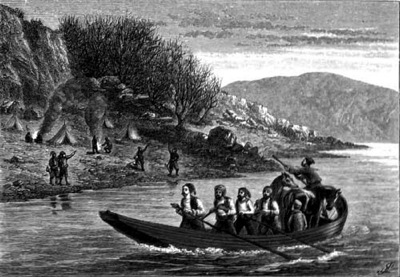
THE LONDRA. Page 102.
They do not make use of rollocks, but twist vine or clematis branches into grommets, which run through holes made for the purpose in the gunwale. These grommets soon wear out, and have to be replaced three or four times in a day's journey. The londra, notwithstanding its rough build, progresses at a very fair pace, so long as it does not meet with a strong head-wind, when its little hold on the water is much against it.
Having comfortably settled ourselves at the bottom of our vessel, among our blankets and saddle-bags, we bid adieu to our sailor friend with an au revoir in London, when he should next visit that port, and got under weigh. Our crew consisted of four brigand-like Montenegrins, who were dirty and miserable, in all save their weapons, which were beautiful. One was the proud possessor of a long pistol, with a silver hilt inlaid with precious stones, the spoil of the Turk. Each had his gun with him, so we were a formidable-looking party.
The banks of the Rieka are exceedingly fine; rocks and dense foliage on either side, with occasional glimpses of the great mountain behind.
Where the river broadened into the lake we rowed through large fields of waterlilies in full bloom. The country seemed altogether uninhabited. We passed one or two londras, whose crews entered into animated discourse with our men, evidently anxious to know who the European travellers might be. At last we were on the great lake. On all sides it is shut in by lofty mountains, some, I should say, quite 10,000 feet in height. Its surface is studded with numerous bare rocky islands, uninhabited by man, but noisy with multitudes of wild fowl and pelicans. Egrets, divers, and ducks, are very numerous on this water. We hugged the western or Montenegrin shore, for the provisions of the Berlin Treaty have given nearly all this side of the lake to the principality.
We were struck by the extreme desolation of the country; gaunt, uncultivated mountains fell to the water's edge. Population there seemed to be none.
Once we saw a village on the shore; on approaching it, it proved to be ruined, deserted—a mere heap of charred débris—a melancholy relic of fierce frontier war. Here, as later on, on the plains of Podgoritza, I noticed that there was a sort of debateable land on the borders of the two countries—a desert region, where men dare not build or cultivate, not knowing when the dogs of war should again be loosed. Thus rich plains are left to the wolf and lynx, the peasant preferring to build his homestead in the poorer but more secure fastnesses of the mountains, than on the rich lowland, where he would sow only that a hostile horde should reap.
As there was a slight breeze, our men hoisted a small square sail, of whose use they seemed to have but little idea. They made fast the sheet and tack to the weather gunwale, and attempted to sail close hauled.
We moved through the water it is true, but astern and to leeward. Much wrangling then ensued as to the proper method of navigating the vessel. Ultimately the crew lowered their canvas in despair, of which we were not sorry, for we very nearly capsized once in a slight squall. Halyard and sheet were securely knotted, and of course the clumsy craft would not come up to the wind.
Had the puff been a little stronger we must have gone down.
Swimming would not have been easy with our heavy accoutrement.
We could not converse much with the men, as our knowledge of Montenegrin was exceedingly limited. We had compiled a little dictionary, with the assistance of our friends, at Cettinje. The usual programme of handing tobacco round, examining each other's arms, was gone through.
Brown rather astonished one of the crew; he had taken hold of the fellow's rifle, and wishing to express his approval of it, pointed to it and read out of the dictionary what he thought was Sclav for "good gun," but which on more careful inspection proved to signify "roast mutton."
All day we paddled along the lone shore, but no town was yet in sight. The evening brought with it one of the most magnificent sunset effects I have ever witnessed. The near mountains on our starboard hand assumed a cold dark appearance as the sun set behind them. Their deep barren defiles had a weird bleakness about them, such as one sees in lifeless Arctic landscapes.
But far away on the port hand, across the water, the rays of the setting sun fell full on the great Albanian mountains, which towered behind the broad plain that fringes the eastern shore of the lake.
Every detail of the fantastic peaks and fissures of the barren granite was sharp and distinct in this clear atmosphere.
Where the rock jutted out it was lurid crimson, as of red-hot coal—elsewhere, of lovely rose and golden tints, while the darker shadows of the hollows were of a deep purple or violet. So utterly barren were these great offshoots of the Mount Scardus, that under this strange light the scenery was of a peculiarly unearthly and weird nature. One could almost imagine oneself to be gazing at a landscape of some lifeless star—a chaos of molten matter—silent but for the occasional roar of fire and volcanic action.
But the blue shadows soon rose up from the water's edge, till the last highest peak lost its crown of fire, and the fine day was succeeded by a lovely starlit night.
The day had been hot, but now it became intensely cold; the wind, which was right in our teeth, freshened; the ripple that broke on the shingle shore became louder; and soon the surface of the lake was broken into short choppy waves capped with foam, that glistened in the starlight. The water washed occasionally over our bulwarks in ominous splashes.
There was evidently quite enough sea for our frail craft. But our men, though they made little progress against the head-wind, pulled on pluckily, encouraging themselves with a wild barbaric chant, which was caught up now by one, now by another—a monotonous yet energetic song, to which their blades kept time.
One of these boat-songs was afterwards translated to me. It runs something thus (I have preserved to a certain extent the irregularity of the original):—
Now then, my hawks, pull! pull! Let the boat fly over the water! The rocks on the shore are full Of Arnauts, thirsty for our slaughter. But we fly swifter than their bullets go. They cannot take aim, so swift we row. Pull! my hawks, pull! Long before their slow feet can return We will fall upon their village—sack and burn, Tear up the smoking rafters of their homesteads Into torches that shall light our homeward way, Laden with rich spoil and foemen's heads. Now then, my hill hawks, pull away! Pull! my hawks, pull!
We expected every moment to see the lights of Scutari burst upon us as we rounded some rugged promontory; but hour after hour of the night passed by, and still no sign of human habitations. Suddenly our boatmen rested on their oars, and entered into a short discussion. When they had come to a decision they pointed to the shore, and endeavoured to explain something to us; what, we could not make out. The dictionary we had compiled at Cettinje was a modest work, containing only words of greeting and the names of strict necessities. The next operation of our crew was to run the boat high and dry on the shingle beach; they then disembarked, and beckoned us to follow.
A fire was soon made up with the brushwood and oleander that grew thickly on the bank.
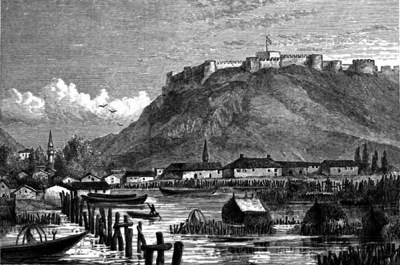
SCUTARI FISHING HARBOUR. Page 109.
What next? we wondered. Was this merely a halt for a little rest and supper? or had our crew struck work, and determined to camp here for the night? We soon found out that the latter was their intention; for after we had supped and smoked a few cigarettes, they one by one rolled themselves up in their cloaks and fell asleep, feet to the fire.
We followed their example, and in consequence of our close proximity to the Montenegrins experienced the attacks of vast armies of fleas.
At four in the morning we got under weigh; it was still dark, but the first faint streak of dawn was visible over the eastern hills. We discovered, later on, that we had encamped on the beach till daylight, because all boats are prohibited from approaching Scutari during the night.
Three Turkish gunboats are stationed off the town, by whom we should have been challenged and stopped, had we proceeded.
At about seven in the morning we reached Scutari. First we had to row through a curious fishing village, which is at the junction of the lake and the broad river that here flows into it. A large number of thatched huts, built on piles, form regular streets in the centre of the stream.
Then the town lay before us, with its old Venetian fortress perched on a lofty rock in the back ground.
We were not much struck by the general appearance of the capital of North Albania—a dingy, dilapidated bankrupt sort of a place it seemed to be.
Scutari is built on the flat promontory formed by the river Bojana, which takes off the waters of the lake to the Adriatic, and another river, which flows into the lake after having crossed the spacious plain which lies between Scutari, and the distant mountains of Biskassi.
On landing, no custom-house or custom-house officers were anywhere visible. We paid off our ship, selected a ragged-looking ruffian to carry our luggage, shouldered our rifles, and marched off to the hotel Toshli, at the other end of the straggling town, which had been recommended to us by the gendarme whose acquaintance we had made on the Austrian Lloyd steamer.
Our first impressions of the city were not favourable. It had an appearance of melancholy decay, still trying to keep up an appearance. The mosques, and some of the better Turkish houses, were rather gaudily ornamented with wooden carvings and bright paint; but now the carvings were broken, and the paint half rubbed off. There was a tea-garden-in-liquidation look about the place.
I remember once seeing Cremorne by daylight. It was some time after outraged respectability had closed the gardens; the occasion being a patriotic meeting which was held there, during the Russo-Turkish war. It was a sad sight to one who had known the place in other days. The plaster statues were broken; the pagodas and the other gimcrack edifices were mouldy, tumbling to pieces, and destitute of paint. This melancholy city of Scutari reminded me irresistibly of Cremorne that day. Everything had been allowed to fall into decay. Any repairing of public or private buildings had long been given up by government and people. One rickety mosque was very funny; its steeple was tiled, if I may use the expression, with the sides of paraffin boxes and Huntley and Palmer's biscuit tins.
The rough paintings on its walls were chipped and dim. The very mollah, in his turban and dirty blue robe, who stood at the door, had a dissipated and unkempt appearance, which harmonized with his surroundings.
Our first impressions of the inhabitants were no less unpleasing. There was a haggard, anxious, half-starved expression in the faces of all we met—a savage fierceness in their eyes, which we had not observed in Montenegro. No one besides ourselves was in European costume, but we attracted no attention; all stalked by us with the utmost indifference. Every man we met—kilted Mussulman, or white-clad Arnaut—was armed to the teeth.
It was some way to Toshli's. We passed through many narrow streets, paved in a fashion well calculated to dislocate the ankles, and traversed numerous grave-yards, neglected and filthy in the extreme.
The hotel turned out to be an unpretending sort of an establishment, half grocery, half café. It was kept by two brothers, Greeks from Janina. It was situated in the principal street of the Christian quarter, close to the foreign consulates. Toshli's is a rough free-and-easy sort of place, but is to be recommended. The cuisine was really very fair. It was curious to observe in the grocery how many English commodities were procurable.
On the shelves I saw Huntley and Palmer's biscuits, Cross and Blackwell's pickles, and, most wonderful of all, brown Windsor soap—an article for which I should imagine that there could be no demand in Albania.
One meets with certain English manufactures in the most remote regions of the world.
I have bought Gillot's steel pens in an Arab town in a remote oasis of the Saharah.
Another curious fact is, that here at Toshli's, and everywhere else in Eastern Europe where plates are in use, one invariably meets with our old willow-pattern services. There is a very large exportation of these from England to these countries.
The café of the hotel, in which is a billiard-table, is much frequented by the Christian merchants, and the Turkish military doctors of the garrison; these are all Christians, being Armenians, Greeks, Poles, and other foreigners.
Italian is understood by many of the Christian merchants here, being the language of commerce on these coasts.
There must, I should say, be a certain amount of Italian blood in the veins of the citizens of Scutari, for it was long one of the strongest Venetian dependencies, and sustained one of the most heroic sieges of history, when Mahomet II. overran Eastern Europe, in the fifteenth century, with his vast hordes of infidels, inflamed with uninterrupted success.
Scutari was finally acquired by Turkey in 1479, by treaty.
The brothers Toshli received us with open arms, for the gendarme had prepared them for our arrival. Having settled ourselves in a comfortable bed-room, which was elegantly draped with strings of malodorous—not to say putrid—sausages, we indulged in some café-au-lait, a luxury we had not enjoyed for some time.
We then called on Mr. Kirby Green, the British consul-general for North Albania, and chargé-d'affaires for Montenegro. This gentleman seemed exceedingly glad to see us, met us with outspread hand, and the remark that "it was rare to see any of his countrymen out here, it was quite an eventful day for him." During our stay in Scutari, Mr. Green did all in his power to assist us in every way. This gentleman, whose experience of Eastern character is very extensive, is emphatically the right man in the right place. It was surprising to find what influence he has in the country, and how excellently he upholds the dignity of England.
He stands very high in the opinion of the natives of both creeds.
"Yes, he is pasha here, and greater than the pasha," was often said of him in my hearing, both by Christians and Mohammedans. They hold him in high respect; and the firmness and justice with which he invariably acts, astonishes and pleases these Orientals, so little accustomed to the like.
Up in the wild mountains, later on, when among the fierce Miridites and Klementis, no sooner did the men we met hear that we were from Scodra (as Scutari is called by the Albanians) and friends of Zutné Green, the savage frown and suspicious handling of yataghan would change to smile of pleasure, and hand outstretched in welcome.
We told Mr. Green what our plans were, and asked him if they were feasible.
We thought of traversing Albania from north to south, from Scutari to the port of Previso, opposite Corfu, by the route of Priserin, Ochrida, Monastir, and Janina. Mr. Green is not a man to discourage travellers without good cause, but said, "Priserin, let me tell you, is the headquarters of the Albanian League, an organization of the most fanatical Mussulmen of the country, whose object is to resist the Austrian advance, and the Montenegrin claims, by force of arms.
"These men are now worked up to a high pitch of religious zeal, and hatred of the Christians. Priserin is, with perhaps the exception of Mecca, the most dangerous spot for a Christian in all Mohammedan countries. It is true that they may receive you very well, as Englishmen, and entertain you with the greatest hospitality; or they may cut your throats as soon as they see you. It is a toss up which of the two they will do.
"You will be either honoured guests, or abominations to be instantly put to death.
"They are the same men that murdered Mehemet Ali, at Jakova. So I advise you to consider the matter carefully."
As guests at Mr. Green's table, later on in the evening, we received a lot of very useful information as to the state of the country, and the ways and means of travelling through it.
CHAPTER IX.
Condition of Albania—Her races—The Mussulman—The Christian—The Arnaut—Prince Scanderbeg—Turkish rule—Albanian language—Gendarmes on strike—A Scutarine beauty—Courtship and marriage—Nuns.
Having now brought my readers into Albania, it does not seem out of place to here give a rough sketch of this almost unknown province of Turkey.
The first thing that strikes one is the utter lawlessness of the people. The Turks have never assimilated their remoter possessions. It is not in their character to do so. They seem, even after so many centuries, to be merely temporarily encamped in Albania. They have pachas and garrisons in the towns, but the natives enjoy a surprising amount of independence, and are allowed to do pretty well as they like. Indeed, the government is very weak here, neither feared nor respected—merely tolerated. The mountain tribes are almost as little under Turkish rule as were the Montenegrins themselves, over whom, until the treaty of Berlin, the Porte claimed a suzerainty. Out of the towns, Turkish officials are not to be found. A powerful tribe will often refuse to pay the dimes to the tax farmer, when a bloody and cruel war will probably ensue, lingering on for years in the hills, in which the government troops will often come off the second best.
At the period of our visit, Albania is in a state of positive anarchy—the gendarmerie on strike, the soldiers refusing to salute their officers, neither having received pay for months, while the natives hold seditious meetings publicly, and unmolested, in the mosques of the garrison towns, in which rebellion against the Porte is fearlessly advocated.
Nowhere is the rotten condition and utter helplessness of the Porte more apparent than here.
The natives, though of one race, may be divided into three classes, differing very much in manners and character. First, we have the Albanian Mohammedan. This is the "wild Albanian kirtled to the knee"—in North Albania, found chiefly in the towns. He is the aristocrat, maybe an owner of lands in the mountains, which he lets out to Arnaut tenants, living on his rents. He is intensely proud of his caste, a despiser of his Christian fellow-townsmen. Courteous, gentlemanly, not over strict in the observance of his creed, he will drink raki on the quiet with an easy conscience.
His walk is a haughty stalk. With his gold-embroidered vest, bright sash—his leather pouch in front, in which are stuck two gold-hilted jewelled pistols and yataghan, his many-folded snowy festinelle, or kilt, which swings from side to side as he struts along—he is indeed an imposing-looking figure.
Secondly, we have the Christian town's-man of the Latin Church—how different in every respect! He wears the fez, Turkish jacket, baggy trousers tied in at the knee, followed by white socks, and European elastic-side boots.
As a Christian the law forbids him to carry arms. There is the timid, fawning, insincere look in his face, so characteristic of the oppressed. These Christians are all traders or merchants, many of them wealthy, but not daring to be over ostentatious, for they live in fear and dread of their unscrupulous neighbours of the other creed, who have on more than one occasion pillaged the Christian quarter. Their position is much what that of the Jews was in medieval Europe.
The dress of the Christian town's-women is not becoming, though exceedingly expensive. Their robe is heavy and thick with gold embroidery, which crackles loudly as they walk. Out of doors they are enveloped in a very ugly red cloak: it is baggy and shapeless. Take an egg, paint it red, cut a good slice off one end and stand it up—you will form a very good idea of a Scutarine Christian lady in outdoor costume. As they are veiled, like the Mohammedans, it is equally impossible to judge of the beauty of either face or figure.
Next we have the third class of the population, the most interesting of all, the country people—or rather, mountaineers, for little but mountain is there in North Albania. These are the Arnauts—Skipitars, as they call themselves—a fierce, hardy race of almost savages, independent, unconquered by the Turks. They too are Latin Christians, but how different from their co-religionists in the town! Their features are indicative of minds that would not tolerate slavery. They stalk proudly through the streets of the towns, bristling with arms, notwithstanding the laws which forbid the Christian to do so. These warlike tribes are too strong to heed the regulations of the feeble government. Their dress is simple, but very manly and workmanlike. They are clad in white homespun from head to heel. Their head-dress is a white skull cap; sometimes they twist a long scarf round the head and under the chin, very much in the style of the Bedouin—this is the "shawl-girt head" that Byron speaks of; a white jacket, with tight sleeves reaching to the wrist, of thick woollen stuff, ornamented with black braid here and there; trousers of the same material, and similarly black braided, baggy behind, but thence close fitting to the leg until they reach the ankle, where they are slit and open out—exactly the cut indeed of the nether garments of the American Indian, except that the lower end is of thicker material, and has the appearance of a gaiter, though it is of one piece with the rest of the garment; opunkas on the feet; a sash round the waist, of common red stuff or of silk, according to the wealth of the man; round the waist a belt, with leather pouch in front, in which the long beautifully worked pistols and yataghan are stuck; a belt of Martini-Henry cartridges over the sash, if he own one of these rifles—if not, a belt from which depend quaint elegantly-carved cartridge and oil-rag boxes, of gold or brass, and long tassels of black silk.
Such is the appearance of an Arnaut mountaineer—a grand costume, showing off the supple, erect frame—the very dress for a savage warrior. The Arnaut, like the Mussulman, shaves his head, leaving a little bunch of hair on the scalp. This gives him a very Indian-like and ferocious appearance. No one who has not seen it can form an idea how this shaving increases the savageness of the expression.
The dress of the women is as hideous as that of the men is handsome. It is not unlike that of the Montenegrins. Their heads are swathed in richly-hued shawls. Their dress is of very thick coarse material, and shapeless. They are fond of wearing leather bands round the waist, ornamented with pins, which are thrust through the leather, with their ends bent up, their heads thus forming elegant patterns on the outside. Round the neck and on the dress, the Arnaut belle wears strings of piastres, swanzickers, and other small coins. Her legs are swathed thickly with a sort of gaiter, which completely prevents one from forming any idea as to the shapeliness of her lower limbs. Most of the mountaineers still wear over their shoulders the curious little black cloak, not unlike the tippet which English ladies have recently copied from their coachmen, which was adopted in mourning for the death of the great Albanian hero Scanderbeg, whose exploits are still sung over the wintry fire by many a mountain bard, to the melancholy accompaniment of the mandolin. There is not an Albanian who is not acquainted with his history.
Albania was once an independent Christian country, though paying tribute to the Porte.
John Castrioti was Prince of the mountain fortress of Kroia and the surrounding country. In 1404 a son was born to him, who was christened George. This was the future hero and deliverer of Albania.
The Prince was persuaded to send this son to the court of Murad II. to be educated. Contrary to the promises made to the father, the boy was brought up in the Mohammedan faith, and when old enough he entered the Turkish army.
On the death of Castrioti, Murad seized his dominion, and attempted with fire and sword to convert the people to the true faith. From that time Scanderbeg formed a design to expel the Turk and liberate his countrymen. He swore a great oath in secret, that never till he died would he cease to wage war on the Turk. The opportunity soon came. He entered into a secret agreement with the Hungarians, and with their assistance defeated the Turks at Nissa with great slaughter.
A fierce war, in which no quarter was given, was then commenced between the Albanians and their oppressors. Driven at times into the fastnesses of the mountains; Scanderbeg ever renewed his brave, seemingly fruitless attempt, when occasion offered.
Ultimately he succeeded in driving the Turks out of Albania; he renounced the Mohammedan faith, and established himself on the throne of his fathers.
Even when he lived the deliverer was almost worshipped as a God. He died in 1467. Then the Albanians, deprived of his skilful generalship, were in time subjugated by the Turks.
Prince George Castrioti was without doubt an extraordinary man. The name of Scanderbeg (Alexander) was given him by the Turks, in their admiration of his prowess.
To say that the Turks have subjugated the Arnauts is not strictly correct. Their position is something like that of the French in the remoter parts of Algeria. They hold certain towns, the intervening country being occupied by independent tribes, governing themselves, having their own laws.
Why, if a Turkish pasha wishes to traverse the mountains through the district of a certain tribe, he must consult the Boulim-Bashi, the town-representative or consul of that tribe, obtain his permission—his safe-conduct—ere he dare undertake the journey.
The administration of criminal law is not a large item of the expenses incurred by the Turkish Government in their rule of Albania. They leave all this to two unpaid judges, who have from time immemorial been the only two dispensers of justice tolerated by the free people—viz., Judge Lynch and Judge Vendetta. Of these I shall have more to say by-and-by.
The Arnauts are divided into several powerful clans, of which the Clementis and the Miridites are the most important in this district. The tribes differ slightly in costume and language. Some tribes, like the Miridites, are in a wretched condition, starving in their mountains, the result of a long protracted war with the government, originating probably in some petty dispute with a tax collector. These wars hang on in a desultory way for years, until the wretched highlanders, in order to support existence, are obliged to become bandits and cattle-lifters—outlaws—the enemies of all men. A Miridite is now a wretched object generally. I have seen them crawl through the narrow alleys of the bazaar of Scutari, ragged, scowling at every one, haggard and weak with hunger, their arms sold for bread—the sign of extreme poverty, for it is a bitter thing for an Arnaut to part with his beloved weapons, heirlooms as a rule. The ramrod of his lost pistols alone dangles from his belt. This, curiously enough, no man ever seems to part with—probably because it is unsalable.
The Albanians are by some supposed to be the descendants of the ancient Pelasgi, and of a far purer race than are the modern Greeks. From the uniformly classic features of the people I should be inclined to adopt this view. The men have splendid skulls, lofty broad brows and small delicately moulded features.
The women are the most beautiful in Eastern Europe. The children are lovely. They have large solemn eyes and splendid mouths—this latter is their most striking feature—slightly turned down at the sides, which gives a singularly sweet and thoughtful expression. One cannot be long among the Arnauts before perceiving that they are evidently of a noble and ancient race, to which the Montenegrin and other Sclav races will bear no compare. The polite manners, the delicacy of perception and tact of these otherwise savage mountaineers, is very pleasant. Fierce and cruel as foes, reckless of life, they yet are splendid friends; faithful—knowing not what treachery is—truthful, virtuous; hospitable, jovial companions, abstemious as a rule, yet not disinclined on grand occasions to pass freely round the cheering raki (a spirit extracted from grape skins after the wine is made) and the absinthe-like mastic.
The language of the Skipitars, as the Arnauts call themselves, varies much in different districts. Old Illyrian probably in origin, it contains Greek, Latin, and Sclavonian words, in almost equal proportion; at least, so it seemed to me, here in the north. For instance, here are the first thirteen numerals in Albanian; the three tongues I mention are all traceable in these—gni, du, tre, kater, pens, giasct, sctat, téte, nand, deit, gnim-deit, dum-deit, trem-deit.
The Albanians do not write in Sclav characters as do their northern, nor in Greek as do their southern neighbours, but, unlike all other races hereabouts, use the Latin character. In addition to our twenty-four letters, they have five others, something like, yet differing in form and pronunciation from, certain of the Greek letters.
Such are the inhabitants of the country—a country as wild as they. Well did Byron call Albania "the rugged nurse of savage men."
The Acroceraunian Mountains and the Mount Pindus send their branches across the whole province. Rugged rocks are heaped one upon the other, with summits hidden in the clouds. It is a region of tempests, which, like to Montenegro, is too poor and barren to produce aught but warriors, who seem ever to thrive best on poor soil, as the stately pines do. The products of the country are few. The acorns of the Vallona oak, which are used for dyeing purposes, martin skins, and boxwood, are the only exports; and not much of these finds its way out of the country. The history of Albania would afford much of interest to any one who would study it.
Once included in the great Bulgarian kingdom, then divided into small principalities, Albania was at last, not without much bloodshed, absorbed by her two powerful neighbours—Venice on the north, Turkey on the east. All the valour of Prince Scanderbeg could only delay for one lifetime the subjugation of his beautiful native land.
Our friend the officer of gendarmerie called on us on the following morning. With him we took a stroll through the town.
He was rather melancholy. He had received no pay for fourteen months, and was commencing to be disgusted with his profession.
His men were in still more wretched plight. Their red uniforms were ragged and torn; many were barefooted. The poor fellows seemed to be all half-starved. At the present moment they were on strike—"en grève," as our friend rather mildly termed what we should call mutiny.
I do not imagine the community loses much by their defection, for the gendarmerie in Albania is a miserable and almost useless body of men. It might fairly be asked what is the good of having police at all in a country where murder and every other crime are recognized institutions? Even rebellion and treason seem not to be punishable offences, for, as I shall have to narrate further on, the Albanian League hold seditious meetings under the very nose of the pashas.
What then have the police to do?
With our friend as cicerone to explain all we saw, we traversed the Christian, and then the Mohammedan quarter of the town.
The streets of the latter are dismal alleys, with lofty walls on either side; for the Mussulman is a person of retiring habits. He loves to build his house, and establish his harem, in the centre of a pleasant garden, which he surrounds with such high walls that no prying eye can spy his conjugal bliss. A semi-detached villa would never suit him. A door in one of these walls was open, so Brown peeped through into the garden within, to the great horror of our companion, who told him if the jealous Turk saw him he would instantly send a bullet into him.
This officer—who, as I believe I have already explained, is a Roman Catholic Christian—took us to his house, and introduced us to his sister, an exceedingly pretty woman. The indoor costume of the Albanian ladies is much more becoming than the ugly scarlet garment that completely conceals their beauty in the streets. This lady was the wife of a wealthy Christian, and her dress was exceedingly costly. The jacket was stiff with beautiful gold embroidery, and large gold coins hung from her neck and girdle.
The manners of an Albanian lady are very pretty and gracious. She brought us coffee with her own hands—small and beautifully-formed as are those of all her race—and sat by us on a heap of cushions, deftly made herself a cigarette, and commenced smoking. She conversed with us in broken Italian, which fell very prettily from her charming lips.
The women of this country do not wither up into old hags by the time they are thirty, as do most orientals and southerners, but preserve their peachy complexions and youthful beauty as long as do the women of our own island. It is true they often get over-corpulent, owing to their exceedingly sedentary lives. A woman of the higher orders but rarely leaves her house; and as she is perpetually squatting cross-kneed, in Turkish fashion, on a divan, or rug, her lower limbs become rather deformed, the result being that her walk is a very ungraceful waddle, rather like that of a well-fed duck.
Our friend's sister had been but recently married. Courtship is curiously managed among the Scutarine Christians. The lover—if he can be so called—never sees his intended till the day of his marriage. A young girl is confined in her father's house for a few years before she arrives at a marriageable age. No men but her nearest relatives ever see her. When her parents consider she is old enough, they let it be known among their friends that they have a marriageable daughter on hand. Probably the young lady's brother will come up to you—if you are a good catch—some day in the street, and say, "You are just the man I wanted to see. My sister is now fourteen years of age. You must marry her." It is an insult to refuse such an offer, for it is generally looked upon as a great honour. However, if the Benedick be rather doubtful as to the advantages of the match, and is desirous of ascertaining whether his proposed bride be endowed with personal attractions, he goes off to an old woman, whose profession it is to intervene in such cases. She calls on the bride, inspects her, and returns to give him an unbiassed summing-up of the young lady's qualities. If he is satisfied, the wedding-day is fixed, but not till the last moment does he view his bride. After the marriage ceremony a very curious performance is gone through. The Albanians entertain peculiar ideas as regards women. To linger with, to be affectionate with, the fair sex, they consider to be degrading to a man's dignity, unfitting him for the sterner business of war. Thus the youth affects to despise the sex, is very shy of showing the slightest regard for it. His sentiments, indeed, are very much those of English boys of a certain age, who would blush to be seen playing with girls. Now, during the marriage feast the bride retires to a room. The bridegroom refuses to follow, and is bound to offer strong resistance; while the other guests—father-in-law, mother-in-law, and all—slap and push in the sham-reluctant one, who at last has to yield to superior numbers, and enters the chamber.
As a young lady is so closely confined to her parents' house until the day of her marriage, she naturally is very anxious to quit a single state, which is by no means a state of blessedness. Should years go by, and no suitable youth accept her hand—for, as I have shown, he can hardly be said to demand it—one course is open to her, in order that she may gain that freedom she yearns after. She becomes a nun, and adopts the white robe of the Scutarine sisters.
The nuns here are by no means confined within great stone walls, as in some countries. They must attend certain services at the church, but at other times they wander about at their own sweet will, and enjoy an absolute liberty that none others of their sex ever acquire in the East. As a natural consequence, if scandal is to be believed, their lives are not entirely unbrightened with flirtations with the other sex.
CHAPTER X.
The bazaar—Turkish gipsies—The vendetta—An assassin—A way to pay debts—Bosnian refugees—A card-party—Paving-stones—Burglars—Army doctors—Change for a ten pound note—Our horses.
After this we visited the bazaar. Imagine a labyrinth of narrow lanes, paved with large round blocks, polished by the feet of many generations; the open booths laden with every variety of European and Eastern goods; the roofs of every height and at every angle, projecting far over on either side—almost meeting in places—joined by festoons of vines, that keep out the glare of the midday sun; and a thick crowd of armed men and veiled women, some mounted, some on foot, in every variety of barbaric costume.
Here is an armourer's shop, the owner, a sour-looking Mohammedan, in snowy festinelle, jacket stiff with gold embroidery, sits cross-legged on his counter, surrounded with every sort of weapon. The Arnaut gun, with flint lock, narrow steel stock beautifully worked, and Damascened barrel fully five feet long, silver inlaid, and hooped with gilt bands, first attracts our attention. The barrels of these guns are rarely of Albanian make, but have been handed down from father to son for generations, and are re-stocked over and over again ere they are condemned. Most of them are of Venetian make; the marks of the most famous gunmakers of the old republic are found inscribed on them. I came across several Tower-marked barrels of antique date, seeming strange in their Albanian stocks. Here we have yataghans, some with plain ivory hilt, others glittering with gold and precious stones, worth a prince's ransom. Here is the long-barrelled Miridite pistol, with quaintly-carved brass stock. Here all the accessories for killing one's fellows—cartridge belts, carved brass cartridge and oil-rag boxes, flints soaking in a pan of water, and so on.
The next stall is a potter's. He works steadily at his wheel, and surrounds himself with gracefully-formed bowls and pitchers of red clay.
Then we have the fruiterer: pomegranates, figs, oranges, vegetables, and fruits too unknown to us, lie in profusion on his counter.
Here is a worker in leather. He provides you with richly-ornamented saddlery, belts for your sweetheart ornamented with the heads of pins, purses, and the curious treble sack which the Arnaut straps in front of him to hold his yataghan and two lengthy flint pistols. Here is a man embroidering a piece of black or red cloth with the most artistic and delicate patterns in gold or silk. This is to be portion of the garment of a woman of rank.
Here is the carpenter. He is at work on a large square box of deal, coarsely painted with bright colours. This is intended to contain the trousseau of the bride, and is the prominent object of the woman's apartment in an Albanian house.
In short you can buy anything in the bazaar, from a horse to a para's worth of halvar.
One of the most curious sights of the bazaar is its gipsy quarter. After traversing one or two sordid alleys, one comes upon a sort of terrace, where, scorning the sun or rain, unprovided with stall or booth, are the zingali tinkers. A wilder and more uncouth lot I never cast eyes upon. Dressed, or rather ragged, in a strange Oriental costume of their own, blackened by exposure, speaking a tongue unknown to all here, there is something very uncanny in them—no wonder that the superstitious Arnaut fears and dislikes them. The women are unveiled, their breasts are bare, and the old hags could well stand as models for a witch of Endor, or any other unearthly and fearsome thing in female human form.
The gipsy has a greater raison d'être here than elsewhere in Europe. The proud races of these regions, more especially the Montenegrins, consider it degrading in the highest degree to work in iron, except in the case of the manufacture of arms. Thus, whereas the Albanians of Scutari, Jakova, and Priserin are excellent workers in other metals, all tinkering is left to the despised zingali.
It is quite the proper thing to have a stall in the bazaar. Men of the highest rank sit behind their wares for a few hours of the day, not perhaps caring much whether they sell or not; but this crowded mart is the common rendezvous, and answers the purpose of a club.
As you force your way through the crowd some friend will recognize you, and beckon you to squat by him on his counter, among the cheap Manchester goods, while you talk over the latest gossip over coffee and cigarettes. We soon had formed so many friendships, that a stroll through the bazaar meant for us the swallowing of prodigious quantities of the thick Eastern coffee, which, by the way, is the best of all, if properly made.
It is by no means unusual to have your shopping disturbed by the report of fire-arms. I have already alluded to the blood feud, or vendetta of Albania. This is here carried to an extent quite unknown in other countries. Indeed, the Franciscan missionaries told me that it is very rare indeed to find a really old man in the mountains, the chances being so much in favour of any given man being killed sooner or later in these constant feuds.
It is in the bazaar, on market-days, that men of two families engaged in a vendetta are most likely to meet. You can generally tell whether a man has a feud on hand, by his furtive look; his pistols are cocked, he carries his gun also cocked in his hand, and looks behind him constantly, for fair play is unknown here. To stab a man behind his back is quite legitimate.
The Arnauts are Roman Catholics, and, as Christians, are by law forbidden to carry arms in the towns. But these powerful tribes are too strong to heed the government regulations. No Arnaut ever comes into the town without his arms, and no one dares interfere with him.
Our friend the gendarme took us to the stall of a friend of his—a notable man, Bektsé Tchotché by name. He was an ill-featured Albanian Mussulman, about forty years of age, dressed in a national costume that must have cost hundreds of pounds, so rich it was. The blade of his yataghan was inlaid with an elaborate gold device from point to hilt. Its handle was rough with large diamonds. His long Albanian pistols were gold hilted, and beautifully carved. This fellow, a man of rank, does not seem to carry on any ostensible trade at his stall, but it was hung with a collection of weapons similar to those on his person. Our gendarme whispered to us, "This is a brave man; much respected; has killed more of his fellow-townsmen than any other Scutarine."
Imagine a policeman in England seriously pointing out, as an admirable character and brave nobleman, the most atrocious murderer of the county. Yet this is what this Bektsé Tchotché is. Murder is not a crime here, however cold-blooded and cowardly. The assassin has but to fear the vengeance of the family—there are no police to interfere with him, especially if he be a Mohammedan. This state of things breeds in the towns a race of ferocious bullies, ready and waiting to wash out any fancied affront with your heart's blood. This man, who is in the enjoyment of several hundreds of pounds sterling per annum, has devoted himself entirely to murder. If you meet him in the town you see him sitting erect on a gaily equipped horse, which he encourages to prance and caracole from one side of the street to the other, to the great danger of passers-by. In Albania furious riding is not an offence—in fact, it is difficult to find what is. If an unoffending passer-by jolt against him accidentally on his promenade, a bullet is most probably sent into him instanter. As all his pistols are at full cock, and have hair triggers, they not unfrequently go off accidentally in the crowded bazaar.
Perfectly incredible to any one who has not visited these countries, is the light in which assassination is regarded. It is more an amusement than anything else—the sport of men. Walk through the streets of Scutari, and you will find the marks of bullets on every house.
The following was quite a recent affair. A young swell one morning was presented with his account, a few shillings only, by his shoemaker. His noble blood could not suffer the indignity long. He walked down the bazaar, found the beast of a tradesman standing in front of his stall, holding his child in his arms, and, without a word, blew his brains out. This gentleman, I need hardly say, is still at large, and swaggers about as usual.
We drank coffee with Bektsé Tchotché, and had a long conversation with him, the gendarme acting as interpreter. He was very kind and polite, and invited us to see him again.
The bazaar at Scutari is full of strange sights, but the most strange and pitiful is a scene one can witness every day outside a certain baker's, who has made a contract with the government. Here for hours patiently waits a miserable crowd of wretches, men, women, and children, thin and pallid, with—yes, even smelling of—starvation. At last a door opens in the loft, and at once they seem to wake from their death-like lethargy; they press up, each trying to be first; they raise their lean arms, and utter prayers and objurgations, hoarse and cracked with hunger. A piece of undercooked maize bread is given to each, and they depart, devouring it in silence. These are Bosnian refugees, families that have emigrated from their homes at the instance of the Turkish government, which now can do so little for them. Better for them had they stayed in their native valleys, and trusted to the justice of the Austrian giaours. Outside the town, by the roadside, one comes across some that are so worn with travel and hunger that they have not the energy to come with the others to receive the scant rations. Here is a typical group. A veiled woman, sitting patiently by the wayside, with several small children lying by her, all starving, and one evidently dying. The father is dead—killed while resisting the infidels, far away in Bosnia. These unfortunates do not beg—they sit there in mute apathy. The children, maybe, crouch up nearer to their mother when they see a giaour passing. If you show some small coins, and beckon to them, the eldest child will perhaps take courage, and painfully drag itself to you, will take the gift, look wonderingly at you with his big eyes (unnaturally big in the white shrunk face), say not a word, and return to his mother to pour what he has received into her lap. The mother all the time sits there impassive, to all outward appearance, quite heedless of what is going on, and utters not a word. It is the daily sight of these poor wretches, and the tales they have to tell, that so excited the Albanian Mussulmen to resist à outrance any occupation of their country by Austria, for of course that power is considered by them as the accursed cause of all this suffering.
We returned to the house of our friend the gendarme, and had a most interesting conversation with him on the customs of his country. He narrated to us, among other things, the last little affair in the way of blood feuds.
"A friend of mine," said he, "was playing at cards in the bazaar with another gentleman. The latter accused my friend of cheating. His reply, of course, was a pistol-bullet, which instantly killed the other. My friend, knowing that many of the dead man's relations were about, escaped from the town to a house he has in the mountains, where he could stay in safety for awhile. The relations of the other, being unable to avenge his death on the person of his murderer, adopted the following very clever plan to entrap and kill, without incurring any risk themselves, the nearest relative of my friend, his father. Two men went to the old man's house, and told him that his son had been slain by a man of Koplik, and that his murderer was now staying in a khan on the road to that village. They offered to accompany him and assist him to avenge his son's death. The old man swallowed the bait without suspicion. On a lonely part of the road, as he rode somewhat in advance of his two companions, they at the same moment fired their pistols into his back, then cutting off his head, sent it in a package to his son."
Thus are things managed in this pleasant land of Albania.
It was dark before we left our friend's house, so he sent his Miridite servant to accompany us with a lantern to our hotel.
Scutari is not lit by night with lamps of any kind, so it is almost impossible to find one's way in the dark through the narrow intricate alleys. Besides, as the paving is laid down carelessly, to say the least of it, one would run a good chance of breaking one's neck, if one dispensed with the services of a link-man. One occasionally comes across deep pits in the middle of a street, or against a rough stone projecting up quite three feet above the average level of the others. As the town is subject to floods, high stepping-stones are placed across the streets at intervals. All this makes walking in the dark exceeding unpleasant in this city.
I said somewhere back that the police have little to do in Scutari. They have one function at any rate. They patrol the streets at night, and arrest all who are not provided with lit lanterns. This rule is strictly enforced. If any one were walking lanternless any night in the town, and did not immediately respond to the patrol's challenge and surrender himself, he would most probably receive a rifle-bullet or so into him. Burglars, provided they carry lamps, are, as far as I can make out, not interfered with by the police. An attempt to break into our consul's house was made not long ago. A watchful cavasse (body-servant) saw the men in the garden, and opened fire on them with his gun from a window. The fire was returned, and kept up for half an hour or so between the two parties, simply by way of passing the time pleasantly, I suppose. The Albanians are vile shots, and no damage was done on either side, beyond may be a window or so broken. The police kept carefully out of the way all the time.
Three army doctors dined with us at the hotel table d'hôte. They were not in a happy state of mind. Their whole conversation was a vehement abuse of the Turkish Government. As they understood Italian we were able to join in the talk. One of them, a very amusing old fellow, an Armenian, waxed very warm over his grievances. "Ah, Signor, you have no idea what a corrupt, vile thing this Turkish Government is. The court eats all the country. We who work, the employés of the state, the doctors, the soldiers, never receive any pay now. We are put off with excuses on excuses, lies on lies. As long as they think they can obtain our labour for nothing, not a para will they let slip through their fingers. Look at my case. I have been a doctor in the Turkish army for forty years, I have been through the Crimea, over all Asia, in the service of the Porte. I am entitled to a good pension. I have been day after day to the office at Constantinople, and put my case before the authorities. They put me off with all sorts of fair promises, but I knew what that meant, so went to them day after day, and worried them so much that they decided to get rid of me in some way. 'There is a permanent hospital in Scutari, in Albania,' they told me. 'In consideration of your long service we appoint you as head doctor of it. Start at once to your post.' Now that I have travelled all this way, at my own expense mind you, what do I find? The permanent hospital no longer exists—it is a myth, and they knew it at Constantinople all the time, and no doubt chuckled merrily, when I had turned my back, at the clever way they had rid themselves of the importunate old nuisance."
Our friend the gendarme called on us after dinner. He too had his grievance. He had just called on his commandant, in hopes of receiving some small portion of the arrears of pay due to him. The following brief conversation ensued:—
"What do you want here, Lieutenant P.?"
"I want money."
"What? Eh! Money! What on earth for?"
"To procure bread."
"Ah! bread; that is well. Do you know what there is in the caisse?"
"No."
"Well, there is nothing; and I see little chance of there being a single para there for some time. So go, young man, and do not indulge in extravagant habits. I advise you as an older man."
After a few consultations with Mr. Green, Brown and myself determined to carry out our original plan of riding to Janina, and of visiting Priserin on our way, if the Leaguesmen were willing to receive us in that city.
Our friend the gendarme offered to accompany us the whole way for a small consideration. This suited us exactly. For with him we could converse, and the chances were small of our meeting people who could understand any Western language, on our route. Besides, the Turkish government compels all travellers to take an escort of zaptiehs. At certain stages these are changed, and another escort is given, of greater or less numerical strength according to the state of the country to be traversed. In the company of this officer, we should probably be able to dispense with this nuisance, except perhaps on a few stages where brigands were supposed to be prowling about. An escort of zaptiehs is really of little use; for when brigands are come across here, it is not in twos and threes, but in overwhelming numbers.
We were rather surprised when our intended companion told us that he could easily procure letters of safe-conduct for us to the chiefs of the League at Priserin and Jakova, as he himself had many intimate friends among the head men of that formidable organization, at Scutari. Curiously illustrative was this of the present condition of this country. Here was an official of the Turkish Government, an officer of police, openly associating and sympathizing with rebels, whose avowed object it is to throw off the Turkish yoke by force of arms, and place a prince of their own choice on the old stone throne of Scanderbeg at Kroia.
The next thing to do was to make preparations for our journey. We had spent all our gold, so found that we were obliged to change some of our English notes. This was no easy matter. After some difficulty, with the assistance of Mr. Green we found an old Christian merchant, Shouma by name, reputedly of great wealth. He might be able to manage the little affair for us.
We called on him, and according to the custom of the country we indulged in coffee, sweetmeats, sherbet, and cigarettes before commencing to state our business. Very suspiciously he looked at the notes. Bills of exchange he would have discounted without hesitation; I believe our own promissory notes would have satisfied him. But in governments this wise man had no faith. He did not believe in a paper currency.
He had observed how in his own country it had depreciated till at last it was absolutely valueless. He knew that even Austria's notes were worth considerably less than the sum they are supposed to represent. I tried to explain to him what Bank of England notes really were—what the difference between a convertible and an inconvertible paper currency was; but Shouma evidently considered that the convertible paper was a still more subtle device of a more clever government to hoodwink and swindle the people.
However, he agreed to change a ten pound note for us, provided that Mr. Green guaranteed that it really was worth ten golden sovereigns. Mr. Green was of course willing to do this for us. Shouma accordingly took our note, but told us that it would take three days at least to rake together so large a sum as ten pounds in Scutari. He would go that very day to the bazaar, and get as much as he could, for us to go on with.
In three days, a huge packet of metallic discs, of every size and inscription, was ready for us. This was accompanied by a document, lengthy as the manifest of a mail steamer, specifying the value of this wonderful ten pounds' worth of coins.
He gave us 131 piastres and a fraction for each sovereign. It took us two hours to count and verify our change. There were silver medjidiés at 22½ piastres each, all sorts of curious concave plates of base metal, worth 11½, 6¾, 13½, and many other odd sums nasty to calculate.
There were Greek coins, Russian roubles, old Austrian swanzickers bearing the effigies of Maria Theresa, Peruvian and Mexican dollars, and I know not what besides. Verifying one's change, is no joke in Albania.
To shop in the bazaar of Scutari is a maddening operation, unless one heroically resigns oneself to the certainty of being cheated twice over in every transaction; for not only must one bargain fiercely and cunningly, and beat down the price the merchant asks for an article in the first instance, but after one has come to terms, and is about to hand over his fifty piastres, say, another still warmer and more utterly confusing discussion is sure to ensue as to the value of the coins one presents to him.