Chapter IV · CORN
Reading edition
Planting
Corn planting began the second month after sunflower-seed was planted, that is in May; and it lasted about a month. It sometimes continued pretty well into June, but not later than that; for the sun then begins to go back into the south, and men began to tell eagle-hunting stories.
We knew when corn planting time came by observing the leaves of the wild gooseberry bushes. This bush is the first of the woods to leaf in the spring. Old women of the village were going to the woods daily to gather fire wood; and when they saw that the wild gooseberry bushes were almost in full leaf, they said, “It is time for you to begin planting corn!”
Corn was planted each year in the same hills.
Around each of the old and dead hills I loosened the soil with my hoe, first pulling up the old, dead roots of the previous year’s plants; these dead roots, as they collected, were raked off with other refuse to one end of the field outside of the cultivated ground, to be burned.
This pulling up of the dead roots and working around the old hill with the hoe, left the soil soft and loose for the space of about eighteen inches in diameter; and in this soft soil I planted the corn in this manner:
I stooped over, and with fingers of both hands I raked away the loose soil for a bed for the seed; and with my fingers I even stirred the soil around with a circular motion to make the bed perfectly level so that the seeds would all lie at the same depth.
A small vessel, usually a wooden bowl, at my feet held the seed corn. With my right hand I took a small handful of the corn, quickly transferring half of it to my left hand; still stooping over, and plying both hands at the same time, I pressed the grains a half inch into the soil with my thumbs, planting two grains at a time, one with each hand.

Figure 7
I planted about six to eight grains in a hill[7] (figure 7). Then with my hands I raked the earth over the planted grains until the seed lay about the length of my fingers under the soil. Finally I patted the hill firm with my palms.
The space within the hill in which the seed kernels were planted should be about nine inches in diameter; but the completed hill should nearly cover the space broken up by the hoe.
The corn hills I planted well apart, because later, in hilling up, I would need room to draw earth from all directions over the roots to protect them from the sun, that they might not dry out. Corn planted in hills too close together would have small ears and fewer of them; and the stalks of the plants would be weak, and often dried out.
If the corn hills were so close together that the plants when they grew up, touched each other, we called them “smell-each-other”; and we knew that the ears they bore would not be plump nor large.
A Morning’s Planting
We Hidatsa women were early risers in the planting season; it was my habit to be up before sunrise, while the air was cool, for we thought this the best time for garden work.
Having arrived at the field I would begin one hill, preparing it, as I have said, with my hoe; and so for ten rows each as long as from this spot to yonder fence—about thirty yards; the rows were about four feet apart, and the hills stood about the same distance apart in the row.
The hills all prepared, I went back and planted them, patting down each with my palms, as described. Planting corn thus by hand was slow work; but by ten o’clock the morning’s work was done, and I was tired and ready to go home for my breakfast and rest; we did not eat before going into the field. The ten rows making the morning’s planting contained about two hundred and twenty-five hills.
I usually went to the field every morning in the planting season, if the weather was fine. Sometimes I went out again a little before sunset and planted; but this was not usual.
Soaking the Seed
The very last corn that we planted we sometimes put into a little tepid water, if the season was late. Seed used for replanting hills that had been destroyed by crows or magpies we also soaked. We left the seed in the water only a short time, when the water was poured off.
The water should be tepid only, so that when poured through the fingers it felt hardly warmed. Hot water would kill the seeds.
Seed corn thus soaked would have sprouts a third of an inch long within four or five days after planting, if the weather was warm. I know this, because we sometimes dug up some of the seeds to see. This soaked seed produced strong plants, but the first-planted, dry seeds still produced the first ripened ears.
If warm water was not convenient, I sometimes put these last planted corn seeds in my mouth; and when well wetted, planted them. But these mouth-wetted seeds produced, we thought, a great many wi´da-aka´ta, or goose-upper-roof-of-mouth, ears.
Planting for a Sick Woman
It was usual for the women of a household to do their own planting; but if a woman was sick, or for some reason was unable to attend to her planting, she sometimes cooked a feast, to which she invited the members of her age society and asked them to plant her field for her.
The members of her society would come upon an appointed day and plant her field in a short time; sometimes a half day was enough.
There were about thirty members in my age society when I was a young woman. If we were invited to plant a garden for some sick woman, each member would take a row to plant; and each would strive to complete her row first. A member having completed her row, might begin a second, and even a third row; or if, when each had completed one row, there was but a small part of the field yet unplanted, all pitched in miscellaneously and finished the planting.
Size of Our Biggest Field
When our corn was in, we began planting beans and squashes. Beans we commonly planted between corn rows, sometimes over the whole field, more often over a part of it. Our bean and squash planting I will describe later; and I speak of it now only because I wish to explain to you how a Hidatsa garden was laid out.
The largest field ever owned in my father’s family was the one which I have said my grandmother Turtle helped clear, at Like-a-fishhook village, or Fort Berthold, as the whites called it. The field, begun small, was added to each year and did not reach its maximum size for some years.
The field was nearly rectangular in shape; at the time of its greatest size, its length was about equal to the distance from this spot to yonder fence—one hundred and eighty yards; and its width, to the distance from the corner of this cabin to yonder white post—ninety yards.
The size of a garden was determined chiefly by the industry of the family that owned it, and by the number of mouths that must be fed.
When I was six years old, there were, I think, ten in my father’s family, of whom my two grandmothers, my mother and her three sisters, made six. I have said that my mother and her three sisters were wives of Small Ankle, my father. It was this year that my mother and Corn Sucker died, however.
My father’s wives and my two grandmothers, all industrious women, added each year to the area of our field; for our family was growing. At the time our garden reached its maximum size, there were seven boys in the family; three of these died young, but four grew up and brought wives to live in our earth lodge.
Na´xu and Nu´cami
In our big garden at Like-a-fishhook village, nine rows of corn, running lengthwise with the field, made one na´xu, or Indian acre, as we usually translate it. There were ten of these na´xus, or Indian acres, in the garden.
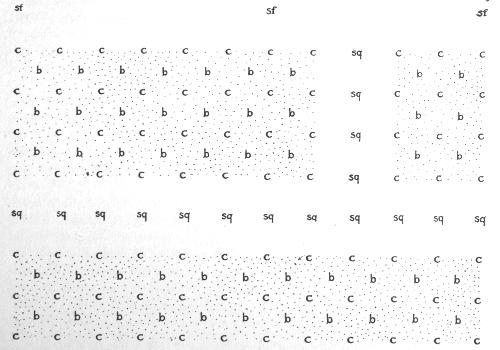
Figure 8
Some families of our village counted eight rows of corn to one na´xu, others counted ten rows.
The rows of the na´xus always ran the length of the garden; and if the field curved, as it sometimes did around a bend of the river, or other irregularity, the rows curved with it.
In our garden a row of squashes separated each na´xu from its neighbor.
Four rows of corn running widthwise with the garden made one nu´cami; and as was the na´xu, each nu´cami was separated from its neighbor by a row of squashes, or beans, or in some families, even by sunflowers.
Like those of the na´xus, the rows of the nu´camis often curved to follow some irregularity in the shape of the garden plot. (See figure 8.)
Hoeing
Hoeing time began when the corn was about three inches high; but this varied somewhat with the season. Some seasons were warm, and the corn and weeds grew rapidly; other seasons were colder, and delayed the growth of the corn.
Corn plants about three inches high we called “young-bird’s-feather-tail-corn,” because the plants then had blunt ends, like the tail feathers of a very young bird.
Corn and weeds alike grew rapidly now, and we women of the household were out with our hoes daily, to keep ahead of the weeds. We worked as in planting season, in the early morning hours.
I cultivated each hill carefully with my hoe as I came to it; and if the plants were small, I would comb the soil of the hill lightly with my fingers, loosening the earth and tearing out young weeds.
We did not hoe the corn alone, but went right through the garden, corn, squashes, beans, and all. Weeds were let lie on the ground, as they were now young and harmless.
We hoed but once, not very many weeds coming up to bother us afterwards. In my girlhood we were not troubled with mustard and thistles; these weeds have come in with white men.
In many families hoeing ended, I think, when the corn was about seven or eight inches high: but I remember when my mothers finished hoeing their big field at Like-a-fishhook village, the corn was about eighteen inches high, and the blossoms at the top of the plants were appearing.
A second hoeing began, it is true, when the corn silk appeared, but was accompanied by hilling, so that we looked upon it rather as a hilling time. Hilling was done to firm the plants against the wind and cover the roots from the sun. We hilled with earth, about four inches up around the roots of the corn.
Not a great many weeds were found in the garden at hilling time, unless the season had been wet; but weeds at this season are apt to have seeds, so that it was my habit to bear such weeds off the field, that the seeds might not fall and sprout the next season.
With the corn, the squashes and beans were also hilled; but this was an easier task. The bean hills, especially, were made small at the first, and hilling them up afterwards was not hard work. If beans were hilled too high the vines got beaten down into the mud by the rains and rotted.
The Watchers’ Stage
Our corn fields had many enemies. Magpies, and especially crows, pulled up much of the young corn, so that we had to replant many hills. Crows were fond of pulling up the green shoots when they were a half inch or an inch high. Spotted gophers would dig up the seed from the roots of young plants. When the corn had eared, and the grains were still soft, blackbirds and crows were destructive.
Any hills of young corn that the birds destroyed, I replanted if the season was not too late. If only a part of the plants in a hill had been destroyed, I did not disturb the living plants, but replanted only the destroyed ones. In the place of each missing plant, I dug a little hole with my hand, and dropped in a seed.
We made scarecrows[8] to frighten the crows. Two sticks were driven into the ground for legs; to these were bound two other sticks, like outstretched arms; on the top was fastened a ball of cast-away skins, or the like, for a head. An old buffalo robe was drawn over the figure and a belt tied around its middle, to make it look like a man. Such a scarecrow would keep the crows away for a few days but when they saw that the figure never moved from its place, they lost their fear and returned.
A platform, or stage, was often built in a garden, where the girls and young women of the household came to sit and sing as they watched that crows and other thieves did not destroy the ripening crop. We cared for our corn in those days as we would care for a child; for we Indian people loved our gardens, just as a mother loves her children; and we thought that our growing corn liked to hear us sing, just as children like to hear their mother sing to them.[9] Also, we did not want the birds to come and steal our corn. Horses, too, might break in and crop the plants, or boys might steal the green ears and go off and roast them.
Our Hidatsa name for such a stage was adukati´ i´kakĕ-ma´tsati, or field watchers’ stage; from adukati´, field; i´kakĕ, watch; and ma´tsati, stage. These stages, while common, were not in every garden. I had one in my garden where I used to sit and sing.
A watchers’ stage resembled a stage for drying grain, but it was built more simply. Four posts, forked at the top, supported two parallel beams, or stringers; on these beams was laid a floor of puncheons, or split small logs, at about the height of the full grown corn. This floor was about the length and breadth of Wolf Chief’s table—forty-three by thirty-five inches—and was thus large enough to permit two persons to sit together. A ladder made of the trunk of a tree rested against the stage.
Such stages we did not value as we did our drying stages, nor did we use so much care in building them. If the posts were of green wood, we did not trouble to peel off the bark; at least, I never saw such posts with the bark peeled off. The beams in the forks of the posts often lay with the bark on. The puncheons that made the floor of the stage were free of bark, because they were commonly split from old, dead, floating logs, that we got down at the Missouri River; if the whole stage was built of these dead logs, as was often done, the bark would be wanting on every beam.
A watchers’ stage, indeed, was usually of rather rough construction; wood was plentiful and easy to get, and the stage was rebuilt each year.
As I have said, it was our custom to locate our gardens on the timbered, bottom lands, and when we cleared off the timber and brush, we often left a tree, usually of cottonwood, standing in the field, to shade the watchers’ stage. The stage stood on the north, or shady, side of the tree.
Cottonwood seedlings were apt to spring up in newly cleared ground. If there was no tree in the field, one of these seedlings might be let grow into a small tree. Cottonwoods grew very rapidly.
The tree that shaded the watchers’ stage in our family field, and which I have indicated on the map, was about as high as my son Goodbird’s cabin, and had a trunk about four inches in diameter. The cottonwood tree standing in Wolf Chief’s corn field this present summer, is perhaps about the height of the trees that used to stand in our fields at Like-a-fishhook village.
Explanation of Sketch of Watchers’ Stage
My son Goodbird has made a sketch, under my direction, of a watchers’ stage (figure 9).
The stage was placed close to the tree shading it, about a foot from the trunk. Holes for the posts were dug with a long digging stick; and the posts were set firm, like fence posts.
The stage was made nearly square, so that the watchers could sit facing any side with equal ease. The beams supporting the floor might be laid east and west, or north and south; but as the tree stood always on the south side of the stage, the floor beams lay always in one of these two ways.
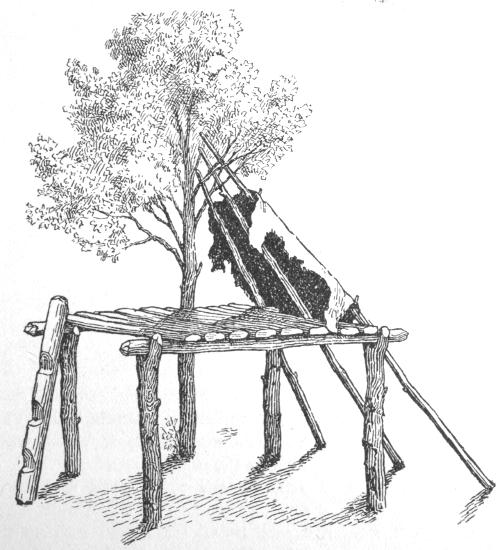
Figure 9
Redrawn from sketch by Edward Goodbird.
In the sketch a skin[10] is seen lying on the stage floor. This is a buffalo calf skin, folded fur out, to make a seat for the watcher. The skin might be folded tail to head, or side to side; and sometimes it was folded flesh side out. It never hung down over the edges of the stage floor, but was folded up neatly to make a kind of cushion. The puncheon floor, at best never very smooth, was rather hard to sit upon; and letting a part of the skin hang down over the side would have been waste of good cushion material.
The three poles on the right of the stage support another calf skin, used as a shield against the sun. The poles merely rested on the ground; they were not thrust into the soil. They could be shifted about with the sun, so that the watcher had shade in any part of the day.
The calf skin used for a sun shade hung on the poles head downward; whether it lay fur or flesh side down did not matter.
Skins dressed by Indians have holes cut along the edges for the wooden pins by which they are staked out on the ground to dry. The poles upholding the skin shade we cut of willows; and we were careful to trim off the branches, leaving little stubs sticking out on the trunk of the pole. These little stubs we slipped through some of the holes in the edge of the skin shade to uphold it and stay it in place. It was not necessary to bind the skin down with thongs; just slipping the stubs through the holes was enough.
Poles for a sun shade were cut indifferently of dry or green wood; and they lasted the entire season.
The ladder by which we mounted a watchers’ stage rested against either of the corners next the tree, against one of the two beams supporting the floor; however we did not consider a watchers’ stage to be sacred, and we placed the ladder anywhere it might be convenient.
The ladder was a cottonwood trunk, cut with three steps; more were not needed, as the stage floor was not high.
Sweet Grass’s Sun Shade
If the tree sheltering a stage had scant foliage, we often cut thick, leafy cottonwood boughs and thrust them horizontally through the branches of the tree to increase its shade. It was a common thing for the watchers to tie a robe across the face of the tree for the same purpose.
If no tree grew in the garden, a small cottonwood with thick, leafy branches was cut and propped against the south or sunny side of the stage.
There was an old woman named Sweet Grass who had no tree in her garden. She built a stage just like that in Goodbird’s sketch (figure 9). To shade it I remember she cut several small cottonwood trees and set them in holes made with her digging stick, along the south side of her stage. They stood there in a row and shaded the stage quite effectively. Her stage stood rather close to the edge of her garden.
The Watchers
The season for watching the fields began early in August when green corn began to come in; for this was the time when the ripening ears were apt to be stolen by horses, or birds, or boys. We did not watch the fields in the spring and early summer, to keep the crows from pulling up the newly sprouted grain; such damage we were content to repair by replanting.
Girls began to go on the watchers’ stage to watch the corn and sing, when they were about ten or twelve years of age. They continued the custom even after they had grown up and married; and old women, working in the garden and stopping to rest, often went on the stage and sang.
Two girls usually watched and sang together. The village gardens were laid out close to one another; and a girl of one family would be joined by the girl of the family who owned the garden adjoining. Sometimes three, or even four, girls got on the stage and sang together; but never more than four. A drum was not used to accompany the singing.
The watchers sometimes rose and stood upon the stage as they looked to see if any boys or horses were in the field, stealing corn. Older girls and young married women, and even old women, often worked at porcupine embroidery as they watched. Very young girls did not embroider.
Boys of nine to eleven years of age were sometimes rather troublesome thieves. They were fond of stealing green ears to roast by a fire in the woods. Sometimes—not every day, however—we had to guard our corn alertly. A boy caught stealing was merely scolded. “You must not steal here again!” we would say to him. His parents were not asked to pay damage for the theft.
We went to the watchers’ stage quite early in the day, before sunrise, or near it, and we came home at sunset.
The watching season continued until the corn was all gathered and harvested. My grandmother, Turtle, was a familiar figure in our family’s field, in this season. I can remember her staying out in the field daily, picking out the ripening ears and braiding them in a string.
Booths
There were a good many booths in the gardens that lay west of the village. Usually a booth stood at one side of every field in which was a watchers’ stage.
To make a booth, we cut diamond willows, stood them in the ground in a circle, and bending over the leafy tops, tied them together. A few leafy branches were interwoven into the top to increase the shade; but there was no further covering.
A booth had a floor diameter of nine or ten feet, and was as high as I can conveniently reach with my hands—six feet.
The girls who sang and watched the ripening corn cooked in these booths. I often did so when I was a young girl; for cooking at the booth was done by all the watchers, even young girls of ten or twelve years. I have often seen my grandmother, Turtle, also, in her booth very early in the morning, in the corn season.
Eating Customs
A meal was eaten sometimes just after sunrise, or a little later; but we never had regular meal hours in the field. We cooked and ate whenever we got hungry, or when visitors came; or we strayed over to other gardens and ate with our friends. If relatives came, the watchers often entertained them by giving them something to eat.
To cook the meal a fire was made in the booth. Meat had been brought out from the village, dried or fresh buffalo meat usually. Fresh meat was laid on the coals to broil; dried meat was thrust on the end of a stick that leaned over the coals; and when one side was well toasted it was turned over.
Fresh squashes we boiled in clay or iron pots; a good many brass or copper kettles also were in use when I was young. We were fond of squashes.
A common dish was green corn and beans. The corn was shelled off the cob and boiled with green beans that were shelled also; sometimes the beans were boiled in the pod.
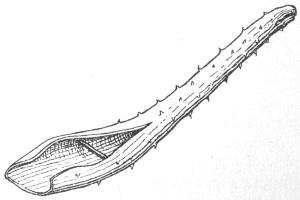
Figure 10
Redrawn from sketch by Goodbird of specimen made by Buffalobird-woman.
To serve the corn and beans we poured the mess into a wooden bowl and ate with spoons made from the stems of squash leaves. Figure 10 is a sketch of such a spoon. The squash stem was split at one end and the split was held open by a little stick. Stems of leaves of our native squashes have tiny prickles on them, but these did not hurt the eater’s lips. Leaf stems of native squashes I think are firmer and stronger than those of white men’s squashes, such as we now raise.
My grandmother, Turtle, was a faithful watcher in our family field in the watching season. I remember she used to bring home in the evening all the uneaten corn she had boiled that day.
Youths’ and Maidens’ Customs
We always kept drinking water at the stage; and if relatives came out, we freely gave them to drink. But boys and young men who came were offered neither food nor drink, unless they were relatives.
Our tribe’s custom in such things was well understood.
The youths of the village used to go about all the time seeking the girls; this indeed was almost all they did. Of course, when the girls were on the watchers’ stage the boys were pretty sure to come around. Sometimes two youths came together, sometimes but one. If there were relatives at the watchers’ stage the boys would stop and drink or eat; they did not try to talk to the girls, but would come around smiling and try to get the girls to smile back.
To illustrate our custom, if a boy came out to a watchers’ stage, we girls that were sitting upon it did not say a word to him. It was our rule that we should work and should not say anything to him. So we sat, not looking at him, nor saying a word. He would smile and perhaps stop and get a drink of water.
Indeed, a girl that was not a youth’s sweetheart, never talked to him. This rule was observed at all times. Even when a boy was a girl’s sweetheart, or “love-boy” as we called him, if there were other persons around, she did not talk to him, unless these happened to be relatives.
Boys who came out to the watchers’ stage, getting no encouragement from the girls there, soon went away.
A very young girl was not permitted to go to the watchers’ stage unless an old woman went along to take care of her. In olden days, mothers watched their daughters very carefully.
Watchers’ Songs
Most of the songs that were sung on the watchers’ stage were love songs, but not all.
One that little girls were fond of singing—girls that is of about twelve years of age—was as follows:
You bad boys, you are all alike! Your bow is like a bent basket hoop; You poor boys, you have to run on the prairie barefoot; Your arrows are fit for nothing but to shoot up into the sky!
This song was sung for the benefit of the boys who came to the near-by woods to hunt birds.
Here is another song; but that you may understand it I shall first have to explain to you what ikupa´ means.
A girl whom another girl loves as her own sister, we call her ikupa´. I think your word chum, as you explain it, has about the same meaning. This is the song:
“My ikupa´, what do you wish to see?” you said to me. What I wish to see is the corn silk coming out on the growing ear; But what you wish to see is that naughty young man coming!
Here is a song that we sang to tease young men that were going by:
You young man of the Dog society, you said to me, “When I go to the east on a war party, you will hear news of me how brave I am!” I have heard news of you; When the fight was on, you ran and hid! And you think you are a brave young man! Behold you have joined the Dog society; Therefore, I call you just plain dog!
These songs from the watchers’ stage we called mi´daxika, or gardeners’ songs. The words of these I have just given you we called love-boy words; and they were intended to tease.
There was another class of songs sung from the watchers’ stage that did not have love-boy words. I will give you one of these, but to make it intelligible, I must first explain a custom of my tribe.
Clan Cousins’ Custom
Let us suppose that a woman of the Tsi´stska Doxpa´ka marries a man of the Midipa´di clan. Their child will be a Tsi´stska; for we Hidatsas reckon every child to belong to the clan of his mother; and the members of the mother’s clan will be clan sisters and clan brothers to her child.
Another woman of the tribe, of what clan does not matter, also marries a Midipa´di husband; and they have a child. The child of the first mother and the child of the second we reckon as makutsati, or clan cousins, since their fathers being of the same clan, are clan brothers.
In old times these clan cousins had a custom of teasing one another; especially was this teasing common between young men and young women. For example, a young man, unlucky in war, might be passing the gardens and hear some mischievous girl, his clan cousin, singing a song taunting him for his ill success. From any one else this would be taken for the deepest insult; but seeing that the singer was his clan cousin, the young man only called out good humoredly, “Sing louder, cousin!”
I can best explain this custom by telling you a story.
Story of Snake-head-ornament
A long time ago, in one of our villages at Knife River, there lived a man Mapuksao´kihec, or Snake-head-ornament. He was a great medicine man; and in his earth lodge he kept a bull snake, whom he called “father.”
When Snake-head-ornament started to go to a feast he would say to the bull snake, “Come, father, let us go and get something to eat!”
The snake would crawl up the man’s body, coil about his neck and thrust his head forward over the man’s crown and forehead; or he would coil about the man’s head like the head cloth a hunter used to wear, with his head thrust forward as I have said.
Bearing the snake thus on his head, Snake-head-ornament would enter some man’s lodge and sit down to eat. The snake however never ate with him, for his food was not the same as the man’s; the bull snake’s food was hide scrapings which the women of the lodge fed to him.
When Snake-head-ornament came home again he would say to the bull snake, “Father, get off.”
The snake would creep down from the man’s head, but before he entered his hole he would roll himself about on the earth lodge floor. Snake-head-ornament would say to him, “What are you doing? Do you think I am bad smelling, and do you want to wash off the smell from your body? It is you who are bad smelling; yet I do not despise you!”
The snake, hearing this, would creep into his hole as if ashamed.
Snake-head-ornament made up a war party and led it against enemies on the Yellowstone River. The party not only failed to kill any of the enemy, but lost three of their own men. This was a kind of disgrace to Snake-head-ornament; for as leader of the war party he was responsible for it. He thought his gods had deserted him; and when he came home he went about crying and mourning and calling upon his gods to give him another vision. He was a brave man and had many honor marks; and his ill success made his heart sore.
In old times, when one mourned, either man or woman, he cut off his hair, painted his body with white clay and went without moccasins; he also cut himself with some sharp instrument.
In those days also, when a man went out to seek his god, he went away from the village, alone, into the hills; and thus it happened that Snake-head-ornament, on his way to the hills, went mourning and crying past a garden where sat a woman, his clan cousin, on her watchers’ stage. Seeing him, she began to sing a song to tease him:
He said, “I am a young bird!” If a young bird, he should be in a nest; But he comes around here looking gray, And wanders aimlessly everywhere outside the village! He said, “I am a young snake!” If a young snake, he should stay in the hills among the red buttes; But he comes around here looking gray and crying, And wanders aimlessly everywhere!
When the woman sang, “he comes around here looking gray,” she meant that the man was gray from the white clay paint on his body.
Snake-head-ornament heard her song, but knowing she was his clan cousin, cried out to her:
“My elder sister, sing louder! You are right; let my fathers hear what you say. I do not know whether they will feel shame or not; but the snake and the white eagle both called me ‘son’!”
What he meant was that the snake and the white eagle were his dream gods; and that they had both called him “son,” in a vision. In her song the woman had taunted him with this. If she had been any one but his clan cousin, he would have been beside himself with anger. As it was, he kept his good humor, and did her no hurt.
But the woman had sung her song for a cause. Years before, when Snake-head-ornament was quite a young man and as yet had won few honors he went on a war party and killed a Sioux woman. When he came home he was looked upon as a successful warrior; and he was, of course, proud that people now looked up to him. Not long after this, he joined the Black Mouth society. It happened, one day, that the women were erecting palisades around the village to defend it, and Snake-head-ornament, as a member of the Black Mouths, was one of those overseeing the work. This woman, his clan cousin, was rather slow at her task and did not move about very briskly. Snake-head-ornament, seeing this, approached her and fired off his gun close by her legs. She looked around, but seeing that it was Snake-head-ornament that had shot, and knowing he was her clan cousin, she did not get angry. Just the same she did not forget; and years after she had a good humored revenge in the taunting song I have given you.
Green Corn and Its Uses
The Ripening Ears
The first corn was ready to be eaten green early in the harvest moon, when the blossoms of the prairie golden rod are all in full, bright yellow; or about the end of the first week in August. We ate much green corn, boiling the fresh ears in a pot as white people do; but every Hidatsa family also put up dried green corn for winter. This took the place with us of the canned green corn we now buy at the trader’s store.
I knew when the corn ears were ripe enough for boiling from these signs: The blossoms on the top of the stalk were turned brown, the silk on the end of the ear was dry, and the husks on the ear were of a dark green color.
I do not think the younger Indians on this reservation are as good agriculturists as we older members of my tribe were when we were young. I sometimes say to my son Goodbird: “You young folks, when you want green corn, open the husk to see if the grain is ripe enough, and thus expose it; but I just go out into the field and pluck the ear. When you open an ear and find it too green to pluck, you let it stand on the stalk; and birds then come and eat the exposed kernels, or little brown ants climb up the stalk and eat the ear and spoil it. I do not think you are very good gardeners in these days. In old times, when we went out to gather green ears, we did not have to open their faces to see if the grain was ripe enough to be plucked!”
Second Planting for Green Corn
Our green corn season lasted about ten days, when the grain, though not yet ripe, became too hard for boiling green.
To provide green corn to be eaten late in the season, we used to make a second planting of corn when June berries were ripe; and for this purpose we left a space, not very large, vacant in the field. In my father’s family this second planting was of about twenty-eight hills of corn. It came ready to eat when the other corn was getting hard; but it often got caught by the frost. Nearly every garden owner made such a second planting; it was, indeed, a usual practice in the tribe.
Cooking Fresh Green Corn
Our usual way of cooking fresh, green corn, was to boil it in a kettle on the cob.
Fresh, green corn, shelled from the cob, was often put in a corn mortar and pounded; and then boiled without fats or meat. Prepared thus, it had a sweet taste and smell; much like that of the canned corn we buy of the traders.
Shelled green corn, in the whole grain, was also boiled fresh, mixed with beans and fats.
Roasting Ears
Green ears were sometimes roasted, usually by an individual member of the family who wanted a little change of diet. The women of my father’s family never prepared a full meal of roasted ears that I remember; if any one wanted roasted, fresh, green corn, he prepared it himself.
When I wanted to roast green corn I made a fire of cottonwood and prepared a bed of coals. I laid the fresh ear on the coals with the husk removed. As the corn roasted, I rolled the ear gently to and fro over the coals. When properly cooked I removed the ear and laid on another.
As the ear roasted, the green kernels would pop sometimes with quite a sharp sound. If this popping noise was very loud, we would laugh and say to the one roasting the ear, “Ah, we see you have stolen that ear from some other family’s garden!”
Green corn was regularly taken out of the garden to roast until frost came, when it lost its fragrance and fresh taste. To restore its freshness, we would take the green corn silk of the same plucked ear and rub the silk well into the kernels of the ear as they stood in the cob. This measurably restored the fresh taste and smell.
We did not do this if the ear was to be boiled, only if we intended to roast it.
For green corn, boiled and eaten fresh, we used all varieties except the gummy; for when green they tasted alike. But for roasting ears we thought the two yellow varieties, hard and soft, were the best.
Mätu´a-la´kapa
A common dish made from green corn was mätu´a-la´kapa, from mätu´a, green corn; and la´kapa, mush, or something mushy; thus, wheat flour mixed with water to a thick paste we call la´kapa, even if unboiled.
Ripening green corn, with the grain still soft, was shelled off the cob with the tip of the thumb or with the thumb nail. The shelled corn was pounded in a mortar and boiled with beans; it was flavored with spring salt.
Corn Bread
We also made a kind of corn bread from green corn.
Green ears were plucked and the corn shelled off with the thumb nail, so as not to break open the kernels. Boiled green corn could be shelled with a mussel shell because boiling toughened the kernels; but unboiled green corn was shelled with the thumb nail.
Two or three women often worked at shelling the corn as it was rather tedious work.
When enough of the corn had been shelled, it was put in a corn mortar and pounded.
Some of the ears were naturally longer than others: a number of these had been selected and their husks removed. Some of these husks were now laid down side by side, but overlapping like shingles, until a sheet was made about ten inches wide.
Another row of husks was laid over the first, transversely to them; and so until four or five layers of the green husks were made, each lying transversely to the layer of husks beneath.
The shelled corn, pounded almost to a pulp, was poured out on this husk sheet, and patted down with the hand to a loaf about seven or eight inches square, and an inch or two thick. However, this varied; a girl would make a much smaller loaf than would a woman preparing a mess for her family.
The ends of the uppermost layer of husks were now folded over the top of the loaf, leaf by leaf; then the next layer of husks beneath; and so until the ends of all the husks were folded over the top of the loaf, quite hiding it.
Two or three husk leaves had been split into strips half an inch to three quarters of an inch in width. These strips were tied together to make bands to bind the loaf. Three bands passed around the loaf each way, or six bands in all.
No grease nor fat, nor any seasoning, had been added to the loaf; the pounded green corn pulp was all that entered into it.
The loaf made, now came the baking. The ashes in the fire place in an earth lodge lay quite deep. A cavity was dug into these ashes about as deep as my hand is long. Into the bottom of this cavity live coals and hot ashes were raked, and upon these the loaf was laid; a few ashes were raked over the top, and upon these ashes live coals were heaped. The loaf baked in about two hours.
We called this loaf naktsi´, or buried-in-ashes-and-baked. Soft white and soft yellow corn were good varieties from which to make this buried-and-baked corn, as we called it.
Drying Green Corn for Winter
Every Hidatsa family put up a store of dried green corn for winter. This is the way in which I prepared my family’s store.
In the proper season I went out into our garden and broke off the ears that I found, that were of a dark green outside. Sometimes I even broke open the husks to see if the ear was just right; but this was seldom, as I could tell very well by the color and other signs I have described. I went all over the garden, plucking the dark green ears, and putting them in a pile in some convenient spot on the cultivated ground. If I was close enough I tossed each ear upon the pile as I plucked it; but as I drew further away, I gathered the ears into my basket and bore them to the pile.
I left off plucking when the pile contained five basketfuls if I was working alone. If two of us were working we plucked about ten basketfuls.
Green corn for drying was always plucked in the evening, just before sunset; and the newly plucked ears were let lie in the pile all night, in the open air. The corn was not brought home on the evening of the plucking, because if kept in the earth lodge over night it would not taste so fresh and sweet, we thought.
The next morning before breakfast, I went out to the field and fetched the corn to our lodge in the village. As I brought the baskets into the lodge, I emptied them in a pile at the place marked B in figure 11, near the fire.
Sitting at A, I now began husking, breaking off the husks from each ear in three strokes, thus: With my hand I drew back half the husk; second, I drew back the other half; third, I broke the husk from the cob. The husks I put in a pile, E, to one side. No husking pegs were used, such as you describe to me; I could husk quite rapidly with my bare hands.
As the ears were stripped, they were laid in a pile upon some of the discarded husks, spread for that purpose. The freshly husked ears made a pretty sight; some of them were big, fine ones, and all had plump, shiny kernels. A twelve-row ear we thought a big one; a few very big ears had fourteen rows of kernels; smaller ears had not more than eight rows.
Two kettles, meanwhile, had been prepared. One marked D in figure 11, was set upon coals in the fireplace; the other, C, was suspended over the fire by a chain attached to the drying pole. The kettles held water, which was now brought to a boil.
When enough corn was husked to fill one of these kettles, I gathered up the ears and dropped them in the boiling water. I watched the corn carefully, and when it was about half cooked, I lifted the ears out with a mountain sheep horn spoon and laid them on a pile of husks.
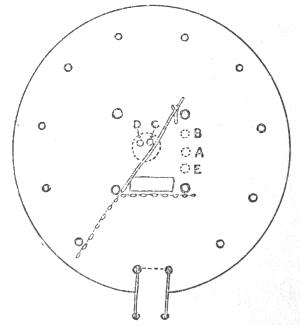
Figure 11
When all the corn was cooked, I loaded the ears in my basket and bore them out upon the drying stage, where I laid them in rows, side by side, upon the stage floor. There I left them to dry over night.
The work of bringing in the five basketfuls of corn from the field and boiling the ears took all day, until evening.
In the morning the corn was brought into the lodge again. A skin tent cover had been spread on the floor and the half boiled ears were laid on it, in a pile. I now sat on the floor, as an Indian woman sits, with ankles to the right, and with the edge of the tent cover drawn over my knees, I took an ear of the half boiled corn in my left hand, holding it with the greater end toward me. I had a small, pointed stick; and this I ran, point forward, down between two rows of kernels, thus loosening the grains. The right hand row of the two rows of loosened kernels I now shelled off with my right thumb. I then shelled off all the other rows of kernels, one row at a time, working toward the left, and rolling the cob over toward the right as I did so.
There was another way of shelling half boiled corn. As before, I would run a sharpened stick down two rows of kernels, loosening the grains; and I would then shell them off with smart, quick strokes of a mussel shell held in my right hand. We still shell half boiled corn in this way, using large spoons instead of shells. There were very few metal spoons in use in my tribe when I was a girl; mussel shells were used instead for most purposes.
If while I was shelling the corn, a girl or woman came into the lodge to visit, she would sit down and lend a hand while we chatted; thus the shelling was soon done.
The shelling finished, I took an old tent cover and spread it on the floor of the drying stage outside. On this cover I spread the shelled corn to dry, carrying it up on the stage in my basket.
At night I covered the drying corn with old tent skins to protect it from dampness.
The corn dried in about four days.
When the corn was well dried, I winnowed it. This I sometimes did on the floor of the drying stage, sometimes on the ground.
Having chosen a day when a slight wind was blowing, I filled a wooden bowl from the dried corn that lay heaped on the tent cover; and holding the bowl aloft I let the grain pour slowly from it, that any chaff might be winnowed out.
The corn was now ready to be put in sacks for winter.
Corn thus prepared we called maada´ckihĕ, from ada´ckihĕ, treated-by-fire-but-not-cooked, a word also used to designate food that has been prepared by smoking.
All varieties of corn could be prepared in this way.[11]
The Arikaras on this reservation have a different way of preparing and drying green corn. They make a big heap of dried willows, and upon these lay the ears, green and freshly plucked, in the husk. When all is ready, they set fire to the willows, thus roasting the corn; and they often roast a great pile of corn at one time, in this way. The roasted ears are husked and shelled, and the grain dried, for storing. Corn that has been roasted in the Arikara way, dries much more quickly than that prepared by boiling.
Of late years some Mandan and Hidatsa families occasionally roast their corn in imitation of the Arikara way; but I never saw this done in my youth.
I do not like to eat food made of this dried, roasted corn; it is dirty!
Mapë´di (Corn Smut)
Mapë´di
Mapë´di is a black mass that grows in the husk of an ear of corn; it is what you say white men call corn smut fungus. Sometimes an ear of corn appears very plump, or somewhat swelled; and when the husk is opened, there is no corn inside, only mapë´di, or smut; or sometimes part of the ear will be found with a little grain at one end, and mapë´di at the other. These masses of mapë´di, or corn smut, that we found growing on the ear, we gathered and dried for food.
There is another mapë´di that grows on the stalk of the corn. It is not good to eat, and was not gathered up at the harvest time. The mapë´di that grows on the stalk is commonly found at a place where the stalk, by some accident, has been half broken.
We looked upon the mapë´di that grew on the corn ear as a kind of corn, because it was borne on the cob; it was found on the ears the grain of which was growing solid, or was about ready to be eaten as green corn. We did not find many mapë´di masses in one garden.
Harvest and Uses
We gathered the black masses and half boiled and dried them, still on the cob. When well dried, they were broken off the cob. These broken off pieces we mixed with the dried half boiled green corn, and stored in the same sack with them.
Mapë´di was cooked by boiling with the half-boiled dried corn. We did not eat mapë´di fresh from the garden, nor did we cook it separately. Mapë´di, boiled with corn, tasted good, not sweet, and not sour.
I still follow the custom of my tribe and gather mapë´di each year at the corn harvest.
The Ripe Corn Harvest
Husking
As the corn in the fields began to show signs of ripening, the people of Like-a-fishhook village went hunting to get meat for the husking feasts. This meat was usually dried; but if a kill was made late in the season, the meat was sometimes brought in fresh.
When the corn was fully ripened, the owners of a garden went out with baskets, plucked the ears from the stalks and piled them in a heap ready for the husking. The empty stalks were left standing in the field.
A small family sometimes took as many as three days to gather and husk their ripe corn; this was because there were not many persons in the family to do the work.
In a big family, like my fathers, harvesting was more speedily done. We had a large garden, but we never spent more than one day gathering up the corn, which we piled in a heap in the middle of the field.
The next day after the corn was plucked, we gave a husking feast. We took out into the field a great deal of dried meat that my mothers had already cooked in the lodge; or we took the dried meat into the field and boiled it in a kettle near the corn pile. We also boiled corn on a fire near by. The meat and corn were for the feast.
Instead of dried meat, a family sometimes took out a side of fresh buffalo meat and roasted it over a fire, near the corn pile.
Having then arrived at the field, and started a fire for the feast, all of our family who had come out to work sat down and began to husk. Word had been sent beforehand that we were going to give a husking feast, and the invited helpers soon appeared. There was no particular time set for their coming, but we expected them in one of the morning hours.[12]
For the most part these were young men from nineteen to thirty years of age, but a few old men would probably be in the company; and these were welcomed and given a share of the feast.
There might be twenty-five or thirty of the young men. They were paid for their labor with the meat given them to eat; and each carried a sharp stick on which he skewered the meat he could not eat, to take home.[13]
The husking season was looked upon as a time of jollity; and youths and maidens dressed and decked themselves for the occasion.
Of course each young man gave particular help to the garden of his sweetheart. Some girls were more popular than others. The young men were apt to vie with one another at the husking pile of an attractive girl.
Some of the young men rode ponies, and when her corn pile had been husked, a youth would sometimes lend his pony to his sweetheart for her to carry home her corn. She loaded the pony with loose ears in bags, bound on either side of the saddle, or with strings of braided corn laid upon the pony’s back.
The husking season, like the green corn season, lasted about ten days. The young men helped faithfully each day, and when they had husked all the corn in one field, they moved to another. Thus all the corn piles were speedily husked.
The husking was always done in the field. We never carried the corn to the village to be husked, as the husks would then have dried, and hurt the hands of the husker. As we plucked the ears, we piled them in a heap in the field, to keep the husks moist and soft.[14]
Rejecting Green Ears
As the huskers worked they were careful not to add any green ears to the husked pile. A green ear would turn black and spoil, and be fit for nothing.
Every husker knew this; and if a young man was helping another family husk, he laid in a little pile beside him, any green ears that he found. These green ears belonged to him, to eat or to feed to his pony.
Last year a white man hired me to gather the corn in his field and husk it; and I kept all the green ears for myself, for that is my custom. I do not know whether that white man liked it or not. It may be he thought I was stealing that green corn; but I was following the custom that I learned of my tribe.
I am an Indian; if a white man hires me to do work for him, he must expect that I will follow Indian custom.
Braiding Corn
Most of the corn as it was husked was tossed into a pile, to be borne later to the village. This was true of all the smaller and less favored ears: the best of the larger ears were braided into strings.
As we husked, if a long ear of good size and appearance was found, it was laid aside for braiding. For this purpose the husk was bent back upon the stub of the stalk on the big end of the ear, leaving the three thin leaves that cling next to the kernels still lying on the ear in their natural position. The part of the husk that was bent back was cut off with a knife; the three thin leaves that remained were now bent back on the ear, and the ear was laid aside. Another ear was treated in the same way and laid beside the first, also with its thin leaves bent back. And thus, until a row of ears lay extended side by side upon the ground, all the ears lying point forward.
Another row was started; and the ears, also lying point forward and leaned against the first row, were laid so as to cover the thin bent-back leaves of the first row, to protect them from the sun. As the braiding was done with these thin leaves, if they were too dry—as the sun was very apt to make them—they would break.
When a quantity of these ears, all with thin husk leaves bent back, had accumulated, one of the huskers passed them to someone of the young men, who braided them; or one of the women of the family owning the field might braid them.
Even with care the thin leaves were sometimes too dry for the braider to handle safely; and he would fill his mouth with water and blow it over the leaves.
Fifty-four or fifty-five ears were commonly braided to a string; but the number varied more or less. In my father’s family, we often braided strings of fifty-six or fifty-seven ears.
I do not know why this number was chosen; but I think this number of ears was about of a weight that a woman could well carry and put upon the drying stage.
When the string was all braided, the braider took either end in his hand, and placing his right foot against the middle of the string, gave the ends a smart pull. This stretched and tightened the string, and made it look neater and more finished; it also tried if there might be any weak places in it.
We braided all varieties of corn but two, atạ´ki tso´ki, or hard white, and tsï´di tso´ki, or hard yellow. These varieties we reckoned too hard to parch, and for this reason they were not braided. We did, however, sometimes parch hard yellow to be pounded up into meal for corn balls.
The strings of braided corn were borne to the village on the backs of ponies. Some families laid ten strings on a pony; but in my father’s family we never laid on so many, believing it made too heavy a load for the poor beast.
The braided strings were hung to dry on the drying stage upon the railing that lay in the upper forks; and if there was need, poles or drying rods were laid across the rails and strings were hung over these also.[15]
These drying rods were laid across only where the forks supported the rails (at the same places the staying thongs were tied), for at these places the stage could better bear the weight of the heavy strings of corn; the drying rods were bound at either end to the railing, to stay them.
The Smaller Ears
Meanwhile the smaller and less favored ears were being carried home in baskets. It took the members of my father’s family a whole day, and the next day following until late in the afternoon, to get this work done.
Each carrier, as she brought in a basket of corn, ascended the log ladder of the stage and emptied the corn on the stage floor. Here the corn lay in a long heap, in the middle of the floor; for a free path was always left around the edge for us women; having this path for our use, we did not have to tread on the corn as we moved about. Also, if a pony came in with a load of braided corn, the heavy strings could be handed up to us women on the stage as we moved around in this free path.
As I now remember, our family’s husked corn when piled on the stage floor, made a heap about eight yards long and four yards wide, and about four feet high in the middle, from which point the pile sloped down on all sides. This was the loose corn, the smaller ears; and besides these there were about one hundred strings of braided corn hung on the railing above the heap. I give these measurements, judging as nearly as I can from the size of our drying stage, and from our average yearly corn yield, when I was a young woman. I think the figures are approximately accurate.
For about eight days the corn lay thus in a long heap upon the stage. At the end of that time the ears on the top of the heap had become dry and smooth and threatened to roll down the sides of the pile. We now took drying rods and laid them along the floor against the posts, two or three of them, for the whole length of the stage on either side, and on the ends of the stage. Planks split from cottonwood trunks were leaned against these drying rods, on the side next the corn. The corn heap was now spread evenly over the floor of the drying stage for the depth of about a foot; the split planks prevented the dry smooth ears from sliding off the stage. The dry ears had a tendency to roll or slide down the sides of the corn pile, as fresh ears did not.
This spreading out the corn heap evenly had also the effect of stirring up the underlying ears and exposing them to the air.
If rain fell while the corn was thus drying on the stage, it gave us no concern. The corn soon dried again, and no harm was done it.
The corn, spread thus in an even heap, took about three more days to dry, or eleven days in all. Then we began threshing.
Drying the Braided Ears
The strings of braided corn hanging on the rails at the top of the posts of the drying stage, dried much more quickly than the loose ears heaped on the stage floor. The wind, rattling the dry ears of the strings together, was apt to shell out the drying kernels; it was therefore usual for us before threshing time to tie these braids together so that the wind could not rattle them.
To do this I would ascend the ladder and make my way along the edge of the stage floor, making places in the corn with my feet as I walked, so that my feet would be on the stage floor and not tread on the drying corn. I would push ten of the braided strings together on the rail or the drying rod on which they hung, and tie them by passing around them a raw hide thong.
These braided strings, bound thus in bundles of ten, hung on the stage until we were ready to store them in the cache pit; and this we could not do until we had our main harvest, the loose ears, threshed and ready to store also.
Seed Corn
Selecting the Seed
I have said that for braiding corn we chose the longest and finest ears. In my father’s family we used to braid about one hundred strings, some years less, some years more, as the season had been wet or dry; for the yield of fine ears was always less in a dry year. Of these braided strings we selected the very best in the spring for seed.
My mothers reckoned that we should need five braided strings of soft white, and about thirty ears of soft yellow, for seed. Of ma´ikadicakĕ, or gummy, we raised a little each year, not much; ten ears of this, for seed, my mothers thought were a plenty.
Hard white and hard yellow corn, I have said, were not braided, because not used for parching. For seed of these varieties, some good ears were taken from the drying pile on the corn stage and stored in the cache pit for the next year with loose grain of the same variety. The ears were not put in a sack, but thrown in with the loose grain.
When I selected seed corn, I chose only good, full, plump ears; and I looked carefully to see if the kernels on any of the ears had black hearts. When that part of a kernel of corn which joins the cob is black or dark colored, we say it has a black heart. This imperfection is caused by plucking the ear when too green. A kernel with a black heart will not grow.
An ear of corn has always small grains toward the point of the cob, and large grains toward the butt of the ear. When I came to plant corn, I used only the kernels in the center of the cob for seed, rejecting both the small and the large grains of the two ends.
Seed corn was shelled from the cob with the thumb; we never threshed it with sticks. Sometimes we shelled an ear by rubbing it against another ear.
Keeping Two Years’ Seed
Corn kept for seed would be best to plant the next spring; and it would be fertile, and good to plant, the second spring after harvesting. The third year the seed was not so good; and it did not come up very well. The fourth year the seed would be dead and useless.
Knowing that seed corn kept good for at least two years, it was my family’s custom to gather enough seed for at least two years, in seasons in which our crops were good. Some years, in spite of careful hoeing, our crops were poor; the ears were small, there was not much grain on them, and what grain they bore was of poor quality. We did not like to save seed out of such a crop. Also, frost occasionally destroyed our crop, or most of it.
When, therefore, we had a year of good crops, we put away seed enough to last for two years; then, if the next year yielded a poor crop, we still had good seed to plant the third season.
In my father’s family we always observed this custom of putting away seed for two years; and we did this not only of our corn, but of our squash seeds, beans, sunflower seeds, and even of our tobacco seeds; for if I remember rightly, the tobacco fields were sometimes injured by frost just as were our corn fields.
Not all families in our village were equally wise. Some were quite improvident, and were not at all careful to save seed from their crops. Such families, in the spring, had to buy their seed from families that were more provident.
Saving a good store of seed was therefore profitable in a way. In my father’s family we often sold a good deal of seed in the spring to families that wanted. The price was one tanned buffalo skin for one string of braided seed corn.
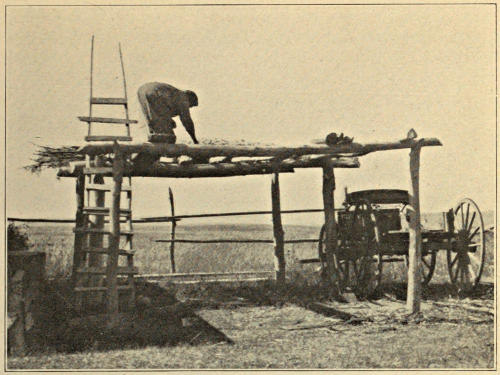
Corn stage of Butterfly’s wife
This stage lacks railings, and is floored Arikara fashion with a willow mat. A pile of drying corn is seen on the stage floor. In the ancient villages, where the lodges were crowded together, the railings were always present.
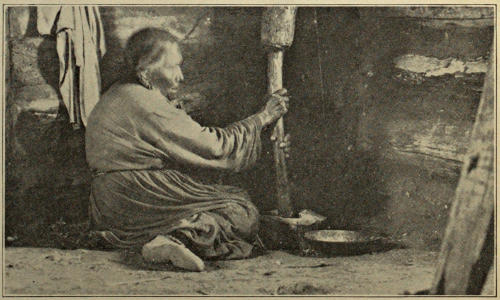
Owl Woman pounding corn into meal in a corn mortar
Even to-day, families on this reservation come to me to buy seed corn and seed beans. A handful of beans, enough for one planting, I sell for one calico—enough calico, that is, to make an Indian woman a dress, or about ten yards.
Threshing Corn
The Booth
The threshing season was always a busy one, for all the families of the village would be threshing their corn at the same time.
Corn was threshed in a booth, under the drying stage.
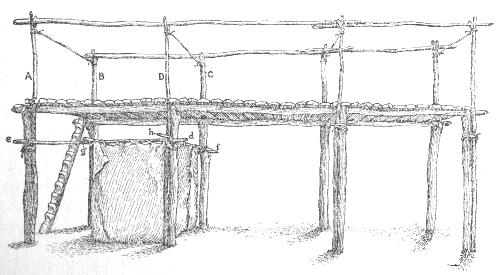
Figure 12
The figure has been redrawn from sketches by Goodbird. The original is a stage now standing on the reservation, but with mat of willows for floor; to this Goodbird added a threshing booth as he saw used by his grandmother when he was a boy. Goodbird’s sketches are closely followed, excepting that the floor of slabs is restored. The figure tallies in every respect with Buffalobird-woman’s description, and the model made by her for the American Museum of Natural History.
To make the booth, I began with the section at one end of the stage. As is shown in figure 12, on the posts A and D, and B and C, were bound two poles, e and f, at about two feet below the stage floor; upon these were bound two other poles, g and h; the poles e, f, and h were bound outside of the posts that supported them.
A long raw hide thong was used for the corner ties. The first pole was raised in position and bound firmly to the post; and if a second pole was to be laid over the first—as was done at two of the corners—the thong was drawn up and made to bind it also to the post. We always kept a number of these raw hide thongs in the lodge against just such uses as this; they were strong, and served every purpose of ropes; we oiled them to keep them soft.
A tent cover was now fetched out of the lodge. Tents were of different sizes, from those of seven, to those of sixteen buffalo cow hides. A woman used whatever sized tent cover she owned; but a cover of thirteen skins was of convenient size.
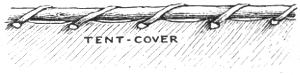
Figure 13
Around the curved bottom of the tent cover was a row of holes, through which wooden pins were driven to peg the tent to the ground. The tent cover was bound to the four over-hanging poles, inside of the four posts, by means of a long thong woven in and out through the holes, as shown in figure 13.
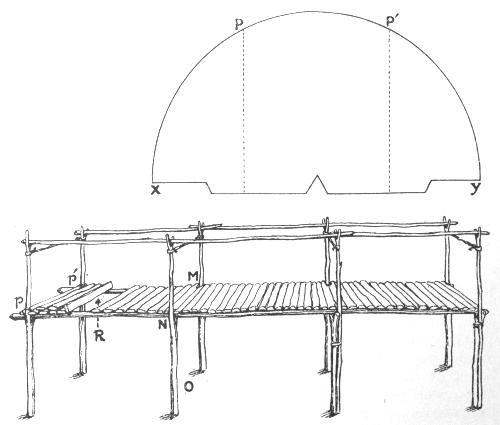
Figure 14
Bound thus to the poles, and quite enclosing the space within them, the tent cover made a kind of booth. The upper parts of the cover, including the smoke flaps, that now hung sweeping the ground, were drawn in and spread flat on the ground to make a floor for the booth; and stones laid upon them weighted the cover against the wing.
In figure 12 the four posts, A, B, C, and D, enclose one section of the drying stage; the booth did not enclose the whole ground space of this section, but about three fifths of it.
Figure 14, I think, will explain the arrangement of the booth. The end corners, X and Y, were bound to opposite posts, M and N, respectively, the lapping edges, at O, forming a door through which the threshers entered the booth; P and P´ were bound to posts at p and p´; the final corner, M, was left untied until the threshers had entered and were ready to begin their task. (Compare with figure 12, in which, however, the posts are differently lettered.)
Before they did this they went above and removed the planks and drying rods laid around the edge of the stage floor, and pushed the corn back toward the middle of the floor into a long heap again, that it might not fall over the edge, now that the planks were taken away. One of the floor planks was now removed, at R. Through the aperture thus made, corn was pushed down to left and right of R; this was continued until there was a pile of corn just under the aperture, and running the width of the booth, about eighteen or twenty inches high.
The threshers now entered the booth and tied the corner at M, closing the door. In my father’s family there were usually three threshers, women; and they sat in a row on the floor of the booth, facing the pile of corn. Each woman had a stick for a flail, with which she beat the corn.
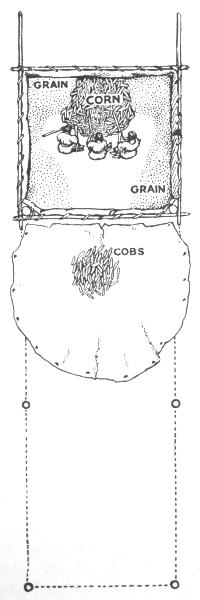
Figure 15
Flails were of ash or cottonwood. An ash flail would be about three and a half feet long and from three quarters of an inch to an inch in diameter, and was cut green. A cottonwood flail was seldom used green; and as it was therefore lighter than the green ash, a cottonwood flail was a little greater in diameter, but of the same length. We were careful that a flail should not be too heavy, lest it break the kernels in the threshing. Kinikinik sticks were sometimes used for flails.
A diagram (figure 15) has been drawn to illustrate how I worked in a threshing booth when I was a young woman. As shown, I sat on the extreme left; one of my mothers and my sister sat as indicated, on my right. More than three seldom worked in a threshing booth at the same time, at least in our family; however, I have known my sister, Not-frost, to make a fourth. I have even known five to be threshing in the booth of some other family in the village, but never more than five.
To thresh the corn, I raised my flail and brought it down smartly, but not severely, upon the pile of corn. The grain as it was thus beaten off the dry cobs would fall by its own weight into the pile, and work its way to the bottom; while the lighter cobs would come to the top of the pile.
Beating the ears with the flails caused many of the kernels to leap and fly about; but the tent cover, enclosing the booth, caught all these flying kernels. It was, indeed, for this that the booth was built.
As the cobs, beaten empty of grain, accumulated on the pile, we drew them off and cast them out of the door of the booth upon a tent cover, spread to receive them, under the middle section of the stage. Many of these cobs had a few small grains clinging to them; and these must be saved, for we wasted nothing.
Having paused then to throw out the cobs, we returned to the pile and thrust our flails in under it, drawing them upward through the corn, thus working the unthreshed ears to the top. As much as we could, we tried to keep the unthreshed ears in the middle of the pile, and the threshed grain pushed to right and left, as will be seen by studying the diagram. To thresh one pile, or filling of corn in a booth, took a half day’s work.
Order of the Day’s Work
Our habit was to begin quite early in the morning, enclose the booth with the tent cover, and set to work threshing; finishing the first filling, or pile, about midday. In the afternoon we began a second pile, first heaping the already threshed grain to right and left, and behind the threshers.
I have said that on the ground under the second section of the stage, a second tent cover was spread to catch the cobs. A part of this tent cover was drawn in under the edge of the booth to help carpet the floor of the booth.
At the end of the day we turned our attention to the pile of cobs; and with our thumbs we shelled off every grain that clung to the cobs. From the cobs of a day’s threshing we collected about as many grains of corn as would fill a white man’s hat. This was taken into the booth and thrown on the pile of threshed grain.
We now disposed of the grain for the night. If we had gotten through threshing rather early in the day, we bore the newly threshed grain in baskets into the lodge, and emptied it into a bull boat.
If we had gotten through our threshing rather late in the day, we made the door of the booth tight, and left the grain on the booth floor throughout the night.
The Cobs
The day’s threshing over, we attended to the cobs. I have said that we shelled off any kernels that clung to them after threshing, so that they were now quite clean of grain.
All day long, as we threshed, we had watched that no horses got at the cobs to trample and nibble them, or that any dog ran over them, or any children played in them. Then, in the evening, if the weather was fine, and there was little wind, one of my mothers or I carried the cobs outside of the village to a grassy place and heaped them in a pile about five feet high. A pile of cobs of such a height I usually gathered from a day’s threshing.
In our prairie country, on a fair day, the wind usually dies down about sunset; and now, when the air was still, I fired the cob pile. As the pile began to burn, I could usually see the burning cob piles of two or three other families lighting up the gathering dusk.
I had to stay and watch the fire, to keep any mischievous boys from coming to play in the burning heap. Children of from ten to fifteen years of age were quite a pest at cob-firing time. They had a kind of game they were fond of playing. Each would cut a long, flexible, green stick, and at the edge of the Missouri he would get a ball of wet mud and stick it on his stick. He would try to approach one of the burning piles, and with his stick, slap the mud ball smartly into the burning coals, some of which, still glowing, would stick in the wet mud. Using the stick as a sling, the child would throw the mud ball into the air, aiming often at another child. Other children would be throwing mud balls at one another at the same time, and these, with the bits of glowing charcoal clinging to them, would go sailing through the air like shooting stars. Knowing very well that the children would get into my burning cobs if I even turned my back, I was careful to stay by to watch.
At last the fire had burned down and the coals were dead; and nothing was left but a pile of ashes. It was now night, and I would go home. Early the next morning, before the prairie winds had arisen, I would go out again to my ash heap. On the top of the ashes, if nothing had disturbed them in the night and an unexpected wind had not blown them about, I would find a thin crust had formed. This crust I carefully broke and gathered up with my fingers, squeezing the pieces in my hand into little lumps, or balls. Sometimes I was able to gather four or five of these little balls from one pile of ashes; but never more than five.
These balls I carried home. There were always several baskets hanging in the lodge, ready for any use we might want of them; and it was our habit to keep some dried buffalo heart skins, or some dried buffalo paunch skins, in the lodge, for wrappers, much as white families keep wrapping paper in the house. The ash balls I wrapped up in one of these skins, into a package, being careful not to break the balls. I put the package in one of the baskets, to hang up until there was occasion for its use.
These ash balls were used for seasoning. I have explained elsewhere how we used spring salt to season our boiled corn; and that every day in the lodge, we ate mä´dạkạpa, or pounded dried ripe corn boiled with beans. But in the fall, instead of seasoning this dish with spring salt, or alkali salt as you call it, we preferred to use this seasoning of ash crust.
In my father’s family, for each meal of mä´dạkạpa we filled the corn mortar three times, two-and-a-half double handfuls of corn making one filling of the mortar. Each time we filled the mortar, we dropped in with the corn a little of the ash crust, a bit about as big as a white child’s marble. Finally, a piece about as big, or perhaps a little larger, was also dropped into the boiling pot.
We Indians were fond of this seasoning; and we liked it much better than we did our spring salt. We did not use spring salt, indeed, if we had ash balls in the lodge.
We called these ash balls mä´dạkạpa isĕ´pĕ, or mä´dạkạpa darkener.
We did not make ash balls if the dogs or horses had trampled on the cobs; or if children had mussed in the fire; nor would we make ash balls if the day had not been rather calm, for a high wind was sure to blow dust into the cobs.
We burned cobs and collected ash balls after every threshing day, unless hindered by storm or high wind. But even if the harvest was a good one, the ash balls that we got from the burned cobs for seasoning never lasted long. We were so fond of seasoning our food with them that every family had used up its store before the autumn had passed.
Winnowing
I have said that after the day’s threshing we stored the newly threshed grain for the night, either in the booth or in a bull boat in the earth lodge; and that we then fired the cobs that had accumulated during the day.
The next morning we spread an old tent cover outside the lodge, near the drying stage; and we fetched the loose grain of the previous day’s threshing out of the booth, or the earth lodge and spread it evenly and thinly upon the tent cover. The grain was here left to dry until evening.
A little before sunset, and before the prairie wind had died down, we fetched baskets and winnowed the grain. The basket was half filled with grain, held aloft, and the grain poured gently out in the wind. Wooden bowls were often used for winnowing, instead of baskets; but they did not hold as much grain.
The winnowing over, I would take up a few grains of the corn to test with my teeth. If, when I bit a kernel in two, it broke with a sharp, snappy sound, I knew it was quite dried; if it broke dull and soft, I knew the grain needed another day’s drying; but at the most, this second day’s drying was enough.
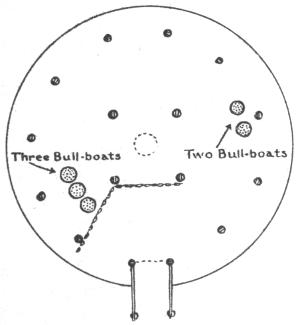
Figure 16
The winnowed grain, now well dried, was borne into the earth lodge and stored temporarily in bull boats. In the diagram (figure 16), is shown where the bull boats full of grain used to stand in my father’s lodge. Some years our harvest filled three bull boats of threshed grain; some years it filled five. In the year illustrated by this diagram, there were three bull boats standing between the planks at the left of the door, and the fire; and two bull boats on the other side of the fire, all full of grain.
The threshed grain, I have said, received its final drying and winnowing upon a tent cover (or covers) spread on the ground near the earth lodge. It was my own habit always to spread these tent covers beside the drying stage on the side farthest away from the lodge. However, the particular spot where the winnowing was done, was determined by the convenience of the household.
We did not usually thresh consecutive days. We threshed one day; dried the grain and winnowed it the second; and threshed again the third day.
Removing the Booth
During these days the booth did not remain always in one place. When the corn on the floor of the first section had all been threshed, the booth was removed to another section. I will now explain how this was done.
In figure 17 my son has diagramed the floor plan of my mothers’ stage and threshing booth, as I remember them.
The stage stands in front of Small Ankle’s lodge, which faces toward the west. The stage is divided into three sections, A, B, C. The posts upon which the floor of the stage rests are d, e, f, g, h, i, j, k.
The booth was first raised under section A, based upon fg and enclosing ground space lmfg.
Sometimes we got up early, bound the poles to the posts and erected our booth before breakfast; then after we had eaten, three or four of us would go out to thresh, one first going up to push down the corn. She raised a plank along the side, fg, just within the booth; this, if the door of the booth was on the side lm. The corn on the floor of the stage in section A was then shoved down as wanted.
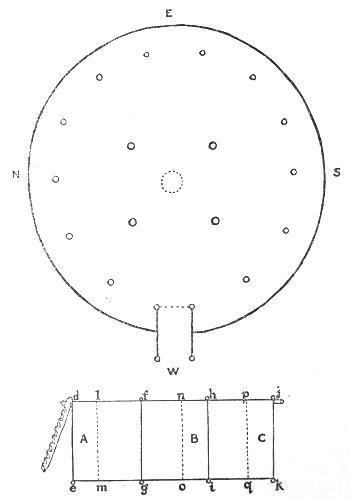
Figure 17
Ground plan of earth lodge here accompanies that of stage to show relative positions of the two structures. The stage always stood, as here, directly before the lodge entrance. The figures are drawn to scale.
The corn pushed down for one threshing, made a pile running the width of the booth, and about forty inches wide and twenty inches high. When the pile was threshed one of the women went up and shoved down another pile. The corn in one section was threshed in about three such piles.
Sometimes, if we worked hard and had plenty of help, we threshed one whole section in one day; but the beating, beating, beating of the corn was hard work, and we more often stopped when wearied and rested until the next day. I have already said that we often spent the next day at the lighter work of drying and winnowing.
When the corn in section A was all threshed, the booth was moved over under the floor of section B, enclosing fgno; and again a plank was taken up to let down the corn. Now this plank was always taken up above the side of the booth opposite the door; and the door was always placed down wind. Thus, if the wind was from the north, the door would be placed on the south side of the booth, and the plank was taken up on the north side, just within the booth. Corn was always threshed in the booth on the side opposite the door.
Sections A and B of my mothers’ stage, as shown in diagram (figure 17) contained only yellow corn. Section C, or a part of it, contained white corn. Braided strings of corn were also hung all around the railing above, but these were not to be threshed.
Section B having been threshed, the booth was removed to section C, enclosing hiqp. I have said that this section had white corn. Now this white corn was piled toward the south end of the stage; and between it and the yellow corn was left a narrow vacant place on the floor. Above this vacant place, meat was often dried; but this meat was removed when we were ready to thresh.
Placing the booth to enclose hiqp, directly under the vacant place, made it easy for us to raise a plank here to push down the white corn. If we had placed the booth on the south end of this section, we should have had to dig into the corn piled here, in order to raise a plank.
Our family’s threshing lasted about five days in a year of good yield; if the year was a poor one, threshing lasted only two or three days.
Threshing Braided Corn
The strings of braided corn were stored in the cache pit (which I will describe later) in the whole ear. If, during the winter, or the following spring, I wanted to thresh a string of braided corn, I put the whole string into a skin sack; and this sack I beat and shook, turning it over and around until all the grain had fallen off the cobs. The sack was then emptied.
Amount of Harvest
Our harvested corn, in a good year, lasted my father’s family until the next harvest, with a small quantity even then unused. Some years we ran out of corn before the harvest came, but not often. We ate our corn as long as it lasted, not husbanding it toward the last, because we knew there were elk and buffalo and antelope to be had for the hunting. If we ran out of corn at all, it was about the first of August; sometimes a little earlier. Sometimes when we had eaten all our last year’s harvest there was a small quantity from the previous season’s harvest with which we eked out our shortage.
My mothers, however, were industrious women, and our shortage, if any, was never for long. Some families, not very provident, had consumed all their harvest as early as in the spring; but such never happened in my father’s family.
Sioux Purchasing Corn
The Standing Rock Sioux used to buy corn of us, coming up in midsummer, or autumn. They came not because they were in need of food, but because they liked to eat our corn, and had always meat and skins to trade to us. For one string of braided corn they gave us one tanned buffalo robe.
Varieties of Corn
Description of Varieties
We raised nine well marked varieties of corn in our village. Following are the names of the varieties:
Atạ´ki tso´ki (White hard) Hard white
Atạ´ki (White) Soft white
Tsï´di tso´ki (Yellow hard) Hard yellow
Tsï´di tapa´ (Yellow soft) Soft yellow
Ma´ïkadicakĕ (Gummy) Gummy
Do´ohi (Blue) Blue
Hi´ci cĕ´pi (Red dark) Dark red
Hi´tsiica (Light-red) Light red
Atạ´ki aku´ hi´tsiica (White, kind of light red) Pink top
Our Hidatsa word for corn is ko´xati; but in speaking of any variety of corn, the work ko´xati is commonly omitted. In like manner, atạ´ki means white; but if one went into a lodge and asked for “atạ´ki” it was always understood to mean soft white corn.
Of the nine varieties, the atạ´ki, or soft white, was the kind most raised in our village. The ma´ïkadicakĕ, or gummy, was least raised, as almost its only use was in making corn balls.
In my father’s family, we raised two kinds of corn, tsï´di tso´ki, or hard yellow; and atạ´ki, or soft white.
The names of the varieties suggest pretty well their characteristics. The atạ´ki aku´ hi´tsiica, or white-with-light-red, was marked by a light red or pink color toward the top or beard end of the ear. The name pink-top which you suggest for this variety will, I think, do for an English name, if the literal translation of the Indian term is, as you say, rather clumsy.
We planted each variety of corn separately. We Indians understood perfectly the need of keeping the strains pure, for the different varieties had not all the same uses with us.
How Corn Travels
We Indians knew that corn can travel, as we say; thus, if the seed planted in one field is of white corn, and that in an adjoining field is of some variety of yellow corn, the white will travel to the yellow corn field, and the yellow to the white corn field.
Perhaps you do not understand what I mean by corn traveling. Well, let us suppose that there are two fields lying side by side, the one in yellow, the other in white corn. When the corn of the two fields is ripe, and the ears are opened, it will be found that many of the ears in the yellow rows that stand nearest the white field will have white kernels standing in the cob; also, in the rows of white corn that stand nearest the yellow field, there will be many ears with yellow kernels mixed in with the white kernels.
We Indians did not know what power it was that causes this. We only knew that it was so. We also knew that when a field stands alone, away from other fields, and is planted with white corn, it will grow up in white corn only; there will not be any yellow grains in the ears. And so of any other variety.
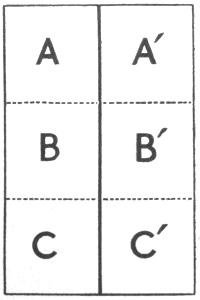
Figure 18
Sometimes two women, owning adjoining fields, would make an agreement; they would divide their fields into sections and plant the corresponding sections on opposite sides of the division line alike. Thus in the diagram (figure 18), A and A´ may be planted in a variety of yellow corn; B and B´ may be planted in beans and squashes; and C and C´ may be planted in a variety of white corn; but even this did not make so very much difference; still the corn traveled.
We thought that perhaps the reason of this was that the ground here was soft, or mellowed and broken by cultivation. We thought corn could not travel readily over hard, or unbroken ground; and as you notice in the diagram, although the two patches of yellow corn are separated from the white corn by the two patches of squashes and beans, yet the beans and squashes are in soft, or cultivated ground. We thought corn traveled more easily over soft ground.
However, we really did not know what made corn travel; we just knew that it did.
Uses of the Varieties
Atạ´ki Tso´ki
I think that perhaps at first, there was but one variety of corn, atạ´ki tso´ki, or hard white; and that all other varieties have sprung from it. I know that when we plant hard white seed, ears often develop that show color in the grain. Sometimes ears are produced bearing pink grains toward the beard end of the cob; such ears we call i´puta (top) hi´tsiica (pink); that is, pink top, or light-red top. In color these ears differed in no wise from atạ´ki aku´ hi´tsiica.