GUY DE MAUPASSANT (continued 2)
Laura Ensor translation
"Here."
I went towards him, and he said:—
"Will you help me to nurse a case of diphtheria? I am all alone, and I want someone to hold the woman, while I take out the false membrane from her throat."
"I'll come with you," I replied, and I got into his carriage.
He told me the following story:—
Diphtheria, terrible diphtheria that suffocates unhappy creatures, had made its appearance at poor Martinet's farm.
Both the father and son, had died at the beginning of the week. The mother and daughter, were now in their turn dying.
A neighbour who attended to them, feeling suddenly unwell, had taken flight the day before, leaving the door wide open, and abandoning the two sick people on their straw pallets, alone, without anything to drink, choking, suffocating, dying; alone, for the last twenty four-hours!
The doctor had cleaned out the mother's throat and made her swallow; but the child, maddened by pain and the anguish of suffocation, had buried and hidden its head in the straw bedding, absolutely refusing to allow itself to be touched.
The doctor accustomed to such scenes, repeated in a sad and resigned voice:
"I cannot really spend all day with these patients. By Jove, these do give one a heart ache. When you think that they have remained twenty-four hours without drinking. The wind blew the rain in on to their very beds. All the hens had taken shelter in the fire-place."
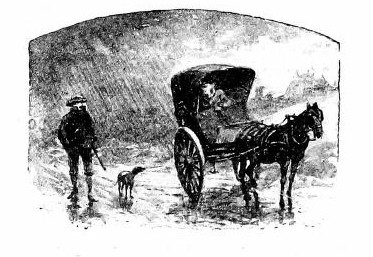
We had reached the farm. The doctor fastened his horse, to the bough of an apple-tree before the door, and we went in. A strong smell of sickness and damp, of fever and mouldiness, of hospital and cellar greeted our nostrils as we entered. In this grey and dismal house, fireless and without sign of life, it was bitterly cold; the swampy chill of a marsh. The clock had stopped; the rain fell down into the great fire-place, where the hens had scattered the ashes, and we heard in a dark corner the noise of a pair of bellows, husky and rapid. It was the breathing of the child. The mother, stretched out in a kind of large wooden box, the peasant's bed, and covered with old rags and old clothes, seemed to rest quietly. She slightly turned her head towards us.
The doctor inquired:
"Have you got a candle?"
She answered in a low depressed tone:
"In the cupboard."
He took the light, and led me to the further end of the room towards the little girl's crib.
She lay panting, with emaciated cheeks, glistening eyes, and tangled hair, a pitiable sight. At each breath, deep hollows could be seen in her thin strained neck. Stretched out on her back, she convulsively clutched with both hands the rags that covered her, and directly she caught sight of us, she turned her face away, and hid herself in the straw.
I took hold of her shoulders, and the doctor, forcing her to open her mouth, pulled out of her throat a long white strip of skin, which seemed to me as dry as a bit of leather.
Her breathing immediately became easier, and she drank a little. The mother raising herself on her elbow watched us. She stammered out:
"Is it done?"
"Yes, it's done."
"Are we going to be left all alone?"
A terror, a terrible terror shook her voice, the terror of solitude, of loneliness, of darkness, and of death that she felt so near to her.
I answered:
"No, my good woman, I will stay till the doctor sends you a nurse."
And turning towards the doctor, I added:
"Send old mother Mauduit; I will pay her."
"Very well, I'll send her at once."
He shook my hand, and went out; and I heard his gig drive off, over the damp road.
I was left alone with the two dying creatures.
My dog Paf had lain down in front of the empty hearth, and this reminded me that a little fire would be good for us all. I therefore went out to seek for wood and straw, and soon a bright flame lit up the whole room, and the bed of the sick child, who was again gasping for breath.
I sat down, and stretched out my legs in front of the fire.
The rain was beating against the window panes, the wind rattled over the roof. I heard the short, hard wheezing breath of the two women, and the breathing of my dog who sighed with pleasure, curled up before the bright fire-place.
Life! life! what is it? These two unhappy creatures, who had always slept on straw, eaten black bread, suffered every kind of misery, were about to die! What had they done? The father was dead, the son was dead. The poor souls had always passed for honest folk, had been liked and esteemed as simple and worthy fellows!
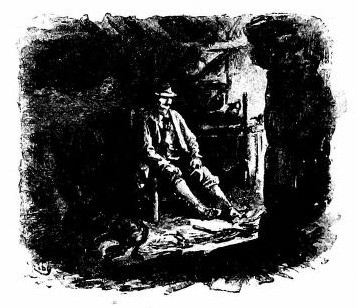
I watched my steaming boots and my sleeping dog, and there arose within me, a shameful and sensual pleasure, as I compared my lot with that of these slaves.
The little girl seemed to choke, and suddenly the grating sound became an intolerable suffering to me, lacerating me like a dagger, which at each stroke penetrated my heart.
I went towards her:
"Will you drink?" I said.
She moved her head to say yes, and I poured a few drops of water down her throat, but she could not swallow them.
The mother, who was quieter, had turned round to look at her child; and all at once a feeling of dread took possession of me, a sinister dread that passed over me, like the touch of some invisible monster. Where was I? I no longer knew! Was I dreaming? What horrible nightmare was this?
Is it true that such things happen? that one dies like this? And I glanced into all the dark corners of the cottage, as though I expected to see crouching in some obscure angle, a hideous, unmentionable, terrifying thing, the thing which lies in wait for the lives of men, and kills, devours, crushes, strangles them; the thing that delights in red blood, eyes glistening with, fever, wrinkles and scars, white hair and decay.
The fire was dying out. I threw some more wood on it, and warmed my back, shuddering in every limb. At least, I hoped to die in a good room, with doctors around my bed and medicines on the tables! And these women had been all alone, for twenty-four hours in this wretched hovel, without a fire, stretched on the straw with the death rattle in their throats! At last I heard the trot of a horse and the sounds of wheels; and the nurse came in coolly, pleased at finding some work to do, and showing little surprise at the sight of such misery.
I left her some money and fled with my dog; I fled like a malefactor, running away in the rain; with the rattle of those two throats still ringing in my ears,—running towards my warm home where my servants were awaiting me and preparing my good dinner.
But I shall never forget that scene, nor many other dreadful things, that make me loathe this world.
What would I not give at times, to be allowed not to think, not to feel, to live like a brute in a warm, clear atmosphere, in a country mellow with golden light, devoid of the raw, crude tones of verdure, a country of the East where I might sleep without weariness, and wake without care, where restlessness is not anxiety, where love is free from anguish, and existence is not a burden.
I should choose there a large square dwelling, like a huge box sparkling in the sun.
From the terrace, I should look upon the sea and the white wing-like pointed sails of the Greek and Turkish boats, as they flit to and fro. The outer walls have hardly any apertures. A large garden with air heavily laden under the overshadowing palm-trees, forms the centre of this Oriental home. Sprays of clear water shoot up under the trees, and fall back again with a slight splash, into a broad marble fountain sanded with golden dust. Here I should bathe often, between two pipes, two dreams, or two kisses.
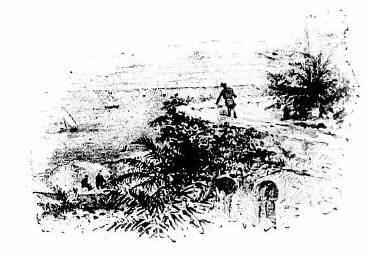
I should have slaves, black and handsome, draped in light airy clothing, noiselessly running hither and thither over the heavy carpets.
My walls should be soft and rebounding, with the round contours of a woman's bosom, and on the divans encircling each room, numberless cushions of every shape, should permit of my reposing in every conceivable attitude.
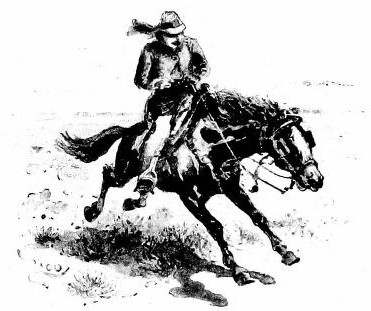
Then, when I should tire of my delicious repose, of my immobility, of my eternal day-dream; satiated with the calm enjoyment of my own well-being, then, I would order a horse to be brought to my door—a horse black or white, as fleet as a gazelle.
And I would spring upon his hack, and in a furious gallop, quaff the tingling intoxicating air.
And I would dart like an arrow, over the glowing country which fills the eye with delight, and has all the bouquet of wine.
In the calm hour of eve, I would fly in a mad career, towards the vast horizon dyed rose colour in the setting sun. Out there, all becomes rose in the twilight: the sun-burnt mountains, the sand, the garments of the Arabs, the dromedaries, the horses, the tents! The rose-coloured flamingoes fly upwards from the marshes to the rose-coloured sky, and I should scream with delight, plunged in the boundless infinite rosiness, of all that surrounds me.
I shall be released from the sight of the streets and the deafening noise of cabs on the pavement, from the sight of black-coated men, seated on uncomfortable chairs, as they sip their absinthe and talk over business.
I should ignore the state of the money market, political events, changes of ministry, all the useless frivolities on which we squander our short and vapid existence. Why should I undergo these worries, these sufferings, these struggles? I would rest sheltered from the wind in my bright and sumptuous dwelling.
The winged dream was floating before my closed eyelids, and over my mind as it sank to rest; when I heard my men awakening, lighting the boat's lantern, and setting to work at some arduous and lengthy task.
I called out to them:
"What on earth are you doing?"
Raymond replied in a hesitating voice:
"We are getting some lines ready, sir; for we thought that you would like to fish, if it was fine enough at sun-rise."
Agay is during the summer, the rendezvous of all the fishermen along the coast. Whole families come there, sleeping at the inn or in the boats, eating bouillabaisse on the beach, under the shade of the pine trees, the resinous bark of which crackles in the sun.
I inquired:
"What o'clock is it?"
"Three o'clock, sir."
Then, without rising, I stretched out my arm, and opened the door that separated my room from the forecastle.
The two men were squatting in the low den, through which the mast passes in fitting into the step; the den was full of such strange and odd things, that one might take it for a haunt of thieves; in perfect order along the partitions, instruments of all kinds were suspended: saws, axes, marling spikes, pieces of rigging, and saucepans; on the floor between the two berths, a pail, a stove, a barrel with its copper circles, glistening under the immediate ray of light from the lantern which hangs between the anchor bitts, by the side of the cable tiers; and my men were busy, baiting the innumerable hooks hanging all along the fishing lines.
"At what hour must I get up?" I asked.
"Why, now, sir, at once."
Half an hour after, we all three embarked on board the dingy, and left the "Bel-Ami" to go and spread our net at the foot of the Drammont, near the Ile d'Or.
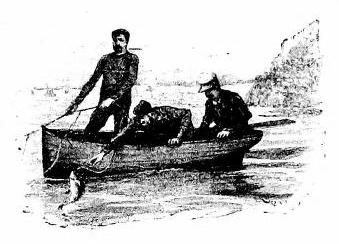
Then when our line, some two or three hundred yards long, had sunk to the bottom, we baited three little deep-sea lines, and having anchored the boat by sinking a stone at the end of a rope, we began to fish.
It was already daylight, and I could distinctly see the coast of Saint-Raphaël, near the mouth of the Argens, and the sombre mountains of the Maures, themselves running out seawards till they came to an end, far away in the open sea, beyond the gulf of Saint-Tropez.
Of all the southern coast, this is the spot I am fondest of. I love it as though I had been born there, as though I had grown up in it, because it is wild and glowing, and because the Parisian, the Englishman, the American, the man of fashion, and the adventurer have not yet poisoned it.
Suddenly the line I held in my hand quivered, I started, then felt nothing, and again a slight shock tightened the line wound round my finger, then another one more violent, shook my whole hand, and with beating heart, I began to draw in the line, gently, eagerly, striving to peer through the transparent blue water, and soon I perceived in the shadow of the boat, a white flash describing rapid circles.
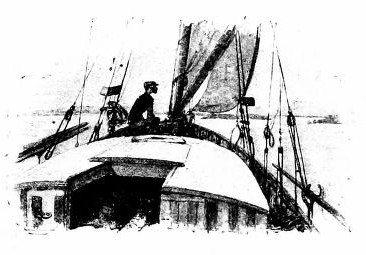
The fish thus seen appeared to me enormous, and when on board it was no bigger than a sardine.
Then I caught many others, blue, red, yellow, green, glittering, silvery, striped, golden, speckled, spotted, those pretty rock fish of the Mediterranean, so varied, so coloured, that seem painted to please the eye; then sea-urchins covered with prickles, and those hideous monsters of the sea, conger-eels.
Nothing can be more amusing than the uplifting of a sea fishing line. What will come out of the sea? What surprise, what pleasure, or what disappointment at each hook pulled out of the water! What a thrill runs through one when from afar some large creature is perceived struggling, as it rises slowly towards us!
At ten o'clock we had returned on board the yacht, and the two men beaming with delight, informed me that our take weighed twenty-three pounds.
I was, however, doomed to pay dearly for my sleepless night! A sick headache, the dreadful pain that racks in a way no torture could equal, shatters the head, drives one crazy, bewilders the ideas, and scatters the memory like dust before the wind; a sick headache had laid hold of me, and I was perforce obliged to lie down in my bunk with a bottle of ether under my nostrils.
After a few minutes, I fancied I heard a vague murmur which soon became a kind of buzzing, and it seemed as if all the interior of my body became light, as light as air, as though it were melting into vapour.
Then followed a numbness of spirit, a drowsy, comfortable state, in spite of the persisting pain, which, however, ceased to be acute. It was now a pain which one could consent to bear, and not any longer the terrible tearing agony, against which the whole tortured body rises in protest.
Soon the strange, and delightful sensation of vacuum I had in my chest, extended, and reached my limbs, which in their turn became light, light as though flesh and bone had melted away and skin only remained; just enough skin to permit of my feeling the sweetness of life, and enjoy my repose. Now I found that I no longer suffered. Pain had disappeared, melted, vanished into air. And I heard voices, four voices, two dialogues, without understanding the words. At times they were but indistinct sounds, at other times a word or two reached me. But I soon recognized that these were but the accentuated buzzing of my own ears. I was not sleeping, I was awake, I understood, I felt, I reasoned with a clearness, a penetration and power which were quite extraordinary; and a joyousness of spirit, a strange intoxication, produced by the tenfold increase of my mental faculties.
It was not a dream like that created by haschich, nor the sickly visions produced by opium; it was a prodigious keenness of reasoning, a new manner of seeing, of judging, of estimating things and life, with the absolute consciousness, the certitude that this manner was the true one.
And the old simile of the Scriptures, suddenly came back to my mind. It seemed to me that I had tasted of the tree of life, that all mystery was unveiled, so strongly did I feel the power of this new, strange, and irrefutable logic. And numberless arguments, reasonings, proofs, rose up in my mind, to be, however, immediately upset, by some proof, some reasoning, some argument yet more powerful. My brain had become a battle-field of ideas. I was a superior being, armed with an invincible intelligence, and I enjoyed prodigious happiness in the sensation of my power.
This state lasted a long, long time. I still inhaled the fumes of my ether bottle. Suddenly, I perceived that it was empty. And I again began to suffer.
For ten hours I endured this torture for which there is no remedy, then I fell asleep, and the next day, brisk as after convalescence, having written these few pages I left for Saint-Raphaël.
SAINT-RAPHAËL, April 11th.
On our way here the weather was delightful, and a light breeze carried us over in six tacks. After rounding the Drammont, I caught sight of the villas of Saint-Raphaël hidden amongst the pine-trees, among the little slender pines beaten all the year round, by the everlasting gusts of wind from Fréjus. Then I passed between the Lions, pretty red rocks that seemed to guard the town, and I entered the port, which, choked up with sand at the further end, obliges one to remain some fifty yards off the quay. I then went on land.
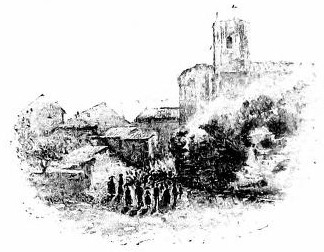
A large crowd was gathered in front of the church. Some one was being married. A priest was authorising in Latin with pontifical gravity, the solemn and comical act which so disturbs mankind, bringing with it so much mirth, suffering, and tears. According to custom, the families had invited all their relatives and friends to the funereal service of a young girl's innocence, to listen to the piously indecorous ecclesiastical admonitions, preceding those of the mother, and to the public benediction, bestowed on that which is otherwise so carefully veiled.
And the whole country-side, full of broad jokes, moved by the greedy and idle curiosity that draws the common herd to such a scene, had come there to see how the bride and bridegroom would comport themselves. I mingled with the crowd, and watched it.
Good heavens, how ugly men are! For at least the hundredth time, I noticed, in the midst of this festive scene, that, of all races, the human race is the most hideous. The whole air was pervaded by the odour of the people, the nauseous, sickening odour of unclean bodies, greasy hair and garlic, that odour of garlic, exhaled by the people of the South, through nose, mouth, and skin, just like roses spread abroad their perfume.
Certainly men are every day as ugly, and smell as obnoxious, but our eyes accustomed to the sight of them, our nostrils used to their odour, fail to distinguish their ugliness and their emanations, unless we have been spared for some time the sight and stink of them.
Mankind is hideous! To obtain a gallery of grotesque figures, fit to raise a laugh from the dead, it would be sufficient to take the ten first-comers, set them in a line, and photograph them with their irregular heights, their legs, either too long or too short, their bodies too fat or too thin, their red or pale, bearded or smooth faces, their smirking or solemn looks.
Formerly, in primeval days, the wild man, the strong naked man, was certainly as handsome as the horse, the stag or the lion. The exercise of his muscles, a life free from restraint, the constant use of his vigour and his agility, kept up in him a grace of motion, which is the first condition of beauty, and an elegance of form, which is produced only by physical exercise. Later on, the artistic nations, enamoured of form, knew how to preserve this grace and this elegance in intelligent man, by the artificial means of gymnastics. The care bestowed on the body, the trials of strength and suppleness, the use of ice-cold water and vapour baths, made the Greeks true models of human beauty, and they have left us their statues, to show us what were the bodies of these great artists.
But now, O Apollo! look at the human race moving about in its festive scenes. The children rickety from the cradle, deformed by premature study, stupefied by the school life that wears out the body at fifteen years of age, and cramps the mind before it is formed, reach adolescence with limbs badly grown, badly jointed, in which all normal proportions have completely disappeared.
And let us contemplate the people in the street, trotting along in their dirty clothing! As for the peasant! Good Heavens! Let us go and watch the peasant in the fields, his gnarled knotted frame, lanky, twisted, bent, more hideous than the barbarous types exhibited in a museum of anthropology.
In comparison how splendid are those men of bronze, the negroes; in shape, if not in face; how elegant, both in their movements and their figure, the tall lithe Arabs. Moreover, I have yet another reason for having a horror of crowds.
I cannot go into a theatre, nor be present at any public entertainment. I at once experience a curious and unbearable feeling of discomfort, a horrible unnerving sensation, as though I were struggling with all my might, against a mysterious and irresistible influence. And in truth, I struggle with the spirit of the mob, which strives to take possession of me.
How often have I observed that the intelligence expands and grows loftier, when we live alone, and that it becomes meaner and lower, when we again mix among other men. The contact, the opinions floating in the air, all that is said, all that one is compelled to listen to, to hear, to answer, acts upon the mind. A flow and ebb of ideas goes from head to head, from house to house, from street to street, from town to town, from nation to nation, and a level is established, an average of intellect is created, by all large agglomerations of individuals.
The inherent qualities of intellectual initiative, of free will, of wise reflection and even of sagacity, belonging to any individual being, generally disappear the moment that being is brought in contact with a large number of other beings.
The following is a passage from a letter of Lord Chesterfield to his son (1751) which sets forth with rare humility, the sudden elimination of all active qualities of the mind, in every large body of people:
"Lord Macclesfield, who had the greatest share in forming the bill, and who is one of the greatest mathematicians and astronomers in Europe, spoke afterwards with infinite knowledge, and all the clearness that so intricate a matter would admit of, but as his words, his periods, and his utterance were not near so good as mine, the preference was most unanimously, though most unjustly, given to me.
"This will ever be the case; every numerous assembly is mob, let the individuals who compose it be what they will. Mere reason and good sense is never to be talked to a mob; their passions, their sentiments, their senses and their seeming interests, are alone to be applied to.
"Understanding they have collectively none, &c...."
This deep observation of Lord Chesterfield's, a remark, however, that has often been made, and noted with interest by philosophers of the scientific school, constitutes one of the most serious arguments against representative government.
The same phenomenon, a surprising one, is produced each time a large number of men are gathered together. All these persons, side by side, distinct from each other, of different minds, intelligences, passions, education, beliefs, and prejudices, become suddenly, by the sole fact of their being assembled together, a special being, endowed with a new soul, a new manner of thinking in common, which is the unanalysable resultant of the average of these individual opinions.
It is a crowd, and that crowd is a person, one vast collective individual, as distinct from any other mob, as one man is distinct from any other man.
A popular saying asserts that "the mob does not reason." Now why does not the mob reason, since each particular individual in the crowd does reason? Why should a crowd do spontaneously, what none of the units of the crowd would have done? Why has a crowd irresistible impulses, ferocious wills, stupid enthusiasms that nothing can arrest, and, carried away by these thoughtless impulses, why does it commit acts, that none of the individuals composing it would commit alone?
A stranger utters a cry, and behold! a sort of frenzy takes possession of all, and all, with the same impulse, which no one tries to resist, carried away by the same thought, which instantaneously becomes common to all, notwithstanding different castes, opinions, beliefs, and customs, will fall upon a man, murder him, drown him, without a motive, almost without a pretext, whereas each one of them, had he been alone, would have precipitated himself, at the risk of his life, to save the man he is now killing.
And in the evening, each one on returning home, will ask himself what passion or what madness had seized him, and thrown his nature and his temperament out of its ordinary groove; how he could have given way to this savage impulse?
The fact is, he had ceased to be a man, to become one of a crowd. His personal will had become blended with the common will, as a drop of water is blended with and lost in a river.
His personality had disappeared, had become an infinitesimal particle of one vast and strange personality, that of the crowd. The panics which take hold of an army, the storms of opinion which carry away an entire nation, the frenzy of dervish dances, are striking examples of this identical phenomenon.
In short, it is not more surprising to see an agglomeration of individuals make one whole, than to see molecules, that are placed near each other form one body.
To this mysterious attraction, must without doubt be attributed the peculiar temperament of theatre audiences, and the strange difference of judgment, that exists between the audience of general rehearsals, and that of the audience of first representations, and again between the audience of a first representation, and that of the succeeding performances, and the change in the telling effects, from one evening to another; and the errors of judgment condemning a play like Carmen, which, later on, turns out an immense success.
What I say about crowds, must be applied to all society, and he who would carefully preserve the absolute integrity of his thought, the proud independence of his opinion, and look at life, humanity and the universe as an impartial observer free from prejudice, preconceived belief and fear, must absolutely live apart from all social relations; for human stupidity is so contagious, that he will be unable to frequent his fellow-creatures, even see them, or listen to them, without being, in spite of himself, influenced on all sides by their conversations, their ideas, their superstitions, their traditions, their prejudices, which by their customs, laws and surprisingly hypocritical and cowardly code of morality, will surely contaminate him.
Those who strive to resist these lowering and incessant influences, struggle in vain amidst petty, irresistible, innumerable and almost imperceptible fetters; and through sheer fatigue soon cease to fight.
But a backward movement took place in the crowd; the newly-married couple were coming out. And immediately I followed the general example, raised myself on tip-toe to see,—and longed to see,—with a stupid, low, repugnant longing, the longing of the common herd. The curiosity of my neighbours had intoxicated me; I was one of a crowd.
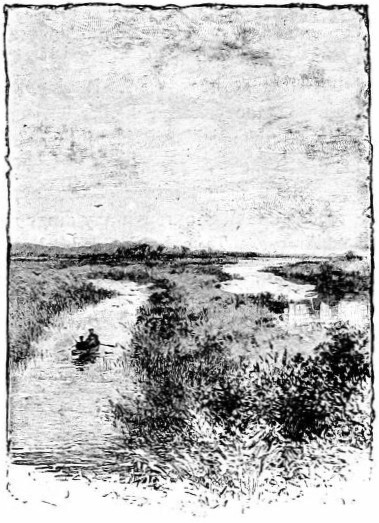
To fill up the remainder of the day, I decided on taking a row in my dingy up the Argens. This lovely and almost unknown river, separates the plains of Fréjus from the wild mountain range of the Maures.
I took Raymond, who rowed me along the side of the low beach to the mouth of the river, which we found impracticable and partly filled up with sand. One channel only communicated with the sea; but so rapid, so full of foam, of eddies and of whirlpools, that we were unable to ascend it.
We were therefore obliged to drag the boat to land, and carry it over the sandhills to a kind of beautiful lake, formed by the Argens at this spot.
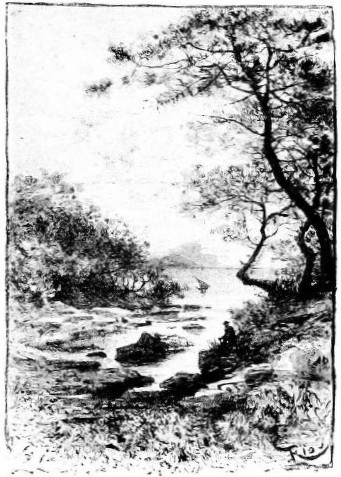
In the midst of a green and marshy country, of that rich green tint given by trees growing out of water, the river sinks down between two banks, so covered with verdure, and with such high impenetrable foliage, that the neighbouring mountains are barely visible; it sinks down, still winding, still looking like a peaceful lake, without showing or betraying that it continues twisting its way through the calm, lonesome and magnificent country.
As in the low Northern plains, where the springs ooze out under the feet, running over and vivifying the earth like blood, the clear, cold blood of the soil; so here, we find again the same strange sensation of exuberant nature which floats over all damp countries.
Birds, with long legs dangling as they fly, spring up from amongst the reeds, stretching their pointed beaks heavenwards; while others, broad-winged and slow, pass from one bank to another with heavy flight, and others, smaller and more rapid, skim along the surface of the river, darting forward like rebounding pebbles. Innumerable turtle-doves cooing on the heights, or wheeling about, fly from tree to tree, and seem to exchange messages of love. One feels a sensation that all around this deep water, throughout all this plain, up to the foot of the mountains, there is yet more water; the deceitful water of the marsh, sleeping yet living; broad clear sheets, in which the skies are mirrored, over which the clouds flit by; in which, widely scattered, all manner of strange rushes spring up; the fertile limpid water, full of rotting life and deathly fermentation; water breeding fever and miasma, at the same time food and poison, spreading itself out in attractive loveliness, over the mysterious mass of putrefaction beneath it. The atmosphere is delightful, relaxing and dangerous. Over all the banks which separate the vast still pools, amid all the thick grasses, swarms, crawls, jumps, and creeps a whole world of slimy, repugnant, cold-blooded animals. I love those cold, subtle animals that are generally avoided and dreaded; for me there is something sacred about them.
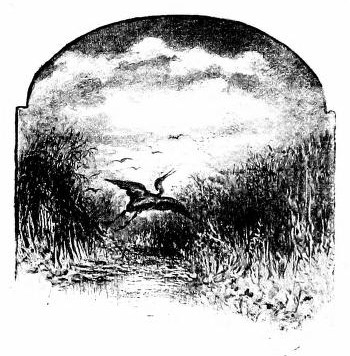
At the hour of sunset the marsh intoxicates and excites me. After having been all day a silent pond lying hushed in the heat, it becomes at the moment of twilight, a fairy-like and enchanted country. In its calm and boundless depths the skies are mirrored: skies of gold, skies of blood, skies of fire; they sink in it, bathe in it, float and are drowned in it. They are there up above, in the immensity of the firmament, and they are there below, beneath us, so near and yet so completely beyond our touch, in that shallow pool, through which the pointed grasses push their way like bristling hairs. All the colour with which earth has been endowed, charming, varied, and enthralling, appears to us deliciously painted, admirably resplendent, and infinitely shaded around a single leaf of the water-lily. Every shade of red, rose, yellow, blue, green, and violet are there, in a little patch of water which shows us the heavens, and space, and dreamland, and the flight of the birds as they skim across its face. And then there is still something else,—I know not what,—in the marshes beheld in the setting sun. I feel therein a confused revelation of some unknown mystery, an original breath of primeval life, which is, perhaps, nothing more than the bubble of gas rising from a swamp at the fall of day.
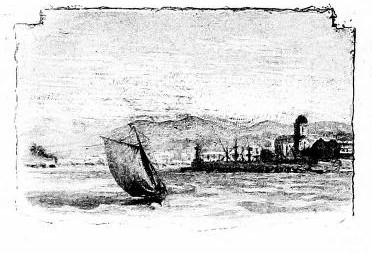
SAINT-TROPEZ, April 12th.
We left Saint-Raphaël at about eight o'clock this morning, with a strong northwest breeze.
The sea in the gulf, though it had no waves, was white with foam, white like a mass of soap-suds, for the wind, the terrible wind from Fréjus which blows almost every morning, seemed to throw itself on the water, as though it would tear it to pieces, raising a rolling mass of little waves of froth, scattered one moment, reformed the next.
The people at the port having assured us that this squall would fall towards eleven o'clock, we decided upon starting with three reefs in, and the storm-jib. The dingy was placed on board at the foot of the mast, and the Bel-Ami seemed to fly directly it left the jetty. Although it carried scarcely any sail, I had never felt it dash along like this. One might have thought that it hardly touched the water, and one would never have suspected that it carried at the bottom of its large keel, two and a-half yards deep, a slab of lead weighing over thirty cwt., besides thirty-eight cwt. of ballast in its hold, and all we had on board in the shape of rigging, anchors, chains, cables and furniture.
I had soon crossed the bay, at the further end of which the Argens throws itself into the sea; and as soon as I was under shelter of the coast the breeze completely fell. It is there that the splendid, sombre, and wild region begins, which is still called the land of the Moors. It is a long peninsula, composed of mountains; with a contour of coasts over sixty miles long.
Saint-Tropez, situated at the entry of the lovely gulf, formerly called Gulf of Grimaud, is the capital of the little Saracen kingdom, of which nearly every village, built on the summit of a peak in order to secure it from attack, is still full of Moorish houses with arcades, narrow windows, and inner courtyards, wherein tall palm trees have grown up, and are now higher than the roofs.
If one penetrates on foot into the unknown valleys of this strange group of mountains, one discovers an incredible country, devoid of roads, and lanes; without even footpaths, without hamlets, without houses.
At intervals, after seven or eight hours' walking, appears a hovel, often abandoned, or sometimes inhabited by a poverty-stricken family of charcoal burners.
The Monts des Maures have, it appears, a system of geology peculiar to themselves, a matchless flora said to be the most varied in Europe, and immense forests of pines, chestnuts, and cork trees.
Some three years ago, I made an excursion into the very heart of the country, to the ruins of the Chartreuse de la Verne, and have retained an ineffaceable recollection of it. If it is fine to-morrow I shall return there.
A new road follows the sea, going from Saint-Raphaël to Saint-Tropez. All along this magnificent avenue, opened up through the forest by the side of a matchless beach, new winter resorts are being started. The first one planned is called Saint Aigulf.
This bears a peculiar stamp. In the midst of a forest of fir trees stretching down to the sea, wide roads are laid out in every direction. There is not a house, nothing but the barely indicated plan of the streets, running through the trees. Here are the squares, the cross-roads and the boulevards. The names are even written up on metal tablets: Boulevard Ruysdaël, Boulevard Rubens, Boulevard Van Dyck, Boulevard Claude Lorrain. One wonders at all these painters' names. Why indeed? Simply because the Company has decided, like God before he lit the sun: "This shall be an artists' resort!"
The Company! No one knows in the rest of the world, all this word contains of hopes, dangers, money gained, and money lost on the Mediterranean shores! The Company! fatal and mysterious word, deep and deceitful!
In this instance however the Company seems to have realized its expectations, for it has already found purchasers, and of the best, amongst artists. At various places one reads: "Building lot bought by M. Carolus Duran; another by M. Clairin, another by Mlle. Croizette, etc." Nevertheless—Who can tell? The Mediterranean Companies are not in luck just now. Nothing is more ludicrous than this fury of speculation, which generally ends in terrible failures. Whosoever has gained ten thousand francs (four hundred pounds) over his field, at once buys ten millions (four hundred thousand pounds) worth of land at twenty sous (ten pence) the metre, in order to sell it again at twenty francs (sixteen shillings). Boulevards are traced, water is conveyed, gasworks are prepared, and the purchaser is hopefully expected.
The purchaser does not make his appearance, but instead of him—-ruin.
Far off in front of me I perceive the towers and the buoys, that mark the breakers on both sides, at the opening of the gulf of Saint-Tropez.
The first tower is called "Tour des Sardinaux," and marks a regular shoal of rocks, level with the top of the water, some of which just show the tips of their brown heads; the second one has been christened "Balise de la Sèche à l'huile."[1]
We now reach the entrance of the gulf, which extends back between two ridges of mountains and forests as far as the village of Grimaud, built at the very extremity, on a height. The ancient castle of Grimaldi, a tall ruin that overlooks the village, appears in the distant haze like the evocation of some fairy scene.
The wind has fallen. The gulf looks like an immense calm lake, into which, taking advantage of the last puffs of the squall, we slowly make our way.
To the right of the channel, Sainte-Maxime, a little white port, is mirrored in the water which reflects the houses topsy-turvy, and reproduces them as distinctly as on shore. Opposite, Saint-Tropez appears, guarded by an old fort.
At seven o'clock Bel-Ami anchored by the quay, at the side of the little steamboat which carries on the service with Saint-Raphaël. The only means of communication between this isolated little port, and the rest of the world is by this Lion de Mer, an old pleasure yacht, which runs in connection with a venerable diligence, that carries the letters, and travels at night by the one road which crosses the mountains.
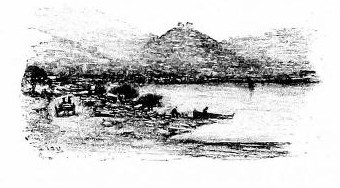
This is one of those charming and simple daughters of the sea, one of those nice modest little towns; which, fed upon fish and sea air, and breeder of sailors, is as much a produce of the sea as any shell. On the jetty, stands a bronze statue of the Bailli de Suffren.
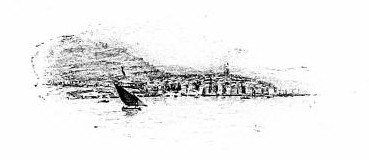
The pervading smell is one of fish and smoking tar, of brine and hulls. The stones in the streets glitter like pearls, with the scales of the sardines, and along the walls of the port, a population of lame and paralysed old sailors bask in the sun, on the stone benches. From time to time they talk of past voyages, and of those they have known in bygone days, the grandfathers of the small boys running yonder. Their hands and faces are wrinkled, tanned, browned, dried by the wind, by fatigue, by the spray, by the heat of the tropics and by the icy cold of Northern seas, for they have seen, in their roamings over the ocean, the ins and outs of the world, every aspect of the earth and of all latitudes. In front of them, propped upon a stick, passes and repasses the old captain of the merchant service, who formerly commanded the Trois-Soeurs, or the Deux-Amis, or the Marie-Louise or the Jeune-Clémentine.
All salute him, like soldiers answering the roll-call, with a litany of "Good day, captain," modulated in many tones.
This is a true land of the sea, a brave little town, briny and courageous, which fought in days of yore against the Saracens, against the Duc d'Anjou, against the wild corsairs, against the Connétable de Bourbon, and Charles-Quint, and the Duc de Savoie, and the Duc d'Epernon. In 1637, the inhabitants, fathers of these peaceful citizens, without any assistance repelled the Spanish fleet, and every year they renew with surprising realism, the representation of the attack and their defence, filling the town with noisy bustle and clamour, strangely recalling the great popular festivities of the middle ages.
In 1813, the town likewise repulsed an English flotilla, that had been sent against it.
Now it is a fishing town, and the produce of its fisheries supplies the greater part of the coast with tunny, sardines, loups, rock-lobsters, and all the pretty fish of this blue sea.
On setting foot on the quay after having dressed myself, I heard twelve o'clock strike, and I perceived two old clerks, notary or lawyer's clerks, going off to their midday meal, like two old beasts of burden, unbridled for a few minutes while they eat their oats at the bottom of a nosebag.
Oh, liberty! liberty! our sole happiness, sole hope, sole dream! Of all the miserable creatures, of all classes of individuals, of all orders of workers, of all the men who daily fight the hard battle of life, these are the most to be pitied, on these does fortune bestow the fewest of her favours.
No one believes this,—no one knows it. They are powerless to complain; they cannot revolt; they remain gagged and bound in their misery, the shamefaced misery of quill-drivers.
They have gone through a course of study, they understand law, they have taken a degree, perhaps.
How dearly I like that dedication by Jules Vallès:
"To all those, who, nourished upon Greek and Latin, have died of starvation."
And what do they earn, these starvelings? Eight to fifteen hundred francs, (thirty-two to sixty pounds) a year!
Clerks in gloomy chambers, or clerks in office, you should read every morning over the door of your fatal prison, Dante's famous phrase:
"Abandon hope, all ye who enter here!"
They are but twenty when they first enter, and will remain till sixty or longer. During this long period not an event takes place! Their whole life slips away in the dark little bureau, ever the same, carpeted with green portfolios. They enter young, at the age of vigorous hopes; they leave in old age, when death is at hand. All the harvest of recollections that we make in a life-time, the unexpected events, our loves,—gentle or tragic memories, our adventures, all the chances of a free existence, are unknown to these convicts.
The days, the weeks, the months, the seasons, the years, all are like. They begin the day's work at the same hour; at the same hour, they breakfast; at the same hour, they leave; and this goes on for sixty or seventy years. Four accidents only constitute landmarks in their existence: marriage, the birth of the first-born, and the death of father, or mother. Nothing else; stop though, yes, a rise in salary. They know nothing of ordinary life, nothing of the world! Unknown to them are the days of cheerful sunshine in the streets, and idle wanderings through the fields, for they are never released before the appointed hour. They become voluntary prisoners at eight o'clock in the morning, and at six, the prison doors are opened for them, when night is at hand. But, as a compensation, they have, for a whole fortnight in the year, the right,—a right indeed much discussed, hardly bargained for and grudgingly granted,—to remain shut up in their lodgings. For where can they go without money?
The builder climbs skywards; the driver prowls about the streets; the railway mechanic traverses woods, mountains, plains; moves incessantly from the walls of the town, to the vast blue horizon of the sea. The employé never quits his bureau, his coffin, and in the same little mirror, wherein he saw himself a young fellow with fair moustache the day of his arrival, he contemplates himself bald, and white-bearded, on the day of his dismissal. Then, all is finished, life is played out, the future closed. How can he have reached this point? How can he have grown old without any event having occurred, without having been shaken by any of the surprises of existence? It is so nevertheless. He must now make way for the young! for the young beginners!
Then the unfortunate mortal steals away, more wretched than before, and dies, almost immediately from the sudden snapping of the long and obstinate habit of his daily routine, the dreary routine of the same movements, the same actions, the same tasks at the same hours.
As I went into the hotel for breakfast, an alarmingly big packet of letters and papers was handed to me, and my heart sank as at the prospect of some misfortune. I have a fear and a hatred of letters; they are bonds. Those little squares of paper bearing my name, seem to give out a noise of chains, as I tear them open,—of chains linking me to living creatures, I have known or know.
Each one inquires, although written by different hands: "Where are you? What are you doing? Why disappear in this way, without telling us where you are going? With whom are you hiding?" Another adds: "How can you expect people to care for you, if you run away in this fashion from your friends? It is positively wounding to their feelings."
Well then, don't attach yourselves to me! Will no one endeavour to understand affection, without joining thereto a notion of possession and of despotism. It would seem as if social ties could not exist without entailing obligations, susceptibilities, and a certain amount of subserviency. From the moment one has smiled upon the attentions of a stranger, this stranger has a hold upon you, is inquisitive about your movements, and reproaches you with neglecting him. If we get as far as friendship, then each one imagines himself to have certain claims; intercourse becomes a duty, and the bonds which unite us seem to end in slip-knots which draw tighter. This affectionate solicitude, this suspicious jealousy, eager to control, and to cling, on the part of beings who have met casually, and who fancy themselves linked together because they have proved to be mutually agreeable, arises solely from the harassing fear of solitude, which haunts mankind upon this earth.
Each of us, feeling the void around him, the unfathomable depth in which his heart beats, his thoughts struggle, wanders on like a madman with open arms and eager lips, seeking some other being to embrace. And embrace he does, to the right, to the left, at haphazard, without knowing, without looking, without understanding, that he may not feel alone. He seems to say, from the moment he has shaken hands: "Now, you belong to me a little. You owe me some part of yourself, of your life, of your thoughts, of your time." And that is why so many people believe themselves to be friends, who know nothing whatever of each other, so many start off hand in hand, heart to heart, without having really had one good look at one another. They must care for some one, in order not to be alone, their affections must be expended in friendship or in love, but some vent, must be found for it incessantly. And they talk of affection, swear it, become enthusiastic over it, pour their whole heart into some unknown heart found only the evening before, all their soul into some chance soul with a face that has pleased. And from this haste to become united, arise all the surprises, mistakes, misunderstandings and dramas of life.
Just as we remain lonely and alone, notwithstanding all our efforts, so in like manner we remain free, notwithstanding all our ties.
No one, ever, belongs to another. Half unconsciously we lend ourselves to the comedy,—coquettish or passionate, of possession, but no one really gives himself—his ego—to another human being. Man, exasperated by this imperious need to be the master of some one, instituted tyranny, slavery and marriage. He can kill, torture, imprison, but the human will inevitably escapes him, even when it has for a few moments consented to submission.
Do mothers even possess their children? Does not the tiny being but just entered into the world, set to work to cry for what he wants, to announce his separate existence, and proclaim his independence?
Does a woman ever really belong to you? Do you know what she thinks, whether even she really adores you? You kiss her sweet body (waste your whole soul on her perfect lips): a word from your mouth or from hers—one single word—is enough to put between you, a gulf of implacable hatred!
All sentiments of affection lose their charm, when they become authoritative. Because it gives me pleasure to see and talk with some one, does it follow that I should be permitted to know what he does, and what he likes? The bustle of towns, both great and small, of all classes of society, the mischievous, envious, evil-speaking, calumniating curiosity, the incessant watchfulness of the affections and conduct of others, of their gossip and their scandals, are they not all born of that pretension we have, to control the conduct of others, as if we all belonged to each other in varying degrees? And we do in fact imagine that we have some rights over them, and on their life, for we would fain model it upon our own; on their thoughts, for we expect them to be of the same style as our own; on their opinions, in which we will not tolerate any difference from ours; on their reputation, for we expect it to conform to our principles; on their habits, for we swell with indignation, when they are not according to our notions of morality.
I was breakfasting at the end of a long table, in the hotel Bailli de Suffren, and still occupied with the perusal of my letters and papers, when I was disturbed by the noisy conversation of some half-dozen men, seated at the other end.
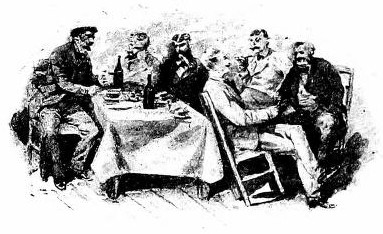
They were commercial travellers. They talked on every subject with assurance, with contempt, in an airy, chaffing authoritative manner, and they gave me the clearest, the sharpest feeling of what constitutes the true French spirit; that is to say, the average of the intelligence, logic, sense and wit of France. One of them, a great fellow with a shock of red hair wore the military medal, and also one for saving life,—a fine fellow. Another, a fat little roundabout, made puns without ceasing and laughed till his sides ached at his own jokes, before he would leave time to the others to understand his fun. Another man with close-cut hair, was re-organizing the army and the administration of justice, reforming the laws and the constitution, sketching out an ideal Republic to suit his own views, as a traveller in the wine trade. Two others, side by side, were amusing each other thoroughly with the narrative of their bonnes fortunes; adventures in back parlours of shops, and conquests of maids-of-all-work.
And in them I saw France personified, the witty, versatile, brave and gallant France of tradition.
These men were types of the race, vulgar types, it is true, but which have but to be poetized a little, to find in them the Frenchman, such as history—that lying and imaginative old dame—shows him to us.
And it is really an amusing race, by reason of certain very special qualities, which one finds absolutely nowhere else.
First and foremost it is their versatility, which so agreeably diversifies both their customs, and their institutions. It is this, which makes the history of their country resemble some surprising tale of adventure in a feuilleton, of which the pages "to be continued in the next number," are full of the most unexpected events, tragic, comic, terrible, grotesque. One may be angry or indignant over it, according to one's way of thinking, but it is none the less certain that no history in the world is more amusing, and more stirring than theirs.
From the pure art point of view—and why should one not admit this special, and disinterested point of view, in politics as well as in literature?—it remains without a rival. What can be more curious, and more surprising, than the events which have been accomplished in the last century?
What will to-morrow bring forth? This expectation of the unforeseen is, after all, very charming. Everything is possible in France, even the most wildly improbable drolleries, and the most tragic adventures.
What could surprise them? When a country has produced a Joan of Arc, and a Napoleon, it may well be considered miraculous ground.
And then the French love women: they love them well, with passion and with airy grace, and with respect.
Their gallantry cannot be compared to anything in any other country.
He who has preserved in his heart, the flame of gallantry which burned in the last centuries, surrounds women with a tenderness at once profound, gentle, sensitive and vigilant. He loves everything that belongs to them; everything that comes from them, everything that they are; everything they do. He loves their toilette, their knick-knacks, their adornments, their artifices, their naïvetés, their little perfidies, their lies and their dainty ways. He loves them all, rich as well as poor, the young and even the old, the dark, the fair, the fat, the thin. He feels himself at his ease with them, and amongst them. There he could remain indefinitely, without fatigue, without ennui, happy in the mere fact of being in their presence.
He knows how, from the very first word, by a look, by a smile, to show them that he adores them, to arouse their attention, to sharpen their wish to please, to display for his benefit all their powers of seduction. Between them and him there is established at once, a quick sympathy, a fellowship of instincts, almost a relationship through similarity of character and nature.
Then begins between them and him a combat of coquetry, and gallantry; a mysterious, and skirmishing sort of friendship is cemented, and an obscure affinity of heart and mind is drawn closer.
He knows how to say what will please them, how to make them understand what he thinks; how to make known, without ever shocking them, without offending their delicate and watchful modesty, the admiration, discreet yet ardent, always burning in his eyes, always trembling on his lips, always alight in his veins. He is their friend and their slave, the humble servitor of their caprices, and the admirer of their persons. He is ever at their beck and call, ready to help them, to defend them, as secret allies. He would love to devote himself to them, not only to those he knows slightly, but to those he knows not at all, to those he has never even seen.
He asks nothing of them but a little pretty affection, a little confidence, or a little interest, a little graceful friendliness or even, sly malice.
He loves, in the street the woman who passes by, and whose glance falls upon him. He loves the young girl with hair streaming down her shoulders, who, a blue bow on her head, a flower in her bosom, moves with slow or hurried step, timid or bold eye, through the throng on the pavements. He loves the unknown ones he elbows, the little shopwoman who dreams on her doorstep, the fine lady who lazily reclines in her open carriage.
From the moment he finds himself face to face with a woman, his heart is stirred, and his best powers are awakened. He thinks of her, talks for her, tries to please her, and to let her understand that she pleases him. Tender expressions hover on his lips, caresses in his glance; he is invaded by a longing to kiss her hand, to touch even the stuff of her dress. For him, it is women who adorn the world, and make life seductive.
He likes to sit at their feet, for the mere pleasure of being there; he likes to meet their eye, merely to catch a glimpse of their veiled and fleeting thoughts; he likes to listen to their voice, solely because it is the voice of woman.
It is by them, and for them, that the Frenchman has learnt to talk, and to display the ready wit which distinguishes him.
To talk! What is it? It is the art of never seeming wearisome; of knowing how to invest every trifle with interest, to charm no matter what be the subject, to fascinate with absolutely nothing.
How can one describe the airy butterfly touch upon things by supple words, the running fire of wit, the dainty flitting of ideas, which should all go to compose talk?
The Frenchman is the only being in the world who has this subtle spirit of wit, and he alone thoroughly enjoys and comprehends it.
His wit is a mere flash and yet it dwells; now the current joke, now the wit, which illumines the national literature.
That which is truly innate, is wit in the largest sense of the word, that vast breath of irony or gaiety, which has animated the nation from the moment it could think or speak: it is the pungent raciness of Montaigne and Rabelais, the irony of Voltaire, of Beaumarchais, of Saint-Simon, and the inextinguishable laughter of Molière.
The brilliant sally, the neat epigram, is the small-change of this wit. And nevertheless, it is yet an aspect of it, a characteristic peculiarity of the national intelligence. It is one of its keenest charms. It is this that makes the sceptical gaiety of Paris life, the careless cheerfulness of their manners and customs. It is part and parcel of the social amenity.
Formerly, these pleasant jests were made in verse, now-a-days they appear in prose. They are called, according to their date, epigrams, bons mots, traits, hits, gauloiseries. They fly through town and drawing-room, they spring up everywhere, on the boulevard as well as Montmartre. And those of Montmartre are often just as good as those of the boulevard, they are printed in the papers; from one end of France to the other, they excite laughter. For, at least, the French know how to laugh.
Why should one good thing more than another, the unexpected, quaint, juxtaposition of two terms, two ideas or even two sounds; a ridiculous pun, some unexpected cock-and-bull story, open the floodgates of our gaiety, causing explosions of mirth, fit to blow up all Paris and the provinces like a mine?
Why do all the French laugh, while all the English and all the Germans can understand nothing of the fun? Why? solely and wholly because they are French, because they possess the intelligence which is peculiar to the French, and because they possess the delightful, enviable gift of laughter.
With them, moreover, a little mother-wit, enables any government to hold its own.
Good spirits takes the place of genius, a neat saying consecrates a man at once, and makes him great for all posterity. The rest matters little. The nation loves those who amuse it, and forgives everything to those who can make it laugh.
A glance thrown over the past history of France, will make us understand that the fame of their great men, has only been made by flashes of wit. The most detestable princes have become popular by agreeable jests, repeated and remembered from century to century.
The throne of France, is maintained by the cap and bells of the jester.
Jests, jests, nothing but jests, ironic or heroic, polished or coarse,—jests float for ever to the surface in their history, and make it like nothing so much as a collection of puns and witticisms.
Clovis, the Christian king, cried on hearing the story of the Passion:
"Why was I not there with my Franks?" This prince, in order to reign alone, massacred his allies and his relations, and committed every crime imaginable. Nevertheless, he is looked upon as a pious and civilizing monarch.
"Why was I not there with my Franks?"
We should know nothing of good King Dagobert, if the song had not apprised us of a few particulars, no doubt erroneous, of his existence.
Pepin, wishing to remove the king Childeric from the throne, proposed to Pope Zacharias the following insidious question:
"Which of the two is the most worthy to reign? He who worthily fulfils all the kingly functions without the title, or he who bears the title without knowing how to reign?"
What do we know of Louis VI.? Nothing. Pardon! In the battle of Brenneville, when an Englishmen laid hands upon him, crying, "The king is taken," this truly French monarch replied: "Do you know, knave, that a king can never be taken, even at chess?"
Louis IX., saint though he was, has not left a single good saying to remember him by. In consequence, his reign appears to the French a wearisome episode, full of orisons and penances.
That noodle, Philip VI., beaten and wounded at the battle of Crécy, cried as he knocked at the gates of the castle of Arbroie: "Open: here are the fortunes of France!" They are still grateful to him for this melodramatic speech. John II., made prisoner by the Prince of Wales, remarks, with chivalrous good will, and the graceful gallantry of a French troubadour, "I had counted upon entertaining you at supper to-night; but fortune wills otherwise, and ordains that I should sup with you."
It would be impossible to bear adversity more gracefully.
"It is not for the King of France to avenge the quarrels of the Duke of Orleans," was the generous declaration of Louis XII. And it is, truly, a kingly saying; one worthy of the remembrance of all princes.
That hare-brained fellow Francis I., more apt at the pursuit of the fair sex, than at the conduct of a campaign, has saved his reputation, and surrounded his name with an imperishable halo, by writing to his mother those few superb words, after the defeat of Pavia: "All is lost, Madame, save honour."
Does not that phrase remain to this day as good as a victory? Has it not made this prince more illustrious, than the conquest of a kingdom? We have forgotten the names of the greater number of the famous battles, fought in these long bygone days; but shall we ever forget: "All is lost, save honour?"
Henry IV.! Hats off, gentlemen! Here is the master! Sly, sceptical, tricky, deceitful beyond belief, artful beyond compare; a drunkard, debauchee, unbeliever, he managed by a few happy and pointed sayings, to make for himself in history, an admirable reputation as a chivalrous, generous king, a brave, loyal, and honest man.
Oh! the cheat! well did he know how to play upon human stupidity!
"Hang yourself, brave Crillou, we have gained the day without you."
After a speech like this, a general is always ready to be hanged, or killed for his master's sake.
At the opening of the famous battle of Ivry: "Children, if the colours fall, rally to my white plumes, you will find them always on the road to honour and victory."
How could a man fail to be victorious, who knew how to speak thus to his captains and his troops?
This sceptical monarch wishes for Paris; he longs for it, but he must choose between his faith and the beautiful city: "Enough," he murmurs, "after all Paris is well worth a mass!" And he changes his religion, as he would have changed his coat. Is it not a fact, however, that the witticism caused a ready acceptance of the deed? "Paris is well worth a mass," raised a laugh among the choicer spirits, and there was no violent indignation over the change.
Has he not become the patron of all fathers of families, by the question put to the Spanish Ambassador, who found him playing at horses with the Dauphin: "Are you a father, M. l'Ambassadeur?"
The Spaniard replied: "Yes, sir."
"In that case," said the King, "we will go on."
But he made a conquest for all eternity of the heart of France, of the bourgeoisie, and of the people, by the finest phrase that prince ever pronounced,—a real inspiration of genius, full of depth, heartiness, sharpness, and good sense.
"If God prolongs my life, I hope to see in my kingdom no peasant so poor, that he cannot put a fowl in the pot for his Sunday's dinner."
It is with words such as these, that enthusiastic and foolish crowds are flattered and governed. By a couple of clever sayings, Henry IV. has drawn his own portrait for posterity. One cannot pronounce his name, without at once having a vision of the white plumes, and of the delicious flavour of a poule-au-pot.
Louis XIII. made no happy hits. This dull King had a dull reign.
Louis XIV. created the formula of absolute personal power: "The State is myself."
He gave the measure of royal pride in its fullest expansion: "I have almost had to wait."
He set the example of sonorous political phrases, which make alliances between two nations: "The Pyrenees exist no longer!"
All his reign is in these few phrases.
Louis XV., most corrupt of Kings, elegant and witty, has bequeathed to posterity that delightful keynote of his supreme indifference: "After me, the deluge."
If Louis XVI. had been inspired enough to perpetrate one witticism, he might possibly have saved his kingdom. With one bon mot, might he not perhaps have escaped the guillotine?
Napoleon I. scattered around him by handfuls, the sayings that were suited to the hearts of his soldiers.
Napoleon III. extinguished with one brief phrase, all the future indignation of the French nation in that first promise: "The Empire is peace." The Empire is peace! superb declaration, magnificent lie! After having said that, he might declare war against the whole of Europe, without having anything to fear from his people. He had found a simple, neat, and striking formula, capable of appealing to all minds, and against which facts would be no argument.
He made war against China, Mexico, Russia, Austria, against all the world. What did it matter? There are people yet, who speak with sincere conviction of the eighteen years of tranquillity he gave to France: "The Empire is peace."
And it was also with his keen words of satire, phrases more mortal than bullets, that M. Rochefort laid the Empire low, riddling it with the arrows of his wit, cutting it to shreds and tatters.
The Maréchal MacMahon himself has left as a souvenir of his career to power: "Here I am, here I remain!" And it was by a shaft from Gambetta that he was, in his turn, knocked down: "Submission or dismissal."
With these two words, more powerful than a revolution, more formidable than the barricades, more invincible than an army, more redoubtable than all the votes, the tribune turned out the soldier, crushed his glory, and destroyed his power and prestige.
As to those who govern France at this moment, they must fall, for they are devoid of wit; they will fall, for in the day of danger, in the day of disturbance, in the inevitable moment of see-saw, they will not be capable of making France laugh, and of disarming her.
Of all these historical phrases, there are not ten really authentic. But what does it matter, so long as they are believed to have been uttered by those to whom they are attributed:
"Dans le pays des bossus Il faut l'être Ou le paraître,"[2]
says the popular song.
Meanwhile the commercial travellers were talking of the emancipation of women, of their rights, and of the new position in society they longed for.
Some approved, others were annoyed; the little fat man jested without ceasing, and ended the breakfast, as well as the discussion, by the following entertaining anecdote:
"Lately," said he, "there was a great meeting in England, where this question was discussed. One of the orators had been setting forth numerous arguments in favour of the women's case, and wound up with this observation:
"To conclude, gentlemen, I may observe that the difference between man and woman is after all, very small."
A powerful voice, from an enthusiastic and thoroughly convinced listener, arose from the audience, crying: "Hurrah for the small difference!"
SAINT-TROPEZ, April 13th.
As it was remarkably fine this morning, I started for the Chartreuse de la Verne.
Two recollections draw me towards this ruin: that of the sensation of infinite solitude and the unforgettable melancholy of the deserted cloister; and also that of an old peasant couple, to whose cottage I had been taken the year before by a friend who was guiding me across this country of the Moors.
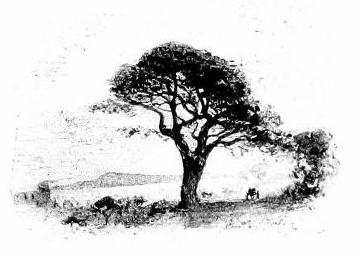
Seated in a country cart, for the road soon became impracticable for a vehicle on springs, I followed the line of the bay to its deepest point. I could see upon the opposite shore the pine woods where the Company is attempting to create another winter resort. The shore indeed is exquisite, and the whole country magnificent. Then the road plunges into the mountains, and soon passes through the town of Cogolin. A little further on, I quitted it for a rough broken lane, which was scarcely more than a long rut. A river, or rather a big stream, runs by the side, and every hundred yards or so, cuts through the ravine, floods it, wanders away a little, returns, loses itself again, quits its bed and drowns the track, then falls into a ditch, strays through a field of stones, appears suddenly to calm down into wisdom, and for a while follows its due course; but seized all at once by some wild fancy, it precipitates itself again into the road, and changes it into a marsh, in which the horse sinks up to the breast-plate, and the high vehicle up to the driving seat.
There are no more houses; only from time to time, a charcoal burner's hut; the poorest live in absolute holes. Is it not almost incredible that men should inhabit holes in the ground, where they live all the year, cutting wood and burning it to extract the charcoal, eating bread and onions, drinking water, and sleeping like rabbits in their burrows, in narrow caverns hewn in the granite rocks. Lately, too, in the midst of these unexplored valleys, a hermit has been discovered, a real hermit, hidden there for these thirty years, unknown to anyone, even to the forest rangers.
The existence of this wild man, revealed by I know not whom, was, no doubt, mentioned to the driver of the diligence, who spoke of it to the post-master, who talked of it to the telegraph clerk male or female, who flew with the wonder to the editor of some little local paper, who made out of it a sensational paragraph, copied into all the country journals of Provence.
The police set to work, to hunt out the hermit, without apparently causing him any alarm, whence we may conclude that he had kept all needful papers by him. But a photographer, excited by the news, set off in his turn, wandered three days and three nights amongst the mountains, and ended by photographing some one, the real hermit some say, an impostor, others will tell you.
Last year then, the friend who first revealed to me this strangely quaint country, showed me two creatures infinitely more curious, than the poor devil who had come to hide in these impenetrable woods, a grief, a remorse, an incurable despair, or perhaps simply the mere ennui of living.
This is how he first discovered them. Wandering on horseback among these valleys, he suddenly came across a prosperous farm: vines, fields, and a farmhouse, which looked comfortable though humble.
He entered. He was received by a woman, a peasant, about seventy years old. The husband, seated under a tree, rose and came forward to bow.
"He is deaf," she said.
He was a fine old fellow of eighty, amazingly strong, upright, and handsome. They had for servants, a labourer and a farm-girl. My friend, a little surprised to meet these singular persons in the midst of a desert, enquired about them. They had been there for a long time; they were much respected, and passed for being comfortably off, that is, for peasants.
He came back several times to visit them, and little by little became the confidant of the wife. He brought her papers and books, being surprised to find that she had some ideas, or rather remains of ideas, which scarcely seemed those of her class. She was, however, neither well read, intelligent nor witty, but there seemed to be, in the depths of her memory, traces of forgotten thoughts, a slumbering recollection of a bye-gone education. One day, she asked him his name:
"I am the Count de X...," he said. Moved by the obscure vanity which is lodged deep in all souls, she replied:
"I too am noble."
Then she went on, speaking for certainly the first time in her life, of this piece of ancient history, unknown to anyone.
"I am the daughter of a colonel. My husband was a non-commissioned officer in my father's regiment. I fell in love with him, and we ran away together.
"And you came here?"
"Yes, we hid ourselves."
"And you have never seen your family since?"
"Oh no! don't you see my husband was a deserter."
"You have never written to anyone?"
"Oh no!"
"And you have never heard anyone speak of your family, of your father, or mother?"
"Oh no, mama was dead."
This woman had preserved a certain childishness, the simplicity of those who throw themselves into love, as if over a precipice.
He asked again:
"You have never told this to anyone?"
She answered: "Oh no! I can say it now, because Maurice is deaf. As long as, he could hear, I should not have dared to mention it. Besides, I have never seen anyone but the peasants since I ran away."
"At least, then, you have been happy?"
"Oh yes; very happy. I have been very happy. I have never regretted anything."
Well, I also had gone last year to visit this woman, this couple, as one goes to gaze at some miraculous relic.
I had contemplated with surprise, sadness, and even a little disgust, this woman who had followed this man, this rustic Adonis, attracted by his hussar uniform, and who had continued to see him under his peasant's rags, with the blue dolman slung over his back, sword at his side, and the high boot with clanking spur.
She had, however, become a peasant herself. In the depths of this wilderness, she had become perfectly accustomed to this life without luxuries, without charm, or delicacy of any sort, she had adapted herself to these simple manners. And she loved him still. She had become a woman of the people, in cap and coarse petticoat. Seated on a straw-bottomed chair at a wooden table, she eat a mess of cabbage, potatoes and bacon from an earthenware plate. She slept on a straw mattress beside him.
She had never thought of anything but him! She had regretted neither ornaments, nor silks, nor elegance, nor soft chairs, nor the perfumed warmth of well-curtained rooms, nor repose in a comfortable bed. She had never needed anything but him! As long as he was there, she had wanted nothing else!
She was quite young when she abandoned life, the world, and those who had brought her up and loved her. Alone with him she had come to this savage ravine. And he had been everything to her, everything that could be longed for, dreamt of, expected, ceaselessly hoped for. He had filled her life with happiness from one end to another. She could not have been happier.
Now I was going for the second time to see her again, filled with the surprise, and the vague contempt, with which she inspired me.
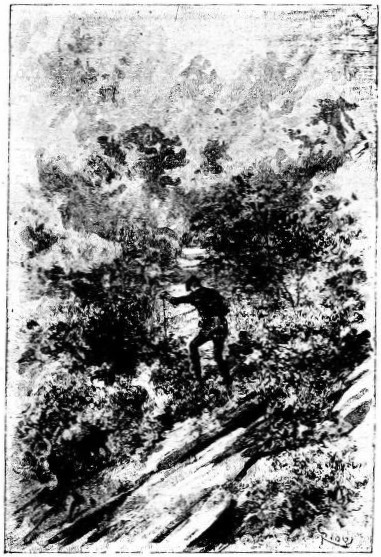
She lived near the Hyères road, on the opposite slope of the mountain on which stands the Chartreuse de la Verne; and another carriage was awaiting me on this road, for the deep track we had followed, had now ceased and become a mere footpath, only accessible to pedestrians and mules.
I started therefore alone, on foot, and with slow steps to climb the mountains. I was in a delightful wood, a real Corsican thicket, a fairy tale wood composed of flowering creepers, aromatic plants with powerful scents, and huge magnificent trees.
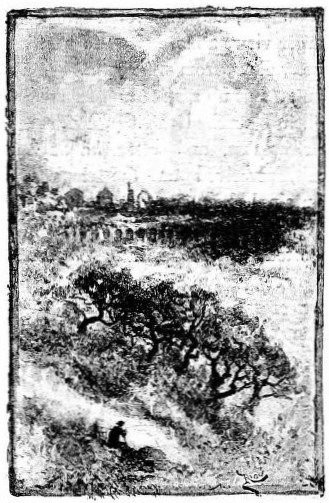
The granite fragments in the track sparkled as they rolled beneath my steps, and in the openings between the branches, I saw sudden peeps of wide gloomy valleys full of verdure, winding lengthily away to the distance.
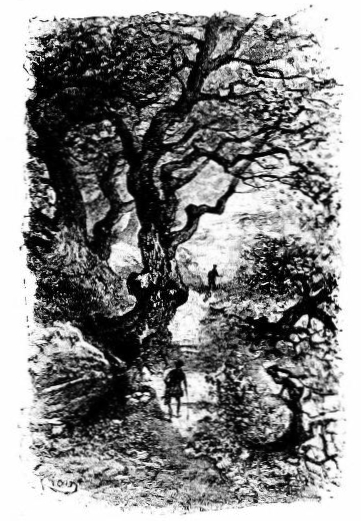
I was warm, the quick blood flowed within my flesh, I felt it coursing through my veins, burning, rapid, alert, rhythmical and alluring as a song; the vast song brutish and gay, of life in movement under the sun. I was happy, I was strong, I quickened my pace, climbed the rocks, ran, jumped, and discovered every minute a larger view, a more gigantic network of desert valleys, from whence not one single chimney sent up a wreath of smoke.
Then I reached the top, dominated by other heights, and after making some circuit, perceived on the slope of the mountain before me, a bleak ruin, a heap of dark stones, and of ancient buildings supported by lofty arcades. To reach it, it was necessary to go round a large ravine, and to cross a chestnut grove. The trees, old as the abbey itself, enormous, mutilated and dying, had survived the building. Some have fallen, no longer able to sustain the weight of years; others, beheaded, have now only a hollow trunk in which ten men could conceal themselves. And they look like a formidable army of giants, who in spite of age and thunderbolts are ready still to attempt the assault of the skies. In this fantastic wood one feels the mouldy touch of centuries, the old, old life of the rotting roots, amidst which, at the feet of these colossal stumps, nothing can grow. For amongst the grey trunks the ground is of hard stones and a blade of grass is rare.
Here are two fenced springs, or fountains, kept as drinking places for the cows.
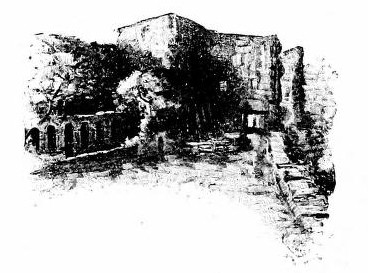
I approach the abbey, and find myself face to face with the old buildings, the most ancient of which date back to the 12th century, while the more recent are inhabited by a family of shepherds.
In the first court, one sees by the traces of animals, that a remnant of life still haunts the spot; then after traversing crumbling and tumbling halls, like those of all ruins, one reaches the cloister, a long and low walk still under cover, surrounding a tangled square of brambles and tall grasses. In no spot in the world, have I felt such a weight of melancholy press upon my heart, as in this ancient and sinister cloister, true pacing court of monks. Certainly, the form of the arcades and the proportions of the place contribute to my emotion, to my heartache, and sadden my soul by their action on my eyes, exactly as the happy curve of some cheering bit of architecture would rejoice them. The man who built this retreat must have been possessed with a despairing heart, to have an inspiration so desolate and dreary. One would fain weep and groan within these walls, one longs to suffer, to reopen all the wounds of one's heart, to enlarge and make the very utmost of all the sorrows compressed within it.
I climbed upon a breach in the wall to see the view outside, and I understood my emotion. Nothing living around, nothing anywhere but death. Behind the abbey, a mountain ascending up to the sky, around the ruins the chestnut grove, in front a valley, and beyond that, more valleys,—pines, pines, an ocean of pines, and on the far horizon, pines still on the mountain tops.
And I left the place.
I crossed next a wood of cork trees, where, a year ago, I had experienced a shock of strong and moving surprise.
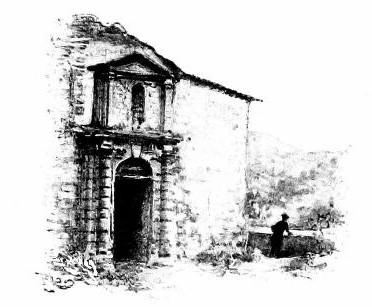
It was on a grey day of October, at the time when they strip the bark of these trees, to make corks of it. They strip them thus from the foot to the first branches, and the denuded trunk becomes red, a blood red as of a flayed limb. They have grotesque and twisted shapes; the look of maimed creatures writhing in epileptic fits, and I suddenly fancied myself transported into a forest of tormented beings, a bleeding and Dantesque forest of hell, where men had roots, where bodies deformed by torture, resembled trees, where life ebbed incessantly, in never-ending torment by these bleeding wounds, which produced upon me the tension of the nerves and faintness that sensitive people feel at the sudden sight of blood, or the unexpected shock of a man crushed, or fallen from a roof. And this emotion was so keen, this sensation so vivid, that I imagined I heard distracting cries and plaints, distant and innumerable; I touched one of these trees, to reassure my fainting spirit, and I fancied, I beheld my hand, as I drew it back, covered with blood.
To-day they are cured—till the next barking.
At length the road appears, passing near the farm which has sheltered the long happiness of the non-commissioned officer of hussars, and the Colonel's daughter.
From afar, I recognize the old man walking among the vines. So much the better; the wife will be alone in the house.
The servant was washing in front of the door.
"Your mistress is here," I said.
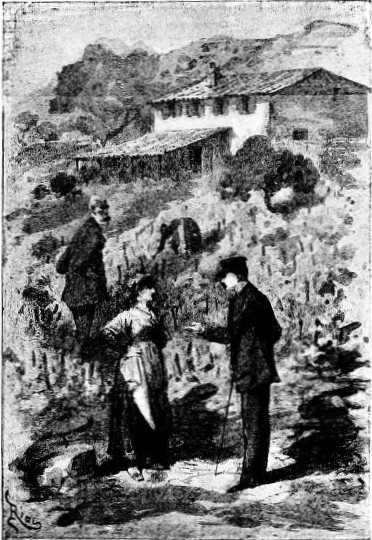
She replied, with a singular look, in the accent of the south:
"No, sir; since six months she is no more."
"She is dead?"
"Yes, sir."
"And of what?"
The woman hesitated, then muttered:
"She is dead—dead, I tell you."
"But of what?"
"Of a fall, then!"
"A fall! where from?"
"From the window."
I gave her a few pence.
"Tell me about it," I said.
No doubt she strongly wished to talk of it, no doubt, too, she had often repeated this history for the last six months, for she retailed it at great length, as a story well-known by heart and invariable in its repetition.
Then I learnt that for thirty years, the old deaf man had had a mistress in the neighbouring village, and that his wife having learnt this by chance from a passing carter, who spoke of it without knowing who she was, rushed panting and bewildered to the attic, and there hurled herself from the window, not perhaps with deliberate purpose, but impelled by the torture of the horrible agony caused by her discovery, which goaded her forward in an irresistible gust of passion, like a whip lashing and cutting. She had flown up the staircase, burst open the door, and without knowing, without being able to stop her headlong speed, had continued to run straight ahead and had leaped into empty space.
He had known nothing of it; he did not know even now; he would never know, because he was deaf. His wife was dead, that was all. All the world must die some time or other!
I could see him at a distance giving orders by signs to his labourers.
Then I caught sight of the carriage which was waiting for me in the shade of a tree, and I returned to Saint-Tropez.
April 14th.
I was going to bed yesterday evening, although it was only nine o'clock, when a telegram was handed to me. A friend, one of my dearest, sent me this message: "I am at Monte-Carlo for four days, and have been telegraphing to you at every port on the coast. Come to me at once."
And behold, the wish to see him, the longing to talk, to laugh, to gossip about society, about things, about people; the longing to slander, to criticize, to blame, to judge, to chatter, was alight within me in a moment, like a conflagration. On that morning, even, I should have been furious at this recall, yet in the evening I was enchanted at it; I wished myself already there, with the great dining-room of the restaurant full of people before my eyes, and in my ears that murmur of voices in which the numbers of the roulette table dominate all other phrases, like the Dominus vobiscum of the church services.
I called Bernard.
"We shall start at about four o'clock in the morning for Monaco," I said to him.
He replied philosophically:
"If it is fine, sir."
"It will be fine."
"The barometer is going down, though."
"Pooh! it will go up again."
The mariner smiled an incredulous smile.
I went to bed and to sleep.
It was I who woke the men. It was dark, and a few clouds hid the sky. The barometer had gone down still more.
The two men shook their heads with a distrustful air.
I repeated:
"Pooh! it will be fine. Come, let us be off!"
Bernard said:
"When I can see the open, I know what I am about; but here, in this harbour, at the end of this gulf, one knows nothing, sir, one can see nothing; there might be a fearful sea on, without our knowing anything about it."
I replied:
"The barometer has gone down, therefore we shall not have an east wind. Now, if we have a west wind, we can put into Agay, which is only six or seven miles off." The men did not seem much reassured; however, they got ready to start.
"Shall we take the dingy on deck," asked Bernard.
"No, you will see it will be quite fine. Let it tow astern as usual."
A quarter of an hour later, we had quitted the harbour, and were running through the entrance of the gulf, to a light and intermittent breeze.
I laughed.
"Well you see, the weather is good enough."
Soon, we had passed the black and white tower built upon the Rabiou shoal, and although sheltered by Cape Camarat which runs far out into the open sea, and of which the flashing light appeared from minute to minute, the Bel-Ami was already lifted forwards by long powerful slow waves; those hills of water which move on, one behind the other, without noise, without shock, without foam, menacing without fury, alarming in their very tranquillity.
One saw nothing, one only felt the ascent and descent of the yacht over the dark and silently moving waters.
Bernard said:
"There has been a gale out at sea to-night, sir; we shall be lucky if we get in without accident."
The day broke brightly over the wild crowding waves, and we all three looked anxiously seawards to see if the squall were returning.
All this time the boat was running a great pace before the wind and with the tide. Already Agay appeared on our beam, and we held counsel whether we should make for Cannes, to escape the rough weather, or for Nice, running to seaward of the isles.
Bernard would have preferred Cannes: but as the breeze did not freshen, I decided in favour of Nice.
For three hours all went well; though the poor little yacht rolled like a cork in the awful swell.
No one who is unacquainted with the open sea, that sea of mountains, moving with weighty and rapid strides, separated by valleys which change place from second to second, filled up and formed again incessantly, can guess, can imagine the mysterious, redoubtable, terrifying and superb force of the waves.
Our little dingy followed far behind us, at the extremity of forty yards of hawser, through this liquid and dancing chaos. We lost sight of it every moment, then suddenly it would reappear perched on the summit of a wave, floating along like a great white bird.
Here is Cannes in the depth of its bay, Saint-Honorat with its tower standing up among the waves, and before us the Cape d'Antibes.
The breeze freshened little by little, and the crests of the waves became flocks of sheep, those snowy sheep which move so fast, and of which the countless troop careers along without dog or shepherd under the endless sky.
Bernard said to me:
"It will be all we shall do to make Antibes."
And indeed seas began to break over us, with inexpressible and violent noise. The sharp squalls shook us, throwing us into yawning gulfs, whence as we emerged, we righted ourselves with terrible shocks.
The gaff was lowered, but at every oscillation of the yacht, the boom touched the waves and seemed ready to tear away the mast, which if it should fly away with the sail, would leave us to float alone and lost upon the wild waves.
Bernard cried out:
"The dingy, sir."
I turned to look. A huge wave filled it, rolled it over, enveloped it in foam as if it would devour it, and, breaking the hawser by which it was made fast to us, took possession of it, half sinking, drowned; a conquered prey which it will presently throw upon the rocks down there, below the headland.
The minutes seem hours. Nothing can be done, we must go on, round the point in front of us, and when we have done that, we shall be sheltered, and in safety.
At last we reach it! The sea is now calm and smooth, protected as it is by the long tongue of rocks and earth which forms the Cape of Antibes.
There is the harbour from which we started only a few days ago, although it seems to me we have been voyaging for months, and we enter just as noon is striking.
The men are radiant on finding themselves back again, though Bernard repeats at every other moment:
"Ah, sir! our poor little boat; it went to my heart, to see it go down like that!"
As for me, I took the four o'clock train, to go and dine with my friend in the principality of Monaco.
I wish I had time to write at length about this surprising state; smaller than many a village in France, but wherein one may find an absolute sovereign, bishops, an army of Jesuits and seminarists more numerous than that of the ruler; an artillery, the guns of which are nearly all rifled, an etiquette more ceremonious than that of his lamented Majesty Louis XIV., principles of authority more despotic than those of William of Prussia, joined to a magnificent toleration for the vices of humanity, on which indeed, live both sovereign, bishops, Jesuits, seminarists, ministers, army, magistrates, every one in short.
Hail to this great pacific monarch, who without fear of invasion or revolution, reigns peacefully over his happy little flock of subjects, in the midst of court ceremonies which preserve intact the traditions of the four reverences, the twenty-six handkissings, and all the forms used once upon a time around Great Rulers.
This monarch, moreover, is neither sanguinary nor vindictive, and when he banishes, for he does banish sometimes, the measure is put in force with the utmost delicacy.
Is a proof needful?
An obstinate player, on a day of ill luck, insulted the sovereign. A decree was issued for his expulsion.
During a whole month, he prowled around the forbidden Paradise, fearing the sword blade of the archangel, in the guise of the sabre of the policeman. One day, however, he hardened his heart, crossed the frontier, reached the very centre of the kingdom in thirty seconds, and penetrated into the precincts of the Casino. But suddenly an official stopped him:
"Are you not banished, sir?"
"Yes, sir, but I leave by the next train."
"Oh! in that case it is all right. You can go in."
And every week he came back: and each time, the same functionary asked him the same question, to which he invariably gave the same answer.
Could justice be more gentle?
Within the last few years, however, a very serious and novel case occurred within the kingdom.
This was an assassination.
A man, a native of Monaco, not one of the wandering strangers of whom one meets legions on these shores—a husband, in a moment of anger, killed his wife; killed her without rhyme or reason, without any excuse that could be accepted.
Indignation was unanimous throughout the principality.
The Supreme Court met to judge this exceptional case (a murder had never taken place before), and the wretch was with one voice, condemned to death.
The indignant sovereign ratified the sentence.
There only remained to execute the criminal. Then arose a difficulty. The country possessed neither guillotine nor executioner.
What was to be done? By the advice of the minister of Foreign affairs, the Prince opened negotiations with France to obtain the loan of a headsman and his apparatus.
Long deliberations took place in the ministry at Paris. At last they replied by sending an estimate of the cost of moving the woodwork and the practitioner. The whole amounted to sixteen thousand francs (six hundred and forty pounds).
The Monarch of Monaco reflected that the operation would cost him dear; the assassin was certainly not worth that price. Sixteen thousand francs for the head of a wretch like that! Never!
The same request was addressed to the Italian government. A King and a brother would no doubt show himself less exacting than a Republic.
The Italian government sent in a bill which amounted to twelve thousand francs, (four hundred and eighty pounds).
Twelve thousand francs! It would be necessary to impose a new tax, a tax of two francs (twenty pence) a head! This would be enough to cause serious, and hitherto unknown trouble in the State.
Then they bethought them of having the villain beheaded by a simple soldier. But the general, on being consulted, replied hesitatingly, that perhaps his men had scarcely sufficient practice to acquit themselves satisfactorily of a task, which undoubtedly demanded great experience in the handling of the sword.
Then the Prince again assembled the Supreme Court, and submitted to it this embarrassing case.
They deliberated long, without finding any practical way out of the difficulty. At last the first president proposed to commute the sentence of death, to that of lifelong imprisonment, and the measure was adopted.
But they did not possess a prison. It was necessary to fit one up, and a gaoler was appointed who took charge of the prisoner.
For six months all went well. The captive slept all day on a straw mattress in the nook arranged for him, and his guardian lazily reclined upon a chair before the door, while he watched the passers-by.
The Prince, however, is economical—extravagance is not his greatest fault—and he has accurate accounts laid before him of the smallest expenses of his State (the list of them is not a long one). They handed him, therefore, the bill of the expenses incurred in the creation of this new function, the cost of the prison, the prisoner, and the watchman. The salary of this last was a heavy burden on the budget of the Sovereign.