"From the Notebook of a Working Surgeon" (continued 4)
Reading edition
“I had a fair lot to do, but not enough; and my brightest days used to be when, after sitting drowsing there on a barrow, some gent would come by a stopping train—fishing p’r’aps, and want his traps carried to the inn, two miles off; or down to the river, when our young station-master would let me off, and I stopped with the gent fishing.
“Sometimes I give out the tickets—when they were wanted; but a deal of my time was take up watching the big daisies growing on the gravelly bank, along with the yaller ragwort; or counting how many poppies there was, or watching the birds chirping in the furze-bushes. I got to be wonderful good friends with the birds.
“We had a siding there for goods; but, save a little corn now and then, and one truck of coals belonging to an agent, there was nothing much there. There was no call for anything, for there would have been no station there only that, when the line was made, the big gent as owned the land all about wouldn’t give way about the line going through his property unless the company agreed to make a station, and arrange that he could stop fast trains by signal whenever he wanted to go up to London, or come down, or to have his friends; for, of course, he wouldn’t go by the penny-a-miler parliamentary that used to crawl down and stop at Gravelwick.
“We had a very cheerful time of it in the early days there afore you know’d the place, me and the station-masters—young fellows they used to be—half-fledged, and I saw out six of them; for they used only to be down there for a short time before they got a change. I used to long to be promoted, and tried two or three times; but they wouldn’t hear of it; and the smooth travelling inspector who used to come down would humbug me by telling me that I was too vallerble a servant to the company to be changed, for I acted as a sort of ballast to the young station-masters.
“This being the case, I got thinking I ought to get better pay, and I told him so; and he said I was right, and promised to report the case; but whether he did so or didn’t, and, if he did, whether he made a load enough report, I don’t know; ’tall events, I never got no rise, but had eighteen shillings a week when I went on the line, and eighteen shillings a week when I came off, five years after.
“Me and the station-master used to chum it, the station being so lonesome. When the young chaps need first to come down, they used to come the big bug, and keep me at a distance, and expect me to say ‘sir.’ But, lor’ bless you, that soon went off, and they used to get me to come and sit with them, to keep off the horrors—for we used to get ’em bad down there—and then we’d play dominoes, or draughts, or cribbage, when we didn’t smoke.
“It was a awful lonesome place, and somehow people got to know it, and they’d come from miles away to Gravelwick.
“‘What for?’ says you.
“There, you’d never guess, so I’ll tell you—to commit suicide.
“It was too bad on ’em, because it made the place horrible. I wasn’t afraid of ghosts; but after having one or two fellows come and put themselves before the fast trains, and having inquests on ’em, for the life of you you couldn’t help fancying all sorts of horrors on the dark nights.
“Why, that made several of our young station-masters go. One of ’em applied to be removed, and because they didn’t move him he ran off—threw up his place, he did—but I had to stay.
“Things got so bad at last that the station-master and me used to look at every passenger as alighted at our station suspicious like if he was a stranger; and we found out several this way, bless you; and if we couldn’t persuade ’em to go away to some other station to do what they wanted, or contrive to bring ’em to a better turn of mind, we used to lock ’em up in the lamp-room and telegraph to Tenderby for a policeman to fetch ’em away.
“Oh, it was fine games, I can tell you, only it used to give you the creeps; for some of these parties used to be wild and mad, though others was only melancholy and stupid.
“Some on ’em was humbugs—chaps in love, and that sorter way—as never meant to do it, only to make a fuss and be saved, so as their young ladies could hear as they meant to die for their sake, and so on; but others was in real earnest; for the fact of one doing it there seemed like a ’traction to ’em, and they’d come for miles and miles right away from London.
“It was a lively time being at a sooicidal station; and though the station-masters and I kept the strictest of lookouts, we got done more’n once; for a fellow would get out right smart, go off, and then, artful-like, dodge back to the line a mile or so away, and the fust we’d hear of it would be from an engine-driver who had gone over him.
“Well, it happens one day that I was alone at the station, when a quiet, gentlemanly sort of a fellow gets out, smiles, asks me some questions about the place, and chats pleasantly for a bit, says he means to have a ’tanical ramble—as he calls it—and finishes off by giving me arf-crown.
“Now, if I’d been as wide-awake as I should have been, I might have known as there was a screw loose. What should a strange gent give me arf a crown for if there wasn’t? But, bless you, clever and cunning as I thought myself, I was that innercent that I pockets the coin, grins to myself, and took no farther notice till, about arf an hour after, I happens to look along the up line, when I turns sick as could be; for I sees my gentleman walking between the rails, and the up express just within a few minutes of being due.
“Even then he’d so thrown me off my guard that I never thought no Wrong, only that he was looking on the railway banks for rhodum siduses, and plants of that kind.
“So I shouts to him—
“‘Get off that ’ere!’ and waves my hands.
“But he takes no notice; and then, all at once, just as the wind brought the sound of the coming express, if he didn’t go down flat, and lay his neck right on the off up-rail, ready for the engine-wheels to cut it off.
“It was like pouring cold water down my back, but I was man enough to act; and, running as hard as I could, I got up to where he lay—about three hundred yards from the station.
“I makes no more ado, but seizes his legs, and tries to drag him away; but he’d got tight hold of the rail with both hands—for it was where the ballast was dear away from it, to let the rain run off—and I couldn’t move him; ’sides which, he began to kick at me fierce, roaring at me to get away.
“Finding as I couldn’t move him, and the train coming nearer, and being afraid that I should get in danger myself if I got struggling with him, I thought I’d try persuasion.
“‘What are you going to do?’ I says.
“‘Tired of life—tired of life—tired of life,’ he kept on saying, in a curious, despairing way.
“‘Get up—get up.’
“For the train was coming on. I could hear it roaring in the distance; and I knew it would spin round the curve into sight, and then dash along the straight to where we were.
“‘Go away,’ he cried, hoarsely; ‘tired of life.’
“‘There was another fellow cut all to pieces there,’ I says, to frighten him.
“‘I know—I know,’ he said; ‘three hundred yards north of the station.’
“He must have read that in a noosepaper, and saved it up, you know.
“What to do I couldn’t tell. I wasn’t able to move him, for he clung to the rails as if he grew there, and the train was coming.
“All I could see to do was to run on and try to stop it; but that wouldn’t have done, for the engine would have been over the poor wretch before the breaks would have acted; and at last, with the roar coming on I stood there in the six foot, and I says, savage like—
“‘It’s too bad; see what a mess you’ll make.’
“‘What?’ he says, lifting up his head, and staring at me a horribly stiff, hard look, as of one half-dead.
“‘See what a mess you’ll make,’ I says, ‘and I shall have to clean it up.’
“‘Mess?’ he says, raising himself, and kneeling there in the six-foot on the ballast.
“‘Yes, mess,’ I says,—‘tatters, rags of clothes, and something so horrid all over the line, that it’s enough to make a strong man sick.’
“‘I never thought of that,’ he says, putting his hands to his head.
“And as he did so there was a shriek, a rush, a great wind, which sent the dust and sticks flying, and the express thundered by, with that poor chap staring hard.
“As it passed, he looked at it with a sort of shudder.
“‘You don’t know what a mess it makes,’ I said, as he got slowly up.
“‘No,’ he says, in a curious way—‘no, I never thought of that.’ And he began to brush the dirt and dust off his clothes. ‘But I thought it would not hurt.’
“‘Not you, perhaps,’ I said, trying to keep his attention; ‘but how about me?’
“‘Yes, yes,’ he muttered, ‘I never thought of that.’
“He stooped down, touched the rail with his finger, looked at it, shuddered, and then looked up the line.
“‘I tell you it’s horrid,’ I said; ‘and it’s cowardly of a fellow to come here for that. Now, then, you’d best come on to the station.’
“‘Yes,’ he said again, ‘I never thought of that.’ And he let me brush him down, and followed me like a lamb to the station, where, unbeknown to him, I telegraphed to the town, and a constable came and took him by the next train, with all the spirit regularly took out of him by my words.
“I’d about forgotten that poor chap till about six months after, when he came down by the stopping train, and shook hands with me, and gave me a five pound note.
“I was afraid he was going to try it on again, but no, bless you. He thanked me with tears in his eyes, for saving his life, telling me he was half-mad at the time, and determined—something polling him like—to end his life. He had felt no fear, and was glad the train was coming, when my words sounded so queer and strange to him that they seemed, as he said, to take all the romance out of the thing, and show it to him in, to use his words, ‘its filthy, contemptible, cowardly shape. If men could see,’ he said, ‘they would never commit such an act.’
“I saw him off again in the train, and was very glad when he was gone.
“That affair about settled me. I was sick of it; and as soon as I could—close upon a year arter, though—I came up to London and took to cabbing, for I’d had quite enough of our old station.”
Chapter Sixteen.
My Patient the Carpenter.
“Bring him in,” I said; and four stout fellows carried the insensible figure of a well built young man into the surgery and laid him on the couch.
“How was this?” I exclaimed. “There, shut the door, we don’t want a crowd in here.”
“It was Harry Linney got teasing him, sir, and betting him he couldn’t climb up the outside of the church tower.”
“And he climbed up and fell, eh?” I said, going on with my examination.
“Yes; that’s it,” said one of the men, staring.
“How stupid!” I exclaimed. “Men like you to be always like a pack of boys.”
“Is he killed, doctor?” said another in awestruck tones.
“Killed? no;” I replied, “but he has broken his left arm, and yes—no—yes—his collar-bone as well.”
“Poor old chap,” said a chorus of sympathising voices, and after bandaging and splinting the injuries I sent the man home.
He was too healthy and active a man to be ill long, and he rapidly improved, and in the course of my attendance I used to smile to myself and wonder whether Darwin was not right about our descent from the monkeys; for certainly the climbing propensity was very strong in Fred Fincher, who used to laugh when I talked to him about the folly of men to climb.
“Well, I dunno, sir,” he said, “climbing’s very useful sometimes. I’m a carpenter, and I have to climb a good deal about housetops in my trade, and nobody says it’s foolish then.”
“That’s a necessity,” I replied. “Yours was only a bit of foolish bravado.”
“Well, suppose it was, doctor,” he said smiling. “Anyhow I was not killed. It was nothing like getting up to oil the weathercock after all.”
“Oil what weathercock?” I said.
“Our weathercock, sir.”
“I don’t know what you mean.”
“I mean at the old place, sir. You see this is how it was:—
“We’d got a weathercock a-top of our church spire at High Beechy; and it was a cock in real earnest, just like the great Dorking in Farmer Granger’s yard; only the one on the spire was gilt, and shone in the sun quite beautiful.
“There was another difference, though. Farmer Granger’s Dorking used to crow in the morn, and sometimes on a moonlight night; but the gilt one a-top of the steeple, after going on swinging round and round, to show quietly which way the wind blew, took it into its head to stick fast in calm weather, while in a rough wind—oh, lor’ a’ mercy! the way it would screech and groan was enough to alarm the neighbourhood, and alarm the neighbourhood it did.
“I wouldn’t believe as it was the weathercock at first, but quite took to old Mother Bonnett’s notion as it was signs of the times, and a kind of warning to High Beechy of something terrible to come to pass.
“But there, when you stood and saw it turning slowly round in the broad daylight, and heard it squeal, why, you couldn’t help yourself, but were bound to believe.
“Just about that time a chap as called himself Steeple Jack—not the real Steeple Jack, you know, but an impostor sort of fellow, who, we heard afterwards, had been going about and getting sovereigns to climb the spires, and oil the weathercocks, and do a bit of repairs, and then going off without doing anything at all—well, this fellow came to High Beechy, saw the Rector, and offered to go up, clean and scrape the weathercock, oil it and all, without scaffolding, for a five pound note.
“Parson said it was too much, and consulted churchwarden Round, who said ‘ditto;’ and so Steeple Jack did not get the job even when he came down to three pound, and then to a sovereign; for, bless you, we were too sharp for him at High Beechy, and suspected that all he wanted was the money, when, you know, we couldn’t have made him go up, it being a risky job.
“The weathercock went on squeaking then awfully, till one afternoon, when we were out on the green with the cricketing tackle for practice, the Rector being with me, for we were going to play Ramboro’ Town next week, and the Rector was our best bowler.
“He was a thorough gentleman was our Rector, and he used to say he loved a game at cricket as much as ever, and as to making one of our eleven, he used to do that, he said, because he was then sure that no one would swear, or take more than was good for him.
“Speaking for our lot, I’m sure it made us all respect him the more; and I tell you one thing it did besides, it seemed to make him our friend to go to in all kind of trouble, and what’s more, it fetched all our lot in the cricket club to church when I’m afraid if it hadn’t been out of respect to the parson we should have stopped away.
“Why, I’ve known him on a hot evening at practice between the overs suddenly cry ‘Hold hard!’ with the ball in his hands, and say—
“‘Tell you what, my lads, I think a glass of Tompkins’s home-brewed wouldn’t be amiss just now. Smith, my man, will you step across and tell them to send me a gallon?’
“Then when it was brought all cool and foaming from out of the cellar, and he took the first glass as a matter of course, he’d got a knack of saying something sensible to a man in a way as did more good than the preaching in a month of Sundays.
“‘That!’ he’d say, with a smack of the lips when he’d finished the cool draught, ‘That’s good, refreshing, invigorating, and hearty. What a pity it is some men will be such fools as to take more than is good for them. Come, my lads, another glass round, and then to work.’
“Why, you may laugh at me, but we all of us loved our parson, and he could turn us all this way or that way with his little finger.
“Well, we were out on the green, as I said, and the talk turned about oiling the weathercock, and about how we’d heard as Steeple Jack, as he called himself, had undertaken to do Upperthorpe steeple, as is thirty feet lower than ours, and had got the money and gone off.
“‘I thought he was a rogue,’ said Billy Johnson. ‘He looked like it; drinking sort of fellow. Tell you what, I’m game to do it any time you like.’
“‘Not you,’ says Joey Rance. ‘It ain’t in you.’
“‘Ain’t it,’ says Billy, tightening his belt, and then—
“‘My good man,’ says the Rector, ‘I couldn’t think of allowing it.’
“You see, ours was a splendid spire, standing altogether a hundred and seventy feet six inches high; and as it says in the old history, was a landmark and a beacon to the country for miles round. There was a square tower seventy feet high, and out of this sprang the spire, tapering up a hundred feet, and certainly one of the finest in the county.
“‘Oh, I’d let him go, sir,’ says Joey: ‘he can climb like a squirrel.’
“‘Or a tom-cat,’ says another.
“‘More like a monkey,’ says Sam Rowley, our wicket-keeper.
“‘Never mind what I can climb like,’ says Billy. ‘I’m game to do it; so here goes.’
“‘But if you do get up,’ said the Rector, ‘you will want tools to take off and oil the weathercock, and you can’t carry them.’
“Just then a message came from the house that the Rector was wanted, and he went away in a hurry: and no sooner had he gone than there was no end of chaff about Billy, which ended in his pulling up his belt another hole, and saying—
“‘I’m going.’
“‘And what are you going to do when you get up there?’
“‘Nothing,’ he says, ‘but tie the rope up to the top of the spire, and leave it for some of you clever chaps to do the work.’
“‘What rope shall you use?’ I said.
“‘The new well rope,’ says Billy. ‘It’s over two hundred feet long.’
“Cricketing was set aside for that day, for Joey Rance went off and got the rope, coming back with it coiled over his arm, and throwing it down before Billy in a defiant sort of way, as much as to say—
“‘There, now let’s see you do it.’
“Without a word, Billy picked up the coil of rope and went in at the belfry door, to come out soon after on the top of the tower, and then, with one end of the rope made into a loop and thrown over his shoulders, he went to one edge of the eight-sided spire and began to climb up from crocket to crocket, which were about a yard apart, and looking like so many ornamental knobs sticking out from the sides.
“We gave him a cheer as he began to go up, and then sat on the grass wondering like to see how active and clever the fellow was as he went up yard after yard climbing rapidly, and seeming as if he’d soon be at the top.
“The whole of the village turned out in a state of excitement, and we had hard work to keep two brave fellows from going up to try at other corners of the spire.
“‘He’ll do it—he’ll do it!’ was the cry over and over again.
“And it seemed as if he would, for he went on rapidly till he was within some thirty feet of the top; when all of a sudden he seemed to lose his hold, and came sliding rapidly down between two rows of crockets, faster and faster, till he disappeared behind the parapet of the tower.
“We held our breath, one and all, as we saw him fall, and a cold chill of horror came upon us. It was not until he had reached the top of the tower that we roused ourselves to run to the belfry door, and began to go up the newel staircase to get to the poor fellow, whom we expected to find half-dead.
“‘Hallo!’ cried Billy’s voice, as we got half-way up the corkscrew, ‘I’m coming down.’
“‘Aint you hurt, then?’ cried Joey Rance.
“‘No, not much,’ said Billy, as we reached him by one of the loopholes in the stone wall. ‘Got some skin off, and a bit bruised.’
“‘Why, we thought you were half killed,’ we said.
“‘Not I,’ he replied, gruffly; ‘the rope caught over one of the crockets, and that broke my fall a bit.’
“‘Going to try again?’ said Joey, with a sneer.
“‘No, I aint going to try again, neither,’ said Billy gruffly. ‘I left the rope up at the top there, thinking you were so clever you’d like to go.’
“‘Oh, I could do it if I liked,’ said Joey.
“‘Only you daren’t,’ said Bill, rubbing his elbows, and putting his lips to his bleeding knuckles.
“‘Daren’t I?’ said Joey.
“Without another word he pushed by Billy, and went on steadily up towards the top of the tower.
“‘I hope he’ll like it,’ said Billy, chuckling. ‘It aint so easy as he thinks. Let’s go down. I’m a good bit shook, and want a drop of brandy.’
“Poor fellow, he looked rather white when we got down; and to our surprise on looking up, on hearing a cheer, there was Joey hard at work, with the rope over his shoulder, climbing away, the lads cheering him again and again as he climbed higher and higher, till he at last reached the great copper support of the weathercock, and then, drawing himself up a bit higher, he clung there motionless for a few minutes, and we began to think that he had lost his nerve and was afraid to move.
“But that wasn’t it—he was only gathering breath; and we gave him a cheer, in which Billy Johnson heartily joined, as, up there looking as small as a crow the plucky fellow gave the weathercock a spin round, afterwards holding on by his legs, clasped round the copper support, while he took the rope from his shoulders, undid the loop, and then tied it securely to the great, strong copper rod.
“All this time he had had his straw hat on; and now, taking it off, he gave it a skim away from him; and away it went right out into space, to fall at last far from the foot of the tower.
“Joey now began to descend very slowly and carefully, as if the coming down was worse than the going up, and more than once he slipped; but he had tight hold of the rope with one hand, and that saved him, so that he only rested, and then continued his task.
“You see, the spire sloped so that he did not hang away from it, but against the stone sides; and so we went on watching him till he was about half-way down, when he stopped to rest, and, pulling up the rope a bit as he stood with one foot on a crocket, he tied in it a big loop, slipped one leg right through, and sat in it, swinging to and fro as he held on to the rope so as to rest his legs.
“We gave him another cheer, and so did the Rector, who just then came up, when Joey waved his hand.
“As he did this, something occurred which took away my breath; for, poor fellow, he seemed to slip, and, before we could utter a cry, he turned over and hung head downwards, falling, with his leg slipping through the loop, till his foot caught; and he hung by it, fighting hard for a few moments to get back, but all in vain; and, as we watched him, his struggles got weaker, so that he did not turn himself up so far when trying to reach the loop where his ankle was caught; and at last he hung there, swinging gently to and fro, only moving his hands.
“By this time the Rector, I and two more had got to the belfry door, and we ran panting up the dark staircase till we got out upon the leads.
“‘Hold on, Joey,’ I shouted. ‘I’m coming.’
“‘Make haste,’ he cried faintly, ‘I’m about done.’
“By this time I was about ten feet up, and climbing as hard as I could, forgetting all the danger in the excitement; for I don’t think I should have dared to go up on another occasion.
“It was very hard work, and as I climbed the wind seemed to blow terribly; but I got up and up, panting as I did so, till at last I was clinging there with one foot resting on a crocket, wondering what I should do.
“‘Look sharp, lad,’ said poor Joey, ‘It seems as if all my blood was rushing into my head.’
“I leaned over and got hold of the rope close to his ankle, but do anything more I could not. I had all the will in the world to help the poor fellow, but it took all my strength to keep myself with one hand from falling; and as to raising my old companion, I neither had the strength nor the idea as to how it could be done.
“The only way out of the difficulty seemed to be to take out my knife and cut the rope, and then the poor fellow would be killed.
“‘Come down,’ cried a voice below me.
“Looking towards the leads, there was the Rector stripped to his shirt and trousers, and with a coil of rope over his shoulder—for the new well rope had proved to be long enough to let him cut off some five and thirty feet.
“‘Don’t leave me,’ groaned Joey, who was half fainting. ‘I feel as if I should fall any moment. I say, lad, this is very awful!’
“‘Here’s the parson coming up,’ I said.
“And so it was; for he went to the row of crockets on the other side of Joey, who now hung, looking blue in the face, and with his eyes closed.
“‘He must make haste—make haste,’ he moaned, softly.
“I stopped, holding on, while the Rector climbed up quicker than either of us had done it, drawing himself up by his arms in a wonderful way till he was abreast of we two—me holding on, and Joey hanging on by one foot.
“As soon as the Rector reached us, he said a few words of encouragement to Joey, who did not speak a word, and then climbing higher, tied the short rope he carried to the long rope just above the loop-knot which held Joey’s ankle. Then coming down a little, he tied his rope tightly round Joey, just under the armpits.
“‘That will bear you, my lad,’ he said. ‘But catch fast hold of it with your hands, while I cut your foot free.’
“Climbing up higher once more, he pulled out his knife, opened it with his teeth, and then began to saw through the strands of the loop that held Joey’s ankle, till there was a snap, a jerk, and a heavy swinging to and fro; for the poor fellow had fallen two or three feet, and was now hanging by the rope round his breast right way upwards.
“He did not make any effort for a few minutes, and as cheer after cheer came to us from below, he swung there, with us holding on for dear life.
“‘Can you climb down now, Rance,’ said the Rector, ‘if I cut you free?’
“‘No, sir,’ he said hoarsely, ‘I’ve no use in my arms or legs—they’re all pins and needles.’
“‘Then we must lower you down,’ said the Rector, calmly. And getting hold of the long piece of rope, he climbed up once more, as coolly as if he was on an apple tree in his own orchard, and saw that the knots were fast; then coming down, he passed his long rope through the one round Joey’s breast, and tied it again round him.
“‘Now,’ he said, ‘Fincher and I will hold on by this rope, and you can let yourself slide through the other loop—one arm first, and then the other, steadily.’
“The poor fellow had hard work to do it; but the loop was loose enough to let him work it over his head, and then with the Rector striding across from the crocket at one angle to that on the other, and me holding on to the rope as well, we let him down, sliding with his back to the stone, till his feet touched the leads, when he fell down all of a heap.
“‘Untie the rope,’ said the Rector, ‘and get him down.’
“He spoke very hoarsely, shouting to them below; and a cheer came up.
“‘Now, Fincher,’ said the Rector, ‘we’ve got to get down.’
“As he spoke, he made a running noose in the rope with the end he held in his hand, let it run up to the the big noose, and pulled it tight.
“Then he made an effort to get his legs together on one angle; but the distance he had been striding was too great, and he couldn’t recover himself, but swung away by his hands.
“‘I can’t help it, Fincher—I must go first,’ he cried. And he was already sliding down the rope as he spoke; but I was so unnerved and giddy now, that I dared not look down.
“I believe I quite lost my head then for a few moments; for I was clinging there for life a hundred and twenty feet above the ground, and the wind seemed to be trying to push me from my hold.
“I was brought to myself, though, just as the landscape about me seemed to be spinning round, by feeling the rope touch my side; and I clasped it convulsively with both hands, and then, winding my legs round it, slid rapidly down, the rope seeming to turn to fire as it passed through my hands.
“A few moments later, and I was safe on the tower leads, trying like the rest to smile at the danger we had passed through; but it was a faint sickly kind of smile and we were all very glad to get down to the green, and cared nothing for the cheers of the people.
“The rope was left hanging there, and stayed till it rotted away; but somehow before a week was out, that weathercock stopped squeaking, as if some one had been up to oil it, and, though nothing was said about it, I’ve always felt as sure as sure that the Rector went up by himself and did it early one morning before any one was up.
“He was cool-headed enough to do it, for he certainly saved Joe Rance’s life, and I know no one in the village would have done it without bragging after. At all events, the weathercock was oiled, and as I said over and over again to Joey, ‘if Parson didn’t oil that weathercock, who did?’
“That all goes to prove what I say,” I replied when he had finished. “You were all guilty of foolhardiness just to gratify a little vanity.”
“Well, you see, doctor, no man likes for his mates to think him a coward.”
“Let them think, so long as you know you are not.”
“That’s what Parson said,” replied Fincher, “when he talked about it next day.”
“Then Parson, as you so politely call him, was quite right.”
Chapter Seventeen.
My Patient the Warehouseman.
“I don’t grudge a man a glass of beer or anything of the sort,” I said to a patient of mine whom I was attending, and who it was said look more than was good for him; “beer is very well in its way, but I’m certain of one thing, and that is that a man is better without either beer or spirits.”
“What! in moderation, doctor?” he said.
“Yes, even in moderation; men existed and were well and strong and happy, depend upon it, long before beer or mead was invented.”
“Ah, doctor, I see you’re a teetotaller,” he said.
“Not I, my man, unless one who seldom takes wine, spirits, or beer be a teetotaller. When you get as old as I am, you will probably begin to think that it is as well to take as much care as possible of the machine in which you live. Suppose you had some clean, pretty mechanism—your watch, say, or a musical box, you would be very careful not to injure it.”
“Of course, doctor.”
“Then, why take anything that is likely to destroy so wonderful a piece of work as the human body?”
“But, does drinking beer destroy the body, doctor?”
“That depends,” I said. “If you have your half-pint or pint of beer for dinner and supper, I believe, honestly, you would be better without it, speaking as a doctor; but I don’t believe that indulgence would keep you from living in fair health to seventy, eighty, or ninety.”
“Then where’s the harm, doctor.”
“The harm is drinking when you don’t want it, and causing in yourself an unnatural thirst or desire for strong drink that can never more be quenched. Look around among your fellow workmen, and see how many you know who must have their half-pint before going to work, and their half-pint at eleven o’clock, and at four o’clock, and after leaving off; and at last get so that their machine won’t go without oiling, and they can’t pass a public-house without wanting more and more.”
“That’s a true word, doctor.”
“And what does it mean,” I said; “in the more moderate cases decided dejection; unnatural features; bloated face; injured intellect and general discomfort; and in the worst cases delirium tremens, and death.”
“Ah, but you are speaking of the worst cases, doctor, the regular drunkards.”
“No,” I said, “I was speaking of the regular drinkers, the men who rarely get drunk, for they are inured to the liquor they consume.”
“I suppose you are right, doctor,” he said; “Jacob Wood went regularly mad with drink.”
“I don’t know Jacob Wood,” I said; “but you may depend upon it if he did go regularly mad, as you call it, he had drunk until his internal organs were all in a state of disease that affected the brain; and if you’ll take my advice, my man—”
“You’d turn teetotaller?”
“No, I don’t put so heavy a tie upon you,” I replied, “you have been used to your beer; well, if you feel to want it make a stringent rule that you will never take any except with your meals; you’ll be a better man in a month, and will not need to come to me.”
“Pity poor old Jacob Wood didn’t come to you, doctor.”
“It’s a pity he did not,” I said. “Let me see, you are a warehouseman, are you not?”
“Yee, sir, I work up in one of the great Tooley Street warehouses, seven stories above the ground, and everywhere around me wool—bales upon bales of wool which we crane up from waggons or lighters and in at an open door, where, if a fellow had had a little drop too much and slipped—well, seven stories would be an awful fall.
“Ours is a place worth going over, sir. There’s floors upon floors beneath, stored with jute and dye-woods, teas, coffees, spices, tobaccos, and lowest of all on the ground floor and in the cellarage, tallows in great hogsheads. Ah, it’s a busy place, and the stores there is worth some money, and no mistake.
“I remember Jacob Wood doctor,” he said, drawing in a long breath as if of pain, “and no wonder; but it’s strange, how very little people see danger when it’s coming to them.
“I was at our warehouse one day, and had been down for half-a-pint, when, ‘What’s the matter with Jacob Wood this afternoon?’ says one of the men.
“But, excepting that he looked a little wild about the eyes, I didn’t see anything more about him than might often be seen in men who will drink heavily at times; and so I said. But at last, towards evening, when I was longing to get away home to spend my evening comfortably, I was left alone upon that floor with him, and felt a bit startled to see him go all at once to the open door where the crane landed the bales, and cut some strange capers, like a man going to dive off a board into the sea.
“Putting down my work, which was getting ready two or three burst bales for the hydraulic press, so that they might be tied up again, I slipped quietly up behind him, and laid my hand upon his shoulder, when, with a yell, he shrieked out.
“And the next moment, by the light of the gas on that foggy winter’s afternoon, we two were wrestling and fighting together, within a few feet of the door, out of which we should have fallen clear a hundred feet upon the stones of the wharf below.
“I should have shouted, but all power of speech seemed taken away, as locked together we wrestled here and there, while his hot breath hissed against my cheek, and I could look close into his wild, glowering eyes as, flushing with rage, he bore me nearer and nearer to the doorway.
“Used as I was at all times to standing close to the edge and receiving bales and packages, I could lean over usually without a shudder; but now, with this madman slowly forcing me back towards the certain death, I could feel the cold sweat standing upon my face, and trembled so with dread that my resistance became feebler and feebler; till as a last resource I managed to get my leg between my opponent’s, and tripped him, when we fell heavily.
“Fortunately for me my enemy was undermost, and the force with which his head came against the warehouse floor partly stunned him, so that I shook myself free, and turned and fled towards the stairs. But the next moment I thought of the open doorway, and the state the poor fellow was in, so turned back to lock it, to ensure that he did not come by his death by falling out before I could get assistance.
“My hand was on the door, but I could not close it, for Wood lay in the way; and shuddering at how near he lay to the gulf, I stooped to draw him on one side, when he started up and seized me again.
“To beat up his hands, and turn, and ran down between the piled-up bales didn’t take long, while roaring with rage I could hear him tearing after me.
“The stairs were pretty close, but as I ran round the end of the bales I found the door closed, and had to dart past to avoid being caught; when I turned down another opening between the packages, and ran panting on.
“Big as the floor was, there was passage after passage between the wool, which was piled-up eight or nine feet high, and I tore on in the hope o’ getting ahead so that I could dart through the stairs door, fasten it after me, and so escape or summon assistance. On and on I ran, now getting ahead, and now with the panting breath close to my shoulder, so that I expected every moment to feel a savage hand laid upon me to drag me down. At last he got so near that his hand brushed me; but, with a yell of horror, I leaped forward again, dodged round a corner, ran down a short passage, and again on, past pillars and piles, when turning round I found that I was alone; and hurrying to about the centre of the narrow passage, between the high walls of wool, I leaned against the side panting and breathless.
“‘Now, if I could but reach the door while he was at the other end,’ I thought, ‘I should be safe;’ and I kept on nervously watching the two ends of the passage lest I should be taken by surprise; when, to my horror, I saw by the gas shining upon it a savage head peer round from the end nearest the way of escape, watch me for a moment, and then disappear. It was now quite dim and twilight in all the passages, and my first idea was to dart off in the opposite direction; but a little thought told me that perhaps the wretch did not see me, and therefore I had better stay where I was; and so I stood minute after minute expecting to see him come round one end or the other, and dash down upon me.
“I knew that about half-past five the watchman would come round, and then I could give the alarm; but it wanted nearly an hour of that time, and how I was to hold out till then I could not tell; for the very thought unnerved me; and, overcome with fear, I could feel my knees tremble and seem ready to give way beneath my weight.
“Five minutes passed—ten minutes—and still no sign. My spirits rose a little, and I began to hope that escape was yet possible, but abated nothing of my watchfulness. Another five minutes, and I had almost determined upon trying to steal down towards the door, where the reflection from the gaslight made the end of the passage quite bright, while where I stood was in a fast-deepening shadow. I took two steps forward noiselessly, and then stopped; stole on again and stopped with a dead silence all around, through which I could hear the singing of the gas and the loud ‘throb, throb’ of my heart. I had somewhat recovered my breath, and kept slinking silently on, every now and then looking back to see that there was no pursuit. What I should have liked, and which would have been in accordance with my feelings at the moment, would have been to dash forward; but I kept down the desire, and crept slowly on between the two huge walls of wool bales piled some eight or nine feet high.
“Only another three yards, and here I stopped, trembling in dread lest Wood might be watching for me; but calling myself fool, coward, and cur, I stepped on again; and at last, with the light shining full upon me, leaned forward to peer cautiously round the edge of the bales. Slowly and quietly, nearer and nearer, till I looked round; and then, with a horrible fascination upon me, I stopped still—for, in precisely the same position, Wood was craning his neck forward to peep round at me; and with eyes looking into eyes, and only three or four inches apart, we stood what seemed minutes immovable. Move I could not, speak I could not, for my throat felt dry and hot; while my eyes, fixed and staring, looked into those glaring, wild-beastlike orbs, which seemed to hold me fixed to the earth as if some horrible nightmare was upon me. I felt that if I closed my eyes but for a moment he would spring at me; and at last, clutching the wool firmly with one hand, I drew myself slowly back, fixing his eyes the whole while, and then, as my strength seemed to come back, I leapt round and fled down the passage once more, as I heard a hideous yell, and saw Wood dash into the entrance.
“But there was silence again directly, and looking back as I reached the middle, I could see that I was not pursued; when, fearing that with all a madman’s cunning he had gone round to try and trap me at the other end, I stopped once more where I was, mentally praying for aid, as I strained eyes and ears to catch sight of or hear my enemy.
“A quarter of an hour must have passed without a sound meeting my ears, and I was hopefully calculating upon aid soon coming, when a slight rustling noise seemed to have been made close by me, and I started and looked eagerly towards the dark and then towards the light end of the narrow passage I was in.
“Nothing to be seen; and the minutes again passed slowly on, when all at once came the most horribly unearthly yell I ever heard from just above my head, and then, overcome with terror as I shrank to the floor, I looked up and knew that Wood had climbed over the top of the wool; and as the thought flashed through my mind, he bounded down upon me and had me by the throat.
“I struggled for a few moments, and then lights seemed dancing before my eyes, blood rushing to my head; and, in a half-insensible state, I have some recollection of being dragged along the floor into the gaslight, and then pulled and thrust about for a few moments, when there came the regular thud-thud of the little pump close by, and I could feel myself moving upwards. But all seemed so calm, and such a desire for sleep was upon me, that it was not till there was a fearful sense of oppression and tightness that I awoke to the consciousness that the wretch had forced me on to the traveller of the hydraulic press, and was now forcing in the water beneath the ram, so that in a few more seconds my life would be crushed out.
“Thud-thud, thud-thud went the pump, and the pressure was awful; while at the same time, as I vainly writhed and tried to press down the heavy plate that was crushing me, I was conscious of a great light which shone around, and which I thought was caused by the flushing sensation in my eyes; but no, for directly there came the noise of shouting, louder every moment; and then I made out, ringing up from the yard, those horrid words, ‘Fire! fire!’ and then I knew that Wood must have fired the warehouse.
“Shouts, cries, and the noise of hurrying feet; and Wood stood in the glare of light, looking first one way and then the other, as if confused, for he had quitted the pump on the first noise of shouting. All at once he darted away; and half fainting and suffocated with the pressure, I could do nothing but groan feebly, after struggling a little, to find every effort vain; and then with sharpened senses gaze at the flames licking the roof of the floor I was on, and escaping up the sides of wool bales, and the more inflammable goods that were in the warehouse. The smoke soon became blinding and the heat stifling; and for me there seemed no hope, since I was sure no one would be able to penetrate to where I was; when again I gave a struggle, and stretched down my hand backwards to try and reach the tap, which would let off the water and set me at liberty, or at least place me in a position to try and escape the horrible death that seemed my fate.
“But no, the handle was far out of my reach; and I groaned and wept at my helpless condition. The press held me by the chest with awful power, but my hands and arms were at liberty; while my head hanging down backwards enabled me to see the flames creeping along faster and faster, as I saw them reversed, and began to calculate how long it would be before they would reach me and end my misery.
“All at once, when nearly fainting, my hand came in contact with the iron bar used to lengthen the handle of the pump, to force in the water with more ease when greater power was required; and then my heart gave a leap as I thought I might be able to strike the handle of the tap and let out the water.
“I grasped the bar, and then I began swinging it about slowly, to try and strike the tap; but in vain, for I could do nothing with it from only being able to swing it at random, for I could not see. Nearer came the flames, louder rose the shouts; and as I looked along the warehouse I could see that all escape was out off by the stairs, even if I had been at liberty; and now, completely overcome by the pressure and the horror of my position, I groaned heavily, and the bar fell from my grasp.
“‘The last hope gone,’ I thought; when at the same moment a familiar sound struck my ear, for in falling the bar had struck upon the tap, when there came the fierce gush of the compressed water, and the ram began slowly to descend till I could crawl out, to fall fainting upon the floor.
“But I was up again directly, for there was a fierce glow in the place; and now I could see Wood busily at work tearing out wool to feed the flames, and dashing everything else he could lay his hands upon into the fire, which seemed at times to singe him.
“I looked round, for he took no notice of me; and I had before seen there was no escape by the door, so, running to the open door by the crane, I caught hold of the rope, and began lowering it down as fast as possible, with the light shining full upon me, and the people below either groaning with horror or cheering me on as I tore at the stout rope, and sent the crane handle spinning round and round.
“Could I but get enough rope out before Wood’s attention was taken, I felt safe, for I knew that I could slide down easily enough; but, as I dreaded, he caught sight of me, and leaving his fiery task, he rushed towards the door; when, with a yell of terror, I leaped from the flooring, clinging tightly to the rope, which began to run swiftly out as I swung to and fro till it was all out, when the jerk nearly dashed me off. But, after sliding down some little way, I recovered myself, and letting the rope glide slowly through my hands, I went lower and lower, with my eyes fixed on the blazing floor above.
“All at once I felt the rope jerked and swung about, and I could see the figure of Wood at it; and then again I was being drawn up, and I knew he must be busy at the crane handle; but the next minute he must have loosened his hold.
“There was a yell from the crowd, something dark dashed by me with a rushing noise, and as I clung trembling to the rope I heard a horrible dull thud, and slipping swiftly down the rope for the remainder of the distance, I suppose I fell fainting by the side of Wood’s mutilated form.
“The fire was got under when our floor was burned out, though much damage was done by water; but with the exception of a strange, nervous timidity that I fancy I shall never get the better of, I was not much the worse.”
“And was Jacob Wood killed?”
“No, sir,” he said; “he fell upon some bales of wool; but he was dreadfully hurt, and never man enough to take his turn in the warehouse again, and very glad we all were.”
“And yet you men rather need an example.”
“Well, yes, sir, we do,” he said, thoughtfully; “but I’m going to turn over a new leaf.”
Chapter Eighteen.
My Patient in the River Police.
“Don’t you find it very dreary at night upon the river?” I said to one of my regular patients—a river policeman—who preferred my services to those of the divisional surgeon for a long bout of sciatica.
“Just like the old woman’s eels, sir, and the skinning: one gets used to it. It’s lonesome like of a night upwards; but there you have the lights on the bridges and there’s gas here and gas there; and a faint roar comes over the housetops from out of the streets. It’s when you’re below bridge that it seems dull; where the big vessels are moored in the black muddy stream, that goes hurrying by them with a low, rushing noise—creeping and leaping at their slimy sides, covering their anchor chains, or the buoy to which they swing, with all sorts of muddy refuse; and sometimes of a night there’ll be a body get hanging on somehow, ready for us to find and take ashore.
“Now, if I give you a bit of tight chain going from a ship’s bows to an anchor down in the mud, on one side; and if I give you a dead body floating along on the other side, you’d think directly as there’d be no chance of the one stopping by the other—you’d think as one would float down all slimy and horrible, touch against t’other, and then rising, it would ride far enough out to sea. But, Lor’ bless you, that’s where you’re wrong; for how it is I can’t tell you, but it always seems to me, and has seemed ever since I was in the river police, that dead bodies lash and hang themselves somehow against mooring chains, on purpose that they might be found, and get a decent burial. Else how could they stop as they do, over and over again? I can’t tell, nor you can’t tell, nor nobody can’t tell; it’s a nat’ral mystery, and mysteries is things as gets over all of us.
“Since I was nearly being found myself, hitched on to a mooring chain—for I’ll lay any money that if I had been bested I should have gone quite naturally all the same to where I’d seen so many before—I’ve got to take a little more than a business interest in such things. It’s very awful, you know; and though I’m an ignorant man, it often sets me thinking on the dark nights when our galley’s going slowly with the stream, floating along the black, rushing river—yes, it often sets me thinking about the state of affairs in our great city, and wondering whether all our great civilisation’s so good after all, when it brings down stream to-night a decently-dressed body with the pockets inside out, and marks as of blows on the swollen face; to-morrow night a well-dressed body with no marks, and money and watch and all there; next night the body of a young woman with an oldish face, but on that face a weary, despairing look, that seems to say there was no rest anywhere but in the river, and into the river she had come; next night, again, perhaps another well-dressed body, most likely with a bit of paper and a half washed-out address pinned inside the torn dress bosom—and this one, perhaps, would be young, and fair, and pale, and sometimes not at all horrible to look at.
“There, I’ve seen great, strong, rough men, used to all sorts of things, stand with their hats off by such sights, and speak in even choky voices, as if they could hardly keep back something that they would be ashamed for others to see, down by some river stairs, where the muddy tide has gone ‘lap, lap,’ at one, two, or three o’clock in the morning. Why, at such times I’ve often felt creepy myself; for people may say what they like, but you never do get used to death, and whenever you meet it you feel a strange sense of quietness stealing over you; and one of the first things generally done when we land a body is, old or young, to cover it with sheet or sack; and even then there’s a horrible sort of drawing of you in it; and I’ve sat before now watching, and unable to get away from the uncouth covered thing, with the stream of water trickling slowly away to get back to the river.
“But, there, I think you’ve had enough about what goes floating down the river and floating up the the river, backwards and forwards, with the tide grinding it against wharf, and pier, and buttress, till there’s no telling who or what it was. I dare say you’ve had enough; but it’s a thing I could go on talking about for hours—beginning with me, or one of my mates, or a River Jack finding of them, and then going on, through the giving notice, and the inquest, and all the rest of it; and it’s all going on day after day, month after month, year after year. Talk of the River Jacks, though, what a singular thing it is: they never by any chance find a body with any valuables about it; but always, when they come across it, watch, money, pins, brooches, they’re all gone; and when, quite serious-like, I’ve asked them how they can account for it, I’ve always got the same answer—a knowing wink of the left eye.
“Ours is a strange sort of life, and lots hardly know of our existence; but, bless you, there’d soon be some rum goings-on if our little row galleys were not always busy at work up and down the river. You take plenty of precautions on shore, don’t you, where there’s wealth? Well, don’t you think there’s as much need afloat, where there’s millions of pounds’ worth of stuff almost at the mercy of the thief? For though sailors are pretty good at keeping watch out at sea, get ’em in port, and watching with them means choosing the softest plank under the bulwarks, and having a good caulk. So that’s where we come in useful—working along with the Custom House officers to keep down the plundering and smuggling that, but for us, would be carried on to an awful extent. For, you see, there are gangs who make it a practice to work with lightermen and with sailors; and sometimes by night, sometimes in open day—they carry off prizes that are pretty valuable.
“River pirates you may call them, though they’ve got half a score of cant names, and tea chests, bags of rice or sugar, kegs of spirits, rolls of tobacco, all’s fish that comes to their net; and if they can’t get things of that sort, why they’ll go in for bits of sails, ropes and chains, or blocks, anything even to a sheet of copper or a seaman’s kit—once they get their claws into it, there’s not much chance of its being seen again.
“It used to be ten times worse than it is now, and in those days there was a fellow whom I’ll call River Jack, who was about the most daring and successful rascal that ever breathed. We knew his games, but we could never catch him in the fact; and at last of all I got so riled at the fault found with us, as robbery after robbery took place, that one night, after a row about a ship’s bell stolen off the deck of a large Swedish corn barque, I made up my mind that I’d never let things rest till I’d caught Mr River Jack at some one or other of his games, and had him sent out of the country.
“Now, talking was one thing and doing another, and just at that time I’d been making arrangements for putting a stop to my activity by hanging a weight round my neck. I needn’t mention any names, but there was a young lady there—my wife now—that I used to go and see, and as soon as ever it came to my time for going off to duty there used to be a scene, for she got it into her head that I should be sure to meet with some terrible accident on the river; and at last, from being rather soft after her, what with the talk and tears, I used to be in anything but a good trim for my spell.
“‘There, don’t be such a chicken,’ I used to say, when she’d laid her little head on my shoulder, and been talking a whole lot of unreasonable nonsense; but it was of no use to talk, she would be a chicken; and one night I went away, feeling as if I had caught the infection, for I never felt more chicken-hearted in my life.
“An hour after I was on the river, with three more, pulling very gently along in and out amongst the shadows of the great ships. But whether we were in the shadow or out, it did not make much difference, for a darker night I never saw, and one and all we came to the conclusion that if we were lucky, there must be something for us to do; for that some of River Jack’s gang would be at work we were one and all sure. You see, it was just the sort of night they would like; for looking out was no use, since we could see nothing four yards ahead; all we could do was to wait in the hope that our friends might come near us—and come they did.
“We had been paddling gently about for a couple of hours, and at last had pulled under the stern of a great vessel that had come up the river that evening, but had been too late to get into dock. She was fresh over from the East Indies; and besides saltpetre, and tea, and cochineal, she had on board a large freight of odds and ends—curiosities and such-like. Of course we did not know this then; but a big vessel like she was seemed very likely to prove a bait to the river pirates, and there we lay holding on to the rudder chains.
“‘I wish I was a-bed,’ says Jack Murray, one of the men under me that night.
“‘I wish I was over a pipe and a glass of grog,’ says Tom Grey, who was another.
“And then we sat still again, knowing that we should be sure to hear of something wrong in the morning, and knowing, too, that even if there was some game carried on within a dozen yards of us we should not hear it.
“We were in luck, though, this night, for a minute after there was a soft plash heard above the rushing of the river, something dark passed over where a miserable glim of a lamp was shining. Then there was a faint low whistle from over our heads, another from out of the black darkness where we heard the plash, and then a boat brushed close by us; there was the sound as of something being lowered down, and before you could say ‘Jack Robinson’ we’d grappled that boat, and the man in it; slipped on the handcuffs, and got him fast, with a bale of silk handkerchiefs in his boat; and in a few minutes we’d got a couple of the sailors as well.
“You may guess my surprise and delight when I took a look at our prisoner with a lantern, to find that it was River Jack himself; and, to make a long story short, he was convicted and sentenced to ten years’ transportation.
“‘But I’ll be back before that, Tom Johnson,’ he shouts to me as soon as he had got his sentence; ‘and when I do come—look out.’
“He was hurried out of court before he could say any more; but those words somehow, for a time, sunk into my memory, and worried me a deal, till I got married, and then I forgot them.
“Well, my married life was just the same as any other man’s married life, except that my wife always had such a dislike to my way of business. Twenty times over she would have had me leave it for something else; but, as I said to her, ‘a bird in the hand’s worth two in the bush, ’specially if the one’s bread and cheese and the other ain’t.’ For, you know, what was the good of me giving up the certain sure for the certain chance?
“‘But I do have such horrible dreams about you,’ she says.
“‘Dreams never come true,’ says I.
“‘Oh, yes, they do,’ she says. ‘My aunt once dreamt that they were going to have the bailiffs in; only a month after, in they came.’
“‘Well, I don’t mind believing that,’ says I, ‘for it’s a very likely thing to happen to any of us.’
“‘But I’m always dreaming you’re being drowned,’ she says.
“‘Well, then don’t dream so any more,’ I says huffishly, for I was in a hurry to be off.
“And I ask you, just as a fair question, is it pleasant, if your duty takes you on the water all day or all night, as the case may be, to have the wife of your bosom always dreaming that you are brought home drowned?
“I got to be obstinate at last, for it was all nonsense to think of giving up a decent position on chance; so the more my wife dreamed about me being drowned, the more I came home at regular times, sound as a roach, and dry as a bone, except in wet weather. Matters went on as usual; chaps were caught stealing or smuggling, and they were imprisoned or fined; and all this time I’d forgotten about River Jack, till one evening, when, from information I’d received, I had myself rowed, as soon as it was dark, on to one of half a score of lighters moored off the Surrey shore, and loaded with the freight they had been taking out of a full-rigged ship, just about a hundred yards ahead. For, you see, some owners won’t go to the expense of having their vessel in dock, but have it unladen where she lies. I had had a hint or two that there was likely to be something on the way; but as it was a light night, I knew very well that if our boat lay anywhere on the watch, the consequence would be that the plundering party would never come near.
“Well, I had myself rowed there, crept on to one lighter quietly, loosened an end of a tarpaulin, got underneath, and made myself snug as possible, giving my men orders to lay off behind a brig two hundred yards away, ready to come up to my help when they heard me whistle. Then, in a moment or two, I heard the oars dip, growing fainter and fainter each moment, till all was still but the sighing of the wind, and the lapping, rushing noise of the tide running down hard.
“What an easy thing it is to plan out anything on paper, or in your own head, and what a different affair it turns out when you work it out in practice! Here was I lying snug in hiding, and all I’d got to do was to wait patiently till anybody came to plunder the lighters, then jump up, staff or pistol in hand, and arrest the lot; whistle, when our galley would come up; the men be transferred into the boat; taken to the station; and praise and promotion for me would most likely follow.
“That’s how it was on paper; this is how it turned out in practice.
“I’d lain there for quite half an hour, in not the most comfortable of positions, when, growing tired, I took a glance out through a hole I slit with my knife in the tarpaulin; but all was still—nothing to be heard but the rushing of the river past the great barge, and I lay back once more, wondering whether the enemy would come, and, if they did come, how long they would be first.
“I don’t think I’m more of a coward than most men, but somehow just about then I began to wish that I had made a couple of our fellows stay with me; then I wished that it was morning; and then, as I turned cold and shivering, I began to think about that dream of my wife’s; and from being cold I now grew hot and wet with perspiration, so that I was thinking of lifting the tarpaulin a little, when I stopped the idea, for I heard all at once a sharp, scratching noise.
“‘Bats,’ I said to myself; and I began to think of the amount of mischief the little wretches do on shipboard, getting carried out, too, in the bales to the lighters, and from them into warehouse and bonded store.
“Then came the scratching again, and a slight rustling; and I uttered a loud, sharp hiss to drive them away; for, shut up as I was, I did not much like the idea of being nibbled by rats.
“That hiss did it; for it was all that some one wanted to know. My whereabouts was nearly guessed at: that showed it exactly.
“The rats seemed to have gone, and I was peering about in the darkness, when there came another faint rustling noise, and then—crash—it was as though half a dozen bales of cotton had been thrown upon me. I was nearly suffocated; but I had sense enough to know that several men had thrown themselves upon the tarpaulin; that my enemies had been too much for me, and had been lying in hiding beneath the coverings when I came, and had now taken me at a disadvantage.
“The thoughts ran rapidly through my brain, and I struggled hard to get myself sufficiently at liberty to blow my whistle, when a voice that I seemed to know whispered—
“‘Lie still, or we’ll drive a knife through to you.’
“Struggling was, I knew, useless then; so I prepared myself for an effort when opportunity offered. But they were too much for me. As the tarpaulin was raised, three men crept under; a lot of oakum was thrust into my mouth; my whistle taken away; the handcuffs in my pocket, ready unlocked, thrust upon my own wrists; and, with many a warning growl, I was rolled off the lighter side into a boat that I had supposed to belong to one of the barges.
“‘Now, Jack, you and Dick take him off,’ was whispered; and I thought I caught the word ‘Erith.’
“‘They’ll lay me in one of the reed-beds, bound hand and foot,’ I thought; ‘and the others will help clear this lighter the while.’
“I was so excited that I made a bit of a struggle, but only to have the end of an oar brought down heavily across my forehead; and the next moment some one leaned over me, and for a few seconds the glaring light of a bull’s-eye rested upon my face.
“The next minute my blood ran cold; for there was a low laugh at my ear, and a voice I seemed to know said—
“‘Every dog has its day, my lad. It’s my turn now!’
“I wanted no telling—I could understand all plainly enough. River Jack had come back, and he meant to have his revenge.
“But what would he do? He would not mur—
“Pooh! nonsense! his companions would interfere. But there was only one here, and they were softly but swiftly rowing me down with the tide. If they would land me at Erith! They said so; but then this scoundrel had not known me, and now that we had openly recognised one another, he could not afford to have me as a witness to his having returned before his time.
“Was my wife’s dream coming true? I shuddered from head to foot as I heard the washing of the water beneath the boat’s keel; and then I thought of the bodies I had seen brought out, and the mooring chains; and then it seemed to me that I was to be as I had seen others, and a horrible sweat of terror broke out on me. But just then my attention was taken up by a low muttering between the men, and Hope whispered that one of them was opposing the other’s plans. Whatever was said, though, silence followed, and they rowed on swiftly for what must have been a quarter of an hour, though to me it seemed an age, when, before I could do more than utter an inarticulate roar of despair, I was lifted quickly to the boat’s gunwale, and in another moment I was beneath the cold, rushing water.
“A struggle or two brought me to the surface again, and I made an effort with my fastened hands to reach the boat; but, with brutal indifference, Jack placed the blade of his scull against my chest, and thrust me under; and when I again rose, it was out of sight of those who had thrown me in.
“Even in that time of agony, with the water burning and strangling in my nostrils, and thundering in my ears, I could think of the plunder the scoundrels would get; of how my men would stay waiting for my whistle; of my wife’s dream; and lastly, of the finding of my handcuffed body, floating up and down with the tide. The papers would call it a mysterious murder, for I was sure to be found; but that River Jack would have it brought home to him was not likely.
“I could do but little; every struggle seemed to send me lower; I tried to float, but in vain; and the water whirled me round and round, drove me against vessel sides that I could not clutch, past lights that I could not hail, and I was fast lapsing into insensibility, when I struck something hard, raised my arms over it, and clung there with my nostrils above water—learning the secret of how bodies could hang to a mooring chain.
“At the end of a fortnight’s fever, I learned how that I had been found soon after by another of our galleys, clinging to the mooring chain of a great vessel; but it was for some time a question of doubt whether our men had found a body with or without life.
“That’s many years ago now, and such deeds have happily grown rare; though you don’t know of all that goes on down the river. I’m in the force still, and mean to stay; for River Jack was taken, and report says he was shot by a sentry while attempting to escape, out in one of the penal settlements.”
Chapter Nineteen.
My Patient the Emigrant.
Talking of penal settlements naturally suggests settlements that are not penal, where our most enterprising unsuccessful men go to seek the home and prosperity that they have not been able to discover here. One such man as this was Samson Harris, who, after twenty years of Australian life, returned home with a comfortable competency for a man of his class. He was no millionaire, but he had made enough to live upon to the end of his days, and then leave enough for his children.
I attended his family, the little that they needed of medical aid, and finding him a thoroughly well-informed man, full of general knowledge, a certain amount of intimacy ensued, and he at various times told me so much of his life out at the Antipodes, that I was pretty well able to picture it from beginning to end.
He gave me one very vivid account of an incident in his career which I have endeavoured to reproduce.
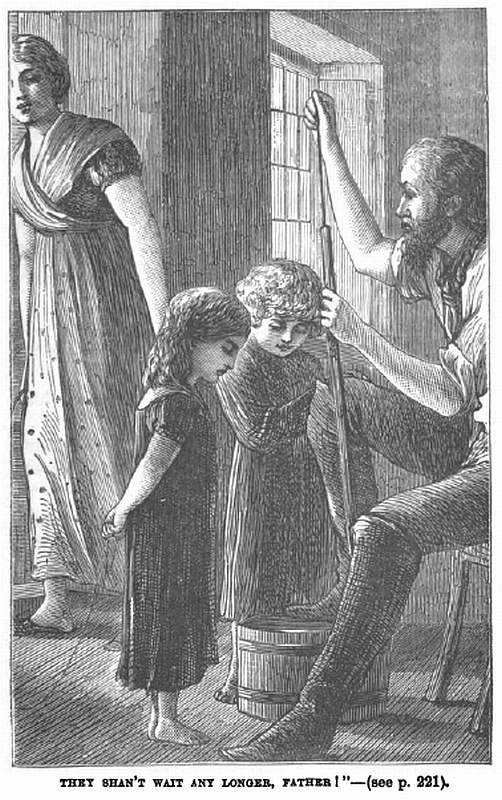
From his description of his home, it might have been in one of the midland counties, the scene was so calm and peaceful. The roughly-built cottage, with its familiar English objects here and there—the loudly-ticking clock, the cleanly-scrubbed three-legged table; the big old family Bible; the cage of white wicker, with its ragged-tailed thrush hopping from perch to perch; and I picture to myself Samson Harris seated there upon a stool in the midst of the humble room, before a tin bucket of water, Englishman written boldly in the lines of his rugged, ruddy, sun-tanned face, as he bent to his task of washing out the barrel of his rifle—a necessity for protection in those early settling days—making the water play up like a fountain from the nipple, to the great delight of two rosy children who were looking on.
It might have been here, in one of the midland counties, but there was something about the brightness of the afternoon sun which streamed in at the open door, the blueness of the sky, the clearness of the atmosphere, and the scenery around, that was not English. The flowers that clustered about the door and nodded round the rough window-frame, and the objects that peeped here and there from some corner, too, told of a foreign land; while the huge pines that shot up arrow-like towards the sky were such as could be seen nowhere but in Australia.
“The poor brutes have been calling you, lass, for the last half-hour,” said he, looking up as a tall, fair-haired girl entered the room where he was busy, milking-pail in hand, and stood to watch the task with as much interest as the children.
“They shan’t wait any longer, father,” said the girl; and she passed slowly through the door, humming a cheery old country ditty, and was gone.
The barrel was taken from the water, and wiped out; and then Harris set to work oiling the lock.
“Hallo, what are you back for?” he exclaimed as a roughly-dressed, heavy-faced man came up to the hut-door at a trot, his forehead streaming with perspiration, which had marked its course in lighter lines through his dust-grimed face. Directly behind him came, at an easy, loping swing, a tall, thin, fleshless-looking native, whose black skin shone as he came into the hut after his companion.
“Blacks out,” panted the heavy-faced man, seizing the door as if to shut it, at the same time examining the cap upon the rifle he carried—“Blacks out, master.”
“Blacks out, Tom?” said Samson; “blacks out? ’Pon my word, I never saw such a coward in my life. Now what in the world were you lagged for that your conscience must make you see a nigger in his paint behind every tree, or peeping up above the scrub? Blacks! Poor, inoffensive beggars. Why, you had your rifle, hadn’t you, ready to scare off a hundred? This makes six times you’ve run home to cry wolf. And you’ve left those sheep to take care of themselves,” he continued, forcing the ramrod into its place as he rose as if to leave the hut.
“’Tain’t wolf this time, master; ’tain’t, indeed,” cried the man earnestly; and then, seeing Harris’s smile of incredulity, he relapsed into a look of sullen injury, and stood leaning upon his rifle-barrel.
“Here, come along,” said Samson.
“Load up first, master,” said Tom. “’Tis true, indeed,” he exclaimed, once more seeking to obtain credence for his story. “I saw scores. Ask Teddy here.”
Now Teddy—or, as he was known in his tribe, Bidgeebidgee—stood spear in hand, showing his white teeth, and apparently listening intently, from the way in which his nostrils expanded and twitched. That something was amiss was evident, for, leaning his spear against the wall, he now took off the ragged blue shirt he wore, unfastened his girdle, and set free a formidable-looking waddy, or club, before throwing himself flat upon the ground to listen.
Samson paused, startled, and though uncharged, he involuntarily cocked his piece as Teddy, the black shepherd, leaped up and exclaimed—
“Black fellows all a-coming—one—two—ten hundred.”
The next instant he threw himself into an attitude of attack, poising his spear for hurling at the first who should cross the threshold.
“Get out,” exclaimed Samson, recovering himself; “here have I lived now two years and only seen a party or two of the poor wretches begging, and—”
“But they burned Riley’s hut, and butchered his wife and children,” said Tom, earnestly.
“Don’t believe it,” said Samson, sturdily, “only a bugbear made up by some of them pioneering chaps to frighten new-comers from going up country and taking claims, so that they may have best choice themselves.”
“Wallace’s boy’s head was battered in,” said Tom.
“Gammon,” said Samson, who, however, could not help looking uneasily towards the black.
“Then there was Ellis’s poor gal; you know how they served her.”
“Hold your tongue, will you?” growled Samson; “do you want to frighten the women to death?” and as he spoke he clapped his hand over his convict servant’s mouth, and glanced uneasily towards the door which led into the interior of the hut—one that was unusually large, for during Samson’s pleasant sojourn in this smiling wilderness, matters had prospered with him, and bit by bit he had added to his dwelling, and found himself compelled to make fresh arrangements for his flocks and ever-multiplying herds.
“Did you call?” said a pleasant voice, and then the door opened, and Samson’s comely wife made her appearance.
“No,” said Samson, “I didn’t call, but—”
“Here a come,” said Teddy, and all present heard the rapid beat of feet, audible to the black’s keen sense some time before. Tom cocked and raised his rifle; Samson snatched down a revolver from a hook over the fireplace, knocking down and breaking a little china group of the children in the wood, an ornament brought from the far-off English home.
But the next moment arms were lowered, and Teddy’s spear was not thrown, for two men, whose faces were known to all present, dashed panting into the hut.
“Look out,” one of them gasped, “the blacks are out.”
“Now then, master!” cried Tom triumphantly.
“Don’t see nothing blacker about than your face, neighbour,” said Samson dryly, as he turned to one of his visitors. “Ain’t neither of you killed, are you?”
The man did not answer, but turning up the sleeve of his woollen shirt to the elbow, showed a long, jagged but superficial scratch from the upper joint to the wrist, with here the blood drying fast, there still standing in beads upon the lips of the wound.
“I might have been,” said the new-comer grimly, “if the fellow who threw the spear that made that long scratch had been truer in his aim. The blacks are out strong, well armed, and in their war-paint; and if you don’t want them in here, Samson Harris, you’d better shut that door.”
Half-grudgingly, the squatter made two steps towards the door; then he stopped for he caught sight of his wife, standing with blanched and drawn face, holding tightly her two children. She did not speak; but, as their eyes met, her lips parted to form one word which the father read in an instant. Thought after thought rushed lightning-like through his brain; all the old colonists’ tales and their horrors seemed to force themselves upon him; the burning of Riley’s hut, and the cruel butchery of wife and children, and the other barbarities said to have been committed; the child of a squatter named Wallace beaten to death with clubs; the death of the blooming daughter of one Ellis. A mist seemed to swim before his eyes for an instant; but the next he had shouted, “Come on, such of you as are men;” for he had again encountered the agonised face of his wife—again interpreted that one word her lips had parted to form, and he dashed to the hut-door; but only to be grasped tightly by his convict servant, Tom.
“Let me go!” he shouted, “are you mad?” and he dealt the man a heavy blow in the chest, and sent him staggering back, shouting—“Hold him, hold him!”
“Let me go, Anderson—Jones!” cried Samson, again struggling to reach the door, but held back by the new-comers. “Are you mad, are you men, when poor Mary is out there in the scrub?”
The wounded man gave more of a yell than a cry, as Samson Harris uttered those words, and, loosing his hold of the father, he made for the door himself, but only to fall heavily, tripped up by the waddy the black shepherd had cunningly placed between his legs.
The fall was heavy; but as he went down two spears darted through the open door, and stuck quivering one in the floor, the other in the table. The next moment the door was dashed to by Teddy, and its rough wooden bar laid across.
“Better there, than through you, Master Anderson,” said Tom, dragging the quivering spear out of the table, and passing it to Teddy.
The young man did not speak; but his eyes glared, and the curls of his black beard seemed to move and writhe as his features worked. Then, grasping the rifle he held in his hand, he turned to Samson Harris, saying in a husky voice—
“Are you ready?”
Samson forced a bullet down upon the powder of the rifle he was now engaged in charging, and nodded his head by way of reply.
There was no opposition made now, and as Samson and Anderson prepared to make a dash out to reach the scrub, Tom the convict, Anderson’s companion, and the black made as if to accompany them.
“No,” said Samson hoarsely, “stay and protect them,” and he pointed to his wife and the two astonished children. “Now open the door.”
At his words, Teddy threw the door widely open, but before any one could pass through, he dashed it to again, while as he did so, Samson groaned, for, “thud—thud—thud” came the sound of three spears as they stuck in the stout woodwork, one passing right through; and he knew that had they stood in the doorway, it would have been to their death.
“Frank Anderson,” said Samson in a low voice, holding out his hand, “I always set my face against your coming here, for I didn’t think you were in earnest, my boy; and now—now—if it’s to come to that—” and he pointed to the spears, his voice shaking a little the while, “I should like to make friends first, though I have gone on against you. Frank Anderson, I beg your pardon!”
The young man groaned, as he took the proffered hand, and then in the same low voice he whispered—
“But Mary, when did she go? Which way?”
“Heaven forgive me,” exclaimed the wretched father, “and I’d forgotten her till she showed me my duty,” and he nodded towards his trembling wife. “She took the pail and went to the cows, half—three-quarters of an hour ago.”
“But we must go to her,” whispered the young man.
“Then you’ll have to go with your skin as full of spears as a porkypine’s back, master,” said Tom, who had crept closer to them. “There; hark at that!” he exclaimed, as a burst of yells arose. “There’s a good two hundred of the black devils dancing about.”
“It would be madness to go,” said Samson, “and like sacrificing three more lives; but she may have hid herself, and escaped.”
The young man shuddered, and then raised his rifle, for a spear came crashing through the window, but happily without striking any one.
“Here,” said Samson, rousing up, “lend a hand?” and with the help of those present, he half carried his wife and two children up a short ladder to a roughly-formed loft, full of wool fleeces, and formed in the low-pitched roof.
“There, creep under them,” he cried, “and first pull up the ladder. Now hide yourselves there, you’ll be safe for the present.”
“Look out,” shouted Tom, as Mrs Harris dragged up the ladder, and its last rounds were beyond reach, while at the warning cry, Teddy the black and Anderson discharged spear and rifle at a couple of blacks who appeared at the inner door, having climbed in by one of the windows. Then ensued a sharp struggle, in which desperate blows were given on either side, and the inner room was cleared; but not before three of the savage assailants lay writhing upon the floor, their life-blood staining the white boards of the plain bed-chamber.
It was a dangerous task, and more than one spear flew through the window as the bodies were hoisted up and thrown through: then the opening was barricaded as well as those of the other little front windows of the hut, and one or two stood at each, ready to meet the next assault.
The thin blue smoke of the discharged pieces floated slowly upwards, and seemed to wreathe about over the trampled blood-stains, when a cry came from Tom the convict, and almost at the same instant the report of his piece, summoned help to the back half-kitchen, half wash-house, whose little window was the only opening in the rear of the house.
The help was needed, for about a score of the blacks had dashed up to the opening, and were trying to force their way in; but a well kept up fire from rifle and revolver drove them back, with several of their number bleeding, upon the ground.
“It’s of no use to be merciful,” exclaimed Anderson. “They must be shot down, or we shall be all butchered. Take a steady aim, sir, for your wife and children’s sake; but I’d keep two or three shots left in my revolver for the last.”
Samson Harris turned and glared at the wild countenance of the young man by his side, as if to ask what he meant, but the look was unnoticed, for, as if thirsting for blood, Anderson kept on loading and firing whenever one of their enemies offered his body as a fair mark.
At every shot that took effect, there was a wild yelling, above which might be heard the shrieking and wailing of the gins as some famous warrior of the tribe slackened his muscles, let fall spear, waddy, shield, or boomerang, that he should hurl no more; but, in spite of their losses, the attack was kept up now on one side, now on the other, spear after spear flying through the little windows, or sticking in the bedding with which they were barricaded, to be dragged out and sent flying back by Teddy the black, who in his excitement had reduced his costume still farther, only wanting a little yellow, red, and white paint to emulate the warrior uniform of his enemies.
But at last the evening had set in, for the short twilight was past, and the stars were looking down calmly upon the scene of the afternoon’s bloodshed. Though but shortly before, dusky figure after dusky figure might have been seen gliding from tree to tree, or darting across some open spot, yelling and brandishing spear or club, now all was silent, save at times the distant lowing of some of Samson’s cattle or the bleating of sheep. Now and again, too, would come the barking and howling of the dogs that had been driven away by the fierce native onslaught—one of those raids made upon the settlers, whom they looked upon as usurping their land.
Samson Harris seemed utterly prostrated by his agony of soul, for again and again—almost incessantly—he kept picturing to himself the child he accused himself of neglecting, struggling in the hands of the blacks. He would have gone to seek her now, mad as the act would have been, in the darkness of the night, surrounded as they were by enemies, but for the prayers of his wife; and their only hope seemed to be that poor Mary had taken the alarm and sought for refuge in the scrub, which extended for some, distance in one direction. This, he knew, would be but an act of folly if she had been seen, for they would have tracked her footsteps to the place of refuge with the greatest of ease; their prayer was that she might have taken the alarm in time. Anderson and his companion had had a very narrow escape at the station they occupied some few miles from Samson’s home; but a bold front and a daring charge had enabled them to combine their forces, so, as Anderson had hoped, to be of some protection to Mary Harris, for whom he had, in spite of her father’s opposition, long entertained a warm feeling of admiration.
There was a chance that, under cover of the darkness, Mary might thread her way amongst the blacks and reach the hut; and in this hope Anderson stood at the open door watching the night through hour after hour, his senses on the stretch. More than once, too, with Teddy for companion, he walked for some little distance round the hut; but stumbling over the body of one of their enemies, he fell amongst the bushes with so loud a crash that he was glad to retreat, and stand watching once more at his post.
An inspection after the afternoon’s struggle had proved that, beyond a few scratches, the defenders of the hut had escaped unharmed; and but for the fearful anxiety which oppressed all present, they would hopefully have looked for the morning, ready to meet their enemy again with renewed courage. Provisions they had in plenty to sustain them, if needs were, for weeks. Ammunition, too, showed no sign of running short, till Samson opened a little keg, to find that the powder it should have contained was powder no more, but one hard mass, into which it had been turned by the dripping from the roof. The bad news was conveyed from one to the other, and in grim silence the men examined their powder-flasks, to find that he who was most wealthy possessed but two charges beyond the one in his rifle.