"From the Notebook of a Working Surgeon" (continued 2)
Reading edition
“‘You’ll go with me again, Harry?’ he said to me as we parted. ‘I shan’t wait till Sunday, but run over on Wednesday night.’
“‘I don’t know, I’ll see,’ I said; and then we parted.
“I went out that afternoon happy and light-hearted, I came back mad and angry. ‘He wants me to go with him to talk to the old people, while he can chatter, and say empty nothings to that girl, who is as much too good for him as she is for—’
“‘Me!’ I said after a pause, for I seemed to grow sensible all at once, and to see that I was making myself what I called rather stupid. Then I began to take myself to task, and to consider about the state of affairs, seeing how that John Ross’s visits were evidently favoured by the old people, perhaps by their daughter, and therefore, why was I to thrust myself in the way, and, besides being miserable myself, make two or three others the same?
“‘I’ll go to bed and have a good night’s rest,’ I said, ‘and so forget all about it.’
“How easy it is to make one’s arrangements, but how hard sometimes to follow them out! I had no sleep at all that night; and so far from getting up and going to begin the fresh week’s work light-hearted and happy, and determined not to pay any more visits along with John Ross, I was dull, disheartened, and worrying myself as to whether Jenny Lee cared anything for my companion.
“‘If she does,’ I said to myself, ‘I’ll keep away, but if she does not, why may she not be brought to think about me?’
“Somehow or another, John Ross had always made companion of me, in spite of our having very different opinions upon certain subjects. He was for, and I was strongly against trades unions. He always used to tell me that he should convert me in time; but although we had been intimate for three years, that time had not come yet. On the contrary, certain outrages that had disgusted the working men, had embittered me against the unions. However, we kept friends; and it was not upon that question that he became my most bitter enemy.
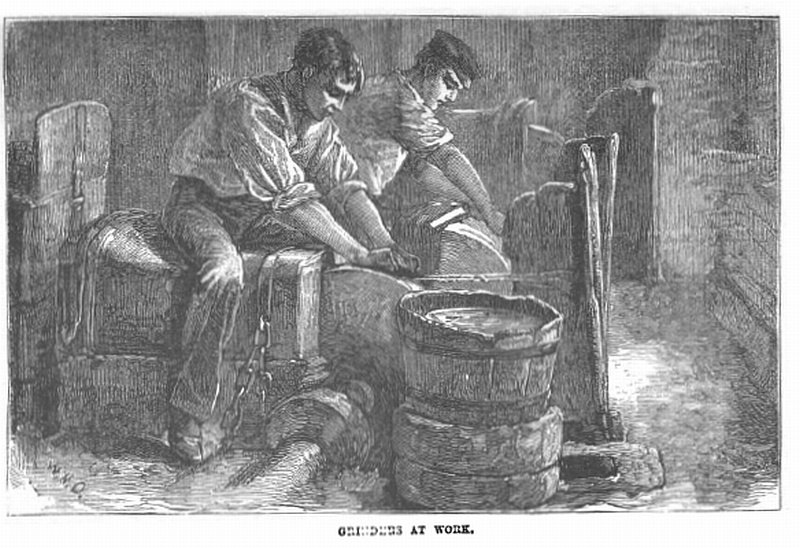
“After many a long consultation with myself, I had determined to go with Ross to the Lees only once more, and had gone; but somehow that ‘only once more’ grew into another and another visit; till from going with John Ross alone, I got into the habit of calling without him, and was always well received. Jenny was pleasant and merry, and chatty, and the old folks were sociable; and the pleasure derived from these visits smothered the remorse I might otherwise have felt, for I could plainly see, from John Ross’s manner, how jealous and annoyed he was. And yet his visits always seemed welcome. There was the same cheery greeting from the old folks, the same ready hand-shake from Jenny; but matters went on until, from being friends, John Ross and I furiously hated one another, even to complete avoidance; while, from the honest, matured thoughts of later years, I can feel now that it was without cause, Jenny’s feelings towards us being as innocent and friendly as ever dwelt in the breast of a true-hearted English girl.
“But we could not see that, and in turn accused her of lightness and coquetry, of playing off one against the other, and thought bitterly of much that was kindly, true, and well meant.
“As may be supposed, each feelings bore bitter fruit. John Ross accused me of treachery, and sowing dissension, ending by desiring, with threats, that I should go to the Lees no more; while I, just as angry, declared that unless forbidden by Jenny, I should go there as frequently as I desired.
“We came to blows. It was during dinner hour, and the wheel was stopped; we had been talking by the dam side, and at last, when in his anger he had struck me, I had furiously returned the blow; then more passed, and after a sharp struggle, I shook myself free, when, unable to save himself, John Ross fell heavily into the deep water, and plunged out of sight for a few moments. But there was no danger, for as he came up he was within reach, and he seized my outstretched hand, and I helped him out, my anger gone, and ready to laugh at him, as he stood there pale and dripping.
“‘I shan’t forget this,’ he said, shaking his fist in my face.
“‘Pooh! nonsense, man!’ I exclaimed, catching the threatening hand in both mine. ‘Let bygones be bygones, and make friends.’ But snatching his hand away, he dashed in amongst the trees, and in a few moments was out of sight.
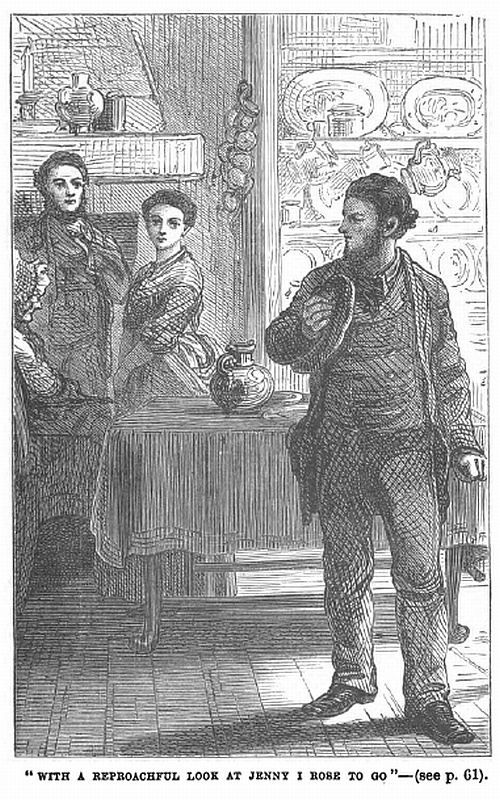
“I did not go up to the Lees that night, but the next evening upon walking up after work-hours, I found John Ross there; and that on all sides I was received with a studied coldness. The old people were quite gruff, and their daughter only replied quietly to my questions. I soon found that my presence acted as a restraint upon the party, and with a reproachful look at Jenny I rose to go.
“I did not see the tears that rose to Jenny’s eyes as I left; for I was meeting the triumphant looks of John Ross, and trying to smother down the bitterness that rose in my breast.
“‘He must have been poisoning them against me,’ I muttered, as I took my solitary way towards the town. ‘I wonder what he has said!’ then I began to think of how I had come between him and his happiness, and accused myself of selfishness, and at last reached my lodgings determined to fight down my disappointment, and to try to forget it in work.
“I fought hard, and it would be beyond words to tell the misery of my solitary heart as I kept steadfastly from the Lees, working early and late to drive away my thoughts, and too much taken up with my own affairs to observe the strange, sullen way in which I was treated by the other men in the wheel. I did notice John Ross’s scowls; but knowing their cause, I did not pay much heed to them, telling myself that I was serving him to the best of my ability, and that if he knew all I suffered, he would only be too glad to offer me the hand of good fellowship.
“‘He’ll find it out for himself some day,’ I said, with a sigh, and went on with my work.
“Of course you know what I mean by the wheel-bands, doctor? You know that to every grindstone there are endless leathern straps, to connect them with the main shafts set in motion by the water-wheel; and by means of these connections each man’s stone is made to revolve. As a matter of course, if these bands were removed, a man’s grindstone would be motionless, and work impossible; and though such acts were common enough in some wheels, nothing of the kind had taken place on our stream, so that I was perfectly astounded one morning upon going to work to find that my bands had been cut.
“I took it to be meant as a joke, so, though much annoyed, I merely set to, and looking as good-humoured as possible, repaired my bands after a rough fashion, so that, saving one or two breaks down, I managed to get a pretty good day’s work done.
“There was plenty of bantering going on, not of a pleasant, jovial kind, but of a sneering, harsh nature, and I went home that night disheartened and put out. I did not give John Ross the credit of the trick, as being too small; and I began to hope, too, that he saw me in my right light. But there was another stab for me that night, for passing along one of the streets whom should I meet but John himself, walking by the side of Jenny Lee and her mother.
“Jenny gazed hard at me, for I moved to her as I passed; but it seemed to me that she only looked on my salute with contempt, and I passed on feeling more bitter than ever.
“The next morning on going to work my bands were gone, and the only reply to my inquiries was a hoarse kind of laughter mingled with jeers. I could see now plainly enough that, probably incited by John Ross, the men intended to make my life so unpleasant at the wheel that I should be glad to seek for work elsewhere.
“‘Don’t want no such independent men here,’ shouted somebody, and several other remarks were made of a like nature.
“‘I can give way when I’m in the wrong, John Ross,’ I muttered to myself; ‘but if you’re at the bottom of this, I intend to show you that mine is consistency of behaviour and not cowardice.’ So, quietly leaving the wheel, I took no heed of the laughter and jeers of the men, but went back to the town, bought new bands, and, to the surprise of those who had thought me driven away, went on with my work as though nothing had happened.
“‘I should take them bands home t’-night, lad,’ said one, jeeringly.
“‘Ay, they wean’t be safe here,’ said another.
“But I let them banter away, though I took care that my new bands should not be stolen, rolling them up and carrying them away with me every night when I left off work.
“This only served to increase the animosity of the men, and sneers and sullen looks were hurled at me from morn till night, till at times I began to ask myself whether it would not be wiser to seek elsewhere for work. But I always came to one conclusion—that I was in the right, and that it would be miserable cowardice on my part to give up.
“So I kept on suffering in silence every insult and annoyance, such as, to their disgrace be it said, some working men are only too ready to heap upon any fellow-toiler who has had the misfortune to make himself obnoxious.
“And so matters went on till one morning, when, passing a number of lowering faces, I made my way to my seat, slipped on my bands, and then, not noticing that the others were lingering about against door and window, took up the first of the knife-blades I had to grind, and applied it to the stone. There was the sharp ‘chirring’ noise, the sparks darted away from beneath the blade, and then there was a sharp blinding flash, a dull report, and I felt myself dashed back, scorched, half stunned, and helpless, but still sensible enough to know that some cowardly hand had placed a quantity of gunpowder where the sparks from my stone would fly—a cruel unmanly trick that was not new in those days—and as I lay there and groaned, I believe it was as much from agony of mind as of body; for it seemed so mean, so despicable, that it was hard to believe that men living in a Christian country could be guilty of such an act.
“But there were some there who did not sympathise with the outrage; and three or four lifted me up, and would have taken me to the infirmary, but I begged them to bear me to my lodgings, and then fetch a doctor, and they brought you.
“‘I’d tell ’ee, lad, who put in the poother,’ said one of them, whispering in my ear, ‘but I darn’t.’
“‘I don’t want to know, Jack Burkin,’ I groaned, as I lay there in the dark, ‘I’d rather not hear;’ and as I spoke, my heart seemed to tell me who was my enemy.
“‘I wish the poor girl might have chosen a better husband,’ I said to myself that night, as I lay there sleepless from pain, when you had done what you could for me, and I lay waiting for the day. Not that I could see it, for all was blank to me now; and as I thought, I pictured myself as I felt I should be in the future—a tall, stout man, with vacant eyes and a seamed and scarred face: for I knew that I was fearfully scorched, and that hair, eyebrows, and lashes were burned off, and my face terribly disfigured.
“It was a bitter time that, but though the pain was still most keen, I laughed at it after the first four-and-twenty hours, glorying in and blessing the day that had laid me helpless there; and I’ll tell you the reason why.
“John Ross had overshot the mark, while I had been blinder than I was at the present time, when a happy light darted into my understanding, and I learnt that I was not to be the solitary man I had expected.
“I was lying in pain and bitterness on the afternoon after the accident, all in darkness. You remember you had been to dress my blackened face and hands once more, but you did not give me much comfort when I asked you about my sight.
“‘Remember’ I said, ‘I told you to be hopeful, for I was in great doubt.’
“‘And what was I to do when blind?’ I asked myself. Certainly, I had saved up a little money, but I knew that would not last long, and that it would be sunken by the doctor’s bill.
“‘Pity I did not go into the infirmary,’ I groaned, and then I felt ready to eat my words, for a sweet little sad voice, that made my heart leap, said, ‘May I come in?’
“I could not have answered to have saved my life, but only groan and try to turn away my face, lest she should see it—my blackened and scarred face, disfigured with cotton-wool and dressing, my head with every scrap of hair scorched off—and, had I been able, I should have tried to hide it with my hands, but they too, with my arms, were burned and bandaged, and I could only slightly turn my head and groan, as I thought of my past manly looks, and trembled to be seen by the bright-faced girl who had first made my heart to beat more swiftly.
“‘May I come in?’ was repeated again, but still I could not answer; and then there was the light sound of a step crossing the chamber floor, a rustle by the bedside, and I heard some one go down upon her knees, and felt two little gentle hands laid upon one of my arms, and a sweet little voice sobbing, ‘Oh, Harry! oh, Harry! that it should come to this!’
“Speak? I could not speak; and as to pain, I believe, with the exultation then in my heart, I could have borne the keenest pangs that ever fell to the lot of man.
“She did not love John Ross, then, and never had, or she would not have come to me thus to lay bare the secret of her pure young heart. Had I been well and strong, and had the sense to have followed up the opportunity once given, she would have been quiet and retiring; but now, in this perilous time—for I learnt after that I was in danger, and that this was known—Jenny had come to my bedside, like some ministering angel, to tend and comfort me.
“I could speak at last though, even if it was but in a whisper; and in those long hours, as she sat by my bed, all reserve was cast aside; and, speaking as one who only looked upon things as they might have been, I told her how I loved her, and how I had kept away, believing that she would be happier with John Ross.
“I learnt now of his pettiness, of the way in which he had defamed me; but let that pass. I could forgive him all since I learned that he had never gained entrance to the little heart beating by my side. I learned, too, of Jenny’s suspicions, aroused by a purchase she had seen the young man make, at a shop in the town, one day when she was not perceived; but I would not have the thought harboured, for I bore him no malice then. And at last I groaned again, and the weak tears forced themselves into my poor smarting eyes as the thought would come of what might have been, and of how I must not indulge in such ideas now, binding the fresh young girl by my side to a scarred and blinded man. I knew that I must be hideous to look upon, but in my ignorance I knew not the heart placed by God in a true woman’s breast, and I could only groan again as I felt a little soft cheek laid to mine, cruelly burned as it was, and the tender sympathising voice ask me if I was in much pain.
“‘Only of the heart, Jenny,’ I whispered, ‘as I think of what I might have been.’
“And then her sobbing question, as she asked me not to think it unmaidenly and bold of her to come to me, and to talk as she had done.
“What could I say, but ask God’s blessing upon her head as her little light step crossed the floor? And then the brightness seemed to have gone, and all was once more dark.
“Day after day she was at my side, to read to me gentle words of hope and resignation; and when, more than once, I spoke of my altered looks, my scarred face and sightless eyes, telling her how it cut me to the heart to say it, but that all this must end, for I should not be acting as a man if I bound her to such a wreck, spoiling her fair young life, did she not tell me she could love me better than if I had been as I was before, begging me not to send her away, lest I should break her heart?
“And it was almost in happiness that day that I lay there, very weak and helpless. You remember when I had been delirious, and very nigh unto death. The light still burned, but the oil was low and the flame danced and flickered so that at any moment it might expire. In the days of my strength I had looked upon death with horror, trembling almost at the name; but now, quite sensible as I lay there, as I thought, waiting for its coming, it was with a strange calm feeling of resignation. There was no dread; I only felt happy and at ease, for those pure little lips at my side had hour after hour offered up prayers in my behalf to where prayers are heard, and with the sincere hope of forgiveness for what I had done amiss, I lay waiting till my eyes should close in the last long sleep. I was sorry, and yet glad, for I felt that it would be cruel to poor Jenny to get well; and though I knew her true heart and her love for me, what was there in the future for her if she took to her heart a husband who was blind and maimed?
“And then the flame grew stronger, ceasing to flicker, and burning with a faint but steady flame—a flame that brightened day by day, and hope would come back, whispered as it was in my too willing ears.
“Then, too, there came a day when there was, as it were, a pale dawn before my eyes—a dawn which took months before it fully broke into day; when after a good long look at my altered face, I took the stick I had not yet been able to lay aside, and one bright afternoon in early spring made my way up to the Lees, to find the old folks out, but Jenny at home.
“And we talked long and earnestly that day, for I had made up my mind to be a man. I knew that I should always be plain, almost to distortion, and I told myself that it was my duty to offer once more to set her free.
“Jenny had been weeping silently for some time, when, turning to me, she said, gently. ‘Don’t think me irreverent, Harry, but do you remember how God chose David to be king over his people?’
“I nodded, for my heart seemed swelled unto bursting, and I could not speak.
“‘He looked upon the heart,’ sobbed Jenny; ‘and oh, Harry, I have tried to choose my king like that.’
“People call this world a vale of sorrows, and I pity those who always speak like that, for they can never have felt the happiness that was mine that night, as two fond arms clasped my neck, and a loving cheek was laid to mine, and they were those of her who has been my wife these fifteen happy years.
“I believe that there are those who think us a strangely-matched couple, and that our little ones all favour their mother; but they don’t know all, for my foolish little wife is even proud of her husband.”
“And well she may be!” I said to myself as I went away, thinking what a blot these trade outrages have been upon working-class history, and how generous stout-hearted men often allow themselves to be led away by the mouthing idlers of their workshops—by men who are constantly declaiming against their betters, and who want as they say for all to be free and equal, with as much sense as the child who cried for the moon.
Chapter Seven.
My Non-Striking Patient.
I had just such a man as my Sheffield grinder to tend once for a broken leg. Samuel Harris was his name, and a very bad fracture I had to deal with.
He lay there without a murmur as I made my examination and then shook my head.
“Seems nasty, don’t it, doctor,” he said coolly.
“It’s a very serious fracture,” I said, “and I’m really afraid,—”
“That I shall lose my leg?” he said, anticipating my words.
“I will try and save it,” I replied, “but you must be prepared for amputation at any moment.”
“All right doctor,” he said, “I’m in your hands. I won’t grumble. If you do take it off, though, and it don’t kill me, I’ll see if I can’t contrive something better than those old wooden legs, that some fellows peg about on.”
“Well we’ll see,” I said, “and if you’ll look at matters in that cheerful way perhaps we shall get on.”
I saved that man’s leg: for a more patient fellow under suffering it was impossible to find, and in the course of various conversations with him, we talked of strikes and outrages, and the various trade disputes, and by degrees he talked about himself and his experiences over similar affaire.
“Ah!” he said, “some men can always make plenty of friends without taking any trouble, and some can make plenty of enemies in the same way; and that last seems to have been my luck through life. I suppose as an ordinary mechanic I’m not such a very bad sort, and I’ll tell you why: after about a dozen years of married life there’s always a pleasant smile to welcome me home—a sweet look that I always answer with a grin which spreads all over my rough, dirty face till it gets lost on each side in my whiskers, and up a-top in my hair. Then, too, for all I’m a big, grim-looking fellow, as my mates call Sour Sam, the little ones never seem a bit frightened of me; but one comes and gets hold of my cap, and another my coat, and one come and pulls before, and another comes and pushes behind, till they get me in my chair beside the table; and I know times and times I haven’t had half a meal for the young rebels climbing on me; for, somehow or another, if there is any time in the day that goes fast, it’s dinner hour. You get sat down, and toss this little one, and play with that, and eat two or three mouthfuls, and then it’s time to go back to the shop, and grime yourself up again with steel filings and oil.
“I was such a grim, gruff fellow, that my shopmates took precious little notice of me; and one day, after it had been brewing for some time, they all turned out—hundred and forty of ’em.
“Now, I was so took aback, and it come upon me so unexpectedly, that I put on my coat and came out with the rest, and stood outside the gates; but as soon as I was outside, I felt mad at having done so, and would have gone back, only it was too late, and what my shopmates had settled it seemed that I must abide by. So, thinking of how it would end, I walked home, though two or three called me a sneak for not joining their meeting at a public-house hard by. After sitting by the fire for an hour I made up my mind what I should do, and that was to go back to work, for I didn’t want to strike, and felt that the treatment we got at the works was quite as good as we deserved; and it didn’t seem fair to me to look upon my employer as an enemy because he had had so much better luck in the world than I had. So back I went without a word, and as I got near the gates there were three or four of our chaps hanging about.
“‘Where going, Sam?’ says one.
“‘Works,’ I says, gruffly.
“‘What for?’ he says; and just then some others came up, and then from here and there more and more, till fifty or sixty stood round.
“‘I’m going into the works,’ I said, roughly, and trying to shove my way on.
“‘Well, but what for!’ he says, with a sort of half laugh. ‘We haven’t heard that they’ve given the rise, but being a favourite you got the news first. Why didn’t you tell us, mate?’
“Of course I didn’t like his bantering way, nor I didn’t like the half laugh which followed; but I said nothing, only tried to push through the crowd, when being brought up short I swallowed down a sort of feeling of rage that seemed to come up my throat, and facing round, I says boldly:
“‘Harry Perkins, you’re on strike, as yer call it; well, I’m not. You don’t mean work: I do; and I’m off into the shop.’
“Well, this seemed to stagger him for a moment, but the next minute half a dozen fellows had hold of me, and I was dragged back right into the middle of the crowd, and the voices I heard naming the pump and river told me I should get some rather rough usage; but the English obstinacy in me began to kick against this treatment, and, shouting out loudly, on the chance of there being some present of my way of thinking, I says:
“‘I mean work, mates, and down with the strikers. Who’s on my side?’ when fifteen or twenty came forward, and then I can’t tell you how it was, for I always was hot-blooded; the next minute we all seemed to be raging and tearing at one another in a regular fight; men shouting, and swearing, and striking fiercely at one another; some down and trampled upon; some wrestling together; and the crowd swaying backwards forwards, here and there, and the battle growing more and more bitter every moment.
“You can’t see much in a fight like this, when you have an enemy to contend with the whole time; but I saw that the men now all came out in their true colours, and that the sides were evenly balanced, for a good half had turned out more from feeling bound to act as the others did, than from being dissatisfied with the rate of pay; while now, seeing the stand I had made on their side, they felt bound to take my part in return, and, as I said before, the fight grew fiercer every moment, while headed by Perkins, the man who had spoken to me, the other side was making head, and we were being beaten back step by step and driven along a narrow street, but fighting desperately the whole time.
“Every now and then a chap on one side or the other would stagger out bleeding and wild, and make his way on to a doorstep, or up one of the courts that connected the street with the next, and more than one went down with a groan; while by some means or other about eight or nine of our side were driven up a court by some of the other party, when, seeing the chance, I shouted to them to follow, and we all ran hard, pursued by our enemies for twenty yards or so, when they turned back.
“‘Come on,’ I shouted, and, leading the way, I got into the next street, led them along it a little way, and then turned down the next court. ‘Keep together,’ I said, ‘and we’ll take ’em behind;’ and the next minute we were back in the street, where our mates still fought on desperately, for in my heart I believe every blow struck on our side was nerved by the thought of home, and those we worked for.
“Next moment we took them in the rear, with a desperate rush, cheering as we did so, and tumbling them over right and left; whilst our mates in front who were just then giving way, cheered again and the fight was hotter than ever. But now, hemmed in between the two parties, the strikers fought desperately, and I caught sight of Perkins with a small hammer in his hand, knocking down first one and then another poor fellow, who crawled out of the struggling mob as well as he could.
“There were no police visible, but they could have done nothing if they had been there; but every window was crowded with people, while men’s wives came harrying up, and shrieking to the people looking on to stop the fight.
“Just then I had downed the man opposed to me, when I heard a heavy blow, and turning, saw the man who worked at the next vice to me go down from a crack on the forehead from Perkins’s hammer, and the next moment I stood on one side just in time to avoid a blow aimed at me, when the handle caught me on the shoulder, and the hammer-head snapped off, falling upon the ground behind me.
“I believe I was half-mad then with pain and excitement as I leaped at Perkins, and closed with him; when, being both big, stout fellows, and heads of the row, the desperate struggle going on between us seemed to act like magic on the others, who stopped to watch us as we wrestled together here and there—now up, now down, the centre of a busy throng, cheering and shouting us on, as if we had been two wild beasts fighting for their amusement.
“I’m not going to give you a long description of a hard fight, nor of the savage feelings that burned in my brain, as mad with fury I tore at him again and again; for I often look back upon that time with feelings of shame, though I can’t help thinking that I only acted as most men would have done in such a case. All I can tell you is that I’ve a recollection of giving and receiving fierce blows, of falling, being picked up, and being cheered on, and muttering through my set teeth ‘It’s for those at home,’ till there came a fiercer and longer struggle than ever, ending in both falling heavily; and I shall never forget the sickening crash with which my opponent’s head came down upon the kerb-stone.
“Then, blind and giddy, I was standing panting there with a policeman hold of each arm, but only to be dragged from him next moment by my mates, who bore me away cheering.
“Early next morning, though, the police were at my place, and I followed them quietly, shuddering as I went, for I heard that Perkins was in a dying state. Then came the examination before the magistrates, and I was remanded a day or two till the doctors had given in their opinion. Our heads of the firm, though, took great interest in the case as soon as they knew all the particulars; and one of the cleverest counsel they could get took my affairs in hand, which ended in my being discharged, for Perkins grew better; but a good many of us were fined pretty smartly for the breach of the peace.
“The workshop was open directly, and quite half the men went back to work; but from that day I began to find out that our town was no place for me. My employers were kind enough, and I was not a penny the worse in pocket for my encounter; but it grew plainer and plainer to me, day by day, that I should be driven out of the place. Threatening letters came; once I was struck down from behind as I came home on a dark night, and though I felt sure the man I caught a glance of was Perkins, I could not swear it. Then came news of the cowardly tricks at Sheffield—throwing powder into houses—and my wife grew pale and ill with apprehension; while what filled the measure up to the brim was my poor lass being set upon and insulted one night only a few yards from our door, so near that I heard her call ‘Help,’ and knew the voice, and ran out.
“The next week I was sitting in our empty room; the floor trampled and dirty with the feet of those who had been to the sale of the things in our bit of a four-roomed house. And the things had sold well, too; for my mates had sent their wives, and one had bought one thing, and another another. But I was down-hearted and sad at seeing first one little familiar thing and then another dragged away, while the thought of being driven out of the place was bitter to me. The wife and children had gone on to London, and there was no one there to see me as something which showed there were weak places in the strong man came into my eyes.
“But I had to choke that down, for a knock came at the door, and it sounded hollow and strange in the empty place. It was a letter; just in time, too, for I was thinking just before of locking up the place and going away, but fancied I should just like one pipe of tobacco for the last where I had spent so many quiet evenings. However, I opened the letter, and then started to run after the postman, feeling that it must be a mistake, for inside was a crisp new twenty-pound note, with a few lines telling me that it was from two friends who regretted the loss to the town and its works, of an honest, upright man, and begging my acceptance of the trifle enclosed, as a testimony of the esteem in which my services had been held.
“Twenty pounds, sir—a larger sum than I had ever before owned at once; but as I’m an honest man I thought more of the words of that letter then than I did of the money; while through being weak, I suppose, there was a wet spot or two upon the note when I put it away.
“After it was dark that night, I went and thanked those from whom I knew it had come, though they would not own to it; but the senior partner slapped me on the shoulder as I went out, and he said:
“‘There’s too much holding aloof between master and man, Samuel Harris; but if all mechanics were like you we should have no more strikes.’”
“He was quite right,” I said, nodding.
“Think so, sir? perhaps he was, perhaps he was not, but depend upon it the best way is to give and take all you can. Striking’s expensive work for both sides; but you see the thing is this—what makes the trouble is that neither side likes to be beat.”
Chapter Eight.
My Patient, the Driver.
I wish I could put Solomon Gann before you in the flesh; for a finer broad-shouldered specimen of humanity I never saw. He was gruff, bluff, swarthy; and rugged as his face was, it always bore a pleasant smile, just as if he had said to you, “Ah! all right; things are rough; but I’m going to take it coolly.”
And he was cool; nobody cooler—even in cases of emergency; and a better man for an engine-driver could not have been chosen.
I first met Solomon Gann in connection with an accident at Grandton, where I and other surgeons were called in to attend the sufferers by a collision with a goods train. After that I attended him two or three times; for he came to me in preference to the Company’s surgeon, and he used to give me scraps of information about his life, and tell me little incidents in his career.
“Glorious profession, ain’t it, Sir,” he said. “Grows more important every day, does the railway profession, and is likely to. Ah! people in our great-grandfathers’ days would have opened their eyes if you had talked about being an engine-driver; and I ain’t much like a four-horse mail coachee, am I? Rum set out, the rail. Not so many years back, and there wasn’t such a thing; and now it employs its thousands, beginning with your superintendents, and going down through clerks, and guards, and drivers, and so on, to the lowest porter or cleaner on the line.
“I’ve had some experience, I have. I was cleaner in the engine-house afore I got put on to stoke; and I’m not going to say that engine-drivers are worse off than other men because I happen to be one: for we want a little alteration right through the whole machine: a little easing in this collar; a little less stuffing there; them nuts give a turn with the screw-hammer; and the oily rag put over the working gear a little more oftener, while the ile-can itself ain’t spared. Don’t you see, you know, I’m a speaking metaphorically; and of course I mean the whole of the railways’ servants.
“The Public, perhaps—and he’s a terrible humbug that fellow Public—thinks we are well paid and discontented; and leaving out danger, let me ask him how he would like to be racing along at express speed through a storm of wind and rain, or snow, or hail, for fifty miles without stopping, blinded almost, cut to pieces almost; or roasting on a broiling summer’s day; or running through the pitchiest, blackest night—Sunday and week-day all the year round. ‘Well, you’re paid for it,’ says the public. So we are, and pretty good wages as times goes; but those wages don’t pay a man for the wear and tear of his constitution; and though there’s so much fuss made about the beauty of the British constitution, and people brag about it to an extent that’s quite sickening, when you come down to the small bit of British constitution locked up in a single British person’s chest—him being an engine-driver, you know—you’ll find that constitution wears, and gets weak, and liable to being touched up with the cold, or heat, or what not; and it’s a precious ticklish thing to mend—so now then!
“We don’t want to grumble too much, but railway work isn’t all lying down on a feather-bed, smoking shag at threepence an ounce, and drinking porter at threepence a pot in your own jugs; we have to work, and think too, or else there would soon be an alteration in the companies’ dividends. Accidents will happen, do what we will to stop ’em, and there’s no mistake about it, our accidents are, as a rule, bad ones—terrible bad ones, even when life and limb don’t get touched. Only an engine damaged, perhaps, but that can easily wear a thousand pound; while a hundred’s as good as nothing when a few trucks and coaches are knocked into matchwood. Then, too, when we have a bad ‘pitch-in,’ as we call it, look at the thousands as the company has to pull out for damages to injured folks. One chap, I see, got seven thousand the other day for having his back damaged; and I don’t know but what I’d think it a good bargain to be knocked about to that tune. But, there, they wouldn’t think my whole carcase worth half as much. But our work ain’t feather-bed work, I can tell you; and as to risk, why, we all of us come in for that more or less, though we get so used to it that we don’t seem to see the danger.
“Oh! you’ll say ‘Familiarity breeds contempt,’ or something else fine; but just you come and stoke, or drive, or guard, or be signalman, or pointsman, every day of your life, and just see if you’ll pull a blessed long face and be seeing a skillington with a hour-glass in one hand and a harpoon in t’other, ready to stick it into yours or somebody else’s wesket every precious hour of the day. It’s all worry fine to talk, but a man can’t be always thinking of dying when he is so busy thinking about living, and making a living for half-a-dozen mouths at home. I like to be serious, and think of the end in a quiet, proper way, as a man should; but it’s my humble opinion as the man who is seeing grim death at every turn and in every movement, has got his liver into a precious bad state, and the sooner he goes to the doctor the better. ’Taint natural, nor it ain’t reasonable; and though we often get the credit of being careless, I mean to say we don’t deserve it half the times, and the very fact of often being in risky places makes you think nothing of ’em. It’s natural, you know, and a wonderful wise thing, too; for if we were always to be thinking of the danger, it’s my belief—my honest belief—that your railway accidents would be doubled; for the men would be that anxious and worried that they would work badly, and in a few years knock up altogether, with their nerves shattered to pieces.
“I’ve been on the line twenty year, and of course I’ve seen a little in that space, and I could tell you hundreds of things about the different dangers, if I had time. Now, for instance, I’ll tell you what’s a great danger that some railway servants has to encounter, and that is being at a small country station, say where perhaps very few trains stop in a day. It don’t matter whether it’s clerk or porter, the danger’s the same; there’s the fast trains thundering by over and over again, twenty times a day may be, and after a time you get so used to them that you don’t hear them coming; and many’s the time some poor fellow has stepped down to cross the line right in front of one, when—there, you know the old story, and I’ve got one horror to tell you, and that will be quite enough, I dare say.
“‘Carelessness—want of caution—the man had been years in the company’s service, and must have known better,’ says the public. But there—that’s just it—it’s that constant being amongst the perils that makes a man forget things that he ought to recollect; and are you going to try and make me believe a man can have such power over his thinking apparatus that he can recollect everything? He must be a very perfect piece of goods if there is such a one, and one as would go for ever, I should think, without a touch of the oily rag. No spots of rust on him, I’ll wager.
“Shunting’s hard work—terrible hard work—for men; I mean the shunting of goods trains at the little stations—picking up empty trucks, and setting down the full ones; coupling, and uncoupling; and waving of lanterns, and shouting and muddling about; and mostly in the dark; for, you see, the passenger traffic is nearly all in the day-time, while we carry on the goods work by night. Ah! shunting’s queer work where there’s many sidings, and you are tripping over point-handles, and rods, or looking one way for the train and going butt on to an empty truck the other way. There’s some sad stories relating to shunting—stories of fine young fellows crushed to death in a moment; let alone those of the poor chaps you may see to this day at some of the crossings with wooden legs or one sleeve empty—soldiers, you know, who have been wounded in the battle of life, and I think as worthy of medals as anybody.
“Of course, you know, a ‘pitch-in’ will come some time spite of all care; and I’ve been in one or two in my time, but never to get hurt. I remember one day going down our line and getting pretty close to a junction where another line crossed the down so as to get on to the up. I knew that it was somewhere about the time for the up train to come along, for it was generally five minutes before me, and I passed it about a couple of miles before I got to the junction—me going fast, it slow. Sometimes we were first, and then it was kept back by signal till we had passed, so that on the day I am talking of, I thought nothing of it that my signal was up ‘All clear,’ though the up train hadn’t crossed, and with my stoker shovelling in the coal, I opened the screamer and on we were darting at a good speed—ours always having been reckoned a fast line.
“All at once, though, I turned as I had never turned before—thoroughly struck aback; for as I neared the station I saw the signal altered, and at the same moment the up train coming round the curve; then it was crossing my line; and it seemed to me that the next moment we should cut it right in two and go on through it. But we were not quite so nigh as that, and before we got close up I had shut off, reversed, and was screwing down the break, for my stoker seemed struck helpless; then I just caught a glimpse of him as he leaped off; there was a crash, and I was lying half stunned back amongst the coal in the tender, and we were still dashing on for nearly a mile before I was quite recovered and the train at a standstill.
“I was half stupid for a bit, and on putting my hand to my head I found that it was bleeding, whilst the screen was bent right down over me, and had saved my life, no doubt. As far as I could see then there was no more damage done to us, and just then the guard came running up and shook hands when he found I’d got off so well.
“‘But where’s Joe?’ he says, meaning my stoker.
“‘He went off,’ I says, ‘just as we went into ’em. How about t’other train?’
“‘Let’s run back,’ he says; and I put her gently back; but all the while in a muddly sort of way, as if I wasn’t quite right in my head, which bled powerful. Then there was a good deal of shouting and noise amongst the passengers; but my guard went along the foot-board from coach to coach till he had quieted them all pretty well, and then by that time they signalled to us to stop.
“Not many ruins to see, there wasn’t, only the guard’s break of the up train, which my engine had struck full, and another few seconds of time would have let us go clear; while how the points didn’t throw us off I can’t tell, for it’s quite a wonder that my train kept on the line.
“The guard’s break was knocked all to shivers, of course, but he had jumped out and escaped with a bruise or two; but not so poor Joe, as I soon saw; for when I asked about him, they showed me something lying under a tarpaulin which a doctor was just putting straight again. But of all things that struck me on the day of that accident there was nothing like the face of the poor young fellow as had the management of the signal. I never saw a face so pale and ghastly and frightened before. But there let it rest. I suppose he was frightened and confused at seeing the two trains coming in together; and as better men have done afore now, he lost his nerve.
“Ever kill anyone? What! run him down? Yes, one. Shocking thing, too, and one I don’t much like talking about; but then, it was not my fault, and I did my best to save him: but then, what can you do when you’re going nearly a mile a minute?
“That was a shunting case, that was, with a goods train, at a little station, past which we on the express down used to go at the rate I said just now. This goods up used to stop there, and be picking up and setting down nearly every day when we passed. I used to give a whistle, and then it was touch and go, and we were thundering along and past them. But one day as we were running along the straight I could see the guard signalling his engine-driver to back a bit to run into a siding, as it came out at the inquest, for some empties, and to do this, what does he do but step on to the down line, and right in front of my train.
“Now all he had to do was to step off again, for he had plenty of time, and keep in the six-foot till we were gone by. I set the whistle going, and I saw his driver waving his hand to him, and a man at the station seemed to me to be shouting; and all this I noticed as we tore along; and then he did not move, while I felt my blood creep like, as I leaned round the screen, holding on to the handle; and just as if he could hear me I shouted to him to take care as I wrenched the handle and signed my stoker to grind down the break.
“But there, bless you, it was impossible to stop, and though I felt no shock, it seems to me that my heart did, and when we pulled up in a wonderful short time, my stoker and I were looking at one another in a queer scared way, for the buffer had caught the poor fellow and driven him along; then the wheels had him, and he was tossed at last into the six-foot to lie with his life-blood soaking into the gravel.
“I’m a big, stout fellow, but as I ran back towards the station I felt sick, and my head was in a whirl; while I seemed to be hearing the thundering-by of the train, the shriek of the whistle, the grinding and screeching of the braked wheels, and seeing that poor fellow torn to pieces. And then I got close up to the spot where there was something lying, and others were coming up to it, all feeling the same creeping, horrified sensation as they trembled and gathered up the pieces of what had a minute before been one of themselves.
“What ought I to have done? Gone back to my engine, helped the men from the station, thrown sand and ballast over the horrible stains? What ought I to have done? I don’t know. But I’ll tell you what I did do. I went and sat down on the bank beside the line, and cried like a great girl.
“But no one saw it, for I had my hands over my face, and them down on my knees, while a gentleman from my train, thinking I was faint, gave me some brandy from his flask, and then I went back to my engine and finished my journey.
“No fault of mine, you know, and though in the heat of a fight a man may perhaps strike down another without feeling any sorrow, yet to cause the death of a fellow servant, when in the ordinary daily work of one’s life, had something very awful in it, and it was a long time before I could run down past that station without feeling my heart beat faster, and a strange shuddering sensation come over me.
“I could tell you some strange stories of our life, sir, not one of the easiest, but I think we’ll stop here for to-day.”
Chapter Nine.
My Patient at the Fire.
“And you don’t think she’ll be marked, sir?”
“No; scarcely at all,” I said. “Poor child! she feels the shock more than anything.”
“Thank God!” he said, fervently. “I’d sooner have lost my own life than she should have suffered. You see, sir, I get blaming myself for taking her; but she said she would so like to see a pantomime, and I thought it would be such a treat. I don’t think I shall ever take her, though, again.”
“How did it happen?” I said.
“Ah! that’s what nobody seems to know, sir,” he said. “It was a terribly full night at the theatre; and though we reached the doors in very good time, with my poor little lassie in high glee, I found we were behind a great many more; and I half wished that I had left work earlier, so as not to disappoint the child. The only pity is, though, that we could get in at all; but we did, and tried to go slowly up the great corkscrew staircase, crowded with good-tempered people, laughing, and pushing their way up. Twice over I felt disposed to give it up; but I thought the child would be so disappointed, and I kept on, taking her upon my back at last when the crowding was worst, and at last getting past the pay barrier, and hurrying up the almost endless steps.
“There was a regular sea of heads before me when I stood at last looking for a favourable spot, and soon finding that taking a seat meant seeing nothing of the performance, I contrived to wedge my way along between two rows of seats occupied by people loud in their protestations that there was no room, till I found a standing-place in front of one of the stout supports of the upper gallery—a pillar that I have always thought of since as the saving of my life.
“I am not going to discuss whether theatres are good or bad places, but I know that night the greatest enjoyment I had was in watching my little girl’s animated countenance, as her eyes rested now upon the handsome chandelier, now upon the boxes full of well-dressed people, then half dancing with pleasure at the strains from the orchestra, while her delight bordered almost upon excitement when the curtain drew up and a showy piece was performed.
“Hundreds must have been turned from the doors that night, for, excepting in the principal parts of the house, there was not standing room, while the heat was frightful. In our poor part of the house we had been wedged in till there was not a vacant spot to be seen, and between the acts the men and women, with their baskets of apples and oranges, came forcing their way through, and were terribly angry with me, as I stood leaning against my pillar, for standing in their way.
“All at once I turned all of a cold shiver, and then the blood seemed to run back to my heart, while my hands were wet with perspiration; for quite plainly I had smelt that unmistakable odour of burning wood. I looked about me; all was as it should be; people were eating, drinking, and laughing; the curtain was down, and the orchestra sending out its lively strains.
“‘Fancy,’ I thought to myself; and I leaned back against my pillar once more, resting my hands upon my child’s shoulders, as we stood there exactly opposite the centre of the stage, and consequently as far from the doors as possible; while the recollection of that tremendous corkscrew staircase made me shudder again, and, fancy or no fancy, I took hold of the child’s arm, meaning to force myself through the crowd, and get out. Once I nearly started, but hesitated, thinking how disappointed she would be to leave when the best part of the performance was to come; twice I was going, and so hesitated for about five minutes—just long enough to have enabled me to reach the staircase and begin running down. Just five minutes; and then smelling the fire once more, I grasped the child’s arm, said ‘Come along,’ and had made two steps, when I saw that I was too late, and dashed back to where I had stood a minute before, by the pillar.
“I won’t call it presence of mind, for fear of being considered vain; but I felt sure that, if I wished to save my child’s life, my place was by that pillar in the centre, for I knew the people would rush right and left towards the doors at the first alarm.
“And now, what made me start back? why, the sight of several people hurrying towards the door; of one here and another there starting up and looking anxiously round as if aware of coming danger; of people whispering together; and anxious faces beginning to show amongst those which smiled. Then came a dead pause; the band had ceased playing, and the musicians were hurrying out through the door beneath the stage, upsetting their music-stands as they went. Still, people did not move, but seemed wondering, till right at the top above the curtain there was a faint flash of light, and a tiny wreath of faint blue smoke, when a shriek, which rang through the whole place, was heard—the most horrible, despairing cry I ever heard—a cry which acted like a shock to every soul present, and unlocked their voices, for before the eye had seen another flash, the whole audience was afoot, shrieking, yelling, and swaying backwards and forwards in a way most horrible, and never to be forgotten. Box doors crashed, as men flung them open and the hurrying crowd in the passage dashed them to again, making the people shriek more than ever, as they fancied themselves fastened in.
“First one and then another man rushed from behind the curtain upon the stage, moving his arms and speaking; but they might as well have shouted to a storm, as the cry of ‘Fire!’ rang through the house, and people tore towards the doors. Self, self, self, seemed to be the only thought as men clambered into the upper gallery, or dropped down into ours. Scores climbed down into the boxes; hundreds dashed frantically along, trampling others under foot, and even clambering over the heads of the dense, wedged-in throng, trying to reach the doors; but all hindering one another.
“It would have been a madman’s act; but I wanted to run, too, and be one of the surging crowd—to be in action at a time when one’s blood ran cold to hear the horrible groans and shrieks of the frightened mob, wedged into a mass, from which now and then a horrid cry rose from a poor wretch beaten down and trampled under foot. I closed my eyes for a moment, but I could see plainly enough the horrors that were going on upon that staircase, and yet I had to fight hard against not only self, but the mob who swayed backwards and forwards past me, some making for one door, some for the other, perhaps only to return again shrieking with horror; while more than one, in climbing over the rails in front of the gallery, fell headlong into the pit.
“As soon as I had been able to collect myself a little, I had caught hold of my child and thrust her at full length beneath the nearest seat, and there she lay, too terrified to move, while people leaped from form to form, over and over her, and I all the time clung desperately to that pillar where I had stood all the evening. More than once I was nearly dragged away; but it acted as a break to the violence of the onslaughts, and whichever way the crowd came, I sheltered myself behind it.
“I felt that it was madness to try and get out, though, had I been alone, I should have tried to reach the pit by climbing from tier to tier; but with a child it was impossible. My best plan seemed to be to follow the example of a grey-haired old man who was holding on by the railings in front of the gallery and calmly, to all appearance, watching the leaping of the fire, though I shuddered as I saw the progress it was making: the curtain was dropping in fiery flakes upon the stage; scenery and woodwork were falling crashing down; while from over the chandelier in the centre of the ceiling a red glowing light kept playing, towards which the smoke floated in wreaths.
“Crash! crash! crash! wings and flies kept falling upon the stage, now from back to front one blaze, from which the sparks, like a golden whirlwind, rushed up amidst the smoke; while the roar became fiercer and fiercer as the currents of air rushed towards the body of flame and fanned it into fresh fury. The glow now fell upon my face, and I turned to fly, for there seemed greater danger in staying than in attempting to escape. The gallery was now nearly empty, though the cries, shouts, and groans from the staircase were still awful.
“I had already leaped over two or three benches, when I remembered the child, and dashed to drag out the little trembling thing, pale and half-stifled with the wreathing smoke which spread through the place. The next moment I had her on my back, and hurried to the right-hand door; but here the struggle and turmoil were fearful, and I turned and made my way to the other, climbing over the broken-down barrier at the back of the gallery, beneath which lay two women groaning.
“I looked back: there were the flames, now crawling round the pillars on each side the stage, and licking and playing amongst the curtains of the private boxes. The audience had all gone from the other parts of the house, but men were darting out of the orchestra door, bringing with them loads of anything valuable they could rescue from the flames.
“In front of the gallery still sat the old man leaning over the railings, and with a half-dread upon me that something was wrong, I hurried back and shook him heavily, when I started back in horror as he fell across the benches, turning up the most distorted face I ever saw as he lay evidently in a fit from fright.
“The flames were coming nearer and nearer, and the smoke grew more and more stifling. The anxiety to be out of this horrible place was intense, but I could not go and leave a fellow-creature helpless in such a situation; so once more making my way to the open door, I set the child down close by the women, leaped back from bench to bench, and somehow contrived to lift the old man and drag him to the top of the staircase, where I staggered against the wall overcome with dread, for the child was gone. ‘Had she been taken down the stairs?’ I asked the women, and shook them roughly to get an answer, but they were quite insensible. It was too much to bear, and I dashed down the staircase, up which still came the sounds of yelling and struggling, as the people fought their way towards safety; but every here and there the crippled and wounded of the fight were left behind, to slowly crawl downwards, their countenances blanched with horror.
“Round and round, ever downwards, I hurried till I came upon a party of men coming up, headed by a body of policemen—for the staircase was at length open; and in reply to my anxious inquiries, I learnt that they had met someone carrying a child, and the next moment I was down in the entrance catching the little one out of the arms of the man who had turned back to bring her down.
“And now, as I stood there faint and exhausted, I But first one and then another brought out, crushed and bleeding, till I staggered off, the child taking me home, further and further from the lurid light behind, towards which people were hurrying from all directions; for I was giddy and confused, but none the less thanks for for my escape.”
Chapter Ten.
My Patients at the Mine.
My residence in Sheffield made me pretty well acquainted with the Yorkshire character, bluff, rough, frank, and hospitable. The first impressions of Yorkshire are perhaps not pleasant, but you soon find that beneath the rough crust there is a great deal that is very warm-hearted and kind.
Upon more than one occasion some terrible accident at one of the coal pits of the South Yorkshire collieries took me out of the town to supply the extra help needed at such a time, and more than once I have been present at terribly heart-rending sights.
I know nothing more shocking, unless it be a wreck, than one of those coal pit accidents, where a shift of men have gone down in robust health to their work, and then there has been a noise like thunder, the news has run like lightning, and the first cry is whose man or whose boy was down.
It was during one of those journeys when I had been summoned to help, that, strolling towards a neighbouring pit for the sake of change and rest after a couple of days’ very hard toil amongst the injured by fire and the falling of the mine roof, I came upon the manager of the neighbouring mine.
He nodded to me in a familiar way.
“Nice morning,” he said.
“Yes, but cold,” I replied.
“Yes, it is cold. How are you going on yonder?”
“I don’t think there’ll be any more deaths,” I said. “The poor fellows are getting on now.”
“Thank God!” he said with a genuine reverence in his tone of voice, “and keep such an accident far from my pit.”
“Amen to that,” I replied. “Is this your pit, then?”
“I call it mine,” he said laughing, “but it’s a company’s. I’m manager.”
“Indeed,” I said, “then perhaps you can gratify my wish to go down.”
“Go down?” he said laughing, “Yes, if you’ll come and stay with us a night or two.”
I hesitated, but he pressed me.
“I should like you to come, doctor. A word or two from you would go well home to my pit-lads who are terribly careless. You being a doctor and a scientific man would be believed.”
“How did you know I was a doctor?” I asked.
“How did I know thou wast a doctor? Why, didn’t I come over to Stannicliffe pit, and see you at work with the poor lads. Say you’ll come doctor, you’ll do your work better after a change, and I’ll send word over that you are here if you’re wanted.”
“On those conditions I’ll come then,” I said. “Is that your house?”
“Yes, that’s my house under the hillside there, facing the south, where the lights are; you saw it as you came up. Pretty? Well, as pretty as we can make it. Looks like an oasis in a black desert; and hard work it is to keep it decent with so many pits about, each belching out its clouds of villainous smoke black as the coal which makes it; for you see we have not only the fires for the pumping and cage engine, but those at the bottom of the ventilating shafts, and the soot they send floating out into the air is something startling, without counting the sulphurous vapours which ruin vegetation.
“Of course, if you like to go down you can go. I’ll go with you. Oh yes: I’ve often been down. I should think I have! Hundreds of times. Why, I’ve handled the pick myself in the two-foot seam as an ordinary pitman, though I’m manager now. I don’t see any cause to be ashamed of it. And, after all, it’s nothing new here in Yorkshire. I could point out a score of men who have been at work in the factories, now holding great works of their own.
“Accidents? Well, yes; we do have accidents, in spite of all precautions and inspection, but not so bad as at Stannicliffe. I’ll tell you of one by and by. Now you, coming down to see a coal pit, look upon it as a dangerous place. Without being cowardly, you’ll shudder when we go down the great black shaft a couple of hundred yards, and you’ll then walk as if you were going through a powder-magazine. But you know what you used to write in your copy-book at school, ‘Familiarity breeds contempt.’ Truer words were never written, and I see it proved every week. It’s dangerous work going up and down our pit, and yet the men will laugh, and talk, and do things that will almost make your blood run cold. It is like throwing a spark amongst gunpowder to open a lamp in some parts of our mine; but our men, for the sake of a pipe, will ran all risks, even to lighting matches on the walls, and taking naked candles to stick up, that they may see better to work.
“Yes, we’ve had some bad accidents here, but I shall never forget one that happened five-and-twenty years ago. Tell you about it? Good: but it shall be after tea, by the warm fireside, and then if you like to go down the pit in the morning, why, go you shall.
“There, that’s cosy. This is the time I always enjoy—after tea, with the curtains drawn; the wind driving the snow in great pats against the window-panes as it howls down the hillside, and makes the fire roar up the chimney. Not particular over a scuttle of coals here, you see. One of your London friends was down once, and he declared that if he lived here he should amuse himself all day long with poker and shovel.
“And now, about this story of the accident I promised—only to hear this you must learn a little more beside. You needn’t go out of the room, my dear.
“Well, as I told you, it was five-and-twenty years ago, and I was just five-and-twenty years old then—working as regular pitman on the day or night shift. Dirty work, of course, but there was soap in the land even in those days; and when I came up, after a good wash and a change, I could always enjoy a read, such times as I didn’t go to the night-school, where, always having been a sort of reading fellow, I used to help teach the boys, and on Sundays I used to go to the school and help there.
“Of course it was all done in a rough way, for hands that had been busy with a coal-pick all day were not, you will say, much fit for using a pen at night. However, I used to go, and it was there I found out that teaching was a thing that paid you back a hundred per cent, interest, for you could not teach others without teaching yourself.
“But—I may as well own to it—it was the teaching at the Sunday-school I used to look forward to, for it was there I used to see Mary Andrews, the daughter of one of our head pitmen. He was not so very high up, only at the pit village he lived in one of the best houses, and had about double the wages of the ordinary men.
“Consequently, Mary Andrews was a little better dressed and better educated than the general run of girls about there; and there was something about her face that used, in its quiet earnestness, to set me anxiously watching her all the time she was teaching, till I used to wake up of a sudden to the fact that the boys in my class were all at play, when, flushing red all over the face, I used to leave off staring over to the girls’ part of the big school-room, and try to make up for lost time.
“I can’t tell you when it began, but at that time I used somehow to associate Mary Andrews’ pale innocent face with everything I did. Every blow I drove into a coal-seam with my sharp pick used to be industry for Mary’s sake. Of an evening, when I washed off the black and tidied up my hair, it used to be so that she might not be ashamed of me if we met; and even every time I made my head ache with some calculation out of my arithmetic—ten times as difficult because I had no one to help me—I used to strive and try on till I conquered, because it was all for Mary’s sake.
“Not that I dared to have told her so, I thought, but somehow the influence of Mary used to lift me up more and more, till I should no more have thought of going to join the other pitmen in a public-house than of trying to fly.
“It was about this time that I got talking to a young fellow about my age who worked in my shift. John Kelsey his name was, and I used to think it a pity that a fine clever fellow like he was, handsome, stout, and strong, should be so fond of the low habits, dog-fighting and wrestling, so popular amongst our men, who enjoyed nothing better than getting over to Sheffield or Rotherham for what they called a day’s sport, which generally meant unfitness for work during the rest of the week.
“‘Well,’ said John, ‘your ways seem to pay you,’ and he laughed and went away; and I thought no more of it till about a month after, when I found out that I was what people who make use of plain simple language call in love, and I’ll tell you how I found it out.
“I was going along one evening past old Andrews’ house, when the door opened for a moment as if some one was coming out, but, as if I had been seen, it was closed directly. In that short moment, though, I had heard a laugh, and that laugh I was sure was John Kelsey’s.
“I felt on fire for a few moments, as I stood there unable to move, and then as I dragged myself away the feeling that came over me was one of blank misery and despair. I could have leaned my head up against the first wall I came to and cried like a child; but that feeling passed off to be succeeded by one of rage. For, as the blindness dropped from my eyes, I saw clearly that not only did I dearly love Mary Andrews—love her with all a strong man’s first love, such a love as one would feel who had till now made his sole companions of his books—but that I was forestalled, that John Kelsey was evidently a regular visitor there, and, for aught I knew to the contrary, was her acknowledged lover.
“I did not like playing the spy; but, with a faint feeling of hope on me that I might have been mistaken, I walked back past the house, and there was no mistake, John Kelsey’s head was plainly enough to be seen upon the blind, and I went home in despair.
“How I looked forward to the next Sunday, half resolved to boldly tell Mary of my love, and to ask her whether there was any truth in that which I imagined, though I almost felt as if I should not dare.
“Sunday came at last, and somehow I was rather late when I entered the great school-room, one end of which was devoted to the girls, the other to the boys. At the first glance I saw that Mary was in her place; at the second all the blood in my body seemed to rush to my heart, for there, standing talking to the superintendent, was John Kelsey, and the next minute he had a class of the youngest children placed in his charge, and he was hearing them read.
“‘He has done this on account of what I said to him,’ was my first thought, and I felt glad; but directly after I was in misery, for my eyes rested upon Mary Andrews, and that explained all—it was for her sake he had come.
“I don’t know how that afternoon passed, nor anything else, only that as soon as the children were dismissed I saw John Kelsey go up to Mary’s side and walk home with her; and then I walked out up the hillside, wandering here and there amongst the mouths of the old unused pits half full of water, and thinking to myself that I might just as well be down there in one of them, for there was no more hope or pleasure for me in this world.
“Time slipped on, and I could plainly see one thing that troubled me sorely; John was evidently making an outward show of being a hardworking fellow, striving hard for improvement, so as to stand well in old Andrews’ eyes, while I knew for a fact that he was as drunken and dissipated as any young fellow that worked in the pit.
“I could not tell Andrews this, nor I could not tell Mary. If she loved him it would grieve her terribly, and be dishonourable as well, and perhaps he might improve. I can tell him though, I thought, and I made up my mind that I would; and meeting him one night, evidently hot and excited with liquor, I spoke to him about it.
“‘If you truly love that girl, John,’ I said, ‘you’ll give up this sort of thing.’
“He called me a meddling fool, said he had watched me, that he knew I had a hankering after her myself, but she only laughed at me; and one way and another so galled me that we fought. I went home that night braised, sore, and ashamed of my passion; while he went to the Andrews’ and said he had had to thrash me for speaking insultingly about Mary.
“I heard this afterwards, and I don’t know how it was but I wrote to her telling her it was false, and that I loved her too well ever to have acted so.
“When next we met I felt that she must have read my letter and laughed at me. At all events, John Kelsey did, and I had the mortification of seeing that old Andrews evidently favoured his visits.
“John still kept up his attendance at the school, but he was at the far end; and more than once when I looked up it was to find Mary Andrews with her eyes fixed on me. She lowered them though directly, and soon after it seemed to me that she turned them upon John.
“It seems to me that a man never learns till he is well on in life how he should behave towards the woman of; his choice, and how much better it would be if he would go and, in a straightforward, manly fashion, tell her of his feelings. I was like the rest, I could not do it; but allowed six months to pass away over my head.
“I was sitting over my breakfast before starting for work, when I heard a sound, and knew what it meant before there were shrieks in the village, and women running out and making for the pit’s mouth a quarter of a mile away. I tell you I turned sick with horror, for I knew that at least twenty men would be down on the night shift; and though it was close upon their leaving time, they could not have come up yet.
“‘Pit’s fired! pit’s fired!’ I heard people shrieking; not that there was any need, for there wasn’t a soul that didn’t know it, the pit having spoken for itself. And as I hurried out I thought all in a flash like of what a day it would be for some families there, and I seemed to see a long procession of rough coffins going to the churchyard, and to hear the wailings of the widow and the fatherless.
“There was no seeming, though, in the wailings, for the poor frightened women, with their shawls pinned over their heads, were crying and shrieking to one another as they ran on.
“I didn’t lose any time, as you may suppose, in running to the pit’s mouth, but those who lived nearer were there long before me; and by the time I got there I found that the cage had brought up part of the men and three who were insensible, and that it was just going down again.
“It went down directly; and just as it disappeared who should come running up, pale and scared, but Mary Andrews. She ran right up to the knot of men who had come up, and who were talking loudly, in a wild, frightened way, about how the pit had fired—they could not tell how—and she looked from one to the other, and then at the men who were scorched, and then she ran towards the pit’s mouth where I was.
“‘There’s no one belonging to you down, is there?’ I asked her.
“‘Oh yes—yes! my father was down, and John Kelsey.’
“As she said the first words, I felt ready for anything; but as she finished her sentence, a cold chill came over me, and she saw the change, and looked at me in a strange, half-angry way.
“‘Here comes the cage up,’ I said, trying hard to recover myself, and going up to the bank by her side; but when half-a-dozen scorched and blackened men stepped out, and we looked at their disfigured faces, poor Mary gave a low wail of misery, and I head her say, softly, ‘Oh, father! father! father!’
“It went right to my heart to hear her bitter cry, and I caught hold of her hand.
“‘Don’t be down-hearted, Mary,’ I said huskily; ‘there’s hope yet.’
“Her eyes flashed through her tears, as she turned sharply on me; and pressing her hand for a moment, I said, softly, ‘Try and think more kindly of me, Mary.’ And then I turned to the men.
“‘Now, then, who’s going down?’
“‘You can’t go down,’ shouted half-a-dozen voices; ‘the choke got ’most the better of us.’
“‘But there are two men down!’ I cried, savagely. ‘You’re not all cowards, are you?’
“Three men stepped forward, and we got in the cage.
“‘Who knows where Andrews was?’ I cried; and a faint voice from one of the injured men told me. Then I gave the warning, and we were lowered down; it having been understood that at the first signal we made we were to be drawn up sharply.
“The excitement kept me from being frightened; but there was a horrid feeling of oppression in the air as we got lower and lower, and twice over the men with me were for being drawn up.
“‘It steals over you before you know it,’ said one.
“‘It laid me like in a sleep when Rotherby pit fired,’ said another.
“‘Would you leave old Andrews to die?’ I said, and they gave in.
“We reached the bottom, and I found no difficulty in breathing, and, shouting to the men to come on, I ran in the direction where I had been told we should find Andrews; but it was terrible work, for I expected each moment to encounter the deadly gas that had robbed so many men of their lives. But I kept on, shouting to those behind me, till all at once I tripped and fell over some one; and as soon as I could get myself together, I lowered the light I carried, and, to my great delight, I found it was Andrews.
“Whether dead or alive I could not tell then; but we lifted him amongst us, and none too soon, for as I took my first step back I reeled, from a curious giddy feeling which came over me.
“‘Run if you can,’ I said faintly; for my legs seemed to be sinking under me. I managed to keep on, though, and at our next turn we were in purer air; but we knew it was a race for life, for the heavy gas was rolling after us, ready to quench out our lives if we slackened speed for an instant. We pressed on, though, till we reached the cage, rolled into it, more than climbed, and were drawn up, to be received with a burst of cheers, Mary throwing her arms round her father’s neck, and sobbing bitterly.
“‘I’m not much hurt,’ he said feebly, the fresh air reviving him, as he was laid gently down. ‘God bless those brave lads who brought me up! But there’s another man down—John Kelsey.’
“No one spoke, no one moved; for all knew of the peril from which we had just escaped.
“‘I can’t go myself, or I would,’ said Andrews; ‘but you mustn’t let him lie there and burn. I left him close up to the lead. He tried to follow me, but the falling coal struck him down. I believe the pit’s on fire.’
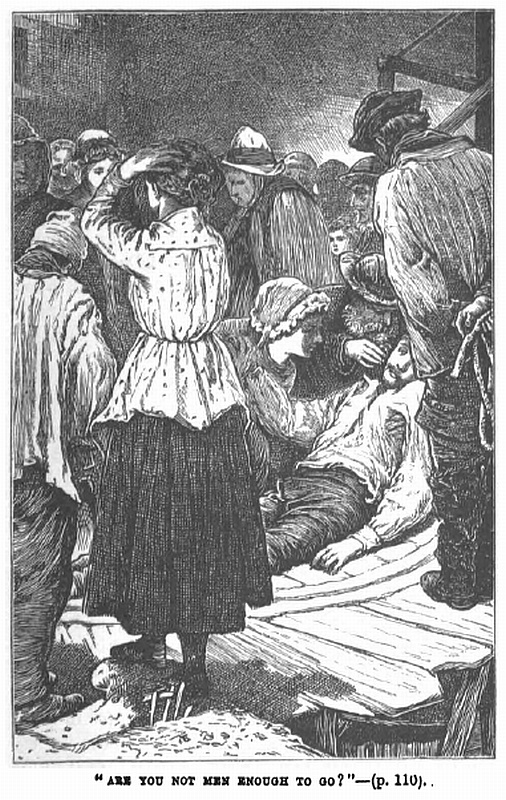
“There was a low murmur amongst the men, and some of the women wailed aloud; but still no one moved except old Andrews, who struggled up on one arm, and looked up at us, his face black, and his whiskers and hair all burnt off.
“‘My lads,’ he said feebly, ‘can’t you do nothing to save your mate?’ and as he looked wildly from one to the other, I felt my heart like in my mouth.
“‘Do you all hear?’ said a loud voice; and I started as I saw Mary Andrews rise from where she had knelt holding her father’s hand; ‘do you all hear?—John Kelsey is left in the pit. Are you not men enough to go?’
“‘Men can’t go,’ said one of the day-shift, gruffly; ‘no one could live there.’
“‘You have not tried,’ again she cried passionately. ‘Richard Oldshaw,’ she said, turning to me with a red glow upon her face, ‘John Kelsey is down there dying, and asking for help. Will not you go?’
“‘And you wish me to go, then?’ I said, bitterly.
“‘Yes,’ she said. ‘Would you have your fellow-creature lie there and die, when God has given you the power and strength, and knowledge to save him?’
“We stood there then, gazing in one another’s eyes.
“‘You love him so that you can’t even help risking my life to save his, Mary. You know how dearly I love you, and that I’m ready to die for your sake; but it seems hard—very hard to be sent like this.’
“That was what I thought, and she stood all the time watching me eagerly, till I took hold of her hand and kissed it; and though she looked away then, it seemed to me as though she pressed it very gently.
“The next minute I stepped up towards the pit’s mouth, where there was a dead silence, for no one would volunteer; and, in a half blustering way, I said, ‘I’ll go down.’
“There was a regular cheer rose up as I said those words; but I hardly heeded it, for I was looking at Mary, and my heart sank as I saw her standing there smiling with joy.
“‘She thinks I shall save him,’ I said to myself, bitterly, ‘Well, I’ll do it, if I die in the attempt; and God forgive her, for she has broken my heart.’
“The next minute I had stepped into the cage, and it began to move, when a voice calls out, ‘Hang it all, Dick Oldshaw shan’t go alone!’ and a young pitman sprang in by my side.
“Then we began to descend, and through an opening I just caught sight of Mary Andrews falling back senseless in the arms of the women. Then all was dark, and I was nerving myself for what I had to do.
“To go the way by which I had helped to save Andrews, was, I knew, impossible; but I had hopes that by going round by one of the old workings we might reach him, and I told my companion what I thought.
“‘That’s right—of course it is,’ he said slapping me on the back. ‘That’s books, that is. I wish I could read.’
“Turning short off as soon as we were at the bottom, I led the way, holding my lamp high, and climbing and stumbling over the broken shale that had fallen from the roof; for this part of the mine had not been worked for years. Now we were in parts where we could breathe freely, and then working along where the dense gas made our lamps sputter and crackle; and the opening of one for an instant would have been a flash, and death for us both. Twice over I thought we had lost our way; but I had a plan of the pit at home, and often and often I had studied it, little thinking it would ever stand me in such good stead as this; and by pressing on I found that we were right, and gradually nearing the point at which the accident had occurred.
“As we got nearer, I became aware of the air setting in a strong draught in the direction in which we were going, and soon after we could make out a dull glow, and then there was a deep roar. The pit was indeed on fire, and blazing furiously, so that as we got nearer, trembling—I’m not ashamed to own it, for it was an awful sight—there was the coal growing of a fierce red heat; but, fortunately, the draught set towards an old shaft fully a quarter of a mile farther on, and so we were able to approach till, with a cry of horror, I leaped over heap after heap of coal, torn from the roof and wall by the explosion, to where, close to the fire lay the body of John Kelsey—so close that his clothes were already smouldering; and the fire scorched my face as I laid hold of him and dragged him away.
“How we ever got him to the foot of the shaft I never could tell; for to have carried him over the fallen coal of the disused galleries would have been impossible. It was either to risk the gas of the regular way, or to lie down and die by his side. I remember standing there for a few moments, and sending a prayer up to Him who could save us; and then with a word to my mate, we had John up between us, and staggered towards the shaft in a strange, helpless, dreamy way. To this day it seems to me little less than a miracle how we could have lived; but the fire must have ventilated the passages sufficiently to allow us to stagger slowly along till we climbed into the cage, and were drawn up.
“I have some faint recollection of hearing a cheer, and of seeing the dim light of the chill December day; but the only thing which made any impression upon me was a voice which seemed to be Mary’s, and a touch that seemed to be that of her hand. I heard a voice saying ‘Terribly burned, but he’s alive. Got a pipe and matches in his hand;’ and I knew they were speaking about John Kelsey, and the thought came upon me once more that I had saved him for her; and with an exceeding bitter cry, I covered my poor fire blinded eyes, and lay there faint and half-insensible.
“And it’s not much more that I can recollect, only of being in a wild, feverish state, wandering through dark passages, with fire burning my head, and coal falling always, and ready to crush me; and I then seemed to wake from a long, deep sleep, and to be thinking in a weak, troubled way about getting up.
“It was a month, though, before I could do that, and then there was a tender arm to help me, and a soft cheek ever ready to be laid to mine; for in those long, weary hours of sickness Mary had been by my side to cheer me back to health, and I had learned that I was loved.”
Chapter Eleven.
My Scalded Patient.
“Thanky doctor. Eh? feel faint? not a bit. Why bless your heart, I could bear twice as much without winking. Scalding ain’t nice, though.”
My patient, a frank, open-faced fellow, smiled as if he liked it all the same.
“There’s something wrong with your boiler work, my man,” I said, “or we should not have so many explosions. How is it?”
“Can’t say, I’m sure, sir. Been used to bilers all my life; but working ’em’s different to making ’em. There’s something wrong, as you say, or they wouldn’t always be a-bustin’. ’Tain’t once, nor twice, nor now and then, for it’s a thing as is always a-happening; and though I’ve never had more than a scald or two myself, I’ve seen some strange sights; men all blown to pieces, so that they were picked up afterwards in baskets; men taken to the hospital with their flesh bulging to them in rags, and there they’d lie writhing and tearing at the wrappings in such agony, that—there, I ain’t above owning it—I’ve cried like a child to see my poor mates’ sufferings. And there they’d be day after day, till a sort of calm came over them and the pain went, when they’d quite smile if you spoke to ’em, they seemed so easy; and it would be because a gentle hand was laid upon ’em, and they were going into the long sleep.