"Adventures of Hans Sterk" (continued 4)
Reading edition
During the day Hans adopted the same caution that he had on the previous evening, and scarcely moved a limb. He saw no Kaffirs until the sun had begun to increase the length of the shadows, when he knew it was past noon. From his retreat he could see far around in all directions, and could thus at once perceive if the enemy approached from any part; but he saw no signs of them during the greater part of the day. As the afternoon passed on, however, he was at once on the alert, when he observed a party of above twenty Zulus following the course he had taken, and evidently tracing him by his spoor. Although he had adopted a Kaffir’s attire in most respects, he had not given up his veldt schoens (skin-shoes), for to walk bare-footed would soon have lamed him. The footprint, therefore, which he left, especially when he walked by night and could not see how to avoid mole-hills and soft ground, which took an impression easily, could be easily seen and traced by a Kaffir; and he was therefore tolerably certain that his enemies would trace him to his present retreat. The party of Zulus were still more than a quarter of a mile from him, when he thought of a bold expedient. Partly concealed, as he would be, among the bushes, he trusted that even a Zulu would not be able to see through his disguise; so, standing erect, he shouted “Mena-bo” (the method of hailing a man, like “Hi,” “Hullo,” in England), and waved his shield to attract attention. The Zulus instantly saw him, and all listened to hear the news, for they immediately concluded that one of their tribe had forestalled them on the spoor, and could give them intelligence of the enemy they were hunting. Hans, pointing with his shield to the hill on his right, and in an opposite direction to that in which he intended to travel, sung out in true Kaffir style, “Um lungo hambili Kona.” (“The white man has gone there.”)
“Have you seen him?” was the inquiry, called with great distinctness.
“Yes; he went when the sun was up high,” was Hans’ reply.
Fearing that he might be asked to come to his supposed friends, he shouted, “The chief sends me;” “Hamba guthle;” (“Travel on well;”) and, with no apparent effort at concealment, Hans walked rapidly through the bush in the opposite direction to that in which he had said the white man had retreated.
At first Hans believed his plan had proved entirely successful; for the Zulus ceased following the traces of his footmarks, and ran in the nearly opposite direction, looking all the time on the ground for any signs of the white man’s footmarks. Hans had made such good use of his time that he had advanced nearly a mile in the direction he knew he ought to travel, whilst the Zulus were endeavouring by a short cut to come on to the spoor of the white man. He could see the Zulus hesitating as they found no signs of footprints, and then he saw them halt and apparently consult. The result of this consultation was soon evident. The party rapidly retraced their steps, and again followed the footprints which Hans had made.
On seeing this, Hans used his utmost speed to reach the banks of the Tugela river, which he knew was not more than two miles from him. On the banks of this river there were wooded krantzs and dark ravines, in which an army almost might lie concealed; and if he were pursued, he believed that in this locality he would have the best chance of escaping the keen eyes of his foes; or if unable to do this, he could fight with the best chance of success.
As he moved quickly on, he lost sight of the Zulus, who had retraced their steps in order to continue their spooring; but he was not left long in doubt as to their proceedings, for upon looking round he saw the whole party on the crest of the hill over which he had passed, running rapidly after him, their shields held aloft, and their assagies waving over their heads. These men had discovered the ruse that had been practised upon them. Even at first one or two suspicious Kaffirs had wished to call the stranger to them, but the fear of stopping the chief’s messenger had deterred them. When, however, they found no spoor where the strange Zulu had told them the white man had gone, they became more suspicious, and upon retracing their steps,—and finding that the traces of the covered foot led them to the spot on which the strange Zulu had been seen, and then led on in the direction in which he had retreated, they at once were almost certain they had been cheated by a bold and quick-witted enemy. There was but a moment’s doubt in the mind of one or two that the man might have been one of their own people, who had possessed himself of a Dutchman’s shoes, and had worn these to protect his feet; but the style of walk was not that of a Kaffir, at least the most experienced men decided that this was not so. Whilst this matter was being discussed, a keen-sighted Kaffir observed on a thorn-bush a small piece of white substance, which on examination proved to be a portion of a white man’s garment; and thus it was at once decided that the man they had seen was a white man, who had disguised himself as a Zulu in order to avoid detection.
The rage of the Kaffirs at having been thus deceived was somewhat decreased when, on reaching the crest of the hill over which Hans had retreated, they saw him in the distance moving rapidly towards the Tugela river. Compared to their own speed and power of endurance, they, had but a poor idea of that of any white man. All white men, they believed, travelled on horseback, and were not, therefore, fitted to take long journeys on foot. Thus the mile start which Hans had obtained, they did not consider of so much consequence as that it only wanted about two hands’ breath of sundown. The savage usually estimates the time in this way, and when near the tropics, where the angle made by the sun’s course with the horizon does not vary much during the year, this method gives very close results. By holding the arm out from the body, and measuring the number of hands’-breadths the sun is above the horizon, the savage knows how far he can journey before it sets. The four fingers only of the hand, when closed and held out at arm’s length, subtend an angle of about seven degrees, and as the sun moves obliquely down towards the horizon, the sun being two hands’ breadth above the horizon would give it an altitude of about fourteen degrees. Near the tropics this would indicate about two hours, or one hour and three-quarters towards sunset. If, however, a person were at the equator it would indicate about seventy minutes to sunset. It was by the sun’s position that the Zulus knew they should have daylight scarcely more than two hours, and they must capture the white man before that time, or they would fail in capturing him at all. They therefore ran with all speed after their enemy, who, finding it was no use attempting any longer to deceive his pursuers, threw off his Zulu attire, dropped his shield, and bringing his gun to the trail, ran forward towards the river.
Hans soon found that he was not in condition for a pedestrian race against such enemies as those who were pursuing him. The Zulu is a born athlete; he is usually a spare man, with not an ounce of superfluous flesh about him; he is kept too in training by constant exercise and no great excess of food, and thus can at a moment’s notice run his eight or ten miles, or walk his fifty miles without breaking down. Had the race been one on horseback Hans would have felt more confidence, for to him the saddle was the natural condition, whilst pedestrianism had not so much been practised. Being, however, young and muscular, and prepared by his late hardships for an active life, he was not a very easy prey to his pursuers. He, however, found himself losing ground rapidly, and therefore that it was necessary to put in practice some scheme in order to save himself by his head, if he could not do so by his heels.
The ground over which he had run was grassy, and thus easily took an impression, so that, even had Hans not known that he could be seen by his pursuers, he would have known that any attempt at concealment would have been fruitless, as his traces would show where he had gone. He ran on, therefore, with all the speed he could until he entered the ravine, which led eventually down to the Tugela, and he then tried an expedient which he believed would throw off his pursuers, at least for a time. Having found a hard piece of stony ground, on which a footprint was scarcely visible, and finding that he could not be seen by his pursuers, he left one or two distinct impressions of his foot on the mole-hills, and then retracing his steps for about fifty yards, he trod carefully on large stones or hard ground, so as to leave no traces, and then took a direction at right angles to that he had formerly adopted. The country was here sprinkled with low thorn-bushes, and was rocky and gravelly, so that footprints were not so easily seen and followed as in more open grassy country. Hans having thus endeavoured to throw his pursuers out, stopped for a few minutes in order to regain his breath, and to listen to his enemies’ proceedings.
The Zulus came straggling on, eager to overtake their victim, and hoping soon to do so, for they had noticed the want of firmness in Hans’ step, and concluded he was like some of their fat men, unable to run far or fast. Noting here and there a footprint which served to show them they were on the right track, the Zulus dashed down the ravine and beyond where Hans had turned and retraced his steps. The whole party had gone nearly two hundred yards onwards before the leaders halted in consequence of finding no spoor; they then spread out in various directions endeavouring to find some sign. Fortunately one of the footprints of Hans had been half concealed by that of a Zulu, who had trodden on the same soft place, and this having been observed, the Kaffirs believed that they might have entirely obliterated other traces in their hasty rush down the ravine. This induced them to seek on further for fresh footprints instead of trying back, and Hans, who could hear their loud voices, knew he should at least obtain a good start even if they did discover his change of direction.
Having regained his breath, Hans decided to move on, not in great haste, but quietly and with care, that he might not be seen by his enemies; for this purpose he moved with the utmost caution over a ridge, and entered a woody valley beyond; he was thus covered from the view of his pursuers, who were still puzzled to find his footprints. He then walked quickly on until he found an open plain about half a mile across, between him and a line of willow-like trees, which he believed grew on the banks of the Tugela. Hans knew that here he must encounter great risk, not so much from the enemy behind, for he believed he should be able to escape them, but from any parties of Zulus who might be out spying, and who would see him and wait in ambuscade for him. He had, however, so firm a conviction that the Zulus behind would only be temporarily puzzled by his artifice that he decided the least risk would be incurred by at once making a rush across this open ground. Waiting a moment to decide for what part of the river he should run, he took one glance around, and then ran off into the plain.
Hans had scarcely gone two hundred yards than he knew he had been discovered by the Zulus in rear, who, immediately they were confused by the spoor, had sent three men to the hill-tops to look out, in order, if possible, to catch sight of him. These spies at once shouted to their companions below, and joining them, the whole body were quickly in pursuit. Hans had, however, more than five hundred yards start, and he knew that he could reach the river long before he could be overtaken. How or where to cross this river he knew not. In some places the Tugela is deep and wide, in other places shallow, the banks marshy, and covered with long reeds. Again the river forces itself between deep precipices, where the baboon alone can ascend or descend. Seeing the willow-like trees, Hans believed that the river might be deep where they grew; and he had therefore selected another part where low bushes prevailed, and where there was an indication of a rapid slope in the ground.
The Zulus were more than a quarter of a mile behind when Hans reached the bank of the river, which he found steep and rocky, the river itself running rapidly over a stony bed. This was just the condition he required; for although he could swim well, yet Hans knew that he could not swim with his heavy gun, nor could he keep his powder dry, and that therefore his last defence would be taken away. On examining the bed of the river he concluded it was not out of his depth, so he instantly decided to cross. Taking his powder-horn in one hand, and his gun in the other, he scrambled down the bank, and selecting those parts where there seemed most ripples on the water, he waded to the opposite bank, the depth in no part being greater than to cover him above his waist, although the rapidity of the stream rendered it difficult for him to retain his footing. He succeeded, however, in reaching the opposite bank without wetting his gun or powder, and he here determined to make a stand: for he thought it possible that some of the farmers might be in the neighbourhood, and that the sound of a gun would call them to his aid. He was also indisposed to give up so good a defence as the river offered. So concealing himself behind some bushes, he waited for his enemies’ approach.
Hans had not long to wait. As hounds follow the scent of their game, so came the Zulus to the banks of the river, looked for a moment at the bank, and then leapt into the stream. Four. Kaffirs who had outstripped the others in speed, were the first to enter the stream, which was at this point about eighty yards wide; they could only advance at a slow pace in consequence of the slippery nature of the rocks and stones on which they had to tread, and also of the rapidity of the stream. So entirely did they look upon their adventure in the light of chasing a feeble enemy, that they had no idea of any risk as they thus ventured into the stream. They believed the white man’s only chance of escape was his speed or cunning in throwing them off his spoor, and they fancied themselves more than a match for these.
Hans watched the men enter the stream, and had noted the leader, a tall, thin, long-legged man, who had invariably taken a decided lead whenever the Zulus had run any distance. He was the first to enter the river, and was midway across before any of the others had advanced twenty yards. Resting his gun on the branch of a small acacia, Hans aimed from his cover at this man, and in another instant the banks of the Tugela re-echoed the novel sound of a heavy gun. The skill of the elephant hunter did not desert him on this occasion; his shot went truly, and the tall Zulu sank beneath the waters of the Tugela, an arm partly raised as the body was whirled down by the rapid current being the only indication of the man’s fate, after Hans’ bullet had struck him.
The Zulus had fresh in their memory the fatal effects of the white men’s guns in the late battle, and those who were already in the stream, and who saw the fate of their fastest runner, instantly turned and scrambled to the opposite bank.
Hans now decided on waiting for a time on this river bank, for he began to feel the effect of a long fast, and of the exertion he had used to escape his pursuers; but a movement of the Zulus on the opposite bank showed him that this step could not be ventured on. No sooner had those who were in the stream when he fired returned to land, than the chief of the party detailed four men to go down the stream, and four up, who were to cross at once, and go round and cut off the retreat of the white man. This plan would at once have prevented Hans’ escape, had he not seen the men leave, and had thus become aware of the plot. Taking off his hat, he moved slightly from his cover, so that the Kaffirs might see him, and then crouched down again, as though waiting for another shot. Instead of doing this, however, he placed his hat on a branch where it could be seen by the enemy on the other side of the stream; then lying flat on the ground, he worked his way along, so as not to be seen from the opposite shore. Having thus got out of sight, he rose, and finding he could not be seen, ran rapidly away from the river bank, and finding an old game path, followed this at speed, until he had gone fully a mile from the banks of the Tugela river.
Chapter Nineteen.
Unexpected Meeting—Hans tells his Story—The Ambuscade—Greek meets Greek in War—The Country near Natal—The News—The solitary Hunt in the Bush.
Believing that as soon as the Zulus found that they had been again cheated they would follow on his trace, Hans ran and walked as fast as he could, avoiding all detached bushes in order to escape any ambuscade which stragglers might have prepared for him. He thus continued his course until it became too dark to find his way, when having chosen a tree, near an open space, where he believed he could have good warning if any enemy approached him, he sat himself down, and began to think how he could procure some food for himself. To light a fire in order to cook was too dangerous a proceeding to adopt, and though almost starving with hunger, yet he could not bring himself to eat raw flesh, and thus he did not see any means of procuring a supper. For two nights he had had no sleep, and though the excitement of his escapes had kept him up, and the water of the river had refreshed him, still nature would not be denied, and he had not long been seated beneath the tree before he felt sleep stealing over him.
“I can sleep safely for an hour or two,” thought Hans, “and will then awake, be ready to proceed at daybreak, and shall certainly find some means of procuring food.”
Arranging himself so as to be ready to grasp his gun at a moment’s notice, he turned on his side, and in a very few minutes was fast asleep, undisturbed by a dream of any kind.
The sun had risen, and was well above the horizon before Hans awoke from his deep sleep, which he did with a sudden start of alarm, as he perceived that it was broad daylight. He instantly stretched out his hand for his gun, but could not find it. Jumping up, he saw that he was surrounded by a large party of Kaffirs, who, armed with assagies and shields, had surrounded him. Without a single weapon to defend himself with, he knew that resistance was useless, and therefore stood calmly awaiting his fate, which he expected was to be assagied immediately. As soon as he stood up, however, several of the Kaffirs called as though to some chief or other person in the distance, and Hans, turning in the direction in which it appeared the person was whom the Kaffirs had called, he first saw the smoke of a fire, and even his strong heart quailed as the thought occurred to him that he was to be roasted alive. His astonishment, however, was extreme, when he saw four white men coming towards him, one of whom was decidedly Dutch in his appearance. “Could these also be prisoners?” was Hans’ first thought, “and are we all to be burnt together?” But seeing that the white men carried their guns, he was more puzzled than before. He waited till the men came close to him before he spoke; he then said, “You have caught me asleep; few men have ever done that before.” For an instant the men looked at one another, and then the stranger, addressing Hans in Dutch, said, “You must be one of the Mensch, but what, in God’s name, are you doing here, and why is your face black?” Hans, forgetting for the moment that he had blackened his face with mud, and that though the water had partly washed off that which had been on his legs, still they had a very Kaffir-like tinge about them, whilst his hair was so matted with mud, that it was unlike a white man’s, burst out laughing at the remark of the Dutchman.
“My face may be black,” he replied, “but I am Hans Sterk, a true-born Africander.”
“You Hans Sterk!” said the other with incredulity. “We heard he was killed with the two Uys.” “You Hans Sterk!” the man repeated, as he came nearer, and examined Hans closely, “and how did you escape? You must be a Dutchman by your speech, though in the dim light of the morning I took you for a Kaffir spy, wearing the clothes of some of Retief’s murdered men. Come to the fire and let us hear your story.”
“Let me eat and drink first,” said Hans. “I have been two days without food, and have travelled on foot at a rate that would have puzzled an ostrich. Then, when I’m washed, you shall hear of my escape. But tell me the news. How came you here? and have all my people escaped?”
“We are out on patrol from the Bay, for we, too, were defeated when your people were; and we came up yesterday to pick up any stragglers. Your people have gone back to Bushman’s river, but it is bad for them. Their cattle are swept away, and they have little or no food. Their crops are destroyed, and they dare not again attack the Zulus, at least not till they get more help.”
Having gained this information, Hans commenced his meal, which consisted of grilled buffaloe. He knew there was a journey before him, so he did not eat to excess; but, having taken sufficient to satisfy his immediate craving for food, he inquired for the nearest stream, and, accompanied by the white men, soon washed off his disguise, and showed himself in his natural colours.
“Then all those Kaffirs are from Natal Bay?” inquired Hans.
“Yes, these are our Kaffirs,” replied the Dutchman. “There were many Kaffirs killed in the battle, and these men have come up to look after any of their friends who may be hidden hereabouts. Our people had a greater defeat than yours, and we lost ten or twelve white men, whilst hundreds of our Kaffirs were killed.”
“How is it that you don’t fear a strong party coming now?” inquired Hans; “for I was followed to within three miles of this place by a party of Zulus.”
“We have our spies out, and one is hidden in that tree on the hill there, and if he saw danger he would signal to us at once. A man reported yesterday afternoon that he heard a shot fired from near the Tugela, but as no one else heard it we began to doubt his report. Still we came on this way on the chance of its being true, and we camped last night about a mile from here, and at daybreak crossed your spoor, and followed it for some time, when a spy came in, and said he had seen a man asleep under a tree, and thought he was a Zulu. You were lucky to escape being assagied at once, before we found out our mistake.”
“Ah!” said the Dutchman, “there’s a signal. Matuan, come here. What does Kangela mean?”
A Kaffir approached at this remark, and looking steadily towards a Kaffir who was signalling from a hill on which the Dutchman had said a spy was concealed, he at once replied—
“Zulus are coming. Not many; we can fight them.”
The Kaffir’s words were heard with delight by the assembled men, who waited for the Dutchman’s directions before acting in any way. “Select three men,” said the Dutchman, who answered to the name of Berg, “and let them be good runners. They must draw the Zulus into an ambush. Conceal the remainder, Matuan, hereabouts.”
Berg having given these directions, and seen the three Kaffirs despatched in the direction in which the Zulus were advancing, followed the Kaffirs, who had run to some bushes, and were all concealed amongst them.
“Next to cattle, these fellows will like to carry off the spears and shields of their enemies,” said Berg, “and we may please them. They are disheartened at the defeat of their people. Our guns will ensure us a victory, so we need not fear the results. We will wait here.”
The Kaffirs on the hill had again disappeared, and a traveller who passed this way, and could not read the spoor that was written on the ground, would have fancied that no human being was within miles of him. There were, however, half-a-dozen white men, and nearly a hundred Kaffirs, crouching among the bushes, waiting to slay an enemy.
“I expect the Zulus who have hunted me are those who are now coming this way,” said Hans.
“How many are there?” inquired Berg.
“Upwards of twenty.”
“Here they come!” exclaimed the Dutchman. “They are in haste to be slain, for not a man will escape.”
The three Kaffirs who had been sent on had soon discovered the Zulus, but pretending not to have seen them, they looked about on the ground as though searching for something. The Zulus soon perceived the three men, and taking advantage of the bushes dodged from one to another, till within a hundred yards of the supposed unsuspicious Kaffirs. Suddenly the Natal Kaffirs, giving a shout of alarm, ran back towards where their people were concealed, but not with such speed as to make their pursuers imagine pursuit would be useless. A race then commenced, in which the Natal Kaffirs had more than once to use their utmost speed, on account of the number of their enemy, and to keep beyond the effective range of an assagy. At length the three men ran past the bushes among which their companions were concealed, and one of them uttering a shrill whistle, the pursuing Zulus suddenly found themselves face to face with five times their number of those who, though almost of the same race, were now their deadly enemies. The trained Zulus were not the men, however, to be slaughtered like sheep. They immediately closed together, and feeling after their late run that they stood no chance of escaping by speed from men who had been lying quiet whilst they had been running, determined to fight where they were. Shortening their grasp on their assagies, they moved slowly forwards against the Natal force, a fine example of trained savages. Berg, upon seeing this, called to his people, who were between him and the Zulus, to lie down. The Natalians having learnt to trust their Dutch masters, obeyed instantly, when Berg and his companions fired a volley at the Zulus with the usual effect. Three Zulus fell dead, and one rolled on the ground mortally wounded. The Natal Kaffirs instantly started to their feet, and rushed on to their enemies, and for a minute a scene of skill and agility was exhibited, such as is rarely witnessed by white men. The two opposing parties met, and rapidly exchanged thrusts, which were, however, parried by the ox-hide shield, which, held sideways, turned the stab. Here and there an assagy was hurled at a foe with deadly aim and great velocity, but the Kaffir seeing its approach, either sprang on one side, and thus avoided it, or received it obliquely on his shield, and sent it glancing in another direction. Where there was no great difference in the style of weapons used, or in the skill of the combatants, numbers very soon decided the encounter, and in less than two minutes only two or three Zulus were seen fleeing over the plain with speed, pursued by a host of relentless enemies, who returned before long, shouting triumphantly, and carrying the shields and assagies of their enemies.
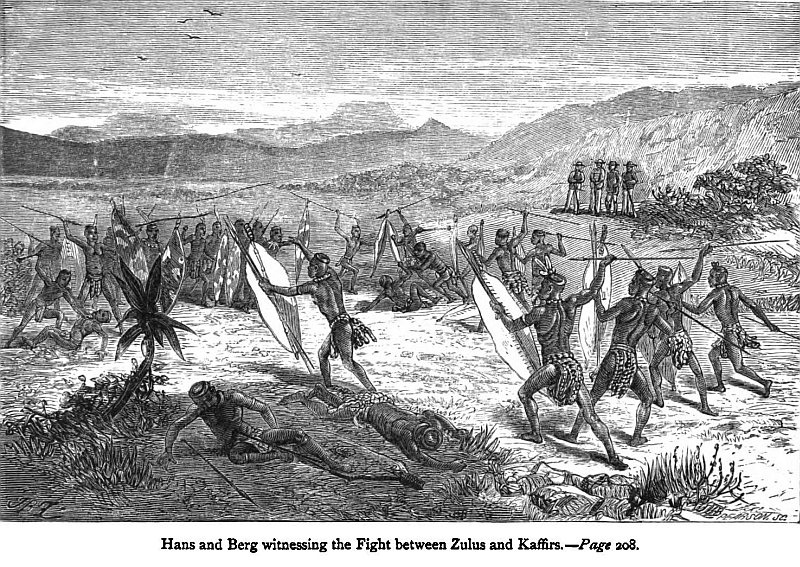
Not one out of the party had escaped, and thus Hans, who would be no party to this slaughter, saw the whole of those who had so nearly terminated his existence cut up to a man at the instant that they were under the belief that they were in such force as to be formidable to the small party they were pursuing. Such are the changes which often occur in savage warfare, the strong party becoming the weak, and being again outnumbered unexpectedly.
“It will not be safe for you to join your people by walking from here,” said Berg to Hans. “There are many spies out from Dingaan, and you would not be likely to reach Bushman’s river. You had better return to the bay with us; then we can talk about our best plan of acting, and you can carry the news up to your people.”
Hans agreed to this proposal, and joined his new friends on their return journey to the bay, on reaching which he was delighted at the beauty of the country and the fertility of the soil. Though the settlers had as yet done little towards cultivating the land, yet it was evident that there were immense capabilities for agricultural pursuits, and it was thus considered a place likely eventually to become of great importance. The vicinity of their treacherous neighbour Dingaan alone seemed to be a drawback, but the emigrants had no doubt that with more caution and fresh strength they would be able to overcome this despot, and prevent him from in future molesting the white men.
Hans remained at Natal Bay for a week, and then started on horseback for the head-quarters of his people, which he reached in four days. Hans was received like one risen from among the dead, for his loss had been mourned by his friends, and by Katrine, so that his return was never expected, and was as much a surprise as any thing could be. He found the camp in a sad state, a want of food being actually felt. Having informed the leaders of his party what were the views of the few residents at Natal, and having pointed out the necessity for maintaining a system of espionage on the Zulus, he made preparations for a hunting expedition into the plains under the Draakensberg for the purpose of supplying his people with eland beef. It is a common practice of those farmers who reside in the vicinity of the plains on which large game are found to devote a certain portion of their time to hunting, in order to supply themselves with a stock of meat. This meat is either salted, or made into beltong; that is, it is cut into strips, rubbed with salt and pepper, and hung in a sunny place, where it gets dry, and can be eaten with no further cooking; or it can be placed in water for a short time, and then boiled. Thus provided with a supply of meat, the fanner need not kill his own cattle, but can allow his live stock to increase, and can thus have very shortly a plentiful supply of cows and oxen, so that he has no want of milk or means to draw his waggons.
Running in nearly a northerly direction, and varying in distance from the coast between 100 and 300 miles, are a range of lofty mountains known as the Quathlamba or Draakenberg. From these mountains all the rivers rise which flow through the Natal district, and empty themselves into the Indian Ocean. The principal rivers that there take their rise are the Umzimkulu, the Umkomazi, the Umgani, the Tugela, with its tributaries, the Mooi river, the Bushman’s, the Klip river, and the Umzimyati or Buffalo river. The Quathlamba mountains descend into the plains, in many cases, by a series of terraces, which extend several miles, and on which are grassy plains of great extent. These plains being well watered and fertile, were, in the days when the first Dutch emigrants visited this district, inhabited by large herds of game. Troops of magnificent elands, amounting to three and four hundred, would be found herding on these terraces. The hartebeest and wildebeest, the wild boar, the quagga, and numberless other animals, could be seen and hunted. Thus, as the African farmer is by nature a sportsman, this neighbourhood was to him a paradise.
The Englishman in his overtrodden land, but with a love for sport, is compelled to put up with a feeble or artificial imitation of it. The hunting of a half-tame fox, following a stabled deer, or even galloping after the hounds who are hunting the boy who pulls the drag, is considered sport. This substitute, however, cannot fairly be termed sport, though it supplies excitement. It is, in fact, not very different from a steeple-chase, but produces utterly different sensations from those which are engendered when hunting the wildest of wild game in a country where man is so rarely seen that he is gazed at as an intruder, and where hunting is a practical reality and necessity as a means of subsistence, upon which the hunter depends, and not as a mere pastime to kill a few hours, or to endeavour to obtain a little excitement. Very much has been written by those who have never tasted the real sport of the wilderness, in favour of the artificial production in our own land, or those have advanced their opinions who from imperfect knowledge of the art, or from a mere glimpse of some of the minor sports of foreign lands, have found nothing in it to gratify them, whilst from long habit and practice these same men were habituated to English sports. Such persons are not competent judges, and cannot be impartial writers. Let us ask those who, having been accustomed to our English field sports, and having enjoyed all the pleasure of a good day among the turnips, have watched with delight the cautious Rover, or the keen-nosed Fan,—who have lived in the front rank during a twenty minutes’ burst over the grass land, enclosed with ox-fences, have at the death been there,—and such will undoubtedly tell us it is good sport, and very exciting. But let these same witnesses tell us what were their feelings as, treading cautiously the rough and tangled buffalo or elephant track, they first comprehended the singular feeling of being utterly alone in the forest, dependent not only for success, but safety, upon their own unaided caution and skill. How fully, too, they appreciated the scene, when a glancing flash of something seemed to dart from out of a tree-fork on to the ground beneath, whilst the light, graceful leopard was recognised as his gorgeous-spotted coat flashed in the sunlight! How thoroughly in harmony seemed the whole scene, as the brilliant trogan or crimson-winged lowry skimmed amidst the festoons of forest vines! The social chattering monkey on the distant branches has long since seen the intruders into his domain, and now performs antics and acts in a manner so like those which illiterate human beings would practise under similar conditions, that we are not surprised at the opinion of those who trace man’s origin to his tailed caricature. It is not, however, in the trees, or in the actual living creatures themselves, that all the interest need be concentrated: the very path we tread is a page deeply written. The ploughed field, meadow, or road of England rarely produces much that is noticed as the hunter rides over them. The forest path in the wilderness must, however, be read with care. Here, at our feet, is a record which must be noted. A smooth-looking spot attracts our attention; the leaves are all pressed down, and it is at once seen that some animal has rested there. Down on your knees, and look with microscopic eyes for some sign of the creature. There are one, two, three hairs, all lying together. They are from the coat of a leopard, whose lair we find warm, evincing that he has been lately disturbed. There, beyond, is the mark of a heavy animal; a hoof is impressed on the soil, and we see a buffalo has lately trodden the path before us. So fresh is the footprint that the buffalo probably disturbed the leopard. Now that our large game is near, we scarcely notice the graceful festoons of wild vine, the masses of rich foliage, or the many rare insects that we disturb as we move the bushes. Before us is the spoor, and we follow this, till we hear a slight movement amidst the dense mass of tangled brushwood before us, and for a few seconds we stand with half-raised rifle, watching for some sign to guide us; but all is still, and with cautiously-raised foot we advance one pace, then a second, and are preparing for a third, when, like a thunderbolt, a magnificent buffalo dashes from his dense cover, bounds over a bush as though he were a mere antelope, crashes through the underwood, and scarcely seeming to feel the heavy bullet which has struck him as he fled, is lost to sight in an instant. A few seconds’ quiet, and then the crack of a heavy branch being broken is heard; then another and another, and the hunter stands half disappointed as these sounds tell him he has disturbed a herd of elephants who were taking their mid-day siesta in the forest near him, but are now striding through the bush, and carrying all before them. This to some constitutions seems more complete sport than England can afford, though there are men who tell us that nothing can be equal to that which they have seen and daily enjoy in the hunting counties of England. Nous verrons. Let the man who angles in his tank, and catches the home-fed gold-fish, tell the Norwegian salmon-fisher that tank fishing is the best sport of the two, and we can but conclude that either his skill or frame is unfitted for the nobler sport, or he has never had the opportunity of seeing more than that of which he is so fond. On the plains there is, perhaps, less excitement than in the bush, when hunting the creatures that are there found; yet to see several herds of wild animals grazing in undisturbed freedom on plains glowing like satin, and through which silver streams wind their way, is to the eye of the man who has been accustomed to crowded cities a gratifying sight. To the hunter who purposes supplying his larder from these herds, it becomes even more interesting; and thus, as Hans and his companions, riding on a commanding ridge, waiting for the morning mist to clear off the valleys beneath them, saw the plains sprinkled with small herds of elands, they rejoiced at their anticipated success, and at once, made their plans for hunting their game.
When disturbed by the sight of man, the antelopes of Africa, to which class the eland belongs, will almost invariably start at a long trot with their heads towards the wind. They pursue this course because they are very keen-scented, and as they meet the wind can tell whether any enemy is concealed before them. Even when they have to run the gauntlet of the hunters, the eland will usually prefer doing so and keeping his head to the wind, rather than run down wind. The only exception to this rule is when the animals know that a very difficult country for hunting is in any one direction. They will then run to this country as to a sanctuary, and can thus escape the hunter; for whilst an eland can descend a steep hill on which are large masses of loose stones at the most rapid trot, a horseman is obliged to dismount and lead his horse until riding becomes possible. Thus it is always one of the objects of a hunter to cut off the retreat of a herd of game from any portion of country in which he knows he could not hunt them with advantage.
A fortnight in the plains enabled Hans to fill his waggons with beltong, and he then returned to the head-quarters of his friends, ready to take any part in the expedition which he knew must be carried out before long.
Chapter Twenty.
The Emigrants collect their Forces—Battle with Dingaan, the Zulu Chief—Formation of the Natal Settlement—The Treachery of the Zulu Chief—Brother against Brother.
Having partially recovered from the defeat that Dingaan had given them, the emigrants endeavoured to obtain sufficient aid from their countrymen who had hitherto failed to join them, to enable them to attack the Zulus and recover their lost cattle. Not only was this aid promised, but supplies of food and ammunition were sent from the Cape, so that the winter of 1838 was passed over, though not without considerable suffering and privation.
Scarcely had the winter passed, and spring commenced, than Dingaan, who had been carefully preparing his army, and who had been employing his spies so as to learn the state of his neighbours, suddenly gave the word, and in August of the same year the Zulu army suddenly rushed into the Natal district, and attacked the emigrants. The farmers, however, were now on the alert. They had sent out scouts, and these brought them timely notice of the advance of their enemies. The waggons were used as fortifications, and every precaution was taken to make as effective a defence as possible. The result was that the Zulus failed to obtain an entrance into any one of the lagers, and were beaten off with great loss. This victory on the part of the emigrants, although a barren one, had the effect of encouraging those who had before been undecided about joining them, and small parties continued to come in until the beginning of December, when a party of above four hundred and fifty men were assembled, all mounted, and armed with good guns. These were joined by another party from the Bay of Natal, the whole combined being a formidable force.
The leader of this force had formerly been a field-cornet at Graaf Reinet, and was acquainted in a measure with some of the precautions used in military manoeuvres or movements. The advance was cautiously conducted, and each night a camp was formed and defences prepared. The advance had been thus conducted until the Umslatoos river was reached, when Hans, who had joined this party, and had ridden on before in order to guard against surprise, saw the first portion of the Zulu army. Instantly riding back, he gave the alarm, and the camp was at once on the alert, making every effort for defence. Instead of following the plan of Uys, and entering the enemy’s country, and thus giving him the advantage of position, enabling him to attack where it best suited him, the new commander had from the first decided on forcing the enemy to attack him, and there now seemed every probability of this desire being accomplished. During the whole night a careful watch was kept, and each map slept with his weapons beside him; but it was not until the first gleams of daylight that the enemy showed themselves.
It was an important day in the history of this now well-known settlement, this 16th of December, 1838,—a Sunday too. On that day a trial of strength took place between the whole of Dingaan’s warriors, amounting to from ten to twelve thousand men, and about four hundred and fifty emigrant farmers. Even considering the difference in the weapons, yet twenty to one were great odds; and should the Zulu warriors succeed in forcing the camp, their numbers would enable them to annihilate their enemy, even though they sacrificed thousands in the endeavour.
Forming themselves into a dense mass, the Zulus rushed on to the farmers’ defences, and endeavoured to tear a way through them. Met every where with a shower of bullets, the dark-skinned soldiers fell fast, and their first effort was a failure. Nothing daunted, however, they again and again renewed their charge, and for three hours never relaxed their efforts. At length a vast number of the enemy having concentrated on one side of the camp only, a party of two hundred mounted farmers dashed out from the opposite side, and, charging both flanks, poured in volley after volley, which soon discomfited the bravest of Dingaan’s chieftains:
“Even as they fell they lay, Like the mower’s grass at the close of day,”
and a panic seizing them, they at length retreated, leaving not less than three thousand men dead upon the field. The emigrants’ loss was most disproportionate, three men only being killed, and some half-dozen wounded.
Immediately after this victory the emigrants pushed forward to Dingaan’s kraal, which they found burning, he having retreated to the bush with the remnant of his forces. Here, on a hill outside the town, they found the remains of their ill-fated countrymen, Retief and his party, many individuals being recognised by the leather pouches they wore. A fierce retribution had, however, been now taken for the treacherous slaughter of these guests, and the power of the great Zulu chief was broken by a mere handful of well-trained men.
Finding that their ammunition was falling short, and their horses losing condition, the farmers did not consider it advisable to continue their attacks on Dingaan in their present state; they therefore seized about five thousand head of cattle, and gradually returned to their lager.
After this decisive victory the emigrants’ position was much improved. They could now venture upon many of those agricultural pursuits which they had before considered it useless to attempt. A town was laid out and named Pietermaritzberg, and at the Bay of Natal another town was formed, now called D’Urban. Landdrosts were appointed at both places, and a regular system of government was established, and the Dutch emigrants were under the impression that they would peaceably possess the land for which they and their relatives had suffered so much; but this was not yet to be. The intelligence of the scenes of bloodshed which had been going on between the emigrants, who were still considered British subjects, and the Zulus, had reached the English government at Cape Town, which, justly claiming the district of Natal as a portion of South Africa belonging to England, despatched a party of troops to occupy the district, and to endeavour to put a stop to these scenes of bloodshed. Very serious results might have occurred between the British troops and the Boers, had not the officer in command acted with considerable judgment, he having received orders to seize the arms and gunpowder of the emigrants, in order to stop their slaughter of the Zulus. As it was, however, the English and Dutch maintained friendly intercourse until the winter of 1839, when the British troops were withdrawn, and the emigrants left for a time in undisturbed possession of Natal. The Zulu chief Dingaan gradually recovered his defeat, and recruited his army; but being bent on the destruction of the emigrants, he proceeded cunningly to discover what they were doing. In order to throw them off their guard, he sent to them above three hundred horses which he had captured from them, and promised to return cattle and guns, desiring to make terms with them. The emigrants replied that when he had returned the whole of the cattle he had taken, and had made restitution for the losses he had occasioned them, they would make peace with him, but not before. The crafty Zulu promised to do this, and therefore employed ambassadors to visit the emigrants occasionally, in order to convey messages backwards and forwards, these ambassadors being actually used as spies, in order to discover whether the emigrants continued together in force, or whether they were scattered, and thus offered a chance of success should an attack be made on them. This treacherous proceeding having been discovered by the emigrants, they dared not yet settle down, and they were in uncertainty what to do, when a singular event occurred in connexion with the native politics.
Dingaan had but two brothers remaining alive: one a youth, the other just reaching manhood, and called Umpanda. Umpanda was unlike Dingaan, inasmuch as the latter lived only for war, the former was a lover of peace. Many of the Zulus, having suffered severely in consequence of the many battles in which Dingaan had engaged, were disposed in favour of peace, and of “Panda,” as he was sometimes called. This fact coming to the ears of Dingaan, this able savage politician decided upon getting rid of his brother by murdering him. Panda, having friends at court, heard of this decision of his worthy brother, and at once fled, and crossing the Tugela river with a number of followers, stopped there, and sent messengers requesting the aid of the emigrants against his treacherous brother. The result of these negotiations was, that the emigrants, finding that there was no chance of safety as long as Dingaan was chief of the Zulus, decided to aid Panda, which they did, and the result was a great and last battle between the Zulus under Dingaan and the Boers with Panda’s forces. During this battle two whole regiments deserted from Dingaan, and joined Panda, whilst the Boers took little or no part in the battle. The result, however, was the total defeat of Dingaan, who was driven from his kingdom far up the country, where he soon after perished; and thus an ally of the farmers occupied the chieftainship of the Zulus, and they could now rest in peace, each seeking the location that suited him best, and requiring his ammunition and gun no longer for the purpose of slaying his enemy, but merely to supply himself with game; and thus the wishes of the emigrants seemed about to be gratified.
Chapter Twenty One.
A Hunting Trip—Round the Bivouac Fire—The Hunter’s Tale—Carried off by a Lion—The Shooting Laws in the Desert—The Ophir of Scripture—Baboons hunting a Leopard—The Natal Rock Snake.
We have for a time omitted the individual adventures of Hans, and have endeavoured to give a brief account of those events in all of which he was an active participator, and which led to the emigrants possessing for a time the Natal district. So occupied had Hans been with the wars of the time, that Katrine had seen but little of him. Now that affairs were more peaceable, Hans wished to marry at once; but Katrine was mourning for several relatives who had been murdered with Reliefs party, or slaughtered at Weenen; she therefore put it off for six months, a proceeding to which her lover greatly objected. Finding she was determined, however, he had no alternative; and so, to make the time pass as rapidly as possible, he arranged with his old companions, Victor and Bernhard, and three other farmers, to go on an elephant-hunting expedition up the country to the north-east, where it was reported elephants abounded.
The party who started on this expedition each took a waggon, which was drawn by fourteen oxen. Accompanying the waggon was a Hottentot driver and three Kaffirs. From four to five horses were taken by each hunter, so that the party amounted to nearly thirty in all. It was quite an unexplored country where these hunters intended to travel, and so there was an additional interest in this expedition. Guns and ammunition were in plenty, and it was anticipated that considerable profit would be derived from the ivory and skins which would be taken during the journey.
“Well, Victor,” said Hans, as the two sat in a tent which had been brought with them, “we have scarcely had a long chat since our battles with the Zulus. Tell me of your escapes.”
“I had several,” replied Victor; “the nearest, though, was when we went with Uys, and we thought you were killed. There were Bernhard and Cobus and some half-dozen of us who wanted to turn back and look after you, but the others would not. The Zulus were closing on us again, and the hill swarmed with them, but we waited for a minute to try and persuade the others to turn back. During that minute the Zulus closed on us, and a great brawny Kaffir threw his knob-kerrie at me. I tried to dodge it, but it came so quickly I could not, and it struck me fairly on the head. Cess, I fell as if I had been shot. I did not lose my senses, but felt paralysed for a time. The Zulus yelled triumphantly as they saw me fall, and the assagies flew thick about us; but the few men with me were my staunch friends, and a dozen bullets answered the triumphant shouts of the Kaffirs. I think it was old Piet who lifted me on my horse, and holding the reins dragged my horse along, till I got right again, and could hold the reins. I returned the kindness before long; for as we rode through the bush a Zulu started up close to him, and would have had an assagy through him before he could have saved himself, for the Kaffir was quite round on his right side, but I was behind him a little, and just as the assagy was leaving the Kaffir’s hands, I sent my bullet through him.”
“Those Zulus fought well!” exclaimed Hans. “If they ever get possessed of guns, they may give us trouble.”
“Some had guns in the last engagement, but they were not much use to them, and the horses they rode caused the death of one of the party, who being unable to manage his horse, which was running away with him into our camp, the Zulu stabbed himself with his own spear.”
“The man was a fool!” exclaimed Hans; “why did he not stab the horse instead?”
“Talking over your battles!” exclaimed Hofman, an old hunter, as he entered the tent. “Ah! we have had plenty of fighting for some time to come, and we may talk about it now, for there will be peace in the land for some time. We have been fortunate in our last battles, though we ought not to have been beaten before. It all arose from underrating the enemy. Though we had guns, and they had none, yet when you fight in bushy country, and there are twenty to one against you, even a savage armed with an assagy is not to be despised. I fought against the Amakosa tribes when they attacked Graham’s Town, and I know how these Africans can fight. You will see more fighting before you die, Hans, depend upon it.”
“I am ready to defend my own and my home,” replied Hans, “though I have no wish to shed any more human blood; though I can say I never shot a Kaffir, unless it was to save my own life.”
“Now we shall have to try our strength against dangerous game, instead of against savages,” said Hofman, “and that will try your nerves at times. I know that I never found in any battle I have been in such nervous work as the first time I shot a lion, and that I did in self-defence, and when little more than a boy.”
“Tell us the tale, Hofman,” said one or two of the party, who had all assembled in the tent, and were busily occupied in smoking.
“It is not much of a tale,” replied the hunter, “and Hans there, I know, has had many more narrow escapes; but it was when I lived under the Winterberg. I had been over to our neighbours, who lived twenty-five miles from us, and I rode an old horse that was almost past work. I was to ride there and back in the day, and bring some seeds with me for the farm. Well, I had ridden there and got the seeds, and should have soon returned, only there was somebody there I liked to stop and talk to, and so I waited rather late. It was near sundown when I started, and I had a good three hours’ ride before me. This I did not think much of, though I had to pass a place called Lions’ Fountain, where lions were usually seen, and if they were not seen, their footprints always were, showing that they lived in the neighbourhood. I rode on, however, and as it got darker I rode quicker; but before long I found the old horse was knocked up, and could not go beyond a walk. I knew my father was fond of the old horse, so I determined to dismount and lead him. I did so, and walked slowly enough, for the horse would not hurry himself. Presently I found him snorting as from fear, and getting quite lively, for which I could not account at first; but noting that the old horse kept turning his head as though looking at something, I strained my eyes to see what it was. I was, as I said, young at the time, and so you may not be surprised when I tell you my heart beat quickly when I saw, not a single lion, for that, I think, I might have felt a match for, but no less than four lions trotting along about sixty yards from the side of the waggon-track I was following. I could scarcely believe my eyes at first, but the night was clear and starlight, and there was light enough for me to see that. What was most strange, too, was that one lion seemed to be afraid that the others should take his prey away from him, for every now and then he would turn on them, and with a smothered growl rush at them, sending them scampering away like cur dogs; then he would trot up again within forty yards, and go along in the same direction. This he did once or twice, till I began to think he was taking care of me, and didn’t mean to eat me or the horse. I was armed with only a single-barrelled gun, and that not a very large bore; so I did not feel at all a match for four lions, and began to try and remember some prayers I had heard might help one at a pinch like this; but I couldn’t well call to mind any thing suitable, and was beginning to think I had better leave the old horse and run for it, when the big lion, having driven off the others to some distance, came up within thirty yards of me, and right in my path. If I led the horse on, I should be nearest the lion, and I believed he would kill me first, and the horse afterwards. I hesitated what to do, and had I been more experienced, I believe I should not have done what I did; for a wounded lion is a terrible creature, even worse than a hungry one. However, I determined to fire at him. Aiming at his forehead, I pulled the trigger, and instantly bolted behind the old horse. Before I could see what happened, I waited a moment, expecting to hear the monster roar; but there was no sound, except of creatures scampering away in the distance; and when I looked to see where the lion was, there he lay dead. My little bullet had struck him between the eyes, and killed him on the spot I remember it all now as if it had just happened, and I think I never was more alarmed than on that night.”
“You were once carried off by a lion, were you not, Hans?” inquired the last speaker.
“Yes, I was carried a hundred yards or more, and scarcely had my skin broken. A lion is like a cat in that; he can hold a live creature in his mouth, and not damage it, just as I have seen a cat carry a mouse, and when it put the mouse down the little creature would run away just as though it hadn’t been touched.”
“I heard you had been carried, Hans, but never heard all the story. How was it?”
“I was out after porcupines, and was lying down one night near a porcupine’s hole, waiting for him to come out. I had no gun, but only my hunting-knife and a large knob-kerrie, with which to knock the porcupine on the nose; for that, as you know, kills him at once. I did not hear a sound until I found the grass near me move, and a lion put his paw on me, and holding me down by it, gripped my back and lifted me up. The brute pressed his claws into me, but luckily my leather belt prevented his teeth from damaging me, and he carried me by holding on to my belt and coat. If either of these had given way, I should have soon been laid hold of in a far more rough manner. I knew the nature of a lion well enough to know that if I struggled I should have my neck broken or my head smashed in an instant, so I did not struggle, but quietly drew my knife, and thought what was best to do. I thought at first of trying to stab him in the heart, but I could not reach that part of him, and his skin looked so loose that I feared I could not strike deep enough, carried as I was. I knew it would be life or death with me in an instant, so turning myself a bit, I gashed the lion’s nose, and cut it through. The lion dropped me as I would drop a poisonous snake, and jumped away roaring with pain. He stood for an instant looking at me, but I did not move, and he did not seem to like to carry me again. More than once he came up to within a few yards, licking the blood as it poured from his nose; but there I remained like a stone, and he was fairly afraid to tackle me again. I know a buffalo and an ox are very sensitive about the nose, and a cat, if just tapped on the nose, can’t stand it; so I thought a lion might be the same, and so it proved, or I should not be here to tell you the story. I think we may have good sport up the country,” continued Hans, “and lions may be plentiful.”
“I don’t go out of my way to shoot lions,” replied Hofman. “There is more danger with a lion than even with an elephant, and when you have shot a lion, what is he worth? His skin will not fetch thirty rix-dollars, and his teeth are only used for ornaments. Now if you kill an elephant, he is worth twenty or thirty pounds at least. So I will leave the lions to you, Hans, and I will go after the elephants; but shall we arrange our shooting laws?”
“Yes, we had better do so now,” replied Hans, “before we come to any large game.”
“Well, my plan always has been, let us shoot for food in turns; or if we all shoot together, divide the meat amongst us. When we come to elephants, let it be that the first bullet entitles the shooter to half the ivory; and whoever puts in another bullet, to a share. What say you to this, men?”
“It is not good,” said Hans; “for men will shoot wild in order just to get a bullet into an elephant, and may thus spoil sport. I propose that whenever we are together, and kill our game together, we mark the tusks, and all share alike. If we are alone, and kill alone, the tusks belong to whoever kills. We are honest men and tried; none of us will shirk his fair risk, and no man will shoot the worse because he knows his friend may get a share of the ivory.”
“Hans’ plan is the best,” exclaimed several.
“I have seen friendships lessened by the disputes over dead elephants,” exclaimed Victor, “and Hans’ plan will prevent disputes. If you and I fire together, we may both think our bullet struck the elephant first. It is better to share, or to shoot alone.”
“My Kaffir tells me we shall find elephants in plenty up the country. Now if we could but capture a young elephant, and bring him safely back to Natal, we should make much money, for I hear in England they will pay large sums for a live animal from Africa.”
“The English must know very little of Africa, and of the game here,” said Hans. “They are, I have heard, all crowded together in that country, and have no elephants or large game wild, so they must wish for our land, and some of them come out here to see what sport is.”
“There is more in the land we shall hunt in than game,” said Hofman; “and if we are lucky, we shall find it. For, though ivory is valuable, gold is more so.”
“Gold!” exclaimed the hunters in one voice; “what makes you think there is gold there?”
“About two years ago I met a man at Algoa Bay, who came from the Faderland. He had come in a ship from Delagoa Bay, and he said that from Delagoa Bay inland, and to the west, gold was found in the rivers. He showed me that he had some gold dust, and that this he had bought from natives. The country about there is very unhealthy, and oxen or horses don’t live well; therefore white men can’t go in from there to find it. He said, too, that the country called Sofala was really Ophir, and that the Patriarchs got their gold from about there.”
“I think, Hofman,” said Hans, “if you search for the gold, I will be content to hunt for elephants. One is certain, the other is risky.”
“We are out to hunt elephants, Hans,” replied Hofman, “and that is what we will do; but if we at any time find ourselves near rivers where there are no elephants, we might look for gold.”
“Yes, that might be done,” replied Hans, “but my gold shall be skins and ivory. Hark to the hyenas! how they yell to-night! There is a lion about, I should fancy.”
“A lion or a leopard,” replied Victor. “It is very strange how the weaker animals often club together to defend themselves against a stronger one. Before I left the borders of the old country, I more than once saw my cattle beat off a hyena. They would form a circle, and show a bold front of horns, and run at the hyena if he came near them.”
“For that there is nothing equal to a troop of baboons,” said Hofman; “they are as cunning and as wise as men. I have watched them often, and they set one of their number to watch for enemies; and if he does not do his duty, the others will beat him. I often amused myself by trying to stalk near the baboons that lived near me when I was near the Winterberg, and they never but once were caught asleep. I managed once to get quite close to them without the sentry seeing me, and then stood up and ran at them. I was soon sorry I had ventured amongst them, for they were savage, and so powerful they could have torn me to pieces had they attacked me; but they at once bit and tore the sentry, who scarcely attempted to defend himself, just as though he knew he deserved to be punished. I can tell you a strange story about these baboons.
“There came into our neighbourhood a leopard, and he lived well for some time, till we hunted him, and he had to keep to the bush. Now it turned out that the leopard killed a baboon, and ate him. The baboons feared to attack the leopard, as he would be too much for them, but they had decided on revenging themselves on him. They therefore followed him about, but at a cautious distance. After a time the leopard wanted to drink, but no sooner did he go to the water than the baboons came around threatening him, and they were so active that the leopard could not attack them successfully. The leopard started off to leave the country, but the baboons followed, barking and screaming after him. For three days the baboons followed him, and would neither let him eat nor drink, when the leopard became quite weak from thirst and want of food. There were so many baboons, too, that they never let the leopard rest, and thus he was worn out As soon as the baboons found he was weak, they assembled around him, and attacked him in earnest, and killed him in a few minutes. I had missed the baboons from my krantzes (steep ravines), and I heard from the neighbours that they had seen baboons following and worrying a leopard, and at last the baboons were heard worrying something, and this turned out to be the leopard, which was found dead and fearfully mangled.”
“I have heard that same thing before,” said Bernhard, “and I know the baboons are capable of it; they are very wise.”
“Yes,” said Hans, “they are useful too; for whatever a baboon eats, a man may venture to eat also. This is the case with monkeys, too. A man ought never to starve, if he lives near where monkeys are; for you can watch what fruit or sorts a monkey eats, and that will show you what you may venture upon. You have been down at the bay for some time, Hofman,” continued Hans; “can you tell us any thing about the large snakes that are there?”
“Yes, I can. There are very large snakes there, but these large snakes are not poisonous. They live in the long grass near rocks or old trees, and feed on birds, small buck, and such things. They will not attack you, I believe; but they could kill a man, as one I shot there had killed and eaten a calf. It was about twenty-five feet long, and two men could not lift it. There are snakes said to be much larger than this one, and I have heard from the Kaffirs of a snake near the coast as long as a span of oxen; but this I cannot speak to, for I never even saw the spoor; yet they may grow to a great size. But there are puff-adders, cobras, ring-hals, and many snakes there, and it is not good to walk much in very long grass. There are elephants, too, near the bay, but the bush is very dense, and the elephants are fierce; it does not do to attempt shooting them there.”
“We have a fine country about us,” exclaimed Hans, “and now that Panda is chief of the Zulus we may rejoice at leaving the old colony to come here. The game was nearly all gone from about there, and the place was worn out. My father shot elephants near Algoa Bay, and all the game was to be seen in the colony; but now there is nothing there, though it is not so far from us. It will be a long time before the elands are driven away from the plains here, and there are buck in plenty. We can go after elephants when we choose, and now that we have won our land we may enjoy it. Good luck to us on our trek, Karls! and I think now we will sleep, and by and by we may sit up at night to becroup large game; so we had better sleep now, when it is not so plentiful.”
The advice of Hans was relished by all the party, who having directed two Hottentots to watch, and to call others in succession, the hunters sought their waggons, and wrapping themselves in their blankets, lay down to rest in these vehicles, which to the hunter are like a ship to a sailor.
The camp was soon quiet, the only sounds being the low guttural voices of the Hottentots, or the low tones of the more harmonious Zulu, as the Kaffirs talked over the scenes of the past few months, and wondered at the power of the white man, which had enabled him to break the strength of the mighty Zulu chieftain who had so long been the terror of those tribes, which, having either fled from him or from other nations near, had settled at Natal, had welcomed the arrival of the white man, and had at once accepted him as an ally: the distant moaning of a wolf, and the shrill barking cry of the jackal, being the other sounds that plainly told that the wilderness was around.
Chapter Twenty Two.
Elephants found—The Hunt—The Evening at the Camp—An Elephant Adventure—Encounter with a Kaffir Spy—More Elephants—Strange Men—Hans made Prisoner.
During the first few days of their journey the only game that the hunters encountered were elands, buffaloes, and antelopes of various kinds. Of these numbers were killed, so as to supply the camp with food, and also to lay in a stock of beltong for the future; for in some parts of Africa the game suddenly disappears, apparently without cause, and the hunter finds it extremely difficult to obtain even the necessaries for his daily meals. More than once there had been expectations raised in consequence of elephants’ footmarks having been discovered, but on examination these proved to be old, and the elephants were evidently journeying northwards when they left their traces on the ground. The party had now reached the sources of the Pongola river, and the traces of elephants were most numerous.
“We must have passed many herds of elephants in the forests,” said Victor, as he rode beside Hans, and followed the spoor of some bull elephants which was very fresh, and which had been traced since daybreak. “We should have stopped and hunted them.”
“We can do that on our return, if we do not obtain enough ivory hereabouts to fill our waggons; but I think this country much better suited for hunting than the thicker bush further down. We can always ride our horses here, which we could not in the bush we have passed; and so our success here will be probably greater. We ought soon to sight these elephants, for the spoor is quite fresh. Hark! did you not hear a trumpet? There are elephants near, and we shall get them to-day. Where are the rest of our party?”
“They have all gone after the spoor that led along the river’s bank, and I don’t think that was as fresh as this; but need we wait for them? They may have found their game, and will not wish to join us.”
“We will ride on,” said Hans. “It was among those trees in that slope I heard the trumpet, and see! there is a bull elephant. Pull up; let us watch him awhile; he is a magnificent tusker, and there are at least half-a-dozen others. Victor, we must get nearly all these. We shall have a good day’s work to do that, though, for they will carry away many bullets. Ah! there was a shot from down to leeward: so the others have found elephants. See! the bull has heard the shot, and is alarmed.”
It was true that the sound of a gun, though probably not an unusual sound, was yet one that alarmed the elephants, for they collected hurriedly together, and strode away at a rapid pace.
“I wish we could have lodged our bullets in them before they became alarmed,” said Hans; “but we may do that now, if we ride on before them, and keep a little wide. The elephant has very bad sight, and he may not see us.”
Hans and Victor galloped forward in the direction in which they had seen the elephants, taking care not to follow exactly in their footmarks, and in a very short time they saw the huge animals had collected under some spreading acacias, and were elevating their ears to endeavour to hear if any danger threatened them, whilst their trunks were raised to catch the scent of any foe.
“Now,” said Hans, “we may drop an elephant before we give them the alarm. They don’t know what to fear; they only know not what to make of the sound of a gun. They have not been much hunted, it is evident, or they would not stop so soon after being alarmed. We will now fasten our horses to these trees, and stalk the elephants; then we can retreat to our horses, and follow them on horseback.”
“We ought to put four bullets into that large bull first,” said Victor; “then the others, not having a leader, will not know what to do.”
“We will stop his getting away, Victor. I can hit him in the leg, and can then take him between the eye and the ear. Unless your bullet is very large, it is between the eye and the ear that you had better shoot, on the chance of a death-shot. I have killed many of my elephants by hitting them there.”
The two hunters fastened their horses to a tree at about 300 yards from the elephants, and then commenced stalking their noble game. The elephants, although but lately disturbed by the discharge of a gun, had recovered from their alarm, and stood beneath the trees, occasionally raising their ears to listen; but the cautious advance of Hans and his companion was conducted so quietly that even the acute hearing of the elephant could not discover that an enemy was near him, and the two hunters succeeded in reaching a tree that was within eighty yards of the largest bull without being seen or heard by their formidable game. The stake for which these men were playing was too important a one to allow of a single chance being thrown away. Thus no word was uttered by either, and merely a signal was given by one or the other to draw attention to some fact which it was necessary to notice. The breaking of a dead stick by treading on it would have been fatal to their success, and thus it was necessary to watch where each foot was placed, in order to avoid such a contingency.
Upon reaching the corner of the tree Hans signalled to Victor that they would fire at the same time, and without delay; for the elephants were getting uneasy, and were uttering short sharp cries, which seemed signals of danger. The great bull of the herd, whose polished white teeth protruded far out of his mouth, stood broadside to the hunters; but his watchful manner and uneasy movements indicated that he might at any moment turn and retreat, or at least alter his position; so Hans, taking aim between the eye and the ear, fired, whilst Victor, aiming at his fore-leg just above the knee, fired at the same instant. The aim of Hans was true, and his bullet found its way through a mass of bone to the elephant’s brain, for it fell dead to the shot, and there was, therefore, no need for the second bullet. The instant the sound of the guns was heard, the remaining elephants retreated over the bushy ground with a headlong, reckless speed. Trees that stood in the way were knocked down, the noise of their being broken sounding like the crack of a rifle. There are few things which give one a greater idea of animal power than the headlong rush of a troop of elephants through a forest. The elephant is usually a quiet animal, and when it moves through the bush it proceeds with scarcely any noise, its feet being well suited for walking quietly. When alarmed, however, it rushes forward almost blindly, for its great weight causes it to move onwards in nearly a straight line, rapid turns being almost impossible. Thus if a tree stand in its way, and is of moderate size only, the elephant runs against it, and breaks it off. On several occasions we have had opportunities of measuring the diameter of the stems of trees thus broken off, and we have found many which were eight inches in diameter. The noise caused by a number of such trees being snapped in two, one after the other may be readily imagined.
As soon as Hans saw the elephant fall, he said, “Bring up the horses, Victor; I’ll cut off the tail, in case any one comes this way.”
Hans had completed his work before Victor had reached him with the horses; so, having reloaded his gun, he ran back to meet Victor. The two then mounted their horses, and rode after the remaining elephants, which by this time had gained a long start; but elephants which have led a quiet, unhunted life for a considerable time soon get too fat to keep up a rapid pace for any length of time, and stand no chance with a horse, except for a few hundred yards. If, however, the huge animals are not hurried, they will continue striding on at a speed of eight or ten miles an hour for some time. After about a mile’s gallop, the hunters were once more near their game, and now quite a different kind of sport commenced to the stalking which had been previously practised. Riding forward, so as to be slightly in advance of the elephants, the hunters pulled up their horses, jumped off, and as the animals shuffled past, sent their four bullets into the largest elephant that remained. Feeling itself hit, the creature turned on its assailants, and with upraised trunk and shrill piercing shrieks rushed on. To mount their horses and gallop off was a momentary proceeding with both Hans and Victor; but so furious was the savage animal’s charge, that it was nearly catching Victor’s horse, and did not cease to pursue until it had followed its enemies for several hundred yards, when, finding further pursuit useless, it followed the other elephants. It was not allowed to go so quietly, however; for the hunters, having reloaded, followed it, and with a second volley brought it to the ground.
“We must let none of those elephants escape,” said Hans, when a second tail was added to that previously taken. “Bernhard is with the other party, and depend upon it they will kill more than an elephant each. There are fine tusks in those elephants’ heads on before us, and the creatures are so blown they cannot run fast now. Two more each will make it a good day’s sport.”
Setting spurs to their horses, the pursuit was once more carried on, and with a discharge of several bullets four more elephants were laid low.
“Now,” said Hans, “I will say the sport is good. We can return to our outspan to-night, and can tell what we have done, not boastfully, but as men who have done well. I hope the others have been as successful.”
On returning to camp, Hofman said—
“Come into my tent to-night, Karls, and eat there; we will then talk over our day’s sport. What have you done, Hans?”
Hans briefly related the results of his day’s work, and described the size of the tusks which his elephants carried.
“You have done better than we have,” said Hofman, “for we have only shot seven amongst us, and two are not full-grown bulls.”
As might be expected, the conversation during the evening was mostly about elephants and elephant hunting; and as we may learn much about the habits of this singular animal, and the method of hunting it adopted by the Africans, we will relate some of the anecdotes connected therewith.
“You ask me where I shot my first elephant,” said Hofman. “It was where few men now hunt elephants, because there are not many there now, and because it is a dangerous place to hunt them in. It was in the Fish-river bush in the old colony. That bush, as you know, is very thick and thorny, and if they would only lie close, and didn’t leave a footmark, a hundred elephants might live there peaceably for years even now; but when I was quite a boy there were not many men could say they had walked ten miles in the Fish-river bush. My father used to go down to Graham’s Town about twice a year to get various things he wanted, and when he went he generally took me. I was little more than fifteen when he went down on the occasion I will tell you of.
“We had to pass the Fish-river bush on the way from our place down to Graham’s Town, and as we were going along I saw near the road,—or rather waggon-track, for it was nothing more,—a broken tree. I turned into the bush to look, and then saw what I knew was the spoor of an elephant. I didn’t say what I had seen, for all of a sudden I got very ambitious, and I thought I would make myself a name, and not be thought a boy any longer. I knew that we outspanned about half a mile further on, and as the day was very hot, I asked my father if he would go on after a short outspan, or wait a bit.
“‘I’ll wait till near sundown,’ he replied, ‘for it is full moon to-night, and we can trek better in the night than in this heat, and we can sleep a little now.’
“‘I’d rather go and shoot,’ said I, ‘if you’d lend me your big gun.’
“‘What do you want the big gun for?’ inquired my father. ‘That is for elephants or rhinoster, and you will find nothing bigger than a buck.’
“‘I can always shoot better with that big gun,’ I replied.
“‘Very well,’ said my father. ‘Don’t lose yourself in the bush; but you can’t do that with the sun shining as it is.’
“‘I’d like Blueboy to come with me, father; he’d carry my buck.’
“Now Blueboy was a bush-boy who was fore-looper (Fore-looper is the leader of the team of oxen; he holds a string fastened to the horns of the first two.) to the oxen sometimes, and who had taught me more spooring than any one else, and I wanted to consult him about this elephant.
“‘Oh yes! take him,’ said my father. So, beckoning Blueboy, I told him I wanted him to come with me, and the little fellow was glad enough to come, as we always had some sport together.
“‘There’s the gun,’ said my father; ‘it’s loaded with two bullets. I’ll just give you two more bullets, and two charges of powder, for you must not waste the ammunition. Mind you’re back an hour before sundown.’
“This parting advice I hoped to comply with, and Blueboy and I walked off.
“I kept quite silent till we were away from the waggons, when I instantly said, ‘Blueboy, we are after an elephant.’
“‘Yes,’ said the sharp little fellow in his broken Dutch, ‘I thought so. I saw you go into the bush where the tree was broken. When did elephant break tree?’
“‘The marks were quite fresh, Blueboy; I think not long before we got there.’
“‘We shall see when we look,’ was his reply.
“We hurried on, and entered the bush, Blueboy going first. He carefully examined the ground, picked up the grass, and at length rushed at a small broken branch as though he had seen a treasure. After turning this over once or twice, he pointed to the eastern part of the sky, and said, ‘When sun there, elephant here. He may now be far off, may be close here; we see soon. Follow me now.’
“I followed him, but with difficulty. He moved like a snake among the bushes, as noiseless as a bird, and as quick as one. We went nearly a mile, when we came to a steep bank, at which Blueboy stopped, and whispered to me, ‘We find him here; water near, and he very hot. Elephant love water. Now come slowly.’
“We moved down the bank, and came to a large pool of water, which was muddy and bubbling. I knew from this the elephant had only just drunk there. Presently I heard a sound as of water being poured out of a narrow-necked bottle, when Blueboy, turning quickly, pointed to some bushes below us, and there was the elephant half buried in bushes, but his back visible above them. I now felt very excited. I knew it was very dangerous work, but I fancied I might be successful. All depended on a surprise. I had heard so much about elephants, and had in imagination so often shot them, that I knew every vital part, and where it was best to fire; so, though I had never seen an elephant before, I knew lots about them. I noticed that the bank was above the elephant, and about twenty yards from it; so if I could get to the nearest place, I should get a good shot in safety. To get to that place I had to retrace my steps, and make a guess at the whereabouts; so pointing this out to Blueboy, he at once led the way, and soon pointed out where I must go. ‘Fire both at once,’ he said, pointing to my barrels. ‘You aim well first time, badly second.’ I crept to the edge of the bank, and was almost afraid as I saw the elephant so close to me. I aimed on the shoulder, just outside his ear, and pulled both triggers. I was knocked right down by the recoil, and fell among the bushes, and the elephant went off very fast for nearly a hundred yards. We could see him plainly, and I began to fear I must have missed him. I didn’t know then how tough elephants were, and how much shooting they required.
“Well, the elephant then stopped, and pulled up some grass, and seemed to be stuffing it into his wounds, for he was losing strength very fast; and then he turned and climbed up the bank, and went away through the bush towards the road we had come with our waggon.
“‘He’ll take to the old track,’ whispered Blueboy; ‘we shall get him again at the tree he broke to-day. Come along quick now, and get there before him. You’ll never do any good following, for you will have to fire at him from behind.’
“I didn’t think we should see much of him by going on before, but I trusted the quick-witted bush-boy, and tried to follow him, but he went away again so quick I called him to stop.
“‘No, no,’ he replied; ‘you must come on, the elephant will get there first else.’
“I ran on as well as I could, and in time we got to the tree.
“‘Is bullet there?’ said Blueboy, pointing to the gun.
“I had not had time to load yet, so I set to work, and put in my remaining bullets. I had scarcely done this before I saw Blueboy point to the bush before us. He pointed eagerly, and said, ‘Oliphant kom, oliphant kom,’ and I heard a very slight noise, as of an animal moving in the bush. I collected my thoughts, and determined to try again what I could do; and having cocked my gun, stood ready.
“I first saw the elephant’s head, but had been taught not to fire at this, if the elephant was facing me; so I waited, and soon saw the chest of the great creature. I aimed steadily, and fired at the chest both barrels, as before. As I fired, Blueboy pulled me on one side. I saw a mass of bush pressed down, and was knocked down by a branch of a tree; but though not much hurt, I couldn’t get up easily, as the tree held me down, but I forced myself out after a bit with Blueboy’s help. I didn’t know at first what it was had knocked me down, but Blueboy said, ‘He dodt, he dodt,’ and on looking round I saw a great black mass among the bushes, and there was the elephant lying dead.
“I went up to the creature, and was astonished with its size; it was, as it lay, far higher than I was. I noticed that there were big tusks, and this delighted me too. I didn’t know that to cut off the tail proved ownership, so I left the animal, and with no little excitement went off to my father at the waggons. He was just getting up from a sleep, and upon seeing me said,—
“‘Well, where’s the buck? I heard a shot: did you miss him?’
“‘I fired all four bullets, father,’ I said.
“‘And missed with all four. That won’t do; you must shoot with a smaller gun, boy, or you’ll waste powder and lead.’
“‘I didn’t miss with one bullet, father; I hit with all.’
“‘Then you’ve killed your buck; and where is it?’
“‘It wasn’t a buck, father,’ I said.
“‘Not a buck! What was it then? Not a buffalo; you don’t mean to say that you’ve fired at a buffalo?’
“‘It was bigger than a buffalo,’ I answered.