"Adventures of Hans Sterk" (continued 2)
Reading edition
Without any explanation of his reasons to his companions, who were men that needed not that a plain fact should be made more plain by argument, Hans said “Follow me,” and the three ran down the pathway to meet Katrine, who, to the delight of Hans, was soon visible, and safely held for a moment in his arms.
“The Matabili are coming,” exclaimed Katrine, “ten of them: can you fight them?”
“Yes, double the number would be nothing, now you are with me, Katie.”
“But, Hans, more are about. I fear so much for you. How can we escape from these brutal murderers? Oh, it was fearful! My poor father was butchered before my eyes, and I lived to see it; but where can these men be? they were close behind us just now.”
Hans was equally surprised at the disappearance of the Matabili, whom he had expected to see immediately behind Katrine and her sister, but who, it was evident, were not following her. Seeing this, Hans turned to his companions and said, “To the horses, men! not a moment must be lost now.”
Hans, half carrying Katrine, who, however, was well able to move on at speed, was followed by Victor and Bernhard, between whom was Katrine’s sister. The party walked and ran up the path towards where the horses had been left, and soon reached the open grassy glade where they had been allowed to graze. Instead, however, of finding their five horses there ready saddled for mounting, and merely knee-haltered to prevent their straying, the place was deserted, and no horses visible.
“Bernhard,” exclaimed Hans, “where are the horses?”
“I left them here, Hans,” replied Bernhard, “they can’t be far off. Let us each take a path, and we shall soon bring them up: let the girls wait here for us.”
Hans reluctantly quitted the side of Katrine and selected the path to his left, his two companions taking two other paths. Hans had proceeded but a few yards along his selected path, and was looking at the spoor of the horses, which was fresh on the ground before him, when a slight noise behind caused him to turn: he had but just time to raise his arm and partly ward off a blow aimed at his head by a Matabili who was armed with a horn knobskerrie, when his arms were seized and he was thrown violently to the ground, his gun dragged from him, and he was held by the powerful arms of some five or six Matabili. Almost at the same instant a shout from Victor and an oath from Bernhard, combined with the sound of struggling in the bush, indicated to Hans that his companions also had been captured; and therefore a regular ambush must have been prepared for the whole party. That he was not slaughtered at once, surprised him; for to make prisoners is usually considered by these warriors to be bad policy. Still, to be thus suddenly made a prisoner, and to know that Katrine also must be once more in the hands of his enemies, was a severe blow to Hans, especially when success had just seemed about to crown his efforts.
Hans was almost immediately bound with his hands behind him and led, with shouts of triumph and laughter, to the open glade where he had expected to find his horses; there he found Victor and Bernhard, bound like himself, and near them more than fifty armed Matabili warriors; whilst crouching on the ground, her arm round her sister, and crying bitterly, sat Katrine, entirely overwhelmed by grief and disappointment. The horses were held by some boys near the group; whilst a Matabili chief, who seemed to command the party, stood watching his prisoners. Suddenly addressing Hans, he said—
“Why have you come armed and without notice into the country of Moselekatse, when it is war between us?”
To this inquiry Hans gave no other answer than a look of disgust at the man, who, signalling to his followers, led the way down the ravine towards the kraals.
Chapter Nine.
Hans Sterk becomes a Prisoner with his Companions—Finds an unexpected Ally—Plots an Escape.
There are few conditions more unpleasant to any man than that of being a prisoner. When, moreover, it happens to a man of active and enterprising habits, and when the captors are men who are bound by none of those laws which possess an influence in civilisation, and where, consequently, the prisoner may be put to death at any moment merely to gratify the whim of a despot, a captive’s condition is one not to be envied.
As soon as Hans Sterk found that he had been fairly entrapped and made prisoner by the Matabili, he blamed himself for his want of watchfulness and caution: had he been one of the unskilled residents of the towns, he could not have been more easily outwitted. He saw that his captors looked at him with contempt and seemed to consider him quite a novice in the art of bush warfare; and as they talked unreservedly of their proceedings, he was enabled to find out how artful had been their plans.
The Matabili, he discovered, had crossed the spoor of his horses, and saw at once that it led to the ravine in which he was concealed; they believed that he must be with his companions concealed in that ravine, but if they followed him at once he would, being provided with horses, either escape by riding, or would fight and probably kill many of his enemies before he was himself slain. They decided therefore to ascertain first whether he was still in the ravine; and a young keen-eyed boy was despatched to the far side, to see if there were any spoor leading out; for if there were not, then the white men must be concealed in the ravine.
As soon as this boy’s report had been received, the Matabili chiefs concluded that the men had come either to act as spies, which was unlikely, or else for the purpose of rescuing the two girls. This latter supposition was considered the more probable by the experienced chiefs; and the ravine having been carefully surrounded by a large party of the Matabili, who, to avoid suspicion, left the kraals in parties of three or four only, a careful espionage was kept upon the two female prisoners, and Hans’ plot immediately discovered and guarded against, and preparations made for his capture and for that of his companions.
The prisoners were conducted to the kraal from which Katrine and her sister had escaped in the morning. The three men were placed in the hut, the door of which was closed, their hands tied behind them, and some half-dozen boys appointed to watch the hut from the exterior.
There are times when men of the greatest energy and enterprise fail in the attempts they are making to obtain certain results; these failures do not invariably occur in consequence of want of skill or care on the part of the men themselves, but seem to be the effect of some inscrutable power, which is often termed luck. When again and again such failures happen, we are accustomed to be thoroughly cast down, and to feel that no endeavours of our own can aid us: do what we may, think what we may, yet an evil luck will attend us, and failure must follow. These seasons of ill-luck or want of success may be the means used to teach us that man’s efforts alone can be but fruitless, and that it needs the assistance of higher powers to ensure success.
It was with a feeling of utter despair that Hans Sterk contemplated his late failure and his present pitiable condition. Like as a beaten chess-player reflects on the move which, if executed, might have saved him his game, so did Hans turn over every act and thought of the past, in order to find how he might have avoided his late failure; but the fact remained, that the enemy had been too crafty for him, and he too sanguine of success.
The hut in which he was a bound prisoner was like all the huts of the Kaffirs. It was constructed of strong wicker-work, and thatched with reeds and long grass; the door was merely a small wattled hurdle, and did not so entirely block the doorway as to prevent those outside from looking in; the walls were so thin that voices and conversation, even though carried on in a moderately low voice, could be heard from hut to hut. After the three prisoners had remained silent a short period, Hans said—
“Friends, I am very sorry that I have brought you into this state. We have tried our best, but we have failed: men can do no more than try.”
“We have been unlucky,” said Bernhard; “and most likely shall not see another sun rise, for the old chief must be furious at his losses lately, and may gratify his vengeance by seeing us assagied.”
“Don’t let us look at the worst,” said Victor; “we must think of escape; it is no use lying here like sheep to be taken, to the slaughter. I too believe we shall die to-morrow, but let us at least try to escape.”
“Rather difficult to escape, with our hands tied, and surrounded by enemies,” remarked Bernhard.
“Nothing is impossible to men with wits and nerve,” replied Hans; “and now I feel once more a man. Thank you, Victor, for giving me fresh strength by your remark, we will try to escape, and here is my plan: as soon as it is quite dark, we will free each other’s arms; this can be done by biting the withes and hide rope of one of us, then he who is free can liberate the others. See, in the roof there is an assagy, with this we can cut the fastenings as soon as one pair of hands are free. Next, one of us can go to the door and by some means attract the attention of the boys on watch, and bring them round to the front of the door; the other two can then work a way through this thin thatch and escape to the horses. The alarm need not be given at once; but if it should be, a run for life is better than nothing.”
“It would never succeed, Hans,” replied Victor: “the noise of breaking through the thatch would be too great; perhaps a better plan may occur to us if we think for awhile.”
The three men sat silently turning over every possible means of escape for nearly a quarter of an hour; but no idea seemed to be likely to be practically useful. As they were thus meditating, they heard a young Kaffir woman speaking to the boys who were on watch. She was laughing with them, and, from what the three prisoners could hear, she seemed to be rejoicing at their capture. At length she said, “I should like to throw some dirt at them, to let them know how little a Matabili maiden thinks of them.” And suiting the action to the words, she pushed aside the door, and, with a taunting laugh, threw a handful of earth at the prisoners. After a few words with the boys, she then withdrew, and all were again silent. A single term of abuse burst from the lips of Bernhard as a lump of clay struck him; and then, with a look of contempt at the door near which the Kaffir maiden had stood, he again racked his brain for some ideas which should aid him to escape.
Hans, who had been working his arms quietly but forcibly backwards and forwards for some time, suddenly withdrew one of his hands from the fastenings, exclaiming,—“So much for the tying of a Matabili! You can free yourselves in five minutes, if you strain your knots. Try what you can do.”
The two men thus addressed commenced straining their knots; which proceeding, however, was not as successful as had been that of Hans. The latter, however, by one or two cuts of the assagy soon liberated the arms of his companions, and, to their surprise, addressed them in a whisper as follows:—
“Soon after sunset we shall be free, so stretch your limbs, and be ready for a battle for life and freedom.”
“What is your plan, Hans?” said Victor; “let us hear.”
“It is not my plan; it is Katrine’s information. That ball of clay that the girl threw contained a roll of paper from Katrine. This is what she says:—
“‘An hour after sundown, there will not be a man in the kraal, only six boys to watch you and two old women to watch us. Free your arms and make your escape; then your guns are in the chief’s hut, the one with the large ox-horns over the doorway, the horses are in the kraal next the cow’s kraal: we will be ready. The girl who takes this I have won by presents. I leave to you, Hans, the plan: you may depend I tell you truth; I have learned all this from the girl.’”
“And that was in the clay ball,” exclaimed Victor. “Ah, Bernhard, we are but stupid hands on the spoor. Hans, after all, is the born leader. What made you think there was any thing in the ball, Hans?”
“I did not think the girl looked cruel,” replied Hans, “and she seemed acting a part as I looked at her.”
“Let us make our plans now. What do you propose, Hans?” inquired Victor.
“We will try my plan first, if that fail we will just rush out and drive off the boys, and so escape. I must find out where the men are all going to, for it depends on that where we ride to. Our horses may not be very fit for a journey, however, and as we shall certainly be followed, and our spoor will be as plain as a waggon-track, we must take care; for once again captured, we shall never have another chance. Ah, here comes the girl again.”
The Matabili girl again came to the door, and with a loud laugh threw in a handful of dirt which she had appeared to pick up from the cattle-kraal near. Amidst this heap was another lump of clay, from which Hans drew a piece of paper, and read, “I can give you no other weapons than three assagies, these will be pushed through your hut soon after sunset; look out for them and draw them in rapidly, so as not to be seen. We must first ride north. God help us!”
“Katrine is better than gold,” exclaimed Victor, “and I for one am glad to be, running this risk for her, and will readily die without complaint, if need be. She will be a fit wife for you, Hans.”
A gratified smile passed over Hans’ face as he heard Katrine thus spoken of; but being more disposed to discuss with his companions any other subject than the merits of his beloved Katrine, he said, “To get our guns will be the great thing, then we can fight well. Why they give us this chance of escape, I don’t know.”
“They trapped us so easily before, they fancy they can venture to leave us with boys, I suppose,” was Victor’s explanation.
“Ah,” replied Hans, “they don’t know that a real man often does not thoroughly act till his case seems desperate and he completely defeated, then he rises to victory.”
The sun appeared to move very slowly to the prisoners in the hut, who anxiously watched the lengthening shadows, and waited impatiently till it began to get dusk. The accuracy of Katrine’s information was soon evident, for between the slight openings of the door Hans saw several Matabili warriors, completely armed, silently move away across the plain outside the kraal. It appeared as if there were to be some general meeting, or gathering of the forces of the Matabili chief, which required all the men to be present; and the prisoners being supposed securely bound, might well be entrusted to the boys, who, on the slightest alarm, might summon the men to their assistance. As nearly as the prisoners could guess, an hour had scarcely elapsed when the girl who had previously brought the notes of Katrine and her sister, passed by the hut in which Hans and his companions were confined, and singing a wild song, seemed intent on some occupation. The three Dutchmen, watching eagerly for some signal, heard the word ‘loop’ uttered several times, as though in the chorus of a song.
“That,” said Hans, “must mean we are to go” (loop being the Dutch for go or be off). “Katrine has taught her this. Bernhard, open the door quietly and look out, all the boys, I fancy, are behind the hut talking to this girl.”
The door was slowly pushed on one side by Bernhard; and there appearing no watchers near, he whispered to his companions the result of his examination.
“Now for our lives,” said Hans, “and for those of the girls. We will go very quickly, but silently, to the hut for our guns, then for our horses, and then for Katrine. Let us go.”
Bernhard led the way out of the hut, the door of which was so low that it was necessary to crawl out on all fours, Victor followed, and lastly, Hans, who stayed to fasten the wicker door in its former position. The three men then walked away towards the hut in which they believed their guns to be, and opening the door, Hans first entered. The inside of the hut was so dark that scarcely any thing was visible; but no sooner had Hans stood up and stretched out his arm, to feel the side of the hut, than his hand came in contact with the arm of a human being. In an instant his hand closed on this arm with a grip which indicated his knowledge that life or death depended now on every trivial circumstance; but before he could grasp the throat of whoever it was, a whispered voice exclaimed, “Hans, it is I, here are your guns,” and Katrine’s voice was immediately recognised by her lover. Bernhard and Victor had by this time entered the doorway, and were first alarmed, then delighted, to find Hans talking to some one in the hut. As soon as Katrine had disengaged herself from her lover, who held her almost as firmly as he would have held an enemy, she explained to him what she believed to be their best chance of escape.
“We must leave this hut, and get out of the enclosure behind it,” she said; “we can creep through an opening in the palisades, and then go round to the kraal where the horses are. It will be difficult to secure them, for two Kaffirs are left in charge of them; but my sister is about there, looking out, and will tell us what is best to be done. All of you must put a blanket each over you, then, if you hide your hats, you will not be known in the dark from Kaffirs, at least till you are seen very close. Then we must lead the horses some distance before we ride away, and we must ride northwards, away from the kloof near which we were taken this morning. All the men have gone south, so we may miss them. Do you see what to do, Hans?”
“Yes,” whispered Hans, “we will go out now. Let me feel, are my powder-horn and bullets here? Yes, they are untouched. Bernhard, you take these and take my gun; I will help Katrine along: then I have a plan.”
The three men wrapped in blankets crept from the hut without being observed; the occupants of the various huts being engaged inside, cooking their evening meal. An opening large enough to allow of the four passing through, was found behind the hut; and in a few minutes Hans had conducted Katrine to a spot some fifty yards outside the enclosure, where he stopped near a clump of bushes that offered concealment. “Now for the most difficult part of the affair,” said Hans, “to procure the horses. Are the men old or young, Katrine, who are watching them?”
“Young,” said Katrine, “and inexperienced.”
“Then I will try a bold plan. If I call Help! you, Victor, come to me, whilst you, Bernhard, take care of Katrine; but if I don’t call, then go down to the stream when I come out whistling from the cattle-kraal. Where is your sister, Kate?”
“She is close here, Hans, and will come when she hears one whistled note; she is hid I don’t know where.”
“Bring her to you, then, and now for the attempt,” said Hans.
To men used, as were these hunters, to make rapid plans, and execute them as quickly, no further explanations were needed; and the two who remained with Katrine waited patiently to see the result of Hans’ scheme, trusting to his skill and knowledge to bring about a favourable result. The method which Hans intended to attempt was a bold one. He knew that, dark as it was, he could not be recognised unless he were examined closely. He also knew that the young Kaffir or Matabili men were ordered about in a very summary way by their elders, and no discussion was ever allowed when an order was given. He had ascertained, by the conversation of the boys outside of the hut, the name of the chief of the kraal; and thus provided he walked boldly towards the kraal, with no effort at concealment. As he approached he called in the Matabili language, “Where are you?”
“Here,” answered the two men.
“The chief wants to show the horses,” said Hans, in his best Kaffir; “bring them out, I am to take them.”
A murmur of surprise escaped the two men as they heard this order; but fearing to dispute or question, they entered the kraal, and, unfastening the horses, led them out of the narrow gateway. Hans covered himself almost completely with his blanket, and as the men came out he said, “Follow me, lead the horses this way.”
As among the followers of Moselekatse there were many renegades from the Zulus, and some from various tribes in all directions, the difference in Hans’ pronunciation of several words was not noticed, or at least not paid particular attention to. And as he spoke in a tone of authority his orders were not questioned, though he was personally unknown to the two men in charge of the horses, who believed him to be some chief sent direct from Moselekatse.
When Hans had led the men some few yards from the bushes where his companions were concealed, he stopped and said, “Now leave the horses here; I can take them alone. Go back and watch the cattle; the chief wants you to see that all is safe in the kraal.”
With that same tacit obedience which had before been shown by the men, and which would appear unaccountable in those who did not know the Matabili character, the men who were directed to watch the horses actually gave them up to a stranger, the magic name of the Chief being sufficient to awe them. They, however, never dreamed of an enemy being near them; and the thought of the Dutchmen who had been so easily trapped in the morning putting so bold a scheme into practice, would have seemed little short of impossible; and thus the horses were given up without any suspicion.
One very low whistle had scarcely been given by Hans before Bernhard and Victor, with Katrine and her sister, were by his side.
“Get on this horse, Katie,” said Hans, “and your sister on that next me, and we can now escape.”
“No,” said Katrine, “it will not do for us to ride. If any Matabili saw us on a horse, they would know we were prisoners escaping, but if they only saw the horses they might not suspect; but now, Hans, do you know which way to go in the dark?”
“It is difficult to find the way,” replied Hans, “for I can see but a short distance; still I can tell by those three stars close together that we are going north.”
“Yes, we are; and I think I can find the path here. We shall have to pass a kraal about half a mile farther on. What shall we do if any men come out?”
“We must tell them we are going to take the horses to the chief,” replied Hans, “that may satisfy them.”
“It may; but this is not the way to the chief’s kraal,” replied Katrine. “We shall be in danger there.”
The party moved on over the soft ground rapidly and quietly; the horses, seeming to recognise their masters, followed them without hesitation, and scarcely required to be touched by the rear follower. As they neared the kraal past which they had to walk, they heard sounds of loud talking and occasional singing, so that the slight noise of the horses’ feet they trusted would not be heard. A Matabili at all times, however, is watchful, and more particularly in time of war. Just as the three men with their charge were opposite the kraal the singing and talking suddenly ceased, and some half-dozen men came out of their huts, and called out, “Who is there?”
“Taking the horses by the chief’s orders,” replied Hans, in Matabili.
Resting his hand on Katrine’s arm, he whispered, “Not a move, Katrine, we must escape by boldness; any hurry now, and we may fail.”
Katrine was a girl who had lived amidst events which the denizen of civilisation is unacquainted with: she had witnessed many rough scenes, was accustomed to hear tales of dangers and risks, and was thus seasoned, as it were, to a life of adventures. Just as the most delicately nurtured English girl will travel by an express train without any very great fear the very day after some fearful accident may have happened on the railway by which she is a passenger, so did Katrine trust that all might turn out well in spite of the apparent dangers around. Still when she found that the approach of her party had been heard by the men of this kraal, and heard them speaking to Hans, she feared another scene of bloodshed would soon be enacted, such as that to which she had been a witness when she was first captured by the Matabili and her father slaughtered. Her trembling arm indicated to Hans her fears, but his whispered encouragement gave her strength and hope.
The moment, however, was critical, and had not Hans’ answer been confident and distinct, he might have had to fight for his life under circumstances where he could not well escape; for it would have been almost certain death to have attempted to ride at speed on a night as dark as that on which they were escaping. Fortunately the men were not curious; and most Kaffirs having a dislike to move about much at night, in consequence of snakes, centipedes, and scorpions, on which their naked feet might tread, they waited inside their kraal until the party had passed, and the sound of their footsteps was heard no more.
“We are safe so far,” whispered Hans, “thank God! Can you tell me, Katrine, where this path leads to?”
“It leads down to the stream about a mile on, and then is lost in the plain beyond. It has been used for driving the cattle to and from water, and also for hunting, there being many ‘wilde’ on the plain beyond.”
“If, then, we can cross the river, we may consider ourselves safe,” remarked Hans; “for we can then put you on the horses, and can ride all night. Our spoor cannot be followed by night, and twelve hours’ start ought to enable us to reach our people before we are overtaken.”
“But there are hundreds of the Matabili out on war,” said Katrine, “and we may fall in with some of them.”
“Ah! and I have lost my far-seer,” said Hans. “That is a loss. But we had better not talk; let us listen and think; we may then be less liable to a surprise.”
The party reached the stream of which Katrine had spoken, and crossed it in safety, and found before them an apparently smooth, undulating plain. After journeying over this about half an hour, the moon rose, she being some days past the full. By her light, and by the aid of the stars as guides, Hans pursued a course which led nearly in the direction of his countrymen’s settlements; but as these were distant fully three days’ journey, even riding at the best speed, and as the parry had no provisions, there seemed much to be overcome before a place of safety could be reached.
Chapter Ten.
The Prisoners are free—The Pursuit—The Horses sick—The Ride for Life—The Concealment.
The morning following that on which Hans and his companions had escaped, broke with all the splendour of an African day. The dew had fallen heavily during the night, and thus the first rays of the sun produced a mist which hung like steam over the valleys; but this soon clearing away, left the atmosphere clear and transparent; so that distance could not be measured by atmosphere, as in our misty climate, but a far-off range of mountains seemed within a short ride of the observers, whereas it was distant at feast fifty miles. This clearness had a great advantage for Hans’ party, as it rendered surprise less likely than if a dense fog or cloudy weather had prevailed.
No sooner did the slightest sign of daylight appear, than Hans, by the aid of some loose powder and a piece of rag, with a flint and steel lighted a fire, and commenced preparations for a breakfast. Victor and Bernhard, like the others of the party, had merely lain down under the shelter of some bushes to obtain a few hours’ rest; but all had gone supperless to bed, if bed it could be termed. But in such a climate a night passed in the open country was not a very great hardship, even to young girls like Katrine and her sister. That very unromantic feeling, hunger, was however demanding attention; and when Victor and Bernhard, suddenly awaking at the sound of Hans’ flint and steel, started up and observed daylight beginning to dawn, and Hans making a fire, they, with an air of surprise, said—
“You have fire, Hans, but where is the food?”
“I did not like to fire a gun, lest I might disturb the country, and let some strange Matabili know we were hereabouts; so I have procured breakfast with a Matabili’s assagy.”
“What have you?” eagerly asked the hungry hunters.
“A young vleck vark and a porcupine,” replied Hans. “The porcupine I found out on the plains, and speared him before he got to his hole. The pig I saw run into a jackall’s hole, so I waited quietly over it with my assagy till it came out to peep where I had gone. I stabbed it in the neck, and held it down till I killed it with my assagy. So we shall not starve yet, Victor; and the girls can eat pork, if they object to porcupine.”
“Ah! Hans,” said Victor, “though I am an old hunter, I know I should starve in the desert where you would keep fat and sleek.”
It was a strange breakfast, that which took place on the mountain-spur, between the five white people on the morning in question. It is seldom that lovers pass through such scenes as those in which were Hans and Katrine. Artificial life is now so much more general than is natural life, that few people are aware how very false is much that surrounds them. A well-bred English lady would probably imagine that she would rather starve than make a meal off a porcupine, when no plate or fork enabled her to eat, as some would term it, “like a Christian.” It is surprising, however, how soon we learn to dispense with these ornaments of the feast, as we may term them. The writer of this tale cannot recall to mind any more enjoyable feasts, though flavoured with the best of wines and the most intellectual society, and amidst scenes of richness or splendour, than some repasts eaten amidst the dense bush of an African forest, with no other companion than the one black follower whose duty it was to spoor or carry the game, and where the cooking was simply toasting on a ramrod over the camp-fire some of the steaks from the buck which an hour previously was roaming freely in the forest. That unrivalled sauce, “hunger,” gave an additional flavour to the venison, whilst the most robust health and the purest air supplied the want of many of those addenda which are considered necessities in civilised dining-rooms.
Thus the breakfast of porcupine and wild pig, though no bread or salt were added, no tea or sugar, and nothing but a draught of pure water from a tiny mountain stream near, was relished by those who with a brief but refreshing sleep had passed the night under the cloudless canopy of heaven.
Hans had selected the halting-place for the night under some trees on a spur of a range of mountains which skirted the plains, so that as the morning dawned he might be able to see around, and thus possibly discover if any parties of the enemy were out in search of him. He found none, however, and therefore immediately breakfast was finished, the horses were mounted, and the party continued their journey, changing their direction now to the westward, in order to ride towards the district in which they believed their friends would be most likely to be found.
The sun had nearly attained his meridian altitude before Hans decided to halt, to off-saddle the horses, and to refresh the party, by partaking of the remainder of his morning’s captures. The place that he had selected for the halt was a slightly wooded ravine, amidst the rocks of which a clear stream ran over a grassy or pebbly bed, behind him was a range of rocky hills, the summit of which was crowned by huge masses of rock, looking from the distance like vast slabs placed by giant strength in their present position. Before them was an undulating plain, on which detached clumps of bushes and trees were scattered; tiny mountain-born streams flowed in various parts of this plain, and could be seen like silver threads winding about amongst trees, shrubs, and ferns, until two or three joining together formed a fair-sized river. On these plains herds of antelope were grazing, and seemed undisturbed by any enemy; ostriches were stalking here and there, whilst the grim circling vulture was wheeling in the air, watching for carrion on which to feast.
“This is a beautiful district,” exclaimed Hans, as he examined the various attractive features of the scene; “it is too good for a black savage to own. What more could a man wish for than what he finds here? There is water in abundance, plenty of grass for his cattle and horses, a soil that would yield if the seed were merely thrown down, game in abundance, and a climate as good as any in Africa. I have heard, but can scarcely believe, that in England there are men, strong men, who pass their whole lives in crowded places, in a country too where the sun is rarely seen, and all for the sake of getting more money than they want for their necessities, but which they thus slave for in order to make a show in the way of ornaments. Can you believe, Victor, that such men know what life really is?”
“It is strange, Hans, at least to us who know how to live by hunting, and whose cattle increase rapidly, if left to themselves; but perhaps these men you speak of would not be happy unless they were thus slaving all their lives. We are not all alike, Hans, and few men know how to love nature.”
“If we live to get back to our friends, Victor, I will marry Katrine, and join the first party that treks for a new station, whenever that may be. See those springbok, Victor, by the tall acacias there, they scent an enemy, what is it? Oh, for my far-seer! the rascally Matabili have that, and won’t know how to use it.”
“No need of a telescope, Hans,” said Bernhard, who had joined the other two; “there is the cause for the springbok running away. Those are Matabili coming over the plain, and we had better be prepared for a gallop, for if they see us we shall have to try what four legs can do against two.”
“I don’t believe they would openly attack us, for there are not more than forty men,” replied Hans, “and thirteen to one is scarcely enough odds to tempt them. They will follow us though, undoubtedly, and will endeavour to surprise us. We had better saddle up and be ready for a start at once.”
“Katrine,” said Hans, “are you ready to go on? there are enemies on the plains below, and we had better ride forward.”
“Yes, I am ready, Hans, but are the horses fit?” replied Katrine; “they seem very tired.”
Hans walked towards the horses, and for nearly a minute watched them closely, particularly a well-bred hardy chestnut that had been ridden by Katrine. This horse was standing with its head low, but did not feed, though the grass was in plenty close to its mouth.
“Victor,” said Hans at length, “come here.”
Victor came to Hans, who, pointing at the chestnut said, “Look!”
Victor for an instant examined the animal, and then with an exclamation said, “It is the sickness. We are lost if the others go in the same way.”
“They will go for certain,” replied Hans, “and so we had better ride whilst we can. That chestnut will be dead in an hour. We must leave him here, and push on with the others.”
The sickness to which Victor referred is the dreaded pest of every South African traveller: the cattle disease which lately in England has carried off whole herds, is not dissimilar to the so-called sickness which affects South African horses and cattle. A horse may appear quite well in the morning, and even when ridden indicate no signs of illness; perhaps about mid-day he may appear slightly dull and lazy, and in the evening be dead. No remedy has yet been found to be effective against this sickness, and thus every traveller bargains to lose a large percentage of horses and oxen on every trip that he makes into strange districts; for it seems that horses seasoned in one district take the disease in another, and thus the traveller has to test the constitution of the animal that carries him by passing through various portions of country, many of which are what may be termed infected. In the far desert the loss of cattle and horses is a disaster beyond remedy, and often causes the ruin of the hunter, or, as in the present case, entails a great risk of life.
Almost concealed, even from close observation, amidst the dense bush of the ravine, Hans’ party believed they had escaped being seen by the ever-watchful Matabili, who seemed to continue their journey in the same direction they were pursuing when first observed. The horses were kept concealed behind the densest bushes, whilst Hans watched the enemy, who was more than a mile distant from him. The warrior, however, trained in the desert observes facts which would escape the attention of the civilised, or half-civilised man, and notices and attaches a meaning to trifling circumstances quite beyond the perception of the other. Just as the Matabili were within the shortest distance at which their path would bring them near the white fugitives, some vultures, attracted probably by the horses of the Dutchmen, halted in their steady flight, and commenced circling overhead Hans observed this at once, and knew the danger of the circumstance.
“The Matabili will see this and will become suspicious,” Hans exclaimed; “they are not men to overlook the vultures’ signal.”
Scarcely had he spoken before the Matabili halted and stood gazing at the bushes amidst which the party were crouching. A very short examination seemed to satisfy them, for, dividing into two parties, they started at a run towards the ravine, beating their shields and muttering a low-toned song.
“We had better ride for it,” said Hans; “we might kill half their number, but the remainder would finish us. Come, Katie, mount the schimmel horse; we will have a gallop.”
The two girls were soon mounted, and though they had to ride on a man’s saddle, with one stirrup crossed over to supply the place of a pommel, they had been too much accustomed to horses from their childhood to find much difficulty in this performance. Victor and Bernhard were soon ready also, and merely waiting for the signal to gallop off.
“Let the men descend into that hollow,” said Hans, “then they will not see us ride away. We will keep the slope of the hill, as the streams are smaller there than in the valley below. Now, be ready, men, and off with you.”
The horses, though far from fresh, in consequence of the small amount of food they had eaten, yet responded to the application of the impromptu whip which each rider had provided himself with, and started at a pace which, if continued, would have placed the riders far beyond the possibility of capture from any pedestrians. Hans, however, knew the infectious nature of the sickness, and watched with anxiety the action of the various horses, for if another horse died, one animal would have to carry double weight, a fact which would prevent any rapid progress. He knew too that the Matabili could journey fully fifty miles a day for several days, and this would be more than the half-starved horses could manage; so that the present position was one of extreme danger.
By the time the Matabili had reached the spot on which Hans and his party had been concealed, he had ridden nearly two miles away, and his spoor alone showed the Matabili how near they had been to their enemies; for they at once recognised the freshness of this spoor, whilst the dying horse showed that he had not been long deserted.
Not knowing that two out of the five riders were women, the Matabili fortunately did not pursue in a body, but despatching two of their fastest and best runners to watch the enemy and to bring back the latest intelligence, the remainder continued their journey towards the head-quarters of their chief.
During fully three hours Hans rode steadily onwards, the sun, the ranges of hills, and the streams serving to show him in which direction he should travel. Wishing to give the horses every chance, he then deemed it advisable to halt, and allow the animals to graze, as also to try and procure some food for the party. Selecting the bank of a stream, where a clear open space round prevented much chance of a surprise, he again off-saddled the horses; and telling Victor and Bernhard to prepare a fire, he started in search of food.
To a hunter as well skilled as was Hans in the habits of animals it was not difficult to procure game when provided with a gun. Some patches of grass and weeds on the leeward side of a ravine at once attracted him; there he thought either a reitbok or a duiker should be found, and either would supply enough food for two days.
Hans was correct in his judgment, and obtained an easy shot at a reitbok, which he killed, and thus provided his companions with food sufficient for two days. Roughly cooked as it was, and eaten with nothing else, it yet was not despised by any one of the party.
About two hours’ additional riding from the last resting-place completed the day’s journey, and a suitable locality having been chosen, the party halted for the night, Hans agreeing to sleep first whilst Victor watched, and then to take his turn about midnight.
Chapter Eleven.
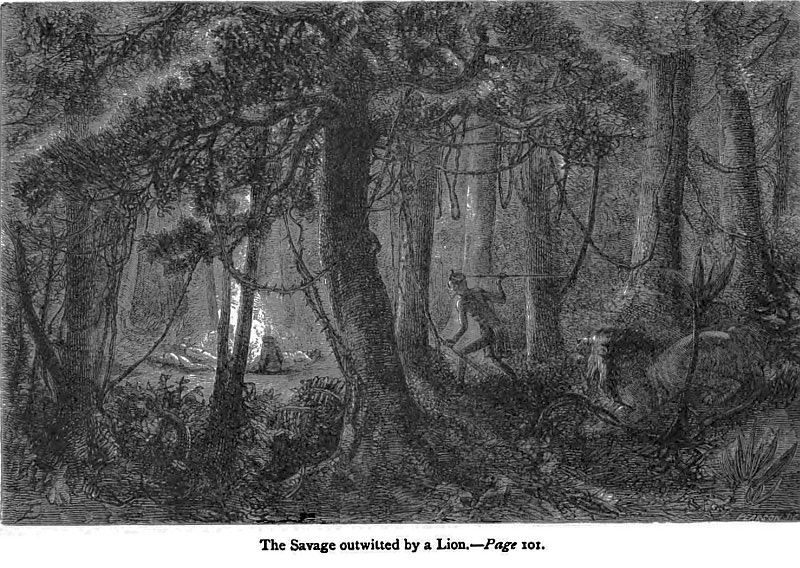
Night in the Wilderness—The Lions roar—The Savage outwitted by a Lion—The Party take up a good position.
There are few more singular experiences to the civilised man than to camp in the wilderness; and there are now but few countries in the world where such an event can occur. Man has now spread so widely over our planet, that but few spots can be found in the state in which nature framed them. To find any spot so far removed from the residence of man that no sound can reach it which is indicative of a human being, is indeed a rarity. The distant bark of a dog, the tinkle of a bell, the bleating of a sheep, or the sound of a signal gun, can all be heard on a still night for many miles. Thus, when we say that to experience the full effects of a night in the wilderness, we should be at least forty or fifty miles from any residence of human beings, and in a country where the wild animals are as yet no more than partially thinned by the occasional visits of hunters, probably Africa alone of all the continents yields to the hunter the thorough wilderness, with its attendant thrilling additions. India is generally too much populated: America somewhat destitute of numerous members of the ferae which abound in Africa. Europe is the land of men and cities, and thus we return to Africa as the true hunter’s paradise.
Scarcely has the sun disappeared below the African horizon, than the hunter realises the novelty of his position in the wilderness; for a space of nearly half an hour the air vibrates with the sharp cricket-like cry, or deep hum of hundreds of insect creatures who are thus signalling their presence to each other. From amidst a lofty ruined mass of rocks, which appeared by day deserted by every living creature, except a few lizards and poisonous snakes, a grim gaunt figure stalks out, and ascending a prominent block of stone, gazes around at the domain over which darkness has again given it dominion. Man may by day be monarch of the hill-side and plain, but by night the lion may well be called monarch of all he surveys. From the dimly-seen, statue-like figure on the rock, a few deep, dissatisfied growls come rolling over the plain, strike the face of the rock, and echo back again in confused murmurs, evincing the power of the mighty beast who thus, with no apparent effort, speaks to all within a range of several miles. From a far-distant and woody ravine, a fiend-like yell next breaks the silence of the night, and is followed by a deep-drawn, howling sigh, as the strand wolf wanders forth to search for the carrion of the day, or to capture such prey as he is capable of doing. Busy, silent-moving forms glide past the hunter, and, with a snort of terror or a growl of anger, move away to the distance, scarce liking to let alone so apparently defenceless a creature as man seems to be, yet awed by a certain presence which the brute creation never thoroughly overcome.
Tiny creeping animals again crackle the crisp leaves as they scamper about in their fastnesses among the bushes, and sniff the scent of the strange intruder; whilst the noiseless flapping of wings attracts for an instant the hunter’s sight as some ghost-like moving night-bird flies around him, and examines the strange being that has intruded into its domain.
Suddenly the sound of a struggle startles the hunter, and a cry of distress from a stricken creature is audible, whilst frightened animals rush hither and thither for a time, and then again relapse into their former indifference. A lion, perhaps, has captured its evening prey from amongst a grazing herd; or a leopard has struck down the antelope that it has been cautiously watching and stalking during the past half-hour. And then again a silence so still, so unbroken, follows the past turmoil, that the desert wanderer fancies he can hear the thin, fleecy clouds moving above him, or the long-absent but deeply-loved voice of one who should be near him. Amidst all the danger, all the novelty of the scene, however, exhausted nature usually exerts her sway, and the hyena’s laugh or leopard’s cry ceases to be heard, whilst the traveller passes into the unconsciousness of sleep, and dreams probably of scenes the very opposite of those amidst which he then is, and awakes, scarcely knowing which is the reality—the dream of old, well-known scenes, amidst which the greater part of his life has been passed, or the wild, unusual events transpiring around him.
To men of adventure such as Hans and his companions, a night in the desert was not unusual, and they experienced but few of the sensations which a more civilised man undoubtedly would feel; yet to these hunters there was something awe-inspiring in the calm stillness of the night, broken only by the shrieks and cries of night wanderers among the wild animals, or the snorts of terror from their horses as these sounds met their ears.
It was past midnight when Hans commenced his watch, and was the only one of the five who was awake. The sisters were sheltered from the dew by a blanket supported by two or three sticks, and arranged so as to form a kind of tent. The two Dutchmen were lying beneath some bushes with merely the blanket over them that served during the day to protect their horses’ backs from a badly-stuffed saddle.
Although Hans believed that any attack from an enemy was unlikely, yet, being a man who knew the value of guarding against every possible, not every likely danger only, he placed himself within a few yards of Katrine and her sister, and there listened attentively to every sound that broke the silence of the night.
When darkness spreads her mantle over the earth it is by sound alone that an enemy can be discovered; for sight is then useless, and a man who has thoroughly trained his hearing can distinguish sounds which are inaudible and unintelligible to the mere tyro. To the ears of Hans the tread of an animal with a hoof would have been recognised from that of a soft-footed animal, such as a lion or leopard, and the footsteps of a man could have been distinguished from those of a quadruped. It is almost impossible for the civilised man to realise the acuteness of the senses of one accustomed to trust his life to his senses, the sight, hearing, and even scent seem to become added to in power, and in fact to have an additional sense given to each. We all know how we can readily distinguish the footstep of some particular friend from that of a stranger, though how we do so it would puzzle us to explain; but thus it is that the trained hunter can instantly decide that a hyaena or antelope is walking past him, that a man is near, or that some other animal is moving in his vicinity.
It was with mingled feelings of surprise and half-doubt that Hans heard what he was confident was the footstep of a man soon after he had taken his position near Katrine. For several minutes not a sound disturbed the stillness of the night except the somewhat heavy breathing of the sleepers; this, however, was a source of great danger. To the acute ears of a lion, or even of a Kaffir, this heavy breathing could have been heard at a distance of several yards, and could thus serve as a guide to either dangerous enemy. Hans, however, did not like to disturb the sleepers until the last moment, or unless he found he alone was unable to deal with the foe. It was evident to Hans that whoever or whatever was the foe who approached, it was one who used the greatest caution: but two or three steps at a time were taken, and then all was quiet. From this fact Hans was convinced that a man was the enemy who was near him, for no other creature could act with so much caution. He was also aware of the peculiar individual daring of members of the Kaffir race. Many men are brave in a crowd, and when led on by example or enthusiasm, but the Kaffir is an epicure in excitement. He likes to venture upon feats of daring alone, and the night is to him the most suitable time for such deeds. It matters not how great is the risk, the greater the risk the greater seems to be the excitement. Knowing this, Hans believed it possible that one single Kaffir might have followed on their spoor, have watched him as he halted for the night, and was now desirous of capturing his guns or assagying some of the sleepers, and then retreating, boast at his kraal of his deeds. Believing this, Hans had an additional reason for remaining silent, for he knew that should he awake his companions, the Kaffir would readily escape, or wait for a more favourable opportunity for attack.
Grasping his hunting-knife firmly, Hans crouched close to the ground and waited anxiously for the nearer approach of his foe. The slow, stealthy tread of the man was evidently guided by the sound of the sleepers, for no eyes could distinguish forms amidst the darkness, and Hans soon found that light as was the breathing of Katrine and her sister, yet this sound was guiding the man towards them.
For several minutes Hans could hear no sound, and he began to fancy the man feared to approach nearer, but at length to his surprise and almost fear, he could distinguish within ten feet of him the figure of a man with arm erect, and in his hand a spear ready to cast. The figure seemed to have risen out of the earth, so silently had it gained its position in the midst of the party; and had not a man as well-trained and as keenly sensed as Hans been on watch, a complete surprise could have been effected.
With a movement as slow and cautious as that of the Kaffir, Hans gathered himself together for a spring on his enemy, who stood listening to the sleepers’ long-drawn breaths, then with a sudden bound he dashed forward, and stabbed with his long knife at where he believed he would reach the Kaffir. He had however either miscalculated his distance, or his enemy was too quick for him, for nothing resisted his stabs, and he fell headlong to the ground, having stumbled over the underwood before him. In an instant he was on his feet again, and crouched down to catch sight if possible of his foe, but nothing was to be seen, and had it not been for a slight rustling of the leaves and the crushing of a few sticks, he would have doubted whether his eyes had not been deceived. These sounds, however, would have convinced him, had he been in doubt, that no vision had crossed his sight, but a substantial and quick-witted enemy; and thus when Victor and Bernhard, awakened by the noise made by Hans’ fall, inquired what was the matter, he was able to whisper in reply, “A single Matabili has tried to becroup us as we slept.”
“Where is he?” said Victor: “has he escaped?”
Before Hans could reply, a sound struck upon the ears of the three men which caused them to grasp their rifles with firmness, whilst the two girls started up with a shriek of terror. This noise was the savage roar of a lion, followed by the agonised yell of a human being in fear and suffering, a momentary struggle, the cracking of some brittle substance, and then the deep, guttural, satisfied grunts of a monster which has captured its prey.
“The Matabili is killed by a man-eater,” whispered Hans; “and perhaps he has saved one of us. I believed I smelt a lion some two hours ago, and perhaps he has been crouching near us, watching for one of us.”
“Katie, dear,” exclaimed Hans, “don’t be afraid. There is no danger: keep quiet, and lie and rest, and, if you can, sleep. We need not start for two hours yet.”
“What was that fearful noise, Hans? I dreamed you were killed.”
“No, Katie, I am well, thank God, and ready to do good service yet: it was only some wild animal made a noise; but trust us three to keep you safe. Don’t talk, dear, but try and sleep, at least keep quiet; for a human voice in this place is so unusual, that even the bats will come and look at us if they hear it. Sleep again, Katie, all is safe.”
“We must all keep awake now,” Hans whispered to his companions: “that lion may attract others. Let us sit back to back, and let no man speak without a cause, and then let it be in the lowest whisper: our lives and those of the poor girls depend now upon such apparent trifles as these.”
The three men sat back to back, and thus each had one-third of the horizon to examine, so that no enemy could approach from any direction where a pair of eyes were not on watch. The night was a still and clear one, and sounds were audible from a considerable distance; near them, however, were noises which kept these hardy hunters in a state of excitement. The lion having captured its prey, had dragged it but a few yards, and had then commenced feasting on it. The sound of the powerful brute’s jaws was distinctly heard as it crunched the bones of its victim, and when at length it had satisfied its hunger, and seemed to have retired a short distance to sleep, other and smaller carnivora squabbled over the remains of the monarch’s feast, and with even more noise fought for their supper.
The poor half-starved horses were carefully hobbled and made fast to each other and to the bushes near, and thus could not escape. Their snorting and uneasiness showed that they were well aware of the presence of their formidable enemy; but the feeble state to which they were reduced caused them to seem almost indifferent to dangers which at other times would have rendered them almost frantic.
After a long silence and most intent listening had convinced the hunters that no immediate danger threatened them, Hans, speaking in a whisper, said—
“That lion must have been stalking our horses when the Matabili came in his way. I wonder was there another man with this one? they often venture alone on these risky journeys. This man, however, will never hunt again in these fields.”
“It is strange that he should have been thus trapped by a lion whilst trying to stalk us,” whispered Victor: “it is the first time I ever found a lion to be my friend, but he has saved us powder and shot. Tell us, Hans, how the man approached us.”
Hans gave a brief description of the manner in which he had heard the man approaching, and of his precautions to prevent an accident, and explained all details until the roar of the lion announced the unexpected termination of the Matabili’s expedition.
“The morning will soon break now,” said Hans; “the Eastern sky is getting lighter; it will be an anxious moment to see how the horses are, for on them mainly depends our safety. How far, think you, are we from our people?”
“We shall take three days’ riding at least to reach them, I think,” said Bernhard.
“Yes, quite that,” said Victor, “and more too, if there are enemies in the way, for then we may have to ride round.”
“There is light enough now to look about us; so let us examine the horses, and allow them to feed if they will,” said Hans; “we shall want all their strength.”
The three men arose, and stretching themselves after their somewhat cramped positions, examined their horses, which were standing quietly near. To the experienced eyes of the hunters, these animals presented a very pitiable condition. Out of the five horses one only seemed lively, and inclined to eat; the remaining four, with hanging heads, lustreless eyes, and drooping ears, seemed indifferent to all around them. A look of despair was exchanged by the three men, as this fact was presented to them.
“In a few hours we shall have but one horse,” exclaimed Hans; “strong as Katie is, her sister is weak, and they can never walk to our people. If the Matabili follow us, we must die. Can you see a remedy, men?”
“We can sell our lives dearly,” exclaimed Bernhard; “that we can at least do. I have thirty bullets at least in my pouch, and in my horn thirty charges of powder. We may beat off a large party of the enemy.”
“The Matabili are not easily beaten off,” remarked Hans: “they rush on in a body, and though you may kill some, the others are upon you before you can have time to load. If we could have some of those many-barrelled guns that I have heard of which fire off several times one after the other, we could do nothing but kill more before we were killed; but with our roers only, we can do but little.”
Whilst the men were thus talking in the twilight, Katie and her sister, fully awake, joined them before their presence was known; and hearing this last remark, the quick-witted girl at once suspected that the horses were unfit to continue their journey.
“We can walk, Hans,” said Katrine, as she touched his shoulder, “we can walk, though, perhaps, not so fast as you can; but we can walk ever so far.”
“If it were walking only, Katie, it would not be much; but it may be we should have to run, and that at a greater speed than a Matabili could follow; that is why I fear.”
“Well, leave us here, and you go on, and bring us back help. The ‘Mensch’ will soon come to us, and we could stop here till they arrive.”
“We live or die together, Katie; I will never leave you here,” exclaimed Hans. “But there is something to be thought of, though. Victor and Bernhard, let me tell you my plan.”
The two men turned from the horses, whose pitiable condition they had been contemplating, to Hans, and waited for his words. After a moment’s thought, Hans exclaimed, “It is our best chance, and it will succeed. This is the plan:—The black horse is as yet well. You Bernhard, or you Victor, as you may choose, upsaddle at once, and ride for our lager. As soon as you reach it, tell Maritz, or any one who is our friend, of our being left in the desert. I have horses among the people, and there are those who will help us. Come back with help and with horses, and we will get safe again among our people.”
“And where will you be, Hans?” was Victor’s inquiry.
“I,” said Hans, “will move on to that range of hills; there are kloofs and rocks there amidst which I can easily find a place of security for Katie and her sister; for the rest trust a hunter. They shall neither starve nor be made prisoners whilst I live. So now, which of you will go? it is the post of danger to go as much as to remain. You, Bernhard, are the lightest man, and ought thus to ride fastest. In six days you should be back, and by that time we shall be accustomed to a rough life.”
“If Victor agrees to this, I will go,” said Bernhard; “and the sooner I go the better: first, though, shall we shoot the lion that killed the Kaffir? otherwise he might be an unpleasant neighbour to you, as he has tasted human flesh.”
“We had better let him stand,” said Hans: “a shot fired here now might be heard on this still day twenty miles. We need not tell every pair of ears within twenty miles that white men are about, for then, perhaps, we might have curious eyes coming to look at us; besides, the lion may be useful to us again.”
“How?” exclaimed the two hunters; “not in killing another Matabili?”
“No,” said Hans; “but the sooner our horses are eaten the better. The vultures will be streaming in this direction very shortly, and as long as a scrap of flesh is on the bones of the animals the vogels will be hovering around this spot. A Matabili would naturally come to see what was dead here, and might find our spoor; so, instead of one, I wish there were twenty lions ready to feast on our horses. I have no fear of lions when I get to those hills, for I will soon make a place there suitable for our safety. So we had better save our powder and bullets for even more cruel enemies than a lion.”
“That is true,” exclaimed Hans’ two companions: “so we will not seek to kill him. Let us look at the spot where he struck down the Matabili.”
The three hunters walked cautiously in the direction in which the lion might be yet concealed, and examined every bush and patch of grass around them. The footprints of the Matabili could be easily traced by these expert spoorers, and they soon found the spot on which the man had been killed. The lion had apparently followed the man from the direction of the hunters, and had struck him down at once, the assagies of the savage being found in a cluster, as though dropped from the helpless hand of the stricken man; the body had then been dragged away about forty yards to some long grass, where the lion had commenced his feast, which had been finished by hyenas and jackalls; so that except a few bones, nothing remained to indicate that a human being had been, sacrificed to the fury of a wild beast. “This might have been the fate of one of us,” said Hans, as he pointed to the few remains before him. “It is the will of God to have spared us, and to have destroyed our enemy. We will trust that our fate may not be like his. We had better return now and make our arrangements at once. We will conceal the saddles and bridles, and then they may be of use if you bring spare horses. So now for work, men, and you, Bernhard, had better ride on. You will not mistake your way, will you?”
“No. I shall find the line easy, and my only fear is whether the horse will carry me. I will bring you help, and that very shortly, or my life will be lost in the attempt—trust me, Hans;” and with a hearty farewell to the party, Bernhard rode off, on an expedition fraught with no little danger, for he had pathless plains to traverse, rivers to cross, mountain-ranges to find a pass through, and all this with the constant possibility of enemies around him, who would follow him till a chance occurred of taking him at a disadvantage.
Chapter Twelve.
Preparations for a Siege—The Rock and Caves—Wild Bees and Rock Rabbits—The Baboons—The Night Watch.
When Bernhard’s course had been watched for some time, Hans decided at once to make his preparations for a week’s residence in the wilderness. He called Victor to his side, and explained to him the advantage of selecting the range of hills which were distant about two miles. These hills were rocky and steep, and thus an enemy could approach only from one side. There was much underwood, and thus there seemed every probability of a secure retreat being found. The difficulty, however, seemed to be how to reach these hills without leaving a visible trail. These advantages and drawbacks having been discussed between the two hunters, it was decided to run the risk of leaving a trail rather than wait where they then were; but scarcely had Hans come to this conclusion than, upon looking westwards, from which direction the wind was blowing, he eagerly exclaimed—
“God is good, and favours us. Look, Victor, a storm is coming.”
“And what of that, Hans?” exclaimed Victor.
“Our spoor will be washed out, Victor: make haste, let us move on rapidly and gain those hills, and if we do so before the rain, the keenest-eyed Matabili will not be able to trace us; so come along. If no eyes are now on us, we may live here for a week without being discovered. Keep close together, Katie, and by my side, take advantage of every bush or slope of ground, and we will yet live to join our people again.”
The two hunters and their charges walked rapidly towards the hills which had been referred to, and entering on an old water-course, worked their way up towards the summit of the kloof. Large blocks of rocks were lying about in all directions, and the water during heavy rains had worked its way among these, so that several hollows were scooped out so as to form caves large enough to hold one or two human beings; these, however, were not places which an experienced man like Hans would select for a resting-place, for he knew that the same cause which had produced these holes would render them unsuitable for habitations. He advanced, therefore, until he found some overhanging rocks which offered an ample protection against any rains which might fall, or winds that might blow, and here putting down the saddles and other articles that he had carried from the last outspan, he requested Victor to remain with Katrine and her sister until he had examined the surrounding ground.
“You know the call of the grey monkey, Victor?” said Hans: “let three distinct calls be a signal that one of us requires the presence of the other. And now I will go and examine round us.”
Hans ascended the kloof, and keeping along the edge of the bush, walked onwards along what at first seemed an old game path; but at length, as he examined this, he became convinced it had once been used and worn by human beings, though now it had been long untrodden; he followed this path until it led him to a small piece of table-land not much larger than a good-sized English drawing-room, which was reached by a very narrow path along a ridge of rocks; this table-land was formed by a solid block of rock, which descended perpendicularly for fully sixty feet on three sides, whilst on the fourth there was a wall of rock rising 200 feet above him. To the eyes of Hans, this place was a fort almost impregnable, and as he scanned the country round, he felt that with twenty trusty men he could hold it against a nation of savages. The face of the rock had been scooped out by artificial means, and two caves about eight feet deep and six feet high had been formed evidently with great labour. This Hans knew must be the work of Bushmen, who for some reason had now apparently deserted the locality. From these caves the surrounding country could be seen in all directions, and water being within a few yards, Hans at once selected this place for the residence of his companions.
Inside the cave were rough carvings of various creatures, scratched on the stone of the rock, whilst just outside a valuable article lay neglected; this was a large gourd, capable of containing about two quarts of water. Hans at once placed this inside the cave, and then commenced cutting some long, dry grass, that grew on the slope near; having procured sufficient of this to make a soft bed in one of the caves, he descended the ravine, and rejoined Victor and the two girls.
“A storm is coming,” he said, “and that will wash out our spoor; so now come with me, and I will show you a nice quiet retreat before the rain falls.”
Victor, aided by Hans and the two girls, ascended the ravine, and on seeing the caves and the security of the retreat, which were evident at once even to the inexperienced eyes of the girls, they were delighted.
“No one can find us here, Hans,” said Katrine; “and if they found us, they could not get at us. However did you come to know of it?”
“I found it by chance,” said Hans; “but now, Katie, you must cover your dress with this grass, and don’t let a sign of a ribbon be seen, for there may be eyes in every bush, and our safety depends on escaping being seen.”
“Here comes the rain,” exclaimed Victor, as the heavy drops of a thunder-shower came pouring down, followed by a deluge of rain: “that will wash out our footprints, and now we cannot be traced; so if we avoid being seen we must be safe. But Hans, what food have we? I am starving, and the girls must sadly want food.”
“There is still some venison, but I am going out after the rain is over to get something else. Now, Katie, you can be useful; use your bright eyes, and you yours too, Meechy, and look all over those hills and plains and see what passes or moves about there. Victor, get some dry wood from out of that next cave, and some grass. We will have a fire presently, and cook some more food, for I can get something, I believe, without firing a shot, for the Kaffir’s spears are not bad weapons.”
Victor did as requested, and Hans, carrying his gun for his protection, and in case of danger, left the caves and walked slowly along the old path, looking in all directions for signs of game.
Many brilliant flowers grew on this hill-side, and thus added to the beauty of the scene, whilst flowering acacias scented the air with their fragrance. On one of the branches of an acacia that hung low, Hans noticed several bees busily engaged gathering honey; from among these he selected one whose legs were thickly covered with the spoil from the flowers; this bee he struck roughly from the branch and carefully watched. The creature, after buzzing angrily round Hans’ head once or twice, darted off up the ravine. Hans watched it as long as it was in sight, and then followed the direction in which the creature had retreated.
After walking about 200 yards Hans disturbed another bee that was busily engaged gathering honey; this creature flew away also up the ravine, and Hans quickly followed it. He knew that when a bee laden with honey is alarmed it will fly to its hive, and he, being desirous of procuring honey, adopted this means to discover the nest or hive. Hans was soon guided by the bees to their hive, and the African bee, being by no means so formidable a creature as its English brother, allows its honey to be taken by those who understand how to do it. The method is, if the honey be in a hollow tree, or in a cleft of the rock, or such a locality, to pay no attention to the buzzing of the bees, or to attempt in any way to knock them away, should they settle on you, but to slowly insert the hand into the nest, and withdraw the honeycomb and carry it away. It rarely happens that the bees attack any one, and should they do so their sting is far less painful than is that of the English bee. (Having taken many bees’ nests in Africa, we were but once attacked by the bees. This took place in consequence of accidentally squeezing a bee between our hand and the tree in which was its honey; the little creature gave a sharp, angry buzz, which seemed the signal for attack, as about twenty bees flew on our head, and several on the face; they all stung, the majority leaving their stings in, but in less than five minutes all the smarting had gone away. One sting from an English red-hipped humble bee is worse than twenty African bees’ stings.)
Hans procured a large heap of honeycomb, with which he proceeded to the caves. He knew that the time might come when they could not leave the caves, and thus, to collect any thing that might serve for food was a proceeding not to be neglected; and honey, though not very substantial, was yet food which made a change from mere flesh. What Hans hoped to get were some rock rabbits, the daas of the Dutch, and the coney of Scripture. These little creatures, not much bigger than a common rabbit, are usually found among rocks, and are very good eating; they are, however, very watchful, and require an expert shot to be able to hit them, for they rarely allow a hunter to approach nearer than one hundred yards to them.
Hans found that the kloofs were full of game. There were guinea-fowl and pheasants in abundance, whilst buck of various kinds had left so many footmarks, that it was evident they abounded in the neighbourhood. He soon discovered the traces of rock rabbits, and with the help of the broad blade of the Kaffir’s assagy he was able to dig out four of these creatures.
Thus provided with food he returned to the caves, and observing that the wood which had been collected was all more or less damp, he at once decided that cooking must be left till the night. “You see, Victor, if we made a fire now, the smoke could be seen for miles, and would thus guide an enemy to us. There is no possible means of preventing this smoke from ascending, so we must not make a fire by day with damp wood. By night we must not show the light of a fire; but that is more easily avoided. We can cover the mouth of the cave, or we can make a fire below here, and can thus cook our food safely, for the smoke cannot be seen by night. We ought to cook enough to do without a fire for a week, and then one risk only is run.”
“In the water-course we came up the water has run under ground,” remarked Victor; “there is room for a fire in that, and no light could be seen from the distance.”
“I remember,” said Hans. “We will collect wood and grass, so as to be ready for the night; then I will try to knock down some guinea-fowl or pheasants.”
Hans, having cut some stout sticks with a knob at the end, again made an expedition into the kloof, and succeeded in knocking down several guinea-fowl with these sticks, which he threw with the skill of a Kaffir. The guinea-fowl, endeavouring to conceal themselves by hiding or crouching amidst the long grass, would allow themselves almost to be trodden on before they would fly away. In addition to the rabbits and guinea-fowl, Hans collected a great many eggs, and thus was provided with food enough to last a week, without incurring the necessity of firing a shot. No sooner had this essential preparation been completed than Hans cut several long, straight sticks, which he thrust into the ground in front of the caves, and at about a foot apart: across these he fastened several horizontal twigs; first by lacing them in and out, and secondly by lashing the ends with the bark that he peeled off a tall, soft-wooded greenish shrub. Having thus traced out a framework, he thatched this with the long tambookie grass which grew in the kloof, and thus before sundown he had formed a very complete room, perfectly sheltered from the wind and rain. In front of this thatched doorway he placed some branches of trees, and thus prevented any person at a distance from being attracted by an artificial-looking construction.
Hans was much pleased with his work, and called to Katrine to examine it from a short distance.
“You could not tell there was any thing there, Katie, except a few bushes, unless you went much closer.”
“No, Hans, it is cleverly done; but I fear there would be no escape for us if any enemy once came on to this bit of ground.”
“No, there would be none, Katie; so we will hope they will not come here; some of them would leave their bones here, that is certain; so it is better for them they should not come. I will now go down and see about cooking our rabbits, for some hot food will be good for us.”
Hans descended to the natural hole in the rocks where he intended lighting his fire as soon as it was dark enough to prevent the smoke from being seen, and having waited till he thought his attempt might be safely made, he lighted his fire, and adding plenty of wood, soon had a sufficient quantity of heat to cook all his game.
Upon leaving the fire and re-ascending the ravine he was startled by seeing the outline of several figures on the summits of the rocks above them. Darkness had now set in, but it would not have been too dark to have enabled him to distinguish these objects, had he not been lately dazzled by the fire-light; this, however, had damaged his keenness of vision for a time, and as the objects disappeared as soon as he moved in the bushes, he had no second chance of examining them. From what he saw, however, he was certain that either Kaffirs or Bushmen were on the rocks above him. In either case his condition would be unpleasant, for with the Bushman, every man’s hand was against him, and his against every man’s; and if the Matabili had traced him to his present retreat, his career would be soon terminated. In either case not a moment was to be lost; so he rapidly moved over the distance which separated him from the caves, when whispering to Victor what he had seen, they cautioned Katrine to keep quiet and concealed, and grasping their rifles, they took up a position from which they could obtain a commanding view of the ridge on which Hans had seen the men.
They had not long to wait before their enemy appeared, drawn out in relief against the sky for a background. Objects on the ridge were visible which could not have been seen had they not been thus situated. For this reason both Hans and Victor soon saw above twenty figures slowly ascend the ridge, and there stand and examine the surrounding country. As he saw the number of the enemy Hans raised his arm and touched Victor, whilst in a whisper he said, “They must be Bushmen.” It seemed impossible that the whisper of Hans could be audible at the distance at which the supposed Bushmen were examining the kloofs, and still more improbable that the movement of Hans could have been seen even by a Bushman’s eyes, yet, on the instant, each figure disappeared as though by magic, whilst no sound met the ears of the hunters.
“Victor,” exclaimed Hans, “those are not mortal enemies. I have killed in my day more than twenty Kaffirs, principally Amakosa: can these be the men’s ghosts, sent here now to torment me? I shot them in fair fight and for the defence of my life or cattle,—yet no mortal could have seen me move or heard me speak, but when I did both, they sank into the rocks to a man.”
“Wait, Hans, let us see what happens; our cause is a good one, and in such a case though the devil may be powerful, God must be more than a match for him. God would not allow the dead Kaffirs to worry us.”
“There! there! Hans, see there are more; they stand up on the rocks, and are carrying something to hurl at us. A bullet could not touch a being belonging to the dead, or I would fire.”
“I wish I had consulted the Missionary about such a case,” earnestly exclaimed Hans; “too many Mensch laugh at the Kaffirs who believe their fathers come and talk to them; but whatever may be this enemy, I, for one, would never laugh at a nation’s belief, when I knew nothing about it. Victor, we might as well have been bred in the towns; we are weak and ill, or we should have seen before that these are baboons, some of the females carry their young, and that is what we fancied they were going to throw at us. That is good: if baboons come here, and stay here, it shows that neither Bushmen or other men have been much here lately, and so we may not be disturbed. We must watch, though; shall I or will you take the first watch? whoever does, he can keep guard till those three bright stars set, and then can call the other. I can sleep to-night, for I feel in this retreat that I have the best chance of success now. If two days pass without the Matabili finding us, we shall escape, provided Bernhard can procure horses; but I would as soon stand up at fifty yards to be shot at with a Bushman’s arrows, as go on foot with Katie towards our lager, for we should then be captured and slain in less than twelve hours. Here, if we keep close, we may be secure for a long time, but moving we should be exposed to all dangers; so now all depends on Bernhard. Will you watch first, Victor, and place yourself near this wall of rock? then every sound from the plain will be heard clearer and more distinctly, for sound comes against this rock like a wave, and is not lost. Call me if you feel too sleepy to watch, for that is possible; and a little sleep when we want it, is better than much—when we court it. I will sleep at once, so call me when you want me.”
Hans listened at the door of Katrine’s cave, but hearing only the slightest breathing, he concluded that she and her sister slept; and so retiring to his own cave, he, with that necessary capacity of the hunter or soldier, was in five minutes fast asleep, and untroubled by dreams or anxieties.
“Half the night is past, Hans,” said Victor, as he entered the cave and gently touched Hans.
“I am ready,” said Hans; “is all quiet?”
“No, not quiet: there are more lions here than in any part of the country I have ever been in; they have been fighting about our horses; the roars and growls have been tremendous ever since you left. The baboons too have been barking occasionally; but there seems no other creatures about except jackalls and hyenas. It would not do to walk down on those plains alone by night, we should be lions’ food in a very few minutes. Now, I am for sleep, so you watch, Hans.”
It was now Victor’s turn to sleep whilst Hans kept watch, and sat with his back to the rocks, a couple of assagies within reach of his hand, and his trusty roer resting on his arm. He listened attentively to every sound that broke the stillness of the night, and pictured to himself the scene that was going on near his poor horses. The occasional deep growl of the lion, or its angry roar, caused him considerable anxiety, not on his own account, but for that of Bernhard. “If Bernhard’s horse is killed or falls sick,” he thought, “we may never leave this place; and poor Katie! what will become of her?”
Chapter Thirteen.
The Matabili appear, and follow the spoor of Hans’ party—The Discovery—The Attack—The Repulse of the Savages.
The day broke with all the splendour of an African morning; the rain of the previous day had refreshed the ground, and filled the various pools with water, and thus the animals and feathered denizens of the plains were cheerful and busy in their various occupations. Numbers of green parrots were screaming in the kloofs near Hans’ retreat, whilst the sweet double whistle of the quail resounded from every patch of grass. The vulture, with its graceful sweeping flight, circled high in the air over the spot where the carcases of the horses still remained; whilst here and there a black-breasted eagre sat on a withered tree, and scanned the surrounding earth and sky, in order to select the most dainty morsel for his morning meal.
The baboons from the summit of the hills had descended into the plains in order to dig up roots, which there grew in abundance, and served them for food. This was a sight which pleased Hans, for there are scarcely any creatures more watchful than baboons, and thus he knew that no enemy could approach without these creatures giving notice by their rapid retreat to the mountain peaks. Having found a hole in the rocks close to the caves, which was full of fresh water, there was no need to quit the small plateau for that necessary, and thus Hans sat and watched the changing effects of the rising sun, whilst he listened to the long-drawn breaths of the sleepers, who, exhausted by the anxiety of the previous night, needed more sleep than was usual.
The plains beneath Hans’ hiding-place offered a beautiful panorama to the sportsman or artist; the bright glowing tints of the foreground were mellowed in the middle distance, whilst far away the mountains assumed a rich blue colour, and yet stood out in bold relief against the distant sky, the dry air failing to give the subdued effect of distance usually observed in our climate. Amidst the groves of wide-spreading acacia, or near the banks of the many tiny streams that wound along the plain, were groups of game. Herds of elands, buffaloes, and quaggas were scattered here and there, whilst smaller and solitary bucks could be seen, now bounding away from some fancied danger, then grazing on the green and fresh grass. The sportsman, provided with ammunition and gun, could keep his camp in plenty here, and need have no fear of starving, were it not that the game at times migrates and leaves a district, when the food ceases to be attractive or plentiful.
As Hans watched the various animals, he noticed a troop of quaggas galloping rapidly across the flats; their passage seemed to alarm various other creatures which had previously been feeding in quietness, and there was a general movement among the quadrupeds. The baboons ceased their labours and moved leisurely up the ravine, till reaching commanding positions on the summits of rocky eminences, they stood erect, and barked their displeasure at some threatening danger.
Hans, determining to obtain a better view of whatever might be the cause, ascended the rocks above his cave, and, taking care to screen himself from observation, scanned the distant country. He soon saw that the animals had not been alarmed without cause, for coming forward at a rapid pace were a party of dark men, who Hans made out to be armed Matabili. There were more than a hundred of them, and from all being armed, from the rapid pace at which they advanced, and from their coming exactly over the same ground that he had ridden forty-eight hours previously, he concluded they were following his horses’ footmarks.
The advance of such a party was not unexpected by Hans. Had he supposed that he would not have been followed, he would have suggested that the whole party should walk on towards his people’s lager. With but one horse the two girls might have ridden turn and turn about, and so have lessened the fatigue of the journey, but even under these circumstances the Matabili would be sure to overtake them, and so he decided that hiding would be the safer plan.
He noticed that three or four men, probably the most experienced, led the main body of the Matabili; these men succeeded each other in the lead, and by acting as guides, often enabled the main body to make short cuts, and thus to save themselves much walking, or rather running, for a slow run seemed the pace that was adopted. Though the enemy followed very accurately the spoor of the horses on which the rain had fallen, and thus seemed capable of tracing him even under these disadvantageous circumstances, yet Hans was in hopes that when the horses were no longer used the Matabili would not be able to follow him. He had, however, seen enough to render it advisable to descend at once from his position, to give the alarm to his companions below, and to seek a place of concealment from which he might observe all the movements of his pursuers.
These arrangements were soon made, and Victor and Hans sat watching with anxiety the approach of their enemies.
The Matabili followed the traces of Hans’ party with the accuracy of hounds on a hot scent, and when they spied some vultures sitting on the trees near the carcases of the horses, their speed was increased, and they hastened to examine what was the cause that attracted these carrion feeders.
The nearly-consumed horses were immediately discovered, and shortly afterwards the skull of the Matabili killed by the lion. The ground around was searched by the various men, and the conclusion was soon arrived at, that although the horses were all dead but one, yet their late captives had by some means managed to escape. The next proceeding was, therefore, to find the spoor, so as to discover in which direction they were to pursue. This was a work of time, for the late heavy rain had washed out nearly every trace from the previously hard soil; but the skilled spoorers spread out in various directions, and some of them at length found the traces of the horse that Bernhard had ridden away.
The Matabili at this were delighted; they believed that the three men had started on foot and had placed one or both of the females on horseback: thus they believed their journey could be accomplished only slowly, so that there was every chance of the fleet-footed savages overtaking their escaped captives, and shortly bringing them back to their prison. The whole party soon assembled round the traces of the horses and held a brief consultation. No time was to be lost in following this spoor; and the most quick-sighted Matabili were at once sent forward to trace it on before. The remainder followed, and looked anxiously for the footprint of man. When, however, some very soft ground had been passed, and no footprints were seen, the leader, an experienced and cunning savage, called on his men to halt, and explained to them that there should be some other footprints besides those which they had seen.