ADAM HEPBURN'S VOW (continued 4)
Reading edition
"I agree with you," said Sir Robert. "Then we can fix upon the place and day, and send word through the surrounding district."
"Have you forgotten that the anniversary of the king's restoration is to be celebrated throughout Scotland on the 29th of this present month?" asked Balfour.
"No: we have had that under discussion likewise, John," replied Sir Robert, "and we intend to celebrate it in our own fashion. But of that more anon. And now we must separate for the night. My quarters in the meantime are here, John. You had better remain with me in case Rathillet should come hither seeking you. He should be here by the latest to-morrow."
Balfour acquiesced, and, being much fatigued, gladly retired to rest, while the others separated to the various places where they were to obtain shelter for the night.
CHAPTER XX.
DRUMCLOG.
All the following day, David Hackstoun of Rathillet was anxiously expected by his brethren in arms, in the vale of Avondale. And when night closed, and there were yet no signs of him, they began to tremble lest some evil had befallen him. Early upon the second morning, however, when that good man and faithful supporter of the Covenanters, Gideon Dickson, the farmer of Windyedge, was leading out his horses as usual to water, he beheld a horseman coming, but slowly and dejectedly, up the road. He at once ran into the house, awakened his distinguished guests, who speedily dressed and got out of doors, just as the horseman rode into the yard.
"David Hackstoun! verily, glad am I to behold your face," said Balfour, advancing to meet him. "We feared, and not without cause, that your unwise delay had cost you dear."
"It was like to be my end," answered Rathillet, with a faint smile, and he was so weary that they had to assist him to alight; then he very cordially greeted Sir Robert Hamilton, with whom he had some slight and very agreeable acquaintance.
"I had a desperate ride, especially betwixt Stirling and Avondale," he said, in answer to their inquiries. "There is a price of 10,000 marks upon my head, and you can readily imagine that there are many greedy vultures on my track. But, truly, I think that as yet the direction of my flight is not known."
"Is there no price upon my head also?" queried Balfour.
"Yes, we are accounted equal prey, but the proclamation is so worded that the rewards fall to whoever shall lay hands on any one of those who were present at or took part in Sharp's assassination," returned Rathillet. "But, come, tell me how is it you are abiding in such apparent ease here? I thought it would have been unsafe to shelter under any man's roof-tree."
"So it is, but this is a very remote place, and difficult of access, and there are many ways of escape from it," returned Sir Robert Hamilton. "And our brethren in arms are not far distant."
"Ah well, very gladly will I rest awhile with you, for I am as sore spent as ever man was," said Hackstoun. "And never did I expect to reach this place alive. The last place I ventured to ask concerning you was a little moorland shieling, where a woman was dwelling alone. She told me her husband was with the army, and that she was making preparations to retire to her kinsfolk in Hamilton, being in daily terror of a visit from the dragoons, who had shot her sister not many weeks ago, when she was returning from a preaching."
At that moment the mistress of the house, a kindly and hospitable dame, appeared, and bade them come in, as breakfast was prepared on the table. She looked compassionately at the worn and weather-beaten appearance of the new comer, and hastened to get him some cool water from the spring, in which to lave his dusty face and hands. Very grateful were all these comforts to the weary fugitive, and, after heartily partaking of the good dame's fare, he lay down to snatch a few hours' much-needed rest. Later in the day Sir Robert Hamilton and he, after long and earnest discussion, set themselves to compile a declaration, which it was their intention to publish on the day of the king's restoration. On the 28th of May, the day before the celebration, eighty men were chosen from among the ranks of the Covenanters, and with Sir Robert Hamilton at their head marched westwards to Glasgow. Andrew Gray and Adam Hepburn were of the number, and the expedition was much to their liking, but the minister of Broomhill remained behind with the forces, as did Balfour and David Hackstoun, for great risk attended their appearance, seeing so high a price was on their heads. About noon, on the 29th, Sir Robert Hamilton's band rode into the burgh of Rutherglen, where a great semblance of rejoicing was going on over the anniversary of the king's restoration. Many of the people merely took part in the proceedings through fear of the consequence, if they refused, but when the Presbyterians rode so boldly into the town, they took heart, and at once revealed their true principles, by heartily approving and taking part in their proceedings. The little company gathered about the ancient cross, and after burning in the very bonfire which had been kindled in honour of the king, all the Acts he had issued against the Covenanters, Sir Robert Hamilton published to all those gathered together, the declaration which Rathillet and he had drawn up against the Government. They then proceeded to extinguish the bonfires, and sweep away all outward tokens of rejoicing with a fearless boldness, which surprised the trembling burghers of Rutherglen not a little.
They then rode away by the route they had come, but the day now being far spent, several of them proposed to remain over night in Hamilton, calculating that next day, being Saturday, they would have ample time to return to Loudon hill in time for the Conventicle on the Sabbath. They were divided, however and the more prudent among them judging that the troops would speedily follow up to avenge the insult to the king, elected not to halt until they rejoined the army. Fifteen of the bolder spirits held on to Hamilton, and sought quarters there, but at day-break they were hastily roused, and informed that Claverhouse, with his troop in pursuit of them, was close upon the town, and was in a great rage, swearing that not a man of them would escape with his life.
By the time they were accoutred and ready to march, the pursuers had entered the town, but the fugitives escaped by another road, and so obtained a little advantage.
In Hamilton Claverhouse learned of the field meeting to be held the following day at Loudon hill, whereat he chuckled with delight, for the dispersion of a conventicle was work after his own heart.
Fair, calm, and sweet broke that summer Sabbath morning over the beautiful vale of Avondale. The watchers stationed on the hill tops since daybreak could see no sign of the approaching foe, and it was with untroubled and reverently thankful hearts that the faithful people came flocking to hear the preaching of that precious Word, for which all these dangers and anxieties were cheerfully endured. It was a strange, striking, and very pathetic scene, to look upon that gathering of simple country folk, denied the privilege of hearing the pure Gospel preached in its simplicity within the walls of their own kirks, reverently assembled to worship the God of their fathers in a tabernacle of which men could not rob them, even the green slopes of their dear native hills.
The inner circle was composed of women and children, and those among the older men not so well able to defend themselves. Below that was a ring of stout country men, armed with halberds, forks, and other weapons, which they had hitherto used in more peaceable pursuits; while beyond these again was a band of sturdy, well-armed foot-soldiers, finally encompassed by a party of horse. Sir Robert Hamilton, calm, dignified, and self-possessed, sat erect upon his steed, ready at a moment's notice to take command of the little army, while near to him sat David Hackstoun, his fine face wearing an expression of deep and heavenly serenity, which told how passing sweet to his soul was this hour of communing with his God. Side by side, on a rocky ledge, sat Balfour of Kinloch, and Adam Hepburn of Rowallan, and, I fear me, their hearts were occupied by far other thoughts than the reverent worship of the God of the Covenant. Yet their outward demeanour was decorous enough. There were also several ministers present.
After the singing of a psalm David Gray led the devotions of the assembly, and as his beautiful and appropriate petitions, the deep breathing of his own pure and reverent soul, fell from his lips, tears rolled down the faces of many present, and more than one voice fervently re-echoed his amen.
The reverend Mr. Douglas, who was to preach the sermon, gave out his text, and had but newly addressed himself to his subject, when a carabine shot was fired from the hill-top, a warning salute which had been agreed upon before the service commenced.
They were speedily informed that Claverhouse, with a considerable body of dragoons, was rapidly approaching. Without the faintest sign of confusion, or any exhibition of terror, the little army prepared themselves for battle.
Sir Robert Hamilton took the command, and was assisted by Balfour and Rathillet, as also by some other gentlemen of rank, present on the field.
To their joy they beheld the enemy advancing towards the morass, which would prove a very considerable barrier in their way. Had Claverhouse been familiarly acquainted with the nature of a Scottish morass, or bog, as the country folk term it, he would without doubt have rather taken a more circuitous route to avoid it. The Covenanters stood perfectly still until the dragoons were well into the moss, then singing the favourite seventy-sixth psalm, to the familiar strains of "Martyrs," they steadfastly advanced to engage the foe in conflict. Those left behind prostrated themselves in prayer to the God of Heaven, supplicating victory for the blue banner of the Covenant, waving in the light summer breeze, its white letters, "For Christ's Cause and Covenant," made resplendent by the brilliance of the summer sun. The first volley fired by the Covenanters emptied many a saddle in Claverhouse's ranks, and without giving them time to rally, the brave little band plunged into the morass, and then began a terrible hand-to-hand conflict, which must ensure either complete victory or total defeat.
Sir Robert Hamilton kept to his horse, encouraging his men with his calm, cheerful demeanour, as well as by his steadfast words. As was to be expected, Adam Hepburn fought with desperate valour, and caused Balfour to regard him anew with a peculiar interest. After a brief, but terrible struggle, Claverhouse, seeing the field was utterly lost, hastily retreated with the exhausted remnant of his troops, narrowly escaping with his own life.
Many dead and wounded lay in the morass, but the Covenanters miraculously lost only one man, while five were wounded.
With thankful and triumphant hearts they prepared to return to the base of the hill.
Balfour of Kinloch, finding himself near Adam Hepburn, as they turned to go, touched his arm and said, in his brief fashion, "What is it in you, Adam Hepburn, which makes you fight like Lucifer himself? Where did you get that desperate courage?"
Adam Hepburn stooped to wipe his reeking sword upon the already blood-stained heather, and after a brief pause made answer, grimly:
"Thirteen years ago, Mr. Balfour, I had a wife, who was to me the very apple of my eye. She was my one ewe lamb, all I had upon the earth, and in my absence they murdered her, shot her down in cold blood upon the threshold of the home whose light she was. I came home to find her dying, and I swore over her dead body that this sword should not be suffered to return to its sheath until it had sucked the life blood of as many dragoons as there were years upon her head."
Balfour, though void of any touch of sentiment, stranger as he was to the finer feelings of human nature, felt himself deeply moved as he listened to these hoarse, low-spoken words, and saw the terrible gleam in the flashing eye of Adam Hepburn. "Ay, how old was she?" he asked, curtly.
"Eight-and-twenty years had passed over her head; for the fifth part of that time she had blessed my life," returned Adam Hepburn, drawing his hand across his brow, which was wet with the sweat of the conflict. "Yes, eight-and-twenty years! Seven miscreants did this right arm send to their account not twelve months after, on the field of Rullion Green. Other four have I encountered in single combat, surprising them when I was in hiding in the vale of Inverburn, and always escaping miraculously with my life."
"And to-day?" queried Balfour, curiously, much struck by his companion's words.
"Nine fell before me in the fight this day," said Adam, with fierce exultation. "Ay, my good and trusty blade, eight times yet hast thou to penetrate the breast of the foe, and then, perchance, thy last resting-place shall be found in the heart of thy poor master himself."
"She must have been a woman above the average, Adam Hepburn, that you should thus dedicate your life to the shrine of her revenge," said Balfour, musingly.
"She was--but there, what need is there for me to say more; was she not my wife?" said Adam Hepburn. Then, as if tired of the conversation, he abruptly turned away, and fell to the rear of the army.
They now returned to the base of the hill, where they were warmly welcomed by those who had so anxiously watched the fray from afar, alternately hoping and fearing, and never ceasing in their prayers.
A devout and reverent thanksgiving service was then held, and those who had attended the Conventicle afterwards returned to their homes, with their faith strengthened, and their hearts much encouraged by the favourable events of the day.
CHAPTER XXI.
DISUNION.
A conference of the leaders of the victorious Covenanting army was held that same day, to decide the next steps to be taken. Balfour of Kinloch, and others of his fiery temperament, so strongly advocated an immediate march to Glasgow that they set aside the more prudent counsels of their moderate brethren, and accordingly next morning Sir Robert Hamilton led the army towards Glasgow. They were joined on the way by many others, encouraged by the news of the victory at Drumclog, and they entered the town early in the day. Claverhouse, however, had already warned out the garrison, who were ready to receive them, and after a sharp tussle, in which seven or eight of the Covenanters were killed, they hastily beat a retreat, and fled to the town of Hamilton, where they pitched a camp.
The report of their success at Drumclog having already been largely published abroad, considerable numbers of those who had held aloof from the struggling handful who had defied the Government against fearful odds, now came flocking to join them. The blue standard of the Covenant was boldly unfurled on the banks of the noble Clyde, and for a time waved proudly in the summer breeze.
Some of the ministers of the district, who, for the sake of their families and desolate parishes had accepted the indulgence, feeling their hearts stirred by the old enthusiasm, rose up with one accord, and quitting their homes, voluntarily joined their brethren in arms. These were accompanied by numbers of their parishioners, who had previously followed the example of their ministers with regard to the indulgence. While the less narrow-minded among the Presbyterians rejoiced unfeignedly at the augmentation of their numbers, and gladly welcomed these brethren to the camp, there was another party who bitterly protested against the admission of the renegades, as they termed them, to the ranks. Thus the days succeeding Drumclog were spent in useless wrangling, while the Government was hastily organising the forces intended to sweep the rebels off the face of the earth.
One evening, a few weeks after the battle of Drumclog, a number of the officers and other leading men among the Presbyterians, were gathered together for conference in the house of William Wylie, a well-known gentleman, and honourable townsman in Hamilton. Among those present were Sir Robert Hamilton, John Balfour, David Hackstoun, William Carmichael, Adam Hepburn, and Andrew Gray of Hartrigge; the last two mentioned being recognised as leaders among the Covenanters on account of their faithfulness and undaunted valour, proved on many occasions since the first rising in Kirkcudbrightshire.
There were also present a goodly number of that protesting party who had accepted the indulgence, and who were desirous that this struggle should be based solely upon the questions affecting religious liberty, and that, therefore, the king's authority in matters temporal should be acknowledged.
"I hold," said Sir Robert Hamilton, in his clear and decisive way, "that the king has forfeited all claim upon our consideration. I therefore emphatically declare that he has no right nor interest to be acknowledged in our councils and actions. He is at war with the people of Scotland, whom we represent, and therefore we cannot acknowledge his authority in any matter whatsoever."
"Then you would that we should utterly and entirely condemn the indulgence of 1669?" asked Mr. Welch.
"Undoubtedly," replied Sir Robert, without a moment's hesitation.
"Then by doing so, a slur is cast upon those brethren who have lately joined us," said Mr. Welch. "Yet they were good and true men, who acted upon the promptings of their own conscience, deeming it better to accept the king's offer than to allow the deplorable desolation to continue in their parishes."
"Mr. Welch, we are not met together to discuss the indulgence, and those who partook of its humiliating benefits," said Andrew Gray rising, and speaking with gloomy energy. "This is a council of war, and the sooner we make arrangements whereby our forces can be fairly united, the better it will be for us in the day of battle, now rapidly approaching."
"But it is incumbent upon us first to publish to the world some declaration, showing our reasons for continuing in arms," protested Mr. Welch. "And I hold that we are bound by the spirit and letter of our Covenants, as expressed in the third article thereof, to expressly own the authority of the king."
"It seems to me that we are wasting time in vain talking, sirs," said David Hackstoun of Rathillet, in his mild, sweet manner. "The brethren who are so anxious that we should declare for the king must remember that we have never yet publicly disowned him, although we have publicly disowned the edicts issued at his instigation. Though we may not approve of a man's actions, brethren, we do not necessarily altogether repudiate the man himself."
"Mr. Hackstoun expresses himself very sweetly and kindly," said Mr. Welch. "But in these times we must use words and perform actions so clear that they cannot possibly be misconstrued. And I make bold to hold still that it is incumbent upon us, according to the wording of our solemn league and Covenant, to acknowledge our loyalty to the king in matters temporal, although we protest against the form of Church government and public worship he would forcibly thrust upon us."
"To my mind the temporal and spiritual interests of a people are inseparable one from the other," said Sir Robert Hamilton, and his face betrayed his weariness of the unprofitable discussion. "And I make bold to hold and to move, that the king having set himself in grave opposition to our Lord Christ, and His Church, and having organised and carried on fearful persecution against those people of God in his Scottish dominions, and having further crowned these many grave offences against his kingly prerogative by publicly declaring war against us, we cannot declare ourselves in his favour. Gentlemen, we would be a world's wonder were we first to own his supremacy and then to fight in battle against him."
"With these finely turned phrases Sir Robert Hamilton may satisfy his own conscience," said Mr. Welch, sourly, "but the arguments he advances, if held to, will, I prophesy, occasion many divisions in our ranks."
"It seems to me, gentlemen," said Adam Hepburn, jumping to his feet, and speaking with passionate eagerness, "it seems to me that we resemble a council of madmen rather than grave and sober folk gathered together to discuss the issues of war. With the king's forces almost within sight of us, were it not a fitter thing that we should be either practising in the field or encouraging each other's hands for the immediate struggle, rather than sitting yelping at each other over trifles?"
"Well said, Adam Hepburn!" exclaimed Balfour, whose dark countenance had worn an expression of open disgust and impatience during the discussion. "I was just marvelling in my own mind how much longer this drivelling was to continue. Let us end this idiotic and off-putting discussion, and go forth as one man to the field; else I warn you that woeful will be the retribution which will follow upon the heels of our folly."
"Mr. Adam Hepburn and the Laird of Kinloch have expressed themselves with a force and clearness which must commend their words to the brethren," said Sir Robert Hamilton. "I would therefore move that this discussion be laid aside, and that, burying all differences, which have somewhat marred the harmony of our relationships one with the other, we go forth as one man, having only before us the spirit of these brave words engraven on our standard--'For Christ's cause and Covenant.'"
"There is wide dissatisfaction in the ranks because of the manner in which the chief posts in the army are distributed," said Mr. Welch, persistently. "I would therefore move that all these posts be declared vacant and new officers harmoniously chosen, in order that when the day of battle comes we may not be split up by jealousies and divisions."
A dead silence followed upon this suggestion. It was broken at length by the tones of Sir Robert Hamilton's voice, which betrayed some sharpness and annoyance.
"I, with those present of my mind, am quite willing to agree to Mr. Welch's proposal upon condition that the origin and nature of our disputes and the cause of the changes be fairly and justly stated, in order that the blame of them may rest upon the heads of those who have kindled the quarrel."
"It is not meet that all those worthy men who, as was said before, for conscience' sake accepted the indulgence should be utterly kept in the background," said Mr. David Hume, who had not yet spoken. "I agree with Mr. Welch."
"By the powers, I will listen to no more drivel about the indulgence!" cried Sir Robert Hamilton, starting to his feet. "Gentlemen, I wish you good day, and an amicable settlement and arrangement of these weighty affairs. I will take no further part in such unseemly and unprofitable discussion."
So saying he stalked out of the place, followed by many of his way of thinking, so that the indulgence party had it all to themselves. The trusty leader, feeling himself unjustly and ungenerously set aside, retired somewhat sorrowfully with his immediate friends to the camp on Hamilton Muir. They heard there that the king's forces under the Duke of Monmouth, who had come expressly from London to command the suppression of the rebellion, were close upon the town of Bothwell.
A warning messenger was at once sent to those who had remained in council in the house of William Wylie, and, after some discussion, it was agreed to send a deputation to wait upon the Duke, in order that their grievances might be laid before him.
Early on the Sabbath morning this deputation, which had been promised safe and patient hearing, crossed the bridge over the Clyde at Bothwell and entered the royal camp. The deputation consisted of Mr. David Hume, Mr. Welch, and the Laird of Kaitloch, and when they were shown into the presence of the duke they were much struck by his noble and princely bearing, and by the mild, benevolent expression on his countenance.
He listened courteously to their supplications, which prayed not only for freedom to meet both in general assembly and to worship as they willed in the churches, but also craved indemnity for all who were now or had been in arms against the king.
The duke gave them courteous hearing, but refused them an answer until they should lay down their arms and submit to the king's mercy.
"My Lord Duke," said Mr. Welch, "we cannot give up our liberty so easily, nor so readily own ourselves in the wrong. If your Grace would but give a little heed to the nature of these our supplications, I am sure your Grace would be speedily convinced of their justice and moderation."
"It is impossible for me to give you the promise of satisfaction, save upon the condition that you at once lay down your arms," replied the duke, calmly. "I am sent hither to stamp out this foolish rebellion, and while quite willing to give you every chance to submit ere it be too late, still I cannot delay the performance of the unpleasant but binding duty imposed upon me by my liege, the king. Therefore go back to your friends, and lay my conditions before them. If an answer be not returned to me within half an hour from now I shall take up the gauntlet of defiance you have thrown down, and order my battalions to advance."
As the duke spoke, he looked, not without compassion, upon the little army lying on the moor upon the opposite bank of the river, close to the bridge, which was the sole barrier betwixt it and the overwhelming forces of the king.
The deputation thanked the duke, and withdrew with haste to their own camp, before which they laid his conditions.
The half-hour of grace was speedily frittered away in a renewal of the bitter and unfruitful debates which had already so weakened their unity, and these were continuing when the alarm was given that the enemy was making preparations for immediate battle by planting their cannon on Bothwell bridge.
CHAPTER XXII
BOTHWELL BRIDGE.
The long, yellow rays of the June sunshine fell upon a strange, unwonted scene that Sabbath morning, on the banks of the flowing Clyde. Upon the Bothwell side the king's forces, to the number of 15,000, were marshalled in proud and glittering array. Well might the leaders of the Covenanters look upon them with sinking heart and foreboding eye, for their own little army, poorly armed, badly trained, and split up by many internal divisions, would, in all probability, be swept away as chaff before the wind. Their position was their chief, nay, almost their only strength. It was assailable only by the narrow bridge, which surely could be held by the bravest among them long enough to give the enemy a serious check. The Covenanters were hastily called to form to resist the attack, but there seemed a strange coldness, an indifference and lukewarmness in the ranks which contrasted sharply with the enthusiastic valour on the day of Drumclog. A number of those who were least untainted by the spirit of jealous dissension voluntarily placed themselves under the leadership of brave Kathillet, and advanced to defend the bridge. It was a terrible and heart-breaking sight to see that dauntless little band, true to the last, marching on to meet the foe, while the great body of their brethren, with sullen faces and indifferent mien, hung back and stood about listlessly, as if quite prepared to see them cut to pieces.
"Is it not enough, Adam Hepburn, to cause a judgment to fall from Heaven, to see yon white-livered and obstinate crew?" exclaimed Andrew Gray, as they were advancing to meet the enemy. "We can expect nothing but defeat to-day. How can God's blessing go with us?"
Adam Hepburn answered not, but the more firmly grasped his trusty blade, and gave a look to his pistols. It was sufficient for him that opportunity was again given to measure swords with the foe, and that to-day he might fulfil his vow to the very letter.
But to Andrew Gray this bitter disunion among the followers of the Covenant was almost like a death-blow, for never once since he first cast in his lot with its fortunes had he swerved from his allegiance to the blue banner, or allowed personal feeling for one moment to interfere with his adherence to the common cause. Bigoted, narrow, prejudiced Presbyterian he might be, but he was at least single-hearted in his love for the Church of his fathers, and true as steel in his upholding of her principles and doctrine.
"I know not why, Adam, but the prevision is strong within me that my hour is come, and that I shall fall this day," he said, in a grave but calm voice. "If it be so you will convey my last messages to Susan and the bairns."
"Surely; but why are you filled with such gloomy forebodings to-day?" asked Adam. "You and I have fought together before now, and save for that scratch you got at Rullion Green, have escaped unhurt."
"Yes, because the time was not yet come," responded Hartrigge. "You will say to Susan, that in the hour of battle I was not unmindful of her, and that through these many weary months of separation she and the bairns have been ever in my thoughts and prayers. She knows my wishes about the upbringing of the bairns. Tell you them that their father died bravely fighting for Christ's cause and Covenant, and that he thought the sacrifice of his life as nothing compared with that sweet cause for which he gave it."
"Here they come!" exclaimed Adam Hepburn, setting his teeth; then the order was given to fire upon the advancing foe, already making a bold effort to cross the bridge. The volley was fired, but there was no time to repeat it, for the enemy came pouring across the narrow defile, and now it was only hand to hand combat, which could keep them back. Brave David Hackstoun, supported by Balfour and Adam Hepburn, were in the very fore front, and many a soldier fell before the dauntless three. Nor was Andrew Gray idle. At the very outset of the fray he received a wound thrust In the left thigh, but continued to fight, although nearly fainting with the pain and loss of blood. It was a fearful sight; the wildest confusion seemed to prevail on the bridge, which speedily began to be rendered almost impassable by the bodies of the fallen. The snorting and pawing of horses, the clashing of swords, the boom of cannon, and the sharp report of musketry, the hoarse wild cries of those maddened with the excitement, mingling with the moans and shrieks of the wounded and dying, filled the air with a din of sound quite indescribable. The clear summer air was obscured by the smoke of the cannon, and at times those sullenly watching the fray from the moor could scarcely discern how went the battle, but they could see that the Clyde ran red with blood.
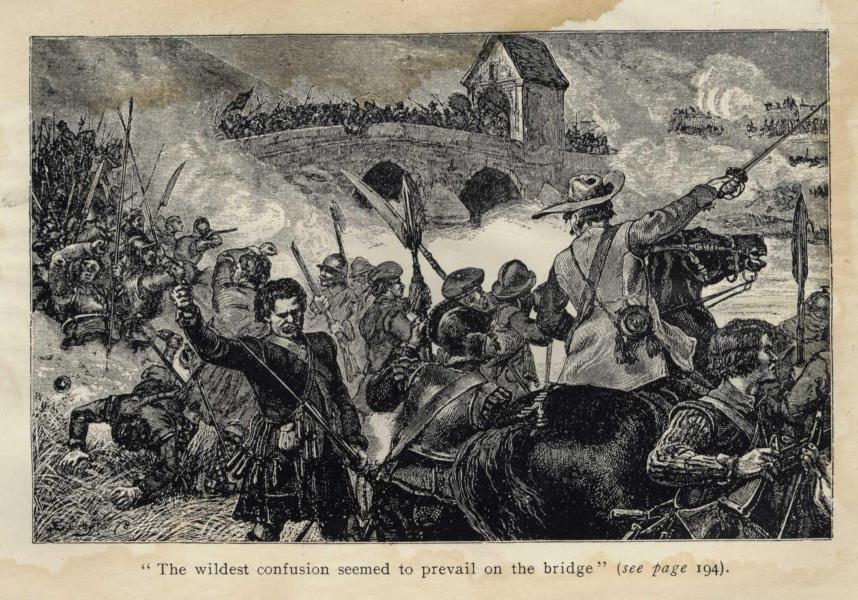
"The wildest confusion seemed to prevail on the bridge"
Seeing his brother-in-law engaged with a dragoon, and that he was like to fall, Adam Hepburn stepped aside, and thrust the trooper through the heart, just as Hartrigge fell.
"Mortal?" he inquired briefly, bending down over him, thus doubly risking his own life by a moment's swerving from his post.
"Yes, to-night I shall sup with my Lord Jesus, and see my son. Tell his mother," Andrew Gray gasped; then Adam had to see to himself, for he was nearly surrounded. Step by step that brave band was driven from their post, one by one they fell, until but a remnant remained. These at last were finally driven from the last foot of the bridge, and Monmouth ordered his entire battalion to mount the cannon and pass over. The remnant turned to flee, but only those who were on horseback had a chance to escape. Rathillet and Balfour, seeing all was lost, gave spur to their steeds and rode rapidly off the field. Adam Hepburn, with faithful Watty McBean, who was wounded in the shoulder, fled on foot, but being pursued by a party of the Duke's army, were taken prisoners, with hundreds of their brethren fleeing across Hamilton Muir. The soldiery disarmed every man among their prisoners, divested them of half their clothing, and ordered them to lie flat down on the ground, warning them that any movement would be followed by instant death.
"I say, Adam Hepburn, whaur will the minister o' Broomhill be, think ye?" queried Watty, who was lying beside Adam, and groaning grievously with the pain of his wound.
"I have not set eyes on him since before we went into action," said Adam. "Oh, for a horse, Watty, to get clean off this fatal field!"
"Ye may say it. I dinna believe this is mysel'," replied Watty. "I was aye a peaceable man, an' to think I should come to this beats a'. I maun just ease mysel' up a wee an' look roond for the minister."
"Watty, if you do, it will be your death," Adam warned him; but Watty was not to be repressed, and accordingly raised his head. No sooner had he done so, than a bullet came whizzing past his ears, and then another, which did not miss its mark. A deep groan escaped Watty's lips, and he rolled over on his side. In a few minutes all was over, and poor Watty had gone where he would inherit that peace which had been so dear to his soul on earth. Adam Hepburn groaned also, in the bitterness of his soul. Of all his kindred and friends was he alone left upon the face of the earth, a desolate outcast, for whom the prison tortures were in reserve? With his own hand he had cut down seven troopers on Bothwell Bridge; only one more well-aimed stroke, and he had been released from his vow!
Oh, if he had but shot or stabbed the trooper who had disarmed him, instead of tamely submitting, although his own life would have been instantly forfeited, it would have but been an end of all his troubles! But Adam Hepburn had still a desire to live. Although he had no craven fear of death the thought of it was not so pleasant as it was to many of the suffering remnant, whose daily prayer had been that they might be taken from these weary troubles into the rest prepared for those who endure for the Master's sake.
The captain commanding the battalion which made all these captive was about to give orders for a general slaughter, when an aide-de-camp from the Duke brought the command that as many prisoners as possible should be spared alive. But there was a body of cavalry pursuing the fugitives who had escaped on foot, and all they overtook were instantly cut down.
The thirst for blood and vengeance being awakened in the breasts of many of the royal officers and men, the most horrible suggestions were made, such as that all the country, including the towns in the west, should be burned, and a general slaughter made of the people; but the Duke of Monmouth very firmly and indignantly set all these infamous proposals aside, and gave peremptory orders for the exercise of due mercy towards the defeated rebels. He thus showed himself a generous and noble-hearted man, and gave evidence in his actions that it had been against his own desire that he had been compelled to suppress the Covenanters in such a summary fashion. But he could not altogether influence those under him, neither could he see everything with his own eye, and the poor prisoners, at the hands of his subordinate officers, met with but little mercy.
It was decided that the prisoners be conveyed to Edinburgh. They were accordingly tied two and two together, and driven before the soldiery, who treated them with the greatest barbarity.
Adam Hepburn had for his companion the godly Mr. John Kid, one of the most devoted sufferers for the cause.
"This is a grievous day for the name and cause of our sweet Lord, friend," said Mr. Kid, when, after the march was begun, he could get a word spoken.
"It has been a bloody day, indeed!" answered Adam Hepburn. "It had been otherwise had there been fewer vile wranglings in our midst. Saw you not how many stood aloof, and left a handful to defend the bridge?"
"Aye, truly my heart was riven by these sad dissensions among the brethren," said Mr. Kid. "You were not, then, of that protesting party which stood back because certain brethren who had accepted the indulgence were in the ranks?"
"No, truly," replied Adam Hepburn, with a slightly bitter smile. "It was all one to me, who or what fought beside me, so long as I got in grips with the enemy."
"Is it so sweet to you to shed blood, my brother?" inquired Mr. Kid, in a mild tone of surprise. But just then a dragoon rode past, and observing that they talked, gave Mr. Kid a blow across the cheek with the flag of his sword, which caused the blood to flow from his nostrils in a copious stream. Being in bonds, he could not endeavour to staunch it, and was therefore in a pitiable plight, seeing which the soldier, with a loud and brutal laugh, bade him hold his blasphemous tongue, unless he desired another blow to keep it company.
"Oh, that I had my good blade!" exclaimed Adam Hepburn under his breath, and at the same time flashing a glance of intense hatred after the trooper.
"Let him be, poor man. He is like those Jews of old that buffeted our dear Lord, who compassionately prayed, 'Father, forgive them; they know not what they do,'" said Mr. Kid, in a quiet voice. "Shall this poor worm, professing to be His servant, not strive to follow that sweet example?"
Adam Hepburn was silent, for what was there in his stormy and rebellious soul in unison with his companion's sweet forgiveness and merciful compassion?
"Know this, friend, that not many days from now I shall be beyond the reach or power of those who can hurt or kill the body," whispered Mr. Kid, after a brief interval. "In a dream my Lord bade me be of good cheer, for these sufferings should not long continue, but should presently have an ending in His Paradise. Oh, to be there even now! But I would not that my Lord should call me until I have fulfilled my testimony, and borne whatsoever may be required of me for His cause and kingdom here."
Adam Hepburn spoke no word, and his companion, thinking him too much occupied with his own thoughts to be disturbed, presently desisted from his remarks, but comforted himself on the weary way by repeating in a low voice many sweet and precious passages of Scripture calculated to encourage the heart in these present trying circumstances.
Although night fell, the prisoners were not allowed to halt in their march, but were mercilessly kept on foot and driven before the cavalry towards Edinburgh.
In the grey dawning of the sweet summer morning they came within sight of the grey towers and turrets of the city.
CHAPTER XXIII.
IN CAPTIVITY.
The prisons in Edinburgh were so full that they could hold no more. What, then, was to be done with the twelve hundred victims brought from the slaughter at Bothwell Bridge?
The Government ordered that they should be shut into the churchyard of the Greyfriars, and there kept unceasing watch over day and night. So the old burying-ground, made memorable and sacred by another great gathering which had assembled within its boundaries forty years before, was now converted into an open gaol, the horrors of which pen could never describe.
In the Grass-market there abode still Edward Kilgour, the merchant, brother-in-law to the late minister of Inverburn. Although a zealous and worthy Presbyterian, he had never joined with his brethren in arms, but had followed the dictates of his conscience and religion more quietly at home, attending to his business and the affairs of his household, and had thus escaped molestation. He was a man now stricken in years, but was still able to perform the duties of his calling, and attend personally in his place of business. His daughter Ailie, now a middle-aged woman, had remained unmarried for her father's sake, and kept his house.
When they heard of the arrival of the prisoners from Bothwell, they were both much exercised in their minds as to whether any of their Inverburn kinsfolk should be among them.
"I'll go up, Ailie," said the old man, "I'll go up to the kirkyard, and, if permitted to approach the gates, see whether I can discern any of the faces of our dear ones among that pitiful throng. Very sure am I that, unless your cousins Andrew and David and Adam Hepburn were slain on the field, they will be there, for they would never turn their backs upon the foe."
"Do not needlessly expose yourself, father," said his daughter, anxiously. "Though you find any of my cousins there, what profit will it be but only to vex us, seeing we cannot help them?"
"You may be right, but I cannot sit still at home till I learn whether any of them be there," said the old man, quietly, and, getting his plaid about his shoulders, went out upon his quest.
Ailie Kilgour busied herself about the house, but as the time passed she began to grow extremely anxious for her father's return. He had been more than two hours gone, when, to her great relief, she at length heard his foot on the stair. When he entered the house she at once saw that he was greatly troubled, for seldom had she seen him look so grave and yet so agitated.
"Well, father?" she said, inquiringly.
"Let me sit down, my daughter, for I am exhausted with sorrow over what I have seen this day. That the Almighty does not at once interpose in the might of His omnipotent arm is, to my mind, evidence that the Church has required all these fearful sufferings to purify her from her iniquity, and that not yet is she refined enough in the fire to be a meet vessel for her Master's glory."
"Tell me what you saw, father," said Ailie, anxiously.
"Saw, lassie! Ask me rather what I did not see! Hundreds of my fellow-countrymen penned up among the tombs like beasts, without any of the comforts which the beasts of the field and the fowls of the air are allowed to seek for themselves. And, more, they are at the ribald mercy of their vile and brutal sentinels, who never cease to taunt them, asking them what has become of their God, that He does not interpose in their behalf," said the old man, with heaving chest and flashing eye, which told how his whole being was stirred.
"Did they allow you to go near the gates?"
"No; I had to stand a good distance away. No man is allowed to approach the gates, though I saw some pious and kind-hearted women enduring patiently the jibes and insults of the soldiers, thankful that they were allowed to pass some little comforts to the prisoners through the iron bars. It seems that they receive no food save what is grudgingly allowed to be given in this way."
"How terrible!" said Ailie, and her ruddy cheek blanched as the picture of the wretched state of the captives was thus vividly presented to her mind. "But tell me, did you see any one you know there?"
"Yes, I saw the face of your cousin, David Gray, the minister of Broomhill, and he also recognised me. I saw, too, a figure I could swear belongs to Adam Hepburn, though the face was so changed that I would not have known it," returned the old man, sorrowfully.
Ailie Kilgour reflected a moment in silence, and then spoke in quiet but decided tones.
"Since they allow women to carry necessaries to the prisoners, I will go at once and take some food to my cousins. I am not afraid of the insults of the soldiers, for I can bear much, and make no sign."
"My daughter, I knew your kind heart would be moved to do this thing," said the old man, gladly. "Make haste, then, Ailie, for if ever hunger and want set their mark on human faces I saw it to-day on the wretched countenances of your cousins."
Accordingly, Ailie got some food prepared, and immediately set out for the Greyfriars. As was to be expected, there were many people about, for the unwonted spectacle to be seen in the churchyard drew many to the place, some out of idle curiosity, others out of sorrow and anxiety, lest perchance any relative or friend might be among that miserable throng. The chief entrance to the churchyard was guarded by half-a-dozen soldiers, who alternately amused themselves with the prisoners within and those compassionate people who sought to minister to them from without. The captives, gaunt, hungry-eyed, and eager-looking, were flocking near the entrance, watching with painful intensity the meagre dole of provisions allowed to be passed within the bars.
Ailie Kilgour stood a little back, scanning the faces in the hope that her eyes would presently fall upon that of her cousin, David Gray. Adam Hepburn she did not think she could recognise again, having only seen him on the occasion of his marriage with her cousin Agnes, thirty years before. Seeing an old, worn-looking man, with a thin, haggard face, and flowing white hair, very earnestly regarding her, she looked more particularly at him, and then gave a violent start, for a look of undisguised recognition of her was on his face. Could that old, old man, with the bent head and tottering frame, be her cousin David, whom she had last seen in all the pride and glory of his manhood, not ten years before? The recognition was so marked, and there was something so strangely familiar in the glance of the eye, that she felt she could not be mistaken. She therefore made a sign to him, and advanced towards the gate. Her basket was then rudely snatched from her by a soldier, and emptied of its contents. The tastiest morsels he reserved for his own eating; then, pointing to what lay on the ground, he bade her, with an oath and a coarse laugh, feed the dogs with the crumbs which fell from the master's table.
A sharp retort was on Ailie's lips, for her temper was easily roused, but she resolutely forced it back, and, meekly stooping, picked up the despised articles he had cast down, and passed them through the bars. A sentinel stood close by her side to see that no word was exchanged betwixt her and the prisoners, but he could not prevent them exchanging glances with each other. The plain loaves which the pampered soldier had so contemptuously cast aside were greedily devoured by the starving prisoners. David Gray distributed a portion among those about him and retired with the remainder to a tombstone, whereon sat Adam Hepburn, a picture of utter dejection and despair. As she walked home, Ailie Kilgour's mind was filled with certain plans and thoughts, which as yet she would not even communicate to her father. She was a shrewd, clever woman, and a prudent one as well, who never got herself into any trouble whatsoever through her tongue; therefore she kept all her thoughts that day to herself.
In the course of the week she went down to Leith, ostensibly to visit a kinswoman who dwelt in that town. But instead of directing her steps to the suburbs, where the maiden lady dwelt, she took her way directly towards that busier portion of the town which clustered about the harbour. Arrived there, she sought out the house of an old school companion, who had married the captain of a trading vessel, and who lived on shore during her husband's voyaging betwixt Denmark and Leith. This woman, Mrs. Barclay by name, was strongly attached to Ailie Kilgour, because she had shown her much real kindness in a time of distress, having herself come from Edinburgh to nurse her through a serious illness. Mrs. Barclay was unfeignedly glad to see her, and bade her a warm welcome. After the usual greetings, the talk turned, as was natural, upon the grievous condition of affairs, and the woeful sufferings of the Presbyterians, and especially of those lately taken on the field of Bothwell. In the course of their talk, Ailie informed Mrs. Barclay that her two cousins were among those imprisoned in the Greyfriars, and then asked when Captain Barclay was expected in port.
"On Sabbath morning, if the wind favour him," responded Mrs. Barclay. "And he will be at home for a few days before leaving to fill a cargo at Queensferry for Copenhagen."
"You can guess my interest in enquiring about your husband, Effie," said Ailie Kilgour, with a slight smile. "You have often said you wished you could repay what I did for you. It is in your power now, not only to repay me, but to place me for ever in your debt, if you will persuade your husband to assist my cousins to escape from the country, that is, if they can by any means get out of their present wretched prison."
"It is a great risk to attempt such a thing, and is accounted a grave offence," said Mrs. Barclay. "Nevertheless, I will very gladly do my utmost. I do not think William will be very difficult to persuade, for he is a real Covenanter at heart."
"Then if I come down again, say upon the Sabbath night, I will see Captain Barclay himself, and get his advice," said Ailie. Then warmly thanking her friend, she went away home. That same day she again prepared a basket of food for the prisoners, and about the sunset proceeded with it to the Greyfriars. Being now known to the sentinels, they did not seek much to molest her, and she was allowed to pass the food through the bars, though one kept guard as formerly, lest any words should pass betwixt them. As Ailie took one small loaf out of the basket, she lifted her eyes to her cousin's face, with a look of such deep and peculiar meaning, that he at once understood he was to keep it to himself, there being something of special importance about it. Having, as was his wont, distributed a portion among a few of his less favoured fellow-sufferers, David Gray rejoined his brother-in-law, who occupied his usual position of listless despairing dejection on one of the tombs. So utterly impossible was it to arouse for a moment his extreme apathy, that David Gray sometimes feared lest Adam's mind had become unhinged by too long dwelling upon one morbid idea. Looking round, to see that none was particularly watching him, David Gray broke in two halves the loaf to which Ailie had directed his attention, and found in the inside a small slip of paper, whereon were some written words, which he immediately perused with feverish eagerness. They ran thus:--
"There are steps being taken for your flight from the country, in the vessel of a friend now lying at Leith. If you can make good your escape, and come here, we will assist you."
"See, here, Adam Hepburn, say, did ever such a thought occur to you?" queried David Gray, furtively slipping the paper into his brother-in-law's hand.
"Yes, the thought of my escape has never once left my mind since we came here," said Adam. "I have gotten the plan matured now, and if you will join me, I think it could be done."
"I am willing and ready," said the minister, eagerly. "What is your plan?"
"I have two, either to boldly scale the wall yonder under cover of the night, and trust to our speed to make good our escape," said Adam, "or else by stratagem creep down to the little gate at the north side, where they consider two guards sufficient. Surely, David, you and I yet could silence a man apiece."
"Desperation lends a new courage to a man when he is in straits," said the minister, thoughtfully. "I would be for trying the north gate in the darkness, but we will wait till Ailie comes again."
On the Sabbath evening, Ailie Kilgour again journeyed to Leith, and found Captain Barclay at home. She also found him sympathetic, and willing to assist, although quite conscious of the risk he incurred in aiding and abetting the escape of Government prisoners. There was one thing in his favour, however, that he was first to convey a cargo from Leith to Hamburg, the Queensferry commission being set aside, so that his passage would be direct from one port to the other.
The harbour and other officials in the employment of the Government were strictly enjoined to rigorously inspect every outward bound vessel, in quest of fugitives, but Captain Barclay did not despair of being able to steal a march upon them in some way or other. He was a bold man, and loved a spice of adventure by sea or land, so Ailie Kilgour knew the matter was safe in his hands.
She was to carry another message to the prisoners next day warning them to try and make good their escape the following night, as Captain Barclay expected to be ready to sail at daybreak on Tuesday morning, and unless they were at hand, could not possibly delay voyaging on their account. Late on the Sabbath evening, Ailie Kilgour and her father were sitting by the kitchen fire, discussing the probability of the prisoners' escape, when they heard a great scuffling on the stair, and a low knocking at the door.
Both started to their feet in alarm, and Ailie, recovering herself first, at once went and undid the bolts. What was her unutterable amazement to behold upon the threshold David Gray and Adam Hepburn!
"Are you pursued?" she asked, in a breathless whisper, and at the same time holding the door wide open.
"Not here; they have lost the scent, and are following us out the Lanark road," they responded. "Except God had veritably helped us this night, by sending down a thick mist when we leaped the wall, we had been both dead men," added David Gray, reverently; then suddenly, in the painful intensity of his feelings, he bent his head on his hands and burst into tears. Looking upon his emaciated frame, guessing the weakness which encompassed him, they marvelled not at his lack of self-control.
The old man now came forward, and being assured that they were indeed there in the body, and not pursued, he bade them, with tears of joy, welcome to his house.
The night was spent in earnest discussion, as to the next step to be taken on the morrow. Adam Hepburn expressed his readiness to go aboard, since it mattered not what became of him, but David Gray shook his head.
"The Almighty, who covered us this night with the wings of His mist, must have some other work for me here," he said. "My soul does not bid me leave Scotland, and my heart cleaves to mine own kindred, upon whose faces I have not looked for many weary days. Therefore I will travel westward as opportunity offers, knowing that except of my Lord's will the enemy shall not again lay hands on me."
On the morrow Ailie Kilgour produced a seaman's dress, which Captain Barclay had given her for a disguise to one of the prisoners, and when Adam Hepburn had shorn off his beard, and attired himself in this garb, his nearest kindred could not have recognised him. It was then agreed, that instead of stealing to the port in the darkness, he should walk boldly down in the broad light of day, and present himself at the abode of Captain Barclay, who might then take him on board publicly as one of his crew.
So Adam Hepburn bade farewell to his friends in the Grass-market, walked without molestation over to Leith, and was duly taken on board the Bittern. The vessel was rigorously inspected before she sailed, but no suspicion being attached to the crew, she was allowed to quit the harbour, and in the dawning of Tuesday morning was out in the open sea.
CHAPTER XXIV.
DELIVERED.
As it was by no means safe for David Gray to sojourn with his kinsfolk in Edinburgh, he was anxious to get away as soon as possible. Ailie Kilgour, with a true woman's ingenuity, had decided upon a plan whereby he might make the journey by easy stages, and without molestation, to Inverburn. Nevertheless, she was somewhat afraid to lay it before her cousin, lest he might laugh at her for her pains. After Adam Hepburn's departure, her father and cousin were sitting discussing ways and means by the kitchen fire, when she came in, bearing in her hand an old linsey-woolsey gown and a faded tartan plaid, which had belonged to her mother.
"All these plans you speak of are too dangerous to be undertaken, Cousin David," she said. "What do you say to disguising yourself as a female hawker, and thus pursue your journey, not only with safety, but with profit?"
In spite of the gravity of his position, David Gray burst into a hearty laugh, such as had not passed his lips for many a day.
"Oh, Cousin Ailie, give me a woman for ingenuity!" he exclaimed. "But what would I make of my beard and my white hair?"
"Follow Adam's example and shave your face smooth and clean," said Ailie. "As for your hair, after it is fastened up under a white cap, it will the better help your disguise."
"Are you in earnest, Ailie, woman?" queried her father, in no little amusement.
"Father, I am in dead earnest," she said, soberly. "I have everything to dress him with, and when I run out for needles and cotton, and buttons and other sundries to plenish his basket with, the disguise will be complete."
David Gray had for a moment fancied his cousin merely joking, but seeing she was in earnest, the feasibility and even the wisdom and cleverness of her suggestion appeared to him quite plainly.
"Cousin Ailie, I believe I will try your plan," he said, suddenly. "I will at least put on the disguise and see what manner of a woman I present."
Much pleased, Ailie ran to the adjoining room for the other articles of attire, and brought also her father's shaving things, in order that her cousin might remove his beard. She then retired, and after about half-an-hour they called to her to come and see the disguise. When she looked upon the complete and wonderful transformation it had made, she nearly clapped her hands with delight. The minister was certainly a tall woman, but in every other respect he was the exact picture of what he wished to represent.
Ailie took her little tartan neckerchief from her shoulders, tied it above the white cap, and then retired back to admire the effect.
"Cousin David, that is just the finishing touch!" she exclaimed, in no small glee. "Your appearance would deceive the cleverest person in the world, I am sure. You look exactly like an aged dame who has weathered a good many storms on the road. If you don't reach Inverburn in safety in my mother's old gown, my name isn't Ailie Kilgour."
"What say you, Uncle Edward?" asked David Gray, turning to the old man.
"Truly, lad, the deception is most wonderful," he replied. "Of course it is hardly a fitting thing for a minister of the kirk to tramp the country in an old wife's gown, but desperate ills need desperate remedies. So I would say, take the lassie's advice, and God go with you."
"Well, I will," said David Gray, "for in my own person and garb I am convinced I should never reach Inverburn alive, nor, indeed, get beyond the environs of Edinburgh."
"You said the pursuers went by the Lanark road," said Ailie. "Your plan will be to go to Stirling, and then across the moors. I daresay you will find the way."
"Easily," responded David Gray, cheerfully. "You are a clever, far-seeing woman, cousin; the thought of such a disguise would never have entered my head."
"It will be a great joy to me, Cousin David, if I am rewarded by saving your life," she said, with a smile and a tear, and so the matter was settled.
All that day David Gray remained in hiding in his uncle's abode, and early on the following morning he bade them both a warm farewell, and set out upon his journey back to his native place. As Ailie watched the gaunt, uncouth-looking figure with the basket and the big cotton umbrella stalking down the street, the very picture of a practised peddling woman, she scarcely knew whether to laugh or cry. So a woman's ingenuity twice outwitted the sharpness of the Government.
We have been long absent from the vale of Inverburn, yet truly nothing of note was happening there, only a dreary and despairing waiting for the dawning of a brighter day, occasionally deepened and intensified by some deed of violence or brutal pillage executed by the dragoons, who infested the entire west of Scotland. Since the fateful day of Bothwell severities had been increased, greater licence given to the soldiery, and less mercy extended to the suffering country folk, whether there were anything against them or not. Along the entire course of the Clyde the country presented a most dismal aspect. In place of smiling homesteads and rich and fertile fields, there was nothing to be seen but smouldering ruins and tract upon tract of desolate wastes, which had not been upturned by the plough for many a year. The population, though now sadly thinned, was in a state bordering upon starvation, everything they had formerly possessed having been stolen from them, and every means of subsistence removed. Yet still it seemed as if the words of Scripture must needs be literally fulfilled, since from him that had not was taken even that which he had. Hundreds had no shelter in the wide earth save that afforded by glens and caves and mountain fastnesses, and even there they were not safe.
The farm of Hartrigge had not escaped these later desolations, for now all that remained of that once substantial and even imposing homestead was one cot-house, which had escaped the flames on account of it being detached from the main buildings, and having thus been overlooked by the ruffians, who, after pillaging the entire place, had set it on fire.
In this humble abode dwelt the widow of Andrew Gray, his sister Jane, and a young lad with his sister, the Sandy and wee Nannie, who had been so dear to their father's heart. Jeanie was now safe with her father and Gavin in that land where eternal peace abides. The bairn's heart seemed to be weighed down by the things happening around her, and she just faded away.
Strange as it may seem, the few yet remaining who loved her on earth saw her depart with gladness, for it had come to that pass in poor stricken Scotland that he who lay down to die was accounted much more to be envied than he who was preserved alive.
One beautiful evening towards the end of July, Susan Gray and her sister-in-law, Jane, were sitting together on the bench outside their cottage door, with their hands lying idle on their laps, a thing they would have accounted a sin in the days of the happy past. But now there was nothing for hands to do, and life was at times a very weariness. These troublous years had wrought a woeful change upon both those women, and had aged them long before their time. Also upon the face of Susan Gray there appeared at times a vague, wandering kind of expression, which seemed to indicate a weakness of the mind, and verily it was not greatly to be wondered at that the nerves of women-folk should be unable to bear the awful strain upon them.
They were not conversing together, for such sorrows as theirs will not bear to be spoken of by the lips; there was a hopeless, purposeless look about them, which was painful in the contrast it presented to their busy, cheerful energy of long ago.
"See Jane!" said Susan Gray, presently. "Is not that a figure on the road? Is it Sandy or the bairn Nannie? They should be on their way home from the village now."
"No; it is a taller figure than either of the bairns," replied Jane. "It is a woman, and she has a basket on her arm."
"Is she like a gangerel [tramp], Jane? She need hardly come here seeking now," said Susan, listlessly.
"Yes, she looks like that. There are not many of her kind on the roads now," said Jane. Then they relapsed into silence, and so sat until the woman with the basket appeared on the path in front of the cottage door. Susan Gray only gave her a careless look, and then went into the cottage, leaving Jane to deal with her.
"My woman, ye need hardly have come this length with your basket," said Jane Gray, kindly, and looking compassionately at the evidences of fatigue on her face. "The wherewithal is much lacking here now. But sit down on the bench here and rest a while, till I bring you a piece of bread, which, thanks be to God, we can still offer to those in greater need than ourselves."
So saying, she pointed to the bench, and retired into the house. The woman set down her basket, and dropping on the seat, covered her face with her hands, and uttered a low but passionate prayer of thankfulness. In this attitude Jane Gray found her when she again stepped out of doors. She laid her hand on the bent shoulders, and said kindly, "You seem quite overcome. Have you travelled many miles this day?"
Slowly the stranger's head was raised, and a pair of eyes fixed themselves on the kind, womanly face with a glance which stirred her very soul; and, without knowing why, she began to tremble from head to foot.
"Sister Jane, do you not know me?" said the voice of one she had mourned as dead. "Then indeed my disguise is as complete as Ailie Kilgour assured me. I am your brother David!"
Jane Gray uttered a low cry, which brought Susan hurrying out to the door. The moment, however, that her eyes rested keenly and sharply on the stranger's face, they penetrated the disguise, and she exclaimed--
"David Gray, as I am a living woman!"
"Even so; thus far the Almighty has brought me through many perils to my native parish," said the minister of Broomhill, fervently.
Jane, having now recovered her first shock of surprise, embraced her brother with great joy, the tears chasing each other down her cheeks in her emotion. So the name of Gray was not entirely swept off the face of the earth, as they had bitterly imagined, and there was hope for the old house yet. They hastened to take him in, and set refreshment before him, after partaking of which he related to them all that which had befallen him and his brethren since they had last met.
Greatly rejoiced were they to learn of Adam Hepburn's escape, but they shed many tears over their hardships in the prison yard at Edinburgh. As David in low and earnest tones delivered his brother's last message to his widow, the tears flowed from her eyes, but in a gentle rain which brought healing with it. It was for these precious words her widowed heart had long and sorely hungered. It was decided that so long as it was considered safe, he should abide under his disguise with them, though a few trusty brethren in hiding in the district would be duly informed of his safety.
So a little sunshine penetrated the dark cloud, and shed a measure of brightness on the hearth of the poor little cottage at Hartrigge.
CHAPTER XXV.
AIRSMOSS.
Poor Watty McBean's hole in the Witches' Cleugh had indeed been of great benefit to many fugitives, and it had never been empty since the fleeing after the slaughter at Bothwell. During the next day the minister of Broomhill repaired in his disguise to that safe hiding, in order to see the brethren there, and so commune with them regarding their present state, and the future fate or welfare of them and such as them. As he pursued his way leisurely along the sequestered and lonely paths which led to the cleugh, he mused much on the wonderful way in which the Lord had led him hitherto. He also marvelled within himself that he had been so long spared, and in his heart there was a petition that he might be made willing and glad to continue his suffering and weary way through life, until the Lord should see fit to call him to Himself. These profitable and godly communings were interrupted somewhat summarily by the abrupt appearance of two dragoons, who came rapidly riding up from the direction of the cleugh, and who immediately drew rein at the sight of the woman, as they imagined the wayfarer to be.
"Hulloa, mistress! do you know anything of that confounded lair where so many Whigs sleep in safety?" queried one, fixing his piercing eye on the face of David Gray.
"Truly the Whigs have had many hiding places in this district," he answered, mildly. "To what one do you specially refer?"
"Faith, I hardly know; it is somewhere about these hills or in the valley between," said the dragoon, pointing backward to the cleugh. "We are creditably informed that several very noted rebels were concealed there, and me and my mate swore an oath that we should find the place, which has baffled the king's soldiers so long. We have made a thorough search, but can find no clue."
"I never heard of any place of concealment among those hills," said David Gray. "Those who are so eager to inform sometimes overreach themselves, and----"
"Leave the hag in peace, Munro!" interrupted the younger man, impatiently. "I believe she is right enough, and we were told lies to beguile us. I for one will get away out of this confounded district with what speed I can. My horse is dead lame, see, stumbling through that accursed ravine."
Marvelling much at the very easy manner in which he had escaped questioning, David Gray watched the two ride away, but did not then pursue his way to the cleugh, lest he should unwittingly betray his brethren. But his soul, long separated from such as had suffered like persecutions with him, was yearning for the sweet fellowship of brotherly counsel, both for the strengthening of his own hands and heart, and also to learn, if possible, whether any of the more noted saints were still alive. He felt himself deeply and peculiarly blessed in the communion he was privileged to obtain with that poor remnant of his kinsfolk still dwelling in the parish of Inverburn, and during the evening of that day the women and the young folk at Hartrigge were much edified with his conversation and with his exposition of the Word. It was long, indeed, since such a joy had been vouchsafed to them. Owing to the somewhat limited accommodation of the humble dwelling which now sheltered the Grays, the lad, Sandy, went down to Inverburn to sleep in the house of an old woman, who gladly gave him shelter for his father's sake. Nannie, with her aunts, abode in the kitchen, and the best end was given up to the minister. They retired early to rest, and in spite of the troubles and anxieties which encompassed them, very soon all beneath the roof-tree of the cottage were asleep. The atmosphere had been dull and heavy all day, and the night was dark and starless; the low-hanging, sullen presaging rain, of which the parched earth stood in sore need. About midnight Susan Gray, who slept lightly, was awakened by a sound she had heard so often during these past weary years, that she could not mistake it now. It was the tramp of hoofs, and in a moment a wild fear that even already the minister was betrayed took possession of her soul. Hastily awaking Jane, both strang up, threw on their outer garments, and stealing over to the casement, which was a little ajar to admit the fresh air, they peered fearfully out. The night was utterly, intensely dark, and they could see nothing, but they could hear now both the trampling and the snorting of horses, and also at a little distance the low, eager voices of men. Through the still, soundless air their strained ears caught these words:--
"He shall not escape us this time, I swear! Egad! it was a clever disguise!--a wench's idea, without doubt. To think that old hag we met peddling her wares in Walston was that veritable heretic David Gray, and we knew it not! It is enough to make a man ashamed of himself!"
Swiftly and silently Jane Gray stole across the narrow passage to the inner room, and awakened her brother, who was enjoying a very sound and refreshing repose. By the time she had made him aware of the danger at hand, the troop had quite surrounded the house, and a great noise broke the stillness of the summer night.
David Gray sprang from his bed to the floor, thinking his hour was come. And yet, was it but to be slain in cold blood like this that the Lord had let him get clear away both from the slaughter at Bothwell and the wearisome captivity of the Greyfriars?
In that moment of agonising suspense and apprehension, when he was striving to prepare for death, even with a soul yearning for life, his eye, as if guided by some unseen power, fell upon the wide, old-fashioned chimney, and in a moment his resolution was taken. Even when the foot of the enemy was on the very threshold of the outer door, the fugitive wrapped a plaid about his white night-clothes, and, committing himself to the God who had so often delivered him, he hastily scrambled up the chimney and out on to the roof. Jane Gray did not see him perform this extraordinary action, she having gone to accost, and, if possible, conciliate and delay, the officer at the outer door.
Without hesitating a moment, knowing he would speedily be observed on the roof, David Gray lay himself flat down, and, sliding down to the eaves, dropped to the ground in front of a mounted dragoon. The apparition in waving white garments terrified the horse, and caused him to rear and plunge wildly, so that his rider was almost unseated. In the momentary confusion that ensued the fugitive took to his heels, and in a brief space was out of sight and beyond pursuit. Meanwhile, quite unconscious of this miraculous escape, Jane Gray was endeavouring to parley with the officer at the door.
"Sorry to disturb your repose, sweet mistress," he said. "If you will but deliver up that renegade, David Gray, who is sheltering here, we will go away and leave you in peace."
"David Gray!" ejaculated Jane Gray, faintly; "what men-folk have we under this roof-tree, sir? The only stranger here is a relative, who has travelled a great distance on foot to sojourn awhile with us, if that be a fault in your eyes."
"Does the stranger wear a linsey-woolsey gown, a tartan plaid, and a white cap, and peddle ribbons and laces to the country lasses, eh?" queried the captain, with grim humour. "To show you that we do not doubt your word, bring out the old lady, so that we may pay our respects to her. Methinks we have met before."
At her wits' end, Jane Gray turned about and went into the room, which, to her astonishment, seemed to be empty. The captain followed her, and, not finding the fugitive there, strode into the kitchen. Susan Gray and Nannie were there, and it needed but one glance at their faces to tell him that neither was the person he sought.
"Your kinswoman has hidden herself, I perceive," he said, grimly. "You had better bid her come forth, or I will give orders to set the place on fire. I have no time to dally here; it is time all honest folk were in bed."
"We are guiltless of hiding him you seek, sir," said Jane Gray, no longer attempting to deny that her brother had been sheltering with them. "And, truly, where in this small abode could he hide? It is a mystery to me where he has gone, unless, indeed, the Lord hath miraculously aided his escape."
At that moment one of the dragoons came hurrying in to say that the prisoner had without doubt made his escape from the roof, and was already beyond pursuit. Then the captain fell into a great rage, and cursed and swore in a manner which made the women-folk tremble. And truly it was a sore disappointment to the man to have had so valuable and notable a Covenanter within his very reach, and yet to be baulked so simply. In his fury he was like to have taken the lives of the fugitive's kinswomen, but was persuaded by a more merciful subordinate to let them be in peace. Nevertheless, he caused lighted brands to be held to the thatched roof of the cottage, and, being dry as tinder, it immediately took fire.
In a short space of time the darkness of the night was illumined by the flames of the burning cottage, and the three defenceless women, now rendered indeed utterly homeless, hastily gathered such small but valuable things as they could carry, and, withdrawing themselves a little, watched the rapid destruction of the only shelter they could call their own on the face of the earth. Yet they could not feel utterly cast down, since God had so marvellously delivered the dear fugitive out of the hands of the pursuer once more. The captain and his troop immediately rode away down to the village, to inflict themselves on such of the inhabitants as could yet give them bite and sup and shelter for the night. Meanwhile David Gray fled, under the grateful cover of the darkness, by the familiar field-paths to poor Watty's famous hiding, where he knew he should find both shelter and comforting welcome from his brethren. His long residence in the cleugh had made him so familiar with it, that even in the darkness he had no difficulty whatever in finding the thicket which hid the cave. And yet he had to creep slowly and with caution, for the nettles and brambles and brushwood proved very formidable to his uncovered limbs, and his feet were already bleeding from coming into contact with the stones as he made his rapid flight from the cottage. As he came up nearly to the mouth of the cave, he gave a long, low whistle, which Jane had told him was a signal understood by those in hiding. In a few minutes it was answered by a similar sound, and the brushwood was carefully swept aside from the mouth of the cave, and he saw the figure of a man.
"Who comes?" a voice said, in an anxious whisper.
"A brother in sore straits, whom the Lord, of His good pleasure, hath this night marvellously delivered," answered David Gray, and at that the man standing at the mouth of the cave stretched out his hand and drew the new-comer into the dimly-lighted recess beyond. In this place there were no fewer than seven persons, both old, young, and middle-aged, whose faces were thin and worn, as if they had suffered much privation. They looked with no little astonishment upon the strangely-attired figure which appeared so suddenly in their midst, and one, an elderly man, of very grave and reverent aspect, after looking intently on his face, jumped up and grasped him by the hand.
"David Gray, an I mistake not, whom I last saw in grips with the enemy at Bothwell Brig!" he exclaimed.
"And whom the Lord hath marvellously preserved from that woeful day to this," supplemented David Gray. "Little did I think last time we met, Mr. Donald Cargill, that we should look upon each other's faces again, and in this place of all places."
"Verily, strange are the vicissitudes of the scattered remnant of the Lord's Zion," said Mr. Cargill. "I have been obliged to keep in hiding these few days, being sore pursued by a troop of dragoons for preaching at Lanark and at various other places in Clydesdale; but come, tell us what hath befallen thee of late, and by what means thou art come hither in this strange attire."
Nothing loth, David Gray entered upon the recital of his exciting experiences during the last two months, and when he had finished, Mr. Cargill had his story to tell, and in this pathetic and mournfully interesting talk the night speedily wore away. Although Mr. Cargill had been obliged to flee for his life to the shelter of the cleugh, it was impossible for one of his ardent and restless spirit to remain long inactive. As soon as they heard from a trusty reporter, who carried them both provisions and news from Inverburn, that the hot pursuit was slackened in the neighbourhood, he announced his intention of going forth once more to the preaching of the Word.
Fired by the eloquence and zeal of the old man, and feeling himself much persuaded to testify in public once more, David Gray petitioned that he might be allowed to go forth in company with him. So the twain quitted their hiding, and travelled eastwards towards Edinburgh, preaching as they went, and meeting with many perils, out of which they had many marvellous deliverances, which would occupy too long a space to recount. In the spring of 1680, new life was infused into the scattered and sometimes fainting remnant, by the return to Scotland of that eloquent preacher and godly man, Richard Cameron, who had been persuaded to retire to Holland for a time previous to the Battle of Bothwell.
In his exile his heart had never ceased to yearn over his suffering native land, and the desire to cast in his lot with his persecuted brethren became so strong at length, that it could not be set aside. It was with great joy that the few earnest souls still left welcomed him back to their midst, and Donald Cargill and David Gray immediately joined themselves to him, and the three went about continually preaching and exhorting the people to hold fast to their faith, for the cause for which they suffered was just and righteous, and must in the end prevail.
It was not long ere these faithful and undaunted men became specially observed of those in high places, and they were vigorously and relentlessly pursued from place to place, but managed to elude the vigilance of those following so continuously in their track. Among Cameron's most close and faithful adherents was brave Hackstoun of Rathillet, who, since Bothwell, had been a wanderer on the face of the earth, having given up all for Christ's sake.
One summer's day a small party of horsemen rode into the little town of Sanquhar, and startled the good folk both by their wayworn and haggard appearance and by their proceedings.
They drew rein at the market cross, and Richard Cameron, their leader, dismounted and slowly read a declaration denying the right of Charles to the throne of Scotland, stigmatising him as a tyrant and perjurer, and solemnly declaring war against him for all time coming.
That done, they rode away as rapidly and mysteriously as they had come, and did not halt till they reached a lonely spot among the hills, where they ventured to rest awhile.
"After what we have done this day," said Mr. Cameron, wiping the midsummer heat from his brow, "I fear it will no longer be safe for us to continue together; and besides, I cannot but think that were we to separate away in different directions we could the better break the bread of life to our starving brethren. What say you, Mr. Cargill? Were it not better that each man of us should go his own way, preaching and exhorting wherever the Lord giveth time and opportunity?"
"Truly, brother, your suggestion savours of wisdom and prudence," said Mr. Cargill, with approval. "But ere we separate we had better agree as to a time when we can again meet together to compare our experiences and strengthen each other's hands for renewed conflict."
"I fear me, brethren, that the end is nigh at hand for more than one of us," said the sweet voice of David Hackstoun. "I, at least, have been visited of late with very precious presentiments of a speedy release from these troubles. Therefore I would say it matters little whether we be together or separate, seeing that, save it be the Lord's time, no evil can befall us."
"Strange that Mr. Hackstoun's presentiments should have visited me likewise," said Richard Cameron. "I am convinced that my race is nearly run; therefore, during what little space is still vouchsafed to me on this earth, I would continue my Lord's work with renewed vigilance, lest when He cometh He should find his unworthy servant asleep."
"As regards Mr. Cargill's proposal that we should make an agreement to meet, I fear that would be useless," said David Gray. "I think we should but wish each other God speed, and leave our future meeting in God's hands. Doubtless, if it be His good pleasure, He will bring us together again in due season, if not here, in His own kingdom, whither we are all hastening with more or less speed."
This latter suggestion was approved, and, after holding a solemn farewell service together, they parted, not knowing whether they should look upon each other's faces again. Mr. Cameron travelled westward to New Monkland, preaching boldly as he went, to the no little comfort of the few to whom the pure Word was yet precious. Hackstoun and David Gray, with a few others, kept together in the south; but hearing, not many days after, that a heavy price was set on Cameron's head, and that he was being vigilantly pursued, they conferred together and decided to retire to the west and band themselves about him, so that, in the event of the enemy falling upon him, there might be some to defend him and render him deliverance out of their hands. Accordingly, a guard under Rathillet travelled across the familiar, and now sacred, ground in the south-western district, and came up with Cameron in Avondale, near the memorable field of Drumclog. To their joy, they found Mr. Cargill with him, and on the Sabbath day a solemn service was held, in which all the ministers took part. Mr. Cameron preached the sermon from the words, "Be still, and know that I am God," and as the eloquent and stirring words fell from his lips, it was noted that his countenance seemed lighted with a radiance not of earth. After the service Mr. Cargill went his way farther west, after agreeing that he should meet Cameron and the rest at Dermeid Muir on the following Sabbath day. During the next few days Cameron's conversation was that of a man who was not long for this world, and he never ceased to exhort those with him to continue steadfast yet a while, for Scotland's deliverance was at hand. He prophesied that the reign of bloodshed and terror would speedily be over, and that the Lord's Zion would ere long be rebuilt upon the ruins of her past and present desolation. On the Wednesday of that week he was sojourning in the house of a godly man at Meadowhead, on the Water of Ayr, and to him and the folk with him in the house he expressed his conviction that the Lord would, in a few hours' time, require him to seal his testimony with his blood. Hearing some report of a troop under Bruce of Earlshall making vigilant search for him and his party, Cameron and his friends agreed to retire to the wild moorland which stretched for many miles between Cumnock and Muirkirk. It was a vast and dreary wilderness, covered with heather and bracken, unrelieved by a green tree or a nodding floweret even in the midsummer time, when all Nature was rejoicing in her wealth and beauty. Towards the east end of this moor Cameron and his friends, being sore fatigued with a long march in the burning heat of the day, lay themselves down awhile to rest. In this solitude they were surprised by the enemy--a large number of soldiers under Earlshall--who came sweeping across the moor with a fury and speed which made it quite impossible for the faithful little band to escape. There was nothing for it but to fight, which the brave remnant immediately decided to do, and quietly but resolutely looked to their arms, and set themselves in order for the fray. It was a pitiable sight upon which the summer sun beat that July afternoon--that handful of God's people dauntlessly facing a goodly regiment of dragoons, all fresh and eager for the fight. Ere the enemy was quite upon them, Cameron led the devotions of his brethren, and in his prayer said, with great fervour, "Lord, spare the green and take the ripe."
Then they exchanged a hand clasp and a solemn farewell, pledging each other to meet in glory.
It was a desperate fight.
The Covenanters fought with conspicuous gallantry, and, even after brave Cameron fell, they continued the conflict over his dead body.
Seeing that there was no hope of victory, and that Rathillet and some others were already taken captive, David Gray, in a last extremity, leaped upon the back of a horse whose rider had been slain, and, rapidly galloping off the field, made his escape. Only one or two others were equally fortunate, and so once again the Covenanters were swept away before the oppressors like chaff on a windy day.
Richard Cameron's remains were carried to Edinburgh, and his head was fixed on the Netherbow port, where it was left to moulder and blacken in the sun. Rathillet, after the usual mockery of a trial, was subjected to terrible and searching tortures, which he bore with a firmness which astonished those who had seen evidence of his sweet yielding nature. His troubles were finally ended on the scaffold, and he went to receive his exceeding great reward. Thus it seemed as if this most precious blood of the Covenant, yea, every drop of it, must be spilled upon the ground, ere the hour of Scotland's deliverance had come.
By slow degrees, and through many strange perils, David Gray wandered wearily back to his native parish. There were times when the weight of his many sorrows was like to overwhelm him, and when he could have cried out for the inheritance in heaven, to which so many of his brethren had already been admitted.
Lurking in the wild solitudes of the mountains, depending for his sustenance upon a few ears of corn, or some of the wild fruits of the earth, it was little wonder if at times his soul fainted within him, and he felt impelled to question the wherefore of these tribulations. In his weakness he was also frequently tempted fiercely by Satan to abjure the cause for which he suffered, and to purchase life and immunity from persecution at the Government price. But by God's grace he was enabled to pass unscathed through these fiery trials, and when at last he crept, a worn and wasted shadow, up his native vale, and sought the shelter of the witches' cleugh, his heart was once more at rest, and abiding steadfastly on the Lord Christ. There were yet some fugitives in Watty's hiding-place, and out of her undying love for the cause, Jane Gray still, when opportunity offered, and when she possessed the wherewithal, stole thither with some relief. Great was her astonishment and joy to behold there her brother David, whom they had of late quite given up as dead. The sight of a familiar and loved face restored anew David Gray's courage and confidence, and he prayed earnestly to be forgiven his temptations to backsliding, with which he had been so sore beset in his desolation.
In spite of the increased vigilance of the oppressors, meetings were still held on the hill-sides and in sheltered nooks, for there yet remained some who would do and dare anything to hear the faithful preaching of the Word.
Very often David Gray led these services, and at last it got noised abroad that he was at large in the district of Inverburn, which, coming to Claverhouse's ears, made him swear a great oath that he should have his head. But although on several separate occasions he had him almost in his clutches, the Lord interposed, and in many marvellous ways vouchsafed deliverance to His faithful servant. About that time it became almost an impossibility to hold a conventicle, for it was certain to become a massacre, so largely were the country districts infested with dragoons, yet there was indeed very little of the old leaven of the Covenant now left in the flesh, for the new generation which had arisen since the first glorious upstanding for the cause was lukewarm and indifferent, and too much taken up with the things of the world to concern themselves much with religious matters.
Within two years after Bothwell a great grief fell upon the few yet remaining faithful to the old cause.
When James II. ascended the throne, after the death of Charles, he published an Act of Toleration, on the conditions of which many persecuted wanderers were induced to return to their homes, and even some ministers to their parishes. It was as deep a snare in its way as the indulgence of Charles had been, its ultimate object being to establish Papacy in Scotland. Into this net many fell, and it indeed seemed as if the martyrdom of the saints were to have no good harvest in the land. But it being now the darkest hour, the dawning was at hand.