ADAM HEPBURN'S VOW (continued 2)
Reading edition
"All these are the beginning of many sorrows."
That sermon was never forgotten by any who heard it. It seemed as if the aged servant of God had risen above the frailty and feebleness of age, for as he proceeded his clear bell-like voice rang through the building with all the eloquence which had made such a stir among the dry bones in the earlier days of his ministry among them. He spoke passionately and prophetically of the sea of troubles upon which the Lord's Zion was now launched, he forewarned them that the time was at hand when they would need to testify to their faithfulness with their blood, yet he bade them be of good cheer, because it was through great tribulation that the brightness of their eternal crown would be gained in joy.
"And now my faithful and well beloved flock, the time has come for me to bid you farewell," he added in conclusion. "In the ordinary course of nature I could not expect to minister to you for a much more lengthened space. As it is, the fiat has gone forth, not from the Eternal King, but from the poor despicable worm who sits upon an earthly throne that you and I, beloved, shall no more worship together within this place. Looking upon its walls to-day for the last time I know how unspeakably dear it is to me. It is peopled with rich and hallowed memories of the past. In this place I have baptised many of you as children, and here, my own children, now worshipping with you, were all consecrated and received into the Lord's Church. Beloved, from Sabbath to Sabbath these many years I have broken the Bread of Life in your midst, and God be my witness that I have expounded the Word to you in accordance with the light vouchsafed to my own soul. I have also had sweet counsel with you in your own homes, in the ordinary course of pastoral visitation, and I call you to witness that in these visitations I have never failed to be faithful in my personal dealings, when I saw it to be for the glory of God, and for the good of souls. Beloved, all that has come to an end. Next Sabbath day neither you nor I will worship within these walls. When or how the doors will again be thrown open for public worship I cannot say. I tremble when I think upon our now desolate Kirk of Scotland, cast out from her heritage, and bidden make her habitation in the wilderness. It is not for me now, and in this place, to say what will be the reward of these sons of Belial, who have wrought this woe in our midst. 'Vengeance is mine, I will repay, saith the Lord.' Brethren, farewell. I would my tongue could utter what is in my heart this day. It is with no common sorrow I repeat the words; Brethren, farewell."
The minister ceased, and looked with eyes of unutterable love upon the sobbing multitude. There was no dry eye in the assembly, save that of Andrew Gray the younger, and his seemed to burn with a strange and lurid fire. His hands beneath the book board were so firmly clenched together that the nails were sunk into the flesh. In the midst of these audible tokens of grief, the minister raised his trembling hands, and in slow, clear, solemn tones, breathed upon them his last benediction. Then he sank back in the pulpit, wholly overcome.
The scene I have just described was no solitary instance; in its main features it was being enacted that day in almost every kirk and parish in Scotland.
In the church of Broomhill that day David Gray also spoke his last farewell to his flock. His was not in any respect so united a congregation as that of Inverburn. There were many, who, for peace' sake would have had their minister bow to Middleton's decree, and make an outward semblance of acknowledging the bishop. David Gray entered his church that day with a heavy heart, not because of the sacrifice he was about to make--that occasioned him but little concern--but because of his wife's coldness and estrangement evinced towards him since he had announced his fixed determination to abide by the dictates of his own conscience. Upon the plea that the younger child could not be left, she absented herself from the church that Sabbath morning; and the minister was not surprised to behold the Haughhead seat unoccupied likewise. He delivered an impressive and heart-stirring discourse from the words, "He that taketh not his cross, and followeth after Me, is not worthy of Me," and when he concluded many were weeping. They crowded round him as he came out of the vestry, shaking him by the hand and assuring him of their continued and unaltered love, and offering assistance in every form. It was with difficulty he escaped their loving detention, and, making his way through the churchyard, entered his own garden by the private door. He reproached himself that he did not feel a lively satisfaction in the thought that he had renounced so much for conscience' sake; he felt sore angered at himself for his miserable and foreboding thoughts, which weighed him nigh to the very dust. As he set foot upon the threshold of the manse, he felt oppressed by the strange stillness of the house. On ordinary occasions, the prattle of his children's voices was the first sound which greeted him at his own door. As he stepped into the house, he heard a sound, like that of weeping, proceeding from the direction of the kitchen. Somewhat alarmed, he immediately proceeded thither, and found Ellen Carmichael, the maid, sitting apparently in the very abandonment of grief.
"Be quiet, Ellen Carmichael, and tell me the cause of this noise," he said, with some sternness. "And what has become of your mistress and the bairns?"
A fresh burst of tears was Ellen's only answer; but at length she managed to sob out some words which whitened her master's face to the very lips.
"They're awa', sir; a' awa' tae Haughheid. The laird cam' wi' the coach jist efter the kirk was in, an' the mistress gaed awa' in't, wi' the bairns, an' a' her claes an' the bairns' claes, an' she said she wasna' comin' back. An' I, sir, what cud I dae but sit doon an' greet, thinkin' on you comin' home tae this empty an' desolate hoose?"
The minister turned about and walked with unsteady step back to the pleasant family room, where, with his wife and little ones, he had spent so many happy hours. It had a desolate, deserted, dreary look, and the very fire seemed to have died in despair in the grate. He looked about him in a dazed manner, and then sinking into a chair, these words escaped his lips in a deep groan of anguish:
"If I be bereaved of my children, I am bereaved."
Verily that was a day of sharp and bitter searching for the minister of Broomhill; nevertheless, ere the hushed silence of the night fell, he had found peace in his desolate home.
CHAPTER VIII.
MR. DUNCAN MCLEAN.
In the course of the ensuing week, the last of the honourable family who had so long dwelt beneath the roof-tree of Inverburn manse, quitted its shelter for ever. Pen fails me to describe fitly that sad farewell. It was indeed a very rending of the heart-strings to the venerable minister of Inverburn. In spite of the wording of the Act, that every ejected minister should remove without the bounds of his Presbytery, Mr. Gray and his daughter went no farther than Adam Hepburn's house at Rowallan, where they were very warmly welcomed. So long as was permitted, they would remain among their own kith and kin. The minister of Broomhill found a shelter at Hartrigge, so that united and affectionate family were not as yet separated one from the other.
On the next Sabbath day no kirk bell rang its sweet, familiar chimes through the quiet Sabbath air. The gates of the churchyard remained closed, and the only sign of life about the venerable pile was the cawing of hoarse-throated rooks, which had assembled by scores on the leafless boughs of the "birks of Inverburn," as if met in convocation over this strange and sad Sabbath day. Betty McBean had gone home to her brother Watty's house in the village; and blithe enough he was to see her, being a bachelor, with no womenkind to make a bite for him or to clean up his house. On the Saturday word was carried through the parish by Watty that the Word would be preached next day in the barn at Rowallan by their beloved shepherd, and all whose soul thirsted for the living water were invited to attend. And, lo, at the hour of meeting, so great was the press thronging in Adam Hepburn's barn that it was hastily decided to hold the meeting out of doors. So a kitchen table with a settle behind it was erected as a pulpit in the corn-yard, and from this the minister of Inverburn preached to his flock. Something in the unusual nature of the proceedings seemed to stir all hearts and to imbue them with a holy enthusiasm. Never had the psalm been sung with such deep fervour; never had the attitude of the hearers been so rapt and reverential. There was something in the knowledge that it was against the law that they assembled together which lent a strange, sweet, yet fearful joy to their relish of that Sabbath day. Hartrigge, with all his family, was there, and the minister of Broomhill also took part in the service. When they separated, just before the twilight, all felt that it had indeed been good for them to be there; and they said one to another, that so long as they could get the Word by walking to Rowallan for it, the king's decree might not prove such a hardship as had been anticipated. But, alas for their vain hopes, their happy congratulations! the day was near at hand when listening to, as well as preaching, the Word was to become a crime worthy of death itself.
The Laird of Inverburn, with Lady Hamilton and the young heir, had driven in their coach that day to Lochlee, to hear John Methven preach. On their way home they passed so many dressed people on the roads, especially as they neared Inverburn, that a suspicion of the truth began to dawn upon the mind of the laird.
Just outside their lodge gates they overtook Watty McBean and his sister Betty, leisurely wending their way homewards. At a word from the laird the coachman pulled up his horses.
"Here, McBean," said the laird, in his peremptory fashion, "tell me why there are so many people on the road at this hour. They look to me as if they had been at kirk somewhere, though very sure am I that none of them worshipped with me to-day at Lochlee."
"Did they no', Sir Thomas? but how should I ken whaur a' the folk hae been wanderin' tae?" asked Watty, innocently. "Mebbe they've been awa' seein' their freens or takin' a bit walk tae theirsels, like Betty an' me."
Very red grew the face of Betty McBean, as she heard her brother utter this deliberate falsehood, and she tugged vehemently at her cap strings, to give some vent to her feelings.
"I believe you are telling me a lie, sirrah!" said the laird, wrathfully, "and if you are it will be the worse for you. Here, you woman, you were the manse maid, I think," he added, directing his remarks to Betty. "Can you tell me whether it be true that your minister is still in the parish, in fact that he is under the roof-tree of Adam Hepburn, at Rowallan?"
"Oh, Sir Tammas, my lord, dinna mak me tell a lee," said Betty piteously; "ye wudna hae me get my auld maister into trouble. He----"
"Betty, if ye dinna haud yer tongue, and come on, it'll be the waur for ye," shouted Watty in her ear, and taking her by the arm, dragged her right away from the coach, and past the gate of Inverburn, without so much as making an apology to the laird.
Sir Thomas looked angry, but his wife sank back, laughing, in the coach, not sorry that Betty had not committed herself.
Lady Hamilton's sympathies were much with the Presbyterians, but she was of too sweet and gentle a disposition to set up her own opinions in opposition to those of her husband.
"Eh, Watty McBean, man, hoo cud ye tell sic a barefaced lee?" queried Betty when her brother released his grip on her arm. "Did the thocht o' the fire and brimstane, which the Word says is the portion o' leers, no pit the fear o' death on yer tongue?"
"Hoot ye silly crater, there's lees an' lees!" quoth Watty, with an air of superior wisdom. "Was I gaun to get the minister and the flock into a peck o' troubles wi' my lang tongue? I see I'll need to keep an e'e on you, Betty. Auld though you be, ye hinna muckle gumption."
"Ye're no feared either tae daur [defy] the laird," said Betty, with a sigh.
"I'm no awn the laird naething, and he canna gar me speak against my will," said Watty, calmly; and Betty, completely overcome by her brother's undaunted spirit, relapsed into silence.
For several weeks the parish kirk at Inverburn remained closed, and the people worshipped with the ministers they loved either in barn or outhouse, or, when weather permitted, under the canopy of heaven. Such a state of affairs, which betokened such utter disregard and contempt for the Prelacy, could not long be allowed to continue undisturbed. The next step taken by the bishops was to fill the places of the ejected ministers with curates of their own, so that the parishioners might no longer have the closed doors of the churches to point at as an excuse for their behaviour.
Sir Thomas Hamilton, a staunch loyalist and an intimate friend of the Bishop of Glasgow, offered his shelter and patronage to any gentleman his lordship might elect to minister in the church at Inverburn.
It was on the third Saturday in January that a notice was posted up on the church door intimating that public worship would be resumed next Lord's Day by Mr. Duncan McLean, at the hour of noon.
The bellman was also sent round, and the news well circulated throughout the parish. It occasioned no little excitement and talk; but the people, with the exception of a few of the laird's pensioners in the village, had not the smallest intention of attending upon the curate's ministrations. Service was to be held at three of the afternoon in the sheltered glen behind the house of Hartrigge, and as Watty McBean expressed it--
"When folk could lift Presbyterian wheat for the gaun [going], it wasna likely they wad be content wi' the curate's puir chaff."
About eleven o'clock on the Sabbath morning, Betty McBean, watching from the window, beheld the coach from Inverburn coming rapidly over the manse brae, towards the village.
"The laird's in't, Watty, an' a jimpy black body, wha'll dootless be the curate, and Peter Rintoull, the bailiff, 's on the box aside the coachman," she cried, excitedly. "I'll bet ye what ye like they'll be comin' seekin' you tae gang up by an' ring the bell."
"Let them come, I'm ready for them," said Watty serenely. "But gang you intae the ben-end [parlour], or yer waggin' tongue'll play mischief."
Only too thankful to be relieved from the necessity of again meeting the laird's questioning gaze, Betty hastily retired into the ben-end just as the coach drew up at the door.
"Watty, Watty McBean!" called out the coachman. "Coome oot; Sir Tammas wants ye!"
Watty took his pipe from his cheek, and retired slowly out to the door, a very uncouth looking figure in his rough homespun garb, and his unwashed unshaven face surmounted by a dirty red night-cap!
"Why are you not more decently attired, McBean? It is time you were getting ready for the service," said the laird sternly. "This is the new minister of the parish, Mr. Duncan McLean."
"Ay, so I was thinkin'. I canna say I'm prood tae see Mr. Duncan McLean," said Watty, in his canny way, and giving his somewhat loose nether garments an expressive hitch. "If he's come tae a cauld pairt, it's no' his blame, puir chield. I'm thinkin' he'll no' be lang afore he gangs back tae them that sent him."
Mr. McLean looked much surprised, and not too well pleased at the man's freedom of address.
"The man is witless, Mr. McLean, a half crazy loon, whom nobody heeds," the laird explained, and then he turned his stern eye on Watty's unruffled countenance. "Look here, McBean, go into the house and put on your Sabbath garments as fast as you can; and see that you be up to ring the kirk bell at the usual time."
"Eh, me? they telt me the Bishop wad send a bell-ringer an' a minister's man wi' the curate," said Watty, with well-feigned astonishment. "Sir Tammas, it's perfectly unpossible that I could be ready at the time. Just look at me; I've a week's dirt tae scrape aff my skin, no' tae mention that my claes taks an hour tae aire afore I cud pit them on without catchin' my death."
The laird bit his lip.
"This is gross impertinence, McBean, for which, as I sit here, I swear you shall not go unpunished. Once for all, will you or will you not be ready to perform your usual duties in the bell tower and the session house in half an hour?"
"That I winna, Sir Tammas; seein' the lord bishop, or whatever be his title, has made the kirk session of Inverburn null and void, he has made the minister's man null and void too; so Maister McLean maun e'en get a man for hissel," answered Watty, with fearless resolution. Then he fixed his keen eye on the ill-favoured face of the curate, and addressed a concluding remark to him. "Ye hae taen muckle upon yersel', young man, tae step into the honoured shoon o' the Reverend Maister Gray. An' if ye get but a cauldrife hearin' this day ye may blame no' the faithfu' folks o' Inverburn, but them that sent ye."
With which comforting assurance Watty turned about, and entering his own house, shut the door.
"If this is the disposition of the parish, Sir Thomas," said the curate sourly, "I fear stronger measures will be necessary ere long."
"If necessary, doubtless they will be taken, Mr. McLean," said the laird. "But do not be cast down by the insolent utterance of a half-witted fellow like Watty McBean. I cannot think the people of Inverburn will so far forget their respect to me, as well as to those in power, as to follow such an example."
One of the laird's servants was procured to undertake Watty's duties, and the bell was duly rung at the appointed time. But it appeared to convey to the hearts of the people no welcome summons to the House of God. Only a few stragglers, and these persons of no note in the parish, came dropping into the church, and when the hour struck there were not more than thirty persons present, and these included the laird and his retinue from Inverburn. Nevertheless the service was proceeded with, and conducted after the true Episcopal fashion; prayers being read from the new book of service. The curate was humiliated and ashamed, the laird furious, and on their way home to Inverburn the two discussed various plans whereby the people might be compelled to attend service in the church.
The following morning Sir Thomas started on horseback to make a tour of the tenantry on his estate, in order to see what they had to say in defence of their absence from the church on the previous day. His first place of call was Rowallan, but before he reached the house he met Adam Hepburn leading one of his work-horses to the smithy. Adam doffed his cap to the laird, and stood still, not unprepared for what was coming.
"I have called to see for what reason you absented yourself from Divine service yesterday, Hepburn?" the laird said briefly, and without greeting of any kind. "Do you know that in so absenting yourself you were guilty of a civil offence?"
"I know not as to that, Sir Thomas; but if a man's heart be not in the service, he is better at home," replied Adam, quietly. "And the king has no power over a man's own conscience."
"See here, Hepburn," said the laird; "is that old man, your father-in-law, still under your roof-tree?"
"He is, Sir Thomas," answered Adam, in the same quiet tone.
"You know the wording of the Act which commands that the ejected ministers shall remove themselves without the bounds of the Presbytery? Rowallan is not without these bounds. I have it in my power to have your father-in-law punished, imprisoned if I like, by simply letting my friend the bishop know how his commands are disobeyed."
A dark red flush rose to Adam Hepburn's brow, and he bit his lip. The hot blood of his race sprang up at the laird's threatening and mocking words.
"And you would make betrayal of the old man the price of my non-attendance at the curate's preaching, Sir Thomas," he said with curling lip. "Such a threat is scarcely worthy of your name. I fear that such measures will not avail with the God-fearing people in the parish."
"You defy me then, sirrah; then be prepared to take the consequences," said the laird furiously, and digging his spurs into his horse's sides, turned the animal's head, and rode away full gallop to Hartrigge, only to have his ire additionally kindled there by the cool defiance and dogged determination of Andrew Gray.
CHAPTER IX.
PREPARING FOR EMERGENCIES.
When the laird rode away, Adam Hepburn turned and walked slowly back to Rowallan. He was somewhat disturbed by what he had heard, not on his own account, but on that of the venerable father of his beloved Agnes. When he entered the room where the minister sat with his daughter Jane, Mrs. Hepburn being busy with her household work, both saw that he was troubled about something.
"Have you heard aught about the preaching yesterday, Adam, that you look so grave?" queried the minister.
"Yes; I met the laird down the road, and he seems sore displeased over the thin attendance at Mr. McLean's ministrations yesterday," replied Adam, a little quickly. "He threatened me, too, that unless I attended the services he would get you into trouble, Mr. Gray."
"I said to you, Adam, my son, when you so nobly offered me the shelter of your roof-tree, that it might get you and yours into trouble, harbouring an ejected and rebellious minister," said the old man sadly. "Better let me go forth ere that trouble comes upon your house."
"Go forth! and whither? At your age, and in the dead of winter, to wander in the open air as some are compelled to do would mean certain death," said Adam Hepburn. "No, no; though I am not such a red-hot churchman as Hartrigge, still, whoever seeks to molest you, be he king's or bishop's official, must first deal with me."
Tears started in Jane Gray's eyes as she looked with pride and gratitude at the erect figure and manly face of her brother-in-law. At that minute Agnes, hearing such serious voices, came in from the kitchen, asking what was the matter. Adam Hepburn turned his blue eyes fondly on his wife's sweet pale face, and smiled to reassure her.
"We are like to get into trouble, wife, by our dourness to attend the curate's preaching, that is all," he answered lightly.
A slightly troubled look stole into Agnes Hepburn's gentle eyes.
"I know not why, but I have of late had many dark forebodings, Adam," she said. "These are sad, sad days in which we live, and especially trying for timorous women-folk like me."
"It is your poor health, dear one, that makes you fanciful. No harm can come upon Rowallan so long as my stout right arm retains its cunning," Adam answered, lightly still; but Agnes, shaking her head, stole back to her duties with a heavy heart.
"I am concerned about Agnes, Jane," said Adam Hepburn, turning his troubled eyes on his sister-in-law's face. "She is not well, and in her sleep is restless and troubled, as if haunted by some strange dread; and she is so thin and worn. Looking on her face, at times I am afraid."
"When the spring time is past she will gather strength, please God," said Jane, cheerfully. "Agnes never was strong in the spring time."
"No; and these exciting and troublous times are too severe a strain upon her sensitive heart," said the minister. "As Agnes herself says, they are not for timorous women-folk to live in."
For some weeks they heard no more of the laird or of his threats, although report had it that severe measures were about to be taken to compel the people to respect the authority of the bishops and to attend upon the ministrations of their curates. Ere long these rumours became terrible realities, and a troop of brutal and unprincipled dragoons, under Sir James Turner, was let loose upon the western and southern shires of Scotland, which they scoured in search of the ejected ministers, and of their faithful flocks, who travelled miles to hear them in the mountain solitudes, worshipping with them in temples not made with hands, but which were consecrated to the Lord by the faithfulness and fearless piety of these Christian people. For a time the parish of Inverburn, although very offensive in its treatment of the curate, escaped the severity with which many other parishes, notably those in the shires of Galloway and Dumfries, were visited. It was at length, however, publicly announced from the pulpit that all who failed to attend Divine service on the following Sabbath day would be apprehended and punished either by fine or other penalty, and that all who gave aid to the ejected ministers or who attended upon their services in the open air were liable to be dragged before the High Commission Court, of which Sharp was the head, and there punished according to the prelates' good pleasure.
Adam Hepburn heard unmoved that report, as also did his brother-in-law at Hartrigge, where David Gray, the minister of Broomhill, was still sheltered, almost, however, at the peril of his life. When the dragoons at length came to Inverburn, he hid in the day-time in a cunningly-concealed cave on the face of the hill upon which Hartrigge stood, and the existence of which was known only to a very few. It was in a spot so difficult of access, and was, besides, so well hidden by brambles and nettles and other brushwood, that for a time at least the fugitive was perfectly safe.
When Sir James Turner and his troop arrived at Inverburn, he, with his subordinate officers, was immediately offered shelter by the laird, while the men were drafted upon various households in the village, notably those who were known to be very zealous Presbyterians. Watty McBean's house was taken possession of by four coarse, swearing, drunken soldiers, who raised Watty's ire to the utmost pitch and nearly frightened Betty out of her wits, besides eating her out of house and home.
At nightfall on the day of their arrival, Watty stole away through the fields to Rowallan to give timely warning to its inmates to get the minister removed out of the way before he should be taken prisoner. He crept up to the room window and gave a familiar tap on the lower pane, lest a knocking at the door might alarm the household. Adam Hepburn himself came to the door, and, at a sign from Watty, stepped outside.
"I've jest come tae warn ye, Adam Hepburn, that Turner an' the sodgers came this nicht," he whispered. "An' by what I hear the rascals, wha hae taen my hoose frae me, sayin' tae ane anither, it's oor minister an' the minister o' Broomhill they're after. Hae ye ony means o' getten Maister Gray outen the road?"
Adam Hepburn nodded.
"We knew the soldiers were on their way to Inverburn, and I'll warrant they'll no lay hands on the minister, or they'll be sharper than I think them. Come in, Watty, and speak to Mr. Gray. He's still with us in the house."
"Ye dinna mean to say so!" exclaimed Watty in consternation. "Certy ye're no feared. If ye take my advice ye'll get him awa' intae safe hidin' as sune as possible. I was sayin' tae Bettie I kent a bonnie howdie hole on the Douglas Water doon the Sanquhar road a bit, that it wad puzzle the sodgers tae find."
"Keep your secret for awhile, Watty. It may be useful some day," said Adam Hepburn, and beckoning to Watty, he ushered him into the warm ingle-neuk, where sat the minister of Inverburn in undisturbed serenity, with his daughters by his side.
"Good evening to you, Watty McBean, my faithful friend," said the minister, rising to shake hands with Watty. "What tidings have ye brought?"
"No very braw [nice] for leddie's ears. The sodgers have come upon Inverburn at last, an' gin they bide lang ther'll be neither bite nor sup, nor an article o' gear in the parish," answered Watty dolefully. "The four villains quartered on us have already pocketed my watch an' my mither's spunes, no' tae speak o' Betty's brooch she got frae yer lamented wife."
Agnes Hepburn's pale cheek grew, if possible, a shade whiter, and instinctively her husband moved to the back of her chair, and laid his firm hand on her trembling shoulder as if to re-assure her.
"Adam, if this be so, my place is no longer here!" said the minister rising. "My son, I have already stayed too long, not only at the peril of my own life, but it is imperilling yours likewise. It will be better for me to keep my hiding-place now, both night and day."
"You will lie down first, father, and snatch a few hours rest," said the sweet voice of Adam Hepburn's wife. "At the cock-crowing Adam will awake you, and you can hide until the nightfall."
"Oh, ye'r safe eneuch till the daw'in', sir," Watty assured him. "The laird's wine, an' soft beds, an' routh [abundance] o' breakfast 'll keep Sir Jeems at the big hoose, I'se warrant, till the sun be up."
"Certainly you will do as Agnes says, Mr. Gray?" said Adam, in his decided way. "Now, Watty, if you'll say good-night, and come with me, I'll show you a 'howdie hole' which would match yours on the Douglas Water."
"Guid nicht, then, Maister Gray, an' may the Lord blind the e'en o' the sodgers, and keep you oot o' their clutches," said Watty with fervour. "Mistress Hepburn an' Miss Jean, guid nicht wi' ye baith; an' should ye need a strong arm and a willint heart at any time, to defend ye, mind that Watty McBean's ay ready!"
"Good night, my faithful Watty; and may the Lord give you patience to bear the infliction of the soldiery on your abode. Provoke them not to anger, Watty, I entreat, for I am told that they are very swift to shed blood," said the minister, earnestly.
"I'll thole [bear] as long as I can, I never was a fechter," said the good soul, with a comical smile, and pulling his forelock in token of respect, he followed Adam Hepburn out of doors.
The moon had now risen, and its clear radiance struggled through the rifts in the cloudy sky, and shone weirdly and fitfully on the wintry landscape, making strange fantastic shadows too on the walls of the outhouses grouped about the farmhouse. Adam Hepburn stepped across the courtyard, and opened the barn door. He then motioned to Watty to enter, and after carefully closing the door, lighted the lantern he had brought with him from the house. The barn at Rowallan was a large and commodious place, with a steep ladder-like stair ascending to the granary above. In one corner a small door gave admittance to an inner apartment, something resembling a closet in a house, and into which the chaff was swept after it was separated from the wheat by the flail. At the present time it was, however, almost empty, there being only a slight sprinkling on the wooden floor. Into this place Adam Hepburn threw the light of his lantern, and then looked enquiringly at Watty.
"What do you see there, Watty, anything by ordinar?" he asked.
"Naething but a common chaff-hole," answered Watty, "and no' a very safe hidin'-place, I wad think. The Douglas Water hole beats it yet."
"Come in, though, Watty, and I'll show you something," said Adam, with a smile, and Watty stepped into the place, in which he could scarcely stand upright. Adam then set down his lantern, and with his hands swept aside the chaff, but still Watty saw nothing save a moth-eaten and discoloured wooden floor. But when Adam inserted into some of the seams the strong blade of his gully knife, and Watty saw a distinct movement in the flooring, he began to have an inkling of what was coming. After some little exertion, Adam Hepburn raised a small trap-door, sufficient to admit the body of a man, and Watty peering into the chasm, with excited interest, saw a ladder which appeared to lead into the bowels of the earth.
"Now creep down after me, Watty, and shut the door after you, and I'll show you something worth seeing," said Adam, and Watty made haste to obey. The ladder was of considerable length, but at last Watty felt his feet on the firm earth, and looking about, saw by the light that he was in a subterranean passage, narrow certainly, but of sufficient height to accommodate even Adam Hepburn's tall figure. Still following his guide, Watty walked a little way along the passage, and then found himself in a kind of cave, a wide open space, sufficient to hold about a dozen people. There was a rude couch composed of stones, built in one corner, upon which now had been piled a substantial tick filled with chaff, above which was spread plenty of blankets and thick coverings, which would make a very comfortable resting place, even in winter. A piece of rough matting covered the floor in front of the bed, and there were some benches which formed a table, or could be used for seats. The floor of the place was perfectly dry, and the atmosphere felt warm and free from dampness. Watty gazed round him in unmitigated astonishment and admiration, and at lasted gasped out--
"This is a howdie hole, an' nae mistak'! Whaur did it come frae, an' wha made it?"
"It has always been here. I believe my great-grandfather, who was killed at Flodden, had something to do with it," replied Adam Hepburn. "At any rate, not a living soul knows of its existence but our own family and you, Watty. But you don't know half its advantages yet. See, the underground passage continues right through here," he added, shedding the light of his lantern into another dark recess; "and what do you think? it runs right through the fields of Rowallan, and under the bed of the Douglas Water, and comes out in the middle of all the brushwood and tangle on the face of the Corbie's Cliff. Ye didna ken there was a hole there, did ye, Watty?"
"No; although I hae speeled [climbed] the Corbie mony a time for nests when I was a laddie," said Watty, solemnly. "It seems as if the Lord had made the place Hissel'."
"Mr. Gray can be made very comfortable here, Watty," continued Adam Hepburn; "and, by the simple pulling of a string I have fastened up in the chaff-hole, I can make a noise which will warn him to escape by the Corbie should the soldiers discover the trap. But I don't think there can be any fear of that."
"No' likely, for I couldna see onything but the flure," said Watty, in much glee; "an' I'm no' blind. Eh, weel, may be mair than the minister 'll be glad o' this grand shelter."
"It is likely the minister of Broomhill will come here under cover of the night some of these days. I would think he was not very safe much longer at Hartrigge," said Adam Hepburn. "Well, Watty, I think we'd better get upstairs again, and you can tell Betty that we are ready for the soldiers whenever they like to come."
"'Deed, Maister Hepburn, I'll no' tell her naething. Weemin folk are no' to be trusted. No' that they mean tae dae mischief; it's jist their tongues, puir craters, fashed [troubled] wi' a weakness, an' they canna help themselves," said Watty, so seriously that his companion could not refrain from laughing.
After some little delay, they again mounted the ladder, and, pushing up the trap-door, emerged into the chaff-hole, and thence out into the open air, where, after a few more words concerning the shelter of the ministers, they parted for the night.
CHAPTER X.
ADAM HEPBURN'S VOW.
The business of life seemed to be standing still in Inverburn. Although it was not the season of the year in which much outdoor labour could be accomplished, the barren fields still lay waiting to be upturned by the plough, and all interest in the ordinary routine of work seemed to be absorbed in other things. The morning after the quartering of the soldiery on the householders there were many strange sights and sounds witnessed and heard in the quiet hamlet of Inverburn. Needless to say that the inn was the chief rendezvous, and honest Mistress Lyall had to pour out her ale and whisky, and even her small stock of wine and brandy, without stint or payment. The swearing horde took possession of the bar, and, in the terror of her soul, poor Katie Lyall flew to a neighbour's house, and left them in undisturbed possession. Having drunk their fill, the ruffians made a raid on every house, lifting what valuables they could lay hands upon, and insulting the women, and bringing many a burning blush to the fair cheek of youth. The unarmed and defenceless men folk in the village were only deterred from open resistance by the sight of the long gleaming swords and loaded pistols of the troopers. But curses, not loud but deep, filled the quiet air, and many a manly hand was clenched, many a manly voice uttered a deep and ominous vow of vengeance.
About half-past nine Sir James Turner and his subordinate officers rode down the manse brae, and, drawing rein at the head of the village street, sounded the reveille. In a short time the regiment was in marching order, and the horses' heads were turned towards Rowallan. And then many a fervent prayer rose to Heaven that the God of Hosts would throw the strong arm of His defence about Adam Hepburn's house, and shelter its dear inmates from the bloody men. Early that morning Adam Hepburn had walked across the fields to Hartrigge to warn David Gray of his danger, and to bid the inmates of the house be prepared for a visit from the soldiery. He arrived to find the minister of Broomhill quietly seated at breakfast with the family, having just crept up from his hiding-place. It was at once hastily resolved that, as it was still early, Adam Hepburn and David Gray should creep down into the valley behind Hartrigge, and, keeping within shelter of the trees and brushwood, follow the course of the Douglas Water until they reached the Corbie's Cliff; then, entering the mouth of the subterranean passage, join the minister of Inverburn in his hiding at Rowallan.
The children at Hartrigge, all but Gavin, being too young to understand the peril of the hour, wondered why uncle David bade them farewell so solemnly and with tears in his eyes; and little Jeanie, listening to his last words to her mother, pondered them long in her heart.
"Farewell, Susan, my sister. The Lord requite thee for thy sisterly kindness to me, who, now a wanderer on the face of the earth, can never hope either to acknowledge or repay it. And may the Lord also vouchsafe the wings of His shelter to this house and its inmates, and shield them in the day of trouble."
Mistress Gray wrung the minister's hand, but was unable to speak. Andrew Gray himself accompanied them to the door, but their parting words were interrupted by the shrill echo of the trumpets sounding the reveille in the village along the vale. Then Adam Hepburn and the minister understanding that ominous sound, plunged into the thicket, and scrambled down the steep into the richly wooded valley below. Meanwhile the women folk at Rowallan busied themselves with their household tasks, and Agnes at least longing for her husband's return. The nervous fear had so grown upon her of late that she was never a moment at rest, save when he was by her side. As she stepped out into the courtyard with a basin of warm food for the poultry, the clatter of hoofs fell upon her ears, and turning her startled eyes in the direction of the road, she saw what appeared to be a moving mass of steel, glittering in the chill winter sunshine, and coming rapidly towards the house.
With a slight scream she dropped the basin with its contents, and fled into the house. Jane Gray, hearing the noise, came hurrying downstairs, and caught her trembling sister in her arms.
"Agnes, my lamb, what is it? What has so frightened you?" she asked, anxiously.
"The soldiers, Jane! they are here!" exclaimed the terrified girl. "Oh, Jane, hide me from them! I wish Adam had not gone away!"
Even Jane Gray's brave heart quailed at the thought of their defenceless state, but she tried to console and assure her sister.
"Don't be afraid, my dearie, they will never harm two defenceless women, and Adam must now be near home. It is nigh two hours since he went away."
Before she could say more the troops swept across the stack-yard, and drew up with a great clatter before the door. The pawing and snorting of the horses, the rattling of their trappings, and the voices of the men, made a strange and alarming din about the quiet house of Rowallan.
Jane Gray placed her sister in a chair, shut the sitting-room door, and drawing herself up, as if with a sudden courage, went out boldly to the door. She was deadly pale, but her demeanour was outwardly perfectly unmoved.
At sight of the woman, Sir James Turner, a coarse and forbidding-looking man, rode his horse up to the very doorstep, and fixed his insolent eyes on the fair, calm face.
"Well, mistress, this is the rebellious house of Rowallan, is it not? Are you the wife of that notorious Whig, Adam Hepburn, who so persistently disavows the king's commands, and shelters the rebel preachers?"
"This is Rowallan, sir," Jane Gray made answer in a clear, steadfast voice. "But I am not Adam Hepburn's wife. There is none within this house but me and my sister, who is in delicate health. May I appeal to your honour as a soldier and a gentleman not to needlessly distress or alarm us?"
A coarse laugh fell from Turner's lips, which was re-echoed by his subordinates.
"A modest request, truly; I might grant it if I get a kiss from those sweet lips for my payment. But say, is that renegade old man, Andrew Gray, the field preacher, not hidden in the house?"
"He is not," said Jane Gray, calmly, while a red spot began to burn hotly on either cheek.
"I am sorry I cannot take your word for it, mistress," said Turner, coolly. "With your permission we will make a search of the house. Here, Dawson and McTavish," he added, turning to a corporal and a sergeant, "dismount, and search the house, and you, Captain Blane, and young Drew, with the others make a thorough inspection of the outhouses. Now, ma'am, let me have a glass of ale or wine to cool my thirst, and show you a loyal subject of the king."
For peace' sake, as well as on the account of her sister, Jane Gray crushed back the indignant refusal burning for utterance, and, holding the door open, briefly bade him enter. She led the way direct to the room where Agnes sat, judging it better that she should be present with her, before the soldiers in their search reached the sitting-room. At sight of the spurred and booted soldier, with his fierce aspect and forbidding eye, Agnes Hepburn again uttered a slight scream, but Jane hastily laid her hand on her lips.
"Hush, hush, Agnes; Sir James Turner will not harm you. He has but come in for some slight refreshment," she said, hurriedly.
"Is this Adam Hepburn's wife, then?" asked Sir James, with insolent curiosity. "Do not tremble so, my sweet mistress. Unless compelled by duty, I would not lay a finger on you. But come, tell me where your brave husband, and the old man, your father, are in hiding, and we will go away and leave the house in peace."
"I do not know; my husband has not been at home for--for--long," Agnes faltered back, and breathing an inward and passionate prayer that the Lord might detain him on the way until the dragoons had left the place.
"How glibly these pretty lips can utter a falsehood!" said Turner, mockingly. But just then he was somewhat mollified by the sight of a cup of rich Burgundy, which Jane Gray had brought from the cupboard to appease his wrath.
"By the powers, I never tasted the like in a Whig house before!" he said, smacking his lips. "For your courtesy to me, mistress, I will not insist upon your revealing the rebel hiding-place. I know your kind, and how obstinate they can be when they choose; yet I swear that, if Adam Hepburn or the minister be about Rowallan, they shall not escape this day."
The two men who had been searching the house now appeared in the doorway, saying they had met with no success, and that there was no possible corner within the four walls where a fugitive could be hid.
Turner then rose and left the house to superintend the search outside.
With agonised eyes the two women watched from the window, trembling at the long delay the searchers made in the barn.
But at length, to their unspeakable relief, those who had entered it again emerged into the open air, and it was quite evident from their faces that their search had been unsuccessful.
After some little delay and consultation, Turner gave the word of command, and the dragoons sprang to horse once more, and stood ready in the courtyard to depart. Then Turner again approached the door, where the sisters now stood, for they could not rest within.
"Though we have been unsuccessful to-day, mistresses," he said, in an angry tone, "we will yet lay hands upon the renegades. I know not what keeps me from compelling you to divulge the secret of their hiding-place; but, hark! I will not be so lenient when I come back. It's not the first time I have had to make a wench confess at the point of the sword."
At that moment, to the dismay and horror of the women, Wyllie, Adam's collie, came running round from the stack-yard barking furiously. Knowing he had accompanied his master to Hartrigge, they stood in intense and silent agony, momentarily expecting to see Adam stride round the corner, and then----. Jane's lip quivered, Agnes covered her face with her hands, and a low moan escaped her lips.
Turner, thinking his threat had frightened them sufficiently, turned his horse's head, and gave the order to march. The dog, now in a perfect fury, and seeming to have taken a special dislike to the commander, ran barking and snapping at the horse's heels.
"Some of you put a bullet through that yelping cur!" he said, with a great oath. Almost as if understanding the brutal order, Wyllie turned tail and ran to his mistress's side, crouching in at her skirts. Turner's order was obeyed, and two pistols were recklessly fired towards the door, heedless of the danger to the women. They missed their aim, but found a mark in Agnes Hepburn's side. Without a sound she fell at her sister's feet. For a moment Turner looked dumbfounded and as if uncertain what to do; then, with another great oath, he repeated the word of command, and the whole troop rode off towards Hartrigge. Before they were well out of sight Adam Hepburn, just arrived in the underground shelter with David Gray, pushed up the trap-door, and stepped out into his own barn-yard. From the great confusion and marks of hoofs, he at once saw that the dragoons had visited Rowallan in his absence, and, with sinking heart, lest any harm should have befallen his darling, he hurried into the house.
At the door Wyllie met him, and looked up into his face with a piteous moan. The dread stillness in the house almost made the man's heart stand still. He strode through the kitchen, and when he stood upon the threshold of the sitting-room door, what a sight met his view! Upon the couch lay the prostrate form of his wife, and Jane kneeling by her side, apparently laving something with water. But stay; what was that staining the whiteness of the handkerchief? Was it blood?
"My God, Jane, what is this?" he asked, hoarsely, and, with one step, was at the side of the couch.
Then he saw the wound in his wife's side, from which her life blood was slowly ebbing.
"They have been here! That is their work, Adam!" Jane Gray answered, in a voiceless whisper. "The bullet intended for poor Wyllie pierced her side! Oh, my poor sister!"
Adam Hepburn knelt down by the couch, and, folding his strong arms about the unconscious figure, called his wife by every endearing name to look up to tell him she was not dead. The tones of that well-beloved voice seemed to recall for a brief space the ebbing breath of life.
The long lashes stirred on the white cheek; after a tremor of the lids they were lifted, and the sweet eyes met his in a look of unutterable love. It was the last effort of the feeble strength. In the moment of agony which followed, the breath gently left the lips, the beat of the heart was stilled for ever, and Agnes Hepburn was safe from the trouble to come.
In the deep and awful silence which ensued a strange and terrible change was wrought upon the face of Adam Hepburn. The pleasant lines and curves, which had but added to its beauty, were deepened into the furrows of a desperate resolution. Gently he laid his dead wife back upon the pillow, and, walking over to the hearth, took down his father's sword from its accustomed place on the wall, and returned with it to the side of the couch.
"I call you to witness, Jane Gray, that I swear here, by the body of my murdered wife, that this sword shall never again be allowed to dry in its sheath until it has been wetted with the life blood of as many dragoons as there were years upon my darling's head," he said, in slow, deep, measured tones, and with eyes gleaming with a fierce resolve. "And God do so to me, and more also, if I fail to stand to the very letter of my vow!"
CHAPTER XI.
UP IN ARMS.
Twelve o'clock was the usual dinner hour at Hartrigge. In spite of the stirring excitement of that morning, the table was spread punctually at noon, and the family gathered about the board. Before, however, Andrew Gray had finished asking a blessing on the food, the dragoons swept up with a great noise to the front door. Catching sight of a gleaming sword out of the window Jeanie screamed in affright, and her mother's face visibly paled. But little Sandy, in all a child's delight over a gay pageant, scrambled up on the window seat, and fairly jumped with glee at sight of so many prancing steeds. With grave, resolute, undisturbed face, Hartrigge rose from his chair, and turned his eyes upon his trembling wife.
"If I lose my life this day, Susan," he said, quietly, "promise me you will rear the bairns in the true religion, and teach them to love and reverence the Church of Scotland and the faith of their forefathers."
Mistress Gray had no opportunity to reply, for at that moment the door was rudely thrown open, and Turner, with a corporal and sergeant, strode into the room.
"Andrew Gray of Hartrigge?" he said, briefly and imperiously.
"I am Andrew Gray," answered Hartrigge, with corresponding brevity.
"A vile Whig and a bigoted Presbyterian, a rebel against the king, and a harbourer of field preachers and like vermin," continued Turner, in his coarse fashion. "I have just come from Rowallan, but the puling womenfolk there have lost their tongues, and could tell us nothing of those we seek. In the king's name, Andrew Gray, I command you to instantly tell me where your canting old father, and your brother, the minister of Broomhill, are to be found. Remember you stand at peril of your life."
Andrew Gray folded his arms across his chest, and looked his questioner in the face with undaunted eye.
"Very well do I know that I stand at peril of my life," he made answer, calmly. "But I can tell you nothing of those you seek."
"You will not, you mean," cried Turner, passionately. "By heavens, the name of Gray seems inseparable from dogged obstinacy, as well as from rebellion and treason. If I tie up your eyes and point a pistol at your mouth it may refresh your memory."
Hartrigge spoke never a word; his wife sank weeping helplessly into a chair, while the children, all but Gavin, who had left the room, crouched beside her in terror.
"Woman, bid your husband obey orders, unless you want me to leave him to you to bury!" said Turner. "I have already wasted too much precious time among your kind."
But never a word spoke Mistress Gray. Then Turner looked towards his subordinates--
"Bind the obstinate pig-headed Whig," he said, briefly. "If I cannot make him speak, we will take him to those who will."
Susan Gray uttered a loud shriek, and sprang to her husband's side; but she was rudely cast aside, while the officers pinioned Hartrigge's arms.
"Stop that howling, woman, or I will give you something to yelp about! I've a mind to burn your house about your confounded ears, but it would take too much time to-day. Let the prisoner to horse, and let us be off. We have other game to bag before sunset to-day."
As Andrew Gray was about to leave the room he stepped to his wife's side, and hastily bade her be of good cheer, for his time had not come yet; then, looking upon the children with a strange softening in his stern eyes, he waved them an affectionate farewell.
With the little ones clinging to her skirts, Mistress Gray followed the oppressors to the door, and stood watching while they bound her husband on a steed. He again turned his face towards her, and exhorted her to be of good cheer, and keep a firm hold upon her faith in God, until they should meet again. His words were brought to a sudden close by a blow upon the mouth, administered by the corporal, who was fastening him securely to the back of the horse. At sight of the blood, Susan Gray covered her face with her hands, and was afraid to look again. Ere he mounted his horse, Turner peremptorily ordered Mrs. Gray to bring him a tankard of ale, or a cup of wine, a command of which she was too much agitated to take notice. Little Jeanie, however, fearing a new exhibition of the terrible man's wrath, with womanly thoughtfulness ran into the house, and brought out a draught for the general. He smiled grimly as he took it from the slim hands of the little maiden, and having quaffed it, bade her not follow the example of her renegade father; and, mounting his horse, gave the order to march, and the troops, with their prisoner in the midst, rode away from Hartrigge. Just then the lad Gavin came through the kitchen with a flushed eager face, and bearing in his hands an old fowling-piece, chiefly used for scaring rooks and other vermin off the crops.
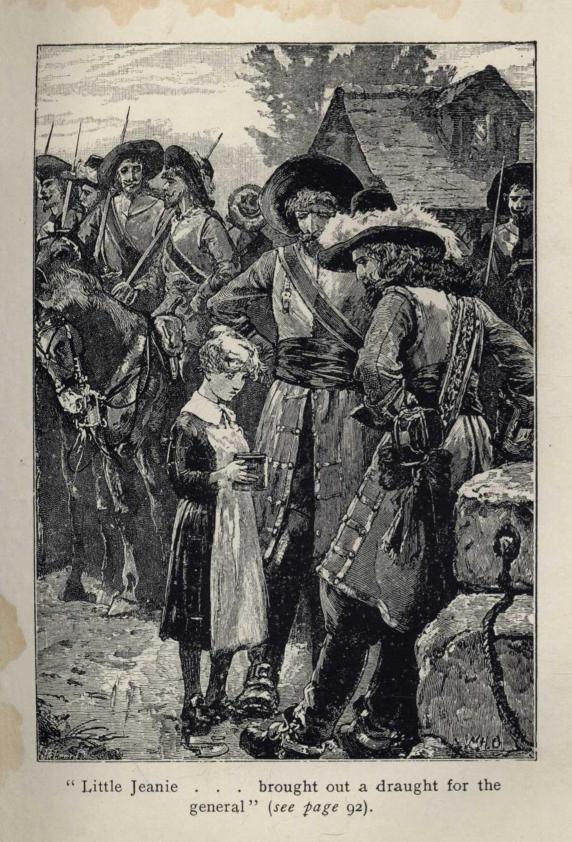
"Little Jeanie ... brought out a draught for the general"
"Why, Gavin, laddie, what did ye think to do?" asked his mother, with a mournful smile.
"Are they away, mother? If they had killed my father I would have shot Turner with this. I have been down at the tool house, loading it with some lead I got in my uncle Peter's shop, at Lanark, when I was there with Uncle Adam," replied the lad, fearlessly.
"Then they would have surely killed you, too, my son," replied the mother, shaking her head; though inwardly admiring the spirit of the boy. "Well, well, Gavin, you will need to take care o' us all now that your poor father is away."
"Mother, what do you think they'll do to him?"
"My son, how can I tell? But I dinna feel as if any great harm would come to him, for he says his time is not come yet," replied Mistress Gray. "I think the Lord in His mercy will restore him ere long to his wife and bairns. But now, Gavin, get away by the fields to Rowallan, and see whether all be well there."
Just at that moment, however, a messenger on horseback appeared at the door, conveying the terrible tidings from Rowallan, and bidding Hartrigge and his wife come over at once. Susan Gray, dumb with horror, sat helplessly down, and wrung her hands in despair. Not having heard the right way of the story, her hopes concerning her husband's comparative safety swiftly ebbed away, for since they spared not a defenceless and delicate woman, how could they allow such as Andrew Gray to escape unhurt? So desolation and woe fell upon the houses of Rowallan and Hartrigge, and it appeared as if the Lord had deserted them, and removed the light of His countenance from His servants.
Meanwhile the regiment had halted on the public road, and after a brief consultation, a portion, under command of Captain Blane, was sent back to Inverburn, where they were to remain for several days, keeping a sharp look-out for the fugitives. They were also empowered to compel all upon whom they could lay hands to attend upon the ministrations of the curate the following Sabbath day. The main body of the troops, with Sir James at their head, then turned southwards, to scour the hill country betwixt Douglasdale and Nithsdale, Turner being anxious to reach his home in Dumfries, from which he had been absent for a considerable space.
In due course they arrived at Dumfries, where Andrew Gray was kept a close prisoner, prior to being sent or taken by Turner before the Commissioner at Edinburgh.
It would have been a swifter and surer plan to have conveyed the prisoner direct to Edinburgh from Inverburn, but Turner expected to lay hands upon some other marked offenders in the southern districts, and to send them in a body under guard to the Commissioners. However, he was unsuccessful, and arrived in Dumfries with his one prisoner, whose only offence was in harbouring field preachers and attending the open-air services.
While Turner rested himself at home, his dragoons were not allowed to be idle, but were despatched in detachments to the various villages and hamlets, to keep the inhabitants faithful in their attendance on the curates, and to extract fines from those who refused, the latter being a very congenial task to the greedy and brutal soldiery.
One cold, bleak morning, when a party of soldiers were maltreating an old man in the village of Dairy, in Kirkcudbrightshire, four of these very wanderers, whom Turner had been seeking, arrived in desperation, seeking shelter and food, and being indignant at the dragoons' behaviour they set upon them, and compelled them to release the old man and give up their arms. Encouraged by their success, they were joined by several villagers, and surprised and overcame another party of dragoons, engaged extracting fines by violence, some little distance away. Further emboldened they marched into Dumfries, took Turner prisoner in his own house, set Andrew Gray at liberty, and constituted themselves into a small army. Thus took place the first rising against the Government, for which Andrew Gray, and many like him, had so ardently longed. With their unwilling prisoner they proceeded northwards, and were joined on the way by others, both on horse and foot. Captain Wallace was chosen as their leader, and by his side rode Andrew Gray, for he was certainly one of the boldest and most resolute among them. Travelling the same route as Turner had come, they entered Inverburn on a Sabbath morning just as service was about to begin. Entering the church, they ejected the curate, but did not take him prisoner, he being beneath their contempt; then they shut the church doors, tore up the book of service in the churchyard, the gates of which they then locked, and proceeded to the village, singing a psalm as they went. At Mistress Lyall's a halt was made for rest and refreshment, and then Andrew Gray rode off rapidly to Hartrigge, to assure his wife of his safety, and tell her their resolve, which was to proceed to Edinburgh, expecting to increase in numbers as they went.
Space will not allow me to dwell long upon the happy meeting at Hartrigge, when the husband and father was so unexpectedly restored to his home. But upon hearing that he was again going forth, Mistress Gray ominously shook her head.
"I'm for peace, Andrew," she said, in a low voice, "an' what's a handful of country folk against the soldiers of the king? Ye'll be slain in cauld blood. Better, far better, bide at hame."
Hartrigge only smiled in a lofty and superior manner at the weakness of the woman, and then inquired concerning the fugitives as well as the folk at Rowallan.
"Grandfather and David are safe enough, but waes me for Rowallan and it's bonnie sweet mistress!" said Susan Gray, with fast filling eyes. "Of course ye canna have heard that Agnes is awa' frae a' the terrors o' these troublous times, and that Adam Hepburn sits a widower by his desolate hearth."
Andrew Gray gave a violent start. It was indeed news to him. Then, with many tears, his wife related the sad story to him, which he heard in absolute silence.
"An' yet ye would still say, Peace, peace! Oh! Susan, woman, I fear ye are a coward at heart!" he said, sternly. "I will to Rowallan; surely Adam Hepburn will be determined to avenge his wife's death."
"Sure enough. He has made his vow, a terrible vow before God, Jane tells me," said his wife. "And when will ye be back to your home again, think you, Andrew?"
"Ah, that I cannot tell. Be of good cheer, Susan, and look well after the house and the bairns. The God of Hosts will preserve me, so long as He sees it to be His good pleasure. So again farewell."
So saying, Hartrigge again bade farewell to his own home, and turned his horse's head towards Rowallan.
Near to the place he saw a figure in the distance, somewhat resembling his brother-in-law, and yet the face seemed greatly changed. When he came nearer, and the figure, recognising him, advanced to meet him, he almost started at the terrible change upon his sister's widowed husband. He had not shaved nor trimmed his beard since his wife's death, and his whole aspect was that of a man whose interest in life was dead. His face was haggard and worn, his eye restless and yearning as if looking ever in vain for some beloved object, his appearance sad and miserable in the extreme.
"You have managed to escape, Andrew," he said, quite quietly, and without evincing either surprise or pleasure.
"Yes, and the Presbyterians are in arms at last; I have travelled with the company from Dumfries, increasing as we came, and there is now an army of nineteen hundred under Captain Wallace's command, lying in the village of Inverburn," responded Hartrigge, slowly. "Our destination is Edinburgh. If you still wish to avenge the murder of your angel wife, now is your time, Adam Hepburn."
Adam Hepburn drew himself up, and the light of a passion terrible to see sprang into his glittering eye. He clenched his right hand, and raised it to heaven.
"Now, O Almighty God, for the fulfilling of my vow," he said, solemnly; then, turning to Hartrigge, briefly announced his willingness and immediate readiness to accompany him. They returned first to inform Jane Gray of their intention; bade her either go to Hartrigge or get young Gavin to abide with her awhile, and not having time to seek the ministers in their shelter, they returned hastily to Inverburn. But Jane Gray immediately proceeded to the hiding-place, and informed her father and brother of the rising of the Covenanters. Then David Gray's eye kindled, and the whole expression of his countenance indicated his desire to go forth with his brethren in defence of the Covenant. Seeing that, the old man blessed him, and bade him go. So David Gray stole by the field paths to the village, and joined the army just as it was setting forth upon its adventurous march.
CHAPTER XII.
RULLION GREEN.
Late on the Sabbath evening the Covenanters reached Lanark, where they were well received by the sympathising inhabitants, who made haste to give them food, and offer them shelter for the night. Early on the following day the army assembled in the High Street, preparatory to setting out on their march to Edinburgh. At request of the leaders, the minister of Broomhill ascended the stairs of the Tolbooth, and conducted a religious service, in which the army and the townsfolk took part. After sermon, the Covenant was read, and also a declaration to the effect that it was simply in defence of their liberties that the Presbyterians had taken arms. Then, amid much enthusiasm, and many fervent God-speeds, the little army turned their faces towards the Lothians. It was now the dead of winter, and the weather was dreary and bitterly cold, being alternated by heavy rain storms and blasts of snow. The roads were in a wretched condition, and as the army endeavoured to march straight as the crow flies, they were led through many deep morasses, and had to cross many a swollen and turbid stream, as well as over bleak and exposed hills, where they received the full force of the blast.
To their disappointment and sorrow, they found the folk in the east not so enthusiastic and sympathising as their more impulsive neighbours in the west. In some villages they were received very coldly, and candidly told they were silly fanatics, and as they approached Edinburgh it seemed as if the influences of the Privy Council had extended far beyond the city boundaries, for the people looked yet more askance at the draggled and wayworn Covenanters, and even refused in some instances to relieve their wants. It was to be expected that such receptions would considerably damp the ardour of many, and as they marched, their number visibly decreased. Some stole away under cover of the night, to make what haste they could back to the comparative safety of their homes, and others less cowardly openly avowed their discontent and disappointment, and deserted their brethren in the broad light of day. But the dauntless and resolute spirit of such as Wallace, their leader, Gray of Hartrigge, and the minister of Broomhill, seemed to be only further strengthened and deepened by these reverses, and cheering the little company on, they bravely continued their march until they came within a few miles of Edinburgh. A halt was then made, and two horsemen despatched to ascertain the disposition of the citizens towards them.
It was yet early in the day when these horsemen returned, with grave countenances and downcast air, telling that they had met with but little cheer. Wallace and Hartrigge hastily rode forward to meet them, and were informed that the city was hostile towards them, the gates being closed, and guns mounted on the walls to resist their entrance.
In some doubt as to the next step to be taken, they rode back to the camp, and a grave consultation was held.
"I am for going on, and forcing an entrance into the city," said Hartrigge, dauntlessly. "It is like playing at warfare to retreat before closed gates and a few guns."
But others, whose discretion was not blinded by zeal, shook their heads, and said it were best to return quietly, and with as much speed as possible, to their homes.
Adam Hepburn took no part in the discussion, but it was easy to see that his soul yearned to shed blood. A look of deep disappointment came upon his haggard face when the majority decided in favour of retreat.
Not being in the slightest degree apprehensive of pursuit by the Government troops, they proceeded leisurely round the eastern slopes of the Pentland hills to the southern side, to begin their march homewards. The day was now closing in; the feeble wintry sun had sunk behind a bank of ominous cloud on the western horizon, and the grey bleak shadows of the night were darkening down. The north wind swept mournfully round the desolate mountain sides, sometimes raising its voice to a wail, as some sharp peak or projecting rock impeded its course.
But suddenly another sound much more ominous than the moaning wind broke upon the startled ears of the faithful band, and to their astonishment they saw what appeared to be a great army pressing rapidly on their rear. Hurriedly the Covenanters set themselves in the order of battle. It was what many among them longed for, and yet unless the God of battles held over them the banner of His defence, and aided them to discomfit their foes, what chance had they, weary, wayworn, with strength far spent by exposure and lack of food, against the dragoons, fresh from the drill and comfortable training of the barracks?
The minister of Broomhill led in fervent prayer, craving victory for the Covenant from the King of Heaven. Then they stood erect, calm, and steadfast, waiting the onslaught of the enemy. The face of Andrew Gray of Hartrigge glowed with the deep enthusiasm of religious zeal, but that of his brother-in-law, Adam Hepburn, was dark with the furious passion of revenge. His eye glittered, his hand trembled as it grasped his father's sword, and in that breathless instant his vow was repeated that the blade should not return to its sheath until it had sucked the life-blood of more than one dragoon.
Like the rush of a mighty wind Dalziel's cavalry came sweeping down upon the right wing of the insurgents' army, which was protected by a party of horse. They were manfully received, and after a vigorous struggle, completely repulsed. The general was amazed at the fighting power of the rebels, whom he had contemptuously imagined to be a gathering of raw country folk, who would turn tail at the first attack of practised soldiery. He hastily organised and led a second attack, which was met and repulsed as before, with considerable loss. Had the insurgents possessed a reserve of cavalry, victory had assuredly been theirs, in spite of the odds against them, but these repeated attacks had slain many of their horse, and those on foot were unequal to a lengthened struggle.
Wildly the din of battle roared in the mountain solitudes, and swiftly, as if in pity, the shadows of the night crept over the bleak hill tops, and up the sombre valleys, until it wrapped conquerors and conquered in its kindly folds. The Covenanters were completely routed, and had the night not speedily fallen, they must have been totally cut to pieces. As it was, fifty of their number lay dead upon the field, besides many wounded, whom they had to leave to their fate. There were also more than a hundred taken prisoners, who envied the untroubled sleep of those who had fallen in the fray. Adam Hepburn, although fighting in the very hottest forefront of the battle, marvellously escaped unhurt.
Dalziel had kept an eye upon him, for he was the most desperate fighter, as well as the surest marksman among the insurgents. He never missed his aim. Twice Dalziel ordered a subordinate to engage him in single combat, or shoot him down from a distance; but the man seemed to bear a charmed life. When the fray was over, Dalziel examined the faces of the prisoners minutely, hoping to find Hepburn among them, but was disappointed. Fleeing among the very last of his brethren from the field, Adam Hepburn came up with his brother-in-law, the minister of Broomhill, whom he recognised in the darkness by his ministerial garb.
"Is that you, David, safe and sound?" he asked, breathlessly.
"Yes! how is it with you, Adam Hepburn?" asked the minister, anxiously.
"All well; I have found my first taste of warfare very sweet this day, David Gray."
"You fought valiantly, Adam, so much so that I was amazed. How did you escape, being ever, as you were, in the thickest of the fray?"
"I know not; I had no thought of anything but cutting down the enemy and of avenging the blood of my murdered Agnes," said Adam Hepburn, his eyes gleaming in the darkness.
The minister sighed. The blessing of God could not rest upon warfare conducted under such a revengeful spirit, and yet he could scarcely blame the man for the bitterness of his wrath.
"I would much rather that you fought for the Covenant than for revenge, Adam," he said, sadly. "Will it restore to you your beloved? Nay; think for a moment, is the spirit you are cherishing one which her gentle heart would have blessed and approved?"
"You speak as a minister, not as a man, David," said Adam Hepburn, fiercely. "Had your wife been murdered in cold blood, as mine was, think you your soul would not thirst for revenge?"
"Your wife died loving you; you have the comforting assurance that her heart was knit to yours in the bonds of no ordinary affection, and that you will meet in glory," said the minister. "My case is sadder than yours, for my wife, while yet alive, has proved herself dead to me."
Adam Hepburn, though silenced, was not convinced.
"Have you seen Andrew?" he asked, abruptly changing the subject.
"No; I have been anxiously looking out for him, for I saw him wounded in the shoulder. I trust he has not fallen into the hands of the enemy."
"I think not. His horse was spared, and I fancied I saw him ride off the field. Well, our first battle is not such as to encourage our hearts, David," said Adam, with a grim smile.
"No; there will be weeping and desolation in many a home over Rullion Green," the minister answered, sadly. "I saw brave John Neilson of Corsac laid hands upon by the enemy and taken prisoner."
"Ay, and many others, whom God defend and deliver, since no human being can," said Adam. "But hark! what is that?"
The rapid sound of hoofs warned them of the approach either of some flying fugitive or a pursuing enemy, and they hastily crept in among some whin bushes, and held their breath until they should be past. To their great joy, however, it proved to be a couple of their brethren, who had been the last to leave the field of battle. Mutual congratulations were exchanged, and then one of the horsemen, a stout yeoman from the upper part of Nithsdale, urged the minister of Broomhill to take his steed, since his slender frame and not too robust constitution rendered him less fit for a long and toilsome march by foot. David Gray yielded to these entreaties and thankfully mounted the animal, for his strength was already far spent. They then separated, the two horsemen riding forward, as before, and Adam Hepburn and the Nithsdale yeoman, by name Matthew Riddell, following more slowly on foot. It was not safe for more than two to be together, on account of the pursuing and watching dragoons, whom they would be certain to encounter on the way. Thus the broken up and scattered army, who but a few days before had set out from Lanark with high hope beating in their breasts, returned to their homes.
Arrived in the parish of Inverburn, David Gray left his horse at the house of a friendly farmer outside of the village, and lest the dragoons should lay hands upon him, he crept up the valley to Hartrigge, and was the first to carry tidings of Rullion Green to Andrew Gray's wife. He found her about her usual tasks, for though her heart was heavy with foreboding fears, Susan Gray continued mindful of her husband's last words, to look well to her household, and put her trust in God. At sight of the minister, who was wofully weather-beaten and wayworn, she at once guessed that some evil had befallen the little army, of which her husband had been one of the chief supporters.
"Oh, David! I like not the way in which you have come back!" she said, in sad and anxious tones. "But have you not brought Andrew with you?"
The minister shook his head.
"Dalziel with his army fell upon us in the Pentland hills, Susan, and swept away our little band like chaff before the wind. Many lie dead upon the field of Rullion Green; Adam Hepburn and I escaped unhurt. Andrew was slightly wounded, but Adam assured me he saw him ride safely off the field. I doubt not the Lord will bring him in safety to his home. But he will need to travel slowly, and with extreme caution, for the entire route between Edinburgh and Lanark is infested with dragoons."
Susan Gray sank into a chair and burst into tears.
"I warned Andrew that peace was aye better than war, and said that an army like yours could have no chance before the king's soldiers," she said mournfully. "I wonder at you, David, a minister of the Gospel, encouraging them to shed blood."
"I believed that the time had come when resistance was demanded of us by the God of the Covenant, else I had not gone forth with them, Susan," answered the minister. "But now I must away to my hiding, for it is as much as my life is worth to be seen here in the light of day. How is it with my father, and poor Jane, left desolate in the house of Rowallan?"
"Your father is keeping well, and is safe in his hiding yet. Gavin is with his aunt, they were both here yester'een," answered Mistress Gray. "The maids have all run away in terror from Rowallan, and Jane came to tell me she had hired one who came seeking a place two days ago. She has been in the service of the laird, but was dismissed for some offence. Gavin says he likes not her appearance, but Jane seems pleased with her, for she is a good worker, and a prudent person, who is never heard about the place."
"Ah, well, the master himself, I hope and trust, will be home to his own house in a day or two, and yet, he will need to keep himself in hiding, for very sure am I, Susan, that after the valiant front he showed at Rullion Green, and the many dragoons he caused to lick the dust, Adam Hepburn will be a marked man henceforth."
Susan Gray very mournfully shook her head.
"Had ye all bidden peaceably at home, there had been none of this," she said, regretfully. "But men folk maun aye have their way."
The minister smiled; then bidding her and the little ones farewell, he stole away down the glen, and along the bank of the stream, to the hole in the Corbie's Cliff.
Looking carefully round to see that none was in sight, he scrambled up the rocky steep, brushed aside the overhanging branches, and plunged into the darkness of the subterraneous passage. Being now very familiar with the way, he had no difficulty in following the many peculiar windings of the passage, and at length he caught sight of the dim reflection of a lighted lamp in the distance, which warned him that he was nearing his father's shelter.
Lest his sudden appearance in the cave should alarm the old man, he called out "Father!" several times, as he quickly approached, and at the sound of the familiar voice, the old man sprang hastily to his feet, and ran to the mouth of the passage.
"My son, David! praise the Lord!" he exclaimed, while tears of joy coursed down his withered cheeks.
After the first glad greetings were over, David Gray sat down, and briefly rehearsed all that had befallen him since he set out with the Covenanting army for Edinburgh. As was natural, the recital greatly saddened the heart of his aged father, for he had solaced himself in his solitary captivity with glowing visions of the success which would attend his brethren in arms, and of the happy results which might accrue from their vigorous upstanding for the truth.
"It is the Lord's will. Unless of His good pleasure, such things could not be," he said. "The Church requires yet further refining in the fire ere she can be purged from all her iniquities, and can stand with clean hands before her God. But now, my son, you are weary, and stand in much need of rest and refreshment. Both are here."
The cave was indeed now a very comfortable place of abode. By degrees Jane Gray had conveyed many little comforts to her father, among the greatest of which was the lamp, and a store of books. Provisions in plenty were also at hand, and the minister of Broomhill partook of his repast with a keen relish, for he had not broken his fast for many hours. Immediately thereafter he stretched himself on the bed, and soon all his troubles were forgotten in the heavy, dreamless sleep of utter exhaustion.
CHAPTER XIII.
THE NEW MAID.
"What are you doing in the barn at this hour of the day, Martha Miller? Putting off your time loitering about, and all the milk pans standing in the dairy wanting to be scalded. Get about your work without more ado!"
It was Jane Gray who spoke, and her voice and manner were both unusually sharp. Ordinarily, even when reproving, she spoke in a tone of habitual gentleness, holding it unbecoming for a gentlewoman to exhibit any violence of temper. It was not that she was particularly annoyed at the woman putting off her time, for indeed there was nothing pushing in the house of Rowallan now, but this was the second time she had caught her in the barn, when she had no call to be there, and her suspicions were roused lest she should be trying to discover, or had already discovered, the secret of the chaff hole.
Martha Miller was the new maid, and in appearance a comely, pleasant-looking person, about whom there was nothing suggestive of treachery or double-dealing. She looked straight into the face of her mistress, and dropped an apologetic curtsey.
"I beg pardon, Miss Gray; I was seeking a bite for the hens. I canna get peace about the doors for them," she answered, glibly, and at the same time pointing to the feathered flock, gathered expectantly round the barn door.
"That is just nonsense, Martha Miller. If you run for a bite to them every time they gather at your heels, you'll have your work," retorted Miss Gray, still sharply. "And, you know, I feed them myself every morning; and that they need, and get no more till bedtime."
"I didna' ken, bein' a hoose-servant, ma'am," answered Martha, with apparent humility. "I'll no' dae it again."
Afraid lest, in her turn, she should arouse the suspicions of the maid, Jane Gray did not then enter the barn, but returned to her household duties. In the afternoon, however, when she went for the customary feed of com for the poultry, she hastily looked into the chaff-hole to see if there were any signs of it having been disturbed. But no; the chaff was scattered over the floor, there was no mark of either hand or foot, and the trap-door had evidently not been disturbed.
Considerably relieved, and somewhat blaming herself for her suspicions of the maid, Jane Gray went back to the house; and yet a vague, inexplicable distrust of Martha Miller continued to oppress her soul She knew her perfectly well. She was the daughter of one of the foresters on the estate of Inverburn, and, before the persecutions, had regularly attended the church with her parents. Jane had not attached any weight to the fact that she had served for two years in the family of the laird, not imagining that Sir Thomas was so bigoted an Episcopalian as to seek to influence his dependents.
She was sitting by her lonely hearth pondering these things in her mind, when there came a low tap at the window. Hastily rising, she peered out, and, with great joy, beheld the face of her brother-in-law, Adam Hepburn.
"Is all safe? Can I come in?"
"All is safe. Inverburn has been quiet for days, and there is not a soldier in the district," she whispered back. "Better go round and enter boldly by the kitchen door, as a master should; it will better impress Martha Miller, the new maid, whom I would not should think we had anything to hide."
Adam Hepburn nodded, walked round about to the barn-yard, where he was joyfully greeted by his faithful collie, and, opening the kitchen door, stalked in. Martha Miller was knitting a stocking by the kitchen hearth, and looked round in no little amazement at sight of the master of Rowallan, whom she knew very well by sight.
"Well, Martha, so you have come to serve at Rowallan," he said, pleasantly. "I heard of it in my absence. I hope we will get on as master and servant. Is your father well?"
"Yes, sir, thank ye," answered Martha, considerably confused by Adam Hepburn's easy manner, and his evident familiarity with all that had transpired during his absence.
"Get on the pot and make me a basin of milk porridge, Martha. I have had a long journey, and am very hungry," he said, quietly, and then joined his sister-in-law in the adjoining room, the door of which he carefully closed.
As Jane Gray was already fully acquainted with the details of Rullion Green, it was not necessary for Adam Hepburn to say anything concerning it, but he had to tell her the story of his own journey home, which had been marked by many perilous vicissitudes and marvellous escapes out of the hands of the enemy. Matthew Riddell, the yeoman, with whom he had travelled, had been laid hands on near Biggar, his own incautiousness and haste to get home having induced him to continue his journey by day, instead of hiding till the friendly darkness fell.
"Is Hartrigge home yet?" Adam asked, suddenly breaking in upon his own narrative.
"No; we were in hopes that you would come together. Susan, poor soul, is in a very anxious frame of mind," answered Jane.
Adam Hepburn looked grave indeed.
"Then I fear he has either been captured or succumbed to his wound. In no other way can I account for his protracted absence. It may be, however, that he is sheltering, for his health's sake, in some friendly household. We will hope so. But tell me, Jane, have you been sojourning in this lonely house alone since my departure?"
"No; Gavin is with me at night. He went home to-day to see his mother, and, knowing I have no fear, may possibly remain till morning. Adam, do you think it will be safe for you to remain quite publicly at your own house? David seemed to think you would be marked."
"Marked or not, I shall not go into hiding, Jane," he said, quietly. "I have but to slay a few more of these miscreants, and then what is life worth to me?"
"Hush! Adam; the Lord gave, and the Lord taketh away. Save of His will, Agnes could not have died," she said, gently. "The thought that she is safe in our Father's house should be a great comfort to you, as it is to me, for, amid the terrors and anxieties of these days, she suffered a perpetual martyrdom."
Adam Hepburn rose and restlessly paced to and fro the room, his face betraying the many conflicting emotions which surged in his soul. His cruel and ruthless bereavement had shaken his faith to the very foundations, and he could well-nigh have exclaimed with the fool, "There is no God." "Other men have fathers, and mothers, and children, Jane," he said, in quick rebellious tones. "I had only her, and the Almighty knew how dear, how necessary she was to my existence. Wherein had I so grievously sinned that I required such a terrible punishment? Willingly would I have given up houses and lands, cattle and oxen, all, all I have in the world, if only she had been spared."
"Dear Adam, we may not question the ways of the Lord," said Jane Gray in a low voice. "I think sometimes it is the things we most set our hearts upon in this evil world that are not good for us to have. There is such a thing as making an idol of a human being, my brother, and you know the command is, 'Thou shalt have no other gods before Me.'"
Adam Hepburn remained silent, but was not convinced.
Jane Gray looked sorrowfully into his face, deploring the change this blow had wrought, not only upon the outward man, but upon the inner spirit, sweeping away all the sunny-heartedness, the blithe and kindly charity which had ever characterised him, making him so lovable in every way. She could but pray that God, to whom all things are possible, would temper the wind, and show to the stricken and rebellious heart the sweet bow of promise behind the bitter cloud.
"And how is the curate performing his pastoral duties now?" enquired Adam presently, in a somewhat mocking tone. "Has his eloquence, combined with the more rugged persuasions of the dragoons, induced many more to attend upon his ministrations?"
"Watty McBean was here the other night, and he told me there was a goodly attendance in the kirk last Sabbath Day, chiefly of those timid and not very steadfast folks, whom fear has moved against their wills," Jane made answer. "I wonder now that Watty did not join with the army; he is a very staunch upholder of the Covenant."
"Ay, but he never was a fechter [fighter], as he says," replied Adam, with a slight smile. "Watty is a sly dog. He'll keep himself out of mischief, yet follow the dictates of his own conscience."
At that moment Martha Miller knocked at the door, and entered bearing a small server, on which stood her master's evening meal, a steaming basin of milk porridge, and a bowl of new milk beside it.
At her entrance Adam Hepburn looked keenly into the woman's face, and when she was gone, he turned to his sister-in-law, and said briefly, "I mistrust the countenance of that woman, Jane. Under what circumstances was she dismissed from the services of the laird?"
"I did not pursue the subject with her, Adam. She said she could not agree with her neighbours in the kitchen, and that her ladyship had blamed her for the disturbances there," replied Jane Gray. "Knowing her to be a capable worker, I engaged her gladly; for though she might be of a quarrelsome temper, she could not well fall out with herself, and I am not one to bandy words with a serving woman."
"Keep an eye on her, Jane, and be careful of your words in her hearing. I misdoubt me very much if she be not a spy sent hither by Sir Thomas Hamilton, who in the zeal of his loyalty to the king will not be slow to forget his honour as a gentleman," said Adam slowly. "I lost faith in the laird from that day he threatened me with danger to your father, if I did not turn out to McLean's preaching."
Jane Gray sighed. If foes were to be found in the very household, among those who broke and ate bread at the table, on whom could trust be stayed? Her brother-in-law's words were simply a re-echo of her own doubts and fears, which, however, she kept as yet to herself.
After some further conversation they separated for the night, but Adam Hepburn did not close an eye, for, under his own roof-tree, his heart was torn anew by the violence of his sorrow, and ached with intolerable yearning for the "touch of a vanished hand, and the sound of a voice that was still!"
On the morrow he went about his duties as usual, superintending the work on the farm, it having been almost at a standstill for many weeks. It was more to keep himself in occupation than out of any interest in the thing, for even the ordinary business of getting and spending had ceased to occupy the minds of men.
That afternoon, when Jane Gray went out as usual to feed her poultry, she had occasion to step round to the corn-yard in search of some young chickens which had deserted their usual roost, and which she feared might become the prey of the foxes that frequently paid a visit to Rowallan, and which that very spring had made off with some of the lambs. Her soft shoes made no noise on the turf, therefore she did not alarm two people sheltering behind a stack of straw, and busily engrossed in conversation. She came upon them quite suddenly, and to her astonishment, who should it be but Martha Miller, the maid, and the curate of Inverburn! Both looked considerably confused, and Martha threw her apron over her head, and turned to go.