PART II. CONTAINING THE CONQUEST OF SIBERIA, AND THE HISTORY OF THE TRANSACTIONS AND COMMERCE BETWEEN RUSSIA AND CHINA.
Reading edition
CHAP. I. First irruption of the Russians into Siberia—Second inroad—Yermac driven by the Tzar of Muscovy from the Volga, retires to Orel a Russian Settlement—Enters Siberia with an army of Cossacks—His progress and exploits—Defeats Kutchum Chan—conquers his dominions—cedes them to the Tzar—receives a reinforcement of Russian troops—is surprized by Kutchum Chan—his defeat and death—Veneration paid to his memory—Russian troops evacuate Siberia—re-enter and conquer the whole country—their progress stopped by the Chinese.
First Irruption of the Russians into Siberia under the Reign of Ivan Vassilievitch I.
Siberia was scarcely known to the Russians before the middle of the sixteenth century[68]. For although an expedition was made, under the reign of Ivan Vassilievitch I. into the North Western Parts of that country, as far as the river Oby, by which several Tartar tribes were rendered tributary, and some of their chiefs brought prisoners to Moscow; yet this incursion bore a greater resemblance to the desultory inroads of barbarians, than to any permanent establishment of empire by a civilized nation. Indeed the effects of that expedition soon vanished; nor does any trace of the least communication with Siberia again appear in the Russian history before the reign of Ivan Vassilievitch II. At that period Siberia again became an object of attention, by means of one Anika Strogonoff, a Russian merchant, who had established some salt-works at Solvytshegodskaia, a town in the government of Archangel.
Anika Strogonoff trades with the People of Siberia.
This person carried on a trade of barter with the inhabitants of the North-Western parts of Siberia, who brought every year to the abovementioned town large quantities of the choicest furs. Upon their return to their country Strogonoff was accustomed to send with them some Russian merchants, who crossed the mountains, and traded with the natives. By these means a considerable number of very valuable furs were procured at an easy rate, in exchange for toys and other commodities of trifling value.
This traffic was continued for several years, without any interruption; during which Strogonoff rapidly amassed a very considerable fortune[69]. At length the Tzar Ivan Vassilievitch II. foreseeing the advantages which would accrue to his subjects, from establishing a more general and regular commerce with these people, determined to enlarge the communication already opened with Siberia. |Second Irruption of the Russians into Siberia in the Reign of Ivan Vassilievitch II.| Accordingly he sent a corps of troops into that country. They followed the same route which had been discovered by the Russians in the former expedition, and which was lately frequented by the merchants of Solvytshegodskaia. It lay along the banks of the Petschora, and from thence crossed the Yugorian mountains, which form the North Eastern boundary of Europe. These troops, however, do not seem to have passed the Irtish, or to have penetrated further than the Western branch of the river Oby. Some Tartar tribes were indeed laid under contribution; and a chief, whose name was Yediger, consented to pay an annual tribute of a thousand sables. But this expedition was not productive of any lasting effects; for soon afterwards Yediger was defeated, and taken prisoner by Kutchum Chan; the latter was a lineal descendant of the celebrated Zinghis Chan; and had newly established his empire in those parts.
This second inroad was probably made about the middle of the sixteenth century; for the Tzar Ivan Vassilievitch assumed the title of Lord of all the Siberian lands so early as 1558, before the conquests made by Yermac in that kingdom[70]. But probably the name of Siberia was at that time only confined to the district then rendered tributary; and as the Russians extended their conquests, this appellation was afterwards applied to the whole tract of country which now bears that name.
For some time after the above-mentioned expedition, the Tzar does not appear to have made any attempts towards recovering his lost authority in those distant regions. But his attention was again turned to that quarter by a concurrence of incidents; which, though begun without his immediate interposition, terminated in a vast accession of territory.
Strogonoff forms Settlements upon the Kama and Tchussovaia.
Strogonoff, in recompence for having first opened a trade with the inhabitants of Siberia, obtained from the Tzar large grants of land; accordingly he founded colonies upon the banks of the rivers Kama and Tchussovaia; and these settlements gave rise to the entire subjection of Siberia by the refuge which they not long afterwards afforded to Yermac Timofeeff.
This person was nothing more than a fugitive Cossac of the Don, and chief of a troop of banditti who infested the shores of the Caspian sea. But as he was the instrument by which such a vast extent of dominion was added to the Russian Empire, it will not be uninteresting to develop the principal circumstances, which brought this Cossac from the shores of the Caspian to the banks of the Kama; and to trace the progress which he afterwards made in the distant regions of Siberia.
By the victories which the Tzar Ivan Vassilievitch had gained over the Tatars of Casan and Astracan, that monarch extended his dominions as far as the Caspian Sea; and thereby established a commerce with the Persians and Bucharians. |Yermac is driven from the Shores of the Caspian Sea. A. D. 1577.| But as the merchants who traded to those parts were continually pillaged by the Cossacs of the Don; and as the roads which lay by the side of that river, and of the Volga, were infested with those banditti; the Tzar sent a considerable force against them. Accordingly, they were attacked and routed; part were slain, part made prisoners, and the rest escaped by flight. Among the latter was a corps of six thousand Cossacs, under the command of the above-mentioned Yermac Timofeeff[71].
He retires to Orel, one of the Russian Settlements.
That celebrated adventurer, being driven from his usual haunts, retired, with his followers, into the interior part of the province of Casan. From thence he directed his course along the banks of the Kama, until he came to Orel[72]. That place was one of the Russian settlements recently planted, and was governed by Maxim grandson of Anika Strogonoff. Yermac, instead of storming the place, and pillaging the inhabitants, acted with a degree of moderation unusual in a chief of banditti. Being hospitably received by Strogonoff, and supplied with every thing that was necessary for the subsistence of his troops, he fixed his winter quarters at that settlement. |Determines to invade Siberia.| His restless genius however did not suffer him to continue for any length of time in a state of inactivity; and from the intelligence he procured concerning the situation of the neighbouring Tartars of Siberia, he turned his arms toward that quarter.
State of Siberia.
Siberia was at that time partly divided among a number of separate princes; and partly inhabited by the various tribes of independent Tartars. Of the former Kutchum Chan was the most powerful Sovereign. His dominions consisted of that tract of country which now forms the South Western part of the province of Tobolsk; and stretched from the banks of the Irtish and Oby to those of the Tobol and Tura. His principal residence was at Sibir[73], a small fortress upon the river Irish, not far from the present town of Tobolsk; and of which some ruins are still to be seen. Although his power was very considerable, yet there were some circumstances which seemed to ensure success to an enterprizing invader. He had newly acquired a large part of his territories by conquest; and had, in a great measure, alienated the affections of his idolatrous subjects by the intolerant zeal, with which he introduced and disseminated the Mahometan religion[74].
Strogonoff did not fail of displaying to Yermac this inviting posture of affairs, as well with a view of removing him from his present station, as because he himself was personally exasperated against Kutchum Chan: for the latter had secretly instigated a large body of Tartars to invade the Russian settlements upon the river Tchussovaia; and had afterwards commenced open hostilities against them with a body of forces under the command of his cousin Mehemet Kul. And although both these attempts had failed of success, yet the troops engaged in them had left behind traces of havock and devastation too lasting to be easily effaced[75].
Marches towards Siberia.
All these various considerations were not lost upon Yermac: having therefore employed the winter in preparations for his intended expedition, he began his march in the summer of the following year, 1578, along the banks of the Tchussovaia. The want of proper guides, and a neglect of other necessary precautions, greatly retarded his march, and he was overtaken by the winter before he had made any considerable progress. |Returns to Orel.| And at the appearance of spring he found his stock of provisions so nearly exhausted, that he was reduced to the necessity of returning to Orel.
But this failure of success by no means extinguished his ardour for the prosecution of the enterprize; it only served to make him still more solicitous in guarding against the possibility of a future miscarriage. By threats he extorted from Strogonoff every assistance which the nature of the expedition seemed to require. Besides a sufficient quantity of provisions, all his followers, who were before unprovided with fire-arms, were supplied with muskets and ammunition; and, in order to give the appearance of a regular army to his troops, colours were distributed to each company, which were ornamented with the images of saints, after the manner of the Russians.
Having thus made all previous arrangements, he thought himself in a condition to force his way into Siberia. |His second Expedition.| Accordingly, in the month of June, 1579, he set out upon this second expedition. His followers amounted to five thousand men; adventurers inured to hardships, and regardless of danger: they placed implicit confidence in their leader, and seemed to be all animated with one and the same spirit. |Arrives upon the Banks of the Tura.| He continued his route partly by land, and partly by water: the navigation however of the rivers was so tedious, and the roads so rugged and difficult, that eighteen months elapsed before he reached Tchingi, a small town upon the banks of the Tura[76].
Here he mustered his troops, and found his army considerably reduced: part had been exhausted by fatigue, part carried off by sickness, and part cut off in skirmishes with the Tartars. The whole remaining number amounted to about fifteen hundred effective men; and yet with this handful of troops Yermac did not hesitate a moment in advancing against Kutchum Chan. That prince was already in a posture of defence; and resolved to guard his crown to the last extremity. Having collected his forces, he dispatched several flying parties against Yermac, himself remaining behind with the slower of his troops: but all these detachments were driven back with considerable loss; and worried in many successive skirmishes. Yermac continued his march without intermission, bearing down all resistance until he reached the center of his adversary's dominions.
These successes however were dearly bought; for his army was now reduced to five hundred men. Kutchum Chan was encamped[77] at no great distance upon the banks of the Irtish, with a very superior force, and determined to give him battle. Yermac, who was not to be daunted by the inequality of numbers, prepared for the engagement with a confidence which never forsook him; his troops were equally impatient for action, and knew no medium between conquest and death. The event of the combat corresponded with this magnanimity. |Defeats Ketchum Chan. 1581.| After an obstinate and well fought battle, victory declared in favour of Yermac: the Tartars were entirely routed, and the carnage was so general, that Kutchum Chan himself escaped with difficulty.
This defeat proved decisive: Kutchum Chan was deserted by his subjects; and Yermac, who knew how to improve as well as gain a victory, marched without delay to Sibir, the residence of the Tartar princes. He was well aware, that the only method to secure his conquest was to get possession of that important fortress. He expected therefore to have found in that place a considerable garrison, determined to sacrifice their lives in its defence. But the news of the late defeat had diffused universal consternation, and Sibir was entirely deserted. |Seats himself upon the Throne.| A body of troops whom he sent before him, to reduce the fortress, found it quite deserted: he himself soon after made his triumphant entry, and seated himself upon the throne without the least opposition. Here he fixed his residence, and received the allegiance of the neighbouring people, who poured in from all quarters upon the news of this unexpected revolution. The Tartars were so struck with his gallant intrepidity and brilliant exploits, that they submitted to his authority without hesitation, and acquiesced in the payment of the usual tribute.
Thus this enterprising Cossac was suddenly exalted from the station of a chief of banditti to the rank of a sovereign prince. It does not appear from history whether it were at first his design to conquer Siberia, or solely to amass a considerable booty. The latter indeed seems the more probable conjecture. The rapid tide of success with which he was carried on, and the entire defeat of Kutchum Chan, afterwards expanded his views, and opened a larger scene to his ambition. But whatever were his original projects, he seems worthy, so far as intrepidity and prudence form a basis of merit, of the final success which flowed in upon him. For he was neither elated with unexpected prosperity, nor dazzled with the sudden glare of royalty: on the contrary, the dignity of his deportment was as consistent and unaffected, as if he had been born a sovereign.
And now Yermac and his followers seemed to enjoy those rewards which they had dearly purchased by a course of unremitted fatigue, and by victories which almost exceeded belief. Not only the tribes in the neigbourhood of Sibir wore the appearance of the most unreserved submission; but even princes continued flocking in from distant parts, to acknowledge themselves tributary, and to claim his protection. |Precarious Situation of Yermac.| However, this calm was of short duration. Insurrections were concerted by Kutchum Chan; who, though driven from his dominions, yet still retained no small degree of influence over his former subjects.
Yermac saw and felt the precariousness of his present grandeur; the inconsiderable number of his followers who had survived the conquest of Sibir, had been still further diminished by an ambuscade of the enemy; and as he could not depend on the affection of his new subjects, he found himself under the necessity either of calling in foreign assistance, or of relinquishing his dominion. Under these circumstances he had recourse to the Tzar of Muscovy; and made a tender of his new acquisitions to that monarch, upon condition of receiving immediate and effectual support. The judicious manner in which he conducted this measure, shews him no less able in the arts of negotiation than of war.
One of his most confidential followers was dispatched to Moscow at the head of fifty Cossacs. |Cedes his Conquests to the Tzar of Muscovy.| He had orders to represent to the court the progress which the Russian troops, under the command of Yermac, had made in Siberia: he was artfully to add, that an extensive empire was conquered in the name of the Tzar; that the natives were reduced to swear allegiance to that monarch, and consented to pay an annual tribute. This representation was accompanied with a present of the choicest and most valuable furs[78]. |1582.| The embassador was received at Moscow with the strongest marks of satisfaction: a public thanksgiving was celebrated in the cathedral; the Tzar acknowledged and extolled the good services of Yermac; he granted him a pardon for all former offences; and, as a testimony of his favour, distributed presents for him and his followers. Amongst those which were sent to Yermac was a fur robe, which the Tzar himself had worn, and which was the greatest mark of distinction that could be conferred upon a subject. To these was added a sum of money, and a promise of speedy and effectual assistance.
Meanwhile Yermac, notwithstanding the inferior number of his troops, did not remain inactive within the fortress of Sibir. He defeated all attempts of Kutchum Chan to recover his crown; and took his principal general prisoner. He made occasional inroads into the adjacent provinces, and extended his conquests up to the source of the river Taffda on one side, and on the other as far as the district which lies upon the river Oby above its junction with the Irtish.
Receives a Reinforcement of Russian troops.
At length the promised succours arrived at Sibir. They consisted of five hundred Russians, under the command of prince Bolkosky, who was appointed wayvode or governor of Siberia. Strengthened by this reinforcement, Yermac continued his excursions on all sides with his usual activity; and gained several bloody victories over different princes, who were imprudent enough to assert their independence.
In one of these expeditions he laid siege to Kullara, a small fortress upon the banks of the Irtish, which still belonged to Kutchum Chan: but he found it so bravely defended by that monarch, that all his efforts to carry it by storm proved ineffectual. Upon his return to Sibir he was followed at some distance by that prince, who hung unperceived upon his rear; and was prepared to seize any fortunate moment of attack which might occur; nor was it long before a favourable opportunity presented itself. The Russians to the number of about three hundred lay negligently posted in a small island, formed by two branches of the Irtish. The night was obscure and rainy; and the troops, who were fatigued with a long march, reposed themselves without suspicion of danger. |Surprised by Kutchum Chan.| Kutchum Chan, apprised of their situation, silently advanced at midnight with a select body of troops; and having forded the river, came with such rapidity upon the Russians, as to preclude the use of their arms. In the darkness and confusion of the night, the latter were cut to pieces almost without opposition; and fell a resistless prey to those adversaries, whom they had been accustomed to conquer and despise. The massacre was so universal, that only one man is recorded to have escaped, and to have brought the news of this catastrophe to his countrymen at Sibir.
Death of Yermac.
Yermac himself perished in the rout, though he did not fall by the sword of the enemy. In all the hurry of surprise, he was not so much infected with the general panic, as to forget his usual intrepidity, which seemed to be encreased rather than abated by the danger of his present situation. After many desperate acts of heroism, he cut his way through the troops who surrounded him, and made to the banks of the Irtish[79]. Being closely pursued by a detachment of the enemy, he endeavoured to throw himself into a boat which lay near the shore; but stepping short, he fell into the water, and being incumbered with the weight of his armour, sunk instantly to the bottom[80].
His body was not long afterwards taken out of the Irtish, and exposed, by order of Kutchum Chan, to all the insults which revenge ever suggested to barbarians in the frenzy of success. But these first transports of resentment had no sooner subsided, than the Tartars testified the most pointed indignation at the ungenerous ferocity of their leader. The prowess of Yermac, his consummate valour and magnanimity, virtues which barbarians know how to prize, rose upon their recollection. They made a sudden transition from one extreme to the other: they reproached their leader for ordering, themselves for being the instruments of indignity to such venerable remains. At length their heated imaginations proceeded even to consecrate his memory: they interred his body with all the rites of Pagan superstition; and offered up sacrifices to his manes.
Veneration paid to his Memory.
Many miraculous stories were soon spread abroad, and met with implicit belief. The touch of his body was supposed to have been an instantaneous cure for all disorders; and even his clothes and arms were said to be endowed with the same efficacy. A flame of fire was represented as sometimes hovering about his tomb, and sometimes as stretching in one luminous body from the same spot towards the heavens. A presiding influence over the affairs of the chace and of war was attributed to his departed spirit; and numbers resorted to his tomb to invoke his tutelary aid in concerns so interesting to uncivilised nations. These idle fables, though they evince the superstitious credulity of the Tartars, convey at the same time the strongest testimony of their veneration for the memory of Yermac; and this veneration greatly contributed to the subsequent progress of the Russians in those regions[81].
With Yermac expired for a time the Russian empire in Siberia. |The Russians quit Siberia.| The news of his defeat and death no sooner reached the garrison of Sibir, than an hundred and fifty troops, the sad remains of that formidable army which had gained such a series of almost incredible victories, retired from the fortress, and evacuated Siberia. Notwithstanding this disaster, the court of Moscow did not abandon its design upon that country; which a variety of favourable circumstances still concurred to render a flattering object of Russian ambition. Yermac's sagacity had discovered new and commodious routes for the march of troops across those inhospitable regions. The rapidity with which he had overrun the territories of Kutchum Chan, taught the Russians to consider the Tartars as an easy prey. Many of the tribes who had been rendered tributary by Yermac, had testified a cheerful acquiescence under the sovereignty of the Tzar; and were inclined to renew their allegiance upon the first opportunity. Others looked upon all resistance as unavailing, and had learned, from dear-bought experience, to tremble at the very name of a Russian. The natural strength of the country, proved not to be irresistible when united, was considerably weakened by its intestine commotions. Upon the retreat of the garrison of Sibir, that fortress, together with the adjacent district, was seized by Seyidyak, son of the former sovereign, whom Kutchum Chan had dethroned and put to death. Other princes availed themselves of the general confusion to assert independency; and Kutchum Chan was able to regain only a small portion of those dominions, of which he had been stripped by Yermac.
The Russians re-enter Siberia.
Influenced by these motives, the court of Moscow sent a body of three hundred troops into Siberia, who penetrated to the banks of the Tura as far as Tschingi almost without opposition. There they built the fort of Tumen, and re-established their authority over the neighbouring district. Being soon afterwards reinforced by an additional number of troops, they were enabled to extend their operations, and to erect the fortresses of Tobolsk, Sungur, and Tara. |Re-conquer their antient Territories.| The erection of these and other fortresses was soon attended with a speedy recovery of the whole territory, which Yermac had reduced under the Russian yoke.
This success was only the fore-runner of still greater acquisitions. |All Siberia conquered and colonized.| The Russians pushed their conquest far and wide: wherever they appeared, the Tartars were either reduced or exterminated. New towns were built and colonies were planted on all sides. Before a century had well elapsed, all that vast tract of country now called Siberia, which stretches from the confines of Europe to the Eastern Ocean, and from the Frozen Sea to the present frontiers of China, was annexed to the Russian dominions.
Progress of the Russians checked by the Chinese.
A still larger extent of territory had probably been won; and all the various tribes of independent Tartary which lie between the South-Eastern extremity of the Russian empire, and the Chinese Wall, would have followed the fate of the Siberian hordes, if the power of China had not suddenly interposed.
CHAP. II. Commencement of hostilities between the Russians and Chinese—Disputes concerning the limits of the two empires—Treaty of Nershinsk—- Embassies from the court of Russia to Pekin—Treaty of Kiachta—Establishment of the commerce between the two nations.
Towards the middle of the seventeenth century, the Russians were rapidly extending themselves Eastward through that important territory, which lies, on each side of the river[82] Amoor. They soon reduced several independent Tungusian hordes; and built a chain of small fortresses along the banks of the above-mentioned river, of which the principal were Albasin, and Kamarskoi Ostrog. Not long afterwards, the Chinese under[83] Camhi conceived a similar design of subduing the same hordes. |Rise of animosities between the Russians and Chinese.| Accordingly the two great powers of Russia and China, thus pointing their views to the same object, unavoidably clashed; and, after several jealousies and intrigues, broke out into open hostilities about the year 1680. The Chinese laid siege to Kamarskoi Ostrog, and though repulsed in this attempt, found means to cut off several straggling parties of Russians. These animosities induced the Tzar Alexèy Michaelovitch to send an embassy to Pekin; but this measure did not produce the desired effect. |Albasin destroyed by the Chinese.| The Chinese attacked Albasin with a considerable force: having compelled the Russian garrison to capitulate, they demolished that and all the Russian forts upon the Amoor; and returned, with a large number of prisoners, to their own country.
Albasin rebuilt by the Russians, is besieged by the Chinese.
Not long after their departure, a body of sixteen hundred Russians advanced along the Amoor; and constructed a new fort, under the old name of Albasin. The Chinese were no sooner apprised of their return, than they marched instantly towards that river, and sat down before Albasin with an army of seven thousand men, and a large train of artillery. They battered the new fortress for several weeks, without being able to make a breach, and without attempting to take it by storm. The besieged, though not much annoyed by the unskilful operations of the enemy, were exhausted with the complicated miseries of sickness and famine; and notwithstanding they continued to make a gallant resistance, they must soon have sunk under their distresses, if the Chinese had not voluntarily retired, in consequence of a treaty being set afoot between the two courts of Moscow and Pekin. For this purpose the Russian embassador Golowin had left Moscow so early as the year 1685, accompanied by a large body of troops, in order to secure his person, and enforce respect to his embassy. The difficulty of procuring subsistence for any considerable number of men in those desolate regions, joined to the ruggedness of the roads, and the length of the march, prevented his arrival at Selengisk until the year 1687. From thence messengers were immediately dispatched with overtures of peace to the Chinese government at Pekin.
After several delays, occasioned partly by policy, and partly by the posture of affairs in the Tartar country through which the Chinese were to pass, embassadors left Pekin in the beginning of June 1689. Golovin had proposed receiving them at Albasin; but while he was proceeding to that fortress, the Chinese embassadors presented themselves at the gates of Nershinsk, escorted by such a numerous army, and such a formidable train of artillery, that Golovin was constrained, from motives of fear, to conclude the negotiation almost upon their own terms.
The conferences were held under tents, in an open plain, near the town of Nershinsk; where the treaty was signed and sealed by the plenipotentaries of the two courts. When it was proposed to ratify it by oath, the Chinese embassadors offered to swear upon a crucifix; but Golovin preferred their taking an oath in the name of their own gods.
Treaty of Nershinsk.
This treaty first checked the progress of the Russian arms in those parts; and laid the foundations of an important and regular commerce between the two nations.
By the first and second articles, the South-Eastern boundaries of the Russian empire were formed by a ridge of mountains, stretching North of the Amoor from the sea of Ochotsk to the source of the small river Gorbitza[84], then by that river to its influx into the Amoor, and lastly by the Argoon, from its junction with the Shilka up to its source.
By the fifth article reciprocal liberty of trade was granted to all the subjects of the two empires, who were provided with pass-ports from their respective courts[85].
This treaty was signed on the 27th of August, in the year 1689, under the reign of Ivan and Peter Alexiewitch, by which the Russians lost, exclusively of a large territory, the navigation of the river Amoor. The importance of this loss was not at that time understood; and has only been felt since the discovery of Kamtchatka, and of the islands between Asia and America. The products of these new-discovered countries might, by means of the Amoor, have been conveyed by water into the district of Nershinsk, from whence there is an easy transport by land to Kiachta: whereas the same merchandise, after being landed at Ochotsk, is now carried over a large tract of country, partly upon rivers of difficult navigation, and partly along rugged and almost impassable roads.
Rise of the Commerce with China.
In return, the Russians obtained what they long and repeatedly aimed at, a regular and permanent trade with the Chinese. The first intercourse between Russia and China commenced in the beginning of the seventeenth century[86]. At that period a small quantity of Chinese merchandise was procured, by the merchants of Tomsk and other adjacent towns, from the Calmucs. The rapid and profitable sale of these commodities encouraged certain Wayvodes of Siberia to attempt a direct and open communication with China. For this purpose several deputations were sent at different times to Pekin from Tobolsk, Tomsk, and other Russian settlements: these deputations, although they failed of obtaining the grant of a regular commerce, were nevertheless attended with some important consequences. The general good reception, which the agents met with, tempted the Russian merchants to send occasional traders to Pekin. By these means a faint connection with that metropolis was kept alive: the Chinese learned the advantages of the Russian trade, and were gradually prepared for its subsequent establishment. This commerce, carried on by intervals, was entirely suspended by the hostilities upon the river Amoor. But no sooner was the treaty of Nershinsk signed, than the Russians engaged with extraordinary alacrity in this favourite branch of traffic. The advantages of this trade were soon found to be so considerable, that Peter I. conceived an idea of still farther enlarging it. |Caravans allowed to trade to Pekin.| Accordingly, in 1692, he sent Isbrand Ives, a Dutchman in his service, to Pekin, who requested and obtained, that the liberty of trading to China, which by the late treaty was granted to individuals, should be extended to caravans.
In consequence of this arrangement, successive caravans went from Russia to Pekin, where a caravansary was allotted for their reception; and all their expences during their continuance in that metropolis defrayed by the Emperor of China. The right of sending these caravans, and the profits resulting from them, belonged to the crown of Russia. In the mean time, private merchants continued as before to carry on a separate trade with the Chinese, not only at Pekin, but also at the head quarters of the Mongols. The camp of these roving Tartars was generally to be found near the conflux of the Orchon and Tola, between the Southern frontiers of Siberia and the Mongol desert. A kind of annual fair was held at this spot by the Russian and Chinese merchants; where they brought their respective goods for sale; and continued until they were disposed of. This rendezvous soon became a scene of riot and confusion; and repeated complaints were transmitted to the Chinese Emperor of the drunkenness and misconduct of the Russians. These complaints made a still greater impression from a coincidence of similar excesses, for which the Russians at Pekin had become notorious.
Exasperated by the frequent representations of his subjects, Camhi threatened to expell the Russians from his dominions, and to prohibit them from carrying on any commerce, as well in China as in the country of the Mongols.
Embassy of Ismailoff to Pekin.
These untoward circumstances occasioned another embassy to Pekin, in the year 1719. Leff Vassilievitch Ismailoff, a captain of the Russian guards, who was sent embassador upon this occasion, succeeded in the negotiation, and adjusted every difficulty to the satisfaction of both parties. At his departure he was permitted to leave behind Laurence Lange, who had accompanied him to Pekin, in the character of agent for the caravans; for the purpose of superintending the conduct of the Russians. |Russians expelled from Pekin.| His residence however in that metropolis was but short; for he was soon afterwards compelled, by the Chinese, to return. His dismission was owing, partly, to a sudden caprice of that suspicious people, and partly to a misunderstanding, which had recently broke out between the two courts, in relation to some Mongol tribes who bordered upon Siberia. A small number of these Mongols had put themselves under the protection of Russia, and were immediately demanded by the Chinese; but the Russians refused compliance, under pretence that no article in the treaty of Nershinsk could, with any appearance of probability, be construed as extending to the Mongols. The Chinese were incensed at this refusal; and their resentment was still further inflamed by the disorderly conduct of the Russian traders, who, freed from all controul by the departure of their agent, had indulged, without restraint, their usual propensity to excess. This concurrence of unlucky incidents extorted, in 1722, an order from Camhi for the total expulsion of the Russians from the Chinese and Mongol territories. These orders were regorously executed; and all intercourse between the two nations immediately ceased.
Embassy of Ragusinski.
Affairs continued in this state until the year 1727, when the count Sava Vladislavitch Ragusinski, a Dalmatian in the service of Russia, was dispatched to Pekin. His orders were at all events to compose the differences between the two courts relating to the Mongol tribes; to settle the Southern frontiers of the Russian empire in that quarter; and to obtain the permission of renewing the trade with China. Accordingly that embassador presented a new plan for a treaty of limits and commerce to Yundschin, son and successor of Camhi; by which the frontiers of the two empires were finally traced as they exist at present, and the commerce established upon a permanent basis, calculated to prevent as far as possible all future sources of misunderstanding. This plan being approved by the emperor, Chinese commissioners were immediately appointed to negotiate with the Russian embassador upon the banks of the Bura, a small river which flows, South of the confines of Siberia, into the Orchon near its junction with the Selenga.
Treaty of Kiatchta.
At this conference, the old limits, which are mentioned in the treaty of Nershinsk, were continued from the source of the Argoon Westwards as far as the mountain Sabyntaban, which is situated at a small distance from the spot where the conflux of the two rivers Uleken and Kemtzak form the Yenisèi: this boundary separates the Russian dominions from the territory of the Mongols, who are under the protection of China.
It was likewise stipulated, that for the future all negotiations should be transacted between the tribunal of foreign affairs at Pekin, and the board of foreign affairs at St. Petersburg; or in matters of inferior moment between the commanders of the frontiers[87].
The most important articles relating to commerce, were as follow:
Account of the Treaty relative to Commerce.
A caravan was allowed to go to Pekin every three years, on condition of its not consisting of more than two hundred persons; during their residence in that metropolis, their expences were no longer to be defrayed by the emperor of China. Notice was to be sent to the Chinese court immediately upon their arrival at the frontiers; where an officer was to meet and accompany them to Pekin.
The privilege before enjoyed by individuals of carrying on a promiscuous traffic in the Chinese and Mongol territories was taken away, and no merchandize belonging to private persons was permitted to be brought for sale beyond the frontiers. For the purpose of preserving, consistently with this regulation, the privilege of commerce to individuals, two places of resort were appointed on the confines of Siberia: one called Kiatchta, from a rivulet of that name near which it stands; and the other Zuruchaitu: at these places a free trade was reciprocally indulged to the subjects of the two nations.
A permission was at the same time obtained for building a Russian church within the precincts of their caravansary; and for the celebration of divine service, four priests were allowed to reside at Pekin[88]. The same favour was also extended to some Russian Scholars[89], for the purpose of learning the Chinese tongue; in order to qualify themselves for interpreters between the two nations.
This treaty, called the treaty of Kiachta, was, on the fourteenth of June, 1728, concluded and ratified by the count Ragusinski and three Chinese plenipotentaries upon the spot, where Kiachta was afterwards built: it is the basis of all transactions since carried on between Russia and China[90].
One innovation in the mode of carrying on the trade to China, which has been introduced since the accession of the present empress Catherine II. deserves to be mentioned in this place. |Caravans discontinued.| Since the year 1755 no caravans have been sent to Pekin. Their first discontinuance was owing to a misunderstanding between the two courts of Petersburg and Pekin in 1759. Their disuse after the reconciliation had taken place, arose from the following circumstances. The exportation and importation of many principal commodities, particularly the most valuable furs, were formerly prohibited to individuals, and solely appropriated to caravans belonging to the crown. By these restrictions the Russian trade to China was greatly shackled and circumscribed. |Monopoly of the Fur Trade abolished.| The present empress (who, amidst many excellent regulations which characterise her reign, has shewn herself invariably attentive to the improvement of the Russian commerce) abolished, in 1762, the monopoly of the fur trade, and renounced in favour of her subjects the exclusive privilege which the crown enjoyed of sending caravans to Pekin[91]. By these concessions the profits of the trade have been considerably encreased: the great expence, hazard, and delay, of transporting the merchandise occasionally from the frontiers of Siberia to Pekin, has been retrenched; and Kiachta is now rendered the center of the Russian and Chinese commerce.
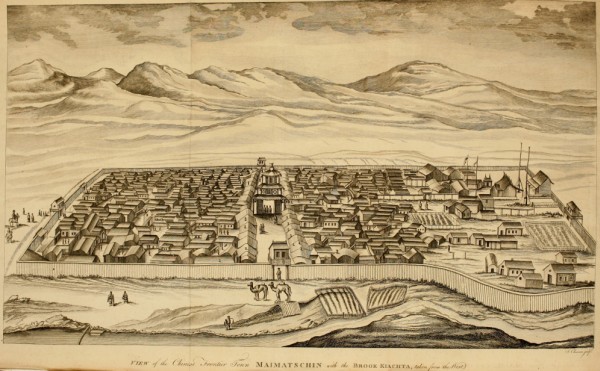
View of the Chinese Frontier Town Maimatschin with the Brook Kiachta, taken from the West.
CHAP. III. Account of the Russian and Chinese settlements upon the confines of Siberia—description of the Russian frontier town Kiachta—of the Chinese frontier town Maimatschin—its buildings, pagodas, &c.
By the last mentioned treaty it was stipulated, that the commerce between Russia and China should be transacted at the frontiers. |Russian and Chinese Settlement upon the Brook Kiachta.| Accordingly two spots were marked out for that purpose upon the confines of Siberia, where they border upon the Mongol desert; one near the brook Kiachta, and the other at Zuruchaitu. The description of the former of these places forms the subject of this chapter.
This settlement consists of a Russian and Chinese town, both situated in a romantic valley, surrounded by high, rocky, and for the most part well-wooded, mountains. This valley is intersected by the brook Kiachta, which rises in Siberia, and, after washing both the Russian and Chinese town, falls into the Bura, at a small distance from the frontiers.
Situation of the Russian Frontier Town Kiachta.
The Russian settlement is called Kiachta from the abovementioned brook: it lies in 124 degrees 18 minutes longitude from the isle of Fero, and 35 degrees N. latitude, at the distance of 5514 versts from Moscow, and 1532 from Pekin.
The Fortress.
It consists of a fortress and a small suburb. The fortress, which is built upon a gentle rise, is a square enclosed with palisadoes, and strengthened with wooden bastions at the several angles. There are three gates, at which guards are constantly stationed: one of the gates faces the North, a second the South towards the Chinese frontiers, and a third the East close to the brook Kiachta. The principal public buildings in the fortress are a wooden church, the governor's house, the custom house, the magazine for provisions, and the guard-house. It contains also a range of shops and warehouses, barracks for the garrison, and several houses belonging to the crown; the latter are generally inhabited by the principal merchants. These buildings are mostly of wood.
Suburb.
The suburb, which is surrounded with a wooden wall covered at the top with chevaux de frize, contains no more than an hundred and twenty houses very irregularly built; it has the same number of gates as the fortress, which are also guarded. Without this suburb, upon the high road leading to Selenginsk, stand a few houses, and the magazine for rhubarb.
This settlement is but indifferently provided with water both in quality and quantity; for although the brook Kiachta is dammed up as it flows by the fortress, yet it is so shallow in summer, that, unless after heavy rains, it is scarcely sufficient to supply the inhabitants. Its stream is troubled and unwholesome, and the springs which rise in the neighbourhood are either foul or brackish: from these circumstances, the principal inhabitants are obliged to send for water from a spring in the Chinese district. The soil of the adjacent country is mostly sand or rock, and extremely barren. If the frontiers of Russia were extended about nine versts more South to the rivulet of Bura; the inhabitants of Kiachta would then enjoy good water, a fruitful soil, and plenty of fish, all which advantages are at present confined to the Chinese.
The garrison of Kiachta consists of a company of regular soldiers, and a certain number of Cossacs; the former are occasionally changed, but the latter are fixed inhabitants of the place. It is the province of the commander to inspect the frontiers, and, in conjunction with the president of the Chinese merchants, to settle all affairs of an inferior nature; but in matters of importance recourse must be had to the chancery of Selenginsk, and to the governor of Irkutsk. The Russian merchants, and the agents of the Russian trading company, are the principal inhabitants of Kiachta.
The limits Westwards from this settlement to the river Selenga, and Eastwards as far as Tchikoi, are bounded with chevaux de frize, placed there to prevent a contraband trade in cattle, for the exportation of which a considerable duty is paid to the crown. All the outposts along the frontiers Westwards as far as the government of Tobolsk, and Eastwards to the mountains of snow, are under the command of the governor of Kiachta.
The most elevated of the mountains that surround the valley of Kiachta, and which is called by the Mongols Burgultei, commands the Russian as well as the Chinese town; for this reason, the Chinese, at the conclusion of the last frontier treaty, demanded the cession of this mountain under the pretext, that some of their deified ancestors were buried upon its summit. The Russians gave way to their request, and suffered the boundary to be brought back to the North side of the mountain.
Maimatschin, the Chinese Frontier-Town.
The Chinese town is called, by the Chinese and Mongols, Maimatschin, which signifies fortress of commerce. The Russians term it the Chinese Village (Kitaiskaia Sloboda) and also Naimatschin, which is a corruption of Maimatschin. It is situated about an hundred and forty yards South of the fortress of Kiachta, and nearly parallel to it. Midway between this place and the Russian fortress, two posts about ten feet high are planted in order to mark the frontiers of the two empires: one is inscribed with Russian, the other with Manshur characters[92].
Mainatschin has no other fortification than a wooden wall, and a small ditch of about three feet broad; the latter was dug in the year 1756, during the war between the Chinese and the Calmucs. The town is of an oblong form: its length is seven hundred yards, and its breadth four hundred. On each of the four sides a large gate faces the principal streets; over each of these gates there is a wooden guard-house for the Chinese garrison, which consists of Mongols in tattered clothes, and armed with clubs. Without the gate, which looks to the Russian frontiers, and about the distance of eight yards from the entrance, the Chinese have raised a wooden screen, so constructed as to intercept all view of the streets from without.
This town contains two hundred houses and about twelve hundred inhabitants. It has two principal streets of about eight yards broad, crossing each other in the middle at right angles, with two by-streets running from North to South. They are not paved, but are laid with gravel, and kept remarkably clean.
Houses.
The houses are spacious, uniformly built of wood, of only one story, not more than fourteen feet high, plaistered and white-washed; they are constructed round a court yard of about seventy feet square, which is strewed with gravel, and has an appearance of neatness. Each house consists of a sitting room, some warehouses and a kitchen. In the houses of the wealthier sort the roof is made of plank; but in meaner habitations of lath covered over with turf. Towards the streets most of the houses have arcades of wood projecting forwards from the roof like a penthouse, and supported by strong pillars. The windows are large after the European manner, but on account of the dearness of glass and Russian talk are generally of paper, excepting a few panes of glass in the sitting room.
The sitting room looks seldom towards the streets: it is a kind of shop, where the several patterns of merchandize are placed in recesses, fitted up with shelves, and secured with paper doors for the purpose of keeping out the dust. The windows are generally ornamented with little paintings, and the walls are hung with Chinese paper. Half the floor is of hard beaten clay; the other half is covered with boards, and rises about two feet in height. Here the family sit in the day-time and sleep at night. By the side of this raised part, and nearly upon the same level, there is a square brick stove, with a streight perpendicular cylindrical excavation, which is heated with small pieces of wood. From the bottom of this stove a tube descends, and is carried zigzag under the boarded floor above-mentioned, and from thence to a chimney which opens into the street. By this contrivance, although the stove is always open and the flame visible, yet the room is never troubled in the least degree with smoke. There is scarcely any furniture in the room, excepting one large dining table in the lower part, and two small lackered ones upon the raised floor: one of these tables is always provided with a chaffing dish, which serves to light their pipes when the stove is not heated.
In this room there are several small niches covered with silken curtains, before which are placed lamps that are lighted upon festivals; these niches contain painted paper idols, a stone or metal vessel, wherein the ashes of incense are collected, several small ornaments and artificial flowers: the Chinese readily allow strangers to draw aside the curtains, and look at the idols.
The Bucharian[93] merchants inhabit the South West quarter of Maimatschin. Their houses are not so large nor commodious as those of the Chinese, although the greatest part of them carry on a very considerable commerce.
The Governor of Maimatschin.
The Surgutschèi, or governor of Maimatschin, has the care of the police, as well as the direction of all affairs relating to commerce: he is generally a person of rank, oftentimes a Mandarin, who has misbehaved himself in another station, and is sent here as a kind of punishment. He is distinguished from the rest by the crystal button of his cap, and by a peacock's[94] feather hanging behind. The Chinese give him the title of Amban, which signifies commander in chief; and no one appears before him without bending the knee, in which posture the person who brings a petition must remain until he receives the governor's answer. His salary is not large; but the presents which he receives from the merchants amount annually to a considerable sum.
The most remarkable public buildings in Maimatschin, are the governor's house, the theatre, and two pagodas.
House of the Governor.
The governor's house is larger than the others, and better furnished; it is distinguished by a chamber where the court of justice is held, and by two high poles before the entrance ornamented with flags.
Theatre.
The theatre is situated close to the wall of the town near the great pagoda: it is a kind of small shed, neatly painted, open in front, and merely spacious enough to contain the stage; the audience stand in the street. Near it are two high poles, upon which large flags with Chinese inscriptions are hoisted on festivals. On such occasions the servants belonging to the merchants play short burlesque farces in honour of their idols.
The small Pagoda.
The smallest of the two Pagodas is a wooden building, standing upon pillars, in the centre of the town at the place where the two principal streets cross. It is a Chinese tower of two stories, adorned on the outside with small columns, paintings, and little iron bells, &c. The first story is square, the second octangular. |The Idol Tien.| In the lower story is a picture representing the God Tien, which signifies, according to the explanation of the most intelligent Chinese, the most high God, who rules over the thirty-two heavens. The Manshurs, it is said, call this idol Abcho; and the Mongols, Tingheru heaven, or the God of heaven. He is represented sitting with his head uncovered, and encircled with a ray[95] of glory similar to that which surrounds the head of our Saviour in the Roman catholic paintings; his hair is long and flowing; he holds in his right hand a drawn sword, and his left is extended as in the act of giving a benediction. On one side of this figure two youths, on the other a maiden and a grey-headed old man, are delineated.
The upper story contains the picture of another idol in a black and white checquered cap, with the same figures of three young persons and a little old man. There are no altars in this temple, and no other ornaments excepting these pictures and their frames. It is opened only on festivals, and strangers cannot see it without permission.
The great Pagoda and its Idols.
The great Pagoda[96], situated before the governor's house, and near the principal gate looking to the south, is larger and more magnificent than the former. Strangers are allowed to see it at all times, without the least difficulty, provided they are accompanied by one of the priests, who are always to be found in the area of the temple. This area is surrounded with chevaux de frize: the entrance is from the south through two gates with a small building between them. In the inside of this building are two recesses with rails before them, behind which the images of two horses as big as life are coarsly moulded out of clay; they are saddled and bridled, and attended by two human figures dressed like grooms: the horse to the right is of a chesnut colour, the other is dun with a black mane and tail, the former is in the attitude of springing, the latter of walking. Near each horse a banner of yellow silk, painted with silver dragons, is displayed.
In the middle of this area are two wooden turrets surrounded with galleries; a large bell of cart iron which is struck occasionally with a large wooden mallet, hangs in the Eastern turret; the other contains two kettle drums of an enormous size, similar to those made use of in the religious ceremonies of the Calmucs. On each side of this area are ranges of buildings inhabited by the priest of the temple.
This area communicates by means of an handsome gateway with the inner court, which is bordered on each side by small compartments open in front, with rails before them; in the inside of these compartments the legendary stories of the idols are exhibited in a series of historical paintings. At the farther extremity of this court stands a large building, constructed in the same style of architecture as the temple. The inside is sixty feet long and thirty broad: it is stored with antient weapons, and instruments of war of a prodigious size; such as spears, scythes, and long pikes, with broad blades, shields, coats of arms, and military ensigns representing hands[97], dragons heads, and other carved figures. All these warlike instruments are richly gilded, and ranged in order upon scaffolds along the wall. Opposite the entrance a large yellow standard, embroidered with foliage and silver dragons, is erected; under it, upon a kind of altar, there is a series of little oblong tables, bearing Chinese inscriptions.
An open gallery, adorned on both sides with flower-pots, leads from the back door of the armoury to the colonade of the temple. In this colonade two slate tablets are placed, in wooden frames, about six feet high and two broad, with long inscriptions relating to the building of the temple. Before one of these plates a small idol of an hideous form stands upon the ground, enclosed in a wooden case.
The temple itself is an elegant Chinese building, richly decorated on the outside with columns lackered, and gilded carved-work, small bells, and other ornaments peculiar to the Chinese architecture. Within there is a rich profusion of gilding, which corresponds with the gaudiness of the exterior. The walls are covered thick with paintings, exhibiting the most celebrated exploits of the principal idol.
This temple contains five idols of a colossal stature, sitting cross-legged upon pedestals in three recesses, which fill the whole Northern side.
Ghessur Chan, the principal idol.
The principal idol is seated alone, in the middle recess, between two columns, entwined with gilded dragons. Large streamers of silk, hanging from the roof of the temple, veil in some measure the upper part of the image. His name is Ghedsur, or Ghessur Chan[98]; the Chinese call him Loo-ye, or the first and most antient; and the Manshurs, Guanlöe, or the superior god. He is of a gigantic size, surpassing more than fourfold the human stature, with a face glistening like burnished gold, black hair and beard. He wears a crown upon his head, and is richly dressed in the Chinese fashion: his garments are not moulded out of clay, as those of the other idols; but are made of the finest silk. He holds in his hands a kind of tablet, which he seems to read with deep attention. Two small female figures, resembling girls of about fourteen years of age, stand on each side of the idol, upon the same pedestal; one of which grasps a roll of paper. At the right-hand of the idol lie seven golden arrows, and at his left a bow.
Before the idol is a spacious enclosure, surrounded with rails, within which stands an altar with four colossal figures, intended probably to represent the principal mandarins of the deified Ghessur. Two of these figures are dressed like judges, and hold before them small tablets, similar to that in the hands of the principal idol. The two other figures are accoutred in complete armour: one wears a turban; and carries, upon the left shoulder, a large sword sheathed, with the hilt upwards. The other has an hideous copper-coloured face, a large belly, and grasps in his right hand a lance with a broad blade.
Although all the remaining idols in the temple are of an enormous size, yet they are greatly surpassed in magnitude by Ghessur Chan.
Maooang.
The first idol in the recess to the right is called Maooang, or the Otschibanni of the Mongols. He has three ghastly copper-coloured faces, and six arms; two of his arms brandish two sabres cross ways over the head; a third bears a looking glass, and a fourth a kind of square, which resembles a piece of ivory. The two remaining arms are employed in drawing a bow, with an arrow laid upon it, ready to be discharged. This idol has a mirror upon his breast, and an eye in his navel: near it are placed two small figures; one holds an arrow, and the other a little animal.
Tsaudsing.
The next idol in the same recess is called by the Chinese Tsaudsing, or the gold and silver god; and by the Mongols Tsagan-Dsambala. He wears a black cap, and is dressed, after the Chinese fashion, in sumptuous robes of state; he bears in his hand a small jewel casket. Near him also stand two little figures, one of which holds a truncated branch.
Chusho.
In the recess to the left is the god Chusho, called by the Manshurs Chua-schan, and by the Mongols Galdi, or the Fire God. He is represented with a frightful fiery reddish face; clad in complete armour he wields a sword half drawn out of the scabbard, and seems on the point of starting up from his seat. He is attended by two little harlbadeers, one of whom is crying; and the other bears a fowl upon his hand, which resembles a sea-pheasant.
Niu-o.
The other idol in the same recess is the god of oxen, Niu-o. He appears to be sitting in a composed posture; he is habited like a Mandarin, and is distinguished by a crown upon his head. He has, in common with the other idols, a mirror upon his breast. The Chinese imagine him to be the same with the Yamandaga of the Mongols; and it is said his Manshurish name is Chain Killova; his Mongol name, which relates to the history of Ghessur, is Bars-Batir, the Hero of Tygers.
Before these several idols there are tables, or altars, on which cakes, pastry, dried fruit, and flesh, are placed, on festivals and prayer days: on particular occasions even whole carcases of sheep are offered up. Tapers and lamps are kept burning day and night before the idols. Among the utensils of the temple, the most remarkable is a vessel shaped like a quiver, and filled with flat pieces of cleft reed, on which short Chinese devices are inscribed. These devices are taken out by the Chinese on new-years day, and are considered as oracles, which foretel the good or ill luck of the person, by whom they are drawn, during the following year. There lies also upon a table an hollow wooden black lackered helmet, which all persons of devotion strike with a wooden hammer, whenever they enter the temple. This helmet is regarded with such peculiar awe, that no strangers are permitted to handle it, although they are allowed to touch even the idols themselves.
The first day of the new and full moon is appointed for the celebration of worship. Upon each of those days no Chinese ever fails to make his appearance once in the temple; he enters without taking off his cap[99], joins his hands before his face, bows five times to each idol, touches with his forehead the pedestal on which the idol sits, and then retires. Their principal festivals are held in the first month of their year, which answers to February. It is called by them, as well as by the Mongols, the white month; and is considered as a lucky time for the transaction of business; at that time they hoist flags before the temples; and place meat upon the tables of the idols, which the priests take away in the evening, and eat in the small apartments of the interior court. On these solemnities plays are performed in the theatre, in honour of the idols: the pieces are generally satyrical, and mostly written against unjust magistrates and judges.
Superstion of the Chinese.
But although the Chinese have such few ceremonies in their system of religious worship, yet they are remarkably infected with superstition. Mr. Pallas gives the following description of their behaviour at Maimatschin during an eclipse of the moon. At the close of the evening in which the eclipse appeared, all the inhabitants were indefatigable in raising an incessant uproar, some by hideous shrieks, others by knocking wood, and beating cauldrons; the din was heightened by striking the bell and beating the kettle drums of the great Pagoda. The Chinese suppose, that during an eclipse the wicked spirit of the air, called by the Mongols Arachulla, is attacking the moon; and that he is frightened away by these hideous shrieks and noises. Another instance of superstition fell under the observation, of Mr. Pallas, while he was at Maimatschin. A fire broke out in that town with such violence that several houses were in flames. None of the inhabitants, however, attempted to extinguish it; they stood indeed in idle consternation round the fire; and some of them sprinkled occasionally water among the flames, in order to sooth the fire god, who, as they imagined, had chosen their houses for a sacrifice. Indeed if the Russians had not exerted themselves in quenching the fire, the whole place would probably have been reduced to ashes[100].
CHAP. IV. Commerce between the Chinese and Russians—list of the principal exports and imports—duties—average amount of the Russian trade.
Merchants of Maimatschin.
The merchants of Maimatschin come from the Northern provinces of China, chiefly from Pekin, Nankin, Sandchue, and other principal towns. They are not settled at this place with their wives and families: for it is a remarkable circumstance, that there is not one woman in Maimatschin. This restriction arises from the policy of the Chinese government, which, totally prohibits the women from having the slightest intercourse with foreigners. No Chinese merchant engages in the trade to Siberia who has not a partner. These persons mutually relieve each other. One remains for a stated time, usually a year, at Kiachta; and when, his partner arrives with a fresh cargo of Chinese merchandize, he then returns home with the Russian commodities[101].
Most of the Chinese merchants understand the Mongol tongue, in which language commercial affairs are generally transacted. Some few indeed speak broken Russian, but their pronunciation is so soft and delicate, that it is difficult to comprehend them. They are not able to pronounce the R, but instead of it make use of an L; and when two consonants come together, which frequently occurs in the Russian tongue, they divide them by the interposition of a vowel[102]. This failure in articulating the Russian language seems peculiar to the Chinese, and is not observable in the Calmucs, Mongols, and other neighbouring nations[103].
The commerce between the Russians and Chinese is entirely a trade of barter, that is, an exchange of one merchandize for another. The Russians are prohibited to export their own coin, nor indeed could the Chinese receive it, even should that prohibition be taken off; for no specie is current amongst them except bullion[104]. And the Russians find it more advantageous to take merchandize in exchange, than to receive bullion at the Chinese standard. The common method of transacting business is as follows. The Chinese merchant comes first to Kiachta, and examines the merchandize he has occasion for in the warehouse of the Russian trader; he then goes to the house of the latter, and adjusts the price over a dish of tea. Both parties next return to the magazine, and the goods in question are there carefully sealed in the presence of the Chinese merchant. When this ceremony is over, they both repair to Maimatschin; the Russian chooses the commodities he wants, not forgetting to guard against fraud by a strict inspection. He then takes the precaution to leave behind a person of confidence, who remains in the warehouse until the Russian goods are delivered, when he returns to Kiachta with the Chinese merchandize[105].
Russian Exports.
The principal commodities which Russia exports to China are as follow:
FURS and PELTRY.
It would be uninteresting to enumerate all the furs and skins[106] brought for sale to Kiachta, which form the most important article of exportation on the side of the Russians. The most valuable of these furs are the skins of sea-otters, beavers, foxes, wolves, bears, Bucharian lambs, Astracan sheep, martens, sables, ermines, grey-squirrels.
The greatest part of these furs and skins are drawn from Siberia and the New Discovered Islands: this supply however is not alone fully adequate to the demand of the market at Kiachta. Foreign furs are therefore imported to St. Petersburg, and from thence sent to the frontiers. England alone furnishes a large quantity of beaver and other skins, which she draws from Hudson's Bay and Canada.[107]
CLOTH.
Cloth forms the second article of exportation which Russia exports to China.
The coarse sort is manufactured in Russia; the finer sort is foreign, chiefly English, Prussian, and French.
An arshire of foreign cloth fetches, according to its fineness, from2 to 4 roubles.
Camlets.
Calimancoes.
Druggets.
White flannels, both Russian and foreign.
The remaining articles are,
Rich stuffs.
Velvets.
Coarse linen, chiefly manufactured in Russia.
Russia leather.
Tanned hides.
Glass ware and looking glasses.
Hardware, namely, knives, scissars, locks, &c.
Tin.
Russian talk.
Cattle, chiefly camels, horses, and horned cattle.
The Chinese also pay very dear for hounds, greyhounds, barbets, and dogs for hunting wild boars.
Provisions[108].
Meal.—The Chinese no longer import such large quantities of meal as formerly, since they have employed the Mongols to cultivate the lands lying near the river Orchon[109], &c. &c.
Imports.
List of the most valuable commodities procured from China.
RAW AND MANUFACTURED SILK.
The exportation of raw silk is prohibited in China under pain of death: large quantities however are smuggled every year into Kiachta, but not sufficient to answer the demands of the Russian merchants.
A pood of the best sort is estimated at 150 roubles;
of the worst sort at 75
The manufactured silks are of various sorts, fashions, and prices, viz. sattins, taffaties, damasks, and gauzes, scanes of silk died of all colours, ribbands, &c. &c.
RAW AND MANUFACTURED COTTON.
Raw cotton is imported in very large quantities; a great part of this commodity is employed in packing up the china ware, and by these means is conveyed into the inland part of Russia without any additional expence of carriage.
A pood sells for—from 4 roubles, 80 cop. to 12.
Of the manufactured cotton, that which the Russians call Kitaika, and the English Nankeen, has the most rapid sale. It is the most durable, and, in proportion to its goodness, the cheapest of all the Chinese stuffs; it is stained red, brown, green, and black.
TEAS.
The teas which are brought into Russia are much superior in flavour and quality to those which are sent to Europe from Canton. The original goodness of the teas is probably the same in both cases; but it is conjectured, that the transport by sea considerably impairs the aromatic flavour of the plant. This commodity, now become so favourite an object of European luxury, is esteemed by the Russian merchants the most profitable article of importation.
At Kiachta a pound of the best tea[110] is estimated at 2 roubles.
Common ditto at 1
Inferior at 40 copecs.
PORCELAIN OF ALL SORTS.
For some years past the Chinese have brought to Kiachta parcels of porcelain, painted with European figures, with copies of several favourite prints and images of the Grecian and Roman deities.
Furniture, particularly Japan cabinets and cases, lackered and varnished tables and chairs, boxes inlaid with mother-of-pearl, &c. &c.
Fans, toys, and other small wares.
Artificial flowers.
Tiger and Panther skins.
Rubies[111], but neither in large quantities nor of great value.
White lead, vermilion, and other colours.
Canes.
Tobacco.
Rice.
Sugar Candy.
Preserved ginger, and other sweetmeats.
Rhubarb[112].
Musk.
It is very difficult to procure the genuine Thibet musk, because the Chinese purchase a bad sort, which comes from Siberia, with which they adulterate that which is brought from Thibet[113].
Advantages of this Trade to Russia.
Russia draws great advantages from the Chinese trade. By this traffic, its natural productions, and particularly its furs and skins, are disposed of in a very profitable manner. Many of these furs procured from the most Easterly parts of Siberia, are of such little value that they would not answer the expence of carriage into Russia; while the richer furs, which are sold to the Chinese at a very high price, would, on account of their dearness, seldom meet with purchasers in the Russian dominions. In exchange for these commodities the Russians receive from China several valuable articles of commerce, which they would otherwise be obliged to buy at a much dearer rate from the European powers, to the great disadvantage of the balance of their trade.
I have before observed, that formerly the exportation and importation of the most valuable goods were prohibited to individuals; at present only the following articles are prohibited. Among the exports, fire-arms and artillery; gunpowder and ball; gold and silver, coined and uncoined, stallions and mares; skins of deer, reindeer, elks, and horses; beaver's hair, potash, rosin, thread, and[114]tinsel-lace: among the imports, salt, brandy, poisons, copper-money, and rhubarb.
The duties paid by the Russian-merchants are very considerable; great part of the merchandise is taxed at 25 per cent.
Furs, cattle, and provisions, pay a duty of 23.
Russian manufactures 18.
One per cent. is also deducted from the price of all goods for the expence of deepening the river Selenga; and 7 per cent for the support of the custom-house.
Some articles, both of export and import, pay no duty. The exported are, writing, royal, and post paper, Russia cloth of all sorts and colours, excepting peasants cloth. The imported are, satins, raw and stained cottons, porcelain, earthen-ware, glass corals, beads, fans, all musical instruments, furniture, lackered and enamelled ornaments, needles, white-lead, rice, preserved ginger, and other sweet-meats[115].
The importance of this trade will appear from the following table.
Table of exportation and importation.
Table of exportation and importation at Kiachta, in the year 1777.
Rbles.Cop.
Custom-house duties,481,460.59-1/2.
Importation of Chinese goods, to the value of1,466,497.3-3/4.
Of gold and silver11,215.
Total of Importation1,484,712.3-3/4.
Exportation of Russian commodities1,313,621.35.
From this table it appears, that the total sum of export and import amounts to2,868,333.
In this calculation however the contraband trade is not included, which is very large; and as the year 1777 was not so favourable to this traffic as the preceding ones[116], we may venture to estimate the gross amount of the average trade to China at near 4,000,000 Roubles.
CHAP. V. Description of Zuruchaitu—and its trade—Transport of the merchandise through Siberia.
The general account of the Russian commerce to China has been given in the preceding chapter, because almost the whole traffic is confined to Kiachta. The description of Zuruchaitu, which was also fixed by the treaty of Kiachta for the purpose of carrying on the same trade, will be comprised of course in a narrow compass.
Description of Zuruchaitu.
Zuruchaitu is situated in 137° longitude, and 49°. 20´ N. latitude, upon the Western branch of the river Argoon, at a small distance from its source. It is provided with a small garrison, and a few wretched barracks surrounded with chevaux de frise. No merchants are settled at this place; they come every summer from Nershinsk, and other Russian towns in order to meet two parties of Mongol troops: these troops are sent from the Chinese towns Naun and Merghen, and arrive at the frontiers about July. They encamp near Zuruchaitu upon the other side of the river Argoon, and barter with the Siberian merchants a few Chinese commodities, which they bring with them.
Commerce.
Formerly the commerce carried on at Zuruchaitu was more considerable; but at present it is so trifling, that it hardly deserves to be mentioned. These Mongols furnish the district of Nershinsk with bad tea and tobacco, bad silks, and some tolerable cottons. They receive in return ordinary furs, cloth, cattle, and Russian leather. This trade lasts about a month or six weeks, and the annual duties of the customs amount upon an average to no more than 500 roubles. About the middle of August the Mongols retire; part proceed immediately to China, and the others descend the stream of the Amoor as far as its mouth, in order to observe if there has been no usurpation upon the limits. At the same time the Russian merchants return to Nershinsk, and, were it not for the small garrison, Zuruchaitu would remain uninhabited[117].
Transport of the Russian and Chinese Commodities through Siberia.
The Russian commodities are transported by land from Petersburg and Moscow to Tobolsk. From thence the merchants may embark upon the Irtish down to its junction with the Oby; then they either tow up their boats, or sail up the last mentioned river as far as Marym, where they enter the Ket, which they ascend to Makoffskoi Ostrog. At that place the merchandize is carried about ninety versts by land to the Yenisei. The merchants then ascend that river, the Tunguska, and Angara, to Irkutsk, cross the lake Baikal, and go up the river Selenga almost to Kiachta.
It is a work of such difficulty to ascend the streams of so many rapid rivers, that this navigation Eastwards can hardly be finished in one summer[118]; for which reason the merchants commonly prefer the way by land. Their general rendezvous is the fair of Irbit near Tobolsk; from thence they go in sledges during winter to Kiachta where they arrive about February, the season in which the chief commerce is carried on with the Chinese. They buy in their route all the furs they find in the small towns, where they are brought from the adjacent countries. When the merchants return in spring with the Chinese goods, which are of greater bulk and weight than the Russian commodities, they proceed by water; they then descend the streams of most of the rivers, namely, the Selenga, Angara, Tunguska, Ket, and Oby to its junction with the Irtish; they ascend that river to Tobolsk, and continue by land to Moscow and Petersburg.
Transport of the Furs from Kamtchatka to Kiachta.
Before the passage from Ochotsk to Bolcheresk was discovered in 1716, the only communication between Kamtchatka and Siberia was by land; the road lay by Anadirsk to Yakutsk. The furs[119] of Kamtchatka and of the Eastern isles are now conveyed from that peninsula by water to Ochotsk; from thence to Yakutsk by land on horse-back, or by rein-deer: the roads are so very bad, lying either through a rugged mountainous country, or through marshy forests, that the journey lasts at least six weeks. Yakutsk is situated upon the Lena, and is the principal town, where the choicest furs are brought in their way to Kiachta, as well from Kamtchatka as from the Northern parts of Siberia, which lay upon the rivers Lena, Yana, and Endigirka. At Yakutsk the goods are embarked upon the Lena, towed up the stream of that river as far as Vercholensk, or still farther to Katsheg; from thence they are transported over a short tract of land to the rivulet Buguldeika, down that stream to the lake Baikal, across that lake to the mouth of the Selenga, and up that river to the neighbourhood of Kiachta.
In order to give the reader some notion of that vast tract of country, over which the merchandize is frequently transported by land carriage, a list of the distances is here subjoined.
FromPetersburg to Moscow734versts.
Moscow to Tobolskright
Tobolsk to Irkutskright
Irkutsk to Kiachta471
6508
FromIrbit to Tobolsk420
FromIrkutsk to Nershinsk1129
Nershinsk to Zuruchaitu370
FromOchotsk to Yakutsk927
Yakutsk to Irkutsk2433
FromSelenginsk to Zuruchaitu850
Zuruchaitu to Pekin1588
Kiachta to Pekin1532
The Chinese transport their goods to Kiachta chiefly upon camels. It is four or five days journey from Pekin to the wall of China, and forty-six from thence across the Mongol desert to Kiachta[120].