NOTE
Reading edition
The last pages of this book were written on the northern border of Afghanistan, and when I parted with the camels in Old Bokhara City, I was already apprised of the possibility of trouble between Russia and Austria. I was not in the least disturbed, but scarcely had I reached my birthplace, one of the German colonies in Bessarabia, when certain events occurred which made war a stern reality. I left Libau three days before the town was bombarded by the Germans, and en route to St. Petersburg came face to face with mobilization. I witnessed the mob which broke up the German Embassy, and saw numerous processions of many nationalities, and it became evident that the Russian people were together in this war. I saw a demonstration by the Hebrews, who carried a picture of the Emperor through the streets, and numerous flags and emblems placarded “Down with the Kaiser,” and I learned subsequently that a handful of Jews in St. Petersburg raised in two days one hundred and forty thousand rubles for the war fund. The leading Russian newspapers stated that all over Russia the Hebrews were collecting money and offering their services to the government. I prophesy that after the termination of this terrible war, whether it ends satisfactorily to the Russians or not, the Jews will win by their loyalty what they most covet—namely, the right to live in any section of the empire, a right to which they were entitled long ago. That the demands of the Polish and Finnish people will be satisfied in every respect is a foregone conclusion.
The great demoralizing effect which vodka has produced among the peasants has already been removed by the Emperor, and I am sure laws will be passed which will make it extremely difficult for the peasants to obtain this life-wrecking poison, responsible for ninety per cent. of all of Russia’s ailments. Until the early fall of 1914, Russians were perishing with drink. Drink was the real obstacle to progress, and more than anything else retarded the manifestations of the many talents of this gifted nation. Yet lo and behold! when people saw that the exigencies of the present war were demanding the utmost self-possession, the coolest brain and the clearest eye, there came a word from the Imperial Throne, half stern command, half earnest supplication: Stop drinking, close the drinking shops, devote sober heads and calm hearts to your country! And drink was stopped. Saloons and houses trading in vodka were closed. People obeyed because they believed the Emperor was right.
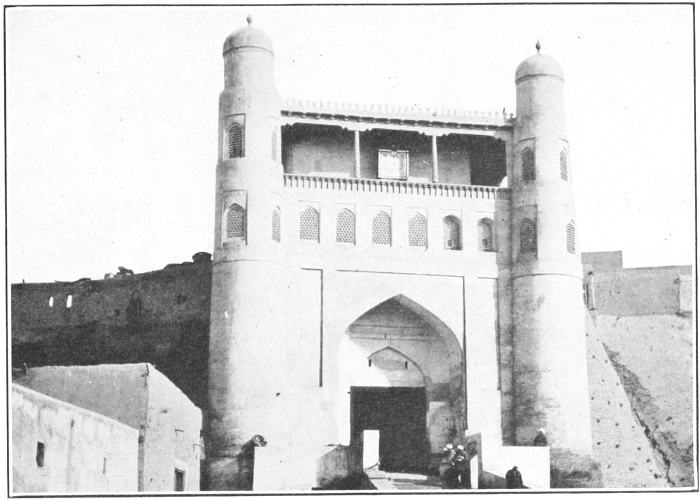
Entrance to Old Fort of Old Palace
It was here I was received by His Highness the Kushbegi, Vice Emir of Bokhara in 1912, 1913 and 1914
The Anglican Bishop of London said in a recent address that what especially won his heart to the Russian people (“Our Eastern ally”) was exactly this wonderful, tremendous, self-sacrifice involving an annual revenue to the state of ninety-three millions sterling, let alone the sacrifice of personal habits, which at first, at least to many people, meant sickness and in few cases even death, and the loss of their habitual though factitious psychic equilibrium. The eminent British ecclesiastic added: “When we in England hear of our public houses (saloons) being crowded sometimes even in the early mornings now, I hope that we shall follow the example of our Russian ally.”
The following despatches on this subject are most interesting:
London, January 25, 1915.—A despatch from Petrograd says that Kharitonoff, Secretary of the Russian Treasury, speaking before the Douma Budget Committee to-day, declared that, owing to the great increase in the national savings due to prohibition, the extraordinary outlay occasioned by the war has as yet caused no great suffering in Russia.
As proof of this, Kharitonoff said the national savings in December, 1913, which had amounted to 700,000 rubles, had increased to 29,100,000 rubles in December, 1914. He added that the total savings for 1913 amounted to 34,000,000, as compared with 84,000,000 rubles for 1914.
About vodka, a Petrograd despatch says:
With war and without vodka, Russia is more prosperous than with vodka and without the war.
That the Tzar and all the people are together to-day as they have never been before in the history of the empire is a well-known fact. What is especially gratifying is the knowledge that this war will break the backs of the last remaining bureaucrats, who owe their existence to the old, haughty, aristocratic German barons of the Baltic provinces, who have always been under the influence of Berlin.
The teaching of the Russian language in all of the public schools has been made compulsory. This is a measure which I had been advocating for years, but which had always been met with opposition on the part of my friends, who told me that the Americans must have queer ideas of liberty when they forced the English language upon all their people regardless of nationality. All arguments to the effect that one language and one system of teaching in all public schools in the entire land meant the creation of a homogeneous unit and the obliteration of the spirit of nationality—often a block to the concerted action of a people—were met with ridicule and derision. In view of all nationalities seeming only too eager to support Russia to-day in her terrible war, and seeming ready to sacrifice the last drop of blood for their country, one might be led to believe that the opposition with which I met whenever in the past I discussed the necessity of Russification of all the empire’s people along the same lines as practiced by us in this country, was justified. Yet prior to the war I was confronted with a picture of the various conflicting elements of Russia’s vast domain expending most of their time and efforts to exterminate each other, due mostly to strong feeling entertained by certain nationalities. Every one knows of the great animosity which exists between the Russians and the Jews, the Tartars and the Armenians, the Poles and the Russians, the Sarts and the Persians, the Uzbecks and the Tadjicks, the Osetins and the Liazgins, and known, too, is the attitude of the Teutons of the Russian Empire, who hold their heads high above every other nationality, to give the impression that they are conferring a favor on all the others by condescending to live among them, and who are ever anxious to impose their language and their iron discipline on all of them, feeling that because they educated the Russians along practically every line imaginable, that that entitled them to be the only rulers of the land.
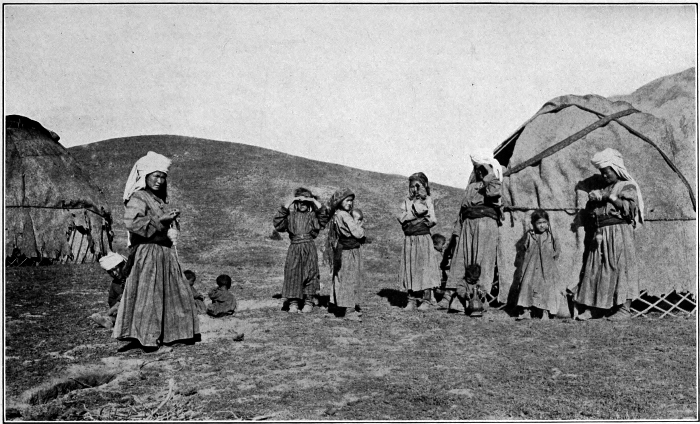
Khirgiz Women and Children in West Turkestan
They are the only Mohammedans who never did veil. Like the Mongolians, and their relatives the Burats, Kalmicks and Jakutsi, they were originally Buddhists
The Douma should discountenance every proposed unreasonable restrictive measure resulting from the war against those Germans who have been Russian citizens for a long time. In this way they will avoid adding to Russia’s already full measure of race problems. I fear that the very recent compulsory introduction of the Russian language into all German schools and throughout the empire has been more the result of revenge upon the millions of Germans living in Russia than the desire to Russianize the hundreds of different nationalities of the empire, but no matter what the motive may have been, I predict that in this case the end will justify the means. With one national ideal, united on all national problems—as she is to-day on the one great question of the war—and ever ready to make sacrifices for a still greater Russia, upholding the motto, “One People, One Country and One Flag,” Russia would become invincible.
Those of Russia’s great men who are doing the thinking for the empire should remember that in order to accomplish what we have in this country—namely, the practical obliteration of all nationalities and subsequent general amalgamation, they must ever bear before them the fact that there should be equal privileges for all and special favors for none. While we in the States have not been entirely successful in carrying out this maxim, the bulk of our people and many of our greatest reformers are working earnestly in that direction.
The great moment has arrived for Russia. All caste distinction and special privileges to the nobility should be eliminated and every nationality put on an equal footing. All people born in Russia, regardless of their nationality, should be honored with the political term “Russians” in the same sense as we in America use the term “Americans,” and religion should not be the only means of classification, for every sane man knows that no child is responsible for a religion which the Russian Government, as has been the case until recently, and Russian parents force upon it. I have never contented myself with the fact that because I am of Teutonic origin and because my parents determined upon my being a Stundist, that I had not the right to consider myself a full-fledged Russian until I saw fit to accept the anointment imposed by the Russian Church, at my request, I must admit, or that because of my German origin I could not consider myself an American when the Constitution of the United States granted me that right.
Every fair-minded Russian must acknowledge that it is an injustice to say that only those of Slavic origin or those having become members of the Greek Orthodox Church are true Russians. Have few people not of Slavic origin and not members of the Greek Orthodox Church helped to make Russia the great empire she is?
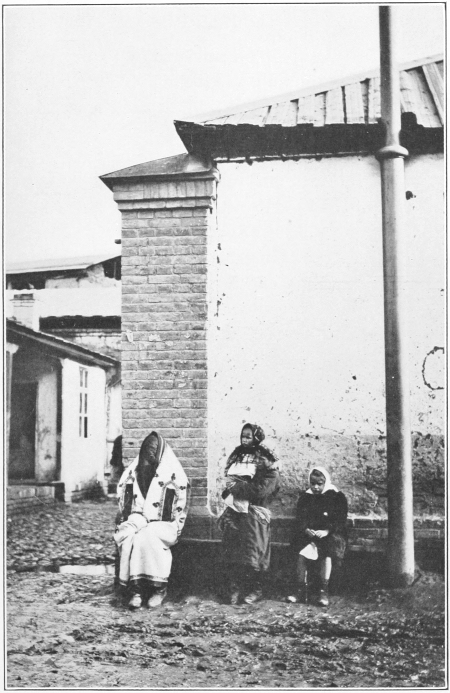
High-Class, Veiled, Sart Woman
In Old Tashkent, the capital of Sir Daria Province, West Turkestan, Central Asia, where the Russian Governor General of Turkestan resides. The architecture of the house and the introduction of windows indicate the dawn of civilization
Most Russians resent the idea of Hebrews born in Russia calling themselves Russians—which, biologically speaking, they are not—yet if they are born in Russia and are Russian citizens, I cannot see why they may not apply to themselves the political term “Russians.”
The peasantry should be compelled to remain sober forever, and the necessary protective laws made for the peasants who desire to sell their land, and if the most stringent laws governing the rate of interest are enforced, the laws now on the statutes affecting Hebrews could be repealed, and the same rights granted to them as are accorded to all other nationalities without doing the peasants the slightest injustice.
That the nationalization of all those Russians who are styled foreigners by the true Slavic Russians is most imperative, I am firmly convinced.
I think the Emperor voiced the proper sentiment in this matter when, in appealing to all his people after the declaration of war, he stated, “Let us forget all internal dissension, and let us all be Russians.”