Chapter IX
Reading edition
ASIATIC POSSESSIONS
For many years the people of the United States thought well of Russia. In a critical hour Russia sent her fleet over, and certainly placed the American people under no small obligation, as the American historians and writers of the Civil War period concede. In 1893, during the World’s Fair at Chicago, Russia still was one of our most favored nations. This state of affairs did not exactly please England. She could not forgive Russia’s aggressive policy in Central and Asia Minor and connived against her at every turn. It is no credit to that great nation that through her intrigues in Afghanistan the Emir not only turned out all Russian business men, but actually executed the natives in Bokhara who traded with them. When in the early nineties the Russian Ambassador at Kabul committed suicide, because he was continually harassed by hired assassins who were spending English money, Russia gave up the struggle.
Up to about ten years ago the English press never lost an opportunity to abuse her enemy, and as English sentiment is naturally reflected in our press, the American people gradually began to think less of Russia. But since the English people have come to understand Russia better, they have indeed regretted their former attitude. Public sentiment has changed in England since she has learned that it is to her advantage to work together with Russia (the same holds true of Russia), lest some day Kaiser Wilhelm’s prophecy, made some twenty years ago, come true, and the Asiatics, now ruled more or less through bluff by England and Russia, wake up and drive the intruders into the Atlantic Ocean, unless, as a saucy Mongol remarked to me, “the Christians in time will embrace the Mohammedan faith and amalgamate with us.”
The United States have an all-powerful class of citizens of Semitic origin who felt they were justified in weaning our people away from Russia, and, controlling as they do a large portion of the press of the United States, they took advantage of the events of the Japanese-Russian war to turn public sentiment in this country against the Russians. This same class showed its strength and hostility when our treaty with Russia was abrogated, and caused some of our Congressmen to make speeches which were anything but justified, and nearly brought about a rupture with that country.
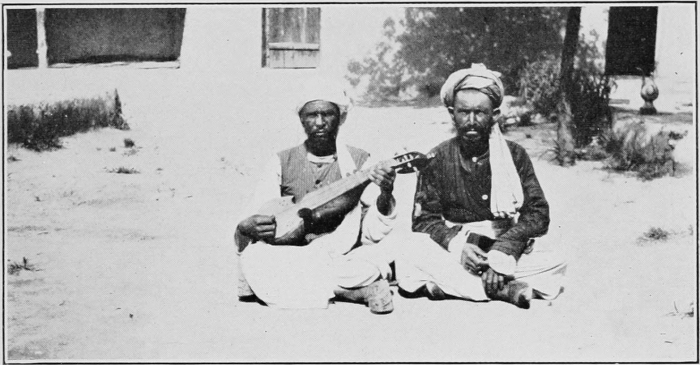
Two Afghan Soldiers
Deserters taken at Kosan, Bokhara. They made me pay them $6 for singing one Afghan song, “Sultan Djan”
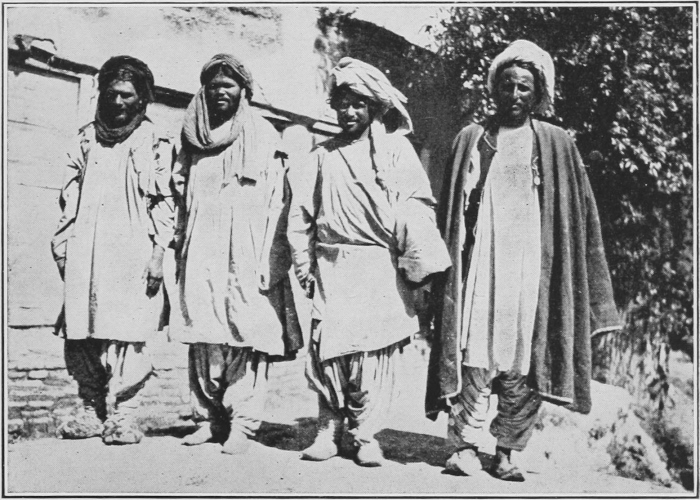
Treacherous Daghas of Afghanistan
Photographed at Kerki on the border of Afghanistan
That we have not entirely sacrificed our Russian trade, amounting to millions annually, is entirely due to such able representatives as Mr. Guild, of Boston, whom we had in St. Petersburg, and who had to deal individually with every single proposition. The able chargé d’affaires, Mr. Wilson, who is still in St. Petersburg, has also proven himself the right man for the difficult task. Such a state of affairs puts us in a ridiculous position, considering the fact that Russia is the buyer of our products, and that, with the exception of cotton, she can do very nicely without any of our goods. Where in 1911 we sold her the value of $83,000,000, Russia sold us less than $7,000,000 worth of goods. It is not my intention to criticise those Americans who feel that Russia is dealing unfairly with their co-religionists, but it does seem that it should be apparent by this time that we cannot force Russia to run her country to suit us. In the eyes of the leading German, French and English newspapers at the time of the abrogation of the treaty, our government certainly deserved the severe criticism it received. During the Japanese-Russian war, the fact that we lent our moral support to Japan, and made it possible for that country to place its bonds over here, and thus pursue the war (to-day she is our dreaded rival), left a sore that we will find no easy task to heal.
The present situation seemed to me to have been well summed up by a business man of Tashkent, who said, “Once the time comes when we are not only able to do without your cotton, but can compete with you in the markets of the world, then your people will not be so anxious to abrogate treaties with us or seek to meddle with the internal administration of our country.” After discussing the matter with people of all classes in nearly every section of European and Asiatic Russia, I have come to the conclusion that we will sacrifice millions annually in trade unless we try in every tactful way possible to improve our relations with Russia.
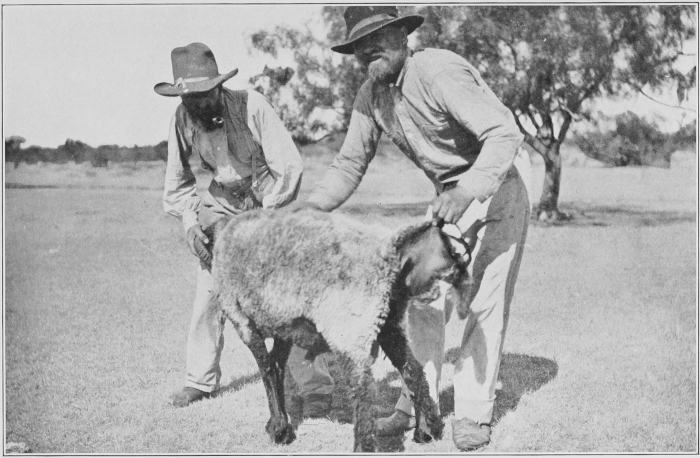
Author’s Father Mr. Christian Young, Sr. Caretaker of Dr. Young’s Karakul Sheep
Photographed on Dr. Young’s ranch near El Paso, Texas.
The Tzar rules over one-seventh of the world, and it is his Asiatic possessions that have made up his enormous empire. For lack of time, much cannot be said about the conquering of vast Siberia, but a vital point to us is that the building of the Trans-Siberian Railway through the entire length of Asia has opened up a country fabulously rich in resources. What the chernoziem of central and southern Russia used to be to the world from the standpoint of wheat-raising, Siberia is becoming now, as immense tracts of wheat land are being opened up. What happened in Dakota and in Nebraska twenty years ago, from the point of view of colonization and general development, is taking place to-day in Siberia, no longer a country isolated from everything and used for penal settlers only, but a country as fit for habitation as any of our northwestern States, where one finds the latest agricultural machinery and people up-to-date in every respect. Just as settlers in the West have progressed more rapidly than those of the East, so have the Russians who settle in Siberia left their less fortunate brethren in European Russia far behind.
Siberia is the coming country of Russia, and if we use any judgment, we can develop a market for our goods that will bring us millions annually. But another blunder such as the abrogation of the treaty, and we will have lost forever our chances of doing business with Russia, and Germany, by rattling her saber, will get it all.
The section of Asia that will interest us the most is Turkestan, Central Asia, as it is from here that the beautiful Persian lamb and Astrakhan furs are imported. The country known as West Turkestan, where immense areas of cotton are now planted, lies immediately west of Chinese Turkestan, is bounded on the west by the Caspian Sea, on the south by Persia, and by Afghanistan and Chinese Turkestan on the east. On the north it graduates into the plains of Siberia. This country is one-fourth the size of all Europe. The longitude is the same as that of South France, Italy and the Balkan Peninsula, but the climate is different from that of those countries. Owing to the distances from large bodies of water, the summers are extremely hot and the winters intensely cold.
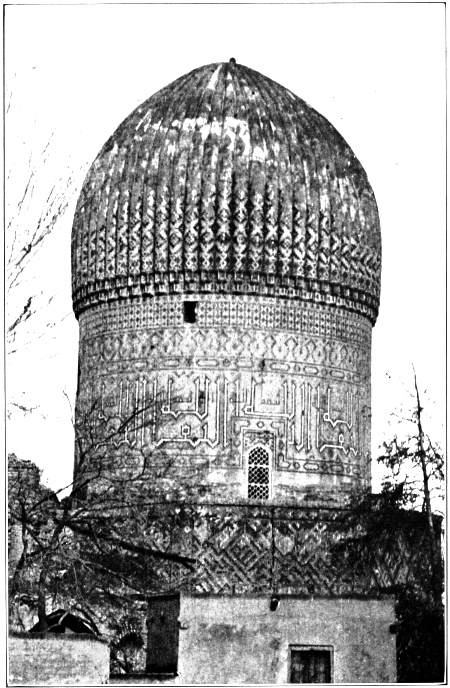
Guri-Mir, Mausoleum of Timur
The murderous Tartar conqueror, in the city of Old Samarkand
Turkestan can be divided into two parts, the low northwestern part, which comprises two-thirds of the area, and the southeastern section, which is mountainous and takes up one-third of the desert. Occasionally one finds large hollows below the level of the ocean, such as the Sari Kamish, ten thousand square miles in area, and one hundred and thirty-five feet below the sea level. Between Merv and Khiva is a hollow with an area of eighteen thousand square miles, two hundred and thirty feet below the level of the Caspian Sea. In the lower portion of Turkestan are some of the worst deserts in the world, such as the Kara Kum, Kizil Kum, Minunistrum, Sari Tishk, Otran and the Hunger steppe. For thousands of years the storms have blown a fine white sand from the exposed mountains, and together with that carried down by the rivers, enormous piles of sand are formed in these awful deserts, considered by some to be worse than the Sahara.
When traveling on the Transcaspian Railroad from Krasnovodsk east toward Bokhara and Samarkand, one beholds for miles and miles in every direction nothing but the shifting sands, in dunes and hillocks, very much like the choppy waves of the Black Sea. Wave on wave of sand drifts back and forth. Sometimes the wind will sift a mound against the Sacksaul, the only plant of the desert. It resembles the mesquite bushes of Texas, excepting that it has no thorns and furnishes nourishment for camels and for fatrump and Karakul sheep.
Just as in the Dakotas and in north Russia the railroad tracks are protected by high snow fences, so here we find dry bushes arranged for miles in fencelike fashion. In spite of this precaution, traffic is at times tied up for weeks, and the people at stations, dependent upon the trains for their water supply, are left to perish. Where water reaches the clayey soil from the Zaravshan, Sir Daria or Amu Daria rivers, such crops as cotton, corn, alfalfa, wheat, barley, and fruit such as pears, peaches, apricots and plums, will grow. The Bokhara melon is much more delicious than our Rockeford canteloupe and keeps through the entire year. In Turkestan too, are the Pamirs, which constitute the so-called roof of the world, where the average elevation is 14,000 to 16,000 feet. In these mountains are wonderful glaciers, higher than those of the Alps, and one there is thirty miles in length. There are absolutely no trees in the Pamirs, excepting in the Aktsh Valley, near the fort of Shah-Djan, where the brother of the Chief of Andijan, Mr. Bjezitsky, was stationed for three years. He boasts of having planted three trees, the only trees in the Pamirs. Mr. Bjezitsky is the only Russian who has traveled through the entire Pamirs. He has gone as far south as Djilala, the most northern railway station in India, near the River Indus.
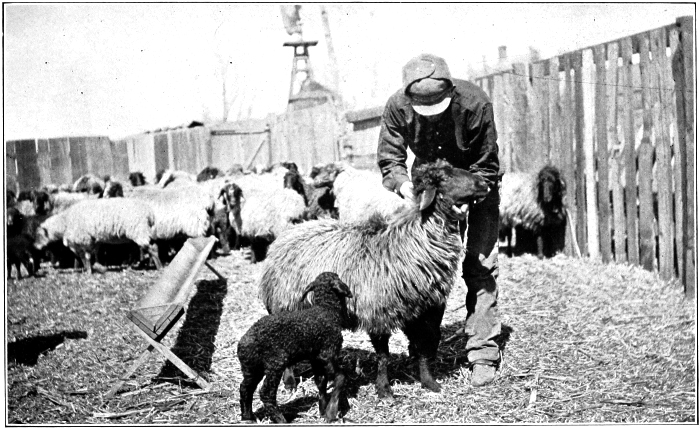
Karakul Ewe and Lamb
Note beautiful tight black curls of lamb at birth. After maturity, curls open and the black pigment oxidizes into gray
The principal rivers in Transcaspia are the Murgab and Tedjent, and they furnish considerable water for irrigation purposes. The very ancient kingdoms of Sodigian, Baktria, and Khorezm occupied the rather unprotected sections of Central Asia, and were entirely dependent upon a few rivers for their existence. It was but necessary for a hostile people to interfere with these rivers, and immediate submission followed. It was in this way that Assyria and Babylonia imposed their rule over the people of southwest Turkestan. Persia then occupied this country until the conquest by Alexander of Macedonia, and it is an easy matter now to collect coins here made at the time the Greeks held that country. When the Greeks lost their power, all of Central Asia came under the control of China, and Jian Kian, who one hundred and twenty-six years before Christ, traveled through Khiva, speaks of the grapes, rice, wheat and fruit which grew where the land was watered, and of the vast amount of territory under irrigation. The Chinese began first to trade with Central Asia, then went west as far as Rome, and eventually they made the Aryans of South Turkestan their dependents.
In going from the railway station of Bairam Ali to Merv in Transcaspia, one sees about forty square miles of ruins of the old city of Merv, built by Shachrock, son of Timur, in 1409, after the awful Mongolian invasion. To-day the Russian Emperor irrigates at his own expense an immense area of land at this place, and is having modern methods of agriculture taught to the natives. From time immemorial the Aryan population of Turkestan was subjected to forced hybridization with the Turkish-Mongolians, and has resulted in a people called the Sarts, who occupy Central Turkestan. In the same way were formed the Taranchi, who occupy Chinese and Eastern Turkestan. In the mountains of the districts of Samarkand and Fergana are still found remnants of the old Aryan race.
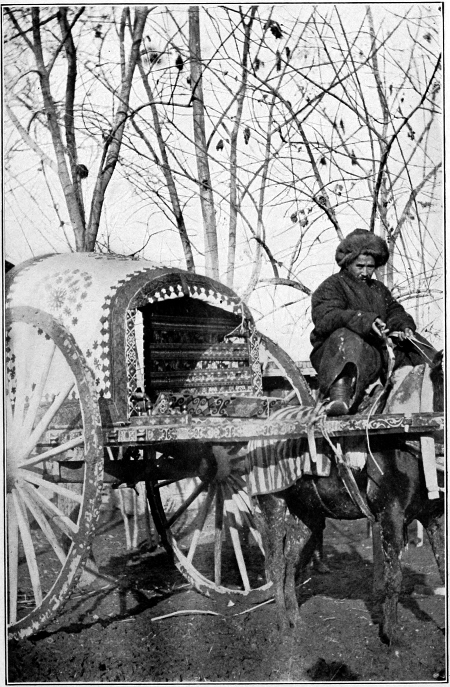
The Famous “Arba” of West Turkestan
The driver always mounts the horse; the driver here is a Sart
From the sixteenth to the nineteenth century, Turkestan was invaded by Russia, and caravans from Bokhara and Khiva came to Russia. In 1717, Peter the Great tried to get into Khiva, but every man of his was slaughtered. Failure after failure taught the Russians where their weakness lay. Finally Perovsky, Chrutcheiev, Tshernaev, Skobelief, Kauffman and others conquered the country for Russia. The oldest town in West Turkestan is Samarkand, which was founded by Persian kings four thousand years ago. This place has had an interesting history under the various peoples and dynasties that have ruled it. It was taken for Russia by the celebrated Kauffman.
The Khanate of Bokhara is of great interest to Americans, as we spend millions in that country annually. It is from there that we obtain Persian lamb, Astrakhan and Krimmer furs, also beautiful rugs and silks. (See Altman’s collection in New York.)
In 1912, 1913, and some five months this year, I traveled in Bokhara in quest of Karakul sheep, and made three importations to the United States and Canada. Up to September 1, 1914, no one else had ever imported any of these animals. Numerous tests have been made by various breeders and my own associates, and the Department of Agriculture, proving that we can produce the so-called Persian lamb skins and broadtail in America, at no small profit to the breeder, by crossing Karakul rams to our lustrous coarse-wooled long wools, such as Lincolns, Cotswolds, Leicesters, Black Faced Highlands, etc. But to obtain satisfactory results only such Karakul rams as are free from fine wool admixture must be employed, and American breeders are here warned against the purchasing of worthless animals from unscrupulous breeders, to whom some inferior stock has been sold by us with the understanding that none of it must be offered for sale until properly bred up, which they failed to do.
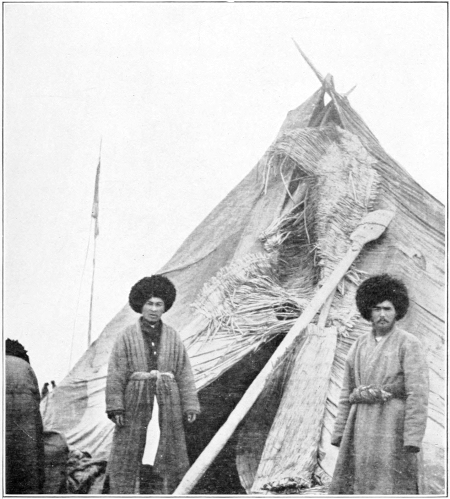
The Inhabitants of Khiva, West Turkestan, Live in Tents Resembling Those of Our Indians
Summer and winter, they wear fur caps about half a foot in height, which is modest compared to the outrageously high caps of the Turcoman and Tekintzi, which often are twice that length
Even as recently as the reign of Alexander II it was still impossible to penetrate into Bokhara. To cross the Caspian Sea meant certain death, and the Russians had a proverb, “If you don’t wish to die, don’t cross the Caspian.” In the early sixties England sent a representative to Bokhara with a view to making a commercial treaty, but the fanatical natives could not tolerate a non-believer among them, and after frightful torture they killed him. This was the fate of every European who ventured into the forbidden country, and often Russians living on the border were attacked. After cutting women and children into pieces and destroying everything by fire, the wild Turcomans would return to their homes and prepare for other raids. At one time an Italian ventured into the country of the bloodthirsty Sarts in quest of the larva of silkworms. He was imprisoned and tortured and a frightful death awaited him. Frantic efforts were made by the Italian Government to liberate him, and the kind-hearted Alexander II was appealed to. At this time several influential Uzbecks from the capital of Bokhara were in Orenburg trading. The Russian Emperor ordered their detention. Word was sent to the Emir that unless the Italian was released he would order the execution of some five hundred Bokharans, including Karavan Bashi Azis, son of one of the great favorites of the Emir. This resulted in the liberation of the Italian.
When last in Bokhara I enjoyed the hospitality of this very same Azis, the oldest and largest dealer in raw Persian and Astrakhan skins in Bokhara. He is eighty years old and a millionaire. He lives in a house that has no windows on the outside and looks like any common Mexican adobe hut, but in the interior is a veritable oriental palace, whose decorations are most beautiful. Only in the summer palace of the Emir could one see the same character of decorations and rugs. I could not help feeling that American money paid for many of these luxuries, because the States and Canada buy the greater part of the entire output of Karakul skins, known under the trade name of Persian lamb and Astrakhan furs.
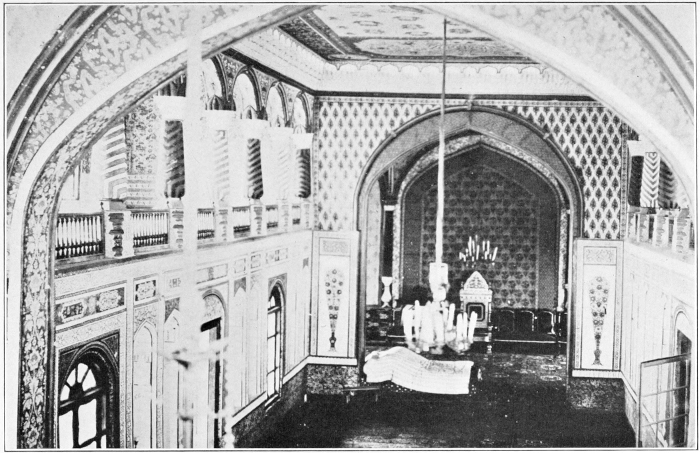
Interior of the Summer Palace of the Emir, Three Miles from the City of Old Bokhara
Here is shown His Majesty’s bed, and chair used by him when receiving foreign guests. The decorations are gorgeous inside the house and outside, and the rugs are among the costliest in the world. The Atachadja Mirachur stated that this was the only photograph ever permitted to be taken of the interior of the palace
I enjoyed the hospitality of Mr. Azis and will never forget the “ploff” on which we feasted. We were all seated on rugs, there being no furniture of any kind. A little “taburetka,” a small, low, square table, was placed over a hole in the floor, into which hot charcoal had been poured. The table was then covered with a quilt. This positively constitutes the only furniture in the reception-room of any native, rich or poor, and while it is thus possible to warm one’s feet, the rest of the body freezes, as the quilt seldom reaches farther than the hips, and it certainly does get very cold at times in Bokhara. Green tea was first served in Chinese cups, and then came the “ploff,” consisting of mutton, raisins and rice, and served for all in one dish. No guest ever gets a chance to leave the palace of the Kushbegi (Minister of Interior) or any of the beks (governors) before he has thoroughly stuffed himself with “ploff” and fruit, and he is expected to drink from five to ten cups of green tea.
Though the inhabitants of Transcaspia, who for years were the most dreaded of desert robbers, have become a peaceful people, they are still closely guarded by Cossacks. But civilization does not seem to have affected them in the least in other ways, and they live in their iurtas (felt tents) and mud houses just like the wildest tribes of the North American Indians. They are ideal horsemen, and the Tekin horse is said by some to surpass even Arabian breeds.
The Turcoman women do not always cover their faces as do the Sart, Tadjick, Uzbeck, and Jewish women. When girls are seven to eight years old, they have already been sold for wives, and, provided they are paid for, are delivered by the parents or nearest male relative when twelve to fifteen years old. If only partially paid for, the girl may live a while with her betrothed, but must again return home until the balance is paid. The price now paid for a wife is fixed by the Russian Government at twenty-five hundred rubles, although secretly much higher prices sometimes obtain.
There is less polygamy in Turkestan now than in former days. This is no doubt due to the influence of Russians and others who trade among the natives, and never miss an opportunity to tell them of the financial advantages of monogamy.
Old Bokhara City and Old Samarkand are indescribably filthy. The water holes, known as “gowsy,” are never cleaned, and it seems incredible that a people who perform their daily gluteal ablutions (a religious rite practiced by every Bokharan, from the Emir down to the shepherd in the desert) in these mud holes would also drink out of them! But they do, and as a result about thirty per cent. of them suffer from the dread disease known as “reshta.” Infection due to filth causes the death of many. Is it any wonder that cholera, plague, fatal dysenteries, and the dread “pendinka” are always prevalent?
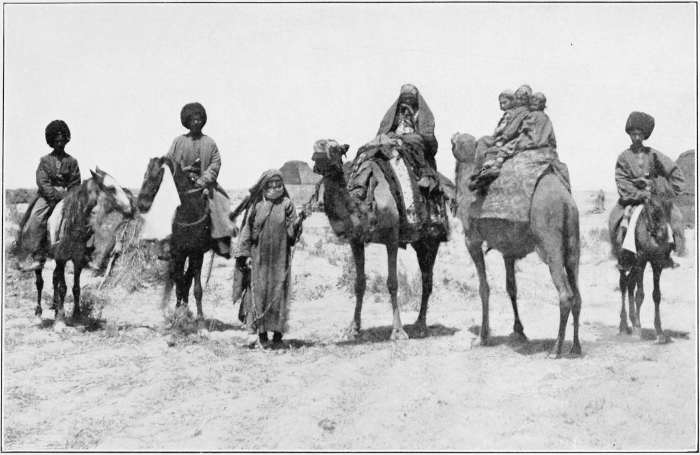
A Tekin Wedding
Transcaspia, West Turkestan
A European must not touch a morsel of food that has not been boiled for at least fifteen minutes. In spite of the greatest care, in some districts few Europeans escape “pendinka,” which causes wounds to appear all over the body that cannot be healed up with any known medicine. They leave frightful scars; but fortunately after nine months this awful disease cures itself, usually leaving no bad effects, though it sometimes predisposes one to rheumatism, as can be testified to by my own experience.
In her treaty with Bokhara, Russia agreed not to interfere with the Emir in the internal management of affairs, but it seems that His Highness is unable to bring about any reforms whatsoever, and for that reason has refused to reside in Old Bokhara City, preferring to live on his estate, about one hundred miles east of the capital. Only a few years ago, when the old Emir still lived, criminals were hurled from the tower minaret, which is about three hundred feet high; others were chopped to pieces on the square in front of the palace, while the public looked on, apparently enjoying the awful sight. Still others were thrown into a noisome stink hole and there left to die. This hole has never been cleaned and proves the method of punishment most feared by the natives.
It has taken the Russian Government and the Emir several years to do away with some of these awful penalties, but as the Russian Ambassador stated, to bring about other reforms now would mean a bloody war, so by educating the children of the better Sarts in the Russian schools, which have been established in the principal towns, it is hoped that in time the natives may learn to live like human beings.
Russia’s problems with her fifty millions of Asiatic polygamists are of a most serious nature, and she must take every precaution to prevent the Mongol from asserting himself again and ruling the white race, as he has done before. We may thank God that we have no race problems to solve quite as serious as Russia’s.
A Russian prince said to me, “Admit our Asiatics and we will admit all Jews.”
I do not think we want to trade with Russia.
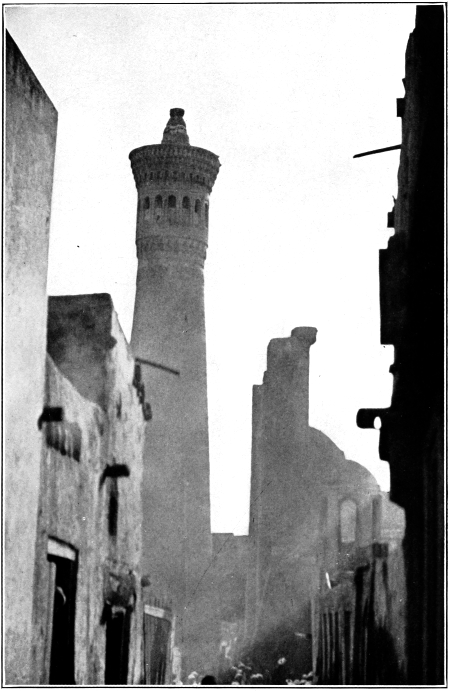
The Minaret, the Tower of Death, in Old Bokhara City
Only a few years ago, a woman found guilty of prostitution was put into a sack and hurled head downward on the Registan Square