Front matter (continued 3)
Reading edition
C 123
The worst condition with regard to the fertility prevails among those with the highest mental endowment. Evidence of this is given in Figure C 123, "Insufficient Fertility of the Highly Endowed in Holland," after J. R. Steinmetz. It shows the rapidity with which the number of children decreases. In order to estimate the significance of these statistics, it must be noted that after taking into account the mortality among children and young persons, and the unfitness for parenthood of an appreciable fraction of the adults, a fully capable couple would have to produce at least four children to assure the necessary moderate increase in the population which is required to prevent a people from sinking into stagnation and deterioration.
C 124
The dying out of highly gifted families is shown to be more accentuated in Figure 255, after Bertillon, "Progeny of the Highly Gifted in France." Four hundred and forty-five of the best known Frenchmen, with their wives, have not even reproduced that number of individuals, and this in spite of the fact that repeated marriages of the same individuals have not been taken into account.
C 125-126
Even if one has been able, up to the present, to live in the hope that the number of persons of more than average ability produced by the mass of the people is always sufficient to replace those that are used up, at the present time anxiety about the "heads" is replaced by anxiety about the "hands." The knowledge of means of preventing fertilization spreads incessantly, and is recklessly promulgated by the neomalthusians and by a shameless industry. We point to Figure C 125, "Want of Fertility in French Towns," after Jayle, and to Figure C 126, "Fertility in Prussia." In Berlin fertility is decreasing most rapidly; at the end of the sixties it still amounted to 200 in every 1,000 women of child-bearing age. In the five years, 1905-1910, only to 84; in the year 1910 only to 74. This state of things is shown also in the relative increase in numbers of the first born.
C 127, 128 & 129
Figure C 127, "Decrease of Legitimate Fertility in Berlin—the two-children system." The other German towns follow the example of Berlin. Berlin to-day produces 20% less children than are required to maintain its own population without immigration, and the same conditions will soon prevail in other towns. Up to now the country districts in general maintain their fertility (West Prussia on Figure C 128), but there, too, modern practices begin to make themselves felt. The town and industrial population increases so rapidly that the conditions prevailing among them have an ever increasing effect on the people as a whole. Thus we see, even at the present time, a serious decline in fertility among an overwhelming majority of European States: Figure C 129, "Decrease of Fertility in Some European States."

D
Exhibited by David Fairchild Weeks, M.D.,
Director of the New Jersey State Village for Epileptics at Skillman, U.S.A.
Explanation of Symbols used in the Charts.
Male individuals are indicated by squares and females by circles. The members of each fraternity are connected by the same horizontal line. The fraternity line is connected by a vertical line to the line joining the symbols representing the father and mother. Illegal unions and illegitimate children are shown by dotted lines. As an aid in tracing the patient's immediate family, a green line is used to connect the direct ancestors on the paternal side, and a red line on the maternal side. The red squares and circles indicate epileptics, the green the insane, the black the feeble-minded, and purple the criminalistic. The figures directly above the fraternity line indicate the rank in birth, a figure inside a square or circle shows the number of individuals of that sex. A black dot suspended from the fraternity line stands for a miscarriage or a stillbirth. A line underneath a square or circle shows that institutional care has been received. The hand points out our patient.
The following letters indicate the different conditions: A, alcoholic; B, blind; C, criminalistic; D, deaf; E, epileptic; F, feeble-minded; I, insane; M, migrainous; N, normal; P, paralytic; S, syphilitic; T, tubercular; W, wanderer, tramp; d, died; b, born; inf, infancy; Sx, unchaste.
D 1
This chart shows very clearly the dangerous results of a marriage in which both of the parents are epileptic. Of the four children the first three were epileptic, and the fourth, a boy, who died at the age of nine, was feeble-minded. All four of these children were cared for at public expense, two are patients at the New Jersey State Village for Epileptics, and the other two were wards of the Children's Home Finding Society. The epileptic father is dead, and the mother married again to an alcoholic man. When last heard of she had another child.
D 2
An epileptic woman, married to a feeble-minded man, is responsible for the large number of defectives shown on this chart. The principal mating is that of one of the epileptic daughters of this woman, who, like her mother, married a feeble-minded man. Eight children resulted from this marriage; one died before two years of age, the other seven were epileptic, the five who are living are patients at the New Jersey State Village. Two of the girls in this fraternity had illegitimate children before receiving proper care. This family is undoubtedly a branch of a family of defectives, most of whom live in an adjoining State.
D 3
This is a case of incest, and shows plainly that the "empty germ plasm can yield only emptiness." These people lived in a hut in the woods. The feeble-minded man had by his defective sister an epileptic daughter, then by this daughter he had four children, one an epileptic, one a feeble-minded woman of the streets, who spends much of her time in jail, one an anencephalic monster who died soon after birth, and one a feeble-minded boy, who did not grow to manhood. Since the hut in the woods burned down, the epileptic woman and feeble-minded daughter live in a cellar in town, though much of their time is spent in jail.
D 4
This chart shows a feeble-minded man, who came from a feeble-minded family, married to an epileptic woman, who descended from a tubercular epileptic father and a mother who is described as "flighty," "not too bright." This couple had six children, three feeble-minded, two epileptic, and one still-born. Since the death of the epileptic mother, the father has secured homes in institutions for all of his children except one, and then married again. As yet he has no children by the second wife.
D 5
The wife in the central mating in this case is a low grade epileptic, who can scarcely recognize her own children. The father is a feeble-minded alcoholic, who works hard, but who spends all his money for drink. There were six children; one died at the age of four, and all of the others except one six-year-old boy are epileptic. All are being cared for by the public. Before the mother and three of the epileptic children were brought to the State Village for Epileptics the family lived in a cellar, slept on rags, and depended on the neighbours for food.
D 6
This is a history which illustrates very well the source of a large number of the almshouse inmates. The central figure is an epileptic woman, who spent most of her life in the poor house. No two of her seven children are by the same father. The epileptic daughter, whose father was feeble-minded, had started to lead the same kind of life as her mother; in the almshouse she gave birth to one illegitimate child before she was put under State care. The mother, when she last left the almshouse, went to live in a hut in the woods with a feeble-minded man, who had three feeble-minded sons; one of these sons married the feeble-minded sister of one of the epileptic patients at the New Jersey State Village.
D 7a
D 7b
This is the history of two patients who have been found to be related, the great grandfather of the one was the brother of the grandmother of the other. The principal mating under D 7a is that of a feeble-minded man married to an epileptic woman, whose mother died in the insane asylum. They had six children, the first died when only a few months old, the next and the fourth were not bright and died young, the third is an epileptic, the fifth is feeble-minded and criminalistic and he is now at the State Home for Boys, the sixth is also feeble-minded and cared for at an industrial home for children. The mother and father, at one time inmates of the almshouse, are now supported by the town. Under D 7b the father, who died of spinal meningitis, was migrainous and had many epileptic relatives, the mother is neurotic. There were four children, the first an epileptic, the second died at 20 of spinal meningitis, the third is of a very nervous temperament, the last, a girl of 16, seems to be normal.
D 8
Both of the parents in this case are feeble-minded. The father was the black sheep of his family, his brothers are intelligent men, and for the most part good citizens; the mother, however, was the illegitimate child of a feeble-minded woman. There were seven children, one an epileptic, the others all feeble-minded with the exception of the sixth, who is now about 11 years old; she was taken from her home and put with a very good family; she shows the effect of the changed environment, and though not up to her grade in school, is only slightly backward. There is some doubt about the parentage of the child, and it is very probable that she is by a different father. Since the father's death the mother has had one illegitimate child; her children were taken away from her except the two oldest because of the immoral conditions in the home, and she now claims to be married to a feeble-minded man, who is the younger feeble-minded brother of her imbecile daughter's husband.
D 9
The central mating in this case is that of an epileptic, alcoholic, sexually immoral man, married to a neurotic and sexually immoral woman, who has many insane and feeble-minded relatives. They had in all ten children; two were epileptic, three, feeble-minded, one criminalistic and sexually immoral, the sixth is the only one who has a good reputation, the last was a stillbirth. The father and mother are no longer living together.
D 10
The case illustrated on this chart is of a feeble-minded woman married to an alcoholic man. The wife descended from an alcoholic father, who had several epileptic relatives. The husband also descended from an alcoholic father, and had an epileptic nephew. Of their nine children, the first three died young of scarlet fever, the fourth was epileptic, and the other five are feeble-minded.
D 11
On this chart we have the history of an epileptic man whose attacks were of the petit-mal type. He married a choreic woman. They had four children, the eldest a man who developed epilepsy after his second marriage. His first wife was insane; by her he had two daughters, one of whom is now an inmate in an insane asylum, the other is neurotic and has been treated in a sanatorium. Of the other children two are apparently normal and one migrainous.
D 12
This chart shows an epileptic man married to a normal woman; he had both epileptic and insane relatives, while she had epileptic, alcoholic, and tubercular relatives. Their first child was an epileptic, the next were twins, one of these appears to be normal while the other is of a very nervous temperament, the fourth died in infancy, and the last three were stillbirths. The mother married the second time, this time to a man who drank to excess after their marriage; by him she had two children, both of whom seem to be normal. They are both in school.
D 13
This is the history of a low grade epileptic. His oldest sister is normal; she was brought up by strangers after her mother's death, and is now earning her living as a saleslady. The second was a boy, who was thought to be normal until he was about sixteen, when he displayed criminalistic tendencies, and for the crime of rape was put in the Reform School. The youngest is a girl, who is of a very nervous temperament. The father was an alcoholic, and went on long sprees; he deserted his wife and family to live with a woman who also deserted a family. His brother is an alcoholic, and married the patient's mother's sister; they are now divorced. The mother was migrainous, she died of tuberculosis; her family shows a neurotic taint, while the father has several epileptic relatives.
D 14
In the central mating the father and mother are both migrainous. They both belong to families prominent in the community in which they reside; their homes are among the best, and they are counted as leading citizens. There were nine children; three died before four years of age, one is epileptic, one seems to be normal, and the others all show some nervous taint, though not migrainous.
D 15
This is the history of a syphilitic and a sexually immoral couple. They were never married, and the woman for many years supported the man, who was never sober and frequently had attacks of delirium tremens. She finally deserted him. Of their eight children two were stillbirths, three were epileptic, and the other syphilitic. One of the epileptics in a jealous rage shot the woman whom he loved, and when he found that escape was impossible, killed himself.
D 15a-b
Charts explaining the method of collecting and recording data.
E
Exhibited by Mr E. J. Lidbetter.
A selection by Mr. E. J. Lidbetter, from his collection of pedigrees, showing pauperism in association with mental and physical defect, justifying the inference that a high proportion of pauperism is to be attributed to the transmission of defect and the perpetuation of stocks of a low type:—
E 1
Pedigree showing mental disease and destructive eye-disease in the same stock. Insanity, epilepsy, feeble-mindedness and idiocy in various degrees in twelve members, several of them being also blind; partial or total blindness from detachment of the retina without mental defect in several others. Tendency to "anti-dating" or "anticipation" of the mental disease in succeeding generations or younger born offspring. The printed numbers on the diagram indicate the age of the individual on 1st attack. Prevalence of tuberculosis (three members). Neither mental nor ocular conditions attributable to syphilis. Of the 49 individuals whose history is known 26 have been, or are being, maintained in public institutions (Asylums, Workhouses, Blind Schools, or Poor Law Schools), 29 have been paupers at intervals, and two are known to have been in prison. Several marriages between mental defectives yielding large but inferior families. (Exhibited by Mr. E. T. Lidbetter. The eye-disease reported upon by Mr. E. Nettleship.)
E 2
Pedigree showing the tendency to intermarry among pauper and defective families. On the left "able-bodied" pauperism and on the right sickness. One hundred and fifty-seven units shown in five generations; 76 paupers shown, including 38 classed as chronic, 32 occasional and six medical only. Twenty-eight died in infancy, nine tuberculous, six insane, two epileptics, and one blind. Shows also pauper children born in lucid intervals of parent suffering from periodic insanity.
E 3
Pedigree illustrating stock of a low type in which very little physical defect appears. The total includes 61 individuals, of whom 42 are or have been paupers, eight have died in workhouse or infirmary, and two in asylums for lunatics; one child is an imbecile. On the whole the stock may be described as mentally sub-normal (not strongly so), but with a marked non-moral tendency. Of the 34 children in the last generation, ten are certainly illegitimate; 15 were, or are, being brought up in Poor Law Institutions, and nine received out-door relief with their parents. The collective period of pauperism in this case exceeds 115 years and the cost to the ratepayers is estimated at about £2,400.
E 4
Showing the case of a woman who had two husbands. With the first her children were consistently defective (deaf and dumb). With the second, one died in infancy and three are doing well. All the children of the first are, or have been, paupers.
E 5
A series showing the intimate relation between tuberculosis infant mortality and pauperism:—
E 5a
Showing a tuberculous family with apparently normal parents, both of whom come from tuberculous stocks. Of their 14 children only two are normal; six are consumptive; four died in infancy. The father was one of a family of 8 of whom only he and one other survived—and that other became insane, and his wife and children became paupers in consequence.
E 5b
Showing insanity, consumption and infant mortality; also the transmission of insanity through the apparently normal.
E 5c
Showing the survival of tuberculous stock by accession of strength from the normal. Only the illegitimate children and their non-sick father survive in this group.
E 5d
Showing the case of a normal woman who had two consumptive husbands. Survival of defective strain by accession of strength from the normal.
E 5e
Consumption in three generations. Male infant mortality. Query, transmission (?) through the normal.
E 6
A series showing transmission of mental defect through the apparently normal.
E 6a
Insanity, blindness, epilepsy and feeble-mindedness.
E 6b
Insanity in three generations. Transmission through the normal in each case.
E 6c
Insanity through the normal twice removed.
E 6d
Insanity, epilepsy, and infant mortality—a Mendelian suggestion.
F
EXHIBITED BY PUBLIC HEALTH DEPARTMENT, CITY OF LIVERPOOL.
E. W. Hope, M.D., M.O.H.
F 1
One large model of insanitary property dealt with in Liverpool, built to scale, etc., with glass cover.
F 2
Charts showing the decline in mortality from phthisis:—
F 2a
One showing rate for England and Wales.
F 2b
One " " England and Ireland.
F 2c
One " " Scotland.
F 2d
One " " Liverpool.
F 3 b c d e f
Six framed and glazed photographs illustrating insanitary property which has been demolished in Liverpool, and the new dwellings which have been erected to house the dispossessed tenants.
G
AN EXHIBIT OF A SYSTEM OF MAKING PEDIGREE RECORDS.
Exhibited by Dr. Raymond Pearl,
Biologist of the Maine Agricultural Experiment Station, Orono, Maine.
This exhibit consists of a series of blank record forms designed to illustrate the method of keeping pedigree records which has been in use at the Maine Agricultural Experiment Station for a period of five years, in connection with its work in the experimental study of inheritance in poultry and in various plants. The advantages which have been found by experience to inhere in this system of pedigree record keeping are (a) simplicity; (b) ease of operation; (c) small chance for error in the keeping of large masses of pedigree records; (d) uniformity of the system, such that records of all kinds, in any way pertaining to the work, may be brought together with great ease for consultation or study.
In addition to the record blanks there are exhibited also various marking devices and other apparatus connected with the proper working of the plan.
It should be noted that while the blanks here exhibited are devised particularly for work with poultry and plants, the same system, with slight modifications, may be successfully applied to the keeping of human pedigree records; indeed it is a pleasure to state that the system here exhibited is an outgrowth and development of a scheme for the keeping of pedigree data in general and particularly human pedigree records suggested many years ago by the late Sir Francis Galton.
H
Exhibited by C. V. Drysdale, Esq., D. Sc.
The Malthusian theory of population leads to the conclusion that the population of the majority of countries is held in check by lack of food. Therefore, there should be a correspondence between the birth and death rates, high birth rates producing high death rates and high infantile mortality, and the death rate should rise or fall with a rise or fall of the birth rate.
In the accompanying diagrams, white strips imply birth rates, shaded strips death rates, and black strips infantile mortality, or deaths of children under one year.
H 1
Shows the relation between birth and death rates and infantile mortality in various countries in 1901-1905.
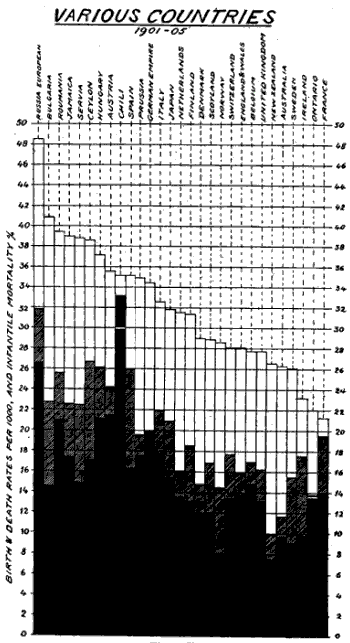
Figure H 1.
H 2
Relation between birth rate and corrected death rates in various countries. (This shows that France is healthier than appears in H 1.)
H 3
Shows relation between birth and death rates from various causes in five districts of London.
H 4
Relation between the birth rate and death rate for various arrondissements of Paris in 1906. (Note that the increase in the Elysée quarter is as high as the average in the quarters of high birth rate.)
H 5-6
Variation of the total population and birth and death rates in the United Kingdom and the German Empire. (Note that the fall in the death rate corresponds fairly closely to that in the birth rate.)
H 7
Id. for France. (Note that the population is still increasing although slowly.)
H 8
Birth and death rates for France since 1781. (Note that the rate of increase of population in 1781 was no higher with a birth rate of 39 per 1,000 than in 1901-6 with a birth rate of only 21 per 1,000. A fall of 17.8 per 1,000 in the birth rate has resulted in a fall of 17.5 per 1,000 in the death rate.)
H 9
Birth and death rates and infantile mortality for England and Wales. Also marriage rate, fertility of married women, illegitimacy and variation of diseases. (Note that the illegitimate birth rate has fallen to half since the fall of the birth rate set in.)
H 10
Birth and death rates and infantile mortality in the Netherlands (Notice the rapid increase of population as the death rate falls, and the great fall of infantile mortality, probably due to the practical work of the Dutch Neo-Malthusian League among the poor.)
H 11-13
Protestant Countries. (Notice the correspondence between the birth and death rates and infantile mortality in all.)
H 14-16
Roman Catholic Countries. (Note that the fall of the birth rate has taken place almost equally with that in the Protestant Countries, and with the same result.)
H 17-20
The only four countries in which the birth rate is approximately stationary. (Notice that the death rate has not fallen—except, perhaps in Russia—and that the infantile mortality has not fallen. Also that the highest birth rate produces the highest death rate and infantile mortality, and the lowest birth rate the lowest mortality.)
H 21-24
The only four countries with rising birth rates. The death rate and the infantile mortality have increased in every one.
H 25
Australia. The death rate has fallen with the birth rate, and is now only about 10 per 1,000.
H 26
New Zealand. The only country in which the fall in the birth rate has not produced a fall in the death rate, and which is not therefore over-populated. The infantile mortality is the lowest in the world, and the death rate less than 10 per 1,000, which gives us an ideal which we can reach in all countries by lowering the birth rate sufficiently.
H 27
The City of Toronto. The birth rate has fallen and afterwards risen. The death rate has fallen with the birth rate, and afterwards risen, showing that the improvements in sanitation have not been the cause of the falling death rate in other countries.
H 28
Berlin. The birth rate rose rapidly from 1841 to 1876, and afterwards fell even more rapidly. The death rate, except for epidemics and wars, rose and fell in almost precise correspondence with the birth rate.
H 29-30
Europe and Western Europe. These show that the total population of Europe is increasing faster, the more the birth rate falls, while in Western Europe the birth and death rates correspond almost exactly. Calculations made from this show that about 25,000,000 fewer deaths have occurred in Europe since 1876, due to the fall in the birth rate caused by the Knowlton Trial and the Neo-Malthusian movement. It should be noted that in the great majority of cases the decline of the birth rate commenced in 1877, the year of the Knowlton Trial.
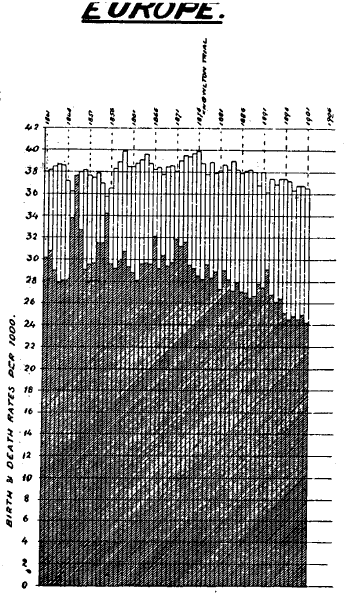
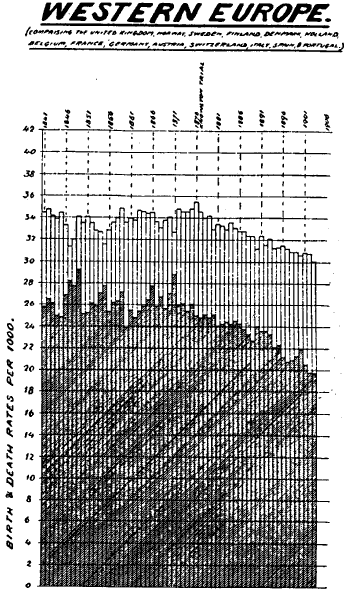
(SEE SUNDBARG'S APERÇUS STATISTIQUES INT'ONAUX 1905. pp. 76 & 80.)
Figures H 29-30
I
Exhibits lent by Mr. and Mrs. W. C. D. Whetham.
I 1
1. Pedigree showing the descent of Administrative Ability.
I 2
2. Wollaston Pedigree, showing the descent of Scientific Ability.
I 3
3. Pedigree showing the Mendelian descent of Eye-colour in mankind.
K
The Racial Form of Nose and Its Segregative Inheritance.
By Geo. P. Mudge.
The form of a nose doubtless depends upon many factors. But chief among them we may suppose are the length, breadth, and angle of inclination of the nasal bones; the form, length, breadth, and thickness of the nasal septum, and the degree of development of the turbinal bones. The segregation and persistence in families of a definite type of nose-form is a subject well worth further study. The inheritance of this character from the Mendelian standpoint has not yet been adequately studied. But as with eye-colour, so with nose-form, we desire to know not only how alternative characters are inherited among individuals of the same race, but how they are transmitted among the offspring of mixed races.
ENGLISH V. GIPSY.
K 1
I am able in the photograph exhibited to show what appears to be an undoubted transmission of a very prominent form of nose from a grandmother to a grandson. The grandmother (on the right of the photograph, who is now over 80 years of age) was the wife of a gipsy and she herself came of gipsy stock. She and her husband eventually settled in a small village in the West of England. They had six children, namely, two sons and four daughters. Of the two sons, one was fair in complexion and had the "wild ways and habits of the gipsy." The other was dark in complexion and married an English countrywoman of the district in which his parents had settled. She was of fair complexion. They are shown, as husband and wife, in the left-hand corner of the central photograph. They have had four children, namely, three girls (shown in the centre of the photograph) and one son (shown standing by the right of his gipsy grandmother in the right corner of the photograph).
The gipsy grandmother has a very prominent type of nose. It is characterised by three chief features: First, the broad base on which the external narial apertures are lodged; second, the marked convexity of the contour of the bridge; third, the well-defined or sharp angularity of the general form. Her son's nose differs from hers in all three of these points. His wife's nose is of the more rounded type and differs very widely from that of the gipsy grandmother (her mother-in-law). The three girl children of these two parents clearly do not possess a nose like that of their grandmother. The two younger daughters appear to resemble their mother, while the oldest appears to be an intermediate between her mother and father. So far then there is no feature of any special interest.
But it is otherwise when we come to deal with the nose of the son (grandson of the old gipsy woman). For it resembles hers in all three of the marked features which give to her nose its distinctive and prominent form. The convexity of the bridge is, perhaps, not quite so pronounced, but then he is still young, and this is a feature likely to become accentuated with age.
Two features of Mendelian interest are shown in this group of a grandmother, two parents and four grandchildren. First, there is a hereditary transmission of nose type from grandmother to grandson. Second, there is a clean segregation of the nose type manifested by the brother, from the contrasted nose type or types exemplified by his three sisters. In addition, the case is interesting since it manifests segregation of characters in the offspring of parents of different races, i.e., a gipsy and a native of the West of England.
In the absence of precise information concerning the form of nose of the gipsy grandmother's husband, and of their five other children, and of the brothers and sisters of the grandmother, it is difficult to formulate a scheme showing a definite Mendelian inheritance in this case. But the two features alluded to in the preceding paragraph are strongly suggestive of inheritance according to Mendelian principles.
We are indebted to Mrs. Rose Haig Thomas for the general facts of this case and for the photograph of the group.
EUROPEAN V. AMERICAN RED INDIAN.
K 2
A few years ago I had an opportunity of meeting two friends who had spent many years in different parts of Canada and were acquainted with families who were derived from an ancestry partly European and partly North American Indian. I gathered from my friends, in virtue of much kindness and patience upon their part, some valuable facts concerning the nature of various facial features in the offspring of the two mixed races—European and Red Indian. I purpose here to deal with two families and with only one character, i.e., the type of nose. The Red Indian and European type of nose are easily distinguishable. In the Red Indian the nose is prominent and its frontal profile is formed by two lines which diverge from the bridge towards the base. The latter is, in consequence, very broad. The form of nose is sometimes known as the busqué or curved type, since its lateral profile is in outline markedly aquiline. But examination of a series of photographs of Red Indians shows some variation in the lateral profile, since some are decidedly concave. But the broadness at the base is apparently never diminished; it is always marked and unmistakable. The well-pronounced Indian nose can always be easily distinguished from the European nose by persons who have had a long acquaintance with both races. But cases do occur where even an experienced observer would feel some doubt in expressing an opinion as to which type a given nose belonged. Such cases are, however, not common.
K 2a
From the pedigrees of families derived from a mixed racial parentage in my possession, I select two for exhibition at this Congress. The first is that known as "Family 5" in my list. In this case a Scotchman (Generation A, S) married a full-blood Indian woman. They had a son and daughter (Generation B, 2 and 3). The half-breed son had the Indian type of nose. The daughter had a small and well-shaped European nose.
The son married a full-blood Indian woman (Generation B, 1) and had four children. Two of these were infants at the time my informant knew them, and though they were described as being generally of the Indian type, they were too young to give any reliable details concerning the form of the nose. The two elder children (Generation C, 1 and 2) were a daughter and a son, and both had the Indian type of nose.
The half-breed daughter (Generation B, 4) married twice. Her first husband was a half-breed Indian (B 3). He was not seen by my informant. They had a son and a daughter (Generation C, 5 and 6). The former was Indian in type of nose as well as in other facial characters. The daughter, though she had very decided Indian cheek bones, had the European type of nose. She is of further interest, inasmuch as while her eye-colour was European the shape of her eyes was characteristically Indian.
The second husband of the half-breed daughter was a Welshman (Generation B, W). By him she had seven children. The last was a baby at the time my informant saw it, and we may leave it out of account. The penultimate child was a son (Generation C, 12), and his nose was sunken, and my informant found it difficult to say whether it was European or Indian in type. I rather suspect from an inspection of some photographs of Indians which I have seen that it resembles a very concave flattened Indian type. Of the remaining five children, four had an European type and one an Indian type of nose.
Assuming that my informant's observations and memory are accurate—and I feel sure they are quite reliable since he spent many years among the Indians and half-breeds of North America in company with other Europeans, and he is a man of naturally sharp discernment—this family shows clear evidence of the segregation of nose type. It is shown more particularly in the children of the half-breed daughter who married twice, since among her offspring (Generation C, 5-13) both types of nose appeared. The re-appearance of the European nose was manifested, not only when she was mated back to an European in her second marriage, but when she married a half-breed like herself. This latter marriage, however, did not constitute, as we might at first sight regard it, an experimental mating in every way analogous to a Mendelian cross of DR x DR; because although she was a half-breed her nose was not like her brother's of the Indian type, but European.
It thus appears as though the Indian nose was dominant in one case, and the European in the other. Too much stress must not be laid on this point. So many half-breeds are indistinguishable from full-blood Indians, that the possibility is to be borne in mind that this woman's mother, who was married to the Scotchman, was not really a full-blood Indian, and that tradition was in error. I am, however, making further inquiries.
But Mendelian segregation is shown in this pedigree in another way. The granddaughter (Generation C, 6), by the first husband, manifested, as already indicated, an European type of nose and European eye-colour. She also manifested other European characters, with which I do not now purpose dealing. But her cheek bones were decidedly Indian and the shape of her eyes were also Indian. Thus we have the segregation in the same individual of the characters of two distinct races of men. In other words, there has been segregation of racial characters followed by their recombination in a hybrid race. That is a fact of some importance, in what we may designate as anthropological Eugenics, or, if we prefer it, as the Eugenics of Anthropology. For it turns our thoughts to the possibility of calling into being a more perfect type of men by the recombination of the better alternative qualities of two less perfect races.
K 2b
The second pedigree exhibited is that of "Family 4" in my list. I am indebted to another informant for the facts of this pedigree, and they relate to another part of North America. In this case a Frenchman (Generation A, F) married a full-blood Indian Princess, namely, a daughter of a Chief. She had one only daughter (Generation B, 2) whose nose was of the Indian type, but rather flat.
The daughter married an Irishman (Generation B, 1), and they had six children. Of these three had European types of nose and three the Indian type (Generation C, 1-6).
This family shows again an apparently clean segregation of Indian and European types of nose. The two types appear, side by side, in different individuals of the same fraternity.
THE SEGREGATION OF RACIAL EYE-COLOUR.
By Geo. P. Mudge.
It is a matter of importance to know the exact influence which a mixture of races exerts upon the hereditary transmission of characters. For instance, do the alternative characters of two races of men, when they are related by marriage, segregate in inheritance in accordance with Mendelian principles? Is the term "blending or fusion of races misleading, and only accurate when employed in a qualified sense"?
It has been shown by Mr. Hurst's very careful investigations in a Leicestershire village that certain types of human eye-colour, which he designates as "Simplex" and "Duplex," are inherited in complete accord with Mendelian principles of inheritance. The two types not only segregate from each other in the course of transmission, but they do so in practically exact Mendelian proportions. And the "Simplex" type, which is the recessive form of eye-colour, breeds true. It begets nothing but the Simplex eye. These results have been confirmed by Professor and Mrs. Davenport in America. In this and similar cases we are merely dealing with the transmission of alternative characters in individuals of the same race. [D]
But one of the interesting problems of the future is concerned with the transmission of characters when human races of diverse characteristics breed together. We are not concerned to discuss now whether the races of mankind are varieties or species.
K 3
SPANIARD v. GIPSY.
The records of travellers provide certain information which helps us to form reliable though limited conclusions as to the results of the interbreeding of different human races. Mrs. Rose Haig Thomas, to whom we are indebted for the exhibit of a photograph, taken during a journey through Spain a few years ago, of a Spanish gipsy woman with her three children, has made several observations of some interest. She became acquainted with a family in which "the mother was a dark-skinned, black-haired, black-eyed gipsy woman. (See photograph, Exhibit No. K 3.) The husband was a Spaniard with blue eyes. There were three children. Of these, the eldest had flaxen hair and blue eyes. The second was a boy with black eyes, black hair, and an olive skin as dark as the mother's. The third child was too young to justify any conclusion being based on its characteristics. It was only 18 months old; but was flaxen-haired, blue-eyed, and fair skinned." This observation of Mrs. Haig Thomas, in Granada, affords then a clear example of the segregation of blue-eye and flaxen-hair characters among the gametes of the black-eyed, black-haired, and olive-complexioned mother. For, in the light of Mendelian researches, it is obvious she was carrying these characters recessive, and that some of her gametes were pure in respect of them.
ARAB v. SPANIARD.
K 4
The second photograph, exhibited by Mrs. Haig Thomas (Exhibit No. K 4), is of three sisters who were also photographed in Granada. The eldest is of the dark, typical "Arab type," so well recognised by Spaniards wherever it is seen in Spain. The second sister is clearly much lighter in hair and fairer in complexion than her sister. The nose, too, is very distinct in both. The baby is fair. It is impossible, of course, to trace the remote ancestry of these sisters, and Mrs. Haig Thomas obtained no information as to their parents, but from what we know of Spanish history the case suggests a possible segregation of Moorish from Gothic features after the intermixture of the two races, by marriage, had occurred. But the question is extremely complex. It is impossible to say to what extent the inhabitants of modern Spain represent in varying degrees a commingled race of Phœnicians and Iberians, of these with Romans and Goths, and of all with Moors, themselves at the time of the conquest of Spain a mixed race. All that can be said with any degree of probability is that these various races have more or less intermingled [E] during the long history of Spain, and that the flaxen hair and blue eyes among its inhabitants are the heritage which the Goths have left them.
EUROPEAN v. AMERICAN RED INDIAN.
For the facts of the segregation of European and Indian eye-colour, I am indebted to two friends who resided for many years in different parts of Canada, and who do not desire their names published.
K 5
The first case of this kind (Pedigree Chart, No. K 5) of segregation of racial eye-colour is that of the offspring from a marriage between a blue-eyed Scotchman and a black-eyed, full blood American Red Indian woman. [F] They had a son and a daughter, and the eyes of both were Indian brown. This brown differs from that of European eyes, and can usually be distinguished by observers who know the two races well. The half-breed son (No. 2, Generation B) married a full blood Indian woman (No. 1), who also had Indian brown eyes, and by her had four children. Two of them were babies at the time my informant knew them, and we may leave them out of account. The other two, a son and daughter (Nos. 2 and 1, Generation C), had Indian brown eyes. This result is in accord with Mendelian expectations.
The half-breed Indian daughter (No. 4, Generation B) of the blue-eyed Scotchman and Indian mother married a Welshman (No. 5, B) with hazel eyes. They had seven children. Of these, two—a son and daughter (No. 7 and 11, Generation C)—had blue eyes. The remaining children—with the exception of a baby, whom my informant had seldom seen—had eyes of varying shades of brown. Two (Nos. 9 and 12, C) had European brown, one dark Indian brown, and one Indian brown eyes (Nos. 8 and 10, C).
The re-appearance of blue eyes among two of the Scotchman's grandchildren is a clear example of the Mendelian segregation among the gametes of the half-breed Indian mother of the factors which produce blue eyes. The Welsh father, with the hazel eyes, must, of course, as we deduce from other cases, have carried the blue-eye factors recessive.
The black-eyed full blood Indian grandmother also carried various shades of Indian brown, recessive to the Indian black which she herself manifested, since her daughter and two granddaughters exhibited Indian brown and dark Indian brown coloured eyes. The two European brown-eyed grandsons were probably in eye-colour hybrids between the hazel colour of the Welsh father and the Indian brown of the half-breed Indian mother.
The pedigree is thus, in respect of eye-colour—and of other characters also which are not here described—clearly Mendelian in its manifestations. It shows that the offspring of two very different types of human races exhibit the same mode of Mendelian inheritance as do the descendants of two contrasted parents of the same race.
K 6
Family 4 (Pedigree Chart, No. K 6) illustrates the same kind of facts and conclusions. In the A Generation a Frenchman, whose eye-colour was unknown to my informant, married a full blood Indian princess who had Indian brown eyes. There was one daughter only (Generation B) by this marriage, and she had Indian brown eyes. She married an Irishman, who had red hair, grey eyes, and a freckled complexion (Generation B). From this marriage there came six children (Generation C). Two of these had "grey eyes like their father." Three had dark brown eyes of European tint. My informant had some doubt as to the European tint of two of these three (Nos. 3 and 4, C Generation); their eye-colour was very dark brown, and possibly it may have been the Indian tint. The remaining member of this generation had Indian brown eyes of a very dark shade.
It may be desirable to state that Families 4 and 5 come from different parts of Canada.
The chief feature of interest in this family is the segregation of the grey eye-colour of the Irishman among his offspring. It appears in two daughters. From what we know of analogous cases, there is little doubt that the gametes of his half-breed Indian wife carried the blue or grey factors derived from her French father. The appearance of an European brown eye-colour in Generation C, No. 6, suggests that the French grandfather had brown eyes, and that, therefore, this colour has segregated out among the gametes of the half-breed Indian mother.
L
Exhibited by Mr. E. Nettleship.
L 1
Congenital Colour-blindness. Pedigree showing unusual features, viz.: (a) females affected; (b) twins, of whom one is affected, the other not; (c) marriage between two unrelated colour-blind stocks. Except that two females are affected the inheritance, so far as can be traced, has followed the rule for colour-blindness; viz., limitation to males and transmission through unaffected females.
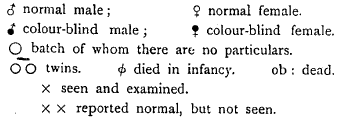
L 2
Hereditary night-blindness with myopia (short sight) affecting 21 males and only 1 female in a large pedigree. The night-blindness congenital and stationary. Descent always through mothers themselves unaffected. Mental defects in several of the night-blind stock. Other pedigrees of this male-limited night-blindness are on record.
Key. and night-blind male and female. Otherwise the same as for L 1.


L 3
Pedigrees of hereditary congenital Nystagmus (involuntary rhythmical movements of the eyes) showing two different modes of descent.
L 3a
In Figure L 3a the nystagmus occurs only in males and descends through unaffected females.
L 3b
In Fig. L 3b both males and females are liable to the disease, and either parent may transmit it, although descent is more often through mother than father.
The movements of the eyes are very often accompanied by rhythmical movements of the head in the non-sex-limited type (Fig. L 3b), but head movements very seldom occur in the male-limited type (Fig. L 3a).
In both types many of those affected have also optical defects of the eyes, especially astigmatism. No mental or nerve complications in either kind.
Key. and male and female with Nystagmus. Otherwise as for L 1.
L 4
Pedigree of hereditary Cataract. The cataract in this genealogy begins in childhood, and usually progresses so as to require operation by the time its subject is grown up; results of operation usually good and lasting. Most of the affected members still living; of the four dead, none died before 54, and two of them lived to 78 and 83 respectively. Both sexes affected and either sex may transmit. No other eye disease and no prevalent constitutional diseases or degeneracies in the cataractous stock.
Many similar pedigrees are known. Key. and male and female with cataract. Otherwise as for L 1.
M
Exhibited by Professor R. C. Punnett, F.R.S.
Mendelian Inheritance in Rabbits.
M 1.
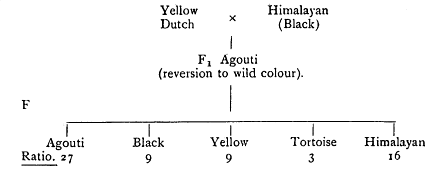
Factors concerned:—
A. the factor for agouti which turns a black into an agouti, or a tortoise into a yellow.
E. the factor for extension of pigment which when present turns a yellow into an agouti, or a tortoise into a black.
S. the factor for self colour which turns a Himalayan into a self coloured animal.
All the rabbits in this experiment contain the factor for black (B).
M 2.
The Himalayan pattern can occur in all four colour classes. Thus the agouti Himalayan has lighter points than the black Himalayan. (cf. 2 specimens shown.)
Experiments to demonstrate that black rabbits may be of different constitution genetically.
Factors concerned in these experiments are:—
A. the agouti factor.
E. the factor for extension of pigment.
D. a factor for density of pigmentation.
All the rabbits are homozygous for the black factor B.
Homozygous agouti = AA BB EE.
Black rabbits may be either:—
(1) Rabbits of the constitution aa BB EE. These breed true and behave as simple recessive to agouti.
(2) Rabbits of the constitution AA BB EE DD., i.e., agoutis to which a double dose of D has been added are pure blacks in appearance, when only a single dose of D is added the animal shows some agouti markings and is an agouti-black. Such rabbits have always proved to be heterozygous, and when mated together give blacks, agouti-blacks, and agoutis in the ratio 7:6:3.
(3) Rabbits of the constitution AA BB Ee Dd. An agouti-black (AA BB EE Dd) becomes a pure black when heterozygous for E. Such blacks when mated with blacks of constitution aa BB EE dd throw some agoutis and also some agouti-blacks.
Further, the experiments have shewn that the factor D is coupled with E in the gametogenesis of rabbits of the constitution AA BB Ee Dd. The gametes produced by such animals are of two kinds only viz—A B E D and A B e d. When mated with a tortoise aa BB ee dd they give blacks and yellows only—and no agoutis. So far as is known, the coupling between E and D is complete. At present this is the only case of coupling between characters yet worked out in a mammal.
M 3
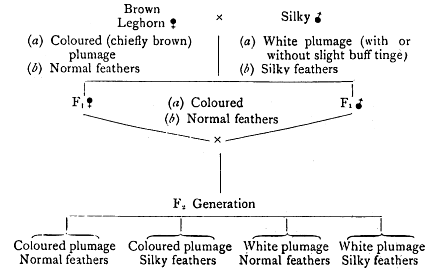
Experiments with Poultry, illustrating the recombination of characters.
M 4
Experiment with Sweet Peas, illustrating reversion on crossing, followed by the appearance of numerous types in next generation.
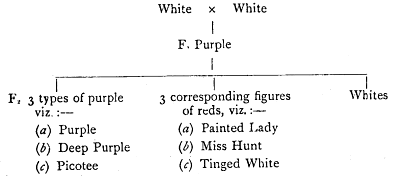
The varied forms in the F_2 generation appear in definite proportions and a certain number of plants of each variety are already "fixed," and have been shewn, by further experiment, to breed true to type.
M 5
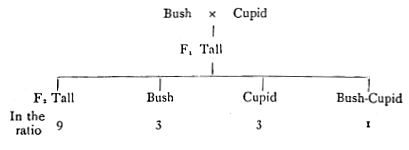
Experiment with Sweet Peas, illustrating reversion in structural characters.
A cross between the ordinary "Cupid" dwarfs and the half-dwarf "Bush" form results in a complete reversion to the normal tall habit such as occurs in the wild sweet pea. A further generation raised from these reversionary talls consists of talls, Bush, Cupids, and a new form, the "Bush-Cupid." These last combine the erect bush-like habit of growth with the dwarfness of the Cupid.
M 6a
Example of association of characters in heredity.
In the sweet pea the dark reddish purple axil is dominant to the light green one. Also the fertile condition of the anthers is dominant to the contabescent sterile condition. In families which involve these characters, the nature of the F_2 generation depends upon the way in which the original cross was made. (A) When each parent has one of the dominant characters.
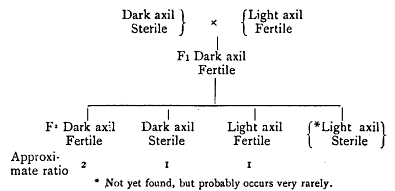
[G] Not yet found, but probably occurs very rarely.
M 6b
(B) If, however, both of the dominant characters go in with one parent, and neither with the other parent, they tend to remain associated in F2; thus:—
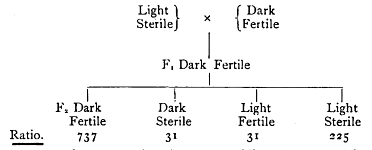
In such a cross the classes resembling the two original parents tend to be produced in excess, while the other two combinations are produced much more rarely. Nevertheless, the ratio of dark to light axil, and of fertile to sterile anthers, is, in each case, a simple 3:1 ratio.
M 7a
Example of association of characters in heredity.
Purple flower colour is dominant to red in the sweet pea, and the old-fashioned erect form of standard with the central notch is dominant to the hooded. In families where these characters are involved, the nature of the F2 generation depends upon the manner in which the cross was made.
(A) When one dominant character goes in with each parent.
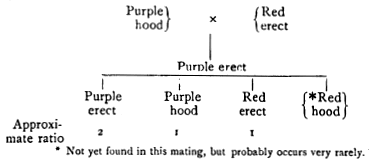
[H] Not yet found in this mating, but probably occurs very rarely.
M 7b
(B) When the two dominants enter, from one parent, they tend to remain associated in the F2 generation.
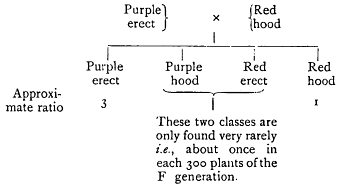
N & N 1
Exhibited by the Utah Agricultural College.
Mr. E. G. Titus.
The chart is 147 feet long, 54 inches wide, exclusive of the important data condensed on a separate 8-foot sheet. This is only a preliminary chart, as may be seen from the condensed data attached, which shows that of the 822 persons represented on the chart 539 are of mature age. The unknown persons represent 303, unknown ability; 336, unknown height; 339, unknown weight; 348, unknown health. The family is remarkable for the health of its members, having so far only 97 deaths. The oldest child, Generation II-1, was born in 1827. There are, of course, a large number of persons on the chart who are rather young. Where a person has more than one ability well marked, such as music and literary ability, or music and business ability, or constructive and business ability, the chart shows only one ability. There are several cases where persons have three well marked abilities. In all cases, the following is the rank on the chart:—
Literary ability is always charted. Following this, music and then art, and then constructive. Constructive ability represents those persons who have a decided mathematical and mechanical turn of mind, who are builders, contractors, carpenters of advanced standing, architects and men of these classes. Under "Various" abilities are classified business, agricultural and domestic abilities. These are not marked on the chart.
It will be noticed under "Diseases" that a majority of the persons who have died were infants, and even among infants the deaths are remarkable for their small number considering the conditions under which the people of the third generation of this family had to live. The paternal ancestor, Generation I., came to America in 1842, dying two years later, and his children came to Utah among the early settlers, 1847-52. Many of the third generation were born in this State under conditions that are not by any means comparable to those existing in communities that have been settled for many years. The opportunity to care for children was very limited. Physicians were not as easily reached, and the methods and appliances of modern times were not at hand. Yet, even under these circumstances, it will be noticed of the 822 persons listed on the chart, that only 68 deaths were those of persons under 25 years.
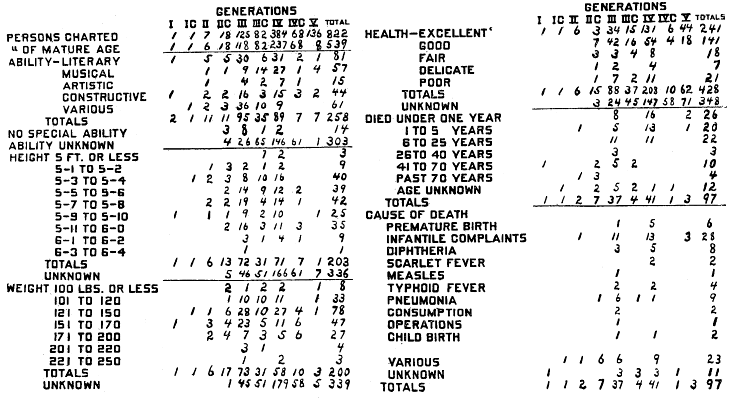
Transcription provided below.
O
Exhibited by the Eugenics Education Society.
O 1 Mendelism.
O 1a
Theoretical Example of Mendelian Inheritance in Peas. (After Thomson.)
O 1b
Theoretical Example of Mendelian Inheritance in Peas. (After Laurie.)
O 1c
Theoretical Example of Mendelian Inheritance, with Dominance, in Mice. (After Laurie.)
O 1d
Illustration of the Theory of Gametic Purity in Mendelian Heredity in Mice. (After Laurie.)
O 1e
Example of Mendelian Inheritance, without Dominance, in Blue Andalusian Fowls. (After Laurie.)
O 1f
Illustration of the Theory of Gametic Purity in Mendelian Heredity, in Blue Andalusian Fowls. (After Laurie.)
O 2
Standard Scheme of Descent. (After Galton.)
O 3
Comparison of Mr. Booth's Classification of All London with the Normal Classes. (After Galton.)
O 4
Descent of Qualities in a Population. (After Galton.)
O 5
Inheritance of Ability, as exemplified in the Darwin, Galton, and Wedgwood Families. (After Whetham and Marshall.)
P
Exhibited by the American Breeders' Association—Eugenics Section.
C. B. Davenport, Esq.
P 1-16
Charts of Statistics of Defectives.
Charts of Classification of Defectives.
Charts of Principles of Heredity.
Pedigrees collected by field-workers in America.
Q
Exhibited by Cyril Burt, Esq.
Description of Diagrams illustrating the use of experimental Tests of Mental Capacities.
1. "Experimental Tests of General Intelligence."
Q 1
A List of twelve tests applied to two schools at Oxford. The first two columns of figures indicate the "reliability" or self-consistency of the tests as compared with that of examinations and master's general impression. The second two columns give the correlations of the results of the tests with the children's "general intelligence." It will be seen that several of the tests of higher mental processes are as reliable as the scholastic tests at present in vogue, and that they correlate quite as highly with intelligence. Further experiments show that while examinations and master's estimates measure knowledge and skill acquired by memory and training, the tests seems to provide measurements rather of innate capacities; and that children of superior parentage (e.g. the preparatory school boys) are themselves superior at tests, which show an appreciable positive correlation with intelligence (i.e. all except tests of touch and weight). The tests thus provide an experimental demonstration of the inheritance of mental ability and a means of measuring the same. (References:—Burt, Experimental Tests of General Intelligence, British Journal of Psychology, Vol. III., Pts. 1 and 2.) Burt, Inheritance of Mental Characteristics, Eugenics Review, 1912, July.
Q 2
2. Sex-differences in mental tests.
A list of experimental tests applied to children of both sexes with a view to measuring their innate capacities for performing mental processes of different levels of complexity. The amount of divergence between the sexes, is indicated by the column in red. It will be seen that the sex-differences become smaller, the higher the level tested. There is some evidence to show that these differences are the result of inheritance and are not the result of difference of tradition or environment. (References: Burt and Moore, the Mental Differences between the sexes. Journal of Experimental Pedagogy, 1912, June. Burt, Inheritance of Mental Characteristics, Eugenics Review, 1912, July.)
R
Exhibit by Dr. George Papillault.
Four sets of questions drawn up by Dr. George Papillault, Professor of Sociology in the Paris School of Anthropology, with a view to noting and comparing the bio-social characteristics of individuals belonging to different groups of population.
R 1
Set of questions adopted by the Commission of Criminology instituted and presided over by Mr. —— Keeper of the Seals; Vice-presidents, Messrs. Léon Bourgeois, senator, and Dr. Dron, Vice-president of the Chamber of Deputies and Reporter to the Commission; Scientific Secretary, Dr. G. Papillault.
This set of questions comprises:
1st. An individual criminological chart for the purpose of showing 271 biological and social characteristics of the prisoners.
2nd. Family Charts for each of the ancestors, descendants or collateral relatives of the prisoner and more particularly intended to note hereditary characteristics.
These Charts have been issued with a view to a methodical enquiry on the criminal, under the direction of the Scientific and Criminological Department.
R 2
Set of questions of the French Lay Mission, designed to note the characteristics of the young natives and of their relatives in the French Colonies. The teachers will have to return them filled up with the greatest care to the Lay Mission, where Dr. Papillault, before their departure, delivered a series of lectures to teach them how to proceed.
R 3
Questions on the half-breeds, adopted by the Paris Society of Anthropology, and designed to show the bio-social characteristics of the half-breeds proceeding from cross-breeding between different races.
R 4
Questions asked by the General Psychological Institute for the purpose of undertaking a vast enquiry on the value taxonomic, organic, bio-social, and selective of the different human races which actually exist in the French Colonies, and particularly in North Africa.
A like spirit and method governs these four sets of questions; to discard the verbalism which obstructs and imperils Sociology; to study characteristics precise, objective, easily controllable and comparable, and likely consequently to form statistics, which alone, are capable of revealing characteristics of groups; to establish the correlations which these characteristics may present among themselves, and to arrive at last at the discovery of positive sociological laws.
S
Exhibited by Frederick Adams Woods, M.D.
Thirteen photographic copies of authentic portraits of distinguished historical personages of the sixteenth century, showing that the bony framework of the face, especially about the nose and eyes, was not commonly the same as it is to-day.
These are samples of a much larger collection.
S 1
Charles VII., XV Century, eye-brows very high above the eyes.
S 2
Mary of Lorraine, Queen of James of Scotland (National Portrait Gallery). Eyes far apart, and eye-brows high.
S 3
Francis I. of France, French School, XVI. Century. (Louvre.) Eyes small, upper eye-lids peculiar, and typical of the period.
S 4
Louse de Rieux; Marquise d'Elboef, XVI. Century. (Louvre.) Naso-orbital region typical, eyes small far apart, upper part of the nose broad and flat, upper eye-lids long (vertical distance between eye and eye brow considerable.)
S 5
Dr. Stokesley, Bishop of London (Holbein.) Eyes far apart upper part of nose broad.
S 6
Jane Seymour (Holbein). Eyes far apart, upper eye lids characteristic.
S 7
Jean de Bourbon, Comte d'Enghien. XVI Century. Eyes far apart, upper eye-lids vertically prominent.
S 8
Portrait of a young German gentleman.
The eye-lids are modern, that is the eyes are set in deeply under the arch, but the eyes themselves are far apart, and the upper part of the nose is broad.
S 9
Mary Queen of England. (National Portrait Gallery).
It would seem that allowance might be made for the crudity of the portrait, but the naso-orbital region is typical of the northern races during the XVI century.
S 10
Holbein's Duke of Norfolk. In the Royal Gallery at Windsor Castle.
Eyes are more deep-set under the superorbital arch than is usual in portraits of the period, but the upper part of the nose is broad, and eyes are far apart.
S 11
Henry VIII., attributed to Holbein but on doubtful authority.
Broad flat nose, small eyes set far apart, eye-brows arching upward and outward. Observe the upper eye-lids in contrast to the Italian by Lorenzo Lotto, which shows the usual modern type of eye-lid.
S 12
Portrait of the Prothonotary Apostolic Juliano. (Lorenzo Lotto.)
Modern type of face. Eyes deep set in under the superorbital arch and eye-brow. Upper part of the nose delicate and projecting. This type of face is occasionally, but only rarely met with north of the Alps during the early period. It is common enough in portraits of Italians.
S 13
Portrait of a German scholar, by Holbein. Modern type, very rarely found.
First
International Eugenics Congress,
LONDON, 1912.
PROGRAMME.

Page
Accommodation 5
Application Forms 23, 25
Arrival 7
Badges 8
Banquet 5
Business Meetings 9, 14
Consultative Committees 3
Correspondence 4
Daily Time-Table 9-18
Delegates 11, 21
Entertainments 7, 9, 11, 13, 14, 16
Exhibition 19
General Arrangements 1
Hospitality Bureau 7, 11
Languages 4
Lunches and Refreshments 10, 27
Meetings 10-18
Membership 5
Offices of Congress 1
Officers 20-20
Place of Meeting 1
Railway Arrangements 5, 6, 7
Receptions 9, 11, 13, 16
Rules of Procedure 8
Stewards 5
Vice-Presidents 2
All Communications should be addressed to the Secretaries.
Offices of the Congress: "The Eugenics Education Society," 6, York Buildings, Adelphi, London. (Office Hours, 10-30 a.m. to 5 p.m.)
PRESIDENT *MAJOR LEONARD DARWIN, D.Sc.
Vice-Presidents.
Sir Clifford Allbutt, K.C.B., F.R.S., M.D., Regius Professor of Physic, Cambridge.
The Right Hon. Lord Alverstone, G.C.M.G., LL.D., Lord Chief Justice.
The Right Hon. Lord Avebury, F.R.S.
Sir Thomas Barlow, Bart., K.C.V.O., F.R.S., President of the Royal College of Physicians.
Dr. Alexander Graham Bell, Founder of the Volta Bureau, Washington.
Sir William Church, K.C.B., D.Sc., lately President of the Royal College of Physicians.
The Right Hon. Winston Churchill, M.P., First Lord of the Admiralty.
Sir William Collins, F.R.C.S., Vice-Chancellor of the University of London.
Dr. C. B. Davenport, Secretary of the American Breeders' Association.
Dr. J. Déjérine, Clinical Professor of Nervous Diseases, Salpêtrière.
Dr. Charles W. Eliot, President Emeritus of Harvard University.
Dr. Auguste Forel, Lately Professor of Psychiatry, University of Zurich.
Sir Archibald Geikie, President of the Royal Society.
Sir Rickman J. Godlee, F.R.C.S., President of the Royal College of Surgeons.
Professor M. von Gruber, Professor of Hygiene, Munich, President of the German Society for Race Hygiene.
Dr. David Starr Jordan, Principal, Leland Stanford University. President of the Eugenic Section, American Breeders' Association.
Monsieur L. March, Director, Statistique Générale de la France.
The Right Hon. Reginald McKenna, M.P., Secretary of State for Home Affairs.
The Right Hon. The Lord Mayor of London.
Dr. Magnan, l'Asile Sainte-Anne, Paris.
Dr. L. Manouvrier, Professor of Anthropology, Paris.
Dr. A. Marie, Asiles de la Seine.
Sir Henry Alexander Miers, D.Sc., F.R.S., Principal of the University of London.
Professor Alfredo Niceforo, Professor of Statistics, Naples.
Sir William Osler, M.D., F.R.S., Regius Professor of Medicine, Oxford.
The Right Rev. The Lord Bishop of Oxford, D.D.
Dr. E. Perrier, Director, Natural History Museum, Paris.
Gifford Pinchot, Washington.
Dr. Alfred Ploëtz, President of the International Society for Race Hygiene, Germany.
Sir William Ramsay, F.R.S., Professor of Chemistry, University of London.
The Right Rev. The Lord Bishop of Ripon, D.D.
Professor G. J. Sergi, Professor of Anthropology, Rome.
Dr. E. E. Southard, Neuro-Pathologist, Harvard University, and Director of the State Psychopathological Hospital.
The Right Hon. Sir T. Vezey Strong, K.C.V.O.
Bleecker van Wagenen, of the Board of Trustees, Vineland Training School, New Jersey, U.S.A.
Professor August Weismann, Professor of Zoology, Freiburg.
Honorary Members.
Monsieur Henri Jaspar, Avocat à la Cour D'Appel, Président de la Société Protectrice de l'Enfance Anormale; Secrétaire de la Commission Royale des Patronages, Brussels.
Monsieur Adolph Prins, Inspecteur Générale des Prisons, Brussels.
Professor Ludwig Schemann, President of the Gobineau-Vereinigung, Germany.
His Excellency the General von Bardeleben, President of the Verein Herold, Berlin.
AMERICAN CONSULTATIVE COMMITTEE.
President—Dr. David Starr Jordan.
Committee.
Dr. C. B. Davenport, Alexander Graham Bell, Professors W. E. Castle, Charles R. Henderson, Adolph Meyer, A. Hrdlicka, Vernon L. Kellogg, J. Webber, W. L. Tower, Dr. Frederick Adams Woods.
Secretary and Treasurer—Dr. C. B. Davenport, Eugenics Record Office, Cold Spring Harbor, Long Island, New York.
BELGIAN CONSULTATIVE COMMITTEE.
Secretary—Dr. Louis Querton, Boulevard de Grande Ceinture, 77, Brussels.
Committee.
MM. Dr. Boulenger, Dr. Bordet, Dr. Caty, Dr. Decroly, Dr. Gengou, Dr. Herman, Dr. L. MM. Gaspart, Gheude, Jacquart, Marc de Sélys Longchamps, Nyns, E. Waxweiler, Professor Marchal.
FRENCH CONSULTATIVE COMMITTEE.
Hon. Presidents.
MM. Bouchard, Henry Chéron, Yves Delage, Paul Doumer, A. de Foville, Landouzy, Paul Strauss.
President—M. Edward Perrier.
Committee.
M. M. Déjérine, Gide, March, Magnan, Manouvrier, Marie, Pinard, Variot.
Secretary and Treasurer—M. Huber, Statistique Générale de la France, Paris, 97, Quai D'Orsay.
GERMAN CONSULTATIVE COMMITTEE.
President—Dr. Alfred Ploëtz, Gundelinden Str., 5, Munchen.
Committee.
The Committee of the International Society for Race Hygiene.
ITALIAN CONSULTATIVE COMMITTEE.
President—Professor Alfredo Niceforo, 54, Via Ara Cœli, Rome.
Committee.
Professors Corrado Gini, Achille Loria, Roberto Michels, Enrico Morselli, Sante de Sanctis, Giuseppe Sergi, V. Ginffrida-Ruggeri.
First International Eugenics Congress
LONDON.
Wednesday, July 24th, to Tuesday, July 30th, 1912.
General Arrangements for the Meeting.
An invitation circular has been widely circulated to all members of Eugenic and Heredity Societies in Europe and America, and to many other persons likely to be interested in the approaching Congress. Through that circular the objects and general plan of the Congress have been made widely known. Copies may still be had on application to the Secretary.
The following arrangements have now been definitely made.
Place of Meeting. The Meetings of the Congress will be held in the Great Hall of the University of London, Imperial Institute Road, South Kensington, London, S.W., which is easily reached from South Kensington Station on the Underground Railway, and by omnibus from all parts of London. (In wet weather those travelling by rail can avail themselves of the subway).
Headquarters of the Congress. Until Tuesday, July 23rd, the headquarters and offices of the Congress will remain at 6, York Buildings, Adelphi, W.C. (close to Charing Cross Station), where all information will be supplied and tickets issued. Office hours 10-30 a.m. to 5 p.m. On and after Wednesday, July 24th, the headquarters will be transferred to the University of London, South Kensington. If arrangements for hotels or for lodgings have not been made previously, members arriving on and after July 24th are recommended to leave their luggage in the "Cloak Room" at the railway station and come to the office of the Congress, at London University, South Kensington, for information.
Correspondence. From July 24th to 30th, Members and Associates of the Congress may have their letters addressed to them at the First International Eugenics Congress, c/o The University of London, South Kensington, S.W., where special postal facilities will be provided. All invitations to Receptions, etc., will be distributed in this way.
Languages. It has been decided that in the Meetings and Discussions the English, French, German, and Italian languages shall be on an equal footing. At the same time it is right to point out that in all Congresses the number of Members speaking and understanding only the language of the country in which they are held has been far in excess of those conversant with several languages; therefore those who speak in English on the present occasion will be most widely understood. The abstract of every paper which is received in time by the Secretary will be translated into English, French, and German. Pamphlets containing the abstracts in these languages will be available on July 24th at the University Buildings. Members wishing for advance copies should notify the fact to the Secretaries, and state clearly in what language they are required, and to what address they should be sent.
Stewards. A number of Stewards acting as interpreters will be in attendance; the languages spoken being indicated by rosettes of the following colours:—Red, French; Blue, German; Green, Italian.
Hotels, etc. The Organising Committee is prepared to book rooms in advance for intending Members. Lists of hotels and the accommodation vouchers have been sent out to all Members with their membership cards. Any Member wishing to pay his membership fee on arrival can on application obtain an accommodation voucher in advance.
To make certain of securing the accommodation desired, it is essential that accommodation vouchers duly filled in should reach the office not later than July 10th.
Tickets of Membership. In order to take advantage of the reduced fares offered by the railway companies (see below), the official Congress ticket must be produced when paying the fare. The subscription entitling to membership of the Congress is £1 sterling; for an Associate it is 10/-. Members may obtain additional tickets for ladies at the cost of 10/- each. These additional ladies' tickets are transferable to ladies. Associates are entitled to all the privileges of Members, except that they have no vote in the meetings and will not receive a copy of the Report when published. The tickets of all Members and Associates who pay in advance will be forwarded to their addresses before the commencement of the Congress. A limited number of Day Membership Cards at 5/- each will be obtainable from the Secretary's Office in the Marble Hall during the Congress. These cards admit to both the morning and afternoon sessions, but do not carry the privileges of voting and hospitality.
Inaugural Banquet. An Inaugural Banquet will be held at the Hotel Cecil on Wednesday, July 24th, at 7 p.m., at which all the officials of the Congress and readers of papers will be the guests of the Entertainments Committee. Members of the Congress can obtain tickets at 7/6 each, from the Hon. Secretary, Entertainments Committee, 30, York Terrace, Harley Street, London, W. Speeches of welcome will be made by the President, the Lord Mayor of London, the Rt. Hon. A. J. Balfour, and others. The Banquet will be followed by a Reception to which all Members and Associates of the Congress will be invited.
Railway Arrangements. Important concessions have been made by a number of Railway Companies to Members and Associates of the Congress. On the railways of Russia, Austria-Hungary, Germany, Switzerland and Holland, no reductions will be allowed; but by taking tickets to a station in Belgium or France, near the frontier, reductions may be secured by groups of not less than 20 visitors travelling together from those countries for the rest of their journey. In all cases it is necessary to produce the Congress Membership Ticket before receiving railway tickets at reduced rates; and arrangements MUST be made in advance, 14 days' notice being required. Persons desiring to take advantage of these concessions must therefore forward their subscriptions at once; and immediately on receipt of their membership ticket should communicate with the Secretary of their country (see page 3). In the following list the countries most distant from London are mentioned first:—
Italy. The P.L.M. Company will grant a reduction of 50% to Members coming from Italy via Modane.
At the time of issuing this notice definite information regarding reduced rates on the Italian State Railways is not to hand.
Germany. Members from Germany desiring to obtain reduced rates are requested to communicate, through their Secretary, with the General Agent of the South Eastern and Chatham Railway Office in Cologne (6 Domhof). Provided at least 20 Members travel together on the journey to London, arrangements can be made for reduced fares at 50% reduction from the Belgian or from the Dutch Frontier to London and back. At least 14 days' notice must be given to secure these facilities.
Belgium. If at least 20 members travel together, a reduction of about 50% is granted. Members are requested to communicate, through the Secretary of their country, with the General Agent of the South Eastern and Chatham Railway in Brussels (19, rue de la Regence).
France. On presentation of their Congress Cards, members attending the Congress will be able to obtain at Paris (Gare du Nord) special 15 day return tickets to London via Calais-Dover or Boulogne-Folkestone at the following fares:—
1st Class.—72f. 85c. 2nd Class.—46f. 85c. 3rd Class.—37f. 50c. available from July 22nd.
These tickets are available by the following trains:—
Paris (Nord) dep. 8-25 a.m. 3-05 p.m. 9-20 p.m.
London (Charing Cross) arr. 3-25 p.m. 10-45 p.m. 5-43 a.m.
(B) (B) (C)
(B) via Boulogne-Folkestone. (C) via Calais-Dover.
Special arrangements can be made for reserved accommodation to be provided for groups. The above-mentioned tickets can also be obtained at the Paris Office of the South Eastern and Chatham Railway (14 Rue du 4 Septembre), but the Congress vouchers must be presented at the time in either case.
Another Route—From Paris (St. Lazare) special 15 day return tickets to London via Dieppe-Newhaven at the following fares:—
1st Class.—47f. 20c.2nd Class.—36f. 40c.
These tickets are available for the following trains:—
Paris (St. Lazare) dep. 10-20 a.m. 9-00 p.m.
London (Victoria) arr. 7-40 p.m. 7-50 a.m.
Great Britain. All the British Railways have very kindly granted exceptional facilities to members of the Congress. Return tickets for the price of a single fare and a third, lasting from July 23rd to 30th, will be issued from all stations in the United Kingdom on presentation of the Congress voucher at the Booking Office.
Members wishing to return to their homes outside London daily, must apply for separate vouchers for each day if the distance is more than 50 miles. If however the member resides within that distance, the usual sleeping-out arrangements will apply, i.e., that tickets at a single fare and a third for the double journey may be issued (upon production of cards of membership or letters of invitation), from the town where the Conference is being held to places where the delegates reside. The minimum fare will be 1/-.
Stations Of Arrival. Passengers travelling from the Continent by the South Eastern and Chatham Railway, arrive at Victoria or Charing Cross Stations according to the train service selected. Passengers by the Great Eastern Railway arrive at Liverpool Street Station; and those by the London, Brighton, and South Coast Railway arrive at Victoria Station.
Hospitality Bureau. During the meeting of the Congress there will be many entertainments in the form of receptions, dinners, afternoon and evening parties, for which there will be invitations to Members and Associates of the Congress. In most cases the number to be entertained is limited, and it is desirable that the Secretaries should have as complete a list of members as possible to submit to the hosts.
All Officials of the Congress, and Readers of Papers, and Delegates, will shortly receive invitations to the various entertainments mentioned in the programme.
Members should apply at the Hospitality Bureau in the Marble Hall on arrival, as the number that can attend each function is limited, and cards will be issued to members in order of application.
A limited number of Tickets for the Zoological Gardens, tickets to hear debates in the House of Commons, and invitations to tea on the Terrace of the House of Commons, etc., will also be available.
The German Athenæum Club has very kindly signified its willingness to accord the privilege of Hon. Membership of the Club to German Readers of Papers and Members of the German Consultative Committee, and to a limited number of German Members of the Congress.
RULES OF PROCEDURE.
The Organising Committee feel that the interest and usefulness of the Congress will be greatly increased by the usual sectional plan being departed from, so that all papers can be discussed in general sittings. This plan will necessarily limit the time available for papers, but, on the other hand, it will allow the interest of all members to be focused on each question to be considered. To enable the maximum amount of work to be done in the time available, the following arrangements have been made:—
Papers. The reader of each paper will be allowed 25 minutes in which to give a summary of his paper and to reply to criticisms. A certain time, limited at the discretion of the Chairman, will then be allowed for discussion (maximum time—20 minutes).
Should the reader of a paper not desire to exercise his right of reply he may devote the whole 25 minutes to his opening summary.
If, on the other hand, he prefers to reserve a longer time for reply he must reduce the length of his opening remarks, bearing in mind that the whole time at his disposal for the two speeches will be 25 minutes.
Discussions. All discussions are under the absolute control of the Chairman, who will regulate the length of time allotted to each discussion, and to each speaker in that discussion. The Chairman will ring a bell one minute before each speech must end. After the bell is rung a second time the next speaker will be called. The maximum time allotted to the discussion on each single paper is twenty minutes,—to each single speaker, seven minutes.
The names of persons wishing to speak must be handed up to the Chairman before the conclusion of the speech opening the Discussion.
Badges. A button badge, consisting of a reproduction of the head of Sir Francis Galton, will be presented to every Member and Associate.
A silvered medal with ribbon and clasp will be presented to members of the Consultative Committees, Readers of Papers and Government Delegates. Distinctive colours will be as follows:—
Organizing and Consultative Committees Medal and Red Ribbon.
Readers of Papers " " White "
Stewards " " Yellow "
Executive Committee " " Blue "
The medals with green ribbons will be on sale, price 1/- each, to all Members and Associates.
DAILY PROGRAMME.
This programme will be adhered to as closely as possible, but the Executive Committee reserve the power to make any alterations which circumstances may render necessary.
WEDNESDAY, JULY 24th.
10 a.m. The Offices of the Congress will be opened at the University of London, South Kensington. Members and Delegates are requested to call during the day, to sign the register and enter their address, and to obtain invitations to the Receptions, Dinners, etc.
3 p.m. A Meeting of the Congress Executive Committee will be held in the Senate Room. The Congress Executive consists of the President, Secretary, and two members of each of the Consultative Committees, and the President, Secretary and two members of the British Executive Committee. The arrangement of the agenda for the Business Meeting on the 27th.
7 p.m. Reception bu the President of the guests to the Inaugural Banquet at the Hotel Cecil, Strand. The Banquet commences at 7-30 p.m. punctually. Speeches will be made by the President, The Lord Mayor of London, Mr. A. J. Balfour and others. All Officers of the Congress, Readers of Papers, Presidents and Secretaries of Branches of the Eugenics Education Society, are the guests of the Hospitality Committee. Ordinary Members of the Congress may attend (tickets, 7s. 6d. each, exclusive of wine) and may take one friend on the same terms. The maximum seating capacity of the hall is 400 and only a limited number of seats are available. To prevent disappointment early application for tickets should be made on the form on page 25, to the Hon. Secretary, Mrs. Alec Tweedie, Entertainments Committee, 30, York Terrace, Harley Street, W.
9-45 p.m. Reception of welcome to all Members and Associates of the Congress at the Hotel Cecil to meet the delegates and others who have attended the Inaugural Banquet.
SECTION I. Biology and Eugenics.
THURSDAY. JULY 25th. MORNING SESSION.
10 a.m. Opening of the Congress.
Presidential Address.
10-30 a.m. "Le Cosidette Leggi Dell 'Ereditarieta Nell' Uomo." (The So-called Laws of Heredity in Man.) V. Guiffrida-Ruggeri, Professor of Anthropology, Naples. Speakers in discussion Professor J. A. Thomson, Dr. Apert.
11-15 a.m. "The Inheritance of Fecundity." Raymond Pearl, Ph. D. Biologist of the Maine Experiment Station, Orono, U.S.A.
Discussion.
12 noon. "Variation and Heredity in Man." L. Sergi, Professor of Anthropology, Rome. Discussion opened by Dr. Seligmann.
12-45 p.m. "On the Increase of Stature in certain European Populations." Soren Hansen, M.D., Director of the Danish Anthropological Committee, Copenhagen.
Luncheon Interval.
1-15 p.m. Cold Lunch will be provided at the University for all Readers of Papers and Members of the Congress Executive Committee who give in their names at the Secretary's table before 11-30 a.m. A few places will be available (Lunch, 2/-) for ordinary members of the Congress. Application for seats should be made at the Secretary's table before noon. (A list of neighbouring restaurants will be found on page 27).
SECTION I.
AFTERNOON SESSION.
2·30 p.m. "Eugenics and Genetics." R. C. Punnett, F.R.S., Professor of Biology, Cambridge University. Discussion opened by Professor W. Bateson.
3·15 p.m. "The Inheritance of Epilepsy." David F. Weeks, M.D., Medical Superintendent and Executive Officer of the New Jersey State Village for Epileptics, U.S.A. (These papers will be illustrated by Lantern Slides).
4 p.m. "La Psicologia Etrica e la Scienca Eugenistica." (Ethnic Psychology and the Science of Eugenics). Professor Enrico Morselli, Director of the Clinic for Mental and Nervous Diseases, Royal University, Genoa.
Discussion.
4·45 p.m. "Influence de l'age des Parents sur les Caractères Psycho-Physique des Enfants." (The Influence of Parental Age on the Psycho-Physiological Characters of Children). Professor Antonio Marro, Director of the Lunatic Asylum, Turin. Discussion opened by Dr. Ewart.
ENTERTAINMENTS.
9·30 p.m. Her Grace the Duchess of Marlborough will hold a Reception at Sunderland House, Curzon Street. (The card of invitation should be given up at the door). Officials and Delegates, who receive their cards in advance, are requested to return them at once to the Hon. Secretary, Entertainments Committee, 30, York Terrace, Harley Street, W., if they do not intend to be present. Ordinary Members of the Congress are requested on their arrival in London to apply at the Hospitality Bureau, at the University for the invitation card.
SECTION II. Practical Eugenics.
FRIDAY, JULY 26th.
MORNING SESSION.
10 a.m. Considérations Générales sur "La Puériculture avant la Procreation." (General Considerations on "Education before Procreation.") Professor Adolphe Pinard, Member of the Paris Medical Academy.
Discussion.
10·45 a.m. "The Bearing of Neo-Malthusianism upon Race Hygiene." Dr. Alfred Ploëtz, President, International Society for Race Hygiene. Discussion opened by Dr. Drysdale.
11·30 a.m. "Rapport sur l'organisation Pratique de l'Action Eugénique." (Report on the Practical Organisation of Eugenic Action). Dr. Louis Querton, Professor of the "Université Libre," Brussels.
11·50 a.m. Discussion opened by Dr. C. W. Saleeby.
12·35 p.m. "Marriage and Eugenics." Dr. C. B. Davenport, Director Eugenics Record Office, U.S.A.
1·15 p.m.
LUNCHEON INTERVAL. [G]
SECTION II.
AFTERNOON SESSION.
2·30 p.m. "Preliminary Report to the First International Eugenics Congress of the Committee of the Eugenics Section American Breeders' Association to Study and Report as to the Best Practical Means for cutting off the Defective Germ Plasm in the Human Population." Mr. Bleecker van Wagenen, Chairman of Committee. (This paper will be illustrated by Lantern Slides). Discussion to be opened by Sir John Macdonnell.
3·45 p.m. "Eugénique Sélection et Déterminisme des Tarés." (Eugenic Selection and Elimination of Defectives). Frederic Houssay, Professor of Science, University, Paris.
Discussion.
4·30 p.m.
CLOSE OF MEETING.
ENTERTAINMENTS.
5 p.m. The Lord Mayor of London will receive the Members of the Congress at the Mansion House, between the hours of 5 and 7 p.m., when the suites of rooms will be on view.
10 p.m. The American Ambassador and Mrs. Whitelaw Reid are giving a Reception to the Members of the Congress at Dorchester House, Park Lane, at 10 p.m. (For directions as to invitation cards see page 11, at foot).
SECTION IIa. Education and Eugenics.
SATURDAY, JULY 27TH.
MORNING SESSION.
10 a.m. "Eugenics and the New Social Consciousness." G. Smith, Professor of Sociology, Minnesota University, U.S.A. Discussion to be opened by Mrs. MacCoy Irwin.
10·45 a.m. "Practicable Eugenics in Education." Dr. F. C. S. Schiller, Oxford University. A Discussion will be arranged in which it is hoped several well-known Educationalists, including Professor Sadler and Dr. Georges Schreiber will participate.
1 p.m.
LUNCHEON INTERVAL. [H]
3 p.m. GENERAL MEETING OF CONGRESS. To be issued after the Meeting of the Congress Executive Committee on July 24th, and circulated to all members on the 26th.

4 p.m.
CLOSE OF MEETING.
ENTERTAINMENTS.
The Co-Partnership Tenants have invited Members to visit the Hampstead Garden Suburb, where they will be entertained to tea. The party leaves South Kensington Station at 2-30 p.m.
Several Luncheon and Tea Parties are also being arranged for this day. Will any Members wishing to enjoy this hospitality give in their names not later than the afternoon of Thursday, July 25th, at the Hospitality Bureau in the Hall of the University?
SUNDAY, JULY 28th.
A Lunch and Garden Party will be given by Mr. Robert Mond to the Members of the Congress in the Grounds of Combe Park, Sevenoaks (near London). Guests will be conveyed there and back by special train. Invitations and all particulars will be issued in the same way as for the Duchess of Marlborough's reception. (See page 11, at foot).
The Proprietors of the London Aerodrome have kindly issued a limited number of invitations to witness exhibition flights during the afternoon (weather permitting).
SECTION III.
Sociology and Eugenics.
MONDAY, JULY 29th.
MORNING SESSION
10 a.m. "Elite Fisio—Psichica ed Elite Economica." ("The Psycho Physical Elite, and the Economic Elite.") Achille Loria, Professor of Political Economy, University of Turin.
10·25 a.m. "The Cause of the Inferiority of Physical and Mental Characters in the Lower Social Classes." Alfredo Niceforo, Professor of Statistics at the University of Naples. (As these two papers treat of similar subjects, they will be grouped for discussion.)
11 a.m. "La Fertilité des Marriages suivant la Profession et la Situation Sociale." (The Fertility of Marriages according to Profession and Social Position). Monsieur Lucien March, Directeur de la Statistique Générale de la France. Discussion opened by Mr. Bernard Mallett.
11·45 a.m. "Eugenics and Militarism." Vernon L. Kellogg, Professor of Entomology, Stanford University.
12·30 p.m. "Eugenics in Party Organisation." Roberto Michels, Professor of Political Economy, University of Turin.
1 p.m.
LUNCHEON INTERVAL. [I]
SECTION IIIa. (Continued).
Sociology and Eugenics.
MONDAY, JULY 29th.
AFTERNOON SESSION.
2·30 p.m. "The Influence of Race on History." W. C. D. and Mrs. W. C. D. Whetham, Cambridge.
2·55 p.m. "Some Interrelations between Eugenics and Historical Research." Dr. Adams Woods, Harvard Medical School. (As these two papers are on similar subjects they will be grouped and discussed together).
4 p.m. "Contributi Demografici ai Problemi dell' Eugenica." (The Contributions of Demography to Eugenics). Corrado Gini, Professor of Statistics, University of Cagliari, Italy.
4·45 p.m.
CLOSE OF SESSION.
ENTERTAINMENTS.
9·30 p.m. A Reception will be given at the University of London by the President and Mrs. Leonard Darwin. (Invitations to this reception will be forwarded to all Members and Associates on their joining the Congress. Those Members who join on or after Wednesday, 24th, should apply for their cards at the Hospitality Bureau at the Congress.)
SECTION IV.
Medicine and Eugenics.
TUESDAY, JULY 30th.
MORNING SESSION.
10 a.m. "Sur la prophylaxie de la Syphilis Héréditaire et son action Eugénique." (On the Prophylaxis of Hereditary Syphilis and its Eugenic Effect). Dr. Hallopeau, Professeur à la Faculté de Médecine.
Discussion.
10·45 a.m. "Alkohol und Eugenik." (Alcohol and Eugenics). Dr. Alfred Mjoën, Kristiania, Norway.
11·10 a.m. "Alcoholisme et Dégénérescence." Statistiques du Bureau central d'Administration des aliénés de Paris et du department de la Seine de 1867 à 1912. (Alcoholism and Degeneracy). (Statistics from the central office for the management of the insane of Paris and the Department of the Seine from 1867 to 1912). Dr. Magnan, of the Asile Saint Anne, Membre de l'Academie de Médecine Dr. Fillassier, Membre de l'Academie de Médecine. (As these two papers are on similar subjects they will be grouped and discussed together). Discussion opened by Dr. Archdall Reid.
12·15 p.m. "Rassenhygiene und Arztliche Gebürtshilfe." (Eugenics and Obstetrics). Dr. Agnes Bluhm, Berlin.
1 p.m.
LUNCHEON INTERVAL. [J]
SECTION IV.
Medicine and Eugenics.

TUESDAY, JULY 30th.
AFTERNOON SESSION.
2·30 p.m. "Heredity and Eugenics in Relation to Insanity." Dr. F. W. Mott, F.R.S., Pathologist to the London County Asylums. (This paper will be illustrated by Lantern Slides.)
Discussion.
3·15 p.m. "The Place of Eugenics in the Medical Curriculum." H. E. Jordan, Professor of Histology and Embryology, University of Virginia, and Chairman Eugenics Section American Breeders' Association for the Study and Prevention of Infant Mortality.
Discussion.
4 p.m. "The History of a Healthy, Sane Family showing Longevity, in Catalonia." Valenti y Vivo, Professor of Medicine and Toxicology, University of Barcelona Spain.
FAREWELL ADDRESS.
By the President.
THE EXHIBITION.
The Exhibition in connection with the First International Eugenics Congress will include—(1) Charts, pedigrees, photographs, and specimens illustrative of Heredity, especially in man. (2) Relics of Charles Darwin, Sir Francis Galton and Gregor Mendel. (3) Portraits of Notable Workers.
The Committee desires to make the Exhibition as fully representative as possible of the past history and present state of the sciences of Heredity and Eugenics.
Many interesting exhibits have been received from America, France, Germany and all parts of the United Kingdom.
Professor von Gruber has sent over from the International Race Hygiene Congress, held in Dresden, in 1911, a collection of exhibits representative of German work.
The American Eugenics Record Office is sending an important exhibit, as are also the State Epileptic Colony of New Jersey, and Dr. Goddard, of Vineland.
Among the British Exhibitors are Major Leonard Darwin, Professor Punnett, Mr. Wheler, Mr. Whetham, Mr. Nettleship, Mr. E. J. Lidbetter and many others.
An Illustrated Catalogue is in preparation, and will be on sale at the Book Stall.
Many of the Exhibitors have signified their intention of attending the Congress, and their willingness to explain their exhibits to enquirers.
MEMBERS OF GENERAL COMMITTEE.
Sir James Barr, M.D., F.R.C.P., F.R.S.E. Sir Edward Brabrook, C.B. Sir James Crichton-Browne, F.R.S. Rev. R. J. Campbell, M.A. The Hon. Sir John Cockburn, K.C.M.G., M.D. Montague Crackanthorpe, K.C. R. Newton Crane, M.A. A. E. Crawley, M.A. Sir Henry Cunningham, K.C.I.E. Francis Darwin, Sc.D., M.B., F.R.S. Dr. C. B. Davenport. Dr. Langdon Down. Havelock Ellis. The Hon. Sir John Findlay, K.C.M.G., LL.D. Professor J. J. Findlay, M.A. Dr. Wilfred Hadley. Mrs. H. N. C. Heath. Admiral W. H. Henderson. Monsieur Huber. The Very Rev. The Dean of St. Paul's, D.D. Dr. David Starr Jordan. R. Dixon Kingham, B.A. Miss Kirby. J. Ernest Lane, F.R.C.S. The Rev. Hon. Edward Lyttelton, M.A. Lady Owen Mackenzie. W. C. Marshall, M.A. Colonel Melville, R.A.M.C. Lady Ottoline Morrell. F. W. Mott, M.D., F.R.C.P., F.R.S. G. P. Mudge, F.Z.S. Professor A. Niceforo. Mrs. J. Penrose. Mrs. E. F. Pinsent. Dr. A. Ploëtz. Mrs. G. Pooley. Professor E. B. Poulton, LL. D., D.Sc. F.R.S. Professor R. C. Punnett, M.A. Walter Rea, M.P. G. Archdall Reid, M.B., F.R.S.E. John Russell, M.A. Ettie Sayer, M.D. C. G. Seligmann, M.D. Professor Arthur Schuster, Ph.D., D.Sc. F.R.S. Edgar Schuster, M.A., D.Sc. F. C. S. Schiller, M.A., D.Sc. Lady Henry Somerset. Dr. J. W. Slaughter. W. C. Sullivan, M.D. Professor J. A. Thomson, M.A. A. F. Tredgold, L.R.C.P. Mrs. Alec Tweedie. W. C. D. Whetham, M.A., F.R.S. Arnold White. A. Gordon Wilson, M.D., F.R.C.S. P. von Fleischl, Hon. Treasurer. Mrs. Gotto, Hon. Secretary.
EXECUTIVE COMMITTEE.
Major L. Darwin, President. Paul Von Fleischl, Hon. Treasurer. Mrs. Gotto, Hon. Secretary. H. B. Grylls, Secretary of the Exhibition. Professor Punnett. Dr. E. Schuster. Dr. Tredgold.
RECEPTION COMMITTEE.
Her Grace the Duchess of Marlborough. The Rt. Hon. the Lord Mayor of London. Lady Aberconway. Mr. Newton Crane. Mrs. Leonard Darwin. Mrs. A. C. Gotto. Mrs. Whitelaw Reid. Mrs. Alec-Tweedie, Hon. Secretary.
DELEGATES. [K]
American Breeders' Association Professor V. L. Kellogg. Bleecker van Wagenen.
Assistance Nationa Monsieur Cassiano Veves.
Board of Education Sir George Newman, M.D.
Borough of Holborn Councillor A. Chapman.
Borough of Ealing Councillor Farr.
Borough of Shoreditch Councillor J. Timmins, M.W.B.
British Womens' Emigration Association Mrs. Ross
British Constitution Association Mr. W. H. Southon.
British Academy Rt. Hon. A. J. Balfour.
Cheltenham Ladies' College Dr. Eveline Cargill.
Commonwealth of Australia Sir John Cockburn, K.C.M.G.
Education Department, Wakefield Alderman Hinchliffe.
Entomological Society of London Professor W. Bateson.
Eugenics Education Society of New Zealand Dr. Emily Siedeberg.
Folk-Lore Society Sir Edward Brabrook.
French Republic Monsieur Lucien March, Directeur Statistique Générale de la France.
Incorporated Association of Assistant Masters in Secondary Schools Mr. F. Charles.
L'Académie de Médecine M. le Prof. Pinard.
Linnean Society Professor W. Bateson.
Liverpool Biological Society Mr. R. D. Laurie.
Local Government Board Dr. Arthur Newsholme.
London County Council Mr. A. O. Goodrich. Sir John McDougall.
Metropolitan Asylums Board Mr. Walter Dennis.
Metropolitan Borough of Finsbury Dr Lauzun-Brown.
Metropolitan Borough of Wandsworth Alderman Major M. Robinson, L.M.D.
National League for Physical Education and Improvement Colonel T. H. Hendley, C.I.E.
National Hospital for the Paralysed and Epileptic Dr. Risien-Russell.
National Service League
National Society for Epileptics Mr. G. Penn Gaskell.
National Union of Teachers Mr. C. W. Crook.
Newport Elementary Education Committee Dr. J. Lloyd Davies. Councillor Peter Wright.
North London or University College Hospital
Nurses' Social Union Mrs. Barnes.
Parents' National Education Union Miss E. Parish. Miss M. Franklin.
Prudential Insurance Co., of America Mr. Frederick Hoffman.
Ranyard Nurses Miss Zoë L. Puxley.
Royal Anthropological Institute Dr. Seligmann.
Royal University of Athens Professor André Andreadis.
Royal College of Surgeons Mr. G. H. Makins, C.B.
Royal Society of Medicine Sir George Savage, M.D.
Royal Statistical Society Dr. Dudfield.
Royal Surgical Aid Society Mr. Henry Allhusen. Rev. Professor Green.
Société Nationale des Professeurs de Français en Angleterre Monsieur A. Perret.
Society of Women Journalists Mrs. Bedford Fenwick.
Society of Medical Officers of Health Dr. A. Bustock-Hill.
St. Pancras School for Mothers Lady Meyer, Mr. Warden.
Union des Associations Internationales, Brussels Madame van Schelle.
University of Barcelona Professor I. Valenti Vivo.
University of Bristol Professor C. Lloyd Morgan, F.R.S.
University of Edinburgh Rt. Hon. A. J. Balfour.
University of Glasgow Dr. W. E. Agor.
University of Minnesota Professor S. G. Smith.
University of Oxford Dr. Edgar Schuster, M.A.
University of St. Andrews Professor Edgar (or) Dr. Heron.
University of Sydney Professor A. Stuart, M.D.
Urban District of Finchley Councillor Royston.
Willesden Urban District Council Councillor Riley.
Women's Freedom League Mrs. Clarke.
First International Eugenics Congress
LONDON, WEDNESDAY, JULY 24th—TUESDAY, 30th, 1912.
To THE SECRETARY, EUGENICS EDUCATION SOCIETY, 6, York Buildings, Adelphi, London, W.C.
Kindly enrol my name as a MEMBER[L]
an ASSOCIATE[M]
of the First International Eugenics Congress for which I herewith enclose my fee.
for which I will pay on arrival. (Cross out one of these lines).
Name _____________________________________________________ Profession _____________________________________________________ Address in full _____________________________________________________ ____________________________________________________ (Kindly write clearly.)
The foregoing data are requested at your earliest convenience, so that they may be included in the official list of the Congress.
Fees may be paid either by cash, postal money order or cheque, to the Assistant Treasurer—
Miss E. Sellar, 6, York Buildings, Adelphi, London, W.C.
N.B.—Only Members paying in advance will be able to avail themselves of the reduced Railway fares, as in all cases the Congress Voucher must be produced before the ticket will be issued.


APPLICATION FORM.
To the Hon. Secretary, Entertainments Committee.
Please send me one Ticket for my own use (and one for a guest[P]), Seven Shillings and Sixpence (10 frcs.) each, for the Inaugural Banquet of the First International Eugenics Congress to be held at the Hotel Cecil, Strand, at 7 p.m., July 24th. I enclose £ s. d. Name _____________________________________________________________ (Member of the Congress). Address __________________________________________________________ __________________________________________________________