Front matter (continued 2)
Reading edition
First International Eugenics Congress,
London, July, 1912.
LIST OF EXHIBITS.
A.
Exhibited by E. G. Wheler, Esq.
A 1
Portrait of Sir Francis Galton, by Charles Furze, 1903.
A 2
Silhouettes of Dr. Erasmus Darwin and his son Erasmus.
A 3
Silhouette of Mrs. Darwin.
A 4
Silhouettes of Samuel Tertius Galton, his son Erasmus and three daughters.

B.
Exhibited by William E. and Leonard Darwin
B 1
Portrait of Charles Darwin, by W. W. Ouless, R A., painted in 1875.
B 2
Portrait of Erasmus Darwin (after Wright, of Derby), the common grandfather of Charles Darwin and Francis Galton.
B 3
Photograph of Charles Darwin, by Maull & Polyblank, taken about the year 1854.
B 4
Leopold Flameng's Engraving, after the portrait of Charles Darwin, by the Hon. John Collier, painted in the year 1881—now in the National Portrait Gallery.
B 5
Photograph of Charles Darwin on his horse Tommy.
B 6
Photograph of the small study at Down in which the "Origin of Species" was written.
B 7
Etching by Axel Haig of the large study at Down, which Charles Darwin occupied from about 1887 onwards.
B 8
Water-colour Drawing of Down House, by Albert Goodwin, painted in 1882.
B 9
Two letters of Charles Darwin, on "Worms and their Habits,"
C.
Exhibited by Professor von Gruber.
C 1 & 2
Experiments by P. Kammerer on changes produced in the colours in the skin of the Fire Salamander—Salamandra maculosa—by keeping them on yellow or black earth respectively.
According as to whether the animals are kept on yellow or black earth the yellow or black colouring of the skin spreads, and this change of colour appears in the same way in the offspring, though a direct influence of the colour of the earth on the germ plasm is absolutely unthinkable. The two pictures in the lower part of Figure C 1 show the colouring of that generation to which the animal portrayed above belongs, according as to whether they have been kept permanently on yellow soil (right) or returned again to black soil (left). Here, it is true, it is not a question of a new quality or tendency. The capacity in the parents to deposit black pigment in their skin has been increased or decreased according to their surroundings. But the distinctive point remains, that their offspring is subsequently endowed with the inherited tendency to produce proportionately more or less pigment. This may, however, be a direct result of the abnormal life conditions of the parents, in so far as the depositing of more or less pigment in the skin of the parents is certainly not a purely local process, but rather is bound up with other metabolic changes which may extend to or influence the developing gametes.
C 3 & 4
Very remarkable are the hereditary changes which Kammerer established in Alytes obstetricans—the midwife toad.
With them copulation normally takes place on dry land. The male extricates from the female the string of eggs, winds it round his hind legs and carries it about until the eggs are ready. Then, and not till then, he enters the water where the larvæ escape. If, however, one keeps these toads in a high temperature (25-30 C.) they enter the water to cool themselves and abandon their normal way of manipulating their brood because the string of spawn swells in water and does not remain sufficiently sticky to allow the male to fasten it to his thighs. The animals become gradually accustomed to live in water, and continue to carry on the business of reproduction there, even when the temperature is normal. As soon as the new instinct has become sufficiently established with the parents they beget offspring, which at a normal temperature go of their own accord into water to deposit their eggs, and also produce eggs more numerous than, and somewhat different from, those of the normal toad. Further, the males of this succeeding generation develop thumbs and forearms of a character which enables them to perform the difficult task of holding the females during copulation in the water.
C 5 & 6
The likeness of offspring to their parents is extremely great and goes into many details; this we frequently overlook because a divergence strikes us more than a similarity. A similarity becomes striking when it is a question of familiar peculiarities. These often relate to exterior unimportant peculiarities. Our collection contains a pedigree (taken by Dr. Walter Bell from Bateson's "Mendel's Principles of Heredity"), Figure C 5, of a family with peculiarly curled hair; also in Figure C 6, a case of heredity of a lock of white hair, likewise taken from Bateson's work by Rizzoli.
C 7
The heredity of physical qualities is strikingly illustrated in Weinberg's Table C 7, showing the age at death of the parents and the marital gross and nett fertility. It is founded on the Stuttgart family registers, and comprises about 1,900 non-tubercular and about 3,000 tubercular families ("Archiv für Rassen and Gesellschafts Biologie" and Württemberger Jahrbücher für Statistik und Landeskunde, 1911). W. Weinberg adds:
Relation of Age at Death of Parents to Gross and Nett Fertility. (After Weinberg.)
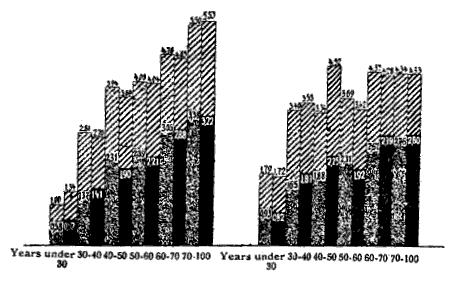
- Non-tuberculous families, number of children surviving 20th year.

- Tuberculous " " " " "

- Non-tuberculous families, number of children dying before attaining 20th year.

- Tuberculous " " " " "

Number of non-tuberculous families about 1,900 (1876-79-86), of tuberculous about 3,000 (1873-89); from Stuttgart family registers.
Figure C 7.
"The gross as well as the nett fertility of those which have died increases with the age attained, the latter, however, in a greater degree, because the mortality of children decreases with the greater age attained at death. With the wife the curve is less steep and less regular, because in her case mortality is unfavourably influenced by the birth functions; this is particularly plainly seen in the case of tuberculous women, when the curve has two peaks."
C 8
The same fact of heredity of "constitution" is demonstrated in Weinberg's Table C 8 showing the age at death of the parents and the mortality of the children up to the age of 20. It is based on the same material as Table 7 and proves: "With the increasing age of the parents child mortality decreases, especially so in the case of the children of the tuberculous, and the number of children reaching the age of sexual maturity increases correspondingly."
Age at Death of Parents and Mortality of the Children up to the Age of 20 (including Still-born).
Non-tuberculous. Tuberculous.
Deaths per 100 living-born children:
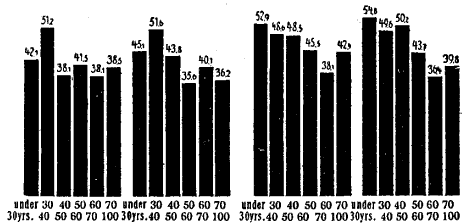
Age at death of father of mother of father of mother
Figure C 8.
C 9 & 10
The same is proved by the two Tables C 9 and 10 by Ploëtz referring to age at death of fathers and mothers and child mortality up to the age of five years. Very striking in both these tables is the extremely low mortality of the offspring of the parents with the greatest longevity.
C 11
Table C 11 by Weinberg: Hereditary of the disposition to beget twins (Archiv für Rassen & Gesellschafts Biologie VI. 1909) is remarkable. "The difference in favour of sisters speaks for Mendel's law of dominance and recessivity. The more twins a woman has borne, the more frequently the same phenomena is found in her nearest female relations." That the mortality among twins is very great is a well-known fact.
Inheritance of Tendency to Bear Twins. About 2,000 families from Würtemberg family registers (after Weinberg). In every 100,000 Births Twin Births occur in the following numbers:
Total population
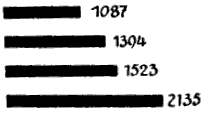
Among daughters of mothers of twins

" maidens
" sisters
Figure C 11.
In every 1,000 Births there are the following numbers of Twin Births among the immediate relatives:
Of all mothers
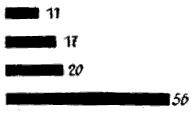
Of women who have had 1 multiple birth
" " 2 " "
" " 3 or more "
Mortality of Twins. Percentage of deaths before the age of 20:
Single-born Children Twins
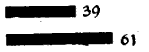
Figure C 11 (continued).
C 12
Figure C 12 the celebrated pedigree of the Hæmophilic family (bleeders) Mampel (by Rüdin after Lossen).
C 13
Figure C 13 showing the inheritance of progressive muscular atrophy (after Eichhorst).
C 14
Figure C 14 a partial reproduction of a pedigree comprising over 2,000 people of the family Nongaret suffering from inherited stationary night blindness (compiled by Cunier, Truc and Nettleship). With regard to these figures it is to be noted that only a fraction of the offspring is affected with the illness, the remainder being perfectly normal. It is remarkable with the bleeders (Hæmophilic persons) that the females do not suffer from the disease though they transfer it to their male offspring; a similar latent disposition is observable in other hereditary conditions, especially colour-blindness.
C 15
W. Weinberg shows in Table C 15 the frequency of tuberculosis within families. He adds: "This is a comparison of the experiences of married tubercular individuals, regarding the frequency of tuberculosis among their parents, brothers and sisters, with the corresponding experiences of their husbands or wives who come on an average from similar surroundings. The experiences of the latter represent the normal expectation. It is especially striking that the family influence tells most with the children of the well-to-do." The well-known fact that the tuberculous frequently come from tuberculous stock is clearly demonstrated in the figures of this table.
C 16
C 17
In Table C 16 Dr. Otto Diem shows the distribution of particular taints in every hundred of the tainted members among the nearest relations (parents, grandparents, uncles, aunts, brothers and sisters) of the entire material he deals with. It is shown for instance that with the mentally sound, 15% of the tainted relatives were mentally diseased against 45.9% with the mentally diseased. Figure C 17 shows the share of this percentage among the parents only. It is demonstrated that with the mentally diseased a much larger percentage of the total hereditary taint is traceable to parental madness, alcoholism, abnormality of character, than with the mentally sound.
C 18
Figure C 18 corresponds, with figure C 17, except that not only the parents are reckoned but the nearest defective relative in any degree.
C 19
Figure C 19 teaches that the reckoning of all the taints in the ancestry taken together with the collaterals fails to give as clear and convincing a picture of the dissimilarity in the heredity of mentally sound and diseased, as the reckoning of the taints among the parents alone. The establishment of the hereditary taint in the direct ancestry appears therefore by far the more important.
C 20
In Figure 144 (Journal f. Psychologie und Neurologie. XIII. Bd.) Drf. Hans W. Mayer gives a number of examples of heredity among moral imbeciles, and he draws the following conclusions: "Consequently moral defect in frequent combination with alcoholism is hereditary in the highest degree. Remedy: Incarceration of these dangerous individuals, not according to the accidental form of the crime committed, but as diseased and forming a public danger. If there is a risk of escape or if liberty is conceded—undoubtedly sterilization to prevent perpetuation of the defect." This latter course is already followed in North America, and a start has been made with it in Switzerland, at least in cases where the consent of the patients is obtained.
C 21
The pedigree of the family of Zero von Jorger, figure C 21 (Archiv für Rassen & Gesellschafts biologie I.), shows in a convincing manner how very important for the protection of society is the prevention of the reproduction of the degenerate. In the course of time this family has burdened the sound and fit with taxation amounting to hundreds of thousands of pounds. The author remarks: "The family Zero springs from good peasant stock intermarrying with homeless female tramps. Its history shows how alcohol (especially spirits) and bad environment (in this case always combined) may create a scourge to society which continues from generation to generation. The family has produced many criminals, lunatics and feeble-minded persons. The offspring of these are destined to die out. Their great fertility at times is counteracted by great infant mortality."
"In places regeneration is evident which invariably is inaugurated by marriage with a good woman and the consequent abandonment of the abuse of alcohol. As with the degeneration so with the regeneration the wife takes the leading part."
The question whether modern civilized races are degenerate in body and mind is much disputed. In some respects for instance in the increase of myopia and caries of the teeth it is generally admitted, but in others it is doubtful, though it may be considered an established fact that the general average of health among all civilized nations is unsatisfactory. We do not know for certain whether the general level of all or certain qualities is being lowered or not, and still less can we say what part is played by heredity.
The demand for the systematic collection of data on these points is the first which Race Hygiene has to make from Governments.
The examinations as to fitness for military service in Germany might offer an excellent index of the physique of the people, but for this purpose the physical condition of the conscripts would have to be recorded in a much more thorough manner than at present (S. Gruber Concordia, 1916). There appears, however, to be no doubt that in general the country and agricultural pursuits produce young men of better average health than do towns and other occupations. This agrees with the fact that the life of the inhabitants in rural districts and of those engaged in agriculture is longer than that of town dwellers.
C 22
Table C 22 compares the duration of life of men living in towns with those living in rural districts in Prussia. Beyond all doubt the peasant population is still constitutionally the most valuable part of the people, and the colonisation at home, such as the Prussian Government is pursuing to an increasing degree, may become of the very highest value for the improvement of the race.
C 23, 24 & 25
Dr. Walter Abelsdorff gives the following explanations to Table C 23, and figures C 24 and C 25. "They endeavour to show the number of families brought 'back to the land' in North Germany in the years 1900-1910."
"The Royal Commission for settlement in West Prussia and Posen has achieved notable results since the beginning of its activity in 1886. This body has brought about from 1886 to 1910 the settlement in the country of 18,507 families, 18,127 in leaseholds and 305 in labourers' dwellings. For 1900 to 1910 the total number of families settled amount to 14,511."
"The Royal General Commission began its activity later, but since 1906 has been energetically pursuing the settlement of agricultural labourers. At Münster, in the years 1908 to 1910, 247 leasehold small holdings for artisans have been created."
"The results of the Royal District Administrations are as yet less considerable, those of private societies with State subvention, though irregular, are worthy of note."
"The total work of settlement is almost exclusively effected by the Commission for settlements and the General Commission."
"Counting five members to each family, 130,000 people have been brought into economically improved conditions. In how far this may benefit the second generation—the children of the settlers—cannot as yet be determined."
"These efforts, however, may be looked upon as a regenerative component among the measures for the improvement of the people."
C 26 & 27
Figure C 26 deals with the fitness for military service in Germany in relation to the locality of birth and the occupation of the individual or the parents. Table C 27 with fitness for military service in town and country (both after Wellmann).
Fitness for Military Service according to Place of Birth and Calling. German Empire, 1902-08. Percentage of Recruits examined and found fit:
Country born. City born.
Employed in Agriculture. Otherwise. Employed in Agriculture. Otherwise.
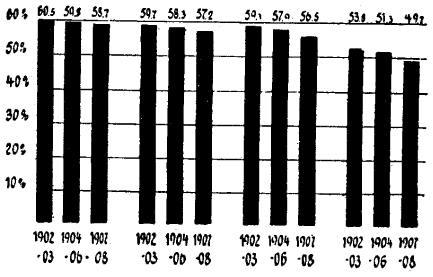
Figure C 26.
Fitness for Military Service in Town and Country. (After Wellmann.)
Trade. Percentage of fit. Locality of Birth.
Of those examined. Of both parents.
Large city. % Village. % Large city. % Village. %
Brewer 63.4 3.0 55.3 3.0 55.3
Cab Driver 63.3 3.2 69.0 1.6 69.8
Smith 61.2 1.9 71.0 1.2 75.7
Skilled Mechanic 29.7 44.4 10.9 30.9 30.0
Implement maker or Tool maker 28.5 36.3 15.9 24.8 28.3
Figure C 27.
C 28
Enlistments into the Army in Germany in 1907 and 1908, according to size (number of inhabitants) of native place, are shown by Dr. Walter Abelsdorff in Figure C 28.
C 29
Figure C 29 shows the percentage of those found fit in the final examination in Bavaria and occupation of the parents.
C 30
Table C 30 shows the total of all the non-commissioned officers and privates in the German Army on December 1st, 1906, classed according as they came from town or country and according to the occupation or the parents.
Attention is invited to the fact that according to Figure C 26 the percentage of those found fit for military service in Germany has diminished in recent years, but it is doubtful whether this is caused by a general lowering of physique. It may be due to the application of a higher standard in consequence of increased supply. The distinct increase in height, in Germany as well as in many other European countries, of those obliged to offer themselves for military service speaks against deterioration in the average of physique. Against the suggestion that with the increase in height may be coupled a greater disposition to tuberculosis must be set the fact that amongst the tall is found a percentage of fit higher than the average.
Abelsdorff remarks of Table C 27: "The results of recruiting for the years 1907 and 1908 have been grouped according to the size of the place of birth of the recruits.
The average for the whole empire in 1907 is 54.9, in 1908 54.5, fit in every 100 finally examined. The percentage of fitness has diminished 0.4% from 1907 to 1908. The numbers for 1904, 1905 and 1906 are respectively 56.4, 56.3, and 55.9%.
Towns with over 1,000,000 inhabitants show the smallest number of fit: 1907, 31.4%; 1908, 28.2%. The decline is 3.2%. Compared with the figure for the whole empire it shows 23.5% less fitness in 1907 and 26.3% in 1908.
For towns of 500,000 to 1,000,000 inhabitants the figures are slightly better; they reach 39.9% in 1907 and 44.0% in 1908; an improvement of 4.9% on the figures of the largest towns. The other three classes, viz., towns with 200,000 to 500,000; 100,000 to 200,000 and 50,000 to 100,000 inhabitants, show comparatively little variation in their figures for fitness for military service. They are 50.1% and 48.9%; 47.9 and 48.2%; 51.8 and 51.5%. The differences between the two years are not material. With the towns of from 200,000 to 500,000 and from 50,000 to 100,000 inhabitants there has been a decrease against an increase in those of from 100,000 to 200,000 inhabitants. But the figures for all three classes remain behind the average figure for the empire and so do those of all towns, they show 50.4 and 50.1%.
The most favourable results are yielded by the country districts. Here there were fit in 1907 58%, in 1908 57.7%. A trifling decrease is shown even here. The figures, however, are higher by 3.1% in 1907 and 3.2% in 1908 than the average for the empire. The conclusion is that the fitness is highest in the smallest, and lowest in the largest places.
Taking the average for the Empire as 100, those found fit from country districts number 106, from towns 92, from towns of over 50,000 inhabitants 83, and from towns of over 100,000 only 80."
The tables showing the recruiting results amongst those qualified for the one year voluntary service are particularly interesting.
C 31
In Table C 31 Schwiening (Veröffentlichungen aus dem Militär Sanitatswesen. 40. Berlin, Hirschwald, 1909) gives the figures of those finally passed as fit for military service in the Mittelschulen (secondary schools), which are classified according to their nature. The figures are too optimistic because no account has been taken of those who were found temporarily unfit. The Classical Schools (Gymnasium) give the least satisfactory results.
Fitness for Military Service and Secondary Schools. Of every 100 of the pupils of the following Schools
Class of School: there were found fit for Military Service:
Classical High Schools (Gymnasium) Old Scientific & Classical High Schools (Realgymnasium) Lower Grade of Classical High Schools (Progymnasium) Polytechnics Lower Grade of Scientific Schools " " " " and Classical High Schools Modern Scientific High Schools Commercial Schools Training Colleges Private Schools Agricultural Schools Average

Figure C 31.
C 32
Table C 32 gives the principal reasons for which students have been rejected as unfit for military service.
Causes of Unfitness for Military Service in the German Empire, 1904-6. Of every 100 permanently unfit.
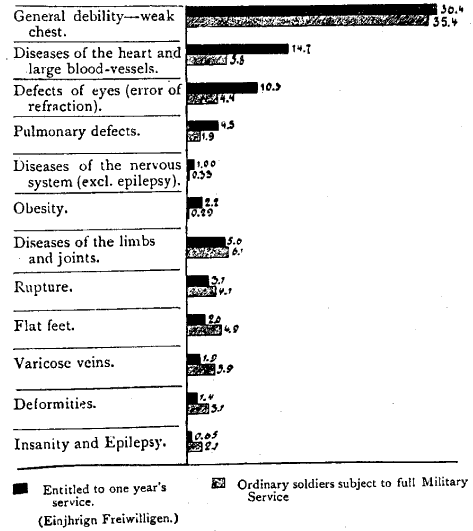
Figure C 32.
C 33
Table C 33 is a comparison of the frequency of the various causes of unfitness as between those qualified for the one year's voluntary service and the recruits in general. This table is very remarkable, because it shows the preponderance of general weakness, diseases of the heart and large vessels, and pulmonary defects among the former.
Military Fitness and Secondary Schools. Percentage of unfit to every 100 recruits examined.
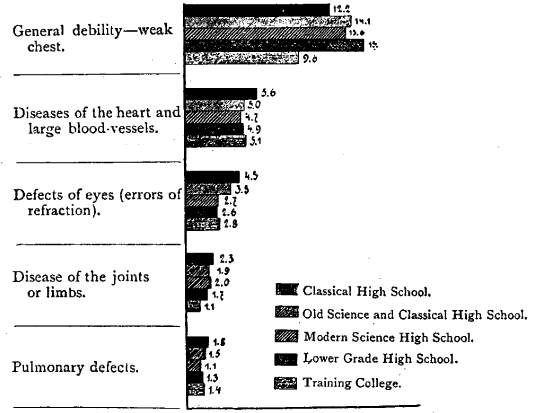
Figure C 33.
C 34
It goes without saying that the schools are only responsible to a lesser degree for this; we have to deal here with a serious symptom of a bad constitution amongst the higher social grades which betrays itself also in the dying out of the socially prominent families. How badly their progeny comes off, in spite of the great care bestowed on it, is illustrated in Table C 34. In two Munich Regiments the percentage of fit among all those entitled to offer themselves for the one year's service from the most varied parts of Germany was only, according to Dieudonné, 21.6, 20.1, and 16.4.
C 35 & 36
Great anxiety is justly caused by the increasing number of those taken care of in public Lunatic Asylums. It remains doubtful to what degree this may be due to the greater use made of asylums and the decrease of the care of the mentally infirm in the family home; the deterioration of the nervous system nevertheless remains according to the general impression an incontestable fact. As a symptom of this may be interpreted the increasing number of suicides in civilised countries, demonstrated in Rüdin's Tables, C 35 and C 36, showing the number of suicides in every one million of inhabitants.
More serious still than the frequency of mental and nervous diseases is another phenomenon which demonstrates how unsatisfactory is the constitutional condition of large circle of our population of to-day.
This phenomenon which as yet has received much too little attention is the large scale on which families die out, at first in the male line. Apparently (sufficient observations for control are not available) those families which hold an eminent economical or social position (aristocracy, old county families, etc., etc.) are mainly concerned. Because exceptional endowment in one or more respects (intelligence, talent, will power, etc.) is generally required to secure or to maintain a leading position, and because such endowment is given to only a small fraction of the population, but is inherited largely by the progeny, this dying out of the leading families means a serious loss to the race.
The deficient fertility of the stock thus endowed results in a lower average of mental capacity in the population generally, and cannot in the long run be made up by the constant re-appearance of distinguished men appearing as variations, the smallest number of whom are "mutations."
The tendency among town families to die out appears to be wide-spread. Professor S. Schott in Tables C 37-C 40 adds materially to our knowledge on this point, Professor Schott makes the following comment on his Tables:—
"S. Schott. Old Mannheim families, 4 tables."
"Source: 'Old Mannheim families. A contribution to the family statistics of the 19th Century by Professor Dr. Sigmund Schott, Mannheim and Leipzig, 1910. J. Rensheimer.' Statistical demonstration of the development, decline, and extinction of about 4,000 families which were in existence at Mannheim at the beginning of the 19th Century, based on permanently maintained family registers. This research, pursued on a basis of population statistics, lends itself only to a limited degree to application for biological purposes."
C 37
Gradual extinction of the Mannheim families in the 19th Century. Only extinction by death in Mannheim and in the male line are taken into account. Families which have disappeared through emigration have been excluded. Branches of families which have become extinct at Mannheim may be flourishing elsewhere. Of 3,081 families, 2,538 have become extinct by death at Mannheim itself, 543 survive. The spiral curve shows the number of survivors in any year as so many per thousand of the original number.
Old Mannheim Families
.
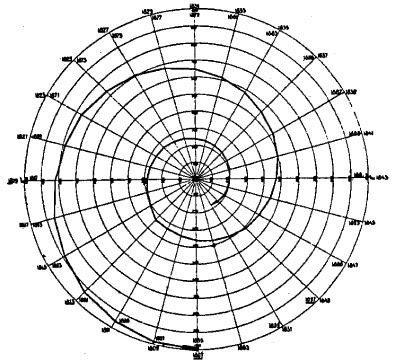
Gradual extinction of Old Mannheim Families during the 19th century.
Figure C 37.
C 38
Average number of children in each generation; the families being grouped according to the number of generations they attained. The families of 1807 (original families) and their descendants were classed into five groups, according to the number of generations they attained in Mannheim. For each group is calculated the average number of children within one generation—for each separate family as well as for the entire family (i.e., the total of all the separate families which have sprung from the same "original family"). For instance: "Original families" which have lasted into the third generation, 464; the separate families show in the first generation, 464 families, 2,377 children; in the second generation, 718 families, with 3,645 children; in the third generation, 754 families, with 2,454 children. Accordingly, the total families show average numbers 5.1, 7.9, 5.3; the separate families, 5.1, 5.1, 3.3. All these averages are minimum figures, because it was impossible to eliminate the moderate number of couples who emigrated before the number of their offspring was completed.
In the generations up to the third inclusive, reproduction may be considered as terminated, but in the fourth, and especially the fifth and sixth, it still is in progress.
C 39
Age intervals separating the various generations.
Taking into account all the families investigated, the average length of time between the birth of the originator of the family and his first born son was 331/4 years, his first born grandchild 632/3 years, and his first born great grandchild 951/3 years. The curves become gradually flatter, because the possible difference between minimum and maximum age distance from one generation to another increases in arithmetical progression.
C 40
Prolificness of first marriages in the 19th century. Taking the entire period from 1811 to 1890 together the percentage of large families (six children or more) and of small families (one-two children) produced by all first marriages, excluding childless ones, is indicated by the horizontal centreline. The positive or negative deviations from the average during each decade are entered respectively above and below this line. The note in Figure C 38 referring to the families which may have emigrated while still productive applies here also. The temporary increase in prolific marriages after 1870 may be in connection with the material decrease in the age of those contracting marriage for the first time, as compared with the preceding decade. (Men 28.65 in the earlier period as against 27.41 in the later, and women 25.92 against 24.68 years.)
The extinction of the families is undoubtedly due partly to other causes than the voluntary limitation of families—to a process of degeneration. A very remarkable proof of the degenerative character of the dying out of families is given by Pontus Fahlbeck in his book, "The Aristocracy of Sweden" (Fischer, Jena, 1903).
C 38-43
The six Figures C 38-43 give what is biologically of greatest interest in it. Note how the terribly quick extinction of the families of the nobility is inaugurated by catastrophic changes: rapid fall in the frequency of marriages, in the number of fertile marriages, and in the number of their progeny. The curves of the surviving families (red in the original tables) are for comparison. That we have to deal here with a natural and not a voluntary process is shown by the rapid increase in the mortality of male youth in the last generations; also by the extraordinary change in the proportion of the sexes of the children—which, of course, is beyond any control, marked preponderance of girls amongst the survivors (possibly also by the frequency of still-born male children).
A disturbance in the normal proportion of the sexes as a symptom of abnormal germ production may also assert itself in the opposite direction. O. Lorenz has pointed out the frequent occurrence of an extraordinary increase of male children immediately before the extinction of a family in the male line. One of the most celebrated of these cases is the one of the family of the Emperor Max II. He had six sons and two daughters, who all reached the age of maturity, but not a single male grandchild in the legitimate male line.
C 44
Fresh evidence is exhibited by von den Velden in Figure C 44. With the families described by von Riffel, who have died out in the male line, there is still a great preponderance of boys in the last generation in which boys have reached the age of sexual maturity, whereas there is a preponderance of females amongst the brothers and sisters of the wives of the last male issue of the family.
Families in Process of Extinction.
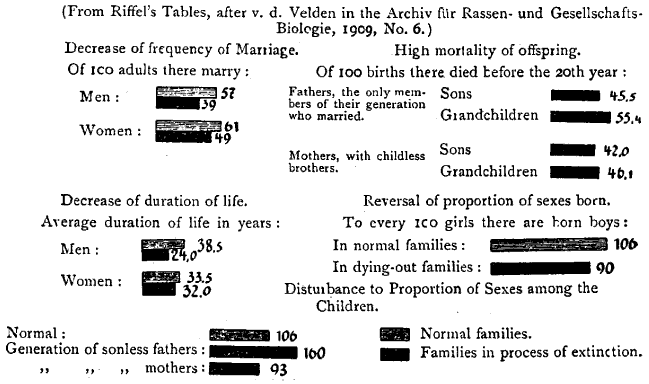
Figure C 44.
C 45
In this connection another figure, C 45, by von den Velden ought to be mentioned. He shows, from investigations made by von Riffel, that the physical condition of childless couples is on the average inferior to that of fertile parents. This, however, by no means holds good in every case. Evidence to the contrary is given by the pedigree of an aristocratic family which has died out in the male line. It may be looked upon as typical. One generation (the second), with three times as many grown up men than women, produces only four boys (44% of the children), of whom two reach maturity. With the fourth generation the male issue dies out. Though a large majority of the members of all three generations (2-4th) have good health and attain to an exceptionally high age, most of the female lines also die out. Only in two branches, which spring from the marriage of an aristocratic daughter with a man from the people, there are children in the fifth generation of whom at least a part promise a healthy progeny. Fahlbeck, too, has drawn attention to the fact that the dying out Swedish aristocracy shows no signs of striking degeneracy in the individual.
This fact is of the greatest theoretical and practical importance because it proves that there exists, up to a certain degree, an independent degeneration of the germ plasm, even as the germ plasm may remain unaffected by damage to the soma. That such a one-sided degeneration of the germ plasm with respect to the power of reproduction may take place among animals has been known for a long time.
In particular, Chs. Darwin has collected facts of this kind in his "Variation of Animals and Plants under Domestication." For civilised peoples it is a matter for reflection that with animals even slight deviations from their customary "natural" mode of living may lead to such serious consequences.
RACE-HYGIENE.
C 46 & 47
As the nature and aims of race-hygiene are still unknown in wide circles it will be useful to show in Tables C 46 and C 47, by A. Ploëtz, what its position is amongst other sciences and what the various branches of its activity consist in.
Many theoretical workers hold that the most important mission or race-hygiene is to fight against Therapeutics and Hygiene of the individual, for about these they have the most serious misgivings. They consider, that by maintaining inferior variations up to the age of reproduction, the average quality of the race must suffer and that to certain defects—which otherwise would rapidly disappear—an opportunity is given to spread through an entire people. This point of view, short sighted as it may be, must be examined into. It appears to be forgotten that on the one hand hygiene is powerless in cases of a high degree of degeneration and that on the other hand hygiene, by prevention of illness, does away with a number of causes of inferiority. Finally it appears to be entirely overlooked that with the best inherent qualities and unfavourable surroundings the individual development may be poor and stunted. Of what use are the highest potentialities if they remain latent? The main point is that so far convincing proofs of the preponderant harmfulness of hygiene are entirely absent. (S. Gruber, Heredity, Selection and Hygiene. Deutsche med. Wochenschr, 1909).
C 48
The Increasing Frequency of Obstetrical Operations and their Significance to the Race. (Based on the official statistics of Baden by Dr. Agnes Bluhm.)
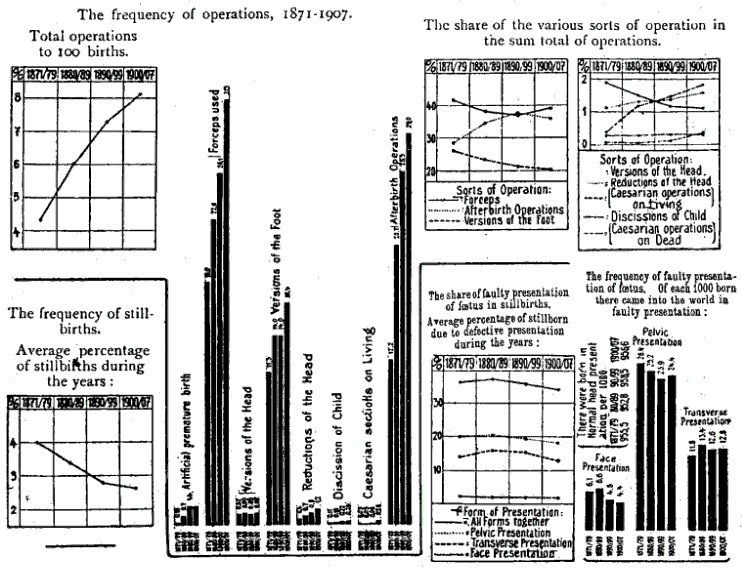
Figure C 48.
Dr. Agnes Bluhm contributes to the question of the deterioration of the race by therapeutic measures in dealing in Figure C 48 with "The increasing frequency of surgical operations in connection with childbirth and its significance for the race." She writes in explanation "The number of doctors having increased relatively much more than the number of the population, it follows that for a growing number of women medical assistance at childbirth is available. To this must be added that progress in surgical technique, above all the diminished danger of infection, allows of a much more frequent operative interference with good results for mother and child. Both these facts find expression in the reduction of the number of stillbirths. The purpose of these operations being to assist a diminished birth capacity in women, and this diminished capacity arising partly from constitutional and consequently hereditary factors, this question suggests itself: Is the average birth capacity of women progressively diminished by the fact that an increasing number of women, more or less unfit for childbirth, are artificially assisted in bringing forth living children who inherit this weakness from the mother?"
"Our table attempts to answer this question on the basis of official Midwifery Statistics compiled in the Grand Duchy of Baden reaching back to 1871, that is the beginning of the antiseptic era.
"To avoid the errors, which small figures might lead to, each calculation has been based on the average figures of a lengthy period. The material dealt with comprises over two million births."
C 48-1
"Figure 1 shows the increasing frequency of all childbirth operations taken together. The period 1871 to 1879 shows an average of 4.38 operations to every 100 births, the period 1900 to 1907 up to 8.12 operations to every 100 births."
C 48-2
"Figure 2 shows the frequency of each class of operation in every 1,000 births. Each class of operation shows an increase in number, but the increase has not been uniform throughout the various classes."
C 48-3
"Figure A and B, shows the share of each class of operation in the total number for the various periods. A more leading part is taken by aftermath operations, by artificially induced premature birth, by perforation of the head and by Caesarean section on the living. Aftermath operations depend (like the use of the forceps) to such a degree on the teachings of the various schools for midwifery (and on the time at the doctor's disposal) that they can hardly serve as a standard of birth capacity. The Caesarean section, too, can hardly be taken as a guide, as a much wider view is taken now of the indications for this operation. But the equally increasing numbers of perforations of the head and artificially induced premature birth are well worthy of attention. For these two operations exclude one another. With the existing tendency to avoid perforation of the head by artificially inducing premature birth, a rise in the curve of premature births should correspond with a sinking of the perforation curve. 1871 to 1879 a maximum of the former actually coincides with a minimum of the latter; but from there on both curves rise, though not in the same degree. Premature births have become since then (see Fig. 2) more than eight times as frequent; perforations of the head have trebled; and dismemberments of the child have doubled. This fact must be considered as a sign of lessened birth capacity."
C 48-4
"Figure 4 shows the decrease of the total number of stillbirths."
C 48-5
"Figure 5 gives the share which abnormal position of the child has in this total, and a comparison of the two shows that whilst the total has decreased by 1.42% the decrease (1880 to 1889) has been 2.35% in the case of stillbirth through abnormal position. The conclusion is, that there is now more opportunity for hereditary transmission of the tendency to faulty position of the child than three to four decades ago."
C 48-6
"But Figure 6 proves that up to now an increased inheritance of this tendency has not taken place. The curves of these positions not only show irregularities but (with the exception of cross births) a tendency to sink."
"Recapitulation. The growing frequency of surgically assisted births cannot be taken as evidence of a diminished birth capacity, but is closely connected with the growing number of doctors. Against the indications of a diminished birth capacity stand at the moment those which previously could be taken as pointing in the opposite direction. It would, therefore, appear that medical interference at birth has brought to the race advantages as to quantity and no drawbacks as to quality. But it is probable that the picture will change during the coming decades, because only then will the daughters of mothers who could not have brought forth living children without surgical assistance become themselves mothers. The renunciation of motherhood on the part of the women least suited for this function and the war against rickets might act as preventatives."
The great anxiety about the elimination of the severest struggle for existence is based on the undoubtedly erroneous fundamental conception that the organism is a sorry product of necessity which can barely manage to maintain a laborious existence by the constant straining of all its faculties, and that it requires the continuous use of the whip of necessity to prevent an organism from giving way to its inherent tendency to degeneration. In fact, however, no organism is conceivable which has not the "Tendency" to maintain itself and to react accordingly. There are many facts which prove that a wealth of capacities and tendencies is dormant in organisms which for innumerable generations have not been active, or, perhaps, have, never functioned in every possible way, and that, therefore, if the occasion arises replacements or accommodations of an unprecedented character may occur. In an unprejudiced system of race-hygiene these facts must not be overlooked. The exhibition in this section gives two specially striking instances; the one from animal the other from plant life.
C 49
To begin with Figure C 49 gives a diagrammatic representation of the development of the eye of a vertebrate—after K. Kraepelin (taken from "Experimentelle Biologie II., T. v. Curt Thesing, Leipzig, Teubner, 1911")—which shows that the lens is formed out of an invagination of the cornea and the retina by an extension of the brain. In the lower part of the plate the various phases of the reconstruction of the lens out of the iris are shown, after it had been removed by a cataract operation from the eye of a Triton larva. (This experiment was carried out by Gustav Wolff.) [A] Thus an organ which normally is not concerned with the formation of the lens takes charge of its regeneration.
A large number of tables deal with the influence of the numerical position in the progeny, with the number of births and the interval between births, on the health of the children, partly acting alone, partly in combination with the influence of the manner of nourishment during infancy.
C 50
Numerical position in family and infantile mortality, after Geissler. According to these statistics, the fifth child of a mother has materially less vitality than the first four, the second and third children have the most; but this does not agree with other statistics.
C 51
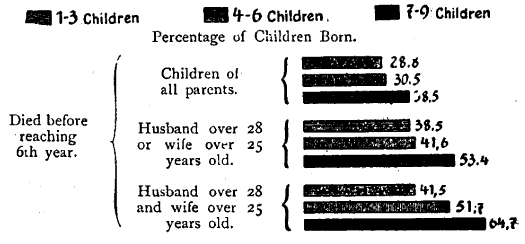
According to Riffel's investigations—influence of the numerical position of the child and the age of the parents at the time of marriage on infant mortality, after v.d. Velden, a material difference between the mortality of the three earliest born children and the three next born is only shown if both parents at the time of marriage have attained a certain age (man over 28, woman over 25); only the seventh to ninth show under all circumstances a materially greater mortality than the earlier children. The children of more aged parents show a materially greater mortality than those of younger parents. The number of children in a family up to the eleventh has no material influence on infant mortality, only in families with twelve children or more a materially greater number of children perish before the fifth year.
Relation of Number of Births to Infant Mortality. Percentage of Deaths to 100 Births.
Died during the first year of life. The mortality of the 1st, 2nd, 3rd and 4th child is below the average. Greatest vitality shown by 2nd and 3rd child. Geissler. 26,429 births to 5,236 marriages of members of Saxon coalminers' funds. (Some still-born infants, and children of marriages to which there were only one or two births, are not included). Died before reaching the age of 0.09 of a year, i.e., a little more than a month. The mortality of the 2nd, 3rd, 4th and 5th child is below the average. Greatest vitality shown by 2nd, 3rd, and 4th child.
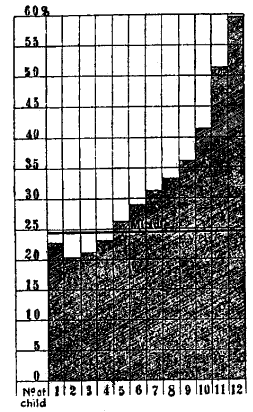
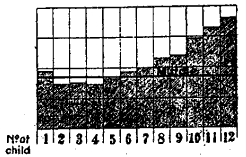
Figure C 50.
Influence of the Number of Births and the Age of the Parents at the Time of Marriage on Infant Mortality.
(From Riffel's Tables, after v. d. Velden).
Influence of the Number of Children Born to a Family on Infant Mortality.
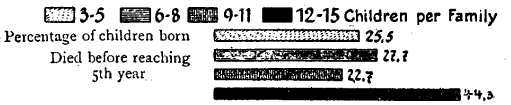
Figure C 51.
C 52
Number of conceptions and conception losses, by Dr. Agnes Bluhm; the exhibitor gives the following explanation—
Hamburger's material deals with 1,042 marriages of the labouring classes in Berlin, with a total of 7,261 conceptions (an average of 6.97 conceptions for each woman); the material of Bluhm comprises 856 marriages of the wealthier and educated German middle and higher classes with a total of 3,856 conceptions (averaging 4.50 conceptions to each woman). Hamburger has counted as conception losses only miscarriages, premature births, stillbirths, or deaths from illness before the completion of the sixteenth year. Bluhm has included all those up to the twentieth year. Both have only included marriages which have been contracted at least twenty years back. As the births in these marriages apparently date back to twenty years, all living children are reckoned as survivors or conception results, even if they have not attained the sixteenth or twentieth year respectively. This has influenced the result optimistically, but as it has done so with both authors alike, the comparison of their results is admissible.
C 52-1
Figure 1 shows the conception losses in marriages of varying conception numbers (Curve A, Hamburger's working-men's families; Curve B, Bluhm's well-to-do families); both curves confirm Hamburger's words that "the percentage of the survivors gets smaller in proportion as the conception number increases." The mounting of Curve B in the families with ten births is probably a delusion brought about by a very small number. In the marriages with eleven or more births there are lost with the well-to-do one quarter and with the working-classes nearly two-thirds of the conceptions up to the twentieth or sixteenth year respectively.
C 52-2
Figure 2 represents the share which miscarriages and premature births have in the conception losses in marriages of different degrees of productiveness (Curve A, Hamburger; Curve B, Bluhm). Amongst the Berlin labouring classes on the average 17.89 per cent. of all conceptions are lost through miscarriage and premature birth; for the wealthier German families the figure is 7.59 per cent.
C 52-3
Figure 3 shows the share which deaths and stillbirths have in conception losses. With the labouring classes it amounts on the average to 32.75 per cent. (Curve A), and in the wealthier families to 10.55 per cent. (Curve B).
C 52-4
Figure 4. To investigate whether the continuous decrease in the percentage of the survivors, going hand in hand with the increase of maternal conceptions, is caused by the constitutional inferiority of the offspring as the numerical position increases, Bluhm has established, in dealing with her material, the loss for each numerical position (first, second, third, etc., conceptions respectively). If this were the case, Curve A, which gives the loss according to the frequency of conception in each marriage, would have to be identical with Curve B, which gives the loss of first, second, and third, etc., conceptions, but this is by no means the case, for only at a very high numerical position of the conception the curves begin to be parallel. This proves that Hamburger's "the percentage of the survivors gets smaller in proportion as the conception number increases" is not a biological law but only expresses a social phenomenon. With the increasing number of children there is a decrease in the value of each individual childlife. The mother is less careful about avoiding miscarriages; she devotes, and must necessarily devote, less care to each child; and the risk of infectious diseases which are a frequent cause of death during infancy increases.
C 53
How little the increasing mortality of the later born children up to the tenth child is based on a biological law is shown in Figure C 53. Numerical position of birth and infant mortality up to the age of five in princely families, by Ploëtz; 463 seventh to ninth children show the same mortality as the 614 first born.
Pearson endeavored to prove a high degree of inferiority in the first born, physically and intellectually as well as morally. But his results are very open to attack, as Weinberg has recently shown; one is reminded of Pearson's results in Crzellitzer's Figure C 54—first and later born. Crzellitzer writes thus about this—"A high degree of myopia is more frequent amongst first born than among later children. The disadvantage of the first born in respect of myopia is based on a greater hereditary taint and on no other factor. Where there is no hereditary taint about one quarter to one-third are affected, no matter whether first, second, third, etc., born. Also in well-to-do families, where the age of fathers at the time of procreation is materially higher, the first born are more frequently myopic than their brothers or sisters."
First and Later-Born. Percentage of Frequency of Extreme Short-sightedness.
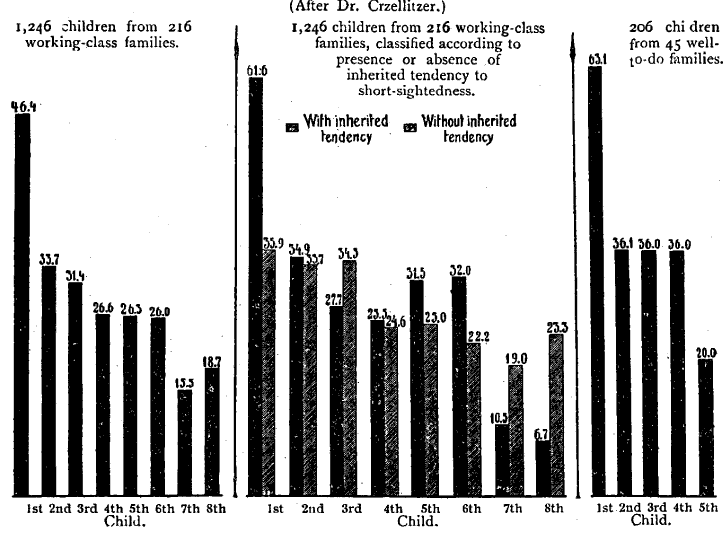
Figure C 54.
A large amount of material has been treated by W. Weinberg, in which tuberculous and non-tuberculous families are compared.
C 55 & 56
Figure C 55—influence of numerical position of birth on infant mortality and Figure C 56—mortality of the first and later born. Weinberg writes concerning these: "The parallelograms in the first row indicate for each position in order of birth how many children out of every hundred die before the age of 20. On this, however, the difference in the mortality in families with different numbers of children has an influence. To counteract this, it has been calculated how many children in each position would die if within each family the number of children had no influence, and the actual number of deaths expressed as a percentage of the expectation calculated in this way gives parallelograms to the second row. After eliminating the influence exercised by the size of the family, the increase of the mortality with the higher birth number appears considerably smaller. Figure C 56, which compares the mortality of the first and last born children, is to a certain extent a test of this. This shows clearly a considerably higher death rate in the last born. Both figures indicate that children of the same numerical position of birth show a higher mortality, if from tuberculous families."
Mortality of Children According to Sequence of Birth 3,129 Tuberculous and 1,830 Non-Tuberculous Families of Stuttgart, 1873-1889 (after Weinberg).
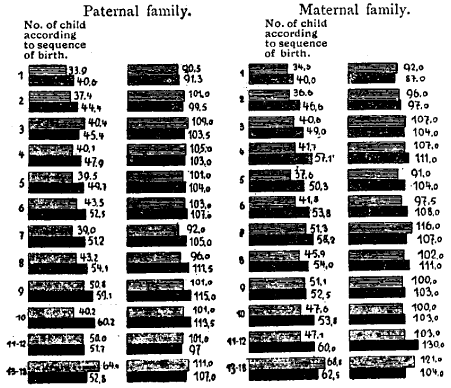

Figure C 55.
Relative Mortality of the First and Last-born. 3,129 Tuberculous and 1,830 Non-Tuberculous Families of Stuttgart, 1873-1889 (after Weinberg)
Of each 100 living-born there died before reaching their 20th year:
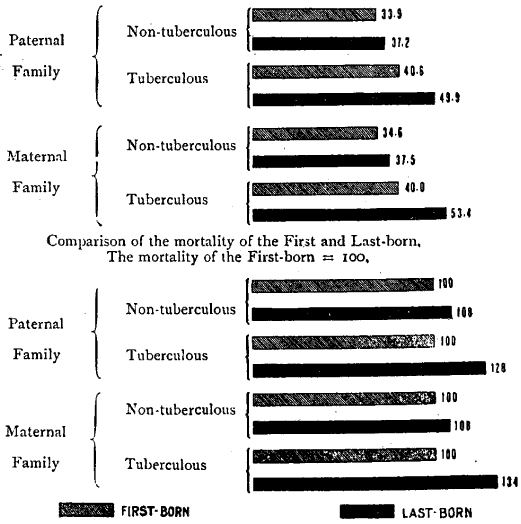
Figure C 56.
C 57
Of a materially greater influence than the numerical position of birth or the number of children in each family is the length of interval between births. We point at first to Figure C 57—interval between births and child mortality, after Ansell and Westergaard, by Dr. A. Bluhm. She writes in reference to it: "Ansell has demonstrated, from the material of the National Life Assurance Society of London, that a child has an increasingly better chance to survive his first year, the greater the interval between his own birth and that of the child born before him. If this interval is less than a year, the infant mortality is double what it is when there is an interval of two years (15.75% against 7.33%). This influence makes itself felt beyond the age of infancy up to five years but not in so striking a manner. The proportion becomes modified to 20% against 12%. As the influence of the birth interval on child mortality is still very perceptible after the tenth or later children, it may be assumed that it is not caused exclusively by the exhaustion of the maternal organism produced by the rapid sequence of births. The varying length of breast-feeding of the children has probably also its influence. Though these statistics give no data about the mode of infant feeding, it is nevertheless probable that in those families in which there are longer intervals between consecutive births each child is suckled for a longer period.
C 58
Birth interval and health of the offspring, after Riffel—v. d. Velden.
C 59
Influence of the length of the birth interval and the duration of breast-feeding on infant mortality, exhibited by Weinberg. The author writes regarding the latter table "in proportion to the length of the interval between two births, the mortality of the children following decreases materially, but this relation only becomes clearly apparent in families in which several of the children have been suckled for more than six months."
C 60, 61, 62
The intimate connection which exists between birth interval and suckling and the great importance which suckling has under the favourable influence of a long birth interval is shown in Dr. Agnes Bluhm's Figures C 60, C 61, and C 62—infant nutrition (breast feeding), number of children and infant mortality, after Dr. Marie Baum. "The material is taken from the towns of Gladbach, Rheydt, Odenkirchen and, Rheindalen, and comprises 1,495, mostly poor families, with 9,393 cases in which the mother survived childbirth and 9,487 children born alive. In this table only 7,983 children were counted, because the remainder had not reached the age of one year on the day of counting. Of these 7,983, there died before the completion of the first year 1,276, or 15.98%."
C 60
Number of children and child mortality: Bluhm adds:—"Figure 1 shows in Curve A the influence of the duration of breast feeding; in Curve B influence of numerical position of birth on the mortality of the infant. The very divergent course of the two curves expresses the very different influence of both these factors on mortality; the latter is almost exclusively dependent upon the length of suckling, and shows corresponding with its increase a continuous and steep decline down to 1.46% from a maximum number of 35%. The very slight increase of the mortality of children suckled for six weeks compared with those who have not been breast fed at all is immaterial (35.55% against 35.28%). These figures prove only that breast feeding up to six weeks does not give the child any protection against fatal diseases. The influence of the birth number hardly makes itself felt up to the seventh child, only from the eighth onwards the power of resistance decreases continuously but not nearly to the same degree in which it grows with the length of breast-feeding (greatest difference only 21%). Curve B shows a materially different course from that of similar curves by other authors, for instance—from Geissler's well-known curve, dealing with Saxon miners, in which not only the first born show up less favourably than the second and third born, but in which, from the fourth child on, the mortality increases rapidly. The economical condition of both groups being similar (85% of Baum's families had a maximum yearly income of £75), it is highly probable that the difference in the curves arises from different methods of infant feeding. In the Rhine provinces, as is also proved by Baum's figures, the feeding is good; in Saxony, however, it is notoriously bad. The co-relation of infant mortality with infant feeding is very clearly illustrated in Figures 2 and 3, the former shows the influence of the length of suckling on the mortality of the children classed in order of birth, the latter the influence of the order of birth in connection with different lengthed periods of suckling. The extraordinarily regular course of all the nine curves in Figure 2 and the extremely irregular course of the six top curves in Figure 3 are very striking. From these figures it is shown that the first, second and third born if breast-fed for a short time only, or not at all, are subjected to much greater risks than the eighth, ninth, tenth or later children, suckled for a sufficient length of time (maximum difference 1 to 42). In the curve showing the children who were breast fed for 39 weeks (Figure 3), the influence of the high birth number shows only to a very small degree."
C 61
Number of children and capacity for breast-feeding. Concerning this it is remarked: "The upper curve shows what percentage of children had to do without breast feeding, and the lower one how many enjoyed the sufficient period of 39 weeks of breast-feeding. Though Baum's figures are only intended to deal with the number of cases of breast feeding and not with its duration, and though no difference is made between exclusive and partial breast feeding, yet some conclusions may be drawn with regard to suckling capacity. In a district where breast feeding is as general as it is in the one examined into here, the number of women who voluntarily renounce every attempt at suckling must necessarily be small. The curve dealing with the children who had no breast feeding at all is therefore likely to give a fairly correct picture of the absolute or primary incapacity for suckling on the mother's part; absolute incapacity does not of course mean that the mother could not produce a single drop of milk, but that she does not produce enough to satisfy the child, and therefore must resort to artificial feeding. As a period of 39 weeks' feeding, even if only partial, points to a good capacity, the lower curve may also be taken as an expression of feeding ability. A comparison of both figures illustrates that the milk production after the first birth is smaller than after the following ones, and that beyond the eighth birth, it decreases materially and continuously, probably in consequence of the exhaustion of the maternal organism."
C 62
The habit of breast-feeding as running in families and infant mortality. With this goes the following explanation: "The two figures illustrate the proportion of mortality of the infants in 143 bottle-feeding families and 376 breast-feeding families of the first order. As the line could not be drawn very sharply, and as in the bottle-feeding families there had to be included those in which as an exception one or other child was suckled for a few days or perhaps for a week, one can see in these groups only the expression of the habit, but not the power of suckling. Both figures illustrate the largely avoidable sacrifice in young lives which still goes on through a want of knowledge and of feeling of responsibility towards the coming race. With the absence of breast-feeding the unfavourable influence of a very large number of children becomes much more apparent; whereas in breast-feeding families the difference in the mortality between medium-sized families (four to six children) and very large families (above ten children) amounts to only 1.39%, it reaches 12.90% with the non-suckling families. Here, if the number of children surpasses ten, nearly every second child dies in the suckling age, and amongst thirteen families there is not a single one which has not lost a child in that period, whereas in breast-feeding families of the first order, with the same large number of children, only every thirteenth child died in infancy, and of sixteen families seven (= 43.75%) lost no infant." The same material is treated in a different way by Dr. Marie Baum, of Dusseldorf, in Figures C 63-66.
C 63
As the length of the period of suckling of the preceding child increases, there is a constant and rapid decrease in the number of children who are born at intervals of less than one year. If the preceding child was not breast-fed a new birth occurred before the expiration of one year in 9.6 cases out of 100. With a suckling period of one-half to three-quarters of a year of the preceding child, this figure is reduced to 1.8 per cent., and after a still longer suckling period to 1 per cent. Out of one hundred mothers who have only partly or not at all suckled the preceding child, seventy must count on a fresh birth within a period of 13/4 years. If the preceding child was suckled for at least 39 weeks, only thirty-eight, and with a suckling period of more than a year only twenty mothers have to reckon on a fresh birth within 13/4 years.
Dependence of Infant Mortality on the Duration of Breast-Feeding and the Length of Time Intervening Between Successive Births.
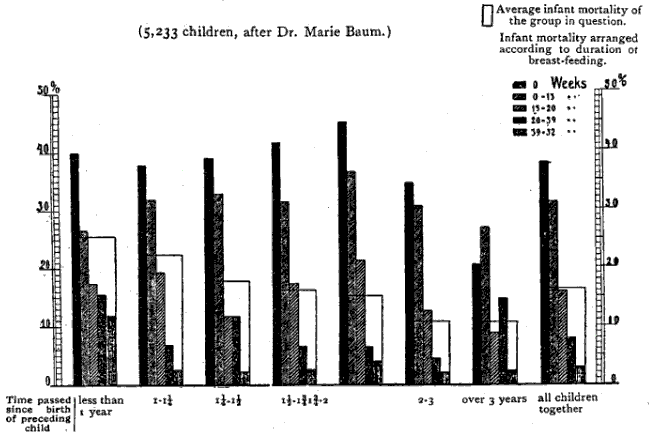
Figure C 63.
C 64
Figure C 64 shows the parallelism between the average length of breast-feeding and the average time between births within the families. A half to three-quarters of the mothers who suckled either long enough or very long show an interval between births of from 11/4 to 3 years, whereas of those who did not suckle at all, or only did so insufficiently, only one-third belong to this group, and figure largely in the column of lower birth intervals.
Dependence of Infant Mortality on the Average Duration of Breast-Feeding and the Average Length of Time Intervening between the Successive Births of the Children in a Family.
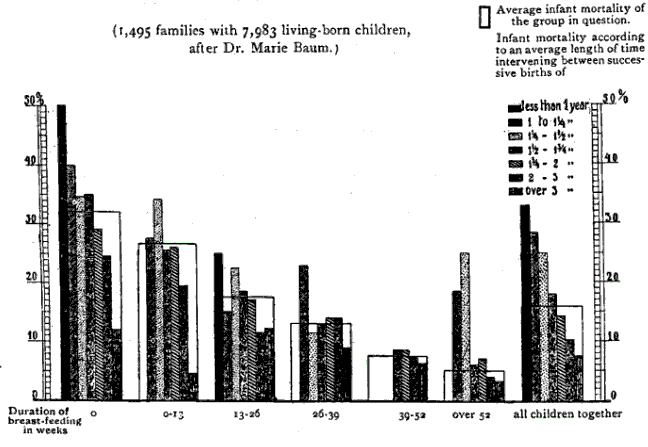
Figure C 64.
C 65
Figure C 65 enables us to examine into the influence exercised by a longer or shorter interval after the preceding birth on the vitality of a child, according as to whether the child was not breast-fed at all or only moderately or amply so. The black oblongs demonstrate that the average infant mortality falls regularly and decisively according to the length of time between the birth of the children considered and their predecessors. The average mortality of infants who are born in rapid succession—under one year, one to one and a quarter years, amounts to over 25 and to 22 per cent. respectively, whereas the average mortality of children with at least two years' interval amounts only to 11 per cent. "At the same time, however, it is observed that the influence of the length of suckling is still greater than that of the length of time elapsing between births. Even with an interval of three or more years, the mortality of children who were insufficiently or not at all breast-fed was above 20 per cent. The children who had been suckled for at least three-quarters of a year were only very slightly influenced by this factor in all groups, except that with a birth interval of less than one year, where the influence of short birth intervals is not counterbalanced even by long extended breast-feeding."
C 66
Figure C 66. "The infant mortality within the families dealt with falls materially and evenly as the average birth intervals lengthen. With an average birth interval of less than one year, one-third of the children die in the first year, but only 7 per cent. where the average birth interval was over three years; but here also the influence is strongly modified by the mode of feeding. With the non-suckling families the mortality is almost 25 per cent., even with a birth interval of more than two years. On the other hand, when the duration of suckling is sufficient, short birth intervals almost disappear (see Table 2), and with an average birth interval of 11/4 to 2 years and a suckling duration of at least half a year the mortality remains on an extremely small scale."
C 67-73
Groth and Hahn have exhibited two large tables C 67 and C 68 and a similar one C 69, the results of their important investigations about breast-feeding and mortality in the administrative districts of Bavaria. Groth shows in Table C 70 "mortality of sucklings in Bavaria," and in Table C 71 "breast-feeding and cancer." In Tables C 72 and C 73 the Groth and Hahn statistics are treated by Dr. A. Bluhm from the point of view of the influence of the habit of breast-feeding on the frequency of births. In connection with Figure C 73 she remarks: "This diagram shows the number of bottle-fed babies in the various Bavarian districts counted at the time of vaccination. To give as correct a picture as possible of the probable influence which the habit of breast-feeding has on the birth-rate (annual number of births per 1,000 of the whole population) there are represented on this figure by green and yellow columns the average birth-rate for the five years, 1875 to 1879, because in that period a record birth-rate was established, so that it may be assumed that there was then no intentional restriction of births. We see within the four 'old Bavarian' districts, where on the average 64.1% of the babies were not breast-fed at all, the number of births is about 4 per 1,000 of the population higher than in the Palatinate and the three 'Frankish' districts, which together only show 18% of non-breast-fed children."
C 72 & 73
"These two figures deal with the influence of the length of suckling on the birth-rate, the longer the duration of the suckling period, i.e., the higher the number of children breast-fed for six months or more, the lower the birth-rate. This only holds good for the country (Curve B) not for towns (Curve A). This circumstance is explained by the fact that the voluntary restriction of births is much more frequent in towns than in the country, where consequently the influence of the length of the period of suckling on the birth frequency can find much stronger expression than in towns, where, as Curve A shows, it is entirely extinguished by artificial birth preventatives. From both tables it results that, to prevent the senseless waste of human life, the interval between every two births must be more than two years; further, that it is possible to increase it by breast-feeding; the number of births in a district is based in the main on the larger or smaller intervals at which the women of reproductive age have children, and it may, therefore, at the same time, be taken as an expression of these intervals. Keeping these two facts in view, and considering the influence of the mode of infant feeding on infant mortality, it appears to be in the interest of the race that by means of the long duration of breast-feeding, the birth intervals should be extended to at least two years. The facts established in these two tables have a considerable bearing on race-hygiene, especially in reference to the Neomalthusian contentions of the necessary inferiority of the later born, and as a confirmation of the utility of breast-feeding for the reduction of birth frequency. Extremely great appears the influence of breast-feeding on infant mortality."
C 74-78
This importance of breast-feeding is further illustrated by Figure C 74—duration of breast-feeding and infant mortality, after Dietrich; by Figure C 75—average number of carious teeth, after Bunge; and by the three figures, C 76, 77, and 78—"average duration of breast-feeding and physical development, duration of breast-feeding and average school reports, and duration of breast-feeding and frequency of rachitic disturbances of development," after the extensive and valuable researches by Röse.
It must be pointed out that a far more direct connection exists between breast-feeding, duration of suckling, infant mortality and physical development than through the mere provision of suitable nourishment for the child. A good suckling capacity is a symptom of a strong constitution which is transmitted from mother to child. Examination of Röse's table offers this suggestion.
C 79-82
The importance of the hereditary constitution (which he considers is dependent on soil and climate) as regards infant mortality v. Vogel expresses in four maps of Bavaria (Figures 79-82), so which he has furnished the following comments (contained in the pamphlet, "Der Örtliche Stand der Säuglingsterblichkeit in Bayern," Munich, Piloty and Loehle, 1911): "The district of the highest infant mortality in Bavaria is inhabited by a population of small height, small fitness for military service, and high tuberculous mortality. The reverse holds good on the whole for the district with a low mortality.
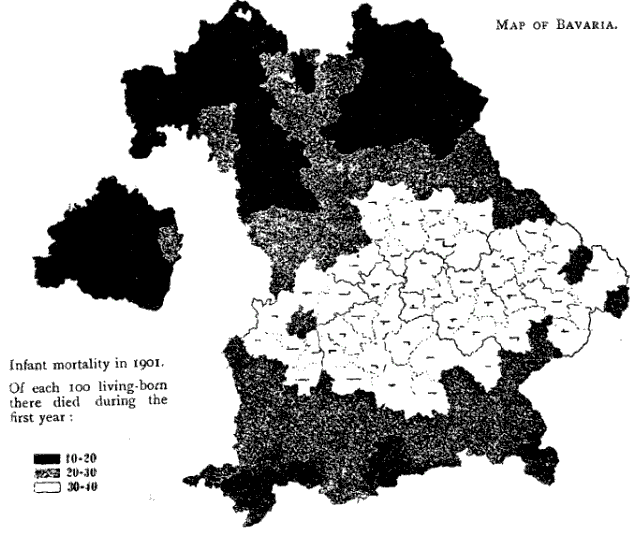
Figure C 79.
I cannot suppress another objection to the usual way of proving the—to my mind undoubted—influence of breast-feeding on the duration of life in infancy. Why is the mortality of those children who have not been suckled for a week so large? Is it because they have not been suckled, or because they have only lived altogether for less than a week? Or, again, to be able to be suckled for 40 or 50 weeks, one must have lived for 40 or 50 weeks, but a child who has lived for 40 or 50 weeks, whether it has been suckled or not, has passed over the worst period. It is well-known that the mortality in the first days of life is the highest in the second week, much higher than in the third week, and so on. In short, the mortality changes in such an extremely high degree in the course of the first year of life that this period is much too long for the comparison between mortality of suckled and non-suckled children. One ought to calculate how many of those who have been suckled for 0 weeks, one week, two weeks, one month, three months, six months, and so on, have survived the first week, the second week, the first month, and so on. Only in this manner can be established what is the share of the absence of breast-feeding and what is the share of the innate weakness and tendency to disease in the degree of infant mortality."
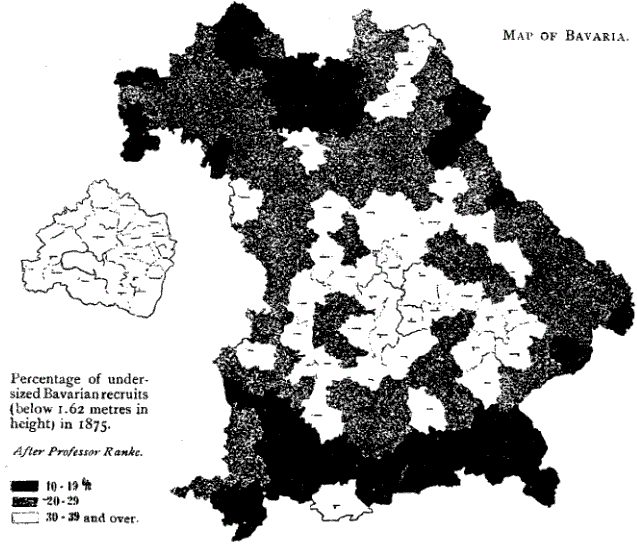
Figure C 80.
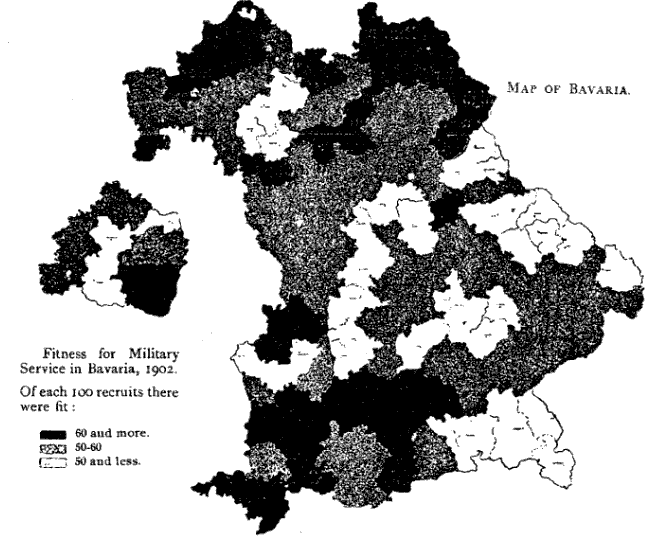
Figure C 81.
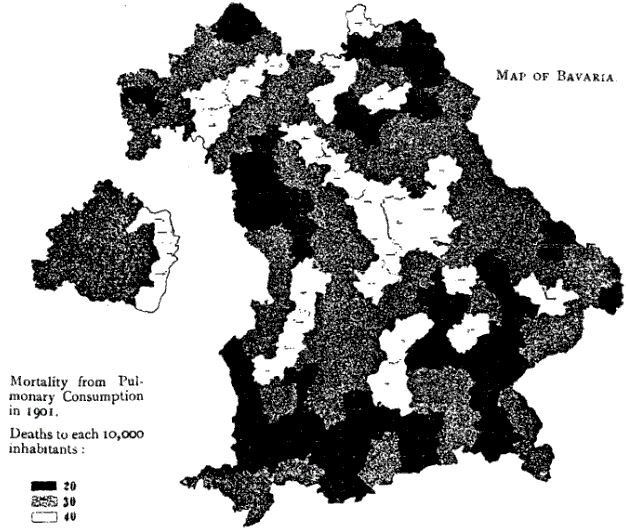
Figure C 82.
C 83
A striking peculiarity of cities, especially large cities, is, as pointed out before, the high mortality amongst men; for this general observation Figure C 83, male and female mortality in town and country, offers an example. Whereas the female mortality in Berlin, in the higher age groups, is even lower than in Mecklenburg with its preponderantly country population—which is evidence that in town life there are no inherent circumstances adversely affecting all persons in a high degree—the male mortality in all the age groups is higher, and in some much higher. The special adverse influence on men of town life is also apparent in the upper part of the figure (comparison of male and female mortality). In Mecklenburg the mortality among men is at most 25% higher than among women, and during the period of most intense child production, as well as in the highest age group, it is even smaller, whereas in Berlin the differences are much more accentuated. It may be remarked that the higher male death-rate in Mecklenburg between the ages of 40 to 75 years can only to a small degree be explained by physiological reasons. This is shown for example by the fact that in the provinces of Schleswig-Holstein, Pomerania, Hanover, Hessen-Nassau, and the Rhein Provinces in the country, the expectation of life for men aged 25 years is about equal to that of women.
C 84 & 85
The higher male mortality in cities is only partially explained by the specific harmfulness peculiar to men's town occupations, though the mortality of peasants and agricultural labourers ranks amongst the lowest. A very important part in this connection may be played by syphilis. How terribly syphilis injures the body, though it is seldom directly fatal, is shown by the experiences of life insurance companies, of which examples are given in Tables C 84 and C 85. With the Gotha Life Insurance Bank, for instance, the mortality of the syphilitic at the ages of 36 to 50 years was found to be nearly double as high (186%) as that of the non-syphilitic.
C 85
Table C 85 shows to what a high degree the heart and vessels especially are harmed by syphilis. At this point it is to be noted that it may now be considered as proved that the statement that general paralysis causes death in 2.9% cases among the non-syphilitic is erroneous, because general paralysis only occurs among persons who have been affected with syphilis. There is no doubt that the poison of syphilis is also most injurious to the germs and the progeny; the fœtus is sometimes infected in the mother's womb, and sometimes suffers by the general debility of the maternal body. A large proportion also of those children who attain a higher age are either enfeebled or damaged in many ways, and this inferiority is often passed down to the grandchildren. The most recent Serum investigations (the Wasserman reaction) are the first to throw full light on this. In Germany syphilis occurs much more frequently in town than in the country; this no doubt dependent on prostitution and on a much greater degree of promiscuity of sexual intercourse in cities. In the country couples keep together with greater constancy, even in the case of cohabitation without marriage.
C 86-88
The frequency of syphilis and other venereal diseases in town and country is illustrated in Table C 86, which gives the result of the enquiries of the Prussian Government on the 30th April, 1900, and Table C 87 after Schwiening, on the frequency of sexual diseases among military recruits. Also Table C 88 which gives the frequency of delirium tremens, epilepsy, and general paralysis in the Prussian lunatic asylums, points in the same direction by the great differences shown in the frequency of general paralysis in the different institutions. This table, at the same time, indicates what is also supported by other observations, that the frequency and intensity of harmful influences through alcohol are much greater in towns than in the country; this may be partly because in cities there is a greater and more regular abuse of alcoholic beverages than in the country, partly because town-life induces a greater susceptibility to alcoholic poisoning than country life (less intense metabolism with sedentary occupations).
C 89-90
Injury to the reproductive function through alcohol. It has been known for a long time that drunkards are frequently sterile. This must be attributed to the fact that the testicles of drunkards become to a great extent atrophied. The condition is shown in Figure C 89 by R. Weichselbaum, [B] representing a section through the testicle of a drunkard. Figure C 90 which shows a section through a normal testicle, enables even the layman to observe the atrophy of the characteristic glandular tissue of the testicle. Weichselbaum has up to now found that in fifty-four cases, without exception, in which alcoholism had been proved, this atrophy could be demonstrated to a greater or less degree. In thirty of these cases the subject was so young that senile atrophy was out of the question. The abuse of alcohol is not the only harmful influence which is able to induce such atrophy of the testicles, but chronic alcoholism acts with special intensity. Very similar results to those of Weichselbaum have been obtained by Bertholet (Zentralbl. f. allg. Pathologie 20 Bd. 1909) in 37 out of 39 habitual drunkards. They agree with observations on the vesiculae seminales of drunkards by Simmonds, who found that in 61% of the cases examined the spermatozoa were absent or dead. It is a permissible assumption that a poison which can cause the total atrophy of the sexual glands may, in an earlier stage, have adversely influenced in respect to quality the function of those organs.
C 91
C 92
Alcohol and Degeneration, from the tables on the alcohol question by Gruber and Kraepelin, Munich; Lehmann; contains the well-known statistics of Demme, Bunge, and Arrivée. Table C 92 adds to the summary of the statistical observations of Demme, further details of the kind of abnormalities which were observed in children of drunkards. Representing, as they do, exceptionally bad cases with a high degree of degeneration, one may doubt whether and in how far congenital hereditary inferiority of the parents may have had its influence.
C 93
Figure C 93 contains the well-known result of v. Bunge's investigations on the influence of paternal alcoholism on the suckling capacity of the daughters. The varying frequency of the habitual consumption of alcohol and of drunkenness proper of the father in the two groups of families is most striking. Official investigations of this question on a large scale are urgently called for.
C 94
Figure C 94 dealing with the interconnection of tuberculosis, nervous diseases and psychoses of the progeny and the alcohol consumption of the father, is derived from Bunge's investigations. It is worthy of notice that he endeavoured to eliminate from his statistics all families in whom hereditary diseases could be traced previously.
C 95
Table C 95 contains a summary of T. Laitinen's experiments on animals with small quantities of alcohol. The degree of injury to the progeny supposed to be produced by even a minimum quantity of alcohol (corresponding to about one-third of pint of beer for a man) is astounding. Repetition of these experiments on a large scale and with the strictest care would be most desirable here also.
C 96
Table C 96 also refers to reports by T. Laitinen. [C] It deals with the effect of alcohol on the progeny in man. Unfortunately Laitinen's paper is so confused and inexact that it is impossible for the reader safely to draw conclusions from it. His personal observations are mixed up with those gathered by means of inquiry sheets circulated by him in such a way that one cannot make out how he has arrived at his weights at birth and mortality. Information is lacking with regard to the nutrition of the children, their age at the conclusion of the investigations, the length of marriage, the rapidity of birth sequence and so on. It is, therefore, indispensable to await the more detailed report before Laitinen's information can be made use of.
C 97
Bezzola has sent in in a modified form the data which he presented to the Eighth International Congress against Alcoholism in Vienna in 1901, on the effect of acute intoxication on the origin of feeble-mindedness. With their help the curve on Figure C 97 has been constructed, showing the distribution of illegitimate births in Switzerland during the different months of the year from Bezzola's data and the corresponding curve of the births of mentally eminent individuals (taken from Brockhaus' encyclopædia.) The author supplies the following comments:—
"Comparison between the general birth curve and the corresponding one for the birth of feeble-minded children."
The casual observation at the registration of the personal history of feeble-minded individuals that 50 per cent. of the birth dates fall within only fourteen weeks of the year (New Year, carnival, and wine harvest) has aroused the desire to deal with the seasonal incidence of the begetting of the feeble-minded on the basis of as much material as possible. For this purpose the author's census of feeble-minded school children, which took place in the year 1897, and referred to the years 1886-90 inclusive, seemed specially suited. Originally (in 1901) a curve was plotted in which all the 8,186 feeble-minded and idiotic children were included whose exact birthdays were known, and this curve was compared with the total curve for that period. (Schweiz. Statistik 112 Liefg.) The latter was constructed in the following manner from the whole number of births (934,619) which occurred in these eleven years:—The general daily average was taken as 100, and the daily average for each month was expressed proportionately. Thus numbers above 100 show a daily birth frequency above the average, while for numbers below 100 the reverse is the case. The curve for the 8,136 feeble-minded persons was constructed in a similar way, and thus a comparison with the general population producing them was made possible. Subsequently (1910-11), in order to secure homogeneous material, the first and last years were left out, since by including them, owing to the non-agreement of the school year and the astronomical year, the earlier months (January-April) were much weighted. By this restriction of the material dealt with the number of feeble-minded is reduced to 7,759, but the material for each separate year is more homogeneous. Distributed between 2,922 days (eight years), the daily production of the feeble-minded is 2.648, the corresponding total number of births of the years 1882-89 ls 677,083, or 231.7 per day. 1.14 per cent. of all births are included in the figure for the feeble-minded. If one treats the total number of births for each month as well as the number of births of feeble-minded according to the method described above, and used by the Federal Statistical Bureau, two curves are produced which diverge considerably from each other in particular months. On the whole the curve for the feeble-minded (thick line) is flatter than the curve for the total. Especially striking are the drop in May and June (corresponding to the procreation period from the 25th July to the 23rd September) and two peaks rising above the "total" curve. One of these is slight, yet distinct. It refers to the months of birth, July and August, corresponding with the procreation period from the 24th September to the 24th November. More conspicuous is the second peak of the curve for the feeble-minded from October to December, otherwise a time poor in births. The centre of the corresponding period of procreation (25th December to 26th March) is in February (carnival). This seems to confirm the suspicion that during the wine harvest and carnival an increased procreation of feeble-minded occurs (procreation during drunkenness?).
We cannot suppress the remark that the fluctuations of the curve for the feeble-minded are much too small to admit of the drawing of an ætiological conclusion, but the fluctuations of the intelligence curve and the illegitimate curve partly exceed the limits of probable error. The peaks of both birth curves in February, correspond to a peak in the procreation curve in May. Perhaps one may attribute them to the existence of a remnant of a period of "heat" (or a rutting season) in man.
C 98
Lead. Whereas the germ cells are well protected against many harmful influences from without which affect the soma of the mother, they and the fœtus produced from them suffer considerably from some. Amongst their deadliest enemies are certain poisons, and notorious in this respect is lead. Table C 98 gives two sets of statistics on this point, they justify the law in Germany, and in other States, forbidding female labour to deal with lead and lead-containing materials. Paul's figures, showing that lead poisoning of the father is also extremely adverse to the production of a healthy progeny, are remarkable.
C 99
Female Labour. A baneful influence on reproduction is brought to bear by the growing quantity of professional female labour away from home and by the economic emancipation of women. Evidence of this is given in Table C 99—"female labour and child mortality"—the data of which are taken from Prinzing's work. Infant mortality is higher the larger the percentage of females employed in factories during the child-bearing period. This is partly due to interference with breast-feeding and partly to the unfavourable influence on pregnancy.
C 100
Dr. Agnes Bluhm has given in Figure C 100 "Female Labour and Reproductive Activity," the statistics of Roger and Thiraux, as well as the results of the investigation of the Imperial Statistical Office on the "Relationship of illness and deaths in the Local Invalidity Fund for Leipzig and surroundings." Dr. Bluhm gives the following explanation: "The top figure on the left is based on material of the Local Invalidity Fund for Leipzig and surroundings, dealing with over a quarter of a million of women of child-bearing age. The distinction between obligatory and voluntary members makes possible the estimate of the influence of work continued up to the time of confinement, because the voluntary members receive the same weekly payments during confinement as the obligatory ones, and, consequently, a woman has no object in joining the voluntary insurance scheme except in order to secure rest before confinement, which they procure for themselves at their own expense and with the loss of their wages. (At that time the compulsory support during time of pregnancy did not exist.) It is to be noted that the voluntary members show ten times as many confinements as the obligatory ones."
"The left hand figure at the top shows that the women who work up to the time of confinement fall ill during their pregnancy twice as often, and have six or seven times as many miscarriages and premature births and 1.28 times as many cases of death in child-bed, as those who stop work for a more or less extended period previous to their delivery."
"The frequency of illness after childbirth is in both categories of women almost the same; but the duration of the illness beyond the period for which the legal subvention provides (13, 26, or 34 weeks respectively) is much greater in the case of the obligatory members who do not spare themselves before their delivery."
"Left hand figure at the bottom—the researches were made by Roger and Thiraux in a maternity home. A comparison is made between the women who entered the home only at the beginning of childbirth and those who entered during the last month of pregnancy or sooner. Premature birth occurs in nearly one-third of the cases among the former, but among the latter only one-eighth.
"Right hand figure at the bottom—dealing with the same material as the left hand figure below compares the weight at birth of the first, second and later born. The average weight of the former is 300 g. and that of the latter 341 g. higher with mothers who cease work two or three months before delivery, than with those who worked up to the last. Possibly this expresses in the main the different duration of pregnancy. The importance of the birth weight of a child for its further development is not to be underrated."
"The top figure on the right shows that the importance of the adverse influence of female labour on the race, shown in the above figures, is growing, because there is an increase of employment amongst married women. Simon's figures show that the manufacturing industries, which in 1907 employed by themselves two million female hands, the number of married women has increased by almost 200,000 during the last twelve years. In agriculture, in which four and a half million females find their main occupation, the share of the married women is much greater still."
"The increase of married female labour being intimately connected with the development of our economic life, which cannot be deliberately influenced, the demand for a Motherhood Insurance for all female labourers of any kind, and for the extension of the legal time of stoppage of work before childbirth to at least four weeks, follows as a practical result of the facts stated above."
Dr. Bluhm's repeated assertion, which is regarded by many as a dogma, that economic conditions cannot be deliberately influenced (i.e., that they are of the character of a law of nature) must not remain uncontradicted as a principal. It is absolutely unproved, though the difficulty of influencing our economic life cannot be denied; the economic order has been created by man and must be altered if it proves harmful for the race.
C 101
The adverse influence of female labour on the progeny is shown from a somewhat different point of view in Table C 101—"premature births and abortions in different callings." The most serious fact shown here is that a low birth rate may frequently be found in conjunction with a high rate for miscarriage and premature birth; as the compiler of these statistics points out, this conjunction is most apparent in those callings which demand frequent intercourse with the public, such as domestic service, that is to say in cases where pregnancy is particularly inconvenient. Probably in these cases artificial prevention of pregnancy goes hand in hand with the procuring of abortion!
Race-hygiene does not aim at an indiscriminate motherhood insurance of married and unmarried mothers, but it aims at the economic subvention and encouragement of legitimate fertility of healthy and able parents, connected with, and rendered possible by, a reduction of female labour away from the home. Marriage is one of the most important hygienic institutions for the individual as well as for the race, and it is folly to allow its decay and to replace it by substitutes.
C 102
The importance of marriage for the health to married persons is shown by figure C 102—"condition with regard to marriage and mortality in Prussia, 1894-97," as given in Prinzing's book. That we have to deal here with an actual favourable influence of marriage, and not with a selection of the healthy at the time of marriage, is proved by the fact that the low death rate of the married is maintained through all age classes and that the widowed and divorced show throughout the highest death rate.
C 103
"Condition with regard to marriage and mortality, cases of death from tuberculosis," after Weinberg, also confirms with regard to tuberculosis the favourable influence of marriage on the health of men. With women the mortality from tuberculosis up to the age of 60 is lowest among the unmarried. Pregnancy and suckling act here adversely, but by far the worst position is also held here by widows and divorced women.
C 104-105
The advantage of marriage for the progeny is made evident in Figure C 104—"mortality of illegitimate children in different European states", and in Figure C 105 dealing with the "survival of the legitimate and illegitimate children in Berlin in 1885." After five years there are still alive more than 60% of the legitimate, but only 40% of the illegitimate children. The higher mortality of the latter is by no means a purifying process of weeding, but the expression of greater sickliness which permanently harms the surviving also. The division of labour between man and wife, with reference to the care of the offspring, is one of Nature's institutions which is of the greatest advantage for parents as well as children.
C 106-107
Inbreeding and the Crossing of Races. On the whole with mankind inbreeding is viewed with fear, and justly so, in view of our customary carelessness with regard to the physical and mental conditions of those who contract marriage. If blood relations have similar pathological conditions or pre-dispositions to illness or degeneracy, the progeny which results from their union is endangered to a particularly high degree. Our collection brings as an example of this in Table C 106—the pedigree of the celebrated Don Carlos. The bad inheritance of Johanna the Mad asserts itself to a lesser degree yet quite perceptibly also in the children of Max. II. Table C 107—the children of Maximilian and his cousin Maria of Spain; undoubtedly the Emperor Rudolf II. was mentally diseased. Also Charles V. and his son Philip II. were abnormal characters.
C 108
Blood relationship of the parents and health of the children, which v. d. Velden has prepared from Riffel's family tables, also speaks for the harmfulness of inbreeding. The offspring of blood relations are emphatically weaker and sicklier than those of persons related distantly or not at all.
C 109
The harm of inbreeding amongst the pathological is also illustrated by the large Table 222 (exhibited by Schüle). Pedigrees from wine-growing districts in the centre of Baden; against this it may be taken as proved that inbreeding in itself between the healthy and fit is not harmful. Animal breeders (as well as plant cultivators) make an extensive use of it with the view to the cultivation of certain hereditary characteristics.
C 110
We show in Table C 110, after de Chapeaurouge, the pedigree of Belvidere, an animal which, in spite of close inbreeding, was distinguished by excellent qualities, and by whom, out of his own daughter, another sire of the highest rank was produced.
C 111
After long-continued and very close inbreeding, even with a faultless condition of the germ plasm, the decrease of vitality and fertility of the progeny asserts itself. Important evidence for this is given by Georg. H. Shull in his exhibition of cross-fertilized, self-fertilized and hybridized maize (Exhibit No. C 111). Shull makes the following comments: "Results of inbreeding with maize—crossing between different races or genotypes, if not too distantly related, results in a progeny which excels its parents in vitality, whereas crosses between individuals belonging to the same genotype engender no increase of vitality as compared with the parents."
In maize, and presumably in most other plants and animals in which cross-fertilization is the rule, all individuals are usually complicated hybrids between different varieties of genotype. They owe their vigorous constitution to this hybrid nature.
"The result of self-fertilization or of close inbreeding is that the hybrid nature diminishes in degree. The stock is reduced to a homozygotic condition, and is thus deprived of the stimulus which lies in the hybrid condition."
"When two given genotypes are crossed, the first hybrid generation is possessed of the greatest vigour. Even the second generation shows much less vitality, and this decrease continues with the third and later generations. But each succeeding generation differs less from its predecessor than the latter differed from its own parents. As soon as the stock has become a pure line, inbreeding produces no further weakening."
"The top row of the exhibited collection of maize cobs (large cobs with many grains) is derived from a family in which for five generations self-fertilization has been prevented by using mixed pollen. These conditions approach those prevailing in an ordinary field."
"The middle row of maize cobs (small cobs with few grains) comes from families of the same derivation as the first row; but for five generations they have been self-fertilized. Each one has characters which the others do not possess. They are almost pure bred, and continued self-fertilization produces no further adverse influence. The cob, quite to the right, without grains, has pistils so short that they do not project from the husks. This genotype must, therefore, be fertilized artificially."
"The lowest row (the largest cobs with the most grains) comes from families which have been created by the crossing of plants belonging to different genotypes, the relationship in which case is indicated by the lines which connect this row with the middle row."
"The following harvests of grain were made in the year 1910:—
Self-fertilization prevented (average of nine families) 53.5 hi pro ha.
Self-fertilized (average of ten families) 25.3 " " "
F1 hybrid (average of six families) 59.2 " " "
F2 hybrid (average of seven families) 38.8 " " "
C 112-114
It is well-known to what degree inbreeding is practised in reigning families. We show as an example for this, Chart C 112, the pedigree of the Archduchess Maria de los Dolores of Tuscany, exhibited by Dr. Stephan Kekule von Stradonitz, and Chart C 113 of the same exhibitor, pedigree of Ptolemäus X. Soter II. (Lathros), and Chart C 114, pedigree of the celebrated Cleopatra. Though with Ptolemäus X. the effect of sexual reproduction in bringing about new combinations of hereditary units was very limited, since the couple, Ptolemäus V. Epiphanes and Cleopatra Syra having produced all the germ cells from which he developed, he appears, nevertheless, to have been a perfectly normal being. In his granddaughter Cleopatra certainly much "extraneous blood" circulated.
C 115
Even where there is no high degree of inbreeding, the individuals of a people are much more closely related to each other than is generally assumed. Table C 115, "theoretical number of ancestors," shows that, assuming the duration of one generation to be 35 years, and that no marriages between relations have taken place, the number of the ancestors of a man living now would have been eighteen billions in the year 0 a.d. In reality the germanic race, wandering west, probably only numbered hundreds of thousands. This phenomenon of "ancestral loss," as Ottokar Lorenz calls it (that the number of real ancestors is much smaller than those theoretically possible), can be illustrated in the pedigrees of the reigning houses.
C 116
We have in Table C 116 an analysis of pedigree of Emperor William II., after Ottokar Lorenz. Investigations show that twelve generations back the real number of his ancestors amounts to only one-eighth of the possible figure. Only 275 persons have actually been found because in the older lines, the bourgeois element, of which no record can be found, has had a very large share.
C 117
Very little knowledge exists concerning the effect of the crossing of races in man. On the whole it appears not to be favourable, if it is a question of crossing of races from far apart, even in purely physical respects. An example of harmful influence is given in v. d. Velden's Table C 117—"Fertility and Health in relation to the crossings of races."
NEOMALTHUSIANISM.
C 118-122
The next and the greatest concern of race-hygiene—much greater than the relative increase of inferiority—is, to-day, neomalthusianism, the intentional restriction of the number of births in varying degrees up to complete unproductiveness. Though conscious regulation of the production of children is absolutely necessary, it becomes fatal to a nation if under no control but the egotism of the individual. For its permanent prosperity a nation requires, in order merely to hold its own, a sufficient number of "hands" and a sufficient number of "heads" to guide those "hands." We referred to this when mention was made of sterility as a phenomenon of degeneration, but this cause of sterility during the last decades only takes a second place compared to deliberate intention. The wealthy and higher social classes were first attacked by neomalthusianism. Their progeny is becoming more and more utterly insufficient, so that under our present social conditions, particularly which give mind and talent better openings, and thereby more and more take out of the mass of the people the better elements, make the strongest demand for them and use them up, the danger of an increasing deterioration of the average quality of its progeny grows greater and greater. The baneful influence of wealth on fertility is shown by several tables. Figure C 118 "Fertility and Wealth," after Goldstein and Tallquist, gives the condition in the French Departments; Figure C 119, "Number of Children and Wealth," after Bertillon, for the Arrondissements of Paris; Figure C 120, "Fertility and Wealth," after Mombert, for Münich, 1901, Table C 121, "The Number of Children in Families of Different Classes in Denmark, 1901," after Westergaard; Table C 122, "Fertility of Marriages, Occupation, and Wealth for Copenhagen, and Dutch Conditions," after Rubin, Westergaard, and Verrijn Stuart.