A YOUNG INVENTOR'S PLUCK
Reading edition
Cover
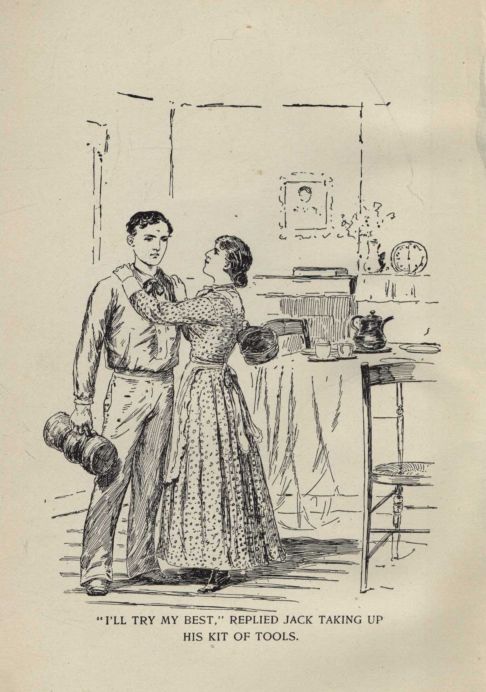
"I'LL TRY MY BEST," REPLIED JACK, TAKING UP HIS KIT OF TOOLS.
A Young Inventor's Pluck
OR
THE MYSTERY OF THE WILLINGTON LEGACY
BY Arthur M. Winfield,
Author of "THE ROVER BOYS AT SCHOOL," "THE MISSING TIN BOX," "SCHOOLDAYS OF FRED HARLEY," etc.
NEW YORK -- AKRON, O. -- CHICAGO THE SAALFIELD PUBLISHING CO. 1901
COPYRIGHT, 1901, BY THE SAALFIELD PUBLISHING CO.
INTRODUCTION
My Dear Boys and Girls:--
"A YOUNG INVENTOR'S PLUCK" relates the adventures of a wide-awake American lad of a mechanical turn of mind, who suddenly finds himself thrown upon his own resources and compelled to support not only himself, but likewise his sister.
Jack Willington's path is no easy one to tread. The bank in which the sister and brother have their little store of money deposited fails, and with this comes the shutting down of the tool works in which our hero is employed. To add to the lad's troubles, there is a large fire in the town and the youth is accused of incendiarism.
But Jack and his sister Deb are not without friends, and the fact that the boy is an inventor and has almost ready the model of a useful and valuable invention, aids him to secure his release, and then he goes forth to run down his enemies and to solve the mystery connected with a rich family legacy.
Generally speaking, life in a factory town is thought to be dull and monotonous, whereas the truth is, that it is usually full of interest and not devoid of excitement of a peculiar kind. In this tale I have tried to picture life in such a place truthfully, with all of its lights and its shadows, and I hope that my story will prove more or less instructive in consequence.
Affectionately your friend,
ARTHUR M. WINFIELD.
CONTENTS
CHAPTER I.
THE SHUT DOWN
CHAPTER II.
FOR THE SAKE OF HOME
CHAPTER III.
A RESULT OF A FIRE
CHAPTER IV.
BAD NEWS FOR DEB
CHAPTER V.
FINDING BAIL
CHAPTER VI.
HOME ONCE MORE
CHAPTER VII.
INTO THE RIVER
CHAPTER VIII.
SOMETHING ABOUT THE MODEL
CHAPTER IX.
MR. BENTON MAKES TROUBLE
CHAPTER X.
DRIVEN FROM HOME
CHAPTER XI.
ON THE RIVER ROAD
CHAPTER XII.
JACK'S DANGEROUS POSITION
CHAPTER XIII.
OVER THE FALLS
CHAPTER XIV.
MAX POOLER'S MEG
CHAPTER XV.
THE MISER OF THE ISLAND
CHAPTER XVI.
ON BOARD THE "KITTY"
CHAPTER XVII.
MEG TO THE RESCUE
CHAPTER XVIII.
DEB AT THE MILL
CHAPTER XIX.
IN CORRIGAN'S POWER
CHAPTER XX.
MONT TELLS HIS STORY
CHAPTER XXI.
CORRIGAN MAKES A MOVE
CHAPTER XXII.
HEAPS OF MONEY
CHAPTER XXIII.
THE MISER'S TREASURE
CHAPTER XXIV.
A GLIMPSE OF THE PAST
CHAPTER XXV.
CHASING ANDY MOSEY
CHAPTER XXVI.
PAPERS OF GREAT VALUE
CHAPTER XXVII.
"LOVE YOUR ENEMIES"--CONCLUSION
ILLUSTRATIONS.
"I'll try my best," replied Jack taking up his kit of tools . . . Frontispiece
"Well, sir, what is it?" he asked, hardly looking up
Jack was soon as busy as a bee, putting the machines in running order and overhauling other farming implements
"Been tellin' sthories about me!" he exclaimed. "Sayin' I sthole yer match-box an' set foire to old gray's house! Oi'll fix ye!"
With a quick spring he gave the young man a push that sent him spinning over backward
The body came within his reach, and leaning over, he stayed its progress
"Did you really go over them falls?" she continued, jerking her thumb in the direction
The miser of the island had lost his balance, and after vainly clutching the air to save himself, had floundered into the water and mud below
"I mean just this," replied Corrigan, catching her by the arm, "you are my prisoner and must do as I say"
With a strong push of his powerful arm, he sent the man flying into a corner
A YOUNG INVENTOR'S PLUCK
CHAPTER I.
THE SHUT DOWN
"Oh Jack! how blue you look!"
"I feel blue, Deb," answered Jack Willington, as he entered the door of his modest home and gave his sister the brotherly kiss he knew she was expecting.
"Is there something the matter up at the tool works, Jack?"
"Yes, Deb. The works are going to shut down."
"To shut down?" repeated the girl, her eyes wide open in affright, for she knew only too well what such a calamity meant. "When will they close?"
"To-morrow. In fact we have quit on the regular work already."
"And how long will the shut-down last?"
"Nobody knows. I asked Mr. Johnson--he's the foreman, you know--and he said he thought a month or six weeks, but he wasn't sure."
"A month! Oh, Jack, it's an awfully long time!"
And Deb Willington's face grew very grave.
"I know it is--longer than I care to remain idle, even if I could afford to, which I can't. But that's not the worst of it."
"No?"
"No; they didn't pay us for the last two weeks' work."
"Why not?"
"Johnson said that they wanted to pay off every man in full, and that the figuring would take several days."
"And you won't get any money till then?"
"Not a cent. My private opinion is that the company is in some sort of a financial difficulty, and only want to gain time. Mont didn't have a word to say about it when I asked him, and, I imagine he knows a good deal about his uncle's affairs."
Deb cast down her eyes in a meditative way.
"To-morrow is rent day," she said, after a pause.
"I know it. I've been thinking of it all the way home. How much have we got toward paying the six dollars?"
"Three dollars and a half." And Deb brought forth the amount from her small purse.
"Humph! I don't see what's to be done," mused Jack, as he removed his hat and sat down. "Mr. Hammerby will have to wait for his money."
"Will he?"
"I don't see what else he can do. But, aside from that, three dollars and a half won't keep us a month. I'll have to look elsewhere for work."
Deborah and John Willington were orphans. Their father had died some ten years before. He had been a strong, industrious and ingenious machinist, of a quiet nature, and at his demise left his wife and two children with a small property, which, however, was subject to a mortgage of several hundred dollars.
His widow found it no easy matter to get along. Jack was but seven years of age and Deb five, and, of course, could do little or nothing, except occasionally to "help mamma."
Mrs. Willington in her reduced circumstances had taken in sewing, and also opened a school for little children, and by these means had earned a scanty living for her family.
But it was not long before the strain began to tell upon the brave woman. She was naturally delicate, and grew weaker slowly but surely, until, eight years later, she quietly let slip the garment she was making, folded her hands, and peacefully went to join her husband in the Great Beyond.
Deb and Jack were terribly startled when the sad event occurred. They were utterly alone in the world. It was true that there were distant relatives upon their mother's side, but they had always been too proud to notice the Willington family, and now made no attempt to help the orphans.
Shortly after the mother's funeral, the mortgage on the homestead fell due, and as it could not be met, the place went under the auctioneer's hammer.
Realty in Corney, as the factory town was called, was not booming at the time, and, as a consequence, when all the costs were paid, only one hundred dollars and the furniture remained as a start in life for the two children.
They had no home, no place to go. What was to be done?
A kind neighbor spoke of adopting Deb, and another obtained for Jack a job in the Tool Company's works.
But the two would not separate. When Jack mentioned it, Deb sobbed and clung to him, until he declared that she should remain with him no matter what happened.
At this time Jack earned eight dollars a week, and had the prospect of a raise. With this amount they rented three rooms for six dollars a month, and Deb, young as she was, took upon herself the important duties of housekeeping.
Things moved crudely at first, but it was so nice to be together, to work for one another, that, excepting for their recent bereavement, which still hung as a heavy cloud over their lives, they lived as happily as "two bugs in a rug."
Jack thought the world of his sister Deb. He was a rather silent fellow, with a practical turn of mind, not given overmuch to fun making, and his sister's bright and cheerful way was just what was needed to lift his mind out of the drudge-rut into which it was wont to run.
He spent all his evenings in her company, either at home or, when the weather was fine, in strolling around Corney, or in attendance upon some entertainment that did not cost much money, and which gave Deb keen enjoyment. Sometimes, when he got the chance, he would do odd jobs at his bench on the sly, and then, with the extra money thus earned, would surprise Deb by buying her something which he knew she desired, but which their regular means would not afford.
Jack was now earning twelve dollars a week and they lived much more comfortably than before. During the past three years they had saved quite a neat sum, but a month of severe illness for Deb had now reduced them to their original capital of one hundred dollars, which was deposited in the Mechanics' Savings Bank of Corney--a sum that both had decided should not be touched unless it became absolutely necessary.
Young as he was, Jack understood the machinist's trade thoroughly. He took a lively interest in his work, and the doing of jobs on his own account had led him to erect a small workbench at home.
Here he often experimented upon various improvements in machinery, hoping at some time to invent that which might bring him in a substantial return.
One of his models--a planing machine attachment--was nearly completed, and this had been considerably praised by Mr. Benton, a shrewd speculator in inventions of various kinds.
"I'm afraid we'll have to draw part of that hundred dollars from the bank," observed Jack as the two were eating the neat supper Deb had prepared. "I hate to do it, but I don't see any way out of it."
"It does seem a shame, after we've kept it so long," returned his sister. "But do as you think best. Only, Jack, dear, please don't worry. It will all come out right in the end."
Her brother had laid down his knife and fork and was resting his chin on his hand in deep meditation.
"You're right, Deb," he exclaimed starting up, "and I ought to be thankful for what we have got, especially for having such a good little sister to ease things up."
"Say, Jack," suddenly began Deb, struck with an idea, "you are so handy with the tools, why don't you open a little shop of your own? Wouldn't it pay?"
Jack's face brightened more than it had for many a day.
"I'm glad you said that," he replied. "I've often thought of it. But I hated to give up a certainty like my wages for----"
"Yes, but now----" began Deb.
"One misfortune gives me a chance to tempt another." He gave a sorry little laugh. "Is that what you mean?"
"You'll get along--never fear."
"There ought to be a chance, true enough. I could sharpen tools, repair lawn mowers and bicycles, and mend all sorts of things. There is no such shop in Corney as yet, and it ought to pay."
"How much would it cost to start?" asked Deb, with great interest.
"I think fifty or sixty dollars would put me into shape to do small work. I have most of the tools, and would only need a lathe and one or two other things--that I could get second-hand."
"I'll tell you what to do then," was Deb's conclusion; "to-morrow morning, go down to the bank and draw out seventy-five dollars. Then we'll pay the rent, and you can take the rest and try your luck."
"Yes, but----"
"No buts, Jack; I'm willing to put up with whatever comes--bad luck as well as good. I'm sure you'll succeed."
"If your good wishes count for anything, I certainly shall," exclaimed Jack, earnestly. "I think I can rent a shop for ten dollars a month, or, maybe, if I pay a little more, I can get one with living rooms attached, which would be cheaper than hiring two places."
"And nicer, too," returned Deb; "you wouldn't have to go so far for dinner, and I could attend to customers while you were away."
The pair talked in this strain for over an hour. His sister's sanguine way of looking at the matter made the young machinist feel as if perhaps the shut-down was not such a bad thing, after all, and might prove the turning point to something better than they had ever before known.
The next morning, for the first time in several years, Jack had breakfast late. It was soon over, and then he put on his good clothes and started for the bank.
The streets were thronged with idle men. The Corney Tool Company employed nearly a thousand persons--in fact, it was by far the principal factory in the place--and to have all these employes thrown out of work was a calamity discussed by everyone.
The Mechanics' Savings Bank had been organized by Mr. Felix Gray, the owner of the tool works, who presided over both places. He was a man of fifty, with an unusually sharp and irritable disposition.
As Jack approached the bank he noticed a large crowd collected in and around the building.
"I suppose, as they can't get their pay, they want to withdraw some of their savings," was his thought as he drew nearer.
An instant later a queer cry came from the interior of the bank, and it was quickly taken up by those outside.
"What is it?" asked the young machinist, of a bystander.
"They've suspended payment," was the short reply.
"What!" gasped Jack, in horror. "You don't mean it?"
But at the same time the crowd cried out loudly, in angry tones:
"The bank's burst! She's gone up for good! No money for the poor man! We can all starve!"
CHAPTER II.
FOR THE SAKE OF HOME
"Can this be possible? Has the bank really burst?"
Over and over Jack asked himself the question. Then the words of the crowd echoed and re-echoed through his ears. Yes, the bank had suspended payment. There was no money for him--no money for anyone!
"It's too bad!" he groaned. "What will Deb say?"
The thought of his sister gave him another pang. Without money and without work, how could he continue to take care of her?
"Oh! Jack, me b'y, not wan pinny av me two hundred dollars will they give me at all," exclaimed Andy Mosey, a fellow-workman, bitterly.
"How did it happen?" asked the young machinist.
"No wan knows. Oi guess old Gray is in a toight hole, an' is usin' the bank's money to get him out."
Andy Mosey was a heavy-set Irishman, with a bloated, red face and fiery hair and beard. His work brought him into daily contact with the young machinist, but Jack did not like the man, first on account of his drinking habit, and secondly, because he suspected the Irishman of having stolen from the pocket of his jumper a silver match safe--a highly-valued Willington heirloom.
"It's a bad business, and no mistake."
The speaker was Dennis Corrigan, a pattern maker. He was a brother-in-law to Mosey, but much more educated, and somewhat refined in appearance as well.
"Yes, indeed," returned Jack.
"How do they expect us to live if they don't pay us our wages or let us draw our savings either?"
"Old Gray will pay dearly fer this," put in Andy Mosey, with a wicked look in his eye; "oi'll vow he'll be moighty sorry for this day's worruk ere long."
Jack elbowed his way up the bank steps and into the building. The cashier's window was closed, and behind the glass this notice was pasted up:
"Depositors are hereby notified that owing to the unexpected run upon this bank, no further payments will be made until the more available assets are converted into cash."
The crowd were all talking loudly and excitedly, and Jack tried in vain to obtain definite information concerning the cause for the suspension.
At length, sick at heart, he returned to the sidewalk, where Andy Mosey, the worse for several glasses of liquor, again addressed him.
"Not wan pinny av me two hundred dollars, Jack, me b'y!" he repeated in a heavy voice; "an' they call it a free counthry! Sure it's only free fer rich people to rob the poor!"
"It's rough," replied Jack.
"Old Gray will pay dearly fer it, mark me wurruds!"
"What will you do?"
"Never moind, Jack, me b'y! Thrust Andy Mosey to get square wid the ould villian!"
Jack retraced his steps homeward with slow and unwilling steps. All his bright hopes of the past hour had been dashed to naught. No money meant no start in business, and with a thousand men idle what chances were there of finding employment?
"If I had a few dollars in my pocket I might try some other town," he thought. "But without some money, it's hard lines, sure enough."
Jack would not have felt it so much had he been alone, but with Deb depending upon him, his responsibility seemed more than doubled.
Their home was on the second floor of a large apartment house standing upon one of the side streets of Corney. As Jack ascended the stairs he heard talking in the kitchen.
"Wonder who is here? Visitors of some kind," he thought.
Entering, the young machinist found Mr. Hammerby, the house-agent, in earnest conversation with Deb.
Mr. Hammerby was a short, dapper business man, small in form, and a person of few words.
"Yes, I never allow a rent day to go by," he was saying. "People who hire from me must expect to pay promptly."
"But sometimes people fall ill, and get behind----" began Deb.
"True, but that's not my fault, and I never--ah, here is your brother at last. Good morning, Mr. Willington."
"Good morning, Mr. Hammerby," returned Jack, soberly, and with a sinking heart. "You came for the rent, I suppose."
"Yes, sir, always prompt, you know," replied the agent, rubbing his hands together.
"I told him you had just gone to get the money," put in Deb.
"I--I'm sorry, but I can't pay you today," said Jack, as calmly as he could, but with a worried glance at his sister.
"Oh, Jack, what has happened?" burst out Deb, growing pale.
"The bank has stopped payment."
"And you expected to get your money from that place?" asked Mr. Hammerby.
"Yes, sir."
"Your sister told me you had gone out for it, but did not tell me where."
"Can't you get any money, Jack?" asked Deb, catching his arm.
"Not a cent."
The tears started in the girl's eyes. Here was indeed a blow.
"Well, I'm sorry, but I must have the rent," said Mr. Hammerby, firmly.
"I can't pay it," replied Jack. "If I had the money, nothing would please me more. But I haven't got any pay for the past two weeks' work, and I have but three dollars and a half, and that we must keep for living purposes."
"Humph! When do you propose to pay?"
"In a few days. Just as soon as I get my money from the factory."
"That won't suit me. If I don't have my money by to-night I'll serve you a three-days' notice to quit."
It may seem strange that Mr. Hammerby should be so hard upon his tenants, but the truth was, he understood more of the factory and the bank affairs than was generally known.
He was well aware that it would be a long time before cash could be had at either place.
"But surely you wouldn't turn us out for being behind just this once!" exclaimed Jack. "We have paid promptly for three years."
"I can't make any allowance. It's pay or leave. I might have got more than you pay for these rooms, but I let you have them at a low figure because I thought you would be prompt."
"But Mr. Gray owns this building," put in Deb, eagerly; "surely he will not allow his own workmen, to whom money is due, to be put out."
"He doesn't bother his head about it," returned Mr. Hammerby, with assumed dignity. "He expects me to obey orders, and those orders are to collect or give notice."
"Well, I haven't the money," repeated Jack.
"I'll step in in the morning," went on the agent, "and then it's money or notice. Good day."
And without further words Mr. Hammerby left the apartment. The minute the door was closed Deb burst into tears.
"They will set us into the street!" she sobbed. "Was ever a person so cruel before! Oh, Jack, what shall we do? What shall we do?"
Jack sank into a chair without replying. His mind was busy trying to devise some means of averting the blow that appeared so imminent. Though it cut him to the heart to see his sister so distressed, he could offer her no comforting hope.
"I'm going up to see Mr. Gray," he said, finally, "I'll tell him just how the matter stands. I don't believe if he knew the particulars that he would let Mr. Hammerby put us out."
"If he did he'd be the hardest-hearted man in Corney," declared Deb, between her sobs.
For Jack to think, was to act, and in a few seconds he was ready to depart.
"Shall I go along?" asked his sister, hesitatingly.
"I guess not. You can meet me at the corner if you like," replied Jack.
Mr. Gray's residence was situated in the fashionable part of the town. It was an elegant establishment throughout, and Jack was not a little awed by the sumptuous surroundings.
He was ushered into the hall, and found himself among half a dozen others, all awaiting an interview with the manufacturer.
It was fully half an hour before he was told to enter the library. He found Mr. Felix Gray seated at a desk which was deep with letters and documents.
The manufacturer was a stout man of fifty, with a certain sullen, bull-dog cast of countenance.
"Well, sir, what is it?" he asked, hardly looking up.
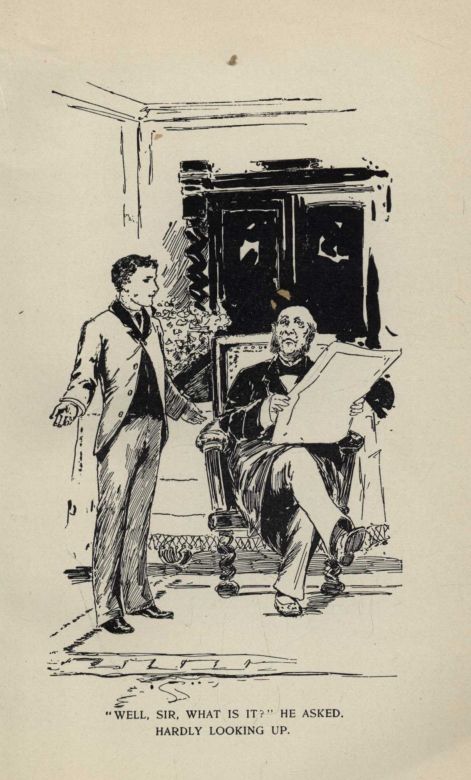
"WELL, SIR, WHAT IS IT?" HE ASKED, HARDLY LOOKING UP.
In a brief but clear manner Jack stated his case. Mr. Gray hardly heard him out.
"Mr. Willington," he said sharply, "I never interfere with my agents' doings. They have entire charge. Besides, it would be folly for me to make your case an exception. If I did so, any other tenant might ask the same privilege."
"Yes, but if you would only give me an order for some of the money due me, or for my savings----" began the young machinist, growing desperate.
Mr. Gray drew himself up.
"You must get that in the regular way," he returned coolly. "I never make exceptions to my rules. Good morning."
And before he could realize it, Jack was out on the street again with bitter defeat written in every line of his handsome face.
CHAPTER III.
A RESULT OF A FIRE
At the corner Jack met Deb, whose anxiety had caused her to follow him close to the Gray mansion.
"My! how long you've been!" she exclaimed, and then with a keen glance into his face: "Did he---- Did he----"
"He said he couldn't do a thing, that it was all in the agent's hands," burst out Jack, "He is meaner than mean. He will let that man put us out even when he owes us more than the amount of the rent. Well, it may be law, but it isn't justice and he shall not do it!"
And the young machinist shut his teeth in grim determination.
"If you can't get the money from the bank, I suppose you can't go into business for yourself," said Deb, when they reached home.
"That's true enough. Before the shut-down I might have borrowed money, but now I guess all our friends need every cent they have."
"Can't we raise some?" Deb's eyes wandered around the apartment. Jack gave a dry little laugh.
"Not on this stuff," he replied. "But we're not reduced to that yet." He walked over to where the model he was working on stood. "Wish this was finished. I believe I can make a neat sum out of this invention."
"How long will it take to complete it?"
"Can't tell. It depends on one's ideas. But I'm going out."
"Where?"
"To look for work."
In a moment Jack had descended to the sidewalk. He found the streets swarming with people, and as he had before thought, with a thousand men idle, what chance was there of getting work? Finding that every place in Corney was full he determined to try Redrock, another manufacturing town, situated on the Camel Falls river, several miles below the present place. The road between the two places followed the river bank. As Jack trudged along close to the water, he heard a sudden cry for help.
Looking ahead he saw that one of the rear wheels of a wagon had come off, and the driver, horses and vehicle were all in danger of being dumped into the stream. It was but a moment's work for the young machinist to rush up, and by catching the horses' heads, to turn them in such a way that the turnout righted itself in the center of the road.
"Thank you, young man!" exclaimed the aged farmer, who was driving, as he sprang to the ground. "That was a narrow escape, and no mistake."
"Your wagon is pretty well damaged," observed Jack as he examined the shattered axle.
"Well, troubles never come singly." replied Farmer Farrell, for such was his name. "This morning something got into the patent rake so it wouldn't work; then the grindstone got cranky, and now this. But thanks to Providence, I'm safe. I reckon I'll have to go back for the other rig, though. Going my way?"
"Yes, sir. I'm bound for Redrock to look for work."
As the two walked along, Jack related what had happened in Corney.
"Well, I declare! I'm lucky any way," declared Farmer Farrell, "I got my money out of the bank a month ago. It's too bad, though, for you. What did you say you were?"
"I'm a machinist," replied Jack, and then suddenly: "Perhaps I can fix up your patent rake and your grindstone. I'll do a good job and won't overcharge you."
To this Farmer Farrell, who was taken by Jack's appearance, agreed, and a few minutes later led the way up a lane to a well-stocked farm.
Down in the barn the young machinist found the things that needed repairing. He looked everything over carefully.
"I'll bring my tools to-morrow and fix them up," he said. "If I get work in Redrock I'll do the work early in the morning or after I quit."
"And the cost?"
"About five or six dollars."
"Cheap enough. Go ahead."
"I will. I'll be on hand early in the morning and do a good job," replied Jack.
The young machinist met with no success at Redrock, and returned in an hour to Corney. Deb was pleased to hear that some work, at least, had been procured.
"It will pay the rent anyway," said Jack, "and that's something. Perhaps, too, it may get me some more jobs like it."
"That's so," replied Deb, her face brightening.
In the evening Jack worked on his model. But he went to bed at ten o'clock, so as to be up early the next morning.
"Jack! Jack! Wake up!"
It was Deb's voice from the next room that aroused him in the middle of the night.
"There is a big fire over on the hill," she continued, "just look out of the window."
But Jack was already up.
"You're right!" he replied. "It's a whopper, too!" he continued, as the flames shot skyward, making all as bright as day. "I'll have to go," he added.
"Must you?"
"Certainly, it's my duty to serve."
For Jack was a duly enlisted member of the Corney Volunteer Fire Department.
He hurried into his clothing as rapidly as possible, and jumped down the stairs three at a time.
"Don't get hurt!" called Deb after him.
The engine house was but a few blocks away. When Jack arrived there, he found that the machine had been dragged out into the street but no further.
"Why don't you catch hold?" he called to a crowd of men who stood on the sidewalk.
"It's old Gray's house!" exclaimed one man, "and it can burn to the ground for all I care."
"He don't help us; now let him help himself," put in another.
"Oh, pshaw! It won't do any good to act that way!" said Jack. "Come, catch hold like men."
Jack was naturally a leader, and when he grasped the rope three other young fellows followed, and in a moment the engine was on its way.
"It's too bad it's Mr. Gray's house," thought the machinist. "It will make him harder-hearted than ever."
He gave no thought as to how the conflagration had originated, and did his best to get the engine to the spot.
But, as has been stated, the place was up hill, and by the time they had made their way along the unpaved road, the fire had gained such headway that it was useless to pour water on the burning building, and all attention was directed to saving the adjoining property.
The heat was intense, and Jack, who was often at the nozzle of the hose, suffered greatly from this and the smoke.
In an hour the fire was declared under control, and a little later the order came to take up the hose and go home.
Jack worked with a will. He had done his duty, and now he was anxious to return, tell Deb all about it, and get to bed again.
While helping to wind the hose upon its carriage, he was suddenly approached by Mr. Gray, accompanied by a stranger.
"There he is!" were Mr. Gray's first words, addressed to the stranger.
The man laid his hand upon Jack's shoulder.
"I want you," he said, quietly.
"What for?" asked Jack.
"I arrest you for setting fire to Mr. Gray's house," was the startling reply.
"Arrest me!" exclaimed the young machinist. "What do you mean? I never set fire to any one's house."
"Oh, yes, you did," put in the manufacturer. "Only you didn't expect to be caught."
"It's false, I----"
"It's true. You shall suffer heavily for this night's work," went on Mr. Gray, bitterly. "We'll see if the law allows tenants who won't pay their rents to set their landlords' houses on fire! Watch him Parker, don't let him escape you!"
"Mr. Gray, I never----" began Jack.
"Come along," broke in the officer, roughly. "You can do your talking in the morning."
And without further words Jack was marched off to the Corney jail.
CHAPTER IV.
BAD NEWS FOR DEB
After her brother Jack had gone, Deb stood by the window a long time, watching the progress of the fire. She beheld the flames shoot up, heard the shrill whistle of the engines, and the shouts of the firemen, and finally saw the light subside.
She opened the window, and from the conversation of the passers-by she learned that it was Mr. Felix Gray's mansion that had been burned.
The little bronze clock upon the kitchen shelf struck four.
"Jack will be returning soon," she thought, "and he'll be awfully tired, too."
An hour passed. She had put on a loose wrapper and sat in the rocker, moving gently forward and backward. Presently the curly head began to nod, and after one or two feeble attempts to rouse up, Deb sank calmly into the land of dreams.
When she awoke, she found it was broad daylight, and the tread of many feet upon the pavement outside told that work had already begun.
"Eight o'clock!" exclaimed the girl. "What can keep Jack so long?"
Then the thought struck her that her brother had returned and retired without waking her, but a glance revealed the empty bed.
Deb's face blanched a trifle as the idea crossed her mind that maybe something had happened, after all. Fires were such dreadful things, with falling chimneys and half-burned staircases, and Jack was so daring, and so ready to risk his life for the benefit of others.
"I'll go down to Mrs. Snitzer's and find out about it," was her conclusion, and locking the door she descended the stairs.
Mrs. Snitzer was a German woman, who, with her husband and three stalwart sons, occupied the floor below. She was a stout, kindly-faced woman of about fifty, had been Deb's neighbor for a year, and took a genuine interest in the girl and her brother.
"Your brudder no got home yet from der fire?" she said, after Deb had stated the object of her morning call; "I thought der fire vas out long ago. Mine boys come home, and vent to ped again, aput five o'clock. Da don't work now, so da say: 'Mudder, ve take a goot sleep for vonce in our lifes;'" she added, with a broad smile.
"Jack's out of work, too," said Deb, soberly.
"Yah? Vat a shame! Nefer mind, it don't last forefer. Come, have some coffee mit me. My man ist gone out for the baber. He come back soon."
The good woman set out one of her low chairs, and knowing that Mrs. Snitzer's invitations were genuine, the girl sat down, and allowed herself to be helped to a bowl of the steaming beverage, accompanied by several slices of sugared zweibach.
Just as the two were finishing Mr. Snitzer came in, paper in hand.
His face grew troubled upon seeing Deb.
"I vas sorry for you," he said, approaching her.
"Sorry for me?" repeated the girl, with a puzzled look. "Why, Mr. Snitzer?"
"Gracious! Didn't you hear?" returned the man, dropping his paper in astonishment.
"Hear what?" faltered Deb.
Mr. Snitzer spoke in German to his wife, who jumped to her feet.
"Nein! nein!" exclaimed the woman, vehemently. "He nefer done dot--nefer in his whole life!"
And then as gently as possible Mrs. Snitzer related how Jack had been accused by Mr. Felix Gray of setting fire to the mansion, and was now languishing in the town jail.
Deb's outburst was dreadful to behold. She threw herself upon the old German woman's breast and sobbed as if her heart would break. Her Jack--her own dear brother, in prison! The only one she had in the wide world taken away from her, and sent to a criminal's cell! It was too horrible to realize.
"How cruel of them to do it!" she moaned. "And he is innocent, too. He was home when the fire broke out;" and she shook her head in despair.
"Of course he didn't do it," said Mr. Snitzer. "All der men say so. Jack vas as steady as anypody. I dink it vas some of der hot-headed men vas guilty."
"So don't cry, my dear girl," added Mrs. Snitzer, sympathetically. "It vill come out all right by der end;" and she took one corner of her clean gingham apron and wiped the tear-stained cheeks.
"Where is the--the jail?" asked Deb presently, in a low voice.
Mr. Snitzer described its location.
"You don't vas going there!" exclaimed the German woman.
"Yes, I am," declared the girl, resolutely, with a sudden, strong look in her beautiful eyes.
"But it vas a terrible bad blace," Mrs. Snitzer ventured to remark.
"I don't care," replied Deb. "I won't mind going where Jack is. I must see if I can't do something for him."
Deb ran up stairs. Her heart was full of fear, and beat wildly.
She exchanged her wrapper for a suitable dress, and arranged her hair. As she was adjusting her hat, there was a knock on the door, and thinking Mrs. Snitzer had come up, she bid the person enter.
"Ah, just in time, I see!" was the exclamation, made in Mr. Hammerby's voice.
Deb's face clouded even more than before.
"Oh, dear, you here?" she ejaculated in vexed tones.
"Yes; on hand, as I always am," replied the agent, removing his hat. "I suppose you are ready with the rent?"
"No, I haven't the money," replied Deb. Somehow it was all she could manage to say.
"Your brother was unable to raise the amount?"
"He hasn't had time to try."
"I'm sorry, but as I said before 'business is business,' and I'll have to serve the notice," and drawing a paper from his pocket, Mr. Hammerby handed it over.
It was a regular notice drawn up in due form, demanding that in three days they quit the place.
Deb read it, but in her excitement did not notice that the avaricious agent had dated it one day back.
"And must we leave in three days?" she faltered.
"Most assuredly--unless you raise the cash."
"But where will we go?" continued the girl hopelessly.
"That's for you to decide," was the answer. Mr. Hammerby had gone through so many "scenes," as he termed them, that the evident suffering of the person he addressed did not affect him.
"But we haven't got anywhere to go," burst out Deb.
"Well, that's not my fault, is it?"
"No, but----"
"Then it's pay or leave," was the cold reply.
"What's up now, Mr. Hammerby?" asked a quiet voice from the hallway.
It was the nephew of the tool manufacturer who had come. His name was Monteray Gray--the Monteray being generally shortened to Mont. He was a young man of twenty, and kept the books for the shipping department of the tool works.
"What, Mr. Gray, is that you?" exclaimed the agent, taken back at the sudden interruption. "Oh, it's only the same old story of no money for the landlord," he added.
Mont looked at Deb. He knew both her and Jack very well.
"I am sorry to hear it," he said, with a pained face.
"It's all because of the shut-down at the factory," explained Deb, who, for a purely womanly reason wanted to set herself right with the young man.
In a few short words she made him acquainted with the situation. Involuntarily Mont's hand went down in his pocket, and then he suddenly remembered that he had no money with him.
"See here, Mr. Hammerby," he said, "you had better take this notice back. There is no doubt that you will get your money."
"Can't do it," replied the agent, with a decided shake of the head.
"But my uncle would never consent to having them put out," persisted the young man.
"Mr. Gray's orders are to give notice to any one who doesn't pay," returned Mr. Hammerby, grimly; "I'm only doing as directed."
"But this is an outrage!" exclaimed Mont. "My uncle virtually owes Mr. Willington twenty odd dollars, and here you intend to put him out for a few dollars rent."
"You can see your uncle about it, if you wish. I shall stick to my orders."
"Then you won't stop this notice?"
"No."
"Very well," replied Mont, quietly.
"I'm hired to do certain things, and I'm going to do them," continued the agent. "Besides, I just heard this morning that this fellow is locked up for setting fire to your uncle's house. I should not think that you would care to stick up for him," he went on.
"But I do care," returned the young man, with a sudden show of spirit. "He is a friend of mine, and I don't believe him guilty."
"Humph! Well, maybe. It's none of my business; all I want is the rent, and if they can't pay they must leave," said Mr. Hammerby, bluntly. "Good morning," he continued to Deb, and without waiting for more words, turned and left the apartment.
"I am sorry that my uncle has such a hard-hearted man for his agent," observed Mont to Deb with a look of chagrin on his face.
"So am I," she replied, and then suddenly; "Oh, Mont, Jack is----"
"I know all about it," he interrupted. "I've just been down to see him. He gave me this note for you," and Mont handed the note to Deb.
CHAPTER V.
FINDING BAIL
Jack hardly realized what arrest meant until he heard the iron door clang shut, and found himself in a stone cell, scarcely six feet square, with nothing but a rough board upon which to rest.
He sat down with a heart that was heavier than ever before. The various misfortunes of the day had piled themselves up until he thought they had surely reached the end, and now, as if to cap the climax, here he was arrested for the burning of a place that he had worked like a beaver for two hours to save.
He wondered how Mr. Felix Gray had come to make the charge against him. He could think of no reason that could excite suspicion, saving, perhaps, his rather hasty words in the tool manufacturer's library the afternoon previous.
"I suppose he thinks I did it out of revenge," thought the young machinist; "but then there are men--like Andy Mosey, for instance--who have threatened far more than I. Guess I can clear myself--by an alibi, or some such evidence."
Nevertheless, he chafed under the thought of being a prisoner, and felt decidedly blue when Deb entered his mind. What would his sister think of his absence, and what would she say when told what had happened?
"Maybe I can send her word," he said to himself, and knocked loudly upon the door.
The watchman was just asleep on a sofa in an adjoining room and did not hear him.
Failing to attract attention in this way, Jack began to kick, and so vigorously did he apply his heels that he awoke the sleeper with such a start that he came running to the spot instantly.
"Can I send a message home?" asked the young machinist.
"Not till morning," was the surly reply; "is that all you want?"
"Yes. Isn't there any way at all?" persisted Jack. "I have a sister who will worry over my absence."
The man gaped and opened his eyes meditatively.
"You might if you was willing to pay for it," he replied, slowly.
"I have no money with me," replied Jack, feeling in his pockets to make sure.
"Have to wait till morning then," was the short reply, and the young machinist was once more left alone.
He was utterly tired out, and in the course of half an hour fell into a troubled slumber, from which he did not awaken until called.
"Some one to see you," were the watchman's words, and the door opened to admit Mont Gray.
Mont was a tall, thin young man. He had a large brow, deep, dark eyes, and a strangely earnest face. He was quiet in his way, attended punctually to his office duties, and was on much better terms with the hands at the tool works than his uncle had ever been. He was the only son of Mr. Felix Gray's youngest brother, who had died a widower some twelve years before--died, some said, and put out of the way, others whispered. That there was some mystery connected with those times was certain. Rumor had it that Felix Gray had crowded his brother out of the business in which he originally owned a half share. This transaction was followed by Monterey Gray's sudden disappearance. Felix Gray gave it as his opinion that his brother had departed for Australia, a place of which he had often spoken.
Young Mont--he was named after his father--had been taken to live with his uncle, who kept bachelor's hall in fine style.
The boy got along as best he could under the sharp guardianship of Mr. Felix Gray, who, as soon as he could, placed Mont at one of the desks, where he was now allowed to earn his board and four dollars a week.
His position at the tool works brought him into daily contact with Jack; and, during the past two years, a warm friendship had sprung up between them. He knew all about the young machinist's ambition, and had spent many an evening at the Willingtons' apartments watching Jack work, and chatting to Deb, with whom, as is known, he was on good terms.
"Hello, Mont!" exclaimed Jack, "what brings you here? Did your uncle send you?"
"Send me!" said the young man. "No, indeed! he doesn't even suspect I'm here; if he did he would raise a row, sure."
"Then you don't believe I'm guilty?" began Jack, somewhat relieved.
"Humph! Nonsense! I only wonder uncle Felix thinks so," returned Mont. "It seems to me that the evidence of a match safe is a mighty slim one."
This was news to the young machinist.
"Why, what about a match safe?" he asked.
"Didn't you hear?" was Mont's question, in surprise. "They found a match safe with your last name on it, in the basement."
Jack sprang up in astonishment.
"Was it a small silver safe, with a bear's head on one side, and a lion's on the other?" he asked.
"Yes; then it is yours?"
"Yes, it's mine. But I haven't seen it for nearly a month," burst out the young machinist. "I missed it out of my pocket, and suspected Andy Mosey of having taken it, though I could not prove it. But I see it all now. Mosey was speaking of revenge up at the bank yesterday morning, and he has done the deed, and used my property to throw suspicion on me."
"But he wouldn't do such a mean thing unless he had a grudge against you," remarked Mont.
"He has several of them. More than once, when he was drunk, and came interfering around my work, I threatened to report him. Besides, I have the job he always thought his son Mike should have."
"I see. But can you prove that he had the safe?"
"I don't think I can. But I believe I can prove that I lost it, and was home when the fire started?"
"Does Deb know you are here?" asked Mont, suddenly.
"Not unless some one else has let her know. Will you take her a note?"
"Certainly; I was going to suggest that very thing. I intended to call on her."
Jack took the sheet of paper that Mont supplied and wrote a few words of cheer to his sister.
"I'll tell her the particulars," said the young man, as he pocketed the letter. "Is there anything else you want done?"
"Nothing now. Maybe there will be later on."
"I'll do what I can for you," continued Mont, "even if my uncle doesn't like it;" and he stepped out of the cell.
Half an hour later Jack was brought out for examination. The court room was crowded with the now idle men, and many were the expressions of sympathy for the young machinist, and denunciation for Mr. Felix Gray's hasty action.
The tool manufacturer himself did not appear. The officer who made the arrest said that the excitement of the past two days had made the plaintiff quite ill.
The hearing was a brief one. The match safe was the only evidence produced against Jack, and as he had no means of proving his innocence then and there, it was decided to hold him to wait the action of the grand jury, three weeks later. Bail was fixed at one thousand dollars--a sum that was thought amply sufficient to keep any one from becoming his bondsman.
Meanwhile, Mont had delivered the note, as already recorded, and while being led out of the court room, Jack recognized the young man in the crowd, and an instant later found Deb at his side.
"Oh, Jack!" was all the poor girl could say, and clinging to his arms, she began to sob outright.
To see Deb cry made the young machinist feel worse than did his incarceration. He drew his sister to one side--away from the public gaze, and comforted her the best he could.
But the thought of going to prison was too terrifying to be subdued.
"Three weeks before they will hear what you have to say!" she exclaimed. "If you could only find that Mosey!"
"But he has left," put in Mont; "I tried everywhere to find him. Maybe you can get bail."
"I can't get it while I'm in prison," returned Jack, gloomily.
"I'll take you anywhere you wish to go," said the under-sheriff, who had him in charge. He was a married man, had daughters of his own, and Deb's anguish went straight to his heart.
Jack thought a moment. "Perhaps I might get Mr. Benton to go on my bond," he said.
The man he referred to was the wealthy speculator who had examined the model and praised the invention.
"But he would want security. Perhaps I'd have to sign over my rights to him," he continued with a sigh.
"It would be a shame to do that," said Mont. "You expect so much from the patent."
"But you wouldn't lose it unless you ran away," put in Deb; "and of course you're not going to do that."
Jack gave another sigh.
"I'll go and see him anyway," he said.
CHAPTER VI.
HOME ONCE MORE
A little later Jack and Mont separated, and in company with the constable, the young machinist called on Mr. Benton at the Coney House.
The speculator listened attentively to Jack's story. He was shrewd, a close reader of human nature, and thought he saw a chance of securing a bargain or of placing the embryo inventor under obligation to him.
"Tell you what I'll do," he said. "Give me a paper securing to me your invention if you don't turn up at the proper time, and I'll go your bond, providing----" and here Mr. Benton paused.
"What?" asked Jack eagerly.
"Providing you give me a half interest in it now."
Jack staggered back.
"A half interest?"
"That's what I said."
"But, sir----"
"You haven't got to accept my offer if you don't wish to," was the apparent indifferent reply.
Had he thought only of himself Jack would have refused. To give up that for which he had worked for years was terribly hard.
But Deb, dear Deb, what would become of her if he did not accept?
"I'll do it," he said, shortly. And then, with a sudden thought: "But you must give me a money consideration."
"How much?" asked the man of means.
"One hundred dollars." Jack knew Mr. Benton would offer less.
"Too much! I'll give you twenty-five."
"No; a hundred."
"Make it fifty. I can't spare a cent more. Besides, the thing may not be worth a dollar."
"Or several thousand," put in Jack. "But I accept the offer."
"Very well. I'll pay you the money to-morrow. I'm short to-day."
Knowing that with all his sharp business practice Mr. Benton was a man of his word, the young machinist did not object to waiting for his cash.
In his excitement he forgot all about Mr. Hammerby and the rent that must be paid.
It was fully an hour before the necessary papers were drawn up and signed, and then with hasty steps Jack made his way home.
Deb met him at the door, and at once he had to give her the particulars of what had been done.
"Never mind, anything is better than having you in prison," she said when he had finished. "And it may be just as well to have Mr. Benton for a partner now as to give him the chance of getting the whole thing later on."
Deb was delighted to learn that they were to receive fifty dollars in cash the next day.
"I'll be so glad to get rid of that horrid agent," she declared, and showed Jack the notice to quit.
In looking it over he discovered that it had been dated the day before.
"The mean fellow!" he exclaimed. "He thinks to get us out one day sooner than the law allows. Won't he be astonished when I pull out the roll of bills and pay him?"
In anticipation of the money soon to be received, and in honor of Jack's release, Deb prepared quite an elaborate dinner.
It nearly took her breath away when she discovered that the outlay footed up to nearly a dollar--a large sum for them. But then her brother did delight in cutlets, with potatoes and green corn, and somehow the table wouldn't have looked complete without some stewed prunes and a pudding-dessert--the latter just fixed to tickle Jack's palate.
During the meal Mont slipped in, and was compelled to sit down with them. He was delighted to see the young machinist free, but shook his head over the price that had been paid for liberty.
"What do you intend to do now?" he asked.
"Find Andy Mosey, if I can, and have him arrested," replied Jack. "It is the only way, I believe, that I can clear myself."
"It isn't likely you will find him," remarked the young man. "He will no doubt keep shady for a while."
"I shan't look for him to-day, excepting to strike a clue," was the young machinist's reply.
After the meal was finished, and Mont had gone, Jack announced his intention to do the repairs that he had promised Farmer Farrell.
"I might as well do them at once," he said to Deb, "it will be several dollars in pocket, and we need all the money we can get now. If this case goes to trial I'll have to hire a lawyer, and they charge heavily."
"So, I've heard," replied Deb, "but I wouldn't mind that if only you get free."
"I'll try my best," replied Jack taking up his kit of tools.
"When will you be back?" she asked as he started to go.
"I can't say. It depends on the job. Don't worry if it is late."
"All right; I'll keep the supper warm till you come."
So young, and yet a perfect housekeeper!
"She'll make some fellow a good wife one of these days," said Jack to himself as he strode along.
It was a fine day, and the walk by the river side was a delightful one, but the young machinist scarcely noticed the surroundings. His mind was busy with the numerous difficulties that had risen round him, and he endeavored to lay out a definite plan of action by which to extricate himself.
When he arrived at the farm, he found his acquaintance of the previous day hard at work on the patent rake, which he had taken almost entirely apart.
"Just in time, young man!" exclaimed farmer Farrell, wiping the perspiration from his brow; "I thought, seeing as how you didn't come this morning, I'd see what I could do myself. But the job's a leetle too much for me. I've got the pesky thing apart and can't put two pieces together again."
"That's because you don't understand machinery and haven't the tools," replied the young machinist, and taking off his coat, he set to work at once.
He picked out the worn screws and bolts and substituted the new ones which he had brought. Then he sorted out the various parts in their proper order, and examined each critically.
"This bit of iron that guides the pressure spring is warped," he remarked. "Did the rake pull hard when the left side was lower than the right?"
"Yes, and squeaked, too."
"Then, that's the cause of it, and all the oil in the world wouldn't help it."
"Can you fix it?" asked the farmer, anxiously.
"I can if I can get a hot fire," replied Jack.
"I'll start it up at once," returned farmer Farrell, and he disappeared into the house.
When he had the fire well under way, Jack heated the part, and gave it the proper shape. Then he put the machine together, adjusted it carefully, and oiled the parts.
"Guess it's all right now," he said, lifting it over.
"We'll soon see," returned the farmer. Going to the barn he brought out one of the horses and hitched him to the machine. Then he mounted the seat and drove up and down the field several times.
"Works like a charm!" he declared. "You understand your trade and no mistake. How much for the job?"
This question was a stickler to Jack. He did not wish to ask too much, and he could not afford to ask too little.
"They would charge you three dollars at the machine shops," he said.
"Then I suppose that's what it's worth," continued the farmer. He was a whole-souled man, and was taken by Jack's outspoken manner. "But there's the other things to do yet," he continued.
"I know it; so we'll put this job at two dollars," said the young machinist.
"Never mind, I'm satisfied to pay three," laughed farmer Farrell. "Come into the barn; I've found quite a lot of stuff that needs doctoring, and I want you to put everything in first-class shape."
"I'll do my best."
Farmer Farrell led the way, and Jack was soon as busy as a bee, putting the machines in running order and overhauling other farming implements.
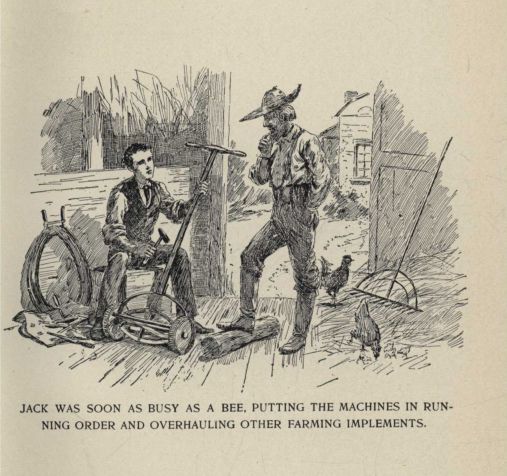
JACK WAS SOON AS BUSY AS A BEE, PUTTING THE MACHINES IN RUNNING ORDER AND OVERHAULING OTHER FARMING IMPLEMENTS.
"Why didn't you stop this morning?" asked the farmer, presently. He had intended going reaping, but Jack's handy use of tools interested him and made him linger.
In an easy manner that did not interfere with his work, the young machinist narrated the particulars of what had occurred to detain him.
"Well, now, that beats all! Trouble piling right up on top of ye! Wonder if I don't know this Mosey," continued the farmer, reflectively. "Is he a short man with a red beard?"
"Yes."
"Didn't he use to work over to Redrock?"
"I believe he did."
"Then I reckon I do. He's a bad egg. I used to sell the company he worked for hay for packing, and Mosey used to weigh it. Several times, when I was sure it was correct, he reported short, and when I spoke to him about it, he said it would never be right until I made it right with him, or, in other words, paid him for his good will."
"How did it turn out?" asked Jack, interested in the story.
"Oh, I spoke of it to the owners, but they believed his side of the story, and I lost their trade. But, all the same, he was discharged a month later for being drunk. If I ain't mistaken, I saw him pass early yesterday morning."
"I just wish I could lay hands on him," returned the young machinist; "I don't believe he would keep out of the way if he wasn't guilty."
"Maybe I'll see him," said the farmer. "If I do I'll watch him, and let you know."
It was close on to six o'clock when Jack finished the work. During the afternoon he had done jobs for which he asked five dollars, and farmer Farrell, who knew that he would have been charged twice as much in the town, paid the bill without a murmur.
Ten minutes later, with his kit under his arm, and the new five-dollar bill tucked safely in his vest pocket, the young machinist started for home.
The sun was setting, and the road, shaded for its greater part by large trees, was growing dark rapidly.
About midway of the distance to Corney stood an old mill, abandoned several years before, whose disused water-wheel still hung idly over the swiftly flowing river beneath.
It was a ghostly looking structure, and having the reputation of being haunted, was seldom visited, except by adventurous tourists and by amateur photographers, who remained at a safe distance to take views of the really picturesque locality.
As Jack passed the mill, he saw a man approach from the opposite direction. Judge of his astonishment when he recognized the individual as Andy Mosey!
He had seen the young machinist at the same instant, and turning rapidly from the road, he darted to one side of the mill.
For a second Jack stood still, hardly able to move. But he quickly recovered, and dropping his kit, which was heavy, he started in pursuit.
"He shall not escape me," he resolved. "He is larger than I, but I am not afraid to meet him face to face."
There was a large shed attached to the mill, and entering this, the young machinist looked carefully around to see if he could find any trace of the man. But a brief search assured him that the place had not been disturbed for months.
Passing through the partly open door, he entered the lower floor of the mill, and found himself in the presence of Dennis Corrigan, Mosey's brother-in-law.
"What do you want here?" demanded Corrigan, springing up from the bench upon which he had been seated.
Jack could hardly form a proper reply. With two men against him, he realized that he was in a bad fix.
"Why, I didn't know that you were here, Corrigan," he began. "I thought----"
Jack never finished the sentence. He heard a noise behind him, but before he could turn to see what it was, he received a cruel blow on the head, and then all became a dark, terrible blank.
CHAPTER VII.
INTO THE RIVER
Slowly and painfully, with a dull ache in his head, and an uncertain look in his eyes, Jack returned to his senses. A thin stream of blood trickled down his neck, and putting up his hand he felt a large lump under the hair.
"It must have been Mosey who struck me," was his first thought as he gathered his scattered faculties together. "Well, thank God, he didn't kill me."
It was some time before he felt any desire to rise, and when he finally did so, he found himself weaker than he had anticipated.
"The coward!" was the young machinist's comment. "To strike me unawares. I knew he disliked me, but hasn't he wronged me enough already?"
Jack did not know--nor, indeed, could he have understood--the bitter hatred the Irishman bore him.
The only pride of Andy Mosey's life was his bull pup and his son Mike, and to have the young machinist occupying a position he thought his son should have, had always been more than this hot-tempered fellow was inclined to bear.
The place in which Jack found himself was totally dark, whether because it had no windows, or because it was night, he could not tell.
He groped around, and seeing a ray of light coming up from beneath, applied his eye to what proved to be a knot-hole in the floor.
He was surprised to find the river flowing directly below, and knew at once that he was in the lowest part of the old mill, opposite the ancient wheel.
"They must have carried me here," he said to himself. "I wonder how long ago?"
He felt his way along the walls, and at last reached the door. He was on the point of lifting the latch, when it was thrown open, and by the the rays of a lantern that at first dazzled him, he saw himself confronted by Dennis Corrigan and Andy Mosey.
"So ye'v cum to yer sinses at last, have ye?" was Mosey's greeting, as he set down the lantern. "Ye wint down moighty easy, so ye did."
"I'd like to know what right you have to treat me in this shameful manner," demanded Jack, indignantly.
"Never moind," returned the Irishman; "it will teach ye a lesson not to tell lying stories about me."
"I haven't said anything but what I believe to be true," replied Jack, pointedly.
"Sure, now, is that raly so? Well, ye can suffer for thinking wrong," continued Mosey. "Oi niver----"
"Oh, stop your everlasting jaw!" broke in Corrigan, who was more practical in his way than his brother-in-law. "Never mind what you've done, and what you haven't done. The question is, what are we to do with the boy, now he's here?"
The Irishman scratched his head.
"It won't do to let him go," he said.
"Suppose we search his pockets," suggested Corrigan.
Jack uttered an exclamation.
"What do you mean?" he demanded; "you wouldn't dare?"
Corrigan laughed. The young machinist did not yet know that this man was at heart a thorough villain.
"Wait and see," he remarked, coolly. "Put your back to the door, Andy, and don't let him escape."
Corrigan was a heavily built and powerful man, and in his present condition Jack knew that he was no match for such an opponent.
"What do you want?" asked the young machinist.
"Want to see what you have with you. Come, show up."
Jack's head still ached from the rough treatment it had received. He did not wish to court another such blow, and so did as demanded.
A knife, ten cents, the five-dollar bill farmer Farrell had given him, and a copy of his agreement with Mr. Benton were all the articles of value that he carried.
"Here's something for you, Andy," observed Corrigan, tossing over the ten-cent piece. "The price of a drink."
Corrigan quietly slipped the five-dollar bill into his own clothes. Then opening the agreement, he held it near the lantern and read it carefully. It seemed to interest him greatly, and muttering something to himself, he shoved it into the inside pocket of his coat.
"Do you intend to rob me outright?" exclaimed Jack, whose blood boiled at such treatment.
"If that's what you call it, I suppose we do," was Corrigan's reply.
The young machinist was now becoming more used to the situation, and he determined to submit no longer. He noticed that Mosey had unconsciously moved to one side, and watching his chance, he sprang for the door.
But Corrigan was too quick for him, and with a reach of his long arm he caught the young machinist by the collar, and held him until Mosey had again reached the door.
Jack's grit was up and he wrestled with all his strength. He caught his antagonist by the waist, and literally threw him to the floor.
"Hit him. Andy, hit him!" screamed Corrigan, trying to regain his feet.
Mosey approached Jack with the same stick he had used in the first encounter. The young machinist caught the blow upon the left arm, and retaliated by landing one square from the shoulder on the Irishman's nasal organ. He did not believe in pugilism, but knew something of the art of self-defense; and used his knowledge to good advantage.
He followed up the first blow by another, and had just gained the door for the second time, when Corrigan, with a vile exclamation, seized the heavy brass lantern, and swinging it over his head, brought it down with all force upon Jack's neck.
The blow half stunned the young machinist, and before he could recover he was on his back, with Corrigan on top of him.
"Phat shall we do?" asked Mosey in bewilderment. Jack's unexpected attack had surprised and dismayed him.
"Get that rope upstairs," gasped Corrigan, who was well-nigh winded; "we'll bind him so tight that he won't give us any more trouble."
The Irishman disappeared for a few moments.
When he returned he held a stout cord in his hand, with which the two bound the young machinist securely, hands and feet.
"We'll leave him here for the present," said Corrigan, when they had finished their work. "Come on," and taking up the lantern, which in spite of its rough usage still remained lit, he led the way up stairs followed by Mosey.
"Well, I'm in a pretty fix, and no mistake," was Jack's mental decision when alone. "So far, my exertions to gain freedom haven't amounted to anything. But if they think that I'm going to give up already, they are mistaken."
He tugged at the cords, and by a strong effort managed, though not without painful squeezing, to pull his feet free.
His hands, however, were placed altogether too closely to allow of a similar proceeding, and he endeavored to find some means of cutting the fastening.
He remembered that the latch of the door was a rusty one, and rough on its lower side. Walking over to this, he began to rub the cord along the edge in the hope of severing it, but the improvised saw--if it might be called such--was not a handy tool, and half an hour passed before he made any material progress.
"It's mighty slow work," he said to himself: "but it's bound to wear away sooner or later."
Presently a heavy step sounded outside on the stairs, and a moment later Andy Mosey pitched into the room.
He was in a sad state of intoxication, and his face was red with anger.
"Been tellin' foine sthories about me!" he exclaimed. "Saying I sthole yer match-box an' set foire to old Gray's house! Oi'll fix ye!"
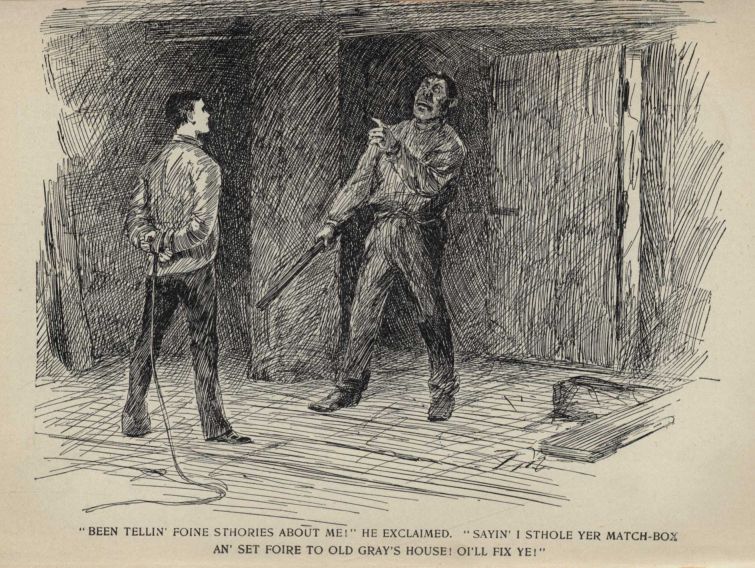
"BEEN TELLIN' FOINE STHORIES ABOUT ME!" HE EXCLAIMED. "SAYIN' I STHOLE YER MATCH-BOX AN' SET FOIRE TO OLD GRAY'S HOUSE! OI'LL FIX YE!"
He held a heavy stick in his hand, and as he spoke he brought it down with full force on Jack's head. The young machinist went down like a shot.
"Tellin' loies about me!" continued Mosey, as he dragged the half senseless body to the water's edge.
"Help! Help!" cried Jack, in a feeble voice.
But his cries were of no avail, and the next instant the young machinist was being swept by the rushing tide down the stream, to the roaring falls below.
CHAPTER VIII.
SOMETHING ABOUT THE MODEL
Deb grew anxious when seven o'clock came and Jack did not put in an appearance. Under ordinary circumstances, she would not have minded it, but the events of the past two days combined to make her worry more than usual. She sat by the window, watching the stream of people returning from work, and then, when it was half after the hour, put on her hat and descended to the street below.
She walked slowly in the direction of the Redrock road, in hope of meeting her brother. At the end of three blocks, she came face to face with Mont Gray, who had just been finishing up some accounts at the tool works.
"Where are you going, may I ask?" he said, with a smile.
"To meet Jack," replied Deb. "He ought to be home by this time."
"Perhaps the work took longer than he expected," observed the young man. "You know he hates to leave a job until it's done."
"Oh, I know that. But I wish he would come, anyway; I can't bear to have him away now."
"Depend upon it, he can take good care of himself," added Mont. "Come, shall I walk home with you?"
"I suppose I might as well go," returned the girl, slowly, and turned back. "Oh, I'm so awfully nervous," she added.
"Your troubles have been too much for you," he answered, kindly. "They would have been for almost any one."
Though Mont's capital was, as we know, rather limited, he was anxious to help Deb and Jack all he could. Yet he hardly knew how to broach the subject.
"Did you--did Mr. Hammerby call again?" he asked, hesitatingly.
"Yes, and gave us a three days' notice to quit," replied the girl. "He----"
"He shall not put you out!" exclaimed the young man, vehemently. "It's an outrage! It's bad enough for my uncle to believe your brother guilty, but to put you out----"
"But we are not going," continued Deb.
"I don't blame you. If I can help you----?" he began.
"No, you don't understand," returned Deb, quickly. "It's real good of you to offer help, but we don't need it," and she told him of the money Mr. Benton was to pay over on the following morning.
"I'm glad to hear you're going to get some cash out of that man," remarked Mont. "Although even so, he made a sharp bargain with Jack."
A few minutes later they reached the house.
"Will you come up?" asked Deb.
"I haven't time," he replied. "I've got to do an errand for my uncle. Maybe afterward, if I have a chance I'll take a look for Jack, and come up with him."
"Oh, I wish you would," she returned, "I know it's dreadfully silly for me to be so easily worried, but I can't help it."
"Oh, it's all right, I suppose. If I was in his place maybe I'd like to be worried about, too," and away went Mont, whistling quite a merry air.
The young girl entered the kitchen and lit the lamp. It was now half-past eight, and as the people of the neighborhood were hard workers. who retired early, the streets were comparatively quiet.
She left the supper dishes upon the table, and putting some extra coal into the stove, set the tea and other things so that they might keep warm.
It was a dreary evening for her. She did not care much to read--actual life interested her far more than books--and now all her thoughts were centered on Jack.
"It's a pretty long walk from that farmer's place," she kept saying to herself. "But he will come soon, oh, he must come soon."
Her reflections were broken by hearing an unknown step upon the stairs, followed by a sharp rap at the door.
Hardly knowing whom to expect at this hour of the night, she bade the person enter.
The newcomer was Dennis Corrigan!
Deb did not know the man. She had seen him on the streets, but though he was fairly well dressed, she was not taken by his general appearance.
"Does Jack Willington live here?" asked Corrigan, with a hasty glance around the kitchen, to see who might be present.
"Yes, sir," replied Deb, and then realizing that the man might have news for her, she continued quickly: "Did he send you?"
"Yes, Miss. He said I was to get a model that he had here."
This assertion surprised the girl. What in the world could Jack want with his model this time of night?
"Where is my brother?" she asked.
Corrigan was not prepared to answer this question.
"He is--down the street," he stammered.
"Where?"
"Why--down in McGlory's saloon."
This reply was a fatal blunder for Corrigan, who by a little scheme of his own, had proposed to get the model into his possession without any difficulty.
"In McGlory's saloon!" repeated Deb, in amazement. "Why, Jack doesn't drink."
"Oh, yes, he does--once in a while," replied Corrigan, glibly.
"You're mistaken!" returned Deb, sharply. "What does he want the model for?"
She was growing a trifle suspicious. The article in question was valuable, and just now doubly so.
"I don't know what he's going to do with it. Got it handy?"
Involuntarily Deb glanced over to where the model stood covered with a cloth. She regretted the action an instant after, for Corrigan's eyes watched her closely.
"How far is that saloon from here?" she asked.
"Only a few blocks."
"Queer he didn't come for it himself."
"He was too busy. He asked me to go for him, and sent this paper as an order. He said you'd know all about it," replied Corrigan, and he handed out the agreement he had stolen from Jack.
Deb recognized the paper at once. Jack must certainly have given it to the man, and yet, for a reason she could not explain, she felt that all was not right.
One thing she remembered; her brother had repeatedly cautioned her not to let outsiders examine the model under any plea. To place it, therefore, in a stranger's hands seemed a risk she did not care to assume.
"What's the matter?" asked Corrigan, as Deb still hesitated. "Ain't it all right?"
He was growing uneasy, fearful of being interrupted just at the moment when the prize was almost within his grasp.
"I would rather have my brother come for it himself," said the girl finally.
"He can't come; he's too busy," persisted the intruder.
"It wouldn't take long to get it if he is only a few blocks away."
"Yes, but he doesn't want to leave. He has a chance of selling it to a man for big money, and he's afraid the man may back out if he leaves him."
Deb was sorely perplexed. The man might be speaking the truth, in which case she did not for the world wish Jack to lose the chance of striking a bargain.
"So I'll take it right along at once," continued Corrigan, stepping over to where the model stood.
But, at this instant, a bright idea came into the girl's head. She knew that she could trust Mr. Snitzer, or one of his sons, and was sure that any one of them would do her a favor willingly.
"You need not take so much trouble," she exclaimed, stepping between the man and the model. "Just leave the address of the place, and I will send it up at once."
This was a staggerer for Corrigan, and he knew not how to answer.
"No, I'll take it myself," he replied, roughly.
His words sent a dreadful chill to Deb's heart. In an instant she realized the man's true object, and her own helpless condition.
"What do you mean?" she cried in terror.
"I mean that if you won't give me the model I'll take it."
The words had hardly been uttered before Deb gave a terrible scream.
"Stop your noise!" hissed Corrigan, jumping to her side, and clapping his hand over her mouth.
The girl struggled to escape, but she was as a feather in this powerful fellow's arms, and half fainting, she felt herself borne into the next room, and the door locked upon her.
Then she heard Corrigan pick up the model, and hurry down the stairs and out of the house.
CHAPTER IX.
MR. BENTON MAKES TROUBLE
"Help! Help!"
"Vas is dot?" exclaimed Mrs. Snitzer, who had been dozing in the rocking chair awaiting her son's return.
"Sounds like some von vas in troubles," replied her husband, from the sofa.
Both sprang to their feet and hurried to the door.
Mrs. Snitzer had scarcely opened it when a man rushed past her and out of the front hall-way.
"Help! Help!"
"It vas Deb, for sure!" cried the German woman, and she ascended the stairs as fast as her portly form would permit, closely followed by her husband.
It took but a moment to pass through the kitchen and unlock the door of the adjoining chamber. They found Deb half dead from fright, and vainly endeavoring to escape.
"Oh, Mrs. Snitzer, a man has just stolen Jack's model!" gasped the poor girl. "He ran down stairs."
"Ve saw him," put in Mr. Snitzer. "I go me after him," he continued, hurrying off as rapidly as his legs would move.
"Oh, what will Jack say when he hears that it's gone!" moaned Deb.
"Tell me apout it," said the kindly German woman.
She took the excited girl in her arms, and stroking the soft, curly hair, tried to calm Deb as best she could.
In a nervous voice the girl told her story. She was on the verge of hysterics, and it was only Mrs. Snitzer's quick sense of comprehension that enabled her fully to understand the situation.
In about ten minutes Mr. Snitzer returned. The look upon his face told plainly that he had failed in the pursuit.
"It vas no use," he said, "I couldn't see nodding of him;" and he dropped into a chair exhausted.
Deb's grief was hard to witness. It was bad enough to have Jack away, but to have some one steal his precious model, the idea of his life, was too dreadful to contemplate.
"I shall never get over it," she sobbed; "I ought to have been more careful!"
Mrs. Snitzer let her cry it out. Experience had taught her that it would do no good to check the flow of tears. She motioned her husband to leave, while she herself made preparations to stay all night.
As the hours wore on Deb for a while forgot the model in her anxiety concerning Jack's welfare. As long as she could remember, her brother had never remained away over night, and whether by premonition or otherwise, she was positive something dreadful had happened.
With the first break of day she was on the watch. She prepared no breakfast, nor did she touch that which the German woman generously offered.
Deb wandered up and down the street for two hours.
Still no Jack.
She visited the neighbors. Had this one seen him? No. Perhaps that one had? Not since yesterday morning.
Suddenly she grew very pale, and with faltering steps approached the jail.
The doorkeeper greeted her with evident surprise.
"What brings you here this morning?" he asked.
"My brother has been missing since last night," replied Deb, in a choking voice, "and I thought that perhaps you had--had locked him up again!"
"Why, no. Haven't seen him since he left," replied the man. "Missing, eh!" He gave a low whistle, "Hope he hasn't jumped his bail."
"What do you mean?"
"Run away to escape trial."
"Jack wouldn't do that."
"Can't tell. Fellows do unexpected things sometimes. So you don't know where he's gone?"
"No."
The doorkeeper reflected for a moment.
"Didn't he accuse somebody else of being the cause of the fire?" he asked.
"Yes, sir; he was almost certain it was done by a man named Mosey."
"And I believe this Mosey couldn't be found?"
"Yes, sir."
"Then maybe your brother has a clue, and is on the man's track."
This put the affair in a new light.
"Perhaps you are right," said Deb, slowly.
"Guess I am. Hope so, anyway."
"Thank you."
The girl breathed more freely when she got to the street. There was a good deal of consolation in what the doorkeeper had said.
She walked over toward the tool works, and saw Mont at one of the windows. A second later the young man came out with a packet of letters.
"I've just finished what remained of the work," he said. "Now I won't have hardly anything to do until we start up again."
He was surprised to learn that Jack had not yet put in his appearance.
"The doorkeeper must be right," he observed reflectively. "Who it was though, that stole the model, I can't imagine. Tell you what I'll do. I'll post these letters, and then walk out to that farmer's place and find out what I can."
When Deb returned home she found a man and a boy in the hall, waiting for her.
"Are you Miss Willington?" asked the man, politely.
"Yes, sir."
"Then I'm sorry, but unless you are able to pay the rent that is due, I have orders to put you out of the house."
Deb shrunk back in horror.
"Out of the house?" she repeated!
"Yes, ma'am, Mr. Hammerby served you with a three days' notice to quit, I believe?"
"He did--two days ago."
"Three days----"
"No, only two."
"Will you please let me see the paper?"
"He dated it a day back," explained Deb.
The man shrugged his shoulders.
"If he did, you should have complained of it at the time. I am a constable, and we people always go by the paper. I'm sorry to disturb you."
"Where will you--you put us?" faltered the girl, with a white face.
"Set your goods in the street," was the matter-of-fact reply. The constable was old in the service, and many cruel scenes had hardened his heart.
"Into the street!" wailed the poor girl.
"That's what I said, unless, of course, you can raise the eight dollars that's due."
"I haven't it now. But my brother expected to get fifty dollars from a man for an interest in an invention of his."
"When?"
"To-day. But my brother is away."
"Can't you get it?"
"Perhaps I can," replied Deb, hesitatingly. "I'll try, anyway. Will you wait till I come back?"
"Certainly," replied the constable, and he took a chair, and began to read the morning paper that he had brought with him.
While Deb was getting ready for her urgent errand, there was a noise outside, and Mr. Benton himself appeared.
"Where is your brother?" he demanded, without any preliminary salutation.
"I don't know, sir," replied the girl, her breath almost taken away by the suddenness of the question.
"They told me he was missing," continued the speculator. "I suppose that you have the model safe?"
"No, sir. It was stolen last evening."
Deb began to cry again. Mr. Benton caught her arm roughly.
"I don't believe a word you say!" he exclaimed, in harsh tones. "It's only a plot to do me out of my rights! But it won't work, understand that, it won't work. Either you must produce the model, or else I'll have you arrested for fraud!"
CHAPTER X.
DRIVEN FROM HOME
Deb looked at Mr. Benton in horror. It was only after several seconds that she fully realized the terrible accusation which he had brought against her.
"A plot!" she faltered. "What do you mean?"
"Only this," continued Mr. Benton, "your brother has run away to escape trial, and he has taken the model with him. You have helped him to do this. But it won't work. I pay my way, and a bargain's a bargain. If I have to pay the thousand dollars, I'll have the model or I'll know the reason why."
"But how do you know Jack has run away?"
"If he hasn't, where is he?"
"He went to a job in the country yesterday morning and hasn't returned yet."
"And you expect me to believe that story?" sneered the speculator.
"It's the truth," replied Deb, bursting into tears. "I'm sure Jack will come back. The model was stolen by a man who said my brother had sent him for it."
"And are you positive that your brother did not send him for it?"
"Almost, sir, because the man ran away with it when I promised to send it by some one else."
"Humph! Well, we'll see; I'll let the matter rest until to-morrow, and then we'll have a settlement."
With these words Mr. Benton pulled his hat more tightly than usual over his small, round head, and tripped down the stairs and out of the building.
Deb's heart sank like a clod. Her last hope was gone. She had counted on getting help from the speculator, and the result had been directly the opposite.
"Rec'on you won't get anything out of him," was the constable's grim comment. He had listened in silence to the brief interview, and now arose to continue his disagreeable but necessary duty.
"Isn't there any way at all of having this thing stopped?" asked the girl, bitterly.
"No; unless you get the money," was the man's reply, and pulling off his coat, he took up a couple of chairs, and marched down stairs.
Deb jumped up and followed him. Her heart beat wildly, and something in her throat nearly choked her. What could she do? Her thoughts ran to Mrs. Snitzer. She knew the kind German woman needed money as much as any of the tool works people did, but perhaps she could give some help, or offer some advice.
She flew to the door of her neighbor's apartments, and knocked eagerly. No answer came, and then she knocked more loudly than ever.
Suddenly she remembered that Mrs. Snitzer had signified her intention of taking her whole family to her brother's farm for a few days, and possibly until the end of the shut-down.
"It's no use, they're all gone!" she sighed. "There is no help to be had!"
Meanwhile the constable worked rapidly. In his time he had been in situations where the neighbors had interfered with him, and he wished to get away as soon as possible.
Soon there was quite a respectable stock of furniture and other household effects piled upon the sidewalk. Deb packed up the smaller stuff as fast as she could--the china and crockery in baskets, and the clothing and linen in the two old family trunks. Truth to admit, the constable did not hurry her a bit more than he could help.
Presently Deb went below to see that no one should walk away with some of their belongings. Her eyes were red and swollen, and a more wretched girl could not have been found in all Corney.
As she sat down on one of the upturned wash tubs she wondered what she was to do. She had no neighbors, and with the exception of the Snitzers they were all strangers to her--they on their part deeming her "stuck up," and perhaps rejoicing to see her placed in her present humiliating position.
The wild hope of Jack's return came constantly to her mind, and twice she ran down to the corner vainly straining her eyes to catch sight of his well-known form.
"If I had only accepted Mont's aid," she thought, "I wonder where I could find him?"
Presently the constable brought down the very last of the goods, and locking up the rooms, went away.
"Why, Deb, I declare, I didn't know you were going to move. You didn't say anything of it last Sunday. How lucky I came before you were gone! or, perhaps, how unlucky to come when you are all upside down. Never mind, go right ahead, and don't pay any attention to me. It's an awful job, isn't it? I haven't experienced moving in ten years, but I remember well that I didn't get straightened out for two months, and then it took twice that long to get accustomed to the new place. Where did you say you were moving to?"
And having thus delivered herself in one breath, the speaker, a middle-aged lady, who wore blue glasses, and was slightly deaf, took Deb's hand in a quick, nervous grasp, and peered into the care-worn face.
"Oh, Miss Parks, we are not moving at all!" cried out the girl, laying her head on her Sunday-school teacher's shoulder.
"Glad I called?" queried Miss Parks, misunderstanding her. "Well, now, seeing things as they are, I didn't expect it. But, maybe I can help you. I'm not overdressed, so just tell me what to do, and I'll go right to work. Hasn't the truck-man come yet?"
"We--are--not--moving," repeated Deb, putting her mouth close to Miss Parks's ear.
"No? Why--why--then something dreadful has happened, all your furniture out here on the sidewalk, with the dust a-blowing on 'em. What is it--fire? That's a dreadful thing. Even if things are not burned up, the smoke gets in 'em, and you can't get it out."
"It isn't fire," returned the unhappy girl, "it's because we can't pay the rent."
"Oh, dear!" Miss Parks was all sympathy at once. "I thought your brother was doing pretty well now," she added.
"So he was. But the tool works have shut down, and we can't get a cent from the bank."
The elderly maiden caught at the words.
"The bank! Isn't it awful. They wouldn't give me mine, yesterday, and I wanted it the worst way, too. But tell me about your trouble."
In a few words, spoken as plainly as possible, Deb poured her tale into the lady's ear.
"I heard about your brother being arrested for the fire," remarked Miss Parks. "But I didn't believe it. Mr. Long says Jack is such a good fellow, and such an excellent scholar."
"I'm glad you think so," burst out the girl. "Oh, Miss Parks, if people only knew Jack as well as I do, they wouldn't say such horrid things about him."
"Well, dear, we all have our trials, and must ask Him to help us bear them," replied the elderly maiden, with sincere piety. "But about the rent. How much is it?"
"Six dollars."
"Not much, truly. But it's more than I have, or I'd pay it in a minute. Have you any money at all?"
"Not over three dollars."
Miss Parks drew out her pocketbook, and examined the contents.
"Just a dollar," she exclaimed. "I declare we are both poor, with money in the bank, too." She paused a moment in deep thought. "I'll tell you what you might do."
"What?" asked Deb, eagerly.
"Move your things down to my house. I'll let you have the back bedroom and attic, and when you're settled we'll see what is to be done. Jack will be back before a great while, I'm certain."
Miss Parks was entirely alone in the world. The house that she occupied was her own, left her by an invalid uncle, whom she had nursed constantly during the last four years of his life. She was a dress-maker, and a lady's companion, and earned a fair living--a goodly portion of which found its way to charity and the church--for she was a devout Christian, and an earnest worker in the cause.
"Oh, thank you!" cried Deb, a heavy weight taken from her mind. "But won't it be inconvenient for you?"
"Not a bit. In fact I think I'll enjoy company."
"Then I'll accept your offer," continued the girl, "And I think it is real good of you to let me come."
Miss Parks bent down and kissed the tired cheeks.
"You're a good girl, Deb," she said. "You don't deserve such a trial as this."
A little later a truckman was engaged who speedily transferred the household goods to Deb's new home.
CHAPTER XI.
ON THE RIVER ROAD
Mont Gray hastened to the Corney postoffice with all possible speed. For his own sake, as well as for Deb's he wished to dispatch his business as quickly as possible, so as to devote the remainder of the day to hunting up Jack.
He was afraid that something out of the ordinary had befallen his friend. He had not wished to add to Deb's already deep anxiety, but he knew Jack too well to imagine that the young machinist would willfully keep his sister in ignorance of his whereabouts.