A YOUNG INVENTOR'S PLUCK (continued 2)
Reading edition
This feeling upon the young man's part might not have been so strong had all other surroundings been more tranquil. But since the shut-down at the tool works the air had been filled with murmurs of dissatisfaction--augmented largely by the suspension of the bank, and everywhere there prevailed a vague feeling that something was about to happen.
One thing was certain. Not a single one of his employes were satisfied with Mr. Felix Gray's management, and there were plenty of hot-headed men who wished him joy over his burnt mansion.
It did not take Mont long to post the letters, and then he struck out at once for the Farrell place.
It was a glorious morning, bright and clear, and when he reached the Redrock road he found the birds singing as merrily as could be.
In spite of the unpleasant things that had happened, Mont felt wonderfully light-hearted, the secret of which was that he was doing something for Deb--a service which he knew she would appreciate, and one which, therefore, he was more than willing to do.
As the young man walked along the river bank whistling cheerily to himself he espied a man coming toward him.
A moment later he recognized the individual as Andy Mosey.
"Wonder what he is doing out here," said Mont to himself. "Perhaps the prison keeper was right, and Jack is on his track--may be watching his chance to get evidence to convict him." When the discovery took place Mont was at a spot where the road ran close to the bank, and here he waited for the Irishman to come up.
As Mosey approached, it was easy to see that he had been drinking heavily. In truth it was but the continuance of his potations of the previous day.
"He had better take care, or he'll go over the bank, sure," was the young man's mental observation, as he watched the reeling form.
As Mosey drew nearer Mont noticed that his eyes were deeply sunken, and that despite the drink, his face looked pale and haggard.
"Possibly he is worried over his wrongdoings," thought Mont, hitting more truth than he imagined. "It's a pity such a strong fellow can't keep from liquor."
The Irishman shuffled directly toward Mont, without apparently noticing him.
"Hello," exclaimed the young man, sharply. "Where bound?"
The Irishman started up in surprise.
"Where you--hic--goin'?" he asked.
"I'm looking for Jack Willington. Have you seen him?"
Mosey gave a shudder. The remembrance of that awful scene in the old mill still hung in his mind.
"No--hic--no," he answered hastily. "Oi haven't see the b'y for two days," and he gave a lurch outward.
"Take care!" exclaimed Mont. "If you tumble over that bank you'll never get out again."
The Irishman drew as far away as possible from the water.
"You're roight, Mont, me b'y," he mumbled. "It's sure death, and no--hic--foolin'."
"So you're certain that you haven't seen Jack?" continued Mont. "He has been out here I know."
The effect of his last words was a truly astonishing one. With a cry of drunken rage, Mosey sprang toward him, his eyes blazing with fury.
"Ye can't come it over--hic--me!" he shouted. "Ye think ye're schmart, but yo're left this--hic--toime."
"What do you mean?" ejaculated Mont.
The extraordinary change in the Irishman's manner nearly dumbfounded him.
"Ye know well enough."
"Then you have seen him?" exclaimed the young man. "Oh, I see. He knows a thing or two about you, and----"
"He don't know--hic--nothin',--now," hiccoughed the Irishman. The liquor had muddled his brain.
"What!" gasped Mont, with a sudden sense of horror. "You--you----" he began.
He was standing with his heels against a small rock that overhung the bank.
"Ye can foind out fer--hic--yerself!" snarled Mosey, and with a quick spring he gave the young man a push that sent him spinning over backward. Mont tried to catch hold of the rock, but the smooth surface slipped from under his hands. He grasped the small bushes--they came out by the roots. He felt himself going down--down;--the glint of the sunshine upon the water sparkled in his face and then?
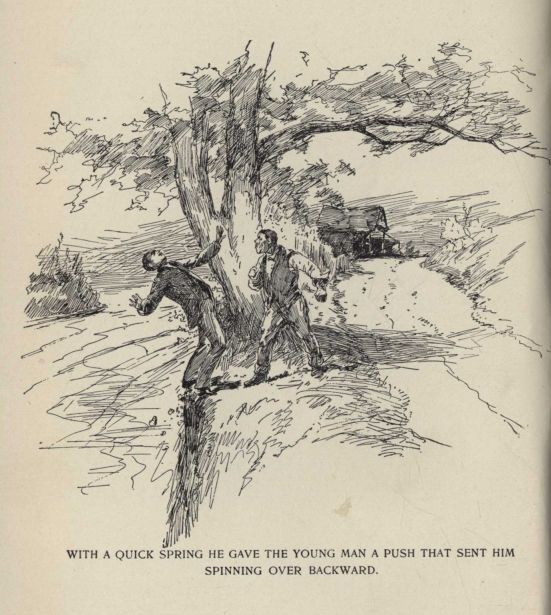
WITH A QUICK SPRING HE GAVE THE YOUNG MAN A PUSH THAT SENT HIM SPINNING OVER BACKWARD.
Mosey got down flat on the rocks and crawling to the edge, peered over the bank. He saw Mont's hat rise to the surface, and float swiftly along with the bounding stream.
"He's gone!" he muttered, hoarsely, after waiting for further signs of his victim. "Gone to the bottom!"
He crawled back to the middle of the road, and arose to his feet.
The awful occurrence had for the time sobered him, and he moved forward without a stagger.
"Bad worruk Oi'm doin'!" he muttered to himself. "Phat will Dennis say?"
The thought of his brother-in-law's possible condemnation of his actions made him shiver. He turned and slowly retraced his steps from whence he had come. He had not quite reached the spot when Corrigan's voice sounded in his ear.
"Where have you been?" he demanded.
"Oi thought Oi'd go to Corney, but Oi changed me moind," was Mosey's reply.
"Good thing you did. They want you up there."
"Phat for?"
Mosey had stopped at the door, and now looked at his brother-in-law sharply.
"Oh, for setting fire to Gray's house," said Corrigan, with a laugh.
"Oh, Oi thought----" the Irishman suddenly checked himself. "Say, Oi didn't see ye on the road," he continued.
"I came up by the back way," replied Corrigan.
"Phy?"
Corrigan made no reply. To tell the truth, he did not wish Mosey to know that he had stolen Jack's model, and that precious article was now safely hidden in the loft of the mill.
"Phy don't ye answer me question?" continued Andy Mosey.
"Oh, I thought I'd try the other way for a change," said Corrigan, as lightly as possible. "How is the young fellow?" he continued, changing the subject.
"He's--he's gone," faltered Mosey. "He--he had a mishap, and fell into the wather."
"Drowned?"
"Yes."
Corrigan gave a whistle of surprise. He was on the point of asking the particulars, but suddenly changed his mind.
"Well, I'm glad he's out of the way," he declared.
Mosey walked into the mill, and sat down on a bench, the picture of fear and misery. Corrigan did not pay any further attention to him, but went upstairs and examined the model he had stolen.
"It is a beautiful piece of work!" was his mental comment, "and if I only work it right I'll make a neat stake out of it!" he added as he hid it away again.
CHAPTER XII.
JACK'S DANGEROUS POSITION
Meanwhile how had Jack fared?
His last cry for help had been cut short by his plunge into the river. With his hands still bound tightly behind him, he felt himself sink many feet, and then a few seconds later he regained the surface, and shook the water from his face. He found that the swiftly flowing tide had carried him several rods from the old mill, and well out toward mid-stream.
"I'm surely lost!" he said to himself with a shudder. "The falls are not more than a quarter of a mile below, and when I reach there----"
A shiver finished the sentence. In time past he had heard of several persons being carried over, and not one had lived to tell the story. What hope was there then for him?
He remembered that half way to the falls the stream narrowed considerably where the tide rushed with a roar that was deafening, and there were several huge rocks. Perhaps, if he could gain one of these, when morning came he might devise some means of escape.
He tried his best to slip off the cord from his wrists, which was the same cord that had been fastened to his feet, and which now dragged a considerable distance behind him. But the hemp was water soaked, and cut into his flesh until it bled.
On and on he was carried. It seemed that every instant the speed increased. It was useless to cry out--no one was near, even if indeed, his voice should reach the shore. His mind was filled with countless anxious thoughts. What would his friends think of his absence? What would Mont say? What would Deb do if he was lost?
Thinking of his dear sister was more painful than aught else, and he uttered a sincere prayer that his life might be spared, for her sake, if not for his own.
Presently, through the gloom came the noise of the water as it washed over and around the rocks below.
He lifted his head as high as possible, and strained his eyes to get a view of the situation, but water and foam were alone in sight.
Nearer and nearer he was now drawing. The water bubbled all around. Then like a flash a black object loomed to the right.
He struggled with all his power to gain it. Kicking and plunging, his side struck a rock.
He tried to grasp it, but it slipped. Another and still another passed. The water surged on all sides.
Suddenly his feet touched bottom. He threw himself with all his force against the current.
"Now or never!" were his thoughts. "For home and Deb!"
He flung his body to one side where a sharp rock stuck out of the water but a few inches, and, half turning, he threw his arm partly over it.
His feet were swept from under him, and as the cord upon his wrists still refused to part, his shoulder was nearly dislocated by the strain that was thus brought to bear.
Beside the sharp rock was another, and drawing a long breath, he gradually worked his way until he lay flat upon its surface.
This new resting place was not more than seven feet in length by three in width, yet to Jack it seemed a perfect island, so much more preferable was it to the cold water of the stream.
The young machinist lay quiet for a long time.
He was utterly exhausted, and it was no easy task to recover the wind that had been knocked out of him.
After a while, he turned over and sat up. He was afraid to try standing, fearful of losing his footing.
In the semi-darkness he calculated that the rocks leading to either shore were fully fifteen or twenty feet away--a distance which, in such a place as this, was as bad as a mile, so far as reaching them was concerned.
"If it was only a little lighter I might throw out the rope and catch fast somewhere," he said to himself. "As it is, I suppose I'll have to wait till morning."
But waiting was far from agreeable. Had he been sure of eventually escaping, it would have been different, but the doubt of this rendered his mind extremely uneasy.
Nearly an hour passed. It grew darker, and one by one the stars came out.
Ceaselessly the water tumbled and roared, as if it knew not the meaning of rest.
As we know, he had had but little sleep the night before, and now he was fagged out. Several times his eyes closed and his head nodded, but he always came to his senses.
"It will never do to go to sleep here?" he exclaimed. "Guess I'll try shouting. It will keep me awake, if nothing else."
He used his lungs to their full capacity, yet his voice was no stronger than the bleating of a lamb in a hurricane.
"No one will ever hear me," was his dismal comment, and then he stopped.
Another hour slowly passed.
To Jack it seemed like an age. He was getting benumbed by the cold water, and his limbs were stiff and sore. How long would it last? How long could it last?
Another hour!
It must surely be morning soon--he had been there certainly a full night already. Why didn't it grow light?
His eyes closed for a moment--more from exhaustion than sleep--and then they closed again.
Why, what was this?
Here he was safe at home! There was the supper table waiting, and Deb, in her neat, white apron, pouring out the tea! Now they sat down together and began to eat, when, hold up--there was a fire somewhere. Was it in their home? Yes, it must be for the fireman was at the window with a hose--and it was Mr. Gray! The water struck Jack in the ear.
"Help! help! I----"
The young machinist awoke in horror. He had slipped from the rock, and was again being madly whirled down the stream!
Oh! the agony of that moment! Why had he allowed himself to fall asleep?
Nothing but certain death now stared him in the face!
In the dim dawn he looked ahead and saw the line of white that marked the last of the breakwater above the awful descent.
"I'm gone, sure!" he sighed. "Good-by to home and Deb!"
On he swept with ever-increasing speed. The lofty brink was only a hundred feet away--now it was seventy-five--now fifty!
With a terrible cry he flung himself back, as if to ward off that which was inevitable.
Stop--what was this? The cord that was dragging behind him tightened; it grew tighter still--it stopped his progress!
"If it only holds!" was his one thought.
He waited, and looked back to see how the hemp had become fastened, but the surface of the water was without a break.
It held, and as it gradually tightened more and more, there slowly arose to the top, the limb of a huge tree that had probably been carried down the stream by the spring freshet.
The knot at the end of the rope had dragged itself fast in a notch between two of the smaller branches, and before it could loose itself, Jack caught the larger branch, and locked his feet tightly around it.
His weight threw the tree still more on its side, and this placed him high and dry several feet above the surface, and about a rod above the falls!
The position was a terrifying one. It made him dizzy to look at the boiling water as it fell, and the vortex below was awful to contemplate.
"I suppose this tree won't stick fast forever," he thought, "and even if it does, how can I ever hope to reach shore from here?"
How long he remained in this trying position, with life on one side, and death on the other, Jack never knew. He clung fast as never before, and to secure himself still further, tied the rope fast to the tree and to his own body.
It was now broad daylight. Surely some one passing on either shore would see and assist him.
But hour after hour dragged along, and no one came. It was getting toward noon, and the sun sent a glare all over the sparkling water.
What was this dark object that was floating so rapidly toward him?
A man!
The young machinist uttered an exclamation. The body came within his reach, and leaning over, he stayed its progress.
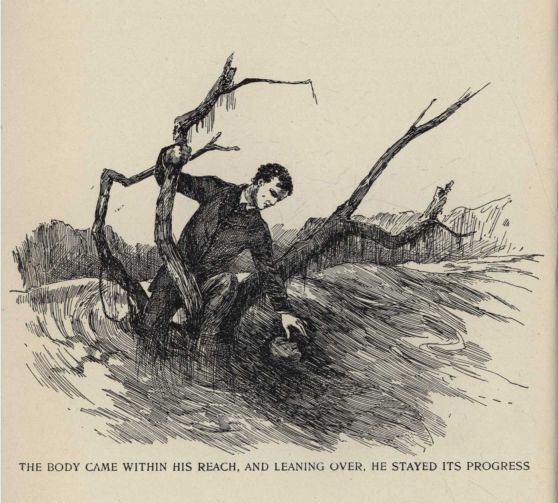
THE BODY CAME WITHIN HIS REACH, AND LEANING OVER, HE STAYED ITS PROGRESS
The form was limp and motionless, the eyes closed.
Jack turned it over.
"Mont Gray!" he shrieked. "Oh, Mont, Mont, are you dead?"
CHAPTER XIII.
OVER THE FALLS
Jack was never so amazed in his life as when he discovered that the pale, senseless form that he had dragged upon the tree beside him was no less a person than his friend, Mont Gray. But at that moment, he did not stop to question how the young man had gotten into a position similar to his own. His one thought was whether or not his friend was alive.
He placed the body as comfortably as possible on the fork of the tree, and then watched eagerly for some sign of life.
There was a cut upon Mont's brow, and presently a few drops of blood oozed from the wound, and trickled down his cheek.
Jack took this as a good sign, and he was not mistaken, for a few seconds later the young man gave a deep sigh, and slowly opened his eyes.
"Where am I?" he asked, faintly.
"Here with me, Mont," replied the young machinist, bending over him. "Don't you know me?"
"Jack!" was the low response. "Oh, how my head hurts! Where are we?"
"On the river."
"We are?" Mont attempted to rise, but Jack pushed him back. "Oh, I remember now!" he continued, shuddering.
"Remember what?" asked the young machinist, eagerly.
"The push Mosey gave me over the bank. My head struck a rock, and I don't know what happened after that. Where did you say we are?"
"In the middle of the river, just above the falls."
"How in the world did we get here? Oh, I see! You came out to rescue me!"
"No, I didn't. Mosey pitched me from the old mill last night, and I've been in the water ever since. I saw your body floating along, and without knowing who it was, caught hold and landed you here."
"You've saved my life," exclaimed Mont, fervently. "I'll never forget that, Jack!"
"I don't know whether I've saved your life or not," returned the young machinist, seriously. "It depends on whether we can reach shore or not; we are close to the falls, and liable to go over at any minute."
Mont pulled himself to a sitting position.
"Better take care!" cried Jack, "or you'll fall off. I am tied fast, and you are not. Here, take this end of the rope and bind yourself."
"Never mind. I'm all right now," replied the young man, as he viewed the situation. "It is a tight scrape, and no mistake," he added. "Wonder how this tree is wedged fast? Must be between the rocks."
"Yes, and it won't hold fast forever," returned Jack.
"We must reach shore, if possible, without delay."
"Easier said than done. Now if we had a rope----"
"Will this do?"
"No; it isn't long enough. Hello! something's giving way already!"
At that instant the trunk of the tree quivered, and moved a foot or so nearer the falls.
"Hold fast for your life!" Jack called; "perhaps it has broken loose!"
He had hardly uttered the words before the tree snapped its fastenings and swept toward the falls.
"Give me your hand, Mont," continued Jack, in a loud voice, seeing that his friend could not secure a good hold.
But before the young man could comply the tree turned over, and both were immersed.
In another instant, the willow, for such it was, had reached the brink. Here it hesitated for a moment, and then with a sharp sound it dove over the madly boiling mass into the maelstrom below!
The noise was terrific. Jack held on, closing his eyes, and forgetting everything.
He felt himself go down, down--and still further. The water rang in his ears, and many colors flickered in his mind's eye. The pressure from above was tremendous.
Ten seconds passed. He felt his senses leaving him. Mont's body bumped against him, and unconsciously he threw his own body partly around that of his friend.
Then all became a dim, dark uncertainty. The willow did not remain under the falls long. The rush of water soon forced it out into the stream below, and once there, it shot along, bearing upon its topmost branches two human bodies.
It drifted in mid-stream, gradually diminishing its speed, until an island stopped its further progress.
It struck upon a sandy shore, and the upper end swung gently around, catching fast in some overhanging bushes.
The bright sun shone down upon the scene as tranquilly as ever. Its warm rays apparently revived Jack, for, with a deep shudder--like one awakening from a horrible dream--the young machinist opened his eyes and endeavored to take in the situation.
He felt as if he had been pulled and beaten until not a spot was left in his body that did not ache. The rope was gone from his wrists, hands and face were cut, and his clothing was torn in a dozen places.
Yet he did not mind all this. He had a certain sense of security--a knowledge that he had passed through a great peril in safety--that more than outbalanced his present sufferings.
Suddenly he thought of Mont. He started up to discover his friend lying near, his face deadly white, and his head hanging over the branch like a lump of lead.
Jack saw that they were close to shore--where, he did not know nor care, and gathering all his remaining strength, he clasped Mont in his arms, and made a leap for solid ground.
He reached the shore, deposited his friend's body on the grass, and then, unable longer to stand, sank down beside the young man.
The moments dragged wearily along. Jack felt himself growing stronger, and by pure grit he arose and turned all his attention to Mont.
"Looks as if he was dead!" was the young machinist's awful thought. "I never saw a drowned man, but he is fearfully quiet. Yet, if there's a spark of life left in him, I'll fan it up if I kill myself doing it."
He knelt down, and taking off Mont's coat, unloosened his collar. Then he rolled him on his back, raising the lower part of the body as high as possible, which caused the water to run from Mont's mouth in a stream.
After this he moved his friend's arms backward and forward to induce respiration, and was rewarded presently by seeing the young man give a gulp and a gasp for breath.
"Thank heaven for that!" ejaculated Jack. "It's a good sign," and with strengthened hopes he continued his efforts.
It was fully half an hour before Mont came to himself and sat up. He, too, was bewildered at the situation.
"Where are we?" he asked, after a long silence, in which both sought to regain their strength.
"I think we are on Blackbird Island," replied Jack, slowly. "That is just below the falls, you know."
"Did we drift here?"
"I suppose so. I don't know any more than you. I came to my senses on the tree only a little while ago."
Mont rolled over on his back and drew a long breath.
"I'm tremendously tired," he explained. "Do you know anything of this place?"
"I have often heard of it, but was never here before. I wonder if anyone lives here?"
"Don't know. It looks rather wild."
"Tell you what we'll do," said Jack. "We'll rest here in the sun for a while and let our clothes dry, and then explore the place and see what means we can find of reaching the mainland."
Mont agreed, and making themselves as comfortable as possible, the two boys rested for over an hour, each in the meantime relating to the other his experience.
"Mosey is a bad egg," was Mont's conclusion; "I suppose he thinks that he has sent us both to our death," and then he told Jack about the stolen model.
The young machinist was much worried.
"It must have been Corrigan," he said, as he arose, and put on his coat. "I wonder what he expects to do with such booty?"
"Sell it if he can," replied the young man. "Hello!" he exclaimed, as he happened to glance up. "Here comes some one. A girl, I declare! What is she doing in this wilderness?"
CHAPTER XIV.
MAX POOLER'S MEG.
The girl who approached was a tall, gaunt creature, certainly not over ten years of age, yet with a knowing look of worldly experience in her pinched face and furtive black eyes.
She was sparingly dressed in an ill-fitting calico gown of ancient pattern. Her feet were bare and on her head rested a dilapidated sunbonnet. She carried a large pail on one arm, and made her way to a gushing spring but a few feet away from where Jack and Mont were reclining.
She started back in surprise upon seeing the pair, and as they sprang to their feet she made a hasty move as if to retreat.
"Don't run away, please," called out Jack. "We won't hurt you."
Thus reassured, the overgrown child--for she was naught else--stopped short, shyly swinging the empty pail from one hand to the other.
"Who're you?" she asked abruptly, as the young machinist came up.
"I'm Jack Willington, and this is my friend, Mont Gray."
"How'd you come here?" was the second question, asked as abruptly as the first.
"We had the misfortune to be carried over the falls," replied Jack.
The girl tossed her pretty, but by no means clean nose, in the air.
"Them falls?" she asked, pointing her long, thin finger to the mighty volume of water up the river.
"Yes."
She gave a contemptuous snicker.
"You can't stuff no such stories down me!" she ejaculated. "Them falls! You couldn't live a minnit in 'em! Think I believe such lies?"
"It's the truth, whether you believe it or not," put in Mont, "We were on that tree"--he pointed it out--"and that saved us. See, our clothes are still wet."
The girl was silent, more convinced by their genteel appearance, than by what was said, that she was being told the truth.
"What is your name?" asked Jack, curiously. He had never met such a unique character before.
"Meg," was the laconic reply.
"Meg? Meg what?"
"No, not Meg what; only Meg."
"But what is your other name?"
"Hain't got none."
"Oh, but you must have," put in Mont. He, too, was becoming interested.
"Never did--leastwise, never knowed it, anyway," and Meg grew sober for a moment.
"Do you live here?" asked Jack.
"Yep."
"Alone?"
"Nope. I live with Mr. Pooler."
"Who is he?"
The girl eyed the young machinist in surprise.
"Why, I thought everybody knew him," she said. "He's the man who owns this island."
"What, the whole of it?" exclaimed Mont, in astonishment.
"Yep."
"And you live here with him?" continued Jack.
"Yep. Have always."
"Any one else here besides you and him?"
"Not now. His wife used to, but she died last winter."
"I suppose you keep house for him?"
"Yep."
A faint smile accompanied the monosyllable this time.
"It's rather hard work for a girl like you," Jack remarked.
Meg tossed back her head.
"Hard! 'Tain't nothing; cookin' and cleanin' ain't. It's garden work that's tough. Look at them hands." She dropped the pail and held them up. "Been blistered lots of times hoein' and diggin'."
"It's too bad," cried the young machinist, indignantly. "It ain't fair to make you work like a slave."
"What would you do if you was me?" asked the girl, with a hungry, searching look in her eyes.
For a moment Jack was nonplused.
"I don't know," he replied, slowly; "I might, though, if I thought over it. Are you a relative of his?"
"Not's I know."
"How long have you been here?"
"Ever since I can remember. I didn't mind it so much when Mrs. Pooler was alive, but since she died I hate it;" and Meg grated her teeth tightly together.
"Where is the house?" asked Mont.
"Over yonder, through the trees."
"Do you think you can get us something to eat?" continued the young man. "We have been out since yesterday, and I'm as hungry as a stray dog."
The girl hesitated.
"We will pay you for it," Mont went on, feeling for his purse, which, luckily, still remained in his pocket.
"Guess I can," said Meg, finally. "Pooler ain't home; he went to the mainland this morning. Did you really go over them falls?" she continued, jerking her thumb in the direction.
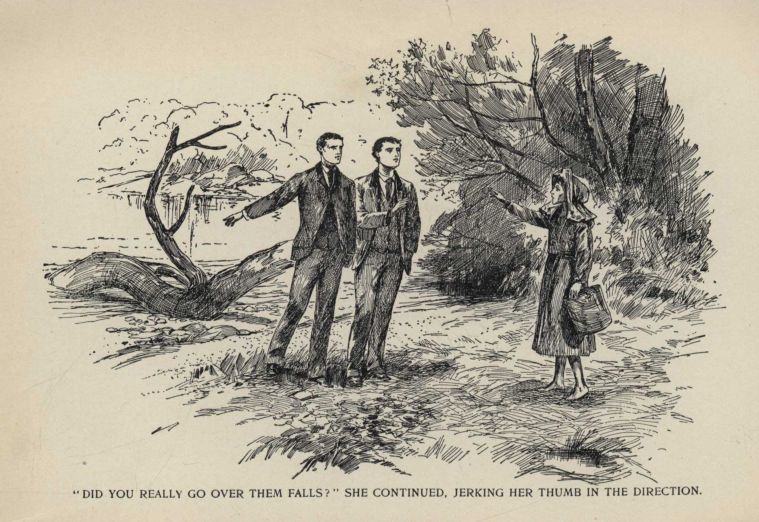
"DID YOU REALLY GO OVER THEM FALLS?" SHE CONTINUED, JERKING HER THUMB IN THE DIRECTION.
"Yes, indeed we did. It was a terrible experience," replied the young man with a shudder.
"Must be. Never heard of 'em comin' out alive--'em as goes over, I mean."
"We are not anxious to try it again," Jack put in.
The "house" consisted of a dilapidated cottage of two rooms and an attic, almost wholly covered by grape vines. Meg led the way around to the back, and motioned them to a bench under a big tree.
"Better stay out here. It's cooler and nicer," she said. "I'll fetch a table;" and in a few seconds she had done so, and placed it before them.
"Don't take too much trouble," said Mont; "we are hungry enough to tackle almost anything."
"'Tain't no trouble--leastwise, not if there's money in it. Pooler worships money."
"Is he rich?" asked Jack.
"Don't ask me!" replied Meg. "I've often heard the men say he was rich, but I never see any money."
"Doesn't he give you any?"
"Not a cent. Say, how will coffee and bread, with some pickerel do? I can get them ready in a few minutes."
"First-rate," replied Mont.
"Then just wait;" and Meg disappeared within the cottage.
"Quite a smart lass," remarked Jack when they were alone.
"Awfully wild, though," returned Mont; "I would like to see this Pooler. Something runs in my mind concerning him--I can't exactly tell what."
"I shouldn't wonder but what he misuses that girl awfully," added Jack, with a shake of his head.
It was not long before Meg returned with quite a substantial meal for both. She set the things before them, and then stood by, ready for further orders.
"What does Mr. Pooler do for a living?" asked Mont, while eating.
"Nothin' 'cept run his farm here," replied the girl. "He's gettin' kinder old."
"He is a farmer, then?"
"Yep. That is, now. He used to work in the tool works at Corney."
"He did?" exclaimed Mont, with interest. "I work there. How long ago was this?"
"I don't know exactly. I heard Mosey and him talkin' 'bout it."
Jack dropped his knife and fork in astonishment.
"Whom did you say?" he ejaculated.
"Mosey," repeated Meg. "Do you know him?"
"I think I do. Is his first name Andy?"
"Yep."
"Well, I'm stumped!" declared the young machinist. "Yes, I know him," he continued bitterly. "And he'll know me, too, when we meet again."
Jack meant all his manner implied. His blood boiled at the thought of the Irishman, and the cowardly treatment he had received at the mill.
"Does Mosey come here often?" he asked.
"Not lately. He used to, him and two or three more. But I oughten to tell you all this! Pooler'll beat me if he finds it out."
"Not if I'm around!" replied Jack, stoutly. "But we will not mention what you have told us."
"Wish you wouldn't. But I don't care anyhow; I'm gettin' tired, and sha'n't stay much longer."
"What will you do?" asked Mont.
"Run away," was the quick reply.
"Where to?"
"I don't know, and I don't care, either. Any place is as good as this, I reckon."
"Perhaps you can find some sort of a home in Corney," suggested the young machinist. "You seem to be quite handy. I will help you if I can."
"And so will I," put in Mont.
"I could do better if I had half a chance," asserted Meg, tapping the ground with her foot.
"May I ask what other men visit Mr. Pooler?" inquired the young man, after a pause.
"A man by the name of Corrigan sometimes comes with Mosey."
"Corrigan!"
Jack and Mont uttered the name together. Here was certainly news. Yet they never dreamt of what was coming.
"Any one else?" asked Jack.
"A man used to come sometimes at night. Pooler thought I never saw him, but I did--and heard who he was, too."
"What was his name?" asked Mont, with just the slightest tremor in his voice.
"Mr. Gray--Felix, Pooler called him."
Mont looked at Jack in deep perplexity.
"There is surely a mystery here," he said.
"You are right," returned the young machinist; "and who knows but what it may concern both of us?"
At this juncture Meg uttered an exclamation.
"There's a boat comin' over!" she cried. "I guess it's Pooler gettin' back!"
CHAPTER XV.
THE MISER OF THE ISLAND
Meg's conjecture was correct. It was Mr. Max Pooler who was the sole occupant of the rowboat that was fast approaching the island.
He pulled a quick stroke, and two minutes brought him to the shore, where, beaching his craft, he jumped out, and walked rapidly toward the cottage.
He was a thin, sallow-complexioned man, with a low forehead and sunken gray eyes. The expression upon his face, especially around his mouth, was a pinched and hard one.
He viewed Jack and Mont in surprise, not unmixed with disapproval, and turned to the girl for an explanation.
"How is this, Meg?" he asked, in a shrill, disagreeable tone of voice. "Whom have you here?"
"Two young men that drifted over the falls," replied the girl, who was somewhat startled by his sudden coming. "I found 'em down by the spring, all tuckered out."
"Over the falls!" Max Pooler's face showed his incredulity. "Never heard of it afore! When did it happen?"
"We can't tell exactly," replied Jack. "We became unconscious, and came to about an hour or so ago."
"Humph!" The master of the island glanced at the table, where a good portion of the food still remained. "Pretty good dinner you're givin' 'em, Meg," he continued.
The girl was silent. She evidently did not like Max Pooler's remark, and stood biting her finger nails in vexation.
"We are willing to pay for what we've had," broke in Mont. "We were so hungry that we couldn't wait till we got back to town, and so persuaded this--this young lady to provide something for us."
Max Pooler looked relieved.
"Ah, that's all right then," he said, rubbing his hands together in satisfaction. "Pay for what you get and owe no man, has always been my motto, and I find it a very excellent one, too. Tell me something of your adventures. And, by the way, is there anything else you wish?"
"No, I'm done," replied the young machinist.
He was thoroughly disgusted with the man's mean manner, though he did not object to paying for what they had had.
But Mont entered readily into conversation. He had eyed Max Pooler keenly from his arrival, and noticed every action of the man. He briefly related the particulars of what had happened on the river. For obvious reasons he did not mention how either Jack or he had fallen into such a position, nor did he mention any names.
"Awful! terrible! truly remarkable!" were Max Pooler's comments. "But did you see 'em?" he continued, in a tragic whisper.
"See whom?" asked Jack, who was somewhat taken back by this sudden change in the man's manner.
"Why, the ghost in the falls," replied Max Pooler, earnestly, "It is the spirit of a man who went over one night."
Jack laughed.
"We did not see it," he replied. "Besides, I don't believe in them."
"Oh, but this is a ghost sure, I've seen him myself many a time in the moonlight."
"Maybe you saw the man go over, and imagined the rest," suggested Mont. "Did you know him?"
"Oh, no!" replied Max Pooler, starting. "No, indeed, I only heard it was so. But the ghost is there. Sometimes it comes on the island!"
"The man must be a little off on this subject," thought Jack, as he watched Max Pooler's manner.
"I guess there is too much water here to allow of any spirits," said Mont, by way of a joke.
"Never mind, I know what I know," replied Max Pooler, with a shake of his head. "You were mighty lucky to get through safely."
"I'll admit that," returned Jack, rising from the table.
Mont also arose, and looked first at the man and then at the girl.
"If you tell me what we owe you, I'll pay it," he said.
Meg was silent. Had she had her own way she would have charged nothing.
"Everything considered, I guess it's worth a quarter apiece," said Max Pooler. "Provisions are frightfully high."
"I'm well satisfied," replied Mont; and taking out his purse, he withdrew a half dollar, and handed it over. "I am very much obliged to you," he added to Meg.
Max Pooler's eyes sparkled as they rested upon the shining silver. He grasped the coin eagerly, and after examining it, stowed it carefully away in his bosom.
There was a pause. Now that he had their money, the owner of the island was evidently anxious to have them take their departure. Both Jack and Mont wished to see more of this old man, but neither could frame a plausible excuse for remaining.
"I suppose your friends will be anxious 'bout you," remarked Max Pooler, by way of helping them off.
Jack's thoughts instantly reverted to Deb, and he said no doubt they would.
"But we have no boat," he added, suddenly. "Can you lend us one?"
"Only got the one I use," replied the old man, shortly.
"I can take 'em over," put in Meg, eagerly. "'T won't take long."
"We will pay you for the use of the boat," added Jack.
The mention of pay immediately altered the matter in Max Pooler's eyes.
"I'll do it for another quarter," he said. "Times are hard and one must make his living."
Jack made no reply. The closeness of the man disgusted him, and he paid the amount without a word.
Meg led the way toward the beach. Their backs were scarcely turned before Max Pooler disappeared in the cottage.
"The mean miser," burst out the girl, when they were beyond hearing, "He's itchin' to put that seventy-five cents along with the rest of his money! Hope you don't blame me for what he's done. Wouldn't have cost you a cent if I'd have had my way!"
"We were very thankful to get something," said Mont, "and were perfectly willing to pay for it, too."
Jack was silent. He half wished that Meg, interesting as she was, was not present. He wished to talk with his friend over the odd news that the last half hour had brought them. He was half inclined to question the young girl further, but did not wish to excite her suspicion, and was diplomatic enough not to get at it excepting in the direct way.
Of one thing he was certain; there was a good deal below the surface that did not yet show, and he determined that he would not drop the matter until he had learned what it was.
"Did you ever hear of a wrecked yacht around here?" suddenly asked Mont of Meg.
"Nope--that is," she hesitated. "What makes you ask that?"
"Oh, I only wanted to know," replied the young man, apparently unconcerned.
"Pooler said I was never to speak of it," returned Meg. "He thinks I don't know where it is, but I do."
"Show it to us, will you?" asked Mont, eagerly.
Meg shrank back.
"It's haunted!" she exclaimed. "Besides, Pooler would kill me if he found it out."
"We'll never tell him, will we, Jack?"
"Certainly not," replied the young machinist, to whom this new move was only another mystery.
"Besides, we intend to be your friends, you know," continued Mont.
"Well, then, come on," replied Meg, finally. "I don't care if he likes it or not. 'Taint a very nice place though."
"Never mind. We can't find any worse or more dangerous places than we have already gone through."
Meg picked her way along one bank of the island for nearly a quarter of a mile. Jack and Mont followed closely.
The ground was covered with a rank growth of reeds and rushes, and in many places was damp and slippery.
At last they reached a deep cave that ran directly between a cluster of twisted and bending willows. The spot was at the upper end of the island, and in full view of the falls.
Here, half hidden by the tall, undergrowth, rested the hull of a dismantled yacht, bearing upon her weather-beaten stern the half-obliterated name:
"KITTY."
CHAPTER XVI.
ON BOARD THE "KITTY"
"Hello!" exclaimed Jack, in astonishment. "I never knew such large craft came here."
"It's really haunted," replied Meg. "Mustn't go near it."
The young machinist laughed.
"Seems to me everything is haunted around here," he said, "Were you ever on board?"
"Nope, Pooler would kill me if I went. He's terrible when he's mad;" and Meg shook her head as the memory of past trials arose in her mind.
Meanwhile Mont had gone on ahead, and now, not without some difficulty, reached the deck of the stranded vessel. Jack followed him, leaving the girl behind.
"Don't be long, please," called out Meg; "I don't like to stay here, and besides, I've got to get back, you know."
"We will stay only a few minutes," replied the young machinist.
Mont had walked aft, and picking his way over the odds and ends that littered the deck, Jack joined him.
"Jack, do you know what I believe?" asked the young man, when they were out of Meg's hearing.
"What?"
"I believe that this yacht was once my father's," replied Mont, earnestly. "His was named the Kitty, and was last seen on this river, above Corney. He used it to cruise around the lakes in."
"Yes, but that was above the falls," returned Jack. "You don't mean----" he began.
"Yes, I do. The water was higher years ago, and I'm convinced that his boat was caught in the stream and went over the falls."
Jack stepped back in astonishment.
"But he could never live through it," he cried.
"He was never seen after that," returned the young man, gravely, "Yet we came out alive," he added. "If he was on the boat he might have escaped."
Mont led the way carefully down the half-rotten companion way into the cabin below.
There the air was foul and stifling. It was totally dark, but Jack stumbled around until he found a small window and threw open a shutter.
A curious sight met their gaze. The place looked as if it had been left immediately after a struggle, although this might have been caused by a violent movement of the craft. A big armchair lay upset in one corner, with a pile of books in another. On the table lay a pile of written and printed papers, some of which had been swept to the floor, and were covered with the ink from an upturned bottle, which, however, had dried years before. Dust, mold and cobwebs were everywhere.
Jack picked up some of the written matter and brushing off the dust tried to read it.
"It seems to be an agreement," he said to Mont, who was looking over his shoulder. "An agreement about an invention, that----"
"It is my father's handwriting!" exclaimed the young man, in an unnatural voice; "I could tell it in a thousand."
Jack turned the document over.
"I guess you're right," he said. "It seems to relate to some improvement in making tools." He looked at the title. "Gracious me!"
"What is it?" cried Mont.
"It is drawn up between the Gray Brothers of the first part, and Martin Willington of the second!"
"And Martin Willington----" began the young man.
"Martin Willington was my father!" ejaculated the young machinist, in great surprise.
At that instant both heard Meg's voice calling loudly.
"Better clear out. Here comes Pooler, and that Andy Mosey is with him!"
Jack and Mont were startled by the unexpected cry from Meg. Both were thoroughly absorbed in the document which the former had picked up from the floor, and for an instant neither caught the full meaning of the girl's announcement.
"Andy Mosey!" repeated the young machinist, looking up from the agitated reading of that faded manuscript. "How in the world did he get here?"
"Heaven only knows!" ejaculated Mont. "Affairs seem to be all mixed, and I give it up. One thing is certain: he and Pooler are close friends."
"Or else have a mutual interest at stake," was Jack's comment. "Just as we two seem to have here," he continued, folding up the paper and putting it in an inside pocket.
"You're right. But what brings Mosey up to this end of the island?"
"Perhaps he thinks to find one or both of our bodies," suggested the young machinist.
"Did you hear me?" called out Meg again. "Pooler and Mosey are comin', and they've both got guns! Better skip out!"
Meg's language was forcible even if not well chosen. In her anxiety to do her two friends a good turn, she had overcome her dread of the so-styled haunted craft, and approached to within a few feet of the side, so that her shrill voice sounded plainly.
"It's a shame to leave these things here," said Mont, as he too, stuffed several papers in his pockets. "This boat was undoubtedly my father's property, and I believe I'm entitled to whatever is here."
"Certainly you are," replied Jack. "As it is, I intend to come back myself. But we can't do much, now, and if those two men see us they may make it very unpleasant, to say the least."
"Wish we were armed. This is the first chance I have ever had of learning the true state of my father's affairs, and how he died, and I don't want to leave until I have sifted the matter thoroughly."
Mont was already on the companionway, and Jack quickly followed him.
"It's queer that Pooler should know that this stranded boat is here, and yet not touch a thing on board," remarked the young machinist. "He seems to be so close, it's a wonder he hasn't carried all the stuff away."
"You don't remember that he thinks this is haunted," replied Mont.
Jack laughed.
"Do you believe that yarn?" he asked.
"Not altogether; yet the man is certainly a strange fellow."
Meg was eagerly awaiting them on the shore.
"I don't see Mosey and Pooler," said Jack, as he stepped to the rail and looked over.
"They're comin' through the woods," explained the young girl, hurriedly; "I just saw 'em through the clearing ahead."
"What brings them here?" asked Mont.
"Don't know. Pooler comes only once in a great while, and I never knew that Mosey to go anywhere but to the cottage."
"Well, what shall we do?" asked the young man, turning to Jack.
"Better get out of his way," suggested Meg. "He's a wicked man when he's mad, and he'll be the maddest man in the district if he catches you two on this boat."
"Suppose we go below and hide," replied the young machinist. "It ought to be an easy thing to do so on such a craft as this."
"Just the idea!" exclaimed Mont. "How slow of me not to think of it."
"But how about the girl?"
"Ain't you goin'?" asked Meg impatiently.
"No; we intend to hide on board," replied Jack. "We were just thinking about you. I hope you won't tell Mr. Pooler where we are?"
"Not unless you want me to."
"Which we certainly do not."
"Suppose you go back to the boat, and get it ready," replied the young machinist after a moment's thought. "We may wish to leave in a hurry."
"All right."
"I can trust you?" he added, with a smile.
"Trust me? Just you try me, that's all!" and with a toss of her head, Meg darted away into the bushes, and was lost to sight.
At the same instant Mont caught hold of Jack and dragged him behind the cabin.
"I just saw Mosey and this Pooler through those trees yonder!" he exclaimed. "They'll be here in another moment!"
"Let's go below at once. We want to get the 'lay of the land,' and secure the best place we can," returned the young machinist, leading the way back to the cabin.
They found several staterooms, all but one of which were locked. The open one seemed to be as inviting a place as any, and this they entered, closing the door carefully behind them.
They were none too soon, for hardly had they settled in the place before they heard the two men clamber on board.
The newcomers were evidently having a spirited confab, but as the deck was thick, not a word could be heard below. Their heavy boots sounded up and down the planking several times, and then the two in hiding heard them come down into the cabin.
"You must have been mistaken," Max Pooler was saying; "I know they were on the island, but the girl rowed 'em to the mainland half an hour ago."
"Oi say no," replied Mosey. "Oi seen them coming over here from me boat. But why should they be on the island at all?" he continued with apparent indifference.
"They fell in the river and went over the falls."
"And lived? Come now, Max----"
"They say so, anyway. Of course I didn't believe the story. I guess they're only a couple of young tramps," said the master of the island. "But if they are still hanging around I want to know it."
"Tramps!" burst out the Irishman. "Phat are ye talkin' about? Do ye mane to say ye don't know who they are?"
"Why no," replied Max Pooler in surprise.
He had tried the doors of two of the staterooms, and was now walking toward the others.
"Well, thin, let me tell ye, one was Jack Willington, whose father got up that machinery years ago----"
"What!"
"And the other wan was Monteray Gray's son."
The miser of the island uttered a loud cry.
"You are fooling!" he said, excitedly.
"No, I ain't."
"Why, I thought his son was dead, that he--he died here," continued Max Pooler, with a white face.
Mosey laughed, a cold, hard laugh.
"Max, me b'y, ye can't kill that lad. If ye'd go out into the worruld more ye'd larn more. Now his father----"
The miser of the island grasped the Irishman fiercely by the shoulder.
"Stop there!" he commanded; "I won't have it--remember that--I won't have it!"
CHAPTER XVII.
MEG TO THE RESCUE
The last part of Mosey and Max Pooler's conversation would no doubt have greatly interested Jack and Mont had they heard it, but the truth was that as soon as they saw the two men preparing to search the place, they immediately sought for some means to escape.
In one corner of the stateroom they found a small door leading by a narrow passage to what, for the want of a better name, may be termed the forecastle. Why it had been put there was not apparent--except, perhaps, to allow a direct communication between the captain and the men, but nevertheless, they used it, and when Max Pooler spoke so sharply to Mosey, the two in hiding had again regained the deck, and did not hear the short quarrel that followed.
"Where to now?" asked Mont, "We can't stay here, that's certain."
"There is Meg with the boat!" exclaimed Jack, pointing down the shore. "Wonder if we can get her to come alongside without them finding it out?"
"We can try," replied the young man, and taking out his handkerchief, he waved it vigorously.
In an instant the young girl caught the signal, and came rowing up.
"Where are they?" she asked, anxiously.
"Down below," replied Jack in a whisper. "Don't make a noise or they will hear you."
"All right. Jump in, both of you."
Mont and Jack were not slow in taking her advice. Both scrambled over the rotten rail, and into the boat, which fortunately was rather roomy.
"Shall I take the oars?" asked the young machinist, who, though not an expert, could still handle the oars fairly well.
"Nope. I can row better'n either of you. Off we go!" And with one quick stroke this slender girl sent the craft far out on the water.
Before she had time to take a dozen strokes Max Pooler appeared upon the deck closely followed by Mosey.
The surprise was great on both sides, and for an instant nothing was said or done.
"Come back, Meg!" called out Max Pooler, rushing to the rail as soon as he had recovered from his astonishment. "Come back, or it will be the worse for you!"
"I'm goin' to row 'em over to the shore," replied the young girl. "It's just what I started to do."
The master of the island stamped his foot in rage. "You little good for nothing! Bring that boat back without another word!"
Meg continued to row without replying.
"Do you intend to mind me?" screamed Max Pooler. "If you don't, as sure as I live I'll shoot you!" and he drew up his gun as he spoke.
"Hold up!" shouted Mont, fearful of harm coming to the girl. "We'll come aboard."
"No we won't!" put in Meg, with a strong show of spirit, "I said I'd take you to the mainland, and I'll keep my word, shootin' or no shootin'!"
Max Pooler pulled back the hammer of the gun he carried. Seeing the action Jack jumped up and placed himself directly in front of the girl.
"Thanks," said Meg. "It's mighty good of you to try to save me, but I don't want you to run such a risk. I've got to have it out with him sooner or later, and now is as good a time as any," and she placed herself again in range.
"Did you hear what I said?" called Max Pooler, leaning over to make himself heard: "I'll give you just five seconds to turn that----"
Crack!
As I have stated, the guardrail on the yacht was rotten, and under the unusual weight, it gave way with a crash.
Splash!
The miser of the island had lost his balance, and after vainly clutching the air to save himself, had floundered into the water and mud below!
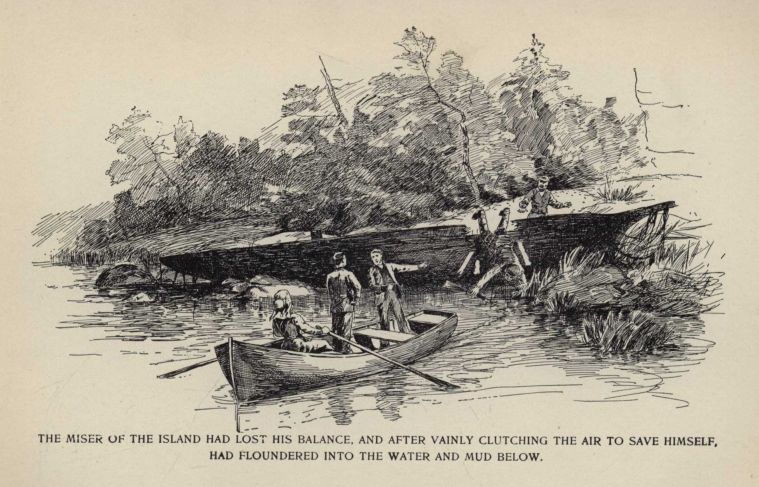
THE MISER OF THE ISLAND HAD LOST HIS BALANCE, AND AFTER VAINLY CLUTCHING THE AIR TO SAVE HIMSELF, HAD FLOUNDERED INTO THE WATER AND MUD BELOW.
"Hello!" exclaimed Jack. "There's an accident that's lucky for us."
"He'll have all he can do to take care of himself," remarked Mont.
"Serves him right," put in Meg, with a laugh. She had not taken the whole affair very seriously. "Maybe it'll cool his blood."
The three saw Mosey rush to Max Pooler's assistance, and then, without waiting to see the outcome of the mishap, the girl again bent to the oars, and sent the boat flying onward.
"What do you intend to do?" asked Jack of Meg, as they neared the shore. "You can't very well go back. I'll help you if I can."
"I don't know," replied the young girl, in perplexity. "I've had enough of life over there."
"Suppose you go over to Farmer Farrell's with us, I think he will board you for a few days anyway, and in the meantime you can find out what's best to do."
"I ain't got no money."
"We'll make that all right," replied the young machinist. "But didn't Pooler ever pay you anything?"
"Pay me? Don't catch him giving out a cent if he can help it. All I got was these duds--'em as was left when his wife died."
"Not much, certainly," put in Mont, surveying the tattered and patched dress.
"Other folks earn money, and I guess I can, too, if I try," continued Meg, as she ran the boat up the accustomed beaching place.
"Certainly you can," declared Jack.
"And have a better living than you had at the island," added the young man.
It was growing dusk when they stepped ashore. Meg tied the boat fast and left the oars on the seats, certain that the craft would not remain uncalled for long.
It was but a short walk to Farmer Farrell's place. They found him driving home the cows, and on the doorstep, joined by his wife, the two honest people listened to what Jack and Mont had to say about themselves and Meg.
The girl stood in the background, much of her former shyness having returned. At the conclusion of the tale, Mrs. Farrell took her hand warmly.
"Poor child! you've had a hard time of it, truly!" she said, "But you sha'n't have any more trouble--at least, not for the present, eh, father?"
"No, we can keep her easily enough," replied her husband. "You want help, Martha, summer coming on, with all the extra work."
"And we'll pay you, too," continued Mrs. Farrell.
"Oh, thank you!" exclaimed Meg. "You 're real kind. Maybe I can't do things just right, but I guess I can learn, and you needn't give me a cent till I do."
"Then, that's settled," said Jack, somewhat pleased at having the matter so easily arranged.
"If only Pooler don't make me go back."
"You say you're no relation of his?" asked Mont.
"Not's I know. He always called me a picked-up."
"Then just let him try it," put in Farmer Farrell, grimly. "I know the man well. He pretends to own Blackbird Island, but he hain't got no more title 'n I have."
"And maybe I can get you a few dresses from my sister, and----" began Jack.
"Well, there, by Jinks!" exclaimed Farmer Farrell, jumping up from the step upon which he had been sitting. "I almost forgot it, being so interested in your story. Your sister was here looking for you."
"Deb!" Jack was indeed astonished, and so was Mont. "What did she want here? Looking for me?"
"Yes; she's had a terrible time. Your model's stolen, and she's been put out of the house for not paying the rent."
The news startled the young machinist. In the excitement he had forgotten all about Mr. Hammerby and the quit notice.
"Did she say where she had moved to?" he asked anxiously.
"No, she was in too much of a hurry. She was frightened half to death on account of your being missing."
"No doubt of it. Poor Deb! Her troubles are as bad as ours," remarked Mont.
"Which way did she go?" was the young machinist's question.
"Toward home again," said Farrell; "I wanted her to stay the worst way when I found out who she was, but she wouldn't think of it."
"Maybe we can overtake her," suggested Mont.
"We'll try, anyway," returned Jack.
He was much worried over the fact that Deb had been compelled to vacate the old home; and then he suddenly remembered that all of his money had been stolen by Corrigan.
"Without a home and without money," he thought dismally. "Well, thank God, my life has been spared, and, as Deb said, 'maybe it will all come out right in the end.'"
Yet his heart was by no means light, as Mont and he set out for Corney.
CHAPTER XVIII.
DEB AT THE MILL
The apartments which the kind-hearted Miss Parks allowed Deb to have were small but pleasant, and the bright sunshine that strolled in the back windows did much toward brightening up Deb's naturally lively disposition.
By the aid of the energetic elderly maiden the furniture from the former Willington rooms was quickly set to rights, a good part of it being stored in the garret until--when?
Deb asked herself that question many times as she sat on the edge of the bed, after Miss Parks had gone below.
"If Jack was only here," she sighed. "Where can he have gone? I will never, never believe he has run away, no matter what Mr. Benton or the others say. Something has surely happened to him."
It was not long before she decided to start on a regular search for her brother, and going down stairs she told Miss Parks of her intention.
"Well, dear, do just as you think best," was that lady's reply. "Where do you intend to go?"
"I shall visit that farmer's place first," replied the girl. "Perhaps they can give me some information."
"I hope so. But have a cup of tea before you leave?"
"Thank you; I really don't care for it."
"Oh, but you must," insisted the good lady. "It will do you a heap of good. Just the thing to quiet your nerves."
Rather than displease her friend, Deb finally consented; and spent ten minutes in the back parlor, sipping the elderly maiden's favorite Young Hyson.
The girl was soon on her way. Farmer Farrell was well known throughout the district, and it did not take her long to reach his place.
She was thoroughly dismayed to learn that Jack had started for home at sundown the day before.
Not knowing where to go or what to do next, she retraced her steps toward Corney. She was in no hurry, and wandered in deep and painful contemplation, to one side of the road.
Near the old mill she stumbled over a bundle that lay in the grass near a tree. Without thinking, she was about to step over it, when something about the cloth covering attracted her attention, and picking it up, she was amazed to find that it was Jack's kit, wrapped in his overalls!
"How in the world did that get here!" she exclaimed, and then turned deathly white, as a horrible suspicion crossed her mind: "Oh, it could never be! no, no, no, no!"
She dropped the bundle and ran down to the water's edge. The spot was just below the mill, and in a little cove, where the river was comparatively quiet.
Nothing was to be seen--nothing but the sparkle of the sun, and the waving shadows cast by the trees overhead.
"It's awfully lonely here," she said to herself. "If Jack came here----"
She was startled to see the shadow of a man close beside her. Looking up she gave a slight scream as she recognized the tall form of Corrigan.
She did not know that the man had been watching her for some time, revolving in his mind what he should say about Jack if asked any questions.
He advanced to her with a smiling face, ignoring entirely the way he had treated her the previous evening.
"Got tired of waiting for Jack to get back?" he asked.
Deb was too much alarmed to offer a reply at once.
"Yes--I am," she stammered.
"Thought you would be. He ought to have sent you word," continued Corrigan. "He sold the model I took, just as I told you he would," he added.
"Where is he?" asked the girl, thrown off her guard by the villain's cool manner.
"Around here somewhere. He's been here and over to Redrock twice since yesterday. He got the contract to fix up the machinery in this old mill. The man who bought it wants the job done as soon as possible, so he went right to work. I'm helping him on the drawing. I'm a draughtsman, you know."
Deb did not know, nor was she aware that Corrigan's statement was purely fictitious.
"Where is Jack now?" she asked, turning over the plausibility of the story in her mind.
"Just went up the stream a ways, to catch the true drift of the tide," replied Corrigan. "He thinks they will get more power if the wheel is shifted around. Better come in the place and wait for him."
Deb hesitated. In spite of all the man was saying, she hated to trust him. Yet, if he was speaking the truth, certainly her treatment of him the previous evening had not been right at all.
"There are some benches inside," continued the fellow; "you are tired, I can see, and the rest will do you good. Jack will land at the bottom room."
Rather reluctantly Deb followed the man into the building.
"Here you are," he said, pulling a bench from the wall, and motioning her to a seat. "You mustn't think I bear you a grudge for what you did last night," he continued, pleasantly.
The girl sat down without replying. The spot was near an open window, and she strained her eyes to catch sight of any craft that might be coming toward the mill.
"Perhaps after all, it's all right, and I'm a silly goose to be so worried," she thought; "it's just like Jack to take hold of the first job that comes to hand. For all I know his silence may be caused by his good luck."
Yet when she remembered about being locked in and, later, turned out of their home, she concluded it was a serious matter, and wondered what her brother would say to that.
It was fast turning to twilight, and the evening sun cast long flickering rays across the rapid stream. Had her mind been tranquil, Deb would have enjoyed the scene greatly, but now her one thought was upon the boat she hoped would speedily appear.
"Object to smoking?" asked Corrigan, after a brief spell of silence.
"Oh, no, smoke as much as you please," replied the girl.
Corrigan filled his pipe, and lighting it, sat down. He was by no means a dull man, and to carry out his hastily formed deception, he began making a few apparent calculations on a bit of paper which he held upon his knee.
He was waiting for Mosey to return from Blackbird Island. He expected that his brother-in-law would see Max Pooler, and transact some private business that interested the three, and from which he expected to receive a neat sum of money. Several times Deb turned to watch Corrigan.
"He seems sincere enough," she kept saying to herself, yet at the bottom of her heart her uneasiness increased. The man hardly knew what to do. On the impulse of the moment he had detained Deb, thinking that he might in some way make her shield him from the punishment he knew he richly deserved, yet now he was not sure he could manage her.
A quarter of an hour, a very long quarter to Deb, passed.
"My brother ought to be in sight," she said. "He ought to stop working. It is getting late."
"Maybe he's struck a new idea," replied Corrigan. "You know he hates to give up unless a point is settled."
Deb knew that this was true of Jack. But might not her brother go straight home, without returning to the mill?
"I guess I'll go up the road to meet him," she said, rising.
Corrigan stepped over to the door. "No, you must stay here," he replied, decidedly.
"Why--why, what do you mean!" exclaimed Deb, turning pale.
"I mean just this," replied Corrigan, catching her by the arm, "you are my prisoner, and must do as I say."
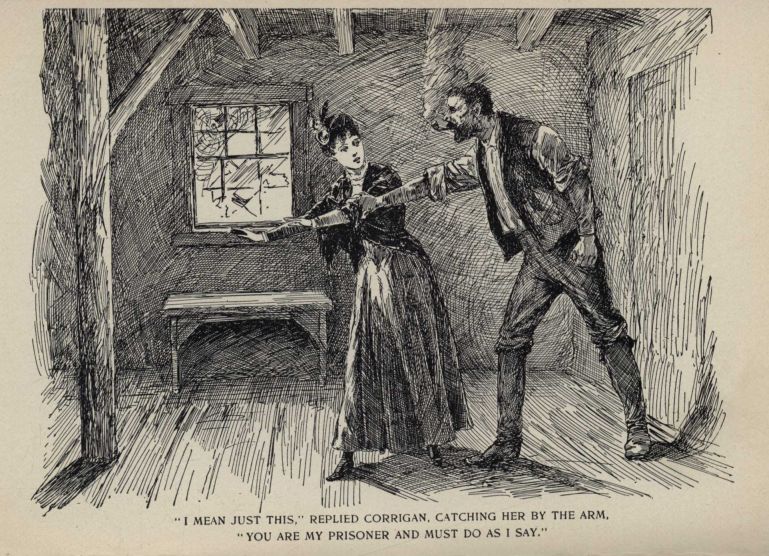
"I MEAN JUST THIS," REPLIED CORRIGAN, CATCHING HER BY THE ARM, "YOU ARE MY PRISONER AND MUST DO AS I SAY."
CHAPTER XIX.
IN CORRIGAN'S POWER
For the moment after Corrigan made his assertion that Deb must do as he said, the terrified girl could not speak. She stared at the man in terror.
"Wha--what do you mean?" she gasped at last.
"You heard what I said," he answered coolly. "I want no nonsense from you either."
"But--but--what are you treating me so for?"
"That's my business, Miss Willington."
"And I must consider myself your prisoner?" she added, growing more pale than ever.
"That's it."
"You have no right to keep me here."
"Perhaps not, but you must remember that might makes right in some cases."
"Where is my brother Jack? I do not believe that you have told the truth about him."
"If you don't believe me, why do you want me to answer your questions?" he returned with a wicked grin on his unshaven face.
"You have harmed Jack in some way--I am sure of it!"
"No, no! To tell you honestly I haven't the least idea where he is," said Corrigan hastily.
Under no circumstances did he wish to stand for the crimes which his brother-in-law had committed. As it was, he felt that he had enough to answer for on his own account.
There was an awkward pause after this. Then of a sudden Deb started to scream, but he quickly clapped his hand over her mouth.
"None of that!" he said, roughly. "If you won't be quiet, do you know what I'll have to do?"
"I guess you are mean enough to do almost anything!" burst out poor Deb.
"I'll have to gag you, that's what. I won't have you yelling for help, remember that!"
"But I do not wish to remain here!" insisted Deb, desperately.
"Oh, pshaw! I won't hurt you. Sit down and keep quiet."
But the girl could not compose herself and began to walk up and down the mill floor. She wished to get to the door and edged in that direction, but Corrigan quickly headed her off.
"You come with me," he said, presently. "I ain't going to trust you down here any more."
"I shan't go a step with you," she answered, vehemently. "O, Mr. Corrigan, please let me go! Please do!" And she clasped her hands and held them out toward him.
"Don't cut up so, Miss Willington. As I said before, I shan't harm a hair of your head. But I must make you stay here for a while. Now come with me."
"But where do you wish me to go?"
"There is a loft overhead. I must lock you up there, but only for a little while."
"But why are you doing this?"
"As I said before, that must remain my business. Come."
She shook her head.
"I--I cannot!" she cried, and began to weep.
Muttering something under his breath the villain caught her by the arms, just as he had caught her when he had come for the model, and in a trice he was carrying her up to the loft. She struggled as best she could but this availed her nothing.
"Now you keep quiet, or I'll surely gag you," he said, as he set her down on the dusty floor. "If you start up any kind of a racket it will be the worse for you."
Having thus delivered himself, Corrigan went below again, closing the door to the loft behind him and fastened one of the bolts which was there to hold it in place.
Left to herself, Deb stood dazed for a moment in the center of the floor. Then she tottered to an empty box standing near and sank upon this, the picture of misery and despair.
What should she do? What could she do?
Over and over she asked herself the questions, but without reaching a satisfying answer. She was the prisoner of a wicked man, and to get away from him appeared impossible.
The loft was very dusty, and from overhead hung huge cobwebs full of dirt and spiders. It was quite dark, for the only window was a little affair overlooking the river and the four tiny panes of this were thick with grime, the accumulation of years.
At last she arose, and with a long-drawn sigh made her way toward the window. It was nailed fast and could not be raised, so she had to content herself with scraping some of the dirt from the glass and looking through the spots thus afforded.
She could see but little, and nothing which gave her satisfaction. Below her was the broad and swift-flowing river, and beyond was a grassy bank, backed up by brush and tall trees. No boat was in sight, nor any human being.
She listened attentively, and not hearing Corrigan began to wonder if he had left the building.
"If he has I must escape somehow," she told herself. "I wonder if I can't pry open that door?"
She knelt over the door and tried it with her bare hands. But this was not sufficient, and getting up she looked around for something which might prove useful to her. In a corner of the loft rested a rusty iron bar, somewhat sharpened at one end. She brought this forth and after inspecting it felt certain that it would prove just what was needed.
Approaching the trapdoor she called out softly:
"Mr. Corrigan! Mr. Corrigan, are you down there?" And then, receiving no answer, she went on: "Mr. Corrigan, I must speak to you. Won't you please listen?"
Still the silence continued, and now her heart arose within her. He must certainly have gone away, and if that was so, now was her time to escape!
Trembling with anxiety, Deb began to work away on the door with the iron bar. At last she got the end of the bar in the crack of the door, and then she began to pry the door upwards. At first it refused to budge, but suddenly the bolt gave way and then the door came open with ease.
She was at liberty, or at least liberty was within her grasp, and with her heart thumping madly in her breast, she began to descend to the floor below, bar in hand. Once she thought she heard a noise outside and stopped short. What if that awful man should be coming back! But the noise ceased and was not repeated, and she went on and soon stood at the spot where he had first made her a prisoner.
The door to the roadway was open, and poor Deb could hardly resist the temptation to fly forth at the top of her speed. But then she remembered that Corrigan might be within easy distance of the mill. If that was so, and he caught sight of her, he would surely make after her.
"I must watch my chance, and if he is around, I must get away on the sly," was what she told herself. Curiously enough, while up in the loft, she had not discovered Jack's model, which was tucked away out of her sight.
With bated breath she tiptoed her way to the open doorway and peered forth. No one was in sight on the road, nor at the water's edge near the mill. All was as silent as a tomb, save for the distant rushing of the water over the rocks.
Waiting no longer, Debt left the mill and started for the road. She was still terribly frightened and ran on as if some great demon was after her trying to clutch her shoulder. In her agitation she did not notice a tree root growing in her pathway, and catching her foot in this, she pitched headlong on the stones and grass.
It was a cruel fall, and as she fell she could not keep back a cry of alarm, followed by one of pain, for her elbow was hurt not a little.
At the cry there was a crashing in the bushes overlooking the river at a point above the mill, and a moment later Corrigan appeared. He had gone out on a point of land to see if he could catch sight anywhere of Andy Mosey.
"What! did you get away?" he roared.
"Let me go!" screamed Deb. "Oh, my elbow! Let me go!"
"Let you go nothing!" he answered, and caught hold of her once more. "Come back with me! Come back this minute!"
"No, no!" she moaned. "I--I don't want to go back!"
"But you shall go back," he answered. And despite her struggles he lifted her into his arms once more and returned with her to the mill.
CHAPTER XX.
MONT TELLS His STORY
As Jack and Mont journeyed on the way to Corney, the young machinist noticed that the young man was rather silent, and when spoken to replied only in monosyllables.
"I suppose he's speculating about those papers and the stranded yacht," thought Jack. "Perhaps they will be valuable to him when he comes to settle up with his uncle. I'd just like to know what interest father had in that tool machinery. Perhaps the patent is still ours, or a royalty on it. As soon as I find Deb, and things are settled a bit, I'm going to investigate the whole subject."
Jack's surmise concerning Mont was correct.
"What do you think of my uncle?" asked the young man, after a long period of silence.
"What do I think of him?" asked the young machinist in turn. "In what way?"
"Why, as to his dealings with people in general."
"Well, I--I really, Mont, I don't want to say anything that will hurt your feelings," stammered Jack, not wishing to be harsh with so dear a friend, and yet determined to speak only the truth.
"Never mind my feelings. Just speak your mind."
Jack was silent a moment.
"I think he's outrageously mean and close!" he burst out. "He doesn't treat you, nor any one else in the tool works fairly! He's the hardest master to work for in the town!"
The young machinist could be blunt when the occasion demanded, and he did not mince matters now.
"I guess you are right," replied Mont, shaking his head affirmatively. "And yet----" he hesitated.
"What?"
"I hardly dare say what is in my mind, Jack. But I want a friend's advice."
"And I'll give it willingly."
"And keep the matter to yourself?"
"Certainly, if you wish it."
"Then I've got this to say about my uncle, Felix Gray," declared Mont. "He is either treating me first-rate--which I don't believe--or else he is the worst scoundrel in Corney!"
Jack was dumfounded.
"The worst scoundrel in Corney?" he repeated almost breathlessly. "You surely don't mean it!"
"Yes, I do," replied the young man, decidedly.
"Don't think I say so hastily. I've thought over the matter a long time. Things can't go on as they have much longer, and when the break comes, I want somebody to know my side of the story."
"Yes, go on."
"In the first place, you must remember that Mr. Gray is not my full uncle. He and my father were only half brothers, so we are not so closely connected as people imagine."
"That's so," replied Jack, trying to catch a glimpse of what his friend was driving at.
"My father was ten years younger than his step-brother," continued Mont, slowly. "He was quite well off, having been left considerable money by an old aunt, who always took a great interest in him. My uncle Felix induced him, shortly after receiving his inheritance, to locate at Corney, and both became equal partners in the tool works."
"On your father's capital?"
"So I imagined; his brother putting his experience and command of trade against my father's money."
"Then you really own a half interest in the works!" exclaimed Jack, in surprise.
"So I always believed. But listen. My father died suddenly, it was said. I returned home in time to hear his will read. In this, his property, without being specified, was left to me as the only surviving member of the family, with Felix Gray as the sole executor and my guardian."
"It was a good deal to trust in his hands."
"I suppose my father had unlimited confidence in his brother. I trusted him, too, and continued at school for three years longer.
"When seventeen years old I returned home, and asked him if I was not old enough to take an active position at the works, and then he offered me my present clerkship, and astonished me by asserting that my father had squandered most of his wealth by extravagant living, and that several hundred dollars was all there was remaining of my share."
"And you think?" began the young machinist, who was beginning to see through the situation.
"What would you think, Jack?" asked the young man, earnestly. "My father lived well--owned the yacht we just left, and all that--but was on the whole, I've been told, a prudent man. Now you know my uncle, what do you make of the matter?"
"Did Mr. Gray ever offer to let you examine the accounts?"
"Only those at the tool works, but not the private ones at home."
"Then, to say the least, he is certainly not acting as a guardian should," declared Jack. "And I think you would be perfectly justified in demanding an examination."
"That's your honest opinion?"
"It is, Mont. If he is acting right he won't mind it, and if he isn't, why the sooner you find it out the better. From my own experience I am sure he would stoop pretty low to increase his wealth or position."
"Yes, but that--that----" hesitated the young man, his face flushing.
"I know what you mean," replied Jack quickly. "To deprive you of what's yours is a crime punishable by imprisonment, and you hate to have such a thing connected with any one in your family. But it's not your fault, and you ought to have your rights."
"Yes, but the publicity?" faltered Mont.
"Oh, pshaw! you don't owe the public anything!" exclaimed the young machinist, somewhat impatiently, so anxious was he to see Mont get his rights. "Perhaps the affair can be settled privately."
"I wish it could," returned the young man eagerly. "I would sacrifice a good deal to have it done in that way."
Mont's nature was a shrinking one. Had he been less diffident it is probable that he would have demanded an account from Mr. Felix Gray long before this.
"How will you approach your uncle?" asked Jack. "Have you any proofs to show that all is not right?"
"I think I have. During the fire I helped carry out a desk from the library, and the other fellow let his end fall, and burst open one of the drawers. The contents rolled out on the ground, and in putting the papers back I came across a bundle marked with my father's name. I was at first going to put it with the rest, but as matters stand, changed my mind, and pocketed it. I took it down to the office, but haven't been able to examine it, except in a general way. And then those documents from the yacht----"
"Here they are," replied Jack, producing them. "You have some, too."
"Yes, quite a bundle."
Mont undid them, and tried to read some of the faded manuscript.
"It's too dark to see much," he observed. "If I'm not mistaken, my father wrote everything that is here."
"It's queer that Pooler should leave all those things on the yacht undisturbed," returned the young machinist. "One would think that such a man as he would have ransacked the boat from stem to stern."
"He certainly must have a reason,", said the young man. "Or else--I've been thinking--he may be a little off in his mind. Did you notice what a restless look his eyes had?"
"Yes, as if he expected to be nabbed by some one."
"What Mosey and Corrigan and my uncle do there beats me."
"And then the yacht. Was your father on board when he died?"
"I don't know. I always supposed he was at home, and never asked about it."
Both felt that for the present at least, the solution of this question was beyond their power to reach, and they lapsed into silence.
They were now near the old mill, and remembering the kit he had dropped when he discovered Mosey, Jack made a search for it.
"What are you looking for?" asked Mont.
"My tools I dropped--gracious, listen!"
A shrill, girlish voice penetrated the air, and fairly struck him to the heart.
"Help! Jack! Help!"
"It's Deb!" he ejaculated. "She's in trouble!" and he ran toward the old building, closely followed by Mont.
It took but a few seconds to reach the place. The door was tightly closed, but with one heavy kick the young machinist burst it open.
They were astonished at the sight within.
There was Corrigan--his red face redder than ever with rage--and in his arms, her hair flying, and her dress plainly showing the effects of her terrible struggle for liberty, was poor Deb!
CHAPTER XXI.
CORRIGAN MAKES A MOVE
Both Jack and Mont had had surprising adventures in plenty, but both of them agreed that none of them equaled the present one.
The noise in the room prevented Corrigan from hearing their entrance, and it was not until Jack's strong hand grasped his arm that he realized the sudden intrusion, and let go his hold upon Deb.
As for the poor girl, she was too exhausted to speak, but with a glad look of recognition, sank back in a faint, supported by Mont, who sprang forward to prevent her from falling to the floor.
"You miserable coward!" exclaimed the young machinist, his blood boiling at a fever heat. "What do you mean by holding my sister in this way?"
With a strong push of his powerful arm he sent the man flying into a corner. It was lucky that he had no weapon in his hands, or Corrigan's career might have received a severe set back.
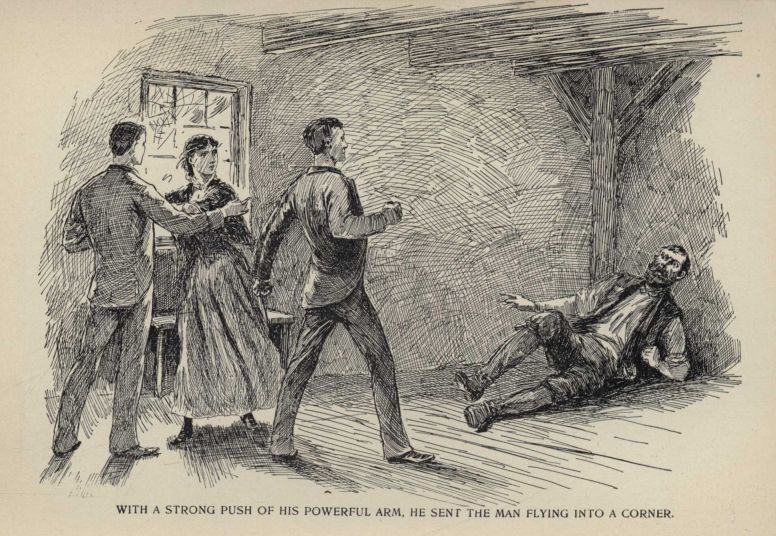
WITH A STRONG PUSH OF HIS POWERFUL ARM, HE SENT THE MAN FLYING INTO A CORNER.
"Are you hurt?" asked Mont of Deb, as the girl presently opened her eyes, and gave a little gasp.
"I--I think not," she replied, slowly. "Oh, how glad I am that both of you came when you did!"
"What brought you here?" asked the young man.
"I was looking for Jack."
Meanwhile Corrigan had risen to his feet, and stood in a corner, his chagrin at being caught showing itself plainly upon his face. Jack faced him, his hand clenched, ready to strike instantly, if necessary.
"Well, what have you got to say for yourself?" demanded the young machinist.
Corrigan offered no reply. The sudden turn in affairs was something he could not understand. He bit his lip and tried to put on a bold and careless front, but the effort was a failure.
"He stole your model, Jack!" cried Deb.
"So I heard," replied her brother. "What have you done with my property?" he added to Corrigan.
"I haven't anything of yours," was Corrigan's cool reply. "It's all a mistake."
"No, it isn't, Jack; it's the truth," reiterated the girl earnestly.
"You went into my house and took that model by force," continued the young machinist. "You see, I know all about it, so you might as well give up the thing at once."
While speaking, Jack had unconsciously stepped to one side. With a sudden movement Corrigan slipped past him, and made for the open door.
But the young machinist was on the alert, and before the man could realize it, he was sprawling on the floor, with Jack on top of him.
By intuition, he appeared to feel that it would be useless to struggle, and so lay perfectly still.
"I've a good mind to bind you, hands and feet," said Jack. "Close that door, will you, Mont?" he added to his friend.
"Will you let me go if I give up the model?" panted Corrigan, who began to feel the weight of Jack's heavy body upon his chest.
"I don't know. But you've got to give it up, anyway."
"I suppose it's hidden here," put in Mont. "That's probably the reason he's hanging around the place."
"Wherever it is you will never find it without being told," broke in Corrigan.
For well-known reasons he was anxious to get away.
"Oh, let him go, Jack!" exclaimed Deb. "I don't care, now I've got you--and Mont"--the last words with a grateful look at the young man, that caused him to blush. Jack thought the matter over carefully. He was not of a vindictive nature, and bore no personal ill-will against Corrigan.
"What do you think of it?" he whispered to Mont.
"Might as well let him go if he gives up your property," replied the young man. "It would be rather hard for us to manage him."
"Then give up the model and you can leave," said the young machinist to Corrigan. "But I never want you to come around me again."
"Give me your word on letting me go if I give it up?" asked the man, with an eager look.
"Yes."
"Come on, then."
Corrigan led the way to the upper room of the mill. The little party of three entered.
"There it is," said the man, pointing to a corner; "you will find it up there, back of that large beam," and he pointed to an angle in the roof, about eight feet from the floor.
"Give me a boost up, Mont," exclaimed Jack.
The young man caught him by the hips, and held him up as best he could.
"It's here, sure enough!" cried the young machinist, and from out of a dim recess he brought forth the model, covered with dust and cobwebs.
So interested were the two that they did not notice Corrigan back out from the room and close the door behind him.
"I'm glad it's safe!" exclaimed Jack, as he placed the precious burden upon the floor.
"I was afraid--Hello--what's that?"
The creak of a bolt not used before sounded in his ears, and in an instant he noticed the closed door.
"He's gone!" ejaculated Mont, in astonishment.
The young machinist sprang to the door and shook it vainly.
"Trapped, by Jinks!" he exclaimed. "Here, quick! we'll break it down!"
With all force both threw themselves against the wooden barrier.
Unfortunately the door was an old-fashioned one, thick and solid, and it stood firm.
"We're caged and no mistake!" cried the young man, nearly breathless from his repeated exertions. "Hist! Listen!"
Pale as a sheet, Jack did as bidden.
There was a struggle going on below. They heard Deb shriek several times.
"Great heavens, what is he doing?" continued Mont.
"We must get out," exclaimed Jack determinedly.
"Now! One, two, three!"
Bang!
The door groaned. It bent out at the bottom, but still held its own.
"Try it again! Now!"
Bang! Crash!
A thin split through one of the panels, but that was all. Jack jumped over to the model.
"What are you going to do?" asked Mont, perplexed.
"Cut our way out," was the reply.
Taking a small screwdriver from his pocket, the young machinist loosened one of the sharp knives of the miniature planer. As he did so there came a scream from beyond the road.
Jack was again back to the door. How rapidly the chips flew! Hurrah! he had made a hole through!
He put in his finger.
"Can you reach the bolt?" asked the young man anxiously.
"Not quite!"
Again the chips flew. The hole grew larger.
"Here, Mont, try your hand. It's smaller than mine."
The young man did so. With a painful squeeze he pushed through the opening, and catching the bolt by his thumb, drew it back.
Jack then opened the door, and rushing out, jumped down the steps four at a time.
"Come on!" he called back to Mont, who was vainly endeavoring to release his hand. "I think he's gone down the road."
The young machinist was not long in reaching the outside. But once there he came to a full stop.
Neither his sister nor Corrigan were anywhere to be seen!
In a few seconds Mont appeared, the back of his hand bleeding from the scratch it had received.
"Where are they?" he gasped, tying his handkerchief over the wound.
"Blessed if I know!" exclaimed Jack.
He ran to a bend in the road, and then back again. Not a soul to be seen anywhere!
Meanwhile, the young man examined the river bank. All was quiet and undisturbed. The sun had set fully an hour before, and the twilight, especially under the trees, was fast deepening.
"We can't trace them in the dark," remarked Mont, as they stopped for consideration.
"We've got to do it," declared the young machinist; "I'm going to find Deb if it takes a week."
"Then I'm with you, Jack. Come on."
"It runs in my mind that they must have taken that road," said Jack, as he pointed to the one that led down the river.
"Well, we might as well take that as any other," returned Mont. "He must certainly have carried her in his arms, and--well, I declare! Isn't that her hair ribbon?" and he picked up a streamer of brown from the road-side.
Jack examined it.
"You're right," he replied, "We are on the direct way to overtake them. Come!"
Both started on a run. They soon passed the falls, and came to a clear spot on the bank of the river.
Mont uttered a cry.
"Look! Look!" he exclaimed, pointing out in mid-stream. "There they are in a boat; Corrigan is making for Blackbird Island!"
CHAPTER XXII.
HEAPS OF MONEY
Mont was right. Far out on the fast-darkening waters of the stream was a small rowboat, with Corrigan at the oars, and poor Deb huddled up on the stern seat.
Jack's heart sank within him.
"He's out of reach," he groaned. "Oh, what fools we were to let him dupe us at the mill."
"I suppose he was afraid to trust us to let him go," said the young man. "Can't we do something?" he asked, disconsolately, as he stepped to the top of a rock to get a better view.
"Come down!" cried Jack, pulling him by the coat. "It's no use letting him know that we have tracked him so far, or he'll do his best to mislead us."
"That is so," returned the young man, and he hurried into shelter. "I suppose he intends to join Mosey and Pooler."
"It's a good thing he didn't know we had been to the island," said Jack. "Suppose we take Meg's boat and follow?" he added, suddenly.
"We would never be able to cope with those three men. If we had arms it might be different. But we haven't as much as a toy pistol."
"Never mind, I'm going," was Jack's reply, and he made for the cove where the craft had been left.
"Then I'm with you," Mont returned, and he followed.
At the water's edge both gave a cry of disappointment.
The boat was gone!
"Of course, Corrigan took it," said the young machinist. "He knew this was the place to look for Pooler's boat."
Mont shook his head dubiously.
"I guess you're right. What's to be done now?" he asked, slowly.
Jack cudgeled his brain for an instant.
"I'll look around. There must be other boats. Of course we haven't any right to take them, but we can't stand on ceremony in a case like this."
He ran down the beach and soon came to a tiny craft tied to a fallen tree.
"Just the thing," he exclaimed, untying the boat and jumping in. "Tell you what to do, Mont. I'll row out and keep them in sight, while you run over to Farmer Farrell's for assistance. Get him to come, and other help, too, if you can, and row directly for the landing. If you don't find me there, fire a pistol shot, and I'll come as soon as I can."