"A Veldt Official" (continued 5)
Reading edition
“I shall remember your wishes in the matter, sir,” said Roden, in his habitual tone of studied and ceremonious politeness, which was the best commentary on the state of relations existing between himself and his new superior.
But although there was a show of reason in the other’s objection, the real ugly motive was manifest—viz., petty annoyance, and the thought of how, at his time of life, his means of existence, or at any rate of that which made existence tolerable, should be dependent on his capacity for eating dirt at the hands of such a mean-minded snob as this Shaston, was bitter and galling to the last degree. The thing was getting past a joke, past all bearing, in fact. Should he endeavour to arrange a transfer? Mr Van Stolz might be able to help him in this. But then he hated to ask anything of anybody: besides, he did not choose to allow himself to be driven out of the place; to yield the ground; to own himself beaten. And then there was Mona.
Mona, the bright beacon star that had arisen upon the grey blankness of his latter-day life. Mona, whose sweet, entrancing spells had woven around the hard granite of his cynical and desolate heart a glittering network of golden sun-rays. Mona, whose secret lore had welled forth warm in its dazzling wares what time he hung helpless over the yawning jaws of death, and the power of whose marvellous love triumphing over the material forces of Nature itself, had again availed to save him. How could he, of his own act, think of leaving her, of going where day after day, week after week, even month after month, nothing would remain of her but a memory? Better endure a little discomfort; better exercise a further stretch of self-control. And then as he thought how sudden had been the change from the former happy circumstances of life, to this wherein his hand was against every man and every man’s hand against him, and life was passed in a state of on the defensive, a cold, grey presentiment shot across his heart. What if it were but the precursor of another change? Nothing lasts; least of all, love.
Thus musing, and not looking where he was going, he ran right into somebody. A hearty laugh drowned his apologies. Looking up he found he had collided with Father O’Driscoll.
“You’re the very man I wanted to meet,” said the old priest, the first greetings over. “See now, Mr Musgrave. D’ye mind stepping round to my place for a moment. I’m in want of a stable-boy, and a fellow has just come to be taken on, but he seems rather lame in one leg. He says you know him, and will recommend him.”
“I?” echoed Roden in some astonishment. “Does he know me?”
“He does. And—well, here we are.”
A sturdy, thick-set Kaffir was squatting against the gate-post of the priest’s house. He rose rather stiffly as they entered, uttering a half-shy and wholly humorous greeting as his eyes met Roden’s, his dark face and shining white teeth all ablaze with mirth, which indeed the other fully shared, remembering how and where they had seen each other last. For in the aspirant for stable duty in the ecclesiastical establishment, he recognised no less a personage than Tom, alias Geunkwe.
“Hallo, Tom! Where have you dropped from? Damaged leg, eh?”
“Been away to see my father, Baas,” answered the Kaffir, grinning all over his face. “An ox kicked me on the leg, but it will soon be well.”
“An ox kicked you, did it?” said Roden, with a half laugh; for he shrewdly suspected the hoof of that ox to have been of very small size, and made of lead. And the Kaffir laughed again, for he knew that Roden was not deceived.
“You know him? Is he honest now?” said Father O’Driscoll.
“Thoroughly, I believe. What’s more, he’s a man of his word. I am telling Father O’Driscoll you are a man of your word, Tom,” said Roden, translating into Dutch, and speaking with a meaning not lost upon the Kaffir.
“I am your child, chief,” replied the native. “Au, I would like to serve the old Baas. He looks kind.”
“Well, Tom, I’ll take you on so,” said the priest. “Go round now, and see after the horse at once; for faith, it’s a long ride the poor beast has just come off. By the way,” he added, turning to Roden as the Kaffir departed, “I seem to have seen him somewhere before. Has he been with any one here?”
“He was with that arch-sweep, Sonnenberg, who employed him to do a particularly dirty trick, and got ‘had’ sweetly in return, as you would be the first to allow if I were to disclose it. There is another thing I might reveal which would convince you that in defining Tom as a man of his word I was speaking no more than the literal truth, only I promised him never to mention it. You have got a right good boy in him, Father O’Driscoll, and if I had any use for a boy I’d employ him myself.”
“Oh, I’m quite satisfied, I assure ye, Mr Musgrave. Many thanks for your trouble.”
Thus Tom obtained the best place in Doppersdorp, and Roden was able in some slight measure to requite the loyalty and good faith of the ci-devant savage warrior, who might, by breaking his word, have delivered him over on that memorable morning to a violent and barbarous death.
Chapter Twenty Five.
Lambert makes a Discovery.
Lambert’s predecessor in the district-surgeoncy of Doppersdorp had an odd hobby—viz., a mania for taking in newspapers representing, not only all parts of the British Empire, but other sections, wild or tame, of the known world. Now, nothing is so cumbersome and space-devouring as files of old newspapers, wherefore those accumulated by Dr Simpson had, by the time of that estimable practitioner’s departure, come to take up the whole available space afforded, by two fair-sized rooms.
At this time, however, it occurred to Lambert that he had custodied this bulky collection of bygone journalism about long enough, wherefore, he wrote to his predecessor suggesting its removal. But the answer he received was to the effect that the cost and trouble of such removal would be too great, and that he might consider these musty old files henceforward his own property, the merit of which endowment being somewhat negative, in that it empowered the recipient to destroy the cumbersome gift; and to such destruction Lambert forthwith resolved to proceed, yet by degrees; for it could not be that among all these records he should fail to find other than a great deal of highly interesting and, from time to time, strange and startling matter. So Lambert would frequently lug in some dusty old file, which, having duly shaken and in a measure cleansed, he constituted a companion to his evening pipe. For reading matter was deplorably lacking in Doppersdorp—the contents of the “public library,” so called, consisting mainly of ancient and heavy novels, soporific and incomplete, or the biographies of divines, sour of habit and of mind narrow as the “way” they were supposed to indicate.
Lambert had his reward, for these old records reaching back a decade—two decades—judiciously scanned, were interesting, undeniably so. There were representative papers issued in the Australian colonies, in New Zealand, in India and America, and in no end of lands beside. Lambert resolved, before accomplishing his projected wholesale destruction, to scissor out such incidents as were worth preserving, and to set up a scrap book; the main difficulty about this resolve lying in the formidable mass of matter from which he felt called upon to select. But while solving this problem, Lambert was destined to receive a shock, and one of considerable power and magnitude.
He was seated alone one evening, looking through such an old file. The paper was an American one, published in some hardly known Western township. Its contents were racy, outspoken, very; and seemed of the nature to have been written by the left hand of the editor, while the right grasped the butt of the ever-ready “gun.” But in turning a sheet of this Lambert suddenly came upon that which made him leap in his chair, and stare as though his eyes were about to drop from his head to the floor. This is what he read:—
“The Crime of Stillwell’s Flat. Portrait of the Accused. Sordid Affair. He Tomahawks his Partner for the sake of Four Hundred Dollars. The Man with the Double Scar. Clever Arrest.”
Such were some of the headings in bold capitals, which, distributed down the column, about summed up the facts of the case, but only cursory attention did Lambert at first pay to these. Not by them had his eye been originally attracted, but by the portrait which headed the column. For this portrait, mere pen-and-ink sketch as it originally had been, was a most vivid and unmistakable likeness of Roden Musgrave.
Yes, there it was, the same clear-cut features, the same carriage of the head—the artist seemed not merely to have caught his expression, but even the characteristics of his very attitude. And—surer, more convincing than all—the same double scar beneath the lower lip. Two men might wear the same marvellous resemblance to each other, but no two men could possibly do so to the extent of both being marked with that peculiar double scar. That, at any rate, rendered the identity complete, and beyond all room for doubt.
“The man with the double scar!” repeated Lambert to himself. “Holy Moses! Am I drunk, or dreaming? No. It’s him all right,” passing his hand over his eyes in a semi-dazed manner. “No two people could be so extraordinarily alike, and Musgrave’s is the sort of face that can’t have many ‘doubles’ in the world. Now to see what they say about it.”
Breathlessly he ran his eye down the column. The facts, as reported, fully justified the opening definition of the crime as a sordid one, if proved against the accused; and that there might be no mistake whatever as to the identity of that critically situated personage with the present assistant magistrate of Doppersdorp, he figured in the trial, simply and without disguise, under the name of Roden Musgrave.
With dazed eyes, Lambert read on. Briefly summed up, the heads of the affair were these. Two prospectors established themselves on a claim together at Stillwell’s Flat, a lonely spot beneath a northern spur of the Black Hills. Their names were respectively, John Denton and Roden Musgrave, and both were supposed to be Englishmen. One morning Denton was found in the slab hut occupied by the pair, with his head cleft nearly in twain, and beside him a bloodstained axe, and worse still, his throat was cut from ear to ear. The wandering cattlemen, by whom the discovery was made, described the place as like a slaughter-yard. A ferocious and brutal crime, indeed! The motive? Robbery, of course. The dead man, who was something of a gambler, was known to have taken back from the nearest township upwards of four hundred dollars he had won, and of this sum no trace could be found. The perpetrator? Denton’s partner, of course, who had disappeared.
Had disappeared to some purpose, too; for a long and vigorous search failed to elicit the slightest clue to his whereabouts, and as the searchers were mostly experienced plainsmen, it was concluded that he was no longer above ground, had probably been killed or captured by the Sioux, who were “bad” about there just at that time.
Then, a couple of months later, when the affair was beginning to fade out of mind, possibly eclipsed by some other and similar tragedy such as from time to time occurs to relieve the monotony of life in the “wild and woolly West,” the missing man was unexpectedly arrested on board a Mississippi steamboat—arrested simply and solely on the identification of that double scar, for his description had been so far circulated—arrested and sent back for trial. And lucky indeed for him that a long enough period had elapsed to enable the excitement to die down; for, had he been found during the first days of it, he would probably have had no trial at all. He would almost certainly have been lynched. Not that it could matter in the long ran. The crime was not only a sordid and brutal one, it was also a clumsy one; in fact, about the clumsiest on record. The murderer had knotted the noose round his own neck. No loophole of escape had he, and, this being so, public opinion was, for once, in favour of the law being allowed to vindicate itself. Such vindication there was no need to anticipate in short and summary fashion.
Lambert, his pulses beating, his hands trembling with excitement, rapidly turned over the sheets of the file. What if the report of the trial should be missing? That would be too vexatious. Yet that it had ended favourably to the accused was clear, since here he was. Stay! Had he escaped prior to it being held? Lambert felt that if that were so, why then, he held in his hand not only the prospects and social position of his enemy but the latter’s very life. Yet it could not be, since Musgrave had made no attempt at changing his name. And then, for the first time, it occurred to Lambert to glance at the date of the file. The affair had taken place just ten years previously.
Ten years? Why, the portrait might have been taken that day. Ten years? Ah, the accused might have been found guilty on a lesser count, and sentenced to imprisonment only. That indeed would be the best of all, and Lambert fairly thrilled with delight over the prospect of breaking the news to Mona Ridsdale that the man she had preferred to himself was only an ex-gaol bird who had “done time,” and who would, of course, now that he was unmasked, be promptly kicked out of the Government Service. Would he never find what he wanted? Ah! There it was.
“The Stillwell’s Flat Murder. Trial of the Accused. Lawyer Schofield’s Eloquent Defence. Judge McClellar sums up. Verdict of Acquittal. The boys talk about Lynching.”
Acquittal? Down went poor Lambert’s house of cards, crumpled in the dust. His discovery could not damage his enemy now. Still, as he read the final report of the trial and its result, he thought he saw light. For the acquittal, under the circumstances, and obtained as it had been, amounted to a verdict of “not proven” far more than to one of “not guilty.”
And the way in which it had been arrived at was ingenious. The evidence against the accused was merely presumptive; indeed, it was no evidence at all. He admitted having quarrelled with the deceased and left him, but totally denied the murder. Moreover, he had satisfactorily explained his movements since. Why had he not returned when wanted? Ah, well now. It was not completely outside knowledge that innocent men had before then been sacrificed at times of popular clamour. But there were two cards which the lawyer for the defence held in his hands, and upon which he mainly relied. The axe-blow which had slain the murdered man had split his head nearly in two, yet his throat had been cut. Now the latter act was quite superfluous, was, in fact, an act of deliberate and cold-blooded barbarity, to which his client, even if he did the killing, would hardly be likely to bring himself. The fact of the dead man’s throat being cut pointed to murderers of a very different type. Everybody knew that the tribal mark of the Sioux was cutting the throat, which never failed to distinguish the victims of their barbarity. Well, the Sioux were “bad” around there just then, and Stillwell’s Flat was a lonely place; in fact, it was in following the trail of several Indians who had run off some of their steers, that those very cattlemen had happened upon the spot. True, the man was not scalped, but possibly the Indian murderers had been alarmed, and decamped before completing that revolting essential to their barbarous work.
But the trump card of all, and one most skilfully played by the advocate, was this:—His client had served in the recent Indian war, might not the murderers have marked him out as the object of their vengeance, and have mistaken his partner for him? He had been one of that little band of heroes, under the command of General Forsyth, who only the previous year had “stood off” overwhelming forces of the enemy; and who with no other rampart than their own dead horses, and no other food than the putrefying flesh of the animals, had managed to hold their own for seven days against the fiercest and most persistent onslaughts known to Plains history. Moreover, he was one of those who had volunteered to break through at night, braving certain death, and almost certain death by torture, in order to make his way to Fort Wallace, and bring relief to the besieged handful of scouts. Was this the man to commit such a foul and sordid murder for the sake of a few dollars? Was this man, who had fought so bravely to defend their frontier, to be sacrificed to such a preposterous suspicion, to be allowed to suffer for the crime almost certainly committed by representatives of that savage enemy, to withstand whom he had so often and so freely risked his life? With the battle of the Arickaree Fork fresh in their memories, not one who heard him could be of any two minds as to the sort of verdict he would be given.
This clever drawing of a red herring across the trail of the main issue answered. Lawyer Schofield’s eloquence had its reward. He obtained his verdict, and his client was acquitted.
But it was not a spontaneous verdict, not a triumphant acquittal. Long and earnestly did the jury debate, and when at last the accused walked forth a free man, he was received with a silence that was ominous. The lawyer, of course, was quite right to do his best for his client, and his strong appeal to sentiment was specious, if successful. But nobody believed overmuch in the theory he had sprung. If the Sioux had killed John Denton, they would have run off all his possessions, probably have fired the slab hut, instead of relieving him of his cash alone. Nor would they have left him his scalp. No. To the frontier community that Indian theory would not wash. Justice had been defeated, and Roden Musgrave had few, if any, friends. But when there sallied forth stealthily that night a band of dissatisfied and justice loving citizens, well-armed, and bearing in its midst an ominous coil of rope, the man who had been acquitted that day was not to be found. Nor, in fact, were they destined ever to set eyes upon him again.
This, set forth in a voluminous report extending over many columns, was the substance of what Lambert read, and, as he grasped all the details, he realised that, although powerless to effect material ruin, there was still that about the equivocal nature of the acquittal which would be sufficient to damage his rival irreparably from a social point of view. Throw mud enough and a great deal of it is sure to stick, is a trite axiom. The crime was an exceptionally brutal one, and the bare suspicion of it still clinging to a man was enough. To do him justice, Lambert himself felt a repulsion towards one who could ever have colourably lain under so horrible a suspicion, which was not altogether the outcome of his hatred of this particular individual. What would Mona think of it? What action would Musgrave’s superior take in the matter? Surely no man could continue to hold an official position with such a stigma clinging to him. Musgrave would be called upon to resign, of course. And then an uneasy misgiving assailed the plotter’s mind, and there loomed up ugly visions of suits for slander, defamation, what not. The man had stood his trial and had been acquitted. It would be a ticklish matter spreading the story around.
The more he looked at it the less he liked it. Nothing was easier than to start this kind of ball rolling, nothing on earth more difficult than to stop its progress once it was fairly in motion. Lambert wanted to see the end of this thing; to which effect he resolved to sleep upon it.
Having accordingly slept upon it, he decided that two heads were better than one. If anybody in Doppersdorp were competent to carry this affair through, that individual was Sonnenberg.
Not for a moment did it occur to Lambert that he was about to perpetrate a wholly mean and dishonourable act, or if it did, he excused it on the ground that all’s fair in love and war. Musgrave had cut him out in a certain quarter; Musgrave had had his day; now he, Lambert, was going to have his. He was not quite fool enough to suppose that he could walk into Mona’s heart over, figuratively speaking, the other’s dead body; nevertheless he would tumble down their own fair house of cards, would, in fact, separate them; and from this purpose he never swerved.
Sonnenberg, when put in possession of this new weapon against their common enemy, fairly howled with delight; when he saw the portrait, and read the report of the case, his exultation knew no bounds.
“We have him! we have him, by God!” he yelled. “Ha, ha! I shall get the value of my fifteen pounds now. This is worth fifty of the gun-selling trap.”
“But, wait now. Let’s be careful,” urged Lambert. “It’s an awkward thing, you know, spreading about a story of this kind. Might get ourselves into trouble, eh?”
“Trouble? Trouble be damned! By to-night, or to-morrow at latest, it shall be all over the district. Even if we did render ourselves liable to any action by passing it on—which we don’t—there’s a better way of doing it.”
“What is it?”
“Why, filter it through Chandler. It won’t take long to run through him.”
“By Jove, the very thing!” cried Lambert.
Chapter Twenty Six.
A Sword—Long Rusted.
Every small community, permanent or temporary, comprises at least one old woman of the male sex, frequently more than one.
It is difficult to particularise whence this product springs. The average club perhaps is pre-eminently its forcing house, for there you shall find the growth both multifold and luxuriant. Likewise on board passenger ships it thrives and flourishes; indeed, so well known is the type as not to need defining here. In up-country townships, too, its roots strike most congenial soil, and in such surroundings its ramblings not unfrequently tend to bestir the monotony of life, even if they should occasionally meet with rough and violent usage.
Now Doppersdorp was no exception to the universal rule, for that historic place owned a really prize specimen of the male “old woman.” This was a brisk, elderly, dapper individual, the primary article of whose creed was that what he didn’t know was not worth knowing. In aspect he was somewhat Hebraic, with the predatory eye and prominent “beak” of a certain phase of “the tribes.” He was shortish of stature, and wore his curly grey hair brushed up aggressively over his ears and neck, eke a beard of the same hue and texture. By profession he described himself as an “agent,” a nondescript term which might mean anything or nothing, and how he procured the requisite equivalent for the necessaries of life was ever a dark mystery. But that the highest heaven and a fairly sordid section of the lower depths of earth might meet in his individuality, he rejoiced in the name of Michael Chandler.
In saying he knew everything we are short of his merit, for he knew a great deal more than everything. He knew very much more than really existed or had ever happened. You could not mention a name or a place but forthwith would stream copious anecdote either relating to individual or locality, delivered in a darkly mysterious tone. Certain it was that no event concerning anybody could be mentioned in his hearing, but that event became common property throughout Doppersdorp within the space of half a day at the furthest.
He had a spiritual side, too, as befitted one thus named from the angelic spheres. He would deliver himself of highly moral and consoling precepts for the improvement of those who sat daily at Jones’ not too well-appointed board; eke would he invent anecdotes whose first narration had, according to him, moved the most hardened to tears. He was full up with unction, too, and would frequently “expound” from the pulpit of a certain chapel of the “omnium gatherum” persuasion, whence was dispensed Sabbath nourishment to the bulk of English-speaking Doppersdorp. And he loved not Roden Musgrave.
Now the said Michael Chandler, commonly known among the irreverent as “Old Buzfuz,” held the office of librarian of the Doppersdorp public library; wherefore Lambert’s proposal to endow that useful institution with some of the files of newspapers bequeathed him by his predecessor, was hailed with genuine elation. The idea was an excellent one. There was plenty of room, and old records were always most interesting. Perhaps though—er—he suggested, turning on some unction, perhaps—er—Dr Lambert would not mind him looking over some of the files he so very kindly wished to present, just to make sure there was nothing objectionable in them. All sorts of people used the library; all ages and sexes, he explained, with another unctuous gulp.
Lambert could have yelled with laughter. Why, this was the very thing they had intended. So with many protestations to the effect that the other’s scruples did him the greatest credit, and so forth, he loaded up “Old Buzfuz” with three or four previously assorted files, deftly contriving that that of the Bryonville Sentinel should occupy the most prominent place among them, and thus engage attention first.
All was going magnificently. This time the plot could not miscarry. Sonnenberg was half beside himself with vindictive elation. He had got his enemy in the hollow of his hand, and would crush him utterly.
Now, towards evening there came a knock at Lambert’s door, which opened to admit Chandler, looking very solemn and mysterious indeed. Would the doctor kindly step round with him to his rooms? Lambert, affecting the greatest surprise and mystification, was not slow to acquiesce. Then, when Chandler, having carefully locked the door, proceeded to draw forth and spread upon the table the sheet containing the very portrait which had so dumfoundered himself the previous night, he was ready to choke with stifled mirth. The long and unctuous rigmarole wherein the other set forth the painful—the extremely painful—discovery he had so unexpectedly made, was all thrown away. Lambert was struggling hard to preserve his gravity and keep up the assumed mystification; and it was a struggle.
“By Jove!” he cried, “I never was more astounded in my life. Why, you might knock me down with a feather. But, hang it, the thing can’t be genuine. It’s only an extraordinary coincidence—a likeness. A devilish good one, but still a mere likeness.”
“It’s more than that, unless the name is a coincidence too. Look at the name!”
“By Jove!” cried Lambert again, staring with admirably feigned amazement at the paper handed to him.
“When people are so very reserved about themselves it usually means that their past has not been a creditable one—ahem!” ejaculated Old Buzfuz, piously shaking his head. “But this is awful—awful. A murderer, too. A murderer!”
“But, what’s to be done? We’d better destroy the papers and keep it to ourselves—eh?” said Lambert. “You see, the thing ends in an acquittal of a sort. How about actions for libel? I don’t want to risk anything of that kind.”
This was putting matters uncomfortably. “Old Buzfuz” cleared his throat.
“There is no question of anything of that kind,” he said. “You see, Dr Lambert, you offered to present these files of papers to the Doppersdorp public library. Now, besides looking through them myself, it will be my duty to submit them to Mr Shaston, who, as chairman of the institution, has a considerable voice in admitting or excluding its contents.”
“Eh, what?” cried Lambert, in pretended alarm. “Why, it may get Musgrave into trouble. He might get the sack.”
“Any action which Mr Shaston may take rests with himself, not with us. Meanwhile, my duty is plain, and I propose to discharge it unswervingly.”
And “Old Buzfuz” pulled a very long face, heaved a very deep sigh, and looked the other straight in the eyes. These two humbugs thoroughly understood each other now.
A couple of mornings later, Roden Musgrave, emerging from his quarters, was surprised to behold two or three groups scattered on the footway and on the other side of the road, intently but furtively watching his house. He noticed, too, that those composing them turned away as he came forth, as though to disguise their intent. And simultaneously with the quick flash of vision in which he took in all this, his eye was attracted to something on his front door, and if his nerves were momentarily shaken it is little to be wondered at. For right across his door, boldly drawn in charcoal, its head daubed with splotches of red, was a great axe; and underneath this, in red lettering, were inscribed the words,
“Stillwell’s Flat.”
The suddenness of the bolt might well have staggered him—the utter unexpectedness of it. How had this grim skeleton been thus dug up from its far-away and long-covered grave, and dangled here before him? Who had done it? And, as his gaze wandered over the groups, it met that of Sonnenberg, and on the evil countenance of the Jew was a smirk of vindictive triumph. He did not avert his glance.
The sight, however, was of all things the best that could possibly have happened. It acted as a tonic. His nerves completely braced now, Roden turned and deliberately examined the daub, looking it up and down from top to bottom. Those furtive groups began to peer anxiously, eager to see what he was going to do next. They expected to see him blanch, grow agitated, perhaps turn faint; instead of which he stood examining the hideous practical joke, with the ghost of a satirical grin drooping the corners of his mouth. He had not turned a hair.
Then he called a native who was limping along on the other side of the street.
“Tom.”
It was indeed the ci-devant warrior, now the priest’s stable-boy. He trotted across, grinning, and saluted.
“Where are you off to now, Tom?”
The Kaffir explained that he was going nowhere in particular. His master was absent, and times were easy.
“Very well. Go inside and get a bucket and brush, and clean that beautiful drawing off my door, while I’m at breakfast,” said Roden, chucking the boy a sixpence, and strolling leisurely down the street in the direction of the Barkly.
Cool though he was, however, the incident had disturbed him not a little. How had this thing come about? Who there could know anything of his past? He saw in this the beginning of the end.
Was it with design, too, that throughout breakfast Chandler should so persistently keep dragging round the conversation to the year 1868? It looked like it. Nor was there any mistaking, either, the constraint in the manner of others. Well, if they intended that sort of annoyance they should learn that they might just as well spare themselves the trouble.
Thus musing he went down to the office. A few Court cases had to be disposed of, during which from his seat in front of the bench he could see Tasker, the agent, who bore him no goodwill either, ostentatiously sketching a gallows on his blotting pad. Darrell was absent, having returned to the Main Camp.
“Would you mind stepping this way, Mr Musgrave?” said Mr Shaston, when the court had risen, leading the way into his private office. “Sit down, please. There is a matter of very serious moment on which I should like a little conversation with you. Perhaps it will save a great deal of explanation, and beating around the bush, if we come to the point at once. In a word, this has come under my notice—no matter how—and if you have any explanation to offer I shall be glad to hear it.”
“This” being the file of the Bryonville Sentinel open at the report of the Stillwell’s Flat case. Roden took it, and looked at it hard and earnestly—his own portrait, lifelike at the present day, the sensational headlines, the equivocal verdict, the acquittal.
This, then, was how the matter had been unearthed; for as he glanced at the paper he recalled old Dr Simpson’s hobby. That kindly-natured old man would not have stirred a finger to harm him. It was Lambert who had unearthed this, Lambert whom he had to thank. Ten long years ago! and now here, in another hemisphere thousands and thousands of miles away, this blood-spectre sprang up once more, hideous and blighting.
“Well?” said Shaston, as he handed it back.
“I have no explanation to offer.”
“Do I understand then that you admit your identity with the—er—the person, whose trial is here reported?”
“You will please understand that I admit nothing. I do not feel in the least called upon to make either admissions or explanations. I will, however, just add this remark. The person, whoever he may be, whose trial is there reported, appears to have been acquitted. That means, I take it, that he has been cleared of the charge.”
“All very well as a legal fiction, Mr Musgrave,” was the icy rejoinder; “but you and I know perfectly that the manner of a person’s acquittal makes all the difference in the world.”
“Then, if a man is once under suspicion, he is always under it, no matter how completely or publicly he may have been cleared? Is that your deliberate opinion, Mr Shaston?”
The other turned white with rage as he glared blankly and furiously at his imperturbable subordinate, whose countenance betrayed no sign of purpose underlying his rejoinder. Yet the latter contained about as hard a hit as could have been dealt, for rumour darkly hinted that Shaston in his younger days had been badly mixed up in some defaulting transaction; and although exonerated, on inquiry, from anything more culpable than gross negligence, the circumstance had placed a black mark against his record, materially retarding his advancement in the Service. As a matter of fact, however, the shaft was an accidental one, Roden being entirely unaware of such an occurrence.
“That may be why I afforded you the opportunity of making an explanation,” said Shaston as soon as he had recovered himself; “for I have considered the matter very carefully, and deem it my duty to bring it to the notice of the Government; unless, of course, you would prefer to resign of your own accord, and thus avoid unnecessary scandal and publicity. In that case I shall be willing to stretch a point.”
“I shall certainly do nothing of the kind, Mr Shaston. And allow me, with great respect, to recommend you to consider the matter yet more carefully; for any step you may take in it as regards myself will be taken at your own serious risk. The same holds good concerning others.”
“As you refuse explanation, I may tell you, sir, that I have no doubt whatever as to your identity with the Roden Musgrave mentioned here. Moreover, I am informed that the inhabitants of this place are preparing a strong memorial on the subject. I have even reason to fear that you may become the object of a most unpleasant popular demonstration. All this means scandal to the Service, and serious detriment to the efficiency and smooth working of my establishment. Wherefore you must see, I am sure, that in bringing the matter officially under notice, I am discharging a most necessary though painful duty.”
“We are alone, I believe, Mr Shaston,” answered Roden, and there was a look in his face which the other had never seen there before and did not half like now. “That being so, we may as well talk with a little more plainness. I would ask you, therefore, to glance at that report; and granting, for the sake of argument, that your theory as to my identity is correct, to say whether you think it likely that the man whose record is there given is the man to be bullied into anything, let alone cowed by such a threat as that of a ‘popular demonstration,’ on the part of the runaway swindlers and fraudulent bankrupts and forgers and ex-convicts who form such an important element in the population of this highly moral village? Do you really share such an opinion?”
The other stared. He simply did not know what answer to make. Roden continued—
“It might be as well, if I may respectfully say so, before undertaking the grave responsibility of branding me or anybody else as a murderer on the strength of a report in so authoritative an organ as the Bryonville Sentinel, to ascertain first, that there is such a place as Stillwell’s Flat; secondly, that a murder actually was committed there; and, lastly, that I ever was there in my life. And now, have I your permission to return to my work, sir?”
“You have, sir. It’s only fair to tell you that my opinion and the course of action I have decided upon in consequence of this—er—of this revelation, remains unchanged.”
But, after his subordinate had withdrawn, Shaston felt horribly uncomfortable. That last bolt had gone right home. What if the whole thing should turn out a fiasco after all?
Chapter Twenty Seven.
“Thou shouldst have known me true.”
In hinting that a public demonstration, hostile to his subordinate, was preparing, Mr Shaston was so far right in that it was no fault of Sonnenberg, and one or two others of like kidney, that something of the sort did not come off. Even then the tender conscience of collective Doppersdorp, whose main ingredients Roden Musgrave had not inaccurately defined, was wounded to the extent of expressing its feelings in a series of petty manifestations of spite and malice. Thus the disfigurement of his front door was repeated, with the difference that this time a gallows, with a man hanging on it, was substituted for the axe. Or, if he passed a knot of youthful loots loafing at a street corner, his ears could not fail to catch some deft allusion followed by a yahoo bray of laughter. And although once or twice reference would be made to tar-and-feathers, still no act of overt hostility was attempted. It might have been, indeed, that upon this virtuous crowd was forced home the same consideration which Roden himself had suggested to his official superior—that, granting the identity, a man with his fighting record was not one to be roughly handled with impunity; especially as during that brief expedition into the Gaika location, he had given substantial guarantee that the record might be a true one. And if in any way this consideration influenced the virtuous public of Doppersdorp, why, it only showed that, among that agglomeration of mischievous turnip-heads, there lingered even yet a stray grain or so of wisdom.
Still his position was an unpleasant one, and grew daily more so. Here and there would be somebody not ill-disposed towards him, but, beyond a feebly apologetic defence when he was out of hearing, they did not care to say so, let alone to parade their sympathy, fearing public opinion or their own women-kind, who in turn feared Mrs Shaston; for of such are the wheels which revolve within each other in the small community.
Now the tongue of Mrs Shaston wagged oft and freely enough to have laid her open to any number of distinct actions for slander. But although Roden had asserted his intention to “take it fighting,” he was growing more and more sick of the whole position every day. This wretched poky little hole-and-corner village, where people grovelled away their lives by the score of years at a time; what was it to him? What was this handful of shopkeepers and pettifogging practitioners, whose main ambition was to squeeze a few extra shillings out of the unwary native, or the wooden-headed Boer, on some pretence just falling short of legally fraudulent, and not always that? Why, nothing, of course—less than nothing. A month after leaving it he would have forgotten that such a place ever existed, have forgotten it utterly and entirely.
All but for one consideration; and that he owned to himself, both in sorrow and in wonder, would never suffer him to forget this passage in his life as long as that life should last. In sorrow, because unaccountably he had a chill presentiment that even that stay would fail him in the hour of need. In wonder, because it seemed little short of miraculous that, having left the cream of life behind him with the capacity for faith and warm trust, he should have been required to take up that life again almost, as it were, from the very beginning—should be called upon to suffer the ordeal of trust and feeling, even after losing all belief in the genuineness and durability of any such transitory illusions.
Since the bursting of the bomb he had not seen Mona, nor bad he heard either from or of her. The same held good of Suffield’s household in general. It almost looked as if they pointedly refrained from coming into the town. Had they heard about it? Why, of course. How should they not have? When a community such as Doppersdorp fastens on to a scandal of that magnitude, why, it worries it for all it is worth.
Now, Charles Suffield, though an excellent fellow under the ordinary circumstances of life, was not the man to stand by a friend at a pinch, if the said pinch should chance to be of abnormal tightness. He was one of those good, commonplace souls to whom a public scandal is a thing of terror; wherefore it is not surprising that, when he came to learn that the friend with whom he and his had been upon such intimate terms, had stood his trial for murder of a peculiarly brutal and sordid nature, narrowly escaping conviction, and that only on the cleverness and eloquence of his counsel rather than on the merits of the case, it is not surprising, we repeat, that he should have been, to use his own definition, knocked end ways. He remembered that friend’s studied reticence, instances of which were continually cropping up, and how they had all frequently laughed at and over such; now these all stood accounted for. The whole thing was hideous, hideous beyond words; less the actual murder than the motive—the pitiful, paltry robbery which had prompted it. And to think that the man should have been mixing with them all this while upon intimate terms. And Mona—oh, great Heavens! what amount of mischief might not be done there?
Suffield’s mind, being largely diluted with commonplace, floundered about in a panic, landing its owner in rather a contemptible hole. For in his horror of scandal, and disgust for the reputed crime, he was quite ready to condemn his former friend right out of hand. His reasoning was of the feminine order, “Everybody says so, therefore it must be true.” Curiously enough it was from a feminine mind that a little wholesome common sense was brought to bear upon the question—the mind of his wife, to wit.
“I won’t believe it, even now,” said Grace sturdily; perhaps with a vivid recollection of that awful post-cart journey, the flooded river, and the broken cord. “There may be some explanation, but anyhow it seems rather unfair to put a man on his trial again after he has been acquitted.”
“Where there’s smoke there must be fire,” rejoined Suffield, with proud originality. “And here I’m afraid there must be a great deal more fire than smoke.”
“Still I won’t believe it. Looking at only one side of the question is supposed to be a feminine characteristic. It strikes me that our sex has been libelled.”
“That’s all very well, Grace, but we’ve got to be practical. What about Mona? They are engaged.”
“Not actually.”
“Well, as good as. It amounts to the same thing.”
“I don’t know,” was the reply, more thoughtfully given. “Speak to her yourself about it.”
Mona received the news as though semi-dazed with its ominous magnitude, and by some curious and subtle instinct believed it. Yet not quite—not quite the whole of it, that is. The motive was too horrible. In that she would not believe, unless he assured her to the contrary. Still, the other was bad enough, whichever way you looked at it. It was appalling. A gulf, a chasm, seemed to open under her feet, paralysing her faculties, deadening everything.
Such was the state of the family councils when Roden, resolved to know the worst, saddled up his horse and started for Quaggasfontein. It was Sunday morning, so he would have the whole day at his disposal, and as he cantered out along the familiar track—how many times had he been over it before?—it was with a very sure foreboding that he was travelling it now for the last time. And as he journeyed he called to his aid all the iron hardness of his now schooled nature; a hardness which he had suffered to be penetrated, though never dispelled, but which events of late had riveted once more in armour layers. Not upon any softening reminiscence would he allow his mind to dwell now, and the very first glance at Mona’s face would justify his resolve; justify it for all time, or—
He was prepared for the constraint with which the Suffields greeted him—so different to his former welcome—the more marked perhaps because of a certain laboured effusiveness in order to render it equally cordial; for even Grace, her first spirited defence of him notwithstanding, could not quite free her manner from the effect of the distilling canker-drop of suspicion. He was prepared for this, and at the moment thought but little of it as he entered with them.
It was a lovely, cloudless morning, and the scent of flowers with the hum of bees and the chirrup of the cicada wafted in at the open windows of the cool, half-darkened sitting-room. By one of these Mona was standing. She turned, as with an effort, jerkily, constrainedly, and her eyes met his.
All was over.
What her countenance expressed it would have been difficult to define. What it did not express was that loving, eager sympathy, that proud, fearless trust, which should range itself beside him in defiance of the whole world, such as he had scarcely expected, yet still owned a deep-down hope that he might find there.
All was over.
While this trial and verdict, swift as a lightning flash, was going on, Suffield had been bustling about the room with the blundering, ostentatious tactlessness of a not very clever man under awkward circumstances, who has more than half lost his head; under cover of which bustle Mona slipped away and was gone, but ere vanishing she left behind a whisper:
“Soon. At the willows.”
“Hallo, Musgrave! I thought Grace was here,” cried Suffield, turning. “Have a glass of grog after your ride, eh?”
“No thanks.”
“What? Did you say you wouldn’t? By the way, you haven’t off-saddled,” glimpsing through the open door the other’s horse still standing in front of the stoep.
“I’m not going to off-saddle,” said Roden. “I don’t think I can stay very long.”
Suffield hardly knew what to answer, so he fired off volleys of commonplaces, which, treading on each other’s heels, soon merged into the most drivelling of incoherences. Roden, watching him, felt moved to pity and contempt: pity for the man who could make so gratuitous an ass of himself, contempt for one whose “friendship” thus collapsed at the first knock, and that knock an outside one.
“If you don’t mind, Suffield, I rather want to have a word or two with Miss Ridsdale,” he said at last. “I think I saw her strolling in the direction of the willows.”
“Certainly, certainly; you’re sure to find her there,” assented Suffield effusively. “When you come back you’ll perhaps change your mind about not off-saddling.”
Roden did not hurry as he took his way along that well-known path. His gait to the superficial observer was that of a bored lounger, strolling to kill time; and as he caught the glimpse of a white dress beneath the leafy canopy in front, so far from quickening his pace, he deliberately halted, and affected to pick up and examine a leaf or a pebble which lay in the path. And as he did so he began softly to hum to himself, and the words which he found himself humming were:
“’Twas here we last parted, ’twas here we first met.”
Chapter Twenty Eight.
“Dead Separate Souls...”
She turned as he overtook her. For a moment they thus stood face to face. Then he spoke.
“I have come to say good-bye.”
“To say—good-bye?” echoed Mona, dully, staring at him as though she were walking in her sleep.
“Yes. There is a gulf between us now such as can never be bridged, never. It is not good that you should even so much as speak with a murderer. A murderer, I repeat.”
The faces of both were white as death. The frames of both were rigid and motionless, as they stood confronting each other beneath the willows—there, where they had first met, there, where those passionate words of undying love had been interchanged, there, where those long, long kisses had stamped their seal upon that love. And here they had met again—to part.
“Roden, say it was not true!” she gasped at last. “You were acquitted at the trial. It is not true; it cannot be true! Say it is not; say it is not!”
“But, what if it is?”
The words forced themselves out with something of a snarl. His lips seemed drawn back, and his eyes glowed like those of a cornered wild beast, as he watched her troubled face.
“But it is not! No, you could never have done such a thing—you! You could never have been a cold-blooded midnight murderer, and robber. No, Roden, I will not believe it!”
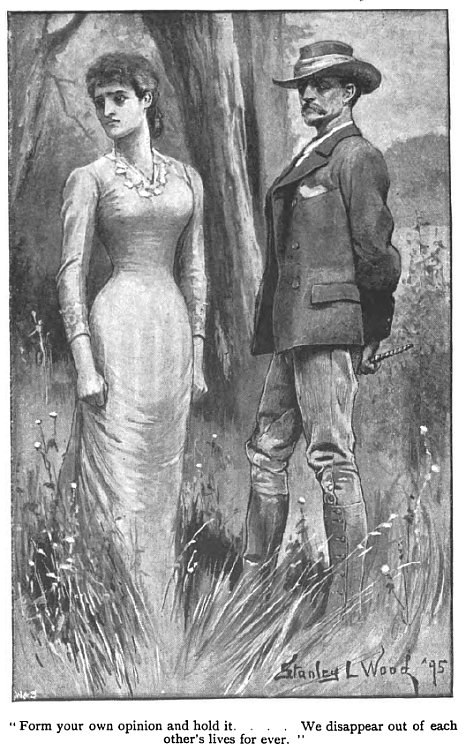
“But you do believe it. You believed it from the first, because that half-start away from me when our eyes first met this morning meant nothing short of belief. That little act of shrinking fixed my mind irrevocably—reft a gulf between us never to be passed in this life. A cold-blooded midnight murderer—and robber—and robber!” he repeated; and now indeed the expression of his face was more than ever like that of a dangerous animal at bay. “And you believe that!”
“But say it is not true! Oh, Roden, say it! Your bare word will be sufficient to restore me, to restore us both, to the blissful heaven we were in before!” she adjured, her voice quivering with anguish.
“Nothing on earth will ever restore that. You killed the possibility that little lightning-like moment when you half turned away from me, looked at me with doubting horror. Now I will say nothing—nothing, you understand. Form your own opinion and hold it, for henceforth it can be nothing to me. We disappear out of each other’s lives for ever.”
Mona made no reply; her face half averted, her lips compressed, her beautiful form erect and rigid. Why was he so terribly strong, with a strength of purpose that was almost appalling, demoniacal, scarcely human in its unparalleled inflexibility? Why did he give no sign of softness, of yielding? She had, as he said, involuntarily, though half-unconsciously, shrunk from him. That was enough. Never again would she see those eyes gladden to the light of hers, never again hear the love tone of that voice. And yet, amid the awful agony of her loss and its realisation, there was still room for that same feeling of shrinking as from the perpetrator of a hideous and sordid crime; and like the mocking whoop of demons in her ears came that cutting, stinging, gibing refrain—the echo of his words, spoken there:—
“Nothing lasts! Nothing lasts!”
She had reached that point where mental anguish becomes physical pain, without in any way losing itself therein. Her brain seemed bursting, her heart refusing to beat. The climax came. She sank down in swooning unconsciousness.
Even then that human being turned to iron repressed the step which he had made towards her—repressed it with a shiver, but still repressed it. Not his the right to touch her—he from whom she had shrunk as from a murderer and midnight robber. Then another thought struck him.
“Yes, it is better so,” he muttered, stepping to the side of the unconscious form, its nobly moulded lines as beautiful as ever in insensibility. “It is better so. Looked at thus for the last time, I can think of her ever as though I had looked upon her in death.”
Then he struggled with himself, fought to restrain the overmastering impulse, for the last time to bend down and press his lips long and hard to her unconscious ones—fought, and conquered, and refrained.
“It would be a murderer’s kiss,” he muttered, between his teeth. Then turning, he lifted up his voice and sent forth a long, loud call.
“Miss Ridsdale has fainted, Suffield,” he said, as the latter came running up. “You had better get her taken to the house. Good-bye, Suffield!”
“Stop, Musgrave, stop!” cried Suffield, who was now supporting Mona’s head. “Don’t go away like that, man. Hang it! after all this time, you know.”
“I won’t shake hands with you, Suffield,” answered Roden without pausing, as he was walking rapidly away to where he had left his horse, still saddled. “You don’t want to take the hand of a murderer—and thief, especially the thief. Good-bye, Suffield.”
He rode away in the broad glare of noontide, the shimmer of heat from the scorching plains rising mirage-like in the distance. The screech of cricket vibrated shrilly upon the burning, glowing atmosphere, to cease abruptly in a silence that was well-nigh as oppressive; then bursting forth again with a strident suddenness which brought back the nerve-racking din tenfold. In the cloudless blue of the heavens, high overhead above the brink of the rock-embattled crest of the mountain range, something black was wheeling and soaring. He looked up, drawn by the distant and raucous cry of the huge bird. It was a dasje-vanger of noble size, like that which he had shot on the eventful day whereon the secret of this new love had been opened to him, and now, in his fierce and hard despair, it seemed that the great eagle was the sprite of the one which he had slain, shrieking forth its hate and exultation.
This then was love! A thing that could take sides with the spiteful clamour of the mob against its object. This then was the Ever Endurable! The first adverse blast had scattered it to the winds. “Mine for ever, throughout all the years,” had been the declaration of that love, yet the course of but a few months had sifted the passionate vow, and had left—a few husks of chaff!
He had gained the “neck” where the waggon road crossed it, and beneath lay the unprepossessing little township. There not a friendly hand would be extended to him, not a friendly voice be lifted in greeting. Those who looked on him would turn their backs, any group he approached would quickly melt away. Yet, for such as these what cared he? Hugging themselves in the security of their sordid daily swindles, in whose very pettiness lay their safety, they would thank God devoutly they were not as he, not as one who had struck down life, sacred life! No, not for the good word, the good fellowship of such as these, cared he. But his mind, seared beyond all further capacity for feeling, reverted to that one heart which was shut towards him, to the pallid death-like face upon whose lips he had refrained from pressing that last kiss, upon those eyes into whose depths he had looked his last upon earth, as surely as though the dull echo of the clods was sounding above a coffin. Yet now—now, while realising the ever-impassable gulf which lay between, he loved her as he had never loved. Yet now he would have given all the world for the one consoling memory of that last kiss, which he had refrained from, had refused. The sterility of those long pent-up springs of love had lent tenfold force to the effort by which at last they should burst their rock-prison—only to end thus. Yet towards the eternal ruling of things it was that all bitterness of feeling was due, not towards her, for had not his uttered premonition from the very first been, “Nothing lasts, nothing lasts?”
That afternoon he sought out his official superior. The latter looked coldly surprised, also a little uncomfortable.
“I desire to say, Mr Shaston, that I have changed my mind. I am prepared to resign my position in the public service, and I have no doubt it will save you a good deal of trouble. If I adopt this course, however, it is subject to one stipulation. I wish to leave at once.”
“When do you desire to leave, Mr Musgrave?” said the other, unbending somewhat, for he was overjoyed. He could get his wife’s relation into the berth now, and would be rid of a subordinate whom he thoroughly hated and at times feared.
“To-morrow at midday, if it can be managed. I shall be prepared to submit everything to your inspection, and formally hand over the keys.”
Shaston readily assented, hardly able to conceal his misgivings lest Roden might think better of it in the interim. He began, however, a pompous commendation of the very proper wisdom displayed in deciding upon such a course, which at once put an end to a very unpleasant state of affairs, and so forth, but found himself ruthlessly but very politely “shut up.” He had got his way, however.
The next day, accordingly, having formally handed in his resignation “on the ground of very urgent private affairs,” and delivered over all that had to be delivered over, Roden prepared for his start. He placed his effects in the hands of an auctioneer, except such few as he cared to remove, and these could follow him at leisure. His intention was to leave the country which had brought him nothing better than an irremovable curse, the curse of a mind roused to feeling again after many years of cold, philosophical quiescence.
In his desolation, his hardly acknowledged longing for one friendly word, the lonely and shunned man thought of Peter Van Stolz. Would he too have turned against him—he with his open, generous nature? Alas, and alas! When love failed, what was friendship? The voice whose quivering whisper had entranced his ear, had irradiated his heart, had been lifted against him in cold condemnation. The head which had lain upon his breast was averted in repulsion. The lips which had kissed his were hardened in scorn. Where then was there room for friendship? Nothing lasts!
Leaving his private quarters, he rode over to the Barkly Hotel, to settle up his score at that sumptuous caravanserai. A group of men were on the stoep, smoking their after-dinner pipe in noisy discussion. His arrival was the signal for a sodden silence. Of this he took no notice—standing in the doorway, with his back to the street, while Jones went inside to receipt the bill.
“And how are ye, Mr Musgrave? It’s a long time since I’ve seen ye, anyway, and me only just back.”
Roden turned quickly. The jolly voice with its touch of brogue, the rusty black coat and stove-pipe hat, the kind face and thick white hair, could belong to no other than Father O’Driscoll. And—he was advancing with outstretched hand. Roden stared, first at that very substantial member, then at its owner. But he did not respond, beyond a stiff bow.
“Ah, an’ is it like ye, to wish to cut an old friend?” said the old man, his hand still held forth, and a look in his eyes that there was no mistaking. For it said, as plain as words, “I know all—all. But understand, I am not called upon to judge you, however some here may reckon themselves to be, God forgive them!”
Roden’s hand closed upon that of the old priest in a warm grasp.
“An old friend, did you say, Father? I am proud of the word as coming from you; of the thing as existing between us.”
“Ah, and what’ll I do now without all our talks about the ould counthry and the fishing? Sure they’ve brought back the chimes of Shandon bells, and the days when I was a bit of a gorsoon a whippin’ the trout out of the Shournagh, wid a long shtick and a crooked pin, faster than the garrison officers could get at ’em with their grand new rods. See now, I’ve only just got back, and the moment I heard ye were leavin’ us I hurried off to find ye. Now come and have a bit of dinner with me before ye leave, and a parting tumbler of punch.”
This in the face of all Doppersdorp, for the benefit of those who had condemned and shunned him. No one was more capable than Roden of keenly appreciating the manner in which his old friend had come forward to stand by him, combining as it did a rare delicacy with the maximum of effectiveness. But this last invitation he could not but decline. To delay his departure even for an hour could serve no good purpose, and he shrank from laying bare so much as a corner of his heart, even to the sweet-natured old Irishman.
The latter, quick to read thoughts, saw through his motive, and did not press him.
“Well, if you’ve got to go I won’t be detaining you. Good-bye, Mr Musgrave,” shaking his hand heartily. “We don’t profess the same creed; but it’ll do ye no harm to know that wherever you go, and wherever you are, there’s an old man’s blessing following you. Good-bye now!”
Such was the end. And as the great spur of the mountain, glowing green and gold in the afternoon sunlight, shut out the last of Doppersdorp behind him for ever, Roden Musgrave was conscious of a feeling of starting forth once more into the world, destitute and alone. Since the day which witnessed his entry into that sordid little township, he had gained that which he had never thought to win again—a restored faith in that marvellous mystery, which, while it lasts, avails to make a very paradise of the heart in which it takes up its most inexplicable abode. Was it a gain? Well, he had lost it now. Never, never could it be restored. Had he done wrong in refusing to speak that word which should exculpate himself? No. Whatever others might think, however circumstances might point most conclusively to the truth, Mona ought to have stood firm. Not for a moment could he admit that he ought to have conceded. Rightly or wrongly that one falling away was enough. Even had he yielded, that would have stood between them for ever.
Now he began to feel strangely aged as he went forth once more into that most dreary of exiles to the man who is no longer young, and whose means are too scanty even for his barest needs—to face the world afresh, that is. In the braced-up strength, and freshness of mind, and elasticity of spirits, of youth, such a prospect is not one to shrink from; on the contrary, it is one which is welcomed with many a buoyant laugh. But later, when strength is waning, and all things pall, and hopes and illusions are laid to rest for ever, buried in a grave of corroding corruption and bitter ashes;—ah! then it is a dark and craggy desert prospect indeed. And as these thoughts started up spectre-like in Roden’s mind, he began to think of death.
Not of the suicide’s death. Oh no. Putting it on the lowest grounds, such an act would be a feebleness, an imbecility, such as found no part within his nature; for it would be a concession to the unutterably contemptible tenet that there existed such a reality as love. Not in him was it to afford such a triumph as that to his enemies, let alone to her who, when tried, had been found so pitiably wanting. No, it was death in its natural order that now filled his mind. Would all things be at rest then? or would it be indeed, as the jarring tongues of striving sects and hair-splitting ’ologies all agreed—the one point on which they did agree—that that death, not so very formidable in itself, was only to open the gate of woe, endless, unutterable, to those who had eaten their full share of the bread of affliction in life—namely, the vast bulk of human kind?
He passed his hand over his eyes. Had it all been a dream? No, no! and yet in a way it had; but a dream from which he had now thoroughly awakened. Nevertheless, as he paced his horse steadily on, mile after mile over the glowing, sunlit landscape, the torment which seethed the soul of this outwardly cool and imperturbable wayfarer might have moved the pity of angels and men. For strive and reason as he would, the love which burnt within his heart flamed more strongly than it had ever done—yet now he had renounced it—and its object he would never again behold in life.
Chapter Twenty Nine.
“O Love, Thy Day sets Darkling.”
The same proud, fearless strength of nature which had allowed Mona to give herself up so unreservedly to this wonderful, all-absorbing love, once she were sure of it, now enabled her to suffer and make no sign. She was not one to wear the willow ostentatiously. Suffield, indeed, was lost in amazement over what he had termed her cool way of taking it. His wife, however, who could see below the surface, knew what a smouldering volcano this “coolness” covered. Sadly, too, she recalled her own words, “Wait until it comes, Mona, and then tell me how enjoyable you find it.” Well, “it” had come, and could anything be a more disastrous, more complete wreck? She would watch her relative with a kind of awed wonder; for Mona never made direct allusion to anything that had gone before. A trifle graver, more reserved perhaps; otherwise as serene, as imperturbable as before. Yet deep down in her heart the wound bled, ached, and throbbed—and that almost unbearably. For she could not move a step without being reminded of the times that were past—if she needed reminding. No way could she turn her eyes without being so reminded. Every object, every feature in the surroundings was fraught with such associations.
Then she would force herself to look things in the face—to take to herself a kind of reckless, bizarre comfort. She had youth, and the glow of healthful beauty throbbed warm and strong within her. The world was great. Life was all before her. And she had pride. She could face the whole world with such an armoury.
There was one thing which, so far as the outside world was concerned, rendered her position easier. There had been no regular engagement. Nothing formal or binding had so much as been hinted at between them. They had been content to live on, penetrating deeper and deeper into the golden mazes of love; no thought for the end, no thought of a barred gate across their way, beyond which should lie a smooth, dead-level road, unending in its placid monotony. Nothing therefore had been “broken off,” nothing claiming explanations, and, more hateful than all, laying her open to condolences.
But the fact that there had been nothing definite between them had its drawbacks. She could not shut herself up; and at times, when visiting among their acquaintances, she would be forced to listen to remarks which cleft her heart, but which she must bear and show no sign; to strictures on the absent one which made her blood surge and boil with suppressed wrath. One such occasion befell about a month after his departure, the time and place being an afternoon call, and the offender Mrs Shaston, who, she suspected, was talking not without design, expatiating to a roomful of people upon what a snake in the grass had been so providentially hunted out of their midst. The hot, passionate blood coursed madly in Mona’s veins, and her eyes began to flash. Suddenly they met those of Father O’Driscoll, who, with his hands crossed on the head of his stick, was seated on the other side of the room as though not hearing what went on. Suddenly the old man leaned across towards the speaker.
“Is it Mr Musgrave ye’re talking about, Mrs Shaston?” he said in his gentle Irish tone.
“Yes. He was once a great friend of yours, Father O’Driscoll, if I remember rightly,” and there was a scarcely veiled sneer underlying the remark.
“Was once a great friend of mine?” repeated the old priest quietly, but in a tone clear enough to be audible to all in the room. “But he is still a great friend of mine, Mrs Shaston, though I doubt if we shall ever meet again, I’m sorry to say.”
It was like flinging a bomb into that côterie of scandalmongers. The lady stared, wrathful—then smiled sweetly. The magistrate’s wife was not an easy person to “put down.”
“As a clergyman you would of course take a charitable view of things, Father O’Driscoll,” she answered, “and I’m sure it’s quite nice to hear you. But we poor every-day people—”
“See here, Mrs Shaston,” broke in the old man, in his most genial tone. “I remember in the old days in Cork springing a riddle on some of the fellows; there was a lot of talk going on at the time, I forget what it was all about, something political most likely. This was it: Why is Shandon steeple like every question? D’ye think they could answer it? They couldn’t at all. The answer was ‘Because there are two sides to it; a dark one and a light one.’”
The application of this was pretty obvious, and gave rise to a constrained sort of silence. Pausing just long enough to lend effect to this, the old man went on, in his frank, merry way. “And the best of the joke is, that some of the fellows, although they’d been born and raised in old Cork, didn’t know that Shandon steeple had two sides at all. I give ye my word they didn’t. They thought it was all dark or all light all round.”
And then, turning to a fellow-compatriot of his, Father O’Driscoll asked whether that particular curiosity of their native city had escaped her notice too, and having launched forth, manoeuvred from one droll anecdote to another, of course leading the conversation farther and farther from the topic of Roden Musgrave; whither indeed it did not return upon that occasion.
By accident or design, Grace Suffield and her cousin took their leave at the same time as the old priest.
“Why do you never come out and see us, Father O’Driscoll?” said Mona, as they gained the street. Her eyes were eloquent with thanks, with unbounded appreciation of the tactful, yet unequivocal manner in which he had championed the absent. “We have not the claim upon your time which your own people have, still you might ride out and see us now and then.”
“Ah, don’t be putting it that way, Miss Ridsdale. Sure, we’re always very good friends in spite of our differences, are we not, Mrs Suffield?”
“I can’t answer that, Father O’Driscoll, until you positively promise to come out and dine with us at the very earliest opportunity,” replied Grace. “My husband will drive in and fetch you and take you back again, if you will only fix the day. If you don’t, why, then I sha’n’t believe you mean what you say.”
“Our friends do come and see us, Father O’Driscoll,” added Mona with meaning; and her eyes again were eloquent, for they said, “You at least were his friend. You at least lifted up one voice on his behalf, and that with no uncertain sound, when all tongues clamoured against him. I want to say more about it, and—perhaps about him” And it is probable that their meaning was read aright, for the required promise was readily given, and as, having bidden the ladies good-bye, Father O’Driscoll took his way down the street, he shook his head sadly to himself as he thought over what had happened; for the heart of this sweet-natured old man was very full of the pain and trouble and separation which had come upon these two.
Beyond the successful working out of it, Lambert had not taken much by his vindictive scheme. In fact, he had taken rather less than nothing; for if he expected to find the road now clear, or at any rate rapidly becoming so, into Mona’s good graces, why, then he never made a greater mistake in his life. She would hardly speak to him, and then only to snub him pitilessly, and with a cold and haughty politeness which left him no road open for a colourably dignified retreat. His revenge must be its own reward. Well, at all events, he had that.
So had Sonnenberg, but he, at any rate, fell into evil case. For he was a good bit of a Lothario of a kind, was this vindictive and plotting child of Israel, and somehow it happened that during the height of his exultation over the utter discomfiture of his enemy, a great and mighty fall awaited himself; for in the very thick of an intrigue whose central figure was a native damsel, “black but comely,” he was surprised by a party of Kaffirs, and most soundly and unmercifully thrashed. Now prominent among the thrashers was the thrashee’s former store-boy, Tom; wherefore the rumour failed not to creep around, that Roden Musgrave had bequeathed a debt of vengeance and a largess to that sometime warrior; and, in short, that Sonnenberg had walked blindly into what was nothing less than a cunningly devised and successfully baited trap. Whether this was so or not, we are uncertain. But the evil Jew, though his bruised bones smarted for many a long day from the whack of the Kaffir kerries, dared make no public stir, by reason of the very circumstances of the case, towards securing the punishment of his assailants; wherefore these went unpunished, and laughed openly.
So time went on, and weeks grew into months, and even the strange affair of Roden Musgrave became ancient history in Doppersdorp, and discussion thereof began to pall, except upon “old Buzfuz,” who was never tired of publicly thanking Heaven for having chosen him as its instrument in unmasking and driving from their midst a most wicked and dangerous impostor; and Roden’s successor, a good-hearted sort of youth of the very ordinary type, fell desperately in love with Mona, but at a distance; and Grace Suffield thought regretfully over that terrible night in the post-cart, and wondered uncomfortably if they had not given their support to a very great act of injustice; and her husband ceased to think any more about it; and things jogged along in Doppersdorp pretty much as they had always done. And some wag, of malice aforethought, turned loose the whole of Emerson’s “Chamber of Horrors,” the ingredients composing which spread themselves over the township, and took a week to collect, save such as incontinently retreated to their native wilds, and two snakes which got into the bank-house and bit Emerson’s native boy, involving much treatment from Lambert, for which their owner had to pay, swearing terribly.
Thus several months went by.
Chapter Thirty.
The Portal of the Shadow.
The R.M.S. Scythian, homeward-bound, was steaming through the smooth and fast darkening waters of Table Bay.
She had hauled out but two or three hours since, and now, as the flashing light of Robben Island was dwindling astern, the second dinner bell rang forth its welcome summons; welcome this evening, at any rate, for, as we have said, the water was smooth, and it would take a very determined sea-sick person indeed to remain away from table. So the passengers, of which there was a full complement, trooped in, to a man and to a woman, and there was much arranging of seats, and a little of discontent with the result of such arrangement.
“This is your seat, sir. And the captain sends his compliments, and hopes to be down before dinner is over.”
Roden Musgrave took the seat indicated by the steward. It was the end chair of one of the three long tables, which ran the length of the saloon. That at the head of the table was the captain’s chair, at present empty. Unoccupied, too, was the seat on the captain’s right. The others were all filled.
He cast a careless glance over the brilliantly lighted saloon, with its sparkle of plate and glass and coloured fruit, and vari-hued dinner-dresses. There were a great many passengers of the usual type. Some might prove good company. Those in his own immediate neighbourhood did not look interesting.
In silence he began his dinner, for he felt depressed. It seemed but yesterday that he was seated exactly as he was now, yet more than a year had gone by since then. A year is nothing of a time, but this had been such a year—for it had comprised a great experience. And now he was leaving this land, whither he had come to try his latter-day fortune; leaving it for ever; himself in far worse case than when he had first sighted it. A hand dropped on his shoulder, and his musings were dispelled.
“Well, Musgrave, I’m glad we’re to have the voyage home together, and it has come about sooner than either of us expected.” And Captain Cheyne, resplendent in gold lace and shining buttons, slid into his seat at the head of the table. They had met already on board and exchanged a hurried greeting in the bustle of hauling out, but had had no time for more than a word.
“Yes, I arranged it so, when I saw that you had got this ship. I say, though,” looking around. “She’s a cut above the old Siberian, both in size and fittings, eh?”
“She is. Well, and how have you been getting on? Been at that place—er—er—I forgot the name—that none of us knew where to find, ever since?”
“No. I’ve just come off Pilgrim’s Rest gold-fields, so called, presumably, because the ‘pilgrims’ leave there the rest of whatever they took with them.”
Two or three in the neighbourhood laughed at this, and the conversation became general. But Roden dropped out of it. Mechanically, he took up the wine-list, and began studying it. While thus engaged he heard the rustle of skirts. The occupant of the empty chair was seating herself. Even then, so utterly without interest in her identity was he, that he did not immediately look up.
“Shockingly late, I’m afraid, Captain Cheyne. But I was doing a lot of unpacking, and time ran on.”
Then he did look up, and that sharply. The whole room seemed to go round, yet outwardly he was as composed and imperturbable of feature as ever he had been in his life. But even to him that moment brought a powerful shock. For, in the occupant of the hitherto vacant chair, he found himself, thus suddenly, unexpectedly, marvellously, face to face with Mona Ridsdale.
Her apologetic remark, laughingly made, ended with a little catch of the voice, as she caught sight of him. She, too, was undergoing her share of surprise, marvel, agitation, but was bravely self-possessed. The quickened heave of the full, beautiful bosom, as revealed by the low-cut dinner-dress, and the wide, appealing dilation of the clear, hazel eyes, were read in all their significance by one; but to the rest they might be due to a not unnatural flurry, consequent on her late appearance. Then both heard, as a far-away, misty-sounding hum, the voice of the captain, introducing them to each other.
This was a happy solution. In their present state of mind, any admission or sign that they were previously acquainted, could not fail to afford some indication of the nature of that acquaintance; and more especially did this hold good of Mona. At any rate, it would draw attention to them both; which in the agitation evoked by this startling surprise was the very last thing they desired. But luckily, the conversation, once it had become general, did not drop; the more so, that a voluble lady, two seats off, began asking the captain question after question of the usual type, varying between the mildly idiotic, and the hopelessly, frantically insane, such as whether he had ever seen so many passengers not sea-sick before; or, if they would reach Plymouth at night or in the daytime—Plymouth then being three weeks distant—or whether a ship like the Scythian would sink at once, if rammed by a sword-fish, or would allow them sufficient time to take to the boats. All of which caused the captain to nudge Roden under the table, while his bronzed and handsome visage wore a comical look of resigned, hopeless patience.
“Remember our last glass together, Musgrave?” he said, as soon as he could conversationally break away. “We’ll do a first one again now,” as the steward deftly popped the cork of a champagne bottle. “What do you think, Miss Ridsdale? When we dropped anchor in the bay he found himself appointed to some place up-country. He bet me a bottle of this stuff I couldn’t tell him where it was, and he won, for, by George, I couldn’t. The best of the joke was, we could hardly find any one who did know. What was the name of the place, Musgrave?”
“Doppersdorp.”
“Doppersdorp. Of course it was. We passed the word, ‘Where’s Doppersdorp?’ and hanged if any one knew. Well, I suppose you found it at last?”
“Oh yes.”
“Did you go to the gold-fields from there?”
“No, I put in about a month at a place called Barabastadt, with my old friends the Van Stolzes. He’s R.M. up there now.”
“Van Stolz? I know him,” said the captain. “He used to be in the Customs, or something, at Port Elizabeth years ago. He was only there a little while though. A thick-set, brisk, jolly little man, isn’t he?”
“Yes. That’s him.”
“I remember him. Good sort of chap, although he’s a Dutchman.”
“Good sort of chap!” echoed Roden. “I should rather say he was. He’s a rare specimen in this world, I can tell you. One who once a man’s friend remains so for life.”
Mona bent down over her plate to hide the sudden rush which welled to her eyes. He was too cruel. The tone—light, easy, cynical—conveyed no special meaning to the other listener. But to her—ah! she felt the full force of its lash. During the foregoing, the other passengers had fallen into their own conversation, leaving this to the trio who are our special acquaintances. But if Roden edged his words with a bitter sting, discernible only to the ears of the one who knew what lay behind them, it was that he felt bitter at that moment—cruelly, remorselessly bitter. Why had she thus risen up before him to revive the sweet and witching mockery of that utterly hollow past? There she sat, in all the bewildering beauty of her splendid form, all grace and seductiveness; she who had so passionately, so fervidly vowed herself his—his for ever in life and in death. There she sat, only the width of the narrow table between them, yet as far removed as though an impassable gulf a thousand miles in breadth divided them. For she had fallen away from him in the hour of trial, and his faith in her was killed. ‘For ever in life and in death!’ had been the hollow ringing vow. ‘In death?’ Ah! that might be; in life, never. And then a strange, weird, ghostly presentiment came upon him, like the black edge of a shadow, as he sat there satiating his eyes with this vision of a most entrancing embodiment of deception, the while mechanically sustaining his share or the conversation.
The saloon was brilliant with light and life, cheerful with voices, for the crowded diners had now found their tongues, presumably about halfway down the gradually decreasing bottles. Laughter?—Oh yes, plenty of that—airy feminine laughter—with the explosive male guffaw. Knives and forks clattered, corks popped. Oh, plenty of light and life here; but without—the dark waters, deep and wide, the dim expanse of unfathomable ocean lying black beneath the stars. “For ever—in life and in death.”
“And how many big nuggets did you pick up on the gold-fields, Musgrave?” said the captain presently.
“Nuggets? Fever’s more plentiful around there than nuggets, and dust than gold-dust,” answered Roden wearily. “The place is a fraud.”
His vis-à-vis was watching him now. Yet the feeling which she had so valiantly repressed came near overpowering her once more, as she noted the change which had crept over his appearance. He seemed to have aged, to have grown leaner and browner, as though he had gone through a hard, hard struggle, bodily and mental, of late. And from the bronzed complexion, wind-swept, sun-tanned by months of open-air life, of toil and exposure, the strange double scar seemed thrown out more prominent, more livid than ever. It was marvellous, well-nigh miraculous, that they should have met again thus.
She too showed traces of the struggle. There was a tired, wistful look about the eyes, the suspicion of a melancholy droop at the corners of the mouth, which imparted to her face a very different expression to that of the self-loving, self-indulgent, and rather heartless Mona whom he had first beheld reclining easily, sensuously, in her hammock under the green willows at Quaggasfontein, now more than a year ago. Had she too suffered? Why then had she been found so lamentably wanting when put to the ordeal? Surely a nature which had proved so weak could have no great capacity for suffering, at any rate, for any length of time. No, it was all a most miserable mistake, all too late. This wonderfully unexpected meeting had shaken him more than he cared to allow. The wound, barely skinned over during these six months or so, now broke open again and bled afresh—bled copiously. More careless, more terse became the tone of his conversation, and beneath it lurked a biting cynical sting, as of the lash of a whip.—Not altogether could his glance refrain from that royally moulded form opposite him, and meeting the tender, wistful appeal of those clear hazel eyes, there shot from his own a flash as of contempt too deep even for resentment. Thus did he arm, fence himself against his own weakness.
The dinner was over at last, and several of the ladies were already leaving the saloon. Mona rose.
“I think I will go on deck for a little,” she said. “Is this delicious smooth weather going to continue, Captain Cheyne? I am a most wretched sailor.”
The captain responded gallantly that he devoutly trusted it would, and she left them. And now that her presence was withdrawn, it seemed to Roden that a blank had fallen. Yet he had but to ascend the companion stairs. It seemed to him that her very announcement embodied an invitation. Still he remained as firmly fixed in his seat as though nailed there. And nailed there he was—by the long, jagged, rusty, and passingly strong iron of an unbending pride. She had turned from him once; was he to go begging to her feet now? No—no. A thousand times, no.
“Nice girl, isn’t she?” said Cheyne, reseating himself and refilling Roden’s glass. “Fine-looking girl, too.”
“She seems alone. Is she under your charge?”
“Not exactly that. She came on board at Port Elizabeth, and I made them put her place next me here at the table. When I got your letter saying you were going to join us at Cape Town, I moved those other people a place up. At any rate, we’ll have a snug corner for the voyage, eh?”
Another surprise was in store for Roden. A group of male passengers who had occupied places at the far end of the saloon was passing them on the way out. Before he could reply his glance was attracted by the face of one of these. It was that of Lambert.
Their glances met. Far less under the control of his feelings than the other the young surgeon gave a violent start, and a half-uttered exclamation escaped him as he met the indifferent, contemptuous gaze of the man whom he had injured. But quickly recovering himself, he passed out with the others.
Lambert, of all people in the world! What on earth was the fellow doing here on board? Oh, the reason was not far to seek, he thought, in derisive pity for his own weakness, with which during the last hour he had been so exhaustively battling. And yet things didn’t seem to fit in, for here was Mona sitting alone at the captain’s table, while Lambert was right away at the other end of the saloon. That was not the explanation. It might be a coincidence that the two were on board together, just as his own presence there was. As before at Doppersdorp, so now, Lambert did not count for anything in the affair.
“Seems to me, Cheyne, you’ve got all Doppersdorp on board,” he said. “First Miss Ridsdale, then that cotton-headed chap who just went out. Now trot out a few more of them.”
The captain stared—then laughed.
“So you knew each other before, did you? Deep dog, Musgrave, deep dog!”
“Oh yes, considering I was there the best part of a year,” he replied, offhandedly. “But that fellow you saw just now making faces at me is a good bit of a sweep. I don’t care about having much to do with him.”
Lambert’s presence on board did away with the expediency, or indeed the advisability of reticence, and it was as well to tell his own story first. So they sat there a little longer, and he gave Cheyne a sort of outline of a good deal—though not all—that had befallen him since they said good-bye to each other last.
“Come round to my cabin for a smoke before turning in, Musgrave,” said Cheyne, as he rose from the table. “I must go on the bridge a bit now, but I’ll send and let you know when I come down.”
Quite a goodly number of passengers were sitting about, or walking the deck, as Roden emerged from the companion. It was a lovely night, and great masses of stars hung in the zenith, their reflections mirrored forth on the smooth surface of the sea, rivalling the phosphorescent flashes glancing like will-o’-the-wisps rising and falling in the dark depths. The loom of the coastline was hardly discernible, for the captain chose to keep plenty of sea room along that dangerous and rock-fringed shore; but the moist, dewy atmosphere, fresh with the salt breaths of the great deep, was delicious; and ever with the voices and laughter of the passengers mingled the steady clanging of the engines, and the mighty churning throb of the propeller, and the soft, soughing wash of the scintillating, blade-like wave curving away on each side of the cut-water of the great vessel.
Roden, moving leisurely in the gloom, tried to persuade himself he was glad, for his eyes rested not upon that well-known form; and in all good faith he did not feel certain whether he was or not, so over-powering had been the shock of the surprise. Then, leaning over the bulwarks, he gazed meditatively forth across the starlit waste of black waters to where the uncertain loom of the land was fading on their starboard quarter, and as he did so all the morbid side of his character came to the fore. Was ever a more utterly forlorn, aimless, God-forsaken wanderer afloat on life’s sea? Here he was returning, with what object he knew not, poorer in pocket, a good ten years chipped out of his life—at least it seemed so—and nothing to look forward to on this side the rave. And by a strange coincidence, separated from him only by the few inches of iron and planking immediately beneath his feet, stood one other gazing forth through the open scuttle at the same starlit scene of sky and sea. With a weariful sigh Mona turned away from the window; then, opening her dressing bag, she took out a small bottle and held it to the light. Yes, she would do it. Only a few drops. Sleep was what she wanted—sleep, sleep—blessed—oblivious sleep, sweet, illusion-bringing sleep.
Chapter Thirty One.
“Dark Roll the Deepening Days...”
In the very circumscribed limits of shipboard it is difficult enough for any two people who want to avoid each other to do so. Given, however, two who are, even in spite of themselves, animated by no such wish, the thing is well-nigh impossible.
Thus it proved to these two. Roden Musgrave, for all his steel-plated armour of pride, for all his strength of purpose, was conscious of a weak place, of a joint in his harness. Deep down in his heart was a great craving, even for a little while, for the old time as it had been. Again he reviewed all that had gone before; again he began to find excuses for her. She had been startled, shocked, horrified. She had been “got at” by Suffield, who, he feared, was at heart a bit of a sneak. Moreover, he himself had hustled, had scurried her too impetuously. A little further time for reflection, for accustoming herself to the—it must be owned rather startling—idea, and she would have acted very differently. He had expected too much—had unconsciously fallen back into the old, old blunder of his salad days, expecting to find something of the nature of an angel; discovering, of course, only a woman.
Not all at once did he come round to this change of opinion. He could not forget that she had believed the charge against him in its entirety—believed that he had treacherously slain a comrade for the sake of robbery; and a very paltry robbery at that. That she should believe him guilty of the homicide was nothing; but of theft! No, that he could never forgive.