"A Veldt Official" (continued 4)
Reading edition
“Game lies close—that’s a good sign,” meditated the horseman. “But it goes like the devil once it is up—that’s a bad one. Well, it may be a good one too, meaning only that this section has been well patrolled.”
It was tantalising, very, as he watched the animals bound away in gracefully flying leaps, affording the sweetest of shots from the saddle. But he who now rode there dared not pull a trigger, for it might easily cost him his life, and that was a possession he did not want to lose just then.
It was an exciting ride withal—keenly so; for every turn of the way might bring him face to face with an enemy. If he topped a rise of the ground, might he not run right into the teeth of a hostile band on the other side? As he rode along the slope of a bush-clad hill, for he avoided the bottom of defile or ravine, he more than half expected the “whizz” of missiles from the ambushed savage lurking concealed above. Yes, it was an exciting ride, a perilous ride, yet he travelled at an easy pace, knowing better than to fall into the blunder of pressing his steed in order that it might the more quickly be got over.
At first he enjoyed the exciting possibilities of the journey—the strong dash of peril—as, keenly on the alert, he urged his steed forward. It reminded him of old times. But each and every excitement has its limits, and as the hours went by the tension relaxed, the strain upon his nerves subsided. He began to think upon other matters than potential danger. That last farewell under the stars—the recollection of it coursed sweet and warm through his being; his pulses bounded with the very gladsomeness of living. Soon they would meet again, and—what a meeting!
For this voluntary absence of his had borne its fruit. But a few days; yet it had seemed to need only this to consolidate and weld this strange, bewildering love of his latter-day life. In the rough duties he had voluntarily undertaken during that brief period—the patrolling, the tireless bivouac under the stars; the shots exchanged with the lurking enemy; the jovial, but not very boisterous revelry of camp life—that image was ever-present, sweet, smiling, radiant-eyed; and try as he might, he could not banish it.
Now the shadow of a cloud swept across his path, together with a gleam of blue lightning. Creeping stealthily up, their jagged outlines gradually obliterating the blue arch, leaden cloud-piles were spreading, and puffs of hot wind set the grasses singing. In sharp, staccato boom, the electric voice spoke overhead, but no rain fell. It was a dry thunderstorm, often the most perilous.
He was riding just beneath the apex of a long, sparsely-bushed ridge. Already, as he began to descend, the lightning was darting down upon the height in vivid streams, which the sharp, startling thunder-crack seemed to accompany rather than to follow.
“This is getting a trifle sultry, and the veldt here is crusted with ironstone,” he said to himself. Then turning his horse, he held ever downward. Half-darkened, the scene was now desolate enough—the long slopes of the kloof, and the ridges cut clear against the livid thundercloud. Down in the hollow several “bromvogels,” the great black hornbill of South Africa, were strutting amid the grass, uttering their drumming bass note. These flapped away heavily on the near approach of the horseman, and rising high overhead, were soon winging their aerial course seemingly to the thundercloud itself.
Suddenly the horse stopped short, and, with ears cocked forward, stood snorting, with dilated eyes gazing upon the dark line of bush in front. Roden’s meditations took to themselves wings, and drawing his revolver, as more convenient at close quarters than the rifle, shifted the latter into his bridle hand, and sat for a moment intently listening.
Not a sound.
It was a nerve-trying moment. The savage war-shout, the crash of firearms, the “whiz” of assegais—that was what it would only too likely bring forth. Still silence, save for the bass grumblings of the thunder.
Then there was a winnowing of wings, and a huge bird arose. Roden knew it for a vulture, of the black and non-gregarious kind. A vulture! That meant the presence of death.
So far reassured, for the bird would not have been there had the scrub concealed living men, he cautiously made his way between the bushes to the spot whence he had seen the funereal scavenger arise, and again the horse started and shied, spinning half round where he stood. One glance, and the secret was out. In the long grass lay the body of a man—a Kaffir.
It had been that of a savage of splendid proportions—tall, broad, thick-set, and muscular. It lay upon its back, staring upward with lacerated eyeless sockets, their contents torn out by the black vulture. Otherwise it was untouched.
Stay—not quite. From a great jagged hole in the chest a very lake of blood had welled, staining the long grass. It was a bullet hole; the sort of gap made by a heavy Snider missile. The man had been shot. But how? when?
The body was quite naked, and whatever it might have owned in life, in the shape of weapons or other requisites, had disappeared. From its aspect, not many days could have elapsed since death. It was a ghastly find, this black, rigid corpse, with its eyeless sockets and teeth bared and set; a ghastly find in the subdued gloom of the shadowing thundercloud, with the blue lightning playing down upon the lonely veldt. But there was worse to follow.
For, exploring farther, Roden came with equal suddenness upon several corpses, half a dozen at least. All were contorted as in the agonies of a violent death, and all were riddled more or less with bullet wounds. What was the secret of this conflict here, he wondered? Who had been engaged in it? Whose the victory? Would he next come upon the bodies of those of his own colour? Looking up suddenly his eyes fell upon a most melancholy object. It was the charred remnant of a burned house.
Now the mystery stood explained. Those whose remains he had found had been shot down by the inmates; slain in self-defence. But, those inmates! Clearly the savages had been victorious; and—what of the inmates?
The walls stood, the dirty whitewash showing livid in contrast to the black, charring action of the names. The roof had fallen in, and the empty apertures, where the windows had been, gaped wide like the staring, sightless sockets of the corpse. The house had been of no great dimensions, and was clearly the dwelling of some small farmer. A low, crumbling sod wall shut in a sorry-looking “land,” containing now only a few trampled cornstalks; and hard by were the broken-down fences of a sheep kraal.
Strong-nerved as he was, Roden Musgrave could not repress a quickening of the pulses, a shrinking of the heart, as he drew near to explore the interior of the ruin. What further dread secret was he about to light upon? The mangled corpses of the white inmates, entombed beneath their own roof-tree, a prey to the devouring assegai of the savage? He expected nothing less.
But a very few minutes’ search convinced him that the place contained no human remains. He was puzzled. What had become of the unfortunate settlers? That there had been a fierce and sanguinary battle was evident, but it was impossible that the savages could have been beaten off, else would the house not have been fired. Herein was a mystery.
The situation of the place was gloomy and forbidding to the last degree, the black rain standing deep within that lonely kloof, and, lying around, the grim earthly remains of those who had assailed it. Opposite rose a rugged cliff, whose brow was crowned with a grove of fantastically plumed euphorbia; and then as his eye caught a stealthy movement amid the gloom of the straight stems, Roden gave a slight start, and immediately was as ready for action as ever he had been in his life.
Yes, something was stirring up there. The moment was rather a tense one, as standing amid those weird ruins he bent his gaze long and eagerly upon the darkness of the straight euphorbia stems, round, regular as organ pipes. Shadowy figures were flitting in and out. Were others creeping up to assail him in the rear, signalled by these? Was he in a trap, surrounded? Then he laughed—laughed aloud; for there went up from the euphorbia clump a strong, harsh, resounding bark:—
“Baugh-m! Baugh-m!”
“Only baboons after all!” he cried, feeling more relieved than he cared to own. And seeing nothing to be gained by further lingering, by extended investigation, he once more mounted his horse and took his way out of this valley of desolation and of death.
And as he gained the opposite ridge, he found that the storm was clearing away, or rather travelling onward. Before him lay a series of grassy flats, fairly open, but dotted with clompjes of bush here and there. The sun had broken forth again, and, the cloud curtain now removed, was flooding the land with dazzling light. The change was a welcome one, and had the effect of restoring the traveller’s spirits, somewhat depressed by the grim and gruesome scene he had just left. And now, as the sun wanted but an hour to his setting, Roden decided to off-saddle for that space of time. Then his steed, rested and refreshed, would carry him on bravely in the cool night air, and but a very few hours should see him safely over the hostile ground, if not among inhabited dwellings once more. So, choosing a sequestered hollow, Roden off-saddled and knee-haltered his steed, and then betook himself to a little clump of bush which grew around a stony kopje, and which afforded him a secure hiding-place and a most serviceable watch-tower, for it commanded a considerable view of the surrounding veldt.
Chapter Twenty.
Mona’s Dream.
Notwithstanding the splendid courage and quickness of resource she had shown upon a certain critical and, but for those qualities on her part, assuredly a fatal occasion, Mona Ridsdale was by no means free from that timidity under given circumstances, which seems second nature with most women. She preferred not to be left alone in the dark if possible to avoid it, and, in fact, had as dread a realisation of what it meant to be “unprotected” as the most commonplace and unheroic of her sex: consequently, when Suffield found it unavoidable to be absent from home a night or two, Mona was apt to conjure up terrors which interfered materially with her peace of mind. Now, just such an absence on the part of her male relative befell some few nights after Roden’s departure for the Main Camp.
“Oh, Grace, I do feel so nervous this evening!” she exclaimed, starting, not for the first time, as one of the ordinary nocturnal wild sounds from veldt or mountain-side came floating in through the open windows. “Feel my hands, now cold they are; and yet it is such a hot night that one wants every square foot of air the windows will admit.”
“That is foolish, Mona,” replied her cousin. “Yes, your hands are indeed cold. Why, to-morrow will ring back not only Charlie, but perhaps somebody else.”
“God grant it may!” was the eager rejoinder. “But do you know, Grace, I have a horrible presentiment on that score too; I believe that is why I feel so shivery to-night. It is like a warning—I feel as if something were going to happen to him—were happening!”
There was a wildness in the glance of the dilated eyes, a quick, spasmodic catch of the voice, which disconcerted the other, who, in ordinary matters, was the less timid of the two.
“Mona, dear, don’t, for Heaven’s sake, give way to such fancies. They grow upon one so. And how you will laugh at them—at yourself—in the morning, when Charlie comes back, and perhaps somebody else.”
“I can’t help it. I wish the night was over. I am sure something is going to happen before the morning.”
The two were sitting together, the supper over, and the nursery department tucked up, snug and quiet for the night. Suffield had ridden away to attend a sale at a distance, and would hardly return before the following afternoon. It was, as we have said, a hot night, and both windows of the room were open; indeed, it would have been well-nigh impossible to breathe had they been shut. At the black spaces thus framed Mona would stare ever and again, with a quick glance of apprehension, as though expecting, she knew not what, to heave into view from the gloom beyond. It was a still night, moreover, and every sound from without was wafted in with tenfold clearness—the weird shout of a night-bird from the mountain-side; the yelp of a jackal far out upon the plain; the loud and sudden, but musical twanging note of the night locust, whose cry can hardly be credited to a mere insect, so powerful, so bird-like is it. Even the splash of a mud-turtle waddling into the dam was audible.
A rushing, booming, buzzing sound swept past the open window. Mona started again, and her face paled. It was only some big flying beetle, blundering past the oblong of light which had half-attracted, half-scared him; yet so overwrought were her nerves that she could hardly repress a startled scream. Now, this sort of thing is catching, and Grace Suffield felt that a little more of it would probably end by unnerving herself.
“My dear Mona,” she said; “this is more than nervousness. You have caught cold somehow. Come now, you must go to bed; and I will make you something hot.”
“I can’t go to bed, Grace, and I couldn’t sleep if I did,” she answered. “Let’s go out on the stoep. The air may make one feel better.”
To this the other agreed, and they went forth. It was a grand and glorious night. A faint moon hung low down in the heavens, and the great planets gushed their rolling fires in the star-gemmed blackness. Such a night had been that other, when only the dark willows had overheard those whispers—deep, pulsating, passionate—welling from the overcharged hearts and strong natures of those who uttered them.
“Look, look! That is almost bright enough for a meteor!” cried Mona as a falling star darted down in a streak of light, seeming to strike the distant loom of the mountain range in its rocket-like course. “There is something weird, to my mind, about these falling stars. What are they, and where do they go to?”
“Everything is weird to your mind to-night, dear. Come in now, and go to bed.”
“Not yet, Grace. I feel better already. I knew the air would do me good. Look there! what is that—and that?”
Her tone now belied her former words—her limbs shook. And now both stood listening intently.
For there floated upon the still night air a sound—an eerie, wailing, long-drawn sound—faint, yet clear; very distant, yet plainly audible; rising and falling; now springing to a high pitch, now sinking to a muffled, rumbling roar—yet so faint, so distant. Far away over the darkened waste where the great castellated pile of the Wildschutsberg rose gloomy beneath the horned moon, there hovered a strange reddening glow. At the sound the dogs lying around the house sprang up, baying furiously.
“Grace, I believe the Tambookie locations out yonder are up in arms. That is the war-cry—they are dancing the war-dance. Listen!”
Here indeed was a potential peril, a tangible one, and removed from the spheres of mere bogeydom. There had been uneasy rumours in the air of late—that the Tembu locations on the confines of the district were plotting and restless, and more than ready to rise and join their disaffected fellow-tribesmen now in open rebellion beneath the slopes of the Stormberg. No wonder if these two unprotected women felt a real apprehension chill their veins, as they stood upon the stoep of their lonely homestead gazing forth with beating hearts, listening to these ominous sounds rising upon the stillness of the night. The distance which separated them from the disaffected savages was not great, hardly more than half a score of miles.
“Even if it is so, I don’t think we have anything to fear,” said Grace at last. “They would go in the other direction if they moved at all; either cross over to join Gungubele’s people, or Umfanta’s, or perhaps move down to league forces with the Gaikas. They would hardly venture so near the town as this.”
“Move down to league forces with the Gaikas?” echoed Mona, horror-stricken at the suggestion. “Why, that would mean that they would cross the very belt of country over which lay Roden’s return route.”
Grace Suffield was quick to grasp her meaning.
“No, no; not that, dear,” she said. “I don’t believe myself there is anything to be alarmed at. I believe they are only making a noise; possibly they have a big beer-drinking on, or something. Kaffirs, in their way, are just as fond of jollification as we are, you know; and I think I remember more than once hearing something of the kind before, only as there was no war on, or even dreamt of, we hardly noticed it at the time, I suppose. Yes, I am perfectly certain that is all it means; so now come in, and we’ll go to bed. You shall sleep in my room if you like.”
Mona suffered herself to be led in, and to be given wine, and generally taken care of: but curiously inconsistent, for all her nervous fears, she preferred to be alone. Then, bidding her relative good-night, she retired to her room, and having fastened the shutters and locked the door, she sat down to think.
Her thoughts flew straight off to one who now was the main object of them. Where was he at that moment? Returning to her, travelling at all speed over a peril-haunted region to return to her, alone perhaps, as he had hinted might be the case; and more than one unspoken prayer went up that it might not be so, or for his safety if it were. Then her recollections went farther back. She recalled many to whom she stood in the same light as she now did to that one—from their point of view, that is—yet none had succeeded in stirring her heart, in causing her pulses to beat quicker, or, if so, for no more than a moment, so to say. She recalled many an impassioned pleading, many a haggard face, grief-stricken, disappointed, down to that of Lambert only the other day, and wondered if they had felt as she would feel were any evil to overtake that one now. How cold, how callous, how inconsiderate she had been to others, she recognised now; and as her thoughts turned to him she felt that, but for the certainty of seeing him again, of all the blissfulness of their reunion, and that in a day or two at the furthest, her life would have been lived—lived and done with for all time.
The house was in dead silence, as in the solitude of her room at last she began to prepare for bed. She had just finished brushing out the thick waves of her hair, when a dull rumble, as of many feet, not far from the window, turned her pale and tottering. Her heart beat like a hammer, and the splendid outlines of her breast, now uncovered, rose and fell with the quick regularity of the roll of surf upon a level beach. Then with the stamping tread there arose a low moaning noise, long-drawn and unspeakably dismal in the dead midnight silence.
“What a despicable coward I am!” she exclaimed, now with a faint smile. Then, with a glance at her magnificent limbs, “I am large framed, and strong, yet the least little thing makes me quake and quiver like a scared child.”
She threw open the shutters, and, as she did so, again went up that unearthly, deep-throated moaning, ending in a short shrill bellow. But she knew the sound. The cattle had returned about the homestead, and were collecting at the spot where a sheep or goat was daily slaughtered for the use of the household and the farm hands. In the faint moonlight she could see the beasts bunched together, their noses down to the blood-soaked spot, sniffing and pawing up the ground as they emitted their dismal mutterings; then they would start off, with tail in air and horns lowered, and career a little way across the veldt, and return, as though the fell fascination was greater than the terror which had first appalled them, to resume their weird, hollow groaning as before. The dogs, well accustomed to this performance, forbore to notice it, beyond a low growl or two. Besides, they held the horns of the excited beasts in wholesome respect.
Closing the shutters again, Mona returned into the room. Just as she was about to get into bed, her glance was attracted by something. A great dark object was moving across the floor. Repressing an impulse to shriek aloud, she lowered her candle so as to dispel the shadow in which the thing moved, for it was under the table, and then with a shuddering horror she saw that it was a huge tarantula.
The evil-looking beast was of enormous dimensions. Outspread, it was the size of a man’s hand, and its great hairy legs and dull, black, protruding eyes gave it the aspect of a demoniacal looking animal rather than a mere insect, as it came shoggling across the floor; then stopped suddenly, as its instincts warned it of danger.
All in a quiver of loathing and repulsion, she snatched up a large book of bound-up music, and dropped it upon the hideous insect. She left it where it lay, not caring to investigate farther; knowing, too, that the thing would be crushed and flattened out of all life and shape beneath the heavy volume. Where did it come from? Tarantulas were quite rare in that high, open, bracing veldt, though plentiful enough in the lower and hotter bush country. But even there she had never seen one anything like this for size.
The nervous fears which had beset her throughout the evening had brought something like exhaustion in their train. No sooner was the light out, and her head upon her pillow, than she was fast asleep. Yet sound though her slumbers were, a thread of uneasiness ran through them. Outside, in the faint moonlight, the cattle still clustered about the bloodstained spot, and even in her sleep she could still hear the pawing of their hoofs, and the unceasing refrain of their dismal and hollow groanings, half-soothing, half-terrifying in the mesmeric effect which they produced upon the ever-changing waves of her consciousness, that hovering border-line between wakefulness and the dream world. She murmured the name of her absent lover, and again, in her sleeping visions she was soothing him to rest in the still midnight, as he lay in feverish pain, but a few hours after she had drawn him back from death.
Then the great tarantula she had slain seemed to come into her slumbers. She saw the upheaval of the broad book under which it lay crushed, and the hideous thing step slowly forth; and as it did so it spread itself out, black, gigantic, to ten times its original size. It advanced to the side of the bed, and leaped up on to the counterpane and crouched there, glowering at her with its dull black eyes, its great hairy feelers moving, its nippers working threateningly. She felt as one under a demoniacal spell, without even power of movement enough to tremble. Then she feared no longer for herself, for that which the grisly monster threatened seemed to be her absent lover. Now she sees him, sees him faintly and dimly as through darkness; and he, too, is unconscious. It is as though she sees him in a grave, amid the gloomy shadows of the nether world, far down in the dim depths of the black river of Death.
And now it seems that the whole room is full of shadowy, hairy shapes, like that which holds her in its demoniacal spell, that the dim darkness is astir with writhing tentacular legs, and they are closing round something—the pale countenance of a sleeping man. There is the glare of blood in their eager eyes, and oh, Heaven! the face of each crawling horror is a human one, dark, savage, bloodthirsty. And he?—Oh, God! oh, God! The countenance of him who now sleeps there, ready for their blood-drinking fangs, is that of her absent lover! She can almost touch him, yet the terrible spell upon her holds her bound. Horror of horrors! she must snatch him again from this grisly peril or he is lost. Too late! too late! no, not yet too late—one moment will do it! This chain that holds her, can she not break it? If she is powerless to touch him, still can she cry aloud in warning? No, she cannot. The gnome-like fiend crouching there has power over every faculty she possesses. Now these appalling shapes are upon the sleeping man, and now their eyes dart fire as from flaming torches. They seem to burn him, for he moves uneasily. Will he not wake? will he not wake? Too late! Then by some means the spell is broken, and with a wild, ringing, piercing cry, she utters aloud her lover’s name in a clarion call of warning, and adjuration, and despair.
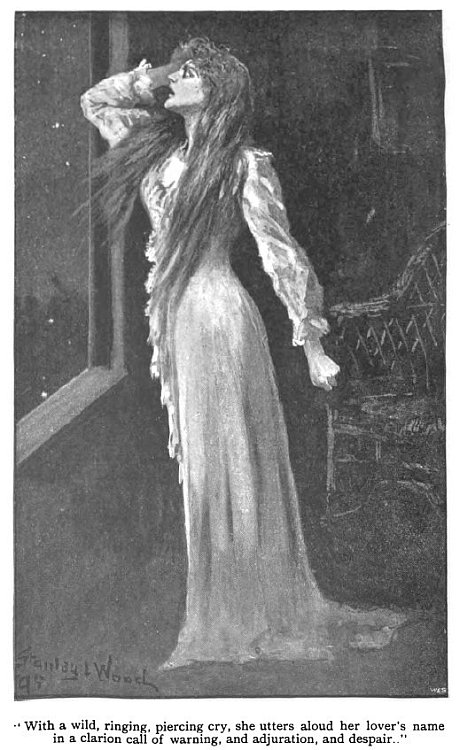
“Mona, what is it? Mona! Mona! What in the world is the matter? Good heavens!”
And Grace Suffield, startled from her bed by the loud ringing cry, stands, candle in hand, within her cousin’s room, shaking with apprehension and alarm. And small blame to her.
For Mona is standing at the open window. The shutters are thrown back, and her tall, white-clad form, half shrouded in her streaming hair, is framed against the oblong patch of bright stars. And she is gazing out upon the midnight waste, with eyes dilated in a wild, wistful, anguished look, as though she were striving to pierce the darkness and distance, and would give her life for the power to do so. It was a weird sight, and chilled Grace Suffield with an eerie and awesome creep, for it was evident that, in spite of her erect attitude and open eyes, Mona was not awake.
What was she to do? Mona had never been given to sleep-walking. Some appalling and powerful dream must have disturbed her. To wake her might be dangerous—the shock would be too great. But in this dilemma Mona turned round suddenly, and her eyes catching the glare of the light, she shut them. Then passing her hand over them two or three times she opened them once more—and beyond a slight start no sign was there that this was other than an ordinary awakening.
“Is that you, Grace!” she said wonderingly. “Why, what’s wrong? Any of the children ill?”
“No, dear. But you—I thought I heard you call for something.”
Thick and clear the waves of recollection flowed back upon Mona’s mind. She started, shuddered, and again that scared look came into her eyes, but she quickly recovered herself.
“It was more than a dream,” she said, speaking half to herself. “Yes, it was not a mere dream—it was a warning. Grace, he has been in danger, and I have warned him. Yes, I have, and I feel confident now. He is safe. My warning has been heard.”
Had it? Had the temporarily released soul, hovering above its slumbering tenement, the power to bridge over such material matter as distance and space? Was it given to the dream-voice, winged by the will-power of the strength and despair of love, to dart forth through the midnight spheres until it should thrill upon the unconscious ears, which a moment later might be beyond hearing aught again in this world? Who can say?
Chapter Twenty One.
A Voice through the Night.
Having rested himself and his steed, and still farther diminished the contents of his saddle bag, Roden filled and lighted another pipe, and began to think about saddling up.
He sent a last look around, but no sign of life was there, save for a faint column of blue smoke rising in the distance. Attentively he gazed at this. Did it mean another burning house, a smoke signal, or a camp of friend or foe? It was impossible to say; at any rate, it was a long way off, and what was more to the purpose, nowhere near his line of route. Satisfied on this point, and feeling on excellent terms with himself and all the world, he rose and made his way down to where his steed was grazing.
But now some trouble awaited; for he had knee-haltered the animal with too great a length of reim, and rather carelessly as to the knot, consequently the latter had slipped, leaving the horse almost as free as though he were loose. So now as he walked quietly up, speaking softly and soothingly, to secure his steed, Roden saw that he would need all his patience.
For the young horse was of a fidgety habit, and, as though aware of his power, no sooner did his rider extend a hand to catch him than, with a loud snort, he swung wildly round, placing his tail where his head should be. Another attempt, more coaxing, only met with a like result. The exasperating brute would allow the hand to approach within halt a yard of the reim, then would slew round as before.
This trick is a common enough one in the ‘cussedness’ of equine economy. It is about as exasperating as anything in this wicked world, and if there exists an average man who, being the victim of it, refrains from using terrible language aloud or secreto, why, in the plenitude of our experience we never fell in with him. At any rate, Roden Musgrave was not such a one, though he so far varied upon usual custom by damning, not the horse, but himself, and his own inconceivable carelessness in making such a bungling job of the knee-haltering.
The plan under the circumstances is craftily to manoeuvre the obdurate quadruped against a bush or a fence. Here, of course, there was no fence, and the only bush was that which grew around the stony kopje to which we have alluded, and thither, in accordance with the much-belauded equine intelligence—which, by the way, invariably shows itself in the wrong direction—nothing on earth would persuade this fiendish beast to proceed. Anywhere else, but—not there.
Roden tried another plan, that of waiting. He would have given much for a good forty yards of lariat, but ‘roping’ cattle and horses is a process unknown in South Africa, consequently he was without that highly serviceable Western implement. Then having waited to allow the horse to calm down again, he advanced once more to the attack.
It was not an atom of use. The young horse put his head down with a snort of defiance, and slewed round more wildly than before. He seemed positively to enjoy the fun of the thing, to enter into the joke with a fiendish glee. It was a joke, however, which might prove a grim one for his rider.
And such indeed it did prove. The reim, an old one, or containing a flaw, suddenly gave way. His leg now free, and at its normal distance from his chin once more, up went the noble animal’s nose into the air, and with a defiant whisk of the tail, which seemed to assert a determination to enjoy his newly gained liberty, away he started at a smart trot, which soon changed to a gallop, heading for all he knew how in the direction of the camp he had left that morning.
Those who prate about the marvellous intelligence of the equine race, are still under the magic of the story-books of their youth. This representative of it no sooner found himself free than he started off—whither? Not, be it observed, for his master’s stable, where excellent quarters and plenteousness of mealies and forage awaited, and which in point of distance was the nearer, they having covered more than half of the journey. Oh no; but back to the camp, back to the scene of his recent hard work, patrols, and scantiness of feed beyond that wherewith Nature had covered the veldt. An intelligent beast, in truth! Nor was he a phenomenal specimen of his kind.
Roden Musgrave, watching his steed vanishing in the distance, followed, we fear, the example of the British army in Flanders. He swore terribly. He was human enough to estimate what he would give to be seated across that now departed quadruped for ten minutes or so, armed with a strong new sjambok, and a pair of long-rowelled spurs; and indeed, the provocation was great.
Well, he was in a pretty plight; alone, dismounted, in the middle of the hostile ground, night drawing on, and only a hazy idea of his route. His boast to Darrell that he could easily evade parties of the enemy was well founded enough when he made it, for the Kaffirs possessed but few horses, and those few, thanks to having been ridden almost from foalhood, of weedy and undersized proportions. Now it was different. He could no more distance the fleet-footed savages than they could have overtaken him when mounted. On foot, he was at their mercy.
There was only one thing to be done under the circumstances. Since he could not ride, he must walk. No sooner decided than acted upon. Hiding the saddle and bridle among the bush on the kopje, and pocketing what remained of his store of provision, he started. Nearly an hour had been lost in his attempts at capturing his miserable traitor of a steed, and now the sun was already down. Well, so much the better. Travelling would be safer by night than by day.
To one accustomed to ride, nothing is more disconcerting than to find himself unexpectedly dismounted, in wild, little-known, and dangerous country. It is even demoralising, for it engenders a feeling or helplessness. A mere man, the only animal without any speed in his legs, is such an insignificant object amid the wild stretch of nature; his capacity for advance and retreat so limited under such circumstances. And he realises it.
Certainly Roden Musgrave realised it that night as he tramped on wearily beneath the stars. Even finding the way was quite a different matter when afoot to what it had been when mounted. Instead of a few minutes’ détour to a point whence an observation might be made, now it meant quite a long and toilsome tramp, with the galling consciousness that all that toil carried him no farther on his way. The thin sickle of a new moon hung in the heavens, and for this he felt duly grateful, for without its light, faint though that was, he would have made but sorry progress amid stones and antheaps and thorns and long grass and meerkat holes.
For hours thus he kept on. Once he saw the red glow of a fire not far from his line of route, and his heart leaped. A patrol? No. A moment’s thought served to show that no patrol would have its camp-fire alight at so late an hour. It could be nothing less formidable than a Kaffir encampment, and that of a strong force, judging from the fearlessness manifested in the small amount of care taken to conceal the blaze. And a Kaffir encampment meant an enemy’s encampment, and that enemy a savage one. So he avoided the vicinity of the light, and held on his way with increased watchfulness.
What weary work it was, mile upon mile over more or less rough ground, every rise surmounted revealing another beyond it, every step covering the possibility of stumbling upon a concealed enemy. Sometimes, too, he would be obliged to deviate a long way from his course, to avoid a deep and bushy kloof, whose vegetation was so dense as to be practically impenetrable. Staggering now with weariness, he was about to sink down to sleep away the remainder of the night, when his gaze lit upon that which banished sleep from him for the moment.
The ground was open there; smooth, and gently undulating. In front, standing in the middle of the flat, was a house.
Was this a delusion? He rubbed his eyes. There, in the faint light of the now setting moon, stood the house, a substantial-looking farm homestead. It was no delusion. Visions of a snug bed, and an inexpressibly welcome sleep, beset the weary wayfarer; of a remount, and a speedy arrival at Doppersdorp—via Suffield’s farm. Eagerly, joyfully, his step regained its elasticity, as he advanced to knock up the sleeping inmates, who, English or Dutch, would certainly receive him with the customary hospitality.
But as he drew near, again his heart sank like lead. No barking of dogs greeted his footsteps. The kraals were empty and the gates open, the shatters of the windows were up. The house was deserted.
“Of course!” he mattered despondently. “The cursed place is empty. Perhaps there’s somebody left in charge, though.”
But even as he approached the door he realised that there was that indescribable something about the place which told that no human being was there, a kind of lifelessness that might be felt. He knocked, but only a hollow echo from the empty passage gave mocking and ghostly response.
“Oh, curse the luck of it all!” he growled. “Hang me if I don’t break in. They’ll have left a shakedown of a sort anyhow, and I’ll do a snug snooze; besides, one may chance to stumble upon a bottle of grog stowed away.”
He looked around. Close by, a black square mass, indistinct in the waning moon, lay the deserted sheep-kraals. But now he noticed what had escaped him before. Behind the house, perhaps fifty yards distant from it, was an enclosed fruit garden, and the trees seemed weighed down with their luscious loads. Ah! the very thing. In his parched and exhausted condition, what would go down better than a dozen or so of peaches or apricots? So, postponing his exploration of the interior, he directed his steps to the garden, and getting over the low sod wall which encircled it, began with the “know” of a connoisseur to look for the tree which bore the best fruit.
This was soon found. Halting under a peach-tree he gathered the fruit as he wanted it, breaking it open and scrutinising it carefully by what little light the moon afforded; for the South African peach is not to be eaten in the dark, its interior being as often as not a mass of squirming maggots; and of it holds good the same as of some human beings—the more immaculately perfect the exterior, the greater the settled corruption within. However, the light was moderately sufficient for such requisite discrimination, and soon he had made a most luscious and acceptable feed.
This done, he returned to the house and carefully tested all the shutters. They were made of strong slabs, and held firm. But there was one small window at the back which was not shuttered, only protected by a board, fitting to the window-frame. This Roden wrenched away in a trice, and seeing that there was no other way of doing it, proceeded cautiously to break a pane of glass.
Heavens! what a clatter and jingle it made in the stillness of the night—the shower of glass falling upon the stone window-sill, and into the room! Then, carefully inserting his hand, Roden was able to pull back the bolt, and in another moment was in the house.
“Well, this is my first burglary, anyhow,” he said grimly to himself, as striking a match he began to survey the surroundings.
Frontier farmhouses are all built pretty much on the same plan, and almost invariably one-storeyed. Roden saw at a glance he was in the kitchen, but it and the living rooms were equally dismantled. The owners of the place, whoever they were, had evidently not trekked in a panic, but in leisurely fashion enough to have taken away with them pretty nearly all that could be taken.
There is always something more or less ghostly about the interior of an empty house at night time. As Roden went from room to room, exploring by the feeble light of a flickering wax vesta, it seemed that in the dark corners lurked the shadows of the former occupants, watching, with resentful and menacing stare, this burglarious intruder. The planks, creaking beneath his footfall, raised loud and unearthly sounds in the hollow silence, and once in the semi-gloom, the swaying of an old blanket, hung overhead on a line, gave him a real start, so strung were his nerves with excitement and fatigue. But the object of his search was a prosaic one enough. He explored every room, every cupboard, the store closet, everything. There were a few old tins of preserved salmon, and a box or two of sardines, half a sack of mildewed flour, and a string of onions. There were utensils of various kinds, all old and worthless, heaped among empty mustard tins and glass bottles of all sorts and sizes. But of what he sought, there was none.
“I’m certain I’d give a sovereign at this moment for a good glass of grog!” he told himself. “However, it isn’t to be had, and I was in lack to drop in here in the fruit season. Those peaches were A1. I think I’ll go and talk to them again.”
But, simultaneously with this determination, a great drowsiness began to come over him. In one of the front rooms, among the heavier furniture which had been left, was a coach, large and massive, and withal comfortable; just the very coach to invite a wearied and exhausted man. So, fixing the shatters so as to admit a crack of air, he flung himself upon the coach, and was sound asleep as soon as he touched it.
Now there came into Roden’s slumbers, at first dead and dreamless, a kind of restful consciousness as languorously soothing as at that hoar on the night after his mishap, when Mona had sat at his bed head, charming him off to sleep by the mere touch of her hand upon his forehead, by the soft intonation of her love-thrilled voice at his ear. Surely, her presence was with him now, here in this lonely deserted dwelling in the heart of the hostile country. He had but to reach forth his hand and touch her. Once more the charm availed, and again he sank into the unconsciousness of a peaceful, dreamless slumber.
Soon, he stirred again in his sleep, and muttered uneasily. Her face was before him once more, and on it was imprinted that same expression of love and agony and despair as he had seen there when he hung over that grisly abyss, in weakness and excruciating pain; her hand alone holding him up from the dreadful death. Some mysterious and awful peril seemed to be rolling in upon him now, holding him spellbound and powerless to move. Now, as then, she was striving to drag him into safety, but futilely. He had no power over himself. The weight which oppressed him was terrible. Then her face vanished in a whirl of despairing horror. Once more all was a blank, all was deadness. Only the silence of the lonely house, the regular breathing of the sleeper.
“Roden, wake! My heart’s life! my beloved one! Wake, wake!”
The voice thrilled in the sleeper’s ear, vibrating through the dense, silent darkness like the notes of a silvery-toned gong. Again there was a flash of a vision of that face again, pale with horror and dread, anguished beyond words—the vision of a white-clad form and long streaming hair.
With a spasmodic start Roden sat bolt upright. What did this mean, what did it portend, this voice of one who was at that moment a long day’s journey distant, springing thus out of the darkness? Heavens! had anything happened to her? It was so real, so vivid, that despairing call! What did it mean? what could it mean?
Seated thus upright on the couch, his eyes rested upon the aperture formed by the fixing apart of the shutters. This, hardly distinguishable before, save for a bright star or two beyond it, was now a stave of light. Daylight? That was his first thought; but in a moment he knew that it was not daylight, for it was flickering, changing. The band of light was now a strong, red glare; and together with the sight there came a sound which there was do mistaking.
Roden was wide awake now; as wide awake as ever he had been in his life. Rising noiselessly from the couch, gun in hand, even as he had slept, he made his way, still noiselessly and with great care to avoid knocking against any obstacle, to the window. One wary glance through the aperture, and then he beheld that which came near causing the last shred of hope to die within his heart.
Chapter Twenty Two.
Between Blade and Flame.
The open space in front of the house was alive with armed Kaffirs. Some were looking at the windows, others were fanning into flame torches which they carried. More and more came crowding up behind, and the subdued hubbub of their bass voices was the sound Roden had heard upon first awakening. They were about as murderous looking a crowd of savages as the eyes of the solitary white man, practically in their power already, could ever have the ill fate to rest on. Most of them were entirely naked, save for a blanket, carried rather than worn, and, smeared from head to foot with red ochre and grease, showed like glistening fiends in the smoky glare of the torches, as their sinuous frames moved to and fro with feline suppleness. A few wore massive ivory rings on one arm, and all were bedecked with some species of fantastic and barbarous adornment; the crest of the mohan, or the long trailing feathers of the blue crane; cows’ tails too, and grotesque necklaces of wooden beads made of “charm” wood; also belts of jackals’ claws. Nearly all had a firearm of some sort, in addition to a goodly sheaf of dark, snaky assegais. And their intention there could be no mistaking. They were there to fire this deserted farmstead.
Already they were blowing the torches into flame, chattering volubly in their destructive glee, as they told each other what a brave blaze this building was going to make. Already several were dragging up great piles of dry thorns, torn from the fencing of the empty sheep-kraals, amid roars of laughter and joking, as the sharp points would prick the naked carcasses of those who gathered them. This was fun indeed; this was sport. Many of them had worked as farm servants on just such a place as this, one or two perhaps on this very place. Now they were going to enjoy the fun of burning it to the ground, and it would make a merry blaze. And shut up within it was a white man, one of the dominant race who was surely and steadily quelling their futile rising, laying low with its deadly breech-loaders the flower of their youth by thousands. One of that now hated race would figure herein at his own holocaust. But this they did not know.
Roden Musgrave thought for a moment, and thought hard. Not for nothing had the very soul of his absent love thrilled across the mysterious dream-space of the slumber world—to save him. Not for nothing had that anguished voice sounded in his ear amid the darkness of the lonely room, to bid him waken and face the grisly peril which hung over him. A minute more, and it would have sounded too late: was it not, indeed, too late now?
There was one chance and only one—the back window. To it immediately he made his way.
That chance was that the savages had not entirely surrounded the house; and it was a poor one.
He looked swiftly but warily forth. That side seemed clear. Deeming it a deserted dwelling the Kaffirs had not thought of surrounding it. All were now gathered in front watching or aiding in the preparations for a grand blaze. Yet the light of the torches shed a glow even upon that side. Still, to hesitate was death.
He dropped through the window, and as he glided swiftly across the open space, which lay between him and the welcome shade of the fruit garden, every moment he expected the roar which should greet his discovery; the whiz of flying assegais, the crash of bullets. But fortune favoured him, and in a moment he lay crouching in the ditch behind the low sod wall, just as the flame was applied to the piles of brushwood which had been heaped against the front of the house.
His first thought had been to escape while they were busy at their congenial work of destruction. But the house stood upon an open flat, and now as the flames roared upward the whole of the surroundings were lit up as in the light of day. Only the insignificant area covered by the welcome shade of the fruit trees afforded concealment. A rat even, stealing across that illumined space, would instantly be discovered. There was no escape that way.
Peering warily through the tufted grasses which had taken root along the top of the sod wall, Roden’s gaze fell upon a scene which was indescribably barbarous and weird. From every side of the house now the flames were bursting forth; windows and doors belching out great red fiery tongues, sometimes with such fury as to drive back helter-skelter a crowd of the savage incendiaries, and in thick, rolling columns the smoke-clouds swept upward, veiling the midnight stars. And forming up in a ring around the burning dwelling the excited barbarians were executing a frenzied war-dance, their red, ochre-smeared frames demon-like as they swung half to one side then to the other, stamping their feet in unison. And above the roar and crackle of the blazing pile the fierce, throaty rhythm of the war-song rose higher and higher, louder and louder, its every note quivering with an insatiate lust for blood. Then, as the frenzy reached its height, leaving their places the savages would ran to and fro, making downward stabs in imitation of slaying those who had been driven out by the flames and were striving to escape. Others again would approach as near as they could, and make believe to be in wait for those who should climb out through the windows—receiving them on their assegais with a deep-throated, bloodthirsty gasp. The pantomime was perfect, and he who crouched there as an involuntary spectator could not forbear a cold shudder, as he witnessed thus vividly represented before him the fate from which he had so narrowly, and by a moment of time, escaped.
But had he escaped it? His present position was one the peril of which it was impossible to exaggerate. Here he lay, imperfectly concealed, within a few yards of at least a hundred barbarians, excited to the most frenzied pitch of ferocity. The fruit garden, which might have covered half an acre, was fenced on the farther side by high, thick quince hedges, through which it would be impossible to make his way noiselessly, if at all; otherwise the idea came to him of attempting flight through the back of the garden while the attention of the Kaffirs was occupied with their barbarous dance. On this side only, that which was bounded by the stone wall, was exit possible, which would mean walking out right into the teeth of his enemies. It was not to be thought of. He was securely trapped—cornered like a snared leopard. Well, he would die like one, fighting to the last. But this resolve afforded not much consolation. We doubt if it ever does.
With an eye to render his precarious position more secure if possible, he gazed warily around. At the end of the sod wall where it joined the quince hedge, he thought the ditch might be deeper, the long grass or other undergrowth thicker. The lay of the ground seemed to point that way. But how to get to it?
Again raising his head to a level with the grass-tufts, he sent a quick, rapid look at the Kaffirs. They were at the very height of their ferocious orgie, and the wild roaring chorus, together with the crash and crackle of the flames, made such a hellish din, that they would have no ears for any sound he might make. So, keeping below the level of the top of the wall, he crept along the ditch.
His hands were lacerated with many thorns, and the pain was excruciating, yet he dared not pause. Any moment the fit might seize upon his enemies to enter the garden. His hopes were to some degree realised. The end of the ditch did afford a greater depression, and its sides were grown with tall grass and brambles. Here, in the corner, he ensconced himself, lying flat to the ground and drawing the undergrowth over him; the while, however, reserving as much freedom for his hands as possible.
Now into Roden’s heart, to inspire him with renewed hope, came two considerations. One was the possibility of rescue. Such a conflagration as this would show for a great distance, and would certainly attract attention, and possibly a strong patrol. The other consideration was a superstitious one. That voice—that marvellously clear-sounding voice, which had thrice come into his dreams in miraculous warning, could not be destined to fail in its mission. He had heard it as distinctly as though its owner were standing there visible before him; that he could swear until his dying day. Never could that startling and signal triple warning have been conveyed to him in vain—never, never could it have been sent to rescue him at the moment of one imminent peril, only that he might succumb immediately to another. It was a weird, sweet, irrational ground for hope, but he held on to it firmly for all that.
Then when the frenzy of the war-dance was at its wildest, fiercest pitch, the bright, gushing flames leaped suddenly on high, as, with a roar like thunder, the roof fell in. A volume of dense, reddened smoke shot upward to the heavens, while a vast cataract of whirling sparks fell around in a seething, fiery hail. The uproarious mirth of the savages changed into wild yells of alarm and dismay as they scurried hither and thither to avoid the falling embers; but the panic was only momentary. Grasping at once the harmless nature of this startling change, they quickly crowded up again, making the night ring with their boisterous laughter, as they chaffed each other vociferously over the scare they had undergone.
For a little while they stood staring at the smoking, glowing embers, chattering volubly. Then Roden, crouching half-buried in his ditch, could feel the vibration of the sod wall, could hear the approach of voices now sounding almost in his ear. Ah! They had discovered his presence. With heart beating and teeth locked together he held his revolver ready in his right hand. His hour had come. One short, sharp struggle, the crash of a shot or two, then the searing anguish of the sharp blades buried in his vitals, the sickening gasp for life, and—his being would have ceased.
Again the ground shook above him. In the dim light he could make out numberless shapes swarming over the sod wall. They dropped into the garden, right on, right over the spot where he had at first lain concealed. Well indeed was it that he had changed his position. And now the object of this new move became manifest. No suspicion of his presence had led to it. Another motive was at work, which it was as well he had not till then thought of, else had he risked certain detection in flight, rather than trust to a hiding-place under the circumstances so transparently insecure. They had come after the fruit.
He could see them standing there, drawing down the laden branches and stripping them of their luscious burden; could hear the swishing, gurgling sound of their jaws as they bit into the ripe peaches and apricots, thrusting them whole into their mouths, and throwing the stones at each other in horseplay, like so many British roughs on a Bank holiday. In sheer wantonness they tore off great boughs covered with fruit and heaped them on the ground, till soon every tree was as nearly as possible stripped, and they were gorged almost to repletion. Then others came over to join in the feast, and now Roden’s heart was again in his throat, for a bevy of them swarmed over the wall just where he lay, the ankle of one even coming into hard contact with the crown of his head. But the warrior, thinking he had kicked a stone, did not look twice, and that peril was passed. Yet, lying there, liable to be butchered at any moment, slain like a rat in a trap, was appalling, and not far short of an equivalent for dying a hundred deaths.
By this time the first streak of dawn was showing in the eastern horizon, and the Kaffirs, now replete, began to depart. Still, many showed a disposition to linger, gathering up the fruit in their skin tobacco bags and blankets, and the ray of hope which had come with that ray of dawn began to fade again into a darkness that bordered on despair. Would they never go? Every moment the earth was becoming lighter. In a light less than half that of the light of day Roden’s hiding-place would afford concealment no more. He would be discovered in an instant.
They had all gone at last, and their receding voices were decreasing in sound and volume; all except one, and this confounded fellow seemed to have a weakness for variety; for now he was coming along the quince hedge, sampling its productions; coming straight upon Roden’s hiding-place.
Twenty—ten—five yards—then so close that the latter might have grasped him. Now a particularly fine quince growing just above reach seemed to attract the eye of the Kaffir. He made a spring—seized the fruit, and, missing his footing, stumbled and fell backward bodily on top of the concealed white man.
Roden was up in a moment. With the quickness of a snake he had seized the Kaffir by the throat before the latter could rise, and had pressed the muzzle of his revolver to the man’s face.
The shout of dismay and of warning which arose to the lips of the savage died in his throat. The black, murderous shining ring of the muzzle seemed to burn through him even as though already he felt the contents. The countenance of his white adversary was terrific in its fell fury of purpose, for it was the face of a thoroughly desperate man, balancing unsteadily on the brink of that precipice, which is Death.
“One sound,” whispered Roden, in Boer Dutch. “Only one sound!” and his look supplied the rest.
Kaffirs are the most practical of mortals. This one was a thick-set and sinewy savage, and were it a hand to hand tussle with his white adversary in which muscular strength alone counted, would have stood every chance. But the first movement would mean the pressure of that deadly trigger, and a head blown to atoms. One shout would have brought his countrymen swarming around him, and the white man would be cut to ribbons in a moment. But that would not result in bringing himself back to life, nor in piecing together again his own head, shattered to a thousand fragments; wherefore he deemed it sound policy to lie still as ordered.
But as he lay there, breathing hard and staring with protruding and amazed eyeballs at the face of the man who threatened him, even the terror of his position could not restrain a smothered gasp; for it was the expression of a mighty astonishment. And his amaze communicated itself to Roden, who by the fast increasing light, now recognised in the countenance of this ferocious-looking and ochre-smeared warrior the honest lineaments of the good-humoured and civil store-boy, Tom.
Yes, it was Tom; each had recognised the other now—Tom, who had come to him like Nicodemus, by night, at the instigation of that unscrupulous rascal Sonnenberg, to endeavour to entrap him into a flagrant violation of the ammunition laws, by inducing him to sell the old gun—Tom who had so deftly turned the tables afterwards upon his scoundrelly employer. Well, he had a gun now, for there it lay beside the assegais, which had escaped from his hand as he fell.
“I know you, Tom,” he whispered in Dutch. “I won’t harm you if you go away and don’t tell the others I’m here.”
The Kaffir stared. “Auf!” he exclaimed; “let me go, Baas. I’ll say nothing.”
Roden looked into the dark, ochre-smeared face. Even beneath this hideous disguise it had an honest look.
“I trust you, Tom,” he said. “Listen, I have not seen you here, you understand, when I return to Doppersdorp, and you—you have not seen me now.”
The other nodded violently.
“Go then, Tom. I trust you.”
The Kaffir, released, rose to his feet, and seized his weapons. It was a critical moment for Roden. So were those which followed.
For now, footsteps were heard returning, the footsteps of several persons, and voices.
“Hey, Geunkwe!” called out one of the latter, “Have you not had enough yet? Wait, we will come and have some more, too.”
“No, no!” cried Tom, alias Geunkwe, hurriedly. “I am coming. We had better not linger here. The smoke will attract white men, and the country is too open. Let us hurry on after the others, before it is too late.” And springing over the sod wall, he joined those still outside the garden who had returned to look for him; and with inexpressible relief Roden could hear their deep voices receding into distance and silence.
Even then, a misgiving assailed him. Could a savage be trusted, especially in war-time? What if this one, now out of reach of the threatening revolver, should betray him to his countrymen? What if even now the latter were stealing back to surprise and overpower him without loss to themselves? The idea was not an exhilarating one.
But although he understood but little of what had passed, he had been struck by the eagerness with which Tom had striven to prevent his fellow-countrymen from entering, and had succeeded. Even this, however, might be part of the ruse. Yet he tried to believe that the Kaffir was trustworthy, as indeed the event proved, for when, after lying concealed for upwards of an hour more, Roden ventured cautiously to peer forth, lo, there was not an enemy in sight.
The sun was now above the horizon, and the bird and insect life of the veldt was starting into glad and joyous being, as Roden, cramped and stiff from his constrained attitude, stepped warily forth to explore. The black ruins of the burnt house still smouldered, sending up jets of blue smoke, and as he stood in the dazzling radiance of the new-born day, contemplating this holocaust of savage hate and vengeance, he thought with a sweet, warm glow around his heart, not unmixed with awe, of how that mysterious voice had called him forth from the slumber which would have ended in the slumber of death.
He turned back to the fruit garden to breakfast on its luscious contents, for his saddlebag had been left within the burning house, and no other food had he. While thus occupied, a sound as of the faint tramping of feet in the distance recalled all his instincts of self-preservation. But he needed to take no second look. Mounted figures crested the sky line—whites—who, to the number of a score and a half, were cantering rapidly towards the still smoking ruins. Then Roden got out and filled his pipe, and having lighted it, sat down on the sod wall and calmly began to blow a cloud.
“Great Scott, Musgrave! is that you or your ghost?” cried Darrell, who was riding at the head of the party. “Why, what on earth has happened to you all this while, man?”
“It’s me, I believe, but I’m not quite sure of it even now,” answered Roden. “And, Darrell, and you fellows, look there. If you had been spending the night lying bunched up in that corner, while John Kaffir was hooraying around a blazing house fifty yards off, and when he had quit that, jumping right over you, and even on to you, on his way to eat peaches, why, you wouldn’t be quite sure of it either.”
Then followed explanations, and how the runaway steed had returned straight to camp, and had been at once recognised by more than one citizen of Doppersdorp there under arms; and how Darrell had been able to collect a patrol, and start post-haste in search of so perilously situated a fellow-countryman as one afoot in the middle of the hostile ground. And all stared open-mouthed as Roden narrated all that had befallen him, including his narrow escape from the deserted house. But of the cause which effected that timely flight he said nothing.
“Well, Musgrave, and which way did they go?” said Darrell, when he had done.
“Who?”
“Why, the Kaffirs, of course. We’ll go and give ’em hell.”
“Darrell, get down into that ditch, there where I was. Tuck your head under your wing, and hold your very breath, and then see how competent you are to form a judgment as to the direction in which any given crowd has retreated.”
“Well, we can spoor them.”
“I wouldn’t. They’ve got hours of start; besides, they’re beastly numerous, and you’re not. No, let them alone.”
Now the extent of the above start, eke of the numerical strength of the enemy, was an exaggeration, and one of set design. Tom, alias Geunkwe, had kept strict faith with him, and Roden Musgrave did not want that honourable savage to be shot or captured, if by a moderate stretch of veracity he could prevent it.
Chapter Twenty Three.
A Change.
“Well, Musgrave, old boy, I’m glad to see you back again,” cried genial Peter Van Stolz, wringing his subordinate’s hand, as the latter entered the office just before Court time on the morning following the events last detailed. “There are two or three drunk cases to polish off; they won’t take ten minutes, and then I want to hear all your adventures.”
So Sannje Pretorius, and Carolus Dirksen, and two or three other worthy specimens of the noble Hottentot, having been fined five or ten shillings apiece, with the alternative of seven days hard, the administrator of Doppersdorp justice lost no time in returning to be put in possession of such more or less stirring facts as the reader is already familiar with. Not altogether, however, for the narrator had a strange repugnance to chronicling his own deeds of slaughter, which, in fact, he so slurred over as to make it appear rather that they had been done by Darrell—a vicarious distinction from which that worthy, at any rate, would in no wise have shrunk. Nor, we hardly need say, did he reveal his meeting with Tom. On that point his lips were sealed, even to his friend. His word, once passed, was inviolable.
It happened that he had come straight into Doppersdorp, abandoning the projected détour by Suffield’s farm, for a sort of nervous exhaustion, supervening on the strain and hardships of that terrible and trying night, had compelled him to take some hours’ rest beneath the first sheltering roof which he came across after his rescue by Darrell and his party, who had escorted him on his road until beyond further risk, returning then to the Main Camp. Hence, reckoning he had been away long enough, he made up his mind to reach Doppersdorp in time for Court. He would ride over to Quaggasfontein in the evening.
Then, at the midday recess, Roden found himself carried off to dine, in order that Mrs Van Stolz might hear his adventures. At that point of his narrative which touched upon the villainous behaviour of the defaulting steed, they all laughed again and again, while recognising that it was no laughing matter at the time.
“What will Miss Ridsdale say when she hears all about it?” said Mrs Van Stolz mischievously. “I suppose you haven’t seen her yet, Mr Musgrave?”
Roden answered that he had not, and then a little more sly fun was poked at him. Finally, it became time to return.
“You see, it’s post day, Musgrave, old boy,” said Mr Van Stolz, as they walked back to the office together, “or I would say, Clear out. I know you are dying to go up to Suffield’s. But it may be in early, and there’s sure to be nothing of much importance. After it’s in, you can clear out as soon as you like. Hark! there’s the horn now. The cart’s just coming over the neck.”
It was. About a mile or so up the road they could make out the rising dust, which should soon resolve itself into a weather-beaten, two-wheeled cart, laden with mail-sacks, and driven by a yellow-skinned Hottentot, tootling on a battered trumpet. Nor was it much longer before a portion of its contents was duly transferred to the public offices.
“Congratulate me, Musgrave!” cried Mr Van Stolz, skipping into his subordinate’s room, with an open official letter in his hand. “Congratulate me! I’m promoted!”
But the beaming and joyous expression of his countenance found no reflection in that of Roden, who said—
“As far as you are the better for it, I do most heartily. Speaking selfishly, however, it’s the worst news I’ve heard for many a long day.”
The other stared for a moment, then his face softened. No congratulations could have conveyed a more direct tribute to the esteem in which he was held by the speaker.
“Thanks, old fellow,” he said, “I know what you mean. We’ve always got on right well together, I really believe.”
“Got on? I should rather think we had. The man who couldn’t get on with you could get on with nobody.”
Still more did the other stare. This habitually cold, reserved cynic! To hear him now, would be to think the man was full of heart.
“I’m afraid my congratulation is of a rueful order at best,” said Roden, with a smile. “And now, where is the transfer to, and what increase does it carry?”
“Barabastadt. It’s just such another hole as Doppersdorp—poor old Doppersdorp isn’t such a bad little place though. It’s away in the Karroo at the foot of the Rooi Ruggensbergen. Good springbok shooting, I believe. And it means 100 pounds a year more, which is a consideration when a man’s hat doesn’t cover all his family. Look; there’s the letter.”
Roden ran his eye down the sheet, which set forth in official rigmarole that His Excellency the Governor, with the advice of the Executive Council, had been pleased to appoint Mr Peter Van Stolz to be Civil Commissioner and Resident Magistrate of Barabastadt, at a salary of so much per annum, in the room of Mr Somebody Else transferred.
“And your successor, what sort of man is he?” he said at length.
“Shaston? Frederick Romsey Shaston. A devil of a name that, Musgrave. Well, he’s rather like his name, rather a pompous sort of chap. I remember him four years ago, when he was ‘acting’ at Maraisburg. He was always getting his judgments reversed. He’s not a bad sort of fellow though; not at all a bad sort of fellow at bottom.”
This is a species of eulogy which is of the faintly exculpatory order, and from both the words and the tone none knew better than Roden Musgrave that his new chief would be almost certain to prove a direct antithesis to his old one.
“No, he isn’t a bad sort of fellow, Musgrave, if you take him the right way. You’ll get on all right.”
In his heart of hearts the speaker knew as surely as he could know anything that the two would not get on all right; however, he was not going to say so.
“It isn’t the ‘getting on’ part of it I’m thinking of, Mr Van Stolz,” said Roden. “Can’t you credit me with realising that true friends are scarce, and not feeling overjoyed at the prospect of losing a firm specimen of the article?”
“Of course, of course. I understand. But, Musgrave, old boy, you mustn’t talk about losing a friend, hope we shall not have seen the last of each other because I have left this. Why, we have had plenty of good times together, and will have plenty more. The wife likes you so much, too. No, no. Of one thing we may be sure. You have always firm friends in us, no matter what happens.”
“Thank you. I am sure of it,” said Roden, on whom the words struck with something like a presentiment. And the time was coming when he was destined to remember them.
Cantering over the grassy flats in the slant of the golden sun-gleam, Roden’s mind dwelt more and more on that mysterious midnight warning which had startled him from a slumber destined otherwise to end in the slumber of death. So signal had been its result, that the anxiety which had at first beset him, lest evil hovered over its utterer, was quite dispelled, giving place to a strange, sweet awe so foreign to his nature that he could hardly recognise his very self. Now, as he drew near Suffield’s house, he smiled curiously at his own eagerness, and made believe to check it. There stood the homestead against its background of green willows, away over the flat, then, as the track dipped into a slight depression, he saw it no more.
All the way out, all that day, he had been trying to picture his reception, and very alluring had that occupation proved. He had never, as we have said, been away from Mona before, not away beyond reach, that is. How would she receive him? He thought he knew. Then, as the house again came into view, he strained his eyes for the first glimpse of that supple, exquisitely modelled form, for the first flutter of a dress. Yet no such glimpse rewarded him.
He was in a fanciful vein, and the circumstance of this dejection struck him with a sort of chill. He rode up to the door amid the clamour of the yelling pack, which, ever aggressive, charged him open-mouthed, a demeanour which speedily subsided into much jumping and tail-wagging as his identity became manifest. Then a gleam of light drapery down among the willows caught his eye. Ah, there she was, but not alone; for both Suffield and his wife were there, and the trio seemed to be indulging in the most prosaic of evening strolls. This then was to be that often-dwelt-on first meeting—a conventional hand-shake, a mere platitude of a “How d’you do?” In which especial particular the irony of circumstances manifests itself more often than not.
“Hallo, Musgrave! We were expecting you to-night or to-morrow,” sang out Suffield. “Glad it’s to-night. Well, how are you? How many Gaikas did you bowl over, and all the rest of it?”
There was no mistaking the cordiality of their greetings, anyway. And the swift glad flash of intense joy in Mona’s eyes, and the pressure of her fingers told all that could have been told had their meeting taken place alone.
“Come in and have a glass of grog, Musgrave,” went on Suffield, “and tell us the news from the front. Though, by the way, that’ll keep till after I’ve counted in. There’s Booi’s flock nearly here already, I see. Never mind. We’ll have our sobje anyhow.”
There was something in the situation that reminded Roden of his first visit here; for Suffield soon departed to look after his sheep, and his wife did likewise to see to her lambs—i.e. her nursery; leaving him alone with Mona. How well he remembered it; the same sunset glow, the same attitude, the easy, subtle, sensuous grace of that splendid figure standing there by the open window outlined against the roseate sky. Even now that the moment he had been thirsting for was come, he hesitated to break the witchery of the spell, to disturb the unrivalled beauty of the picture.
She turned from the window and came to him. For an instant they stood gazing into each other’s eyes, and then—the promise of the oft-pictured meeting was fulfilled.
“Darling, darling!” she murmured in thrilling tenderness, after that first long sweet embrace, locking her fingers in his with a grip that was almost convulsive. “I hold you now again. I did not believe it was in me to think so much, to suffer so much, on account of any one—any one. Oh, Heaven! how I have suffered! One night—the night before last—I had such a frightful dream. I dreamt you were threatened with the most appalling danger. I could see you, and you were lying asleep in a dim and shadowy place, and I could not warn you, could not raise my voice, could not utter a word. Hideous shapes, horrors untold were creeping up, crowding about you; still I could not speak. Then the spell was broken, and I called aloud, and woke up to find myself at the open window, and Grace standing there in the doorway looking the very picture of scare. For I really did call out.”
A strange, eerie sensation crept over her listener. What sort of power was this—of separating soul from body during the mere ordinary unconsciousness produced by slumber?
“And that dream of yours, if it was a dream, was literally the saving of my life, Mona. Listen, now.” And then he told exactly how he had lain asleep in the deserted house, and how, thrilled by the startling accents of her anguished voice in the midnight silence, the vision of her troubled countenance, he had awakened barely in time to escape certain death. The hour coincided exactly.
“How was I dressed?” whispered Mona, a strong awe subduing her voice, as she gazed at him with startled eyes, and trembling somewhat.
“The vision was more or less indefinite, all but the face. Yet you were in white, with flowing hair, as on that night when you braved everything to try and make me forget my bruised and battered condition in sleep.”
“It is—is rather awful,” she whispered, with a shudder. “But in every detail the—the picture corresponds—time, place, appearance, everything. Oh, darling, surely your life is mine, that it has been given me to save twice.”
He was thinking the same thing. And then, running like a strand through the entrancement of this first meeting, came the thought of what such a consideration meant. Nothing lasts; love vulgarised by a commonplace legal tie least of all. This was one thing; but love united, with its hundred and one petty, uphill struggles and hardships, its familiarity breeding contempt, its daily friction of temper and will—that was another. He was not young enough to see only the enchantment of the moment, all deliriously sweet as this was. The other side of the picture would obtrude itself—disillusion, life soured. Nothing lasts; nothing which is real, that is. Such moments as this, such transitory blissful moments of a fool’s paradise, came as near to happiness as anything this life could afford; yet even they were dashed by the consciousness, the certainty, that they were nothing more. They constituted life no more than the five large beads constitute the whole rosary; happy indeed were it, if the proportionate parallel held good, and that one great joy were allowed for every decade of sorrow, and disillusionment, and deadness and pain.
Greatly concerned was the household on learning the approaching transfer of Mr Van Stolz, of whom Suffield declared that the Lord might have been pleased to create a more thoroughly good sort, but that He hadn’t.
“So he’s going to Barabastadt, you say, Mr Musgrave?” said Grace. “We may see him again, then. There are some relations of ours living up there, the Rendleshams. We go and stay with them sometimes.”
“Up there! Why, they’re about sixty miles from the town,” said Suffield. “They’ve got a place called Kameelsfontein, and the springbok shooting is heavenly.”
“And the second family is the reverse,” said Mona. Then, for Roden’s benefit. “There’s a second wife and two unutterably detestable step-daughters, and between the three they’ve managed to oust poor Ida, who is dear old John’s only child. She was sent to England to be educated. We were great friends when I was over there last, though I am a good deal older than she is.”
To the credit of Doppersdorp be it said, it likewise was greatly concerned over the departure of Mr Van Stolz; and if that genial official had ever felt doubts as to his widespread popularity, no further room for such existed now, if the expressions of regret which met him on all sides counted for anything. And by way of giving public expression to this, a banquet on such a scale was organised at the Barkly Hotel, as to inspire in the commercial mind of Jones regrets that a paternal government did not furnish a perennial supply of highly popular officials to Doppersdorp, providing at the same time for their transfer at least every three months. And how the champagne corks which popped during that historic entertainment constituted a great multitude which no man could number; and how Sonnenberg was of deliberate purpose, and of malice aforethought, set down to carve a roasted sucking-pig; and now he not only cheerfully performed that function, but likewise partook largely of the infantile porker, in direct defiance of his tormentors and of the law of Moses; and how the thunders of applause which greeted the toast of the guest of the evening, caused Jones to tremble lest his property should be engulphed in a fate similar to that which overtook the temple of Dagon; and how Roden Musgrave, responding for The Civil Service, waxed so eloquent upon the virtues of his departing chief, as to draw from the latter the stage-whispered remark, that “butter seemed cheap just then”;—are not all these things graven in the annals of Doppersdorp, which is the Centre of the Earth? How, too, many of the assembled worthies, those who ate peas with their knives, and those who did not, finished up the evening by getting gloriously drunk, the anxiety of whom to “chair” home the said guest of the evening being only defeated by those whose regard for that official’s valuable existence, even though it should thenceforward be spent elsewhere, was of a practical nature;—this, too, we regret to say, is likewise faithfully recorded among the archives aforesaid. But the enthusiasm of Doppersdorp, if highly demonstrative, not to say uproarious, was, for once in a way, very real.
Chapter Twenty Four.
“Who Knew Not Joseph.”
Mr Frederick Romsey Shaston, the new Resident Magistrate of Doppersdorp, was in every respect a direct antithesis of the old one.
In aspect he was a square-built, middle-aged man, with grizzled hair, and rather thin, short beard, prominent nose, and cold blue eyes; a man of few words, and those few words, when spoken, conveying distinctly that in the speaker’s mind there was but one opinion worth the slightest consideration in all the world—viz., that of Mr Frederick Romsey Shaston.
He was a man to dislike on sight, one whose manner might be termed brusque for the sake of euphemy, but which sometimes and by accident just fell short of being offensive; a man in whom lurked not one spark of geniality or kindly feeling; a cold, flaccid, mental jelly fish.
The flourish of trumpets which had enveloped the departure of his predecessor was an offence to him, possibly as suggesting the certainty of a very different farewell, when his own time should come. In this spirit he went closely into all connected with the office, hoping to discover some pretext for throwing mud at Mr Van Stolz’ administration. But he might as well have tried to chip a snowball out of the moon.
To Roden Musgrave he took an intense dislike, which he exhibited in first pointedly wondering at finding a man of his age in that position; an impertinence which its recipient could afford utterly to ignore. From the very first, however, he had made up his mind to bring about a change, partly to secure the berth for a relation of his wife, partly because he only felt comfortable with young subordinates, whom he could treat as he chose; whereas this one, even he realised that he could not treat as he chose.
For he knew that in experience and knowledge of the world, this man was immeasurably his superior; and the better able to hold his own, that he was most thoroughly up to his work. He had mastered all the ins and outs of office and court routine, and had everything at his fingers’ ends. He would be an extremely difficult man to oust; yet as we have said, Mr Shasten made up his mind from the very first that ousted he should be.
By the attorneys and law-agents practising in the District Court the new R.M. was most cordially detested. Not one of them but had been snubbed more or less—frequently more—when practising before Mr Van Stolz, but never undeservedly, and this they well knew. So, too, did they know that outside the Court, that sunny-natured official would be the first to crack a joke with them, or lend them his horse, or do them a good turn in any way he could. The present occupant of the Bench, however, was past master in the art of delivering himself of cold, scathing, contemptuous rebukes. The practitioners for once agreed among themselves. They put their heads together and arranged to “go for” him whenever opportunity offered, and now and again it did offer, for Mr Shaston was at times a trifle shaky, alike in his procedure and in his judgments. Then they went for him tooth and nail, Darrell especially, who feared no man living, and between whom find the new official many a passage of arms would occur, of increasing fierceness and frequency.
With the farmers, too, he was unpopular. Mr Van Stolz, himself a Dutchman, had been pre-eminently the right man in the right place. Mr Shaston, however, was utterly devoid of that bluff, open-hearted species of blarney which is the right way to the Boer heart; consequently, by that stolid and wooden-headed race, he was regarded as the most stiff and starched type of the verdommde Engelschman. Moreover, rightly or wrongly, he soon acquired a reputation for favouring the native servants, as against their white employers, in such cases as came before him; which reputation once established on the part of a magistrate is a very death knell to his popularity among the Boers, and scarcely less so among their fellow English stock-raisers.
Some among the townspeople he condescended to admit to a certain degree of friendship. Among these was Lambert, the District Surgeon, also Sonnenberg; both of whom toadied him fulsomely, for they began to see in the new R.M. a possible weapon for striking a deadly blow at the object of their respective hate. His dislike of his subordinate was by this time patent, and both worthies now began to chuckle; for they foresaw the not far distant removal of the latter from Doppersdorp. Not that this would satisfy the malice of the vindictive Jew; nothing would, short of the ruin and disgrace of his enemy. Since the gun episode, resulting so signally in the biter being bit, and bit hard, Sonnenberg had cudgelled his crafty and scheming brain to hit upon a plan, but hitherto in vain. As postmaster, the thought had crossed his mind that he might in some way or another strike at his enemy through his correspondence. But then the latter never received or despatched any correspondence; never from month’s end till month’s end. This in itself was singular, and set the Jew thinking.
Now, if there was one individual whom the change of administration concerned almost more than all the rest of the community put together, that individual was Roden himself. No more was the daily routine lightened by an occasional cheery talk, the ever-present joke, and the sociable pipe, and above all by the most perfect of mutual good feeling. This he was prepared for. But when his new superior began to show his hostility in the most needlessly gratuitous fashion; to find fault, and that too often publicly, where, as a matter of fact, no fault was to be found, his temper, at no time a long-suffering one, began to feel the strain. Still he kept it in hand, observing the most rigid scrupulosity in the discharge of his duties, and giving no handle to the other for putting him in the wrong. He knew that an explosion was only a question of time, and was shrewd enough so to order his doings as to keep on the right side.
But, if in his new official superior he had found an enemy, he had made one in the person of that functionary’s wife, though this was perhaps inevitable. Personally Mrs Shaston was a good-looking woman, tall, and of rather striking appearance, who had once been very handsome. But to her husband’s brusquerie she added a commanding manner, or, to drop euphemy, a domineering one, which rendered her a trifle more unpopular than himself, if that were possible. She had at first inclined to a modicum of reserved graciousness towards Roden Musgrave, which soon changed to the most bitter and virulent rancour, when she discovered that he had no notion whatever of being turned into a sort of running footman. Her husband’s subordinates were her subordinates; such was her creed, and what did a subordinate mean but one who had to do as he was told? So when Roden took the earliest opportunity of differing with her on this point, and that in the most practical way possible, she became his bitter enemy for all time.
Daily his position became more manifestly unpleasant. He had never laid himself out to win anybody’s goodwill, and this sin of omission had rendered him as unpopular as those of commission on the part of his chief had brought about a like result concerning the latter. Of two unpopular officials in a place like Doppersdorp, or for the matter of that anywhere, the most powerful would score, and Mr Shaston after all was a power in the community. Moreover, such a community has a special faculty for producing a large litter of curs, wherefore many who had been effusively civil to Roden Musgrave when the latter was hand-in-glove with Mr Van Stolz, now showed their real nature by turning round and barking at him unceasingly.
Now, of course such pleasant little amenities as smoking pipes in office hours, or shutting up at all sorts of times when there was nothing particular doing, though tending to render life pleasant, were, after all, irregular, and no one knew this better than Roden; consequently he was quite prepared for all sorts of changes in this direction, and accepted them cheerfully. But his new superior thought he saw a very promising ground of annoyance, which might, if deftly worked, bring about the revolt he desired.
“There is a matter I have been intending to speak to you about, Mr Musgrave,” he began one day when Roden had taken some correspondence in to be signed, “and that is your very frequent absences; I don’t mean from the office during hours, but from the town. For instance, I find that you are frequently absent from Doppersdorp the whole night, visiting your friends in the country, and not infrequently for two nights.”
“But that would be only from Saturday evening to Monday morning early, sir; while off duty.”
“A Civil Servant is never off duty, Mr Musgrave, except when he is on leave of absence,” was the frigid rejoinder. “Now, I am not aware that the absences to which I refer come under that heading.”
With a strong effort Roden mastered his contemptuous indignation, for he saw that his superior had discovered a new form of mean and petty annoyance. He had far too much savoir vivre to make any such retort as would have arisen to the lips of nine men but of ten in like position—viz., that Mr Van Stolz had never raised any such objection. So he said:
“Do I understand, sir, that you object to my sleeping the night at a friend’s house if outside Doppersdorp, even though I am back punctually for office hours?”
The other felt vicious. The question was unpleasant in its directness, and, while put with perfect respect, its pointedness seemed cutting.
“Er—you see, Mr Musgrave, we are supposed to be resident here—that is, to reside here; the object of which is that we may be found when wanted, and that object is defeated if we are whole nights, or a day and a night, away from the place. It is not a personal matter, not a question of what I object to; but supposing any emergency were to arise requiring your presence, and nobody knew where to find you; or at any rate, that you were so far away that it amounted to the same thing!”
“Would you mind, sir, stating for my guidance the precise distance the Service regulations allow an official to ride or walk without having obtained formal leave of absence?”
The other felt very cornered at this persistent attempt to knock his objections to match-wood, and proportionately savage.
“I am surprised, Mr Musgrave,” he said, speaking more quickly, “at a man of your age asking such a question. Surely you should know that there is a common-sense medium in all things.”
“Still I should prefer to know exactly what restrictions the Service places upon our movements. Do you mean, sir, that we are never to pass the night at the house of a country friend without formal leave of absence?”
“No, no. I don’t mean to lay down quite such a hard and fast rule,” was the more yielding reply, for this deft plurality imported into the pronoun was disconcerting. “What I would dwell upon, however, is the strong desirability of returning to the town to sleep, unless detained by unforeseen circumstances, such as stress of weather, or anything else which is absolutely unavoidable.”