A TRUE AND EXACT HISTORY (continued 3)
Reading edition
Their way of reckoning their ages, or any other notable accident they would remember, is by the Moon; and so accounting from the time of their Childrens births, the time they were brought out of their own Country, or the time of their being taken Prisoners, by some Prince or Potentate of their own Country, or any other notorious accidents, that they are resolved to remember, they account by the Moon; as, so many Moons since one of these, and so many Moons since another; and this account they keep as long as they can: But if any of them live long, their Arithmetick failes them, and then they are at a dead fault, and so give over the chase, wanting the skill to hunt counter. For what can poor people do, that are without Letters and Numbers, which is the soul of all businesse that is acted by Mortalls, upon the Globe of this World.
Some of them, who have been bred up amongst the Portugalls, have some extraordinary qualities, which the others have not; as singing and fencing. I have seen some of these Portugall Negres, at Collonell James Draxes, play at Rapier and Dagger very skilfully, with their Stookados, their Imbrocados, and their Passes: And at single Rapier too, after the manner of Charanza, with such comelinesse; as, if the skill had been wanting, the motions would have pleased you; but they were skilfull too, which I perceived by their binding with their points, and nimble and subtle avoidings with their bodies, and the advantages the strongest man had in the close, which the other avoided by the nimblenesse and skilfulnesse of his motion. For, in this Science, I had bin so well vers’d in my youth, as I was now able to be a competent Judge. Upon their first appearance upon the Stage, they march towards one another, with a slow majestick pace, and a bold commanding look, as if they meant both to conquer; and comming neer together, they shake hands, and embrace one another, with a cheerfull look. But their retreat is much quicker then their advance, and, being at first distance, change their countenance, and put themselves into their posture; and so after a passe or two, retire, and then to’t again: And when they have done their play, they embrace, shake hands, and putting on their smoother countenances, give their respects to their Master, and so go off. For their Singing, I cannot much commend that, having heard so good in Europe; but for their voices, I have heard many of them very loud and sweet.
Excellent Swimmers and Divers they are, both men and women. Collonell Drax (who was not so strict an observer of Sundaies, as to deny himselfe lawfull recreations) would sometimes, to shew me sport, upon that day in the afternoon, send for one of the Muscovia Ducks, and have her put into his largest Pond, and calling for some of his best swimming Negres, commanded them to swim and take this Duck; but forbad them to dive, for if they were not bar’d that play, they would rise up under the Duck, and take her as she swome, or meet her in her diving, and so the sport would have too quick an end. But that play being forbidden, the duck would make them good sport for they are stronger ducks, and better Divers by farre then ours: and in this chase, there was much of pleasure, to see the various swimmings of the Negroes; some the ordinarie wayes, upon their bellies, some on their backs, some by striking out their right legge and left arme, and then turning on the other side, and changing both their legge and arme, which is a stronger and swifter way of swimming, then any of the others: and while we were seeing this sport, and observing the diversities, of their swimmings, a Negro maid, who was not there at the beginning of the sport; and therefore heard nothing of the forbidding them to dive, put off her peticoate behind a bush, that was at one end of the Pond, and closely sunk down into the water, and at one diving got to the Duck, pul’d her under water, & went back againe the same way she came to the bush, all at one dive. We all thought the Duck had div’d: and expected her appearance above water, but nothing could be seen, till the subtilty was discovered, by a Christian that saw her go in, and so the duck was taken from her. But the trick being so finely and so closely done, I begg’d that the Duck might be given her againe, which was granted, and the young girle much pleased.
Though there be a marke set upon these people, which will hardly ever be wip’d off, as of their cruelties when they have advantages, and of their fearfulnesse and falsnesse; yet no rule so generall but hath his acception: for I beleive, and I have strong motives to cause me to bee of that perswasion, that there are as honest, faithfull, and conscionable people amongst them, as amongst those of Europe, or any other part of the world.
A hint of this, I will give you in a lively example; and it was in a time when Victuals were scarce, and Plantins were not then so frequently planted, as to afford them enough. So that some of the high spirited and turbulent amongst them, began to mutinie, and had a plot, secretly to be reveng’d on their Master, and one or two of these were Firemen that made the fires in the furnaces, who were never without store of drie wood by them. These villains, were resolved to make fire to such part of the boyling house, as they were sure would fire the rest, and so burn all, and yet seem ignorant of the fact, as a thing done by accident. But this plot was discovered, by some of the others who hated mischiefe, as much as they lov’d it; and so traduc’t them to their Master, and brought in so many witnesses against them, as they were forc’t to confesse, what they meant should have been put in act the next night: so giving them condigne punishment, the Master gave order to the overseer that the rest should have a dayes liberty to themselves and their wives, to doe what they would; and withall to allow them a double proportion of victual for three dayes, both which they refus’d: which we all wonder’d at knowing well how much they lov’d their liberties, and their meat, having been lately pincht of the one, and not having overmuch of the other; and therefore being doubtfull what their meaning was in this, suspecting some discontent amongst them, sent for three or foure of the best of them, and desir’d to know why they refus’d this favour that was offer’d them, but receiv’d such an answer: as we little expected; for they told us, it was not sullennese, or slighting the gratuitie their Master bestow’d on them, but they would not accept any thing as a recompence for doing that which became them in their duties to do, nor would they have him think, it was hope of reward, that made them to accuse their fellow servants, but an act of Justice, which they thought themselves bound in duty to doe, and they thought themselves sufficiently rewarded in the Act. The substance of this, in such language as they had, they delivered, and poor Sambo was the Orator; by whose example the others were led both in the discovery of the Plot, and refuseall of the gratuitie. And withall they said, that if it pleas’d their Master, at any time, to bestow a voluntary boone upon them, be it never so sleight, they would willingly and thankfully accept it: & this act might have beseem’d the best Christians, though some of them were denied Christianity; when they earnestly sought it. Let others have what opinion they please, yet I am of this beliefe; that there are to be found amongst them, some who are as morally honest, as Conscionable, as humble, as loving to their friends, and as loyall to their Masters, as any that live under the sunne, & one reason they have to be so, is, they set no great value upon their lives: And this is all I can remember concerning the Negroes, except of their games, which I could never learne, because they wanted language to teach me.
As for the Indians, we have but few, and those fetcht from other Countries; some from the neighbouring Ilands, some from the Maine, which we make slaves: the women who are better verst in ordering the Cassavie and making bread, then the Negroes, we imploye for that purpose, as also for making Mobbie: the men we use for footmen and killing of fish which they are good at; with their own bowes and arrows they will go out; and in a dayes time, kill as much fish, as will serve a family of a dozen persons, two or three daies, if you can keep the fish so long. They are very active men, and apt to learne any thing, sooner then the Negroes; and as different from them in shape, almost as in colour; the men very broad shoulder’d, deep breasted, with large heads, and their faces almost three square, broad about the eyes and temples, and sharpe at the chinne, their skins some of them brown, some a bright Bay, they are much craftier, and subtiler then the Negroes; and in their nature falser; but in their bodies more active, their women have very small breasts, and have more of the shape of the Europeans then the Negroes, their haire black and long, a great part whereof hangs downe upon their backs, as low as their hanches, with a large lock hanging over either brest, which seldome or never curles: cloaths they scorne to weare, especially if they be well shap’t; a girdle they use of tape, covered with little smooth shels of fishes, white, and from their flanke of one side, to their flank on the other side, a fringe of blew Bugle; which hangs so low as to cover their privities. We had an Indian woman, a slave in the house, who was of excellent shape and colour, for it was a pure bright bay; small brests, with the nipls of a porphyrie colour, this woman would not be woo’d by any means to weare Cloaths. Shee chanc’t to be with Child, by a Christian servant, and lodging in the Indian house, amongst other women of her own Country, where the Christian servants, both men and women came; and being very great, and that her time was come to be delivered, loath to fall in labour before the men, walk’d down to a Wood, in which was a Pond of water, and there by the side of the Pond, brought her selfe a bed; and presently washing her Child in some of the water of the Pond, lap’d it up in such rags, as she had begg’d of the Christians; and in three hours time came home, with her Childe in her armes, a lusty Boy, frolick and lively.
This Indian dwelling neer the Sea-coast, upon the Main, an English ship put in to a Bay, and sent some of her men a shoar, to try what victualls or water they could finde, for in some distresse they were: But the Indians perceiving them to go up so far into the Country, as they were sure they could not make a safe retreat, intercepted them in their return, and fell upon them, chasing them into a Wood, and being dispersed there, some were taken, and some kill’d: but a young man amongst them stragling from the rest, was met by this Indian Maid, who upon the first sight fell in love with him, and hid him close from her Countrymen (the Indians) in a Cave, and there fed him, till they could safely go down to the shoar, where the ship lay at anchor, expecting the return of their friends. But at last, seeing them upon the shoar, sent the long-Boat for them, took them aboard, and brought them away. But the youth, when he came ashoar in the Barbadoes, forgot the kindnesse of the poor maid, that had ventured her life for his safety, and sold her for a slave, who was as free born as he: And so poor Yarico for her love, lost her liberty.
Now for the Masters, I have yet said but little, nor am able to say halfe of what they deserve. They are men of great abilities and parts, otherwise they could not go through, with such great works as they undertake; the managing of one of their Plantations, being a work of such a latitude, as will require a very good head-peece, to put in order, and continue it so.
I can name a Planter there, that feeds daily two hundred mouths, and keeps them in such order, as there are no mutinies amongst them; and yet of severall nations. All these are to be employed in their severall abilities, so as no one be idle. The first work to be considered, is Weeding, for unlesse that be done, all else (and the Planter too) will be undone; and if that be neglected but a little time, it will be a hard matter to recover it again, so fast will the weeds grow there. But the ground being kept clean, ’tis fit to bear any thing that Country will afford. After weeding comes Planting, and they account two seasons in the year best, and that is, May and November; but Canes are to be planted at all times, that they may come in, one field after another; otherwise, the work will stand still. And commonly they have in a field that is planted together, at one time ten or a dozen acres. This work of planting and weeding, the Master himselfe is to see done; unlesse he have a very trusty and able Overseer; and without such a one, he will have too much to do. The next thing he is to consider, is the Ingenio, and what belongs to that; as, the Ingenio it selfe, which is the Primum Mobile of the whole work, the Boyling house, with the Coppers and Furnaces, the Filling room, the Still-house, and Cureing-house; and in all these, there are great casualties. If any thing in the Rollers, as the Goudges, Sockets, Sweeps, Cogs, or Braytrees, be at fault, the whole work stands still; or in the Boyling-house, if the Frame which holds the Coppers, (and is made of Clinkers, fastned with plaister of Paris) if by the violence of the heat from the Furnaces, these Frames crack or break, there is a stop in the work, till that be mended. Or if any of the Coppers have a mischance, and be burnt, a new one must presently be had, or there is a stay in the work. Or if the mouths of the Furnaces, (which are made of a sort of stone, which we have from England, and we call it there, high gate stone) if that, by the violence of the fire, be softned, that it moulder away, there must new be provided, and laid in with much art, or it will not be. Or if the barrs of Iron, which are in the flowre of the Furnace, when they are red hot, (as continually they are) the fire-man, throw great shides of wood in the mouths of the Furnaces, hard and carelesly, the weight of those logs, will bend or break those barrs, (though strongly made) and there is no repairing them, without the work stand still; for all these depend upon one another, as wheels in a Clock. Or if the Stills be at fault, the kill-devill cannot be made. But the main impediment and stop of all, is the losse of our Cattle, and amongst them, there are such diseases, as I have known in one Plantation, thirty that have died in two daies. And I have heard, that a Planter, an eminent man there, that clear’d a dozen acres of ground, and rail’d it about for pasture, with intention, as soon as the grasse was growne to a great height, to put in his working Oxen; which accordingly he did, and in one night fifty of them dyed; so that such a losse as this, is able to undo a Planter, that is not very well grounded. What it is that breeds these diseases, we cannot finde, unlesse some of the Plants have a poysonous quality; nor have we yet found out cures for these diseases; Chickens guts being the best remedy was then known, and those being chopt or minc’t, and given them in a horn, with some liquor mixt to moisten it, was thought the best remedy; yet it recovered very few. Our Horses too have killing diseases amongst them, and some of them have been recovered by Glisters, which we give them in pipes, or large seringes made of wood, for the same purpose. For, the common diseases, both of Cattle and Horses, are obstructions and bindings in their bowells; and so lingring a disease it is, to those that recover, as they are almost worn to nothing before they get well. So that if any of these stops continue long, or the Cattle cannot be recruited in a reasonable time, the work is at a stand; and by that means, the Canes grow over ripe, and will in a very short time have their juice dried up, and will not be worth the grinding.
Now to recruit these Cattle, Horses, Camells, and Assinigos, who are all lyable to these mischances and decaies, Merchants must be consulted, ships provided, and a competent Cargo of goods adventured, to make new voyages to forraigne parts, to supply those losses; and when that is done, the casualties at Sea are to be considered, and those happen severall waies, either by shipwrack, piracy, or fire. A Master of a ship, and a man accounted both able, stout, and honest, having transported goods of severall kinds, from England to a part of Africa, the River of Gambia, and had there exchanged his Commodities for Negres, which was that he intended to make his voyage of, caused them all to be shipt, and did not, as the manner is, shakle one to another, and make them sure; but having an opinion of their honesty and faithfulnesse to him, as they had promised; and he being a credulous man, and himselfe good natur’d and mercifull, suffered them to go loose, and they being double the number of those in the ship, found their advantages, got weapons in their hands, and fell upon the Saylers, knocking them on the heads, and cutting their throats so fast, as the Master found they were all lost, out of any possibility of saving; and so went down into the Hold, and blew all up with himselfe; and this was before they got out of the River. These, and severall other waies there will happen, that extreamly retard the work of Suger-making.
Now let us consider how many things there are to be thought on, that go to the actuating this great work, and how many cares to prevent the mischances, that are incident to the retarding, if not the frustrating of the whole work; and you will finde them wise and provident men, that go on and prosper in a work, that depends upon so many contingents.
This I say, to stop those mens mouths, that lie here at home, and expect great profit in their adventures, and never consider, through what difficulty, industry, and paines it is acquired. And thus much I thought good to say, of the abilities of the Planters.
The next thing is, of their natures and dispositions, which I found compliable in a high degree to all vertues, that those of the best sort of Gentlemen call Excellent; as, Civilly in treating of Strangers, with communicating to them any thing within the compasse of their knowledge, that might be beneficiall to them, in any undertaking amongst them, and a assisting them in it, giving them harbour for themselves and servants. And if their intentions were to buy Plantations, to make diligent inquiries for such as they desired, and to drive the bargain as neer the winde for their advantages, as possibly they could, and to put themselves in some travells, in setling the businesse: Or, if that could not do them service, to recommend them to any friend they had, that lay more fit and convenient for their purpose. Loving, friendly, and hospitable one to another; and though they are of severall Perswasions, yet, their discretions ordered every thing so well, as there never were any fallings out between them: which to prevent, some of them of the better sort, made a Law amongst themselves, that whosoever nam’d the word Roundhead or Cavalier, should give to all those that heard him, a Shot and a Turky, to be eaten at his house that made the forfeiture; which sometimes was done purposely, that they might enjoy the company of one another; and sometimes this Shot and this Turky would draw on a dozen dishes more, if company were accordingly: So frank, so loving, and so good natur’d were these Gentlemen one to another; and to expresse their affections yet higher, they had particular names one to another, as, Neighbour, Friend, Brother, Sister: So that I perceived nothing wanting, that might make up a firme and lasting friendship amongst them; though after I came away, it was otherwise.
Sports and exercises they never us’d any, as Bowling, Shooting, Hunting, or Hawking; for indeed there are no places fit for the two first exercises, the Countrey being so Rocky, uneven and full of stumps of trees: and for the other two, they want game; for there are no kind of wild beasts in the Iland, nor any foule fit to hawk at; besides the Country is so woody, as there is no Champian to flye in; Pheasants, Partridges, Heathpoults, Quailes, or Rayles, never set foot upon this ground, unlesse they were brought there; and if so, they never liv’d, and for Hawkes, I never saw but two, and those the merriest stirrers that ever I saw flye; the one of them was in an evening just at sunne setting, which is the time the Bats rise, and soar to a good height; and at a downecome, this Barbary faulcon took one of them and carried it away.
Tame beasts that are living on the Iland. Camels.
If I shall begin with the largest first I must name Camells, and these are very usefull beasts, but very few will live upon the Iland: divers have had them brought over, but few know how to diet them. Captaine Higginbotham had foure or five, which were of excellent use, not only of carrying down sugar to the bridge, but of bringing from thence hogsheads of Wine, Beer, or Vinegar, which horses cannot do, nor can Carts pass for Gullies, and Negroes cannot carry it, for the reasons afore mentioned; a good Camell will carry 1600 l. weight, and go the surest of any beast.
Horses.
We have from severall parts of the world, England, Holland, Bonavista, the Iles of Cape Verd, Virginia, New England, and some from one of the Leeward Ilands in the Carribbies call’d Currissa, besides some we breed and very strong and good mettled, bold and fit to charge on: these horses we use either for the Ingenio, or the Saddle, seldom or never for carrying sugar, the gullies being so steep.
Oxen, Bulls, and Cowes.
We have from the severall places I have nam’d, but chiefly Bulls, from the Ile of May, and Bonavista; which are Cattell, being well taught, will work the orderliest that I have seen any. With these, we have Cowes, and some of them we use for the Payle, and some for the Ingenio, some we breed, and have speedier increase then in Europe, for here a Calfe will bring a Calfe in fourteen months; and if it were not for the diseases that take away our Cattell, we should not need to fetch any from forraine parts.
Assinigoes.
Are here of exceeding great use in the Iland, in carrying our sugars down to the bridge which by reason of the gullies, the Horses cannot doe: besides when the great raines fall the wayes are so deep, and full of roots, as when a horse puts in his legge between two roots, he can hardly pull it out againe, having a great weight on his back; and if he fall, ’tis hard lifting him up. Whereas the Assinigoes pick and choose their way, and sometimes choose out little wayes in the wood, such as they know are fit for them to passe, which horses cannot doe, because the wayes are too narrow for them, or if they were not, they would want much the wit of the Assinigoes, to pick and choose their way. And if by chance the Assinigoes fall, two Negroes are able to help him up, and we seldome use more then two, for assistance to the Christian that has the charge of the carriages. One of these Assinigoes will carry 150 weight of sugar; some of the strongest 200 weight; our Planters have been very desirous if it were possible to get Mules there, for they would be of excellent use, in carrying their sugars, and working in the Ingenio; but they had got none when I was there, but they were making trialls, either to get some of those, or some large Horse Assinigoes, to breed with the Mares of that Country.
Hogges.
We have here in abundance, but not wild or loose, for if they were they would do more harme then their bodies are worth; they are enclos’d, and every man knows his own, those that reare them to sell, do commonly sell them for a groat a pound; weighing them alive; sometimes six pence if flesh be deere. There was a Planter in the Iland, that came to his neighbour and said to him: Neighbour I hear you have lately bought good store of servants, out of the last ship that came from England, and I heare withall, that you want provisions, I have great want of a woman servant; and would be glad to make an exchange; If you will let me have some of your womans flesh, you shall have some of my hoggs flesh; so the price was set a groat a pound for the hogges flesh, and sixe pence for the Womans flesh. The scales were set up, and the Planter had a Maid that was extreame fat, lasie, and good for nothing. Her name was Honor; The man brought a great fat sow, and put it in one scale: and Honor was put in the other, but when he saw how much the Maid outwayed his Sow: he broke off the bargaine, and would not go on: though such a case as this, may seldome happen, yet ’tis an ordinary thing there, to sell their servants to one another for the time they have to serve; and in exchange, receive any commodities that are in the Iland; I have said as much already of the largeness weight and goodnesse of these hogs as is needful, and therefore I shall need no more.
Sheepe.
We have here, but very few; and those do not like well the pasture, being very unfit for them; a soure tough and saplesse grasse, and some poysonous plant they find, which breeds diseases amongst them, and so they dye away, they never are fat, and we thought a while the reason had been, their too much heate with their wool, and so got them often shorne; but that would not cure them, yet the Ews bear alwayes two Lambs, their flesh when we tried any of them, had a very faint taste, so that I do not think they are fit to be bred or kept in that Countrey: other sheep we have there, which are brought from Guinny and Binny, and those have haire growing on them, instead of wool; and liker Goates then sheep, yet their flesh is tasted more like mutton then the other.
Goates.
We have in greater plenty, and they prosper farre better then the sheep, and I find little difference in the taste of their flesh, and the Goats here; they live for the most part in the woods, sometimes in the pasture, but are alwaies inclos’d in a fence, that they do not trespass upon their neighbours ground; for whosoever finds Hog or Goat of his neighbours, either in his Canes, Corne, Potatoes, Bonavist, or Plantines, may by the lawes of the Iland shoot him through with a Gun, and kill him; but then he must presently send to the owner, to let him know where he is.
Birds.
The Birds of this place (setting two aside) are hardly worth the pains of describing; yet, in order, as I did the Beasts, I will set them down. The biggest is a direct Bussard, but somewhat lesse then our grey Bussards in England, somewhat swifter of wing; and the only good they do, is, sometimes to kill the Rats. The next to him in bignesse, is the larger Turtle Dove, and of them, there is great store in the Iland: ’tis a much handsomer bird, both in shape and colour, then ours in England, and is very good meat. Next to her is the lesser Turtle, a far finer bird then she, but of a contrary shape; for this is of the shape of a Partridge, but her plumidge gray, and a red brown under the wings; a pretier bird I do not know, of so few glorious colours; her tune like the other. The next is a bird like a Thrush, of a melancholly look, her feathers never smooth, but alwaies ruffled, as if she were muing, her head down, her shoulders up, as if her neck were broke. This bird has for three or four notes, the loudest and sweetest, that ever I heard; if she had variety, certainly no bird could go beyond her; she lookes alwaies, as it she were sick or melancholly.
Another there is, not much unlike a Wren, but big as a Thrush; and this is as merry and jolly, as the other is sad; and as she sits on a stick, jets, and lifts up her train, looking with so earnest and merry a countenance, as if she would invite you to come to her, and will sit till you come very neer her. This bird I never heard sing. The next is Black-bird, with white eyes, and that so ill becomes her, as she is accounted an unhandsome bird; her voice harsh, somewhat like our Jay in England; they go in great flocks, and are harmefull birds, for they are great devourers of corn, and blossomes of trees, and the Planters wish them destroyed, though they know not which way. They are a kinde of Stares, for they walk, and do not hop as other birds. One thing I observe in these birds, which I never saw in any but them, and that is, when they flie, they put their train into severall postures; one while they keep it straight, as other birds; sometimes they turn it edge-waies, as the tail of a fish, and by and by put it three square, with the covering feather a top, and the sides downwards. The next is of the colour of a Feldefare, but the head seemes too big for her body, and for that reason they call her a Counsellor; her flying is extream wanton; and for her tune, ’tis such as I have not heard any like her, not for the sweetnesse, but the strangenesse of it; for she performes that with her voice, that no instrument can play, nor no voice sing, but hers; and that is, quarter notes, her song being composed of five tones, and every one a quarter of a note higher then other. Mr. John Coprario, a rare composer of Musick, and my dear friend, told me once, that he was studying a curiosity in musick, that no man had ever attempted to do; and that was, of quarter notes; but he not being able to go through with it, gave it over: But if he had liv’d to have gone with me to the Barbadoes, this bird should have taught him. Under this size, there are none considerable; Sparrowes, Haysocks, Finches, yellow Hamers, Titmise, and divers others of that sort, for which I have no names. But the last and strangest of all, is, that which we call the huming Bird, much lesse then a Wren, not much bigger then a humble Bee, her body long, her wings small and sharp, of a sullen sad green, no pleasant colours on her; her manner of feeding is, just as a Bee, putting her bill into a blossome or a flower, tastes as lightly as a Bee, never sitting, but purring with her wings, all the time she staies with the flower; and the motion of her wings are as nimble and swift, as a Bee: We have no way to take her, but by shooting sand out of a gun at her, which mazes her for the present, that you may take her up; but there is no way to keep her alive, her feeding being such, as none can give her but her selfe. Now for the Birds that live upon the outward verge of the Iland, I have not much to say. Sometimes Teals come to our Ponds, three or four couple together, but never go away; for when we see them, we take a gun, and comming neer, shoot them, and the report of the gun frights, and makes those that are alive flie away, and fetch one turn, and come back to see their fellowes dead, and alight to them, and so we shoot and shoot again till all be kill’d; for they will alwaies come back to see their dead friends. The like we do with those birds we call Oxen and Kine, which come to us in like manner. Small Swallowes we have now and then, but somewhat different from ours in colour.
But there is a Bird they call, a Man of war, and he is much bigger than a Heron, and flies out to Sea upon discoveries, (for they never light upon the Sea) to see what ships are comming to the Iland; and when they return, the Ilanders look out, and say, A ship is comming, and finde it true. I have seen one of them, as high as I could look, to meet us twenty leagues from land; and some others, almost as big as Ducks, that in an evening came in a flock of twenty, or there about, and they made divers turnes about the ship, a little before Sun-setting; and when it grew dark, they lighted upon the ribs of the ship, and with little nooses of packthred, the saylers caught them; they were very fat and good.
Though the Bat be no Bird, yet she flies with wings, and alwaies a little before Sunsetting, at which time they come out of holes, chimneys, and hollow trees, and will raise them to a great height, feeding themselves with flies that they finde in the aire, at that time of the evening.
Of lesser Animals and Insects.
Having done with Beasts and Birds, we will enquire what other lesser Animalls or Insects there are upon the Iland, of which, Snakes are the chiefe, because the largest; and I have seen some of those a yard and a halfe long. The only harme they do, is to our Pigeon houses, and milk panns; so that if we leave any hole in the bottom of the house, where they can come in, they will get to the nests, and devour the young Pigeons, if they be not over big. And yet ’tis strange to see, what great morsells they will swallow; slide they will up against a wall, if it be but perpendicular; but if it be declining outward, they cannot get up, but will fall back ten foot high, if they be hindred by any stooping of the wall; for which reason we make jetties, neer the top of such roomes, as we will keep them out of; they have climbed six foot high upon the outside of a wall, come in at a window, down on the inside, skim our milk pannes, and away again: Till we took one of them there, we knew not by what means our pannes were thus skim’d. They never sting any body, nor is there any venomous beast in the Iland. The next to these are Scorpions, of which, some of them are as big as Ratts, smooth, and coloured like a Snake, somewhat blewer, their bellies inclining to yellow, very nimble and quick to avoid their pursuers: yet, the Snakes will now and then take them, between whom there is a great conflict, before the quarrell be decided; for, the Scorpions that are large, are very strong, and will maintain the fight sometimes halfe an houre; I have seen them wrastle together a good part of that time: But in conclusion, the Snakes get the better, and devour the other. These Scorpions were never known to hurt man or beast. Toads or Frogs we have none.
Lizards we had in great plenty, but the Cats kill them so fast in the houses, as they are much lessened in their number. This little Animal loves much to be where men are, and are delighted to stand and gaze in their faces, and hearken to their discourse. These with us, I think, are different from those of Europe; the bodies of ours are about four inches long, the tail neer as much, headed not much unlike a Snake; their colour, when they are pleased, a pure grasse-green on the back, blewish toward the side, and yellowish on the belly; four leggs, and those very nimble: When they see at distance some of their own kinde, that they are angry with, they swell a little bigger, and change their colour, from green to russet or hair-colour, which abates much of their beauty; for, their green is very pleasant and beautifull: Cold they are as Frogs. Next to these are Cockroches, a creature of the bignesse and shape of a Beetle; but of a pure hair-colour, which would set him off the better, if he had not an ugly wabling gate, but that makes him unhandsome. He appears in the evening when ’tis dark, and will, when he pleases, flie to your bed, when he findes you sleeping, and bite your skin, till he fetch blood, if you do not wake; and if you take a Candle to search for him, he shifts away and hides himselfe, as the Puneses do in Italy. The Negres, who have thick skins, and by reason of their hard labour, sleep soundly at night, are bitten so, as far as the breadth of both your hands together, their skins are rac’t, as if it were done with a currie-comb. Next to these tormentors, are Musketos, who bite and sting worse then the Gnats and Stouts, that sting Cattle in England, (and are commonly felt in marish ground). And next to them Meriwings, and they are of so small a sise, and so thin and aereall, as you can hardly discern them, but by the noise of their wings, which is like a small bugle horn, at a great distance: Where they sting, there will rise a little knob, as big as a pease, and last so a whole day; the mark will not be gone in twenty four hours. Caterpillars we have sometimes in abundance, and they do very great harme; for, they light upon the leaves of our Potatoes, which we call Slips, and eat them all away, and come so low, as to eat of the Root too: And the only remedy we have, is, to drive a flock of Turkies into the place where they are, and they will devour them. The harmes these vermine do us, is double; first, in the slips, which is the food we give our Horses, and is cast into the rack; and in our Potatoes, being the root of these slips, which we our selves feed upon.
Flies we have of so many kindes, (from two inches long with the great hornes, which we keep in boxes, and are shewed by John Tredescan amongst his rarities) to the least Atome, as it would be a weary work to set them down; as also the sudden production of them, from Nothing to Maggets, from Maggets to Flies; and there is not only a race of all these kindes, that go on in a generation, but upon new occasions, new kindes; as, after a great downfall of rain, when the ground has been extreamly moistned, and softned with the water, I have walk’d out upon a drie walk (which I made my selfe) in an evening, and there came about me an army of such flies, as I had never seen before, nor after; and they rose, as I conceived, out of the earth: They were as big bodied as Bees, but far larger wings; harme they did us none, but only lighted on us; their colour between ash-colour and purple.
The next of these moving little Animalls, are Ants, or Pismires, and those are but of a small sise, but great in industry; and that which gives them means to attain to their ends, is, they have all one soul. If I should say, they are here or there, I should do them wrong; for they are every where, under ground, where any hollow or loose earth is, amongst the roots of trees, upon the bodies, branches, leaves, and fruit of all trees, in all places without the houses and within, upon the sides, walls, windowes, and roofes without; and on the floores, side-walls, sealings, and windowes within; tables, cupbords, beds, stooles, all are covered with them, so that they are a kind of Ubiquitaries. The Cockroaches are their mortall enemies, and though they are not able to do them any mischiefe, being living, (by reason they are far stronger and mightier then a hundred of them, & if they should force any one of them with multitudes, he has the liberty of his wings to make his escape) yet, when they finde him dead, they will divide him amongst them into Atomes; and to that purpose, they carry him home to their houses or nests. We sometimes kill a Cockroach, and throw him on the ground, and mark what they will do with him; his body is bigger then a hundred of them, and yet they will finde the means to take hold of him, and lift him up; and having him above ground, away they carry him, and some go by as ready assistants, if any be weary; and some are the Officers that lead and shew the way to the hole into which he must passe; and if the Van curriers perceive, that the body of the Cockroach lies crosse, and will not passe through the hole, or arch, through which they mean to carry him, order is given, and the body turned endwise, and this done a foot before they come to the hole, and that without any stop or stay; and this is observable, that they never pull contrary waies.
Those that are curious, and will prevent their comming on their Tables, Cupbords, or Beds, have little hollowes of timber, fill’d with water, for the feet of these to stand in; but all this will not serve their turne; for they will some of them, goe up to the sieling, and let themselves fall upon the teasters of the Beds, Cupbords, and Tables.
To prevent them from comming on our shelves where our meat is kept, we hang them to the roofe by ropes, and tarre those roapes, and the roofes over them, as also the strings of our Hamacks, for which reason we avoid them better in Hamacks then in beds.
Sometimes when we try conclusions upon them, we take the Carpet off the Table, and shake it, so that all the Ants drop off, and rub down the leggs and feet of those tables, (which stood not in water) and having done so: we lay on the Carpet againe, and set upon it a Sallet dish, or Trencher, with suger in it, which some of them in the room will presently smell, and make towards it as fast as they can, which is a long journey; for he must begin at the foot of the table, and come as high as the inside of the Carpet, and so go down to the bottome and up of the outside of the Carpet, before he gets on the table, and then to the sugar, which he smels to; and having found it, returns againe the same way, without taking any for his paines, and enformes all his friends of this bootie; who come in thousands, and tenne thousands, and in an instant, fetch it all away; and when they are thickest upon the table, clap a large book, (or any thing fit for that purpose) upon them so hard as to kill all that are under it, and when you have done so, take away the book, and leave them to themselves, but a quarter of an houre, and when you come againe, you shall find all those bodies carried away. Other trials we make of their Ingenuity, as this. Take a Pewter dish, and fill it halfe full of water, into which put a little Gally pot fill’d with Sugar, and the Ants will presently find it, and come upon the Table; but when they perceive it inviron’d with water, they try about the brims of the dish, where the Gally pot is neerest, and there the most venturous amongst them, commits him selfe to the water, though he be conscious how ill a swimmer he is, and is drown’d in the adventure: the next is not warn’d by his example, but ventures too; and is alike drown’d and many more, so that there is a small foundation of their bodies to venture on; and then they come faster then ever, and so make a bridge of their own bodies, for their friends to passe on; neglecting their lives for the good of the publique; for before they make an end, they will make way for the rest, and become Masters of the Prize; I had a little white sugar which I desired to keep from them, and was devising which way to doe it, and I knockt a Nayle in the beam of the roome, and fastned to it a brown thread, at the lower end of which thread, I tyed a large shell of a fish; which being hollow I put the sugar in; and lockt the door, thinking it safe; but when I returned, I found three quarters of my sugar gone, and the Ants in abundance, ascending and descending, like the Angels on Jacobs Ladder, as I have seen it painted, so that I found no place safe, from these more then busie Creatures.
Another sorts of Ants there are, but nothing so numerous or harmfull as the other, but larger by farre; these build great nests, as bigge as Bee hives, against a wall, or a tree, of Clay and Lome, sometimes within doors, and in it severall little Mansions, such as Bees make for themselves, but nothing so curious; these the Cockroaches and Lizards meet withall, way-laying them neere their nests, and feed upon them: which to prevent they make from thence, many and severall galleries that reach some of them sixe or seaven yards severall waies, of the same earth they doe their nests; so that for such a distance as that, they are not to be perceiv’d, by any of their enemies, and commonly, their Avenues go out amongst leaves, or mosse, or some other Covert, that they may not be perceiv’d; but the most of these are in the woods; for we have destroyed their nests, and their galleries within doors so often, as they are weary of building, and so quit the house, I can say nothing of these, but that they are the quickest at their work of building, of any little Creatures that ever I saw. Spiders we have, the beautifullest and largest that I have seen, and the most curious in their webs; they are not at all Poysonous.
One sort more of these harmefull Animals there are, which we call Chegoes; and these are so little that you would hardly think them able to doe any harme at all, and yet these will do more mischiefe then the Ants, and if they were as numerous as harmefull, there were no induring of them; they are of a shape, not much unlike a Louse, but no bigger then a mite that breeds in cheese, his colour blewish: an Indian has laid one of them, on a sheet of white paper, and with my spectacles on I could hardly discern him; yet this very little Enemy, can and will do much mischiefe to mankind. This vermine will get thorough your Stocken, and in a pore of your skinne, in some part of your feet, commonly under the nayl of your toes, and there make a habitation to lay his off spring, as bigge as a small Tare, or the bagge of a Bee, which will cause you to go very lame, and put you to much smarting paine. The Indian women have the best skill to take them out, which they do by putting in a small poynted Pinne, or Needle, at the hole where he came in, and winding the poynt about the bagge loosen him from the flesh, and so take him out. He is of a blewish colour, and is seene through the skinne, but the Negroes whose skinns are of that colour (or neer it) are in ill case, for they cannot finde where they are; by which meanes they are many of them very lame: some of these Chegoes are poysonous, and after they are taken out, the Orifice in which they lay, will fester and rankle for a fortnight after they are gone. I have had tenne taken out of my feet in a morning, by the most unfortunate Yarico an Indian woman.
Some kind of Animals more there are in the woods, which because I never saw I cannot speak their formes: some of them I guesse are no bigger than Crickets; they lye all day in holes and hollow trees, and as soon as the Sun is downe, they begin their tunes, which are neither singing nor crying, but the shrillest voyces that ever I heard: nothing can be so neerely resembl’d to it, as the mouths of a pack of small beagles at a distance; and so lively, and chirping the noyse is, as nothing can be more delightfull to the eares, if there were not too much of it, for the musick hath no intermission till morning, and then all is husht.
I had forgotten amongst my fishes to mention Crabs; but because this kind of them live upon the land, I might very well overslip them and now bring them in, amongst these Animals: they are small Crabs, such as women sell by dozens in baskets in the streets, and of that colour raw and alive, as these are boyl’d, which is of a reddish colour. These Crabs are comming from the Sea all the year long, (except in March) they hide themselves in holes, and in houses, and sometimes in hollow trees; and into every part of the Iland they come, some times we meet them going up stairs in the night, sometimes in our low rooms, sometimes in our Gardens, where they eat the berries. We hold them not good meat: But the Negres will often upon Sundaies go a Crabbing, and think them very great dainties when they are boyled. These Crabs in March come all out of their holes, and march down towards the Sea in such multitudes, as to cover a great part of the ground where they go, and no hedge, wall, or house can stop them, but they will over. As we ride, our Horses tread on them, they are so thick on the ground. And they have this sense, to go the nearest way to the Sea, from the place where they are, and nothing can stop or stay them, but death. ’Tis the time I guesse they go to breed.
Trees.
Having past through all the reasonable and sensitive Creatures of this Iland, I come now to say somewhat of the Vegetables, as of Trees: and of those there are such infinite varieties, as to mention all, were to loose my selfe in a wood; for, it were impossible for any one in the time I stayed there, (though he studied nothing else) to give an account of the particulars. And therefore I will onely mention such, as for beauty or use, are of most and greatest esteem in the Iland.
Physick-Nut.
And for that there is none of more use than the Physick-Nut, I will begin first with that, which though the name seem to promise health, yet, it has poyson lodg’d secretly within, and that poyson may bring health, being physically applyed, and in fit times and seasons. The reason why I think it poysonous, is, because Cattle will not brouse, nor feed on the leaves, nor willingly come neer the shade. This tree will grow to be eighteen foot high, but we have a way to employ it; as for beauty and use, there are none such in the Iland. This tree (which is of the height as I have told you) has many sprigs, of four, five, and six foot long; we lop them one after another, and as we take off the branches, cut stakes of them, about foure foot and a halfe long, and stick them in the ground an inch deep, and no more, close to one another, in the manner of Palissadoes; and so, with a rail of either side, to keep them eeven, and here and there a spur or braket on either side, to keep them steedy for a month; by which time, they will not only gather roots to strengthen them, and hold them up, but leaves to cover their tops, and so even and smooth they fall, as to cover the tops of themselves, at least two foot and a halfe downward; and will in a month more, be so firmly rooted in the earth, as you may remove your railes and brakets, to assist those that are planted after them, in other places. These leaves being large, smooth, and beautifully shap’t, and of a full green, appear to your eyes like so much green Satin, hang’d on a rail or line, so eeven and so smooth they hang naturally.
The stems will grow apace, but more in their bignesse then their height, (for you may if you please, keep them at this height, by cutting off the tops) and in a while they will not only touch, but imbody themselves one into another; and then they become as strong and usefull a fence, as any can be made, so close, as to keep in Conies, and keep out Rats; for, neither Cattle nor Vermine love to come neer it. And as it is a beautifull and usefull fence, for Gardens and Orchards, and to keep in Conies, Turkies, Muscovia Ducks, and Dunghill foul, that cannot flie over, (having one wing clipt) so it serves us for singular use, in fencing about all our Pastures, or what other ground we would enclose: For, our fences being all made of faln trees, with the ends laid crosse one upon another, and many of those trees such wood, as were apt to rot and decay, by extream moisture, and violent heat; and the Planters having found the most of them were rotten and decayed, and to make new fences of that kind unpossible, by reason the timbers and trees that grew very neer that place, were imployed in making those fences, (for as they made them, the timber stood in their way, and no more adoe but cut them down, and lay them in their places without further removing) and removes of so great trees as they were, not to be done with few and weak hands: So that they were come to a great strait, and knew not which way, nor how, to renew these fences; some of the Pastures having no lesse then three thousand two hundred sixty eight trees to encompasse them. At last, they thought upon this way, of making new fences, which is the most commodious that can be imagined. And so they gather’d all the Physick-nuts they could, and sowed them, and made large Nurseries of them, which as soon as they grew to any strength, they remov’d, and planted them so, as making a sleight hedge between the old fence and the Pasture, that Cattle might not tread them down, being young and tender, they planted them between; and in four years time they grew so strong, as they were of sufficient ability to defend themselves, and became a very sufficient fence to keep in or out the strongest Bulls in the Pasture. And then, all the wood of the old fence being drie, and fit for the Furnaces, was cut in short pieces, cleft, and sent home by the Assinigos; and part was gathered together, and made into Charcoals, for fewell at home, and for the Smiths Forge, for we have there no Sea-coales. Besides this, there is another use of this Plant, and that is Physicall: Take five of the kernells, and eat them in a morning fasting, and they are a Vomit and Purge; but the body must be strong that takes so many: three will serve a body that is easie to work on: I my selfe took five of them, and they gave me twelve vomits, and above twenty stooles, which was too great an evacuation in a hot Country, where the body is weak, and the spirits exhausted by continuall sweating.
But I saw a stronger man there take them before me, and they wrought moderately with him; but, finding a weaker constitution to work on, they had the more powerfull operation.
This Nut, as it growes on the tree, is like a white Pear-plumb, and of a yellowish colour, with a pulpe on it, as much as a Plumb; but that being taken off, there remains a stone, of a blackish colour, and within that, a kernell, and in that kernell, in the parting it in two halves, as our Hazle-nuts in England, will part in the middle long-wise, you shall finde a thin filme, which lookes of a faint Carnation, which colour is easily discerned, the rest of the kernell being so perfectly white; Take out that filme, and you may eat the nut safely, without any operation at all, and ’tis as sweet, as a Jordan-Almond. This filme is perfectly discern’d, when the nut is new gathered; but I have look’d on them which have been longer kept, after I brought them into England, and I finde the Carnation colour quite gone, but the kernell retaines still his operation, both in Vomit and Purge.
The leaves are shap’d not much unlike a Vine leafe, but thrice as big, and much thicker, and fuller green.
Poyson tree.
The poysoned tree, though I cannot commend for her vertues, yet for her beauties I can. She is almost as large every way as the Locust, but not of that manner of growing; her leaves full out as large and beautifull, as the Lawrells, and so like, as not to be known assunder. The people that have lived long there, say, ’tis not wholsome to be under the shade of this tree. The fellers, as they cut them down, are very carefull of their eyes; and those that have Cipers, put it over their faces; for if any of the sap flie into their eyes, they become blinde for a month. A Negre had two Horses to walke, which were left with him by two Gentlemen; and the Horses beginning to fight, the Negre was afeard, and let them go; and they running into the wood together, struck at one another, and their heeles hitting some young trees of this kind, struck the poysonous juice into one anothers eyes, and so their blindnesse parted the fray, and they were both led home stone blind, and continued so a month, all the hair and skin pilling off their faces. Yet, of this timber we make all, or the most part, of the Pots we cure our Sugar in; for, being sawed, and the boards dried in the Sun, the poyson vapours out.
And as this tree’s poyson is in her sap, so the Mantionell’s is in her fruit, which they account as high a poyson, as that of the Cassavie. The fruit is like an apple John, and ’tis said to be one of those poysons, wherewith the Indian Caniballs invenome their Arrowes.
Cassavie.
And now I have nam’d the Cassavie, ’tis fit it come in the rank of poysons, though with good ordering it makes bread. ’Tis rather a shrub then a tree, the sprigs, few of them bigger then a broom-staffe, crooked and ill shap’d; but no matter for that, for the leaves are so thick, as to cover them; and they grow in tufts or bunches, and ever an odd one, as, 5. 7. 9. or 11. every leafe an inch broad, and six or seven inches long; dark green, and turning backward from the foreside. Their Roots I have set down already, their bignesse, and manner of growth, with the use of them.
Coloquintida.
Coloquintida is as beautifull a fruit, as any you can see, of the bignesse of an Ostrages egge; a fruit of so ill a taste, as a spoonfull of the liquor mars a whole pot of pottage; the rinde smooth, with various greens, interlac’d with murries, yellowes, and faint carnations.
Cassia-fistula.
Next to this shall be the Cassia fistula, which is a tree that will grow the most, in the least time, of any that ever I knew: I set one of the seeds, (which is but a small seed) and in a yeers time, it grew to be eight foot high, and as large and big in the stem, as an ordinary Rattoon you walk withall: The leaf of this tree is like that of an Ash, but much longer, and of a darker colour; the fruit, when ’tis ripe, just of the colour of a black pudding, and shap’d as like, but longer. I have seen of them above 16 inches long; the pulp of it is purgative, and a great cooler of the reins.
The poysoned Cane.
Now because we will have all, or as many of the poysonous and Physicall trees and plants together as we can, that they may not trouble another leafe, we will put in a plant amongst the trees, and that is so like a sugar Cane as hardly to be discern’d, the one from the other: and this Plant hath this quality, that whosoever chews it, and sucks in any of the juyce, will have his tongue, mouth, and throat, so swell’d as to take away the faculty of speech for two dayes, and no remedy that I know but patience.
Tamarine.
Tamarine trees were but newly planted in the Iland, at the time I came away, and the Palme tree (so much admir’d for her two rare vertues of Oyle and Wine) was newly begun to be planted, the plant being brought us from the East Indies, but the Wine she brings may rather be called a pleasant drink, then to assume the name of Wine: ’tis thus gather’d, they cut the bark in such a part of the tree, where a bottle may fitly be plac’t, and the liquor being received into this bottle, it wil keep very good for a day and no longer, but is a very delicious kind of liquor.
Fruit trees.
Figge tree.
The poysonous trees and plants being past over: ’tis now fit to mention such as will make amends, and put our mouths in taste, but not too suddenly to fall upon the best, I will begin with the most contemptible fruits which are in the Iland, the Fig tree and Cherry tree, which have savory names, but in their natures neither usefull, nor well tasted. The Fig tree being very large, but beares a small fruit, and those of so meane a condition, as I never saw any one eate of them, and the leaves not at all of the shape of our Fig leaves, nor the fifth part so large, the body of the tree I have seen as large as; an ordinary Elme here in England.
Cherry tree.
The Cherry tree is not altogether so large, the fruit as useless and insipid: but the colour something resembling a Cherry, and the shape not much unlike; which caused the planters to call it by that name.
The next to these shall be fruites, rather for sauce then meat, to whet our appetites to those that follow after; and these are the Citrons, Oranges, Lymons, Lyme.
The Citron is a small tree, though she beare a great fruit; and so ill matcht they are, as the fruit pulls it down to the ground, and most of the fruit touches, and beares upon the ground; the stalk of a dark colour, the leafe shap’t like that of the Limon, but of a very dark green: these fruits we had in great abundance, when first we came there, but were all cast away, by reason we had none but Muscavado suger, and that is not fit to preserve with; besides there were very few then that had the skill to do them.
Orange.
The Orange trees do not prosper here, nor are the fruits so kindly as those of Bermudos: large they are and full of juice, but not so delicious as those of that Iland; besides they are very full of seeds, and their rinds neither so deep, and pure an Orange Tawny, nor so thick, and therefore not so fit to preserve: the trees seldome last above seven years in their prime, and then decay.
Limon.
The Limon tree is much better shap’t and larger, but this fruit is but here and there, stragling in the Iland. I have seen some of the fruit large, and very full of juice, with a fragrant smell: the leaves both of these and the Orange trees, I shall not need to mention being so well known in England.
Lime-tree.
The Lime tree is like a thick Hollybush in England, and as full of prickles: if you make a hedge of them, about your house, ’tis sufficient proofe against the Negres; whose naked bodies cannot possible enter it, and it is an extraordinary sure fence against Cattell; it commonly growes seven or eight foot high, extreamly thick of leaves and fruit, and of prickles; the leaves not unlike those of a Limon tree, the fruit so like as not to be discerned, at the distance of three yeards, but only that ’tis less, but in the taste of the rinde and juice, extreamly different, much fitter for sauce then the Limon, but not so good to eate alone.
Prickled apple.
The Prickled apple, growes on a tree extreamly thick leav’d, and those leaves large, and of a deep green, shap’t not much unlike the leafe of a Wallnut tree in England: this fruit is shap’t like the heart of an Oxe, and much about that bigness; a faint green on the outside, with many prickles on it, the tast very like a musty Limon.
Prickled Peare.
The next in order, shall be the Prickled peare, much purer in taste and better form’d; the fruit being not unlike in shape to a Greenfield-peare, and of a faint green, intermixt with some yellow neare the stalk; but the body of a mixt red, partly Crimson, partly Stammell, with prickled spots of yellow, the end of it growing somewhat larger then the middle, at which end, is a round spot of a murrey colour, the bredth of an inch, and circular with a Centre in the middle, and a small circle about it, and from that circle within, lines drawn to the utmost extent of that round Murrey spot, with faint circles betweene the small circle and the largest, upon that Murrey spot.
These lines and circles, of a colour no more different in lightnesse from the murry, then only to be discerned, and a little yellower colour.
Pomegranate.
The Pomegranate is a beautifull tree the leaves small, with a green mixt with Olive colour, the blossome large, well shap’t, and of a pure Scarlet colour; the fruit not so large there, as those we have from Spaine. The young trees being set in rowes, and planted thick make a very good hedge, being clipt eeven a top with Garden shears. The fruit is very well known to you and therefore I shall need say nothing of that, and these are all the remarkable fruits that grow on trees, and are proper to this Iland, that I can remember, though I believe there are many more.
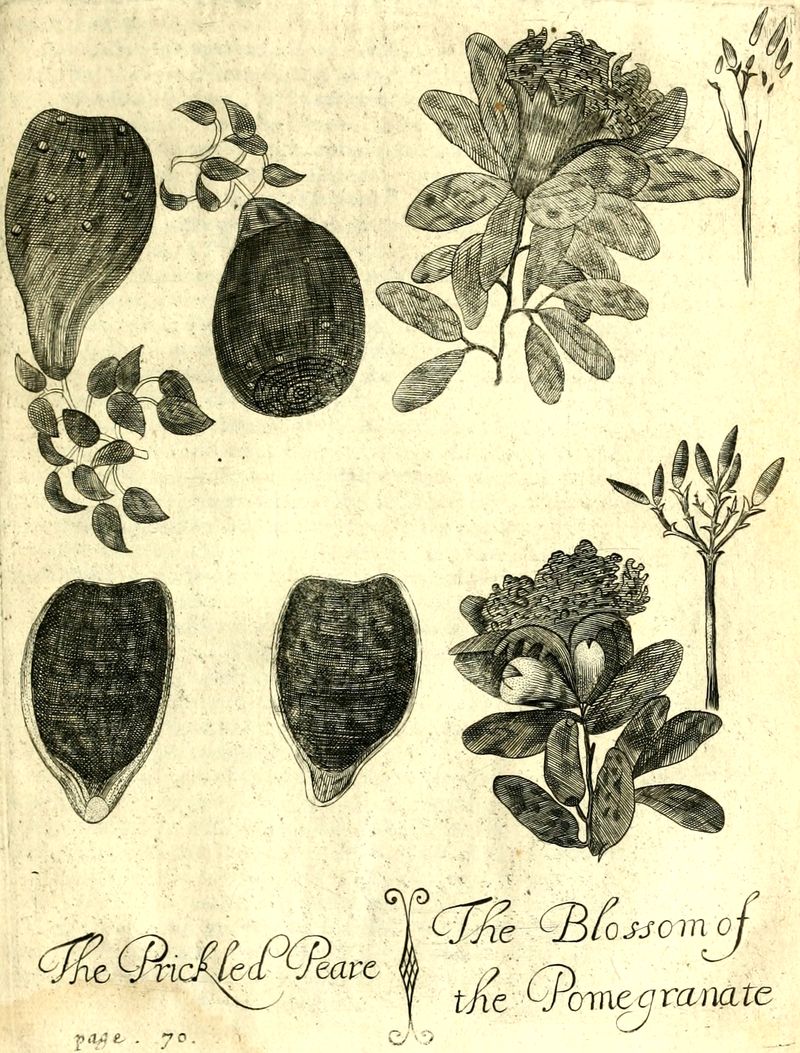
page. 70.
The Prickled Peare
The Blossom of the Pomegranate
Papa.
The Papa is but a small tree, her bark of a faint willow colour, her leaves large, and of the shape of the Physick nut tree, but of the colour of her own bark, the branches grow out four or five of one height, and spread almost levell, from the place where they bud out; to the ends of the branches, and about two foot higher, such other branches spreading in the same manner, and if the tree grow to a greater height then ordinary, a story or two more of these bowes: the top handsomely form’d to the branches, the fruit somewhat bigger then Turnips, growing close to the body of the tree, where the branches grow, and are somewhat a fainter Willow, then either the body, branches, or leaves. The tree, though it may be accounted wood, yet the softest that yet I ever saw; for, with my knife, I can cut down a tree as big as a mans leg at one chop. The fruit we boyl, and serve it up with powdred pork, as we do turnips in England; but the turnip is far the more savoury fruit.
Guaver.
The Guaver growes on a Tree, bodied and leav’d like a Cherry-tree, but the leaves somewhat larger and stiffer; the fruit of the bignesse of a small Limon, and neer that colour, onely the upper end somewhat blunter then the Limon; the rinde about the thicknesse of the rinde of a Limon, but soft, and of a delicate taste; it holds within a pulpie substance, full of small seeds, like a fig, some of them white within, and some of a stammell colour. These seeds have this property, that when they have past through the body, wheresoever they are laid down, they grow. A Planter, & an eminent man in the Iland, seeing his Daughter by chance about her naturall businesse, call’d to her: Plant even, Daughter, plant even. She answered: If you do not like ’em, remove ’em, Father, remove ’em. These fruites have different tastes, some rank, some sweet; so that one would give a reason of this variety, which was, according to the severall constitutions they had past through, some having a milder, some a stronger savour.
This tree doth much harm in our Plantations; for the Cattle eating of them, let fall their loads every where, and so they grow in abundance, and do much harm to the Pastures, and much pains and labour is taken to destroy them. They are the best fruites preserv’d of any, the seeds being taken out, and the rinde only preserved.
Coco.
I have been told by some Planters in the Iland, that Coco-trees grow there, and they are such men as I give credit to, but I never saw any; yet, I may venture to tell what shapes they bear, having been well acquainted with them at the Iland of St. Jago, where there grew very many of them. They seldome are above 80. or 90 foot high, some a 100. The branches of these come out in severall parts of the tree, leaving spaces between the heights; but the greatest quantity is at top, and that top alwaies stoops a little; but the Nuts grow where the lower boughes break out.
These Nuts are of severall sises, the most of them as big as a large foot-ball, with a green skin without, and between that and the shell, a pulpy substance, which when it is drie, is like the rinde of the Mangrave tree, of which they make roaps, or (to bring the resemblance a little neerer) like hemp hurds. This Nut-shell is neer half an inch thick, which we commonly cut at one end, a hole as big as a thirty shilling piece, and we finde the shell full of a clear and pure tasted liquor, very delicious, but not very wholsome. This shell is lin’d within with a substance as thick as it selfe, a white colour, and tastes sweeter then the best french Walnut, and of that softnesse. The colour of the leaves of this tree, are like the Olive leaves.
Custard-Apple.
The Custard apple growes on a tree full of branches and large leaves, and is a lively and lusty tree to look on; the fruit, when ’tis ripe, as big as the largest Pomewater, but just of the colour of a Warden. When ’tis ripe, we gather it, and keep it one day, and then it is fit to be eaten. We cut a hole at the lesser end, (that it may stand the firmer in the dish) so big, as that a spoon may go in with ease, and with the spoon eat it. Never was excellent Custard more like it selfe, then this to it; only this addition, which makes it transcend all Custards that art can make, though of naturall ingredients; and that is, a fruity taste, which makes it strange and admirable. Many seeds there are in it, but so smooth, as you may put them out of your mouth with some pleasure.
Anchovie-Pear.
’Twas never my luck to see any of those trees, that bear the Anchovie-Pears, nor to taste of the fruit, and therefore can give you no account of that tree; only to let you know, that there is such a tree in the Iland.
Trees of mixt kinds. Macow.
The Macow is one of the strangest trees, the Iland affords; the body and branches being stuck all over with prickles, of the finest formes that I have seen.
They are black as jet, or Ebony polish’d; the sises, from one to seven inches long, sharp at the point, with proportionable increasings, from that part where it growes to the tree or bough, and wav’d, as I have seen some swords, from the point to the hilts, the finest naturall pick-tooths that can grow. I brought a large bundle with me, but had them pickt out of my Box by the way. This tree is about the largenesse of an ordinary Willow, the leaves of that colour and shape, but extreamly stiffe and hard.
It bears at top a large tuffe of fruit, which we call Apples, but they are not a fruit to be eaten; their colour as their leaves, willow-green, and just such for shape as the Cyprus tree bears. Sure, Nature form’d this tree to some great purpose, she is so arm’d; for neither man nor beast can touch her, without being wounded. She is well shap’d, her body straight, her branches well proportion’d, her top round.
Date tree.
Next to this in colour are Date-trees, but the leaves somewhat longer. The shape of this tree I cannot give you, having never seen any old enough to bear the name of a tree, but sprigs rising from the root, at least ten foot high.
Mangrave.
The Mangrave is a tree of such note, as she must not be forgotten; for, though she be not of the tall and lusty sort of trees, yet, she is of great extent; for, there drops from her limbs a kinde of Gum, which hangs together one drop after another, till it touch the ground, and then takes root, and makes an addition to the tree. So that if all these may be said to be one and the same tree, we may say, that a Mangrave tree may very well hide a troop of Horse. The bark of this tree being well ordered, will make very strong roaps, and the Indians make it as fine as flax, and spin it into fine thred, whereof they make Hamocks, and divers other things they wear: and I have heard, the linnen they wear is made of this bark, as also their chaires and stooles.
Calibash.
The Calibash tree bears leaves of the fullest and richest green, of any that I know, and the greatest plenty of leaves; her fruit not for food, it is for the most part as big as that of the Coco, round as a ball, green as the leaves of the same tree, smooth and shining, and their manner of growing is so close to the body, and the largest of the boughes, as to touch them so, that till it be pull’d or cut off, we cannot perceive any stalk it has. Of this round ball, we make dishes, bowls and cups; for, being hollow within, as the Coco-nut, we employ them for severall uses, as they are of different sises; some for dishes, some for cups, some for basons, and some of the largest to carry water in, as we do Goards, with handles a top, as that of a kettle, for they are smoother, and much stronger then they. These look very beautifully on the tree, and to me the more beautifull, by how much they were the more strange; for, by their firm and close touching the trees, without any appearance of stalks, they seem to cleave, rather then grow to the trees.
Bay tree.
One, and but one tree in this Iland have I seen, that bears an English name, and that is the Bay tree, whose leaves are so aromatick, as three or four of them will amply supply the place of Cloves, Mace, and Cinamon, in dressing any dish of meat where that is required. It differs nothing in shape or colour from ours in England.
Timber trees.
The Cedar is without question the most usefull timber in the Iland; for being strong, lasting, and not very heavy, ’tis good for building; but by reason of the smoothnesse and fairnesse of the grain, there is much of it us’d in Wainscots, Chairs, Stooles, and other Utensils within dores; but, as they grow, I never saw any of them beautifully shap’d, the leaves just like those of the Ash in England, but somewhat bigger.
Mastick.
The Mastick is a tree very tall, but the body slender, and therefore Nature hath provided means to support her; for, she has spurs or brackets above seven foot from the ground, which are fixt or engrafted in the body; and some of the spurs reach out from the tree to the root, so broad, as that tables have been made of a round form, above three foot and a halfe diameter. Some trees have two, some three of these spurrs. This tree has commonly a double top, one side being somewhat higher then the other. The fruit is like none of the rest, ’tis of a stammell colour, and has neither skin nor stone; but it is more like a Cancre then a Fruit, and is accounted unwholsom, and therefore no man tastes it: ’tis, I believe, the seed of the tree, for we see none other. The leaves of this tree grow of such a height, as till they fall down, we can give no judgment of them. The timber of this tree is rank’d amongst the fourth sort, three being better then it. I have seen the bodies of these trees neer sixty foot high.
Bully.
The Bully tree is lesse then the Mastick, and bears a fruit like a Bullis in England; her body streight, and well shap’t; her branches proportionable, her timber excellent and lasting.
Redwood.
Redwood is a handsome tree, but not so loftie as the Mastick, excellent timber to work, for it is not so hard as some others, which is the cause they seldome break their tooles in working it, and that is the reason the work-men commend it above others. ’Tis a midling tree for sise, the body about two foot and a halfe diameter.
Prickled yellow-wood.
This is accounted as good as the Red-wood in all respects, and is a strong and lasting timber, good for building, and for all uses within doors.
Iron wood.
Iron wood is called so, for the extream hardnesse; and with that hardnesse it has such a heavinesse, as they seldome use it in building; besides, the workmen complain that it breaks all their tools. ’Tis good for any use without doores, for neither Sun nor rain can any waies mollifie it. ’Tis much used for Coggs to the Rollers.
Lignum vitæ.
Lignum vitæ they use now and then for the same purpose, when the other is away; but having no bowling in that Country, little is used: They send it commonly for England, where we employ it to severall uses; as, for making Bowles, Cabinets, Tables, and Tablemen.
Locust.
The Locust is a tree, not unfitly to be resembled to a Tuscan Pillar, plain, massie, and rurall, like a well lim’d labourer; for, the burden it bears being heavy and ponderous, ought to have a body proportionably built, to bear so great a weight. That rare Architect, Vitruvius, taking a pattern from Trees, to make his most exact Pillars, rejects the wreathed, vined, and figured Columnes; and that Columna Atticurges, mentioned by himselfe, to have been a squared Pillar; and those that are swell’d in the middle, as if sick of a Tympany or Dropsie, and chuses rather the straightest, most exact, and best sis’d, to bear the burthen that lies on them. So, looking on these trees, and finding them so exactly to answer in proportion to the Tuscan Pillars, I could not but make the resemblance the other way: For, Pillars cannot be more like Trees, then these Trees are like Tuscan Pillars, as he describes them. I have seen a Locust (and not one, but many) that hath been four foot diameter in the body, neer the root, and for fifty foot high has lessened so proportionably, as if it had taken pattern by the antient Remainders, which Philander was so precise in measuring, which is a third part of the whole shaft upward, and is accounted as the most gracefull diminution. The head to this body is so proportionable, as you cannot say, ’tis too heavy or too leight; the branches large, the sprigs, leaves, and nuts so thick, as to stop all eye sight from passing through, and so eeven at top, as you would think you might walk upon it, and not sink in. The Nuts are for the most part three inches and a halfe long, and about two inches broad, and somewhat more then an inch thick; the shell somewhat thicker then a halfe crown piece, of a russet Umbre, or hair colour; the leaves bigger than those that grow upon the Ash in England: I shall not mention the timber, having given it in my Buildings. The Kernells are three or four in every nut, and between those, a kinde of light pulpie substance, such as is in a Hazle-nut, before the kernell be grown to the full bignesse: In times of great famine there, the poor people have eaten them for sustenance: But, of all tastes, I do not like them.
Bastard-Locust.
Another Locust there is, which they call the bastard-Locust. This lookes fair, but will not last.
Palmeto the lesse.
There is a tree called the Palmeto, growing neer the Sea-coast, which being a sandy light ground, does not afford that substance of mould, to make a large tree; nor shall you finde in that low part of the Iland, any considerable trees fit for building, which is a main want and hinderance to them that would build there; for, there is no means to transport any from the high lands, by reason of the unpassableness of the wayes; the body of this tree I have seen about 45 or 50 foot high, the Diameter seldome above 15 or 16 inches, the rind of a pure ash colour, full of wrinkles, the leaves about two foot and a halfe long, in bunches, just as if you took twenty large flaggs, with their flat sides together, and tied them at the broader ends. With these bunches they thatch houses, laying every bunch by himselfe on the lathes, somewhat to overhang one another, as tiles do. This is a very close kind of thatch, keeps dry and is very lasting, and looking up to them on the inside of the room, they are the prettiest becomming figures that I have seen of that kind, these leaves grow out no where but at the tops of the trees.
Palmeto Royall.
Another kind of Palmeto there is, which as it has an addition to the name, has likewise an addition to the nature: for I beleive there is not a more Royall or Magnificent tree growing on the earth, for beauty and largeness, not to be paralell’d; and excels, so abundantly in those two properties and perfections, all the rest, as if you had ever seen her, you could not chuse but fall in love with her; I’m sure I was extreamly much, and upon good and Antique Authority: For if Xerxes strange Lydian love the Plantane tree, was lov’d for her age, why may not I love this for her largeness? I beleive there are more women lov’d for their largeness then their age, if they have beauty for an addition, as this has; and therefore I am resolv’d in that poynt, to go along with the multitude, who run very much that way: but how to set her out in her true shape and colour, without a Pencill, would aske a better Pen then mine; yet I will deliver her dimensions as neer truth as I can, and for her beauty much will arise out of that. But first I will beg leave of you to shew her in her Infancy, which is about tenne or twelve years old, at which time she is about seventeen foot high, her body and her branches, and that part which touches the ground, not unlike an Inkhorne, which I have seen turn’d in Ivory, round at the bottome and bellied like that part which holds the Inke; and the stem or body of the tree, growing less, as that part which holds the Pens, but turn’d by a more skilfull workman; and some of this body, part tawny, part purple, with rings of white and green mixt, that go about her; and these rings at sixe inches distance. This stem, to be about sixe foot and a halfe high, upon which growes the bottome of the stalks, thinne as leaves of Parchment, enwrapping one another so close as to make a continued stem, of the same bigness, for two foot and a halfe above the other, every one of those filmes or skins, bearing a stalk, which lessens so insensibly, from the skinne to the poynt as none but the great former of all beauty can make the like.
These stalks or branches, are of severall lengths, those that are the most inward, are the highest; and every one of those stalks adorn’d with leaves, beginning a little from the filmes to the poynt, and all these leaves like Cylinders, sharp at either end, and biggest in the middle; that part of the stem which is the enwrappings of the filmes of a pure grasse green, shining as parchment dyed green, and slickt with a slick-stone, and all the branches with the leaves, of a full grass green spreading every way, and the highest of them eight foot above the green stem, the other in order to make a well shap’t Top, to so beautifull a stem. The branches sprout forth from the middle, or intrinsick part of the tree, one at once; and that wrapt up so close as tis rather like a Pike then a branch with leaves, and that Pike alwayes bends toward the East; but being opened by the Suns heat spreads the leaves abroad, at which time the outmost or eldest branch or sprig below withers and hangs down, and pulls with it the filme that beares it, and so both it and the filme which holds it up turne of a russet colour and hang down like a dead leafe, till the wind blowes them off; by which time the Pike above is become a branch, with all its leaves opened; then comes forth another Pike, and then the next outmost branch and filme below, falls away as the former, and so the tree growes so much higher, as that branch took roome, and so a pike and a dead leafe, a pike and a dead leafe, till she be advanc’t to her full height which will not be till 100 years be accomplished: about thirty or forty years old, she will bear fruit, but long before that time, changes her shape, her belly being lessened partly by the multiplicity of roots, she shoots down into the earth (nature foreseeing how great a weight they were to beare, and how great a stress they were to suffer, when the winds take hold of so large a head, as they were to be crown’d with) and partly by thrusting out sustenance and substance, to raise and advance the stem or body (for out of this belly which is the storehouse of all this good it comes) so that now she becomes taper, with no more lessning then a well shap’t arrow, and full out as straight, her body then being of a bright Ash colour, with some dapples of green, the filmes a top retaining their smoothness and greenness, only a little variation in the shape, & that is a little swelling neer the place that touches the stem or body, not much unlike an Urinall, so that the swelling that was in the body, is now raised up to the filmes or skinns above. But at this age, the branches stand not so upright, as when the tree was in her minority, but has as great beauty in the stooping and declension, as she had in the rising of her branches, when her youth thrusts them forth with greater violence and vigour, and yet they had then some little stooping neer the poynts. And now there is an addition to her beauty by two green studds, or supporters, that rise out of her sides, neer the place where the filmes joyne to the tree, and they are about three foot long, small at the place from whence they grow, but bigger upwards, purely green and not unlike the Iron that Glasiers use to melt their Sawder with.
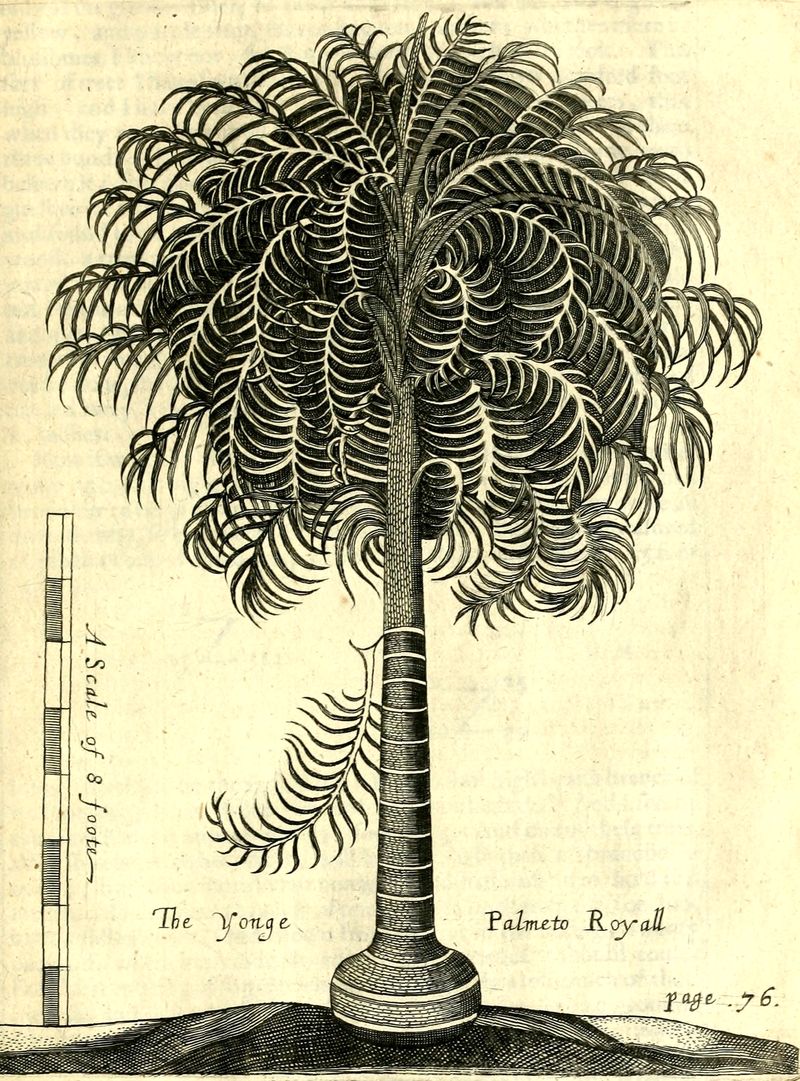
page. 76.
The Yonge Palmeto Royall
One growes on one side of the tree, the other on the other side, and between these two of the same height, on either side the tree, a bush upon which the fruit growes, which are of the bigness of large French grapes, some green, some yellow, some purple, and when they come to be purple, they are ripe, and in a while fall down, and then the yellow becomes purple, and the green yellow; and so take their turnes, till the tree gives over bearing. These fruits we can hardly come by being of so great a height, nor is it any great matter: for the taste is not pleasant; but the Hoggs find them very agreeable to their palats for those that eat of them grow suddenly fat. I have seen an Negre with two short ropes clyme the tree, and gather the fruit, about this time, she is 80 foot high, and continues that forme, without variation; only as she growes older, so taller and larger; and has alwaies green, yellow, and purple fruit, succeeding one another; whether there be blossomes, I know not, for I never went so high as to look. This sort of trees I have seen of all sises, from ten, to two hundred foot high; and I have been told by some of the antient Planters, that when they came first upon the Iland, they have seen some of them three hundred foot high: And some reasons I have to perswade me to believe it; for, amongst those that I have seen growing, which I have guest to be two hundred foot high, the bodies of which I measured, and found to be but sixteen inches diameter. And I once found in a wood, a tree lying, which seem’d to have been long fallen; for, the young wood was so grown about her, as standing at one end, I could not see the other: But, having a couple of Negres with me, that were axe-men, I caused them to cut away the wood that grew about the tree, that I might come to the other end, which I thought would never be done, she was so long, and yet a great part of her cut off, and carried away. I measured the diameter of her stem, and found it to be 25 inches.
16 ——— 200 / / / 25 ——— 312 200 ——— 25 / / / 312 ——— 39
Now if we go by the rule of Three, and say, If 16 inches diamiter make 200 foot high, what shall 25 inches? And by this rule we shall prove her to be 312 foot high. But the branches of this tree were all carried away, so that I could see none of them. But I have measured a branch of one of those trees of 200 foot high, and found it 25 foot long. So then, by the same Rule: If 200 foot high bear a branch of 25 foot long, what shall a Tree of 312 foot high do? And I see by the same Rule, it appears to be 39 foot long. And one of these trees, after she comes to bear fruit, will have no lesse then 20 branches at once, (but many more in her nonage) and halfe of them hold this length. I have seen a branch of one of these small trees of 200 foot high, fallen down, and blown from the tree in the falling, twenty paces off, which has made me admire from whence it should come: For, the tree being of so great a height, the branches lose much of their bignesse and length by their distance: But, lying on the ground, where we can take the just measure, we find what they are. And it is an admirable thing, to see the form of this sprig or branch, which is not above two inches broad where it joynes to the film, and is lessening of the breadth from that end to the point, which is twenty five foot long, so insensible, as it is not possible to discern where the diminution is. So smooth, so eeven, so firme and tough, as though it be not wood, ’tis much stronger, and abler to endure the weather, or any kinde of bending. The leaves that grow upon this stalk, are all of them (unlesse towards the points) two foot long; that part which touches the stalk, small, but strong enough to bear the leafe, and has a little short stalk, to which the leafe growes, which leafe is as exactly form’d, as the stalk, growing by degrees, to make two inches broad in the middle, and losing that breadth insensibly to the point. These leaves are thin, but tough enough, to endure the strongest winde that blowes, without being broken, and not above four inches distant one from another; which multiplicity of leaves, makes the beauty of the tree the fuller. About the time this tree parts with her belly, & growes to a slender kind of shape, she drawes up amongst her roots some of the soyle that bred her, about two foot higher than the levell of ground that is neer it; and by reason it is held in by an infinity of small roots, that come from the body, it there remaines firm, and falls not down; the outside of this earth is about a foot round about, broader than the diameter of the tree; so that if the diameter of the tree be a foot, the diameter of this earth is three foot at top, but somewhat more below; for the sides are not so steep, as to hold one breadth above and below. If this earth were beautifull, smooth, and large enough, it might be called the Pedistan to that Corinthian Pillar, the Palmeto Royall. But what is wanting in the Pedistall, is supplyed in the dimensions of the Pillar; for, the Corinthian Pillar is allowed for length but nine of her own diameters, and this will not aske leave to take 150. which makes her the more beautifull, since the strength she hath, is able to support the weight she bears: And for the Architrave, Frize, and Cornise, they are not to be compar’d with the beauty of the head of this Pillar, together with the fruit & supporters. And I believe, if Vitruvius, himself had ever bin where this Pillar grew, he would have chang’d all his deckings and garnishings of Pillars, according to the form of this. And though the Corinthian Pillar be a Columne laciviously deckt, like a Curtesan, and therein participating (as all inventions do) of the place where they were first born; (Corinth having been without controversy, one of the wantonnest Townes in the world) yet, this wants nothing of her beauty, and yet is chast, which makes her the more admirable and the more worthy to be prised. One thing more I have to say of this tree, which is not onely the root that brings forth all this beauty, but the root of much admiration and wonder; that, being a tree of that height, bearing a top of so vast an extent, as from the point of the branches of one side, to the point of the stalk on the other side, to be 78 foot, upon which, the winde cannot but have a main power and force; yet, I never saw any of them blown down, nor any root of this tree bigger then a Swans quill: but there are many of them, and they fasten themselves in the Rocks, which hold them very firm. The wood of this tree is so extream hard, and tough withall, as most of the axes that are employed to fell them, are broken in the work; and they are well enough serv’d, for cutting down such beauty. The use our Planters made of them at first comming, before they knew how to make shingles, was, to saw the bodies of these trees to such lengths, as might reach from the ridge pole, to the Eves of the house; for, they were hollow, and then sawing them long-wise, there were two concaves, which they laid together, setting the hollow sides upward; and where they close, one to cover them, with the hollow side downward, and so the whole house over. And this was the use they made of the bodies of these Trees, for which, very many of them were destroyed.