Front matter (continued 4)
Reading edition
'Treason!' he cried. 'Foul treachery is at work! Agrando has made an attempt to seize my whole party! Some of them he has indeed already basely captured; and he has now actually attacked some of our airships. Monck is in difficulties himself, he tells me; but he hopes to be able to send my yacht to our aid soon, now that I have told him where we are. Whether he can do more than that, he says, he really does not yet know.'
There were exclamations of amazement at these sinister tidings, and the friends stared at one another in bewildered perplexity.
'I can scarcely, even now, believe it!' cried Alondra.
'You are sure there is no mistake? Or may it be that some one is playing a joke upon you?' suggested Gerald rather vaguely.
'No one would dare to attempt such a thing!' Alondra asserted haughtily.
'But—it sounds impossible,' said Jack helplessly.
'It wouldn't if you knew our master as well as we do,' Malandris put in. 'I have had an idea for some time past that something of the kind was hatching.'
'If it be as you say, Prince, our position is critical indeed,' Malto declared. 'Agrando will not hesitate now to send one of his airships against us—the very thing I thought we were safe from so long as daylight lasted. I am afraid we must make up our minds to the inevitable—we shall all be his prisoners before another hour is over. And what that means you can now guess; although what we have already told you is but a small portion of the actual truth.'
'My father will rescue us; and they dare not harm us meantime!' cried Alondra proudly. 'Agrando knows too well the terrible vengeance that would be exacted.'
Malto shook his head.
'Do not count too much upon that, Prince,' he said. 'It was partly the fear that some such plot was brewing which made me wish to see King Ivanta in order that I might warn him. I had hoped that in return he would be willing to assist me in another matter on which my heart is set—to right a great wrong. But I fear it is useless to dream of it now.' And he sighed.
'But is there no other way of escape open to us?' Jack asked. 'Surely, if it be that our friends cannot come to our aid, we should do better to try some other plan rather than stay on here to be tamely captured whenever it pleases Agrando to send an airship to take us prisoners!'
'Yes, it might be better even to risk a run across the enclosure where your monster lives,' Gerald put in. 'It is only a choice of monsters—that or Agrando.'
'Very likely both—Agrando will give us to him later on,' said Malandris grimly.
'Well, then, what is this place that we are in?' Jack went on. 'Is it empty? Is there nothing in the place that might be useful to help us to defend ourselves?'
'This pavilion is a sort of grand stand—a place of vantage from which the privileged spectators obtain a good view—and a safe one—of what takes place in the enclosure when there is anything exciting going on,' Malandris explained. 'It is not used for any other purpose, and is empty'——
'Wait a moment!' Malto interrupted, with a sudden light in his eyes. 'I am not so sure that it is quite empty. Is there not a store-place below, where they keep'——
'You are right, Malto,' the other answered in some excitement. 'I had forgotten it. There may be some arms and things there which would be useful indeed if we have to try to hold out for a time till assistance can reach us. But I am afraid the place is locked up'——
'Perhaps my key will fit; if not, we must break it open.'
Just then there came a great gust of wind and another and louder growl of thunder; and a little later there was heard an outburst of shouting outside. Malto ran out on to the balcony to see what it meant.
There was a good deal of excitement amongst their enemies below. People were talking one to another, and some were pointing up at the pavilion, while a few were huddled together in a knot. In the middle of these last were seen two men who were doing something with some wings, seemingly preparatory to taking a flight in the air.
'They have thrown off all thought of concealment,' said Malto, coming inside again. 'You can see that. So what you told us, Prince, must be only too true! They are going to send a couple of fliers up to attempt our capture.'
'But in that case, why does not Agrando send an airship and settle the matter at once?' Gerald asked.
'I expect just now all his airships are busy fighting my friends,' said Alondra. 'They will attend to us presently, I suppose, if the people here don't succeed.'
'Well, we will make a fight of it, anyway!' cried Malto sturdily. 'I believe we may find the means down below, if you can keep them at bay for a little time while we search'——
'We can manage that, I think,' Jack answered him. 'Do you go below and see what you can find to help us.'
Again there came a blustering gust of the fast-rising wind. Then there was a blinding flash, followed by a deafening crash of thunder which shook the whole building to its foundations.
CHAPTER XXVII.
A DESPERATE VENTURE.
Malto and Malandris disappeared down a stairway; and Alondra and the two chums strolled on to the outside gallery to watch their foes.
The wind was now very high, and the darkening sky grew blacker every minute. The swirling gusts whistled and shrieked amongst the outer metal framework, and moaned dismally through the windows and doors.
On each floor of the pavilion there was one of these galleries which ran the whole way round on the outside, being partitioned off from the interior by glass windows only. Hence there was almost as good a view from the inside as from without; except that one could not look over and see what was going on immediately beneath.
'The storm seems likely to be a bit of luck for us,' Jack observed, as he watched the preparations which were going on below. 'They don't seem to find it to their liking.'
So boisterous had the weather become that they found wings almost unmanageable. The two men were trying their best to manipulate some contrivances of the kind, but with scant success. Every time an attempt was made at a start, a blast would come along, swishing and buffeting the outspread wings, and dashing one or other of them to the ground ere the aeronaut could rise high enough to use them properly.
'Why, it doesn't seem much use to think of attacking us in that way in such a wind!' exclaimed Gerald. 'If they even succeed in making a start, they will only run a risk of being either dashed against the building or carried past it out of sight. And they couldn't hope to fly back in face of this wind, could they?'
'No, you are quite right,' Alondra returned. 'I must say those two fellows must be either unusually clever or uncommonly foolish, to think they can attack us under such circumstances. Nevertheless, we must be on our guard. One of them might, by some chance, get blown against the framework here, and cling to it. Then, with his trident, he would make short work of us if he caught us within reach.'
'And if we were idle meantime,' put in Jack, between his teeth. 'There, look at that!'
One of the daring aeronauts had taken advantage, as he thought, of a slight lull, and had sprung up into the air. But a sudden gust caught one of the wings and dashed it violently to the ground again, causing him to fall heavily.
'If that's all they can do, we haven't much to fear from them!' cried Gerald, rubbing his hands.
But his rejoicing came too soon, for even as he spoke there came another lull; and the other aeronaut rose into the air and came straight towards them.
Alondra laid a hand upon both of his companions and dragged them promptly back through the door, and closed it. Jack, who had been about to fire at the assailant, looked not a little surprised.
'Another moment—before you could use your weapon—he would have had the three of us!' exclaimed the young prince. 'We had better watch him from behind the glass, where we are safe, and wait to see what happens next.'
The two chums could but recognise the wisdom of this advice. They had not at first realised that the man had risen high enough to bring them within range. They had been in imminent danger, therefore—supposing their foe had been able to use his trident—of being assailed and rendered helpless before their bullets could take effect. Inside the glass they were safe, for the fateful flash could not penetrate it.
The attacker seemed to be coming on gaily, or, at least, without any great trouble, when another blast caught him and spun him round like a great top. Then, ere he could reach the gallery, it carried him downwards with a sudden swoop, and left him helpless, but unhurt, at the foot of the building.
He picked himself up, and a crowd of his friends seized upon him and half-carried, half-dragged him back to a distance which they considered necessary for another attempt.
'We had a narrow escape,' Alondra declared. 'He is a plucky fellow; and he was as cool and unflustered just then as if there had been no roaring wind playing around. I saw it in his eye. It was lucky I did see it, and rushed you two into shelter in time.'
'We have to thank you for being so prompt, then,' Jack answered. 'We must be more careful next time. He 'll have another try, I suppose?'
'I don't know. I almost doubt if he will risk it, plucky as he evidently is. You can hear how the wind is increasing.'
He opened the door a little way as he spoke, and such a gust came in as almost forced it out of his hand.
'It's a regular tempest!' cried Gerald. 'The building itself seems to rock about with it and almost feels as if it might blow over.'
'Yes, it will certainly stop any further attempts of that kind,' Alondra decided. 'No man who is not a fool or a madman would trust himself on wings in such a storm. His life would not be worth a minute's purchase. He would be likely to be blown against the first thing that came in his way, and have his brains dashed out. No airship, even—unless it were the great Ivenia—could make headway against such a wind.'
'What you say is true enough, Prince; yet I am afraid we shall have to show ourselves mad enough to risk it,' said Malto, who had re-entered the apartment unperceived. 'If the chance were offered you of trying to escape on wings, now, at this moment, or waiting to be pounced upon by Agrando's people later on, which would you choose?'
'What is the use of asking such a question?' Alondra queried in return, somewhat impatiently. 'Surely we have something more urgent to think of just now than'——
'Not at all,' answered Malto coolly. 'It happens to be the most urgent question of the moment. To cut the matter short, Prince, we have met with a great find. We have discovered, besides the tridents and things I had hoped for, several complete flying-outfits. They are motor-wings, and if you have the courage to try your luck with them in this storm, there is no reason why we should not bid Agrando's people a cheery "Good-bye," and flit off before his airships come buzzing about our ears in real earnest.'
The friends stared at one another in blank astonishment. Here was an unexpected turn indeed! Truly, it was a most momentous decision which they were called upon to make—to do that which Alondra but a minute before had pronounced none but a fool or madman would dare to risk, or stay and take their chance of being rescued.
'Honestly, it seems to me our only plan,' Malto declared. 'Malandris and I have been discussing it downstairs, and we came to the conclusion that your friends would have been here before this if they were coming at all. I am sorry to say I fear they must have got the worst of it; and Agrando is only waiting till the wind drops to come and seize us. He thinks he is sure of us; and need not, therefore, risk one of his airships in such a storm.'
'I fear you must be right, my friend,' said Alondra sadly. 'In that case, your plan, wild as it would otherwise be, is the only one open to us. For my part, I will risk it.'
'And I!' exclaimed Gerald and Jack together.
'Then the sooner we act upon that decision the better,' said Malto. 'At any moment the wind may drop, and our chance will have gone. Everything is ready. From the top outside gallery we can get a better send-off than those chaps down there had. We can slip out upon the farther side, and be off and away before they have time to understand what's afoot. Then we must trust to the very force of the wind to carry us well beyond their reach. There is one suggestion I have to make. It is that we shall be all five roped together with double ropes, so that we shall keep together; in that way, if one is in trouble, the others may be able to help him. Otherwise, we shall probably be blown about like flies, and lose touch with one another in the first ten minutes.'
No time was lost in further discussion. They all set to work with a will, dragging the necessary equipage up to the top floor. There they speedily completed their arrangements, went out on to the outside gallery, and, after some preliminary manoeuvring, Malto gave the signal.
Being on the lee side, sheltered for the moment from the gale, they managed to make a fairly good start. They threw themselves fearlessly from the gallery, and a great shout of rage and astonishment which came to their ears from below told them that their foes had just caught sight of them.
A moment more and the howling tempest had caught them and was whirling them madly forward. Upwards they sailed with poised wings, like immense birds, while their bewildered enemies below gazed after them with staring eyes and open mouths.
There was another flash of lightning, followed on the instant by a crash that seemed to shake the very rocks around; and then there were cries and shrieks from the crowd as stones and pieces of metal-work came flying through the air.
The lightning had struck the pavilion and wrecked it!
CHAPTER XXVIII.
SAILING ON THE STORM-WIND.
The five adventurous fliers were borne along by the wind in a fashion which can be better imagined than described.
To Gerald and Jack, at least, it was an absolutely novel experience, whatever it may have been to the others. Every time they glanced down it almost made them giddy to see the rate at which the various features of the landscape were racing, as it were, past them.
Of the wrecking of the pavilion by lightning they knew nothing. They had been dazzled by the awful flash, and almost deafened by the terrible crash which followed; but they were then already two or three hundred yards from the scene. A minute or two later, and they were a mile or more away; and the place itself would have been out of sight even if they could have looked round.
But they had no time to look round. They scarcely seemed to have time to look ahead. No sooner did they catch sight of something—a large building, a group of trees, or what not—in the distance, than, lo! it seemed to make a mad rush towards them. One moment it was half a mile away; the next it had vanished behind them.
But it was very difficult to distinguish any individual object.
The whole landscape beneath them was one vast blur. Cities, villages, trees, fields, woods, streams, lakes, hills, valleys—all seemed to be merged into a vague mass, and there was no time to single out details before they had slipped past.
Curiously enough—and contrary to all expectations of the two visitors from Earth—their progress, wild and mad as it seemed when they looked down, was serene, easy, almost quiet, when they looked up. So long as they made no effort to stop or turn they scarcely felt any wind at all; and so long as they could keep clear of possible obstacles in their course by sailing over them there appeared to be no immediate danger. Below them all was a wild, mad race amid a continuous, low, booming roar; above, everything looked quiet, almost stationary, for the black clouds travelled noiselessly and kept exact pace with them.
Whether they would be able to continue to travel thus so long as the storm should last was another matter—as also was the question of where they were being carried. They had no control over their course, no idea of what their ultimate destination was likely to be, no possible means of arresting their wild career. To have ventured on a lower course, nearer the ground, in the hope of stopping, would have meant certain death.
Nor could they so much as speak to one another. They were all roped together, it is true, and this proved a very wise precaution, for without it they would undoubtedly have quickly become separated and hopelessly lost to one another. Malto had left plenty of rope between each, and this was now extended to its utmost, leaving too great an interval to permit even of shouting. They all looked to Malto—who was in the centre—for guidance; and he conveyed his directions and advice by signs.
Of other fliers, or of airships of any kind, they saw none. It was the custom to send warnings ahead in such case, and for all air-craft to seek shelter until the storm had passed.
The wings they had found and appropriated were a sort of combination—that is to say, they were supplied with electric motors, but could also be used as ordinary wings when the supply of electricity stored in the batteries ran out, just as one can work a motor-cycle with one's feet. At present the travellers were husbanding their power carefully, using only just enough to keep them at what seemed to be a safe height.
It had been Malto's hope, when they had started, that the storm would not continue in such fury for any length of time. But this expectation proved to be delusive. Hour after hour passed, and still they were carried along at a pace which would have rendered any attempt at stopping sheer madness. Cities and towns had long disappeared; villages, even, now seemed to be no more. The ground became hilly, and less and less cultivated till they came upon a region which was little more than a rocky desert. Here the hills were growing into mountains; and some of these towered up to such a height that possible collision with their rocky peaks became a very ugly possibility.
Malto grew alarmed, and signalled to his companions to ascend yet higher. Upwards they mounted accordingly, and passed into the midst of the swirling clouds. Here they were in a thick mist, but presently, to Malto's relief, they struck into an upper current free from cloud, and there they entered a region of perfect calm.
They could now even talk, and look round, and take rest of a sort. The sun was shining, and everything was bright and cheerful. Beneath their feet they could see nothing save great masses of sombre, heavy-looking clouds scurrying furiously onwards.
'Whew!' Jack uttered a long whistle of relief. 'This is a change indeed! I began to wonder where on Earth—h'm, I mean where on Mars—we were rushing to! Where do you suppose we 've got to? I mean, supposing we dropped straight down, what part of your world should we be in?' He asked the question in a general sort of way, and Malto answered him as vaguely, by admitting frankly that he had not the least idea.
'I confess I 've lost count of all landmarks,' he declared. 'I am very much afraid we are now near what is known as the Great Desert. It is a more or less waterless tract which is uninhabited, save by some roaming tribes of wanderers who do not bear the best of characters.'
'Ha! You have deserts, then, as we have?' said Gerald.
Malto looked at him in surprise.
'Why, of course; I thought everybody knew that! Fully one-third of our globe is waterless desert, and, what is worse, the tract is gradually extending. Our scientific men prophesy that the proportion will grow larger and larger until the whole planet becomes a dried-up waste. That is the cheerful sort of doom they predict for future generations!'
'Curious, isn't it?' murmured Jack, glancing at Gerald. 'That is exactly what our earthly scientists have prophesied as likely to happen to Mars in the future!'
'And to our own planet also, some day, I suppose,' Gerald rejoined. 'Only, here, I suppose, the process has gone farther than it has with us.'
'Well, desert or no desert, it will be better than Agrando's dungeons,' said Jack. 'We shall have to go down into it, I suppose, when the storm subsides? We can't stop up here indefinitely. What are we to do meanwhile? Can't we try to work back in this upper current?'
Malto shook his head.
'It would probably be of very little use, and would certainly be unwise,' he counselled. 'We have come hundreds of miles—much farther than our whole store of electric force would carry us. If we expend it all in trying to work back we shall be in bad case if, when we come to the end of our store, we still find ourselves where we do not want to be. Now, to support ourselves up here quietly will take but very little of our reserve force, and we shall have a good stock left for emergencies. That is my advice; in fact, that is practically all we can do. We must wait here till the storm below has blown itself out. Then we will go down and try to find out what country we have got into.'
'I think you are right,' Alondra agreed.
'It is already well on in the afternoon—judging by the sun—and we have had nothing to eat. I 'm getting hungry!' Jack grumbled. 'Don't you have aerial inns up in the clouds here, where storm-tossed travellers can get a meal?'
Needless to say, they were all hungry, but there was nothing to be done but wait. So, to pass the time, they began to compare notes, and Alondra related his adventure of the early morning in the pool in the glass-house. Malto and Malandris nodded their heads significantly as they listened.
'Ah, there are strange tales afloat about that glass-house and the deadly plant it shelters,' the elder man declared. 'I have never seen it myself, but I have heard quite enough concerning it.'
The talk went on, and an hour or two slipped by; and then, just as the sun drew near the horizon, Malto, looking down, suddenly ventured an opinion that the wind below had subsided.
To test the point, they swept downwards, passed through several strata of dense cloud, and found, sure enough, that the guess had been correct. Below the cloud all was now almost as calm as above. There was scarcely breeze enough to carry them along.
They finally descended, just before sunset, in a gloomy, forbidding valley of rocks, where there were no signs of Martian inhabitants to be seen in any direction. They found, however, a small stream—a fact which surprised Malto—and this enabled them to quench their thirst. But how to obtain the wherewithal to satisfy their hunger was another and more hopeless matter.
CHAPTER XXIX.
ATTACKED IN THE DARK.
Presently Malto uttered an exclamation of surprise. He walked a short distance up the little watercourse and examined carefully some bushes growing on its banks. They seemed to excite both interest and pleasure.
'I know those plants,' he explained to his companions. 'They will provide us with a very fair and toothsome supper, and they also tell me a story. You wished to know where we had drifted to, and I can now tell you almost exactly.
'This is not the Great Desert—fortunately, we have not travelled far enough to reach that—but a tract lying upon its borders. We are in a region situated between the desert and the country of Iraynia, which,' he added slowly, and with some sadness in his tone, 'is my native land.'
'Oh!' said Alondra; 'so you are a native of Iraynia! I have heard a good deal about that country, though I have never been there. Was there not some great fuss or trouble there some years ago, before my father'——
'Before King Ivanta allowed the tyrant Agrando to annex it, would you say? Yes, Prince, there was. And thereby hangs a tale. I will not tell it to you now, however—it will keep for another time; but I may say that it is a tale of terrible, almost incredible wrong, and treachery, and wickedness. It is that great wrong which I wished to induce King Ivanta to inquire into, in order that the memory of a good man's name may be cleared from dishonour. That man was my father, Prince; and that was the reward I was hoping to win from King Ivanta. Now you will understand why I said I could not share my reward, if I obtained what I hoped for, with any one else!'
There were notes of deep feeling and sadness in the young fellow's voice as he spoke in low, incisive tones, turning his face away the while as though afraid he might break down.
There was a pause; then Alondra said gently and sympathetically, 'I am sorry, indeed, that you have such a heavy trouble to bear. Later on you shall give me fuller particulars, and I will myself lay them before my father. He is just and fearless in punishing where wrong has been done, and if he finds, on investigation, that your story is true, I am certain he will right you, and the memory of your father, and punish the wrongdoers.'
'He will have to fight to maintain his own position ere that can come about, I fear!' rejoined Malto gravely. 'But I thank you, Prince, all the same, for your sympathy and your promise. Another day I will, as you say, give you the details—when the time comes. Let me now explain how we are situated here. We are in a desolate territory known as Kubandia. It is nothing but a maze of arid rocks and mountains, and wild, gloomy gorges and valleys, almost waterless, but not so bad, in that respect, as the Great Desert which lies beyond. For the reasons I have mentioned the tract has a bad name, and also for another—that there are bands of reckless outlaws who have made it their fastness. They are, I believe, for the most part remnants or descendants of men who were originally honest patriots—men who were driven into exile by Agrando's heavy hand when he took over the government of the country. Now, I fear, they are, most of them, no better than brigands and unscrupulous adventurers. It is said that there are many bands, under different heads, but all directed by one leader—a clever, daring chief, of whom wild tales are told. His name is Fumenta; and it is a name held in terror by Agrando's followers. But for this man's wonderful genius and bravery, it is believed these brigands would all have been exterminated before this. He has, somehow, managed to evade capture for many years, and carry on a guerilla warfare, holding his own in these wild valleys and gorges in spite of all the forces Agrando has sent against him. Such, at least, is what we hear. I myself can say nothing as to this part from my own knowledge, because I have been brought up in Agrando's city and forced to be one of his servitors.'
'Naturally, however, you cannot help feeling a certain amount of sympathy for these outlaws, who are your own countrymen, and who have been driven, as you think, perhaps unjustly, into exile, eh?' queried Alondra, eying the other keenly.
'It may be so—deep down in my mind,' was the quiet answer. 'Certainly, however, I have no sympathy with tales of robbery and murder such as are related of these bands. But, of course, they may not be true, or they may be very much exaggerated. We only hear one side, that told by Agrando's people; and from my own experience I can tell you that it is not safe to believe all they assert.'
'But how do you know where we are, if, as you say, you only know of all these things by hearsay?' was Alondra's shrewd query.
'Oh, I have been in these parts before as a boy, and I know that those plants yonder are peculiar to this region. You do not find them anywhere else.'
'I see. Well, if they are good to eat, let us try them as soon as we can. For my part, I am hungry enough to devour anything that is fairly eatable.'
'We must have a fire. It is the root which is good to eat; and it requires cooking,' Malto returned. 'I have dug these roots up and cooked them many times when picnicking out here with other youngsters. If you others will get some wood together, and start a fire, I will soon have a first-rate supper ready for you.'
The young fellow proved as good as his word, and some half-hour later, just as darkness fell, they were all sitting round a cheerful fire, discussing a very agreeable meal off something which had a flavour not unlike baked potatoes.
'Humph! Not a bad thing to fall back upon in a wilderness like this!' Jack declared. 'And what are we going to do afterwards? How are we to get back to our friends?'
'That is not easy to say,' Malto answered soberly. 'We must have passed right over my country to get here, and that alone means two or three hundred miles. It is a land which is full of Agrando's followers, and you may be sure that his airships will, by this time, be cruising about in search of us.'
'That sounds cheerful! Looks as if we shall have to stay here and do a bit of outlaw business on our own account!' cried Jack.
Malandris glanced at him with a very grave expression in his eyes. 'Your remark exactly describes the position, young sir, though spoken, doubtless, half in jest. I am sorry to have to say it, for it is not a trifling matter. For myself, I accept it as preferable to the fate from which you all so pluckily aided to rescue me. But it grieves me that I should live to see the son of the good and wise King Ivanta in the position of a hunted fugitive!'
Alondra started and flushed up at these plain words. But there was in the elder man's eyes a look so thoroughly honest and kindly that it was impossible to take offence.
'Perhaps such an experience will do me no harm,' he answered, after a minute's thought. 'That is, provided it ends in the right way. It is better than passing the time in Agrando's palace as his captive. My father is sure to rescue us in his own good time. He will follow us up and find us out, wherever we are, and the punishment he will inflict on his daring enemies will be terrible. Does Agrando hug to himself the notion that he can pit himself against his overlord?' Alondra continued, with a proud curl of his lip. 'Why, where is his fleet? What means has he of resisting my father's power?'
'He has been making secret preparations ever since his return from his trip to the evening star. I feel sure of that!' Malto declared.
'Why don't you try a wireless message?' Jack asked of Alondra.
The young prince shook his head. 'It is useless. The little instrument you saw does not carry far enough,' he explained. 'Monck Affelda cannot hear me unless he is within a hundred miles. But you may be sure of one thing, the news of all that has happened has before this been flashed through to my father, and he is already on his way to our assistance in the Ivenia. How can Agrando think he can prevail in the end against such a monster of the skies as the Ivenia?'
As he spoke these words there was a sudden illumination of the spot where they were sitting round their fire, and the sound of voices was heard. Lights were flashed upon them from the air above, dazzling their eyes and rendering it impossible to make out what had happened or who the speakers were. But the words were unmistakable; some one had called out in harsh, hoarse tones, 'Surrender! You are my prisoners! If you make any attempt at resistance you are all dead men!'
CHAPTER XXX.
CAPTURED.
When the ominous summons to surrender was heard, shouted down from some invisible person in the air above them, it was Malto who took upon himself to reply.
His brain had been working quickly. At first he had feared that it was Agrando's people who had thus found them out, but a moment's reflection convinced him that such a thing was extremely improbable. If it were indeed so, then, such was his detestation of his late master, and horror of again falling into his clutches, that he would rather have died fighting than yield.
But Agrando's men would have acted first. There would have been no preliminary summons; they would simply have used their tridents to render the fugitives powerless at once. The inference was that these must be some other people who were not armed with tridents. All the same, resistance was probably useless, as they could not even see their adversaries, and a fight could only end in one way. So he called out, 'Who are you? And why do you threaten us? We have no quarrel with you, whoever you are. We are peaceable folk.'
'You will find out who we are in good time,' was the answer, given with a grim laugh. 'Will you surrender quietly, or shall we'——
The speaker did not finish the sentence, but waited for an answer, as though he considered it unnecessary to say more.
There were other sounds, however, which had caught Malto's quick ear—sounds as of a number of men moving about amongst the surrounding rocks, and from these he drew the inference that the threat that had been made was not likely to prove an idle one.
'If we yield, what are you going to do with us?' he asked again.
'That is for us to say. We cannot make any bargain with you,' was the answer given roughly and impatiently.
'Will you guarantee us good treatment? Remember, I have told you we are peaceable folk. Have you no fear that King Agrando will call you to account?'
At this there was a harsh laugh.
'We have no fear of Agrando or his ruffians,' the voice declared jeeringly. 'You will gain nothing by appealing to him here.'
'Then you ought to welcome us as friends instead of treating us as enemies, for we have no more bitter foe than that same Agrando.'
'Why,' cried another voice, 'the fellow is mocking us! Is he not himself one of Agrando's myrmidons? He is dressed in the tyrant's uniform—ay, and so is another I can see beside him!'
'A man may wear another's uniform and yet be no friend of'—— Malto began, when Malandris interrupted him. It struck him that the second speaker was not unknown to him.
'I ought to know that voice!' he exclaimed. 'I should recognise it among a thousand. Surely it is Landris, who was once a friend of mine!'
'It is Malandris,' they heard the second man then say; and there ensued a colloquy in a low tone between the unseen speakers. Presently the second man's voice was heard again.
'If you are Malandris, what are you doing here? If you have come out at the tyrant's bidding to join in hunting us down'——
'We are fugitives, Landris. We have run away from him, as you yourself did once, and for the same reason—because we could put up with his treatment no longer. He condemned me to the cage of the krudias—his great monstrous bats—but by good chance these brave gentlemen, who are my companions, rescued me, and we all had to flee for our lives in consequence.'
Again there was a conference in low tones, and what seemed to be an argument ensued. At last the one called Landris said aloud, 'I tell you I will have it so! I know this Malandris to be an honest man, and once he saved my life; and I insist that he and those with him shall go before the chief and speak for themselves.'
'Oh, very well, if you insist!' the other replied. 'But, recollect, if there is trouble about it, it is your doing, not mine.'
'You will have to be bound and blindfolded, Malandris—all of you,' Landris now said. 'I will conduct you to our leader, and you can tell your story to him. If he believes that you speak the truth he will not harm you—indeed, he may welcome you if so be that you care to join him and fight against Agrando, even as he did with me.'
'Lead us to him, friend Landris. That is all I ask,' Malandris said.
A few moments later the fugitives found themselves in the midst of a crowd of rough-looking men, who climbed down from the adjoining rocks, bringing with them lanterns and pieces of rope.
They were certainly not by any means of attractive appearance, and their apparel was of the coarsest. Their hair and beards, too, were unkempt, and their manners gruff and surly. But they had the appearance of alert, hardy veterans of the wilds; and in their handling of their prisoners there was nothing cruel or insulting.
The one named Landris greeted Malandris with quiet friendliness, and his companion—the one who had called upon them to surrender—also came and conversed with the prisoners. His name, it appeared, was Duralda. He was a fine, picturesque figure of a man, with bearded face, shaggy hair, and dressed in what had probably once been a rich costume, but had evidently seen its best days. This man examined and questioned each prisoner in turn, but showed no resentment when, acting upon a hint from Malandris, they told him civilly that they preferred to tell what they had to tell to his chief.
Their wings and other belongings were packed up by the band—of whom it was now seen there were fully a hundred—and in due time the whole party commenced a march over very difficult, rocky ground.
At the end of some two hours a halt was called. They were then blindfolded, and the march resumed in slow fashion, each captive being led by two guards, one on each side.
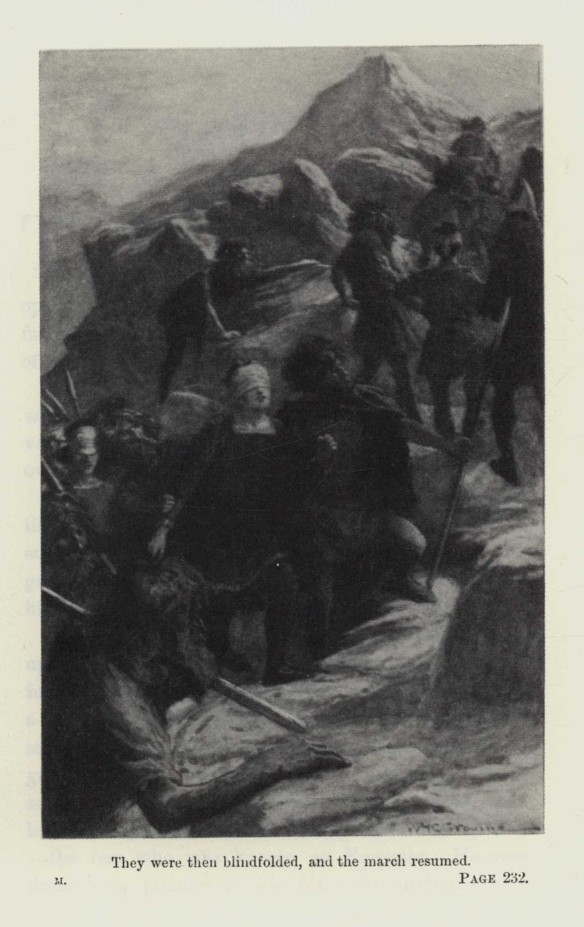
They were then blindfolded, and the march resumed.
This time, after ascending some steep, broken ground, they came to steps, up which their guards assisted them.
At length there was another halt, and a low, tumultuous murmuring sound told them that they must have arrived in the midst of a considerable assembly.
Then the bandages were removed from their eyes, and they gazed round upon a marvellous scene.
CHAPTER XXXI.
AT HOME IN A VOLCANO.
The prisoners found themselves in the middle of what they took to be a vast round building, with an immense domed roof, open to the sky in the centre. As a matter of fact, they afterwards knew it to be the interior of the crater of an extinct volcano.
Into the open part, one of Mars' two moons was peeping, throwing down a warm, mellow light, very different from the pale silvery beams of our own moon.
But this soft radiance was lost in the bright illumination given out by thousands of lights of some kind which were placed about within the great dome—some round the rocky walls, others high up in the wide, lofty roof.
Round the sides, below, were seats, rising tier upon tier, save at one place, where was a platform or dais, upon which were raised seats with a canopy over them. Just in front of the highest seat stood a man of commanding appearance, who gazed at the prisoners with a look of keen, searching scrutiny. This man, as they afterwards learned, was the chief of whom Malto had spoken—the one who was known as Fumenta. He was dressed as plainly as his followers—indeed, more plainly than some of them; but there was that in his face, in his manner, in his very pose, which singled him out from all the rest, and proclaimed the fact that he was their leader.
That he must be old was apparent from the gray beard and the gray hair which showed beneath his head-covering—a kind of helmet. His face, too, was seamed and marked, and spoke eloquently of a life of hardship and adventure. But his tall figure was upright and stalwart, and exhibited no sign of failing strength; while his dark, piercing eyes were flashing with a fire almost as of youth.
Duralda and Landris mounted, by means of three or four steps, on to the platform, and, after a respectful salutation, conferred in a low tone with their leader. Meantime, those seated around—of whom there must have been many hundreds—ceased their talk, and gazed in silence at the prisoners.
Presently, Fumenta turned from his henchmen, and, fixing his eagle glance upon the captives, began to question them. 'Who are you?' he asked. 'And what are you doing in these parts?' His voice was sonorous, and, though stern, not unpleasing. He glanced from one to the other, as if to mark the effect of his question upon each in turn; but he evidently addressed himself more particularly to Malandris, who had been pointed out by Landris.
'We were storm-tossed travellers at the time we were captured, my lord,' Malandris answered. 'We had lost our way. Apart from that, we were fugitives fleeing from'——
Fumenta's eyes flashed and his brow grew dark.
'I want a plain answer,' he interrupted warningly. 'You—you two—wear Agrando's hated livery; you are evidently his servitors—some of his myrmidons! Woe to you if you have come here to play the part of spy for him!'
At the mention of the words 'livery' and 'servitors,' Malto had started and flushed. And now at the word 'spy' he seemed to lose control of himself. He laid a hand on Malandris, as though asking that the answering of the questions should be left to him. Then, drawing himself up, he said haughtily, 'Though we are your prisoners, sir, I fail to see why we should endure your insults without protest! It is true, alas! that I have for many years been one of Agrando's servitors—ay, even his slave, I may almost say. But I am not the first, nor the only one, of gentle birth, who has been forced by the tyrant to serve him thus. At last, however, I have escaped, and I only await the opportunity of picking up some other suit of clothes to throw off for ever what you aptly call his hated livery. If you are, indeed, as I suspect, the chief Fumenta of whom I have heard, I have no reason for fear, for I have been told of him that he is brave and just, an upright, chivalrous gentleman, though he has been sorely persecuted. I have never heard, however, that he was given to insulting his prisoners, and taunting them with having been forced to serve a hateful tyrant.'
Alondra, who had been engaged in 'taking stock,' so to speak, of everything and every one around, turned and looked at Malto in surprise. The young man had suddenly come out in a new character. He was looking his questioner squarely in the face, his eyes flashing back glance for glance, his whole attitude full of indignant protest. Yet was there in it nothing of rudeness; on the contrary, even in his defiance, there was a subtle suggestion of that deference which a young man may always pay to age without lowering his own dignity.
But what was even more noticeable was the fact that Fumenta himself appeared to be just as much taken aback as Alondra had been. To the surprise of every one there—his own people most of all—he showed no sign of anger, and the look he cast at the speaker, shrewd, searching, as it was, was free from all trace of irritation. There was a pause, while he eyed the young man from head to foot. He looked at him as if trying to read his very soul. Then, for a moment, a quick, eager expression came into his face; but it faded again instantly, he passed his hand over his forehead in a strange, dreamy way, and finally shook his head.
When he spoke again his tone was gentler. 'You are bold, young sir,' he said. 'Few dare to speak to me as you have done. Yet if you tell the truth your boldness will be justified, for it shall never be said that those who have called me a just man spoke falsely. I confess I like your spirit; you remind me of—— But it's useless now to speak of that. What is your name?'
'I have been known as Malto. But it is not my true name.'
'How so?'
'Agrando chose, for purposes of his own, that I should be called Malto while I was yet but a boy; and I had no choice but to submit.'
'Ha! But why, then, after serving him and submitting to him for so many years, did you suddenly wish to leave him?'
'Because, sir, something accidentally came to my knowledge of which I had previously been ignorant. It is rather a long story, but I may say briefly that I wished to make a personal appeal to King Ivanta. Instead, however, we had to flee for our lives in the midst of the great storm which has but just passed, and we were carried here by the high wind.'
'With these companions?' asked Fumenta. For the first time he seemed to notice the prince's rich dress. Malto's personality had so attracted his attention that for the time being he had troubled little about the others. Now he seemed suddenly interested in Alondra. 'And who, young sir, are you?' he queried.
Alondra drew himself up, and proudly answered, 'My name is Alondra, son of King Ivanta!'
The words had a marvellous effect; they seemed to electrify the assembly. Till then every one had been silent, content to await quietly the result of their chief's questioning, and anxious to hear all that was said. Now there burst out a great commotion. Every one present sprang up in amazement. Some simply stood and stared in helpless astonishment; some leaned forward to gaze upon the youth as though scarcely able to believe their ears; others, again, turned to their nearest neighbours, and began talking and gesticulating excitedly.
Exclamations were heard, some of which gave a clue to the cause of this excitement: 'What a piece of luck for us!' 'What a hostage!' 'Now King Ivanta must listen to us; we can compel him!'
It was obvious that these outlaws regarded the young prince as a great prize—one which they meant to turn to account in negotiating with Ivanta.
As to Fumenta, he, it was easy to perceive, was nearly as much astonished by the statement as were his followers. He seemed, indeed, almost too surprised for speech, and for a few minutes exhibited some signs of incredulity. Then, suddenly making up his mind, he bent his head courteously, and said, 'It is a pity we did not know this sooner. Had you told my people at first who you were, Prince, they would have handled you a little more gently, I expect. They are rough fellows; the life we lead has made them so.'
'I have not complained,' said Alondra, with one of his good-natured smiles. 'But certainly I wish now that I had spoken sooner, if it would have been better for these friends of mine. They are my royal father's guests, and are supposed to be under his protection. But Agrando has suddenly revolted. We went there on a peaceful visit, and he made a treacherous attack upon my whole party, and sought to take us prisoners.'
Fumenta started, while from the listening throng came loud exclamations. Every one strained his ears in eager excitement.
'What do you tell me?' exclaimed Fumenta, evidently utterly amazed. 'Agrando in revolt! Tried to seize you and your party! Is that, then, the reason you are fleeing from him?'
'Truly, we had no other course open to us, as we were situated. I myself and these companions were cut off from my followers, and we had to make our escape as and how we could. It was a desperate venture, as you know, to cast ourselves loose in the air in such a storm. But it was our only chance. Had we not taken the risk we should have been Agrando's prisoners. I do not even now know how his traitorous attack turned out. I don't know whether my followers have got away or have been captured. But this I do know,' he concluded, looking round proudly, 'there will be a heavy reckoning for all this. My father King Ivanta will be already on his way, by this time, to look for us, and to punish Agrando and his treacherous crew.'
To the astonishment of Alondra and those with him, this speech was received by the whole assembly with a great burst of cheering. Again and again, and yet again, did it ring out. And the shouters, after cheering themselves hoarse, pressed forward and crowded round the 'prisoners,' seeking eagerly to kiss the prince's hand, or, failing that, to shake hands with one or another of his companions.
Gerald and Jack found themselves suddenly treated with exuberant friendliness by those whom they had regarded but a few minutes before as dangerous enemies. They stared about them, bewildered, not understanding such a sudden change. Alondra was as perplexed as the rest, and his face showed it.
Fumenta smiled, and proceeded to explain: 'These followers of mine, rough fellows though they are, to whom Agrando and his tools have given a bad name, are really honest patriots who have been driven into exile to escape from the tyrant,' he said. 'We have fought against him, and against his bloodthirsty followers, it is true; but otherwise we have harmed no man. And, above all, we have no quarrel with King Ivanta, save in so far as he had been led—by false representations, doubtless—to espouse Agrando's cause against us. Now, therefore, that you have told us that Agrando has revolted, my friends are delighted, because they know it must lead to the tyrant's overthrow and to his just punishment. As to the rest, you can command us all, Prince. Every man here will join your standard and fight for you against Agrando. We are ready to offer our aid, our lives, to King Ivanta. We will fight to the death for him against that cruel monster.'
'We will! We will!' cried the shouting crowd. 'Long live King Ivanta!' 'Long live Prince Alondra!'
Just then a messenger entered in breathless haste, and saluting Fumenta, spoke to him aside.
There was a brief colloquy between the two, after which Fumenta spoke aloud, so that all might hear: 'Some airships have been sighted in the distance, seemingly coming this way. All lights must be extinguished.' Then, addressing Alondra more particularly, he continued, 'There are two squadrons, it seems; but our scouts could not tell whose ships they are. They may carry your enemies or your friends, or a party of each, one in chase of the other. At the same time, a thick mist is rising, as is often the case here after such a storm as we have had, and most likely the airships will disappear in the fog and we shall see no more of them.'
'But that would be a bad thing if some of them are my friends,' said Alondra. 'Your people took charge of the motor-wings we brought with us; let us go out in them to reconnoitre. If we meet with friends we will all join together; but if we discover that they are enemies, and they do not look like going away, we will return and warn you.'
Fumenta considered for a few minutes, then answered, 'Very well; so be it.'
By this time all lights had been put out, and the whole vast interior was in black darkness, save for the opening in the centre, where some rays of moonlight were still feebly struggling through the thickening vapours.
Through this opening, a little later, Alondra and his companions rose, flying like spectres on silent wings, and disappearing into the mist.
CHAPTER XXXII.
IVANTA A FUGITIVE.
Alondria's companions in his scouting expedition were Gerald and Jack, Malto and the outlaw chief Fumenta, the latter having taken the place of Malandris, who had been left behind.
'You will want some one who knows this region as a guide, or you will not be able to find your way through the mist,' Fumenta had pointed out. Alondra had been prompt to recognise the wisdom of the suggestion, and gladly accepted it.
It seemed that these outlaws were without flying apparatus of any kind except the roughest sort of wings. They lived the life of hunted men, and even if they had possessed airships or other flying machines, they were without the necessary means of utilising them.
All kinds of air-craft required electricity to work them; which, in its turn, as with us, required machinery to produce it. Throughout Ivanta's dominions there were stations here and there at which passing aeronauts could refill their storage batteries on payment of certain specified sums. At these stations gigantic engines of immense power were ever at work, day and night, accumulating the necessary force, and it was upon this constant supply that all airships were dependent. When they journeyed beyond the districts in which these stations were situated, travellers were compelled to be careful not to venture too far afield—no farther, that is, than they could travel back again with the storage power on board.
For the same reason, the outlaws had none of the usual weapons—those tridents which wielded such strange, mysterious power; or, if they possessed any, they were useless to them for want of the needful force.
Throughout the inhabited portion of the planet the same state of things prevailed. There were no small weapons other than the tridents, save swords, spears, and the like. Nor were there any large weapons like our cannon and big guns. Owing to their great weight, all such contrivances had long ago been abandoned as too heavy to be carried in the air, and as being no longer of any use on the ground. An airship depended for its means of offence either upon ramming an adversary, or being able to get above it, and drop upon it bombs, which, upon bursting, produced a similar effect upon living beings around it to that of the tridents—that is to say, they rendered them for the time being unconscious. Thus, warfare in the air resolved itself chiefly into a manoeuvring contest, the one which could soar uppermost, and get exactly over its adversary, usually—other things being equal—gaining the advantage.
Having no machinery for the production of electricity, and consequently no flying apparatus save the clumsy, slow wings without motors, Fumenta and the bands of which he was chief were for the most part restricted in their operations to nocturnal expeditions. They seldom ventured abroad in the daytime, but remained hidden in their underground retreats.
Fortunately for their purpose, their leader had discovered, amid the arid wilderness of rocky mountains into which he had been driven, an extinct volcano with an ancient crater open to the sky. Within was the immense cavity which they had made their chief hiding-place, and running into it from all points of the compass were endless galleries and passages—a veritable labyrinth which extended for miles in every direction. These led to numerous underground grottos, large and lofty caverns, which they had turned into dwelling-places. The whole formed a sort of subterranean town.
Not the least remarkable thing about this retreat was the ingenious ruse by which Fumenta had kept its existence unknown to his enemies. He had discovered, in some of the lower galleries, considerable accumulations of sulphur, and whenever, during the daytime, the approach of airships was signalled by his scouts, he had sulphur fires lighted in the crater just beneath the funnel-like opening, sending up columns of smoke and sulphur fumes.
As a consequence, the report had gone forth that the supposedly extinct volcano had become active again, and its neighbourhood was shunned as dangerous by all not in the secret. A few venturesome inquirers, who had attempted to make explorations, had been baffled by the sulphur fumes, and had returned declaring that there were evident signs of renewed volcanic activity.
Similarly, if, as sometimes happened, an occasional airship, driven out of her course by high winds, passed near the place at night, and saw a light coming up through the opening, it was put down to the same cause.
These notes are necessary to explain the events which follow.
The mist seemed to grow thicker as the adventurers sailed cautiously onwards, and it soon became obvious that they would quickly have lost themselves if they had not had Fumenta to guide them. He, however, seemed to know his way about in it with as much certainty as if it had been clear. He was aided, no doubt, by a dim radiance which struggled down from the moon above.
He led off to the right, mounting always upwards, till, after they had travelled perhaps a mile, he brought them to a halt beside a towering peak.
'Here,' he said, in low, guarded tones, 'you had better rest for a little time, while I reconnoitre from the top of the mountain, which rises yet some hundreds of feet into the air. It is one of the highest peaks about here, and these occasional ground-mists scarcely ever reach its top. It may be that we can get a view from its summit over the top of the mist, but at the same time we shall run some risk of being seen ourselves. Let me, therefore, make the trial first, as I am more used to this kind of thing than you are. I will return in a short time and let you know the result. Do not leave this spot, and, whatever you do, do not talk loudly. Voices travel far in this mist; you cannot tell how near our enemies may be.'
With that he started off, mounting silently upwards, and the four he left behind began discussing their recent adventures, and the possible future, in low tones.
'So that's the great outlaw chief!' said Jack. 'What do you think of him? I suppose he is to be trusted? I must say I am agreeably surprised! I like his looks; yet one never knows! He might betray you, Prince, to your enemies. How if he could buy off Agrando's hostility that way? It might be a great temptation!'
'I do not think he is one of that sort,' Alondra returned.
'Nor do I,' Gerald put in.
Malto had remained silent. He had seemed to be pondering deeply over something. At these words from the others he suddenly woke up, as it were, from his reverie, and spoke warmly. 'I would stake my life on his loyalty!' he exclaimed passionately. 'He is a good man—a great man—an upright, brave, honourable man! I feel it, I know it! But why do I know it? Why does he rouse such a tumult of strange thoughts and ideas in my breast? That is what has been puzzling me ever since I set eyes on him! Have I seen him before? It seems to me that I have—must have done so! Yet when? Where? How could it be? My head seems to go round puzzling it out, and trying to seize upon some thought, some memory, which I feel, but cannot put into words!'
The others looked in surprise at this outburst.
'Hush! We were warned to be quiet!' said Alondra. 'Our opinions are really the same as yours. What was said was only spoken in the way of ordinary caution. You need not take it to heart as though we were wronging a friend of yours!'
'A friend of mine!' Malto answered bitterly and somewhat incoherently. 'Would that I could call such a man my friend! I have no such friend in the world! My life, since I was a boy, has been passed among deadly enemies, who destroyed my father and brought me up as a slave! I have ever been a child of misfortune; and now, see how ill-fortune dogs me! I come across you, and you promise to take me to King Ivanta, to give me the opportunity of pleading my cause with him and asking for my rights; but what comes of it? At once treachery steps in again, and instead of your helping me, I only lead you into trouble and fresh misfortune!'
'Nay, it was no doing of yours,' said Alondra gently. 'Have patience, my friend, and all will yet come right! I feel sure it will! My father is not going to be beaten by people like Agrando and his confederates. He will soon come to our aid and rescue us, have no fear! Then you shall tell him your story, and he will see that right is done. Meantime, it seems to me, we have been fortunate in meeting with Fumenta. If he and his people are to be trusted—and I feel sure they are—we have found useful and faithful allies, and a secure hiding-place where we can await developments!'
As the young prince finished, he started. While he had been speaking the last few words there had been heard a tiny, muffled 'ting-ting,' and now, in the surrounding stillness, it was heard still more plainly.
'Ting—ting-ting—ting—ting!' it rang out.
'By Jove!' exclaimed Jack, 'that's your wireless telegraph affair!'
Alondra plunged a hand into his breast and brought out the little instrument they had seen when they had been in the pavilion.
He placed it on his outstretched palm, and again were heard the clear, silvery notes of the little gongs.
Excitedly he opened it and began to manipulate the miniature levers and pins.
'What did I tell you?' he breathed, in low accents. 'Said I not that my father would be soon on his way to our assistance?'
Just then Fumenta came gliding back like some weird, mysterious shadow.
'Follow me,' he said, 'and I will show you a strange sight!'
First, however, they told him the news.
'My father King Ivanta has come to seek us,' Alondra said joyously. 'He is not far away!'
To their surprise the outlaw chief nodded his head and answered slowly, 'I know. But he cannot help us. He is in hiding, as we are. He cannot aid us at present. I may, however, help him by offering him a temporary refuge, as I have done to you.'
Alondra turned and faced him in amazement, his eyes flashing, and his cheeks flushing with indignation.
'My father—in hiding? You—offering him a refuge?' he gasped. 'Sir, have you suddenly'——
'Peace, my son! You speak too loudly,' rejoined the old man quietly. 'However painful it may be to you to hear it, what I have said is but the exact truth, as I will prove to you presently. Come with me, and I will show you something that will surprise you.'
He commenced his upward flight as he spoke, and the others wonderingly followed. His words had, so to speak, struck them dumb; and no one uttered another word.
After a few minutes' flight it grew lighter, and they could tell that they were nearing the limits of the mist above them. Then Fumenta stopped upon a sloping rock, and, looking round at his companions to enjoin caution, signed to them to walk slowly up the incline.
They obeyed, and, behold! quite suddenly their heads were above the mist. It was almost as if they had put them up through a trap-door and looked around. The vapours closed round them below like a mantle. They could not see their own hands, but they could see for miles around on every side.
A large fleet of airships could be seen in the air above, going restlessly backwards and forwards. The moon which our astronomers call Phobos was throwing a rather feeble light over what seemed to be a pinkish-white sea, which was, in reality, the surface of the mist.
The airships were assisting the moonlight by throwing their searchlights around in all directions, prowling to and fro, and making sudden dashes here and there, exactly as might a swarm of huge birds of prey on the wing seeking for food.
'Those,' said Fumenta, indicating the airships, 'are the war-vessels of Agrando and the allies who have joined him. They know that King Ivanta, in his yacht—not his great "chariot of the skies," the mighty Ivenia, look you—is hiding somewhere in the mist below. He must have come hither to seek for you—why he should come in his yacht instead of the Ivenia I know not—and they have chased him here, and have lost him in the fog!'
CHAPTER XXXIII.
A QUEER HUNT.
Even as Fumenta spoke, two dark shapes rose quickly above the fleecy vapours as though to take a cautious observation.
Alondra and the two chums instantly recognised them as the two yachts the Nelda and the Lokris; but ere they could breathe a word both craft had dived back into the fog.
At once two or three of the hostile airships made a dart at the place where they had appeared, and so impetuous was their rush that they narrowly missed ramming one another. But for some reason they did not dive after the fugitives. They were evidently averse to trusting themselves in those foggy depths.
Fumenta nudged his companions, and they crept down the rocky slope into the concealment of the mist again.
'It wouldn't do to stay up there,' he said, when they had reached what he considered a safe distance. 'Now, Prince, if you can send a message to your friends, will you please ask them to remain in one place till we find them? You can explain to them that they have nothing to fear at present; evidently their enemies do not care to hunt for them down in the fog. They prefer to wait till it clears off, as they know it is pretty sure to do in an hour or two. In that hour or two we must manage to find your friends and conduct them to a place of safety.'
'How can you do that?' asked Alondra helplessly. 'I confess I feel bewildered. The world seems turned upside down! I could not have believed my father would'—— He hesitated to finish the sentence.
'My son,' said the old chief kindly, 'you may comfort yourself with the thought that your august father is doing what he finds best in the circumstances. Now the fox is going to aid the eagle, and hide him in his burrow until the hunters have gone away. Then we must offer what assistance we can in finding and regaining possession of the Ivenia, from which—as I read it—King Ivanta has become separated, probably through a trick or some fresh treachery. If we can help him to do that, the eagle will then be able to turn on his enemies as though they were a host of small birds, and all will be well!'
Alondra looked fixedly for a moment at the outlaw leader, and then impulsively seized his hand and shook it, and there were tears in his eyes as he exclaimed, 'I don't know who you are, sir; but I know that you are a friend in need. I shall leave it to the king my father to thank you properly, later on; now I can only say your kindly words have filled my heart with gratitude.'
'Let us say no more, Prince, but set to work,' was the terse reply.
Alondra set to work accordingly, and after some delay, succeeded in getting into communication with his friends again.
'My father has understood my message,' he presently said, 'and agrees to your suggestion. They are resting on a hill-top below, and will stay there until we get to them.'
'Good!' observed Fumenta. 'Now, the thing is to find out where that hill-top is.'
'Is there any way of telling by means of that little instrument whether, as we move about, we are getting nearer to them or farther away?' asked Jack. 'In our world, when, as children, we played at hide-and-seek, we used to say we were getting "cold" when we were on the wrong track, and "hot" when we were on the right one. Now, is there any way of telling with the help of that little contrivance whether, as we move about, we are getting "hot" or "cold"?'
'Why, yes, to some extent,' Alondra returned, but not without hesitation. 'I think I shall be able to form an idea, as we go on, by the sound it gives out. The nearer we are, the stronger the current, and the louder the little bells ring.'
'Exactly! That's what I was hoping for,' said Jack. 'With that to guide us, it ought not to be such a very long business.'
And then there began the most extraordinary hunt for the airships hidden in the mist that can well be imagined.
It proved to be more difficult and perplexing than the searchers had at first thought would be the case. They went up and down, to and fro, going too far in one direction, then turning, only soon to find that they had travelled too far in the opposite track. It was a veritable game of blindman's-buff, and as time went on, and Fumenta's prediction about the mist clearing seemed likely to be realised, the seekers became first anxious and then seriously alarmed. It was true that the sounds given out by Alondra's wondrous little instrument varied according to their distance from those who were signalling to them; but the differences were so slight as to be extremely difficult to detect.
At last, however, their perseverance was rewarded. Gerald was the first to catch sight of what they sought. A half-smothered exclamation from him drew the attention of the others to what seemed no more than a dark shadow. They were all actually passing it, and in another moment or two would have lost sight of it. But when Gerald pointed it out, Alondra made a dart towards it, and quickly called to his companions to follow him.
A few minutes later they were standing on the deck of the king's yacht, and Alondra was folded in his father's arms.
'What has happened, father?' he asked. 'Where is the Ivenia?'
'Ah, that is what I want to know!' Ivanta confessed. 'Some strange, unforeseen occurrence—an accident, or treachery, I know not what—has hidden her away. Thanks to the machinations of Agrando and Zuanstroom, the whole of the people of my realm seem to have gone mad and turned against me. For the time being, Alondra, your father is an exile, a fugitive, with scarce a friend in the world.'
'You have one friend, oh king!—one who has some followers you may depend upon,' said Fumenta, stepping forward. 'If you will accept my services'——
'Who are you?' the king asked, turning to him wonderingly.
Alondra explained, and Ivanta frowned.
'Fumenta! The one who is in rebellion against me!' he exclaimed, eying the outlaw chief keenly and coldly.
'Not so, oh king!' Fumenta answered, drawing himself up proudly. 'No rebel against you have I ever been! No one can say it! But against your vassal Agrando, yes! I have been his sworn enemy for many a year, and not without good reason; but against you I have had no other complaint to make than that you supported him against me. Doubtless you were misled by false and lying misrepresentations, and had you known the truth—— But there is no time for the discussion of such matters now. I offer you safe asylum, not for yourself and your followers only, but for your airships. You will find that I and all my people are loyal to you, and will fight to the death against Agrando and his allies.'
'But how can you hide my airships away?' asked the king doubtfully.
'You shall soon see, oh king! Do not delay, I pray you. The mist is already getting thinner. A little longer, and our chance will be gone.'
Ivanta looked at Alondra, and the two conferred apart for a brief space. Then Ivanta returned to Fumenta, and, holding out his hand, said, 'I hear you have been a good friend to my son and his companions in the time of their need. That is enough for me! Henceforth you are my friends—you and all your followers.'
Fumenta thereupon took charge of the craft as a pilot might, issuing instructions in low tones to the officers. Under his guidance, the Nelda glided slowly through the mist, closely followed by the Lokris, which had been resting a few yards away.
Then, as they went along, Alondra asked for tidings of their friends, and heard bad news indeed.
Many of the party who had accompanied Alondra to Agrando's court had been treacherously seized.
Monck, it seemed, had got away in the Lokris, bringing with him the two sailors and—somewhat curiously—Zuanstroom's nephew Freddy, who had sought shelter with him and begged piteously not to be left behind. These were all safe on board the other yacht.
'But of others,' said the king, 'I am sorry to say that they are now held as prisoners by Agrando. Aveena and several of your friends, Alondra, are amongst them, and,' he went on, slowly and bitterly, 'most humiliating of all, for me to have to confess it—for it seems as though I had failed in a host's first duty—so, I am deeply pained to tell you, is our friend Armeath.'
CHAPTER XXXIV.
A NIGHT EXPEDITION.
It was getting near dawn, and the mist was perceptibly clearing away, when the two air-yachts approached the great funnel-shaped opening leading down to the ancient volcano.
Ivanta, who had been wondering how Fumenta was going to keep the promise he had made that he would hide the airships away, looked with great curiosity at the dark, uninviting cavity.
'Are we to try to squeeze in there, friend Fumenta?' he asked. 'Is that your idea?'
For answer the outlaw asked what was the length of the larger of the two vessels, and Ivanta gave him the measurement upon the Martian scale.
'I thought so. Then there is room,' he declared.
And so it turned out. By means of a little manoeuvring, the two vessels were induced to sink slowly through the opening, without touching the sides. And when once through the funnel there was plenty of room for them in the great dome-like space below to rest, all upstanding, on the ground.
Then, upon some metal staging round the base of the funnel, high up in the domed roof, fires were lighted, and upon them, after a time, when they had started a sufficient draught, quantities of sulphur were thrown.
The draught was so great from the maze of underground galleries that all the fumes were carried up into the sky, while below the air was fresh and pure.
'There!' said Fumenta, in well-satisfied tones, when all was in working order, 'those sulphur fumes are carried thousands of feet up into the air. That I know to be the fact, because I have been up to make sure. No airships will come near us—they cannot do so without running the risk of asphyxiating every soul on board!'
King Ivanta laughed good-humouredly. His was just the nature to appreciate a clever scientific stratagem such as he saw this was.
'Fumenta, you are a man after my own heart!' he cried. 'I love a man who can use his brains and bend adverse circumstances to his will! You and I ought to have been acquainted before. I can see you have the capacity for ruling, by the way you have drilled and disciplined those ragged followers of yours. By the stars, I would have made you a king!'
'Perhaps I have been nearer to that than you think, King Ivanta,' was the unexpected answer.
Ivanta started and eyed him searchingly. He frowned and puckered his lips, and seemed to be thinking deeply.
'It almost seems to me that we have met before, and that I ought to know who you are,' he mused. 'Yet I don't see how such a thing could be.'
'Let us speak of the present and the future, oh king!' returned Fumenta, evidently desirous of changing the subject. 'What are your plans, sir?'
'My friend, I have not yet formed any. Until I know where my great airship is I am tied down, I fear me, to playing a waiting game. It is a strange experience for one like myself, Fumenta,' he went on philosophically, 'to find one's self a fugitive. I, who have solved the great problem of navigating space itself, who have visited distant planets, have been outwitted by men of grovelling instincts like Agrando and Zuanstroom; tricked, deceived, betrayed, and driven to welcome the protection and hospitality of outlaws!'
'Of outlaws, truly, but not of criminals, King Ivanta,' Fumenta answered firmly. 'All my followers are honest men, patriots, honourable fighters for their own and their country's rights, though their manner of life has made them rough and perhaps somewhat soured. Now, sir, let me make a suggestion. In Iraynia I have a much larger following than I have here. Let us go and show ourselves together there, and I warrant you the whole land will rise in your favour, and you will find you have at least one country loyal to you.'
Ivanta looked curiously at the old man, and hesitated.
'But we have need of airships,' he said.
'They have them.'
'And—the sinews of war—money—gold, my friend, gold! My treasure-house is by this time in the hands of my foes. Not only that, but they have in their control the fascination of diamonds too. But that would not matter so much if I had my own treasury. Without gold, even a king is helpless, my friend. We can do nothing without gold.'
'That I can supply also,' was the startling reply, made quite quietly, and without the least resemblance of boastfulness.
Again Ivanta started, and this time his keen eyes scrutinised the other's face as if doubtful whether he were a madman or a magician. Suddenly he inclined his head and said, 'That your statement astonished me I need scarcely say. As, however, you have performed all that you promised thus far, I will not pay you so poor a compliment as to doubt you in this. Well, now then, since you say you have plenty of gold, there is only one other thing necessary—machinery. Airships are of no use without a supply-station.'
'We will seize one,' answered the outlaw chief, with unexpected decision. 'Lend me your yacht and your outfit, and I will undertake to seize one of Agrando's chief power-stations. It is, as I happen to know, weakly held just now. But when we have captured it I will show you how you can defend it against the whole strength of your enemies. It is now daylight. The airships prowling around above us will draw off during the day when they find you have disappeared; and at night I will guide you to the place I have told you of, and we will seize it and hold it for you.'
'If you do that, Fumenta, you shall be made'——
But the old chief held up his hand. 'I am asking for no reward, oh king—or, at least, none of the kind you have in your mind. I have lived a hard, adventurous life, and am now getting old. Those I loved are dead, and I have none to care for, and no ambition for myself. I may, however, ask for some recognition in another form; one which, when the time comes, it will give you no trouble, cost you nothing, to grant. I crave your permission to keep my own counsel, and say no more in the meanwhile.'
'So be it, my friend,' said the king, simply and kindly. 'I have no desire to inquire into your secrets before you are ready to reveal them to me freely and of your own accord.'
Thus was the compact made between these two, who, but a few days before had seemed so far apart—the great and powerful king, who had then been a ruler over more than half the planet, and the outlaw leader, who led the life of the hunted, and lived in burrows 'like a fox.'
While this talk was taking place the chums and Alondra were comparing notes with Monck and the two sailors.
'We've seen some queer sort o' fightin', Mr Gerald, since we lost sight o' you,' said Tom Clinch. 'The catamounts played every scurvy trick they could think of against us! But me and Bob Reid and Mr Monck, we give 'em as good as they brought, and we scraped through and got away somehow.'
'Yes, but without Mr Armeath,' said Gerald sadly. 'I am not reproaching you,' he hastened to add, 'but I am terribly anxious about him. Will they harm him, do you think, Mr Monck? Why should they? He has nothing to do with this upset between King Ivanta and Agrando!'
'Well,' said Monck thoughtfully, 'Agrando and Zuanstroom have gone off to Ivenia, taking Kazzaro with them. They will have their hands pretty full for the present, at any rate, with organising their forces and establishing their position, not to mention the question of seizing and dividing out the diamonds. They have left Mr Armeath a prisoner behind them, and I do not suppose he is in any personal danger so long as they are absent.'
'That is some little comfort, though not much,' muttered Jack. 'If we could but find some way to get at him and rescue him from those brutes while they are away!'
'Just what I was thinking of,' said Alondra. 'If my father would allow me to take out my yacht, we might make a dash in the night, you know, eh? She and the Nelda are the two fastest fliers in the whole world, except the Ivenia. What think you, Monck Affelda? There are others of our friends, too, you know—Aveena, and nearly a dozen besides, I hear.'
'We will see, Prince. I will speak to the king about it, and if his consent can be gained I am quite ready to join in a forlorn hope of the sort on the chance of rescuing our friends.'
When, however, Ivanta was asked to sanction the 'forlorn hope,' he said they must wait first to see the result of the expedition Fumenta had planned, for which the services of both yachts would be required. So, for the moment, the one enterprise had to give place to the other.
The day was passed in telling one another their adventures on both sides. Scouts came in at intervals and reported the movement of the hostile airships. Some of the latter hovered about for some hours after daylight had come and the mist had cleared, as though half-suspicious that some trick had been played upon them. They even made a half-hearted attempt to approach the column of smoke which ascended steadily from the mouth of the 'volcano.' But the smell of suffocating sulphur fumes was so strong that they came to the conclusion it would be safer to give the place a wide berth.
Soon afterwards they divided into two parties, one returning by the way they had come, while the other went off in the direction of the waterless desert, to which they finally concluded the fugitives must somehow have managed to flee.
Towards evening the fires were extinguished in readiness for the departure of the yachts, and the interior of the old crater was filled with Fumenta's followers, who were paraded in honour of Ivanta.
'I need not call for volunteers, King Ivanta,' said their chief. 'Every man is ready and willing to serve you! Select what men you have room for, and the rest will remain here awaiting your commands. All are ready to fight for you to the death.—Say, my men, is it not so?'
The great vaulted roof rang with the cheers and shouts which went up in response to this appeal.
'Long live King Ivanta!' 'Long live Prince Alondra!' was heard on all sides.
King Ivanta could not listen to their greetings given so heartily in his present circumstances without emotion. 'My children,' he said, 'your proffered devotion has touched my heart! That you are trustworthy and brave I feel assured; and I cannot quarrel with Destiny when, in my greatest need, it sends me such sturdy supporters.'
As soon as it was quite dark the party of hardy adventurers set out in the two yachts, Fumenta acting again as pilot on board the Nelda. Alondra was in charge of his own craft; and he had with him Gerald and Jack, Monck, the two sailors, and Malto and Malandris. Their young charge Freddy was left behind, with a couple of attendants to look after him.
During the day Alondra had presented Malto to Ivanta, and explained that he had some request to prefer; but Malto discreetly asked permission to defer it to a more suitable season, and so the matter had dropped.
The two craft glided swiftly onwards for some hours over a country which showed no signs of being inhabited. Then a few lights were seen here and there, telling of scattered villages, and at last a cluster of lights indicated that they were approaching a large town.
While yet some distance away, Fumenta called a halt, and at his request the king ordered a small airship to be got out which acted the part which a steam pinnace fulfils in regard to one of our men-of-war.
Ivanta, with Arelda and Abralda, two of his officers, entered this with Fumenta, and they dropped gently and silently down through the air, and landed on the ground near a large building which stood alone on the outskirts of the town.
From the town itself came the hum and low murmur of many people.
Fumenta gave a curious signal, which sounded like the cry of some bird of the night. At first there was no response, but after it had been twice repeated, a door in the building opened, and a figure came out, closed it, and advanced cautiously towards them.
There were further signs and countersigns given and received on both sides, and then the stranger spoke. 'Is it the Chief?' he asked.
'It is the Chief,' Fumenta replied. 'You have heard the news, and know that the hour has come? Is all prepared?'
'All is prepared, Chief,' answered the man, saluting. 'We have had everything ready and waiting for you since the news came; for we thought that you might be here to-night. Do you wish to speak to the men before we start?'
'Yes. I have with me some one they will be very surprised to see. Lead the way.'
With another salute, the man turned and led the way towards the door from which he had just emerged.
CHAPTER XXXV.
HOW IVANTA GAINED A FLEET.
Fumenta and those with him passed through the doorway into a spacious, well-lighted vestibule, in which other doors could be seen leading to the interior of the building. In particular, there were two large ones in the centre immediately opposite to that by which they had entered. These were evidently very jealously guarded, for at the entrance of the strangers some armed men, who had been standing in front of them, advanced in a rather threatening manner.
The one who had gone out to meet Fumenta and had brought him in, spoke to the officer in charge of these guards.
'Throw open the doors, friend Medro. It is the Chief.'
'The Chief! And who besides, good Lymento?' asked the officer cautiously.
'One for whom I will be answerable,' answered Fumenta brusquely. 'Waste not time in idle talk. This will be a critical night for us; and we have no time to lose.'
Without other reply than a salute, the officer turned on his heel and ordered his men to throw open the doors. And as they fell back he advanced and cried in sonorous tones, 'Friends all, the Chief!'
Fumenta stepped past him, conducting Ivanta, and called out in ringing accents, 'And with him the King! Friends, I bring into your midst King Ivanta. He has been deserted by those he trusted. He is, indeed, actually now being hunted by those upon whom he has conferred benefits, and stands at the present moment in sore need of trustworthy friends. I assured him he would find them here. Tell me, have I promised aright?'
Before them was a great hall filled with people in varied dresses, as though they had been brought together from many different parts. There were ragged, rough, but stalwart men, very much of the style of Fumenta's followers; and there were others, both soldiers and civilians, of different grades, some plainly, some richly dressed.
It was, in fact, a meeting gathered from far and near of those of the inhabitants of Iraynia who had secretly sympathised with Fumenta and his outlaws, and who had been hoping for, almost expecting, some such 'burst up' as had now taken place between Agrando and Ivanta. And they had been secretly planning to rise, when that time arrived, against Agrando themselves, and endeavour to throw off his yoke once and for all.
But they had not exactly expected what had actually happened. King Ivanta had always wielded such power, and had shown himself so strong, that the possibility of his ever being in his present position had never entered into their calculations. Consequently, Fumenta's words fell upon the assembly almost as a bombshell might have done—that is to say, with a temporarily stunning effect.
For a space there was silence—a dead silence, which seemed at first to be chilling, irresponsive. Then suddenly some one in the body of the hall jumped up and shouted, 'We have no quarrel with King Ivanta. We are ready to help him against Agrando! Fumenta, you have done well to tell the king that in his present difficulty he will find friends here.'
At once others seized the cue, and hastened to declare their approval of the words spoken. A few moments more, and the scene at Fumenta's stronghold was being repeated here.
'Long live King Ivanta!' was the cry which was taken up on all sides, and repeated till the roof shook.
Fumenta turned to Ivanta with a slight smile upon his usually hard-grained visage. 'You hear, oh king! These are the men of Iraynia! You see that I did not act without reason in bringing you here. All these will be henceforth your followers, and they, again, have more—a thousand times more—at their backs, who will flock to us as soon as the news spreads.'
Ivanta was visibly affected. Never in his life till this day had he known what it meant to stand in need of a few true friends. He who had led conquering armies, and had listened to the acclamations of vast multitudes representing nearly half the nations of the planet, and received the homage of their rulers as his vassals—he was now listening with gladness and gratitude to the kindly welcome of those whom he had—unknowingly, it is true—treated with injustice, and allowed Agrando to tyrannise over!
He now addressed them, telling them in simple but dignified language how he thanked them all for their welcome; and after a brief conference with their chiefs he gladly agreed to their request that he should become their leader himself, and for the future take the direction of the operations they had planned.
Then they conducted him to a large enclosure where a number of airships were lying.
'These we seized immediately we heard the news of Agrando's revolt,' Lymento explained. 'Their crews we made prisoners, and they are under lock and key. What we now need is a storage station to keep these craft supplied with electricity. They have enough reserve power to last a day or two, but not longer.'
'That station we can seize this very night,' Fumenta again declared. 'It is at a place called Crudia, some two hours' journey from here, and, as I have already said, I happen to know that it is at the present moment weakly held. But we have no time to lose, for one of the first things Agrando will do will doubtless be to reinforce the garrison as a precaution. Extra men and airships may even now be on their way there, so if we desire to get there first we must hasten. Which of these airships will you choose, sir, to sail in yourself?'
Rapidly Fumenta ran over the list of their sizes and special characteristics. At the end of it, Ivanta decided that he would keep to his own yacht.
'My two yachts,' he reminded his new friends, 'are, with the exception of my great vessel, the Ivenia, the fastest craft in the world. When they cannot fight they can always run away,' he went on meaningly. 'It may sound strange, perhaps, to some of you to hear me talk thus of running away; but there are others doubtless among you who will understand my meaning. Of late years you have not seen much fighting in the air, but you may nevertheless be aware that in such warfare swiftness and quick manoeuvring often count for as much as size and numbers.'