Front matter (continued 2)
Reading edition
Then it was that the chums saw the use made of the shields borne by the soldiers, which Gerald had first noticed when he had been a prisoner. They were, as stated, transparent, and it now appeared that they were used as a protection against the mysterious power of the 'tridents,' or 'electric guns.' Just as electricity will not pass through glass, so the curious 'flash' from the tridents could not pass through these shields. The heads, feet, and legs of the combatants, and some other parts of their bodies, were also protected in similar fashion, so that they appeared to be partly dressed in shining armour. They wore helmets, breastplates, and leg and thigh pieces, which looked like glass, yet were not brittle, and which, like the shields, were proof against the power of the tridents.
Thus, a duel between two antagonists equipped in this manner resolved itself, to a great extent, into a trial of skill in the use of the shield. Through it each could see the other; and many were the feints and stratagems resorted to by a practised fighter to get at his foe behind his shield.
Every night King Ivanta held a levee or other Court function, which all who were off duty were free to attend, and at which very curious entertainments were sometimes provided.
Altogether there was no lack either of occupation or amusement during the three months which the voyage lasted.
Gerald and Jack applied themselves assiduously to learn the Martian language, and in this they were joined by Mr Armeath. Then, by way of relaxation, they gained the king's permission to learn the mysteries and use of the trident and shield. Monck fitted them out in suits of the shining armour, and they practised under the instruction of one named Aveena, a young noble of the Court. Thanks to his tuition, they became so expert that they entered for contests before the king, and came off victorious in more than one bout with others of their own age. Silas Zuanstroom was one of those they each vanquished in turn; only with the result, however, of increasing the coldness which had grown up between the two parties of travellers from the Earth.
One day, Gerald met with yet another disagreeable adventure in the Zoo, and again narrowly escaped a terrible death. This time it was a large venomous serpent of vicious and aggressive disposition, which (again by some 'accident') had got loose just about the time when Gerald, unarmed and unsuspicious of danger, was taking his stroll round the cages. Monck came upon him, a little later, clinging to the upper branches of a tall palm-like tree, which the serpent was slowly climbing, bent on reaching him.
This time the engineer reported the matter to the king, who sternly ordered a strict inquiry with the object of finding out who was to blame. But no evidence was forthcoming to show that the occurrence had been other than an accident; and the affair ended in the punishment of one of the keepers in charge for negligence.
But more exciting events were steadily preparing, and began to develop as the voyage went on.
One morning the two chums were called into Armeath's private apartment, where he was awaiting them with Monck. He explained that he had received the king's permission to impart to them an important piece of information. 'I am going to entrust you with a bit of a secret,' said he, 'and I must ask you to regard it as confidential, and say nothing about it to any one—particularly to the Zuanstrooms; which, of course, includes the two lads. Doubtless you have wondered what it was which induced King Ivanta to pay a second visit to our Earth. It is this, that what we call precious stones do not exist naturally in Mars. None were ever seen there until the king brought back a quantity after his first visit.'
Gerald burst into an exclamation. 'Just what I guessed, sir,' he cried. 'I have had that idea in my mind for some time!'
'It was a shrewd guess, lad,' Monck observed. 'The fact is, that once the Martians had set eyes on them they went almost mad over them, and became clamorous for a larger supply to be brought, in order that those who could afford it might be able to purchase some.
'Our gracious master, who is continually thinking what new thing he can do to please his people, determined to pay a second visit to the Earth specially to secure a large supply. Hence his taking up with Zuanstroom, the "Diamond King." But Zuanstroom was not easy to arrange with. When he learned the actual state of the case, he insisted, as a part of the bargain, that my master should promise to bring him over to Mars for a trip, and take him safely back. Nothing less would satisfy him.'
'I see,' said Jack. 'And I suppose his diamonds are on board too—a whole shipload of them, so to speak?'
'Exactly. The greatest load of treasure, I suppose, that has ever been carried on any ship of the air or the sea.'
'But,' said Gerald, 'the Zuanstrooms know all this. Why mustn't we speak to them about it?'
'Because, at this point, I come to my story,' Armeath said, with a half-smile. 'For years I have been experimenting, trying to manufacture precious stones artificially. At last I succeeded in getting diamonds from a certain mineral; only to find, however, that the discovery was almost valueless, because I could not get enough of the particular mineral. I found out that there was some in the island we have been living on, and that was the reason I went there to stay for a time. When, however, I understood what King Ivanta wanted, I told him of my experiments, showed him the results, and he was highly delighted. He said it would be easier and cheaper to manufacture diamonds than to buy them from the Diamond King on his own terms.'
'But how can that be done, sir, if the necessary material is so scarce?' asked practical Jack.
'You shall hear. King Ivanta recognised the mineral, and declares that there is plenty of it to be obtained from the planet Saturn. He saw quantities of it when he was there!'
'Then we are to go to Saturn to obtain a supply; I suppose?' cried Gerald, full of enthusiasm at the prospect of this new and unexpected addition to their programme of adventure.
'That I cannot yet say,' replied Armeath. 'We must hear what the king says.'
'But, sir,' exclaimed Jack, 'you would not think of leaving us alone—stranded—upon a strange planet! Suppose you never came back!'
'It is not a pleasant place to visit; I can tell you that much,' Monck put in. 'Saturn, at the present time, is in the stage which the scientists tell us the Earth was in, ages ago, when the great antediluvian monsters existed. Those monsters—or similar ones—are alive now on Saturn; and terrible creatures they are, I can assure you! The amalpi—the unicorn-like animal which hunted you, Master Gerald—is one which we managed to capture and bring back from Saturn. But it is small and almost harmless compared with some of the animals and reptiles we saw there! I do not think I would go there again, Mr Armeath, of my own choice, even for the sake of bushels of diamonds!'
'If I go, it will not be exactly for the reason you suppose, my friend,' returned Armeath. He spoke very gravely, and with a note of sadness in his tone. 'Your king, in most things, has shown himself a very wise monarch; but I think he has made a mistake in introducing jewels at all amongst his subjects. Upon our globe they have always been the cause of heartburning, envy, jealousy, and all kinds of evil passions. In too many cases they have proved, as all of us know, a veritable curse, and have led to crimes innumerable. But, for good or for evil, your master has made certain promises, and arranged certain things with the Diamond King. King Ivanta's people are all agog, waiting in clamorous impatience for the cargo of jewels which we are taking to them. It is too late now to alter that; but, look you! what if I prove to them that jewels just as good can be made as cheaply as bits of glass? What will be the consequence?'
'Nobody will want them,' Monck answered, laughing.
'Just so! And that, in my opinion, would be for the future benefit of all the inhabitants of Mars! It is for that—and with that idea alone—that I am ready to risk the danger of a trip to Saturn.'
'If that be so, then I am with you,' exclaimed the engineer. 'It is a worthy object, and I will help you all I can! But to obtain the mineral you want will be almost like undertaking over again the fabled labours of Hercules, for the place where it exists is guarded by creatures more formidable than the fabled Hydra, and more terrible than the worst of the ancient dragons!'
CHAPTER X.
CAPTURED BY A COMET.
The Ivenia, the great Martian airship, sped onwards upon its wonderful voyage for a period of nearly two months without anything occurring to interrupt its continuous progress. Then, one night, there came a startling interruption of its smooth, gliding flight through space—one that nearly terminated it for good and all.
It so happened that the two chums were sitting up that night with Mr Armeath in the conning-tower, a privilege but seldom accorded to any one not actually engaged in the navigation of the ship. The officer in charge, however, was one named Malanda, the one who had been in attendance on the king when Gerald had saved his life. He it was who had recognised the lad at the critical moment when he had been a prisoner, and since that time he had treated him with marked kindness.
The conning-tower was a roomy apartment, very curiously constructed. It could be raised or depressed by mechanical means, so that at some times it projected above the outer surface of the ship, while at others it was just level with it. In the former case there was a clear view in all directions except immediately beneath; in the latter there was no direct view save upwards; but the images of outside objects were then thrown on to a screen, as in a camera-obscura.
Upon this eventful night the conning-tower had been raised, and the two chums had been amusing themselves by peering through powerful telescopes at the heavenly bodies around them.
It was truly a wonderful, a fascinating sight, and one which Gerald, especially, was never tired of contemplating. The various constellations blazed out with a vividness and beauty far exceeding their appearance as seen through our atmosphere from the surface of the Earth. Thanks to Malanda, the two lads had learned to distinguish the planets from the far-more distant fixed stars. They knew that the latter were at such tremendous distances that they 'didn't count,' as Jack put it; the only ones they were likely to have anything to do with being the planets, which, like our Earth, are always revolving round our sun.
Of course, as they were going to visit Mars, they watched that orb particularly; and they felt a special interest in noting how its pinkish-red light increased in size and intensity as they drew nearer. Next in interest came our Earth, which they had so recently left, whose bluish light waned exactly in proportion as that of Mars waxed stronger. Then there was beautiful Saturn, with its wondrous rings of light; perhaps they were also to visit that mysterious orb, and learn what those lustrous bands were composed of!
Besides these, there were plenty of curious things to watch and admire. The planets had their moons in attendance upon them—some having two, some as many as eight—all behaving as our own moon does—each, that is to say, showing in turn as a thin crescent, a half-moon, a full-moon, and so on; and the voyagers had watched these changes with interest which never flagged. It seemed such a strange thing to think of: several moons round one planet; one, perhaps, a new moon; and two or three others near the full, all shining at the same time!
Now, it was while they were gazing at these beautiful sights that Jack noticed a tiny speck of light which struck him as unfamiliar. He mentioned it in an undertone to Gerald, who, just then, was half-watching what was to be seen of Saturn, half-dreaming of what lay beyond. Gerald pointed his telescope in the direction indicated, and looked at the speck of light, but seeing nothing particular in its appearance, turned his attention again to other objects.
Jack, however, was more observant. His acute, practical sense had told him that here was something different from anything he had seen before. He promptly recognised two or three very important points in connection with it. One was that its light was different in colour from that of anything else he could see. Another was that it was very unsteady, yet it did not 'twinkle' as do the far-distant stars; and yet another was that it was growing in intensity very quickly.
'Therefore,' said Jack to himself, 'I believe it must be comparatively near, and coming towards us at a most tremendous rate.' Finally, he drew Mr Armeath's attention to the phenomenon.
Armeath in turn pointed it out to Malanda, who had no sooner glanced at it than he rushed across the floor of the chamber to some levers, which he began to manipulate, at the same time setting a number of bells ringing in various parts of the great aerostat. One of these, as it afterwards appeared, rang out its urgent message in the sleeping-apartment of the king, who roused at once from his slumber and hurried to the conning-tower.
Before his arrival, however, the alarm bells had summoned others to the place, and from their excited talk the chums quickly learnt the cause of the excitement. For they had worked at the study of the Martian language to such good purpose that by this time they could understand most of what was said.
There were many confused exclamations, and much incoherent talk; but amidst it all they heard again and again the cry, 'A comet! A comet!'
Just then Jack found the engineer Monck beside him, and he asked for further information.
'I cannot tell you much about it now, my lad,' was the reply; 'but I know that this is one of the gravest dangers of our voyage. Comets have well been called "the spectres of space." The planets and their moons move in certain well-defined orbits or tracks, and you know exactly where you are likely to meet them and what to do if you wish to avoid them. But comets seem to be controlled by no known law, and you never can tell where you may encounter them. Compared with any of the planets, they are, of course, small; but they are enormous compared with our aerostat, and quite big enough to accomplish our destruction if one of them ran against us. So you can understand that great care is necessary when one is sighted.'
'These people seem very excited; do you think there is serious danger, sir?' Gerald asked.
'No, no—a—at least, I hope not. But when a comet is anywhere near it is always a relief when we are safely past it. You will see, however, that all will quiet down when our royal master is here. He is the only one, I believe, who really knows how to meet the danger.'
The words were scarcely spoken when they were verified by the king's arrival. As his stately form strode into the chamber, a great hush fell upon those assembled there, and, like magic, quiet and orderly procedure took the place of what had looked very much like unreasoning panic.
He stood for a few moments gazing around to take in the situation, then he looked at the advancing comet, which could now be plainly seen without any telescope furiously rushing, at tremendous speed, seemingly straight at the ship.
Flashes and bursts of light accompanied it like explosions of mighty bombshells, lighting up the interior of the conning-tower as might flashes of terrible lightning. Already it had grown from a tiny speck of light to a ball of fire as large as our moon looks at the full; and it was rapidly growing bigger and bigger.
Then Ivanta gave a series of orders in sharp, commanding tones, and some of the crowd of officers went off to execute them. The doors of the chamber were closed, and a moment later the conning-tower sank down, and all became dark save for a fiery image which was now to be seen upon a large screen. This gave a view of the comet as it would have appeared if they had still been looking direct at it. From the apparent size of a moon it had now grown to twice as large as our sun looks to us. Its shape was no longer round, but was changing each second, the continual explosions sending out irregular masses of fire upon all sides in turn.
Even as seen upon the screen it was an awful sight to look upon. It seemed like some gigantic, fiery monster bent upon devouring them.
Armeath put a hand affectionately upon each of his wards. He could see that the position of the aerostat was critical, and that they were all in terrible danger. It was not a moment for talk or comment, but he bent down and whispered a few words in the ears of the two lads. 'We are in the hands of God, my boys,' he said devoutly. 'Such things as these are but some of the smallest and most puny of His great works! If He so wills it we shall pass the danger safely, and live to remember it with admiration and wonder in place of fear!'
The fiery shape grew in size till it covered the whole screen, and in intensity till, even as thus reflected, the light from it was almost blinding. Then there came a close, stifling feeling, and the chamber grew so hot as to become almost intolerable. They were conscious of something which whizzed past them with a frightful roar. In a second it was gone, and the heat and light grew perceptibly less.
'It has passed!' murmured Armeath; and he breathed a prayer of thankfulness.
Monck, who had remained alongside them, gave a gasp of relief.
'That's the nearest brush we've ever had since I 've been on board!' he muttered.
'Has it really gone? Are we safe now, do you think, sir?' Gerald asked in a whisper. Both lads had held their breath at the critical moment. Though they had shown no signs of panic, the strain had been pretty severe, and they breathed more freely now.
'Yes, it has gone—shot past us like a flash. And now'——
Suddenly the aerostat gave a lurch, and then swerved from its course so abruptly as almost to throw the voyagers off their feet. To them it felt as if it had swung round in a great half-circle, and was now flying along in the opposite direction to that in which they had been going.
It was the first time since leaving the Earth that the travellers had experienced anything that could be called a jar or swerve; and they now stared at one another in startled surprise.
What could it mean?
Ivanta's voice was heard issuing hurried orders, and his officers hastened to execute them. Malanda crossed the floor to handle a lever near to where Monck was standing.
'What is it, friend Malanda?' asked the engineer, in an anxious undertone.
'We are caught in the attractive power of the comet,' was the answer, 'and it is pulling us along after it. Unless we can manage to fight free, this ship will follow the comet through space as long as it may continue to rush about on its erratic journey, which would probably mean at least a thousand years!'
CHAPTER XI.
'WELCOME TO MARS!'
The minutes which followed Malanda's startling announcement were anxious ones indeed for those of the voyagers who had heard it. The great majority on board, however, were happily ignorant of what had happened, and knew nothing about it till subsequently.
Even Armeath and his companions could not afterwards tell much more about it than has been here set down, for the reason that Ivanta ordered the conning-tower to be cleared of every one save two or three of his officers. So they had to march out with the others; and of what went on inside, or whether the aerostat was likely ever to struggle out of its fearful position, they in the meanwhile knew nothing. For what seemed a long, weary time they could only wait on in suspense while the issue was being decided.
It was a good half-hour before the welcome news was brought to them that the king had succeeded in getting his ship free from the comet's sinister influence; and then no further particulars were vouchsafed. How it had been done was again one of those secrets which Ivanta kept strictly to himself. All that was made known was that the aerostat had now resumed her voyage, and that, as it happened, no harm had been done.
A few days later, Gerald was seated in one of the large conservatories, reading a book which he had borrowed. Both he and Jack could now read the Martian language fairly well, and they found in the library on board a new storehouse of wonders of the most fascinating description. Hearing footsteps, he glanced up, and saw that Tom Clinch had come to seek him.
'Could I 'ave a wurd wi' you, Mr Gerald?' Clinch asked.
'Certainly, Tom. What's the trouble?'
'Well, Mr Gerald, it be like this. I've 'eerd—it's odd 'ow things do get about—as we was nearly run down t'other night by a comet or some such blamed foolishness.'
Gerald looked with surprise upon the weather-beaten features of the faithful henchman, and with difficulty repressed a smile as he noted their woe-begone expression.
'I don't know how you managed to learn so much, Tom,' he answered quietly; 'but something of the kind did occur, I believe. Still, there is no occasion for you to take it so seriously. The danger is past; and they tell me it's not likely to happen again during the rest of our journey.'
But Tom Clinch was not so easily comforted. He shook his head with a dissatisfied grunt.
''Ow does they know?' he asked dubiously. 'They doan't keep a proper lookout, Mr Gerald, that's what's the matter, else they 'd 'a sighted this reckless galoot afore she got so near. They'd 'a seen as she wurn't under proper control, an' they should 'a sounded the siren. Why doan't they 'ave somebody perched on the top, outside, in a little sort o' crow's-nest? They could 'ave a speakin'-tube to shout through if ye like.'
'I 'm afraid it wouldn't answer; it would be rather uncomfortable—and, um—well, a little cold for the man outside,' replied Gerald gravely, though his eyes were twinkling. 'But is that all you wish to say?'
'Why, no, sir. Me an' Bob Reid, we've talked it over, an' we's agreed t' offer t' run the look-out for 'em, turn an' turn about, if ye likes. We's old sailors, an' we knows the ropes, an' we 'd keep a proper watch. Seems t' me as the people aboord 'ere be mostly landlubbers, what ain't got no nautical knollidge like.'
Gerald listened with a sympathetic air, for though he was naturally vastly amused, Tom looked so very much in earnest that he had not the heart to seem to ridicule his well-meant suggestion.
Promising, therefore, that he would make the generous offer known in the proper quarter, he dismissed the old sailor, just as his chum Jack came upon the scene.
Gerald did not notice at the moment that Jack looked serious too, and proceeded to tell him, with a laugh, what Clinch had been saying.
'Fancy the two honest old worthies talking this over, and coming sedately to me with such an offer!' said he. 'What an idea—that they should have a lookout placed outside, where the temperature runs far below that of liquid air! Jupiter!'
Then he noticed, for the first time, that his chum was also looking troubled.
'Why, what's amiss?' he asked. 'You and Tom Clinch seem alike to-day—you both remind me of the Knight of the Troubled Countenance. You look as if you wanted cheering up. You should read this book I 've got hold of; it would make you laugh.'
'What is it about?'
'It's written by some old Martian crank of an astronomer, and contains his speculations upon the subject of the Earth. They call us, you know, the evening star; for so our planet appears to them, just as Venus does to us. Well, he is writing and speculating about their evening star—that is, about our world—and he declares his conviction that it cannot be inhabited by human beings like those living on Mars. He argues that because the light from our Earth shines with a bluish tint, therefore, if there are people on it, they must have blue skins. He brings forward a lot of most convincing arguments to support this theory, and winds up by declaring that if our world is really inhabited, it can only be by a race of ape-like creatures, with blue skins and bodies partly covered with green hair!'
'H'm! So much for some people's scientific theories. However, I 've got something else to talk to you about just now. While you 've been reading and dreaming, and going about with your head in the clouds'——
'Above the clouds, Jack—far, far above the clouds! Be practical, now. Consider! Are we not far above the clouds?'
'Will you listen, you incorrigible dreamer?' exclaimed Jack impatiently. 'I want to tell you that I am afraid there is some fresh trouble brewing in which those Zuanstrooms are mixed up. Two or three times lately I have come upon their youngster, Freddy, wandering about in melancholy fashion, and when I asked him why he was alone, he said, each time, that they had sent him out because the "ugly old man" had come there to talk, and he was in the way. Now, by "ugly old man" Freddy means the one you called the Ogre—Kazzaro. The question naturally suggests itself, why should there be secret conferences between that worthy and the Diamond King?'
'Seems funny, doesn't it? Have you mentioned anything about it to our guardian or Mr Monck?'
'Not yet. You see, I haven't anything definite to go upon. But I 'm going to keep my eyes open, and I mean, if I can, to find out what it really is that is going on between the Zuanstrooms and the crowd they've become so thick with.'
'Well, I'll help you to keep an eye on them too. Neither Kazzaro nor Mr Zuanstroom is any friend of ours; that we know. I do believe that if they could have their way they would throw us off the ship, and leave us to go whizzing about in space like a couple of little comets.'
However, time passed on without anything further occurring to strengthen Jack's suspicions; and soon they were almost forgotten in the interest and excitement which sprang up and grew from day to day as they neared the end of the voyage.
The apparent size of Mars was visibly increasing each time they looked at it, till at last it seemed to take up the whole of the firmament in front of them. It was a wonderful, and in many ways an awe-inspiring, sight. For, just as when they had been leaving the Earth it seemed to be our globe which was travelling away from them—not they from the Earth—so now Mars appeared to be coming towards them, and at a frightful pace. Majestic, magnificent, inconceivably grand, it certainly was; but there was something oppressive in its very grandeur, something awful in its swift, silent approach, something terrible in its overwhelming greatness.
Seas and continents began to show upon its surface, till the wondering spectators could see the whole of one side laid out as on a gigantic map. And there, plain to the eye, were the so-called 'canals,' those curious constructions or formations which our earthly astronomers have viewed through their telescopes and puzzled over for so many years, and which are supposed to be artificial canals upon a gigantic scale.
At last, the Ivenia entered the planet's atmosphere, through which they had been viewing everything as through a faint-pinkish haze. Then a great change took place in the outward appearance of the aerostat. The upper covering was removed, the immense wings were spread, a beautifully carved and decorated 'figurehead,' like the head of a colossal bird, was run out at one end and a tail-like addition at the other.
Monck led Mr Armeath and his companions out on to the upper deck.
'You may now safely venture into the open air,' he observed; 'for, unknown to you, the air within the aerostat has been gradually changing, and becoming denser. We are all, therefore, now acclimatised, and you will feel no ill effects.'
As they looked through their glasses, the two lads uttered exclamations of astonishment and admiration.
Below them could be seen an extensive city, built beside an arm of the sea, which, instead of being blue, was of an ethereal, rosy tint. There were towering palaces and noble buildings, vast embankments and terraces, surrounded by beautiful gardens, amidst which could be distinguished stately colonnades, winding streams, and glistening fountains and cascades.
The Ivenia swept downwards with a swift, gliding motion, in a series of wide circles, like some giant bird poised on outstretched wings. There was no vibration, no jar, no motion even of the wide-spreading wings as she sank lightly and gracefully through the air.
And as she descended, the air below became filled with what at first had the appearance of a great flight of birds.
Gerald asked what they were, and Monck bade him look again through his glasses. Then he saw that what he had mistaken for distant birds were in reality numbers of flying-machines mounting upwards to meet the Ivenia.
A little later these smaller air-craft were swarming round the great aerostat, the occupants uttering shouts and cries of joyous welcome to their returning king. These flying-machines were of all shapes and kinds, and they thronged round Ivanta's superb 'chariot of the skies' as might a swarm of steamers, yachts, and other craft round a mighty warship bearing our own king back to England's shores after a foreign trip.
Finally, the wondrous structure landed easily and quietly upon the ground in the midst of a vast crowd of people; and, as she came to rest, King Ivanta stepped out from the conning-tower and showed himself to the shouting throng.
Then, turning to Armeath and the others whom he had brought with him as guests, he said, with a charming mixture of royal dignity and kindly condescension, 'Welcome, my friends! Welcome to our world! Welcome to Mars!'
CHAPTER XII.
PRINCE ALONDRA.
As King Ivanta spoke to his visitors the words 'Welcome to Mars!' there came a rustling sound, and a strange figure, shining and glistening in the sunlight, suddenly appeared on the deck beside him.
So rapidly had it arrived that the startled spectators scarcely saw more than the sheen from its resplendent body before it was amongst them, alighting with the grace and ease of a swallow close to the king, whom it addressed in joyous, laughing accents, 'Welcome, father! welcome home!'
Even King Ivanta was evidently taken by surprise, for at first he scarcely seemed to understand this arrival any more than the strangers from Earth did. The next moment, however, he had clasped the radiant vision in his arms in a close embrace. Then he drew back and regarded the youth—for such the figure was—critically. 'Why, Alondra, my son,' said he, 'what is this surprise?'
Alondra, as the visitors were soon to learn, was Ivanta's son, his only child. He was about the same age as Gerald, with an exceedingly handsome, open, merry-looking countenance, lithe and graceful in figure and in every movement. On this occasion he was clad in a most bizarre costume, which included two large wings, just now folded back behind the shoulders, and trailing on the floor of the deck.
It was impossible to guess what these wings could be made of. The surface was composed of thin, feathery flakes in constant motion, which glistened in the sunshine with iridescent brilliance, something between the sheen of silver and the sparkle of crystal. A tunic of the same marvellous material covered the body to the knees, below which were attachments like smaller wings, which now fitted closely round the ankles.
Evidently this wondrous outfit was as new and surprising to the king as it was to the strangers.
The youth seemed delighted at the impression he had created. He walked to and fro, opening and folding his wings, and turning this way and that to show them off to advantage.
'Almost all my own invention, father,' he laughed, as he moved about—'mine and Amaldo's! We were afraid we should not get it finished and in working order before your return. Indeed, I only took my trial-flight in it yesterday! Is it not a splendid creation'?'
He opened the wings and fluttered them in the sunlight. Ripples of light and dancing colours ran incessantly over the surface, producing effects so exquisitely varied and beautiful as to be absolutely indescribable.
'It is perfect, Alondra! Truly, as you say, a splendid creation!' said Ivanta admiringly.
'These things, however, are a little too long when folded, as you can see,' Alondra continued, looking down at them with a critical air. 'I must have them shortened. You can see that if you are not careful you may catch your feet in them and get a tumble.'
In order the better to explain his meaning, he stepped backwards towards Gerald, who was standing near, watching everything with intense interest.
Scarcely had the young experimenter uttered the words than he involuntarily illustrated them, in the most practical fashion, by tripping on one of the wings, and rolling over at Gerald's feet.
Gerald stepped quickly forward to help him up, and in doing so was astonished at the youth's seeming lightness. So light was he that Gerald, in trying to raise him, lifted him clean off his feet, almost as though he had been made of cork. As a consequence, Alondra came near to losing his balance and rolling over again. Then the two stood staring and smiling at one another.
'Why, how strong you must be!' exclaimed the young prince.
'H—how light you must be!' was Gerald's answer. And he looked so very puzzled and perplexed that the other burst into a merry peal of laughter. Then he turned to the king. 'Father,' he began, but stopped and hesitated.
Ivanta interpreted the inquiring look. 'Your surprising creation has made me forgetful of other matters, my son,' said he. 'I owe an apology to our friends here. These gentlemen, Alondra, are visitors from Lokris, the planet I have been to visit. They are our guests. I need not say more than that to commend them to your attention and care.—My guests, this is my son, Prince Alondra, who, I am sure, is ready to add his welcome to my own!'
'That I am!' cried the young prince, his handsome face alight with interest and surprise. 'A warm welcome to you all! Welcome to Zotis!'
'Ah, they do not know our world by our name!' Ivanta reminded him. 'They call it Mars.'
'Welcome, then, to Mars!' said Alondra.
He held out both hands at once; and, as it happened, he caught hold of one each of Gerald and Jack, and they returned his greeting as heartily as it was given. Then he caught sight of Monck, who was standing a little in the background. At once he made a dart for him.
'Why, there is Monck Affelda!' he cried. 'You have returned, then! Welcome, dear friend! I was afraid that, perhaps, when you got back to your own world you would stay there, and we should never see you more!'
'Alondra, here are others waiting to know you!' the king reminded him.
And the lad at once turned obediently, with a look of quick apology at Monck for not saying more at the moment.
All the rest of the strangers having been duly presented, Ivanta gave his attention to his own subjects, who were now streaming up the ladders which had been let down the sides of the aerostat and crowding the deck to pay their respects to their sovereign.
Alondra, meantime, stepped back to where the two chums were standing with their guardian and the engineer, and commenced a lively chat, asking them a hundred questions concerning the world they came from, the incidents of the voyage, and so forth.
Both Gerald and Jack took to him at once. It was almost impossible, indeed, to do otherwise. His frank, gay, smiling manner, his attractive face, and easy, graceful air captivated them completely. Never, they afterwards declared, had they met so attractive a personality. 'A true son of the stars,' Jack dubbed him. Glad were they then that they had made such good use of their time and had learned the language of their hosts in advance. Even Silas, who presently joined the group, became quite amiable under the young prince's genial influence; and little Freddy fell in love with him then and there.
Naturally, amongst these young people, there was a lot to ask about on both sides. Question followed question, inquiries and explanations were interrupted with exclamations of surprise, wonder, admiration, and delight.
Then Alondra caught sight of others who were known to him, among them Aveena the young noble, and went off to greet them on their return.
'He is a splendid youngster, the prince,' observed Monck admiringly. 'Everybody loves him. Clever, too—quite a young inventor, I can assure you.'
'What is this flying-dress affair?' asked Jack. 'Do people fly here, then? Or is this the first time it has been done?'
'To the last question the reply would be both yes and no,' Monck answered. 'If you had noticed, as we came down, you would have seen many aeronauts flying about singly amongst the various airships and flying-machines.'
'I thought I saw something of the kind,' Jack returned. 'But we circled about so rapidly, and there were so many buzzing around, that I scarcely had a chance to make them out.'
'As you now know, the air here is very dense.'
'To me it seems very light and exhilarating,' Gerald put in. 'I expected, when you used to tell us it was so dense, to find, when we arrived here, that we should scarcely be able to breathe.'
'Ah, that is another matter which I will explain directly. As I have told you before, the air here is so dense that to make a flying-machine was never a matter of any great difficulty. For the same reason, with a properly constructed pair of wings, you can, after a little practice under expert tuition, very soon learn to soar into the air, and fly about after a fashion. It has, however, hither-to, it must be confessed, been a rather clumsy fashion. Now, this is the first time I have seen it really gracefully and easily done. I knew before we went away that Prince Alondra and his tutor—an old scientist named Amaldo, who was also the king's tutor when he was a boy—were at work upon some new device which was understood to be the prince's own idea originally. What it was I never knew exactly, for they kept it a sort of half-secret. Here, however, it seems, is the outcome of the idea; and a very successful outcome too, so far as I can judge.'
'What is the invention?' asked practical Jack. 'Does it consist, I mean, in the dress, in the material of which it is composed—wonderful stuff it certainly seems to be—or in a new shape for the wings, or what?'
'Ah, that is exactly what I do not yet know any more than you. Doubtless, the prince will enlighten us ere long—when he has enjoyed the general mystification a little longer.
'Well, now, to turn to the other point. You say the air here feels to you light and exhilarating rather than dense and heavy. It is not exactly the air which gives you this feeling; it is due rather to the difference in what we call gravity. On Mars, things weigh only half what they would weigh on our Earth. It follows that our muscles feel stronger in proportion. It requires less strength, less exertion, to lift your leg or your arm. Every action or movement, great or small, is easier—even breathing. Therefore, you have a sense of lightness, of ease, of unusual strength.'
A light broke upon Gerald. 'I see! That was why the prince seemed so light to me when I went to help him up just now!' he cried.
'Exactly. We who have come from Earth, and who possess muscles used to the greater weight of everything there, are all "strong men" here. You will find this one of the first and one of the most curious of your experiences here.'
Just then they saw King Ivanta approaching, bringing Alondra with him. They had left the crowd of richly arrayed courtiers and officers to come across to Gerald.
'Alondra,' said the king, indicating Gerald as they drew near, 'I wish to commend this brave young gentleman to your especial care; and I hope you two will become good friends. You must teach him to fly. If he learns to fly as well as he has learned to swim, then I can testify that he should make a clever performer; for he saved your father's life!'
CHAPTER XIII.
THE PALACE IN THE CLOUDS.
Ivanta said a few more kindly words, and then returned to the brilliant circle he had left, this time beckoning the Diamond King to accompany him.
'My father says I may conduct you to our home,' said Alondra, as the king went away. 'So, if you are agreeable, we will start at once. My yacht is waiting close by.'
'We are ready, I think,' said Armeath. But in his manner there was some hesitation.
Monck interposed. 'You are thinking of your baggage,' he said, with a smile; 'but you need not trouble. It will be looked after, and whatever you want will be brought on afterwards.'
'Good! That being so, we are at your service, Prince. Shall our attendants come with us?'
'I dare say they will feel a bit lost if you leave them alone in a strange world,' laughed Alondra. 'So, by all means bring them with you, if it so pleases you.'
So Tom Clinch and Bob Reid, looking very confused and wonderstruck at their new surroundings, were sent for; and the whole party followed Alondra—who had been joined by Aveena—to the other end of the deck.
Here, to their surprise, they found a most beautiful structure awaiting them, moored, so to speak, to the Ivenia.
Compared with the great aerostat in which they had made their memorable voyage, she was like a tiny, graceful yacht beside one of our modern warships; yet she was large and roomy enough to accommodate a numerous party.
Alondra led his guests across a gangway on to the deck, and then, begging them to excuse him, he dived into a cabin. In a minute or two he returned, having divested himself of his 'flying dress,' and appearing now in a rich costume similar to that usually worn by the king and his courtiers.
He gave the signal, ropes were cast off, unseen engines began to work with a quiet, smooth, scarcely perceptible vibration, setting in motion several curious spiral contrivances which revolved round three masts.
The 'yacht' rose quietly through the air, and when she was clear of the Ivenia, wings spread out on each side. Then she sailed swiftly away in a direction a little to the right of the city they had seen.
'What a curious arrangement!' exclaimed Jack, as he watched the revolving spirals.
'They take the place of fans,' Monck explained. 'They are far more handy and more powerful.'
'And far prettier too!' cried Gerald. 'What lovely coloured devices they make as they twirl round! They are like kaleidoscopes; and the wings, too, seem to be spangled with gold.'
'She is a beautifully designed structure in every way,' observed Monck. 'One of the latest and best, and also one of the fastest of our pleasure yachts.'
Meanwhile, a little apart, Tom Clinch and Bob Reid sat together, staring about, noticing everything, and making their comments in low, awe-struck tones.
'Well, well! that ever I should live t' see the likes o' this!' said Clinch. 'What d'ye think of it all, Bob?'
'I 'm thinkin' what 'd happen if she was t' shift 'er ballast, Tom. I do 'ope it be well stowed.'
'Ay, ay, Bob. Theer be a lot in the way a ship be ballasted. But 'ow do she manage t' keep up? That 's what beats me! Them wings scarcely moves at all.'
'Tom,' said Reid, leaning over to speak almost in a whisper, 'don't ye notice what queer sort o' air this be 'ere? 'Tain't a bit like ourn at 'ome.'
'No, it ain't. I notices that. What about it?'
'It must be some o' the liquid air I've read of, as scientific chaps thinks a lot of in our world. Depend on it, this is where it comes from!'
Tom slapped his thigh.
'Right ye are, mate! That explanations it. That 's 'ow 'tis she floats like this 'ere. They be all a-livin' 'ere in liquid air! An' them wings bain't wings at all! They be fins!'
Just then Monck drew Armeath's attention to a comparatively large, heavy-looking airship which was just rising into the air from near where the Ivenia lay.
'That,' said he, 'is one of King Agrando's war-vessels; or rather she was formerly a war-craft, but now she serves the purpose of a private yacht. She is just starting off to carry him and his people back to their own country.'
'Is that far away, Mr Monck?' Gerald asked.
'Yes. A pretty good distance as distances are reckoned on this globe.'
'The farther away the better, I should say,' muttered Jack. 'Good riddance go with him!'
A little while afterwards they neared a grand-looking mass of rock which rose abruptly from the plains below. It was a precipitous mountain, and upon its lofty summit, literally amongst the clouds, rose the noble towers and domes of the most stately building the strangers had ever seen.
They realised at once that none of our earthly buildings could compare with this magnificent pile. As the yacht rose in the air, and they obtained a better view, their amazement increased, every moment exhibiting more clearly its vast proportions and revealing some fresh surprise. What it might be built of was a puzzle; for it shone through the rosy haze with a golden lustre, and looked a veritable fairy palace of the upper air.
'Wh-what is that wonderful sight? Is it another town—a real town—or an effect of sunlight among the clouds?' gasped Gerald.
'That is King Ivanta's palace,' said Monck quietly. 'It is Alondra's home—the place we are going to stay at.'
'But how do you get to it?'
'The way we are getting to it now; there is no other way. No person could climb up that mountain. There is no road, no path to it. It can only be approached by airship.'
Just then a hoarse shout was heard, and there came a loud clanging of bells and gongs.
Amidst it all, Tom Clinch's voice was clearly heard. 'Avast theer, ye galoots!' he cried. 'Port yer helm, ye blunderin' lubbers! Can't ye see yer runnin' inter us?'
So absorbed had the strangers been in gazing at the palace on the mountain-top that they had not noticed a flying-craft which had been travelling behind them, and had almost overtaken them. Alondra and his attendants, seeing the effect produced upon his guests by the scene before them, had reduced the speed, and allowed the yacht to float upwards in leisurely fashion, omitting to look out for what might be behind them.
There was now a sudden bustle on board as the navigators rushed to the various levers, and a moment later the yacht dropped suddenly with a downward swoop, allowing the strange craft to pass harmlessly overhead.
'Jupiter!' cried Gerald, 'that was a near squeak! What careless people they must be! Is that sort of thing common here?'
Monck scowled and shook his head. 'No,' he said curtly. 'And there will be trouble about it to-morrow. Some one will be called to account for it, you may be sure!'
Alondra made no remark, but coolly resumed the journey as though nothing out of the way had happened.
Gradually they drew nearer to the mountain-top, and all the while fresh beauties burst upon their view. Down the rocky sides tumbled mighty waterfalls, which gleamed like masses of molten gold till they were lost in clouds of golden spray below. Around the wondrous edifice itself were now seen groves and terraces upon a tableland broken by hills and dales extending far into the clouds beyond.
The travellers from the distant Earth, reassured by Alondra's coolness, gazed upon the scene of grandeur and sublimity in wondering silence, and seemed for a while scarcely to breathe. So entranced were they that they scarcely noticed when their yacht 'grounded' upon the summit of the mountain, at a short distance from an imposing gateway which formed the main entrance to the palace.
A minute or two later they passed down a gangway, and then followed their young host towards the gateway, which seemed to loom up larger and higher as they approached it.
Suddenly the massive gates were thrown open, and a stream of attendants sallied forth and ranged themselves in two rows, between which the guests were ushered into the building. Through wide galleries, open courtyards, where fountains played among strange plants and flowers, and up spacious staircases, they passed onwards to a central hall, where they found another assembly of nobles and officials, evidently waiting to receive them.
At one end, upon a dais, was a throne of ivory and gold, and on each side of it a number of richly upholstered seats.
Alondra signed to his chief guests to seat themselves upon the latter, while he himself occupied the throne.
'Good friends,' said he, addressing the assembly, 'I bring you glorious news—the news of the safe return of the king, my father! You have doubtless already seen that his "chariot of the skies" has arrived? To that I am rejoiced to be able to add the welcome tidings that my royal father, and all who accompanied him, have come back safely and in good health.'
At this there was much shouting and clapping of hands upon the part of the hitherto silent crowd. Evidently they had been awaiting news in some suspense, anxious as to whether, though they knew the Ivenia had returned, some untoward accident might have happened to any of those on board.
'I am also the bearer, good friends, of commands to you from the king,' continued Alondra, when the shouting had died down. 'By his wish I take my seat here in his absence, to welcome in his name to his royal home some strangers he has brought with him from a far-distant planet. Good friends, that is all I need say to you! These strangers are the king's friends and guests, and as such he bids you receive and treat them until he comes himself to attend to their pleasure and comfort.'
Then such a clamour was heard as fairly took the visitors by surprise. It seemed even to surpass that which had greeted the announcement of the king's safe return. Hands, handkerchiefs, banners, were waved, trumpets blared, cymbals sounded. Finally, at a sign from the prince, there was a general rush towards the dais, the friendly crowd almost tumbling over one another, as each seemed determined to be the first to shake hands with these strangers from a distant world.
CHAPTER XIV.
TOM CLINCH'S STATEMENT.
When the plaudits which greeted the strangers had subsided, and the strenuous handshaking had come to an end, Monck, at a signal from Alondra, conducted them from the great hall to a private suite of apartments.
'These are assigned to you for your own use during your stay here,' he explained. 'I may tell you, in confidence, that they have never been occupied by any save guests of consequence. Therefore, the fact that they have been allotted to you is one more proof that my royal master desires to pay you special honour in the eyes of his people.'
'It is very kind of him,' murmured Armeath, 'but a little embarrassing. It is likely to cause misapprehension. We are no royal visitors, you know.'
'My master knows it also,' Monck reminded him. 'But he is not like other monarchs. You know by this time, for instance, that he never allows any one to address him as "your Majesty." He looks upon it as unnecessary, and resents it as he does any kind of adulation or flattery. He expects that we shall treat him with due respect as the head of the State. If you go beyond that, so far from pleasing him, you only offend him.'
'And if you do less,' observed Gerald, 'why then'——
'I cannot tell you what would happen,' returned Monck drily. 'So far as my experience extends, I have never seen it attempted.'
'Truly, these are sumptuous quarters,' said Armeath, gazing round at the richly furnished rooms.
'You will find your sleeping apartments equally comfortable, with marble baths attached, where you can have a swim before breakfast if it so please you. Also, you will see there is an ample wardrobe from which to select your Court dress'——
'Eh, what's that? Are we to put on Court dress, sir?' Jack stared, and looked first at the engineer and then at his guardian in serio-comic distress. 'Must we do that? We've never been used to that sort of thing, you know!'
'What does that matter?' said Gerald. 'When one goes to Rome one must do as Rome does.'
A little while later the two chums were looking over a collection of the most gorgeous raiment they had ever set eyes upon. Gerald viewed the dazzling costumes with enthusiastic admiration; but Jack was inclined to regard them almost with disfavour.
'Beautiful! Splendid!' exclaimed Gerald. 'Just what I have seen in my sleep when I was a child, and I used to gaze at the stars and dream that I went up into the heavens to visit them! In those dreams I went from one star to another, and saw the most charming countries and places, and all the good people in them were dressed in clothes something like these.'
'And how were the bad ones dressed?' asked Jack quizzically.
'There weren't any,' Gerald declared stoutly.
'What! No ogres, or giants, or bad fairies? However, it's odd, now, to think of those old dreams of yours! I remember how you used to recount them to us afterwards. It's curious to think how, after all, they seem to be coming true, isn't it?'
'Yes,' answered Gerald slowly, as the dreamy, far-away look came again into his eyes. 'But this is only the beginning. If they are all coming true, we have experiences before us more wonderful even than anything that has happened yet! Perhaps it will turn out so. Who can tell?'
'Well, I've got to that state of mind now that I sha'n't be so very much surprised if they do; and if they don't, I 'm quite content with what we have in hand,' said practical-minded Jack.
Their two attendants were lodged in adjacent rooms, so that they might be within call when wanted. Presently, Gerald looked in upon them to see how they were getting on, and was much amused to see Reid staring blankly at a heap of clothes, much as Jack had been doing but a little while before. These costumes, it is true, were much plainer and less pretentious; but they were, nevertheless, far finer clothes than either of the two worthies had ever yet worn, or ever expected to.
'Why, Bob, what's the matter?' Gerald asked. 'You look as dismal as if you were going to have a tooth out!'
''E 's a poor sort o' creechure sometimes, be Bob Reid,' said Clinch sententiously. Tom was busy picking out the most showy dress he could find, and attiring himself therein. ''E often doan't seem to know when 'e's in luck. What's these yer fine things sent for if we ain't t' wear 'em? Take what Providence sends ye, an' be thankful! Them's my sentiments.'
As he spoke he selected a coloured hat with a very high crown and poised it on his head, opposite a looking-glass.
'I never 'ad no 'igh 'at to wear afore, an' I ain't a-goin' t' throw this chance away,' said Tom.—'Look at that, Bob Reid,' he continued, as he surveyed himself in the glass and strutted to and fro. 'See 'ow it sets off yer figger, me lad!'
Gerald smiled, and was turning away, when Tom suddenly threw the hat on one side, and, looking very serious, said, 'Mr Gerald, I wants a wurd wi' ye. Ye knows as we was nearly run down a while since a-comin' up 'ere?'
'Yes, Tom. Well?'
'D' ye know who was in that blunderin' pirate as tried t' send us rattlin' down on the rocks below?'
'No, I saw no one. It was a strange-looking craft, and seemed to have no one on board; though, I suppose, the people were really boxed up and out of sight.'
Tom looked cautiously round, as if doubtful whether there were any hidden listeners. Then he came close to Gerald, and said in a whisper, 'But I see one on 'em! 'E were a-peepin' out o' a porthole! Nobody but me was lookin', an' as soon as 'e see me 'e bobbed back.'
'Well, who was it?' Gerald asked, impressed by Tom's manner. 'Any one we—you or I—know?'
Tom nodded portentously.
'Ay, ay, sir; one who ain't no frien' o' yourn—the one ye call the Ogre—an' a jolly good name for 'im too!'
'Are you sure—quite sure, Tom? This may be a serious matter! You should not say such a thing unless you are absolutely certain.'
'As sure as I am that me 'ead be on me shoulders, sir. The ugly swab! As if anybody could mistake 'is phizog!'
Gerald reflected a while, then said, 'Say nothing to any one else about this, Tom. Keep your own counsel. There may be nothing in it, and if you talk it may get you into trouble.'
'Ay, ay, sir! I shall be dumb about it onless ye tells me t' speak.'
Presently a loud flourish of trumpets and sounds of shouting and a general commotion announced that the king himself was approaching. Monck led the visitors to a post of vantage outside the palace, from which they could obtain a good view.
The sun was near to setting, and its beams cast a lurid glow over the scene—redder than any sunset they had ever seen on Earth.
Below them was a vast plain with a few low hills, upon and round which was the great city of Ivenia, looking vast and glorious, with magnificent buildings extending in one direction pile upon pile almost as far as the eye could see. On the other side lay the sea, glistening like molten copper.
The king's air-yacht—larger and more beautiful even than the one they had come in—was seen rising majestically towards them, surrounded by hundreds of smaller air-craft, their decorations glittering and sparkling in the sun's red beams. There was no booming of cannon, as would be the case with us, but a loud, musical, humming sound, which was curiously agreeable to the ear.
When in due course Ivanta landed upon the height, a few of the craft accompanying him landed also, and from them poured out a stream of people splendidly arrayed, who trooped after him in procession to attend the reception in the palace.
This was a repetition upon a larger scale, so to speak, of the function at which Prince Alondra had presided, Ivanta this time occupying the throne himself, with the young prince beside him. As before, places of honour were given to the strangers, amongst whom the Zuanstrooms were now included; and the proceedings were even more enthusiastic and of longer duration, winding up with a grand banquet. It would take too long to describe all that followed. It must suffice to say that the two chums voted it the most wonderful entertainment that they had ever heard of or that imagination could picture; and when at last they lay down together for their night's rest they were both about tired out.
Now, however, that the dazzling excitement of this wonderful day was over, and they were once more alone and quiet, the memory of their narrow escape from death and of what Tom Clinch had said came back to Gerald's mind like the proverbial skeleton of the feast.
He had had a talk with Monck about it, and had been rather snubbed for his pains. The engineer said he had seen Kazzaro go with his master on board the large ex-warship which he had pointed out as serving now as Agrando's private yacht. Therefore, the Ogre could not possibly have been where Clinch said he was.
And Monck had ended the talk by rather curtly advising Gerald not to hunt for mares' nests, and warning him to be careful not to mention such suspicions to any one else.
'We shall make inquiries and find out who the people were who so nearly ran us down,' Monck assured him; 'and they will be called to account for their reckless navigation of the air. But I do not myself believe that there was anything more than carelessness, nor that Kazzaro could have been on board.'
Gerald felt a little sore at the engineer's blunt refusal to believe honest Tom Clinch; and Jack sympathised with him, and tried to comfort him by declaring that he agreed with his view.
'Depend upon it, Tom would not be likely to make a mistake in such a matter,' Jack agreed. 'He is an old sailor, and is as sharp as a needle in a case of emergency like that. My own opinion—strictly, of course, between ourselves—is that that imp of evil we call the Ogre was there, and that he deliberately tried to run us down and to kill us all, including the king's son. You will remember my saying I believed that some understanding existed between the Ogre and Zuanstroom. I am still positive that I was right, and that there is some sinister mischief brewing. Mr Monck may disbelieve it and laugh at the idea if he chooses to, but don't you feel sore, old chap. I am afraid he will wish by-and-by that he had treated our hints more seriously.'
Gerald shivered. 'I would rather it should turn out that it is Monck who is right and we who are wrong,' he returned. 'It's horrible to think that we have come all this way, and incurred so many risks, only to meet with plots and murderous attempts. It used not to be so in my dreams,' he added moodily. 'I wonder why it should be so now? Mr Monck gave us to understand that we were coming to a place where there were no more wars, where King Ivanta reigned in peace and security, beloved by all his subjects. Why does it not seem to be as he led us to believe? Are we the cause? Is it due simply to the fact that the Zuanstrooms don't like us—that they are angry because we came, or jealous because the king shows more favour to you than he does to Silas?'
'No; I don't think it is our fault,' said Jack, with decision. 'Zuanstroom has brought with him the biggest cargo of diamonds ever seen; and, as Mr Armeath said, trouble was sure to follow. Now, dismiss it from your thoughts, old chap, and go to sleep.'
'I will; and perhaps some of the old dreams about the stars will come back to me,' Gerald finished, with a sigh. 'I hope, if they do, there will be no diamonds there!'
CHAPTER XV.
HUNTING THE GREAT MARS EAGLE.
The time that followed upon their arrival on Mars was a period of great enjoyment for the two chums. The gloomy feeling which had been caused by their narrow escape upon that first day quickly passed away and was now almost forgotten.
Agrando and the Ogre stayed at home in their own country, and the chums saw and heard nothing of them. Zuanstroom and his son went their own way, for the most part making friends with the nobles and the chief citizens, and seemingly bent only upon the acquisition of useful knowledge concerning the country they were in and its inhabitants.
Gerald and Jack, on the other hand, became the daily companions of the young prince; and the three grew more friendly and intimate as the weeks passed by.
Alondra showed himself a charming host in his behaviour towards his young guests, and did all he could to make their stay pleasant. He took them about, showing and explaining such things as were new to them and likely to excite their interest, and in particular initiating them into the mysteries of the Martian sports and pastimes. In some of these, as has been related, the two lads had already made themselves proficient during the voyage; but those had necessarily been only of such a kind as were possible in a comparatively confined space.
To attempt to tell of the many strange things the visitors met with, the novel and surprising sights they saw, and all their curious experiences, would, however, extend this narrative to too great a length. It is only possible to relate some of the more noteworthy.
The one great marvel of the place—naturally, the one which had first attracted their attention, and which was always in evidence—was the fact that everybody went about in the air. No one ever thought of travelling far in any other manner; no other kind of mechanical locomotion was to be seen, except as regards the transport of heavy goods. These were still carried to and fro on railways of various kinds, or on other motor vehicles—'slow, old-fashioned affairs,' as Alondra called them—or still slower 'electric ships.' None of these, Monck explained, could travel at a faster rate than a hundred miles or so an hour—reckoning miles as we do on Earth, and that was far too slow to suit the Martians of to-day.
'Fancy any one travelling at such an absurdly slow speed!' observed Alondra, laughing at the idea. 'Yet, ages ago, in what some here call the good, old-fashioned days, people, even upon the longest journeys, had to be content with crawling about our world no faster than that! We can travel far more quickly now, in our racing air-yachts, and I suppose that on your planet, which we know is bigger than ours, you travel more swiftly still?'
Gerald thought of some of our old-fashioned, slow-going railways, and blushed. 'I am sorry to have to confess that we do not,' he returned, a little shamefacedly. He did not like having to admit at every turn how far his native Earth was 'behind the age,' as things were understood in Mars. But it was constantly the case, nevertheless.
They sailed about almost daily in the young prince's yacht—the one which had carried them up to the king's palace the first day—and they were astounded at the speed she attained in the air. No doubt, as Jack remarked, the marvellous Ivenia must have travelled immeasurably faster, or they would have been years upon their journey instead of months. But they had scarcely been aware of her real speed, because they had passed no object near enough to give any idea of the actual rate at which they were being whirled through space.
It happened that the prince's air-yacht had been named after our Earth. She was called Lokris, which, as has been already made known, was the name by which the Martians knew our planet.
'She was built shortly after my father's return from his first visit to your world,' Alondra explained; 'and I felt so interested in all he had to tell me about it that I called her by that name.'
At times there were 'air-regattas,' at which races were arranged for various classes of airships and flying-machines. The prizes at these were valuable and were eagerly competed for, and the Lokris was frequently one of the competitors. In these contests the young prince showed himself a skilful and daring navigator of the air; and sometimes, when the two chums accompanied him, they had some exciting experiences, as the competing yachts whirled along, often neck and neck, at almost incredible speed. At such times it was often the most venturesome—almost, one might say, the most reckless—who came in winners.
Alondra was delighted to discover that in his two visitors he had gained sailing companions after his own heart. He took special pains to teach them to assist him in the handling of the yacht, and they soon grew expert. Then the two sailors were instructed, and took the place of the former crew; and the five became celebrated for their skilful and fearless manoeuvring and for the number of races they won.
Tom Clinch and Bob Reid entered into the spirit of the thing with great gusto, and soon proved themselves as clever in the air as ever they had been in the handling of sailing-boats on the water at home. And when the prizes began to come in—half of which Alondra allotted to them, the other half being distributed in charity—their satisfaction and delight may well be imagined.
It should be explained that these Earth-born assistants gained a considerable advantage from the fact, which has already been noted, that their muscles were stronger comparatively than those of the natives. Thus the four on board the Lokris could do the work of nearly double the number of Martians—and as in this kind of racing the work was often heavy, and required considerable physical exertion, the saving in weight effected by carrying a smaller crew made an important difference.
But the great sport of the Martians, it presently appeared, was eagle-hunting. A species of eagle, very much larger than any on Earth, had their eyries amongst some mountain peaks in a wild district some distance away. In regard to size, the visitors found that birds were larger on the average, while some animals were often smaller, than those species on our earth which correspond to them. Certainly these eagles—known by the name of krondos—were gigantic birds, swift and very high flyers, and terribly savage, powerful creatures when attacked.
Doubtless they would have been exterminated long ago but for the fact that they had been expressly preserved for the purposes of sport, just as foxes are in England.
Packs of smaller tame eagles, of a different breed, were trained to hunt them. Assisted by these, a party of Martian nobles would sally forth in their air-yachts and chase the formidable giant eagles from peak to peak, following them in their circling flights into the upper air or their dizzy downward swoops, until some expert hunter-aeronaut contrived to throw a net over the quarry and capture it alive.
That was, briefly, the general procedure, Monck explained; but, as he further remarked, it did not always come off as per programme. Sometimes the krondos assumed the offensive against the hunters; and cases had been even known of their dragging men out of the airships and carrying them off, or dashing them down upon the rocks below.
'The king has arranged for a grand krondo-hunt to-morrow, in your honour!' Alondra one day informed the chums. 'We must be astir early in the morning. You are to come with me in my yacht. Now you will see some truly royal sport. Our air-yacht races are but as a children's game compared with this!'
It came to pass, accordingly, that at dawn a great procession of air-craft, headed by the king in his own yacht—known as the Nelda—started off in the beams of the rising sun for the district which was the haunt of the great birds.
An hour's run brought them to the hunting-ground, and the chums thought they had never seen a more desolate tract. Great, rocky cliffs and heights, and soaring mountain-peaks above, with dark, gloomy ravines and valleys below, were its chief features—truly a suitable region for the ferocious winged monsters they were in search of.
Alondra was the first to sight one of the creatures; and, following the rules of the hunt, turned his yacht quickly and dashed away in pursuit. He was wearing, as it happened, through a fancy of his own, his new flying-dress. Why, exactly, the chums who were with him did not know; though he had hinted mysteriously at some new experiment he was desirous of trying.
As the Lokris shot upwards, and then swerved to round a towering peak, something went wrong with one of the revolving spirals; and Gerald, as he had done before in a similar case, climbed up the mast to try to right it.
In the meantime, the speed was checked, and the craft passed closer to the rock than had been intended.
Other yachts, which had turned aside to follow, were catching them up; and Alondra, who did not like this, was shouting excited instructions to Gerald, when there came a loud rushing of wings as two immense dark forms rose unexpectedly from off the rock and sailed upwards within a few yards of him. One of the giant birds swung round in a narrow circle, poised, and then swooped down upon the busy worker on the top of the mast.
So sudden and unlooked for was the rush, so powerful the clutch which gripped him, that Gerald was forced from his hold; and a moment later the bird, with its prey, was seen either flying or falling headlong down towards the valley, thousands of feet below.
A great shout of horror and dismay went up from the spectators; but, even as the cries were heard, a glistening, shining figure flashed from the side of the yacht.
Alondra had dived through the air after his friend!
CHAPTER XVI.
IN DIRE PERIL.
As Alondra disappeared over the side of the Lokris, Jack made a dart at the controlling-gear and began handling the levers. They were placed on a raised platform or bridge situated in the bow, in such a position as to give the best all-round view for directing and managing the craft. He had seen that Gerald had cleared the spiral just before he had been attacked by the giant eagle, and that everything, therefore, was now again in working order. Just before leaping off, Alondra had paused a second to give him a look which said as plainly as words could have done, 'I leave you in charge;' and Jack acted promptly upon the unspoken wish.
'Hold tight, everybody!' he shouted, and a moment later the airship plunged downward.
The Nelda, carrying King Ivanta and his party, had turned and dived too; and the two airships came close together, and raced for a while side by side in their swift descent.
King Ivanta was directing his own craft, and he made signs to Jack, indicating in dumb show his line of action.
Below them, and, as yet, far ahead, could be seen the feathered monster bearing off his prey, in what was now a more gradual downward sweep. Alondra could be seen, too, in close pursuit behind.
Jack understood Ivanta's meaning, and the two airships parted company—one going off to the right and the other to the left.
Then followed a most strange and terribly exciting chase.
The desolate valley at its farther end opened out, and there, away in the distance, could be seen a sheet of water forming an extensive lake. It was the object of the pursuers to drive the krondo in that direction.
This required very delicate and careful manoeuvring. If, on the one hand, the bird were pressed too closely, it might drop its prey upon the rocks beneath, which would mean for Gerald certain death. On the other hand, it was advisable to force it to fly its hardest, so that it would have no leisure to peck at its victim en route. Once it was over the water, Alondra, who had armed himself with his trident, would probably be able to deal with it.
All this King Ivanta had conveyed to Jack in pantomime, for no words could be heard amidst the rush through the air as the airships plunged madly downwards. Jack had been quick to divine what was intended, and now took his share in the hunt accordingly.
The krondo, however, also seemed to guess what its pursuers were trying to do, and it exhibited a desire to balk them by making for one or other of the rocky precipices which rose like colossal walls on either side of the valley. Every time it tried to do this, the king on the one side, or Jack on the other, immediately swept round to head it off.
Behind them came a number of other airships, which had formed now into more or less orderly ranks, some above and some below. Their occupants were watching all that took place with breathless interest, and held themselves ready to close up if the bird should elude the leading pursuers and break back.
The position was rendered yet more difficult by the appearance of four other krondos, which swooped down with blood-curdling screams, and followed the first one, quite ready and willing to fight it on their own account for the possession of its prize.
In one respect this, perhaps, was an advantage, as it had the effect of causing the robber to hold on to its prey more obstinately, and rendered it less likely to drop it. But there was also the danger of the other krondos closing round and pecking Gerald to death amongst them.
Suddenly a new factor was added. From the king's yacht quite a flock of birds emerged and began flying about with shrill cries and hoarse calls. These were Ivanta's tame eagles—small birds, comparatively speaking, but still, in actual fact, strong creatures, which had been trained to hunt their giant cousins.
At first they circled round and darted this way and that in seeming confusion, no doubt dazzled by the light, for they had thus far been kept hooded. But they quickly became accustomed to their surroundings, and then a close observer might have seen that they were all watching their master the king, as he stood plainly in view upon the prow of his craft.
He waved his hands, and away they flew in a compact cloud, heading straight for the four krondos, just as they were beginning to 'mob' the one which was carrying Gerald.
Then ensued a battle-royal in mid-air, the sagacious, trained birds dashing at the bigger ones and darting away again, harrying and worrying them, as clever hounds will rush in at a wild boar, snap at it, and dart away before the bigger beast has time to turn and rend them.
This attack of the trained birds had the effect of turning the pursuing krondos from their intended purpose. They had now enough to do to defend themselves; and clouds of feathers could be seen falling through the air, testifying to the severity of the combat.
During the melee the first robber, glad of the opportunity of making its escape with its prize, winged its way steadily onwards until at last it was over the waters of the lake.
Here its speed grew perceptibly less, and it began to dip in its flight—unmistakable signs that it was tiring. For, large and powerful as the creature was, the weight it was carrying was bound to tell upon it sooner or later.
The pursuing airships now came up, and while some forged on ahead, the others closed round in such a manner as to hem the robber in.
Alondra, who had been following the heavily burdened thief without any great effort, made a sudden spurt, and, sweeping round, passed close to it. There was a flash of light, and a sharp, crackling sound.
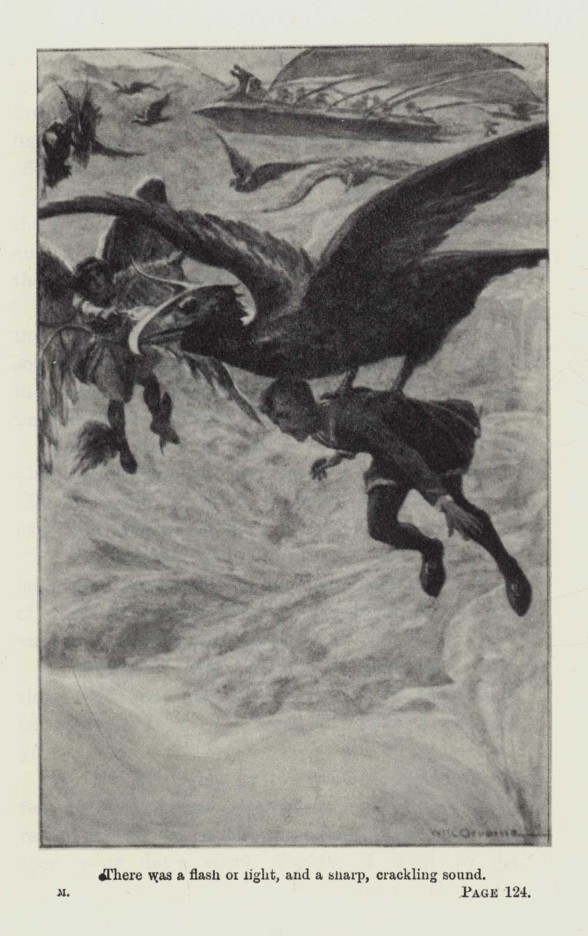
There was a flash of light, and a sharp, crackling sound.
Then the spreading wings drooped, the gigantic bird seemed to stagger and shrink, and finally it collapsed. Robber and prey fell together into the lake, and the waters closed over them.
There were a few moments of anxious suspense. Was Gerald injured? Would he be able to swim? These and similar questions were in the minds of the spectators as they scanned the surface of the lake.
Jack had turned his airship downwards as he saw Alondra make his rush, and a moment or two after the bird's fall the craft alighted on the water and lay gently rocking within a few yards of the spot.
Jack and Clinch both sprang to the side, and there were two splashes as they dived almost simultaneously.
Just, however, as they disappeared from sight beneath the water, two other forms emerged. One was the krondo, which floated motionless; the other was Gerald, who was swimming vigorously, seemingly none the worse for what he had undergone.
A great cheer went up from the assembled crowd, which was renewed again and again as first Jack and then Clinch reappeared, and, catching sight of their friend, hastened towards him to offer their help.
Just then the king's yacht descended close to the swimmers; a ladder was thrown from her side, and Ivanta himself stepped down and assisted them to climb on hoard.
He soon satisfied himself by actual examination that no great harm had been done. Gerald had some nasty scratches, and the muscles were bruised in places; but otherwise he was unhurt, and was inclined to make light of his adventure.
'It's an experience that no one on our own planet can boast of,' he observed with a smile. 'No one since the days of Sindbad the Sailor has ever been carried off by a bird.'
'I am thankful that it has been no worse, my lad,' said Ivanta, and in his tone there was a note of deep and kindly feeling. 'It is an unpleasant variation of our usual sport.'
'I confess I was on tenterhooks the whole time,' said Armeath, who was one of the king's party, 'and I am more relieved than I can tell you.'
'Oh, it's all right, sir!' answered Gerald cheerfully. 'I am none the worse, and I am quite ready to go on with the hunt. Don't let me spoil your day's sport. Besides, I want to get a bit of my own back. Those feathered brutes have hunted me; I want to hunt them before I 've done with them!'
'So you shall!' returned the king. 'But you must first put on some dry clothes. Go down to my cabin, and Alondra will find you a change.'
'I haven't thanked him yet for following up the beast so promptly,' cried Gerald, turning to Alondra, who had just alighted on the deck and grasped his hand. 'I saw all that went on! I saw you, Alondra, leap down after me; and it was that really which turned the bird in the right direction, for he was heading the other way!'
'I noticed that,' said Alondra modestly. 'I remembered that there was this lake ahead of us, and it struck me in a flash that the best—almost the only—chance of saving you was to drive the krondo towards it. Of course, I could have overtaken him and mastered him; but I could not have supported you and battled with him too—to say nothing of the others which would have been after us.'
''Twas wisely thought out, my son,' Ivanta declared. 'I caught your idea directly I noted that you had purposely turned the bird from the line it had first taken. Our young friend here was prompt, too, in following it up and aiding me to prevent it from breaking back,' he added, indicating Jack. 'Now, go and change your clothes; and we will give you your revenge upon the krondos.'
Half an hour later they were back again in the valley which had been the scene of Gerald's startling adventure. A desultory fight was still going on between Ivanta's trained eagles and a pair of their foes. Upon the rocky ground below lay one dead krondo and several of the smaller birds. Of the fourth krondo nothing was to be seen; it had probably taken refuge in flight.
Ivanta looked at his dead birds with grave concern and regret.
'This is my fault! I forgot to call them off!' said he. 'I do not like to have my faithful feathered friends treated like this.'
He put a whistle to his lips, and at the sound of it his eagles obediently left the krondos they were 'mobbing;' and the latter at once flew off. Evidently they had had quite enough of the fray, and were glad of the chance of making good their retreat without further trouble.
'We will find some more to chase presently,' observed Ivanta. 'First, let us see what can be done for those of my eagles which are hurt but not killed.'
Armeath and his wards looked on with wondering approval as they saw the attention Ivanta proceeded to bestow upon his wounded birds. It was curiously characteristic of the man to delay the proceedings and keep all his friends waiting for such a cause.
Later on, the hunt was resumed, and the visitors had some lively experiences among the mountain-peaks, though none quite so startling as the first one.
They found it, as Alondra had said they would, splendid sport. The krondos were hunted out and pursued by the small eagles in all their turns, and these were followed by the airships, just as the huntsmen follow the hounds. There was the same rivalry, too, amongst the latter to be 'in at the death.'
Naturally, this necessitated some bold manoeuvring on the part of the airships. At one time they would be circling through the upper air to dizzy heights far above the highest mountains; then suddenly there would be a turn and a mad plunge downwards for thousands of feet, as their quarry swooped down almost to the level of the ground below. There were many hairbreadth escapes from collisions; and altogether the sport was about as exciting as the most daring or the most reckless could desire.
'It beats the switchback railway business and all that sort of thing hollow!' exclaimed Gerald that evening, when relating their experiences to Freddy; for the Zuanstrooms had not joined the hunting-party.
'Looping the loop's nothing to it!' Jack declared.
Freddy looked wistful. 'How I wished I was with you!' he sighed.
'H'm! I 'm afraid you are not old enough yet for that sort of thing, youngster,' remarked Jack loftily. 'What has Silas been doing to amuse you to-day?'
'He hasn't been amusing me at all,' was the answer. 'It's been one of my "bad days" again. The nasty, ugly old man has come back, and has been with uncle and Silas all day; and whenever he comes I am always sent off and left to amuse myself as best I can!'
Gerald and Jack looked at each other. Jack gave a long, low whistle; Gerald exclaimed under his breath, 'The Ogre again!'
CHAPTER XVII.
LESSONS IN FLYING.
'It bain't no sort o' use; I shall never l'arn t' fly!' grumbled Bob Reid, as he stood rubbing his bruises. He had just come 'a nasty cropper,' and seemed, as he expressed it, to have 'hurt meself all over at wanst.' One hand was rubbing a leg, while the other was busy with a shoulder. 'If I 'ad 'alf a dozen more 'ands I could find plenty for 'em t' do!' he continued ruefully. 'I seem t' be bruised everywhere. Let's give it up, Tom, afore we suicides ourselves unintentional.'
'Not I!' cried Tom Clinch, who was balancing himself on a ladder. He flung his arms—to which two great wings were attached—about wildly, and leaped into the air, gasping as he came floundering down. 'You see, Bob, I 'll master it yet!'
The two sailors had had some 'flying-dresses' lent them, and had been practising and striving for all they were worth to learn the mystic art; but somehow they could not, as Tom put it, 'fall into the knack.'
'It be like swimmin',' Tom went on, between leaps and jumps which would have done credit to a Spring-heeled Jack. 'It takes a long time t' fall inter the knack'——
'Ye'll fall inter the ditch d'reckly,' Bob tittered, as Tom rolled over on the ground. 'It's no use, Tom! Let's be sensible, an' give it up. It ain't dignerfied like fur us two chaps at our time o' life!'
'I be goin' t' try another jump from that there ladder,' returned Tom obstinately. 'You needn't try no more if ye funks it! But when I starts out to do a thing I don't like t' be beat! Other people 'ere does it, so why shouldn't we?'
'Ay, but they l'arns it in their young days,' said Bob.
'Theer 's Mr Gerald—he's gettin' on fine! An' Mr Jack, too, ain't doin' bad at it! He be a-practisin' now just out yonder—t'other side that fence! There he goes now—a-soarin' up in grand style! I 'd give 'alf me month's wages t' be able t' go like that!'
'It's that puff o' wind's took 'old o' 'im,' Bob declared, as he watched Jack perform some rather curious aerial evolutions. 'Strikes me the wind's got 'old of 'im, an 'e can't 'elp 'isself! Yes! Look out fur 'im t' stop 'im, Tom!'
Tom had just succeeded, at the moment this urgent warning was uttered, in again climbing laboriously up the ladder on to a narrow platform which had been erected as a 'jumping-off place' for fliers.
There were several of these platforms, of various heights, placed at intervals in some spacious fields laid out specially near the city of Ivenia, for the use of those who were learning to fly, or experimenting with small flying-machines. They might be likened to the diving-platforms, with ladders leading up to them, which are to be seen at some bathing-places. They were open to all, and were freely used by old and young—especially the latter. It was no uncommon sight to see numbers of boys and girls—some almost babies—fluttering about like so many large butterflies.
This particular morning the two sailors were practising on their own account in one part, while Gerald and Jack were similarly engaged, not far away, under Alondra's tuition.
It was a windy day, with violent squalls at intervals, and lulls between. Just at the time Tom climbed to the platform there had arisen a very violent gust, which came sweeping across, bearing with it the figure of Jack, with large wings whirling about like the sails of a windmill. Whether he was purposely heading for the platform as a refuge to which he could cling, or whether the unexpected violence of the wind carried him there, it would be difficult to say. All that is certain about it is that he cannoned against Tom Clinch, and a moment later the two were gyrating and spinning in the air like a couple of gigantic bluebottles. Then, as though poor Bob Reid had not already enough bruises to attend to, the two descended like an avalanche plump on top of him. Finally, Gerald, who had followed Jack in his involuntary flight, sailed straight into the struggling group. Fortunately, at this point Alondra arrived. He had come after the two chums to render them his assistance, and was now able to help to disentangle them.
'One o' my wings is broke!' cried Tom, as he sat up and surveyed the wreck.
'I'm afraid both mine are,' said Jack.
'You 've broke my back atween ye!' Bob spluttered, as he rolled over. 'This settles it! No more flyin' fur me!'
'I've had enough for to-day too!' Jack laughingly owned, as he proceeded to divest himself of his flying outfit. 'It's a mistake for beginners to practise on a windy day.'
'I doan't practise no more—wind or no wind,' Bob declared in a tone of conviction. 'All I wants now be some limbrokation—an' plenty on it!'
'I think you only require a little more practice,' Alondra afterwards assured the two chums, as they were walking home towards his yacht, leaving their outfits to be brought after them by the two sailors.
'I don't know,' said Jack doubtfully. 'We've been trying it for a good while now, and we don't seem to make much progress. I begin to doubt if we ever shall. It's different with you, you see. Your people have learnt it more or less for generations, and it's in the blood, I fancy. I think we shall have to be content with motor-wings.'
Jack referred to the smallest form of flying-machine in use. It consisted merely of a pair of wings worked by a small motor, a balancing tail, and a saddle-seat on which the aeronaut perched himself. In many respects it might be described as the aerial counterpart of our motor-bicycle.
From the incidents just related it will be gathered that the visitors had not made much progress in learning the use of artificial wings. Whether there was something different in their physical constitution, or whether it was, as Jack was inclined to think, that the knack of flying was becoming hereditary amongst the Martians, it is certain that neither the youthful aspirants nor the two elderly sailors had so far been able to master the tantalising secret of soaring into the air at will with artificial wings alone. They could come down—from a height; but then, as Tom Clinch remarked, 'Most people can do that wi'out any l'arnin'.'
When, an hour or two later, Alondra's yacht landed them again at Karendia, as the king's palace was called (the name meant literally 'the palace in the clouds'), they found Monck awaiting them.