SIMPLE COUNTERPOINT IN TWO PARTS
Reading edition
FIRST SPECIES
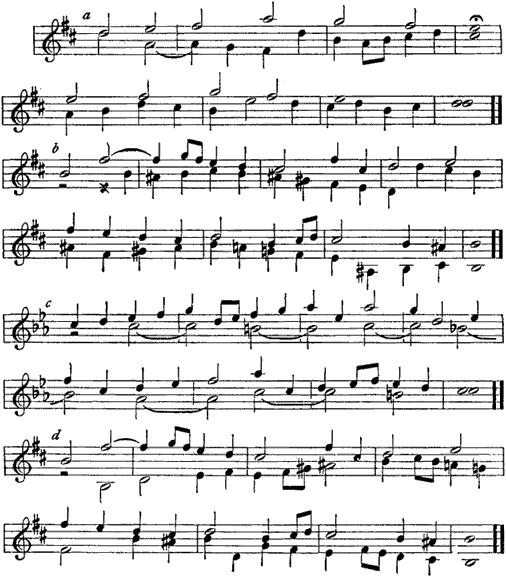
Two-part counterpoint comprises a cantus firmus and a counterpoint. [Fig. 6.]
Fig. 6.

Although in two-part counterpoint we have to deal with intervals, rather than harmonies, still the harmonic progressions represented by these intervals should be regarded.
The exercises should begin and close with tonic harmony. At the beginning the unison, fifth or octave, and at the close the unison or octave, are permitted. [Fig. 7.]
Fig. 7.

After the first measure it is better to use imperfect consonances only. The perfect consonances, however, may be used sparingly when a more melodious counterpoint is thereby obtained.
The unison may be used in the first and last measures only. [Fig. 7.]
All progressions must be diatonic, and parts should not cross.
The repetition of a note in a lower part should be avoided wherever possible. In a higher part, repetition to the extent of three notes in succession is allowed.
Do not use more than three thirds or sixths in succession. [Fig. 8.]
Fig. 8.

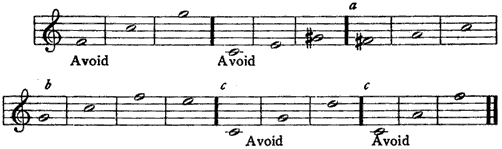
Successive similar skips, except the minor third (a), in one direction, are to be avoided. Successive skips of a fourth are good when the tones are the fifths of the triads on I, IV and vii°. The last tone should return one degree (b). [Fig. 9.]
Do not move more than an octave in one direction in two skips. [Fig. 9c.]
Fig. 9.
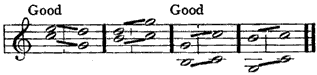
Covered fifths and octaves, except from I to V, or V to I, are forbidden. [Fig. 10.]
Fig. 10.
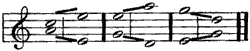
Both parts skipping in contrary motion to a fifth or octave should be avoided in two-part writing. [Fig. 11.]
Fig. 11.
Avoid consecutive perfect intervals. [Fig. 12.]
Fig. 12.

The augmented fourth (Tritone) is not only considered bad as a melodic interval by some authorities, but its appearance between different parts in successive intervals is also prohibited. This prohibition, however, holds good only when the chords in which it appears are in fundamental position, as in Fig. 13a. This is shown by the fact, that if one part skips as at b, there is no unpleasant effect.
Fig. 13.
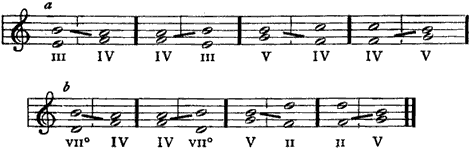
Avoid consecutive major thirds in major keys. In minor keys they are good. [Fig. 14.]
Fig. 14.
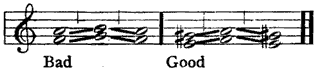
Use adjacent voices in writing, and do not exceed the vocal compass of a voice.
Modulation may be resorted to within the exercises, but only to nearly related keys; for example, in C, to G, F, a, e, or d.
At the close parts should proceed stepwise to the unison, or octave. [Fig. 15a.]
A close as in Fig. 15b may be used occasionally. In this case the leading-tone is better in the higher part.
Fig. 15.

EXERCISES
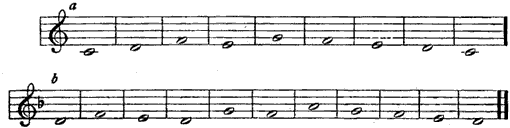
To each of the following canti firmi write two counterpoints above, and two below.
Canti Firmi
Fig. 16.
LESSON II
SECOND SPECIES
Fig. 17.

All rules for the first species must be observed.
Two notes are written in the counterpoint to one of the cantus firmus, except in the last measure. [Fig. 18a.] In the last measure but one the first species may sometimes be used. [Fig. 18b.]
Fig. 18.

Repetition of a note in any but the first species is forbidden. [Fig. 19.]
Fig. 19.
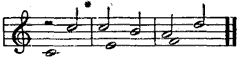
The counterpoint may begin on the first or the second half of the measure, preference being given to the second half. When it begins on the first half it must be a unison, fifth, or octave; when on the second half, it may be any consonance. [Fig. 20.]
Fig. 20.
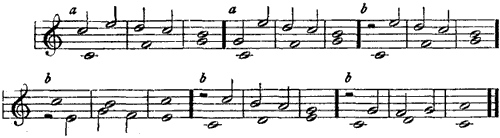
After the first measure the interval on the first beat should be an imperfect consonance, as in the first species, but the fifth, or octave, may be used occasionally.
In this and succeeding lessons, all notes in the measure not belonging to the harmony implied on the first beat, must be treated as dissonances, e.g., those belonging to the implied harmony may be left by a skip (a) or stepwise progression (b) unless dissonant with the cantus firmus; then avoid their use; if foreign to it, whether consonant (c) with the C.F. or not (d), they must be treated as embellishments or passing-tones. [Fig. 21.]
Fig. 21.
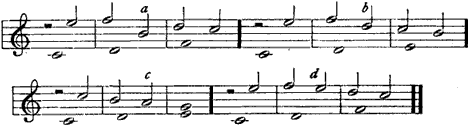
The embellishment may be used as follows: when above the principal tone, it may be a semitone (a) or a whole tone (b) distant from it; and when below, a semitone (c). [Fig. 22.]
Fig. 22.

When the counterpoint is below the cantus firmus, the fifth of the chord needs special treatment. It is permitted on the weak beat when the lower is treated as an harmonic passing-tone.
An harmonic passing-tone is the second of three tones belonging to the same chord. [Fig. 23a.] While the third tone should be a member of the chord containing the fifth as an harmonic passing-tone, the chord above it may change as in Fig. 23b.
The fifth is permitted on the strong beat when it is only an implied fifth (six-four chord); that is, the third and fifth appear on the strong beat, and the root does not come in until the second half of the measure. [Fig. 23c.]
Fig. 23.

The unison is permitted on the weak beat. [Fig. 24.]
Fig. 24.
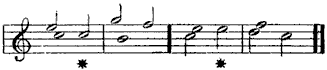
Avoid broken-chord effects, that is, do not use more than three tones belonging to the same chord in succession. [Fig. 25.]
Fig. 25.

Avoid frequent skipping of parts. [Fig. 26.]
Fig. 26.
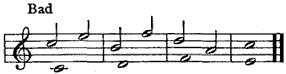
Parts may cross occasionally, but should return immediately [Fig. 27.]
Fig. 27.
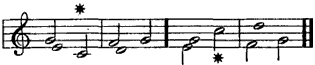
Consecutive fifths or octaves on consecutive strong beats are bad; but they are good on the weak beats if the second fifth or octave is approached in the opposite direction from the first. [Fig. 28.]
Fig. 28.
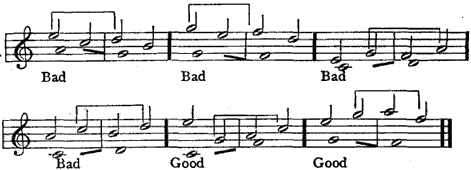
In minor the sixth degree may occasionally be raised on the strong beat, if it is desired to proceed upward to the raised seventh degree. [Fig. 29.]
Fig. 29.
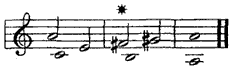
In the last measure but one, both the supertonic and leading tone should appear. [Fig. 30.]
Fig. 30.
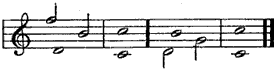
Three notes may be written to one of the cantus firmus, as in Fig. 31. For this no new rules are required.
Fig. 31.

The cadences in Fig. 32 are good. It will be seen that the cadences of the first species may also be used.
Fig. 32.

EXERCISES
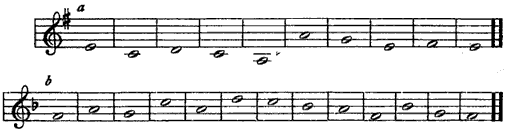
To cantus firmus a write two counterpoints above and two below in the first species.
To cantus firmus b write two above and two below in the second species.
Canti Firmi
Fig. 33.
LESSON III
SECOND SPECIES IN BOTH PARTS[A]
Fig. 34.

When writing second species in both parts no cantus firmus is used, both parts being original. One part begins on the first beat, the other may begin on either the first or second beat. [Fig. 35.]
Fig. 35.
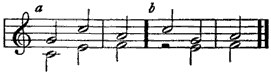
The interval formed by the two notes appearing on the second beat should be a consonance, or one of the following dissonances: The augmented fourth, the diminished fifth, the minor or diminished seventh when properly resolved, and the perfect fourth when approached in contrary motion.
All tones not belonging to the harmony implied on the first beat, must be treated as dissonances. [Fig. 36.]
Fig. 36.
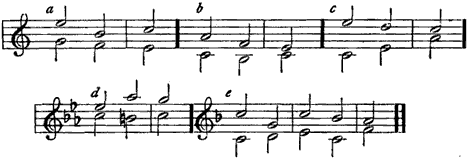
The seventh or ninth of the implied harmony of a measure, when approached in an upward direction, may be used in either part, provided it is consonant with the other part, or comes within the requirements of the exceptions. [Fig. 37.]
The passing major seventh and its root may appear on the weak beat, even when approached in similar motion as in Fig. 37a. The seventh must then be treated as a passing-tone.
Fig. 37.
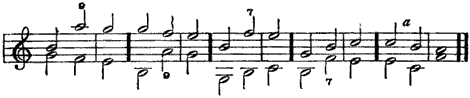
The cadences in Fig. 38 are good when writing second species in both parts. Those having the second species in one part only, may also be used.
Fig. 38.

Writing the second species in both parts will, in this lesson, be confined to a mixture of the first and second species, as in Fig. 39.
In this do not use the second species more than four measures continuously in one part. It will be noticed that the second species may occasionally be used in both parts. In later lessons opportunity will be given to write it continuously in both parts.
Fig. 39.

EXERCISES
Write two eight-measure phrases mixing the first and second species. [Fig. 39.]
To cantus firmus a write one counterpoint above and one below, three notes to the measure. [Fig. 31.]
To cantus firmus b write one above and one below, in the second species.
Canti Firmi
Fig. 40.
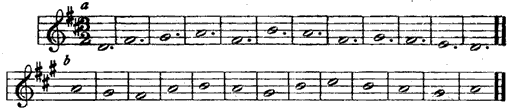
LESSON IV
THIRD SPECIES
Fig. 41.
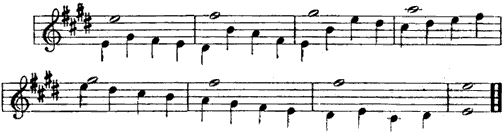
In this species, four notes are written in the counterpoint to each note of the cantus firmus. The counterpoint may begin on the first, second, or fourth quarter. The second quarter is, however, the most usual. [Fig. 42.]
Fig. 42.

The exercises should begin and end with tonic harmony.
When the counterpoint begins on the first quarter it must form a perfect consonance with the cantus firmus. When on the second or fourth quarter, any consonance may be used.
All previous rules are to be regarded, unless exceptions are made.
At least one of the first three quarter-notes of a measure should be left degreewise. [Fig. 43.]
Fig. 43.

The last quarter of a measure is usually left degreewise. If approached by a skip or by a degreewise progression of at least two quarter-notes, it may be left by a skip in the opposite direction from which it was approached. A skip of a third in the same direction is also good when this skip is preceded by a skip of a third (d). [Fig. 44.]
Fig. 44.
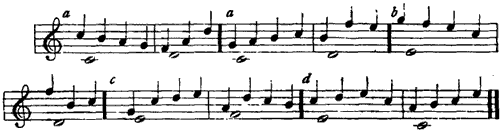
Parts may cross occasionally.
The use of non-harmonic tones, as in Fig. 45, is good in either part. At a the passing-tone, instead of progressing directly to the adjacent chord-tone, skips a third to the other side of it and then returns. The embellishment is treated in the same way, but is most effective when the principal tone is the leading-tone, as at b. In both cases the counterpoint should continue degreewise through the chord-tone. [Fig. 45.]
Fig. 45.

The fifth, when in the lower part, may be used on any but the first quarter, provided it is treated as a passing-tone, e.g., approached and left by stepwise progression in one direction.
Fig. 46.

Consecutive fifths and octaves are forbidden when appearing on the accented beats of successive measures; between prominent notes of successive measures not more than four quarters apart; and between a prominent note of one measure and the first quarter of the next. [Fig. 47.]
Fig. 47.
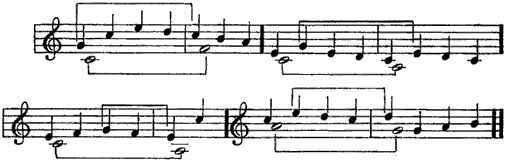
Oblique motion to the unison is bad. It is permitted if it continues in the same direction through the unison. [Fig. 48.]
Fig. 48.

The unison may be used on any but the first quarter of a measure.
Frequent repetition of a figure as in Fig. 49 is not good.
Fig. 49.

The embellishment may be used either above or below, whether a semitone or a whole tone; but when it is a whole tone below, it is most satisfactory as the ninth of the implied chord. [Fig. 50.]
Fig. 50.

In minor the sixth and seventh degrees of the scale are raised both ascending and descending, when used in harmonies containing the leading-tone as a chord-tone. They are unaltered both ascending and descending in harmonies containing the sixth degree of the scale as a chord-tone. In other harmonies they are raised in ascending only.
The sixth or seventh degrees may be chromatically altered with only one note intervening. [Fig. 51.]
Fig. 51.
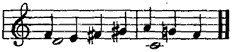
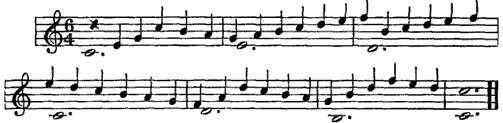
Six notes may be written to one of the cantus firmus, as in Fig. 52.
Fig. 52.
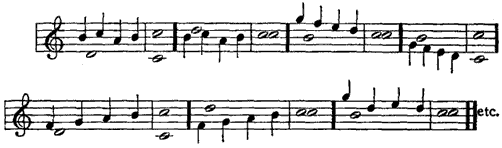
The cadences in Fig. 53 are good.
Fig. 53.
EXERCISES
To cantus firmus a write three counterpoints above and three below, in the third species.
Write two eight-measure phrases, using second species continuously in both parts. [Fig. 34.]
Cantus Firmus
Fig. 54.

LESSON V
THIRD SPECIES IN BOTH PARTS
Fig. 55.
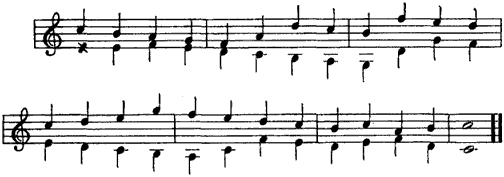
The suggestions given for writing second species in both parts apply here, except that when both parts move degreewise, any interval may come on the second and fourth quarters, preferably a consonance. The third quarter is treated the same as the second half when writing the second species in both parts.
The augmented fourth, and diminished fifth and seventh, may be approached in similar motion. [Fig. 56.]
Fig. 56.

The augmented fourth following the perfect fourth, as in Fig. 56a, is good.
The minor seventh, and the major and minor ninth of a chord, may be used freely on any but the first quarter, but must be consonant with the other part. [Fig. 57.]
Fig. 57.

The first and third species may be mixed, as in Fig. 58.
Fig. 58.

The second species may be used in one part and the third in the other, also six notes in one part and two in the other, and six in one and three in the other. All tones appearing simultaneously, must comply with the suggestions for tones appearing on the weak beat given in previous lessons, where both parts have other than the first species. [Fig. 59.]
Fig. 59.
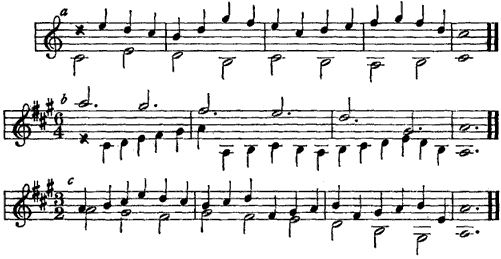
The cadences in Fig. 60 are good, and will suggest others.
Fig. 60.

EXERCISES
To cantus firmus a write one counterpoint above and one below, in the third species.
To cantus firmus b write counterpoints in six notes, one above and one below. [Fig. 52.]
Write one eight-measure phrase, mixing the first and third species. [Fig. 58.]
Write two eight-measure phrases, using third species in both parts. [Fig. 55.]
Canti Firmi
Fig. 61.
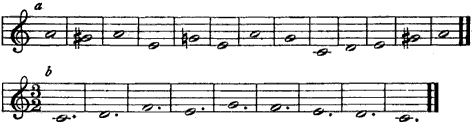
LESSON VI
FOURTH SPECIES
Fig. 62.

This species is the same as the second, except that the last note of the measure is tied to the first note of the next, forming a syncopation. As in the second species, the first note of the counterpoint should form a unison, octave or fifth, and when the counterpoint begins on the second half it may also be an imperfect consonance.
When the counterpoint begins on the first half, the second half is treated the same as the second half of succeeding measures, described in the next paragraph.
After the first measure, the second half of the measure should contain a consonance (Fig. 63a), the first half a consonance (b), or dissonance (c), preferably the latter, in which case a suspension is formed. This is the most desirable form of syncopation. When the first half contains a dissonance, the counterpoint must descend—or ascend in retardation (d)—one degree to an imperfect consonance (c). When the first half is a consonance, it may be left by a skip to some other chord-tone (e), or by degreewise progression (f). In the latter case the second note is non-harmonic, and therefore should not be used to prepare a syncopation except as in Fig. 63d (Retardation of the root in I6).
Fig. 63.

When writing three notes to one in the fourth species, the suspension may resolve on the second beat (a), or the third (b). In the latter case, the suspension skips (c) to some other chord-tone, before resolving. The resolution to the leading-tone (d) forms an important exception to this rule. [Fig. 64.]
Fig. 64.
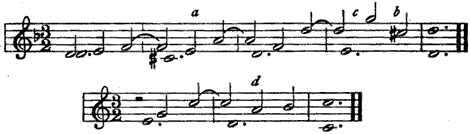
The fifth may be used in the lower part if it becomes the preparation of a suspension (Fig. 65a). It may also be used in the lower part, as in Fig. 65b, provided it resolves by skipping to the third of the chord.
In skipping from the fifth to the root, or the reverse, in the lower part, do so in an upward direction. The fifth, when treated as an harmonic passing-tone, may, however, be approached either ascending or descending.
Fig. 65.
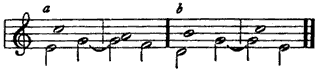
The retardation should be used only when prepared by the leading-tone. It rises a semitone in resolving. [Fig. 66.]
Fig. 66.
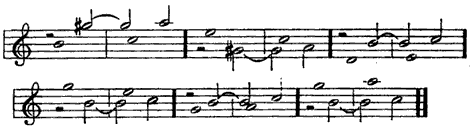
The following dissonant intervals may be used on the first half of the measure:—When the counterpoint is above, the fourth and seventh in suspension, and second and fifth in retardation; and when below, the second in suspension, and the fourth and seventh in retardation. [Fig. 67.]
Fig. 67.
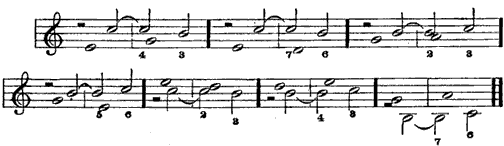
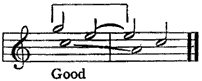
Consecutive fifths on consecutive strong beats of the measure are good when one of the tones of the second fifth is prepared, as in Fig. 68.
Fig. 68.
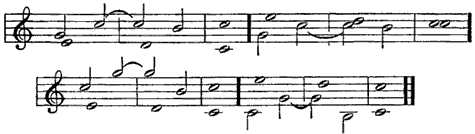
The following cadences are good:
Fig. 69.
EXERCISES
Write one eight-measure phrase with two notes to the measure in one part and six in the other; one with three notes in one and six in the other; and one with two notes in one part and four in the other. (Fig. 59.) In combining the species in this and succeeding lessons the student may place any species in any part.
To the cantus firmus write two counterpoints above and two below, in the fourth species.
Cantus Firmus
Fig. 70.

LESSON VII
FOURTH SPECIES (Continued)
The first and fourth species may be mixed as in Fig. 71. Rules for writing other than the first species in both parts are to be regarded.
Fig. 71.

EXERCISES
To cantus firmus a write two counterpoints above and two below, in the fourth species.
To cantus firmus b write two above and two below, three half-notes to the measure, with syncopations.
Write two eight-measure phrases, mixing the first and fourth species.
Canti Firmi
Fig. 72.
LESSON VIII
COMBINING THE FOURTH SPECIES WITH THE OTHERS
All previous rules for combining species still apply.
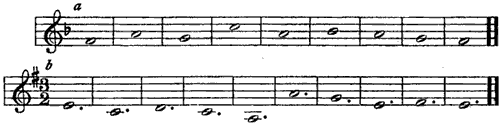
In combining the fourth species with other than the first, the following intervals may be used on the first half of the measure, in addition to those mentioned in Lesson VI: When the counterpoint is below, the fourth, fifth and seventh in suspension, and the ninth in retardation; and when above, the fifth in suspension, and the seventh in retardation; but in every such case the part having other than the fourth species must skip to some other chord-tone before resolving the suspension. [Fig. 73.]
Fig. 73.
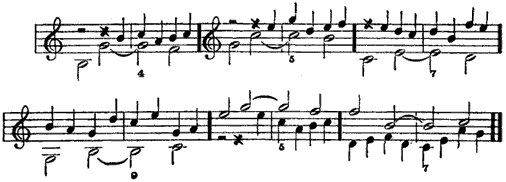
The leading-tone may be doubled as in Fig. 74. Here the leading-tone that is prepared skips to some other chord-tone, while the new leading-tone remains stationary.
Fig. 74.
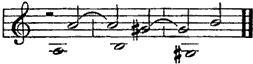
The minor or diminished seventh, major or minor ninth, may be used as preparation of a suspension in either part, provided it is approached by a skip in an upward direction, and is consonant with the other part, or is one of the permitted dissonances. [Fig. 75.]
Fig. 75.
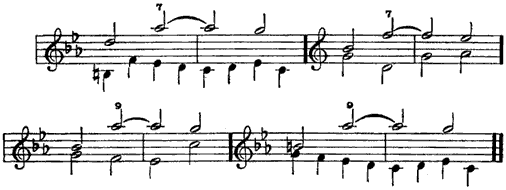
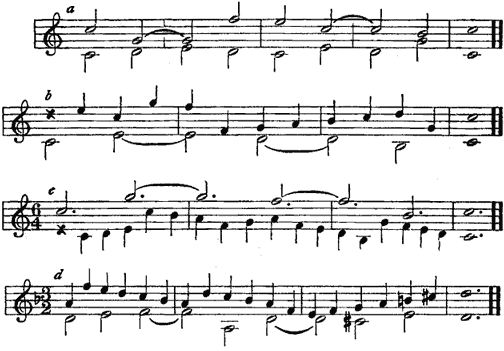
The fourth species may be combined with the second or third species, and two or three notes syncopated may be written in one part with six in the other. [Fig. 76.]
Fig. 76.
EXERCISES
To the cantus firmus write one counterpoint above and one below, in the fourth species.
Write one eight-measure phrase each, of the following combinations: The fourth species with the second; the fourth with the third; two notes syncopated against six notes; and three notes syncopated against six notes. Write some in major and some in minor. [Fig. 76.]
Cantus Firmus
Fig. 77.

LESSON IX
FIFTH SPECIES: FLORID COUNTERPOINT
Fig. 78.

Florid counterpoint is a mixture of the second, third and fourth species.
In addition to these species eighth-notes may be used in groups of two on the second and fourth quarters of the measure. Both notes should be approached and left stepwise, with the exception that the first may be taken by a skip. [Fig. 79.]
Fig. 79.
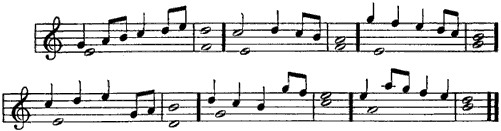
Not more than one and one-half measures of any one species should be used continuously in one part. [Fig. 80.]
Fig. 80.
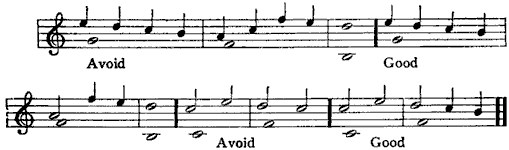
In the use of quarter-notes it is necessary to exercise care. They may be used on the first half when preceded by quarter-notes, when the entire measure is filled, or when they precede a half-note which is the preparation of a suspension. On the second half they are always good. [Fig. 81.]
Fig. 81.
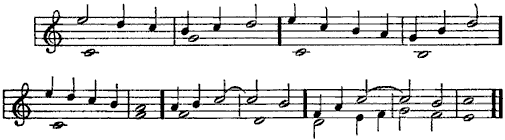
For the present the suspension should not be less than a half-note or its rhythmic equivalent in the ornamental resolution.
In this species the suspension may resolve ornamentally, that is, it may have some note or notes interpolated between the suspension and its resolution. The relative position of the suspension and its resolution must remain the same as in the regular resolution. [Fig. 82.]
When the suspension is left by a leap, the note skipped to should be consonant with the other part (b). When eighth-notes are used, as at a, they must be approached and left stepwise.
The suspension, instead of being sustained as a half-note, may be repeated on the second quarter, as at c. In this case it is best to continue stepwise through the tone of resolution.
At d the resolution, instead of coming on the second half, appears on the quarters on either side. This is good.
Fig. 82.
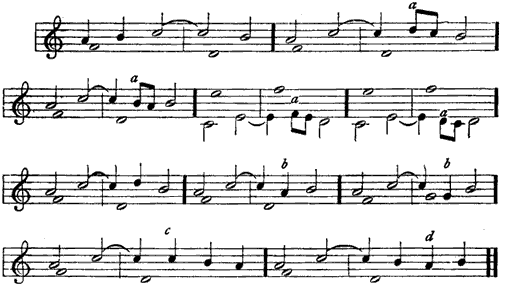
The ornamental resolution may be used in either part.
Use the suspension freely.
The solutions should be musical, and are to be written over and over again until such are secured.
All cadences of the second, third and fourth species, or any combination of these, may be used.
EXERCISES
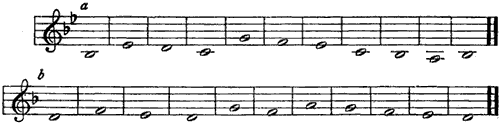
To canti firmi a and b write two counterpoints above and two below, in the fifth species
Canti Firmi
Fig. 83.
LESSON X
FLORID COUNTERPOINT (Continued)
When florid counterpoint is combined with other than first species, the dotted half followed by a quarter-note (a), or two eighth-notes (b), is good. Also, a rhythmic figure, as at c, where a half-note occupies the second and third quarters, may be used. [Fig. 84.]
Fig. 84.

EXERCISES
Write one eight-measure phrase, each, of the following combinations: The fifth species with the second; the fifth with the third; and the fifth with the fourth. Write also two eight-measure phrases with fifth species in both parts. [Fig. 85.]
Fig. 85.