SIMPLE COUNTERPOINT IN THREE PARTS
Reading edition
LESSON XI
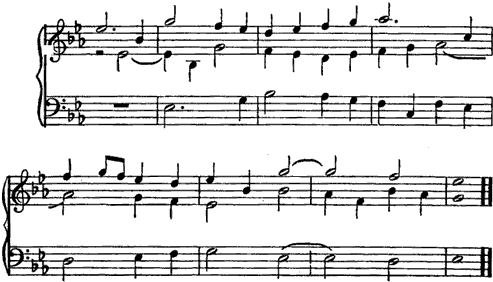
FIRST SPECIES
Fig. 86.
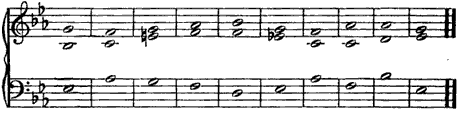
Regard all rules for two-part counterpoint, unless otherwise mentioned.
If possible, each measure should contain a complete chord. When in the first species it becomes necessary to double an interval, let it be preferably the root. The third should be doubled only when a decidedly smoother melodic progression is thereby obtained; and when both thirds are in outer parts, each should be approached and left stepwise in one direction (Fig. 87). The doubling of the fifth is, of course, impossible, since it necessitates the omission of the third.
Fig. 87.

All triads may be used in their first inversion.
Diminished and augmented triads, however, are best used in their first inversion.
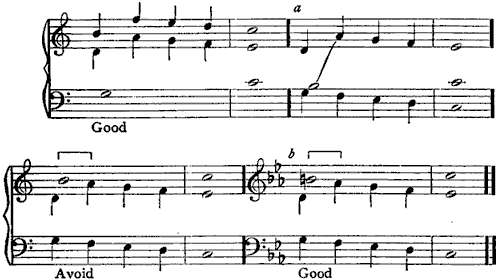
The six-four chord may be used at the close as the cadencing tonic six-four chord. Do not approach the root and fifth in similar motion, as at b. [Fig. 88.]
Fig. 88.
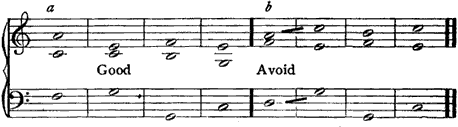
The dominant seventh may be used in any but its second inversion, the fifth being omitted.[A] The seventh requires no preparation. Other chords of the seventh are better not used until second species and later.
If possible, let the chord in the first measure appear complete. The last chord but one should be complete, unless some form of V or V7 is used. [Fig. 89.]
Fig. 89.
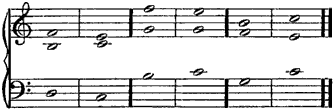
Consecutive major thirds may be used when three or more parts are employed. [Fig. 90.]
Fig. 90.

A note may now be repeated in the lowest part when it becomes the seventh of a dominant seventh-chord. [Fig. 91.]
Fig. 91.
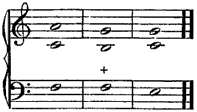
In writing, use soprano, alto and tenor, or alto, tenor and bass; and do not separate upper parts more than an octave. For a chord or two they may (for the sake of better voice-leading) separate a tenth.
All hidden fifths and octaves are bad, except between I and V and V and I. [Fig. 92a, b.]
The perfect fifth following the diminished fifth is good when taken in an upward direction stepwise in the higher parts. [Fig. 92c.]
Fig. 92.
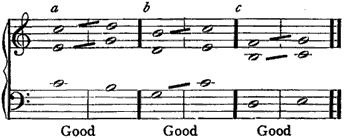
All cadences used in harmony are good.
Unless otherwise mentioned, put the cantus firmus in any part, but avoid its continued use in the same part.
EXERCISES
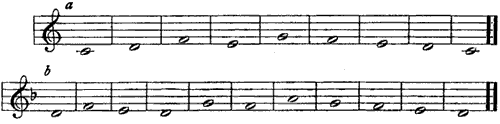
To canti firmi a and b write the first species in all parts. Write each three times, setting the cantus firmus in a different part in each solution. This necessitates transposing the cantus firmus, when setting it in the other parts.
Canti Firmi
Fig. 93.
LESSON XII
THE SECOND SPECIES
Fig. 94.
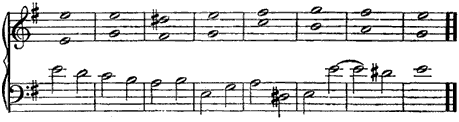
The second species is written in one part and the first in the other two.
All suggestions made for the second species in two-part counterpoint are to be observed, unless otherwise mentioned. Those regarding consecutive perfect intervals are especially to be observed.
The fifth, when in the lowest voice, should be used as in two-part counterpoint, except when used in V43 or the cadencing tonic six-four chord.
The V43 chord may be used on the weak beat, necessitating the omission of the third. [Fig. 95a.]
The third may be omitted (b), or doubled (c), on the weak beat in this and succeeding species. [Fig. 95.]
Fig. 95.
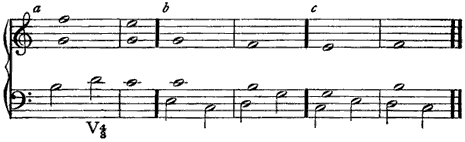
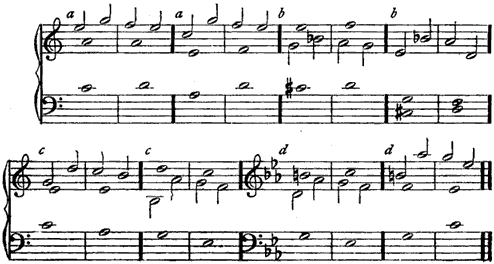
The minor or diminished seventh may be approached by a skip in an upward direction on the weak beat in any part. This usually necessitates the omission of some other chord-member on the weak beat.
The major or minor ninth may also be used in the same way, except in the lowest part, provided it is at least a ninth above the root. [Fig. 96.]
Fig. 96.
The progression from vii°6 to V in root-position or any inversion in the same measure, is good. [Fig. 97.] Use b and c only when using other than first species in two or more parts.
Fig. 97.
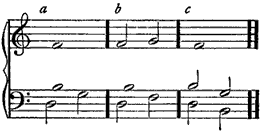
Each measure should usually contain a complete chord. If not complete on the first beat, bring the missing interval in on the second. [Fig. 98.]
Fig. 98.
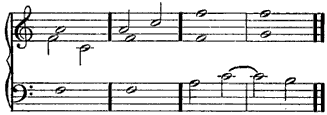
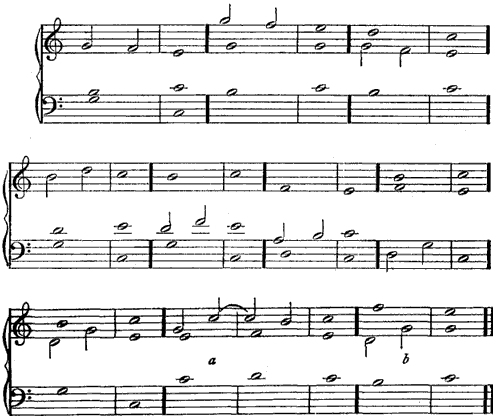
The cadences in Fig. 99 are good, and will suggest others. The use of the fourth species is permitted as at a. A note may be repeated in the final cadence in all species as at b.
Fig. 99.
EXERCISES
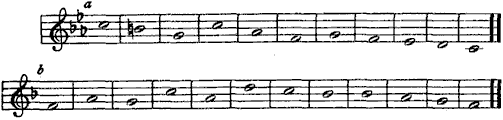
To cantus firmus a write the first species in all parts, as previously directed.
To cantus firmus b write second species in one part. Write three times, changing cantus firmus and counterpoint about so that they will appear in each part in turn.
Canti Firmi
Fig. 100.
LESSON XIII
SECOND SPECIES IN TWO PARTS
Fig. 101.
The suggestions for second species in both parts, in two-part counterpoint, apply for the two parts having the second species in three-part counterpoint.
Accidental harmonies sometimes appear on the weak beat. All tones in this accidental harmony foreign to the chord on the strong beat must be treated as dissonances. This must be regarded whenever two or more parts have other than the first species. [Fig. 102.]
Fig. 102.
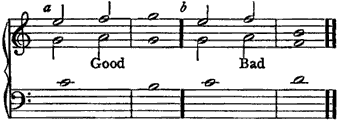
At Fig. 102a, the accidental harmony f-a-c is on the weak beat. The f and a, being foreign to the chord c-e-g on the strong beat, are correctly treated as dissonances. At b, the f and a are left by skip, which is not permitted.
The second species may be written continuously in all parts; the tones appearing on the weak beat must be harmonically related to one another, and those foreign to the chord on the strong beat must be treated as dissonances. [Fig. 103.]
Fig. 103.
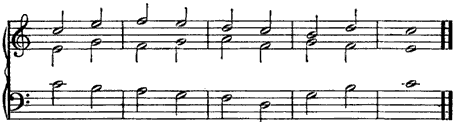
The first and second species may be mixed, as in Fig. 104.
Fig. 104.
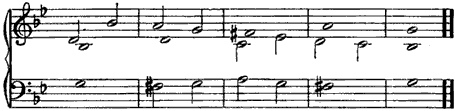
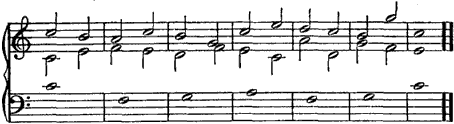
The cadences in Fig. 105 are good, and will suggest others. Those with first species in all parts may also be used.
Fig. 105.
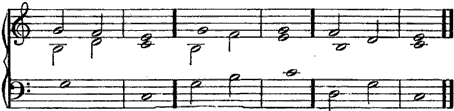
EXERCISES
To cantus firmus a write a counterpoint in the second species in one part. Write three settings, as directed in the previous lesson.
Write two eight-measure phrases mixing the first and second species in all parts.
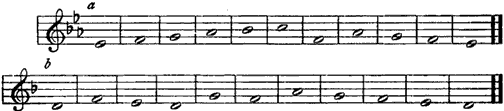
To cantus firmus b write counterpoints in the second species in the other two parts. Write two settings, with the cantus firmus in different parts.
Canti Firmi
Fig. 106.
LESSON XIV
THIRD SPECIES
Fig. 107.
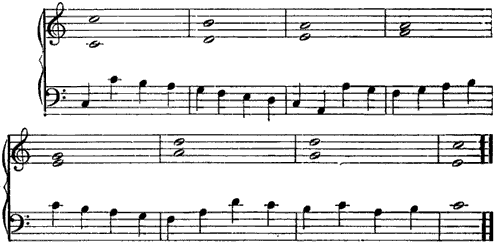
The suggestions for third species in two-part counterpoint, as well as those for writing the second species in three-part counterpoint, apply when writing third species in three-part counterpoint.
The cadences at Fig. 108 are good, and will suggest others.
Fig. 108.
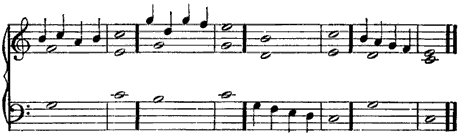
EXERCISES
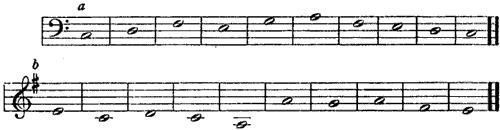
To cantus firmus a write third species in one part. Write three settings as previously directed.
To cantus firmus b write second species in two parts, as previously directed.
Write one eight-measure phrase, using second species in all parts.
Canti Firmi
Fig. 109.
LESSON XV
THIRD SPECIES IN TWO OR MORE PARTS
Fig. 110.
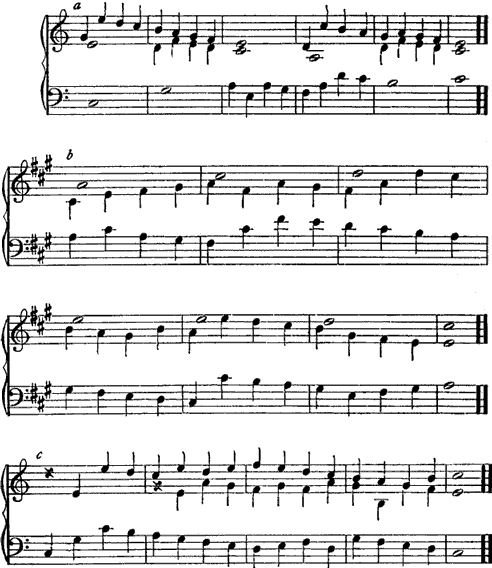
Previous suggestions when two or more parts have other than first species, apply here.
In using the ninth of a chord it is well to keep it at least a seventh distant from the third, as well as a ninth above the root, except in the case of the dominant ninth in minor keys, where it may be separated by only an augmented second ([b]). [Fig. 111.]
Fig. 111.
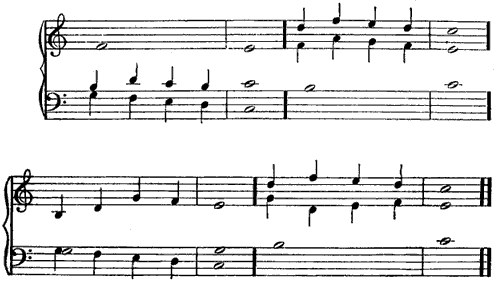
In writing the third species in all parts, notes appearing simultaneously should be harmonically related. Treat all tones foreign to the chord on the first quarter as dissonances.
The cadences in Fig. 112 are good.
Fig. 112.
EXERCISES
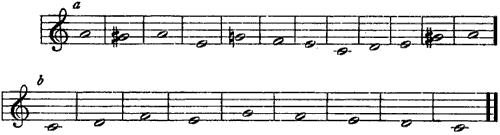
To cantus firmus a write third species in one part, as previously directed.
To cantus firmus b write third species in two parts, as in Fig. 110b. Write twice, changing the cantus firmus about.
Write one eight-measure phrase, mixing first and third species as in Fig. 110a.
Canti Firmi
Fig. 113.
LESSON XVI
THIRD SPECIES (Continued)
EXERCISES
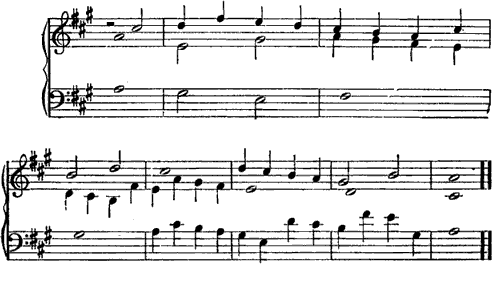
To the cantus firmus write third species in one part, as previously directed.
Write one eight-measure phrase, mixing first and third species; also one mixing first, second and third. [Fig. 114.]
Write one eight-measure phrase, using third species in all parts. [Fig. 110c.]
Fig. 114.
Cantus Firmus
Fig. 115.

LESSON XVII
FOURTH SPECIES
Fig. 116.
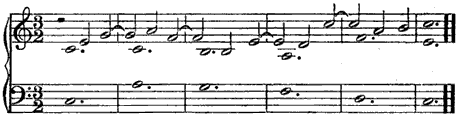
When the syncopation is a suspension or retardation, it is treated the same as in harmony.
The retardation should always be prepared by the leading-tone.
When the syncopated note belongs to the harmony of the measure, it may be left by a skip or stepwise progression. [Fig. 117.]
Fig. 117.
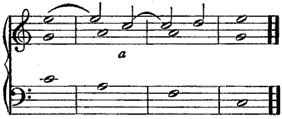
The third may be omitted on the strong beat in this species, provided the part having fourth species skips to the missing third, as at Fig. 117a.
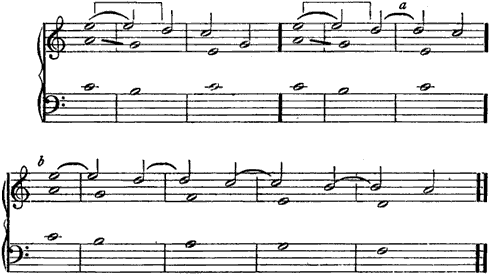
Consecutive fifths, but not octaves, are saved by the suspension. Whenever they occur, do not use the note of resolution as preparation of a suspension, or tie it into the next measure (a), since it is really the passing seventh, and that does not lend itself well to either of the above, except in sequence as at b. [Fig. 118.]
Fig. 118.
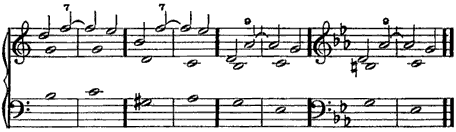
The seventh or ninth of a chord, except the major seventh, may be used as preparation of a suspension when approached by a skip in an upward direction, as in Fig. 119.
Fig. 119.
This species may also be written in triple rhythm. [Fig. 120.]
Fig. 120.
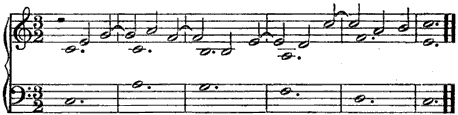
The cadences in Fig. 121 are good, as well as those of the second species.
Fig. 121.
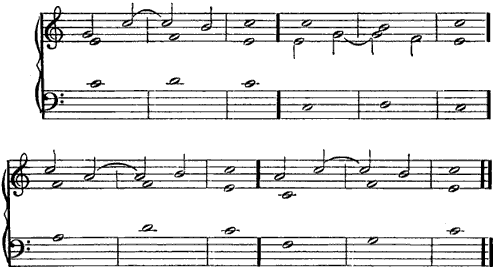
EXERCISES
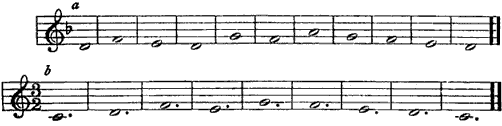
To cantus firmus a write fourth species in one part. Write three settings, as usual.
To cantus firmus b write fourth species in one part in triple rhythm. Write three settings, as above.
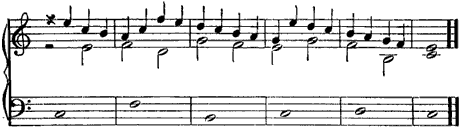
To cantus firmus b write second species in one part and third in the other. [Fig. 122.]
Fig. 122.
Canti Firmi
Fig. 123.
LESSON XVIII
FOURTH SPECIES (Continued)
EXERCISES
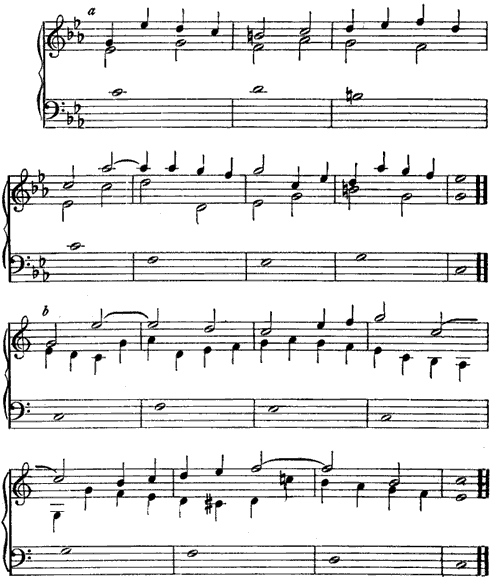
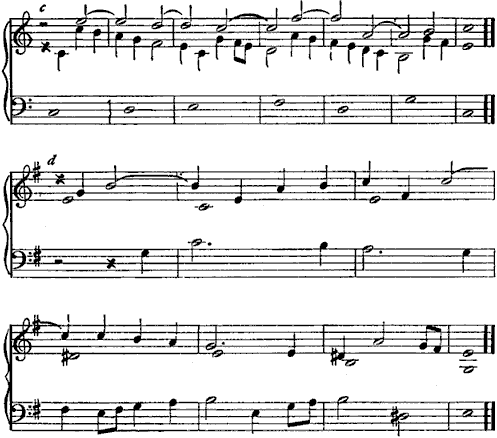
Write two eight-measure phrases, using the fourth species mixed in all parts. [Fig. 124a.]
To cantus firmus a write second species in one part and fourth in the other. [Fig. 124b.]
To cantus firmus b write third species in one part and fourth in the other. [Fig. 124c.]
Fig. 124.
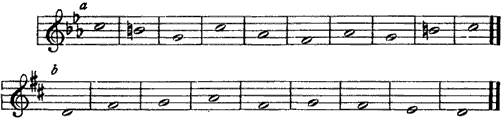
Canti Firmi
Fig. 125.
LESSON XIX
FIFTH SPECIES
Fig. 126.
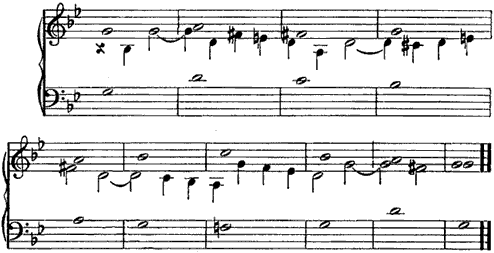
No suggestions other than have already been given for two- and three-part counterpoint are necessary for this species.
EXERCISES
To canti firmi a and b write fifth species in one part. Write each three times, as usual.
Canti Firmi
Fig. 127.
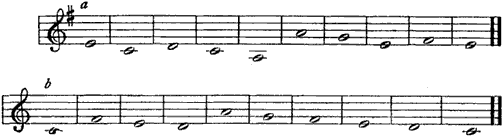
LESSON XX
FIFTH SPECIES (Continued)
EXERCISES
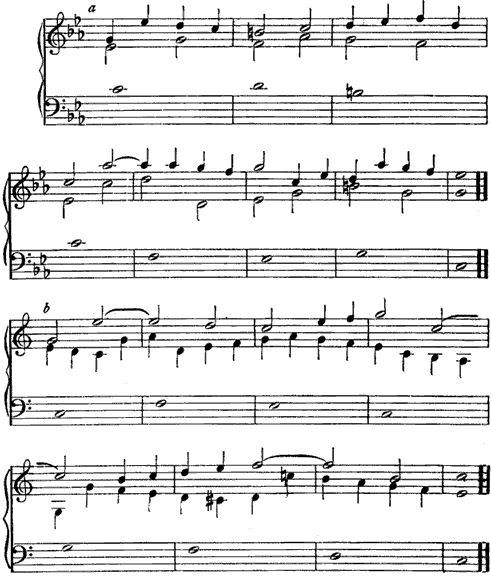
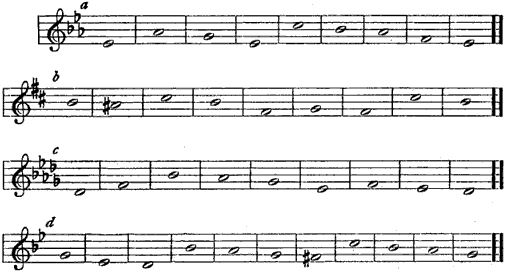
To cantus firmus a write second species in one part and fifth in the other. [Fig. 128a.]
To cantus firmus b write third species in one part and fifth in the other. [b.]
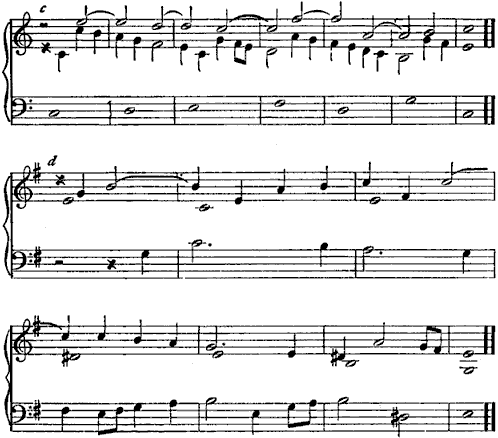
To cantus firmus c write fourth species in one part and fifth in the other. [c].
To cantus firmus d write fifth species in two parts. [d.]
Fig. 128.
Canti Firmi
Fig. 129.
LESSON XXI
COMBINING THE VARIOUS SPECIES
EXERCISES
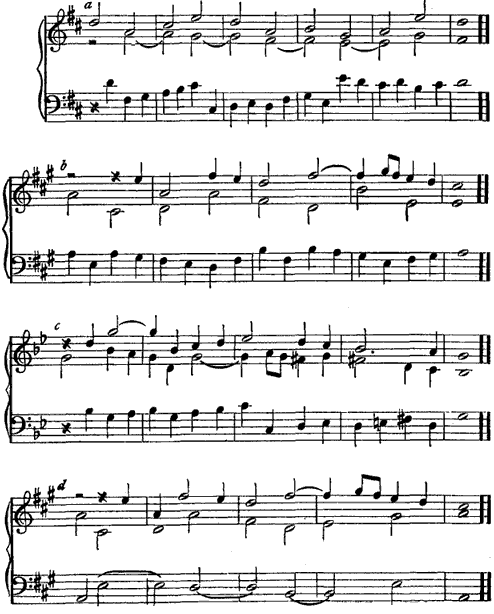
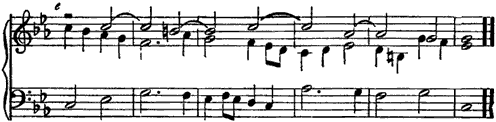
Write one eight-measure phrase each, of the following combinations: (1) 2nd, 3rd and 4th species (Fig. 130a); (2) 2nd, 3rd and fifth species (b) (3) 3rd, 5th and 5th species (c); (4) 2nd, 4th and 5th species (d); (5) 4th, 5th and 5th species (e).
Fig. 130.
LESSON XXII
FIFTH SPECIES IN ALL PARTS
EXERCISES
Write five eight-measure phrases with fifth species in all parts, making use of imitation at the beginning as in Fig. 131. The imitation need only be relative and continue for three or four notes. It is also well, when a part uses a striking melodic figure, to have some other part imitate it immediately after.
Fig. 131.