ON SCREENS IN ITALY AND SPAIN.
Reading edition
I commence with Italy, first, because it has been the fountain from whence Catholic truth has flowed to other parts of Christendom, and secondly, as I believe it is a very general delusion that screens formed no part of the fittings of a Roman church.
As an overwhelming contradiction to this often-repeated error, I produce a representation of the great screen in old St. Peter's, from the most irrefragable authority,[7] from which it will be seen that a double marble wall was erected, about six feet high, and twelve feet apart, that on these walls stood twelve porphyry pillars, supporting a transverse cornice surmounted with standards for lights. Moreover, at the neck of these pillars, under the cap, rods were extended for the suspension of lamps, which were kept perpetually burning in honour of the Apostles, whose relics lay beneath the high altar.
This altar, as will be seen by the plan, stood considerably within the screen, surrounded by pillars, and covered by a ciborium. The back of the altar is turned towards the nave, with a cross and candlesticks upon it, and must have effectually concealed the celebrant from the people; behind all this is seen the great apse, with the cathedra for the pope, mosaic ceiling, and usual decorations.
This is the most important authority for the use of screens in the ancient Roman church; and the dignity and sanctity of the old basilica of St. Peter was so great, that it would be naturally considered as the type for other churches; moreover, if we except the details which belong to the early period of its erection, it is a perfect type of a Pointed screen,—convert the twelve pillars into shafts, surmount them with arches, and terminate them by a bratishing, and we have a work of the mediæval period. It is also exceedingly interesting to observe that this screen is surmounted by standards for wax tapers, and many lamps were suspended from it. The most modern screens of the seventeenth and eighteenth century still preserve these features, and the traditional arrangement has lasted from the reign of the emperor Constantine down to our time. It will be seen by the plate which represents the screen, that the altar is covered with an elevated ciborium, raised on four pillars, connected by rods, from which veils of silk and precious stuffs were suspended. It may be useful to remark, that, although as I have before said, the altar itself was never shut off purposely from the sight of the people, yet it is most certain that all altars were provided with these veils or curtains, which were closely drawn during the consecration. There is especial mention of the gifts of such curtains by the early popes to the altars of churches in Rome;[8] and though this rite has been long disused, yet the lateral curtains, suspended on rods, which still hang in many continental churches, are remains of the ancient reverential practice. It is greatly to be desired that these ciborium altars were more generally revived in our times, especially for the reservation of the holy sacrament. Their vaulted coverings are not only most majestic in appearance, but they are practically useful in preventing the deposition of dust on the altar and tabernacle. In all cases, side curtains should be retained for altars in lateral chapels, as they preserve the celebrant from distraction, and protect the tapers, &c., from currents of air. But to answer these ends, it is essential that the curtains should be suspended nearly at right angles to the reredos, and not expanded flat against the walls, as may be seen in some churches of our own time.
THE SISTINE CHAPEL SCREEN.
This screen, which is still standing, is probably not older than the sixteenth century. It is composed of an elevated basement of marble, about five feet high, and divided above this into compartments, by square pillars of marble, supporting an entablature, and the spaces between them being filled by a bronze grating of crossing bars, making a total height of above 12 feet. On the top of the entablature are metal standards for tapers.
Father Bonanni, who wrote in the seventeenth century, describes the chapel as arranged in the following manner:—1. The altar. 2. The pope's throne. 3. The benches for the cardinals and prelates. 4. An enclosed space for the religious and officers of the pope's court. 5. A sort of balustrade which separates these portions from the laity: at the top of this balustrade are placed four, six, or seven tapers, according to the solemnity of the time.
The term balustrade has been usually applied by old writers to screens, and must not be understood in the modern acceptation, of signifying a sort of rail hand high; in this instance we have a clear proof to the contrary, for the screen termed a balustrade is still standing, and, with the exception of the style of pillars and mouldings, is very similar to those erected in Pointed churches. Trevoux, in his great dictionary, has the following explanation of the word: "Balustre also signifies those small pillars to shut off the alcove in a room, or the chancel of a church or chapel. Columellæ, Cancelli, &c." In this sense they are always to be understood when mentioned by old writers in reference to church architecture. Low balustrades, or rails, were unknown to antiquity. The enclosures were always of a sufficient height to prevent persons getting over them, and the low rails round altars, are, in England, a pure Protestant introduction, and originated in the necessity of preventing the gross irreverence offered by the Puritan party to the holy tables, on which they frequently sat during the sermon. If the word balustrade as used by French and Italian writers, be not thoroughly understood, it must lead to a misconception of the old arrangements. Pistolezi, in his great work on the Vatican, describes this screen as a balustrade; his words are as follows:—"La Capella—e divisa in due spartamenti, il minore, che della Porta alla Balustrata de marmore si estende, serve per i Laici," &c.
THE QUIRINAL CHAPEL
Has a wall in the same position as the screen of the Sistine chapel, about five feet high, surmounted by pillars, bearing candelabra for large wax tapers, but the spaces between these are open. This was set up in the pontificate of Pius VI.
SAN CLEMENTE.
The marble enclosure of the choir is four feet six inches high; the floor of this choir is two steps above the nave. Between this choir and the sanctuary is a cross wall of marble, six feet high, with an opening in the centre, through which only the back of the altar can be discerned, as the basilica is turned to the west. It will be readily perceived by these arrangements, that although no ornamental screen-work existed, yet, practically, the sanctuary is far more shut out than in Pointed parochial churches, where the solid panelling rarely exceeds three feet six inches; and it must be admitted, that, if the first few feet were built up solid, as at San Clemente, it is a matter of little consequence, as regards facilities of seeing, whether this base is surmounted by open work, or terminated by a cornice.
The original fittings and choral arrangements of the greater part of the ancient churches at Rome have been entirely modernized, with a view to their embellishment, during the revived Pagan period. Indeed, this city has been singularly unfortunate. During the prevalence of Christian art, it was almost deserted, and even the Popes resided at Avignon, in a pointed palace of stupendous dimensions and design. But on their return, the new and corrupt ideas of art had arisen, and so much money was expended in rebuilding and altering the ancient edifices, that Rome possesses far less interesting ecclesiastical buildings than many comparatively small cities of Italy, and it is impossible to form the least idea of the beauty of Italian mediæval art, without visiting those places that have had the advantages of poverty and neglect, and the consequent preservation of the ancient and appropriate fittings.
THE BASILICA OF ST. NEREI AND ACHILLE, ROME.[9]
This remarkable screen is of marble, about seven feet high, cut like a panelled wall. A flight of steps ascends on each side behind the screen, to an elevated platform, from which rise the steps and ciborium of the altar; on this same level the Epistle and Gospel were sung by the deacon and sub-deacon, from marble desks enriched with carvings, and fixed on the entablature of the screens. There are two twisted candlesticks for tapers, and it is probable that originally there were a greater number. The altar, as usual, has its back turned towards the people; so that this truly ancient and interesting church is in diametrical opposition to the all-seeing principle of modern times.
I have figured a curious example of an iron screen from a painting in the cathedral of Sienna, by Pinturicchio. I imagine this sort of metal trellis screens to have been very common in the Italian churches.[10]
We next proceed to Florence, where the remains of mediæval architecture are far more extensive and interesting than at Rome. The choir of the cathedral is immediately under the dome; an octagon subasement supported a screen of the Doric order, covered with sculptures and bas-reliefs. This was only removed a few years since, and, in consequence of its removal, the canons, in order to preserve themselves from the cold air, usually officiate during the winter months in a glazed chapel, very like a large counting-house, that has been erected on the north side of the church. It is, I believe, practically impossible to keep choir in this church without a screen.
SANTA CROCE.
In this church many of the old screens yet remain. They are for the most part composed of metal trellis-work, supported by wrought uprights, and terminated by open bratishing. Those on the north side are quite perfect, and evidently coeval with the fabric.
SAN MICHELE.
The altar of the church San Michele, which was erected in a building originally a corn-market, out of devotion to a picture of our Blessed Lady, that was depicted against one of the pillars. It is surrounded by a superb screen of marble and bronze, which will be better understood by referring to the plate, on which it is figured. The execution of the sculpture of this altar is most admirable, and the minutest details are finished with extreme delicacy and care, and many of the panels are enriched with precious stones and jaspers. The upper part of the screen supports a richly-moulded brass trough, to receive the drippings of the numerous tapers offered upon this altar, and for which standards with prickets are disposed above each mullion or division of the screen. The whole is in the most perfect state, and offers a splendid example of mediæval Italian art.
SAN PETRONIO, BOLOGNA.
The nave of this gigantic and noble church is alone completed. The choir at the eastern end is therefore but a temporary erection in the two last bays. Several of the side chapels are enclosed by Pointed screens, coeval with the erection of the church. They are composed partly of wood, and partly of marble and metal; but they are elaborate and lofty, and quite of the same character as those of the northern churches.
PADUA.
The church of San Antonio has a large screen and rood loft, of cinque-cento-work, at the entrance of the choir, which is also surrounded by screen-work, and another screen, of a much older date, with open arches and tracery-work executed in marble, divides off the chapel of S. Felice from the main body of the church. The arrangement of the choir of this remarkable church is very similar to that which prevailed in the French cathedrals; and some of the churches in Venice bear a very close resemblance to the Flemish ecclesiastical buildings.
The chapel of Santa Maria dell' Arena, in the same city, remains nearly in its original state, and exhibits a very curious example of choral arrangement. The stalls partly return on each side of the entrance, and are backed by stone walls about four feet high on the inside, and seven on the outside; the space between them is ascended by steps, and forms a platform or ambo for the chanting of the Gospel and Epistles, for which purpose an iron and a marble desk, both of the fourteenth century, still remain. These form a screen to the choir, and serve as dosells or reredoses to two altars which are placed against them. There are no appearances of there ever having been any screen-work above these, but all above a solid wall seven feet high is of small consequence as regards facilities of seeing for those in the nave. This chapel was not, however, parochial, but erected for the use of a confraternity.
VENICE.
The screen of S. Mark has been so often depicted, that it has not been thought necessary to give a plate for its illustration; but it is a very fine example of an early Italian screen. Some writers have commonly described it as Byzantine, but it differs entirely from Greek screens, which are invariably solid, and entered by three doors; whereas that of S. Mark is open above the subase, and has only one pair of doors in the centre. It is a very remarkable work of the period, and decorated with several marble images above the entablature, executed by early Pisan sculptors. The images are of a much more recent date than the screen itself, which is one of the most ancient and best preserved examples of screens now remaining in Italy.
The church of Frairi, or Santa Maria Gloriosa, contains a very remarkable choir screen, which I have figured among the plates. It is composed of marble, and quite solid; the front is divided into compartments representing the prophets, boldly designed, and carved in bas-relief; at each end are the ambones for the Epistle and Gospel, with an angel for the book-bearer.
Beneath the corbels which support these ambones are the four Evangelists represented seated and writing the Gospels. The corbels themselves are beautifully wrought with cherubims and angels. The choir stalls within this screen are of elaborate Gothic-work, and ornamented with skilful inlay. Altogether, this church is another most striking example, out of multitudes of others, of the extreme fallacy and absurdity of the modern notion that Pointed architecture is unsuited to Italy and the south; and yet we hear this continually put forth in the most positive manner; and instead of men importing the grand ideas and spirit of those Italian artists who flourished in the mediæval era, we are inundated with the wild eccentricities of Bernini, or the more insipid productions of an even later school.
Not having visited Spain, I am not able to give any account of the church fittings from personal observation, but I have had an opportunity of inspecting several accurate drawings made on the spot, and from them it appears that huge screens of ornamental iron-work, reaching to a vast height, and elaborate in detail, are by no means uncommon. I have figured one on a small scale from the cathedral of Toledo, and I have little doubt that they greatly resemble the choir screens of St. Sernin at Toulouse, which I have given to a larger scale. This city partakes most strongly of a Spanish character, which strengthens my supposition regarding the similarity of the screen-work.
Plate II.
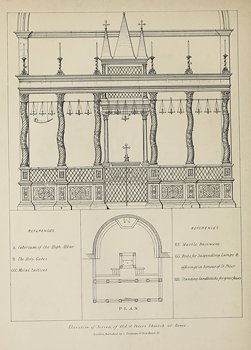
Elevation of Screen of Old St. Peters Church at Rome.
REFERENCES
A. Ciborium of the High Altar.
B. The Holy Gates.
CCC. Metal lattices.
EE. Marble Basement.
GG. Rods for Suspending Lamps & offerings in honour of St. Peter.
HH. Standing Candlesticks for great feasts.
PLAN: Gates.
Plate III.
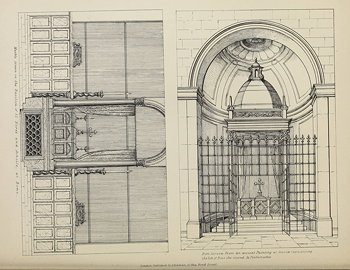
Marble Screen in the Basilica of SS Nerei and Achille, at Rome.
Iron Screen from an ancient Painting at Sienna representing the life of Pius the second, by Pinturicchio.
Plate IV.
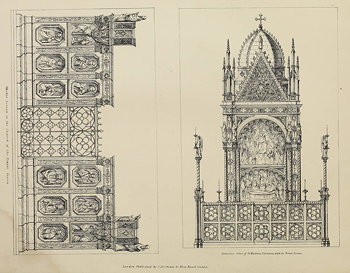
Marble Screen in the Church of the Frairi, Venice.
Detached Altar of St. Michele, Florence, with its Brass Screen.