ON SCREENS IN BRITTANY.
Reading edition
S. FIACRE LE FAOUET.
This remarkable rood loft, which I have figured in the plates, is worked in oak, and has been richly painted. The arrangement of the crucifix, and images of our Blessed Lady and St. John, is very singular, as they are placed in front of the loft, instead of being elevated above it. The two thieves are also represented, as is usual in the Crucifixions and Calvaries in Brittany. The crosses to which they are attached are composed of branches of trees.
On the Epistle side the Fall of Man caused by the first Eve, and on the opposite angle the Redemption of Man, through the second Eve, the Blessed Virgin, to whom the angel is announcing the mystery of the incarnation.
There are several very curious carvings in the frieze, among which the popular subject of the mass of S. Martin is easily distinguished.
The church which contains this very curious rood loft is situated in a remote locality, and almost deserted; but a few years since, this venerable relic of ancient piety and art was actually on the point of being sold, had not a neighbouring innkeeper, who derived no small profit from the lovers of antiquity, whom this screen brought to his house, so resolutely opposed its removal, that it was at length suffered to remain.
LAMBADER.
This screen, which is beautifully preserved, with flamboyant tracery, is remarkable for the spiral staircase by which it is ascended, supported by slender shafts, and most ingeniously constructed; the wood groining under the rood loft is bad in principle, as savouring too much of stone construction; but the front of the loft is elaborately carved with tabernacle-work and imagery.
FOLGOET.
This screen, equally remarkable for the elegance of the design as the beauty of its sculptured enrichments, is divided into three compartments, consisting of open cusped arches, supported by pillars, with images, under tabernacle-work, which run up above the arches, and terminate in niches and pinnacle-work. The spaces between this and the canopy-work over arches is filled with quatrefoil-work.
There are two altars on either side of the entrance door, and the space between this and the arch is filled with open tracery-work, like windows.
There are numerous screens yet remaining in many of the churches of Brittany, and originally they were to be found in all. Many others of great interest might be described, but those selected are sufficient to illustrate the argument.
Plate XI.
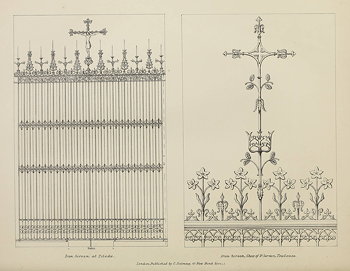
Iron Screen, at Toledo.
Iron Screen, Choir of St. Sernin, Toulouse.
Plate XII.
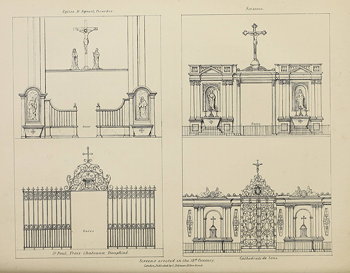
Screens erected in the 18th. Century.
Église D'Agnes, Picardie.
Soissons.
St. Paul, Trois Chateaux, Dauphiné.
Cathédrale de Sens.
Plate XIII.
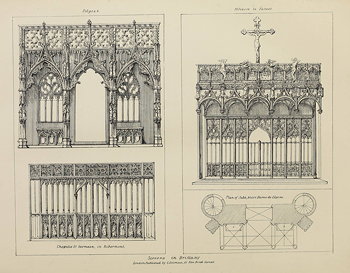
Screens in Brittany.
Folgoet.
St. Fiacre le Faouet.
Chapelle St. Germain, in Ribermont.
Plan of Jubé, Notre Dame de Lépine.
Plate XIV.
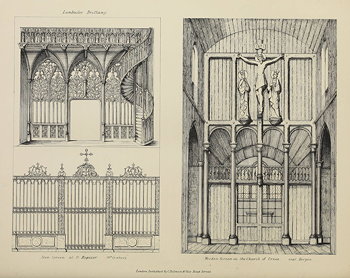
Lambader Brittany.
Iron Screen at St. Riquier. 18th Century.
Wooden Screen in the Church of Urnes, near Bergen.