Front matter (continued 3)
Reading edition · Edition 2
Using the metal scrap I scraped at the threads of the screw, blurring them. Then I started it in the hole, half a dozen turns, until it came up against the match-heads.
The shoes Margareta had bought me had built-up leather heels: hell on the feet, but just the thing to pound with.
I took the shoe by the toe and hefted it: the flexible sole gave it a good action, like a well-made sap. There were still a couple of "if's" in the equation, but a healthy crack on the screw ought to drive it against the packed match-heads hard enough to detonate them, and the expanding gasses from the explosion ought to exert enough pressure against the glass panels to break them. I'd know in a second.
I flattened myself against the wall, brought the shoe up, and laid it on the screw-head.
There was a deafening boom, a blast of hot air, and a chemical stink, then a gust of cool night wind—and I was on the sill, my back to the street six hundred feet below, my fingers groping for a hold on the ledge above the window. I found a grip, pulled up, reached higher, got my feet on the muntin strip, paused to rest for three seconds, reached again....
I pulled my feet above the window level and heard shouts in the room below:
"—fool killed himself!"
"Get a light in here!"
I clung, breathing deep, and murmured thanks to the architect who had stressed a strong horizontal element in his facade and arranged the strip windows in bays set twelve inches from the face of the structure. Now, if the boys below would keep their eyes on the street underneath long enough for me to get to the roof—
I looked up, to get an idea how far I'd have to go—and gripped the ledge convulsively as the whole building leaned out, tilting me back....
Cold sweat ran into my eyes. I squeezed the stone until my knuckles creaked, and held on. I laid my cheek against the rough plaster, listened to my heart thump. Adrenalin and high hopes had gotten me this far ... and now it had all drained out and left me, a frail ground-loving animal, flattened against the cruel face of a tower like a fly on a ceiling, with nothing between me and the unyielding concrete below but the feeble grip of fingers and toes. I started to yell for help, and the words stuck in my dry throat. I breathed in shallow gasps, feeling my muscles tightening, until I hung, rigid as a board, afraid even to roll my eyeballs for fear of dislodging myself. I closed my eyes, felt my hands going numb, and tried again to yell: only a thin croak.
A minute earlier I had had only one worry: that they'd look up and see me. Now my worst fear was that they wouldn't.
This was the end. I'd been close before, but not like this. My fingers could take the strain for maybe another minute, maybe even two; then I'd let go, and the wind would whip at me for a few timeless seconds, before I hit.
Down inside of me a small defiance flickered, found a foot-hold, burned brighter. I would die ... but Hell, that would solve a lot of problems. And if I had to die, at least I could die trying.
My mind moved in to take over from my body. It was the body that was wasting my last strength on a precarious illusion of safety, numbing my senses, paralyzing me. It was a tyranny I wouldn't accept. I needed a cool head and a steady hand and an unimpaired sense of balance; and if the imbecile boy wouldn't co-operate the mind would damn well force it. First: loosen the grip—Yes! if it killed me: bend those fingers!
I was standing a little looser now, my hands resting flat, my legs taking the load. I had a good wide ledge to stand on: nearly a foot, and in a minute I was going to reach up and get a new hold and lift one foot at a time ... and if I slipped, at least I'd have done it my way.
I let go, and the building leaned out, and to hell with it....
I felt for the next ledge, gripped it, pulled up, found a toe-hold.
Sure, I was dead. It was a long way to the top, and there was a fancy cornice I'd never get over, but when the moment came and I started the long ride down I'd thumb my nose at the old hag, Instinct, who hadn't been as tough as she thought she was....
I was under the cornice now, hanging on for a breather and listening to the hooting and hollering from the window far below. A couple of heads had popped out and taken a look, but it was dark up where I was and all the attention was centered down where the crowd had gathered and lights were playing, looking for the mess. Pretty soon now they'd begin to get the drift—so I'd better be going.
I looked up at the overhang ... and felt the old urge to clutch and hang on. So I leaned outward a little further, just to show me who was boss. It was a long reach, and I'd have to risk it all on one lunge because, if I missed, there wasn't any net, and my fingers knew it; I heard my nails rasp on the plaster. I grated my teeth together and unhooked one hand: it was like a claw carved from wood. I took a half-breath, bent my knees slightly; they were as responsive as a couple of bumper-jacks bolted on at the hip. Tough; but it was now or never....
I let go with both hands and stretched, leaning back....
My wooden hands bumped the edge, scrabbled, hooked on, as my legs swung free, and I was hanging like an old-time sailor strung up by the thumbs. A wind off the roof whipped at my face and now I was a tissue-paper doll, fluttering in the breeze.
I had to pull now, pull hard, heave myself up and over the edge, but I was tired, too tired, and a dark curtain was falling over me....
Then from the darkness a voice was speaking in a strange language: a confusion of strange thought symbols, but through them an ever more insistent call:
... dilate the secondary vascular complex, shunt full conductivity to the upsilon neuro-channel. Now, stripping oxygen ions from fatty cell masses, pour in electro-chemical energy to the sinews....
With a smooth surge of power I pulled myself up, fell forward, rolled onto my back, and lay on the flat roof, the beautiful flat roof, still warm from the day's sun.
I was here, looking at the stars, safe, and later on when I had more time I'd stop to think about it. But now I had to move, before they'd had time to organize themselves, cordon off the building, and start a door-to-door search.
Staggering a bit from the exertion of the long climb I got to my feet, went to the shed housing the entry to the service stair. A short flight of steps led down to a storeroom. There were dusty boards, dried-up paint cans, odd tools. I picked up a five-foot length of two-by-four and a hammer with one claw missing, and stepped out into the hall. The street was a long way down and I didn't feel like wasting time with stairs. I found the elevator, got in and pushed the button for the foyer.
In a few seconds it stopped and the doors opened. I glanced out, tightened my grip on the hammer, and stepped out. I could see the lights in the street out front and in the distance there was the wail of a siren, but nobody in the lobby looked my way. I headed across toward the side exit, dumped the board at the door, tucked the hammer in the waist band of my pants, and stepped out onto the pavement. There were a lot of people hurrying past but this was Lima: they didn't waste a glance on a bare-footed carpenter.
I moved off, not hurrying. There was a lot of rough country between me and Itzenca, the little town near which the life boat was hidden in a cañon, but I aimed to cover it in a week. Some time between now and tomorrow I'd have to figure out a way to equip myself with a few necessities, but I wasn't worried. A man who had successfully taken up human-fly work in middle life wouldn't have any trouble stealing a pair of boots.
Foster had shoved off for home three years ago, local time, although to him, aboard the ship, only a few weeks might have passed. My lifeboat was a midge compared to the mother ship he rode, but it had plenty of speed. Once aboard the lugger ... and maybe I could put a little space between me and the big boys.
I had used the best camouflage I knew of on the boat. The near-savage native bearers who had done my unloading and carried my Vallonian treasures across the desert to the nearest railhead were not the gossipy type. If General Smale's boys had heard about the boat, they hadn't mentioned it. And if they had: well, I'd solve that one when I got to it. There were still quite a few 'if's' in the equation, but my arithmetic was getting better all the time.
CHAPTER XIII
I took the precaution of sneaking up on the lifeboat in the dead of night, but I could have saved myself a crawl. Except for the fact that the camouflage nets had rotted away to shreds, the ship was just as I had left it, doors sealed. Why Smale's team hadn't found it, I didn't know; I'd think that one over when I was well away from Earth.
I went into the post office at Itzenca to pick up the parcel Margareta had mailed me with Foster's memory-trace in it. While I was checking to see whether Uncle Sam's minions had intercepted the package and substituted a carrot, I felt something rubbing against my shin. I glanced down and saw a grey and white cat, reasonably clean and obviously hungry. I don't know whether I'd ploughed through a field of wild catnip the night before or if it was my way with a finger behind the furry ears, but kitty followed me out of Itzenca and right into the bush. She kept pace with me, leading most of the time, as far as the space boat, and was the first one aboard.
I didn't waste time with formalities. I had once audited a briefing rod on the boat's operation—not that I had ever expected to use the information for a take-off. Once aboard, I hit the controls and cut a swathe through the atmosphere that must have sent fingers jumping for panic buttons from Washington to Moscow.
I didn't know how many weeks or months of unsullied leisure stretched ahead of me now. There would be time to spare for exploring the boat, working out a daily routine, chewing over the details of both my memories, and laying plans for my arrival on Foster's world, Vallon. But first I wanted to catch a show that was making a one-night stand for me only: the awe-inspiring spectacle of the retreating Earth.
I dropped into a seat opposite the screen and flipped into a view of the big luminous ball of wool that was my home planet. I'd been hoping to get a last look at my island, but I couldn't see it. The whole sphere was blanketed in cloud: a thin worn blanket in places but still intact. But the moon was a sight! An undipped Edam cheese with the markings of Roquefort. For a quarter of an hour I watched it grow until it filled my screen. It was too close for comfort. I dumped the tabby out of my lap and adjusted a dial. The dead world swept past, and I had a brief glimpse of blue burst bubbles of craters that became the eyes and mouth and pock marks of a face on a head that swung away from me in disdain and then the sibling planets dwindled and were gone forever.
The life boat was completely equipped, and I found comfortable quarters. An ample food supply was available by the touch of a panel on the table in the screen-room. That was a trick my predecessor with the dental jewellery hadn't discovered, I guessed. During the course of my first journey earthward and on my visits to the boat for saleable playthings while she lay in dry-dock, I had discovered most of the available amenities aboard. Now I luxuriated in a steaming bath of recycled water, sponged down with disposable towels packed in scented alcohol, fed the cat and myself, and lay down to sleep for about two weeks.
By the third week I was reasonably refreshed and rested. The cat was a godsend, I began to realize. I named her Itzenca, after the village where she adopted me, and I talked to her by the hour.
"Say, Itz," said I, "where would you like your sand-box situated? Right there in front of the TV screen?"
No, said Itzenca by a flirt of her tail. And she walked over behind a crate that had never been unloaded on earth.
I pulled out a box of junk and slid the sand-box in its place. Itzenca promptly lost interest and instead jumped up on the junk box which fell off the bench and scattered small objects of khaff and metal in all directions.
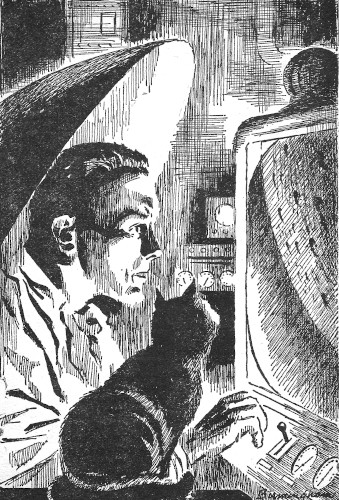
"Come back here, blast you," I said, "and help me pick up this stuff."
Itz bounded after a dull-gleaming silver object that was still rolling. I was there almost as quick as she was and grabbed up the cylinder. Suddenly horsing around was over. This thing was somebody's memory.
I dropped onto a bench to examine it, my Vallonian-inspired pulse pounding. Itz jumped up into my lap and nosed the cylinder. I was trying to hark back to those days three years before when I had loaded the lifeboat with all the loot it would carry, for the trip back to Earth.
"Listen, Itz, we've got to do some tall remembering. Let's see: there was a whole rack of blanks in the memory-recharging section of the room where we found the three skeletons. Yeah, now I remember: I pulled this one out of the recorder set. I showed it to Foster when he was hunting his own trace. He didn't realize I'd pulled it out of the machine and he thought it was an empty. But I'll bet you somebody had his mind taped, and then left in a hurry, before the trace could be color-coded and filed.
"On the other hand, maybe it's a blank that had just been inserted when somebody broke up the play-house.... But wasn't there something Foster said ... about when he woke up, way back when, with a pile of fresh corpses around him? He gave somebody emergency treatment and to a Vallonian that would include a complete memory-transcription.... Do you realize what I've got here in my hand, Itz?"
She looked up at me inquiringly.
"This is what's left of the guy that Foster buried: his pal, Ammaerln, I think he called him. What's inside his cylinder used to be tucked away in the skull of the Ancient Sinner. The guy's not so dead after all. I'll bet his family will pay plenty for this trace, and be grateful besides. That'll be an ace in the hole in case I get too hungry on Vallon."
I got up, crossed the apartment and dropped the trace in a drawer beside Foster's own memory.
"Wonder how Foster's making out without his past, Itz? He claimed the one I've got here could only be a copy of the original stored at Okk-Hamiloth, but my briefing didn't say anything about copying memories. He must be somebody pretty important to rate that service."
Suddenly my eyes were rivetted to the markings on Foster's trace lying in the drawer. "Zblood! The royal colors!" I sat down on the bed with a lurch. "Itzenca, old gal, it looks like we'll be entering Vallonian society from the top. We've been consorting with a member of the Vallonian nobility!"
During the days that followed, I tried again and again to raise Foster on the communicator ... without result. I wondered how I'd find him among the millions on the planet. My best bet would be to get settled down in the Vallonian environment, then start making a few inquiries.
I would play it casually: act the part of a Vallonian who had merely been travelling for a few hundred years—which wasn't unheard of—and play my cards close to my gravy stains until I learned what the score was. With my Vallonian briefing I ought to be able to carry it off. The Vallonians might not like illegal immigrants any better than they did back home, so I'd keep my interesting foreign background to myself.
I would need a new name. I thought over several possibilities and selected "Drgon." It was as good a Vallonian jawbreaker as any.
I canvassed the emergency wardrobe that was standard equipment on Far-Voyager life-boats and picked one in a sober color, then got busy with the cutting and seaming unit to fit it to my frame.
The proximity alarms were ringing. I watched the screen with its image of a great green world rimmed on one edge with glading white from the distant giant sun, on the other, flooded with a cool glow reflected from the blue outer planet. The trip was almost over and my confidence was beginning to fray around the edges. In a few minutes I would be stepping into an unknown world, all set to find my old pal Foster and see the sights. I didn't have a passport, but there was no reason to anticipate trouble. All I had to do was let my natural identity take a back seat and allow my Vallonian background to do the talking. And yet....
Now Vallon spread out below us, a misty grey-green landscape, bright under the glow of the immense moon-like sister world. I had set the landing monitor for Okk-Hamiloth, the capital city of Vallon. That was where Foster would have headed, I guessed. Maybe I could pick up the trail there.
The city was directly below: a vast network of blue-lit avenues. I hadn't been contacted by planetary control. That was normal, however. A small vessel coming in on auto could handle itself.
A little apprehensively I ran over my lines a last time: I was Drgon, citizen of the Two Worlds, back from a longer-than-average season of far-voyaging and in need of briefing rods to bring me up to date on developments at home. I also required assignment of quarters ... and directions to the nearest beer-joint. My tailoring was impeccable, my command of the language a little rusty from long non-use, and the only souvenirs I had to declare were a tattered native costume from my last port of call, a quaint weapon from the same, and a small animal I had taken a liking to.
The landing-ring was visible on the screen now, coming slowly up to meet us. There was a gentle shock and then absolute stillness. I watched the port cycle open; I went to it and looked out at the pale city stretching away to the hills. I took a breath of the fragrant night air that was spiced with a long-forgotten perfume, and the part of me that was now Vallonian ached with the inexpressible emotion of homecoming.
I started to buckle on my pistol and gather up a few belongings, then decided to wait until I'd met the welcoming committee. I whistled to Itzenca and we stepped out and down. We crossed the clipped green, luminous in the glow from the lights over the high-arched gate marking the path that curved up toward the bright-lit terraces above. There was no one in sight. Bright Cintelight showed me the gardens and walks and, when I reached the terraces, the avenues beyond ... but no people.
The cat and I walked across the terrace, passed through the open arch to a refreshment lounge. The low tables and cushioned couches stood empty under the rosy light from the ceiling panels.
I stood and listened: dead silence. The lights glowed, the tables waited invitingly. How long had they waited?
I sat down at one of them and thought hard. I had made a lot of plans, but I hadn't counted on a deserted spaceport. How was I going to ask questions about Foster if there was no one to ask?
I got up and moved on through the empty lounge, past a wide arcade, out onto a terraced lawn. A row of tall poplar-like trees made a dark wall beyond a still pool, and behind them distant towers loomed, colored lights sparkled. A broad avenue swept in a wide curve between fountains, slanted away to the hills. A hundred yards from where I stood a small vehicle was parked at the curb; I headed for it.
It was an open two-seater, low-slung, cushioned, finished in violet inlays against bright chrome. I slid into the seat, looked over the controls, while Itzenca skipped to a place beside me. There was a simple lever arrangement: a steering tiller. It looked easy. I tried a few pulls and pushes; lights blinked on the panel, the car quivered, lifted a few inches, drifted slowly across the road. I moved the tiller, twiddled things; the car moved off toward the towers.
Two hours later we had cruised the city ... and found nothing. It hadn't changed from what my extra memory recalled—except that all the people were gone. The parks and boulevards were trimmed, the fountains and pools sparkled, the lights glowed ... but nothing moved. The automatic dust precipitators and air filters would run forever, keeping things clean and neat; but there was no one there to appreciate it. I pulled over, sat watching the play of colored lights on a waterfall, and considered. Maybe I'd find more of a clue inside one of the buildings. I left the car and picked one at random: a tall slab of pink crystal. Inside, I looked around at a great airy cavern full of rose-colored light and listened to the purring of the cat and my own breathing. There was nothing else to hear.
I picked a random corridor, went along it, passing through one empty room after another. I went out on a lofty terrace overlooking gardens, leaned on a balustrade, and looked up at the brilliant disc of Cinte.
"We've come a long way to find nothing," I said to Itzenca. She pushed her way along my leg and flexed her tail in a gesture meant to console.
I sat on the balustrade and leaned back against the polished pink wall, took out a clarinet I'd found in one of the rooms and blew some blue notes. That which once had been was no more; remembering it, I played the Pavane for a Dead Princess.
I finished and looked up at a sound. Four tall men in grey cloaks and a glitter of steel came toward me from the shadows.
I had dropped the clarinet and was on my feet. I tried to back up but the balustrade stopped me. The four spread out. The man in the lead fingered a wicked-looking short club and spoke to me—in gibberish. I blinked at him and tried to think of a snappy comeback.
He snapped his fingers and two of the others came up; they reached for my arms. I started to square off, fist cocked, then relaxed; after all, I was just a tourist, Drgon by name. Unfortunately, before I could get my fist back, the man with the club swung it and caught me across the forearm. I yelled, jumped back, found myself grappled by the others. My arm felt dead to the shoulder. I tried a kick and regretted that too; there was armor under the cloaks. The club wielder said something and pointed at the cat....
It was time I wised up. I relaxed, tried to coax my alter ego into the foreground. I listened to the rhythm of the language: it was Vallonian, badly warped by time, but I could understand it:
"—musician would be an Owner!" one of them said.
Laughter.
"Whose man are you, piper? What are your colors?"
I curled my tongue, tried to shape it around the sort of syllables I heard them uttering, but it seemed to me a gross debasement of the Vallonian I knew. Still I managed an answer:
"I ... am a ... citizen ... of Vallon."
"A dog of a masterless renegade?" The man with the club hefted it, glowered at me. "And what wretched dialect is that you speak?"
"I have ... been long a-voyaging," I stuttered. "I ask ... for briefing rods ... and for a ... dwelling place."
"A dwelling place you'll have," the man said. "In the men's shed at Rath-Gallion." He gestured, and snapped handcuffs on me.
He turned and stalked away, and the others hustled me after him. Over my shoulder I got a glimpse of a cat's tail disappearing over the balustrade. Outside, a long grey aircar waited on the lawn. They dumped me in the back seat, climbed aboard. I got a last look at the spires of Okk-Hamiloth as we tilted, hurtled away across the low hills.
I had had an idealistic notion of wanting to fit into this new world, find a place in its society. I'd found a place all right: a job with security.
I was a slave.
CHAPTER XIV
It was banquet night at Rath-Gallion, and I gulped my soup in the kitchen and ran over in my mind the latest batch of jingles I was expected to perform. I had only been on the Estate a few weeks, but I was already Owner Gope's favorite piper. If I kept on at this rate, I would soon have a cell to myself in the slave pens.
Sime, the pastry cook, came over to me.
"Pipe us a merry tune, Drgon," he said, "and I'll reward you with a frosting pot."
"With pleasure, good Sime," I said. I finished off the soup and got out my clarinet. I had tried out half a dozen strange instruments, but I still liked this one best. "What's your pleasure?"
"One of the outland tunes you learned far-voyaging," called Cagu, the bodyguard.
I complied with the Beer Barrel Polka. They pounded the table and hallooed when I finished, and I got my goody pan. Sime stood watching me scrape at it.
"Why don't you claim the Chief Piper's place, Drgon?" he said. "You pipe rings around the lout. Then you'd have freeman status, and could sit among us in the kitchen almost as an equal."
"I'd gladly be the equal of such a pastry cook as yourself," I said. "But what can a slave-piper do?"
Sime blinked at me. "You can challenge the Chief Piper," he said. "There's none can deny you're his master in all but name. Don't fear the outcome of the Trial; you'll triumph sure."
"But how can I claim another's place?" I asked.
Sime waved his arms. "You have far-voyaged long indeed, Piper Drgon. Know you naught of how the world wags these days? One would take you for a Cintean heretic."
"As I've said, in my youth all men were free; and the High King ruled at Okk-Hamiloth—"
"'Tis ill to speak of these things," said Sime in a low tone. "Only Owners know their former lives ... though I've heard it said that long ago no man was so mean but that he recorded his lives and kept them safe. How you came by yours, I ask not; but do not speak of it. Owner Gope is a jealous master. Though a most generous and worshipful lord," he added hastily, looking around.
"I won't speak of it then, good Sime," I said. "But I have been long away. Even the language has changed, so that I wrench my tongue in the speaking of it. Advise me, if you will."
Sime puffed out his cheeks, frowning at me. "I scarce know where to start," he said. "All things belong to the Owners ... as is only right. Men of low skill are likewise property; and 'tis well 'tis so; else would they starve as masterless strays ... if the Greymen failed to find them first." He made a sign and spat.
"Now men of good skill are freemen, each earning rewards as befits his ability. I am Chief Pastry Cook to the Lord Gope, with the perquisites of that station, therefore, that none other equals my talents."
"And if some varlet claims the place of any man here," put in Cagu, "then he gotta submit to the trial."
"Then," said Sime, "this upstart pastry cook must cook against me; and all in the Hall will judge; and he who prevails is the Chief Pastry Cook, and the other takes a dozen lashes for his impertinence."
"But fear not, Drgon," spoke Cagu. "A Chief Piper ain't but a five-stroke man. Only a tutor is lower down among freemen."
There was a bellow from the door, and I grabbed my clarinet and scrambled after the page. Owner Gope didn't like to wait around for piper-slaves. I saw him looming up at his place, as I darted through to my assigned position within the huge circle of the viand-loaded table. The Chief Piper had just squeezed his bagpipe-like instrument and released a windy blast of discordant sound. He was a lean, squint-eyed rascal fond of ordering the slave-pipers about. He pranced in an intricate pattern, pumping away at his vari-colored bladders, until I winced at the screech of it. Owner Gope noticed him about the same time. He picked up a heavy brass mug and half rose to peg it at the Chief Piper, who saw it just in time to duck. The mug hit a swollen air-bag; it burst with a sour bleat.
"As sweet a note as has been played tonight," roared Owner Gope. "Begone, lest you call up the hill devils—"
His eye fell on me. "Now here's a true piper. Summon up a fair melody, Drgon, to clear the fumes of the last performer from the air before the wine sours."
I bowed low, wet my lips, and launched into the One O' Clock Jump. To judge from the roar that went up when I finished, they liked it. I followed with Little Brown Jug and String of Pearls. Gope pounded and the table quieted down.
"The rarest slave in all Rath-Gallion, I swear it," he bellowed. "Were he not a slave, I'd drink to his health."
"By your leave, Owner?" I said.
Gope stared, then nodded indulgently. "Speak then."
"I claim the place of Chief Piper. I—"
Yells rang out; Gope grinned widely.
"So be it," he said. "Shall the vote be taken now, or must we submit to more of the vile bladderings ere we proclaim our good Drgon Chief Piper? Speak out."
"Proclaim him!" somebody shouted.
Gope slammed a huge hand against the table. "Bring Iylk, the Chief Piper, before me," he yelled.
The piper reappeared.
"The place of the Chief Piper is declared vacant," Gope said loudly. "—since the former Chief Piper has been advanced in degree to a new office. Let these air-bags be punctured," Gope cried. "I banish their rancid squeals forever from Rath-Gallion. Now, let all men know: this former piper is now Chief Fool to this household. Let him wear the broken bladders as a sign of his office." There was a roar of laughter, glad cries, whistles.
I gave them Mairzy Doats and the former piper capered gingerly. Owner Gope roared with laughter.
"A great day for Rath-Gallion," Gope shouted. "By the horns of the sea-god, I have gained a prince of pipers and a king of fools! I proclaim them to be ten-lash men, and both shall have places at table henceforth!"
I looked around the barbarically decorated hall, seeing things in a new way. There's nothing like a little slavery to make a man appreciate even a modest portion of freedom. Everything I had thought I knew about Vallon had been wrong: the centuries that passed had changed things—and not for the better. The old society that Foster knew was dead and buried. The old places and villas lay deserted, the spaceports unused. And the old system of memory-recording that Foster described was lost and forgotten. I didn't know what kind of a cataclysm could have plunged the seat of a galactic empire back into feudal darkness—but it had happened.
So far I hadn't found a trace of Foster. My questions had gotten me nothing but blank stares. Maybe Foster hadn't made it; there could have been an accident in space. Or perhaps he was somewhere on the opposite side of the world. Vallon was a big planet and communications were poor. Maybe Foster was dead. I could live out a long life here and never find the answers.
I remembered my own disappointment at the breakdown of my illusions that night at Okk-Hamiloth. How much more heartbreaking must have been Foster's experience when and if he had arrived back here.
And Foster's memory that I had been bringing him for a keepsake: what a laugh that was! Far from being a superfluous duplicate of a master trace to which he had expected easy access, my copy of the trace was now, with the vaults at Okk-Hamiloth sealed and forbidden, of the greatest possible importance to Foster—and there wasn't a machine left on the planet to play it on.
Well, I still meant to find Foster if it took me—
Owner Gope was humming loudly and tunelessly to himself. I knew the sign. I got ready to play again. Being Chief Piper probably wasn't going to be just a bowl of cherries, but at least I wasn't a slave now. I had a long way to go, but I was making progress.
OWNER Gope and I got along well. He took me everywhere he went. He was a shrewd old duck and he liked having such an unusual piper on hand. He had heard from the Greymen, the free-lance police force, how I had landed at the deserted port. He warned me, in an oblique way, not to let word get out that I knew anything about old times in Vallon. The whole subject was tabu—especially the old capital city and the royal palaces themselves. Small wonder that my trespassing there had brought the Greymen down on me in double quick time.
One afternoon several months after my promotion I dropped in at the kitchen. I was due to shove off with Owner Gope and his usual retinue for a visit to Bar-Ponderone, a big estate a hundred miles north of Rath-Gallion in the direction of Okk-Hamiloth. Sime and my other old cronies fixed me up with a healthy lunch and a bottle of melon wine, and warned me that it would be a rough trip; the stretch of road we'd be using was a favorite hang-out of road pirates.
"What I don't understand," I said, "is why Gope doesn't mount a couple of guns on the car and blast his way through the raiders. Every time he goes off the Estate he's taking his life in his hands."
The boys were shocked. "Even piratical renegades would never dream of taking a man's life, good Drgon," Sime said. "Every Owner, far and near, would band together to hunt such miscreants down. And their own fellows would abet the hunters! Nay, none is so low as to steal all a man's lives."
"The corsairs themselves know full well that in their next life they may be simple goodmen—even slaves," the Chief Wine-Pourer put in. "For you know, good Drgon, that when a member of a pirate band suffers the Change the others lead the newman to an Estate, that he may find his place...."
"How often do these Changes come along?" I asked.
"It varies greatly. Some men, of great strength and moral power, have been known to go on unchanged for three or four hundred years. But the ordinary man lives a life of eighty to one hundred years." Sime paused. "Or it may be less. A life of travail and strife can end much sooner than one of peace and retirement. Or unusual vicissitudes can shorten a life remarkably. A cousin of mine, who was marooned on the Great Stony Place in the southern half-world and who wandered for three weeks without more to eat or drink than a small bag of wine, underwent the Change after only fourteen years. When he was found his face was lined and his hair had greyed, in the way that presages the Change. And it was not long before he fell in a fit, as one does, and slept for a night and a day. When he awoke he was a newman: young and knowing nothing."
"Didn't you tell him who he was?"
"Nay!" Sime lowered his voice. "You are much favored of Owner Gope, good Drgon, and rightly. Still, there are matters a man talks not of—"
"A newman takes a name and sets out to learn whatever trade he can," put in the Carver of Roasts. "By his own skills he can rise ... as you have risen, good Drgon."
"Don't you have memory machines—or briefing rods?" I persisted. "Little black sticks: you touch them to your head and—"
Sime made a motion in the air. "I have heard of these wands: a forbidden relic of the Black Arts—"
"Nuts," I said. "You don't believe in magic, do you, Sime? The rods are nothing but a scientific development by your own people. How you've managed to lose all knowledge of your own past—"
Sime raised his hands in distress. "Good Drgon, press us not in these matters. Such things are forbidden."
I went on out to the car and climbed in to wait for Owner Gope. It was impossible to learn anything about Vallon's history from these goodmen. They knew nothing.
I had reached a few tentative conclusions on my own, however. My theory was that some sudden social cataclysm had broken down the system of personality reinforcement and memory-recording that had given continuity to the culture. Vallonian society, based as it was on the techniques of memory preservation, had gradually disintegrated. Vallon was plunged into a feudal state resembling its ancient social pattern of fifty thousand years earlier, before development of memory recording.
The people, huddled together on Estates for protection from real or imagined perils and shunning the old villas and cities as tabu—except for those included in Estates—knew nothing of space travel and ancient history. Like Sime, they had no wish even to speak of such matters.
I might have better luck with my detective work on a big Estate like Bar-Ponderone. I was looking forward to today's trip.
Gope appeared, with Cagu and two other bodyguards, four dancing girls, and an extra-large gift hamper. They took their places and the driver started up and wheeled the heavy car out onto the highroad. I felt a pulse of excitement as we accelerated in the direction of Bar-Ponderone. Maybe at the end of the ride I'd hit paydirt.
We were doing about fifty down a winding mountain road. As we rounded a curve, the wheels screeching from the driver's awkward, too-fast swing into the turn, we saw another car in the road a quarter of a mile ahead, not moving, but parked—sideways. The driver hit the brakes.
Behind us Owner Gope yelled "Pirates! Don't slacken your pace, driver. Ram the blackguards, if you must!"
The driver rolled his eyes, almost lost control, then gritted his teeth, reached out to switch off the anti-collision circuit and slam the speed control lever against the dash. I watched for two long heart beats as we roared straight for the blockading car, then I slid over and grabbed for the controls. The driver held on, frozen. I reared back and clipped him on the jaw. He crumpled into his corner, mouth open and eyes screwed shut, as I hit the auto-steer override and worked the tiller. It was an awkward position for steering, but I preferred it to hammering in at ninety per.
The car ahead was still sitting tight, now a hundred yards away, now fifty. I cut hard to the right, toward the rising cliff face; the car backed to block me. At the last instant I whipped to the left, barrelled past with half an inch to spare, rocketed along the ragged edge with the left wheel rolling on air, then whipped back into the center of the road.
"Well done!" yelled Cagu.
"But they'll give chase!" Gope shouted. "Masterless swine!"
The driver had his eyes open now. "Crawl over me!" I barked. He mumbled and clambered past me and I slid into his seat, still clinging to the accelerator lever and putting up the speed. Another curve was coming up. I grabbed a quick look in the rear-viewer: the pirates were swinging around to follow us.
"Press on!" commanded Gope. "We're close to Bar-Ponderone; it's no more than five miles—"
"What kind of speed have they got?" I called back.
"They'll best us easy," said Cagu cheerfully.
"What's the road like ahead?"
"A fair road, straight and true, now that we've descended the mountain," answered Gope.
We squealed through the turn and hit a straightaway. A curving road branched off ahead. "What's that?" I snapped.
"A winding trail," gasped the driver. "It comes on Bar-Ponderone, but by a longer way."
I gauged my speed, braked minutely, and cut hard. We howled up the steep slope, into a turn between hills.
Gope shouted. "What madness is this?"
"We haven't got a chance on the straightaway," I called back. "Not in a straight speed contest." I whipped the tiller over, then back the other way, following the tight S-curves. I caught a glimpse of our pursuers, just heading into the side road behind us.
"Any way they can head us off?" I yelled.
"Not unless they have confederates stationed ahead," said Gope; "but these pariahs work alone."
I worked the brake and speed levers, handled the tiller. We swung right, then left, higher and higher, then down a steep grade and up again. The pirate car rounded a turn, only a few hundred yards behind now. I scanned the road ahead, followed its winding course along the mountainside, through a tunnel, then out again to swing around the shoulder of the next peak.
"Pitch something out when we go through the tunnel!" I yelled.
"My cloak," cried Gope. "And the gift hamper."
We roared into the tunnel mouth. There was a blast of air as the rear deck cover opened. Gope and Cagu hefted the heavy gift hamper, tumbled it out, followed it with a cloak, a wine jug, assorted sandals, bracelets, fruit. Then we were back in the sunlight and I was fighting the curve. In the rear-viewer I saw the pirates burst from the tunnel mouth, Gope's black and yellow cloak spread over the canopy, smashed fruit spattered over it, the remains of the hamper dragging under the chassis. The car rocked and a corner of the cloak lifted, clearing the driver's view barely in time.
"Tough luck," I said. "We've got a long straight stretch ahead, and I'm fresh out of ideas...."
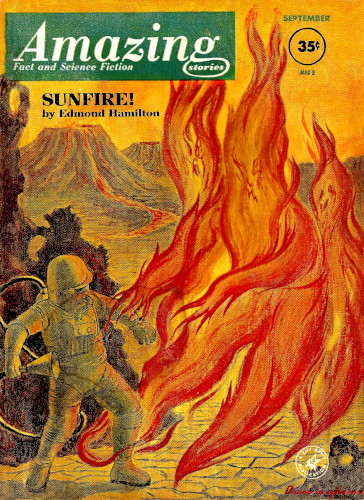
The other car gained. I held the speed bar against the dash but we were up against a faster car; it was a hundred yards behind us, then fifty, then pulling out to go alongside. I slowed imperceptibly, let him get his front wheels past us, then cut sharply. Here was a clash of wheel fairings, and I fought the tiller as we rebounded from the heavier car. He crept forward, almost alongside again; shoulder to shoulder we raced at ninety-five down the steep grade....
I hit the brakes and cut hard to the left, slapped his right rear wheel, slid back. He braked too; that was a mistake. The heavy car lost traction, sliding. In slow motion, off-balanced in a skid, it rose on its nose, ploughing up a cloud of dust. The hamper whirled away, the cloak fluttered and was gone, then the pirate car seemed to float for an instant in air, before it dropped, wheels up, out of sight over the sheer cliff. We raced alone down the slope and out onto the wooded plain toward the towers of Bar-Ponderone.
A shout went up; Owner Gope leaned forward to pound my back. "By the nine eyes of the Hill Devil!" he bellowed, "masterfully executed! The prince of pipers is a prince of drivers too! This night you'll sit by my side at the ringboard at Bar-Ponderone in the rank of a hundred-lash Chief Driver, I swear it!"
I spent the first day at Bar-Ponderone rubbernecking the tall buildings and keeping an eye open for Foster, on the off chance that I might pass him on the street. By sunset I was no wiser than before. Dressed in the latest in Vallonian cape and ruffles, I was sitting with my drinking buddy Cagu, Chief Bodyguard to Owner Gope, at a small table on the first terrace at the Palace of Merrymaking, Bar-Ponderone's biggest community feasting hall. It looked like a Hollywood producer's idea of a twenty-first century night club, complete with nine dance floors on five levels, indoor pools, fountains, two thousand tables, musicians, girls, noise, colored lights, plenty of booze, and food fit for an Owner. It was open to all fifty-lash-and-over goodmen of the estate and to guests of equivalent rank.
Cagu was a morose-looking old cuss, but good-hearted. His face was cut and scarred from a thousand encounters with other bodyguards and his nose had been broken so often that it was invisible in profile.
"Where do you manage to get in all the fights, Cagu?" I asked him. "I've known you for three months, and I haven't seen a blow struck in anger yet."
Cagu finished off an oily greenish drink and signalled for another.
"Here." He grinned, showing me some broken front teeth. "Swell places, these big Estates, good Drgon; lotsa action."
"What do you do, get in street fights?"
"Nah. The boys show up down here, tank up, cruise around, you know."
"They start fights here in the dining room?"
"Sure. Good crowd here; lotsa laughs."
I picked up my drink, raised it to Cagu—and got it in my lap as somebody jostled my arm. I looked up. A battle-scarred thug stood over me.
"Who'sa punk, Cagu?" he said in a hoarse whisper.
Cagu took a pull on a fresh drink, put the glass down, stood up, and threw a punch to the other plug-ugly's paunch. He oofed, clinched, eyed me resentfully over Cagu's shoulder. Cagu pushed him away, held him at arm's length.
"Howsa boy, Mull?" he said. "Lay offa my sidekick; greatest little piper ina business, and a top driver too. How about a drink?"
"Sure." Mull rubbed his stomach, sat down beside me. "Ya losin' your punch, Cagu." He looked at me. "Sorry about the booze in the lap. I thought you was one of the guys." He signalled a passing waiter-slave. "Bring my friend a new suit, and a shot. Make it snappy."
"Don't the customers kind of resent it when you birds stage a heavyweight bout in the aisle?" I asked.
"Nah; we move down inta the Spot." He waved a thumb in the general direction of somewhere else. He looked me over. "Where ya been, piper? Your first time ina Palace?"
"Drgon's been travelling," said Cagu. "He's okay. Lemee tell ya the time these pirates pull one, see...."
Cagu and Mull swapped lies while I worked on my drinking. Although I hadn't learned anything on my day's looking around at Bar-Ponderone, it was still a better spot for snooping than Rath-Gallion. There were two major cities on the Estate and scores of villages. Somewhere among the population I might have better luck finding someone to talk history with ... or someone who knew Foster.
"Hey!" growled Mull. "Look who's comin'."
I followed his gaze. Three thick-set thugs swaggered up to the table. One of them, a long-armed gorilla at least seven feet tall, reached out, took Cagu and Mull by the backs of their necks, and cracked their skulls together. I jumped up, ducked a hoof-like fist ... and saw a beautiful burst of fireworks followed by soothing darkness.
I fumbled in the dark with lengths of cloth entangling my legs, sat up and cracked my head—
I groaned, freed a leg from the chair rungs, groped my way out from under the table. A waiter-slave helped me up, dusted me off. The seven-foot lout lolling in a chair glanced my way, nodded.
"You shouldn't hang out with lugs like that Mull," he said. "Cagu told me you was just a piper, but the way you come outa that chair—" He shrugged, turned back to whatever he was watching.
I checked a few elbow and knee joints, worked my jaw, tried my neck: all okay.
"You the one that slugged me?" I asked.
"Huh? Yeah."
I stepped over to his chair, picked a spot, and cleared my throat. "Hey, you," I said. He turned, and I put everything I had behind a straight right to the point of the jaw. He went over, feet in the air, flipped a rail, and crashed down between two tables below. I leaned over the rail. A party of indignant tally-clerks stared up at me.
A shout went up from the floor some distance away. I looked. In a cleared circle two levels below a pair of heavy-shouldered men were slugging it out. One of them was Cagu. I watched, saw his opponent fall. Another man stepped in to take his place. I turned and made my way down to the ringside.
Cagu exchanged haymakers with two more opponents before he folded and was hauled from the ring. I propped him up in a chair, fitted a drink into his fist, and watched the boys pound each other. It was easy to see why the scarred face was the sign of their craft; there was no defensive fighting whatever. They stood toe-to-toe and hit as hard as they could, until one collapsed. It wasn't fancy, but the fans loved it. Cagu came to after a while and filled me in on the fighters' backgrounds.
"So they're all top boys," he said. "But it ain't like in the old days when I was in my prime. I could've took any three of these bums. The only one maybe I woulda had a little trouble with is Torbu."
"Which one is he?"
"He ain't down there yet; he'll show to take on the last boys on their feet."
More gladiators pushed their way to the Spot, downed drinks, pulled off gaily-patterned cloaks and weskits, and waded in.
After an hour the waiting line had dwindled away to nothing.
"Where's Torbu?"
"Maybe he didn't come tonight," I said.
"Sure, you met him; he knocked you under the table."
"Oh, him?"
"Where'd he go?"
"The last I saw he was asleep on the floor," I said.
"Hozzat?"
"I didn't much like him slugging me. I clobbered him one."
"Hey!" yelped Cagu. His face lit up. He got to his feet and floored the closest fighter, turned and laid out the other. He raised both hands above his head.
"Rath-Gallion gotta champion," he bellowed. "Rath-Gallion takes on all comers." He turned, waved to me. "Our boy, Drgon, he—"
There was a bellow behind me, even louder than Cagu's. I turned, saw Torbu, his hair mussed, his face purple, pushing through the crowd.
"Jussa crummy minute," he yelled. "I'm the champion around here—" He aimed a haymaker at Cagu; Cagu ducked.
"Our boy, Drgon, laid you out cold, right?" he shouted. "So now he's the champion."
"I wasn't set," bawled Torbu. "A lucky punch."
"Come on down, Drgon," Cagu called, waving to me again. "We'll show—" Torbu turned and slammed a roundhouse right to the side of Cagu's jaw; the old fighter hit the floor hard, skidded, lay still. I got to my feet. They pulled him to the nearest table, hoisted him into a chair. I made my way down to the little clearing in the crowd. A man bending over Cagu straightened, face white. I pushed him aside, grabbed the bodyguard's wrist. There was no pulse. Cagu was dead.
Torbu stood in the center of the Spot, mouth open. "What...?" he started. I pushed between two fans, went for him. He saw me, crouched, swung out at me.
I ducked, uppercut him. He staggered back. I pressed him, threw lefts and rights to the body, ducked under his wild swings, then rocked his head left and right. He stood, knees together, eyes glazed, hands down. I measured him, right-crossed his jaw; he dropped like a log.
Panting, I looked across at Cagu. His scarred face, white as wax, was strangely altered now; it looked peaceful. I took a bottle from a waiter-slave, poured out a stiff drink, then a couple more. Somebody helped Torbu to his feet, walked him to the ringside. I had another drink. It had been a big evening. Now all I had to do was take the body home....
I went over to where Cagu was laid out on the floor. Shocked people stood around staring. Torbu was on his knees beside the body. A tear ran down his nose, dripped on Cagu's face. Torbu wiped it away with a big scarred hand.
"I'm sorry, old friend," he said. "I didn't mean it, you know I didn't."
I picked Cagu up and got him over my shoulder, and all the way to the far exit it was so quiet in the Palace of Merrymaking that I could hear my own heavy breathing.
In the bodyguards' quarters I laid Cagu out on the bunk, then faced the dozen scowling bruisers who stared down at the still body.
"Cagu was a good man," I said. "Now he's dead. He died like an animal ... for nothing."
Mull glowered at me. "You talk like we was to blame," he said. "Cagu was my compeer too."
"Whose pal was he a thousand years ago?" I snapped. "What was he—once? What were you? Vallon wasn't always like this. There was a time when every man was his own Owner—"
"Look, you ain't of the Brotherhood—" one thug started.
"So that's what you call it? But it's just another name for an old racket. A big shot sets himself up as dictator—"
"We got our Code," Mull said. "Our job is to stick up for the Owner ... and that don't mean standing around listening to some japester callin' names."
"Names, hell," I snapped. "I'm talking rebellion. You boys have all the muscle and most of the guts in this organization. Why let the boss live off the fat while you murder each other for the amusement of the patrons? You had a birthright ... once. But it's up to you to collect it ... before more of you go the way Cagu did."
There was an angry mutter. Torbu came in, face swollen.
"Hold it, you birds," Torbu said. "What's goin' on?"
"This guy! He's talkin' revolt and treason," somebody said.
"He wants we should pull some rough stuff—on Owner Qohey hisself."
Torbu came up to me. "You're a stranger around Bar-Ponderone. Cagu said you was okay. You worked me over pretty good ... and I got no hard feelin's; that's the breaks. But don't try to start no trouble here. We got our Code and our Brotherhood. We look out for each other; that's good enough for us. Owner Qohey ain't no worse than any other Owner ... and by the Code, we'll stand by him!"
"Listen to me," I said. "I know the history of Vallon: I know what you were once and what you could be again. All you have to do is take over the power. I can lead you to the ship I came here in. There are briefing rods aboard, enough to show you—"
"That's enough," Torbu broke in. He made a cabalistic sign in the air. "We ain't gettin' mixed up in no tabu ghost-boats or takin' on no magicians and demons—"
"Hog wash! That tabu routine is just a gag to keep you away from the cities so you won't discover what you're missing—"
"I don't wanna hafta take you to the Greymen, Drgon," Torbu growled. "Leave it lay."
"These cities," I ploughed on. "They're standing there, empty, as perfect as the day they were built. And you live in these flea-bitten quarters, jammed inside the town walls, so the Greymen and renegades won't get you."
"You wanna runs things here?" Mull put in. "Go see Qohey."
"Let's all go see Qohey!" I said.
"That's something you'll have to do alone," said Torbu. "You better move on, Drgon. I ain't turnin' you in; I know how you felt about Cagu gettin' killed and all—but don't push it too far."
I knew I was licked. They were as stubborn as a team of mules—and just about as smart.
Torbu motioned; I followed him outside.
"You wanna turn things upside-down, don't you? I know how it is; you ain't the first guy to get ideas. We can't help you. But we got a legend: someday the Rthr will come back ... and then the Good Time will come back too."
"What's the Rthr?" I said.
"Kinda like a big-shot Owner. There ain't no Rthr now. But a long time ago, back when our first lives started, there was a Rthr that was Owner of all Vallon, and everybody lived high, and had all their lives ... it's kind of like a hope we got—that's what we're waitin' for through all our lives."
"Okay," I said. "Dream on, big boy. And while you're treasuring your rosy dreams you'll get your brains kicked out, like Cagu." I turned away.
"Listen, Drgon. It's no good buckin' the system: it's too big for one guy ... or even a bunch of guys ... but—"
I looked up. "Yeah?"
"... if you gotta stick your neck out—see Owner Gope." Abruptly Torbu turned and pushed back through the door.
See Owner Gope, huh? Okay, what did I have to lose?
I stood in the middle of the deep-pile carpet in Gope's suite, trying to keep my temper hot enough to supply the gall I needed to bust in on an Owner in the middle of the night. He sat in his ceremonial chair and stared at me impassively.
"With your help or without it," I said, "I'm going to find the answers."
"Yes, good Drgon," he said, not bellowing for once. "I understand. But there are matters you don't understand."
"I understand too much," I snapped. "Do you remember Cagu? Maybe you remember him as a newman, young, handsome, like a god out of some old legend. You've seen him live his life. Was it a good life? Did the promise of youth ever get paid off? And what about yourself? Don't you ever wonder what you might have been ... back in the Good Time?"
"Who are you?" asked Gope, his eyes fixed on mine. "You speak Old Vallonian, you rake up the forbidden knowledge, and challenge the very Powers...." He got to his feet. "I could have you immured, Drgon. I could hand you to the Greymen, for a fate I shudder to name." He turned and walked the length of the room restlessly, then turned back to me and stopped.
"Matters stand ill with this fair world," he said. "Legend tells us that once men lived as the High Gods on Vallon. There was a mighty Owner, Rthr of all Vallon. It is whispered that he will come again—"
"Your legends are all true. You can take my word for that! But that doesn't mean some supernatural sugar daddy is going along and bail you out. And don't get the idea I think I'm the fabled answer to prayers. All I mean is that once upon a time Vallon was a good place to live and it could be again. Your cities and roads and ships are still here, intact. But nobody knows how to run them and you're all afraid to try. Who scared you off? What broke down the memory-recording system? Why can't we all go to Okk-Hamiloth and use the Archives to give everybody back what he's lost—"
"These are dread words," said Gope.
"There must be somebody behind it. Or there was once. Who is he?"
Gope thought. "There is one man pre-eminent among us: the Great Owner, Owner of Owners: Ommodurad by name. Where he dwells I know not. This is a secret possessed only by his intimates."
"What does he look like? How do I get to see him?"
Gope shook his head. "I have seen him but once, closely cowled. He is a tall man, and silent. 'Tis said—" Gope lowered his voice, "—by his black arts he possesses all his lives. An aura of dread hangs all about him—"
"Never mind that jazz," I said. "How can I get close to him?"
"There are those Owners who are his confidants," said Gope, "his trusted agents. It is through them that we small Owners learn of his will."
"Can we enlist one of them?"
"Never. They are bound to him by ties of darkness, spells, and incantations."
"I'm a fast man with a pair of loaded dice myself. It's all done with mirrors. Let's stick to the point. How can I work into a spot with one of these big shots?"
"Nothing easier. A driver and piper of such skills as your own can claim whatever place he chooses."
"How about bodyguarding? Suppose I could take a heavy named Torbu; would that set me in better with a new Owner?"
"Such is no place for a man of your abilities, good Drgon," Gope exclaimed. "True, 'tis a place most close to an Owner, but there is much danger in it. The challenge involves the most bloody hand-to-hand combat, second only to the rigors of a challenge to an Owner himself."
"What's that?" I snapped. "Challenge an Owner?"
"Be calm, good Drgon," said Gope, staring at me incredulously. "No common man with his wits about him will challenge an Owner. He is a warrior trained in the skills of battle. None less than another such may hope to prevail."
I smacked my fist into my palm. "I should have thought of this sooner! The cooks cook for their places, the pipers pipe ... and the best man wins. It figures that the Owners would use the same system. But what's the procedure? How do you get your chance to prove who can own the best?"
"It is a contest with naked steel. It is the measure and glory of an Owner that he alone stands ready to prove his quality against the peril of death itself." Gope drew himself up with pride.
"What Owner can I challenge? How do I go about it? What's the procedure?"
"Give up this course, good Drgon—"
"Where's the nearest buddy of the Big Owner?"
Gope threw up his hands. "Here, at Bar-Ponderone. Owner Qohey. But—"
"And how do I call his bluff?" I asked.
Gope put a hand on my shoulder. "It is no bluff, good Drgon. It is long now since last Owner Qohey stood to his blade to protect his place, but you may be sure he has lost none of his skill. Thus it was he won his way to Bar-Ponderone, while lesser knights, such as myself, contented themselves with meaner fiefs."
"I'm not bluffing either, noble Gope," I said, stretching a point. "I was no harness-maker in the Good Time."
Gope sat down heavily, raised his hands, and let them fall. "If I tell you not, another will. But I will not soon find another piper of your worth."
CHAPTER XV
Gaudy hangings of purple cut the light of the sun to a rich gloom in the enormous, high-vaulted Audience Hall. A rustling murmur was audible in the room as uneasy courtiers and supplicants fidgeted, waiting for the appearance of the Owner.
It had been two months since Gope had explained to me how a formal challenge to an Owner was conducted, and, as he pointed out, this was the only kind of challenge that would help. If I waylaid the man and cut him down, even in a fair fight, his bodyguards would repay the favor before I could establish the claim that I was their legitimate new boss.
I had spent three hours every day in the armory at Rath-Gallion, trading buffets with Gope and a couple of the bodyguards. The thirty-pound slab of edged steel had felt right at home in my hand that first day—for about a minute. I had the borrowed knowledge to give me all the technique I needed, but the muscle power for putting the knowledge into practice was another matter. After five minutes I was slumped against the wall, gulping air, while Gope whistled his sticker around my head and talked.
"You laid on like no piper, good Drgon. Yet have you much to learn in the matter of endurance."
After surviving two months of Gope's training I felt ready for anything. Gope had warned me that Owner Qohey was a big fellow, but that didn't bother me. The bigger they came, the bigger the target....
There was a murmur in a different key in the Audience Hall and tall gilt doors opened at the far side of the room. A couple of liveried flunkies scampered into view, then a seven-foot man-eater stalked into the hall, made his way to the dais, turned to face the crowd....
He was enormous: his neck was as thick as my thigh, his features chipped out of granite, the grey variety. He threw back his brilliant purple cloak from his shoulders and reached out for the ceremonial sword one of the flunkies was struggling with; his arm was like an oak root. He took the sword with its sheath, sat down, and stood it between his feet, his arms folded on top.
"Who has a grievance?" he spoke. The voice reverberated like the old Wurlitzer at the Rialto back home.
This was my cue. There he was, just asking for it. All I had to do was speak up. Owner Qohey would gladly oblige me.
I cleared my throat with a thin squeak, and edged forward, not very far.
"I have one little item—" I started.
Nobody was listening. Up front a big fellow in a black toga was pushing through the crowd. Everybody turned to stare at him, there was a craning of necks. The crowd drew back from the dais leaving an opening. The man in black stepped into the clear, flung back the flapping garment from his right arm, and whipped out a long polished length of razor-edged iron. It was beginning to look like somebody had beaten me to the punch.
The newcomer stood there in front of Qohey with the naked blade making all the threat that was needed. Qohey stared at him for a long moment, then stood, gestured to a flunky. The flunky turned, cleared his throat.
"The place of Bar-Ponderone has been claimed!" he recited in a shrill voice. "Let the issue be joined!" He skittered out of the way and Qohey rose, threw aside his purple cloak and cowl, and stepped down. I pushed forward to get a better look.
The challenger in black tossed his loose garment aside, stood facing Qohey in a skin-tight jerkin and hose; heavy moccasins of soft leather were laced up the calf. He was magnificently muscled but Qohey was bigger.
Qohey unsheathed his fancy iron and whirled it up overhead, made a few practice swipes. He handled it like it was a lady's putter. I felt sorry for the smaller man, who was just standing, watching him. He really didn't have a chance.
I had got through to the fore rank by now. The challenger turned and I saw his face. I stopped dead, while fire bells clanged in my head.
The man in black was Foster.
In dead silence Qohey and Foster squared off, touched their sword points to the floor in some kind of salute ... and Qohey's slicer whipped up in a vicious cut. Foster leaned aside, just far enough, then countered with a flick that made Qohey jump back. I let out a long breath and tried swallowing.
Qohey's blade flashed, cutting at Foster's head. Foster hardly moved. Almost effortlessly, it seemed, he interposed his heavy weapon between the attacking steel and himself. Clash, clang! Qohey hacked and chopped ... and Foster played with him. Then Foster's arm flashed out and there was blood on Qohey's wrist. A gasp went up from the crowd. Now Foster took a step forward, struck ... and faltered! In an instant Qohey was on him and the two men were locked, chest to chest. For a moment Foster held, then Qohey's weight told, and Foster reeled back. He tried to bring up the sword, seemed to struggle, then Qohey lashed out again. Foster twisted, took the blow awkwardly just above the hand guard, stumbled ... and fell.
Qohey leaped to him, raised the sword—
I hauled mine half way out of its sheath and pushed forward.
"Let the man be put away from my sight," rumbled Qohey. He lowered his immense sword, turned, pushed aside a flunky who had bustled up with a wad of bandages. As he strode from the room a swarm of bodyguards fanned out between the crowd and Foster. I could see him clumsily struggling to rise, then I was shoved back, still craning for a glimpse. There was something wrong here; Foster had acted like a man suddenly half-paralyzed. Had Qohey doped him in some way?
The cordon stopped pushing. I tugged at the arm of the bodyguard beside me. "What's to be the fate of the man?" I asked.
"They're gonna immure him."
"You mean wall him up?"
"Yeah. Just a peep hole to pass chow in every day ... so's he don't starve, see?"
"How long—?"
"He'll last; don't worry. After the Change, Owner Qohey's got a newman—"
"Shut up," another bruiser said.
The crowd was slowly thinning. The bodyguards were relaxing, standing in pairs talking. Two servants moved about where the fight had taken place, making mystical motions in the air above the floor. I edged forward, watching them. They seemed to be plucking imaginary flowers.
I moved even farther forward to take a closer look, then saw a tiny glint.... A servant hurried across, made gestures. I pushed him aside, groped ... and my fingers encountered a delicate filament of wire. I pulled it in, swept up more. The servants had stopped and stood watching me, muttering. The whole area of the combat was covered with the invisible wires, looping up in coils two feet high.
No wonder Foster had stumbled, had trouble raising his sword. He had been netted, encased in a mesh of incredibly fine tough wire ... and in the dim light even the crowd twenty feet away hadn't seen it. I put my hand on my sword hilt, chewed my lower lip. I had found Foster ... but it wouldn't do me—or Vallon—much good. He was on his way to the dungeons, to be walled up until the next Change. And it would be three months before I could legally make another try for Qohey's place.
I would have to spend that time working on my swordplay, and hope Foster could hold out. Maybe I could sneak a message—
A heavy blow on the back sent me spinning. Four bodyguards moved to ring me in, clubs in hand. They were strangers to me, but across the room I saw Torbu looming, looking my way....
"I saw him; he started to pull that fancy sword," said one of the guards.
"He was asking me questions—"
"Unbuckle it and drop it," another ordered me. "Don't try anything!"
"What's this all about?" I said. "I have a right to wear a Ceremonial Sword at an Audience—"
"Move in, boys!" The four men stepped toward me, the clubs came up. I warded off a smashing blow with my left arm, took a blinding crack across the face, felt myself going down—another blow, and another: all killing ones....
Then I was aware of being dragged, endlessly, of voices barking sharp questions, of pain.... After a long time it was dark, and silent, and I slept.
I groaned and the sound was dead, muffled. I put out a hand and touched stone on my right. My left elbow touched stone. I made an instinctive move to sit up and smacked my head against more stone. My new room was confining. I felt my face ... and winced at the touch. The bridge of my nose felt different: it was lower than it used to be, in spite of the swelling. I lay back and traced the pattern of pain. There was the nose—smashed flat—with secondary aches around the eyes. They'd be beautiful shiners, if I could see them. Now the left arm: it was curled close to my side and when I moved it I saw why: it wasn't broken, but the shoulder wasn't right, and there was a deep bruise above the elbow. My knees and shin, as far as I could reach, were caked with dried blood. That figured: I remembered being dragged.
I tried deep-breathing; my chest seemed to be okay. My hands worked. My teeth were in place. Maybe I wasn't as sick as I felt.
But where the hell was I? The floor was hard, cold. I needed a big soft bed and a little soft nurse and a hot meal and a cold drink....
Foster! I cracked my head again and flopped back, groaned some more. It still sounded pretty dead.
I swallowed, licked my lips, felt a nice split that ran down to the bristles. I had attended the Audience clean-shaven. Quite a few hours have passed since then. They had taken Foster away to immure him, somebody said. Then the guards had tapped me, worked me over—
Immured! I got a third crack on the head. Suddenly it was hard to breathe. I was walled up, sealed away from the light, buried under the foundations of the giant towers of Bar-Ponderone. I felt their crushing weight....
I forced myself to relax, breathe deep. Being immured wasn't the same as being buried alive—not exactly. This was the method these latter-day Vallonians had figured out to effectively end a man's life ... without ending all his lives. They figured to keep me neatly packaged here until my next Change, thus acquiring another healthy newman for the kitchen or the stables. They didn't know the only Change that would happen to me was death.
They'd have to feed me; that meant a hole. I ran my fingers along the rough stone, found an eight-inch square opening on the left wall, just under the ceiling. I reached through it, felt nothing but the solidness of its thick sides. How far along the other open end was I had no way of determining.
I was feeling dizzy. I lay back and tried to think, but everything remained fuzzy.
I was awake again. There had been a sound. I moved, and felt something hit my chest.
I groped for it; it was a small loaf of hard bread. I heard the sound again and a second object thumped against me.
"Hey!" I yelled, "listen to me! I'll die in here. I'm not like the rest of you; I won't go through a Change. I'll rot here until I die. Do you hear me?..."
I listened. The silence was absolute.
"Answer me!" I screamed. "You're making a mistake...!"
I gave up when my throat got raw. I felt for the other item that had been pushed in to me. It was a water bottle made of tough plastic. I fumbled the cap off, took a swallow. It wasn't good. I tried the bread; it was tough, tasteless. I lay and chewed and thought. As a world-saver I was a bust. I had come a long long way and now I was going to die in this reeking hole. I had a sudden vision of steaks uneaten, wines undrunk, girls unhad, and life unlived. And then I had another thought: if I never had them was it going to be because I hadn't tried? Abruptly I was planning. I would keep calm and use my head. I wouldn't wear myself out with screams and struggles. I'd figure the angles, use everything I had to make the best try I could.
First, to explore the tomb-cell. It hurt to move but that didn't matter. I felt over the walls, estimating size. My chamber was three feet wide, two feet high, and seven feet long. The walls were relatively smooth, except for a few mortar joints. The stones were big: eighteen inches or so by a couple of feet. I scratched at the mortar; it was rock hard.
I wondered how they'd gotten me in. Some of the stones must be newly placed ... or else there was a door. I couldn't feel anything as far as my hands would reach. Maybe at the other end....
I tried to twist around: no go. The people who had built the cage knew just how to dimension it to keep the occupant oriented the way they wanted him. He was supposed to just lie quietly and wait for the bread and water to fall through the hole above his chest.
That was reason enough to change positions. If they wanted me to stay put I'd at least have the pleasure of defying the rules. And there just might be a reason why they didn't want me moving around.
I turned on my side, pulled my legs up, hugged them to my chest, worked my way down ... and jammed. My skinned knees and shins didn't help any. I inched them higher, wincing at the pain, then braced my hands against the floor and roof and with all my strength forced my torso toward my feet....
Still no go. The rough stone was shredding my back. I moved my knees apart; that eased the pressure a little. I made another inch.
I rested, tried to get some air. It wasn't easy: my chest was crushed between my thighs and the stone wall at my back. I breathed shallowly, wondering whether I should go back or try to push on. I tried to move my legs; they didn't like the idea. I might as well go on. It would be no fun either way and if I waited I'd stiffen up, while inactivity and no food and loss of blood would weaken me further every moment. I wouldn't do better next time—not even as well. This was the time. Now.
I set myself, pushed again, I didn't move. I pushed harder, scraping my palms raw against the stone. I was stuck—good. I went limp suddenly. Then I panicked, in the grip of claustrophobia. I snarled, rammed my hands hard against the floor and wall, and heaved—and felt my lacerated back slip along the stone, sliding on a lubricating film of blood. I pushed again, my back curved, doubled; my knees were forced up beside my ears. I couldn't breathe at all now and my spine was breaking. It didn't matter. I might as well break it, rip off all the hide, bleed to death; I had nothing to lose. I shoved again, felt the back of my head grate; my neck bent, creaking ... then I was through, stretching out to flop on my back gasping, my head where my feet had been. Score one for our side.
It took a long time to get my breath back and sort out my various abrasions. My back was worst, then my legs and hands. There was a messy spot on the back of my head and sharp pains shot down my spine, and I was getting tired of breathing through my mouth instead of my smashed nose. Other than that I'd never felt better in my life. I had plenty of room to relax in, I could breathe. All I had to do was rest, and after a while they'd drop some more nice bread and water in to me....
I shook myself awake. There was something about the absolute darkness and silence that made my mind want to curl up and sleep, but there was no time for that. If there had been a stone freshly set in mortar to seal the chamber after I had been stuffed inside, this was the time to find it—before it set too hard. I ran my hands over the wall, found the joints. The mortar was dry and hard in the first; in the next.... Under my fingernail soft mortar crumbled away. I traced the joint; it ran around a twelve-by-eighteen-inch stone. I raised myself on my elbow, settled down to scratching at it.
Half an hour later I had ten bloody finger tips and a half-inch groove cut around the stone. It was slow work, and I couldn't go much farther without a tool of some sort. I felt for the water bottle, took off the cap, tried to crush it. It wouldn't crush. There was nothing else in the cell.
Maybe the stone would move, mortar and all, if I shoved hard enough. I set my feet against the end wall, my hands against the block, and strained until the blood roared in my ears. No use.
I was lying there, just thinking about it, when I became aware of something. It wasn't a noise exactly. It was more like a fourth-dimensional sound heard inside the brain ... or the memory of one.
But my next sensation was perfectly real. I felt four little feet walking gravely up my chest toward my chin.
It was the cat, Itzenca.
CHAPTER XVI
For a while I toyed with the idea of just chalking it up as a miracle. Then I decided it would be a nice problem in probabilities. It had been seven months since we had parted company on the pink terrace at Okk-Hamiloth. Where would I have gone if I had been a cat? And how could I have found me—my old pal from Earth?
Itzenca exhaled a snuffle in my ear.
"Come to think of it, the stink is pretty strong, isn't it? I guess there's nobody on Vallon with quite the same heady fragrance. And what with the close quarters here, the concentration of sweat, blood, and you-name-it must be pretty penetrating."
Itz didn't seem to care. She marched around my head and back again, now and then laid a tentative paw on my nose or chin, and kept up a steady rumbling purr. The feeling of affection I had for that cat right then was close to being one of my life's grand passions. I couldn't keep my hands off her. They roamed over her scrawny frame, fingered again the khaffite collar I had whiled away an hour in fashioning for her aboard the lifeboat—
My head hit the stone wall with a crash I didn't even notice. In ten seconds I had released the collar clasp, pulled the collar from Itzenca's neck, thumbed the stiff khaffite out into a blade about ten inches long, and was scraping at the mortar beyond my head at fever heat.
They had fed me three times by the time the groove was nine inches deep on all sides of the block, and the mortar had hardened. But I was nearly through, I figured. I took a rest, then made another try at loosening the block. I stuck the blade in the slot, levered gently at the stone. If it was only supported on one edge now, as it would be if it were a little less than a foot thick, it should be about ready to go. I couldn't tell.
I put down my scraper, got in position, and pushed. I wasn't as strong as I had been; there wasn't much force in the push. Again I rested and again I tried. Maybe there was only a thin crust of mortar still holding; maybe one more ounce of pressure would do it. I took a deep breath, strained ... and felt the block shift minutely.
Now! I heaved again, teeth gritted, drew back my feet, and thrust hard. The stone slid out with a grating sound, dropped half an inch. I paused to listen: all quiet. I shoved again, and the stone dropped with a heavy thud to the floor outside. With no loss of time I pushed through behind it, felt a breath of cooler air, got my shoulders free, pulled my legs through ... and stood, for the first time in how many days....
I had already figured my next move. As soon as Itzenca had stepped out I reached back in, groped for the water bottle, the dry crusts I had been saving, and the wad of bread paste I had made up. I reached a second time for a handful of the powdered mortar I had produced, then lifted the stone. I settled it in place, using the hard bread as supports, then packed the open joint with gummy bread. I dusted it over with dry mortar, then carefully swept up the debris—as well as I could in the total darkness. The bread-and-water man would have a light and he was due in half an hour or so—as closely as I had been able to estimate the time of his regular round. I didn't want him to see anything out of the ordinary. I was counting on finding Foster filed away somewhere in the stacks, and I'd need time to try to release him.
I moved along the corridor, counting my steps, one hand full of bread crumbs and stone dust, the other feeling the wall. There were narrow side branches every few feet; the access ways to the feeding holes. Forty-one paces from my slot I came to a wooden door. It wasn't locked, but I didn't open it. I wasn't ready to use it yet.
I went back, passed my hole, continued nine paces to a blank wall. Then I tried the side branches. They were all seven-foot stubs, dead ends; each had the eight-inch holes on either side. I called Foster's name softly at each hole ... but there was no answer. I heard no signs of life, no yells or heavy breathing. Was I the only one here? That wasn't what I had figured on. Foster had to be in one of these delightful bedrooms. I had come across the universe to see him and I wasn't going to leave Bar-Ponderone without him.
It was time to get ready for the bread man. I groped my way into one of the side branches; Itzenca at my heels. With half a year's experience at dodging humans behind her, she could be trusted not to show at the crucial moment, I figured. I had just jettisoned my handful of trash in the backmost corner of the passage when there was a soft grating sound from the door. I flattened myself against the wall.
A light splashed on the floor; it must have been dim but seemed to my eyes like the blaze of noon. Soft footsteps sounded. I held my breath. A man in bodyguard's trappings, basket in hand, moved past the entry of the branch where I stood, went on. I breathed again. Now all I had to do was keep an eye on the feeder, watch where he stopped. I stepped to the corridor, risked a glance, saw him entering a branch farther down the corridor. As he disappeared I made it three branches farther along, ducked out of sight.
I heard him coming back. I flattened myself. He went by me, opened the door. It closed behind him. Darkness, silence and despair settled down once more.
The bread man had stopped at one cell only—mine. Foster wasn't there.
It was a long wait for the next feeding but I put the time to use. First I had a good nap; I hadn't been getting my rest while I scratched my way out of my nest. I woke up feeling better and started thinking about the next move. The door creaked, and I did a fast fade down a side branch. The guard shuffled into view; now was the time. I moved out—quietly, I thought, and he whirled, dropped the load and bottle, and fumbled at his club hilt. I didn't have a club to slow me down. I went at him, threw a beautiful right, square to the mouth. He went over backwards, with me on top. I heard his head hit with a sound like a length of rubber hose slapping a grapefruit. He didn't move.
I pulled the clothes off him, struggled into them. They didn't fit too well and they probably smelled gamey to anybody who hadn't spent a week where I had, but details like these didn't count anymore. I tore his sash into strips and tied him. He wasn't dead—quite, but I had reason to know that any yelling he did was unlikely to attract much attention. I hoped he'd enjoy the rest and quiet until the next feeding time. By then I expected to be long gone. I lifted the door open and stepped out into a dimly lit corridor.
With Itzenca abreast of me I moved along in absolute stillness, passed a side corridor, came to a heavy door; locked. We retraced our steps, went down the side hall, found a flight of worn steps, followed them up two flights, and emerged in a dark room. A line of light showed around a door. I went to it, peered through the crack. Two men in stained kitchen-slave tunics fussed over a boiling cauldron. I pushed through the door.
The two looked up, startled. I rounded a littered table, grabbed up a heavy soup ladle, and skulled the nearest cook just as he opened up to yell. The other one, a big fellow, went for a cleaver. I caught him in two jumps, laid him out cold beside his pal.
I found an apron, ripped it up, and tied and gagged the two slaves, then hauled them into a storeroom.
I came back into the kitchen. It was silent now. The room reeked of sour soup. A stack of unpleasantly familiar loaves stood by the oven. I gave them a kick that collapsed the pile as I passed to pick up a knife. I hacked tough slices from a cold haunch of Vallonian mutton, threw one to Itzenca across the table, and sat and gnawed the meat while I tried to think through my plans.
Owner Qohey was a big man to tackle but he was the one with the answers. If I could make my way to his apartment and if I wasn't stopped before I'd forced the truth out of him, then I might get to Foster and tell him that if he had the memory playback machine I had the memory, if it hadn't been filched from the bottom of a knapsack aboard a lifeboat parked at Okk-Hamiloth.
Four 'if's' and a 'might'—but it was something to shoot at. My first move would be to locate Qohey's quarters, somewhere in the Palace, and get inside. My bodyguard's outfit was as good a disguise as any for the attempt.
I finished off my share of the meat and got to my feet. I'd have to find a place to clean myself up, shave—
The rear door banged open and two bodyguards came through it, talking loudly, laughing.
"Hey, cook! Set out meat and wine for—"
The heavy in the lead stopped short, gaping at me. I gaped back. It was Torbu.
"Drgon! How did you...." He trailed off.
The other bodyguard came past him, looked me over. "You're no Brother of the Guard—" he started.
I reached for the cleaver the kitchen-slave had left on the table, backed against a tall wall cupboard. The bodyguard unlimbered his club.
"Hold it, Blon," said Torbu. "Drgon's okay." He looked at me. "I kind of figured you for done-for, Drgon. The boys worked you over pretty good."
"Yeah," I returned, "and thanks for your help in stopping it. You claim to believe in the system around here. You think it's a great life, all fair play and no holds barred and plenty of goodies for the winner. I know, it was tough about Cagu, but that's life, isn't it? But what about the business I saw in the Audience Hall? You guys try not to think about that angle, is that it?"
"It was the Owner's orders," said Blon. "What was I gonna do, tell him—?"
"Never mind," I said. "I'll tell him myself. That's all I want: just a short interview with the Owner—minus the wire nets."
"Wow ..." drawled Torbu; "yeah, that'd be a bout." He turned to Blon. "This guy's got a punch, Blon. He don't look so hot but he could swap buffets with the Fire Drgon he's named after. If he's that good with a long blade—"
"Just lend me one," I said, "and show me the way to his apartment."
"I didn't like the capers with the wires, neither did most of the boys. We're Brothers of the Guard," said Torbu. "We ain't got much but we got our Code. It don't say nothing about wires. If we don't back up our oath to the Brotherhood we ain't no better than slaves." He turned to me. "Come on, Drgon. We'll take you to the Guardroom so you can clean up and put on a good blade. If you're gonna lose all your lives at once, you wanna do it right."
Torbu watched as the boys belted and strapped me into a guardsman's fighting outfit. I had made him uneasy, maybe even started him thinking.
I felt better in the clean trappings of tough leather and steel. Torbu led the way and fifteen bodyguards followed, like a herd of Trolls. We stopped before a great double door. Two guards in dress purple sauntered over to see what it was all about. Torbu clued them in. They hesitated, looked us over....
"We're goin' in, rookie," said Torbu. "Open up." They did.
I pushed past Torbu into a room whose splendor made Gope's state apartment look like a four-dollar motel. Bright Cintelight streamed through tall windows, showed me a wide bed and somebody in it. I went to it, grabbed the bedclothes, and hauled them to the floor. Owner Qohey sat up slowly—seven feet of muscle. He looked at me, glanced past me to the foremost of my escort....