Front matter (continued 2)
Reading edition · Edition 2
"I don't see anything," I said.
"Let's take a closer look." Foster started off and I followed, the publican trailing behind. I made out a dim shape, with a deep depression in the earth before it.
"This could be the spot," Foster said. "Old graves often sink—"
Suddenly he grabbed my arm. "Look...!"
The surface of the ground before us seemed to tremble, then heave. Foster snapped on his flashlight. The earth at the bottom of the hollow rose, cracked open. A boiling mass of lumi-self, rose, bumbling along the face of the weathered stone.
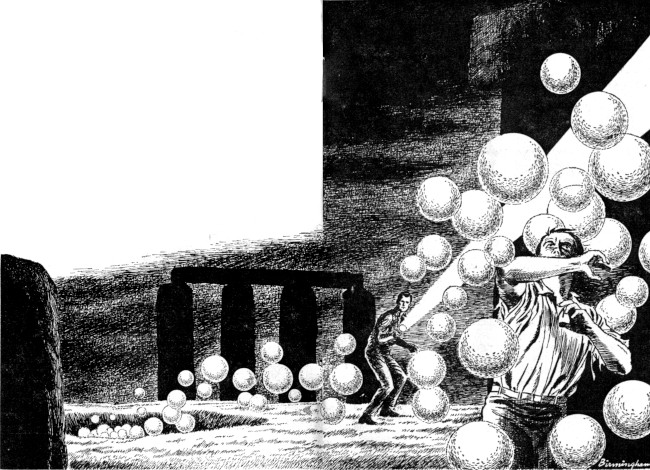
"Saints preserve us," the publican said in a choked voice. Foster and I stood, rooted to the spot, watching. The lone globe rose higher—and abruptly shot straight toward us. Foster threw up an arm and ducked. The ball of light veered, struck him a glancing blow and darted off a few yards, hovered. In an instant, the air was alive with the spheres, boiling up from the ground, and hurtling toward us, buzzing like a hive of yellow-jackets. Foster's flashlight lanced out toward the swarm.
"Use your light, Legion!" he shouted hoarsely. I was still standing, frozen. The globes rushed straight at Foster, ignoring me. Behind me, I heard the publican turn and run. I fumbled with the flashlight switch, snapped it on, swung the beam of white light on Foster. The globe at his head vanished as the light touched it. More globes swarmed to Foster—and popped like soap bubbles in the flashlight's glare—but more swarmed to take their place. Foster reeled, fighting at them. He swung the light—and I heard it smash against the stone behind him. In the instant darkness, the globes clustered thick around his head.
"Foster," I yelled, "run!"
He got no more than five yards before he staggered, went to his knees. "Cover," he croaked. He fell on his face. I rushed the mass of darting globes, took up a stance straddling his body. A sulphurous reek hung around me. I coughed, concentrated on beaming the lights around Foster's head. No more were rising from the crack in the earth now. A suffocating cloud pressed around both of us, but it was Foster they went for. I thought of the slab; if I could get my back to it, I might have a chance. I stooped, got a grip on Foster's coat, and started back, dragging him. The lights boiled around me. I swept the beam of light and kept going until my back slammed against the stone. I crouched against it. Now they could only come from the front.
I glanced at the cleft the lights had come from. It looked big enough to get Foster into. That would give him some protection. I tumbled him over the edge, then flattened my back against the slab and settled down to fight in earnest.
I worked in a pattern, sweeping vertically, then horizontally. The globes ignored me, drove toward the cleft, fighting to get at Foster, and I swept them away as they came. The cloud around me was smaller now, the attack less ravenous. I picked out individual globes, snuffed them out. The hum became ragged, faltered. Then there were only a few globes around me, milling wildly, disorganized. The last half dozen fled, bumbling away across the plain.
I slumped against the rock, sweat running down into my eyes, my lungs burning with the sulphur.
"Foster," I gasped. "Are you all right?"
He didn't answer. I flashed the light onto the cleft. It showed me damp clay, a few pebbles.
Foster was gone.
CHAPTER VI
I scrambled to the edge of the pit, played the light around inside. It shelved back at one side, and a dark mouth showed, sloping down into the earth: the hiding place the globes had swarmed from.
Foster was wedged in the opening. I scrambled down beside him, tugged him back to level ground. He was still breathing; that was something.
I wondered if the pub owner would come back, now that the lights were gone—or if he'd tell someone what had happened, bring out a search party. Somehow, I doubted it. He didn't seem like the type to ask for trouble with the ghosts of ancient sinners.
Foster groaned, opened his eyes. "Where are ... they?" he muttered.
"Take it easy, Foster," I said. "You're OK now."
"Legion," Foster said. He tried to sit up. "The Hunters...."
"I worked them over with the flashlights. They're gone."
"That means...."
"Let's not worry about what it means. Let's just get out of here."
"The Hunters—they burst out of the ground—from a cleft in the earth."
"That's right. You were half-way into the hole. I guess that's where they were hiding."
"The Pit of the Hunters," Foster said.
"If you say so," I said. "Lucky you didn't go down it."
"Legion, give me the flashlight."
"I feel something coming on that I'm not going to like," I said. I handed him the light and he flashed it into the tunnel mouth. I saw a polished roof of black glass arching four feet over the rubble-strewn bottom of the shaft. A stone, dislodged by my movement, clattered away down the 30° slope.
"That tunnel's man-made," I said. "And I don't mean neolithic man."
"Legion, we'll have to see what's down there," Foster said.
"We could come back later, with ropes and big insurance policies," I said.
"But we won't," said Foster. "We've found what we were looking for—"
"Sure," I said, "and it serves us right. Are you sure you feel good enough to make like Alice and the White Rabbit?"
"I'm sure. Let's go."
Foster thrust his legs into the opening, slid over the edge, disappeared. I followed him. I eased down a few feet, glanced back for a last look at the night sky, then lost my grip and slid. I hit bottom hard enough to knock the wind out of me, and found myself lying on a level floor.
"What is this place?" I dug the flashlight out of the rubble, flashed it around. We were in a low-ceilinged room ten yards square. I saw smooth walls, the dark bulks of massive shapes that made me think of sarcophagi in Egyptian burial vaults—except that these threw back highlights from dials and levers.
"For a couple of guys who get shy in the company of cops," I said, "we've got a talent for doing the wrong thing. This is some kind of Top Secret military installation."
"Impossible," Foster replied. "This couldn't be a modern structure, at the bottom of a rubble-filled shaft—"
"Let's get out of here, fast," I said. "We've probably set off an alarm already."
As if in answer, a low chime cut across our talk. Pearly light sprang up on a square panel. I got to my feet, moved over to stare at it. Foster came to my side.
"What do you make of it?" he said.
"I'm no expert on stone-age relics," I said. "But if that's not a radar screen, I'll eat it."
I sat down in the single chair before the dusty control console, and watched a red blip creep across the screen. Foster stood behind me.
"We owe a debt to that Ancient Sinner," he said. "Who would have dreamed he'd lead us here?"
"Ancient Sinner, Hell," I said. "This place is as modernistic as next year's juke box."
"Look at the symbols on the machines," Foster said. "They're identical with those in the first section of the Journal."
"All pot-hooks look alike to me," I said. "It's this screen that's got me worried. If I've got it doped out correctly, that blip is either a mighty slow airplane—or it's at one hell of an altitude."
"Modern aircraft operate at great heights," Foster said.
"Not at this height," I said. "Give me a few more minutes to study these scales...."
"There are a number of controls here," Foster said. "Obviously intended to activate mechanisms—"
"Don't touch 'em," I said. "Unless you want to start World War III."
"I hardly think the results would be so drastic," Foster said. "Surely this installation has a simple purpose, unconnected with modern wars—but very possibly connected with the mystery of the Journal—and of my own past."
"The less we know about this, the better," I said. "At least, if we don't mess with anything, we can always claim we just stepped in here to get out of the rain—"
"You're forgetting the Hunters," Foster said.
"Some new anti-personnel gimmick," I said.
"They came out of this shaft, Legion. It was opened by the pressure of the Hunters, bursting out."
"Why did they pick that precise moment—just as we arrived?" I asked.
"I think they were aroused," Foster said. "I think they sensed the presence of their ancient foe."
I swung around to look at him.
"I see the way your thoughts are running," I said. "You're their Ancient Foe, now, huh? Just let me get this straight: that means that umpteen hundred years ago, you personally, had a fight with the Hunters—here at Stonehenge. You killed a batch of them and ran. You hired some kind of Viking ship and crossed the Atlantic. Later on, you lost your memory, and started being a guy named Foster. A few weeks ago you lost it again. Is that the picture?"
"More or less."
"And now we're a couple of hundred feet under Stonehenge—after a brush with a crowd of luminous stinkbombs—and you're telling me you'll be nine hundred on your next birthday."
"Remember the entry in the journal, Legion? 'I came to the place of the Hunters, and it was a place I knew of old, and there was no hive, but a Pit built by men of the Two worlds....'"
"Okay," I said. "So you're pushing a thousand."
I glanced at the screen, got out a scrap of paper, and scribbled a rapid calculation. "Here's another big number for you. That object on the screen is at an altitude—give or take a few percent—of thirty thousand miles."
I tossed the pencil aside, swung around to frown at Foster. "What are we mixed up in, Foster? Not that I really want to know. I'm ready to go to a nice clean jail now, and pay my debt to society—"
"Calm down, Legion," Foster said. "You're raving."
"OK," I said, turning back to the screen. "You're the boss. Do what you like. It's just my reflexes wanting to run. I've got no place to run to. At least with you I've always got the wild hope that maybe you're not completely nuts, and that somehow—"
I sat upright, eyes on the screen. "Look at this, Foster," I snapped. A pattern of dots flashed across the screen, faded, flashed again....
"Some kind of IFF," I said. "A recognition signal. I wonder what we're supposed to do now."
Foster watched the screen, saying nothing.
"I don't like that thing blinking at us," I said. "It makes me feel conspicuous." I looked at the big red button beside the screen. "Maybe if I pushed that...." Without waiting to think it over, I jabbed at it.
A yellow light blinked on the control panel. On the screen, the pattern of dots vanished. The red blip separated, a smaller blip moving off at right angles to the main mass.
"I'm not sure you should have done that," Foster said.
"There is room for doubt," I said in a strained voice. "It looks like I've launched a bomb from the ship overhead."
The climb back up the tunnel took three hours, and every foot of the way I was listening to a refrain in my head: This may be it; this may be it; this may be it....
I crawled out of the tunnel mouth and lay on my back, breathing hard. Foster groped his way out beside me.
"We'll have to get to the highway," I said, untying the ten-foot rope of ripped garments that had linked us during the climb. "There's a telephone at the pub; we'll notify the authorities...." I glanced up.
"Hold it," I said. I grabbed Foster's arm and pointed overhead. "What's that?"
Foster looked up. A brilliant point of blue light, brighter than a star, grew perceptibly as we watched.
"Maybe we won't get to notify anybody after all," I said. "I think that's our bomb—coming home to roost."
"That's illogical," Foster said. "The installation would hardly be arranged merely to destroy itself in so complex a manner."
"Let's get out of here," I yelled.
"It's approaching us very rapidly," Foster said. "The distance we could run in the next few minutes would be trivial by comparison with the killing radius of a modern bomb. We'll be safer sheltered in the cleft than in the open."
"We could slide back down the tunnel," I said.
"And be buried?"
"You're right; I'd rather fry on the surface."
We crouched, watching the blue glare directly overhead, growing larger, brighter. I could see Foster's face by its light now.
"That's no bomb," Foster said. "It's not falling; it's coming down slowly ... like a—"
"Like a slowly falling bomb," I said. "And it's coming right down on top of us. Goodbye, Foster. I can't claim it's been fun knowing you, but it's been different. We'll feel the heat any second now. I hope it's fast."
The glaring disc was the size of the full moon now, unbearably bright. It lit the plain like a pale blue sun. There was no sound. As it dropped lower, the disc fore-shortened and I could see a dark shape above it, dimly lit by the glare thrown back from the ground.
"The thing is the size of a ferry boat," I said.
"It's going to miss us," Foster said. "It will come to ground to the east of us."
We watched the slender shape float down with dreamlike slowness, now five hundred feet above, now three hundred, then hovering just above the giant stones.
"It's coming down smack on top of Stonehenge," I yelled.
We watched as the vessel settled into place dead center on the ancient ring of stones. For a moment they were vividly silhouetted against the flood of blue radiance; then abruptly, the glare faded and died.
"Foster," I said. "Do you think it's barely possible—"
A slit of yellow light appeared on the side of the hull, widened to a square. A ladder extended itself, dropping down to touch the ground.
"If somebody with tentacles starts down that ladder," I said, in an unnaturally shrill voice, "I'm getting out of here."
"No one will emerge," Foster said quietly. "I think we'll find, Legion, that this ship of space is at our disposal."
"I'm not going aboard that thing," I said. "I'm not sure of much in this world, but I'm sure of that."
"Legion," Foster said, "this is no twentieth century military vessel. It obviously homed on the transmitter in the underground station, which appears to be directly under the old monument—which is several thousand years old—"
"And I'm supposed to believe the ship has been orbiting the Earth for the last few thousand years, waiting for someone to push the red button? You call that logical?"
"Given permanent materials—such as those the notebook is made of—it's not impossible—or even difficult."
"We got out of the tunnel alive," I said. "Let's settle for that."
"We're on the verge of solving a mystery that goes back through the centuries," Foster said. "A mystery that I've pursued, if I understand the Journal, through many lifetimes—"
"One thing about losing your memory," I said. "You don't have any fixed ideas to get in the way of your theories."
Foster smiled grimly. "The trail has brought us here. I must follow it—wherever it leads."
I lay on the ground, staring up at the unbelievable shape, and the beckoning square of light. "This ship—or whatever it is," I said: "It drops down out of nowhere, and opens its doors—and you want to walk right into the cosy interior—"
"Listen!" Foster cut in.
I heard a low rumbling then, a sound that rolled ominously, like distant guns.
"More ships—" I started.
"Jet aircraft," Foster said. "From the bases in East Anglia probably. Of course, they'll have tracked our ship in—"
"That's all for me!" I yelled, getting to my feet. "The secret's out—"
"Get down, Legion," Foster shouted. The engines were a blanketing roar now.
"What for? They—"
Two long lines of fire traced themselves across the sky, curving down—
I hit the dirt behind the stone in the same instant the rockets struck. The shock wave slammed at the earth like a monster thunderclap, and I saw the tunnel mouth collapse. I twisted, saw the red interior of the jet tail-pipe as the fighter hurtled past, rolling into a climbing turn.
"They're crazy," I yelled. "Firing on—"
A second barrage blasted across my indignation. I hugged the muck and waited while nine salvoes shook the earth. Then the rumble died, reluctantly. The air reeked of high explosives.
"We'd have been dead now if we'd tried the tunnel," I gasped, spitting dirt. "It caved at the first rocket. And if the ship was what you thought, Foster, they've destroyed something—"
The sentence died unnoticed. The dust was settling and through it the shape of the ship reared up, unchanged except that the square of light was gone. As I watched, the door opened again and the ladder ran out once more, invitingly.
"They'll try next time with atomics," I said. "That may be too much for the ship's defenses—and it will sure as hell be too much for us—"
"Listen," Foster cut in. A deeper rumble was building in the distance.
"To the ship!" Foster called. He was up and running, and I hesitated just long enough to think about trying for the highway and being caught in the open—and then I was running, too. Ahead, Foster stumbled crossing the ground that had been ripped up by the rocket bursts, made it to the ladder, and went up it fast. The growl of the approaching bombers grew, a snarl of deadly hatred. I leaped a still-smoking stone fragment, took the ladder in two jumps, plunged into the yellow-lit interior. Behind me, the door smacked shut.
I was standing in a luxuriously fitted circular room. There was a pedestal in the center of the floor, from which a polished bar projected. The bones of a man lay beside it. While I stared, Foster sprang forward, seized the bar, and pulled. It slid back easily. The lights flickered, and I had a moment of vertigo. Nothing else happened.
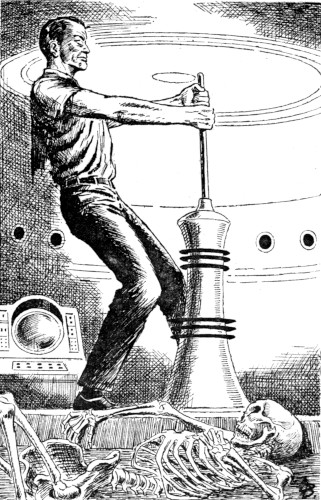
"Try it the other way," I yelled. "The bombs will fall any second—" I went for it, hand outstretched. Foster thrust in front of me. "Look!"
I stared at the glowing panel he was pointing to—a duplicate of the one in the underground chamber. It showed a curved white line, with a red point ascending from it.
"We're clear," Foster said. "We've made a successful take-off."
"But we can't be moving—there's no acceleration. There must be sound-proofing—that's why we can't hear the noise of the bombers."
"No sound-proofing would help if we were at ground zero," Foster said. "This ship is the product of an advanced science. We've left the bombers far behind."
"Where are we going? Who's steering this thing?"
"It steers itself, I would judge," Foster said. "I don't know where we're going, but we're well on the way. There's no doubting that."
I looked at him in amazement. "You like this, don't you, Foster? You're having the time of your life."
"I can't deny that I'm delighted at this turn of events," Foster said. "Don't you see? This vessel is a launch, or lifeboat, under automatic control. And it's taking us to the mother ship."
"Okay, Foster," I said. "I'm with you." I looked at the skeleton on the floor behind him, and added; "But I sure hope we have better luck than the last passenger."
CHAPTER VII
It was two hours later, and Foster and I stood silent before a ten-foot screen that had glowed into life when I touched a silver button beside it. It showed us a vast emptiness of bottomless black, set thick with corruscating points of polychrome brilliance that hurt to look at. And against that backdrop: a ship, vast beyond imagining, blotting out half the titanic vista with its bulk—
But dead.
Even from the distance of miles, I could sense it. The great black torpedo shape, dull moonlight glinting along the unbelievable length of its sleek flank, drifted: a derelict. I wondered for how many centuries it had waited here—and for what?
"I feel," said Foster, "somehow—I'm coming home."
I tried to say something, croaked, cleared my throat.
"If this is your jitney," I said, "I hope they didn't leave the meter ticking on you. We're broke."
"We're closing rapidly," said Foster. "Another ten minutes, I'd guess...."
"How do we go about heaving to, alongside? You didn't come across a book of instructions, did you?"
"I think I can predict that the approach will be automatic."
"This is your big moment, isn't it?" I said. "I've got to hand it to you, pal; you've won out by pluck."
The ship appeared to move smoothly closer, looming over us, fine golden lines of decorative filigree work visible now against the black. A tiny square of pale light appeared, grew into a huge bay door that swallowed us.
The screen went dark, there was a gentle jar, then motionlessness. The port opened, silently.
"We've arrived," Foster said. "Shall we step out and have a look?"
"I wouldn't think of going back without one," I said. I followed him out and stopped dead, gaping. I had expected an empty hold, bare metal walls. Instead. I found a vaulted cavern, shadowed, mysterious, rich with a thousand colors. There was a hint of strange perfume in the air, and I heard low music that muttered among stalagmite-like buttresses. There were pools, playing fountains, waterfalls, dim vistas stretching away, lit by slanting rays of muted sunlight.
"What kind of place is it?" I asked. "It's like a fairyland, or a dream."
"It's not an earthly scheme of decoration," Foster said, "but I find it strangely pleasing."
"Hey, look over there," I yelped suddenly, pointing. An empty-eyed skull stared past me from the shadows at the base of a column.
Foster went over to the skull, stood looking down at it.
"There was a disaster here," he said. "That much is plain."
"It's creepy," I said. "Let's go back; I forgot to get film for my Brownie."
"The long-dead pose no threat," said Foster. He was kneeling, looking at the white bones. He picked up something, stared at it. "Look, Legion."
I went over. Foster held up a ring.
"We're onto something hot, pal," I said. "It's the twin to yours."
"I wonder ... who he was."
I shook my head. "If we knew that—and who killed him—or what—"
"Let's go on. The answers must be here somewhere." Foster moved off toward a corridor that reminded me of a sunny avenue lined with chestnut trees—though there were no trees, and no sun. I followed, gaping.
For hours we wandered, looking, touching, not saying much but saturated in wonder, like kids in a toy factory. We came across another skeleton, lying among towering engines. Finally we paused in a giant storeroom stacked high with supplies.
"Have you stopped to think, Foster," I said, fingering a length of rose-violet cloth as thin as woven spider webs. "This boat's a treasure-house of marketable items. Talk about the wealth of the Indies—"
"I seek only one thing here, my friend," Foster said; "my past."
"Sure," I said. "But just in case you don't find it, you might consider the business angle. We can set up a regular shuttle run, hauling stuff down—"
"You Earthmen," sighed Foster. "For you, every new experience is immediately assessed in terms of its merchandising possibilities. Well, I leave that to you."
"Okay okay," I said. "You go on ahead and scout around down that way, if you want—where the technical-looking stuff is. I want to browse around here for a while."
"As you wish."
"We'll meet at this end of the big hall we passed back there. Okay?"
Foster nodded and went on. I turned to a bin filled with what looked like unset emeralds the size of walnuts. I picked up a handful, juggled them lovingly.
"Anyone for marbles?" I murmured to myself.
Hours later I came along a corridor that was like a path through a garden that was a forest, crossed a ballroom like a meadow floored in fine-grained rust-red wood and shaded by giant ferns, and went under an arch into the hall where Foster sat at a long table cut from yellow marble. A light the color of sunrise gleamed through tall pseudo-windows.
I dumped an armful of books on the table. "Look at these," I said. "All made from the same stuff as the Journal. And the pictures...."
I flipped open one of the books, a heavy folio-sized volume, to a double-page spread in color showing a group of bearded Arabs in dingy white djellabas staring toward the camera, a flock of thin goats in the background. It looked like the kind of picture the National Geographic runs, except that the quality of the color and detail was equal to the best color transparencies.
"I can't read the print," I said, "but I'm a whiz at looking at pictures. Most of the books show scenes like I hope I never see in the flesh, but I found a few that were made on Earth—God knows how long ago."
"Travel books, perhaps," Foster said.
"Travel books that you could sell to any university on Earth for their next year's budget. Take a look at this one."
Foster looked across at the panoramic shot of a procession of shaven-headed men in white sarongs, carrying a miniature golden boat on their shoulders, descending a long flight of white stone steps leading from a colonnade of heroic human figures with folded arms and painted faces. In the background, brick-red cliffs loomed up, baked in desert heat.
"That's the temple of Hat-Shepsut in its prime," I said. "Which makes this print close to four thousand years old. Here's another I recognize." I turned to a smaller, aerial view, showing a gigantic pyramid, its polished stone facing chipped in places and with a few panels missing from the lower levels, revealing the cruder structure of massive blocks beneath.
"That's one of the major pyramids, maybe Khufu's," I said. "It was already a couple thousand years old, and falling into disrepair. And look at this—" I opened another volume, showed Foster a vivid photograph of a great shaggy elephant with a pinkish trunk upraised between wide-curving yellow tusks.
"A mastodon," I said. "And there's a woolly rhino, and an ugly-looking critter that must be a sabre-tooth. This book is old...."
"A lifetime of rummaging wouldn't exhaust the treasures aboard this ship," said Foster.
"How about bones? Did you find any more?"
Foster nodded. "There was a disaster of some sort. Perhaps disease. None of the bones was broken."
"I can't figure the one in the lifeboat," I said. "Why was he wearing a necklace of bear's teeth?" I sat down across from Foster. "We've got plenty of mysteries to solve, all right, but there are some other items we'd better talk about. For instance: where's the kitchen? I'm getting hungry."
Foster handed me a black rod from among several that lay on the table. "I think this may be important," he said.
"What is it? a chop stick?"
"Touch it to your head, above the ear."
"What does it do—give you a massage?" I pressed it to my temple....
I was in a grey-walled room, facing a towering surface of ribbed metal. I reached out, placed my hands over the proper perforations. The housings opened. For apparent malfunction in the quaternary field amplifiers, I knew, auto-inspection circuit override was necessary before activation—
I blinked, looked around at the rod in my hand.
"I was in some kind of power-house," I said. "There was something wrong with—with...."
"The Quaternary field amplifiers," Foster said.
"I seemed to be right there," I said. "I understood exactly what it was all about."
"These are technical manuals," Foster said. "They'll tell us everything we need to know about the ship."
"I was thinking about what I was getting ready to do," I said, "the way you do when you're starting into a job; I was trouble-shooting the Quaternary whatzits—and I knew how...."
Foster got to his feet and moved toward the doorway. "We'll have to start at one end of the library and work our way through," he said. "It will take us awhile, but we'll get the facts we need. Then we can plan."
Foster picked a handful of briefing rods from the racks in the comfortably furnished library and started in. The first thing we needed was a clue as to where to look for food and beds, or for operating instructions for the ship itself. I hoped we might find the equivalent of a library card-catalog; then we could put our hands on what we wanted in a hurry.
I went to the far end of the first rack and spotted a short row of red rods that stood out vividly among the black ones. I took one out, thought it over, decided it was unlikely that it was any more dangerous than the others, and put it against my temple....
As the bells rang, I applied neuro-vascular tension, suppressed cortical areas upsilon, zeta and iota, and stood by for—
I jerked the rod from my head, my ears still ringing with the shrill alarm. The effect of the rods was like reality itself, but intensified, all attention focussed single-mindedly on the experience at hand. I thought of the entertainment potentialities of the idea. You could kill a tiger, ride an airplane down in flames, face the heavyweight champion—I wondered about the stronger sensations, like pain and fear. Would they seem as real as the impulse to check the whatchamacallits or tighten up your cortical thingamajigs?
I tried another rod.
At the sound of the apex-tone, I racked instruments, walked, not ran, to the nearest transfer-channel—
Another:
Having assumed duty as Alert Officer, I reported first to coordination Control via short-line, and confirmed rapport—
These were routine SOP's covering simple situations aboard ship. I skipped a few, tried again:
Needing a xivometer, I keyed instruction-complex One, followed with the code—
Three rods further along, I got this:
The situation falling outside my area of primary conditioning, I reported in corpo to Technical Briefing, Level Nine, Section Four, Sub-section Twelve, Preliminary. I recalled that it was now necessary to supply my activity code ... my activity code ... my activity code.... (A sensation of disorientation grew; confused images flickered like vague background-noise; then a clear voice cut in:)
YOU HAVE SUFFERED PARTIAL PERSONALITY-FADE. DO NOT BE ALARMED. SELECT A GENERAL BACKGROUND ORIENTATION ROD FROM THE NEAREST EMERGENCY RACK. ITS LOCATION IS ...
I was moving along the stacks, to pause in front of a niche where a U-shaped plastic strip was clamped to the wall. I removed it, fitted it to my head—
(Then:) I was moving along the stacks, to pause in front of a niche—
I was leaning against the wall, my head humming. The red stick lay on the floor at my feet. That last bit had been potent: something about a general background briefing—
"Hey, Foster!" I called, "I think I've got something...."
"As I see it," I said, "this background briefing should tell us all we need to know about the ship; then we can plan our next move more intelligently. We'll know what we're doing." I took the thing from the wall, just as I had seemed to do in the phantom scene the red rod had projected for me.
"These things make me dizzy," I said, handing it to Foster. "Anyway, you're the logical one to try it."
He took the plastic shape, went to the reclining seat at the near end of the library hall, and settled himself. "I have an idea this one will hit harder than the others," he said.
He fitted the clamp to his head and ... instantly his eyes glazed; he slumped back, limp.
"Foster!" I yelled. I jumped forward, started to pull the plastic piece from his head, then hesitated. Maybe Foster's abrupt reaction was standard procedure. In any case whatever harm this gadget could do to Foster's brain had already been done. I might as well let the process take its course. But I didn't like it much.
I went on reasoning with myself. After all, this was what the red rod had indicated as normal procedure in a given emergency. Foster was merely having his faded personality touched up. And his full-blown, three-dimensional personality was what we needed to give us the answers to a lot of the questions we'd been asking. Though the ship and everything in it had lain unused and silent for forgotten millennia, still the library should be good. The librarian was gone from his post these thirty centuries, and Foster was lying unconscious, and I was thirty thousand miles from home—but I shouldn't let trifles like that worry me....
I got up and prowled the room. There wasn't much to look at except stacks and more stacks. The knowledge stored here was fantastic, both in magnitude and character. If I ever got home with a load of these rods....
I strolled through a door leading to another room. It was small, functional, dimly lit. The middle of the room was occupied by a large and elaborate divan with a cap-shaped fitting at one end. Other curious accoutrements were ranked along the walls. There wasn't much in them to thrill me. But bone-wise I had hit the jackpot.
Two skeletons lay near the door, in the final slump of death. Another lay beside the fancy couch. There was a long-bladed dagger beside it.
I squatted beside the two near the door and examined them closely. As far as I could tell, they were as human as I was. I wondered what kind of men they had been, what kind of world they had come from, that could build a ship like this and stock it as it was stocked.
The dagger that lay near the other bones was interesting: it seemed to be made of a transparent orange metal, and its hilt was stamped in a repeated pattern of the Two Worlds motif. It was the first clue as to what had taken place among these men when they last lived: not a complete clue, but a start.
I took a closer look at an apparatus like a dentist's chair parked against the wall. There were spidery-looking metal arms mounted above it, and a series of colored glass lenses. A row of dull silver cylinders was racked against the wall. Another projected from a socket at the side of the machine. I took it out and looked at it. It was of plain pewter-colored plastic, heavy and smooth. I felt pretty sure it was a close cousin to the chop sticks stored in the library. I wondered what brand of information was recorded in it as I dropped it in my pocket.
I lit a cigarette and went back out to where Foster lay. He was still in the same position as when I had left him. I sat down on the floor beside the couch to wait.
It was an hour before he stirred. He reached up, pulled off the plastic head-piece, dropped it on the floor.
"Are you okay?" I asked.
Foster looked at me, his eyes travelling up to my uncombed hair and down to my scuffed shoes. His eyes narrowed in a faint frown. Then he said something—in a language that seemed to be all Z's and Q's.
"Enough surprises, Foster," I said hoarsely. "Talk American."
He stared into my eyes, then glanced around the room.
"This is a ship's library," he said.
I heaved a sigh of relief. Foster was watching my face. "What was it all about?" I said. "What have you found out?"
"I know you," said Foster slowly. "Your name is Legion."
I nodded. I could feel myself getting tense again. "Sure, you know me." I put a hand on his shoulder. "You remember: we were—"
He shook my hand off. "That is not the custom in Vallon," he said coldly.
"Vallon?" I echoed. "What kind of routine is this, Foster?"
"Where are the others?"
"There's a couple of 'others' in the next room," I snapped. "But they've lost a lot of weight. Outside of them there's only me—"
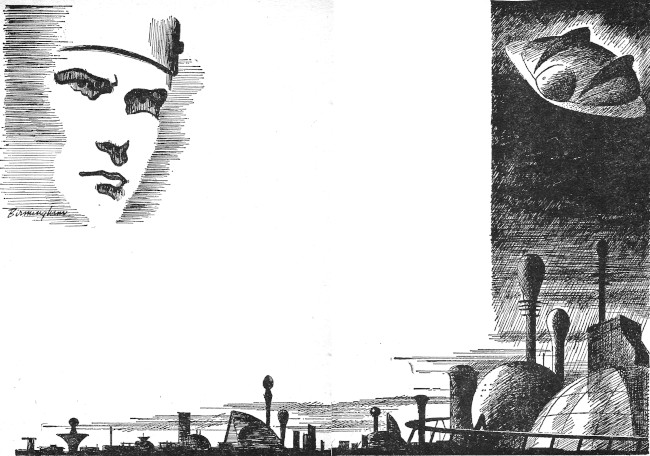
Foster looked at me as if I wasn't there. "I remember Vallon," he said. He put a hand to his head. "But I remember too a barbaric world, brutal and primitive. You were there. We travelled in a crude rail-car, and then in a barge that wallowed in the sea. There were narrow, ugly rooms, evil odors, harsh noises ... and The Hunters! We fled from them, Legion, you and I. And I remember a landing-ring...." He paused. "Strange, it had lost its cap-stones and fallen into ruin."
"Us natives call it Stonehenge."
"The Hunters burst out of the earth. We fought them. But why should the Hunters seek me?"
"I was hoping you'd tell me," I said. "Do you know where this ship came from? And why?"
"This is a ship of the Two Worlds," he replied. "But I know nothing of how it came to be here."
"How about all that stuff in the journal? Maybe now you—"
"The journal!" Foster broke in. "Where is it!"
"In your coat pocket, I guess."
Foster felt through his jacket awkwardly, brought out the journal. He opened it and looked at the part written in the curious alien characters that nobody had been able to decipher.
But he was reading it.
For hours I had waited while Foster read. At last he leaned back in his chair and sighed.
"My name," he said, "was Qulqlan. And this," he laid his hand upon the book, "is my story. This is one part of the past I was seeking. And I remember none of it...."
"Tell me what the journal says."
Foster picked it up. "It seems that I awoke once before, in a small room aboard this vessel. I was lying on a memo-couch, by which circumstance I knew that I had suffered a Change—"
"You mean you'd lost your memory?"
"And regained it—on the couch. My memory-trace had been re-impressed on my mind. I awoke knowing my identity, but not how I came to be aboard this vessel. The journal says that my last memory was of a building beside the Shallow Sea."
"Where's that?"
"On a far world—called Vallon."
"Yeah? And what next?"
"I looked around me and saw four men lying on the floor, slashed and bloody. One was alive. I gave him what emergency treatment I could, then searched the ship. I found three more men, dead; none living. Then the Hunters attacked, swarming to me. They would have sucked the life from me—and I had no shield of light. I fled to the lifeboat, carrying the wounded man. I descended to the planet below: your Earth. The man died there. He had been my friend, a man named Ammaerln. I buried him in a shallow depression in the earth and marked the place with a stone."
"The Ancient Sinner," I said.
"Yes ... I suppose it was his bones the lay brother found."
"And we found out last night that the depression was the result of dirt sifting down into the ventilator shaft. But I guess you didn't know anything about the underground installation, way back then. Doesn't the journal say anything...?"
"No, there is no mention made of it here."
"How about the Hunters? How did they get to Earth?"
"They are insubstantial creatures," said Foster, "yet they can endure the vacuum of space. I can only surmise that they followed the life boat down."
"They were tailing you?"
"Yes; but I have no idea why they pursued me. They're harmless creatures in the natural state, used to seek out the rare fugitive from justice on Vallon. They can be attuned to the individual; thereafter, they follow him and mark him out for capture."
"Say, what were you: a big-time racketeer on Vallon?"
"The journal is frustratingly silent as to my Vallonian career," said Foster. "But this whole matter of the unexplained inter-galactic voyage and the evidence of violence aboard the ship make me wonder whether I was being exiled for crimes done in the Two Worlds."
"So they sicked the Hunters on you?" I said. "But why did they hang around at Stonehenge all this time?"
"There was a trickle of power feeding the screens," said Foster. "They need a source of electrical energy to live; until a hundred years ago it was the only one on the planet."
"How did they get down into the shaft without opening it up?"
"Given time, they pass easily through porous substances. But, of course, last night, when I came on them after their long fast, they simply burst through in their haste."
"Okay. What happened next?—after you buried the man."
"The journal tells that I was set upon by natives, men who wore the hides of animals. One of their number entered the ship. He must have moved the drive lever. It lifted, leaving me marooned."
"So those were his bones we found in the boat," I mused: "the ones with the bear's-tooth necklace. I wonder why he didn't come into the ship."
"Undoubtedly he did. But remember the skeleton we found just inside the landing port? That must have been a fairly fresh and rather gory corpse at the time the savage stepped aboard. It probably seemed to him all too clear an indication of what lay in store for himself if he ventured further. In his terror he must have retreated to the boat to wait, and there starved to death."
"He was stranded in your world, and you were stranded in his."
"Yes," said Foster. "And then, it seems, I lived among the brutemen and came to be their king. I waited there by the landing-ring through many years in the hope of rescue. Because I did not age as the natives did, I was worshipped as a god. I would have built a signalling device, but there were no pure metals, nothing I could use. I tried to teach them, but it was a work of centuries."
"But how could one go on living—for hundreds of years? Are you people supermen that live forever?"
"Not forever. But the natural span of a human life is very great. Among your people, there is a wasting disease from which you all die young."
"That's no disease," I said. "You just naturally get old and die."
"The human mind is a magnificent instrument," Foster said; "not meant to wither quickly."
"Why didn't you catch this 'disease'?"
"All Vallonians are innoculated against it."
Foster turned back to the Journal. "I ruled many peoples under many names," he said. "I travelled in many lands, seeking for skilled metal-workers, glass-blowers, wise men. But always I returned to the landing-ring."
"It must have been tough," I said, "exiled on a strange world, living out your life in a wilderness, century after century...."
"My life was not without interest," Foster said. "I watched my savage people put aside their animal hides and learn the ways of civilization. I built a great city, and I tried—foolishly—to teach their noble caste the code of chivalry of the two Worlds. But although they sat at a round table like the great Ringboard at Okk-Hamiloth, they never really understood. And then they grew too wise, and wondered at their king who never aged. I left them, and tried again to build a long-signaller. The Hunters sensed it, and swarmed to me. I drove them off with fires, and then I grew curious, and followed them back to their nest—"
"I know," I said. "'And it was a place you knew of old; no hive but a Pit built by men'."
"They overwhelmed me; I barely escaped with my life. Starvation had made the Hunters vicious. They would have drained my body of its life-energy."
"And if you'd known the transmitter was there—but you didn't. So you put an ocean between you and them."
"They found me even there. Each time I destroyed many of them, and fled. But always a few lived to breed and seek me out again."
"Didn't your signaller work?"
"No. It was a hopeless attempt. Only a highly developed technology could supply the raw materials. I could only teach what I knew, encourage the development of the sciences, and wait. And then I began to forget."
"Why?"
"A mind grows weary," Foster said. "It is the price of longevity. It must renew itself. Shock and privation hasten the change. I had held it off for many centuries. Now I felt it coming on me.
"At home, on Vallon, a man would record his memory at such a time, store it electronically in a recording device, and, after the Change, use the memory-trace to restore, in his renewed body, his old recollections in toto. But, marooned as I was, my memories, once lost, were gone forever.
"I did what I could: I prepared a safe place, and wrote messages that I would find when I awoke—"
"When you woke up in the hotel," I said, "you were young again, overnight. How could it happen?"
"When the mind renews itself, erasing the scars of the years, the body, too, regenerates."
"When I first met you," I said, "you told me about waking up back in 1918, with no memory."
"Yours is a harsh world, Legion. I must have forgotten, many times. Somewhere, sometime, I lost the vital link, forgot my quest; when the Hunters came again, I fled, not understanding."
There was a silence, then Foster spoke in a faraway voice.
"What came to pass aboard this ship all those centuries ago?" he said. "Why was I here? And what killed the others? Someday, somehow I must learn the truth of this matter."
"What I can't figure out is why somebody didn't come after this ship. It was right here in orbit."
"Consider the immensity of space, Legion. This is one tiny world, among the stars."
"But there was a station here, fitted out for handling your ships. That sounds like it was a regular port of call. And the books with the pictures: they prove your people have been here off and on for thousands of years. Why would they stop coming?"
"There are such beacons on a thousand worlds," said Foster. "Think of it as a buoy marking a reef, a trailblaze in the wilderness. Ages could pass before a wanderer chanced this way again. The fact that the ventilator shaft at Stonehenge was choked with the debris of centuries when I first landed there shows how seldom this world was visited."
I thought about it. Trying to piece together Foster's past would be a slow process. I had an idea:
"Say, you said you were in the memory machine. You woke up there—and you'd just had your memory restored. Why not do the same thing again, now? That is, if your brain can take another pounding this soon."
"Yes," he said. He stood up abruptly. "There's just a chance. Come on!"
I followed him out of the library into the room with the bones.
Foster walked across to the fancy couch, leaned down, then shook his head. "No," he said. "Of course it wouldn't be here...."
"What?"
"My memory-trace: the one that was used to restore my memory—that other time."
Suddenly I recalled the cylinder I had pocketed hours before. With a surprising flutter at my heart I held it up. "This it?"
Foster glanced at it briefly. "No, that's an empty—like those you see filed over there." He pointed to the rack of pewter-colored cylinders on the opposite wall. "They would be used for emergency recordings. Regular multi-life memory-traces would be key-coded with a pattern of colored lines."
"It figures," I said. "That would have been too easy."
"It doesn't matter, really. When I return to Vallon, I'll recover my past. There are vaults in Okk-Hamiloth where every citizen's trace is stored."
"I guess you'll be eager to get back there," I said. "Have you been able to figure out how long you were marooned down on Earth?"
"Since I descended from this ship, Legion," he said, "three thousand years have passed."
"I'm going to miss you, Foster," I said. "You know, I was kind of getting used to being an apprentice nut."
"Come with me to Vallon, Legion," he said.
"Thanks anyway, buddy," I said. "I'd like to see those other worlds of yours but in the end I'd regret it. I'd just sit around on Vallon pining for home: beat-up people, and all."
"Then what can I do for you, Legion, to reward your loyalty and express my gratitude?"
"Let me take the lifeboat, and stock it with a few goodies from the library, and some of those marbles from the storeroom, and a couple of the smaller mechanical gadgets. I think I know how to merchandise them in a way that'll leave the economy on an even keel—and incidentally set me up for life. As you said, I'm a materialist."
"Take whatever you desire."
"One thing I'll have to do when I get back," I said, "is open the tunnel at Stonehenge enough to sneak a thermite bomb down it—if they haven't already found the beacon station."
"As I judge the temper of the local people," Foster said, "the secret is safe for at least three generations."
"I'll bring the boat down in a blind spot where radar won't pick it up," I said. "Our timing was good; in another few years, it wouldn't have been possible."
"And this ship would soon have been discovered."
I looked at the great smooth sphere hanging, haloed, against utter black. The Pacific Ocean threw back a brilliant image of the sun.
I turned to Foster. "We're in a ten-hour orbit," I said. "We'd better get moving. I want to put the boat down in southern South America. I know a place there where I can unload without answering too many questions."
"You have several hours before the most favorable launch time," Foster said. "There's no hurry."
"Maybe not, but I've got a lot to do—and I'm eager to start."
CHAPTER VIII
I sat on the terrace watching the sun go down into the sea and thinking about Foster, somewhere out there beyond the purple palaces on the far horizon, in the ship that had waited for him for three thousand years, heading home at last. It was strange to reflect that for him, travelling near the speed of light, only a few weeks had passed, while three years went by for me—three fast years that I had put to good use.
The toughest part had been the first few months, after I put the life boat down in a cañon in the desert country south of a little town called Itzenca, in Peru. I hiked to town, carrying a pack with a few carefully selected items to start my new career. It took me two weeks to work, lie, barter, and plead my way to the seaport town of Callao and another week to line up passage home as a deck hand on a banana scow. I disappeared over the side at Tampa, and made it to Miami without attracting attention. As far as I could tell, the cops had already lost interest in me.
The items I had brought with me from the life boat were a pocketful of little grey dominoes, that were actually movie film, and a small projector to go with them. I didn't offer them for sale, direct. I made arrangements with an old acquaintance in the business of making pictures with low costume budgets for private showings; I set up the apparatus and projected my films, and he copied them in 35 mm. I told him that I'd smuggled them in from East Germany.
I had twelve pictures altogether; with a little judicious cutting and a dubbed-in commentary, they made up into fast-moving twenty-minute short subjects. He got in touch with a friend in the distribution end in New York, and after a little cagey fencing over contract terms, we agreed on a deal that paid me a hundred thousand for the twelve, with an option on another dozen at the same price.
Within a week after the pictures hit the neighborhood theatres around Bayonne, New Jersey, in a cautious try-out, I had offers up to half a million for my next consignment, no questions asked. I left my pal Mickey to handle the details, on a percentage basis, and headed back for Itzenca.
The lifeboat was just as I'd left it; it would have been all right for another fifty years, as far as the danger of anybody stumbling over it was concerned. I explained to the crew I brought out with me that it was a fake rocket ship, a prop I was using for a film I was making. They went to work setting up a system of camouflage nets (part of the plot, I told them) and unloading my cargo.
A year after my homecoming, I had my island—a square mile of perfect climate, fifteen miles off the Peruvian coast—and a house that was tailored to my every whim. The uppermost floor—almost a tower—was a strong-room, and it was there that I had stored my stock in trade. I had sold the best of the hundred or so films I had picked out before leaving Foster, but there were plenty of other items. The projector itself was the big prize. The self-contained power unit converted nuclear energy to light with 99 percent efficiency. It scanned the 'films', one molecular layer at a time, and projected a continuous picture. The color and sound were absolutely lifelike.
The principles involved in the projector were new, and—in theory, at least—way over the heads of our local physicists. But the practical application was nothing much. I figured that, with the right contacts in scientific circles to help me introduce the system, I had a billion-dollar industry up my sleeve. I had already fed a few little gimmicks into the market; a tough paper, suitable for shirts and underwear; a chemical that bleached teeth white as the driven snow; an all-color pigment for artists. With the knowledge I had absorbed from all the briefing rods I had studied, I had the techniques of a hundred new industries at my fingertips—and I hadn't exhausted the possibilities yet.
I spent most of a year roaming the world, discovering all the things that a free hand with a dollar bill could do for a man. Then followed a year of fixing up the island.
Now, after the first big thrill of economic freedom had worn off, it was beginning to get me: boredom, the disease of the idle rich, that I had sworn would never touch me. But thinking about wealth and having it on your hands are two different things, and I was beginning to remember almost with nostalgia, the tough old times when every day was an adventure, full of cops and missed meals and a thousand unappeased desires.
I finished up my expensive cigar and leaned forward to drop it in a big silver ashtray, when something caught my eye out across the red-painted water. I sat squinting at it, then went inside and came out with a pair of 12x binoculars. I focussed them and studied the dark speck that stood out clearly now against the gaudy sky. It was a heavy looking power boat, heading dead toward my island.
I watched it come closer, and ease alongside the hundred foot concrete jetty I had built below the sea-wall. The engines died, and the boat sat, in a sudden silence. Two heavy deck guns were mounted on the foredeck, and there were four torpedoes slung in launching cradles. I saw ranks of helmeted men drawn up on deck. They shuffled off onto the pier, formed up into two squads. I counted; forty-eight men, and a couple of officers. There was the faint sound of orders being barked, and the column stepped off, moving along the paved road that led up to the house. They halted. The two officers, wearing class A's, and a tubby civilian with a briefcase approached the steps leading up to my perch.
The leading officer, a brigadier general, no less, looked up at me.
"I am General Smale," he said. "This is Colonel Sanchez of the Peruvian Army—" he indicated the other military type—"and Mr. Pruffy of the American Embassy at Lima."
I nodded.
"We would like to talk with you about an official matter, Mr. Legion. It's of great importance, involving the security of your country."
"OK, General," I said. "Come on up."
They filed onto the terrace, hesitated, then shook hands, and sat down in the empty chairs. Pruffy held his briefcase in his lap.
"I'm here," the general said, "to ask you a few questions, Mr. Legion. Mr. Pruffy represents the Department of State in the matter, and Colonel Sanchez—"
"Don't tell me," I said. "He represents the Peruvian government, which is why I don't ask you what the hell an armed American force is doing wandering around on Peruvian soil. What's it all about, Smale?"
"I'll come directly to the point," he said. "For some time, the investigative and security agencies of the US government have been building a file on what for lack of a better name has been called 'The Martians'. A little over three years ago an unidentified flying object appeared on a number of radar screens, descending from extreme altitude. It came to earth at ..." he hesitated.
"Don't tell me you came all the way out here to tell me you can't tell me," I said.
"—a site in England," Smale said. "American aircraft were dispatched to investigate the object. Before they could make identification, it rose again, accelerated at tremendous speed, and was lost at an altitude of several hundred miles."
"I thought we had better radar than that," I said. "The satellite program—"
"No such specialized equipment was available," Smale said. "An intensive investigation turned up the fact that two strangers—possibly Americans—had visited the site only a few hours before the—ah—visitation."
I nodded. I was thinking about the close call I'd had when I went back to see about putting a bomb down the shaft to obliterate the beacon station. There were plain-clothes men all over the place, like old maids at a movie star's funeral. It was just as well; they never found it. The rocket blasts had collapsed the tunnel, and apparently the whole underground installation was made of nonmetallic substances that didn't show up on detecting equipment. I had an idea metal was passé where Foster came from.
"Some months later," Smale went on, "a series of rather curious short films went on exhibition in the United States. They showed scenes representing conditions on other planets, as well as ancient and prehistoric incidents here on Earth. They were prefaced with explanations that they merely represented the opinions of science as to what was likely to be found on distant worlds. They attracted wide interest, and with few exceptions, scientists praised their verisimilitude."
"I admire a clever fake," I said. "With a topical subject like space travel—"
"One item which was commented on as a surprising inaccuracy, in view of the technical excellence of the other films," Smale said, "was the view of our planet from space, showing the Earth against a backdrop of stars. A study of the constellations by astronomers quickly indicated a 'date' of approximately 7000 B.C. for the scene. Oddly, the north polar cap was shown centered on Hudson's Bay. No South Polar cap was in evidence. The continent of Antarctica appeared to be at a latitude of some 30°, entirely free of ice."
I looked at him and waited.
"How, studies made since that time indicate that nine thousand years ago, the North Pole was indeed centered on Hudson's Bay," Smale said. "And Antarctica was in fact ice-free."
"That idea's been around a long time," I said. "There was a theory—"
"Then there was the matter of the views of Mars," the general said. "The aerial shots of the 'canals' were regarded as very cleverly done." He turned to Pruffy, who opened his briefcase and handed a couple of photos across.
"This is a scene taken from the film," Smale said. It was an 8 × 10 color shot, showing a row of mounds drifted with pinkish dust, against a blue-black horizon.
Smale placed another photo beside the first. "This one," he said, "was taken by automatic cameras in the successful Mars probe of last year."
I looked. The second shot was fuzzy, and the color was shifted badly toward the blue, but there was no mistaking the scene. The mounds were drifted a little deeper, and the angle was different, but they were the same mounds.
"In the meantime," Smale bored on relentlessly, "a number of novel products appeared on the market. Chemists and physicists alike were dumfounded at the theoretical base implied by the techniques involved. One of the products—a type of pigment—embodied a completely new concept in crystallography."
"Progress," I said. "Why, when I was a boy—"
"It was an extremely tortuous trail we followed," Smale said. "But we found that all these curious observations making up the 'Martians' file had only one factor in common—you, Mr. Legion."
CHAPTER IX
It was a few minutes after sunrise, and Smale and I were back on the terrace toying with the remains of ham steaks and honeydew.
"Beer for breakfast;" I said. "A little unusual, maybe, but it goes swell with ham and eggs. That's one advantage of being in jail in your own house—the food's good."
"I can understand your feelings," Smale said. "It was my hope that you'd see fit to co-operate voluntarily."
"Take your army and sail off into the sunrise, General," I said. "Then maybe I'll be in a position to do something voluntary."
"Your patriotism alone—"
"My patriotism keeps telling me that where I come from a citizen has certain legal rights," I said.
"This is a matter that transcends legal technicalities," Smale said. "I'll tell you quite frankly, the presence of the task force here only received ex post facto approval by the Peruvian government. They were faced with the fait accompli. I mention this only to indicate just how strongly the government feels in this matter."
"Seeing you hit the beach with a platoon of infantry was enough of a hint for me," I said. "You're lucky I didn't wipe you out with my disintegrator rays."
Smale choked on a bit of melon.
"Just kidding," I said. "But I haven't given you any trouble. Why the reinforcements?"
Smale stared at me. "What reinforcements?"
I pointed with a fork. He turned, gazed out to sea. A conning tower was breaking the surface, leaving a white wake behind. It rose higher, water streaming off the deck. A hatch popped open, and men poured out, lining up. Smale got to his feet, his napkin falling to the floor.
"Sargeant!" he yelled. I sat, open-mouthed, as Smale jumped to the stair, went down it three steps at a time. I heard him bellowing, the shouts of men and the clatter of rifles being unstacked, feet pounding. The Marines were forming up on the lawn.
Smale bounded back up the stairs. "You're my prime responsibility, Legion," he barked. "I want you in the cellar for maximum security."
"What's this all about?" I asked. "Interservice rivalry? You afraid the sailors are going to steal the glory?"
"That's a nuclear-powered sub," Smale barked. "Gagarin class; it belongs to the Soviet Navy."
I stood there with my mouth open trying hard to think fast. I hadn't been too startled when the Marines showed up; I had gone over the legal aspects of my situation months before, with a platoon of high-priced legal talent; I knew that sooner or later somebody would come around to hit me for tax evasion, draft dodging, or overtime parking; but I was in the clear. The government might resent my knowing a lot of things it didn't, but no one could ever prove I'd swiped them from Uncle Sam. In the end, they'd have to let me go—and my account in a Swiss bank would last me, even if they managed to suppress any new developments from my fabulous lab. In a way, I was glad the show-down had come.
But I'd forgotten about the Russians. Naturally, they'd be interested, and their spies were at least as good as the intrepid agents of the US Secret Service. I should have realized that sooner or later, they'd pay a call—and the legal niceties wouldn't slow them down. They'd slap me into a brain laundry, and sweat every last secret out of me as casually as I'd squeeze a lemon.
The sub was fully surfaced now, and I was looking down the barrels of half a dozen five-inch rifles, any one of which could blast Smale's navy out of the water with one salvo. There were a couple of hundred men, I estimated, putting landing boats over the side and spilling into them. Down on the lawn, the sergeant was snapping orders, and the men were double-timing off to positions that must have been spotted in advance. It looked like the Russians weren't entirely unexpected. This was a game the big boys were playing, and I was just a pawn, caught in the middle. My rosy picture of me confounding the bureaucrats was fading fast. My island was about to become a battlefield, and whichever way it turned out, I'd be the loser. I had one slim possibility; to get lost in the shuffle.
"Sorry, General," I said and slammed a hard right to his stomach and a left to the jaw. He dropped. I jumped over him, plunged through the french doors, and took the spiral glass stairway four at a time, whirled, and slammed the strong-room door behind me. The armored walls would stand anything short of a direct hit with a good sized artillery shell, and the boys down below were unlikely to use any heavy stuff for fear of damaging the goods they'd been sent out to collect. I was safe for a little while.
Now I had to do some fast, accurate thinking. I couldn't carry much with me—when and if I made it off the island. A few briefing rods, maybe; what was left of the movies.
I rummaged through odds and ends, stuffing small items into my pockets. I came across a dull silvery cylinder, three inches long, striped in black and gold—a memory-trace. It reminded me of something....
That was an idea. I still had the U-shaped plastic head-piece that Foster had used to acquire a background knowledge of his old home-world. I had tried it once—for a moment. It had given me a headache in two seconds flat, just pressed against my temple. It had been lying here ever since. But maybe now was the time to try it again. Half the items I had here in my strong-room were mysteries, like the silver cylinder in my hand, but I knew exactly what the plastic headband could give me. It contained all anyone needed to know about Vallon and the Two Worlds, and all the marvels they possessed.
I glanced out the armor-glass window. Smale's Marines were trotting across the lawn; the Russians were fanning out along the water's edge. It looked like business all right. It would take them a while to get warmed up—and more time still to decide to blast me out of my fort. It had taken an hour or so for Foster to soak up the briefing; maybe I wouldn't be much longer at it.
I tossed the cylinder aside, tried a couple of drawers, found the inconspicuous strip of plastic that encompassed a whole civilization. I carried it across to a chair, settled myself, then hesitated. This thing had been designed for an alien brain. Suppose it burnt out my wiring, left me here gibbering, for Smale or the Russkis to work over?
But the alternative was to leave my island virtually empty-handed.
No, I wouldn't go back to poverty without a struggle. What I could carry in my head would give me independence—even immunity from the greed of nations. I could barter my knowledge for my freedom.
There were plenty of things wrong with the picture, but it was the best I could do on short notice. Gingerly I fitted the U-shaped band to my head. There was a feeling of pressure, then a sensation like warm water rising about me. Panic tried to rise, faded. A voice seemed to reassure me. I was among friends, I was safe, all was well....
CHAPTER X
I lay in the dark, the memory of towers and trumpets and fountains of fire in my mind. I put up my hand, felt a coarse garment. Had I but dreamed...? I stirred. Light blazed in a widening band above my face. Through narrowed eyes I saw a room, a mean chamber, dusty, littered with ill-assorted rubbish. In a wall there was a window. I went to it, stared out upon a green sward, a path that curved downward to a white strand. It was a strange scene, and yet—
A wave of vertigo swept over me, faded. I tried to remember.
I reached up, felt something clamped over my head. I pulled it off and it fell to the floor with a faint clatter: a broad-spectrum briefing device, of the type used to indoctrinate unidentified citizens who had undergone a Change unprepared....
Suddenly, like water pouring down a drain, the picture in my mind faded, left me standing in my old familiar junk room, with a humming in my head and a throb in my temples. I had been about to try the briefing gimmick, and had wondered if it would work. It had—with a vengeance. For a minute there I had stumbled around the room like a stranger, yearning for dear old Vallon. I could remember the feeling—but it was gone now. I was just me, in trouble as usual.
A rattle of gunfire outside brought me to the window in a jump. It was the same view as a few moments before, but it made more sense now. There was the still-smoking wreckage of the PT boat, sunk in ten feet of water a few yards from the end of the jetty. Somebody must have tried to make a run for it. The Russian sub was nowhere in sight; probably it had landed the men and backed out of danger from any unexpected quarter. Two or three corpses lay in view, down by the water's edge. From where I stood I couldn't say if they were good guys or bad.
There were more shots, coming from somewhere off to the left. It looked like the boys were fighting it out old style: hand to hand, with small arms. It figured; after all, what they wanted was me and all my clever ideas, intact, not a smoking ruin.
I don't know whether it was my romantic streak or my cynical one that had made me drive the architect nuts putting secret passages in the walls of my chateau and tunnels under the lawn, but I was glad now I had them. There was a narrow door in the west wall of the strong-room that gave onto a tight spiral stair. From there, I could take my choice: the boathouse, the edge of the woods behind the house, or the beach a hundred yards north of the jetty. All I had to do was—
The house trembled a split second ahead of a terrific blast that slammed me to the floor. I felt blood start from my nose. Head ringing, I scrambled to my feet, groped through the dust to my escape hatch. Somebody outside was getting impatient.
My fingers were on the sensitive pressure areas that worked the concealed door. I took a last glance around the room, where the dust was just settling from the last blast. My eyes fell on the cylinder, lying where I had tossed it. In one jump I was across the room and had grabbed it up. I had found it aboard the life boat, concealed among the bones of the man with the bear-tooth necklace. Now I, with my Vallonian memories banked in my mind, could appreciate just how precious an object it was. It was Foster's memory. It would be only a copy, undoubtedly; still, I couldn't leave it behind.
A blast heavier than the last one rocked the house. Snorting and coughing from the dust, I got back to the emergency door, went through it, and started down.
The fight was going on, as near as I could judge, to the south of the house and behind it. Probably the woods were full of skirmishers, taking advantage of the cover. The best bet was the boathouse, direct. With a little luck I'd find my boat intact.
The tunnel was dark but that didn't bother me. It ran dead straight to the boathouse. I came to the wooden slat door and stood for a moment, listening; everything was quiet. I eased it open and stepped onto the ramp inside the building. In the gloom, polished mahogany and chrome-work threw back muted highlights. I circled, slipped the mooring rope, and was about to step into the cockpit when I heard the bolt of a rifle snick home. I whirled, threw myself flat. The deafening bam of a 30 calibre fired at close quarters laid a pattern of fine ripples on the black water. I rolled, hit with a splash that drowned a second shot, and dove deep. Three strokes took me under the door, out into the green gloom of open water. I hugged the yellowish sand of the bottom, angled off to the right, and kept going.
I had to get out of my jacket, and somehow I managed it, almost without losing a stroke. And there went all the goodies I'd stashed away in the pockets, down to the bottom of the drink. I still had the memory-trace in my slacks. I managed thirty strokes before having to surface. I got half a gulp of fresh air before the shot slapped spray into my face and echoed off across the water. I sank like a stone, kicked off, and made another twenty-five yards before I had to come up. The rifleman was faster this time. The bullet creased my shoulder like a hot iron, and I was under water again. My kick-work was weak now; the strength was draining from my arms fast. I had to have air. My chest was on fire and there was a whirling blackness all around me. I felt consciousness fading....
As from a distance I observed the clumsy efforts of the swimmer, watched the flounderings of the poor, untrained creature.... It was apparent that an override of the autonomic system was required. With dispatch I activated cortical area omicron, rerouted the blood supply, drew an emergency oxygen source from stored fats, diverting the necessary energy to break the molecular bonds.
Now, with the body drawing on internal sources, ample for six hundred seconds at maximum demand, I stimulated areas upsilon and mu. I channeled full survival-level energy to the muscle complexes involved, increased power output to full skeletal tolerance, eliminated waste motion.
The body drove through the water with the fluid grace of a sea-denizen....
I floated on my back, breathing in great surges of cool air and blinking at the crimson sky. I had been under water, a few yards from shore, drowning. Then there was an awareness, like a voice, telling me what to do. From out of the mass of Vallonian knowledge I had acquired, I had drawn what I needed. And now I was here, half a mile from the beach, winded but intact. I felt beat and hungry, but I had to keep my mind on the problem of getting to the mainland. It was a fifteen-mile swim, but if the boys on shore could keep each other occupied, I ought to be able to make it. The full moon would make steering easy. And the first thing I would do when I got out of this would be to order the biggest, rarest steak in South America.
CHAPTER XI
I sat at the kitchen table in Margareta's Lima apartment and gnawed the last few shreds off the stripped T-bone, while she poured me another cup of coffee.
"Now tell me about it," she said. "You say they burned your house, but why? And how did you get here?"
"They got so interested in the fight, they lost their heads," I said. "That's the only explanation I can think of. I figured they'd go to some pains to avoid damaging me. I guessed wrong."
"But your own people...."
"Maybe they were right: they couldn't afford to let the Russkis get me."
"But how did you get covered with mud? And the blood stains on your back?"
"I had a nice long swim: five hours' worth. Then another hour getting through a mangrove swamp. Lucky I had a moon. Then a three-hour hike...."
"You'd better get some sleep," said Margareta. "What do you want me to do?"
"Get me some clothes," I said. "A grey suit, white shirt, black tie and shoes. And go to my bank and draw some money, say five thousand. Oh yeah, see if there's anything in the papers. If you see anybody hanging around the lobby when you come back, don't come up; give me a call and I'll meet you."
She stood up. "This is really awful," she said. "Can't your embassy—"
"Didn't I mention it? A Mr. Pruffy, of the embassy, came along to hold Smale's hand ... not to mention a Colonel Sanchez. I wouldn't be surprised if the local cops weren't in the act by now...."
"Where will you go?"
"I'll get to the airport and play it by ear. I don't think they've alerted everybody. It was a hush-hush deal, until it went sour; now they're still picking up the pieces."
"The bank won't be open for hours yet," said Margareta. "Go to sleep and don't worry. I'll take care of everything."
I knew I wasn't alone as soon as I opened my eyes. I hadn't heard anything, but I could feel someone in the room. I sat up slowly, looked around.
He was sitting in the embroidered chair by the window: an ordinary-looking fellow in a tan tropical suit, with an unlighted cigarette in his mouth and no particular expression on his face.
"Go ahead, light up," I said. "Don't mind me."
"Thanks," he said, in a thin voice. He took a lighter from an inner pocket, flipped it, held it to the cigarette.
I stood up. There was a blur of motion from my visitor, and the lighter was gone and a short-nosed revolver was in its place.
"You've got the wrong scoop, mister," I said. "I don't bite."
"I'd rather you wouldn't move suddenly, Mr. Legion."
"Which side are you working for?" I asked. "And can I put my shoes on?"
He rested the pistol on his knee. "Get completely dressed, Mr. Legion."
"Sorry," I said. "No can do. No clothes."
He frowned slightly. "My jacket will be a little small for you," he said. "But I think you can manage."
"How come you didn't figure I was dead?" I asked.
"We checked the house," he said. "No body."
"Why, you incompetent asses. You were supposed to think I drowned."
"That possibility was considered. But we made the routine checks anyway."
"Nice of you to let me sleep it out. How long have you been here?"
"Only a few minutes," he said. He glanced at his watch. "We'll have to be going in another fifteen."
"What do you want with me?" I said. "You blew up everything you were interested in."
"The Department wants to ask you a few questions."
I looked at the pistol. "I wonder if you'd really shoot me," I mused.
"I'll try to make the position clear," he said. "Just to avoid any unfortunate misunderstanding. My instructions are to bring you in, alive—if possible. If it appears that you may evade arrest ... or fall into the wrong hands, I'll be forced to use the gun."
I pulled my shoes on, thinking it over. My best chance to make a break was now, while there was only one watch dog. But I had a feeling he was telling the truth about shooting me. I had already seen the boys in action at the house.
He got up. "Let's step into the living room, Mr. Legion," he said. I moved past him through the door. In the living room the clock on the mantle said eleven. I'd been asleep for five or six hours. Margareta ought to be getting back any minute....
"Put this on," he said. I took the light jacket and wedged myself into it.
The telephone rang.
I looked at my watchdog. He shook his head. We stood and listened to it ring. After a while it stopped.
"We'd better be going now," he said. "Walk ahead of me, please. We'll take the elevator to the basement and leave by the service entrance—"
He stopped talking, eyes on the door. There was the rattle of a key. The gun came up.
"Hold it," I snapped. "It's the girl who owns the apartment." I moved to face him, my back to the door.
"That was foolish of you, Legion," he said. "Don't move again."
I watched the door in the big mirror on the opposite wall. The knob turned, the door swung in ... and a thin brown man in white shirt and white pants slipped into the room. As he pushed the door back he transferred a small automatic to his left hand. My keeper threw a lever on the revolver that was aimed at my belt buckle.
"Stand absolutely still, Legion," he said. "If you have a chance, that's it." He moved aside slightly, looked past me to the newcomer. I watched in the mirror as the man in white behind me swiveled to keep both of us covered.
"This is a fail-safe weapon," said my first owner to the new man. "I think you know about them. We leaked the information to you. I'm holding the trigger back; if my hand relaxes, it fires, so I'd be a little careful about shooting, if I were you."
The thin man swallowed. He didn't say anything. He was having to make some tough decisions. His instructions would be the same as my other friend's: to bring me in alive, if possible.
"Who does this bird represent?" I asked my man.
"He's a Soviet agent."
I looked in the mirror at the man again. "Nuts," I said. "He looks like a waiter in a chile joint. He probably came up to take our order."
"You talk too much," said my keeper between his teeth. He held the gun on me steadily. I watched his trigger finger to see if it looked like relaxing.
"I'd say it's a stalemate," I said. "Let's take it once more from the top. Both of you go—"
"Shut up, Legion." My man licked his lips, glanced at my face. "I'm sorry. It looks as though—"
"You don't want to shoot me," I blurted out, loudly. In the mirror I had seen the door, which was standing ajar, ease open an inch, two inches. "You'll spoil this nice coat...." I kept on talking: "And anyway it would be a big mistake, because everybody knows Russian agents are stubby men with wide cheekbones and tight hats—"
Silently Margareta slipped into the room, took two quick steps, and slammed a heavy handbag down on the slicked-back pompadour that went with the Adam's apple. The man in white stumbled and fired a round into the rug. The automatic dropped from his hand, and my pal in tan stepped to him and hit him hard on the back of the head with his pistol. He whirled toward me, hissed "Play it smart" just loud enough for me to hear, then turned to Margareta. He slipped the gun in his pocket, but I knew he could get it out again in a hurry.
"Very nicely done, Miss," he said. "I'll have this person removed from your apartment. Mr. Legion and I were just going."
Margareta looked at me. I didn't want to see her get hurt—or involved.
"It's okay, honey," I said. "This is Mr. Jones ... of our Embassy. We're old friends." I stepped past her, headed for the door. My hand was on the knob when I heard a solid thunk behind me. I whirled in time to clip the FBI on the jaw as he fell forward. Margareta looked at me, wide-eyed.
"That handbag packs a wallop," I said. "Nice work, Maggie." I knelt, pulled off the fellow's belt, and cinched his hands behind his back with it. Margareta got the idea, did the same for the other man, who was beginning to groan now.
"Who are these men?" she asked.
"I'll tell you all about it later. Right now, I have to get to some people I know, get this story on the wires, out in the open. State'll be a little shy about gunning me down or locking me up without trial, if I give the show enough publicity." I reached in my pocket, handed her the black-&-gold-marked cylinder. "Mail this to—Joe Dugan—at Itzenca, general delivery."
"All right," Margareta said. "And I have your things." She stepped into the hall, came back with a shopping bag and a suit carton. She took a wad of bills from her handbag and handed it to me.
I went to her and put my arms around her. "Listen, honey: as soon as I leave go to the bank and draw fifty grand. Get out of the country. They haven't got anything on you except that you beaned a couple of intruders in your apartment, but it'll be better if you disappear. Leave an address care of Poste Restante, Basle, Switzerland. I'll get in touch when I can."
Twenty minutes later I was pushing through the big glass doors onto the sidewalk, clean-shaven, dressed to the teeth, with five grand on one hip and a .32 on the other. I'd had a good meal and a fair sleep, and against me the secret services of two or three countries didn't have a chance.
I got as far as the corner before they nailed me.
CHAPTER XII
"You have a great deal to lose," General Smale was saying, "and nothing to gain by your stubbornness. You're a young man, vigorous and, I'm sure, intelligent. You have a fortune of some million and a quarter dollars, which I assure you you'll be permitted to keep. As against that prospect, so long as you refuse to co-operate, we must regard you as no better than a traitorous criminal—and deal with you accordingly."
"What have you been feeding me?" I said. "My mouth tastes like somebody's old gym shoes and my arm's purple to the elbow. Don't you know it's illegal to administer drugs without a license?"
"The nation's security is at stake," snapped Smale.
"The funny thing is, it must not have worked, or you wouldn't be begging me to tell all. I thought that scopolamine or whatever you're using was the real goods."
"We've gotten nothing but gibberish," Smale said, "most of it in an incomprehensible language. Who the devil are you, Legion? Where do you come from?"
"You know everything," I said. "You told me so yourself. I'm a guy named Legion, from Mount Sterling, Illinois, population: one thousand eight hundred and ninety-two."
Smale had gone white. "I'm in a position to inflict agonies on you, you insolent rotter," he grated. "I've refrained from doing so. I'm a soldier; I know my duty. I'm prepared to give my life; if need be, my honor, to obtain for my government the information you're withholding."
"Turn me loose; then ask me in a nice way. As far as I know, I haven't got anything of military significance to tell you, but if I were treated as a free citizen I might be inclined to let you be the judge of that."
"Tell us now; then you'll go free."
"Sure," I said. "I invented a combination rocket ship and time machine. I travelled around the solar system and made a few short trips back into history. In my spare time I invented other gadgets. I'm planning to take out patents, so naturally I don't intend to spill any secrets. Can I go now?"
Smale got to his feet. "Until we can safely move you, you'll remain in this room. You're on the sixty-third floor of the Yordano Building. The windows are of unbreakable glass, in case you contemplate a particularly untidy suicide. Your person has been stripped of all potentially dangerous items. The door is of heavy construction and securely locked. The furniture has been removed so you can't dismantle it for use as a weapon. It's rather a drab room to spend your future in, but until you decide to co-operate this will be your world."
I didn't say anything. I sat on the floor and watched him leave. I caught a glimpse of two uniformed men outside the door. No doubt they'd take turns looking through the peephole. I'd have solitude without privacy.
I stretched out on the floor, which was padded with a nice thick rug, presumably so that I wouldn't beat my brains out against it just to spite them. I was way behind on my sleep: being interrogated while unconscious wasn't a very restful procedure. I wasn't too worried. In spite of what Smale said, they couldn't keep me here forever. Maybe Margareta had gotten clear and told the story to some newsmen; this kind of thing couldn't stay hidden forever. Or could it?
I thought about what Smale had said about my talking gibberish under the narcotics. That was an odd one....
Quite suddenly I got it. By means of the drugs they must have tapped a level where the Vallonian background briefing was stored: they'd been firing questions at a set of memories that didn't speak English. I grinned, then laughed out loud. Luck was still in the saddle with me.
The glass was in double panels, set in aluminum frames and sealed with a plastic strip. The space between the two panels of glass was evacuated of air, creating an insulating barrier against the heat of the sun. I ran a finger over the aluminum. It was dural: good tough stuff. If I had something to pry with, I might possibly lever the metal away from the glass far enough to take a crack at the edge, the weak point of armor-glass ... if I had something to hit it with.
Smale had done a good job of stripping the room—and me. I had my shirt and pants and shoes, but no tie or belt. I still had my wallet—empty, a pack of cigarettes with two wilted weeds in it, and a box of matches. Smale had missed a bet: I might set fire to my hair and burn to the ground. I might also stuff a sock down my throat and strangle, or hang myself with a shoe lace—but I wasn't going to.
I looked at the window some more. The door was too tough to tackle, and the heavies outside were probably hoping for an excuse to work me over. They wouldn't expect me to go after the glass; after all, I was still sixty-three stories up. What would I do if I did make it to the window sill? But we could worry about that later, after I had smelled the fresh air.
My forefinger found an irregularity in the smooth metal: a short groove. I looked closer, saw a screw-head set flush with the aluminum surface. Maybe if the frame was bolted together—
No such luck; the screw I had found was the only one. What was it for? Maybe if I removed it I'd find out. But I'd wait until dark to try it. Smale hadn't left a light fixture in the room. After sundown I'd be able to work unobserved.
A couple of hours went by and no one came to disturb my solitude, not even to feed me. I had a short scrap of metal I'd worked loose from my wallet. It was mild steel, flimsy stuff, only about an inch long, but I was hoping the screw might not be set too tight. Aluminum threads strip pretty easily, so it probably wasn't cinched up too hard.
There was no point in theorizing. It was dark now; I'd give it a try. I went to the window, fitted the edge of metal into the slotted screw-head, and twisted. It turned, just like that. I backed it off ten turns, twenty; it was a thick bolt with fine threads. It came free and air whooshed into the hole. The screw apparently sealed the panel after the air was evacuated.
I thought it over. If I could fill the space between the panels with water and let it freeze ... quite a trick in the tropics. I might as well plan to fill it with gin and set it on fire.
I was going in circles. Every idea I got started with "if". I needed something I could manage with the materials at hand: cloth, a box of matches, a few bits of paper.
I got out a cigarette, lit up, and while the match was burning examined the hole from which I'd removed the plug. It was about three sixteenths of an inch in diameter and an inch deep, and there was a hole near the bottom communicating with the air space between the glass panels. It was an old-fashioned method of manufacture but it seemed to have worked all right: the air was pumped out and the hole sealed with the screw. It had at any rate the advantage of being easy to service if the panel leaked. Now with some way of pumping air in, I could blow out the panels....
There was no pump on the premises but I did have some chemicals: the match heads. They were old style too, like a lot of things in Peru: the strike-once-and-throw-away kind.
I sat on the floor and started to work, chipping the heads off the matchsticks, collecting the dry, purplish material on a scrap of paper. Thirty-eight matches gave me a respectable sample. I packed it together, rolled it in the paper, and crimped the ends. Then I tucked the makeshift firecracker into the hole the screw had come from.