Front matter
Reading edition
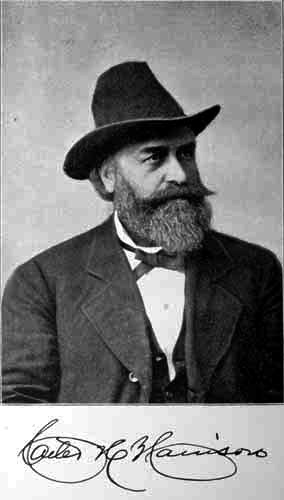
Carter H. Harrison
A Summer's Outing AND THE OLD MAN'S STORY
BY
CARTER H. HARRISON.
CHICAGO: DIBBLE PUBLISHING CO. 1891.
COPYRIGHTED BY DIBBLE PUBLISHING CO 1891 ALL RIGHTS RESERVED
G. M. D. LIBBY PRINTER AND ELECTROTYPER CHICAGO
Transcriber's Note: Minor typographical errors have been corrected without note. Dialect spellings, contractions and discrepancies have been retained.
The cover of this book was created by the transcriber and is placed in the public domain.
PREFACE.
"A Summer's Outing" comprises letters hastily written while the writer was on the wing. Being printed in the Chicago Tribune they were favorably received by many friends, who have urged their being published in book form, as a thing now needed by would-be tourists to the Yellowstone National Park and to Alaska. To this end they were revised and somewhat enlarged. If the little book be of little value, the apology is offered that it will be, too, of little cost.
"The Old Man's Story" is thrown in as filling between two covers, and need not be read except by those who find an idle hour hard to dispose of.
Carter H. Harrison.
231 Ashland Boulevard, Chicago, May 6th, 1891.
TABLE OF CONTENTS.
INTRODUCTION.
The Writer Indulges in Fancies 9
LETTER I.
A Run Through Pretty Wisconsin and Minnesota — Beautiful St. Paul — Jealousy Between Twin Cities — An Indignant St. Paul Democrat and a Careless Seattle Man — Dakota and the Dirty Missouri River — A Dissertation on Waste of Land and Destruction of Trees — The Bad Lands — The Yellowstone River — Gateway to National Park and its Guardian Eagle 15
LETTER II.
The National Park, "The Wonderland of the Globe" — The Home of the Evil One — Steam Vents — Geysers — The Grotto — The Giant — The Bee-Hive — The Castle and Old Faithful in the Upper Geyser Basin 27
LETTER III.
Mammoth Hot Springs — A Wonderful Formation — The White Elephant — A Theory Accounting for the Hot Springs and Geysers — Mud Geysers — Marvelous Colorings of Some Pools 45
LETTER IV.
How to do the Park — Hotels and Vehicles — My Innocents — Charming Scenery — Natural Meadows — Wild Animals — Beautiful Flowers — Debts to the Devil — Camp Life and Fishing — Wonderful Canyon — Painted Rocks — Glorious Waterfalls — Nature Grotesque and Beautiful 59
LETTER V.
We Leave the Park Satisfied — Helena — Its Gold Bearing Foundations — Broadwater — A Magnificent Natatorium — A Wild Ride Through Town — Crossing the Rockies — Spokane — A Busy Town — Midnight Picnic — Fine Agricultural Country — Sage Bush a Blessing — Picturesque Run Over the Cascades — Acres of Malt Liquors — Tacoma — A Startling Vision of Mt. Renier (Tacoma) — Washington, a Great State 82
LETTER VI.
Thriving and Picturesque Seattle — Two Curious Meetings — Victoria and its Flowers — Esquimault and the Warspite — Two Broken Hearted Girls — Charming Sail on the Island Sea — Picturesque Mountains — Growth of Alaska — Whales and their Sports — Native Alaskans — Their Homes, Habits, Food, Feasts and Wild Music — Baskets and Blankets — Salmon Fisheries — Mines and Dogs 102
LETTER VII.
Steaming up the Ice-Packed Fiords and Channels of the Arctic Country owned by Uncle Sam — Salmon Canneries — Canoe Building by Natives — Ascent of the "Muir" Glacier, an Ice Cliff 300 Feet High — Fantastic Ice Formations at Takou — Summer and Winter Climates — Impudent Crows and Oratorical Ravens 134
LETTER VIII.
Vancouver — A Picturesque, Growing City — A Run over the Canadian Pacific — Magnificent Scenery met with from the Start — A Glorious Ride — Fraser River Glutted with Salmon — A Never-Tiring View from Glacier House, Four Thousand Feet above the Sea — Rugged, Precipitous Grandeur of the Selkirks and Rockies — Natural Beauties of Banff — Reflections at the "Soo." 162
CHAPTER IX.
The St. Mary's River — Charming Scenery — The Locality for Summer Homes — An Episode — Mackinaw — Grand Rapids, a Beautiful City 196
PART II.
"THE OLD MAN'S STORY."
The Secret of the Big Rock 203
LIST OF ILLUSTRATIONS.
Carter H. Harrison, (Frontispiece.)
Terrace, Mammoth Hot Springs Page 16
The Giant, Upper Geyser Basin " 32
Jupiter Terrace, Mammoth Hot Springs " 48
Map Illustrating Geyser Actions " 54
The Grotto, Upper Geyser Basin " 64
The Biscuit Bowl, Upper Basin " 80
Old Faithful " 90
Grand Canyon " 112
INTRODUCTION.
THE WRITER INDULGES IN FANCIES.
The summer outing is a fad—a necessity of fashion. Reigning beauty bares its brow on ocean waves and climbs mountain heights, courting sun-kisses. Jaunty sailor hats and narrow visored caps are donned, that the amber burning of the summer's excursion may be displayed at early assemblies of heraldic Four Hundred. Anglo-mania has taught at least one good lesson—that the russet cheek of romping health is more kiss-tempting than the rose-in-cream of beauty lolling on downy cushions. Elite closes its massive doors and draws down front window shades; Paterfamilias sweats in his struggle to force a balance to the credit side, and mothers and daughters sit at back windows in glare of sunlight, wooing sun-beams, while notices of "Out of town" are already placarded on front stoops.
The summer outing is urged by honest doctors, with the admission that change of air and scene is oftentimes worth more than all the nostrums doled out over apothecaries' counters. Motion is nature's first inexorable law. A tiny drop of water is pressed between two plates of glass, apparently rendering the slightest motion impossible. The microscope fills it with scores or hundreds of beings full of life and energy, disporting in pleasure or waging deadly battle. Around us and about us nothing is still. The grasses grow in refreshing green and spring beneath the feet, but ere the wane of day, wither and crackle under the tread. Flowers bloom in beauty and within the hour fade in ugliness. The rock ribs of earth expand and contract under tidal commands of sun and moon, and continents lift from, or are sinking beneath briny oceans.
The gleaming sun, so rounded in glowing calmness as he gently circles across the vaulted sky, is a raging mass of countless millions boiling, dashing, burning jets, in any one of which fiery Vesuvius would be lost as a dim spark. Myriads of starry spheres flecking the midnight sky, are mighty suns tortured by inconceivable convulsions. Far off beyond them the telescopic lens dips up from limitless space countless suns, all boiling, roaring and raging in unending, monstrous motion.
Motion evolves change. Change goes on everywhere, declares science! Change, cries orthodoxy, is universal save in One—the everlasting, unchangeable maker of all things! Orthodoxy tells us that man—man the soul—, was made in God's image and was by him pronounced good. The "good" in God's eye must be perfect. We know that man—the soul man—grows—the perfect therefore grows and perfection becomes more perfect. A Paradox! So is that mathematical truth that two parallel lines drawn towards infinity, meet.
The deathless soul emanates from God. Is the question irreverent? May not the Eternal who started then and keeps all things moving and growing—may not He grow in perfection? May not the Omnipotent become more potent, the Omniscient wiser? Being given to digression, I give this in advance to save the reader one later on.
In obedience to fashion's and nature's law, I would put myself in motion and would seek change. I will take an "outing" in this summer of A.D. 1890.
My daughter, a school girl, will go with me. The old and those growing old, should attach to themselves the young. Old tree trunks in tropical climes wrap themselves in thrifty growing vines. The green mantle wards off the sun's hot rays, and prevents to some extent too rapid evaporation. Gray-haired grandfathers oftentimes delight to promenade with toddling grandchildren. This is good for momentary divertissement, but for steady regimen it is a mistake. Callow childhood furnishes not to the old, proper companionship. The unfledged but intense vitality of the one may sap the slow-running current of the other, and reduce it to the lower level—to second childhood. Age should tie to itself ripening youth. Then heart and springtide is absorbed by the older, and ripe experience given to the younger in exchange.
We resolve to do the Yellowstone National Park, by way of the Northern Pacific Railroad, thence onward to Puget Sound and Alaska to return by the Canadian Pacific. We hope for health, pleasure and brain food. I shall write of our goings and comings, that my friends at home may through our eyes feel that they are voyaging with us.
A beautiful or grand scene is doubly enjoyed when one feels he may through a letter have hundreds see what he sees and as he sees. They become his companions and hold sweet communion with him, though thousands of miles may lie between them. This is sympathy, and sympathy makes the joy of life. The tete-a-tete between lovers "beneath the milk-white thorn that scents the evening gale," is delicious. But not more sweet than the communion between the orator and the mighty audience which he sways and bends at will. He holds a tete-a-tete with each of his listeners.
Byron swore he "loved not the world, nor the world him." The bard was self-deceived. He wrote that he might win the sympathy of millions. Bayard Taylor told the writer once that he wrote from an irresistible impulse. His warm, generous nature yearned for the sympathy of a reading world. I shall write that a few hundred may see through my eyes—may feel when my heart beats, and for a few brief hours may be in sympathy with me. Some one possibly may sneer "Cacoethes Scribendi." Catch the retort, "Honi soit qui Mal-y-pense."
LETTER I.
A RUN THROUGH PRETTY WISCONSIN AND MINNESOTA. BEAUTIFUL ST. PAUL. JEALOUSY BETWEEN TWIN CITIES. AN INDIGNANT ST. PAUL DEMOCRAT AND A CARELESS SEATTLE MAN. DAKOTA AND THE DIRTY MISSOURI RIVER. A DISSERTATION ON WASTE OF LAND AND DESTRUCTION OF TREES. THE BAD LANDS. THE YELLOWSTONE RIVER. GATEWAY TO NATIONAL PARK AND ITS GUARDIAN EAGLE.
Mammoth Hot Springs, July 17, 1890.
We left Chicago by the Wisconsin Central Railroad for St. Paul. From the beginning the run was interesting, especially to one who remembers what the country was thirty-five years ago—an almost flat prairie of tangled grass, in which the water was held as in a morass, promising but little to the ambitious earth-tiller. I recall a remark of Senator Douglas when the future of our flat prairies was being discussed in my presence thirty-five years ago: "People do not realize that the drainage problem is being now daily solved. The leader of a herd of cattle browsing the prairies, is an engineer, and his followers faithful laborers in making ditches. When going to and from their grazing grounds, they march in line and tread down paths which make no mean drains. The cattle of Illinois are annually lifting millions of acres out of the swamp into good arable lands."
As soon as the Des Plaines was crossed, good farms began, and comfortable farm houses were always in sight; oats bent and waved in light green, and corn stood sturdy in emerald, where a third of a century ago, even in July, a pedestrian was compelled to step from ant-hill to ant-hill to keep his ankles dry. Copses of young wood relieved the monotony of too much flatness, and in a few hours after our start, pretty lakes shimmered in the sinking sun light, and sweetly homelike villas were ever in view. We crossed the Wisconsin line, and hill and vale or gentle undulations with wooded heights and flowing streams, and villages and saw mills enlivened the journey.
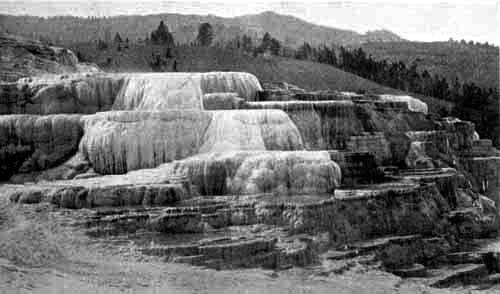
TERRACES AT MAMMOTH HOT SPRINGS. (SEE PAGE 16.)
In the distant future when population shall become abundant, and tasteful homesteads shall replace somewhat speculative shanties, few countries of the world will be more pleasingly rural than southern and middle Wisconsin.
Books should be carried by the tourist in his trunk, and newspapers should be religiously discarded throughout the run to St. Paul. The country traversed opens many a pleasing page during the summer months, and glowing pictures are spread before him on nature's living canvass. He unfortunately loses much when the curtain of night is drawn over God's own impartial book: the book which never misleads if carefully read and studiously digested.
At St. Paul we had some hours to ride about the pretty town, before boarding the Northern Pacific railroad for our long journey to Puget's Sound. This great road has the singular characteristic of having double termini at each end, and between each of the twins there exists a feud rarely found except between cities engaged in actual war with each other.
Athens and Sparta hated each other not as do St. Paul and Minneapolis. Just now, owing to the taking of the census, there is blood in the eye of every St. Paulite. An elderly gentleman introduced himself to me the other day at the station. After a while he said: "It is a —— shame the way the United States is treating St. Paul. I am a Democrat, sir, and can stand a little stuffing of the ballot-box, but I draw the line there. I can't stand the stuffing of the census. We are willing to concede to Minneapolis 10,000 more population than we have, but Harrison ought to be turned out of office for running it up to 40,000. It is a fraud, sir—a miserable Republican fraud. We will be revenged, sir, and will show our teeth next fall and don't you forget it." I sympathized with him and felt like marching to Washington at once to send my cousin Ben back to Hoosierdom.
In the National Park I saw at four different hotels the names of Mr. —— Mrs. —— and two little blanks. There was a bracket after the names, but the writer had evidently forgotten to write in the address. The name preceding his on the first book was from Boston. At the next place the preceding person was from New York, and again from some other city. The fourth day at dinner I was introduced to the head of the family. He was from Seattle. I asked him why it was he had not put in his address, declaring I would tell it on him at Tacoma. "Good Heavens!" he exclaimed, "have I done that?" He rushed back to the register and wrote "Seattle" as big as a John Hancock. The next time we met in a crowd, I twitted him about the thing. He then declared he must have left out the address instinctively from a natural aversion to being known to come from any spot so close to Tacoma. Considerable jealousy of St. Paul on the part of her twin city is natural, for it is a beautiful town. Its residences on the hills are very fine, and their locations lovely beyond those of all but few cities. The entire town was very clean, and in the hill portion bright and cheerful. The residences are generally surrounded by considerable grounds, filled with trees and shrubbery, in much variety and in luxuriant growth. The young girl with me fell so completely in love with the clean, pretty place, that she declared, if she ever got married it would be to a St. Paul man.
The run through Minnesota is as if through a great park. Everything is green and bright. Copse, meadow and field are as fresh as a May morning. The natural location of frequent wooded clumps, of prairie openings and of lakes, could hardly be improved by a landscape engineer. We passed the great wheat fields of Dakota at night, but I thought there was far less of barren plain and alkali patches as we approached the Missouri river, than I saw there seven years ago.
How different the feelings with which we approached the Missouri from those experienced as we drew near the Mississippi! One cannot get up a feeling of respect for the tortuous, treacherous, muddy, long and snake-like ditch. One takes off his hat to the Father of Waters, but feels like kicking, if he had a place to kick, this lengthy, nasty thing. No one can see any real use for it, except as a tributary to and feeder of the Mississippi. It has not and never had a placid infancy. Several of its upper feeders are beautiful, clear, rapid, purling streams. But some of them apparently without rhyme or reason suddenly become flowing mud. One dashes on a train along one and wishes he could alight to cast a fly for a speckled beauty. The road takes a turn around a mountain spur, and lo! the crystal stream has become liquid mud, to prepare itself, I suppose, for the mucky thing it will soon join. Possibly and probably, these transformations are owing to a miner's camp and a placer washing on the other side of the spur.
North Dakota has not become settled along the railroad, after quitting the great wheat belt, as I expected. Farms are very scattered, and when seen are small and wear an air of neglect. Yet the native plains are cheerful looking and roll off in green undulations. The Forest Commissioners, if there be any, must find some more hardy species of trees than those now used to enable them to grow brakes for warding off the winds and blizzards. The railroad people have planted many trees, but they do not thrive. They seem alive about the roots, but dead after reaching one or two feet. Possibly a blanket of snow lies about the roots in winter and protects them; but the alternation of cold and hot winds apparently kills the sap as it rises higher up. Government should inaugurate a thorough system of arboriculture, inviting and encouraging a real science.
The Socialists say the Nation should own the land. To a certain degree the Socialists are right. The fountain of land ownership is in the Government. It should maintain such ownership to a certain extent throughout all time. "The earth is the Lord's and the fullness thereof." Government is and should be the lord of the domain, and should never part with such control as may prevent private owners from destroying the land which is to be the heritage of the people to the latest generation. It should forbid and prevent a waste of land. To this end it should force the husbanding of all resources for the improvement of that which is to support the people for all time. No private owner should be allowed to destroy wantonly that which comes from mother earth. What comes from the bosom of the land, and is not essential to feed and maintain the cultivator, should be given back to it. A man should be fined who burns manure. Man should not cut timber to such an extent as to reduce a necessary rainfall. Commissioners should determine from scientific data, how much of forest is necessary in fixed districts of the country, and when so determined no one should be permitted to cut a tree without replacing it by a young one. In the Old World millions of acres are now worthless which once supported teeming populations; all because they have been denuded of trees. Nearly all European countries as well as India are now, and have been for some years, earnestly endeavoring to check this evil. Commissioners of Forestry, earnest and educated men, have been appointed. Schools of Forestry are fostered by the state. The betterment has been so marked, that the ordinary pleasure seeking traveler sees a wonderful change between visits separated by twenty or thirty years. America has countless millions of acres scarcely capable of supporting a human being, which could be made to wave in cereals or grow fat in edible roots, if only trees were grown to induce a somewhat regular rainfall.
The arid plains of the Great West have the richest of known soils, if a little human sweat mixed with water in sufficient quantity could be kneaded into it. Government as the lord paramount of its domain, should force the growing of trees and should prevent the destruction of timber wherever the same is necessary to keep up or improve the land. It has parted with the title to the soil, but still retains the power to use it for its own support. It levies and collects taxes from lands as the paramount owner. The same power exists to prevent the waste of that from which its taxes spring or through which its people may live.
"No one is a man," says the Arab maxim, "until he has planted a tree, dug a well, and grown a boy." The nation is an aggregation of men and should follow the maxim. The statesman who devises a good system of taxation is entitled to the praises of all men, but he is but a pigmy to the man who turns sterile deserts into places of plenty, or who make many blades of grass grow where now only one springs up. I am ready to bow down before the man who will maintain and improve the soil of our Eastern States, or will shower over the West a copious rainfall.
Bismark was disappointing. It has not improved as could have been expected since we helped to lay the corner-stone of its Capitol seven years ago.
BAD LANDS OR "MAUVAISES TERRES."
The "bad lands" are as God-forsaken in appearance as they were years since. There the very earth has been burned and the Evil One seems to have set his foot-print on every rod. Men do live in them, but more blessed is he who dies in genial surroundings! What a hold upon us has the love of life! So short and such a bauble! How worthless when robbed, as it must be in this bleak tract, of every concomitant of the joyful! Only the All-powerful can reclaim the soil of the "bad lands," and not until a cataclysm has carried it 1,000 fathoms beneath the sea, will it be fitted for sunlight and ready to support life. It has been burned up with the coals and lignites which underlaid the surface. After striking the Yellowstone Valley the ride westward becomes pretty. The mountains are bold, with fine outlines, often lifting in picturesque precipices from the water's edge. Great strata of coal are frequently seen stretching in level parallel lines for considerable distances. Snow appears in seams and gorges on the loftiest heights. While not offering as grand displays as are seen in one or two points of other across-the-continent roads, the Northern Pacific presents more varied scenery, and far more that is pleasing and restful to the eye, than any other except the Canadian Pacific.
To most travelers much of the scenery of the Northern Pacific until Helena is reached is monotonous. But to one disposed to be a student of nature and a lover of its varied forms, many instructive lessons can be conned from the car window, and many pleasing pictures hastily enjoyed. The Yellowstone, along whose banks the road runs for three hundred and fifty miles, is a cheerful stream. When first reached it is muddy, but after the mouths of one or two large affluents have been passed it becomes clear and limpid. Its flow is almost constantly rapid and turbulent. But few still reaches are seen, and these are rarely over a mile or so in length. On one or the other bank considerable mountains lift from the water's edge, in lofty, clear-cut precipices. The upper slopes have but few trees and rarely any clumps or masses, but offer much variety in earth coloring. Light brown, sometimes deepening into chocolate, is the dominant tone. There are frequent stretches of yellow, here and there flecked with patches or bands of venetian red. This latter sometimes takes a tint so bright as to merit being called vermilion.
At Livingston, a thousand and odd miles from St. Paul, we left the Northern Pacific, and by a narrow-gauge road continued up the Yellowstone, fifty-one miles to Cinnabar; thence by Park coaches, wagonettes and surreys, eight miles along the wildly rushing Gardner river, and through a narrow defile hemmed in by lofty precipices beneath frowning crags—the gateway to the park—to the "Mammoth Hot Springs." Near the gateway on a lofty pinnacled rock, so slender as at first to be mistaken for the trunk of a huge tree, sat an eagle upon its eyrie, keeping watch and ward over the entrance to the people's pleasure ground. The bird's nest is built of loose sticks laid upon the rocky point, which is not broader than a good-sized tree stump. How it withstands the dash of storms, which often rage through the narrow pass, is a marvel. Yet it has been there for many years, and each year sends forth its young brood. I regret to say this eagle is not the genuine American screamer, which so grandly spreads its wings upon the daddy's dollar, but is the great white-headed fish-hawk. He is easily mistaken for the bald eagle, but is smaller and a somewhat sociable bird, building his home near by those of others of his species. The true eagle is sullen and solitary, and chooses his eyrie many miles removed from his fellows. Indeed he spurns all fellowship with his kind.
All tourists delight to look at the "Devils Slide" in the Gardner canyon. It is from five to six hundred feet high, a few feet broad, between thin slate dykes, and as smooth as a toboggan way. As there is no record that the father of lies was acquainted with sand paper, there is a peculiar pleasure in imagining the grinding away of the seat of his trousers, while he was polishing down his coaching slide. In spite of what the preachers say, there is no doubt that man, woman and child hate the devil, and are delighted by any evidence of annoyance to him.
LETTER II.
THE NATIONAL PARK, "THE WONDERLAND OF THE GLOBE." THE HOME OF THE EVIL ONE. STEAM VENTS. GEYSERS. THE GROTTO. THE GIANT. THE BEE HIVE. THE CASTLE AND OLD FAITHFUL IN THE UPPER GEYSER BASIN.
Grand Canyon, Yellowstone National Park, July 22.
American dudes of both sexes wandering about the world have been sorely perplexed because Uncle Sam has had no huge ships of war with which to display his grandeur in foreign ports, and no embassadorial residences in which Yankee heels may air themselves to advantage. When foreigners have made allusion to our poverty in this regard, and their own wealth of splendor, we have been forced to fall back upon the Yankee's retort, "Yes; but you hain't got no Niagary." Luckily but few of those who taunted us were aware that Niagara was simply located in the United States but did not belong to it. But now we can throw back at the effete denizens of other lands "the wonderland of the globe,"—The Yellowstone National Park—in which there is more of the marvelous sports of nature than exists in the entire outer world besides. We can tell them of these wonders, and can then say that these marvels are the Nation's, and that this park of over 3,500 square miles is maintained by the Nation for the people, for their amusement and recreation. It is to be regretted that more of the surplus which has been lying idle in the treasury vaults has not been expended to enable the people to better enjoy their wealth of wonders. The people may read of their treasures; they may see folios of illustrations, but no one can comprehend them without seeing them; no pen pictures can bring them before the eye of one who has not been here; no photograph can display their forms and then dye them in their wondrous colors; no painter can spread them upon canvas, for he would at once be put down as an artistic liar. The simple truth is an exaggeration, and a precise copy is a distortion of nature's molds.
THE EVIL SPIRIT'S ABODE.
No wonder the Indians have given this section of the country a wide berth, for well might they believe it the home of the evil spirit. One of them straying here might wander for days and never mount an elevated point without being able to count scores of columns of white steam lifting above the trees from different points of the forest, telling him of the wigwams of the evil one. If he stole along the valleys, he would come upon pools of water of crystal clearness tempting in appearance to the thirsty; some of them not larger than the blanket which covered his shoulders, others so large that the tepees of half his tribe would not cover their area; some mere jagged holes in the rock, others with rims a foot or so in height, and as regular as his pipe of peace. Here are some a few inches or a few feet in depth, with bottoms and sides painted in rainbow tints; there are others with deep sunken walls embossed and tufted, and dyed with the colors of the setting sun, and with dark throats so deep that they seem to be yawning from fathomless depths. Here they are as placid as the eye of the papoose hanging at the squaw mother's back. Our Indian pauses at the painted brink of one, dips his hand into the tempting fluid—jerks it back quickly, but perhaps not before it is scalded. There they boil up one, two, three or more feet and appear as though they would pour out a flood from below, but not a drop passes over the rim of the pool. The boiling motion is from volumes of steam working its way through the waters from the bowels of the earth and spreading upon the breeze. Boiling water elsewhere wastes itself away, but these pools boil and boil from year to year, and scarcely vary perceptibly in height. Our untutored tourist turns his eye upon the mountain bordering the valley, whose sides are so encrusted with geyserite deposit that it appears to have been formed of this material, and to have been erected by boiling springs; along its whitened side and far up on its crest are springs or vents, from which arise columns of lifting steam and the mountain seems to roar; startled, he hears close to his feet, a gurgling sound such as comes from an animal whose throat is newly cut. His eye seeks the spot whence comes this sound of death. He sees an orifice in the ground not large enough to take in his body, but from it comes the death rattle a hundred times louder than the largest buffalo could make when pierced about its heart. The Evil Spirit is slaying an animal so huge that if he were on the ground its tread would shake the earth.
A WONDERFUL PLATEAU.
He climbs over a mountain spur and sees spread before him a white plateau of several hundred acres. Jets of steam are pouring from a thousand points of its surface, some rising only a few feet, others lifting 500 feet into the air; here from fountains boiling merely, or spouting up to one, two, or more feet; there from simple vent holes in the nearly level surface of the plain. Some pour from fantastic forms—great stumps of trees with one side torn away; from piles of downy cushions; from great platters of biscuit, a part as white as dough, others crisp and brown; from ruined castles; from orifices bordered by mighty, parted, Ethiopian lips of whitish gray tone or painted red and brown. One is fashioned like an old time conical straw bee-hive. So well is the model copied, that no great stretch of imagination would be required to enable one to hear the buzz of busy honey makers swarming about it. Another is a rude cabin chimney with steam lifting from its top, in lieu of smoke curling from a woodman's fire.
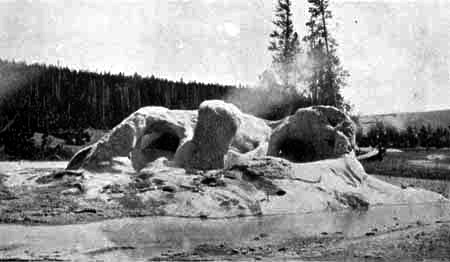
He approaches one which might once have been a grotto, with stalagmites and stalactites forming its ribs and roof, but the superincumbent earth having been removed, the stony skeleton is laid bare, partly a dozen or more feet above the ground and partly sunken below. From its hollow pit comes a roaring sound not unlike the growl of a lion when feeding, only of a king of beasts many fold enlarged. He hears close by it a noise he takes to be the call of a familiar bird. There is no bird in sight, but near his feet in the rocky platform is a small vent he could close with his thumb; it is breathing, but its breath is high heated steam; its inspiration is a gentle gurgle, its expiration is the blue jay's call.
Its breath comes from deep below, from the lungs of the monster whose stertorous breathing is an indication that he is turning over in his hidden lair; and as he turns he belches forth a mouthful of steam and water through the grotto. He has evidently eaten something disagreeable and is sick in the regions of the maw, for up comes another and a larger mouthful; and then another and more, until he pours out his very insides in tons of boiling water. Through every opening of the grotto's frame, water and steam rush forth in mighty volume. Thousands of gallons to the minute lift in jets ten to thirty feet through each opening, and run in great streams to the crystal river a little way below. The monster bellows, the vents about the grotto's base whistle, the water splashes, and the steam rushes, scalding hot. After a while—perhaps in twenty or thirty minutes—all flowing ceases, and a column of steam pours out for perhaps an hour and lifts several hundred feet into the air.
"THE GIANT" IN ACTION.
While this strange action is being seen, close by, a rumbling noise is heard in the depths of "The Giant," 200 or 300 yards away. The noise increases, not unlike that of an approaching railroad train, and is soon accompanied by a discharge of water three or more feet in diameter at the geyser nozzle, lifted in an almost vertical column 150 to 200 feet high, all enveloped in a veil of steam. This pours through the top of a geyserite formation some ten feet high, and a dozen or fifteen from out to out—a monster stump, broken and jagged as if a monarch of the forest had been snapped off by a mighty storm blast.
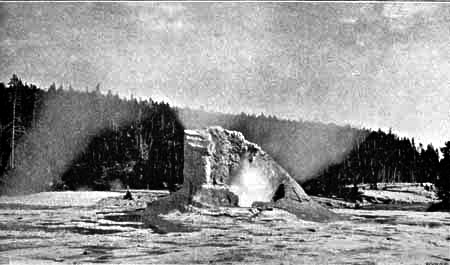
THE GIANT, AT UPPER GEYSER BASIN. (SEE PAGE 33.)
The flood drops all about in spray, veiling the lifted column, and is of such quantity that the river nearly seventy-five feet wide, is doubled in depth when the monster is in action.
Our accidental red tourist has lost his Indian stoicism, and wishes to see something more of the Devil's doings. The "Giant" having become silent, he steals along the white formation a few hundred yards, when, from a small hole in the ground, without any warning, up shoots a beautiful little geyser about twenty feet high, a perfect spreading jet d'eau, accompanied by no steam and lasting only perhaps a quarter of a minute. The action of this little jet over, every drop of its lifted water flows back into its mouth and disappears down its throat; but not for long, for it again shoots up in four minutes, and is so regular in its action, that it has been christened "Young Faithful."
The plateau here spoken of—"The upper geyser basin"—is two or more miles long and of irregular width, probably averaging a third of a mile. It is all white with encrusted geyserite deposit often giving out a hollow sound to the tread. This deposit varies in thickness from a few inches to several feet. It is grayish white, resembling tarnished frozen snow.
THE SPLENDID—200 FEET HIGH.
But see that noble column spouting 200 feet high in a somewhat slanting stream not far from a quarter of a mile away. Close by a smaller jet shoots obliquely, mingling its spray with the larger one. The tourist is too far removed to see the brilliant rainbow formed in the mingling spray. But let him wait some hours and he may visit it again to witness another active eruption from the "Splendid Geyser," which pours four times a day from a simple hole in the rock, and has as yet builded himself no geyserite nozzle. A short walk brings one to the "Devil's Punch Bowl," where the old Fiend takes his nocturnal nip, from a basin a few feet in diameter, inclosed by an embossed rim a foot high and as regular as the raised edge of a Dresden punch bowl, and always boiling and seething to keep the tipple hot and ready.
In this plateau are hundreds of pools of exquisite colorings, and scores of geysers lifting more or less regularly and at shorter or longer intervals; some of the intervals being of hours, others of days and others still measured only by minutes. The geysers are all named in accordance with a supposed resemblance of their formation to some known thing, or to the character, size or quality of their eruptions; "The Queen," "The King," "The Bee-hive," "The Castle," "The Princess," "Old Faithful," "The Excelsior," "The Splendid" and so on. The pools take their names generally from the colorings of their rims or sides, or of the water held in them, as "The Emerald," "The Amethyst," "The Sunset," "The Rainbow" and "The Morning Glory." Some of the pools are named from the nature of their boilings, others from the rock formation in their throats and about their sides; "The Biscuit Bowl," "The Snow-ball," "The Spouter." Many of the names are by no means far fetched. The "Biscuit Bowl," for example, resembles a mass of well formed monster breakfast rolls, some in whitened dough, others in all stages of brown from the half done to the well baked.
The tourist approaches a flattened cone, with a base 600 or 800 feet in circumference, and fifty feet high, surmounted by the ruins of an old castle. The owner of the "Castle" has been growling all day and emitting an unusual amount of steam. He is evidently preparing to erupt, which he does at intervals of several days. His terrific growlings increase as the day wears on, and angry spurts of boiling water accompanied by steam show he is getting his temper up to white heat. He has been quiet for an unusual time of late and when aroused, like Othello, he will be fearfully moved. He makes a few angry premonitory belches and bellows. The noise is accompanied by a trembling of the earth for hundreds of yards. A mass of water is then ejected from 50 to 100 feet up, mixed with steam in dense mass. The flow of water is of short duration; but is of thousands of tons, and is followed by an emission of steam large enough to run an ocean steamer. This steam escape can be heard for a mile or more, and sounds like the roar made by a Long Island Sound steamer blowing salt from its boilers. The noise is continuous for an hour; it gradually lessens, however, until it ceases entirely. Steam is then lazily emitted continuously, and a loud gurgling noise is constant deep down in the Geyser throat. This is more or less the case with nearly all of the geysers. A few, however, become so quiet, that very close attention is necessary to catch any boiling noise. The "Castle" geyser blows off for hours before his steam generators are cleaned.
IT SCARES THE WHITE MAN.
Our red cheeked tourist has stoicism, but he cannot stay over this Devil's kitchen long enough to see half of the mighty vents in action. One, which but rarely plays, shakes the very earth. A good white man, who flatters himself that he is a child of God and believes in sovereign reigning grace, is struck by it with awe akin to terror.
But there is one geyser which becomes familiar to the civilized tourist and seems to win from him a sort of affection, because of his conscientious behavior. His very regularity, however, would strike the more terror into the heart of the untutored red man. He has built his home under a mound 300 yards in circumference and twenty or so feet high at its apex, upon which he has cast a geyserite chimney ten to fifteen feet high and six or eight in diameter. This chimney he has ornamented within and without with huge tufted beads, and painted those within with rose and white, orange and brown, red and grey. These adjuncts, however, do not compare to those of many others, for some of them seem to have wrapped their throats in great pillows, hard as gypsum, but looking as soft and tufty as if made of swans down, while others have painted their inside linings with all the tints of the rainbow; and their crystal clear water seems to have caught the cerulean blue from the heavens and are holding it in solution.
But to return to this geyser; for nearly an hour he has been as quiet as a lamb, just enough of steam arising from his throat to show he is gently breathing. The steam breath gradually grows and is exhaled with more vigor. Presently he belches up a barrel or so of water which falls back into his throat. Then in a minute come two or three such little spasms, when up lifts a rounded column two or three feet in diameter, rising higher and higher in exact perpendicularity 150 feet high. The jet breaks more or less as it rises into pointed sprays, which, when there is no wind blowing, fall with almost precise regularity about the up going column.
WATCHES ARE SET BY IT.
In about five minutes the jet of water ceases, but is followed by considerable steam emissions for a quarter of an hour, when one can look down into his throat and see the crystal water ten to fifteen feet below the apex, and all quiet and still. So regular is the action of this geyser that one could, by watching it, almost dispense with a watch. He never plays in less than sixty-three minutes, and never delays action longer than seventy. Indeed, some of his most constant admirers declare these variations are the fault of watches, not of "Old Faithful." Thus he is named, and as such is known far and near. There are several of these geyser-basins scattered over the park from ten to twenty-five miles apart, the principal ones being the "Norris," the "Lower Geyser Basin" and the "Upper Geyser Basin." These are reached in succession on the tourist road from "Mammoth Hot Springs."
The regular tourist, starting from Mammoth Hotel, dines at the "Norris" and sleeps at the "Lower Basin." The next day, if he prefers to go on with his coach, he passes the "Excelsior," which is the hugest of all the geysers, and has been for two or three years nearly quiet, but this year is in tolerable eruption. It is a vast pool, possibly over two hundred feet in diameter. When quiet, water about twenty feet below the pool rim boils, seethes and tosses in horrible motion. It erupted just as our party reached it, but not in one of its grand actions. A mass of water possibly many feet in diameter was lifted fifty or more feet in the air. It is said that when in full eruption the height of the column is from two to three hundred feet. This I doubt. The mass of steam enveloping the jet is so great that the water column is entirely hidden, and has given rise to exaggeration on the part of those who have seen it at its best. The basin of the Excelsior is called "Hell's half acre," and it is by no means a misnomer, for the earth trembles, and the roar when the geyser is in action is that of an earthquake, while great stones are scattered about for several hundred feet. Close by it are the "Prismatic Springs" and the "Turquoise." The first is two or more hundred feet in diameter and is a placid mass of scalding water. It has various depths; in the center where very deep, it is of an indigo blue which shades off into a bluish green; then where very shallow, it runs off into yellow, orange, red and brown, while some circles are white. It is a marvel of beauty. The color of the Turquoise is precisely described by its name.
The whole park plateau is filled with hot springs, which are building up elevations with their deposit and mounting them as they build. The water is all clear as crystal, but holds in solution lime, iron, sulphur and other minerals, which it deposits sufficiently fast to encrust a key, horseshoe, or other piece of metal in three or four days with a solid enamel—say the sixteenth of an inch in thickness—and of the appearance of second-class white sugar.
The geysers eject, when in action, large quantities of water, but the springs, though boiling and spouting, and appearing to be lifting much water, flow over their rims in very small streams. As they flow they build up their margins, which are thus made almost exactly level. This gentle flow runs off in wavy ripples generally; not in little rivulets, but in thin sheets, depositing the solid matter they have held in solution while below, which is freed by the action of the atmosphere. In this way the springs lift themselves, and build lofty hills. The deposit when fresh is hard, but when dry becomes generally friable, though there are cases where it maintains great hardness. These deposits often times wear beautiful colors, and nearly always do so when being made or while under water. Some of the quiet pools are over 100 feet in diameter. The outer edges when shallow are of a deep brown, followed by a lighter brown or red, then blending into a yellow and followed by a yellow olive, and deepening as they sink into dark olive, while in the deep throats they are almost black. The water before it makes the deepest point, in some is of emerald greenness, in others of exquisite blue; along the steep sloping walls assuming a rich amethyst or tinted in exquisite sapphire.
All deposits take either a wavy or a tufted form, whether on gentle slopes or on perpendicular walls. Some steep walls are not unlike slightly tufted fleeces of wool. The tufts are of all sizes, from that of an orange up to others as large as a bushel basket. One can scarcely realize that these tufts are hard. They appear beneath the water to be as light and soft as newly fallen snow upon an evergreen bush. Some of them are creamy white, others yellow, orange and all shades of brown. In one of the Geyser basins is a large pool actually used by the hotel people as a laundry tub. If you will promise not to mention it I will confess two evidences on my part of weakness. I always shed tears at the theatres, and I washed some handkerchiefs in this boiling pool and they came out nicely white.
NATURE'S PAINT-POTS.
To many, the paint-pots at the "Lower Basin" are the most curious things seen in the park. Imagine somewhat rounded pits of all sizes from those a few inches in diameter to others of forty and even sixty feet across, filled with fine white mud or mortar, such as plasterers call putty, and used by them for hard finish. This is boiling and plopping (I coin this word) like mush in huge pots, or thick soap in mighty caldrons. In boiling, the big bubbles lazily lift several inches high, and more lazily burst with a muffled noise, and sputter dabs of thick paste several feet into the air. Falling upon the rim of the pool, these erect a wall—now smooth as a plastered wall—and then in rough grotesque finish. No mortar made up for a first-class plaster finish was ever tempered as is this natural paste. When dry and pulverized it is an almost impalpable powder. The paste is sometimes white, but more often is of a pale scotch gray. One large pool is half white or whitish grey, the other half of a delicate peach blow. In one pot the putty was a pretty pink salmon. Putting these three colors on a cardboard to dry, I found that much of the coloring disappeared after exposure to the atmosphere. At one basin between the Yellowstone canyon and the great Yellowstone Lake, the mortar is of dark mud, pure and simple, and is lifted many feet in the air, and falling, is sucked back into a monster throat with horrible gurgling sound. Go to a slaughter house to see a stuck pig breathing his last. Multiply his agonizing throes several hundred fold and a good idea can be had of the struggle of these hidden monsters. One of the mud geysers is said at times to be so violent in its action, that the earth trembles for a very considerable distance, when the monster is in full eruption. Curiously there will sometimes be found a pool of crystal pure water boiling or spouting not many feet away, and in one instance, close to a mud boiling pool is a large spring of pure cold water. One is tempted to wish to turn one of these into the mouth of the mud geyser to wash down its throat and ease its agony. Neither the mud nor the white mortar in these craters overflow, but bubble, sputter, and plop year after year. The particles are as impalpable as the fine ground paint upon an artist's easel.
All kinds of pools, geysers and paint-pots are heated more or less highly, all of them nearly up to, and some much above boiling point. The heating is not from the visible water being near to any fire or heated surface, but from super-heated steam, generated far below, being forced through the surface water. Sometimes only steam escapes through the surface orifices. These are called vents. The steam coming from some of these is so hot that the skin would be taken from the hand by a single instantaneous application. They seem to be a sort of safety valves from the great steam generators in the bowels of the earth. No wonder the Indian gives this country a clear berth, or that a good schoolmarm tourist constantly had on her lips Hades! Hades!! Hades!!! To be candid, I think she used the old fashioned word.
LETTER III.
MAMMOTH HOT SPRINGS. A WONDERFUL FORMATION. THE WHITE ELEPHANT. A THEORY ACCOUNTING FOR THE HOT SPRINGS AND GEYSERS. MUD GEYSERS. MARVELOUS COLORINGS OF SOME POOLS.
The tourist entering the National Park by way of Livingston through the Gardner Canyon, and rocky Gateway, at about sixty miles reaches the "Mammoth Hot Springs". Here he sees a surprising formation. Before him rises in terraces each from twenty to thirty feet high, a great white cataract looking mass, several hundred feet high, bulging out into the valley. The center projects with rounded contour far beyond the wings, which recede on either side, and to be seen must be skirted. The entire bent crest is not far from three miles in length. When first approached, it strikes the eye as a succession of water falls tumbling from terrace to terrace. To a second glance it appears a system of falls one above the other hardened into dirty ice. To one who has visited lofty snow clad mountains, an act of deliberation is required to prevent him believing that the terraces are a part of a glacier of more or less purity.
The crests of the different terraces are almost level—some of them apparently exactly so. They are built by water, and, water here levels as it builds, for if there be a depression it seeks it, and depositing the solid matter held in solution, levels it up with the rest. From the crest of the upper terrace runs back a plateau of silicious incrustation covering 300 to 400 acres. Scattered over this, are shallow pools of hot water of a bluish white tinge. About their shallow sides these pools have concentric, tinted borders, some a few inches wide, others of one or two feet. These are bent to conform to the irregular shape of the pools, one within the other, and are several deep. The borders differ from each other in color, being red, orange, yellow and brown and of intermediate shades.
Near the front bulge of the upper terrace, lifts the principal spring or pool on its individual terrace, high above the main plateau. It looks like a turret when seen from below. Flowing in thin sheets over the margin, sometimes a simple ooze, the water from each pool makes a deposit as it spreads over the surrounding surface. At the foot and in front of the great precipice, stand two isolated slender pillars of geyserite, one of them about forty feet high. They are hollow and are the cones or nozzles of extinct geysers. One is called the "Liberty Cap" the other the "Devil's Thumb." They lift sheer up from the level in front of the great formation, and are a sort of sentinels keeping watch and ward over the wonderful picture. A large part of the precipitous projection of each terrace is moist from slowly trickling water.
At the rear of the great plateau half hidden among scattered trees, is a long fissure in the solid rock foundation of the mountain slope. Through this has poured up hot water from below, building, as it flowed, a huge white formation two to three hundred feet long, ten to fifteen feet high, and about as broad, rounded and smooth on its crest. This is supposed to resemble an elephant in recumbent position and has been aptly named "The White Elephant." If one pauses to listen, he will hear a gurgling of running water down in the leviathan's inside, not unlike that made when its living namesake pours a draught of water from his trunk down into his throat. Here, as everywhere else in active spring formations, the sound of running water can be heard beneath the surface incrustation. In some instances the ear must be bent down to catch a gentle rippling; in others it deepens into a hoarse gurgle.
The silicious crest of all of the plateaux on which a person walks, gives out so hollow a sound, that one is apt to feel somewhat anxious lest it break beneath his weight. I suspect, however, if it should do so, the bottom would be found generally at only a few inches, and a crimped shoe would be the most injurious result. Occasionally, however, the crest may cover a deep pool, but not often. When a pool is very still a film of solid matter spreads over its margin as grease does over cool water. This attaches itself to the edge and spreads towards the center. Gentle ripples then overflow this but do not break it down, but thicken it by further deposits. Sometimes one sees these edges projecting well over a deep pool, and strong enough to bear up the weight of several men; some of these may at some time be the cause of very scalding accidents. The principal danger, however, to a moderately prudent tourist is to his shoe leather. One frequently steps into a little puddle after a geyser ceases to act, or walks into a thin sheet to see more closely the coloring of a pool. Either of such imprudences may cost a pair of good shoes. The safest course is to wear old ones for a ramble and to keep a good dry pair at the hotel.
THEORIES ABOUT THE FORMATIONS.
It may not be amiss to suggest some solution of the problems under which the silicious incrustations are produced and the active geysers act.
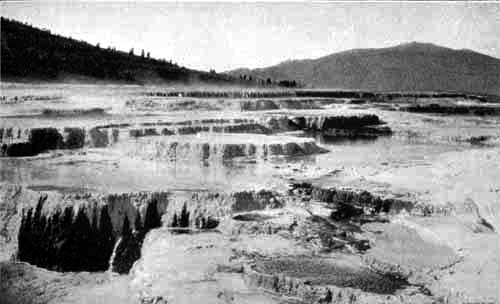
JUPITER TERRACE, MAMMOTH HOT SPRINGS. (SEE PAGE 48.)
The entire Yellowstone Park is an elevated plateau thrown up by volcanic eruption, or more probably was left when the plains sank beneath the ocean, leaving the crumpled back bone of the continent pushed far above. The rocky ribs of earth were pitched here into a more or less vertical position, leaving seams and fissures running deep down into the bowels of the earth in the neighborhood of intense internal fires. Volcanic forces have left their marks throughout the Park. The hot springs and geysers are their feeble remnants.
On the mountain heights, melting snows and rains fill great lakes and copious flowing rivers. These send veins more or less large, or percolate down into the earth crust, supplying the intensely heated rocks with moisture for a vast volume of super-heated steam. The steam seeks an outlet through fissures made in the plutonic rocks by volcanic forces and through seams in the upper crumpled and pitched stratified formations. Passing through these latter this intensively heated steam erodes the softer rocks into throats, recesses and pockets, and taking up minerals in chemicals solution bears them upward, meeting the cooler crust and mingling with percolations from melting snows and rains, it becomes more or less condensed and pours out in small springs. These as they flow, deposit the silicious and other mineral matter held in solution, building up the lower side of the spring, until the rim is level. Thus the spring becomes a more or less rounded pool.
The over flow now becomes very gentle and even over the entire rim. The atmosphere reaches the whole of the overflow as it spreads over the surface of the ground and causes rapid precipitation. The constant outpour causes a constant lifting of the pool and of the incrustations about it. This spreading crust is in laminae or thin sheets. As the pool rim lifts, the weight of the column of water forces some of it between the sheets and carries it hot and rich in mineral and earthy solid matter to the outer edges of the formation, where it escapes to spread the incrustation wider and wider. The streams beneath the crust gradually wear away their channels leaving open spaces above them, which give out a hollow sound when one walks over them, and in them the rippling or gurgling of flowing water is to be heard more or less, beneath the crust.
When such underflowing streams cut a large enough channel, they frequently build up new small pools more or less removed from the parent spring. In other words one vein of hot water coming from below may be the source of several pools. Yet there are many only a few yards apart, which have sources far removed from each other, or at least the steam which supplies them with their heat and solid matter in solution, has passed through widely different and distant rock formations. This is shown by the different and distinct minerals which color the water and the formations deposited by them.
The water in one pool will be comparatively pure, while close by, is that of another strongly impregnated with sulphur, depositing great tufts in yellow and brown, and still another with red borders and olive throat full of oxide of iron. Here will be a pool beautifully green, with exquisitely tinted formations, proving that copper or arsenic are held in solution; and then within a half stone's throw is still another of intense cerulean blue and a third of most delicate sapphire.
In one of the paint pots, in the "Lower basin" not over forty feet in diameter, about half of the putty is pearl gray, while the other half is a rich peach blow. I said that the overflow of the pools was generally small. I recall several small ones and a few fully thirty or more feet in diameter, from which the overflow in a calm day was almost uniform from the entire veins, and nowhere thicker than a very thin sheet of glass. And in some instances the out put was so thin as to be a simple ooze. And yet in many of such pools the boiling action in the centre was great enough to lift bubbles and turbulations many inches high. In one pool called the "Spouter" there are constant large jets lifting from a few inches up to three or more feet, a wild fearful boiling and still only a small stream ran from it. And still others which boiled furiously but had no outflow at all. It is not improbable that from these latter there are water exists below the crusts, which have been lifted up as rims or pool margins. The bubbles and turbulations are not strictly speaking from boiling hot water, but from steam rushing up and striving to escape.
MARVELOUS COLORINGS.
No ordinary stretch of imagination will enable one who has not seen them to realize the variety and exquisiteness of the tints and colorings of many of the pools. The caves of Capri near Naples, furnish not a more wondrous blue, and the grottoes of tropical seas do not afford such variety. The tints are partly derived from the minerals held in solution by the water, but are probably owing more to the reflected tones of the geyserite formation surrounding the throats, walls and margins.
One can easily understand the solution of the problem resulting in the formation and actions of the pools, and of the building of the encrustations of the plateaux, which extend over hundreds of acres. But the actions of geysers are so weird and strange that science has probably not fully explained them. I confess myself too much of a tyro to fully comprehend the more scientific elucidation, which explains the action on chemical principles. I can, however, comprehend the more practical but possibly less scientific theory, which is sufficient for me and will probably also be so for the majority of my readers. The pools and hot springs are formed at all elevations in the valleys and on mountain slopes.
THEORIES AS TO GEYSER ACTION.
The Geysers are always in the valleys and generally contiguous to the lowest points. When lifted up they are probably so raised by their own energies as builders.
On the following page is a cut showing a section of the earth crust, running across a valley and up the mountain side. Along its lowest point flows rapidly a stream of cold clear water fed by melting snows and dews on mountains towering above and more or less distant.
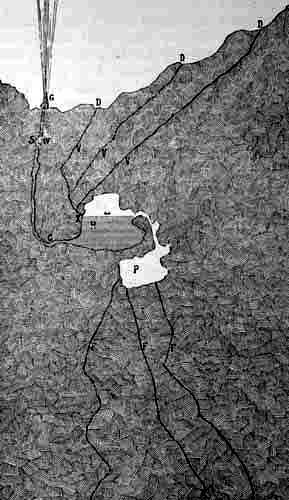
"G" is a geyser cone. Below is the geyser throat or well sinking down to "W".
"S" is a shaft more or less vertical opening into the geyser well and running far down into the softer rocks to "C" a somewhat horizontal continuation leading into "R" a recess or pocket in the softer upper rocks of sufficient capacity in some cases to hold hundreds or thousands of tons of water.
"P" is another recess opening into "R" near its apex. These recesses or pockets have been scooped out by superheated steam pouring up from far below through plutonic rocks contiguous to living central fires. Such steam is generated from veins and percolations of water always sinking from the earth's surface and from moisture believed to exist in or about all rocks.
"D" "D" and "D" are reservoirs on the surface of the earth or beneath it high up on the mountains, perennially supplied by rains and melting snows.
"V" "V" "V" are veins through which water flows from reservoirs "D" "D" "D" into recess "R" at "X". These veins are also fed by percolations throughout the formations through which they run. "F" "F" are fissures or seams in the upper rocks running into and extending deep down in the primative or igneous rocks below, along which highly heated steam generated near the internal fires underlying earth's solid crust, rushes upward into recess or pocket "P". We will assume that there are no veins conveying cold water into this latter recess or pocket.
Now we assume also that at a given moment recesses "R" and "P" and shaft "S" and its continuation "C" are free or nearly free of water. Steam, however, is rushing from them and out of geyser "G" in hot, roaring volume. In recess "R" it is encountering cold water flowing in at "X" and rapidly loses its high temperature and is being condensed. As such condensation goes on, the horizontal continuation "C" is being filled. As it fills the escape of steam at "G" lessens rapidly, until continuation "C" becoming full of water, it ceases entirely or only a small amount lifts lazily up from the hot shaft "S". The inflow at "X" and condensation fills recess "R" with water more or less cool. The steam coming up through "F", "F" no longer having an escape, heats the water in "R" until it reaches a line "L" in recess "R," where it becomes so hot as no longer to condense steam or does it to a very small extent. The pressure of the high heated steam now stops a further inflow at "X" and forces the water upward into shaft "S" and is capable of sustaining the column at the geyser throat "W" and the column in veins "V" at a like height. Condensation having ceased the steam in "R" above "L" and in "P" becomes superheated and acquires enormous expansive power. Finally its energy is so vast that a sudden expansion or explosion takes place. The water at "L" is pressed enormously downward and the contents of recess "R" are forced upward through shaft "S" into the geyser well and then through the contracted nozzle at "G" in a mighty jet high into the open air. The action of suddenly expanded or exploded steam is spasmodic and immediate. All of the water in recess "R" is therefore rapidly thrown out at "G". The water gone, fearfully hot steam follows it through "G" until its spasmodic energy ceases almost if not quite as suddenly as it was at first aroused. Immediately the steam, now coming from recess "R" begins to go through the cooling process before described, until again the shaft is closed at "C" and again a repetition of the eruption is brought about.
This series of actions is more or less regular in all geysers. In old "Faithful" the round is completed in about sixty-three minutes. The recesses or pockets are of various sizes in different geysers requiring different periods of time to be filled. The time taken to empty them, and in some measure the height of the jets depend probably very largely upon the size of the throat and of the nozzle of the geysers. "Old Faithful" has a comparatively small nozzle. His jet continues for several minutes and mounts to a great height. The same is true of the "Splendid." "The Castle" spurts up a very much larger volume of water; but not nearly so high, from a huge throat and in very much less time. The "Excelsior" has a throat many feet in diameter, and ejects a column proportionately large. Its actions are not regular and indeed it is rather a water volcano than a geyser, throwing up large stones and gravel.
"Young Faithful" emits no steam. It is probably only a sort of adjunct of some of the violently boiling pools near by. Steam, which in some of these cause violent turbulations at regular intervals, forces water through lateral shafts up through this little gem. Its throat is very small. A considerable body of water passing from behind with only a moderate force, yet finding only the small throat, makes a jet of considerable height. Jets resembling it are frequently seen on low rocky cliffs on the sea shore, caused by the ocean swell passing into grottoes and caverns and forcing water up along small fissures through the overhanging rock, called "puffing holes". The foregoing theory of geyser action may not bear the test of close criticism, but it is probable that such criticism may be answered by hypotheses not here alluded to. At all events it may be sufficiently satisfactory for the ordinary mind.
LETTER IV.
HOW TO DO THE PARK. HOTELS AND VEHICLES. MY INNOCENTS. CHARMING SCENERY. NATURAL MEADOWS. WILD ANIMALS. BEAUTIFUL FLOWERS. DEBTS TO THE DEVIL. CAMP LIFE AND FISHING. WONDERFUL CANYON. PAINTED ROCKS. GLORIOUS WATERFALLS. NATURE GROTESQUE AND BEAUTIFUL.
Grand Canyon, Yellowstone National Park, July 24, 1890.
I will say at the beginning of this letter, a few words as to how the Park's wonders can be seen. There are associations under leases from the Government and supposed to be under its control, which regulate the movements of regular tourists, in and through the park; one for transportation alone, and the other for feeding and housing.
The latter has five hotels, two of them completed—two others sufficiently so to house their guests. The completed houses are, one at "Mammoth Hot Springs," the other at "Grand Canyon." These are fairly appointed hotels and each is capable of nicely accommodating several hundred guests. Aside from these there are two where a tourist can live in comfort, provided he be not over fastidious. The largest and best hotel is at "Mammoth Hot Springs," at an elevation of 6,200 feet. The next best and next largest one is at "Grand Canyon," 7,500 feet up. Several other hotels are partially finished.
The transportation company has some seventy-five vehicles, two-thirds, if not three-fourths of them Concord stages and wagonettes carrying six to seven passengers, but capable of carrying three or four more by placing three on a seat; the other vehicles are four-passenger surreys. The coaches and wagonettes each have four horses, the surreys two. The tourist purchases tickets for the round trip. Forty dollars carries one from Livingston on the railroad to Mammoth Hot Springs and then around the park, occupying five and a quarter days. This includes hotel expenses. One thus sees everything in the grand tour, but somewhat hurriedly. However, quite a number stop over at the "Upper Geyser Basin" and at "Grand Canyon;" the stop-overs thus making room for those who had halted the day before. There are at this time tourists enough to start out each day from Mammoth Hot Springs about five coaches and several surreys all leaving at a fixed hour and reaching points of interests or other hotels close together, each vehicle maintaining its position in the line throughout the tour. Thus racing is prevented. A great mistake is made in keeping the vehicles in line too close together. For at times the dust on some of the roads is very deep, causing passengers in some of the vehicles to be choked and rendered very uncomfortable. It rains frequently throughout the park; but for this the tour would be almost unbearable. Our party was in this respect very fortunate.
The management very foolishly discourages individual stop-overs, but suggests a stage or surrey party to hold over the vehicle. This is expensive and parties are not always of one mind. I stopped and now stop over, taking my chances for a vacancy in a coach. This should be encouraged by the management, for a person can spend several days of pleasure and instruction at two, three or more points.
"Grand Canyon" from which this letter is started, would make a charming resort for parties for days, or even weeks, and two or three days should be taken to study the "Upper Geyser Basin." But the entire management is yet in an embryo state, and too great an endeavor is made to make both ends meet, with a profitable balance at the end of the season. Some travelers complain bitterly of the accommodations furnished at the hotels. They are, however, I suspect, of those who expect the comforts of home, or the luxuries of first-class city hotels where ever they go. Those who are prepared to make the most of life, and to pick up pleasure wherever to be found, can spend several weeks in the Park, without loss of flesh and with instruction regarding the sports and freaks of nature to be found no where else. The wonders are unique and the marvels unequaled elsewhere in the world.
Some tourists are so unfortunate as to arrive at the park when very large excursion parties from the East make their entry. Then the hotels become necessarily crowded. No prudent provision can make preparation for an extra hundred pouring in on top of the regular travel. At such times one is compelled to take a bed in a room with several others and may even be forced to crowd two in a bed. That happened once to our party. But none of the travelers had the small pox or itch, so no great harm resulted. By hugging the outer rail of a bed, instead of the bed fellow, the necessity of tumbling two in a bed is not altogether a catastrophe.
Besides those who make the regular tours, there are many who hire carriages and wagons at Cinnabar for a leisurely excursion, which may be longer or shorter to suit disposable time and the fullness of purses. Parties too, besides hiring carriages and horses, frequently take tents and enjoy a regular roughing life. We encountered many of these. Some were of a man and his family, others of two or three young men, and still others of men and ladies by the dozen or two, and in one instance thirty or forty were in the party. The large parties have a number of attendants who generally go ahead to prepare the camps for the night, while the tourists loiter along the way to inspect the marvels or to botanize. The small parties we saw, pitched their tents when practicable, near a trout stream, several of which furnished fine sport. Throughout the Park we noticed that at and about localities usually chosen for camping ground, warnings were nailed upon the trees, "Put out the fires." Destructive forest fires have resulted from carelessness of campers. Soldiers in pairs ride along several of the roads daily to see that these regulations are observed, and to prevent injurious results from non-observance. Twice we saw blue coats extinguishing smouldering fires left by reckless people.
My personal stage party up to this point, has been my daughter and some intelligent schoolmarms from New York, one of them, however, resenting the appellation of "schoolmarm." She is a principal. Woman-like, they seemed glad when I assumed command of the party. Queer, how even the brightest and most independent woman takes to a sort of master. Show me one who will not submit to the yoke, and ten to one she is one few men desire to boss. I call my party, "my Innocents," and all move with alacrity when I cry out, "Come girls!"
Between us, it has been several years since the youngest of them wore short dresses. I mean this in good part, for girls just getting into long skirts are very like the rinsing fluid into which the wash-woman dips her clean laundry, and called "blue water"—rather thin!
THE GROTTO, UPPER GEYSER BASIN.(SEE PAGE 31.)
All my Innocents are good, but can stand a straight shot in sensible English. One quotes with a sigh the remark of a friend, who when in the park, had but one word—the word translated "sheol" in the revised version. Quotation marks are convenient when one wishes to say something a little naughty. The Rev. Thomas Beecher, who is one of our daily party, but not in our coach, and who by the way is something of a wag, and is not averse to having a learned theological discussion with one who, like himself, was intended for an Evangelist, speaking of the huge amount of solid matter brought here above ground, declares he must look up Bob Ingersoll to tell him the Devil is making some mighty big holes down below. For my part if the Devil is doing all this, I shall begin to cultivate high respect for him as an artist, and would only ask him not to let the bottom drop out until my friends to the third and fourth generation may come and see. After them it matters not. Let the deluge come. It is evident from the names given to many points about the park that the Devil's friends have done much of the christening in this region.
Now, having to some extent touched upon the marvelous antics of Nature in Uncle Sam's domain, I will say something of those things nearly as interesting, and which make this tour charming as a simple road excursion. The park is full of beauties. The drives are often through delightful pine forests. The trees are small, but straight as arrows, tall and lading the air with delicious perfumes. Many hundred, or rather hundreds of thousands of acres are dead: Some from forest fires, but in many cases apparently from a species of blight, possibly from a failure of nourishment in the thin soil on the mountain slopes for the trees after they have attained any size. Tracks of fierce mountain storms are frequently seen; miles upon miles of forests are thrown down, the trees all lying in one direction, showing that the devastation was done by straight running winds, and not by tornadoes.
There are noble mountains constantly towering above us, although we are ourselves sometimes nearly nine thousand feet above the sea, and never after leaving Mammoth Hot Springs, under 7000. Many of the mountains have bands of snow stretching far below their pinnacles, and some of them are properly entitled, snow-capped. The mountains and slopes are fairly well treed; and the small plains or plateaux show beautiful downs bordered with forest and cut by copses. These downs are green and so smooth in the distance that it is difficult to realize that man has had nothing to do with laying them out. Several level valleys are very pretty and when seen from eminences remind one of valleys over which people go into ecstasies in foreign lands. If there were here a church spire, and there a mill and a sprinkling of hamlets, they would be as happy valleys as the vaunted ones abroad.
The utter absence of habitations on the long drives is a striking peculiarity. The roads being tolerably good and entirely artificial, makes one expect to see hamlets, and he involuntarily finds himself looking for a farm house, when the coach emerges from a forest, and comes upon a broad stretch of clean looking well grassed native meadow land. A turn of a mountain spur along a crystal stream, which has deepened into a pool, suggests a mill pond, and that a water wheel will soon come into view. A grassy plain all sun-lighted causes one to look for a herd of cattle lazily lying in a wooded copse on its margin. But no habitation other than the regular hotels, are to be found within the wonder land.
The park is comparatively a free and safe home for many varieties of wild animals. Guns and pistols are forbidden, except to the soldiers and to the scouts who are a sort of a police corps, whose duty is to see that trespassers do not enter upon the Government preserve. Elk, deer, mountain sheep, bear black and cinnamon, buffalo and other animals indigenous to the Rocky mountains, range freely over the hills without molestation; and beaver build their dams close by the hotels. How many buffalo are yet denizens of the park, I could not definitely learn, but was told that there are from fifty to a hundred. Squirrels and chipmunks are very numerous in several varieties, and very gentle. The bear are becoming too numerous for the safety of such animals as they prey upon. On this account the scouts are destroying many of them.
I said there are no domestic animals, except a few about the hotels. The result is, the grasses are fine and the flowers in great profusion and very beautiful—patches of larkspur as blue as indigo, acres of lupin of various tints, generally blue and lilac with eyes of white; gentians so rich and purple that one feels that they have been dipped in Tyrian dyes; sunflowers and buttercups, making acres look as if they had been sprinkled with gold; and many other beautiful flowers, whose names I know not. But one thistle I must not forget to mention. It is short and heavy from the ground, not unlike the edible thistle of Japan, with leaves and stalks of flesh colored pink, bleached into a sort of mixture of white, green and rose, with clustered flowers in compact head of exquisite rose and pink. It is a rarely beautiful flower. One flower of delicate lavender, thickly strewn along branching spikes, was wholly unknown to all of our party and is acknowledged of great beauty. Its leaf and small flowers lead me to think it a wild hollyhock.
STUPENDOUS SOUNDS OF FALLING FLOODS.
As I sit at my window the roar of the glorious Yellowstone falls filling my ear, I look out across the deep river canyon, to an upper plateau of several thousands of acres of beautiful meadow, some miles away, with here and there a copse of young pines, and all fringed by rich forest, and feel I should see a herd of fallow deer wandering over some ancient, lordly park. It is true that my glass shows that much of the velvety softness of the down is from green sagebush, which is so softened down by the distance that from here it resembles well cut grass. It is very beautiful.
Guide books tell us not to drink the water. I think their writers were in collusion with the hotel management to force guests to buy lager and apollinaris at 50 cents a bottle. By the way, there is on the first days drive an apollinaris spring. It seems to me the simon pure thing. We drank freely of it at the spring and afterwards from bottles carried for several hours. One of the bottles was tightly corked, and, when opened, popped as if well charged. At another spring—a little thing immediately on the edge of the road on the Beaver river and in the cool and beautiful Beaver canyon, we had soda water flavoured with lime juice. At least, it reminded me very distinctly of soda water with which the juice of the lime had been mingled in Ceylon. The bar-tenders in the "Flowery Isle" call it "lemon squoze." It was our favorite beverage in hot Colombo. Both of these springs are small, but from them could be bottled many cases a day. A gentleman in the party who has drank only Apollinaris since he came into the Park, tasted from my bottle and declared it quite equal to the pure stuff. Feeling the need of an alterative, I twice drank several glasses from a hot spring with decided benefits; and have partaken freely throughout the tour of the springs (except those whose brilliant green showed them largely impregnated with arsenic or copper,) and with no perceptible injurious effects. The hotel people are inclined to disparage the waters of the springs generally, and discourage their use, thereby and possibly for that purpose, largely increasing the consumption of lager and bottled waters, which sell at fifty cents a bottle. The enormous number of empty bottles along the road sides and at the hotels testify to the thirst and timidity of the traveling public. The coach drivers call the empty bottles along the road "dead soldiers." The "peg" i.e. whisky soda is the bane of the European in India. The disposition to make "dead soldiers" in the National Park very probably does more harm to the tourist than the native waters would if judiciously used.
When the government does its duty—makes abundant roads and bridges about its marvelous domain here, and analyzes thoroughly its hot springs—I doubt not there will be found many of them of great hygienic value, and sanitariums will be established to make the park a blessing to the afflicted of the country.
One good housewife whom I met frequently at the different halting-places, sighed deeply at the enormous waste of hot water, declaring there was enough here to laundry all America, and to wash the poor of all our big cities. The good people tell us everything was made for man. I doubt it. He is not worth the good things lavished upon him. He is a part of the mighty plan and will be followed after the next cataclysm by beings as much above him as he is above the chimpanzee. But if the good people be correct, Congress ought to take immediate steps to enable the people more fully to utilize the mighty Hygea located within the bounds of this park.
Surrounded by bare and bleak mountains and hot and arid plains, here at this elevation rains are abundant, and dews are sufficient; trees clothe mountain top and slope; grass is green and fattening, and flowers deck the open downs and shade the forest land. And yet the air is dry and beneficial to all except those whose lungs require an atmosphere less light. We have seen several consumptives who have come here for their health. The rarified atmosphere makes their breathing very laborious and painful. Possibly in the early stages of the disease, benefits may be derived from a sojourn here, but in its later stages, the poor victims suffer fearfully. The majority of those whom we have seen here for health, are camping out and seem to be having a good time. They have their horses, and spend their time fishing and riding.
On the road from the lower Geyser basin to Grand Canyon we halted at a little rivulet to water our stock. The stream cut its way deep down in a grassy plain, and was so narrow that one could easily jump over it. A small camping party had just pitched its tents close by. While the tent lines were being stretched, the gentleman of the party came to the rivulet near us to angle for his supper. He cast his fly a few times, when there was a "rise" to it not twenty feet from our coach, and a two pound beauty, speckled and plump was landed. I envied the camper.
In some localities in the Yellowstone, and especially in and about the great lake, parasites so infest the fish as to unfit them for the table. The infected fish, however, are easily known and may be discarded, while the good are retained. A gentleman who has fished throughout the park informed me, that as a rule, the fish were good. Like the trout in all the Rocky mountains and Pacific regions, the fish caught here lack the delicate flavour of the brook trout taken in the Adirondacks and throughout the New England States.
We regret we could not visit the Great Yellowstone Lake. The hotels there being unfinished, the regular stage route does not yet take it in. It is at an altitude of 7700 feet, and is over twenty miles long from the North-west to the South-east and fifteen from North-east to South-west, covering an area of 150 or more square miles. It is very irregular in its form and said to be a beautiful sheet. Excepting the lake in the Andes it is much the largest lake in the world at so great elevation. A large hotel is being erected on its margin. When finished it will make a very attractive addition to the Park tour, and will furnish a stop over for days or weeks to those who have time at their command.
One is surprised to find how quickly he becomes fatigued by a short climb, until his lungs become accustomed to the rare medium he is taking in. One old man, I need not name, stepped jauntily by the side of a pretty schoolmarm and swore he was 32, but the climb of a mile made him, with blushes which tinged the cuticle of his bald head, acknowledge he was past 65. He was somewhat relieved, when he saw how the sweet innocent was panting at his side.
There is here what I am told exists nowhere else in the world—a mountain of glass—volcanic obsidian—monster masses resembling the molten opaque blocks left by the Chicago great fire in the ruins of a glass warehouse. We drove along a road of shivered glass. The engineers built fires over great obsidian bowlders, and then threw cold water from the stream close by over the heated mass, breaking it into glass gravel. Chipmunks of several varieties, gray pine squirrels, hop about barking within a few feet of one; robins are almost as gentle as sparrows, and bears come down near to one of the hotels nightly to be fed for the amusement of the tourists. Beavers have their dams close by our hotel and can at dusk be seen swimming about and feeding. A small herd of buffalos, since we have been here, rushed across the road just in front of an excursion party, giving the stage horses a fright and nearly creating a panic. No gun is allowed in the park, except to the military and scouts, and no one can kill an animal, except when driven to it for want of necessary food. Two companies of soldiers patrol the regular routes to enforce the regulations and to serve as voluntary guides for the ladies of the daily parties. They forbid the smallest specimen to be carried off. I had even to hide the little dabs of mud I took from a paint-pot. Uncle Sam is cultivating good nature among men and beasts within this, his unique domain. Even the devil may grow good-natured, and may cut up his didos and antics after a while only for the people's amusement.
THE CLIMAX OF GRANDEUR AND BEAUTY.
Having told you of the freaks and sports of nature which make the more striking marvels of this wonderland; and having spoken of the softer and sweeter characteristics of the Park, I now come to what the majority of the travelers consider its gem.
A Soudanese wise man is said to have swallowed the tale of Jonah and the whale without making a wry face, but grew fighting mad when asked to believe the story of snow and ice in northern lands. The genii might easily send a man through a whale's belly, but Allah himself could not make water hard and dry. So it is easy to tell of the monstrosities of the park, and hope for credence. They are simply monstrosities—the work of demoniac power, and are credible. But who can make another believe that huge precipices, one and two thousand feet high, have been painted with all the colors of the setting sun; that the rainbow has settled upon miles of rocks and left its sweet tints upon their rugged sides? And yet this and these are true of the Yellowstone canyon.
We approached it from the South on a road running near the river. On a pretty grassy bank we rode along the stream, here over a hundred yards wide, rolling swiftly yet smoothly along in green depths, preparing to make its two plunges into the chasm below. Swift and swifter it hurried onward in quickened dignity. Presently the rock walls on either side grew contracted to a hundred or so feet, and then the green stream rushed in smooth slope to a gateway of eighty feet in width, through which, with parabolic swoop, it leaps 112 feet with such depth on its brink, that the deep-emerald green is not lost till it strikes a ledge at the bottom, where a large part of the falling sheet is shot off at an angle into the air, half as high up as the fall itself. The two sides of the river at the brink of the fall rush against precipitous walls and are bent and curled upwards into a veil six or eight feet high over the green center—a veil of countless millions of crystal drops—over the main stream of emerald more than half hidden in a mighty shower of diamonds. Standing immediately on the edge, one can imagine how Niagara's Horseshoe would look if one could get within a few feet of it. This fall is not very lofty nor wide, but is one of the most beautiful in the world. The river after the first fall rushes in foamy swirl a half mile further, between cliffs which on either side lift 1,500 feet high, and growing higher and higher, and then with one wild leap plunges 300 feet into the rocky gorge below.
As it drops the emerald and the diamond struggle for supremacy, but the brighter crystal gains the ascendency before all is lost in the lace-like mist which envelopes the depths. The whole when seen from a little distance looks as light as a gem-decked veil of lace, but so vast is the body of the water which makes the leap, and so great the fall, that to one standing a mile away, with a point of land intervening between him and the fall, shutting off the noise of the splashing water, there comes a deep and mellow bass, richer than any I ever heard before made by a water fall. It is not an angry tone like Niagara's roar, but is as deep and mellow as distant rolling thunder when heard in a mountain gorge.
These falls are beautiful in the extreme, but the beholder soon forgets them in wonder of the canyon which bends between the towering cliffs for four miles. Far under him, at least 1500 feet down, the river leaps and tears, now in green, and then in snowy foam, between precipices at whose feet no human foot ever did or can safely tread. The rocks lift on either side in mighty buttresses like giant cathedral walls. Standing out before the walls are towers and pointed spires of most artistic form, all painted in exquisite tints. The upper walls are of yellow and orange hue, with here and there towers and bulwarks of chalky white or of black lava over which is a film of venetian red. The upper yellow walls, sink and contract between the lifting buttresses, which at their base are of lava black, running first into dark umber, and then into chocolate bordered with black and stained with red, often so bright as to be vermillion. In some places the main walls are broken down, where some long-ago slide has carried their steepness into the river below, but with slopes far too steep for human tread. Some of these slopes are orange and yellow as if coated with sulphur; others are painted in vertical bands of brown and red, with between them narrow stripes of pearl gray and yellow, and of orange stretching for hundreds of feet, and at one point for a half mile in extent; one of these slopes look as if a banner with these several colors, had been spread over it, and then being removed, the colors of the drapery had been left upon the soft velvety rock. The buttresses and spires lift now fifteen to a hundred feet apart, and then they are spread so that the golden wall between shows 150 to 200 feet. All of the colors except the yellow seem to be in and of the rock. The yellow looks as if made by blowing thousands of tons of flowers of sulphur upon the walls, the flowers having clung when the wall had some incline, but having dropped off from the vertical rock.