Front matter (continued 2)
Reading edition
These painted rocks extend along the canyon for about four miles; then the gorge grows more somber and dark, and so continues some twenty miles. This lower part seems to be of a harder rock. It was cut through myriads of ages ago and has grown darkly gray, while the painted part is of a much later period and is of soft rocks—so soft that they seem to be composed of somewhat indurated volcanic ash, sulphur being the predominating mass. The red coloring is from oxide of iron. These blending together make other tints. Burnt Umber, often deepened into a rich chocolate is the dominating one. The buttresses are of a harder yet still a rather soft lava, of a yellowish brown tint near the summits, red and brown below, and finally towards their bases almost black. Sometimes there are slopes of white lime and several towers, nearly 2,000 feet high sheer up from the river, are so white that one could think them chalk. Half way down the heights are great points, like the sharpened spires of a cathedral, colored as if a mighty pot of venetian red had been emptied over them and had run in streaks down the rocky sides. Had an artist tried to sell me a picture of these cliffs, before I had seen them, in no way exaggerated in coloring, I would have called him a fraud, and would have thought he had taken me for a fool. I have seen now and then pictures which I considered daubs, which I now know did not in the least overdo Nature in its freak of rock-painting. I quit the park glad that I came, but feel that the rush and labor of going through it would hardly repay a second hasty visit, at least for several years. Yet I can recall no excursion of the same length in any part of the world half so full of surprises. Could we have made it leisurely, our enjoyment would have been greatly enhanced. We have met some tourists who think the labor and annoyance of the thing over-balance the profit and pleasure. Burns says "Man was made to mourn." In my weary round, I have frequently been convinced that about half of the travelers of the world were made to growl, or at least half think they fail to show their "raisin" unless they do growl.
Equanimity of temper is the most valuable of all human characteristics for happiness. It is absolutely necessary to the traveler, who desires to learn much, and to enjoy what he sees. A plain traveling suit on one's back, a resolution to make the most of every thing in one's mind, and the least possible luggage to carry, are the three indispensables for a good traveler. The park people may not do all they should for the public; indeed, I fear they have many short-comings, but I for one, am very glad they are here, and that they do as much as they do.
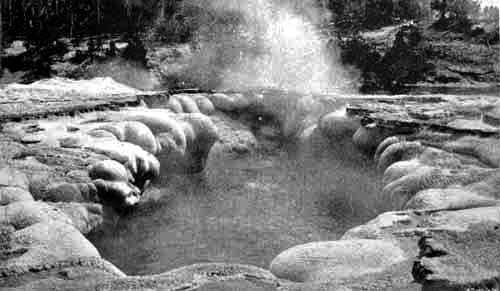
THE BISCUIT BOWL POOL, AT UPPER GEYSER BASIN. (SEE PAGE 35.)
The hotels at Mammoth Hot Springs and at Yellowstone canyon are large, each capable of housing two or three hundred guests. The beds are clean and soft, the table fair and the attendance quite good. I have only one complaint to make. At the first named hotel they will insist on a brass band's tooting a good part of the time. The noise it made was execrable. There is no such thing as bad music, it is either music or it is noise. At Norris, the hotel is poor and the managers impolite. At the Lower and at the Upper Geyser Basin, the houses are unfinished, and the rooms not sufficient in number, but the people do their best to please. This endeavor should cover a multitude of sins.
LETTER V.
WE LEAVE THE PARK SATISFIED. HELENA. ITS GOLD BEARING FOUNDATIONS. BROADWATER. A MAGNIFICENT NATATORIUM. A WILD RIDE THROUGH TOWN. CROSSING THE ROCKIES. SPOKANE. A BUSY TOWN. MIDNIGHT PICNIC. FINE AGRICULTURAL COUNTRY. SAGE BUSH A BLESSING. PICTURESQUE RUN OVER THE CASCADES. ACRES OF MALT LIQUORS. TACOMA. A STARTLING VISION OF MT. RENIER (TACOMA). WASHINGTON, A GREAT STATE.
Tacoma, Washington, July 31, 1890.
Familiarity is said to breed contempt; certainly it robs strange things of much that at first seems marvelous. On our return from the excursion around the Park, the formation at Mammoth Hot Springs had lost much of that which on our first visit struck us as so wonderful and charming. We had seen other things greatly more wonderful with which to compare them. The encrustations seemed not so white and the colorings of the water had lost some of their prismatic variety and perfection.
The impressions made upon the mind by Niagara grow on succeeding visits. A storm at sea arouses no less awe because several have been before passed through. Niagara and the ocean are in eternal motion. Motion irresistably suggests change, and change precludes monotony. One does not lose his feeling of awe, after looking for many times upon the towering heights of the Yungfrau or of Kinchinjinga. Their inaccessible peaks and eternal snows repel every disposition to close communion. I doubt not, however, if a safe railroad could be run up to mighty Everest's loftiest pinnacle, that tourists would snap their fingers at the world's monarch when standing in warm furs 29,000 feet above the sea.
The still and apparently unchangeable incrustations at Mammoth Hot Springs, were looked upon on our final visit without awe or surprise. A large party of us left the hotel for Cinnabar closely packed in the coaches and surreys on a bright sunny afternoon, glad we had seen the wonderland, but quite satisfied to leave our labors behind us. As we dashed down the defile near the park line, we doffed our hats and bade adieu to the eagle sitting on its eyrie as we had seen him on our entrance. The downward ride was quite rapid, and some of us who had been drawn into somewhat close communion during the past week were almost sorry when we so soon reached Livingston—some to go eastward and others westward, all to part most probably forever.
From Livingston to Helena the run was made at night. We found the latter a bustling place and well worth a visit. There is an air about a mining camp which can be seen in no old country, and Helena though now full of city airs yet has many of the characteristics of the camp. Its foundations rest upon gold bearing earth, and even now in digging cellars, quite in the town, pay dirt is found. Nearly the entire site of the city has been dug over by the miner. It was in one of its gulches, now a street, that a prospector wearied out by unsuccessful tramps and reduced to his last dollar, stuck in his pick to try for a "last chance." He had no expectation of reward, but dug down in sheer desperation before going off a pauper. The result was "The last chance mine," one of the richest ever discovered.
We stopped at the Helena hotel and found it quite equal to any in large eastern cities.
The Broadwater Hotel, however, some three to four miles out of town, is now the lion of the place. It is a cottage-built house, with 200 fine rooms, all finished in hardwoods and elegantly furnished. Its bathrooms, with huge porcelain tubs and large dressing-rooms attached to each, are especially fine and the baths are said to be medicinally good.
THE SWIMMING BATH OF THE WORLD.
But these dwindle when compared with its huge swimming bath. The natatorium building is about 350 feet long by 150, with a roof 100 feet high, supported by light arches in single spans. The tank is 300 feet by 100; at one end about four feet deep, and running to ten or more at the other. Natural hot and cold waters pour over a precipice of cyclopean masses of granite at one end, about fifty feet wide and forty high. This precipice is pierced by three large openings over which the water pours in great sheets, and so artistically that one would easily believe it a series of natural falls. The flow is so large that the tank is replenished several times a day. The temperature was to me rather high—about 80 degrees. A swim in its deep waters, however, was very fine. The whole is lighted by day through windows high up, of cathedral glass in different tints, terra cotta predominating. The hotel, with its 200 rooms, and the tank-house and grounds are illuminated at night by incandescent lights. We saw it only by day, but could easily imagine how beautiful it must look and how gay a scene it must offer when 300 or 400 people are in at night—men and gay ladies. Very decorous bathing suits are furnished to bathers, and those bringing their own, are compelled to have them of conventional modesty. I was told that 300 bathers of an evening is not an unusual number, and that it is largely frequented during nine months of the year and by the very best people of the city. The charge is fifty cents for an entrance, so as to keep out the riff-raff. Col. Broadwater has expended half a million on the house and grounds, bringing his hot water from a mineral hot spring some four miles up a gorge, and a large supply of cold pure water also from the hills. The hotel was full. We took lunch with the Colonel and some friends, and found it like everything else, first class. A steam and an electric motor road leads from the city to the hotel. By the way, why do the street car people not put in electrical motors in Chicago? At St. Paul, Helena and Spokane we have ridden upon them and were delighted. A car looks as if it were out fishing with a fishing rod springing from its top, bent just as if it were playing a gamy fish.
The hospitalities of the Broadwater very nearly cost us our connection at the railroad. We gave ourselves but little time, expecting to find a carriage ordered to be in waiting at the electric road city terminus. It was not there and we walked to our hotel to find we had but eleven minutes to get our luggage on a carriage and to reach the railroad station a mile and a half away. The porter said it was impossible to reach it in time. We ordered our traps brought down and rushed to our rooms for our small pieces. At the office were a crowd of newly arrived travelers. I called to the clerk saying I had no time to pay hotel bills. He smiled. Taking advantage of his good humor we mounted the carriage telling the driver to make the train or die. He said he would land us on the train or in—naming a rather hot place. He tore through the town at a full gallop. People in shop doors looked at us and smiled. Possibly they suspected an old gray beard was getting away with a young girl. The jehu and his horses were plucky. The station house as we drove up hid the train from us, and hid us from it. We turned the building, the train was well in motion, the engineer checked up but the train continued to move. We jumped down; the driver threw our trunk into the baggage car; I landed my valise on the platform of the next car; my daughter got her satchel on the next and she climbed up on the third. I caught on and climbed the fourth and threw the fare to the driver. Quite a crowd of people about the station admired our pluck, and when our driver yelled out "Hurrah for Chicago" a generous response went up from a score or more of throats. Success is admired everywhere, but out west it is the cure all. Every man at that station would at that moment have voted for me for—pound master. Shortly after leaving Helena the climb is commenced in scaling the real Rocky Mountains. The road bends and winds over many magnificent curves and loops, rapidly climbing upward. Now we look far above us, at a locomotive slowly creeping along the mountain side, and we look down upon the road we had a few moments before puffed along, but already hundreds of feet immediately under us. The mountains towered above us, covered by great black precipices, and mighty detached rocks standing alone or in groups. This is the true backbone of the continent, and the black scattered rocks might be vertebrae pushing through the worn cuticle. We could understand here why these are called the rocky mountains. Rough towers and jagged turrets black with the weather wear of ages are the salient features of the heights and slopes. Here they are in great groups, there isolated. Now they are compacted into massive precipices, frowning and repellent, and then scattered as if dropped by icebergs. They are, however, not mighty loose boulders, but are moored to and are a part of the mountain's foundation rocks.
We crossed some lofty trestle bridges and looked down upon a stream thick with mud from a gold washing camp near by. At length we reached the summit. Our extra locomotive was side tracked and we breathed an atmosphere perceptibly different from that we had left on the eastern side of the range. We were now upon the Pacific slope.
We halted for a few minutes at Missoula. The fine valley was bathed in the glowing red of sunset. We lost at night much beautiful wooded scenery which I once before enjoyed so much. To one simply going to Puget Sound it is worth while to stop over at Missoula and then to run down Clark's Fork by day. But we wished to have a full day at our next stopping place.
Of all the cities we have seen, the busiest was Spokane—pronounced as if there were no "e" at the end and the "a" quite broad. Seven years ago I was there. Then it had but 800 dwellers. Now there are in the neighborhood of 25,000. There are several streets with elegant business blocks, finished or being completed, of four, five, and six stories in height, comparing favorably with those of any Eastern city in architectural design and finish. The heart of the city reminds one of Chicago the spring after the great fire, and the people seem to have the same pluck, and energy, and confidence that so marked our people at that time. Some of the private houses on the steep, hugely-bowldered slope of a high hill on one side of the city are models of elegance. We visited two which were real chefs d'oeuvres of architectural design—one a Swiss chalet, the other Mooresque in design. Everything was after the original models, even to much of the furniture. I have never seen except in some model houses abroad such complete specimens. The outside of several others which we did not visit are quite as fine. Mrs. Cutter, the proud mother of the architect, exhibited her house with great hospitality, and Mrs. Moore seemed to feel that she had no right to hide her gem of a residence.
At evening we were invited to a fete champetre on a fine lake some forty miles north of the city and 800 feet elevated above it. About 300 of the elite of the town went out by rail, danced, and had supper, returning to town by 1 o'clock in the morning. The young girl with me enjoyed it greatly. A severe cold just caught forbade my appreciating anything but the sweet, sincere hospitality shown us. Judge Kinnaird, the son of one of the friends of my early Kentucky boyhood, got us the entree of Spokane's "four hundred." This is destined to continue a thriving city, but lots at $1,000, four miles from the heart of the city, will burn badly some real estate speculators. It is said a mining trade of nearly $50,000 a day naturally belongs to the town. I fear, however, there will be a bursting of a bubble when the burnt district shall be restored. A large trade will be necessary to support the great number of mechanics and laborers now lifting the town from its ashes. Hotel Spokane is a very large and good house.
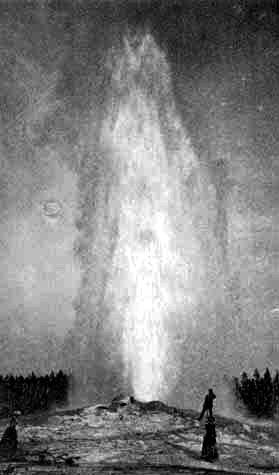
OLD FAITHFUL, AT UPPER GEYSER BASIN. (SEE PAGE 36.)
Very fine crops are grown in the Spokane Valley. The crops of oats and wheat sown for hay was being harvested and proved a very heavy yield. Washington claims she will harvest over 20,000,000 bushels of wheat this year. I was surprised to see fine fields of grain on the rolling plains in the great bend of the Columbia river. I remember speaking of the richness of this soil in the "Race with the Sun," but thought artificial irrigation would be necessary to make it yield. This year there are fine crops where only nature's watering can ever be availed of. One of the stations, quite removed from any water course, has grown into a thriving town, showing that the country around is prosperous.
I suspect that a fair rainfall cannot be relied upon from year to year. It will, however, become more and more reliable, for it has been the rule throughout the world and probably through all ages, that rains follow cultivation, and man's presence and industry calls down Heaven's aid. The answer of Hercules to the cartman would be the reply of Ceres as well to the prayers of her votaries.
The ash colored sage bush was thought by the early men of the great plains to be poison to the land. It however was one of God's bounties to man. It prevented the soil from being blown away and where it grew the most lavishly, is now found to be the best of soils. Sage bush not only keeps the winds away, but when dead and rotten fills up sand pockets with material rich for all of the small grains. The people of the Yakima valley on the eastern slope of the Cascade mountains, boast that theirs is the garden spot of the Pacific country. They certainly do produce fine fruits, melons and garden vegetables, but I have not been struck favorably with the outlook of the locality in either of my trips through the land.
The run from Ellensburg over the Cascades is a magnificent ride. The enormous mass of forest, prevents many extended views, but those seen are very fine. Every break in the forests would reveal lofty mountains' slopes clothed in forests of marvelous richness, and now and then snowy heights would tower aloft. Once a fine view of Renier is caught, the monarch of the grand range. Robed in his snowy ermine he stands out a sceptered hermit wrapped in his isolation. Seen from the sound he is one of the most picturesque peaked mountains of the world, and from all inland points of view he is a grand towering mass of ever living snow and ice.
ARKANSAS HOT SPRINGS, RIVALED.
Having done considerable hard work on the trip so far, we resolved to take a rest at the hot springs, three and-a-half hours from Tacoma, on Green River. Three years ago my boys and I fished here pleasantly for several days. The place is unpretentious, but the waters possess apparently the same properties as those of the Arkansas hot springs. The place is some fourteen hundred and fifty feet above Tacoma. During our present three days stop, an overcoat has been comfortable in the evenings, and we sleep under three blankets. A cold batch of air drops down the valley from Mount Reniers (Tacoma calls him Mount Tacoma; Renier is his name), 14,400 feet of snowy peak, driving away all summer sultriness. A bath in the medicinal waters of seven minutes and then a pack causes the perspiration to flow from one quite as heavily as the same course would do in Arkansas. Before leaving home I had a large and painful carbuncle on the back of my neck. The sign of the cross was cut deeply into it, and as it healed it proved a nest-egg for several smaller jewels near by. These I cauterized with pure carbolic in the park, but still they annoyed me much. Four baths here have at least temporarily dried them up. Men who came here three or four weeks ago on crutches from rheumatism, are walking about freely and feel themselves able to buckle down to work.
A WONDERFUL GROWTH OF TIMBER.
A sight of the magnificent cedar and fir forests here would amply repay an Easterner for a day's stop-over. I have been among them before several times, yet at each visit they surprise me as they did at first. Fifty thousand shingles are made from a single cedar. I counted twenty-one firs on a space considerably less than a quarter of an acre. The owner, a sawyer, assured me they would cut over five thousand feet of board each. He owns a quarter of a section about his mill and expects to market 15,000,000 feet of lumber from his land. He said the railroad company had cut 30,000,000 feet from its right of way of 400 feet by ten miles in this locality. I saw on a quarter of an acre a cluster of twenty odd trees from four and-a-half feet to over six in diameter and 300 high. They ran up about 150 feet before reaching a limb. Mighty logs lie upon the ground so thickly that even a good woodsman can walk but little over a mile an hour. Cedar logs, moss-covered and sodden, stretch 100 feet in the tangled undergrowth, and have lain there so long that one often sees a fir tree, growing with its roots straddled over them 50 to 100 years old.
We were pleased to find among the guests of the springs one of Chicago's fairest daughters, now living at Tacoma, whose pulled-candy tresses three years ago out-glistened the fiber of her bridal veil, and whose eyes are bluer than the turquoise in her talismanic ring. I like little unpretentious Green River, Hot Springs, even if its table is not of the Delmonico order.
MALT LIQUORS IN THE ORIGINAL PACKAGE.
A pretty drop of fourteen hundred and odd feet through wild rocky gorges and thickly treed glades, along the rapid green waters of the river, in which trout abound, between lofty heights, brought us to the world-famous hop yards of the Puyallup Valley. What masses of green lift upon the closely-set hop-poles! I involuntarily cried "Prosit und Gesundheit" as we whizzed through them. Twenty-three or four years ago, the first hop root was planted in the soil of this marvelous valley. Now in this valley and others in this locality, two hundred and fifty thousand acres are giving forth each year crops unknown in any other hop land. Two thousand pounds to the acre are not unusual, and some yields have been nearly if not quite double that. Thousands of barrels of malt liquors were green about us in original packages.
When we alighted at Tacoma, from which I date this letter, I was most agreeably surprised to find that Mr. Winston and his two fair daughters were on the same train. They had intended going with us into the Yellowstone Park, but were unavoidably detained. They have done the Park more rapidly than we did and here overtook us. To-morrow we will be fellow-passengers for Uncle Sam's ice-bound Eldorado, Alaska. Tacoma has been and is growing with great rapidity. A great suburb covers a wide slope on the upper end of the town, which at night, when I was here three years ago, had the appearance of a Titanic camp-fire. Fires gleamed along great logs; fires burnt on sides and tops of lofty stumps, and fires belched forth from burning trees fifty and more feet from the ground. Diagonal auger holes had been bored near the root into the heart of a tree. Two holes meet at the heart thus causing a draught. Fire was put in, igniting the inflammable pitch, always richest near the ground. It then bored its way up the heart to break out as from a flue, often a hundred feet from the roots.
Tacoma was a cluster of shanties with a small population, barely among the thousands, seven years ago. It was a dusty, scattered, ungainly big village of 12,000 three years ago. Now the census gives it about 40,000 population. The Northern Pacific company is filling the five-mile flat marsh along the Puyallup River which empties into the bay, in front of the town. A large part of this belongs to the Indian Reservation, and is covered by several feet of water during the high tides, which come up the Sound. The filling is being done by a powerful pumping dredge, which pours each day a vast quantity of sand and silt from the deeper part of the river upon the flats to be filled. My friends Christy and Wise of the Illinois Club, Chicago, are part owners of the powerful dredge, and I suspect are making a big thing of it. The reclaimed land will, when high and dry, be worth millions, and will be the seat of the best business portion of the future city. The generous way in which this great railroad company has taken possession of and is appropriating the fat of this place reminds one forcibly of what is or may be going on in a city between this and the Atlantic. Columbian World's Fair Commissioners, Directors, and City Councils may possibly be sometimes just a little too generous, as Congresses are and have been. The people may sometimes permit their patriotic fervor to make them somewhat unobservant of the wide reach and tenacious grasp of monopoly. Corporations are said to have no souls. Railroad corporations are as voracious as their iron horses and have consciences as cold as their iron rails.
The big hotel here is now crowded with travelers, the most of them just returned from or about to sail for Alaska. Cots are doubled up in many rooms. The wide veranda, overlooking the sound, last night was full of gay promenaders from many quarters of the Union; they enjoyed very fair music from the house band, while they watched with delight the unique spectacle of what appeared to be a new moon arising in the east with its crescent bent downward instead of upward. Fair Luna arose to us immediately over the sharp rounded pinnacle of lofty Mount Tacoma. She presented a narrow silver crescent—a mere thread at first, but waxing by a rapid crescendo movement, she showed her first, her second, and her third quarter, and then her full rounded self in all of her cold glory many degrees up in the sky. The proud mountain having played his short role of eclipsing a planet at once sank into gray nothingness. It seemed a pity the moon's movement was so rapid. She is a cold, fickle jade and is said to be from rim to core hard in eternal frost. It was but fitting she should rest awhile on yonder pinnacled home of eternal ice and snow.
During the afternoon of yesterday after our arrival, all of the mountain's lower mass, more than two-thirds of its height, was absolutely invisible, veiled in translucent, unclouded haze. No one could have guessed a mountain was there, but high up some four to five thousand feet of his ice-locked lofty summit hung like a gigantic balloon, thinly silvered and delicately burnished, floating on airy nothingness some ten degrees above the horizon. To those who have never seen this effect of a snow-clad mountain, the picture was startling and to all was weird in the extreme. Few mountain chiefs in the world are seen to such advantage as Tacoma from this point on a clear day. The beholder standing on a level of the sea sees the whole of the cone in all of the majesty of fourteen thousand four hundred and odd feet, over 6,000 feet of this being clothed in eternal snow. We were lucky in seeing the floating summit yesterday, for a change of wind has since then brought the smoke from forest fires down into the valley to-day, and a compass is necessary to fix the great mountain's exact location. He may keep himself impenetrably veiled for several weeks. If I be not mistaken, I was told he was invisible last year for nearly if not quite three months.
Mr. Clint Snowden, the Secretary of the Board of Trade, has been our cicerone, as the board was our host, in showing us about the city to-day. Its growth one could scarcely comprehend from the information as the increase of population. Seeing has shown the naked truth. The great kindness to me in the past of friends in Seattle has made me rather a Seattler. But I tremble lest it may not be able to keep pace with its pushing rival. Will the country be able to support two big cities? I have great faith in the country. Three years ago I said there would be a mighty empire along the Pacific slope—that is, a mighty part of the great Nation of the continent. Each visit here more and more impresses me that my prophecy will be fulfilled. I recalled the fact that we once thought it an outrage that "the Father of his country" should have his state-namesake off in an out of the way corner of the country, and that corner a mountainous mass of worthless land; but now one can realize that Washington will be the most picturesque state in the Union, and when America becomes densely populated, it will be one of the richest. The yield of all kinds; lumber, coal, hops, wheat and oats, fish and fruits will this year equal that of many of the eastern states. The state will ere many years have gone by, prove a magnificent namesake of the Father of his country.
Dust is one of the most serious impedimenta of the Pacific slope; for three months of the year it makes one's throat and lungs a sort of mortar bed, but the soil which so easily turns to impalable powder and in such quantities as to be almost solid along some of the roads, is of marvelous richness. The trees are nearly as imposing monarchs as are the mountains; the flowers are as beautiful as the rivers are clear and pearly; the fruits are glorious and the climate is delicious. Though the noon-day sun is so hot as to make a broad-brimmed hat or an umbrella a necessity, yet the nights are so cold that one gets chilled under less than three blankets. Speaking of fruits, we must say that excepting in the Caucasus the world has no equal for the cherries of this locality—so pulpy and so big. A peddler selling some, captured his purchaser when he cried out: "But, then, sir; them's cherries, not apples." While writing this the sun marches deeply into the West. We must soon board the steamer which sails before day to-morrow.
LETTER VI.
THRIVING AND PICTURESQUE SEATTLE. TWO CURIOUS MEETINGS. VICTORIA AND ITS FLOWERS. ESQUIMAULT AND THE WARSPITE. TWO BROKEN HEARTED GIRLS. CHARMING SAIL ON THE INLAND SEA. PICTURESQUE MOUNTAINS. GROWTH OF ALASKA. WHALES AND THEIR SPORTS. NATIVE ALASKANS. THEIR HOMES, HABITS, FOOD, FEASTS AND WILD MUSIC. BASKETS AND BLANKETS. SALMON FISHERIES. MINES AND DOGS.
Steamer Queen, Aug. 10, 1890.
I wrote voluminously from the Yellowstone National Park, quite at large on the run on the Northern Pacific railroad, and expected to make a big letter on the Alaskan excursion. But I am discouraged. If all the pencils seen making copious notes and extracting from route and other books on this steamer were preparing letters, and if a like proportion on the other regular steamers do the same, then the thing will be written into the ground during this season alone. I will, however, commence a short letter; the humor of my pen may make it a long one.
We boarded the "Queen" at Tacoma the night of the 31st of July. Before morning we cleared the port, and at six landed at Seattle for a two hours stop. It was too early for us to see any of our friends, but giving us time to mark the wonderful growth of the last three years. In my last, the possibility of Tacoma taking the lead of Seattle was expressed. When one sees the elegant houses going up or gone up here since the fire of a year ago; looks over the hills which were three years since clothed with forests but now are covered with beautiful residences; drives over paved streets where he so short a time since was choked by dust; and glides in cable and electric cars smoothly up grades which make a walk laborious and caused the horses in his carriage to pant and blow—when one sees all these things and recalls the pluck of these people when they let the world know they wanted no help from outside when their city lay in ashes, then he feels Tacoma will have a mighty struggle even with the Northern Pacific's help to catch and lead Seattle.
The Tacoma people claim that the United States census gives them the larger population. This the Seattleite denies, and I suspect with justice. He claims his city will have over 43,000 population, all within the compact boundaries of the town, and several thousands in the suburbs. Many may be there helping to build the place up out of its ashes. The greater proportion of them will probably remain permanently, for Seattle has a great trade. Before the fire a year ago it was rather over crowded. The large warehouses and hotels now gone up, are not in advance of the demand. I was, the day before while driving about Tacoma, almost a Tacoma man. But as our ship bent out of her rival's harbor, I was again a Seattler.
The view of the city perched upon its terraced hills is very imposing from the bay, and recalls a long ago prospect from the sea at Genoa. While the Queen was steaming out of the bay into the open sound, I mounted to the hurricane deck for a parting view of the picturesque place. At the foot of the upper gang way I paused to let a gentleman and lady pass me on their descent from above. The gentleman held out his hand saying "Mr. Harrison, I think; we never met but once before. We were vis-a-vis at the dinner table in Colombo, Ceylon. My wife and I had just landed from the "Rome" on our way from Australia. You were about to embark on her for Suez." Indeed if I be not mistaken I got the state room he had vacated. Mr. Sargent and his wife, had a few days ago arrived at San Francisco from Japan and were then on their way to Alaska before going to their home in New Haven, from which they had been absent for several years. This meeting made a singular co-incidence with another of the day before at Tacoma. As I was crossing the rotunda of the Tacoma hotel, a stranger accosted me, and at the same time held out his hand, saying "This is Mr. Harrison of Chicago, is it not?" I replied "Yes". "We never met but once Mr. Harrison, and that was at the supper table at Agra, India. We sat side by side and talked of the Taj." This gentleman was from New York and was too, on his way to Alaska. He had just come from the East and had expected to sail on the Queen, but not being able to secure a berth, was about to go aboard the George W. Elder, which had been crippled on a rock the week before, and sailed from Tacoma the evening of the 31st. It was pleasant thus to meet these people—utter strangers to each other, whom I had encountered on the other side of the world. It is remarkable how often such chance meetings come to voyagers in distant regions. It shows how the love of travel grows upon one. Seeing begets a desire for seeing. A large number of our fellow passengers on this excursion have been world wanderers.
We tied to the pier at Port Townsend for a couple of hours. We had time for a hasty run over the town and to measure the march of its improvement during the past three years. It has grown very considerably and improved much. Its people make huge calculations as to its future, but have no expectation of their town being a rival of the other two cities. It has been the port of entry for the Sound, which has given it considerable advantages. This exclusive privilege it will hereafter have to share with one or both of the others. Back of it lies the unexplored Olympian mountains, in which many think rich gold mines will be found. If this should be the case, then Port Townsend will forge ahead.
Our far northern excursion is now coming to a close. We have done Alaska and are again sailing through British waters. Vancouver Isle stretches to our right. We can easily imagine that a turn of a headland may reveal the Warspite, with her guns, throwing 300-pound shot, ready to knock us into pi should our Yankee inclinations tempt us to give a too short twist on the lion's tail. By the way, the ironclad bearer of the Admiral's broad pennant, is a ferocious looking monster.
Having three hours at our command before dark on our arrival at Victoria the first of the month, we drove about the staid and orderly town, drinking in air laden with the breath of honeysuckle embowering lattice and cottage; exclaiming in delight at sight of roses hanging in mighty clusters and festooning porches and verandas, or lifting their faces six inches from out to out on strong stems in the gardens; and having our eyes refreshed by parterres of dahlias, nasturtiums, feverfews, and many delicate flowers in white or of every tint. This town was evidently settled directly from England. The love evinced for cottage adornment would have been lost in a passage through the Canuck settlements of the East. The sweet embowered cottage is an English institution, as thoroughly as is "magna charta." Wherever either exists we know it to be a heritage from the seagirt isle.
THE FAIRY-LIKE HARBOR OF THE BRITISH FLEET.
Our drive brought us about six o'clock to Esquimault, the fairy-like harbor of the British fleet of the North Pacific. What a little gem it is! A rounded patch of sea, a few hundred yards in diameter, lifted up and dropped thirty fathoms deep among well-wooded, sloping hills and connected by a short, deep channel less than a hundred feet wide, with the mighty ocean. This channel is in fact a gateway with smooth granite buttresses, of bowlder-like surface, lifting a few feet above high tide. These buttresses were built by no human hand, but were born of the molten mass poured up from the earth's fiery center. The very globe shook and reeled in volcanic spasms at their birth. Here, in this quiet little harbor, thoroughly protected from the outer sea, lay the fearful man of war Warspite, a sleeping Titan, surrounded by several others less formidable, but yet of ugly dimensions. Close by the entrance of the harbor is a great dry dock, in which American vessels have been courteously repaired. Near this is a little hamlet where one can get a fair meal and can take rowing boat to visit the great ships.
The drive from town to the harbor is very charming; through pretty woods, on good roads, overlooking green arms of the sea which run back into the hills, in crystal clearness. One can well say these sea-creeks run back into the hills, for the incoming tides send currents up them of great strength. Pretty villas are built along the well kept roads, and acres of wild roses scent the air, while the red barked Arbutis leans over the cool streams with knarled bronze like arms and branches. The excursion steamers all anchor at Victoria long enough to permit tourists to take this and other drives.
When we reached the neighborhood of the man-of-war, it was so late that we had no expectation of going aboard, but our hackman desirous of putting in as much time as possible, and a boatsman in want of a job assured us we would be received aboard the Warspite. A large number of her 600 complement were leaning over the bulwarks, and gold lace and brass buttons shone upon the eyes of our two young girls. Their little hearts fluttered as no glacier of the Arctic zone could have made them do. Ah! what a wondrous spell the glitter on the shoulders of soldier or sailor works upon the female heart! Even the married woman of our party had a heightened color as we approached the gangway of the mighty ship. Fancy the two broken hearts of the girls and the composed, sad face of the matron when a sailor came down the gangway to inform us the hour for visitors was past, that no one was received after five o'clock. One of the men of our party told him the next time we came we would board his ship from the deck of the "Chicago." He laughed. There is no taint of a quarrel between the brave tars of an English and an American man-of-war. We rowed slowly away. The music from the band poured down upon us from the decks and was caught in sweet echo by the hills around. How I pitied the girls! They are just on the edge of society, and what tales they could have told their schoolmates! Chicago's late representative at the Court of the Shah of Persia smiled as only one who had been at a court could smile. But the girls uttered sighs which smote the writer's too sympathetic soul.
WHEN WE GOBBLE UP CANADA.
The Warspite lies at Esquimault (up here called Squimal) ready to shake the icebergs of Behring Sea. A word to President Harrison and Secretary Blaine: Don't tell England that our blood is up to fighting heat, until we are ready to gobble down Canada and the Canadian Pacific railway at a mouthful. It can be done and not at the expense of a very wry face. Then let England roam about the oceans to her hearts content, while we Yankees will play base-ball with a continent for our grounds, with basemen and shortstops between the two oceans, and out-fielders on the Gulf of Mexico and the Arctic seas.
SAILING THROUGH THE ISLES OF THE PACIFIC.
We are now on our tenth day from Tacoma. The ship will reach her home Tuesday, the twelfth day, having sailed over 2,100 miles; some ten hours of this was in the open Pacific, from Glacier Bay to Sitka, and then from that port south to Clarence Strait. The remainder of the distance was in the interior channels, and across perhaps a half-dozen short openings into the sea. The several channels have fixed names and are of various breadths, from 200 or 300 yards to four or five miles. Sometimes we were next the broad continent, but often small islands lay between the straits and the mainland, with large islands or smaller ones several deep, towards the sea. The sailing along the watery road was plain and easy except in two narrow straits, where the ship had to slow up frequently, while she bent in and out to avoid rocks. These are taken partly as cut-offs and partly for the beauty of the scenery. The islands are all mountains lifted from the water; all are more or less tree-clad, with peaks on the tallest, rocky, jagged, and oftentimes with streamers of snow stretching downward in their upper gorges.
Vancouver Island is 300 miles long, covered by a broad, lofty range of mountains in pile behind pile, broken and in some instances with heads wrapped in perpetual snow. North of this along the way are four irregularly shaped long islands, around each of which a good steamer would require nearly a day to sail. These, too, are a mass of rugged, jagged, sharply pointed and peaked mountains in very confused mass, with no valleys, but with narrow gorges and small flats, along many of which pour pellucid streams from snowy heights. Seen from the south, the mountains are green up to a height of two or more thousand feet, with rocky summits flecked with snow or banded in the long downward gorges. Viewed from the north, the snow often lies in broad fields and always is in greater profusion then when seen from other points of the compass. The smaller island mountains are not so lofty, but are beyond the dignity of hills, being from 1,500 to 2,000 and some of them 3,000 feet high.
AWE-INSPIRING MOUNTAINS.
To the eastward the mainland presents one continuous mass of mountains; never in even ranges, but all broken, toothed and needled, with foothills next the water green and rounded. The loftier masses behind shoot their rocky height into the blue sky from 3,000 to nearly 5,000 feet above the sea. Flecks and bands of snow are never absent from these, and often the smooth upper heights are wrapped in pure mantles of white.
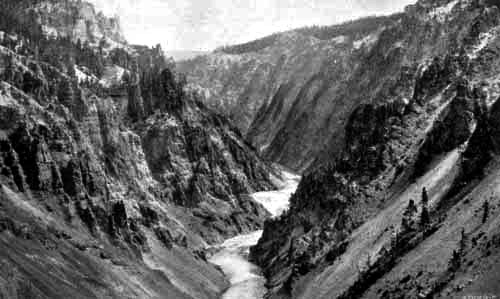
GRAND CANYON FROM THE BRINK. YELLOWSTONE CANYON. (SEE PAGE 77.)
Into the mainland enter many crooked, deep inlets antlered in form, the counterparts of the fiords of Norway with this difference, those of Norway have generally lofty precipices lifting directly from the water; here there are fewer precipices. The mountains, however, lift up very steep, with wooded slopes, but permitting their pinnacles to be seen. Some prospectors abroad told us that the scenery on these fiords was majestic in the extreme. And well it may be, for nearly all of the inlets are flanked by notched and peaked mountains, shooting into the sky with shoulders and necks wrapped in eternal frosts. When our great Republic shall have its boundary lines marked only by oceans and seas, then these bold highlands should be set apart as a continental park for the free people of the Western hemisphere.
The mountains of both mainland and islands are thoroughly picturesque, with rugged upper members topped out in sharp points and rocky pinnacles, such as are seen nowhere in the old states of our country and but rarely in the new ones or in any of the old Territories. There are no deciduous or hardwood trees, and but few hardwood shrubs. Firs, balsams, and hemlocks cover the mountain sides, and cedars sometimes are seen in the small flats next the sea or up the gullies. The forests on mountains slopes are of small trees, and no track of the fire fiend is ever seen. The air is so humid along the entire outer sea coast from the mouth of the Columbia to Behring Strait that one cannot avail himself of forest fires to help clear the land. Should the trees be deadened and fall, they would lie sodden and wet until destroyed by sluggish rot, while tangled undergrowth and young forests would spring up in almost impenetrable maze. On many mountain slopes more than half of the trees are dead but still standing, while often are seen great belts of bare, dead trunks, with not a single live one, but a green carpet of fresh after-growth spreading over the ground. The soil is so thin upon the rocky mass of the mountain that sustenance is not afforded for any but young and vigorous forests. After a few years' growth the living die to make a soil for larger ones to come. Thus ever do the young feed upon the old. A man works, accumulates and dies, for his children to feed upon his hoarded fat, perhaps to squander it in riotous living. One frequently sees here the footprints of avalanches which have swept the accumulations of long years, trees and soil, into the sea or gorges, leaving the rock bare as it was in its primal upheaval. So, too, misfortunes and unavoidable shocks sweep away the heritage of worthy sons from worthy sires.
THE RUINS OF MIGHTY FORESTS.
On the more gentle slopes and in the small valleys of Alaska, fallen timber builds up a rich soil. The trees, however, lie for many years piled one upon another, the newer upon the older, and all heavily covered with moss and yielding to slow decay. When decayed, they make a soil so uneven in surface that a walk over it is an arduous task. When a tree falls it lies and moulders for long years; heavy, rich moss wraps it as in thick blankets. In this way the ground becomes covered by hummocks several feet high. These hummocks are as thick as graves in an old cemetery. We saw an upturned tree back of Sitka ten to twelve feet in diameter some distance from its roots. Saplings ten inches in diameter were growing among its upturned roots fifteen feet from the ground. Moss six inches thick lay like a winding sheet about the trunk. Half of the lower trunk had been slabbed off, I suspect by natives for material for their carved wood work, for it was perfectly sound.
Another large tree lay prone at great length. A fir over three feet in diameter was sitting astride it, sending its roots down to the ground on either side. A trail running across it made it necessary to cut down into the old trunk. The wood left at the bottom was perfectly sound. Again I saw a large tree perched some feet up upon an old stump, its roots having found the ground down in the hollow. The majority of the large trees on the flats have grotesque trunks for several feet from the ground, showing that they had been distorted by old trunks, in whose moss-covered sides the seed from which they sprang had germinated. The air is so full of moisture that moss soon covers a fallen tree and furnishes the best bed for sprouting the delicate seed of coniferae. The expense of clearing such land as might be fitted for cultivation will retard for a long time any agricultural pursuits in Alaska. A well-posted man assured me it would cost $600 per acre.
Live stock would thrive here if lands could be opened. Grasses are rich and luxuriant, and the few horses and cows seen were sleek and fat. But I do not think from what we saw and heard that either as an agricultural or as a grazing country Alaska ever will or can be a success. Cauliflowers, lettuce, potatoes, and several other garden vegetables looked well at Sitka and Fort Wrangel but in small patches. A few beds of poppies and daisies were very fine, and several other flowers were brightly yellow in the little gardens.
"THERE SHE BLOWS!"
We have had charming weather—the Captain says the best trip of the season. Several of our passengers give your correspondent credit for being the mascot of the party—a compliment very complacently accepted. The good, sunny days have not only enabled us to enjoy hugely the beautiful and often sublime scenery, but have given us many opportunities for studying some of the mannerisms of the leviathans of the deep. We have seen many whales, several times ten to twenty at once, and at close range. They rolled themselves in grand dignity up out of the water a few hundred yards from us, and, slowly bending, threw their flukes several feet into the air. Then they would spurt great geysers ten or more feet high, making a noise not unlike that made by elephants when blowing dust over themselves, but far louder. Indeed, when some blew a hundred yards away from us, it sounded like a somewhat continuous emission from a steam stack.
To-day several fine fellows were very near us, and one apparently young one threw himself several feet entirely into the air. He seemed from twelve to eighteen feet long. The passengers thought it a baby whale sporting for the amusement of its dam. But a glass happening to catch him on the fly it was discovered he had a decided snout. Some of us then decided it to be a Greenland shark, which has an underjaw provided with very sharp, rather protruding teeth, with which it scoops out of a whale great chunks of blubber. Close by where it leaped a large whale lifted its fluke almost perpendicularly out of the water and thrashed it into foam. This was kept up for several hundred yards till we got too far away to see it well. This we are told is sometimes done in a kind of wanton sport, but I suspect in this instance the monster was trying to defend itself from one of its inveterate enemies. At any rate our passengers were afforded a very unusual sight.
THE NATIVE ALASKANS.
Of the animated nature, however, exhibited for our amusement and study, the native Alaskans were the most interesting part. They are very improperly called Indians, being of a distinct race from the American red men. I went into several shacks or native houses. They are built by the natives, and under no outside advice or architectural interference. I saw the manner of arrangement of their little stock of furniture. I saw them preparing their food and eating their meals; heard them talk, and watched the play of their features when trading and when having some sport. I thought I saw cropping out everywhere decided Japanese characteristics. It is difficult to name or enumerate the points of resemblance. But they exist, and are to me far more marked than any resemblance between the Japanese and the Chinese, who are supposed by most ethnologists to be of cognate families. These people are to me degraded descendants of the land of the rising sun who entered America through the Aleutian Isles.
The Alaskan shacks are generally located near the water, in somewhat orderly rows, one behind the other. They usually, as far as I could see, consist of a single room occupying the entire house. At or near the center of the building is a square, covered with dirt when the house is raised up, or if the house be low down, then on the ground, whereon the fire burns. Around this square is a somewhat raised platform, as in a Japanese house; on this, the different members of the family, or the several families have their separate locations, with their boxes, beds and other individual property. Frequently the room is thirty to forty feet square, and houses ten, twenty, and often forty or more people. These are members of a large family or of a sub-tribe. By the way a woman is frequently chief of a tribe, and one reads over the door in large letters the name of "Blank (a woman) chief." The Indians seem to evince a sort of boastfulness in the numberings on their houses, which at Sitka run from 3,000 or 4,000 up to five and six. It is barely possible this may be a part of a system of enumeration running through several colonies or tribes, and throughout the land wherever such tribes live. But a white man living in the territory told us it arose from the native desire to look big and to appear as one of a great multitude.
The individual possessions of the different members of a family, are kept in boxes and piled upon them. I looked into several of these boxes. Every thing was thrown in pell-mell—shoes, skins, scarfs, tools, pails and even iron pots and axes. The packing of a box looked as if it had been done in a hurry. The women and children when indoors were found, except at meal time, squatted about the several platforms. When at meals they were huddled on their haunches on the earthen square about the open fire. There are no chimneys to the houses. The fire being built in the center of the squares, the smoke goes out as in Japan through openings in the center of the roof, and to a considerable extent through the doors. About and above the openings in the roof are a sort of screen which may be shifted according to the direction of the wind.
In several small shacks at Juneau, old fashioned iron stoves were seen, with stove pipes leading above the roof. The inside of a shack is an omnium gatherum, not only of people of both sexes and of all ages, but of fishing nets, axes and saws, boat paddles, and blocks on which wooden work was being done. Dried fish and pelts stretched are on the walls and hanging from the roof poles.
The natives are very dark and swarthy, and have rather a yellow tinge in their complexions than red; have large heads and huge, broad, flat, stolid faces, long bodies, short, ill-shaped legs, and ungainly gaits. The habit of squatting when at rest, and when propelling their canoes and fishing, has developed unduly the upper body at the great expense of the lower limbs. They obtain their livelihood from the sea, and spend much more than half of their waking hours in their dugouts. They have no thwarts in their canoes to sit upon, but squat down upon the bottom, or bend on their knees. This causes the legs to dwindle when young and to become decidedly crooked. This, too, is the cause of their decidedly shambling gait when walking. They do not look bright, but are skilled in all things they understand, and learn with great rapidity, not by imitation as the Chinese do, but from inborn aptitude like that of the Japanese. Their blankets, made of the wool of the mountain goat, are marvels of closely woven fabrics, and their baskets of a kind of tough grass are as close as the finest Panama hats and very harmoniously colored. They carve fairly in wood, their totems and small ware being quite artistic. In silver ornamentation they excel. Blankets are the medium of exchange; not the native ornamental blankets, but those introduced by the Hudson Bay people. The old traders bought furs, and pelts, paying for them in woolen blankets. A pile of furs was worth so many blankets. From what I can learn the skill of a native trader has always been in his ability to demand a large number of blankets for his goods, and then to maintain as long as possible the stolidity of his countenance, during the higgling necessary to meet the views of the shrewd Hudson Bay fellow. About the places we visited only silver coin is taken in trade, and a native man or woman rarely drops a peg from the price first demanded.
THE HOME AT SITKA.
At a school, "The Home," in Sitka, under the control of a church organization in the States, are a large number of girls and boys of all sizes. They are neat, intelligent in feature, recite fluently and feelingly simple speeches and verses, and sing sweetly and as if they felt not only the sense but the harmony of their hymns. A band of twenty youths plays brass instruments well and with great precision in time. They have all pleasant low voices and the girls exceedingly sweet ones. I noticed the same characteristics among some wholely uneducated and semi-savage women when singing to a wild uncouth dance of the men.
A party of about sixty of a certain family returned in canoes from berrying while we were in Sitka. They went through uncouth motions while in the boats and then danced in savage grotesqueness on the shore, where they were received by the men and women of other families in wild glee. It was a berry "potlach" or feast. The women's voices could be heard singing in low, weird but sweet monotone. After dancing and distributing pieces of calico among certain of the berrying people, a party of over a hundred entered a large shack, closing the door to us white outsiders. There they went through some long ceremonies. I managed to get inside and for a few minutes was not disturbed. All were squatted around the great room, in the center of which was a fire, the smoke going out of an aperature in the roof. When I entered all were singing in so low a tone that it could almost be termed crooning. The whole thing was weird and wild, but the singing was not lacking in untutored melody. Some other tourists seeing me get in also entered, opening the door so widely that the wind drove the smoke back into the room. A sort of head man who was next the fire leading the song, got angry—gave the word, when all got up hurriedly, and each taking a large basket or bowl full of berries went off to their respective homes.
From what I could learn, a whole sub-tribe takes boats and visits some locality possibly a day or more's sail away, where the berry crop is known to be good. They remain until their canoes are well filled. When they return some of the men stand up in the canoes arrayed in showy colored calico or other bright stuff—and shout and sing and wildly gesticulate. By this, those in the village at once understand whether or not the excursion has been successful. In accordance therewith the returning party is met on the landing. If unsuccessful with dirges and lamentations. If successful with a "potlatch," a species of joyous fete.
The party we saw were in high feather. Bedizened fellows stood in the prows of the boats, going through gesticulations and contortions which, had they been white men, would have overturned the treacherous dugouts. They shouted and chanted in wild glee. Their songs were returned from the shore. There were forty to sixty in the returning party. As soon as their keels touched the strand, they poured out, a few in uncouth antics, but the bulk of them in solemn decorousness. When landed one two or more sang in wild weird tones, the women joining in the chorus. After going through certain formalities, presents were given to members of the returning party, of coin, and of strips or pieces one or more yards long of calico in red or other bright colors. Then the singing was continued, and the berries were removed from the canoes and carried into a large shack where other ceremonies were gone through. No white people were allowed to enter. A couple of natives stood guard at the door, and grufly if not angrily turned off all who attempted to gain ingress. The ceremonies were continued within for two or three hours. It was at the later end of this that I gained admission, as above stated, while the attention of the guards was removed.
The whole thing seemed very ridiculous, especially when one remembered that at best only a few bushels of huckleberries were the occasion of the rejoicing. Our Grecco-maniacs, however, should not deem the thing small. For according to Homer, the immediate success of the demigods of Greece—the heroes who gyrated in that wonderful tempest-in-a-tea-pot, the Trojan war, did quite as silly things over just as pitiful successes. After all, too, it is not the size of a thing which makes it valuable, but the size the possessor thinks it possesses. A bushel of huckleberries to an Alaskan is quite as large, as a schooner load of wheat would be to old Hutch, or a dozen car load of pigs would be to P.D.A.
THE DELICACIES OF THE TABLE.
I went into a house at Juneau; a woman and several children with one man were squatted around the fire taking their dinners. This consisted of a large dried salmon. A woman held it in her hand before the hot fire, screening her hand by a fold of the fish. When it was cooked on one side enough to burn her hand, she turned another fold and when satisfied with her culinary art, tore it apart in a large wooden bowl. The fish was in fact scarcely at all cooked, but was simply made very hot. This, however, seemed satisfactory to the feasters. Each member of the family tore a piece off with fingers or teeth. The hands of the young girls were soaked with the oil exuding from the hot and fat salmon. They wiped them clean several times during the meal upon their luxuriant tresses, which hung down their backs in massive braids. I think I must have a good-natured face, for I have never in any land offended when making such domiciliary visits. In this instance the woman wished me to join them in their feast, assuring me it was good. At least I so took the words with the expressions of face used. They had no bread of any sort. After they had sufficiently filled themselves, each took a long draught of water, from a native wooden pail.
Salmon is the staple article of food, and hangs drying by the scores and hundreds on racks in front of each shack or house and upon the walls within. The fish on the racks seemed small, possibly such are reserved for home consumption, while the larger ones had been sold to the canneries. The Alaskan salmon, however, is not a large one. It must be fattening food, for men and women are generally plump and the children as rounded as well-fed pigs. The little ones are as frisky and happy as in Japan, which I thought the paradise of babies. I was struck by the full rounded paunches of the little ones. This, too, is remarkable among their little cousins in the land of the rising sun; possibly a result of fish diet. During the summer season the Indians consume large quantities of berries—blue or huckleberries and salmon berries. The English call the latter, cloud berry in Norway. I saw a basket full of a white clustered root in front of a shack; a sort of bunch of small seed like bulbs compacted into a single bulb, very white, not unlike a mass of snow-drops glued together into a ball walnut-sized. I asked a woman who was washing them if they were good. She grinned and put a handful into her mouth as answer, at the same time handing me some. They tasted like a starchy paste made from impalpable flour. I asked the name. She replied "Chinook (Indian) lice." They cannot pronounce the "r," but Chinese-like substitute "l" for it.
Another delicacy is a kind of very small fish egg, deposited by a sort of herring on fine twigs of hemlock placed by the natives in certain places in the sea for the purpose. The eggs are clustered on the twigs until they are as big as one's thumb, thousands upon thousands, upon a small branched limb. The branches are hung up to dry. When used they are soaked in fresh water and the eggs stripped off by the hand. The eggs when soaked swell till they seem perfectly fresh. I asked the woman I saw soaking them if they were good. A smile from ear to ear illumined her face; she offered me some and then opened her capacious mouth into which she threw a handful which she crushed with evident delight. Though of an enquiring mind, I abstained heroically from accepting the proffered hospitality. Had the eggs been fried I doubt not they would have made a good dish. The dry ones were shriveled and as dead looking as the roe in a smoked herring, yet when soaked they seemed as plump and fresh as if just taken from the mother fish.
GUM-CHEWING AMONG THE NATIVES.
When selling berries to the ship passengers the women are either all the while eating of their goods or are chewing some kind of gum, generally the latter. Why should not Alaska's 400 chew gum as well as our own. One of their fashions is very grotesque. We saw several women with their faces, necks, arms and hands stained almost black. Whether this was done for ornamentation, or as a sort of mourning badge, I could not definitely learn. Both solutions were given us by people residing among them. If the latter, it furnished another evidence of Japanese origin. A Japanese married woman blackens her teeth, and plucks her eye brows and lashes to make herself unattractive, as a proof of her love for her lord. These women carry out the same idea when in sorrow. Their grief is certainly much more economical than in politer lands where, robes de deul are both nobby and costly.
At each town visited by us lines of women with some men were crouched down on their haunches, with their wares for sale; dressed skins, carved wood, spoons, totems, and uncouth images of animals; baskets beautifully woven of a kind of grass, very close, very strong, and decorated in bold, natural colors. They have what so many untutored but somewhat self-cultured half savage people have, a thorough conception of harmony of color. At first, to our cultivated estheticism, the coloring used by them is too glaring, but when toned down by time, or when seen at a little distance, no civilized people can surpass them.
The baskets made by the people of a sort of strong grass probably mixed with some kind of bark, are very strong and so closely woven, that they will hold water. They can be folded tightly without breaking the fiber. I had considerable difficulty in getting a native to part with an old one. It would seem they recognize the softness lent by age. I offered several women two or three times as much for old ones, which they had in use, as they asked for new ones. The one I succeeded in getting was from a woman who had no new ones for sale. It probably had held rather unsavory messes, but its coloring is exquisitely soft and mellow. A passenger asked what I wanted with the dirty thing. Its soft tone being pointed out, she spent over an hour going from shack to shack fruitlessly endeavoring to obtain one.
The same difference is observable between old and new Turkish rugs. Their beauty is not in the texture or weight but in the harmony of color, which no European has yet been able to surpass, if equal. The high art of France has not yet learned to create in large ungraceful figures the result found in rugs laboriously made by the half civilized people of Eastern Turkey and of the Caucasus. The French attain it only by grouping small figures of graceful design. The Thlinkets are the most numerous of the native tribes, and are the ones which so resemble the Japanese. A Thlinket when playing merchant to the tourist visitors offers his wares with an utter indifference and apparently never drops a tittle from his first price. If you purchase he or she seems pleased; if you decline his air is of one utterly indifferent. We saw a large number at work about the Treadwell mines in different capacities, and in drilling and quarrying the quartz. They seem to work as well as the average white man.
By the way, the Treadwell mine is an extraordinary thing. Gold-bearing quartz is quarried like common stone. The vein, if it can be so termed, is 500 feet wide, open upon the surface and extending to an unknown depth. It is of low grade ore, yielding only from four to eight dollars per ton, but is so easily reached and worked with such cheapness that many think it the most valuable mine in the world. The mine runs 240 stamps, being the largest number in existence under one roof. It is controlled by so close a corporation that the yield is never divulged and its value is a secret. It is said, however, that an offer of $15,000,000 to $20,000,000 has been refused. Its machinery is almost if not entirely run by water power furnished by a mountain stream tumbling from a lofty height immediately behind and over the mine. It is on Douglas Island, which is separated from the main land at Juneau by a channel about a mile in width.
Other paying mines are being worked about Juneau, and promising claims have been located in many parts of the Territory. The seal produce of the land is too well known to need any comment, but it will probably surprise the majority of our people when they learn that the salmon crop of last year was of about 750,000 cases. Each case I believe, holds two dozen cans. When one considers the fact that the waste of fish at the great packing canneries is enormous, not more than half of an eight pound sock-eye salmon—the best of all—being used, and then considers the number caught by the natives for themselves and for their dogs, we can easily marvel at the vast schools which frequent these Northern waters. The waste spoken of is not because more cannot be saved, but because the middle part of the fish cans best and is saved with a minimum of labor. The back with its fin is removed by one stroke of the knife, then the same is done with the belly. The head and tail is then cut so deep into the body that only four pounds of an eight-pounder is left. This is divided into four equal parts. One part is then rolled and pressed by the hand into a can. The cans are closed and placed in great vats, where they are boiled. When about done they are taken out and pricked to let the air out, and again soldered. They go again into vats to be boiled an hour and a half. This long cooking in air-tight cans causes the bones to be absorbed without wasting the juices and flavor of the fish. When this is done, each can is again examined and any one at all puffed up is again pricked to let all air escape and is again boiled. They are then cooled for boxing. Some canneries on the Pacific pack from forty all the way up to a hundred thousand fish a day.
I spoke of dogs. There are a great many in the Indian villages. They are all more or less mixed of Esquimaux breed. They exceed the number of children, are all wolf-like, and are on the best of terms with the people. It is amusing to set one of them to barking, especially if the bark be of the howl kind, for immediately it is caught up by his nearest neighbor and carried on until every dog in the camp is squatting on his haunches and lifting his voice to its highest pitch. The medley of sounds, from the pup's quaver through the whole gamut of different ages to the sober howls of the grandfather, is very droll, especially when the hearer sees the performers in their dead earnestness. They lift their heads and look so solemn, and howl in so lugubrious a key, that one feels that in this dogish art at least they are unequaled by the canines of any other part of the world.
LETTER VII.
STEAMING UP THE ICE-PACKED FIORDS AND CHANNELS OF THE ARCTIC COUNTRY OWNED BY UNCLE SAM. SALMON CANNERIES. CANOE BUILDING BY NATIVES. ASCENT OF THE "MUIR" GLACIER, 300 FEET ABOVE WATER. FANTASTIC ICE FORMATIONS AT TAKOU. SUMMER AND WINTER CLIMATES. IMPUDENT CROWS AND ORATORICAL RAVENS.
Steamer Queen, Gulf of Georgia, Aug. 10.
The salmon canneries of Alaska are not all in the neighborhood of the towns at which the excursion steamer calls, but are at or near every considerable stream which flows into the straits, channels and inlets. The instinct of the fish send them at regular seasons into fresh water, where and near which, they are caught in vast numbers. Other steamers, some of them carrying passengers and requiring a week longer to make the trip, call at stated times at several places, to which the Queen does not go, to take on and unload freight. The natives are the principal fishermen using, both nets and hooks from their trim canoes. These are dug out from a single log, some barely holding a man, others carrying with safety fifty or more. A log of two feet diameter will make a canoe nearly twice as large at its waist. When dug out to a thin shell almost as light as birch bark, the frame is filled with water, into which hot stones are thrown until the wooden walls are thoroughly steamed, hot and pliable. Sticks of different lengths, the longest at the canoe waist, are then set into the frame, which is spread out into a fine, cutter-shaped keel. A high prow and somewhat raised stern are cut out of the log or set into it. Some of the crafts present finely modeled keels. The shell of a canoe holding over sixty people, is often less than a half inch thick, and so light that two people can easily pull it high on dry land. The native squats in the bottom of his canoe and paddles it with great speed.
We saw a boat not twenty feet long, the whole filled to the top with light firewood. On this were perched two men, three women, a dog, a small tent, and the cooking utensils of the family. They were sailing from Juneau to another village several miles away. A native gets into his canoe as lightly and carefully as if he were treading on eggs. In this instance, the boat sank until its upper line was not four inches out of water. We expected to see it swamped, for there was a light wind and a few white caps. We watched it with our glasses until safely landed at a village several miles away. The natives, of villages quite distant from the towns at which the steamers call, bring their wives, dogs, and household utensils, together with what they may have to sell in the curio line to these places on the day the steamers are due. They pitch their tents on the shore not far from the steamboat pier, draw their canoes upon the strand above high water mark, and seem as much at home as if regularly domiciled. They remain as long as they see a chance for trade and then fold their tents and silently steal away. They require only a few minutes to get themselves and their worldly possessions aboard their little dugouts. At Juneau there were several of these temporary inhabitants. They all embarked after sundown, and with the long twilight were able to reach their permanent abodes before well-set dark.
The people catch fish at or near their respective villages. The canneries each have a small steambarge, which is sent to several villages daily to pick up the catch. In this way the salmon are landed at the packing-places when perfectly fresh. The Alaskan salmon is as a rule small, averaging only about six pounds, while "sock eye" of the Frazer River run evenly at eight pounds, and the Columbia River furnishes an average of nearly twenty pounds. Large fish, however, were brought to our steward, also magnificent halibut, which the passengers enjoyed greatly. One soon becomes satiated with salmon on the Pacific Coast. It is as thoroughly an every day food, as is the hog and hominy on a southern plantation. Except to the Indian, it does not seem to be as good for a steady diet as the southerner's homely fare. Several other varieties of salt water fish furnish a less surfeiting every day food than this famous beauty. We hailed with pleasure, the change to halibut given us by our steward when we reached Alaska. No where is this solid denizen of the sea, found in better kelter than up here.
A PICTURE OF SITKA.
Our ship on the excursion stops at Seattle and Port-Townsend, in Washington; Victoria and Nanaimo, on Vancouver's Island; and at Fort Wrangle, Juneau, and Sitka, in Alaska; at each long enough to afford passengers full time to satisfy themselves. Juneau is the largest place owing to the rich mines in the vicinity. All have large canneries near by, which employ natives, many of whom have acquired considerable property. A native woman, widow to a white trader, and her daughter were passengers from Juneau to Chilkat. She is a sort of Merchant, continuing the business of her defunct husband. She bore herself most decorously in her half mourning, and seemed quite able to steer her own bark through the remaining voyage of life. She is reputed to be worth several thousand dollars, and manages her affairs shrewdly. Her eligibility was suggested to the late friend of Persia's shah. His eyes rested more fondly upon her plump daughter, who displayed much agility and a trim ankle when she descended the gangway in a high sea out side of Chilkat.
Sitka has one of the prettiest sites and harbors in the world, and its climate just now is simply delicious. It is built on slightly rising ground on a bay running some miles from the sea, with beautiful little islands, clustered in large number in front of the town. These lift with rounded rocky foundations naked and water-washed at low tide, but are clothed in rich green shrubbery above high water mark. They would make an exquisite water park for a large city. Over one edge of this park lifts a few miles away, Mount Edgecumbe, a perfect volcanic cone about 3,000 feet high. Its lower two thirds are clothed in green. Its upper third, beneath its broad extinct crater, is of rich red rock. Long points of the red run down into the green, while points of the green run up into the red. It reminds one much of famous Fuji-yama in Japan. The god-mountain of Japan is over four times as high, but Edgecumbe is seen so close that the contrast does not entirely belittle it.
Around and behind Sitka are lofty foot hills clothed in forests, making a perfect amphitheater, while behind them rear pointed, rocky mountains more or less snow flecked. The town is on the great island of Baranoff, which is a mass of pinnacled mountains, the northern slopes of which are always white with sheets of snow. When we sailed, a few days before, northward through Prince Frederick Sound, these mountains formed a wonderfully beautiful background. Prince Frederick Sound is about twenty by thirty odd miles. All around it lie grand mountains of exceeding ruggedness on their highest peaks, but green below, with stripes, bands and patches of white. Through a break to the south the sound stretches some miles further, backed by the Baranoff range, rising in innumerable sharply pointed pinnacles, and about their shoulders as purely white as loftiest Alpine heights. All the mountains are comparatively uncovered when seen on their southern, western, and eastern exposures, while those seen from the north although not more lofty, are clothed in blankets of white, as if to protect them from the northern blasts.
The entire Alaskan trip presents a constant succession of gorgeous scenery, and if the weather be fine, it is worth the time taken and the cost in money to one who loves the picturesque and enjoys the rugged grandeur of nature, even if they were no grand glaciers. The time is not far distant, when commodious hotels will be maintained in these northern possessions as summer resorts. Many people will then spend weeks in them, and with the aid of small excursion barges will find health and delights.
An intelligent man who has resided for several years in Sitka, assured me he much preferred its winter climate to that of southern Ohio, where he had grown up to mature manhood. The average winter climate is rather milder than that of Washington, but with no extreme of cold. The frequent rainy days during the summer are a great draw back to the pleasure of excursion tourists. The chances are decidedly that he will find everything wet when he arrives. Our party was one of the lucky ones. The air was clear and balmy. The sun made a parasol agreeable to the ladies. I lolled for an hour on the stoop of a deserted house, with my head in shade, but my body and lower limbs warmed by a delicious sun bath, while my eyes feasted upon the glorious picture spread before me of mountain peak and green slopes, and gently rippling water as the tide slowly crept up the soft beach of the little bay behind the town.
Except when sailing across four entrances or broad straits running out to the open sea, the entire voyage to and from Alaska, usually is and always may be through straits, canals, and fiords so thoroughly protected from the ocean's angry waters that the smallest steamer can hardly feel a toss. On this excursion of ours, the briny depths below us were often as smooth as glass, reflecting the mountains, as from a mirror. As the swell from our steamer would roll off in smooth, rounded and diverging lines, they would weave fantastic forms, upon their mirror like surface, of green forest, rugged rocks, or snow caps. Towards the land beyond the effect of the swell, the mountains would often be so perfectly delineated upon the mirror, that a photograph of them would show them as distinctly below as above. The picture could be turned upside down with but little detriment to the view. Near the steamer the rounded crest of the swell would reflect long weird lines of forest, which would spread out behind us as the swell sank to a lower level.
At night millions of small fish, probably herrings, would be disturbed in their schools, and fluttering and hurrying from the ship's prow would make the water blaze in brilliant phosphorescence. Now and then a large fish would dart through these schools, leaving behind him a bright wake of flame. As he dashed through them, the herrings would scatter their flame work into myriads of sparkling diamonds. When our ship would push into the school, the alarm seemed to be given to quite a distance in the mass. The dense pack of little fellows forward the ship's bow, would break the sea into chaotic burning mass, as they sped in haste before the great monster chasing them. The line to the right and left then bent aft, weaving the sea into a waving network of fire. Farther off the brightness was toned down to a glistening shimmer, and then was lost in the distance. The schools we saw were moving in great lines in the direction we were sailing. They were composed of millions of little finny flutterers.
PANORAMA ON LAND AND WATER.
Frequently as we sailed over the placid sea, little diving ducks would flap the waters in a race from the ship's hull, and when a hundred feet off would dive for a score or more feet, perfectly satisfied that by their dive they had hidden their tracks from the mighty monster. Droves of porpoise rolled about us, and now and then one would race with us for a mile or so and seem really to understand and enjoy the contest. Asiatic crows cawed around us when we were ashore most familiarly, and with the cute impudence, so characteristic of his brethren in Eastern Asia. When we landed at Muir Glacier, a young school marm and I wandered along the shore then bare from the receding tide, up to the icy precipice. A couple of crows espied us and flew about us cawing, and finally perched on a rock close by. I told the fair one that these birds instinctively saw that we were to be caught by the incoming tide or under an ice fall, and were awaiting a feast. Their cawing was so constant, that she become superstitious, and declared she could not stand it. I had to shy a pebble at them to allay her timidity. The crow is a familiar bird up here, but the raven is an Alaskan institution. If I be not mistaken he is held by the natives in a sort of veneration. He is twice or more as large as our crow; has a huge roman nosed beak, which occasionally snaps with a report nearly as loud as the snaps of a pelican's bill. His coat is of shiny, burnished bottle green black, and his eye has an expression queerly mixed of vacuous imbecility, and cunning impudent rascality. He is a genuine stump speaker, and as fond of his own orations as a famous eastern after dinner talker is of his pretty speeches.
When we strolled in the deep shade of the dense forest behind Sitka, some of these impudent fellows settled in adjoining trees and held dialogues and debates, possibly upon our human characteristics. They would harange and then seem to crack coarse jokes, when one of them would almost laugh in low gutturals, not unlike the gurgling of water running from a two gallon jug. A wag among us declared they were making ward stump-speeches, and was willing to wager that if ravens language could be understood, we should find that some of the jokes were utterly unfit for polite ears. Those we saw were rather jolly good fellows, and were not of the family of which one appeared to Edgar Poe in his hashish dreams.
I said that the simple, beautiful scenery presented by the Alaskan excursion, well repays the loss of time and money expended upon it. Many of the mountain-flanked channels are wonderfully beautiful. The Linn or Chilkat Canal is surpassed by nothing of the sort we have ever seen. It is about four miles wide and probably 30 long. On either side tower mountains, say 3,000 feet high, rising from the water like great receding buttresses, clothed thickly in forest below, with scattered copses toward the upper slopes, and flecked with openings of low shrubbery in pale green, artistically contrasting with the dark tone of firs and spruce. All are topped by rocks, those near us gray, and the most distant ones of an undertone of purple, while in the far distance, the mountains on either shore become first blue-gray, and then blend off into sweet opalescent tints. Over and above all, towered at no great distance mighty snow fields and glaciered heights. Crillon, Fairweather, and La Peronse to the west cut the clear blue sky with their points 15,000 and nearly 16,000 feet above us; mantels of clouds here and there fell about their titanic shoulders, and light veils of mist wound and unwound about them just under their snowy pinnacles. Into this glorious fiord we steamed to its head at Chilkat, and then back to enter Glacier Bay, the acme of Alaska's wonderful exhibitions.
Fully nine Alaskan tourists out of ten go for its glaciers, which are seen in a magnitude and grandeur inducing one to pass as scarcely worthy of notice, the best of any other country which is possible of approach. They are seen in icy hardness on distant summits shortly after passing the boundary of British Columbia. They increase in frequency as one goes further north, until on a clear and cloudless day one is scarcely ever out of sight. The first visited by us was that at the head of Takou inlet south of Juneau. It is comparatively small, less than a mile wide at its foot, but running back several miles. Its foot presents a perpendicular wall of ice 150 to 200 feet high, rising out of water several hundred feet deep. Its face is irregular; here supported by icy buttresses, and there sinking back into icy recesses; now with irregular pilasters and projections of soft snowy appearance and then with broken columns, recesses, and caves of every tint of blue from the flitting opalescent to transparent ultra-marine and deep indigo.
FANTASTIC GRANDEUR OF THE GLACIERS.
Now is seen a mass of closely welded crystals of diamond whiteness glistening under the kiss of the sun, like monster piles of precious gems; then a huge broken and fissured wall compactly studded with turquoise and amethysts and gems so green as to be almost emeralds forming the icy cliffs. Loud reports as of rifle guns would fill the ear, coming from the cracking behind of the solid moving mass as it pushed onward in its descent. Hark! A rattle of musketry! You look and see a mere hat full of snowy ice tumbling from the upper edge. As it falls it becomes a cart full, a house full, and then with a report as loud as that of a heavy cannon, a section of the wall's face separates from the mass behind and tumbles into the deep water with a splash which scatters spray one or two hundred feet around, and the air is filled as with the bellowing of thunder echoed from projecting ice walls and from the lofty mountains hemming in the narrow inlet. The fallen mass disappears below the surface. But look! See that monster lifting from the water a half hundred feet away from where the tumbling ice fell! It is a dome-like pinnacle of ice. Up it rises slowly, revealing the most exquisite tints as its shoulders broaden; ten feet, twenty, fifty, aye, nearly a hundred feet! For a moment it poses a solidified mass of ultramarine. Sparkling waters pour in cascades from its uplifted dome. But see! It leans a little; it leans a little more; and tumbles with a mighty noise and sends geysers up to the brink of the icy precipice and wide around for several hundred feet. As its upper member or crest topples over, a huge section many times more bulky than the part we had seen above water, lifts, and then lies stretched three or more hundred feet, and exposed above the surface nearly thirty feet. The huge mass of possibly a hundred thousand tons weight came only to a small extent from the icy wall standing before and above us; but the fissure above extended—three or more hundred feet down into the glacier below water, and rested on the ground. For one end was covered with mud and for many feet was deeply stained.
An officer of the ship declared this was the finest exhibition of the sort he had ever seen, and that the iceberg thus made and now slowly floated out by the receding tide weighed far more than a hundred thousand tons. Our ship was lying with its bow toward the glacier not a thousand feet away. The vessel rocked and reeled from stem to stern as the great waves made by the glacier avalanche rolled under her. We lay there two hours listening to constant reports and seeing a succession of ice slides. While so resting for the enjoyment of passengers, the captain was laying in ice enough for his next round trip. Icebergs of all sizes, from those weighing only a ton up to others half as big as the steamer, were floating all about us. Some of crystal whiteness and as clear as the lens of a telescope. Others were of every tone of blue, deepening sometimes into translucent olive. The most of the bergs were of delicious purity, but a few were full of mud brought from the bed hundreds of feet under water. In some were seen good sized cobble stones; in one a boulder weighing probably a quarter of a ton. Sailors in a boat picked from these masses chunks of perfect clearness, passed grappling ropes under them, and then hoisted them by the steam derrick upon the main deck. Sometimes the piece seen above water was not larger than a barrel, but when lifted into full view it weighed one, two or more tons. For every foot of ice seen in an iceberg above water eight lie below. Thus when a berg floated close to us showing thirty feet above water, it had, if of even form, 240 feet below.