Chapter V · DAKOTA AND ASSINIBOIN CULTS. (continued 2)
Reading edition
§ 186. Very soon after this the people who are outside of the dancing lodge sing a song in praise of the devotees of all kinds, and the old women are walking about with their clothing and hair in disorder, the garments flapping up and down as they dance. The attendants hold the pipes for the candidates to smoke, and they decorate them anew. After they decorate them, the dancing is resumed. By this time it is past noon, so the girls and boys whose ears are to be pierced are collected in one place, and presents are given to all the poor people.[163] After the children’s ears have been pierced, the attendants make the candidates rise again and continue the dance.
§ 187. Torture of owner of horse.—The man whose horse has taken part in the dance is tied to the tail of his horse, and his chest is pierced in two places and fastened by thongs to the sun pole. Some of the attendants whip the horse several times, making him dart away from the pole, thereby releasing the man, as the thongs are broken by the sudden strain (see § 29).
§ 188. The devotees dance through the night, and when it is nearly midnight they rest. Beginning at the left side of the dancing lodge, every devotee stops and cries at each post until he makes the circuit of the lodge. By this time it is midnight, so the attendants make them face about and stand looking towards the east, just as in the afternoon they had made them face the west.
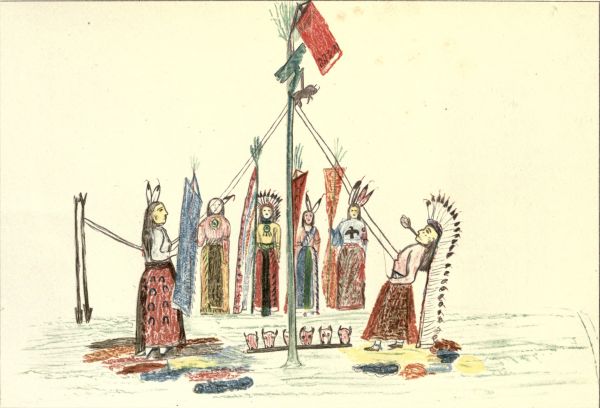
Bureau of Ethnology. Eleventh Annual Report. Plate XLVIII
GAST LITH. CO.
THE SUN-DANCE.
END OF THE DANCE.
§ 189. At sunrise they stop dancing and they leave the dancing lodge. As they come forth, they pass out by the right side, and march four times around the exterior of the lodge. After which they proceed directly to the lodge of preparation, around which they march four times prior to entering it.
§ 190. When the devotees emerge from the dancing lodge, one of their attendants places more gifts on the line of sticks between the two lodges, and after the procession has moved on there is considerable disputing among the small boys of the camp for the possession of the gifts.
§ 191. After leaving the lodge of preparation, the exhausted devotees are taken back to their own tents, where each one is given four sips of water and a small piece of food, and by the time that he gets accustomed to food after his long fast, he eats what he pleases, enters the sweat lodge, rubs himself with the wild sage, and thenceforward he is regarded as having performed his vow.
§ 192. The spectators scramble for the possession of the blankets and long pieces of calico left as sacrifices at the dancing lodge, and some of them climb to the top of the sun pole and remove the objects fastened there. The sun pole is allowed to remain in its place. The author saw a sun pole at Ponka Agency, then in Dakota, in 1871. It had been there for some time, and it remained till it was blown down by a high wind.
At the conclusion of the dance the camp breaks up and the visitors return to their respective homes.
§ 193. All who participate in the dance must act according to rule for if one slights part of the rites they think that he is in great danger. The men selected as overseers or managers are the persons who act as the attendants of the candidates.
The candidates think that all their devotions are pleasing to the sun. As they dance, they pray mentally, “Please pity me! Bring to pass all the things which I desire!”
INTRUSIVE DANCES.
§ 194. During the sun dance, other dances—intrusive dances, as Lynd terms them—are going on in the camp. Among these are the following: The Mandan dance, performed by the Ćaŋte ṭiŋza okolakićiye, or the Society of the Stout-hearted Ones; the Wakaŋ waćipi or mystery dance, the Peźi mignaka waćipi or the dance of those wearing grass in their belts, the ghost dance, the buffalo dance, and the Omaha kiyotag a-i, popularly called the grass dance.
§ 195. When a man joins the Mandan dance as a leader, he wears a feather headdress of owl feathers, a scarf, called “Waŋźi-ićaśke,” is worn around his neck and hangs down his back, and he carries a pipe, a bow, and arrows. In the Peźi mignaka waćipi, both young men and young women take part. All these dances are held outside the lodge of the sun dance, within which lodge only the one dance can be performed. The grass dance is named after the Omaha tribe. As many men as are able to participate in that dance march abreast until they reach the camp of some gens, where they sit down facing the people whom they visit, hence the name, meaning, “the Omaha reach there and sit down.” Then the visitors sing while a noise is made by hitting the ground with sticks, etc. The singers and dancers sit looking at the tents of the gens that they have visited, and remain so until property and food are brought out and given to them. Then they arise and probably dance. They think that if they ask Wakantanka for anything after the conclusion of the sun dance they will receive it. So they call on him in different songs, thus: “O Wakantanka, please pity me! Let me have many horses!” Or, “O Wakantanka, please pity me! Let there be plenty of fruits and vegetables!” Or, “O Wakantanka, please pity me! Let me live a long time!”
§ 196. During the sun dance they sing about some old woman, calling her by name. They can sing about any old woman on such an occasion.
One of these songs has been given by Mr. Bushotter, but the writer must content himself in giving the words without the music.
“Winŭŋ´ḣća ḳuŋ tókiya lá huŋwo´? He´-ye-ye+! Yatíla ḳuŋ´ śuŋ´ka wíkinićápe. Hé-ye-ye+! E´-ya-ya-ha´ ya´-ha ya´-ha yo´-ho he´-ye-ye+! E´-ya-ya-ha´ ya´-ha ya´-ha yo´-ho he´-ye-yâ!”
That is: “Old woman, you who have been mentioned, whither are you going? When they scrambled for the stick representing a horse, of course you were on hand! How brave you are!”
They sing this in a high key, and when they cease suddenly, they call out, “Ho´wo! Ho´wo! E´-ya-ha-he+! E´-ya-ha-he+!” “Come on! Come on! How brave you are! How brave you are!” When they have said this repeatedly an old woman enters the circle, making them laugh by her singing and dancing.
Thus ends the Bushotter account of the sun dance, which was read at a meeting of the Anthropological Society of Washington, May 6, 1890.
CAPT. BOURKE ON THE SUN-DANCE.
§ 197. After the reading of the paper, Capt. John G. Bourke, U.S. Army, remarked that he had seen the sun dance of the Dakota several times, and once had enjoyed excellent opportunities of taking notes of all that occurred under the superintendence of Red Cloud and other medicine men of prominence. Capt. Bourke kindly furnished the author with the following abstract of his remarks on this subject:
In June, 1881, at the Red Cloud Agency, Dakota, there were some twenty-eight who went through the ordeal, one of the number being Pretty Enemy, a young woman who had escaped with her husband from the band of Sitting Bull in British North America, and who was going through the dance as a sign of grateful acknowledgment to the spirits.
The description of the dance given in the account of Bushotter tallies closely with that which took place at the Red Cloud ceremony, with a few very immaterial exceptions due no doubt to local causes.
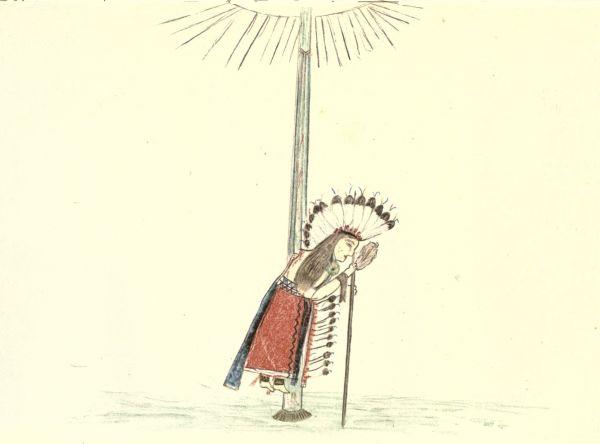
Bureau of Ethnology. Eleventh Annual Report. Plate XLIX
GAST LITH. CO.
A SUSPENDED DEVOTEE.
§ 198. At Red Cloud, for example, there was not a separate buffalo head for each Indian; there were not more than two, and with them, being placed erect and leaning against a frame-work made for the purpose, several elaborately decorated pipes, beautiful in all that porcupine quills, beads, and horsehair could supply. Buffaloes had at that time disappeared from the face of the country within reach of that agency, and there was also an increasing difficulty in the matter of procuring the pipestone from the old quarries over on the Missouri River [sic].[164]
§ 199. First, in regard to securing the sacred tree, after the same had been designated by the advance party sent out to look for it. The medicine men proclaimed to the young warriors that all they were now to do was just the same as if they were going out to war. When the signal was given, the whole party dashed off at full speed on their ponies, and as soon as we arrived at the tree, there was no small amount of singing, as well as of presents given to the poor.
Next, a band of young men stepped to the front, and each in succession told the story of his prowess, each reference to the killing or wounding of an enemy, or to striking coup, being corroborated by thumping on the skin which served the medicine men as a drum.
§ 200. The first young man approached the sacred tree, swung his brand-new ax, and cut one gash on the east side; the second followed precisely the same program on the south side; the third, on the west side, and the fourth, on the north side, each cutting one gash and no more.
§ 201. They were succeeded by a young maiden, against whose personal character, it was asserted, not a breath of insinuation could be brought, and she was decked in all the finery of a long robe of white antelope skin almost completely covered with elks’ teeth, as well as with beads. She seized the ax, and, with a few well-directed blows, brought the tree to the ground.
§ 202. In carrying the tree to the camp it was placed upon skids, no one being allowed to place a hand upon the tree itself. Upon reaching the summit of the knoll nearest the camp the tree was left in charge of its immediate attendants while the rest of the assemblage charged at full speed upon the camp itself.
§ 203. When the tree had been erected in place, it was noticed that each of those who were to endure the torture had been provided with an esquire, while there was also a force of men, armed with guns to preserve order, criers to make proclamations, and heralds and water-carriers armed with long staves tipped with bead-work and horse-hair. These water-carriers did not carry water for the men attached to the tree, they were not allowed to drink, but if they happened to faint away the medicine men would take a mouthful of water apiece and spray it upon the body of the patient, producing coldness by the evaporation of the water.
§ 204. All the Indians on that occasion were attached to the tree itself by long ropes of hair or by thongs, fastened to skewers run horizontally under the flesh. (See § 181.)
§ 205. The young woman, Pretty Enemy, was not tied up to the tree, but she danced with the others, and had her arms scarified from the shoulders to the elbows. All this scarification was done by a medicine man, who also slit the ear of the babies born since the last sun dance.
§ 206. The young men were scarified in the following manner: Their attendants, whom I have called esquires, seized and laid them on a bed of some sagebrush at the foot of the sacred tree. A short address was made by one of the medicine men; then another, taking up as much of the skin of the breast under the nipple of each dancer as could be held between his thumb and forefinger, cut a slit the length of the thumb, and inserted a skewer to which a rope was fastened, the other end of the rope being tied to the tree.
§ 207. The young men placed eagle pipes, as they were called, in their mouths. These pipes were flutes which were made each from one of the bones in an eaglet’s wing. They had to be sounded all the time the young man was dancing. This dancing was done in the manner of a buck jump, the body and legs being stiff and all movement being upon the tips of the toes. The dancers kept looking at the sun, and either dropped the hands to the sides in the military position of “attention,” with the palms to the front, or else held them upward and outward at an angle of 45 degrees, with the fingers spread apart, and inclined towards the sun.
§ 208. When laid on the couch of sagebrush before spoken of, each young man covered his face with his hands and wailed. I was careful to examine each one, and saw that this wailing was a strictly ceremonial affair unaccompanied by tears.
§ 209. Before approaching the tree the victims were naked, with the exception of blue cloth petticoats and buffalo robes worn with the fur outside, giving them the appearance of monks of the olden time. The buffalo robes were, of course, thrown off when the young men were laid on the sagebrush, preparatory to the scarification. One young man was unable to tear himself loose, and he remained tied up to the tree for an hour and seven minutes by my watch. He fainted four times. The medicine man put into his mouth some of the small red, bitter, salty seeds of the Dulcamara, while the women threw costly robes, blankets, articles of beadwork and quillwork, and others of the skin of the elk and antelope upon the rope attaching him to the tree, in the hope of breaking him loose. The articles thus attached to the rope were taken away by the poor for whom they were given. There was any amount of this giving of presents at all stages of the dance, but especially at this time, and the criers were calling without ceasing, “So and so has done well. He is not afraid to look the poor women and children in the face! Come up some more of you people! Do not be ashamed to give! Let all the people see how generous you are!” or words to that effect. (I had to rely upon my interpreter, who was reputed to be the best and most trustworthy at the agency).
§ 210. One of the prime movers in the organization of this particular dance, Rocky Bear, at the last moment, for some particular reason, decided not to go through the terrible ordeal. He explained his reasons to the tribe, and was excused. He gave presents with a lavish hand, and it was understood that on some subsequent occasion he would finish the dance. There was no sign of dissatisfaction with his course, and everyone seemed to be on the best of terms with him. All through the ceremony there was much singing by the women and drumming by the medicine men, and a feast of stewed dog, which tastes very much like young mutton, was served with boiled wild turnips.
§ 211. By a comparison of the accounts of Miss Fletcher, Capt. Bourke, and Bushotter it will be noticed that while there are several points of disagreement which, as Capt. Bourke remarks, are “due no doubt to local causes,” the accounts are in substantial agreement. Miss Fletcher says that the opening of the camp circle was toward the east; but Bushotter gives it as toward the north. She states that the tent of preparation was erected on the first day after sunset; but Bushotter says it was set up on the fourth day. She represents the selection of the men who go to seek the tree, the departure to fetch the tree, the felling of the tree, the bringing it and setting it up within the camp circle as all taking place on the fourth day. Bushotter states that the men were selected on the third day; they went to seek the tree on the fourth day; they went to fell the tree on the fifth day, and on the same day they brought it to the camp and set it in place. Capt. Bourke saw four men and one girl employed in felling the tree. Miss Fletcher mentions that five men and three girls did this in 1882; but Bushotter recorded that several men and women took part in this performance. The ears of the children were pierced on the fourth day after the raising of the sun pole, according to Miss Fletcher; but Bushotter says that this did not occur till after the devotees had been scarified and fastened to the pole and posts, on the sixth day. Bushotter agrees with Miss Fletcher in saying that on the sixth day the earth was “mellowed,” the devotees scarified, and they danced with the thongs fastened to the pole, etc., and attached to the skewers running under their flesh.
BERDACHES.
§ 212. These unfortunate beings, who have been referred to as miⁿquga and miⁿquge in Chapter III (§ 30), are called wiŋkta by the Santee and Yankton Dakota, and wiŋkte by the Teton. They dress as women and act in all respects as women do, though they are really men. The terms for sodomy, wiŋktapi and wiŋktepi, are significant, and go to prove that the berdaches should not be called hermaphrodites. It is probable that the Dakota regard the moon as influencing these people. (See § 353.)
ASTRONOMICAL LORE.
§ 213. Ho-ke-wiŋ-la is a man who stands in the moon with outstretched arms. His name is said to mean Turtle Man. When the Teton see a short man with a large body and legs they generally call him “Ho-ke-la,” after the man in the moon.
The Teton do not like to gaze at the moon, because at some past time a woman, who was carrying a child on her back, gazed a long time at the moon, till she became very weak and fell senseless.
No Teton dare look at the stars and count even “one” mentally. For one is sure to die if he begin to count the stars and desist before finishing. They are also afraid to point at a rainbow with the index finger, though they can point at it with the lips or elbow. Should one forget, and point with the index finger, the bystanders laugh at him, saying, “By and by, O friend, when your finger becomes large and round, let us have it for a ball bat.”
DAY AND NIGHT.
§ 214. One of Bushotter’s Teton texts reads thus:
Indians are often singing “The day and night are mysterious” or “wakaŋ.” They do so for the following reasons: While the day lasts a man is able to do many wonderful things at different times, and he kills so many animals, including men, and sometimes he receives presents, and besides he is able to see all things. But he does not fully understand what the day is, nor does he know what makes the light. Though the man can do various things during the day, he does not know who makes or causes the light. Therefore he believes that it was not made by hand, i.e., that no human being makes the day give light. Therefore the Indians say that the day is “wakaŋ.” They do not know who causes all these things, yet they know that there is some one thing having power, and that this thing does it. In their opinion, that is the sun. So they pray to the sun; and they respect both the day and the sun, making them “wakaŋ.” On that account they usually sing some songs about them. Then they say that the night is “wakaŋ.” When it is night, there are ghosts and many fearful objects, so they regard the night as “wakaŋ,” and pray to it.
THE DAWN.
§ 215. When Bushotter’s younger brother was sick on one occasion he was made to pray to Anpao, The Dawn. The tent skins were thrown back from the entrance and the sick boy was held up with the palms of his hands extended towards the light, while he repeated this prayer: “Wakaŋ´taŋka, uŋ´śimála yé! Téhaŋ wauŋ´ kte,” i. e., “O Great Mysterious One, please pity me! Let me live a long time!” Then the patient was laid back on his couch. While the sick boy prayed a blanket was held up, and the next morning it was hung from the top of the tent. When the invalid recovered the blanket and a tobacco pouch were taken to a hill and left there as sacrifices. The boy got well, and the people believed that some mysterious power had cured him.
WEATHER SPIRIT.
§ 216. The Teton say that a giant, called Waziya, knows when there is to be a change of weather. When he travels his footprints are large enough for several Indians to stand while they are abreast; and his strides are far apart, for at one step he can go over a hill. When it is cold the people say, “Waziya has returned.” They used to pray to him, but when they found that he did not heed them they desisted. When warm weather is to follow Waziya wraps himself in a thick robe, and when it is to be cold he goes nude. The members of the Heyoka or Anti-natural Society love the acts of Waziya; so they imitate him in always saying or doing the opposite of what might be expected under the circumstances. Riggs says,[165] “Waziya, the god of the north, and Itokaga, the god of the south, are ever in conflict and each in turn is victorious.”
HEYOKA.
§ 217. Waziya and Heyoka are not fully differentiated. Heyoka, according to Riggs,[166] is “the antinatural god.” He is said to exist in four varieties, all of which have the forms of small men, but all their desires and experiences are contrary to nature. In the winter they stand on the open prairie without clothing; in the summer they sit on knolls wrapped in buffalo robes, and yet they are freezing. Each of them has in his hands and on his shoulders a bow and arrows, rattles, and a drum. All these are surcharged with lightning, and his drumstick is a little Wakinyan. The high mounds of the prairies are the places of his abode. He presides over the land of dreams, and that is why dreams are so fantastic.
§ 218. In speaking of the Heyoka gods, Pond says:[167]
Like the Wakinyan, there are four varieties of them, all of which assume in substance the human form, but it would be unnecessarily tedious to note the differences of form, especially as the differences are unimportant. They are said to be armed with the bow and arrows, and with deer-hoof rattles, which things are charged with electricity. One of the varieties carries a drum, which is also charged with the same fluid. For a drumstick he holds a small Wakinyan god by the tail, striking on the drum with the beak of the god. This would seem to us to be an unfortunate position for a god, but it must be remembered that it is “wakan,” and the more absurd a thing is, the more “wakan.”
§ 219. One of these gods in some respects answers to the whirlwind zephyr of Greek mythology. It is the gentle whirlwind which is sometimes visible in the delicate waving of the tall grass of the prairie.[168]
By virtue of their medicine and tonwan powers the Heyoka render aid to such men as revere them, in the chase, or by inflicting and healing diseases, especially those resulting from the gratification of their libidinous passions.
HEYOKA FEAST.
§ 220. Lynd gives an account of the Heyoka feast. He says:[169]
They assemble in a lodge, wearing tall, conical hats, being nearly naked, and painted in a strange style. Upon the fire is placed a huge kettle full of meat, and they remain seated around the fire smoking until the water in the kettle begins to boil, which is the signal for the dance to begin. They dance and sing around it excitedly, plunging their hands into the boiling water, and seizing large pieces of hot meat, which they devour at once. The scalding water is thrown over their backs and legs, at which they never wince, complaining that it is cold. Their skin is first deadened, as I am creditably informed, by rubbing with a certain grass; and they do not in reality experience any uneasiness from the boiling water—a fact which gives their performances great mystery in the eyes of the uninitiated.
§ 221. Dr. Brinton has confounded the Heyoka with the Wakinyan. The two are distinct classes of powers, though there is some connection between them, as may be inferred from the following stories in the Bushotter collection.
§ 222. No Indian belonging to the Heyoka Society ever tells of his own personal mystery. Such things are “wakaŋ,” and not even one man can be induced to sing the Heyoka songs upon an ordinary occasion; because if they sing one of those songs except at the proper time they say that the Thunder-beings would kill the entire households of the offenders. Therefore they object to singing the Heyoka songs and they do not like to speak about them.
STORY OF A HEYOKA MAN.
§ 223. It is said that the people of the olden times knew when they were about to die, and they used to dream about their deaths and how they would be when the time drew near. One of those men said, “When the first thunder is heard next spring, I and my horse shall die.”
For that reason his kindred were weeping from time to time, this man who had dreamed of his death decorated the legs of his horse by moistening light gray clay and drawing zigzag lines down the legs. In like manner he decorated the neck and back of the horse, and he made similar lines on his own arms. Then he would walk about the prairie near the camp, singing and holding a pipe with the stem pointing toward the sky.
When the leaves opened out in the following spring, the first thundercloud was seen. Then the man said, “Ho, this is the day on which I am to die!” So he tied up his horse’s tail in a rounded form, put a piece of scarlet blanket around the animal’s neck, and spread a fine blanket over his back, as a saddlecloth, with the ends trailing along the ground. He painted himself and his horse just as he had been doing formerly, and, taking the pipe, he walked round and round at some distance from the camp, pointing the pipestem towards the clouds as he sang the Heyoka songs. The following is given as a song of the human Heyoka man, but it is said to have been sung originally by the mysterious and superhuman Heyoka in the thundercloud:
Ko-la, o-ya-te kin, ko-la, wan-ni-yaŋg u-pe e-ye he+! Ko-la, o-ya-te, kin, ko-la, wan-ni-yaŋg u-pe e-ye he+! Ko-la, lo-waŋ hi-bu we! Ko-la, će-ya hi-bu we! O-ya-te waŋ-ma-ya-ka-pi ye. He-he-he! Ta-muŋ-ka śni ḳuŋ e-ye-ye he+!
In this song, “oyate” means the Thunder-beings; “kola,” the Heyoka men here on earth, whom the Thunder-beings threatened to kill; “oyate waŋmayakapi,” ordinary Indians who are not wakan; “He-he-he! tamuŋka śni ḳuŋ,” i. e., “Alas! I hate to leave them (living Indians),” means that the singer expects to be killed by the Thunder-beings.
The whole song may be rendered freely thus:
My friends, the people are coming to see you! My friends, the people are coming to see you! My friends, he sings as he comes hither! My friends, he cries as he comes hither! You people on earth behold me while you may! Alas! alas! alas! I hate to leave my own people!
On the day referred to the Heyoka man had not been absent very long from the camp when a high wind arose, and the rain was so plentiful that a person could not see very far. Then the Thunder-beings looked (i. e., there was lightning) and they roared; but still the man and his horse continued walking about over there in sight of the camp. By and by there was a very sudden sound as if the trees had been struck, and all the people were much frightened, and they thought that the Thunder-beings had killed them. Some of the women and children fainted from fear, and the men sat holding them up. Some of the people thought that they saw many stars, and there seemed to be the sound, “Tuŋ+!” in the ears of each person.
When the storm had lasted a long time, the Thunder-beings were departing slowly, amid considerable loud roaring. When it was all over the people ventured forth from their lodges. Behold, the man and his horse had been killed by the Thunder-beings, so his relations were crying ere they reached the scene of the disaster.
The horse had been burnt in the very places where the man had decorated him, and his sinews had been shriveled by the heat, so he lay with each limb stretched out stiff. The man, too, had been burnt in the very places where he had painted himself. The grass all around appeared as if the Thunder-beings had dragged each body along, for it was pushed partly down on all sides. So the people reached there and beheld the bodies.
As the men in former days used to know events beforehand, as has just been told, it has long been the rule for no one to reveal his personal mystery, which he regards as “wakan.”
HEYOKA WOMEN.
§ 224. Bushotter gave the following account of a female Heyoka who was killed by lightning:
A certain woman whom I saw after she had been killed by lightning belonged to the Heyoka Society. When she walked, she carried a pipe with the mouthpiece pointing upward, as she thought that the Thunder-beings would put the mouthpiece into their mouths, though the act would immediately cause her death.
§ 225. “Women used to dream about the Thunder-beings, just as the men did, and in those dreams the Heyoka man or woman made promises to the Thunder-beings. If the dreamers kept their promises, it was thought that the Thunder-beings helped them to obtain whatever things they desired; but if they broke their promises, they were sure to be killed by the Thunder-beings during some storm. For this reason the Heyoka members worshiped the Thunder-beings, whom they honored, speaking of them as wakan.”
§ 226. Some of the women sing, and some do not; but all let their hair hang loosely down their backs, and their dresses consist of a kind of cloth or a robe sewed down the middle of the back. Sometimes the cloth is all blue, at other times half is red and half is blue. Some times there is beadwork on the dress. Even the Heyoka women wear the long red cloth trailing on the ground before and behind them, in imitation of the young dandies of the tribe.
IYA, THE GOD OF GLUTTONY.
§ 227. Lynd speaks of the “vindictive Iya” as driving the hunters “back from the hunt to the desolation of their lodges”.[170]
And Riggs has written:[171]
A people who feast themselves so abundantly as the Dakotas do, when food is plenty, would necessarily imagine a god of gluttony. He is represented as extremely ugly, and is called E-ya. He has the power to twist and distort the human face, and the women still their crying children by telling them that the E-ya will catch them.
IKTO, IKTOMI, OR UNKTOMI.
§ 228. Ikto or Iktomi (in the Teton dialect) or Unktomi (in the Santee) are the names now given to the spider by the Dakota; but the names once belonged to a mythical character, who resembles in many respects the Ictinike of the Omaha and Ponka, and the Ictciñke of the Iowa, Oto, and Missouri tribes. “Ikto,” say the Teton, “was the first being who attained maturity in this world. He is more cunning than human beings. He it was who named all people and animals, and he was the first to use human speech. Some call him the Waunća or Mocker, a name now applied to the monkey.[172] If we see any peculiar animals at any place, we knew that Iktomi made them so. All the animals are his kindred, and they are obliged to act just as he commanded them at the beginning.”
§ 229. In enumerating the powers that delight in working ill to the Indians, Lynd mentions Unktomi thus:
“The ubiquitous Unktomi tortures the Indians in their hunger by bringing herds of buffaloes near the camp, which they no sooner start to pursue than he drives away by means of a black wolf and a white crow.”[173]
§ 230. Though Ikto was very cunning, he was sometimes deceived by other beings. One day he caught the rabbit, and the latter was about to fare hard, when a thought occurred to him. He persuaded his captor to release him on condition that he taught Ikto one of his magic arts. Said the rabbit, “Elder brother, if you wish snow to fall at any time, take some hair such as this (pulling out some rabbit fur) and blow it in all directions, and there will be a blizzard.” The rabbit then made a deep snow in this manner, though the leaves were still green. This surprised Ikto, who thought that he had learned a wonderful accomplishment. But the foolish fellow did not know that rabbit fur was necessary, and when he tried to make snow by blowing his own hair, he was disappointed.
§ 231. On another occasion, Ikto reached a stream which he could not ford. So he stood on the bank and sang thus:

DAMN Tó-kin ko-wá-ka-tanma-ká-ni,e-chin´chinna-wá-zhin!
I stand, thinking often,Oh that Imight reach the other side!
Presently a long object passed, swimming against the current. When it reached him it said, “I will take you across, but you must not lift your head above the water. Should you notice even a small cloud warn me at once, as I must go under the water.” Ikto was then told to give the warning thus: “Younger brother, your grandfather is coming.” Before the other bank was reached Ikto gave the warning, and so sudden was the commotion that Ikto became unconscious. On recovering, he found that the thunder was roaring, and the water was dashing high, but the monster had disappeared.
It is shown in the section on Spider lore (§ 249) how the name Iktomi has been transferred from the mythical character to the insect, who, in turn, is invoked as “grandfather.”
ĆAŊOTIDAŊ AND HOḢNOĠIĆA.
§ 232. These powers have been scarcely differentiated; and some writers speak of them as identical. They seem to have been of the nature of bogies or boggarts. Says Lynd:[174]
Ćaŋotidaŋ draws the hungry hunters to the depths of the wood by imitating the voices of animals, or by the nefarious “Cico! cico!” (i. e., I invite you to a feast! I invite you to a feast!) when he scares them out of their senses by showing himself to them.
On the same page he distinguishes between the Ćaŋotidaŋ and the Oḣnoġića thus:
“The stray lodge becomes the delight of the wild Ohnogica,” implying that such lodges were haunted by this spirit for the purpose of frightening any unwary traveler who ventured there without a companion.
In Tah-koo Wah-kon (p. 75, note), Riggs speaks of the “Chan-o-te-dan or Hoh-no-ge-cha. The former is a fabulous creature, dwelling usually in the woods as the name indicates. The latter name would seem to give it a place by the door of the tent.” With this we may compare the Omaha invocation, “O thou who standest at the right side of the entrance! Here is tobacco!” (§ 40). The name also reminds us of “The Dweller upon the Threshold” in Bulwer’s “Zanoni.”
Riggs, in his “Theogony of the Sioux,” p. 270, writes thus of the “Chan-o-te-na”:
This means, Dweller in the woods. Sometimes he is called Oh-no-ge-cha, which would seem to assign him to a place in the tent. Whether these are one and the same, or two, is a question in dispute. But they are harmless household gods. The Chan-o-te-na is represented as a little child, only it has a tail. Many Indian men affirm that they have seen it, not only in night dreams, but in day visions.
The name Hoḣnoġića or Oḣnoġića is called by the Teton, Uŋgnaġićala, which is the name of the screech-owl. As the Ponka Indaȼiñga dwells in the forest, and is said to resemble an owl, he must be identical with the Dakota Ćaŋotidaŋ or Uŋgnaġićala. (See § 38.)
ANŬŊG-ITE.
§ 233. Wonderful stories of beings with two faces are found among the Dakota as well as among the Omaha. Lynd[175] states the belief of the Dakota (i. e., those speaking the Santee dialect) that “women with child are but torturing sports for the vengeful Anog-ite.”
In the Omaha legend of Two Faces and the Twins[176] the pregnant mother of the Twins died as soon as she had gazed at Two Faces. In the Teton legend of He-who-Has-a-Sword and Ha-ke-la, the latter is said to have met a giant, Anuŋg-ite, or Two Faces, who pretended to be an Indian woman nursing an infant. The infant had been stolen from its parents by the Anuŋg-ite, who drew a rose brush across its face to make it cry. As soon as this was done the Two Faces said, in a woman’s voice, “A-wo! A-wo! A-wo!” that being the expression used by Teton women when they wish to soothe crying infants.
§ 234. The Indians used to hear an Anuŋg-ite or Two Faces pass along kicking the ground. When he kicked the ground with one foot bells used to ring and an owl hooted, and when he kicked with the other it seemed as if a buffalo bull was there, snorting as he does when about to charge. At the next step a chickadee was heard, and when he moved the other foot he made all kinds of animals cry out. The Indians had heard this Anuŋg-ite and were afraid of him. Now and then when a man who thought himself strong was alone when he met the Anuŋg-ite the latter surprised him by catching him and throwing him into one of his ears. These ears were so large that each could hold three men. No person knew where the Anuŋg-ite made his abode, and no one cared to follow him; no one dared to go out of doors at night. Now, there was an old man and his wife who had a lodge to themselves, and their only child was a willful boy. One night he was particularly ill-behaved, and when his mother told him to do something he disobeyed her. So she said: “I will put you out of the lodge and the Anuŋg-ite will toss you into his ear.” She did not believe this, and merely said it to frighten her son into obedience. Finding him heedless, she seized his arm and, though he began to cry, pushed him out of the lodge and fastened the entrance securely. The poor boy ran crying around the lodge, but soon there was silence. The mother in turn began to cry, and went to seek him, but she did not find him outside the lodge. The next morning she and her husband, weeping, went to seek him among the people in the neighboring camp, asking every one about him, but no one had seen him. So they returned to their lodge, and they wept many days for their son. One night the mother was weeping. Suddenly she heard some one say, “Hiⁿ! hiⁿ! You said to me: Ghost, take that one. Hiⁿ! hⁿ!” This was said often, and she noticed a rattling of small bells as the being walked along. Just then she said: “Husband, I think now that a ghost has taken my son.” The husband said: “Yes; you gave the boy to the ghost, and, of course, the ghost took him. Why should you complain? It serves you right.” Then the mother cried aloud, so that her voice might have been heard at a distance. Then said she: “Husband, to-morrow night I will lie hid by the wood-pile, and if the ghost comes I will have a knife in my hand, and after I catch it by the leg I will call to you. Be ready to come at once. You must aid me, and I will recover my son, because I know that he threw him into his ear.” So the next night she lay in wait for the monster. By and by something was coming, crying out “Hiⁿ!” and making all kinds of birds and animals cry out as it walked. She saw a very large being come and stand by the lodge. He was very tall, his head being above the smoke-hole, down which he peeped into the lodge. Suddenly the mother called to her husband, and seized one leg of the monster with both hands. Then she and her husband gashed the legs in many places, and, after tying a thong to one leg, they pulled down the monster and bound him securely. They guarded him till it was day. Then they beheld a hideous monster covered with thick hair, except on his faces. They split his ears with a knife, and within one they found their long-lost son, who was very lean and unable to speak. He had a thick coat of long hair on him from his legs up to his head, but his head and face were smooth. And he would have become an Anuŋg-ite had he not been rescued. He did not survive very long. After the parents had taken their son from the ear of the monster they put many sticks of wood on a fire, and on this they laid the monster. He soon was in flames, and they stood looking on. Many things were sent flying out of the fire in all directions, just like sparks. These were porcupine quills, bags, all kinds of feathers, arrows, pipes, birds, axes, war-clubs, flints, stones for sharpening knives, stone balls resembling billiard balls, necklaces of tuki shells, flints for striking tinder, flint hide-scrapers, whips, tobacco-pouches, all kinds of beads, etc.[177]
PENATES.
§ 235. It has been supposed that the Dakotas had no penates or household gods; but according to Riggs,[178] “such have come into the possession of the missionaries. One of these images is that of a little man, and is inclosed in a cylindrical wooden case, and enveloped in sacred swan’s down.”
GUARDIAN SPIRITS.
§ 236. Each Teton may have his special guardian spirit. If such spirits are remembered they confer great power on their favorites. The latter may be surrounded by foes and yet escape, either by receiving great strength, enabling them to scatter their enemies, or by being made invisible, disappearing like a ghost or the wind. Sometimes it is said that one is rescued by being turned into a small bird that flies off in safety. (See §§ 122, 325.) This refers to those who “ihaŋbla” (have intercourse with spirits) or who have guardian spirits (tawaśićuŋpi) as servants. Bushotter’s stepfather has a guardian spirit who enabled him to tell about lost animals, etc., and bad deeds, even when the latter were committed in secret. So Bushotter and the other children of the household were afraid to do wrong after they had been detected several times by the aid of the guardian spirit.
BELIEFS ABOUT THE BUFFALO.
§ 237. In several of the Siouan tribes the buffalo is considered a “grandfather.” He figures in the traditions of the Osage.[179] Gentes and sub gentes are named after him. His image plays an important part in the sun dance (§ 164).
§ 238. Miss Fletcher[180] mentions a prayer used during the White Buffalo Festival of the Hunkpapa Dakota, in which are remembered the “powers of the earth, wind, sun, water, and the buffalo.” And in her article on “The Shadow or Ghost Lodge; a Ceremony of the Ogallala Sioux,” she states that 2 yards of red cloth are (were) “lifted and offered to the buffalo, with a prayer that good may (might) be granted to the father” (i. e., of the dead child) “during the period of the lodge-keeping.”[181]
§ 239. In her article on the “Elk Mystery of the Ogallala Sioux”[182] is given an important note:
Among the Santees in past times, a man who should dream of buffalo must announce it in the following manner: He takes the head of a buffalo he has killed, carefully removes the skin, preserving it as nearly whole as possible, and throws away the skull and the flesh. He then restores the skin to its natural shape and lets it cure. When this has taken place, a few feet square of earth is set apart at the back of the lodge, the sods cut off, and the exposed earth made fine. This is the “U-ma-ne.” Upon this earth a new blanket, formerly a robe, is spread. The blanket or robe must not belong to a woman. The buffalo head is placed in the center of the blanket, and one side of the head (is) painted blue, and the other (side) red. Upon the blue side, tufts of white swan’s down are tied to the hair of the head. Sometimes small eagle feathers are substituted, and, very rarely, large feathers. Upon the red side, tufts of down-colored red are similarly tied. These decorations look like “a woman’s sunbonnet,” as they cover the head and fall to the shoulders. The pipe is only filled and presented to the head. The feast kettle is hung over the fire. When all is in readiness, the man who prepared the head thus addresses it: “Grandfather! Venerable man! Your children have made this feast for you. May the food thus taken cause them to live, and bring them good fortune.” An Indian of remarkable intelligence, whose father before him had been a priest of the higher class, explained that in some religious festivals the buffalo and the earth were spoken of as one, and (were) so regarded. “Therefore if any one should revile or ridicule the buffalo, ever so softly, the earth would hear and tell the buffalo, and he would kill the man.”
Bushotter furnished two articles on the buffalo, translations of which are appended.
ORIGIN OF THE BUFFALO.
§ 240. The buffalo originated under the earth. It is said that in the olden times, a man who was journeying came to a hill where there were many holes in the ground. He explored them, and when he had gone within one of them, he found plenty of buffalo chips, and buffalo tracks were on all sides; and here and there he found buffalo hair which had come out when the animals rubbed against the walls. These animals were the real buffalo, who dwelt underground, and some of them came up to this earth and increased here to many herds. These buffalo had many earth lodges, and there they raised their children. They did many strange things. Therefore when a man can hardly be wounded by a foe, the people believe that the former has seen the buffalo in dreams or visions, and on that account has received mysterious help from those animals. All such men who dream of the buffalo, act like them and dance the buffalo (bull) dance. And the man who acts the buffalo is said to have a real buffalo inside him, and a chrysalis lies within the flat part of the body near the shoulder-blade; on account of which the man is hard to kill; no matter how often they wound him, he does not die. As the people know that the buffalo live in earth lodges, they never dance the buffalo dance in vain.
THE TATAŊGNAŚKIŊYAŊ OR MYTHIC BUFFALO.
§ 241. It is said that a mythic buffalo once attacked a party of Indians, killing one of them. The others fled and climbed a tree, at which the buffalo rushed many times, knocking off piece after piece of the tree with his horns till very little of it was left. Then one of the Indians lighted some tinder and threw it far off into the tall grass, scorching the buffalo’s eyes, and seriously injuring his horns, causing the hard part of the latter to slip off, so that the animal could no longer gore any one. But as he was still dangerous, one of the men determined to fight him at the risk of his own life, and so he slipped down from the tree, armed with a bow and some arrows. He finally gave the buffalo a mortal wound. Then all the men came down the tree and cut up the buffalo after flaying him. They were about to carry off the body of their dead comrade in a robe, when they were obliged to climb a tree again because another mythic buffalo had appeared. He did not attack them, but went four times around the body of the slain man. Then he stopped and said, “Arise to your feet.” All at once, the dead man came to life. The buffalo addressed him, saying, “Hereafter you shall be mysterious, and the sun, moon, four winds, day and night shall be your servants.” It was so. He could assume the shape of a fine plume, which was blown often against a tree, to which it stuck, as it waved repeatedly.
THE BEAR.
§ 242. The Assiniboin address prayers to the bear.[183] They offer it sacrifices of tobacco, belts, and other esteemed objects. They celebrate feasts in its honor, to obtain its favors and to live without accidents. The bear’s head is often preserved in the camp during several days, mounted in some suitable position and adorned with scraps of scarlet cloth, and trimmed with a variety of necklace collars, and colored feathers. Then they offer it the calumet, and ask it that they may be able to kill all the bears they meet, without accident to themselves, in order to anoint themselves with his fine grease and make a banquet of his tender flesh.
THE WOLF.
§ 243. Smet says, “The wolf is more or less honored among the Indians” (i. e. the Assiniboin) “Most of the women refuse to dress its skin for any purpose. The only reason that I could discover for this freak is, that the wolves sometimes go mad, bite those they meet and give them the hydrophobia. It is doubtless to escape this terrible disease and to avoid the destruction of their game, that the Indians make it” (the wolf) “presents, and offer it supplications. In other cases, he is little feared.” The “little medicine wolf” is in great veneration among the Assiniboin. As soon as an Indian hears his barks, he counts the number; he remarks whether his voice is feeble or strong, and from what point of the compass it proceeds. All these things are regarded as good or bad omens. If the undertakings of the Indians result, as they occasionally do, in success, after hearing the barking of the little wolf, this animal is honored by a grand feast after the return of the party.[184]
§ 244. That some of the Dakota reverenced the wolf is evident from the fact that there is a society, called the Wolf Society, but known among the white people as the Dog Society. That society has many beautiful songs, according to Bushotter, and its membership is confined to young men. All the wolf stories belong to this society. Three of these stories follow this section.
§ 245. The man who met the ghost woman after fleeing from the two ghost men[185] encountered a wolf, who pitied him and showed him the way to a camp, where he was received and adopted into the tribe. This man always remembered the wolf as a kind animal, and when he killed any game, he threw a portion outside of the camp, as an offering to the wolf.
§ 246. There was once a handsome young Teton, whose wife’s father disliked him and plotted against him. He dug a pit within his lodge, covering it with skins. Then he invited his son-in-law to a feast. The son-in-law met a wolf, whom he saluted, asking him the way to the village. The young man was persuaded to recline on the skins, which gave way, precipitating him into the pit. The father-in-law and his two single daughters covered the skins with earth, and removed their tent elsewhere on the morrow, when all the people started on a journey. After some days, the wolf who had met the man went to the deserted camping place in search of food. On reaching the place where the accident (?) had happened, he heard a human cry. So he dug away the earth, removed the skins, and found the man, whom he recognized. The wolf pitied him, and said, “As you did not kill me when we met, you shall now be saved.” So he howled, and very soon many wolves appeared. They found a lariat, which they lowered into the pit, and by grasping the other end with their teeth, they pulled the man up. He was very grateful, promising never to harm a wolf. Just then a weeping woman appeared, gazing in surprise at the man, as he was very thin, looking like a ghost. She was his wife, and her heart was soon made glad when he told her of his rescue.
§ 247. Once upon time a man found a wolf den, into which he dug to get the cubs. The mother came, barking, and she finally said to him, “Pity my children;” but he paid no attention to her. So she ran for her husband, who soon appeared. Still the man persevered. Then the wolf sang a beautiful song, “O man, pity my children, and I will instruct you in one of my arts.” He ended with a howl, causing a fog. When the wolf howled again the fog disappeared. Then the man thought, “These animals have mysterious gifts,” and he tore up his red blanket into small pieces, which he put as necklaces on the cubs, whom he painted with Indian red, restoring them to their place in the den. Then the grateful father exclaimed, “When you go to war hereafter, I will accompany you, and bring to pass whatever you wish.” So they parted as friends. In the course of time the man went on the war path. As he came in sight of a village of the enemy, a large wolf met him, saying, “By and by I will sing and you shall steal their horses when they least suspect danger.” So they stopped on a hill close to the village, and the wolf sang. After this he howled, making a high wind arise. The horses fled to the forest, many stopping on the hillside. When the wolf had howled again, the wind died away, and a mist arose; so the man took as many horses as he pleased.
HORSES.
§ 248. These are well named “Cŭñka wakaⁿ (Śuŋka wakaŋ)” for they are indeed wakaŋ. Consequently the Dakota have the Cŭñg olowaⁿ (Śuŋg olowaŋ) or Horse Songs, and they pray to the horses (ćewićakiyapi). If any one paints a horse in a wakaŋ manner, when he has no right to do so, he is sure to pay the penalty: he will encounter misfortune of some sort, or he will fall ill, or he will be slain by a foe, or he will have his neck broken by being thrown from a horse.
SPIDERS.
§ 249. The Teton pray to gray spiders, and to those with yellow legs. When a person goes on a journey and a spider passes, one does not kill it in silence. For should one let it escape, or kill it without prayer, bad consequences must ensue. In the latter case, another spider would avenge the death of his relation. To avoid any such misfortune, when the spider is encountered, the person must say to it, “Iktómi Tuŋkaŋśila, Waʞiŋyaŋ niktepe lo,” i. e., “O Grandfather Spider, the Thunder-beings kill you!” The spider is crushed at once, and his spirit believes what has been told him. His spirit probably tells this to the other spiders, but they can not harm the Thunder-beings. If one thus addresses a spider as he kills it, he will never be bitten by other spiders.
§ 231. One of the Dakota myths tells how Unktomi killed himself, causing his limbs to shrivel up till they assumed the appearance of spiders’ limbs.
SNAKE LORE.
§ 250. Some Dakota will not kill snakes by hitting them. He who violates the law in this respect will dream horrible dreams about various kinds of snakes; and occasionally it happens that such a man has a horse bitten by a snake. The Siŋteḣla taŋka, or the Ancient of Rattlesnakes, was one of the enemies of the Thunder-beings.
“There are some things about which it is most unlucky to dream. Snakes are said to be terrible; they seek to enter a man’s ears, nose, or mouth” (i.e., in the dream); “and should one succeed, it is a sure sign of death. ‘No good comes from snakes.’”[186]
THE DOUBLE WOMAN.
§ 251. In the olden times there was what they called “Wiŋyaŋ nuŋ-papi-ka,” or the The Double Woman, consisting of two very tall females who were probably connected by a membrane. They wore horned headdresses decorated with feathers, and bunches of feathers hung from the right shoulder of one and from the left shoulder of the other. Instead of heel tags, each female had a turtle trailing from the heel or quarter of one moccasin, and a feather from that of the other. In the sketch as given by Bushotter there is a pale blue stripe around the bottom of each skirt, and half of each trailing feather is of that color. Each body, above the top of the blanket, is painted with blue dots on a yellow ground. There is a blue stripe across the right shoulder of the woman on the right, and one across the left shoulder of the other woman, each stripe curving downward towards the opposite side. (See Pl. L.)
They dwelt in a lodge on a very high black cliff. They were always laughing immoderately, as if they were strangers to sorrow. On pleasant evenings they stood on a hill, where they amused themselves by swinging. Should any Indian see them, when he reached home he vomited something resembling black earth, and died suddenly. These women were skillful dancers, and they used to reflect rays of light by means of their mirror, just as the young Indian men do in sport. They jumped many times and sang this song:

Će´-paŋ-śi ku- wa´- ni-to´Tu´-wa le´-ćiśi´-nami´-ćo-ze´.
“Cousin, please come over here! Some one waves a robe over in this direction at me. Ha! ha! ha!” Then they walked about. No one knew from what quarter the Double Woman was coming, and how the two lived was a mystery. There are many tall women found now among different Indian tribes who imitate the behavior of the Double Woman.
John Bruyier and other Teton at Hampton, Va., regard this story of the Double Woman as manufactured by Bushotter. But this character figures in two Santee myths in Rev. S. R. Riggs’s collection, about to be published by the Bureau of Ethnology.[187] (See § 394.)
BUREAU OF ETHNOLOGY ELEVENTH ANNUAL REPORT PL. L
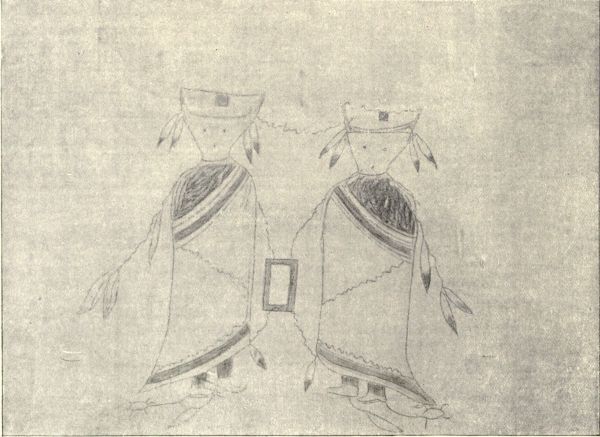
THE DOUBLE WOMAN.
DEER WOMEN.
§ 252. Deer women of the Teton resemble the Wolf women of the Pawnee. Both tempt unwary youths whom they encounter away from the camp in solitary places. Should a youth yield to the woman’s solicitations the result will be a sad one. As soon as he leaves her she will resume her natural shape. The youth will appear as if drunk or insane, and he will reach home with difficulty. His health will become impaired, and he will soon die. So now the hunters avoid any female that they see on the way. They hate the Deer women. The Deer women never speak, but in all other respects they resemble Indian women.
DWARFS OR ELVES.
§ 253. Dwarfs or elves are probably referred to in the following;
This [i. e. the object sought by Lewis and Clarke’s party] was a large mound in the midst of the plain, about N. 20° W. from the mouth of Whitestone River, from which it is 9 miles distant. The base of the mound is a regular parallelogram, the longest side being about 300 yards, the shorter 60 or 70; from the longest side it rises with a steep ascent from the north and south to the height of 65 or 70 feet, leaving on the top a level plain of 12 feet in breadth and 90 in length. The north and south extremities are connected by two oval borders, which serve as new bases, and divide the whole side into three steep but regular gradations from the plain. The only thing characteristic in this hill is its extreme symmetry, and this, together with its being wholly detached from the other hills, which are at the distance of 8 or 9 miles, would induce a belief that it was artificial; but as the earth and loose pebbles which compose it are arranged exactly like the steep grounds on the borders of the creek, we concluded from this similarity of texture that it might be natural. But the Indians have made it a great article of their superstition; it is called the Mountain of the Little People, or Little Spirits, and they believe that it is the abode of little devils in the human form, of about 18 inches high, and with remarkably large heads; they are armed with sharp arrows, with which they are very skillful, and are always on the watch to kill those who should have the hardihood to approach their residence. The tradition is that many have suffered from these little evil spirits, and, among others, three Maha Indians fell a sacrifice to them a few years since. This has inspired all the neighboring nations, Sioux, Mahas, and Ottoes, with such terror that no consideration could tempt them to visit the hill.[188]
BOGS.
§ 254. Bogs are very mysterious. There are various strange objects covered with thick hair which remain at the bottom of a bog. These objects have no eyes, but they are able to devour anything, and from their bodies water is ever flowing. When one of these beings wishes, he abandons his abode and reclines under ground at another place; then there is no water issuing from the place where he used to lie, but a spring gushes forth from the new resting place. The water of this spring is warm in winter, but as cold as ice in summer, and before one dares to drink of it he prays to the water, as he does not wish to bring illness on himself by his irreverence. In the olden days one of these strange beings was pulled up out of a bog and carried to the camp, where a special tent was erected for him. But water flowed all around him, which drowned almost all of the people. Then the survivors offered him food, which he held as he sat motionless, gazing at them. The food disappeared before the spectators were aware of it, though they did not see the being eat it.
TREES.
§ 255. The Dakota prayed to trees, because it was reported that in former days a tree had sung at intervals. A man claimed to have witnessed this, and from that time they have been regarded as mysterious.
CUSTOMS RELATING TO CHILDHOOD.
§ 256. The Teton sing on account of the unborn child, and set up a pole inside the lodge, at the part opposite the entrance, fastening eagles’ down to the top of the pole, just as they do when a boy has advanced toward manhood.
§ 257. Soon after birth they paint the face of the infant, whether it be a boy or a girl, with vermilion, in the “Huŋka” style.[189] Should they neglect to do this, it is said that the infant would become blear-eyed or it would suffer from some kind of sickness.
§ 258. When the navel string is cut, a small bag is made of deerskin, cut in the shape of a small tortoise, known as patkaśala. In this bag is placed a piece of the navel string and sweet-smelling leaves, with which the bag is filled. The infant has to carry this bag on its back. Part of the navel string is buried, and when the child is large enough to get into mischief they say, “He is hunting for his navel string.”
§ 259. Prior to the naming of the infant is the ceremony of the transfer of character. Should the infant be a boy, a brave and good-tempered man, chosen beforehand, takes the infant in his arms and breathes into his mouth, thereby communicating his own disposition to the infant, who will grow up to be a brave and good-natured man. It is thought that such an infant will not cry as much as infants that have not been thus favored. Should the infant be a girl, it is put into the arms of a good woman, who breathes into its mouth.
§ 260. Twins are a mystery to the Teton, who believe that they are of superhuman origin, and must come from Twin-land. As they are not human beings, they must be treated very politely and tenderly, lest they should become offended and die in order to return to Twin-land.
In his MS. Teton vocabulary, sent to the Bureau of Ethnology in July, 1890, Dr. J. M. Woodburn, Jr., recently physician at Rosebud Agency, S. Dak., makes the following statement which seems worthy of notice: “Twins are lucky as regards themselves only; the mother is looked upon as unfortunate. The twins may die, but they are sure to be born again into separate families. No ordinary human being can recognize them as twins after the new births; but twins themselves are able each to recognize the other as his fellow-twin in a previous state of existence. Medicine men often claim that their supernatural powers are due to a previous existence as twins.” (See §§ 267, 287.)
§ 261. When a child is able to walk, they say that “He kicks out the teeth of his elder brother” (or “sister,” as the case may be). The teeth of the elder child which have been shed, probably the first set, are buried under the entrance to the lodge so that other teeth may come in their place. Whoever steps over the spot where the teeth have been buried will soon have other teeth in his mouth.
PUBERTY.
§ 262. Among the Oglala Dakota, according to Miss Fletcher,[190] the rites incident to the puberty of girls take place on the fourth day of the sun-dance festival. In a note on page 260 of the Peabody Museum Report, vol. III, the same authority says:
Through the kindness of Rev. A. L. Riggs I learn that among the bands of Eastern Sioux living near Fort Sully, Dak., a feast, called the reappearance of the White Buffalo Skin, is held for the consecration of a girl on her arriving at puberty. The feast is sacred and costly, and not everyone can afford it. Those who have once made the feast become the privileged guests at every such feast, occupy the feast tent, and are served first. A prominent feature in the feast is the feeding of these privileged persons, and the girl in whose honor the feast is given, with choke cherries, as the choicest rarity to be had in the winter. The feast can be held at any time. Bull berries, or, as the Dakotas call them, “rabbits’ noses,” may be substituted, or finely pounded meat mixed with fat, in case no berries are to be had. In the ceremony, a few of the cherries are taken in a spoon and held over the sacred smoke, then fed to the girl. The spoon is filled anew, incensed as each person is fed. As each one is given the cherries, he is addressed thus: “Wi-ća-śa-ya-ta-pi wo-yu-te de ya-tiŋ kte,”
i.e., “You will eat this chief’s food.” The eaters are not chiefs; they only partake of chiefs’ food.
§ 263. Initiation to manhood took place in one of two ways: (1) By the wohduze ceremony, or, (2) by the bear dance, as witnessed by Long.
The former has been referred to in §§ 122-125 of this article; the latter has been described by Long[191] as
a ceremony which they are in the habit of performing when any young man wishes to bring himself into particular notice, and it is considered a kind of initiation into the state of manhood. There is a kind of flag made of fawn skin dressed with the hair on, suspended upon a pole. Upon the flesh side of it are drawn certain figures indicative of the dream which it is necessary the young man should have dreamed before he can be considered a proper candidate for this kind of initiation. With this flag a pipe is suspended by way of sacrifice. Two arrows are stuck up at the foot of the pole, and fragments of painted feathers, etc., are strewed upon the ground near it. These pertain to the religious rites attending the ceremony, bewailing and self-mortification. The young man who has had the dream acts the bear in this dance, and is hunted by the other young men; but the same man can not act the bear more than once in consequence of his dreams.
§ 264. Miss Fletcher says:[192]
The maturity of the sexes is a period of serious and religious experiences which are preparatory by their character for the entrance of the youth or maiden into the religious and secular responsibilities of life, both individual and tribal. Among the tribes which hold especial public ceremonies announcing the maturity of a girl, these rights are held not far from the actual time of puberty, and indicate the close of childhood and entrance of the person into the social status of womanhood. The public festival has, however, been preceded by private religious rites. With young men the religious training precedes and follows puberty, and the entrance is publicly announced by the youth joining in the dangers and duties of tribal life. According to the old customs, a young man did not take a wife until he had proved his prowess, and thus became enrolled among the manly element, or braves, as they are sometimes spoken of. The initial fasts of warriors have been mistaken sometimes for ceremonials of puberty.
GHOST LORE AND THE FUTURE LIFE.
MEANING OF WANAĠI.
§ 265. The word “wa-na-ġi” means more than “apparition.” The living man is supposed to have one, two, or more “wanaġi,” one of which after death remains at the grave and another goes to the place of the departed. The writer has been told that for many years no Yankton Dakota would consent to have his picture taken lest one of his “wanaġi” should remain in the picture, instead of going after death to the spirit land. The Teton Dakota apply the name of “ghost” or “shadow” to the lock of hair cut from the forehead of the deceased and kept for some time by the parents; and till that lock is buried the deceased is supposed to retain his usual place in the household circle.
§ 266. Lynd[193] says that to the human body the Dakota give four spirits:
The first is supposed to be a spirit of the body, which dies with the body. The second is a spirit which always remains with or near the body. Another is the soul which accounts for the deeds of the body, and is supposed by some to go to the south, by others to the west, after the death of the body. The fourth always lingers with the small bundle of the hair of the deceased, kept by the relatives until they have a chance to throw it into the enemy’s country, when it becomes a roving spirit, bringing death and disease to the enemy in whose country it remains. From this belief arose the practice of wearing four scalp feathers for each enemy slain in battle, one for each spirit.
§ 267. “Some Sioux claim a fifth scalp feather, averring that there is a fifth spirit, which enters the body of some animal or child after death. As far as I am aware, this belief is not general, though they differ in their accounts of the spirits of man, even in number.
Some of these metempsychosists go so far as to aver that they have distinct recollections of a former state of existence and of the passage into this. The belief, as before stated, does not appear to be general.” (See §§ 260, 287.)
§ 268. With regard to the place of abode of the four spirits of each man—though they believe that the true soul which goes south or west is immortal—they have no idea, nor do they appear to have any particular care as to what may become of them after death. It may be remarked, that the happy hunting grounds, supposed to belong to every Indian’s future, are no part of the Dakota creed—though individual Dakota may have learned something like it from the white men among them.
ASSINNIBOIN BELIEFS ABOUT THE DEAD.
§ 269. The Assinniboin “believe that the dead migrate toward the south,[194] where the climate is mild, the game abundant, and the rivers well stocked with fish. Their hell is the reverse of this picture; its unfortunate inmates dwell in perpetual snow and ice and in the complete deprivation of all things. There are, however, many among them who think that death is the cessation of life and action and that there is naught beyond it.[195]
“The Assinniboine believe that their dead go to a country in the south, where the good and brave find women and buffaloes, while the wicked or cowardly are confined on an island, where they are destitute of all the pleasures of life. The corpses of brave men are not deposited in trees, but on the ground, as they will help themselves, and they are covered with wood and stones to protect them from the wolves.”[196]
GHOSTS NOT ALWAYS VISIBLE.
§ 270. The ghosts of the departed are not always visible to the living. Sometimes they are heard but not seen, though in the lodge with a mortal. Occasionally they become materialized, taking living husbands or wives, eating, drinking, and smoking, just as if they were ordinary human beings.
DEATH AND BURIAL LORE.
§ 271. As ghosts visit the sick at night it is customary to drive them away by making a smoke from cedar wood, or else cedar is laid outside the lodge. Sometimes a piece of cedar is fastened up at the smoke-hole. (See § 42.) One Teton story shows how a female ghost disliked a bad odor and fled from it. When they hear a ghost whistling, some one leaves the lodge and fires a gun. Before death the lodge is surrounded by ghosts of deceased kindred that are visible to the dying person.
All the dead man’s possessions are buried with him; his body is dressed in good clothing. The favorite horse is decorated and saddled, and to this day various articles belonging to the deceased are fastened to him. The horse is shot and part of his tail is cut off and laid near the head of the burial scaffold, as it is thought that in such a case the ghost can ride the ghost of the horse and use all the articles carried by that animal.
§ 272. Why the Teton stopped burying in the ground.—Long ago the people buried some men on a hill and then removed camp to another place. Many winters afterwards a man visited this burial place, but all traces of the graves had disappeared. So many men came and dug far down into the hill. By and by one said, “A road lies here.” So they dug in that direction and made a fire underground. And there they found a tunnel large enough for men to walk in by stooping, with many similar intersecting ones. They followed the main one and finally came to a place whither a strange animal, the Waḣaŋksića, had dragged the corpses. For this reason the Lakota became unwilling to lay their dead in the ground, so they began to bury on scaffolds which could not be reached by beasts of prey. At the present day the Teton gives three reasons for not burying in the ground: (1) Animals or persons might walk over the graves; (2) the dead might lie in mud and water after rain or snow; (3) wolves might dig up the bodies and devour them.
§ 273. Importance of tattooing.—In order that the ghost may travel the ghost road in safety it is necessary for each Lakota during his life to be tattooed either in the middle of the forehead or on the wrists. In that event his spirit will go directly to the “Many Lodges.” The other spirit road is said to be short, and the foolish one who travels it never reaches the “Many Lodges.” An old woman sits in the road and she examines each ghost that passes. If she can not find the tattoo marks on the forehead, wrists, or chin, the unhappy ghost is pushed from a cloud or cliff and falls to this world. Such is the lot of the ghosts that wander o’er the earth. They can never travel the spirit road again; so they go about whistling, with no fixed abode.
§ 274. If a quiet and well-behaved person dies his ghost is apt to be restless and cause trouble, but the ghost of a bad person who dies a natural death is never feared. The ghost of a murdered person is always dangerous.
§ 275. If a ghost calls to a loved one and the latter answers, he or she is sure to die soon after. If some one is heard weeping outside of a lodge, it is a sign that a person dwelling in that lodge is doomed to die. If a sister dies, she has a strong desire to return and carry off a beloved brother. So in the event of a death in the family a gun is fired or medicine is thrown on a fire to raise a smoke. If one who is alone encounters a ghost, the latter will be apt to pull his mouth and eyes until they are crooked. This danger is encountered only by one who has dreamed of a ghost. He who has been harmed by a ghost always faints, and it is long before he revives. Mothers scare bad children by saying, “Well, wait a bit and I will tell a ghost to come and carry you off.” Some one who has dreamed of ghosts will draw one on a skin, etc., to frighten the children. Such a person is said to draw his own ghost just as he will appear in future. No one else dares to draw a ghost. (See § 299.)
CEREMONIES AT THE GHOST LODGE.[197]
§ 276. When a son dies the parents with a knife cut off some hair from the top of the head, just above the forehead, placing the hair in a deerskin cover. Then they set up three poles, fastened together at the top and forming a sort of tripod. A cord hung over the top of these holds up the white deerskin pack containing the hair of the deceased. This hair is called the ghost or shade (or wa-na-ġi) of the dead person. The deerskin pack hangs horizontally from the poles and the skin is worked with porcupine quills in many lines, and here and there are various kinds of red and blue circular figures sewed on it. All the sod had been cut away from the ground beneath the pack, and on this bare or virgin earth they put a bowl and a drinking vessel, each ornamented with porcupine work. Three times a day do they remember the ghost, for whom they put the choicest food in the bowl and water in the drinking vessel. Every article is handled carefully, being exposed to the smoke of sweet-smelling herbs. The pack said to contain the ghost is put in the ghost lodge with the knife which he used during life.
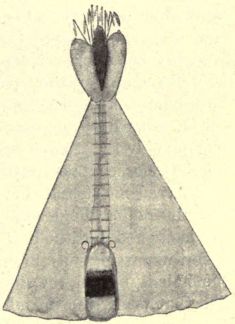
FIG. 192.—The ghost lodge.
The Indians always have observed the custom of smoking pipes and eating while sitting in the ghost lodge. At the back of the lodge they prepare a seat and in the middle they set up two poles similar to those erected outside the entrance to the tents. Before they eat in the lodge, they sacrifice part of the food. Whenever they move the camp or single tent from one place to another all these sacred objects are packed and carried on a horse kept for this special purpose. This horse is called “Wanaġi taśuŋkewakaŋ,” i.e., “The ghost’s horse.” This horse has his tail and mane cut off short; the hair on the body is shaved very close; his body is rubbed all over with yellow clay. Some one then rubs paint on the fingers, touching the rump gently several times, as well as the forehead and around the neck and breast. A feather is tied to the end of the tail. On his back they place a saddlecloth and a saddle, each ornamented with porcupine quills. The horse must mourn—i.e., keep his hair short—as long as the ghost remains unburied; but as soon as the hair is removed from the pack and buried the horse’s hair is allowed to grow long again. As soon as the people stop to encamp the ghost lodge is set up before any of the others. The articles which are kept there remain for a specified time, perhaps for several years, during which period certain ceremonies are performed. At the end of the allotted time comes the ghost feast, the Waéćŭŋpi or Wakíćaġápi, when the ghost pack is opened and the ghost taken out and buried. Then all the people assemble, setting up their tents near the ghost lodge. The kindred of the deceased weep and bring food to the place. All this food has been boiled. They set up in the ground some forked sticks, such as are used for digging wild turnips, and straight poles are laid along the forked sticks. On the poles are hung moccasins, and in the space between the forked sticks are piled blankets, buffalo robes, calico, untanned skin bags, tanned bags, porcupine quills, wild turnips, and fruits.[198] These are distributed by women, and the people spend the time pleasantly. They also give presents to the young women. If the deceased was a male and a member of an order of young men, all who belong to it are invited to a feast (there was a similar custom among the Ponka, in 1872), where they sing songs. When they stop singing they sit with bodies erect, but with bent head and stooping shoulders. Then the parents of the dead youth enter the lodge, weeping as they pass around the circle, and each one places both hands on the head of each guest, because the son, who regarded the men as his friends, is no longer present. If the deceased is a female, only the women assemble, except some men who lead the singing. If horses take part in the ceremonies, their manes and tails are shaved short, and they, too, receive gifts. Here and there one of the kindred of the deceased gives away all his property, and then the bag is opened and the hair or ghost is taken out and buried. From this time the parting with his parents is absolute. They think that, until the hair is buried, the deceased is really present with the household, and that when this burial takes place he dies a second time. After this burial the kindred put on their usual clothing, and while they weep for the dead at intervals they are at liberty to anoint and decorate themselves according to fancy.
Another account of Bushotter states that when they prepare for the ghost feast they redden the sack containing the hair and hang the war bonnet of feathers on the three poles at right angles with the ghost sack. They wish to remember his deeds in war, so they also stick one end of his war spear in the ground, with its top leaning against the tops of the three poles. His shield is suspended from one of the poles. The three pipes on the shield in a colored sketch prepared by Bushotter denote that on so many expeditions the deceased warrior carried a war pipe. The red stripes declare how many of the enemy were wounded by him, and the human heads show the number of foes that he killed. The half-moon means that he shouted at his foes on a certain night. Once he threw aside his arms and engaged in a hand-to-hand struggle with a foe; this is shown by the human hand. The horse-tracks indicate that he ran off with so many horses. If his name was Black Hawk, for instance, a black hawk was painted in the middle of his shield.
All these things are arranged before they open the bag containing the hair. Then they enter the lodge, and there they open all the things that they have brought. The kindred of the deceased are the only ones to enter the lodge, and when they see the hair taken from the sack they scream suddenly for a minute or two. It is at this time that they distribute the gifts. Food has been boiled in many kettles, and is now divided among the people not the kindred of the deceased, who are scattered around the ghost lodge, and some food is usually given to the young men of the order to which the deceased belonged.
A woman who attends to collecting the food, calico, bags, clothing, etc., turns to the four posts of the scaffold in succession, and utters one of the following sayings or prayers at each post: “If the ghosts eat this, may I live long!” or “May the ghosts eat this, and I obtain many horses!” or “If my nephew (or niece) eats this, may someone give me many presents!” This woman is careful to put the best part of the food on the bowl or dish, under the scaffold near the head of the corpse.[199] Should any one eat before the food has been put aside for the ghost, all the ghosts become angry with him, and they are sure to punish him; they will make him drop his food just before it reaches his mouth, or they will spill the water when he tries to drink, and sometimes they cause a man to gash himself with a knife.
GOOD AND BAD GHOSTS.
§ 277. Some ghosts are beneficent, but most of them are maleficent. They know all things, even the thoughts of living people. They are glad when the wind blows. Bushotter’s younger brother was crazy at one time, and a doctor or peźuta wićaśa said that the sickness had been caused by a ghost.
INTERCOURSE WITH GHOSTS.
§ 278. Lynd says: The belief in the powers of some Dakotas to call up and converse with the spirits of the dead is strong in some, though not general. They frequently make feasts to those spirits and elicit information from them of distant friends and relatives. Assembling at night in a lodge, they smoke, put out the fire, and then, drawing their blankets over their heads, remain singing in unison in a low key until the spirit gives them a picture. This they pretend the spirit does; and many a hair-erecting tale is told of the spirit’s power to reveal, and the after confirmation.[200]
GHOST STORIES.
A few ghost stories of the Teton collection will now be given.
§ 279. The ghost husband.—A young Lakota died just before marrying a young girl whom he loved. The girl mourned his death, so she cut her hair here and there with a dull knife, and gashed her limbs, just as if she had been an old woman. The ghost returned and took her for his wife. Whenever the tribe camped for the night the ghost’s wife pitched her tent at some distance from the others, and when the people removed their camp the woman and her husband kept some distance behind the main body. The ghost always told the woman what to do; and he brought game to her regularly, which the wife gave to the people in exchange for other articles. The people could neither see nor hear the ghost, but they heard his wife address him. He always sent word to the tribe when there was to be a high wind or heavy rain. He could read the thoughts of his wife, so that she need not speak a word to him, and when she felt a desire for anything he soon obtained it for her.
§ 280. The solitary traveler.—Once a solitary traveler was overtaken by a tremendous thunderstorm near a forest. So he remained there for the night. After dark he noticed a light in the woods, and when he reached the spot, behold, there was a sweat lodge, in which were two persons talking. One said, “Friend, some one has come and stands without. Let us invite him to share our food.” The listener fled suddenly, as they were ghosts, and they pursued him. Though he looked behind now and then, he could not see them; so he ran with all his might towards a hill, and escaped from them. As he was ascending a divide of the Bad Lands, all at once he heard the cry of a woman. He was very glad to have company for the rest of the journey; but no sooner had he thought about the woman than she appeared by his side, saying, “I have come because you have just wished to have my company.” This frightened the man, but the ghost woman said, “Do not fear me, else you will never see me again.” So they went on silently till daybreak. Then the man looked at her, but her legs could not be seen, though she was walking without any apparent effort. Then the man thought, “What if she should choke me?” Immediately the woman disappeared like the wind. (See § 245).
§ 281. The ghost on the hill.—One day, when the people were hunting the buffalo, a strange man appeared on a hill. He wore a winter robe, with the hair outside. When he was descending the hill the people became alarmed, but he continued to advance. The young men rushed to meet him, taking bows and arrows. They could not see his face. They tried to shoot him, but each arrow passed by him on one side or the other. So they finally fled, as he was a ghost.
§ 282. The Indian who wrestled with a ghost.—A young man went alone on the warpath. At length he reached a wilderness, encountering many difficulties, which did not deter him from his undertaking. One day, as he was going along, he heard a voice, and he thought, “I shall have company.” As he was approaching a forest he heard some one halloo. Behold, it was an owl. By and by he drew near another forest, and as night was coming on he had to rest there. At the edge of the forest he lay down in the open air. At midnight he was aroused by the voice of a woman, who was wailing, “My son! my son!” Still he remained where he was, and continued putting wood on the fire. He lay with his back to the fire, placing his flint-lock gun in readiness before him. He tore a hole in his blanket large enough to peep through.
Soon he heard the twigs break under the feet of one approaching, so he peeped without rising. Behold, a woman of the olden days was coming. She wore a skin dress with long fringe. A buffalo robe was fastened around her at the waist. Her necklace was composed of very large beads, and her leggins were covered with beads or porcupine work. Her robe was drawn over her head, and she was snuffling as she came. The man lay with his legs stretched out, and she stood by him. She took him by one foot, which she raised very slowly. When she let it go it fell with a thud, as if he was dead. She raised it a second and third time. Still the man did not move himself. Then the woman pulled a very rusty knife from the front of her belt, seized his foot suddenly, and was apparently about to lift it and gash it, when up sprang the man, saying, “What are you doing?” Without waiting for a reply he shot at her suddenly, and away she went, screaming “Yuŋ! yuŋ! yuŋ! yuŋ! yuŋ! yuŋ!” Then she plunged into the forest and was seen no more.
Once again the man covered his head with his blanket, but he did not sleep. When day came he raised his eyes, and, behold, he saw a human burial scaffold, with the blankets, etc., ragged and dangling. He thought, “Is this the ghost that came to me?” On another occasion he came to a forest where he had to remain for the night. He started a fire, by which he sat. Suddenly he heard some one making the woods ring as he sang. The man shouted to the singer, but the latter paid no attention to him. The man had a small quantity of wasna (grease mixed with pounded dried buffalo meat and wild cherries) and plenty of tobacco. So when the singer, who was a male ghost, came to him and asked him for food, the man replied, “I have nothing whatever;” but the ghost said, “Not so; I know that you have some wasna.” Then the man gave some of it to the ghost and filled the pipe for him. After the meal, when the ghost took the pipe and held it by the stem, the man saw that his hand had no flesh, being nothing but bones. As the ghost’s robe had dropped from his shoulders to his waist all his ribs were visible, there being no flesh on them. Though the ghost did not open his lips as he smoked, the smoke was pouring out through his ribs. When he finished smoking the ghost said to the man, “Ho! we must wrestle together. If you can throw me, you shall kill a foe without hindrance, and steal some horses.” The young man agreed to the proposition; but before beginning he gathered plenty of brush around the fire, on which he put an armful. Then the ghost rushed at the man, seizing him with his bony hands, which pained the man, but this mattered not. He tried to push off the ghost, whose legs were very powerful. When the ghost was brought near the fire, he became weak, but when he managed to pull the man towards the darkness, he became very strong. As the fire got low the strength of the ghost increased. Just as the man began to grow weary the day broke. Then the struggle was renewed. As they drew near the fire the man made a desperate effort, and with his foot he pushed a firebrand suddenly into the fire. As the fire blazed again, the ghost fell just as if he was coming to pieces. So the man won, and the ghost’s prophecy was fulfilled; he subsequently killed a foe, and stole some horses. For that reason people have believed whatever the ghosts have said.