Chapter III · CULTS OF THE OMAHA, PONKA, KANSA, AND OSAGE.
Reading edition
BELIEFS AND PRACTICES NOT FOUND.
§ 17. There are certain beliefs and practices which have not been found among the four tribes whose cults are treated of in this chapter. Ancestors were not worshiped. They were addressed reverently when alive, and when they died it was not contrary to custom to refer to them by name, nor did their deaths involve the change of name for a single object or phenomenon. It was a very common occurrence for the name of the deceased to be assumed by a surviving kinsman. This is shown by genealogical tables of a few Siouan tribes, the material for which was collected by the author, and which will form part of his monograph on “Indian Personal Names,” now in course of preparation for publication by the Bureau of Ethnology.
§ 18. They never heard of Satan or the devil until they learned of him from the white people. Now they have adopted the terms, “Wanáxe piäjĭ,” “Iñgȼaⁿxe piäjĭ,” and “Wakanda piäjĭ.” The first is used by the Omaha and Ponka, the others were heard only among the Ponka. They have a certain saying, applicable to a young man who is a liar, or who is bad in some other way: “Wanáxe piä´jĭ égaⁿ áhaⁿ,” i. e. “He is like the bad spirit!” This becomes, when addressed to the bad person, “Wanáxe piä´jĭ éȼikigaⁿ´-qti jaⁿ´,” i.e. “You act just like the (or a) bad spirit.”
§ 19. Though it has been said that hero worship was unknown among the Omaha and Ponka, it has been learned that Omaha mothers used to scare their unruly children by telling them that Icibajĭ (a hero of the ┴e-sĭnde gens) or his friend ┴exujaⁿ (a hero of the [K]aⁿze gens) would catch them if they did not behave. There was no worship of demigods, as demigods were unknown. Two Crows and Joseph La Flèche said that phallic worship was unknown, and they were surprised to hear that it had been practiced by any tribe. (See § 132, 164.) As the Ponka obtained the sun-dance from their Dakota neighbors, it is probable that they practiced the phallic cult.
§ 20. Totems and shamans were not worshiped, though they are still reverenced. Altars or altar-stones were unknown. Incense was not used, unless by this name we refer to the odor of tobacco smoke as it ascended to the Thunder-being, or to the use of cedar fronds in the sweat lodge. There were no human sacrifices, and cannibalism was not practiced.
OMAHA, PONKA, AND KANSA BELIEF IN A WAKANDA.
§ 21. According to Two Crows and Joseph La Flèche, the ancestors of the Omaha and Ponka believed that there was a Supreme Being, whom they called Wakanda. “Wakanda t‘aⁿi tĕ eȼegaⁿi, they believed that Wakanda existed.” They did not know where He was, nor did they undertake to say how He existed. There was no public gathering at which some of the people told others that there was a Wakauda, nor was there any general assembly for the purpose of offering Him worship and prayer. Each person thought in his heart that Wakanda existed. Some addressed the sun as Wakanda, though many did not so regard him. Many addressed Wakanda, as it were, blindly or at random. Some worshiped the Thunder-being under this name. This was especially the case when men undertook to go on the war path. [7] Mr. Say recorded of the Kansa: “They say that they have never seen Wakanda, so they cannot pretend to personify Him; but they have often heard Him speak in the thunder. They often wear a shell which is in honor or in representation of Him, but they do not pretend that it resembles Him, or has anything in common with his form, organization, or size.”
SEVEN GREAT WAKANDAS.
§ 22. Ԁaȼiⁿ-naⁿ-pajĭ said that there were seven great Wakandas, as follows: “Ugahana[p]aze or Darkness, Maxe or the Upper World, ┴ande or the Ground, Iñgȼaⁿ or the Thunder-being, Miⁿ or the Sun, Niaⁿba or the Moon, and the Morning Star. The principal Wakanda is in the upper world, above everything.” (This was denied by Joseph La Flèche and Two Crows; see § 93.) The author thought at first that these were the powers worshiped by Ԁaȼiⁿ-naⁿpajĭ and the members of his gens or subgens; but subsequent inquiries and statements occurring in the course of texts furnish cumulative evidence favoring the view that some or all these powers had many believers among the Omaha and the cognate tribes.
INVOCATION OF WARMTH AND STREAMS.
§ 23. Ԁaȼiⁿ-naⁿpajĭ said that Macte or Warmth was a good Wakanda. Ni ȼiⁿ, the flowing Stream, according to him, was thus addressed by a man who wished to ford it: “You are a person and a Wakanda. I, too, am a person. I desire to pass through you and reach the other side.” Two Crows denied this, saying that his people never prayed to a stream; but George Miller said that it was true, for his father, Little Soldier, prayed to a stream when he was on the war path, and that such invocations were made only in time of war.
PRAYER TO WAKANDA.
§ 24. Prayer to Wakanda, said La Flèche and Two Crows, was not made for small matters, such as going fishing, but only for great and important undertakings, such as going to war or starting on a journey. When a man wished to travel he first went alone to a bluff, where he prayed to Wakanda to help him and his family by protecting them during his absence and by granting him a successful journey. At a time when the Ponka were without food, Horse-with-yellow-hair, or Cañge-hiⁿ-zi, prayed to Wakanda on the hill beyond the Stony Butte. The latter is a prominent landmark in northern Nebraska (in what was Todd county, Dakota, in 1871-’73), about 7 miles from the Missouri River and the Ponka Agency (of 1870-’77)[8]. Several Omaha said that the places for prayer were rocks, high bluffs, and mountains. “All Omaha went to such places to pray, but they did not pray to the visible object, though they called it Grandfather.”—(Frank La Flèche.) They smoked towards the invoked object and placed gifts of killickinnick, etc., upon it. Compare with this the Dakota custom of invoking a bowlder on the prairie; calling it Tŭñkaⁿcidaⁿ (Tuŋkaŋśidaŋ), or Grandfather, symbolizing the Earth-being.[9] Though it has been said that a high bluff was merely a place for praying to Wakanda, and that it was not itself addressed as Wakanda, the author has learned from members of the Omaha and Pouka tribes that when they went on the warpath for the first time, their names were then changed and one of the old men was sent to the bluffs to tell the news to the various Wakandas, including the bluffs, trees, birds, insects, reptiles, etc.[10]
ACCESSORIES OF PRAYER.
Among the accessories of prayer were the following: (a) The action called ȼistube by the Omaha and Ponka, riçtowe by the three ┴ɔiwere tribes, and yuwiⁿtapi (yuwiŋtapi) by the Dakota, consisting of the elevation of the suppliant’s arms with the palms toward the object or the face of the being invoked, followed by a passage of the hand downward toward the ground, without touching the object or person (see §§ 28, 35, 36). (b) The presentation of the pipe with the mouthpiece toward the power invoked (see §§ 29, 35, 40). (c) The use of smoke from the pipe (See §§ 27, 36), or of the odor of burning cedar needles, as in the sweat lodge. (d) The application of the kinship term, “grandfather,” or its alternative, “venerable man,” to a male power, and “grandmother” to a female power (see §§ 30, 31, 35, 39, 59, 60, etc.). (e) Ceremonial wailing or crying (Xage, to wail or cry—Dakota ćeya. See § 100).[11] (f) Sacrifice or offering of goods, animals, pieces of the suppliant’s flesh, etc. In modern times the Kansa have substituted the lives of animals, as deer, grouse, etc., for those of human enemies (see §§ 28, 33, etc.).
OMAHA AND KANSA EXPRESSIONS ABOUT WAKANDA.
§ 25. Samuel Fremont said that before the advent of the white race the Omaha had certain expressions which they used in speaking of Wakanda. When an Indian met with unexpected good fortune of any sort the people used to say, “Wakanda has given him some assistance.”[12] Or they might say, “Wakanda knows him.”[13] Sometimes they said, “Wakanda has planned for his own (i. e., for his friend, relation, or subject).”[14] If a Kansa prospers, he says, “Wakan´da aká aⁿmaⁿ´yüxü´dje aka´ eyaú,” i. e., “Wakanda has indeed been looking at me!” And in speaking of the success of another, he says, “Wakan´da aká níka yiñké uyü´xüdje aká eyaú,” i. e., “Wakanda has indeed been looking at the man.”
Samuel Fremont said that when an animal detected the approach of the hunter and consequently fled from him, the man prayed thus:
Hau´Wakan´da,wani´tawiⁿ aⁿȼá‘iéiⁿtecĭ iⁿȼégȼizeégaⁿ. Cĭ wiⁿ´waȼíɔnaaⁿȼákiȼe kaⁿbȼégaⁿ,
Ho,Wakanda,quadruped oneyou gave to meperhapsagain you take yours back from me somewhatagainoneyou cause to appear to me I hope
i. e., “Ho, Wakanda, you may have given me an animal, but now it seems that you have taken it from me. I hope that you will cause another to appear to me.” But if the hunter shot at an animal and missed it, he said nothing.
PONKA BELIEF ABOUT MALEVOLENT SPIRITS.
§ 26. About eighteen years ago, the author was told by the Ponka, whose reservation was then in southern Dakota, that they believed death to be caused by certain malevolent spirits, whom they feared. In order to prevent future visits of such spirits, the survivors gave away all their property, hoping that as they were in such a wretched plight the spirits would not think it worth while to make them more unhappy. At the burial of Mazi-kide, an Omaha, the author observed that some one approached the corpse and addressed it. In referring to this in 1888, Samuel Fremont said that the speaker said, “Wakanda has caused your death.” In telling this, Fremont used the singular. “Wakanda aka.” On repeating this to George Miller, the latter said that it should have been “Wakanda ama,” in the plural, “the Mysterious Powers,” as the Omaha believed in more than one Wakanda before they learned about the one God of monotheism.
This agrees with what was learned about the Dakota by the late missionaries, Messrs. S. R. Riggs and G. H. Pond, and by the late James W. Lynd, as stated in chapter V.
AN OLD OMAHA CUSTOM.
§ 27. “Abicude,” said Samuel Fremont, “is a word which refers to an old Omaha and Ponka custom, i.e., that of blowing the smoke downward to the ground while praying. The Omaha and Ponka used to hold the pipe in six directions while smoking: toward the four winds, the ground, and the upper world.” The exact order has been forgotten by Fremont, but Lewis and Clarke have recorded the corresponding Shoshoni custom. Capt. Lewis tells how the Shoshoni chief, after lighting his pipe of transparent greenstone (instead of catlinite), made a speech, after which he pointed the stem of the pipe toward the four points of the heavens, beginning with the east and concluding with the north. After extending the stem thrice toward Capt. Lewis, he pointed it first toward the heavens and then toward the center of the little circle of guests, probably toward the ground, symbolizing the subterranean power.[15]
In addressing the four winds, a peculiar expression is employed by the Omaha:
┴a[p]édúbahíȼaȼĕ ȼáȼiⁿcé, iⁿwiñ´ʞaⁿi-gă, Thou who causest the four winds to reach a place, help ye me!
Windfour you cause it to reach there you (sing.) who movehelp ye me.
Instead of the singular classifier, ȼaȼiⁿce, the regular plural, nañkácĕ, ye who sit, stand, or move, might have been expected. (See § 33.)
In smoking toward the ground and upper world, the suppliant had to say, “I petition to you who are one of the two, you who are reclining on your back, and to you who are the other one, sitting directly above us. Both of you help me!” “Here,” said Fremont, “the ground itself was addressed as a person.” Two Crows said that some Omaha appealed to a subterranean Wakanda when their word was doubted, saying, “Iⁿc‘áge hídeaʇa aká aⁿná‘aⁿi,” “The venerable man at the bottom hears me.” The author is unable to say whether this was ┴ande or Wakandagi. (See § 37.)
The following was recorded of the Omaha, and refers to a custom relating to the buffalo hunt.[16]
On coming in sight of the herd, the hunters talk kindly to their horses, applying to them the endearing names of father, brother, uncle, etc. They petition them not to fear the bisons, but to run well and keep close to them, but at the same time to avoid being gored.
The party having approached as near to the herd as they suppose the animals will permit without taking alarm, they halt to give the pipe bearer an opportunity to perform the ceremony of smoking, which is considered necessary to their success. He lights his pipe, and remains a short time with his head inclined, and the stem of the pipe extended toward the herd. He then smokes, and puffs the smoke toward the bisons, and the earth, and finally to the cardinal points successively.
THE SUN A WAKANDA.
§ 28. In the Osage traditions the “mysterious one of day” is invoked as “grandfather.”[17]
He replies that he is not the only Wakanʇa. That the Kansa worshiped the sun as a Wakanda appears from the following: “On one occasion, when the Kansa went against the Pawnees, the stick was set up for the mystic attack or ‘waqpele gaxe.’ The war captain addressed the rising sun thus:
“Páyiⁿáqlikŭⁿ´blaeyaú. Cŭñ´gewábliⁿalí kŭⁿ´blaeyaú.Wayü´qpeckíkŭⁿ´bla eyaú.Haléje
PawneeI stun by hittingI wish indeed.HorseI have them I have come backI wishindeed. Pulling down (a foe)tooI wish indeed.Calico (shirt)
uɯíblage.Haqiⁿ´uɯíblage.Haská ckiPáyiⁿáqli-daⁿ´ mík’ü támiñke,Wákanda-é,é gü´aⁿyakiyé-daⁿ.
I tell you about it.Robe I tell you about it Blankettoo PawneeI stun by hitting when I give to youwillI who (sit) O Wakanda!thatyou cause me to be returning when.
“I wish to kill a Pawnee! I desire to bring horses when I return. I long to pull down an enemy! I promise you a calico shirt and a robe. I will give you a blanket also, O Wakanda, if you allow me to return in safety after killing a Pawnee!” When warriors performed the “waqpele gaxe” or the attack on the stick representing the foe, no member of the Lṵ or Thunder gens could participate. On such an occasion the warrior turned to the east and said:
“Aⁿmaⁿ´pyekŭⁿ´blaaú. Haskáuɯíblageaú,Wákanda-é,”
To follow me(?) or We follow it(?) I wish.BlanketI tell you of it. O Wakanda
i.e., I wish my party to pass along the road to the foe(?). I promise you a blanket, O Wakanda (if I succeed?).” On turning to the west he said:
“Uⁿ´hŭⁿuɯíblageaú, Wákanda-é,”
BoilingI tell you of it.O Wakanda
i. e., “I promise you a feast, O Wakanda (if I succeed?).” When it was decided to perform the “waqpele gaxe,” the dudaⁿhañga or war captain made one of the lieutenants carry the sacred bag, and two of the kettle tenders took bundles of sticks, which they laid down in the road. The four remaining kettle tenders remained at the camping place. The next morning all the warriors but those of the Lṵ gens went to the place where the sticks had been laid, drew a circle around the bundles, set up one of the sticks, and attacked it, as if it were a Pawnee. This ceremony often caused the death of real enemies.
Among the Osage and Kansa prayer was made toward the rising sun in the morning and towards the setting sun in the afternoon and evening.
Among the Omaha and Kansa the head of a corpse is laid towards the east. For this reason no Omaha will consent to recline with his head towards that point. The Kansa lodges also are orientated, and so were those of the Omaha (see § 59). The east appears to symbolize life or the source thereof, but[18] the west refers to death; so among the Osage the course of a war party was towards the mythic or symbolic west, towards which point the entrances of the lodges were turned[19] (see §§ 83 and 384).
Gahige, the late Omaha chief, said that when he was young all the Omaha prayed to the sun, holding up their hands with the palms towards the sun and saying, “Wakan´da, ȼá‘eaⁿ´ȼa-gă,” etc., i. e., “O Wakanda, pity me!” They abstained from eating, drinking, and (ordinary) smoking from sunrise to sunset; but after sunset the restrictions were removed.[20]
For four nights the men who thus prayed did not sleep at home. At the end of that period the task was finished. “Íwackaⁿ gáxai,” i. e., they made or gained superhuman power. They could thus pray at any time from the appearance of grass in the spring until the ground became frozen.
THE OFFERING OF TOBACCO.
§ 29. In 1889 George Miller gave an account of what he called “Niní bahaí tĕ,” i. e. the offering or presentation of tobacco. Whether this phrase was ever used except in a religious or superhuman connection is more than the author is able to say. Whenever the Indians traveled they used all the words which follow as they extended the pipe with the mouthpiece toward the sun:
“Haú,niní gakĕ Wakan´da, Miⁿ´ȼéniñkĕ´cĕ! Ujañ´ge ȼiȼíʇa kĕ égaⁿqtiuáhatéă.
Hotobaccothat lg. ob. Wakanda Sunthis you who sitRoad yourthe lg. ob.just soI follow its coursewill !
Iñgáxa-gă! Edádaⁿctécte údaⁿqtiákipañkiȼa´-gă! Edádaⁿjúajĭwiⁿ´ĕdedíteʞĭ´ íbetaⁿañkiȼá-gă!
Make it for me Whatsoeververy goodcause me to meet it Whatinferioroneit is thereif cause me to pass around it
Ȼi´-naⁿ ámustawaȼíɔna ȼagȼiⁿ´, ní-uȼan´daȼéȼaⁿȼéȼaⁿska édegaⁿ, edádaⁿwaníta ʇan´de
Only thou directly above (us)in sightyou sit islandthis placethis largebut whatquadrupedground
uckaⁿ´ckaⁿ ȼaⁿbȼúgaqti níkaciⁿgaȼaⁿ´ ctĕwaⁿ´wiⁿ´ aⁿ´baataⁿ´ íȼaɔni´gȼaⁿʞĭ, égaⁿ-naⁿ.
mv. on it here and therethe allpersonthesoeverone dayhow long you decide for him whenalways so.
Ádaⁿwi´ʞa-naⁿ maⁿ´hă, Wakan´da”
ThereforeI ask a favor of you alone. Wakanda
This may be rendered freely thus: “Ho, Mysterious Power, you who are the Sun! Here is tobacco! I wish to follow your course. Grant that it may be so! Cause me to meet whatever is good (i. e., for my advantage) and to give a wide berth to anything that may be to my injury or disadvantage. Throughout this island (the world) you regulate everything that moves, including human beings, when you decide for one that his last day on earth has come, it is so. It can not be delayed. Therefore, O Mysterious Power, I ask a favor of you.”
THE PONKA SUN DANCE OF 1873.
In the summer of 1873, when the author was missionary to the Ponka in what was Todd County, Dakota, that tribe had a sun dance on the prairie near the mission house. The scarifications and subsequent tortures and dancing lasted but three hours instead of a longer period, owing to the remonstrances of Bishop Hare, the agent, and the missionary. The head chief, White Eagle, was tied to his pony, after he had been scarified and fastened to the sun pole. Some of his policemen, armed with whips, lashed the pony until it leaped aside, tearing out the lariat that fastened the chief to the sun pole, and terminating his participation in the ceremony. (See Pl. XLVI and § 187.) For obvious reasons the author did not view the sun dance, but he was told about it by some of the spectators. As the chief, Standing Buffalo, had said to Bishop Hare in the council previous to the sun dance, “You white people pray to Wakanda in your way, and we Indians pray to Wakanda in the sun dance. Should you chance to lose your way on the prairie you would perish, but if we got lost we would pray to Wakanda in the sun dance, and find our way again.”
THE MOON A WAKANDA.
§ 30. No examples of invocations of the moon have yet been found among the Omaha and Ponka. But that the moon is “qube” appears from the decorations of robes and tents. (See §§ 45-47.)
The moon is addressed as a “grandfather” and is described as the “Wakanʇa of night” in “Osage Traditions,” lines 55-59.[21]
BERDACHES.
The Omaha believe that the unfortunate beings, called “Miⁿ-qu-ga,” are mysterious or sacred because they have been affected by the Moon Being. When a young Omaha fasted for the first time on reaching puberty, it was thought that the Moon Being appeared to him, holding in one hand a bow and arrows and in the other a pack strap, such as the Indian women use. When the youth tried to grasp the bow and arrows the Moon Being crossed his hands very quickly, and if the youth was not very careful he seized the pack strap instead of the bow and arrows, thereby fixing his lot in after life. In such a case he could not help acting the woman, speaking, dressing, and working just as Indian women used to do. Louis Sanssouci said that the miⁿ-quga took other men as their husbands. Frank La Flèche knew one such man, who had had several men as his husbands. A Ponka child once said to the author, “Miⁿjiñga-ma nujiñga ama ʇi-gaxe-nandi, miⁿquga, ai,” i.e., “If boys make a practice of playing with the girls they become (or are called) miⁿquga.” This term may be rendered “hermaphrodite” when it refers to animals, as “ʇe miⁿquga,” a hermaphrodite buffalo. It must have been of this class of persons, called “Miⁿ-quge” by the Kansa that Say wrote when he said:
Many of the subjects of it (i.e., sodomy among the Kansa) are publicly known, and do not appear to be despised or to excite disgust. One was pointed out to us. He had submitted himself to it in consequence of a vow he had made to his mystic medicine, which obliged him to change his dress for that of a woman, to do their work, and to permit his hair to grow.[22]
After giving an account of the Miⁿquga which agrees with what has been written above, Miss Fletcher[23] tells of “a man who had the misfortune to be forced to this life and tried to resist. His father gave him a bow and some arrows, but the penalty of his vision so wrought upon his mind that, unable to endure the abnormal life, he committed suicide.” (See §§ 212, 353.)
STARS AS WAKANDAS.
§ 31. That the Omaha and Ponka regarded the stars as Wakandas seems probable from the existence of nikie names and the personal mystery decorations. (See §§ 45, 47, and 52.) There are star names in the Night gens of the Kansa, and they point to the mythical origin of the gens. The Kansa made offerings to the morning star. Among the Osage the traditions of the Tsiɔu Wactaʞe and Bald Eagle people mention several Wakanʇas among the stars. These are as follows: Watse ʇuʞa, a “grandfather;” Watse miⁿʞa, a “grandmother;” Miⁿkak’e peȼŭⁿ[p]a, the Seven Stars (Pleiades?), a “grandfather;” the constellation Ta ȼa[p]ȼiⁿ or the Three Deer, a “grandfather;” the morning star, Miⁿkak’e tañʞa (literally, large star), a “grandfather;” the small star, a “grandfather;” the bowl of the Dipper, called “Wa[p]aha ȼiñkce; the Funeral Bier,” a “grandfather,” and the Female Red Bird, a “grandmother,” the eponym of the Tsiɔu Wactaʞe or “Red Eagle” gens. She, too, was probably a star.[24]
§ 32Gaⁿedádaⁿ ȼiⁿ´ctĕwaⁿ ȼahaⁿ´-naⁿini´aciⁿ´gaama´, [p]ahe´ʇañga´ȼiⁿ,ctĕwaⁿ´. “Wakan´da
Andwhat the col. ob.soeverusually Indianthe pl. sub.hill largethe col. ob.soever Wakanda
bȼu´gaqtiwi´ʞai ă,”e´-naⁿi.“Hau, ┴an´deniñkĕ´cĕ, ʞa´cijiñ´gae´gaⁿa´witaⁿ te´ă,”ai´
all I ask a favor of you (pl.)! they said usuallyHoGroundyou who sitsome timelittle soI tread on youwill!say
ni´kaciⁿ´gaama´.┴ade´ ui´ȼĕ du´bahatĕ´ctĭ ȼahaⁿ´-naⁿi. “┴ade´ ui´ȼĕ du´bahanañka´cĕ,
Indiansthe pl. sub. Whence the wind is sent hither(?)in four places thetoothey usually pray (to) Whence the wind is sent hither(?)in four places ye who are
iⁿwiñ´ʞaⁿi-gă.”Gaⁿ´ gage´giȼaⁿ´ini´aciⁿ´ga uke´ȼiⁿama´,Wakan´dawa´ȼahaⁿi tĕ´di.
help ye meandthey speak in that manner to (one) Indianordinarythe pl. sub. Wakandathey pray to themwhen
“The Indians used to invoke various objects, including the mountains, saying, ‘O, all ye mysterious powers, I ask a favor of you!’ They prayed to the ground, saying, ‘O, you who are the ground! May I tread you a little while longer!’ i.e., ‘May my life on earth be prolonged!’ When one prayed to the four winds, he would say, ‘Ho, ye four winds, help me!’ Thus did speak when they prayed to the Wakandas.”—(George Miller.)
THE WINDS AS WAKANDAS.
§ 33. The Omaka and Ponka invoked the winds, as has been stated in part of the preceding section. See also the statement of Samuel Fremont (§ 27).[25]
In preparing for the pipe dance the tobacco pouch, two gourd rattles, and the ear of corn have a figure drawn on each of them with green paint; it is the cross, indicating the four quarters of the heavens or the four winds.[26]
KANSA SACRIFICE TO THE WINDS.
“In former days the Kansa used to remove the hearts of slain foes and put them in the fire as a sacrifice to the four winds. Even now (1882) offerings are made to every Wakanda by the Kansa, to the power or powers above, to those under the hills, to the winds, the thunder-being, the morning star, etc. As Aliⁿkawahu and Pahaⁿlegaqli are Yata men (i. e., members of gentes camping on the left side of the tribal circle), they elevate their left hands and begin at the left with the east wind, then they turn to the south wind, then to the west wind, and finally to the north wind, saying to each, ‘Gá-tcĕ, Wakan´da, mik’ü´ eyau´,’ i. e., ‘O Wakanda, I really give that to you.’ In former days they used to pierce themselves with knives and splinters of wood, and offer small pieces of their flesh to the Wakandas.”[27]
OSAGE CONSECRATION OF MYSTIC FIREPLACES.
The author considers that the following statement of the Osage chief, [K]ahiʞe-waʇayiñʞa (of the Tsiɔu Wactaʞe gens), refers to the invocation of the four winds. It appears to have been associated with fire or hearth worship. Whenever a permanent village of earth lodges was established among the Osage and Kansa, there was a consecration of a certain number of fireplaces before the ordinary fireplaces could be made by the common people. The consecrated fireplaces were made in two parallel rows, beginning at the west and ending at the east. Among the Kansa there were seven on one side and six on the other, but among the Osage there seem to have been seven on each side. Among the Osage, the Tsiɔu Wactaʞe and Paⁿɥka gentes were the ‘roadmakers,’ i. e., those who consecrated the two rows of fireplaces. [K]ahiʞe-waʇayiñʞa said, “When the old Tsiɔu man made his speech, he went into details about every part of a lodge, the fireplace, building materials, implements, etc. Four sticks were placed in the fireplace, the first one pointing to the west (see §§ 40, 84). When the first stick was laid down, the Tsiɔu leader spoke about the west wind, and also about a young buffalo bull (Tseʇṵ-ɔiñʞa), repeating the name, Wanie-skă (meaning not gained). When the stick pointing to the north was laid down he spoke of Tsehe-qṵʇ[s]e (gray buffalo horns), or a buffalo bull. When the stick at the east was laid down, he spoke of Tse-ʇṵʞa-tañʞa (a large buffalo bull). On laying down the fourth stick, pointing to the south, he spoke of Tse miⁿʞa (a buffalo cow). At the same time a similar ceremony was performed by the aged Paⁿɥka man for the gentes on the right side of the tribal circle. In placing the stick to the east, he mentioned Taʇ[s]e [K]aqpa tsĕ (the east wind) and Tahe ca[p]e (dark horned deer). In placing that to the north, Taʇ[s]e Ԁa[s]aⁿ tsĕ (the north wind, literally, ‘the pine wind’) and Tahe qṵʇ[s]e (the deer with gray horns) were mentioned. In placing that pointing to the west, Taʇ[s]e Maⁿha tsĕ (the west wind) and an animal which makes a lodge and is with the Tahe pa[s]iʞe (probably a deer name) were mentioned. In placing the stick pointing to the south, he spoke of Taʇ[s]e Ak’a tsĕ (the south wind) and Ta wañka he aʞȼaɔi skutañʞa (probable meaning, a large white female deer without any horns).
§ 34. In time of war, prayers were made about the fire (§ 287), when a warrior painted his face red, using the “fire paint,” a custom of the left or Tsiɔu side of the tribe. Those on the right or Hañʞa side used “the young buffalo bull decoration,” and probably offered prayer in connection therewith, in order to be filled with the spirit of their “little grandfather” (the young buffalo bull), as they rushed on the enemy. This will be seen from the words employed by the warrior: “My little grandfather is always dangerous as he makes an attempt. Very close do I stand, ready to go to the attack!”[28]
THE THUNDER-BEING A WAKANDA.
OMAHA AND PONKA INVOCATION OF THE THUNDER-BEING.
§ 35. Among the Omaha and Ponka, when the first thunder was heard in the spring of the year, the Black bear people went to the sacred tent of the Elk gens, and there they assisted the Elk people in the invocation of the Thunder-being. At a similar gathering of the Ponka, the Ponka Black bear people said, “Hau, iⁿc‘áge, ȼiʇúcpa ȼéȼu añ´ga-taⁿ ganáxiwaȼáȼai. Maⁿciáʇahá maⁿȼiñ´gă,” i. e., “Ho, venerable man! by your striking (with your club) you are frightening us, your grandchildren, who are here. Depart on high.”[29]
THUNDER-BEING INVOKED BY WARRIORS.
The Thunder-being is invoked by all present during the feast preparatory to starting on the warpath, when there is a small party of warriors. Each one addresses the Thunder-being as “Nudaⁿhañga,” leader in war, or war captain.[30]
When a large war party is desired, the Thunder-being is invoked (See history of Wabaskaha, in Contr. N. A. Ethn., Vol. VI, p. 394). Wabaskaha himself prayed, saying, “Oh, Wakanda, though foreigners have injured me, I hope that you may help me.” All who heard him knew that he desired to lead a large war party. When the four captains were chosen, they had to cry incessantly at night as well as by day, saying, “Oh, Wakanda! pity me! help me in that about which I am in a bad humor.” During the day they abstained from food and drink; but they could satisfy their thirst and hunger when night came.
At the feast preparatory to starting off as a large war party, the keepers of the sacred bags sing thunder songs as well as other sacred songs. One of the thunder songs used on such an occasion begins thus:
“Wi-ʇí-gaⁿ naⁿ´-pe-wá-ȼĕ é-gaⁿ, Wi-ʇí-gaⁿ naⁿ´-pe-wá-ȼĕ é-gaⁿ, Wé-tiⁿ kĕ gȼi-haⁿ´-haⁿ ʞĭ, Naⁿ´-pe-wá-ȼĕ ——.” “As my grandfather is dangerous, As my grandfather is dangerous, Dangerous when he brandishes his club, Dangerous ——.”
When he had proceeded thus far, Ԁaȼiⁿ-naⁿpajĭ stopped and refused to tell the rest, as it was very “waqube.” He said that the principal captains of a large war party tied pieces of twisted grass around their wrists and ankles, and wore similar pieces around their heads. But Two Crows, who has been a captain, says that he never did this. (See, however, the Iowa custom in § 75.)
ICTASANDA CUSTOM.
The following “nikie” or ancient custom of the Ictasanda gens was related by George Miller:
Najiⁿ´daⁿ´ctĕaⁿ´ ʞĭ,naⁿ´paiʞĭ, gaⁿ´Wakan´da-manini´ uji´wa‘i´itĕ. Gaⁿ´nini´uji´wa‘i´i tĕ´die´giȼaⁿ´i
Rainperhapsifthey fear seen danger ifsothe Wakandas (pl. ob.)tobacco put in they gave to them the (past act)andtobaccoput in they gave to themwhenthey said to one
tĕ:Ȼéȼu waqpa´ȼiⁿ-qtia´ȼiⁿhe´, aⁿwaⁿ´waʇa´ȼicaⁿcte´ctewaⁿ ȼiúde ti´gȼegáxai-gă, ʇigaⁿ´ha.
the (past act) Herevery poorI who movein what direction soeverto become abandoned (suddenly) make yeO grandfather.
Ĕ´dedi´ ȼa´ȼiⁿcé(é) jaⁿmiⁿ´. Ȼigȼíze-maⁿ´ȼiⁿ,ĕ´dedí ȼáȼiⁿcé (é) jaⁿmiⁿ´.Ȼiaⁿ´ba-ti´gȼe, ĕ´dedí ȼa´ȼiⁿcé.
You are mv. thereI suspect. Walking Forked-lightning,you are mv. thereI suspect.Sheet-lightning flashes suddenlyyou are mv. there
(é) jaⁿmiⁿ´. Ȼiaⁿ´ba-gí-naⁿ, ĕ´dedi´ ȼáȼiⁿcé(é) jaⁿmiⁿ´.Gáagigȼédaⁿ ĕ´dedí ȼáȼiⁿcé(é) jaⁿmiⁿ´. Gaⁿ´
I suspect.Sheet-lightning is often returning hither.you are mv. thereI suspect (a name referring to passing thunder) you are mv. thereI suspect.And
gatégaⁿgáxa-bájĭ ʞĭ´ctĕníaciⁿ´gaciⁿȼiqáde ȼégaⁿnajiⁿ´i,maqpi´ kĕʇáȼicaⁿxagé najiⁿ´i.Gaⁿ´Wakan´da
in that mannerhe does notif man(See Note.)thusstands,cloud toward the lg ob.crying stands.AndWakanda
amáwégi[p]ahaⁿ´-bi,aí.Níkaciⁿ´ga taⁿ´waⁿgȼaⁿwédajĭamáaȼiⁿ´naⁿ´pai,ijáje gĕ´
the pl. sub.that they know about them, their own they say.Persongenselsewherethe pl. sub.to have it they fear seen danger,namethe pl. in. ob.
ctĕwaⁿ.Águdi´ctĕníkaciⁿ´ga amáiȼa‘e´ȼĕ amáIcta´sanda úckaⁿeʇai´tĕe´gaⁿga´xai.Waaⁿ´
even.In some places (not specified)person the pl. sub.those who have visions, etc.Ictasanda customtheirthe ob.sothey do.song
ĕ´qtiga´xai daⁿ´ctĕgiaⁿ´najiⁿ´i.Nini´bakĕuji´ aȼiⁿ´ie´gaⁿmaqpi´kĕʇáȼicaⁿúgaqȼe
they themselves they makeperhapssinging their ownthey stand.Pipethe lg. ob. filledthey haveascloudtowards the lg. ob.facing
baha´ najiⁿ´i.Ni´kaciⁿ´gaama´a´ji ctĭga´xe-naⁿ´i. Ataⁿ´ctĕnini´baaȼiⁿ´-bajĭ gaⁿ´waaⁿ´ si´aⁿȼe´
holding out tothey stand.Personthe pl. sub. differenttoo they often do.Sometimespipethey do not have sosingingalone
daⁿ´ctĕnajiⁿ´-naⁿi. Kĭni´kaciⁿ´gaama´ ȼe´i´ȼa‘e´ȼĕ ama´ úckaⁿeda´daⁿúdaⁿuha´‘i´ȼĕ tai´
perhapsthey stand often.Andpersonthe pl. sub.this those who have visions, etc.deedwhatgoodto follow the coursepromisewill
ʞĭ´ctĕi´bahaⁿ´i,cĭ úckaⁿjúajĭa´kipa tai´ʞĭ´ctĕ i´bahaⁿ´i.Gaⁿni´kaciⁿ´ga ȼiⁿaⁿwaⁿ´waʇagaqȼaⁿ´
eventhey know,againdeedunsuitablethey will meeteven they know.Andpersonthe mv. onein what directionlarge hunting expedition
maⁿȼiⁿ´ctĕwaⁿ´nini´ uji´‘i´ie´gaⁿwaȼi´gȼañkiȼai´. E‘aⁿ´ujañ´geuha´ taiʞĭ´ctĕ i´bahaⁿgi´gaⁿȼai´
walkssoevertobaccoputs ingives toascauses him to prophesy. Howroadhe will follow its courseevento knowwishes for him
e´gaⁿwaañ´kiȼai´. Kĭataⁿ´ctĕni´kaciⁿ´gaama´e´gaⁿi, a´ȼade-naⁿ´i,wani´tadaⁿ´ctĕube´[s]niⁿʞĭ, wani´ta
as causes him to sing.Andsometimespersonthe pl. sub.just so, they often pronounce,quadrupedperhapsthey find outif quadruped
d‘u´baaⁿ‘i´i hă,e´daⁿ´ctĕaⁿ´i.
somethey have given to me. he saysperhaps.
Notes.
383, 4, et passim. Ȼaȼiⁿce ejaⁿmiⁿ, contracted in rapid pronunciation to, ȼaȼiⁿcejaⁿmiⁿ.
383, 4-6. Ȼigȼize-maⁿȼiⁿ, Ȼiaⁿba-tigȼe, Ȼiaⁿba-gínaⁿ, and Gaagigȼedaⁿ are “nikie names” of the Ictasanda or Thunder gens of the Omaha. They may refer to four Thunder beings, one at each point of the compass, or one dwelling in the direction of each of the four winds.
383, 8. Ciⁿȼiqade, with the arms elevated and the hands stretched out, palms down, towards the clouds.
383, 9-10. Nikaciⁿga wedajĭ ama, etc. Other gentes of Omaha fear to mention these Ictasanda names, or to bestow them on members of their gentes.
383, 11. Agudictĕ ... iȼa‘eȼĕ ama, etc. Refers to the Iñgȼaⁿ iȼa‘eȼĕ ama, or the Thunder shamans, of the other Omaha gentes.
Translation.
When the Ictasanda people become fearful during a shower, they fill a pipe with tobacco and offer it to the Thunder-beings. And when they offer the tobacco, they speak thus: “O grandfather! I am very poor here. In some direction or other cause a place to be abandoned by those (who would injure me?). I think that you are there O Ȼigȼize-maⁿȼiⁿ! I think that you are there. O Ȼiaⁿba-tigȼe! I think that you are there. O Ȼiaⁿba-gi naⁿ! I think that you are there. O Gaagigȼedaⁿ! I think that you are there.”
And when they do not offer the tobacco, they stand with the arms elevated and the hands stretched out, palms down, as they cry towards the clouds. And they say that the Thunder-beings know about them, their worshippers.
The Omaha of the other gentes fear to mention these Ictasanda nikie names, or to bestow them on members of their gentes, as well as to invoke the Thunder-being or beings, unless they belong to the order of Thunder shamans. In that case, they can do as the Ictasanda people do. They make songs about the Thunder-beings, and stand singing their own songs. They fill the pipe with tobacco, and stand, holding it with the mouth-piece toward the clouds, as they gaze towards them.
These shamans often act otherwise. Sometimes they do not fill the pipe, and then they stand singing the Thunder songs, without offering anything to the Thunder-beings.
And these shamans know when anything promises to result in good or evil to the person undertaking it. So when a person wishes to join a large hunting party, he fills a pipe with tobacco, and offers it to a shaman, thus causing him to prophesy. As he wishes him to know the result of following a certain course, (i. e., of traveling in a certain direction), he induces the shaman to sing (sacred songs). And sometimes the shaman predicts the very occurrence which comes to pass; if, for instance, he foretells that the inquiring man will kill game, he may say, ‘The Thunder-beings (?) have given me some quadrupeds.’
KANSA WORSHIP OF THE THUNDER-BEING.
§ 36. The following was a custom of the Lṵ or Thunder-being gens. At the time of the first thunder-storm in the spring of the year, the Lṵ people put a quantity of green cedar on a fire, making a great smoke. The storm ceased after the members of the other gentes offered prayers. The Buffalo or Tcedŭñga gens aided the Lṵ gens in the worship of the Thunder-being, by sending one of their men to open the sacred bag of gray hawk skin and remove the mystery pipe. These objects were kept by a Lṵ man, Kinuyiñge, who was not allowed to open the bag.
Pahaⁿle-gaqli, of the Large Hañga gens, and Aliⁿkawahu, of the Small Hañga, are the leaders in everything pertaining to war. Pahaⁿle-gaqli furnished the author with a copy of his war chart, on which are represented symbols of the mystery songs. In the middle of the chart there should be a representation of fire, but Pahaⁿle-gaqli said that he was afraid to draw it there, unless he fasted and took other necessary precautions. The songs used in connection with the chart are very “wakandagi,” or mysterious. They are never sung on common occasions, or in a profane manner, lest the offender should be killed by the Thunder-being. One of the three songs about the sacred pipe, sung when the wrappings are taken from the pipe (See § 85) by Aliⁿkawahu is as follows:
“Ha-há! tcé-ga-nú ha-há! Ha-há! tcé-ga-nú ha-há! Ha-há! tcé-ga-nú ha-há! Hü-hü´!”
(Unintelligible to the author. Said when Aliⁿkawahu presses down on the covers or wrappings of the pipe.)
“Yu! yu! yú! Hü-hü´! Hü-hü´!”
(Chorus sung by all the Large and Small Hañga men.)
This last line is an invocation of the Thunder-being. The arms, which are kept apart and parallel, are held up toward the sky, with the palms of the hands out. Each arm is then rubbed from the wrist to the shoulder by the other hand.[31]
After the singing of these three songs, Pahaⁿle-gaqli carries the sacred clam shell on his back.
The second figure on the chart is that of the venerable man or Wakanda, who was the first singer of all the Hañga songs. When Aliⁿkawahu and Pahaⁿle-gaqli are singing them, they think that this Wakanda walks behind them, holding up his hands toward the Thunder-being, to whom he prays for them.
When the war pipe is smoked by any Hañga man, he holds the pipe in his right hand, and blows the smoke into the sacred clam shell, in his left. The smoke ascends from the clam shell to the Thunder-being, to whom it is pleasant.
The Kansa used to “cry to” the Thunder-being before going on the warpath. When the captain (the head of the Large Hañga gens) smoked his pipe, he used to say,
Haú,Wákanda-é,Páyiⁿ-máhaⁿ miⁿ´ts’ekŭⁿ´bla eyau,”
Ho?O Wakanda!Skidione to dieI wishindeed
i. e. “Ho, Wakanda! I really wish a Skidi” (or, Pawnee Loup) “to die!”
The men of the two Hañga gentes unite in singing songs to stop rain, when fair weather is needed, and songs to cause rain when there has been a drought. (See § 43.)
SUBTERRANEAN AND SUBAQUATIC WAKANDAS.
§ 37. The Omaha and Ponka believe in the Wakandagi, monsters that dwell beneath the bluffs and in the Missouri river. These monsters have very long bodies, with horns on their heads. One myth relates how an orphan killed a Wakandagi with seven heads.[32]
The Omaha have a tradition that a Wakandagi was seen in the lake into which Blackbird creek empties, near the Omaha agency. It is impossible to say whether the Wakandagi and the ┴ande or Ground were differentiated (See § 27). The Kansa Mi-á-lṵ-cka were somewhat like the Wakandagi, though in one respect they resembled the mythical Ԁá-[s]nu-ta of the Omaha, i. e., in having enormous heads. The Kansa speak of the Mialṵcka as a race of dreadful beings with large heads and long hair.[33] They dwelt in remote places, to which they were supposed to entice any unwary Indian who traveled alone. The victim became crazy and subsequently lived as a miⁿquga or catamite. Some of the Mialṵcka dwelt underground or in the water, sitting close to the bank of the stream. The ancient Mialṵcka was a benefactor to the Indians, for he took some wet clay and made first a buffalo calf and then three buffalo bulls, which he ordered the Indians to shoot, after teaching them how to make bows and arrows and to use them.
THE INDAȻIÑGA.
§ 38. The Ponka, in 1871, told the author of a being whom they called the Ĭndáȼiñga. This being was a superhuman character, who dwelt in the forests. He hooted like an owl, and he was so powerful that he could uproot a tree or overturn a lodge. The Ponka had a song about him, and mothers used to scare their children by saying, “Behave, else the Ĭndaȼiñga will catch you!” Joseph La Flèche had heard it spoken of as a monster in human shape, covered with thick hair. As the Ponka for wearing a mask is “Ĭndáȼiñga gáxe,” or “to act the Ĭndáȼiñga,” it may be that this character was an aboriginal bogy. Compare the Dakota Ćaŋotidaŋ, Hoḣnoġića, Uŋgnaġićala, etc. (§ 232.) Omaha mothers used to scare their children by telling them that if they did not behave, Icibajĭ (a hero of the ┴e-sĭnde gens) or ┴exujaⁿ (a hero of the [K]aⁿze gens) would catch them.[34] Another fearful being was Ĭnde-naⁿba, or Two Faces, the very sight of whom killed a woman who was enceinte.[35] This being resembled, in some respects, Ictinike, the deceiver,[36] though Ictinike was usually the counterpart of the Dakota Ikto, Iktomi, or Uŋktomi. (See §§ 228-231.) As a worker of evil Ictinike may be compared with the Dakota Anŭŋg-ite or Two Faces, and the latter in turn resembled the Ĭndáȼiñga of the Ponka. (See §§ 233, 234.)
OTHER KANSA WAKANDAS.
§ 39. The third figure on the Kansa war chart is[37] that of the Wakanda or aged man who gives success to the hunter. He is thus addressed by Aliⁿkawahu and Pahaⁿle-gaqli:
Ts‘áge-jiñ´gahaú!Dáble maⁿ´yiⁿ-aú!Dádaⁿwadjü´ta níkaciⁿgackédaⁿ wáyakípa-bá[p]aⁿ
Venerable manHo!To hunt large quadrupedswalk thouWhatquadrupedperson soeveryou meet themand (pl.)
ts’éya-bána-hau!
kill ye!
i.e., “Venerable man, go hunting! Kill whatever persons or quadrupeds meet you!” They think that this being drives the game towards the hunter.
In the war chart there are seven songs of the Wakanda who makes night songs. Fig. 16 of that chart refers to a song of another Wakanda who is not described. Fig. 18 refers to two shade songs. Shade is made by a Wakanda. Fig. 19 is a dream song. There is a Wakanda who makes people sleepy, an Indian Somnus.
§ 40. OMAHA INVOCATIONS OF THE TRAP, ETC.
Jábedaⁿ´ctĕújiʞĭ, makaⁿ´ígaxemaⁿȼiⁿ´i ʞĭ,éniníbaháeʇátĕ é.(The invisible being who first made the
Beaverfor instancehe traps it if,medicinemaking for that purpose he walksif,thattobaccoshowinghis theit.
medicine was thus addressed:Níkaciⁿgapahañ´gamakaⁿ´ ícpahaⁿniñkĕ´cĕ,[p]éjehíde ckaⁿzé niñkĕ´cĕ,niní
Personfirstmedicineyou knew you who (sit),medicineyou taught you who (sit)tobacco
gakĕ´!Ȼéȼu edádaⁿckaⁿzé niñkĕ´cĕ,ninígakĕ´!Ȼéȼu edádaⁿckaⁿzégĕiȼápahaⁿ-majĭ´-qti wiⁿ´áiȼágaȼaȼiⁿhé ȼaⁿ´ja,
that lg. ob.Here whatyou taught you whotobaccothatHerewhat you taughtthe pl. in. ob. I do not know at allone I am carrying on my arm and in my hand as I movethough,
caⁿ´edádaⁿctécte íwamakáaȼĕ téă.Ninígakĕ´,aí níaciⁿgaamá.(He then prays to the beaver:) Haú,Jábe!Niní
yetwhatsoever I get it easily by means of will!Tobaccothat, lg. ob.,says personthe mv. sub. Ho,Beaver!Tobacco
gakĕ´!Úbahie‘aⁿ´ckáxai gĕ bȼúgaqtiugígȼacaⁿ´i-gă!Niní gakĕ´!(Next, to the medicine:)Haú, Ԁéjehíde,niní
that! lg. ob.Feeding placehow you made themthe pl. in ob. alltravel ye in your own!Tobacco that! lg. ob.Ho,Medicine, tobacco
gakĕ´!‘Aⁿ´qti ctéctewanítawiⁿ uhé eaⁿ´ȼĕtaté,eȼégaⁿ najiñ´-gă. ‘Aⁿ´qti ctécte [p]áqȼuge aⁿ´ȼaⁿskátaté,
that! lg. ob. No matter how it is (or At any rate)quadruped onepass me on the road (to the trap)shall, thinking itstand thou.At any ratenostrils large enough for me (i.e., to smell me.) shall,
eȼégaⁿnajiñ´-gă.Ninígakĕ´! (Invocation of the trap:)Haú,Maⁿ´zĕ nañkácĕ!ninígakĕ´! ‘Aⁿ´qti ctéctewiⁿ´
thinking itstand thou.Tobaccothat! Ho,Ironye who (sit)!tobacco that! lg. ob. At any rateone
wat’éaȼĕtámiñke,eȼégaⁿ gȼiⁿ´i-gă. (Invocation of the pack-strap:)Haú,Wé‘iⁿ niñkĕ´cĕ!ninígakĕ´!
I kill itwillI who,thinking it sit ye. Ho,Packstrapyou who (sit)!tobacco that! lg. ob.
Aⁿ´qti ctéctewíwanítaáhigiweát‘ĕ,eȼégañ-gă.Haú, ┴ijébeíɔnugaʇáȼátaⁿcé!ninígakĕ´!‘Aⁿ´qti ctéctewí
At any rateIquadrupedmanyI touch them,think thou.Ho, Entranceat the right sideyou who stand! tobaccothat! lg. ob.At any rate I
wanítaaⁿȼaⁿ´bakĭn´deanájiⁿ támiñke,eȼégañ-gă.Haú, ┴e-sĭn´deugáckeȼátaⁿcé! ninígakĕ´!‘Aⁿ´qti ctéctewí
quadrupedbrushing by meI stand willI who (sit),think thou.Ho,Buffalo-tail tied to ityou who stand! tobaccothat! lg. ob.At any rateI
wanítaaⁿʇáp‘ĕanájiⁿtámiñke,eȼégañ-gă.Haú, Unéȼĕniñkĕ´cĕ!niní gakĕ´!‘Aⁿ´qti ctéctewiwaníta aⁿ´naaí
quadruped near to meI stand willI who (sit),think thou.Ho,Fireplace you who (sit)!tobaccothat! lg. ob. At any rateIquadrupeddrops over on me (from the kettle)
agȼiⁿ´támiñke,eȼégañ-gă.
I sit willI who (sit), think thou.
Notes.
Told by George Miller. In the last invocation, he began to dictate thus: “Haú,Náwiⁿxedúbaákipasan´de nañkácĕ!”
Ho,Firebrandfourmeet at a common pointye who
i. e., “Ho, ye four firebrands that meet at a common point (i. e., in the middle of the fireplace)!” He subsequently changed it to an invocation of the fireplace itself. But it is very probable that there was an invocation of the four firebrands, resembling the ceremonies of the Kansa and Osage (see § 33). George has given all that he remembers of the invocations, but he does not recollect the exact order.
387, 3. [p]eje-hide, “lower part,” or “roots of grass,” an archaic name for “makaⁿ”, medicine. Nini gakĕ—the classifier kĕ shows that a long object, the pipe, is referred to, the tobacco being in the pipe when it is offered to the powers.
388, 1. aiȼagaȼaȼiⁿhe, contr. from áiȼágaȼa áȼiⁿhé, used here in the sense of “abȼiⁿ,” I have.
388, 12. aⁿȼaⁿbakĭnde, eq. to aⁿȼaⁿbista ȼéwaȼĕ, to send them (through) when they are so close that they touch me.
Translation.
The invisible being who first made the beaver medicine and taught its use to mankind, was thus addressed: “Oh, Thou who didst teach how to make the medicine, here is tobacco! Though I have your medicine, the nature of which I do not understand at all, grant that I may easily acquire something or other by means of it! Here is tobacco!”
When he addressed the beavers, he said, “Ho, ye Beavers! Here is tobacco! Let all of you travel in your feeding places which you have made. Here is tobacco!” To the beaver medicine itself, he said, “Ho, Medicine! Here is tobacco! Stand thinking thus, ‘At any rate an animal shall surely pass me and be caught in the trap, and its nostrils shall be large enough to smell me.’” The trap itself was thus addressed: “Ho, ye pieces of iron! Here is tobacco! Sit ye and think thus: ‘At any rate I will kill one!’” To the pack-strap was said, “Ho, pack-strap! Here is tobacco! Think thou, ‘At any rate I shall press against many quadrupeds.’” The right side of the entrance to the tent (?) was thus addressed: “Ho, Thou who standest at the right side of the entrance to the tent! (§ 232) Here is tobacco! Think thou, ‘At any rate I shall continue to have some one bring dead animals on his back and send through me suddenly, rubbing against me as they pass through.’” To the principal tent pole these words were said, “Ho, Thou who standest with the buffalo tail tied to thee! Here is tobacco! Think thou, ‘At any rate, I shall have a quadruped to come near me.’” When the man invoked the fireplace, he said, “Ho, Fireplace! Here is tobacco! Think thou, ‘At any rate I shall sit and have the water fall on me in drops as it boils over from the kettle containing the quadruped.’”
These invocations may be compared with what the prophet Habakkuk tells us about the Chaldeans, in the first chapter of his prophecy. In his prayer to God, he says, “These plunderers pull out all men with the hook, draw them in with their casting net, and gather them with their draw net, and rejoice and are glad in it. Therefore they make offerings to their casting net, and burn incense to their draw net, for through them their catch is rich and their food dainty.”[38]
FASTING.
§ 41. This topic naturally precedes that of visions or dreams about mystery, animals, and objects. Two Crows and Joseph La Flèche heard the following spoken of as an ancient custom. It was told them in their youth by some of the old men of that day, who had received it from their elders as having been practiced by the tribe for unnumbered generations. When old men had sons, sisters’ sons, or grandsons, who approached manhood, they used to direct those youths to abstain from food and drink, and to put clay on their faces, saying:
“Qaⁿxa´ʇaxage´ maⁿȼiⁿ´i-gă.Aⁿ´ba ȼa´bȼiⁿdu´bajaⁿ´ ʞĭ,waȼáta-bajíi-gă, kĭ níȼataⁿ´-bajíi-gă. Ȼiqu´bajĭ
Far awaycryingwalk ye.Day three foursleepif,do not eat (pl.), and waterdo not drink (pl.) You are not “qube”
cte´ctĕwaⁿ,caⁿ´ Wakan´daakáuȼi´ʞaⁿtá aka. Wa´ȼawaqpáni maⁿɔniⁿ´iʞĭ, waɔnáhaⁿ-deȼaxáxage ʞĭ,
even if,stillWakanda the sub.he willaid you. You act as if pooryou walkif,you praywhen you cryif
uȼi´ʞaⁿ ta´ aka,”
he will aid you.
i. e., “Walk ye in remote places, crying to Wakanda. Neither eat nor drink for three or four days. Even though you do not acquire personal mysterious power, Wakanda will aid you. If you act as poor men, and pray as you cry, he will help you.”
When their throats became dry, their voices gave out. When they had completed their fasts, they went home, being exceedingly emaciated. At that time they could not swallow solid food, so they were obliged to subsist on mush mixed with much water, till by degrees they became able to eat what they pleased. Many thought that this fasting enabled them to have superhuman communications with Wakanda.
Fasting was practiced at other times, but always in order to obtain superhuman assistance or to acquire a transfer of superhuman power. A Ponka war captain exhorted each of his followers thus: “Ahaú! Wackaⁿ´ egañ´-gă! Qu´bekiȼa´-bi ȼiⁿhe´!” i.e., “Oho! Do exert yourself! Be sure to make yourself the possessor of superhuman power by the aid of the animal that you have seen in your vision after fasting!”[39] Members of a small war party had to fast four days, counting from the time that they started on the warpath.[40] Before the large war party was formed to avenge the wrongs of Wabaskaha, the four prospective captains fasted.[41] When the Kansa captain fasted, he could not visit his family, but a small fasting lodge was erected for him at some distance from his own house.[42]
MYSTIC TREES AND PLANTS.
§ 42. The Omaha have two sacred trees, the ash and the cedar. The ash is connected with the beneficent natural powers. Part of the sacred pole of the Omaha and Ponka is made of ash, the other part being of cottonwood. The stems of the niniba weawaⁿ, or “sacred pipes of friendship,” are made of ash. But the cedar is linked with the destructive agencies, thunder, lightning, wars.[43]
When the seven old men took the pipes around the Omaha tribal circle, the bad Maⁿȼiñka-gaxe people wore plumes in their hair and wrapped branches of cedar around their heads, being awful to behold. So the old man passed them by and gave the pipe to the other Maⁿȼiñka-gaxe, who were good. In the Osage traditions, cedar symbolizes the tree of life. When a woman is initiated into the secret society of the Osage, the officiating man of her gens gives her four sips of water, symbolizing, so they say, the river flowing by the tree of life, and then he rubs her from head to foot with cedar needles three times in front, three times at her back, and three times on each side, twelve times in all, pronouncing a sacred name of Wakanʇa as he makes each pass. Part of the Paⁿɥka gens of the Osage tribe[44] are Red Cedar people. The Pañka gens of the Kansa tribe is called “Qŭndjalaⁿ,” i.e., “wearers of cedar (branches) on the head.” Cedar is used by the Santee Dakota in their ceremony of the four winds. (See § 128.) The Teton Dakota believe in the efficacy of the smell of cedar wood or of the smoke from cedar in scaring away ghosts. (See § 272.) In the Athapascan creation myth of Oregon, obtained by the author in 1884, the smoke of cedar took the place of food for the two gods who made the world, and the red cedar is held sacred as well as the ash, because these two trees were the first to be discovered by the gods.[45]
That the Hidatsa have a similar notion about the red cedar is shown by their name for it, “midahopa,” mysterious or sacred tree. Compare what Matthews tells about the Hidatsa reverence for the cottonwood with what is recorded above about the Omaha sacred pole.[46] (§ 344.)
The cottonwood tree also seems to have been regarded as a mystic tree by the Omaha and Ponka, just as it is by the Hidatsa. The sacred pole of the two tribes was made from a tall cottonwood.[47] When the lower part of the sacred pole became worn away, about 8 feet remained, and to this was fastened a piece of ash wood about 18 inches long. In preparing for the dance called the Hede watci, the Iñke-sabĕ people sought a cottonwood tree, which they rushed on, felled, and bore to the center of the tribal circle, where they planted it in the “ujeʇi.” Mystic names taken from the cottonwood are found in the Ȼixida and Nika[p]aɔna, the two war gentes of the Ponka tribe, and in the Ȼatada and [K]aⁿze gentes of the Omaha.[48]
That there were other mystic trees and plants, appears from an examination of the personal names of the Omaha, Ponka, and cognate tribes. For instance, ┴ackahigȼaⁿ, a nikie name of the ┴a[p]a, or Deer gens of the Omaha, conveys some reference to a white oak tree, ʇackahi; and in the Nuqe, a Buffalo gens of the Ponka tribe, we find the name ┴abehi, from a plant, bush, or tree found in Nebraska, the leaves of which, resembling those of red cherry trees, are used by the Omaha for making a tea. Further study may show that the Winnebago, who have the name Waziʞa, Pine Person, reverence a pine tree. (Query: May not this name be Cedar Person, rather than Pine Person?)
Among the Iowa, Oto, and Missouri, we find several cedar, corn, and pumpkin names. Several corn and pumpkin names occur in the name list of the Kansa tribe. Corn, elm, and black hawthorn names are found in the Osage name list, as well as cedar names; and their traditions tell of the cedar, red oak, and sycamore, as well as of the corn and pumpkin.[49] (See § 49.)
IȻA‘EȻĔ.
§ 43. This term has been defined in Chapter II (§ 8). It is very probable that fasting for several days tended to produce the condition of mind and body requisite for the supposed superhuman communications. According to Ԁaȼiⁿ-naⁿpajĭ and other Omaha, some persons thought that they saw or heard ghosts or various animals. Sometimes men were roused from sleep, imagining that they heard mysterious voices. They claimed to have interviews with U-ga-ha-na-[p]a-ze, or the Ancient of Darkness; Ma-qpi, or the Ancient of Clouds; ┴ande, or the Ground Being; Iñgȼaⁿ, or the Thunder-being; the Sun, the Moon, the Morning Star, the Ancient of Rattlesnakes, the Ancient of Grizzly Bears, the Ancient of Black Bears, the Ancient of Buffaloes, the Ancient of Big Wolves, and the Ancient of Prairie Wolves. Each being or animal thus seen in a dream or vision seems to have been regarded as the special guardian spirit of the person claiming to have had interviews with him. The Iñgȼaⁿ iȼa‘eȼĕ-ma, or Those who had interviews with the Thunder-being, never danced at the meetings of their society. They invited one another to feast, and they sang as they remained seated. The songs referred to the Thunder-being. When they finished eating and singing the ceremonies ended. This order of Thunder shamans claimed the power to make rain (see § 36).
According to Ԁaȼiⁿ-naⁿpajĭ and Little Village Maker, these shamans could also make circles of seven colors around the sun and moon, and the two men just named said that they had seen this done. Joseph La Flèche and Two Crows gave the following explanation: “When there are clouds that obscure the moon, a circle is seen around the moon, and it sometimes resembles a rainbow.” Though Two Crows belongs to the Buffalo society (┴e iȼa‘eȼĕ-ma, or Order of Buffalo shamans—see § 89), he said that he had never had an interview with a mysterious buffalo, but that his work in the order was confined to the practice of surgery, he being the keeper of the “makaⁿ skiȼĕ,” or sweet medicine. Notwithstanding this, there are certain buffalo songs, the property of the order, and which they claim to be powerful charms capable of working cures, when used by the surgeons of their order. Said Two Crows to the author, “If they had sent for the doctors of our order we could have cured President Garfield.” The author obtained two of these Buffalo songs from an Omaha, but they are recorded only in singing notation.[50]
Among the Omaha societies are the Cañge iȼa‘eȼĕ-ma, the Horse shamans,[51] the Caⁿʇañga iȼa‘eȼĕ-ma, the Big Wolf shamans,[52] and the Maⁿtcu iȼa‘eȼĕ-ma, the Grizzly Bear shamans.[53]
According to Francis La Flèche,[54]
“There are three degrees of powers which come to men through visions: First, when the vision takes the form of an animal which addresses the man, he will then have acquired a power which will stead him in danger, and give him success in life. Second, if the vision assumes the appearance of a cloud, or a human shape having wings like an eagle, and a voice addresses the man, he will have the additional power of being able to foretell events. Third, when the vision comes without any semblance and only a voice is heard, the man is given not only the power to achieve success and foretell events, but he can foresee the coming of death. Should a man endowed with the third degree so elect, he can in due form join the Ghost Society; or, if he prefers, he can practice his powers individually.”
His father, the late Joseph La Flèche, told the author in 1882 that the Ghost Dance formerly belonged to the Ponka tribe, from whom the Omaha took it; though it has not been used by the Omaha since about A. D. 1850.[55] The only inference which the author can draw from this statement of the father is that if the Omaha obtained the Ghost Dance from the Ponka, the Ghost Society or order of Ghost shamans is not an original Omaha society. That the two are closely connected is proved by the names, Wanaxe iȼa‘eȼĕ-ma, the (order of) Ghost shamans (or, The Ghost Society), and Wanaxe iȼa‘eȼĕ watcigaxe, The dance of those who have visions of ghosts, or, The Ghost Dance.
The Kansa have the Tce wactce, or Buffalo shaman, and an order of such shamans. When a Kansa had a vision or dream (i-ya-k’e-ye) of an animal, etc., he painted the mystery object on his shield. An old woman used to “iyak’eye” of a flying serpent, the [M]yets‘a táji lícka. The remains of such enormous serpents are found in the Black Hills, “and if one finds such a reptile, he must die.” For an account of the Kansa “wakandagi” see § 66.
The Kwapa or Ukaqpa Indians speak a dialect more closely allied to that of the Omaha and Ponka than to those of the Kansa and Osage. With them, to have superhuman communications is called dȼa-q‘é-dȼĕ; shamans and doctors are níka qúwĕ, mysterious men, and among their societies of such men are the following: Te dȼáq‘edȼĕ, Those having superhuman communications with the Buffalo; the Maⁿtú dȼaq‘édȼĕ, Those having interviews with the Grizzly Bear; the Iⁿtaⁿ´dȼaⁿ tañ´ʞa dȼaq‘édȼĕ, Those having interviews with the Panther; and the Jawé dȼaq‘édȼĕ, Those having interviews with the Beaver. There were doubtless other orders, but they are unknown to the author’s Kwapa informant, Alphonsus Valliere, of the Wajiñʞa or Bird gens.[56]
PERSONAL MYSTERY DECORATIONS.
§ 44. The Omaha and Ponka have certain personal mystery decorations, some of which are worn on garments, and others appear on the tents of their owners. The makers and wearers of such decorations must be members of one of the orders of shamans. George Miller’s father, Little Soldier, used to wear a buffalo robe decorated in the style shown in Figs. 156 and 157. It was his personal mystery decoration, which no one else could use. Even members of his gens (the Ictasanda, a Thunder and Reptile gens) feared to imitate it. The father promised to paint this decoration on four white blankets for his son George, but he died before he could paint the fourth one.
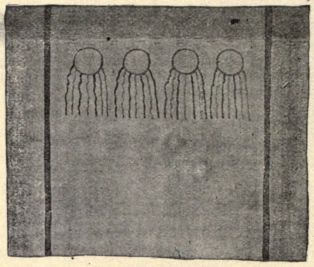
FIG. 156.—George Miller’s personal mystery decoration.
George received the first one when he was about seventeen years of age. Before he married he had worn out three. He still has the right to decorate and wear the fourth blanket, according to his father’s intention. He could decorate other white blankets in this style, and wear them, if he wished, but he could not transmit to any one of his children (the grandchildren of Little Soldier) the right to make and wear such a decoration, unless George himself should hereafter see the objects in a dream or vision.
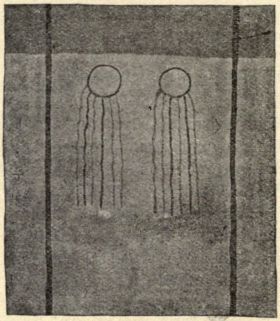
FIG. 157.—A variant of Fig. 156.
The right to use such designs on a buffalo robe, blanket, tent, etc., must originate with one who has had a vision or dream in which the mystery objects are manifested. Those who could use the class of designs represented in the accompanying illustrations (Figs. 156-161) were members of the order of Thunder shamans (Iñgȼaⁿ iȼa‘eȼĕ-ma).
ORDER OF THUNDER SHAMANS.
§ 45. This order is composed of those who have had dreams or visions, in which they have seen the Thunder-being, the Sun, the Moon, or some her superterrestrial objects or phenomena.
When a person saw the Thunder-being or some other mystery object, he kept the matter a secret for some time. He took care to join the first war party that went from his camp or village. When the party reached the land of the enemy or got into some trouble the man told of his dream or vision. Should the dreamer or seer kill or grasp a foe while a member of the expedition he made a Thunder song. He who brought back one of the enemy’s horses also had the right to make a Thunder song. Some time having elapsed after the return of the warriors, the seer painted the mystery objects on a robe or blanket, and prepared a feast, to which he invited all the members of the order of Thunder shamans. When the guests had assembled the robe was hung up and shown to them. Then all who were present rejoiced. From that time onward the host was a member of the order, and he could wear the robe with safety.
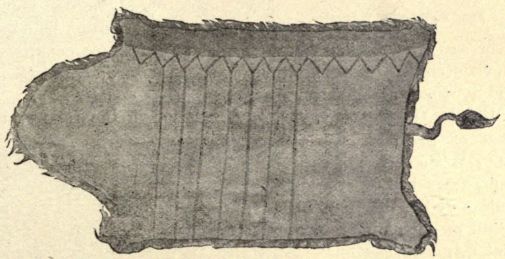
FIG. 158.—Robe of Wanukige.
He could give his son the right to wear such a robe, but unless that son had a similar vision he could not transmit the right to one of the next generation. Little Soldier painted a buffalo robe with his personal mystery decoration, and gave it to Two Crows, whose father had been one of the leaders of the order of Thunder shamans. So Two Crows wore the robe, and he can make another like it; but he can not transmit the right to his son, Ga‘iⁿ-bajĭ. Two Crows would have been afraid to wear the robe or to copy the decoration on it had he not been a member of the order by direct inheritance from his father. A father can clothe his son in such a robe when that son is large enough to go courting. The man can not give such a robe to his daughter, but he can give one to his son’s son, or to his daughter’s son, should that grandson be a large youth, who has neared or reached the age of puberty.
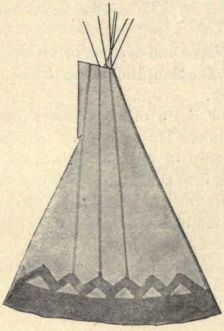
FIG. 159.—Tent of Wanukige.
If a man who became eligible by his vision to membership in the order of Thunder shamans ventured to wear the decorated robe without inviting the members of the order to a feast, he incurred the anger of the members and misfortune was sure to follow. Should a man wear such a decorated robe without having had a vision of the mystery object, he was in danger (if the object was connected with the Thunder-being, etc.) of being killed by lightning. Every Omaha feared to decorate his robe, tent, or blanket with an object seen by another person in a dream or vision. For instance, George Miller would not dare to have bears’ claws, horses’ hoofs, etc., on his robe, because neither he nor his father ever saw a bear or horse mysteriously. There are penalties attached to violations of the prohibitions of the other orders, but George Miller did not know about them.
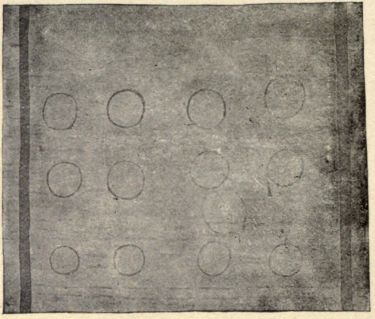
FIG. 160.—Robe of Ȼaqube.
Besides the personal mystery decoration of the robe or blanket, is that of the tent. Pl. XLIV, E is a sketch of a tent, furnished to the author by Dried Buffalo Skull, an old man of the Ȼatada gens of the Omaha. The decoration of this tent was the personal mystery or “qube” of Hupeȼa, Sr., father of Hupeȼa, Jr. (now known as ┴enugaʇañga), of the Wasabe-hit‘ajĭ or Black Bear sub-gens of the Ȼatada. After the death of Hupeȼa, Sr., the decoration became the property of his kinsman, Agaha-wacuce, of the same sub-gens, and father of Ԁaȼiⁿnaⁿpajĭ. The circle at the top, representing a bear’s cave, is sometimes painted blue, though Agaha-wacuce had it reddened. Below the four zigzag lines (representing the lightnings of different colors) are the prints of bears’ paws. The lower part of the tent was blackened with ashes or charcoal. Among the four zigzag lines, red, according to Mr. Francis La Flèche, symbolizes the east.
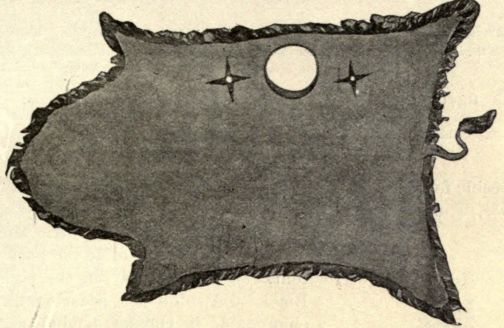
FIG. 161.—Robe of Ԁahe-ʇap‘ĕ.
Wanukige, a chief of the Ictasanda gens, had a vision of the aurora borealis, so he depicted this on his robes and tent, as shown in Figs. 158 and 159. On the tent were seven stripes, three on each side of the entrance and one in the rear. Each robe that he wore had seven stripes.
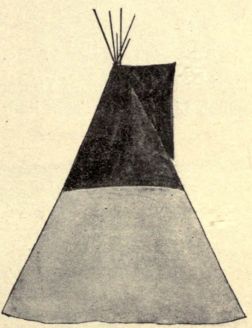
FIG. 162.—Generic decoration referring to night, etc.
Fig. 160 represents the personal mystery decoration of Ȼaqube of the [K]aⁿze gens. George Miller’s father could wear this decoration, but the right to it could not be transmitted by him to any one else. Ԁahe-ʇap‘ĕ, of the [K]e-‘iⁿ subgens of the Ȼatada gens, once had a vision of two stars and the new moon. Consequently he decorated his buffalo robe, as shown in Fig. 161, and joined the order of Thunder shamans. He died when the author was at the Omaha agency (between 1878 and 1880).
GENERIC FORMS OF DECORATION.
§ 46. There are examples of generic forms of decoration, as well as those of specific forms. For instance, when a person had a vision of the night, or of the Thunder-being, or one of some other superterrestrial object, he blackened the upper part of his tent and a small portion on each side of the entrance, as shown in Fig. 162.
It was given thus by George Miller:
Níaciⁿgaamáágudictĕhaⁿ´ daⁿ´ctĕíȼa‘eȼéamá ʇíugȼiⁿ´iʞĭ,wiⁿdétaⁿ sábeȼaí,kĭciágudíctĕ níkaciⁿgaamá
Peoplethe pl. sub.where evernightfor example they have visions of it.the pl. sub. tentthey dwell inif one-half the length they blackenandagainwhereever peoplethe pl. sub.
iñgȼaⁿ´ íȼa‘eȼéamácĭégaⁿ ugȼiⁿ´-biamá.
thunder being they have visions of it.the pl. sub againsothey dwell in, they say.
SPECIFIC FORMS OF DECORATION.
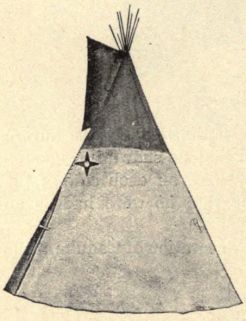
FIG. 163.—Tent of Aⁿpaⁿ-skă, Sr.
A specific form related to the generic one just described is shown in Fig. 163. The blackened part of the tent represents the night, and the star denotes the morning star. There was a star on the left hand at the back of the tent, and another star on the right side. Black and blue are occasionally interchangeable in Omaha symbolism; hence we find that the night is represented by a blue band on a coyote skin worn by the elder Aⁿpaⁿ-skă, and subsequently by his son and namesake, when the latter was a small boy. The blue band was worn next the shoulders of the owner (Fig. 164).
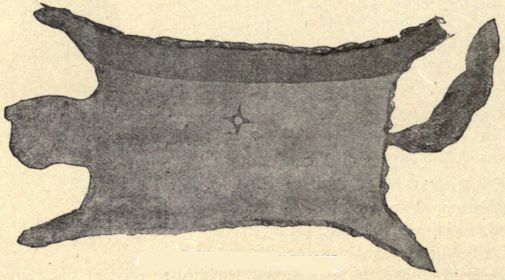
FIG. 164.—Robe of Aⁿpaⁿ-skă, Sr.
The decoration refers to his “qube” or “sacred vision.” Little Cedar, of the Maⁿȼiñka-gaxe (Omaha) gens, belonged, we are told, to the Miⁿ iȼa‘eȼĕ-ma, or order of Sun and Moon shamans, probably identical with the order of Thunder shamans. Fig. 165 represents a vision which Little Cedar once had, described thus by George Miller:
Gaⁿ´níaciⁿgaaká íȼa‘eȼá-bi egaⁿ´ȼetégaⁿ ʇiugátĕugȼiⁿ´-biamá.Mázi-jiñ´ga ijáje aȼiⁿ´-biamá.Sábetĕhaⁿ´ kĕé
Andmanthe sub. having had a vision, they saylike this std. ob. tentpaintedthehe dwelt in, they say, Cedar Little his namehad, they sayBlack thenightthe lg. ob.that
gáxai;niaⁿ´ba ȼaⁿéȼaⁿbetĕgáxai. Niaⁿ´bauȼan´da ȼan´diníkaciⁿgaugȼiⁿ´gáxai,gañ´ʞĭ íȼa‘eȼaíȼiñkéétĕ.
mademoon the cv. ob.emerging themade.Moonin the midst of in the partpersonsitting in madeandone seen in a visionthe one who thatthe
Niaⁿ´baéȼaⁿbeatí-nandi náqȼiⁿégaⁿ-naⁿ´i.
Moonemergingcomes regularly, when blazes (sends up light)somewhatusually.
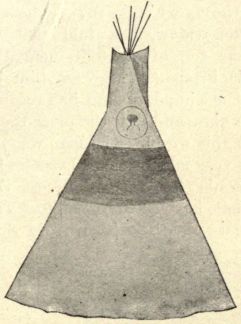
FIG. 165.—Tent of Mazi-jiñga—ghost vision.
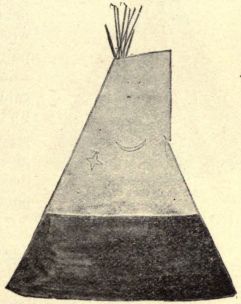
FIG. 166.—A tent of Nikuȼibȼaⁿ.
The black band refers to the night; the circle, to the moon; the circumscribed figure is a ghost that he saw in the moon; and the dots above the moon refer to the “white which stands above the rising sun or moon.” Pl. XLIV B shows another tent decoration of the same man. The red circle represents the sun, in which stands a man holding the ʇa-cá-ge, or deer rattles, made of the hard or callous knobs found near the hoofs of the deer. These knobs are split, hollowed out, and strung on sticks. The tent being very large, the figure of the man was almost life size, and a real feather was tied to his head. The blue band at the bottom may represent night, but there is no certainty about it.
§ 47. Fig. 166 is the decoration of one of the tents of Ni-ku-ȼi-bȼaⁿ, father of the present Wackaⁿ-maⁿȼiⁿ (Hard Walker), an ex-chief of the Omaha. Nikuȼibȼaⁿ was one of the two leaders of the order of Thunder shamans, and was regarded as being very “qube” or mysterious. The black band at the bottom refers to the night, and above it are seen the moon and a star. The old man named one of his grandchildren Haⁿakipa (Meets the Night), after the vision to which the tent decoration refers.
George Miller furnished the description of Nikuȼibȼaⁿ’s tent, obtained from an old woman, who is his widow:
“Gaⁿwíqti ʇaⁿ´ba-májĭȼaⁿ´ja,uȼaí égaⁿana´‘aⁿhă.Gaⁿ´ iñgȼaⁿ´ íȼa‘eȼá-biamá,ádaⁿ ʇuɔniñ´gegáxaitĕ
AndI myselfI did not see him thoughthey have told about himas I have heard it.AndThunder Being he had a vision of him, they saytherefore rainbowmade itthe (past act)
gátĕ.┴íhuʞaⁿȼaⁿʇá bagȼéjaitĕ,éuȼaíhă wa‘újiñgaigáqȼaⁿaká. Maⁿ´ciaʇá aȼiⁿ´akíi,á-biamá.Eʇá ctĭ
that ob.Smoke-holeat the part painted in spotsthe (past act)that told it.old womanhis wife the sub.On highhaving him had reached there againhe said, they say. Theretoo
majaⁿ´ȼéégaⁿ,á-biamá. Qubĕ´qtigáxainíaciⁿga, ádaⁿʇíugátĕáwatégaⁿ gáxegaⁿ´ȼaiʞĭ,gaⁿ´ égaⁿgáxai.
landthislike he said, they sayVery mysteriousthey made him manthereforetentpaintedthe howto make ithe wishedwhen at any ratesohe made it.
Bagȼéjaitĕ másié wakaítĕ.”
Made spotted by painting hehailthat it meantthe (past act).
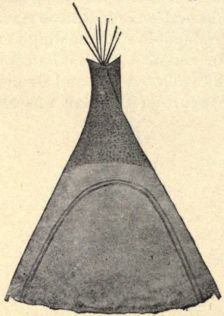
FIG. 167.—Another tent of Nikuȼibȼaⁿ.
That is, “I myself did not see him, but I have heard what was told. They say that he had a vision of the Thunder-being, so he made that rainbow which appears in the figure (Fig. 167). The old woman, his widow, has told that he painted the top of the tent, near the smoke-hole, in spots. They say that he said that the Thunder-being had carried him up on high, and that the place there resembled this world. The man was regarded as very mysterious; therefore he decorated his tent according to the pattern that he wished to make. The painted spots represent hail.” Many years ago, Nikuȼibȼaⁿ said that he had been carried up into the world above this one, and that he found it resembled the world in which we live. The rainbow and hail depicted on the tent formed part of the vision, but their exact significance has not been explained.
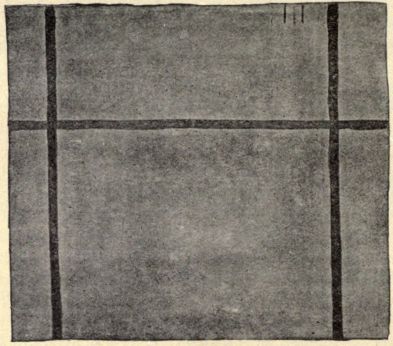
FIG. 168.—Blanket of Cuʞa-maⁿȼiⁿ.
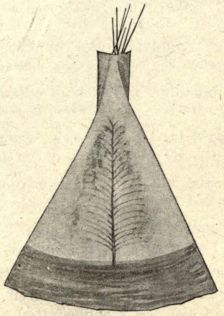
FIG. 169.—Tent of ┴e-saⁿ; vision of a cedar.
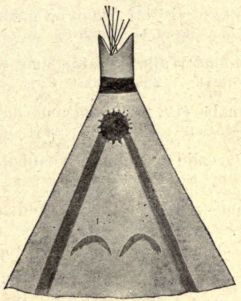
FIG. 170.—Tent of ┴e-saⁿ; sun and rainbow vision.
Cu-ʞa maⁿ-ȼiⁿ, an Omaha, had a vision which gave him the right to use the decoration given in Fig. 168. The meanings of the different marks have not been learned. Cuʞa maⁿȼiⁿ bequeathed the blanket to his son, [K]axe-giaⁿ (Flying Crow), now known as Gilbert Morris.
§ 48. The old chief ┴e-saⁿ (Ta sone of Maj. Long), Distant-white Buffalo, father of the chiefs Standing Hawk and Fire Chief, had a vision of a cedar tree, which he painted on each side of his tent, as seen in Fig. 169. The next sketch (Fig. 170) shows the back part of another tent of ┴e-saⁿ. The blue band near the top is called “sabe” (black); below this is the sun and a blue rainbow; near the bottom are two horsetails. The only decorations on the front of the tent are two horsetails, one on each side of the entrance. This tent was used by Standing Hawk after the death of his father. This decoration may have been made after a vision of horses, as Standing Hawk was a member of the order of Horse Shamans (Cañge iȼa‘eȼĕ-ma). George Miller speaks thus about it:
Gaⁿ´níaciⁿgaakáníkagahíátai egaⁿ´íȼa‘éȼĕ daⁿ´etĕaⁿ´itĕ,miⁿ´ ȼaⁿugaí, íʇi.Cĭcañ´gĕsĭn´de ctĭ
Andmanthe sub.chief he was beyondashe had a vision perhapsthe (past act)sunthe cv. ob. he paintedhe painted the tent with it.Again horsetailtoo
gáxai,hidékĕ´di. ┴íhuʞaⁿ[p]asíȼaⁿ sábĕȼai.
he madebottomat the Smoke holetip endthe parthe blackened.
That is, “As the man was a head chief, he may have had a vision, for he occupied a tent on which he painted the sun, and he also decorated it with horse-tails at the lower part. He painted the border of the smoke-hole a dark blue (ʇu sabĕ, which is some-times called, sabĕ).
“Iȼádiamádaⁿ´ctĕ égaⁿgáxaitĕ´di,ijiñ´geamá íȼa‘éȼa-bájĭctĕwaⁿ´ égaⁿgáxe-naⁿ´-biamá,ádaⁿ égaⁿgáxai.”
His fatherthe pl. sub.perhapsso didwhenhis sonthe pl. sub. they did not have visions of iteven sousually did, theythereforesohe did
That is, “When the fathers decorate their tents in consequence of their respective visions, their sons (who succeed them) usually imitate them (or dwell in the decorated tents), even when they themselves have not had visions of the objects. Therefore he (i.e., Standing Hawk) did so.”
George Miller told the following about Ԁede-gahi or Fire Chief, another son of ┴e-saⁿ:
CĭégaⁿԀéde-gáhiaká ugȼiⁿ´iwaʇaⁿ´be.Wataⁿ´zihi íʇiwaʇaⁿ´beȼaⁿ´ja, áwatégaⁿiȼápahaⁿ-májĭ ȼaⁿ´ja,níkagáhi
AgainsoFire Chiefthe sub. he sat in itI sawCorn-stalk painted on the tentI sawthough of what sortI knew notthoughchief
égaⁿégaⁿugȼiⁿ´itĕ. Wataⁿziȼiⁿ´ctĭwaqu´be gáxai.Kĭcĭ´Ԁéde-gáhiaká taⁿ´waⁿgȼaⁿeʇáamá Wajiñ´ga-ȼatájĭamá
likesohe sat in the (past act) Cornthe col. ob.toomysterious he made itandagainFire Chief the sub.gens histhe pl. sub.Birdeat not the pl. sub.
wahábapahañ´gaju´t‘aⁿtĕ´di ȼatá-bajĭwahábaȼiⁿ´, níkaciⁿgaamánaⁿ´wapeȼaté tai tĕ´.Ȼataíʞĭ,wahába ȼiⁿ´,
ear of cornfirstmatureswhen they do not eatear of cornthe col. ob. peoplethe pl. sub.fear them they will eatthe (act)They eatif ear of cornthe col. ob.
wajiñ´gaȼasniⁿ´ weʞubaí.Iñké-sabĕákadíctĭ égaⁿgáxe-naⁿ-biamáʇí ugá.Hañ´gaákadíctĭégaⁿ gáxe-naⁿ´-biamá
birddevour they fear themShoulder blackamong the too somakeusuallythey saytent painting.Foremostamong thetooso makeusuallythey say
ʇíugá.
tentpainting.
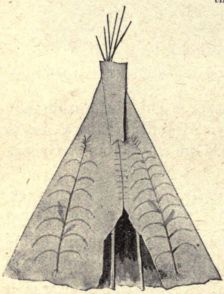
FIG. 171.—Cornstalk decoration of the tents of Fire Chief and Waqaga.
This refers to Fig. 171, and may be thus rendered: “And I have likewise seen the tent of Fire Chief. It was decorated with cornstalks, but I do not know the reason for it. He dwelt in such a tent because he was a chief. Corn was regarded as “waqube,” mysterious. In the sub-gens of Fire Chief, the Wajiñga-ȼatajĭ, or, those who eat no small birds, the people feared to eat the first ears of corn that matured, lest the small birds (particularly blackbirds) should come and devour the rest of the crop. There was a similar tent decoration in the Iñke-sabĕ and Hañga gentes.” In the former, it was used by Waqaga (see § 53). The cornstalks and ears were green, the tips of the ears were black. There were two similar cornstalks on the back of the tent.
CORN AND THE BUFFALO.
§ 49. Corn is regarded as a “mother” and the buffalo as a “grandfather” among the Omaha and other tribes.[57] In the Osage tradition, corn was bestowed upon the people by four buffalo bulls or “grandfathers.”[58] Dr. Washington Matthews tells of a similar Arikara belief about an ear of corn.[59] (See § 42.)
OTHER OMAHA MYSTERY DECORATIONS.
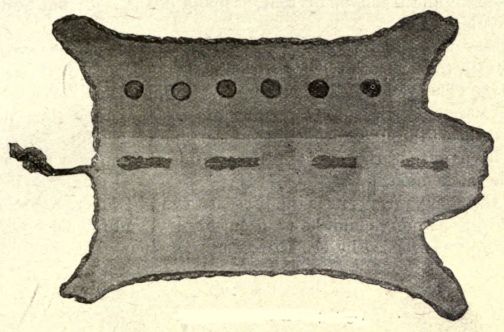
FIG. 172.—Robe of Ni-ȼactage.
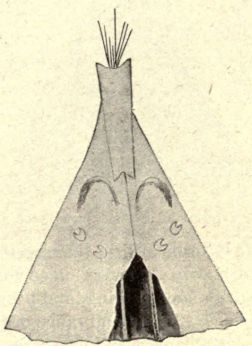
FIG. 173.—Duba-maⁿȼiⁿ’s father’s tent.
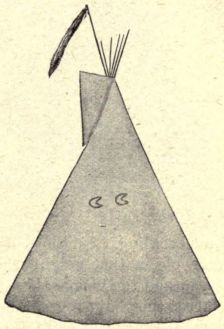
FIG. 174.—Maⁿtcu-naⁿba’s tent.
§ 50. Among the members of the order of Buffalo (┴e iȼa‘eȼĕ-ma) was Niȼactage, whose robe is shown in Fig. 172. The red band is at the top. The black spots represent the places where the buffaloes play “buffalo wallows.” Buffalo hoofs are in blue.
Duba-maⁿȼiⁿ’s father had a vision of horses, hence he wished to depict horse-tails and tracks on his tent, as found in Fig. 173; but he died before he finished it.
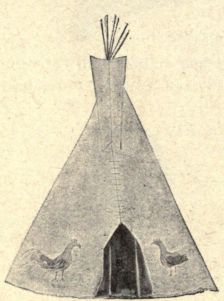
FIG. 175.—Wackaⁿhi’s tent.
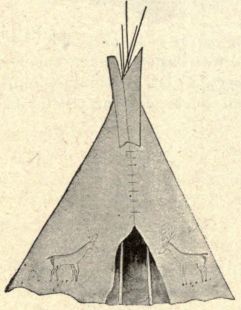
FIG. 176.—Tent of unknown Omaha.
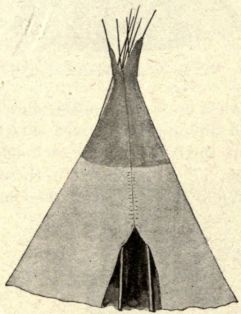
FIG. 177.—Tent of ┴ebi‘a.
The father of Maⁿtcu-naⁿba had a vision of horses, and bequeathed to his son Maⁿtcu-naⁿba the right to decorate his tent in the style shown in Fig. 174. The yellow was connected with the vision. When the owner dwelt in an earth-lodge, the horse-tail was tied to a long pole, which was thrust through the opening at the top of the lodge. So when he used his skin tent, the horse-tail hung from the top of a long pole above the smoke-hole.
When the Omaha dwelt near the present town of Homer, Nebr., and Wackaⁿhi was a young child, he went out to play, and fell asleep. He said that he was aroused by the sounds made by many chickens crowing and cackling. In those days (fide George Miller) there were no white people in that neighborhood; but now in that very place where Wackaⁿhi had the vision, there is a wealthy family living, and besides large herds they have a great many chickens. In remembrance of that occurrence, Wackaⁿhi painted his tent with his personal decoration as given in Fig. 175.
An unknown Omaha had a vision of deer, so he decorated his tent accordingly. (See Fig. 176.) George Miller could not furnish the man’s name.
§ 51. Among the members of the order of Grizzly Bear shamans was an Omaha named ┴ebi‘a (Frog). The top of his tent was painted yellow, as shown in Fig. 177. There was no other decoration; but this yellow evidently was connected with a grizzly bear vision, as it appears in the decoration adopted by the father of Two Crows, who was not only one of the two leaders of the order of Thunder shamans (Iñgȼaⁿ iȼa‘eȼĕ-ma) but also a member of the orders of Buffalo and Grizzly Bear shamans (┴e iȼa‘eȼĕ-ma and Maⁿtcu iȼa‘eȼĕ-ma). (See Pl. XLIV, D, in which a grizzly bear is depicted as emerging from his den. The blue part represents the ground.)
This decoration (of the tent of Two Crows’ father) is thus described by George Miller:
Maⁿtcúiȼa‘eȼaíegaⁿ´ ʇítĕégaⁿgáxai. Maⁿtcúwadaⁿ´baitĕ´diʇan´de kĕmaⁿ´taʇaéȼaⁿbetí wadaⁿ´bai,gaⁿ´
Grizzly bearthey have visions of itas tentthe std. ob.sothey make it Grizzly bearthey see themwhen groundthe lg. ob.withinemerging comethey see themand
égaⁿgáxaiʇí tĕ.┴an´dekĕ ʇúȼĕ-naⁿ´i,ʇíhébekĕ zíȼĕ-naⁿ´i.”
so they make ittentthe std. ob.Ground the lg. ob.they usually paint blue tentpartthe lg. ob. they usually paint yellow.
That is, “When they have had visions of grizzly bears, they decorate their tents accordingly. When they see grizzly bears, they behold them coming out of the ground, and so they paint the tents. They always (or usually) paint the ground blue, and part of the tent they paint in a yellow band.” This shows the conventional use of colors. See Pl. XLIV, E, for the sketch of another tent representing the vision of a grizzly bear.
KANSA MYSTERY DECORATIONS.
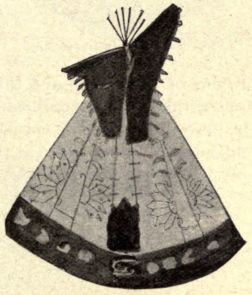
FIG. 178.—Tent of a Kansa who had an eagle vision.
§ 52. Three Kansa decorations follow. They are taken from an original sketch made by a Kansa man, known to the white people as Stephen Stubbs. The first tent (Fig. 178) is that of a man who had fasted and held mysterious communication with an eagle which gave him some feathers. He had danced the pipe dance once for some one. At the base of this tent are seen two peace pipes on each side of the entrance. At the back are a black bear and a large turtle. The second tent (Fig. 179) is that of a man who had danced the pipe dance three times. Buffalo tails are fastened to the tops of the triangular pieces forming the shelter of the smoke-hole, feathers hang from the two shields, and the stars are above and on the base of the tent skins. Feathers, shields, and stars are also on the back of this tent.
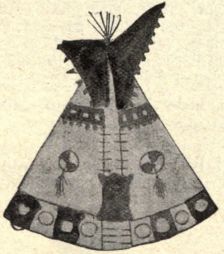
FIG. 179.—Kansa decorated tent.
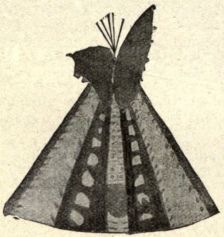
FIG. 180.—Kansa decorated tent.
Fig. 180 is the tent of a man who has danced the pipe dance four times. It is very probable, judging from the stars on the tents, that the owners of the second and third Kansa tents had had visions. The Kansa say that when a man has danced the pipe dance twice, his tent can be decorated with two cornstalks at the front (one on each side of the entrance), and two more at the back. The pipes used in the calumet or pipe dance are regarded as “Wakandaʇaȼicaⁿ” by the Omaha and Ponka, and the inference is that the Kansa and Osage had a similar belief about these pipes and the accompanying dance. Perhaps there was a time when no man could undertake the pipe dance unless he had a vision of some kind.
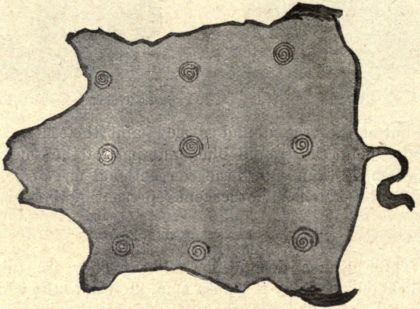
FIG. 181.—Maⁿze-guhe’s robe.
OMAHA NIKIE DECORATIONS.
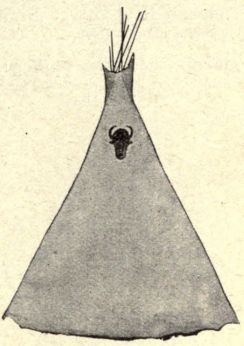
FIG. 182.—Maⁿze-guhe’s tent.
§ 53. As the gentes of the Omaha and Ponka are regarded as being “Wakandaʇaȼicaⁿ,” the “nikie” and “nikie names” have a religious significance. George Miller has furnished the author with a few nikie decorations, which are now given.
Maⁿze-guhe, an Omaha, belonged to the Waȼigije sub-gens of the Iñke-sabĕ gens. The decoration of his robe (Fig. 181) marks the nikie of the sub-gens, as it consisted of spiral forms known as “waȼigije.” That of the tent (Fig. 182) refers to the nikie of the entire gens. In the latter case, the buffalo head was painted on the back of the tent.
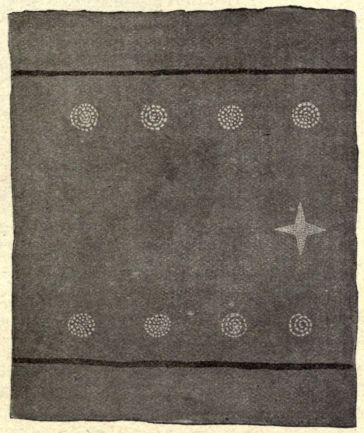
FIG. 183.—Duba-maⁿȼiⁿ’s father’s blanket.
Duba-maⁿȼiⁿ, who has a nikie name referring to the buffalo, belongs to the Waȼigije sub-gens. His father wore a black blanket embroidered with beadwork in two rows of spirals, between which was a star. All these figures were made of white beads. (See Fig. 183.)
In the Pipe sub-gens of the Iñke-sabĕ there were several tent decorations. Of the first, George Miller speaks thus:
Níkaciⁿ´ga-mataⁿ´waⁿgȼaⁿ´-ma niníbat‘aⁿ´amáIñké-sabĕ akádiʇíugaí,niníbaíʇi. Kĭwédajĭ-ma
The peoplethose in the gentespipe havethe pl. sub.Black shoulder among thetentthey paint pipepainted the tent withAnd those elsewhere
wédahaⁿ-májĭ,añ´ka-bájĭ ebȼégaⁿ.Iñké-sabĕakádiníkagáhi akáégaⁿgáxaiebȼégaⁿ, aⁿ´ctĕwaⁿ´gáxa-bájĭ
I do not know themthey are not soI think. Black shoulderamong the chiefthe sub.somade I thinkof any patternhe did not make
ebȼégaⁿ.Niníbawaqúbegáxai ʞĭ,niníbajaⁿ´kĕ bȼáskagáxai,uȼískai,wajiñ´gadá ájiitĕ,ʇáhiⁿjíde
I think.Pipemysterious thing madewhenpipewoodthe lg. ob. flatmadeput porcupine work around it bird heads put many on itthe past act“deer fur” red
íkaⁿtaⁿ´i.”
tied to it.
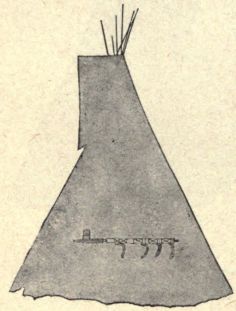
FIG. 184.—Iñke-sabĕ tent decoration.
That is, “Those persons who belong to the Iñke-sabĕ sub-gens known as Keepers of the Pipes, paint their tent(s) with the pipe decoration. I do not know of any other persons, members of other gentes, using this decoration; I think that no others use it. I think that the Iñkesabĕ chief decorates his tent in this manner, and that he did not decorate it in any way he pleased. When the sacred pipes were made (on the tent) the pipestem was made flat, porcupine work was put around it, several heads of birds were fastened on it, and tufts of reddened horses’ hair were tied to it at intervals.” (See Fig. 184 and Pl. XLIV, C.) This Iñke-sabĕ tent had only two pipes on it—one on each side of the entrance.
The second Iñke-sabĕ tent decoration is thus described by the same authority:
Aⁿjiñ´gatĕ´diʇi´-ugȼiⁿ´ waʇaⁿ´beʞĭ,ȼekégaⁿ ugȼiⁿ´i.Niníbamácaⁿugȼé íʇiwaʇaⁿ´beNiníba t‘aⁿ´akádi,
The smallwhentent dwelt in I saw themwhenlike this lg. ob. they dwelt inPipequill feather attached to at right angles painted the tent withI sawPipehad among the
Waqágaégaⁿíʇiwaʇaⁿ´be. Niníbawaqúbekĕékigaⁿ´qti ȼaⁿ´ja,emácaⁿugȼé gáxai,niníbawéawaⁿ
Burrssopainted the tent with I saw themPipesacredthe lg. ob. just like itthoughthatquill feather attached to at right anglesmadepipecalumet
akéĕhă.Ȼaⁿ´janiníba kĕéínikagáhiʞiʞáxai, níaciⁿ´gaamáátaqtigáxaininíba waqúbe.Níaciⁿ´gaamá
that is it.Thoughpipethe lg. ob. that aforesaidchief by means of it they make themselvespeoplethe pl. sub. exceedinglymake itpipesacred Peoplethe pl. sub.
píäjĭ´qtictéctĕwaⁿ´,ukít‘ĕákikiȼáqtimaⁿȼiⁿ´ictéctĕwaⁿ´,kikídĕqtimaⁿȼiⁿ´ictéctĕwaⁿ´,niníbakĕéȼaⁿbeaȼiⁿ´ ahíi
very badnotwithstandingforeign nation contending fiercely togetherthey walk notwithstandingshooting often and fiercelythey walk notwithstandingpipethe lg. ob. coming forththey take it thither
ʞĭ,uȼúci kĕuháaȼiⁿ´ aȼai´ ʞĭ,múkictaⁿtai´.Téqigáxainíaciⁿ´gaamá.
when in the middlethe lg. line following its coursethey take itwhen they stop shooting at one anotherwill Preciousthey make itpeoplethe pl. sub.
That is, “When, in my childhood, I saw the tents in which the people dwelt, they were of this sort. (See Fig. 185.) I saw the tent decorated with the pipes having feathers attached to each pipe at right angles. I saw a tent of this sort when it was occupied by Waqaga of the Pipe sub-gens. (See another tent decoration of this man, § 48.) Though these pipes closely resemble the peace pipes (niniba waqube), they are made with the feathers attached to the stems at right angles. These are the pipes used in the pipe dance. By means of the pipes the people made for themselves that which was equivalent to (or, lead to) the chieftainship. So they regarded the sacred pipes as of the greatest importance. Even when the people were very bad, even when different tribes continued to struggle with one another; even when they shot often at one another, when some persons came forth with the peace pipes, and bore them to a place between the opposing forces, carrying them all along the lines, they stopped shooting at one another. The Indians regarded the pipes as precious.”
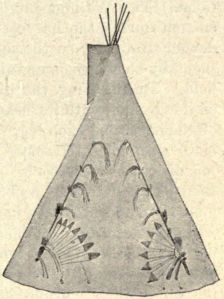
FIG. 185.—Iñke-sabĕ tent decoration.
A ┴a[p]a nikie tent decoration is shown in the tent of Heqaga. (Pl. XLIV, C.) This tent had two pipes on each side of the tent, double the number on the Iñke-sabĕ tent (Fig. 184).
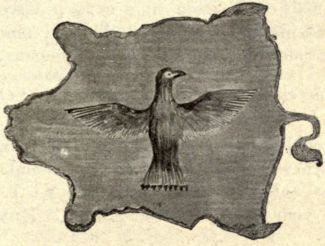
FIG. 186.—Waqaga’s robe.
Fig. 186 is given as the nikie decoration of a robe belonging to Waqaga. The bird on the robe is an eagle. Members of the Pipe sub-gens of the Iñke-sabĕ have eagle birth names. And we know that Waqaga belonged to that sub-gens.
The author understood Joseph La Flèche and Two Crows to say, in 1882, that while nikie names possessed a sacredness, it was only the sacredness of antiquity, and that they were not “Wakandaʇaȼicaⁿ.”
But the author now thinks that such a statement needs modification; for, besides what appears at the beginning of this section, we know that among the Osage and Kansa the nikie names are associated with the traditions preserved in the secret society of seven degrees, and that this applies not only to names of gentes and sub-gentes, but also to personal nikie names. The author frightened an Osage in January, 1883, by mentioning in public some of this class of names.
OMAHA NIKIE CUSTOMS.
§ 54. Among the nikie of the Omaha, the following may be mentioned: The Wajiñga-ȼatajĭ, or “Blackbird people,” had a curious custom during the harvest season. At that time the birds used to devour the corn, so the men of this sub-gens undertook to prevent them, by chewing some grains of corn which they spit around over the field.[60] During a fog, the [K]e-‘iⁿ men would draw the figure of a turtle on the ground, with its head to the south. On the head, tail, middle of the back, and each leg, were placed small pieces of a (red) breechcloth with some tobacco. They imagined that this would make the fog disappear very soon.[61] The [K]aⁿze gens, being Wind people, flap their blankets to start a breeze when mosquitoes abound.[62] The ┴a-[p]a gens have a form for the naming of a child on the fifth morning after its birth, according to Lion, one of the chiefs of that gens.[63] In the feast on the hearts and tongues,[64] the Hañga men who belong to the sub-gens keeping the sacred pole, eat the buffalo tongues, though the buffalo is their “grandfather” and the eponym of their gens; but they can not eat the “ʇa” or buffalo sides. However, the other Hañga men, who can not eat the tongues, are allowed to eat the consecrated buffalo sides, after the ceremonies connected with the thanksgiving and anointing of the sacred pole.[65] No Omaha child had its hair cut until it had been taken to an old man of the Ictasanda gens, to have the first locks cut, the first moccasins put on the child’s feet, and prayers to be said over it. Sometimes the old man said
“┴ucpáha,Wakan´daȼa‘éȼiȼé-deʞácimaⁿȼiñ´kasíáȼagȼétate,”
O grandchild,Wakandapity you whena long timesoilfoot you set it erect onshall,
i.e., “O grandchild, may Wakanda pity you, and may your feet rest a long time on the ground!” Another form was sometimes used—“Wakanda ȼa‘eȼiȼe tate. Maⁿȼiñka si aȼagȼe tate. Gudihegaⁿ ne tate,” i.e., “May Wakanda pity you! May your feet tread the ground! May you go ahead (or, live hereafter)!”[66]
§ 55. When there is a “blizzard,” the other Kansa beg the members of the Tcihaciⁿ or Kaⁿze gens to interpose, as they are Wind people.
“[M]i´tcigu-e´,haⁿ´baya´li kŭⁿ´blaeyau´.Ciñ´gajiñ´gayi´ta kik’ŭⁿ´yakiye´tce au´ [64], a´beau´.”i.e., “They say,
O grandfather,daygoodI desire indeed.Childyour you cause him to be decorated (or painted)will .they say.
‘O grandfather (said to one of the Kaⁿze gens), I wish good weather. Please cause one of your children to be decorated!’” Then the youngest son of one of the Kaⁿze men, say one over 4 feet high, is chosen for the purpose, and painted with red paint (I´gamaⁿ jü´dje i´kik’ŭⁿ´kiya´be au). The youth rolls over and over in the snow and reddens it for some distance all around him. This is supposed to stop the storm.
GOVERNMENTAL INSTRUMENTALITIES.
§ 56. Among the Omaha governmental instrumentalities which are “Wakandaʇaȼicaⁿ” are the chiefs, the keepers of the three sacred tents, the keepers of the sacred pipes, the gentes, sub-gentes, and taboos, none of which can be regarded as fetiches, and the following which appear to be fetiches: The sacred pipes (including the war pipes of the Elk gens, the two peace pipes kept by the Iñke-sabĕ gens, the mysterious objects kept by the “keepers of the pipes” in the Ȼatada, [K]aⁿze, Maⁿȼiñka-gaxe, ┴e-sĭnde, ┴a-[p]a, and Ictasanda gentes, and the weawaⁿ or pipes used in the calumet dance), the sacred pole, the sacred hide of a white buffalo, the sacred arrows of divination, and the sacred clam shell of the Elk gens.[67]
§ 57. OMAHA AND PONKA TABOOS.
Buffalo skull not touched by—
1. ┴e-[p]a it‘ajĭ sub-gens of Ȼatada (Omaha).
2. Waȼigije sub-gens of Iñke-sabĕ (Om.).
3. ┴e-sĭnde gens (Om.).
4. Part of the Wacabe gens (Ponka).
5. Part of Necta gens (P.).
Buffalo tongue not eaten by—
1. Waȼigije sub-gens of Iñke-sabĕ (Om.).
2. Hañgaqti or Wacabe sub-gens of Hañga (Om.).
3. Part of Nika[p]aɔna gens (P.).
4. Part of Wacabe gens (P.).
5. Part of Necta gens (P.).
Buffalo (black) horns not touched by part of Iñke-sabĕ gens (Om.).
Buffalo sides (when consecrated), not eaten by ┴a waqube ȼatajĭ sub-gens of Hañga gens (Om.).
Buffalo rib (lowest one, ʇeȼiʇ-ucagȼe), not eaten by ┴e-sĭnde gens (Om.).
Buffalo and domestic calf not eaten when the hair is red, but can be eaten when the hair turns black, by ┴e-sĭnde gens (Om.).
Buffalo calf can not be touched, when its hair is “zi” (yellow or red), by a sub-gens of the Necta gens (P.).
Buffalo calf can not be eaten at any time by—
1. Iñgȼe-jide gens (Om.).
2. Part of Wacabe gens (P.).
3. Part of Necta gens (P.).
Deer not eaten by—
1. Part of Hisada gens (P.).
2. Part of Nika[p]aɔna gens (P.).
Male deer not eaten by Elk gens (Om.); but Deer gens can eat venison.
Skin of any animal of the deer family can not be touched by ┴ada gens (Om.).
Flesh of male elk not eaten by Elk gens (Om.).
Bladder and sinew of male elk not touched by Elk gens (Om.).
Elk not eaten by part of Nika[p]aɔna gens (P.).
Turtles not eaten by Turtle sub-gens (Om.).
Black bear skin not touched by—
1. Black bear sub-gens (Om.).
2. Black bear sub-gens (P.).
Wild-cat skin, not touched by pipe sub-gens of Deer gens (Om.).
Cranes and swans not eaten by part of Hañga gens (Om.).
Swans not touched (formerly?) by Miⁿxasaⁿ wet‘ajĭ sub-gens of Maⁿ-ȼiñka-gaxe gens (Om.).
Small birds not eaten by Wajiñga-ȼatajĭ (Blackbird or Small bird) sub-gens of the Ȼatada gens (Om.). They can eat wild turkeys, ducks, geese, swans, cranes. When members of this sub-gens are sick they can eat grouse.
(Small birds) blackbirds, (black ones), swallows, and grouse not eaten by part of Hisada gens (P.).
Reptiles neither touched nor eaten by—
1. Ictasanda gens (Om.).
2. Wajaje gens (P.).
Blood not touched by part of the Ȼixida gens (P.), hence their name, Wami it‘ajĭ.
Red corn not eaten by a sub-gens of the Iñke-sabĕ gens (Om.).
Charcoal not touched by—
1. A sub-gens of the Iñke-sabĕ gens (Om.).
2. The Pipe sub-gens of the Deer gens (Om.).
3. A sub-gens of the Ȼixida gens (P.).
4. The Pipe sub-gens of the Wajaje gens (P.).
Verdigris not touched by—
1. [K]aⁿze gens (Om.).
2. Pipe sub-gens of Deer gens (Om.).
3. Part of the Ȼixida gens (P.).
4. Pipe sub-gens of the Wajaje gens (P.).
FETICHISM.
§ 58. According to Dr. Tylor, “Fetichism is the doctrine of spirits embodied in, or attached to, or conveying influence through, certain material objects.”[68]
Fetiches may be regarded as of two kinds—those pertaining to the tribe or gens, and those belonging to individual members of the social organization. Some fetiches are amulets, others are charms.
FETICHES OF THE TRIBE AND GENS.
§ 59. Omaha tribal fetiches.—The sacred pole and white buffalo hide, in the keeping of the Hañga gens until a few years ago, but now in the Peabody Museum of Archæology and Ethnology at Cambridge, Mass., were regarded by the Omaha as “wakanda egaⁿ,” i.e., “like Wakandas,” or “partaking of the nature of deities.” During the public thanksgiving after the buffalo hunt, prayer was made towards the sacred pole.[69]
The sacred tent in which the sacred pole of the two tribes was kept was never painted. When the people remained in their permanent villages of earth lodges, the entrance of the sacred tent faced the sunrise; but when the tribe migrated, the entrance of the tent faced the direction in which they traveled. The pole was never exposed to dew, rain, or snow, but was kept within the lodge, during any kind of bad weather. It was never laid down, but was tied to a tent pole. In good weather it was exposed to view. Sometimes it was tied to one of the tent poles near the entrance, as shown in Fig. 187. When not tied thus, it rested on a forked post set in the ground, either in the rear of the tent or in front of it. The top of the pole, to which the scalp was fastened, projected beyond the forked post. When this post was in the rear of the tent, the top of the pole pointed towards the tent; but when the post was set up in front, the pole pointed in the direction to be traveled. The place for the pole in good weather was determined by its keeper.
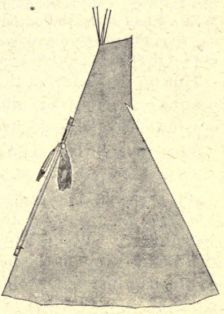
FIG. 187.—Sacred tent in which the pole was kept.
The people feared the pole, and they would not dare to tread on the tent or its tent-poles. Should a horse tread on a tent-pole of this tent, its legs were sure to be broken subsequently. George Miller knew of two horses that did this, and their legs were broken when the people were surrounding a herd of buffalo.