Front matter (continued 4)
Reading edition
"The grief of Polydeuces for the death of Castor was terrible to see; and there was no one in all the world who could comfort him, or in any way make him forget his loss. Then he prayed the gods that they would take him, too, to Hades, that he might be in the dear company of his brother. And Zeus heard his prayer; and he asked Polydeuces to choose whether he would sit in the courts of Olympus, and be the peer of Ares and Pallas Athené, or whether he would share all things with Castor. And the glorious hero cried, 'Let me be forever with my brother!' His wish was granted to him; and the twin heroes still live, although the quickening earth lies over them. One day they wander in the fields of asphodel, and enjoy the bliss of immortality; the next, they flit among the unquiet shades in the sunless regions of the dead. And thus they share together whatever of joy or woe the grave can bring.
"When King Tyndareus learned that he was bereft of his sons, he fell prone to the earth; and no one in Lacedæmon could console him. 'Send for Helen, my peerless daughter!' he cried. 'Send for Menelaus. He is my only son. He shall dwell in my palace, and rule in my stead!'
"And that is the way in which it came about, that Menelaus was called to the kingship of Lacedæmon."
Old Icarius remained but a short time at Ithaca. A ship was waiting in the harbor, ready to sail to Pylos and the ports beyond; and he knew that a like opportunity to return to Lacedæmon might not soon be offered. And so, leaving his blessing with his children Odysseus and Penelope and the babe Telemachus, he departed.
ADVENTURE XVI.
THE CHILDREN OF PROMETHEUS.
There was sore distress in Lacedæmon. Famine and a deadly pestilence grieved the land, and in every household the notes of wailing and despair were heard. For Apollo, vexed because the men of Laconia were so slow to understand his wishes, was shooting his fateful arrows broadcast among them. Like a night-cloud he brooded over the land, and strong men and fair women and helpless babes all fell alike beneath the sharp blows of his deadly shafts. And the heart of Menelaus the king was burdened with grief because of the people's sore affliction. Then, when he found that sacrifice of lambs and goats availed him nothing, he sent in haste to ask the oracles the cause of Apollo's wrath, and to learn what could be done to stay the plague. The answer came as quickly:--
"When the bones of the children of Prometheus are brought from Ilios, and entombed in Lacedæmon, then the wrath of silver-bowed Apollo shall be turned aside, and the smiles of his favor shall bless the land."
Then Menelaus made ready to depart at once to Troy to do that which Apollo demanded. A short journey by land brought him to the strong-built town of Helos on the shore of the eastern sea. There a swift-sailing ship lay at its moorings, while a score of long-haired seamen paced the beach, anxious to embark upon any errand across Poseidon's watery kingdom. The captain hailed the king with joy, and the ship was soon made ready for the long voyage to Ilios. A plenteous stock of food was stored away in the broad hold; arms, for defence against sea robbers and savage men, were put in order, and hung in their places; and rich presents for Priam, king of Troy, were taken on board.
The next day a favoring wind sprang up; the sails were set; the seamen took their places; and the ship with King Menelaus on board sped on its way to distant Ilios. Poseidon, looking out from his golden palace beneath the sea, saw the vessel as it hastened on its errand; and he bade the waves be still and in no wise hinder its speed, for Apollo's business must not be delayed; and he called upon the breezes to blow steadily towards Ilios, that so the embassy of Menelaus might be happily performed.
"Surely the gods are all in league with us," said the captain of the ship one day, pleased with the delightful voyage. "To-morrow we shall doubtless sight the Lesbian coast, and from thence it is but a short sail to Ilios and Troy. And now, as we sit together in the prow of our good vessel, I pray you to tell us the story, once more, of great Prometheus, the bones of whose children seem so precious to Apollo."
And Menelaus willingly consented, and told the story as he himself had oft-times heard it from the bards:--
"When Zeus waged pitiless war upon the Titans, and hurled them headlong from the heights of Mount Olympus, he spared from the general ruin those who fought not with their own kindred, but espoused his cause. Among these and foremost of all was great Prometheus, whose name is Forethought, and whose chiefest glory lies in this, that he was the friend and lover of mankind. It was the hope of bettering man's condition that led him to fight against his kindred, and to aid in placing Zeus upon the throne of ancient Cronos. Yet Zeus cared naught for the feeble children of earth, but sought rather to make their burdens heavier and their lives more sad, that so the race might perish utterly. And the great mind of Prometheus set to work to learn how to make their lot less sad and their lives less miserable.
"He saw that as yet they dwelt without forethought upon the earth, their life's whole length being aimless, and their minds as void of reason as is the beast's. They lived in sunless caverns, or in holes scooped in the ground; and no provision did they make for heat or cold or times of scarcity, or the varying needs of youth and age. And Prometheus wasted no vain words in pity, but took at once upon him the Titanic task of lifting the race up to a level with the gods. First, he taught them the use of fire, which, some say, he stole from Helios' car, and brought to the earth, hidden in a fennel-stalk. Then he showed them how the stars rise and set, and how the seasons change in never-varying order. He showed them how to yoke and make submissive to their will the wild steeds of the desert plain; how to turn the sod beneath the soil by means of the furrowing plough; and how to build fair houses and cities with strong walls and frowning towers. He taught them how to make ships, the storm-winged chariots of the sea, and how to navigate the briny deep. He showed them the treasures which lie hidden underneath the ground,--gold, silver, iron,--and taught them how to turn them into forms of beauty, strength, and use. In short, all arts now known to men came to them from the hands and mind of pitying Prometheus.
"Now, when Zeus looked down from high Olympus, and saw the puny tribes of men no longer grovelling in the earth like senseless beasts, but standing upright, and claiming kinship with the gods, he shook with pent-up anger. And he called two of his mightiest servants, Strength and Force, whom none can resist, and bade them seize the friend of man, and bind him upon a peak of the snow-crowned Caucasus, there to linger through the ages in loneliness and pain.
"Then the ruthless slaves of Zeus went forth to do his bidding. They seized the mighty Titan, and dragged him to the bleak and barren regions of the Caucasus, beyond the utmost limit of the habitable earth. And with them went the mighty smith Hephaestus, all unwillingly, to bind the great victim with bonds of brass, which none could loose, to the lonely mountain crags.
"'This thing I do loathing,' said Hephaestus. 'Here I must perforce leave thee, chained and bolted to the immovable rocks. Thou shalt never behold the face of man, nor hear the accents of his voice; but the blaze of the unpitying sun shall scorch thy fair skin, and thou shalt long for the night with its shimmering stars to cast a veil of coolness over thee. Year after year, thou shalt keep thy lonely watch in this joyless place, unblest with sleep, and uttering many a cry and unavailing moan. For Zeus is pitiless. This is what thou gainest for befriending man.'
"There, then, they left him fettered; but not until rude Strength had taunted him: 'Lo, thou lover of mankind! Call now the puny race of mortals round thee, and crown them with honors! Could all of them together lessen thy punishment in the least? Surely the gods did jest when they gave thee the name of "Forethought," for thou hast need of forethought to free thee from these bonds.'
"Then, when the solitary sufferer knew that there was no one to hear him, save only the sun, and the earth and the winds, and the winding river and the distant sea, he broke forth in grievous cries and lamentations:--
"'O pitying sky, and swift-winged winds, and river-springs, and the many-twinkling smile of ocean, I cry to you! O mother Earth, and thou all-seeing Sun! behold what I endure because I gave honor to mortals! Behold what torture is in store for me, while for ten thousand years I writhe in these unseemly chains! Yet the things that come are all foreknown to me, and nothing happens unexpected; and I must bear as best I may the ills that will perforce be mine, knowing that the end of all these things shall come to me at last.'
"Then the Ocean nymphs, with the fragrance of flowers and a rustling sound like the whirr of birds, came floating through the air, and hovered about the crag where Prometheus was bound. They had heard the clank of the iron and the heavy blow of the sledge resounding to the very cavern-depths of Ocean; and they had hastened to come, and offer him their sympathy.
"Following them, came old Oceanus himself, riding in his winged chariot; for no firmer friend had Prometheus than this hoary-headed ancient of the encircling sea. He came to condole with the suffering Titan, and to counsel patience and submission. But he staid not long.
"'I will drink the cup of bitterness to its very dregs,' said Prometheus, 'and will bide the time when Zeus shall have quenched his wrath.'
"And Oceanus, feeling that he had come in vain, turned about, and gladly hastened homeward to his halls beneath the ocean billows.
"After this many others came, weeping tears of sorrow for the sufferer,--tears of anger at the tyranny of Zeus. And wails of mourning were borne thither on the wings of the wind from all the tribes that dwelt in Asia,--from the warrior maidens on the Colchian coasts, from the savage horsemen of the Scythian plains, and from the dwellers on the farther shores of Araby. But the Titan, chained to the desolate crags, suffered on. Above him the vultures hovered, and the wild eagles shrieked; and sun and storm beat mercilessly upon his head, as the weary days and the lengthening years passed by. And yet no deliverance came.
"One day, as he writhed helplessly in his chains, Prometheus saw in the valley below him what at so great distance seemed to be a beautiful heifer, having a fair face like that of a woman. 'Surely,' said he aloud, 'it is the child of Inachus, she who warmed the heart of Zeus, and is now through Here's hate changed into an unseemly shape, and driven to weary wanderings.'
"Then the maiden gazed at him in wonder, and asked, 'Who are you whom the gods have doomed to suffer in this solitary place? And how came you to know my father's name, and the sorrows that have come upon me? And tell me, I pray, if such knowledge be yours, whether there shall ever be any help for me, and when my sufferings shall have an end.'
"The Titan answered, 'I who speak to thee am Prometheus, who brought down fire to men, and gave them knowledge, and taught them how to do godlike things. And I know that thou art Io, once the lovely daughter of Inachus, king of Argos; but what thou art now, let thy own lips speak and answer.'
"'I cannot choose but tell you all,' the maiden answered, 'though my speech shall with sobs be broken when I recall the memory of happy days forever gone. There was a time when in my father's halls I dwelt in maidenly freedom, a spoiled and petted child. But as I grew to womanhood, dreams came to me which told me that I was beloved by Zeus. Such trouble did these visions bring to me, that I was fain to tell my father of them. He knew not what to do. But he sent swift messengers to Delphi and Dodona to ask the oracles what the dreams portended, and how he could best give pleasure to the gods. The answer came, that he should drive me from his doors into the wide and cruel world, or otherwise the fiery bolts of Zeus would burn up all his household and destroy him utterly. Reluctantly and weeping bitter tears, he shut me out; and lo! straightway my body was changed into the loathed form which stands before you, and a gad-fly stung me with its fangs, and I rushed away in madness, vainly hoping to find relief at Lerne's fountain water. But there the herdsman Argus, with his hundred eyes, did track me out; and with his scourge and the goading fly, I was driven along unending ways. Then Hermes, seeing my distress, took pity on me, and sought to free me from my cruel keeper. But Argus never slept; and with his hundred eyes he saw every danger, and shunned it while it was yet afar. At last Hermes bethought him of the power of music. Playing a soft melody on his lute, he stole gently towards the herdsman; the sweet sounds charmed the savage ear, and sleep overpowered the hundred eyes. Then Hermes drew his sword quickly, and smote off the head of Argus, thus gaining for himself the name of the Argus-queller. But the shade of the terrible herdsman still follows me, and I find no rest; and aimlessly I have come, thus goaded onward, to this wild mountain region.'
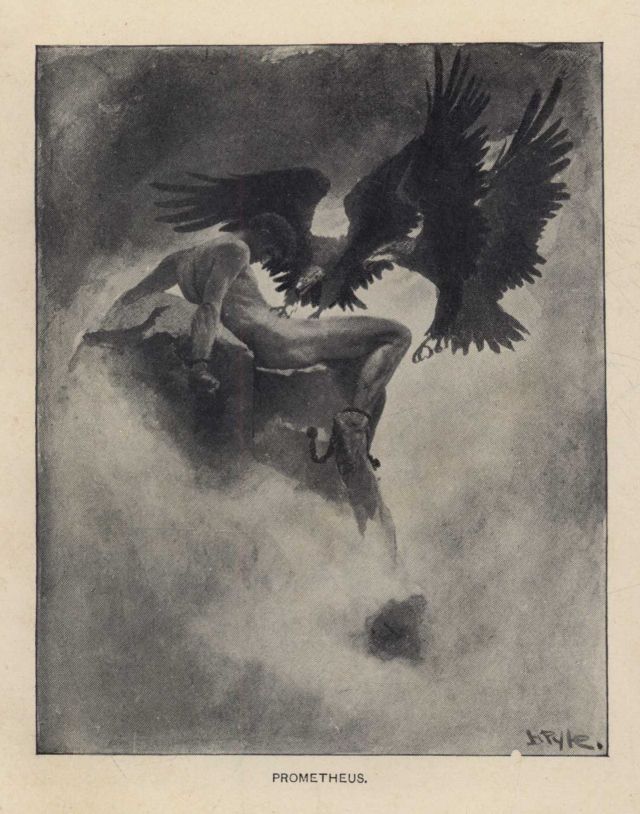
PROMETHEUS.
"Then Prometheus in pitying accents said, 'Listen now to me, and I will tell thee, Io, what other sorrows thou must bear from Here; for it is she who brought this woe upon thee and who hounds thee thus from land to land. Thou shalt journey onward from these mountain regions through the Scythian land, and the region of the uncouth Chalybes who work in iron. Thence thou shalt cross the mountains to the dwelling-place of the Amazons, who shall lead thee to the place where the ocean-gates are narrowest. There thou shalt plunge into the waves, and swim with fearlessness of heart to Asia's shore. And that strait shall by its name, Bosphorus, tell to latest ages the story of thy wandering. But what I have told thee is only the beginning of thy doom.'
"Then Io wept.
"'Were it not better to die,' she asked, 'than to endure this hopeless misery?'
"'Not so, O maiden,' answered the Titan; 'for if thou livest, then a son of thine shall loose me from my fetters, and perchance shall shake the throne of Zeus himself. When thou hast crossed the sea-ways which part the continent, thou shalt wander on until thou hast reached the outmost islands where the Gorgons dwell; then returning thou shalt pass through the country of the griffins and the region of Ethiopia, and shalt come at last to the three-cornered ground where flows the Nile. There thou shalt rest, and thy maiden form with all its comeliness shall be thine again. In Canobus, a fair city by the sea, shall a home be made for thee; and there shall Epaphos thy son be born, from whom in after-times shall spring great Heracles, who shall break my bonds and set me free from these hated fetters.'
"Then Io, with a sigh of mingled hope and despair, went on her weary way, and left Prometheus alone again in the everlasting solitudes. And the wild eagles swooped down from their high-built nests, and circled with threatening screams about him; a grim vulture flapped its wings in his face, and buried its talons in his bosom; a mighty storm came hurtling down through the mountain passes; the earth shook to and fro, and the peaks of Caucasus seemed as if toppling to their base; a hurricane of snow and hail and rattling ice smote the Titan about the head, and wrapped his body in eddying gusts; the lightnings leaped with lurid glare athwart the sky, and the thunders crashed with deafening roar among the crags; and earth and air and sea seemed blent together in a mighty turmoil, and whirling into utter chaos. Yet, in the midst of all, the old Titan quailed not; but with voice serene and strong he sang of the day when right shall triumph over might, when truth shall trample error in the dust, and the reign of Zeus give place to that of a nobler monarch just and perfect in all his ways.
"Thus years upon years passed, and ages circled by, until thirteen generations of men had lived and died upon the earth. Then came Heracles, the descendant of Io, to purge the world of vile monsters, and to give freedom to those who were in bonds. And as he wandered from land to land, to do the bidding of his master Eurystheus, he passed through Ethiopia, and came to the region of the Caucasus, close by the eastern Ocean's stream. There, as he gazed upward at the everlasting peaks, he saw the great Titan fettered to the naked rock, while the eagles circled about him, and the grim vulture digged its talons into his flesh; and Heracles knew that this was Prometheus the ancient, the friend of the human race and the foe of tyrants. He drew his bow, and with his unerring arrows slew the eagles and the vulture; and then, with mighty blows of his club, he broke the chains which Hephaestus of old had wrought, and with his strong hands he loosed the long-suffering prisoner from his fetters. And the earth rejoiced; and men everywhere sang pæans of triumph, because freedom had been given to him who raised them from the dust, and endowed them with the light of reason and the fire of god-like intelligence."
This was the tale which Menelaus told to a company of eager listeners seated about him, in the prow of the swift-sailing vessel.
"Now you should know," he added, "that every lover of freedom in Hellas is in truth a child of Prometheus. And so when Apollo, through his oracle, bade me fetch from Ilios the bones of the old Titan's children, I understood that I was to gather the dust of all the Hellenes who have died in the Trojan land, and carry it to Lacedæmon for honored burial. And such is the errand upon which we are sailing to-day."
"But why is it said that every Hellene is a child of Prometheus?" asked the captain. "Is it simply because he is a lover of freedom and a hater of tyrants, as the old Titan was? Or is there a real line of kinship reaching from us up to him?"
"I will tell you," answered the king. "While Prometheus hung fettered to the bleak crag of Caucasus, and in grim patience bided the day of deliverance, his son Deucalion tilled the plains of Phthia, and gathered the ripe fruits on its sunny hills. And he dwelt in peace with all men, cherishing in his heart the words which his father had spoken to him in former times. But the world was full of wickedness, and there was violence and bloodshed everywhere; and men no longer had respect for the gods, or love for one another. 'We are a law unto ourselves,' they cried. 'Why then should any one obey the behests of a master whom he has not seen?' And they went on eating and drinking and making merry, and gave no thanks to the giver of every good.
"At length, when their wickedness waxed so great that it was past all bearing, Zeus spoke the word, and a mighty flood burst upon the land. The west wind came sweeping in from the great sea, bringing in its arms dark clouds laden with rain. And when Deucalion saw the veil of darkness covering the sky, and heard the roar of the hurricane in the valley below him, he called to Pyrrha, his golden-haired wife, and said, 'Surely, now, the day has come of which my father told me often,--the day when floods of water shall come upon the earth to punish the wickedness of men. Hasten into the ark which I have built, that, if so be, we may save ourselves from the merciless waves.'
"And they made the ark ready, and put a great store of food in its broad hold, and waited for the rising of the waters. Nor was it long; for the torrents gushed down from the hillsides and filled the valleys, and the plains were covered over, and the forests sank from sight beneath the waves. But Deucalion and Pyrrha sat in the ark, and floated safely on the bosom of the heaving waters. Day after day they drifted hither and thither, until at last the ark rested on the lofty peak of Parnassus. Then Deucalion and Pyrrha stepped out upon the dry ground; the rain ceased to fall, the clouds were scattered, and the waters fled down the valleys and hastened to the sea; but all the people of Hellas, save only Deucalion and Pyrrha, had perished in the flood. And feeling their loneliness in the midst of the ruin and death which had come upon the land, these two built an altar to the gods, and offered thanks for their deliverance. Then Zeus sent Hermes, the bright messenger, to speak words of comfort to them.
"'Among all the folk of this land,' he said, 'you alone have lived blameless lives, and with your clean hands and pure hearts have pleased the immortals. Ask now what you most desire, and it shall be given to you.'
"Then Deucalion wept as he bowed before the messenger. 'Grant that we may see the earth teeming again with busy men,' he said.
"'It shall be as you wish,' answered Hermes. 'As you go down the mountain into the plain, cover your faces with your mantles, and throw the bones of your mother behind you.'
"Then the messenger left them, and they wondered between themselves what was the meaning of his words.
"'Who is our mother?' asked Pyrrha.
"'Is not the earth the mother of us all?' then answered Deucalion. 'His meaning is plain enough now.'
"So, as they went down Parnassus, they took up stones, and threw them behind them. And the stones which Deucalion threw sprang up and were mighty armed men; and those which Pyrrha threw became fair women. Thus the hills and the valleys were peopled anew; and the earth smiled and was glad that a new and happier day had dawned.
"But Deucalion went with Pyrrha into Locris; and there he built the city of Opus, where he reigned king for many years; and there sons and daughters, noble and beautiful, were born; but the noblest was Hellen, from whom the Hellenes are descended, and our country of Hellas takes its name.
"Do you understand now how every one of us can claim to be a son of great Prometheus?"
ADVENTURE XVII.
A CAUSE OF WAR.
Time passed.
Menelaus had returned from Ilios, bringing with him the bones of his countrymen who had died in that distant land. The great plague had been stayed, for the anger of Apollo had been assuaged. And it had seemed for a time that the old days of peace and plenty had come again to Lacedæmon, never to depart.
Yet within a few weeks all was changed once more. There was silence in the golden halls of Menelaus, and guests sat no longer as of yore around the banquet tables. Anger and grief and uneasiness were plainly seen in every face. Men gathered in the streets, and talked in wild, excited tones about the strange things which had lately happened in Lacedæmon; and the words "Helen," and "Paris," and "Troy," and "Ilios" seemed to be on every tongue, and repeated with every sign of love and hatred, of admiration and anxiety.
"Our good king, by his visit to Ilios, lifted the scourge of pestilence and famine from our land," said one of the elders of the city; "but he brought to our shores a greater evil,--even Paris, the handsome prince of Troy. And now the glory of our country, the sun which delighted all hearts, the peerless Helen, has been stolen by the perfidious one, and carried to his home beyond the sea."
"And do you think there will be war?" asked a long-haired soldier, toying with the short dagger in his belt.
"How can it be otherwise?" answered the elder. "When Menelaus won peerless Helen for his wife, the noblest princes of Hellas promised with solemn oaths that they would aid him against any one who should try either by guile or by force to take her from him. Let the word be carried from city to city, and all Hellas will soon be in arms. The king, with his brother Agamemnon, has even now crossed over to Pylos to take counsel with old Nestor, the wisest of men. When he comes back to Lacedæmon, you may expect to see the watch-fires blazing on the mountain-tops."
"No sight would be more welcome," answered the soldier.
"None, indeed, save only the towers and palaces of Troy in flames!" returned the other earnestly.
* * * * *
Meanwhile, with troubled brow and anxious heart, Menelaus sat in Nestor's halls, and told the story of his wrongs. Before him, seated on a fair embroidered couch, was the aged king, listening with eager ears. Behind him stood his brother Agamemnon, tall and strong, and with eye and forehead like mighty Zeus. Close by his feet two heroes sat: on this side, Antilochus, the valiant son of Nestor; and on that, sage Palamedes, prince of Eubœa's distant shores. The last had just arrived at Pylos, and had not learned the errand which had brought the king of Lacedæmon thither.
"Tell again the story of your visit to Troy," said Nestor. "Our guest, good Palamedes, would fain understand it all; and I doubt not that he may be of service to your cause."
Then Menelaus began once more at the beginning,--
"There is no need that I should speak of the long voyage to Ilios, or of the causes which persuaded me to undertake it. When I drew near the lofty citadels of Troy, and through the Scæan gates could see the rows of stately dwellings and Athené's marble temple, and the busy market-place of that great city, I stopped there in wonder, fearing to venture farther. Then I sent a herald to the gates, who should make known my name and lineage, and the errand upon which I had come; but I waited without in the shade of a spreading beech, not far from the towering wall. Before me stood the mighty city; behind me the fertile plain sloped gently to the sea; in the distance I could see the tomb of Ilus and the sparkling waters of Scamander; while much farther, and on the other side, the wooded peak of Ida lifted itself toward the clouds. But I had not long to view this scene; for a noble company of men led by Paris himself, handsome as Apollo, came out of the gates to welcome me. With words of kind greeting from the king, they bade me enter within the walls. They led me through the Scæan gates and along the well-paved streets, until we came, at last, to Priam's noble hall. It was a splendid house, with broad doorways and polished porticos, and marble columns richly carved. Within were fifty chambers, joining one another, all walled with polished stone; in these abode the fifty sons of Priam with their wedded wives. On the other side, and opening into the court, were twelve chambers, built for his daughters; while over all were the sleeping-rooms for that noble household, and around were galleries and stairways leading to the king's great hall below.
"King Priam received me kindly, and, when he understood my errand, left naught undone to help me forward with my wishes. Ten days I abode as a guest in his halls, and when I would return to Lacedæmon he pressed me to tarry yet a month in Troy. But the winds were fair, and the oracles promised a pleasant voyage, and I begged that on the twelfth day he would let me depart. So he and his sons brought many gifts, rich and beautiful, and laid them at my feet,--a fair mantle, and a doublet, and a talent of fine gold, and a sword with a silver-studded hilt, and a drinking-cup richly engraved that I might remember them when I pour libations to the gods.
"'Take these gifts,' said Priam, 'as tokens of our friendship for you, and not only for you, but for all who dwell in distant Hellas. For we too are the children of the immortals. Our mighty ancestor, Dardanus, was the son of Zeus. He it was who built Dardania on the slopes of Ida, where the waters gush in many silvery streams from underneath the rocky earth. To Dardanus a son was born named Erichthonius, who, in his time, was the richest of mortal men. And Erichthonius was the father of Tros, to whom were born three noble sons, Ilus, Assaracus, and Ganymedes. The last was the handsomest of men, and for his beauty's sake the gods carried him to Ida's sacred summit to be the cup-bearer of Father Zeus and the companion of the immortals. Then Ilus had a son, famous in song and story, named Laomedon, who in his old age became my father. He, though my sire, did many unwise things, and brought sore distress upon the people of this land.
"'One day Apollo and Poseidon came to sacred Troy, disguised as humble wayfarers seeking some employment. This they did because so ordered by mighty Zeus.
"'"What can you do?" asked my father, when the two had told their wishes.
"'Poseidon answered, "I am a builder of walls."
"'And Apollo answered, "I am a shepherd, and a tender of herds."
"'"It is well," answered Laomedon. "The wall-builder shall build a wall around this Troy so high and strong that no enemy can pass it. The shepherd shall tend my herds of crook-horned kine in the wooded glens of Ida. If at the end of a twelvemonth, the wall be built, and if the cattle thrive without loss of one, then I will pay you your hire: a talent of gold, two tripods of silver, rich robes, and armor such as heroes wear."
"'So the shining archer, and the shaker of the earth, served my father through the year for the hire which he had promised. Poseidon built a wall, high and fair, around the city; and Apollo tended the shambling kine, and lost not one. But when they claimed their hire, Laomedon drove them away with threats, telling them that he would bind their feet and hands together, and sell them as slaves into some distant land, having first sheared off their ears with his sharp sword. And the twain went away with angry hearts, planning in their minds how they might avenge themselves.
"'Back to his watery kingdom, and his golden palace beneath the sea, went great Poseidon. He harnessed his steeds to his chariot, and rode forth upon the waves. He loosed the mighty winds from their prison-house, and sent them raging over the sea. The angry waters rushed in upon the land; they covered the pastures and the rich plain of Troy, and threatened even to beat down the mighty walls which their king had built. Then, little by little, the flood shrank back again; and the people went out of the city to see the waste of slime and black mud which covered their meadows. While they were gazing upon the scene, a fearful monster, sent by angry Poseidon, came up out of the sea, and fell upon them, and drove them with hideous slaughter back to the city gates; neither would he allow any one to come outside of the walls.
"'Then my father, in his great distress, clad himself in mourning, and went in deep humility to the temple of Athené, where stands the heaven-sent statue which we call Palladion. In sore distress, he called unto the goddess, and besought to know the means whereby the anger of Poseidon might be assuaged. And in solemn tones a voice came from the moveless lips of the Palladion, saying,--
"'"Every day one of the maidens of Troy must be fed to the monster outside of the walls. The shaker of the earth has spoken. Disobey him not, lest more cruel punishments befall thee."
"'Then in every house of Troy there was sore distress and lamentation, for no one knew upon whom the doom would soonest fall. And every day a hapless maiden, young and fair, was chained to the great rock by the shore, and left there to be the food of the pitiless monster. And the people cried aloud in their distress, and cursed the mighty walls and the high towers which had been reared by the unpaid labors of Poseidon; and my father sat upon his high seat, and trembled because of the dire calamities which his own deeds had brought upon his people.
"'At last, after many humbler victims had perished, the lot fell upon the fairest of my sisters, Hesione, my father's best-loved daughter. In sorrow we arrayed her in garments befitting one doomed to an untimely death; and when we had bidden her a last farewell, we gave her to the heralds to lead forth to the place of sacrifice. Just then, however, a noble stranger, taller and more stately than any man in Troy, came down the street from the Scæan gate. Fair-haired and blue-eyed, handsome and strong, he seemed a very god to all who looked upon him. Over his shoulder he wore the tawny skin of a mighty lion, while in his hand he carried a club most wonderful to behold. And the people, as he passed, prayed him that he would free our city from the dread monster who was robbing us of our fair loved ones.
"'"I know that thou art a god!" cried my father, when he saw the stranger. "I pray thee, save my daughter, who even now is being led forth to a cruel death!"
"'"You make mistake," answered the fair stranger. "I am not one of the gods. My name is Heracles, and like you I am mortal. Yet I may help you in this your time of need."
"'Now, in my father's stables there were twelve fair steeds, the best that the earth ever knew. So light of foot were they, that when they bounded over the land, they might run upon the topmost ears of ripened corn, and break them not; and when they bounded over the sea, not even Poseidon's steeds could glide so lightly upon the crests of the waves. Some say they were the steeds of Boreas given to my grandfather Tros, by his sire Erichthonius; others, that they were the price which Zeus paid for godlike Ganymedes, most beautiful of men. These steeds, my father promised to give to Heracles if he would save Hesione.
"'Then the heralds led my fair sister to the shore, and chained her to the rock, there to wait for the coming of the monster. But Heracles stood near her, fearless in his strength. Soon the waves began to rise; the waters were disturbed, and the great beast, with hoarse bellowings, lifted his head above the breakers, and rushed forward to seize his fair prey. Then the hero sprang to meet him. With blow upon blow from his mighty club, he felled the monster; the waters of the sea were reddened with blood; Hesione was saved, and Troy was freed from the dreadful curse.
"'"Behold thy daughter!" said Heracles, leading her gently back to the Scæan gate, and giving her to her father. "I have saved her from the jaws of death, and delivered your country from the dread scourge. Give me now my hire.'
"'Shame fills my heart as I tell this story, for thanklessness was the bane of my father's life. Ungrateful to the hero who had risked so much and done so much that our homes and our country might be saved from ruin, he turned coldly away from Heracles; then he shut the great gates in his face, and barred him out of the city, and taunted him from the walls, saying, "I owe thee no hire! Begone from our coasts, ere I scourge thee hence!"
"'Full of wrath, the hero turned away. "I go, but I will come again," he said.
"'Then peace and plenty blessed once more the land of Ilios, and men forgot the perils from which they had been delivered. But ere long, great Heracles returned, as he had promised; and with him came a mighty fleet of white-sailed ships and many warriors. Neither gates nor strong walls could stand against him. Into the city he marched, and straight to my father's palace. All fled before him, and the strongest warriors quailed beneath his glance. Here, in this very court, he slew my father and my brothers with his terrible arrows. I myself would have fallen before his wrath, had not my sister, fair Hesione, pleaded for my life.
"'"I spare his life," said Heracles, in answer to her prayers, "for he is but a lad. Yet he must be my slave until you have paid a price for him, and thus redeemed him."
"'Then Hesione took the golden veil from her head, and gave it to the hero as my purchase price. And thenceforward I was called Priam, or the purchased; for the name which my mother gave me was Podarkes, or the fleet-footed.
"After this, Heracles and his heroes went on board their ships and sailed back across the sea, leaving me alone in my father's halls. For they took fair Hesione with them, and carried her to Salamis, to be the wife of Telamon, the sire of mighty Ajax. There, through these long years she has lived in sorrow, far removed from home and friends and the scenes of her happy childhood. And now that the hero Telamon, to whom she was wedded, lives no longer, I ween that her life is indeed a cheerless one.'
"When Priam had finished his tale, he drew his seat still nearer mine, and looked into my face with anxious, beseeching eyes. Then he said, 'I have long wished to send a ship across the sea to bring my sister back to Troy. A dark-prowed vessel, built for speed and safety, lies now at anchor in the harbor, and a picked crew is ready to embark at any moment. And here is my son Paris, handsome and brave, who is anxious to make voyage to Salamis, to seek unhappy Hesione. Yet our seamen, having never ventured far from home, know nothing of the dangers of the deep, nor do they feel sure that they can find their way to Hellas. And so we have a favor to ask of you; and that is, that when your ship sails to-morrow, ours may follow in its wake across the sea.'
"I was glad when Priam spoke these words, for, in truth, I was loath to part with Paris; and I arranged at once that he should bear me company in my own swift ship, while his vessel with its crew followed not far behind.
"And so with favoring winds being blessed, we made a quick voyage back to Lacedæmon, bringing with us the bones of my beloved countrymen. What followed is too sad for lengthy mention, and is in part already known to you. Need I tell you how I opened my halls to Paris, and left no act of courtesy undone that I might make him happy? Need I tell you how he was welcomed by fair Helen, and how the summer days fled by on golden wings; and how in the delights of Lacedæmon he forgot his errand to Salamis, and cared only to remain with me, my honored guest and trusted friend? One day a message came to me from my old friend Idomeneus. He had planned a hunt among the mountains and wooded vales of Crete, and he invited me to join him in the sport. I had not seen Idomeneus since the time that we together, in friendly contention, sought the hand of Helen. I could not do otherwise than accept his invitation, for he had sent his own ship to carry me over to Crete. So I bade farewell to Helen, saying, 'Let not our noble guest lack entertainment while I am gone; and may the golden hours glide happily until I come again.' And to Paris I said, 'Tarry another moon in Lacedæmon; and when I return from Crete, I will go with you to Salamis, and aid you in your search for Hesione.' Then I went on board the waiting ship, and prospering breezes carried us without delays to Crete.
"Idomeneus received me joyfully, and entertained me most royally in his palace; and for nine days we feasted in his halls, and made all things ready for the hunt. But, lo! on the evening of the last day, a vision came to me. Gold-winged Iris, the fleet-footed messenger of the gods, stood before me. 'Hasten back to Lacedæmon,' she cried, 'for thou art robbed of thy dearest treasure!' And even while she spoke, one of my own ships came sailing into the harbor, bringing trusted heralds whom the elders of Lacedæmon had sent to me. They told me the fatal news. 'No sooner were you well on your way,' they said, 'than Paris began to put his ship in readiness to depart. Helen prayed him to tarry until your return, but he would not hearken. "I will stay no longer," he said. "My seamen rest upon their oars; the sails of my ship are spread; the breeze will soon spring up that will carry me to my own fair home across the sea. But you, beauteous Helen, shall go with me; for the deathless gods have spoken it. Aphrodite, long ago, promised that the most beautiful woman in the world should be my wife. And who is that most beautiful woman if it is not yourself? Come! fly over the sea, and be my queen. It is the will of the gods."'
"It was thus that the perfidious Trojan wrought the ruin of all that was dear to me. At first, Helen refused. But Paris is a handsome prince, and day after day he renewed his suit. Then on the sixth day she yielded. In the darkness of the night they went on board his waiting vessel, carrying with them the gold and jewels of my treasure-house; and in the morning, when the sun arose on Lacedæmon, they were far out at sea.
"You know the rest: how in wrath and great sorrow I hurried home from Crete; how I first counselled with my own elders, and then with my brother Agamemnon of Mycenæ. And now, O noble Nestor, we have come to Pylos, seeking thy advice. On these two things my mind is set: Helen must be mine again, and Paris must suffer the punishment due to traitors."
When Menelaus had ended, sage Nestor answered with many words of counsel. "Keep the thought of vengeance ever before you," he said. "Yet act not rashly. The power of Troy is very great; and, in case of war, all the tribes of Asia will make common cause with Ilios. But an insult to Lacedæmon is an insult to all Hellas, and every loyal Hellene will hasten to avenge it. More than this, the chiefs of almost every state have already sworn to aid you. We have but to call upon them, and remind them of their oaths, and all the mightiest warriors of our land will take up arms against the power of Troy."
Then Palamedes spoke in like manner, and his words had great weight with Menelaus; for among all the heroes there were few who equalled him in wisdom. He it was who first built beacon fires on the headlands, and lighthouses to warn venturous seamen of the hidden dangers in their way; he it was who first invented scales for weighing, and who taught men how to measure grain and wine by certain standards; he it was who first made dice, and who showed what beauty and mystery lie hidden in the letters which Cadmus brought from Phoenicia to Hellas. And he was wise in statecraft and the knowledge of human nature.
"Nestor has spoken well," he said, addressing Menelaus, "and it behooves us to follow his advice. Now do you and Agamemnon return at once to Argos and Lacedæmon, and call upon the fighting men along the eastern coast to join you in the war. In the mean while, Nestor and myself will do the same, here on the western coast and among the islands of the sea."
"By the way," said Nestor, "there is Odysseus, king of Ithaca,--the rarest and bravest of men. Did he but know of this affair, he would be a host within himself, to lead us to sure victory."
"That is true," said Palamedes, "and we must seek his aid first. My ship lies now at anchor, just off the beach; and if noble Nestor will be my comrade, we will sail to-morrow to Ithaca, and make sure of his valued aid."
"Most surely I will go with you," said old Nestor. "And I will never rest nor give up the fight, until Helen is returned to Menelaus, and Paris has received his due reward."
ADVENTURE XVIII.
AN UNWILLING HERO.
In the shade of the orchard trees, at the foot of Mount Neritus, there was gathered, one afternoon, a happy family party. The chief figure in the group was white-haired Laertes, in his gardener's garb, picking some ripe fruit from the overloaded branches. At his right stood Anticleia, as queenly beautiful as when her hero-husband had won her in the halls of old Autolycus. At his left was Penelope, her sweet face beaming with smiles; while on the ground beside her sat Odysseus, gently dandling in his arms the babe Telemachus, and laughing at the budding wisdom of the child.
"Some men wander the wide world over, seeking for empty glory," said he, turning towards Penelope. "But I would rather have my pleasant home, and live amid its never-failing delights, than share the honors even of great Heracles."
At this moment, Phemius the bard was seen coming in haste from the palace. "What news, Phemius?" asked Odysseus. "Hast thou finished that new song of thine? And dost thou hasten thus to sing it to us before some part of it shall go out of thy mind?"
"Nay, master," answered the bard, speaking in anxious tones. "I have come to tell you that there are guests waiting in the hall. Famous men they are,--even Nestor, king of Pylos, and shrewd Palamedes of Eubœa. And they bring wonderful news,--news of that which will, perchance, fill our land with sadness."
"Tell me what it is," said Odysseus.
Then the bard told the story of Paris and Helen, as he had learned it briefly from Palamedes; and he explained the errand of the hero-guests which they had thoughtlessly imparted to him. Odysseus looked at his smiling babe, and at his fair wife, and his loved mother, and his honored father; and his brow darkened as he shook his head, and said, "Why should I risk so much, and, joining in this war, leave all that is dear to me on earth, simply for the sake of Menelaus and his misguided Helen?"
Then, after a moment's thought, he added, "I will not go. Tell Nestor and Palamedes that I am mad, and cannot go."
All at once a great change seemed to come over him. He put the babe into its nurse's arms; and then with long strides, and in the aimless manner of a maniac, he made his way across the orchard, and along the footpath by the beach to the white palace near the shore. When his old friends, Nestor and Palamedes, saw him, they hastened towards him, expecting to receive his greeting; but with unmeaning words, and a vacant stare, he passed by them without a word of recognition. "He is mad," said the frightened servants, as they fled before him.
"Yes, he is mad, and knows not where he is nor what he does," said Phemius, hastily rejoining the guests. "When I went out to find him just now, he was wandering among the fruit trees, picking the green fruit, and roaring like a wild beast. The gods have taken his reason from him."
"How sad that so great a mind should be thus clouded!" answered Nestor, with a sigh. "And at this time it is doubly sad for us and for all who love him, for we had counted on great things from shrewd Odysseus. Surely some unfriendly god has done this thing with intent to harm all Hellas."
"Do not judge hastily," whispered Palamedes. "We shall find out from whence this madness comes."
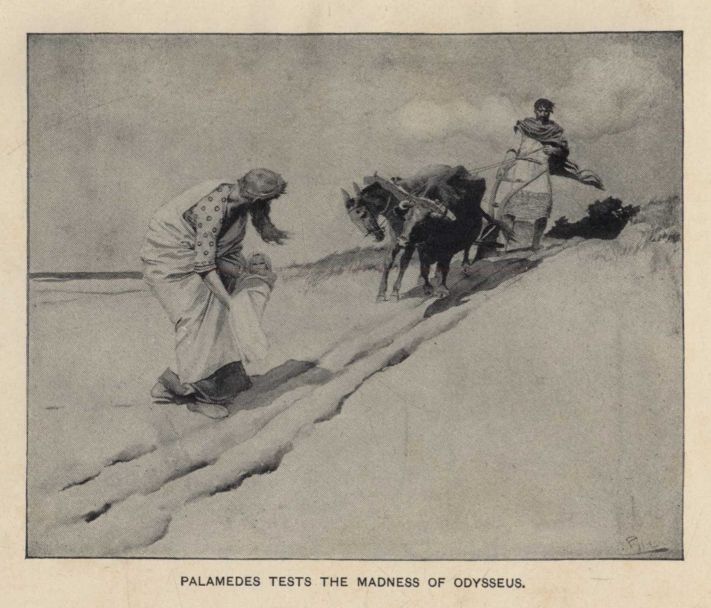
PALAMEDES TESTS THE MADNESS OF ODYSSEUS.
Soon Odysseus rushed from his chamber, looking wildly about him, as if the very Furies were at his heels. He was dressed in his richest garments, and on his shoulder he carried a bag of salt. Without speaking to any one, he made his way to the stables, where, with his own hands, he harnessed a mule and a cow, and yoked them side by side to a plough. Then he drove his strange team down to the beach, and began to plough long, deep furrows in the sand. By and by he opened the bag of salt, and strewed the white grains here and there, as though he were sowing seed. This strange work he continued until the daylight faded into darkness, and all the people were fain to seek rest under their home-roofs. Then he drove his team back to the stables, unyoked the beasts and fed them, and hurried silently to his chamber.
The next morning, as soon as the dawn appeared, he was seen ploughing the sandy beach as before.
"I will see whether there be any reason in his madness," said Palamedes to Nestor.
It chanced at that moment, that Eurycleia the nurse was passing by with little Telemachus in her arms. Without another word, Palamedes lifted the babe, and laid it smiling in the last furrow that Odysseus had made, so that on his next round the team would trample upon it. As Odysseus drew near, urging forward the mule and the cow, with many cries and maniacal gestures, he saw the helpless babe. The sight of its danger made him forget himself and his assumed madness; he turned his team aside, and running forward seized Telemachus, and, kissing his laughing lips, handed him, with every show of gentleness, to the good nurse.
"Ha, Odysseus!" cried Palamedes. "Thou canst not deceive us. Thou art no more mad than I am. Cease now that boyish play, and come and talk with us as becometh a hero."
Then Odysseus, seeing that he had been fairly outwitted by one as shrewd as himself, knew that further pretence of madness would avail him nothing. For a single moment his brow was clouded with anger, and he whispered hoarsely to Palamedes, "You shall have your reward for this!"[1] Then, leaving his plough and his ill-matched team upon the beach, he took his two guests kindly by the hand, and led them into his palace. A great feast was spread upon the tables, and the morning was spent in eating and merry-making, and not a word was said concerning the great business which had brought the kings to Ithaca.
[1] See Note 13 at the end of this volume.
Later in the day, however, Nestor told Odysseus the story of the perfidy of Paris. Then Palamedes followed with a speech so clear, so forcible, that the hearts of all who heard it were stirred to their very depths; and Odysseus, rising from his seat, renewed the vow which he had made when Menelaus won fair Helen for his bride. And from that time to the very end, there was not a man among all the Hellenes, who threw himself more earnestly into the work than did Odysseus.
For seven days Nestor and Palamedes tarried at Ithaca, talking with Odysseus, and making plans for the war against Troy. On the eighth day, the three heroes embarked for the mainland; and for months they journeyed from country to country, and from city to city, reminding the princes of their vows, and stirring all Hellas into a flame. Soon the watch-fires were kindled on every mountain-top; and every warrior in the land made haste to see that his arms were in order, and every seaman to put his ship to rights. And Ares, the mighty god of battle, brandished his sword above the sea; dread comets blazed red in mid-heaven; glittering stars fell to the earth, or shot gleaming athwart the sky. Sounds of warlike preparation were heard, not only in the dwellings of men, but even in the halls of Zeus, upon the airy summit of Olympus.
ADVENTURE XIX.
HEROES IN STRANGE GARB.
There dwelt at Mycenæ a wise soothsayer, named Calchas,--a man versed in all the lore of earth and sky, and holding some sort of communion with the immortals. He could lift the veil of the future, and see what to other men lay hidden in the darkness; and next to the Pythian oracle at Delphi, or the talking oak of Dodona, he was held in high repute as knowing the counsels of the gods. When all the great chiefs sat one day in Agamemnon's hall, and talked of their warriors and their ships and their arms, and boasted of their readiness to sail at once for Ilios, the old soothsayer came and stood before them. His white locks streamed in flowing waves about his shoulders; his gray eyes gleamed with a strange, wild light; he moved his long arms to and fro above his head, and pointed with his thin fingers first towards the sky, and then towards the sea.
"Hearken ye to the seer," said Menelaus; "he has had a vision, and perchance he can tell us how we shall fare in this great business which we have undertaken."
Then Calchas spoke and said, "Verily I know not any thing of this matter, save by the gift of soothsaying which the far-darting Apollo has bestowed upon me. Yet when I inquired of him, this answer did he give: 'Let the long-haired Hellenes make war upon Troy. They shall not prevail against that city unless Achilles, the dear son of Thetis, lead them.' Send now for him, and enlist him in your cause; for otherwise you shall fail, and the Trojans shall boast of your ruin!"
Having said these words, the seer strode from the hall, leaving the hero chiefs alone. For a time they sat in silence, each pondering the matter in his own mind. Then Agamemnon spoke, and his words were full of anger and unbelief. "Never yet," said he, "did Calchas prophesy any thing but ill. He sees naught but evil; and when we feel most sure of success, then it is the joy of his heart to foretell failure. Now, after the gods have thus far favored us, and when all things are in readiness for the gathering together of our forces, this woful soothsayer comes to tell us that without Achilles we shall fail. For my part, I care little for his words, and am willing to run all risks."
"Say not so," quickly answered Odysseus. "The old man speaks as Apollo gives him utterance; and no man shall dare put his judgment in the scales against the foreknowledge of the gods. Let us seek Achilles at once, and persuade him to join us in our league against Ilios."
"But who shall find him?" asked Menelaus. "Two months ago, I was in Iolcos by the sea, whither I had gone to see old Peleus. I found that that aged king dwelt no longer in the ancient city, but had removed into his own country of Phthia, and there abode among his Myrmidons. Into Phthia, therefore, I went, hoping to find Achilles also there. But old Peleus wept when I asked about his son. 'In truth, I know not where the young man is,' he said, in answer to my questions. 'For when the news was noised about, that the chiefs of Hellas were planning war upon Troy, then silver-footed Thetis carried her son into some distant, unknown land, and hid him there. For the Fates have declared the doom of Achilles, that his days on earth shall be few but glorious; and his mother feared, that, should he join in the great war, he would meet an untimely death. Thus, then, it is that I am bereft already of my only son; for I know not whether I shall ever again behold him.' In this manner Peleus, the lord of horses, bewailed the absence of his son. And though in every city I sought news concerning the whereabouts of the young hero, I could learn nothing whatever. Even Patroclus, his bosom friend and comrade, wept for him as for one dead. I do not believe that he can be found in Hellas."
Then Nestor the wise arose and spoke. "It does not become us," he said, "to doubt or dispute the words of Calchas the seer. Therefore we must find Achilles, and win him to our cause; or, laying aside all thought of war, we must humbly surrender to Paris the noblest treasure of our country, even beauteous Helen."
"Achilles can be found," said Odysseus. "I myself will seek him, and the moon shall not wane thrice ere I shall have found him. Let the best ship in Argos be put in readiness at once; and let a crew of the most skilful oarsmen be chosen, and a good store of food be put into the hold. I will embark to-morrow, and you shall see me no more until I bring good news of Thetis's godlike son."
So then Odysseus set sail on a long, uncertain voyage to the islands of the sea, in search of the hidden hero. Vainly did he visit Cythera, the lofty isle where Aphrodite first rose in all her beauty from the salt sea-foam; he touched at Melos, rich in corn and wine; he skirted Paros, known to all the world for its figs and its spotless marble; he stopped for a month at sacred Delos, the birthplace of Apollo; he explored well-watered Ophiussa, where serpents curse the ground, and grapes grow purple on the climbing vines; he sought long time in Andros among the groves and in the temple sacred to ruddy-faced Dionysus: yet in none of these lands heard he any news of the godlike son of Peleus. Weary of their long and fruitless voyage, the comrades of Odysseus murmured sorely, and besought him to return to Mycenæ, and give up the search. But he turned a deaf ear to their pleadings, and sailed away to Scyros, where old Lycomedes reigned. For the bright-eyed goddess Athené had whispered to him in a dream, and told him that in the court of Lycomedes he would find the hero for whom he sought.
In a narrow inlet, hidden by trees and tall reeds, the ship was moored, while shrewd Odysseus went alone and unheralded to the palace of the king. He had laid aside his warrior's gear, and was now attired in the guise of a wandering peddler, and loaded with a heavy pack of precious wares. And lo! as he neared the high-built halls of Lycomedes, he came to a spacious garden just outside of the courtyard, and hard by the lofty gate. A green hedge ran round it on four sides, while within grew many tall trees laden with fruits and blossoms,--pear trees, pomegranates, apple trees, and olives. So well cared for were these trees, that they yielded fruit in every season of the year, nor ever failed, even in winter time. Beyond these, all manner of garden beds were planted, where flowers bloomed in never-ending freshness,--the dewy lotus, the crocus flower, the pale hyacinth, violets, asphodels, and fair lilies. And in their midst, two springs of never-failing water gushed: one of them watered the garden and the fields beyond; the other ran close by the threshold of the palace, and bubbled up in the market-square, where all the people came to fill their vessels.[1]
[1] See Note 14 at the end of this volume.
As Odysseus stood and gazed in rapt delight upon this scene of beauty, a party of happy maidens came through the courtyard, and stopped in the garden to pluck the fruits and flowers. Then on the open lawn, they fell to playing ball; and one among them sang a lightsome song as they tossed the missile to and fro, or danced with happy feet upon the smooth-mown sward. When they saw Odysseus standing in the path, they stopped their game, and stood silent in their places, scarce knowing whether to advance and greet the stranger kindly, or in girlish timidness to flee into the palace. The hero opened then his peddler's pack, and held up to their delighted gaze a golden necklace set with amber beads. No further thought of flight had the maidens now. With eager yet hesitating feet, they came crowding around him, anxious to see what other thing of beauty he had brought with him. One by one, he showed them all his treasures,--ear-rings, bracelets of finest workmanship, clasps, buckles, headbands, and golden hair-pins. These they took in their hands, and, passing them from one to another, eagerly debated the price. One only of the company, taller and nobler than the others, stood aloof, and seemed to care nothing for the rich and handsome ornaments. Odysseus noticed this, but shrewdly kept his counsels to himself.
"A merchant like myself," said he, "must needs have goods for all,--for the young as well as for the old, for the grave as well as for the gay, for the hero as well as for the lady. It is his duty no less than his delight to please."
With these words he laid before the maidens a sword with hilt most deftly carved, a dagger with long keen blade, and a helmet thickly inlaid with precious gems. The one who had not cared to look at the trinkets now started quickly as if a trumpet had blown; she took up the sword, and handled it like a warrior long used to weapons; she tested the edge of the dagger, and sounded the strength of the helmet. Odysseus had learned all that he wished to know. He thought no more of the ornaments,--the bracelets, the clasps, and the hair-pins,--but gave them to the maidens for any price that they chose to offer. When all were pleased and satisfied, he turned to that one still toying with the sword, and said sharply,--
"Achilles!"
Had an earthquake shaken the isle of Scyros at that moment, Achilles would not have been more startled. For the tall, fair body, clad in a maiden's robes, was none other than that long-sought hero.
"Achilles," again said Odysseus, "I know thee, and it is useless to struggle longer against thy destiny. Put off that unbecoming garb, and come with me. Thy countrymen need thee to aid them in waging bitter war against Troy."
Then he told to the listening hero the story of the great wrong which Paris had done,--the unbearable insult which he had put upon the folk of Hellas. No man ever used words more persuasive. When he had ended, Achilles took him by the hand, and said, "Odysseus, truly do I know the destiny which is mine, and it behooves no man to struggle long against the doom which has been allotted to him. For the gods ordain that man should live in pain, while they themselves are sorrowless. You have heard it said, how on the threshold of Zeus there stand two caskets full of gifts to men. One casket holds the evil, and one the good; and to whomsoever is dealt a mingled lot, upon him misfortunes sometimes fall, and sometimes blessings. So it is with me and with my father's house. For upon Peleus were bestowed rich gifts, even from his birth, and he excelled all other men in good fortune and in wealth; and he was king over the Myrmidons; and to him was given a sea-nymph for a wife, even Thetis, my goddess-mother. Yet, with all the good, sorrow has come upon him in his old age; for in his halls there are no kingly sons to gladden his heart and hold up his hands.[2] I am his only son, and of me it has been written that I am doomed to an untimely death; and it was for this that silver-footed Thetis brought me hither across the sea, and, clothing me in maidenly attire, left me to serve in Lycomedes' pleasant halls. But I tire of life like this. I would rather die to-morrow, a hero in some grand struggle, than live a hundred years among these soft delights. I will sail with you at once for Phthia, where my father sits, already bereaved, in his spacious halls. There I will summon my Myrmidons, and my best-loved friend Patroclus; and then with eager hearts we will hasten to join our countrymen in war against the Trojan power."
[2] See Note 15 at the end of this volume.
* * * * *
Thus, then, did Odysseus perform his quest, and thus the last and greatest ally was won to the Hellenic cause. And yet the war was long delayed. Many times did the moon wax and wane; and seed-time and harvest, and fruit-gathering, and the storms of winter, came again and again in their turn,--and still the heroes were unready to join their forces and enter upon the mighty struggle.
At length, however, after nearly ten years had passed, all the princes and warriors of Hellas gathered their ships and men together at Aulis, and along the shores of the Euripus. A thousand dark-hulled vessels were moored in the strait; and a hundred thousand brave men were on board, ready to follow their leaders whithersoever they should order.
Chief of all that host was mighty Agamemnon, king of men, bearing the sceptre of Mycenæ, which Hephaestus, long before, had wrought most wondrously. He was clad in flashing armor, and his mind was filled with overweening pride when he thought how high he stood among the warriors, and that his men were the goodliest and bravest of all that host.
Next to him was Menelaus, silent and discreet, by no means skilled above his fellows, and yet, by reason of his noble heart, beloved and honored by all the Greeks; and it was to avenge his wrongs that this mighty array of men and ships had been gathered together.
Odysseus came next, shrewd in counsels, and no longer an unwilling hero; but, earnest and active, he moved among the men and ships, inspiring all with zeal and courage. He wore upon his shoulders a thick purple mantle, clasped with a golden brooch of curious workmanship, which Penelope had given to him as a parting gift. Around his waist was a shining tunic, soft and smooth, and bright as the sunshine. With him, wherever he went, was his herald and armor-bearer, Eurybates,--a hunchbacked, brown-skinned, curly-haired man, whom Odysseus held in high esteem because of his rare good sense.
There, also, was young Achilles, tall and handsome, and swift of foot. His long hair fell about his shoulders like a shower of gold, and his gray eyes gleamed like those of the mountain eagle. By the shore lay his trim ships--fifty in all--with thousands of gallant Myrmidons on board. And ever at his side was his bosom friend and comrade, Patroclus, the son of Menoitios. He it was to whom old Peleus had said when they were about embarking for Aulis, "Thou art older than my child Achilles, but he is nobler born and mightier far in warlike deeds. But thou art wise and prudent; therefore, do thou speak gentle words of warning to him, and show him what is best to do: he will hearken to thy words spoken for his good."
There also was Ajax, the valiant son of Telamon, huge in body and slow in speech, but, next to Achilles, the bravest of all the host. And the other Ajax, clad in his linen corslet, and master of forty ships from Locris, moved also among the mightiest of the heroes. There, too, was Nestor, the aged king of Pylos, rich in wisdom and experience, and skilled in persuasive speech. With him was his son Antilochus, the quondam suitor of fair Helen, a warrior worthy of such a sire.
And there was Idomeneus, the stalwart chief who ruled the hundred cities of Crete, and was the sworn friend of Menelaus. And there was Philoctetes, the cunning archer, carrying the great bow which had been given him for his last sad act of friendship to his master, Heracles. And there was Diomede, of the loud war-cry, wearing the skin of a great fiery lion round his shoulders, and marshalling the warriors who had come with him from Argos, and Tiryns of the mighty walls. And there, too, among so many others of far greater worth, was Nireus of Syma, his well-oiled locks as neatly curled, and his linen as spotlessly white, as when in youth he had sued for Helen's hand in the court of old Tyndareus.
Now when the day had come for the fleet to sail, the chiefs stood upon the shore, and offered solemn sacrifices to Poseidon, and prayed the gods to prosper them in their undertaking and bring them safe again to their loved homes in Hellas. While they were burning the choicest bits of fat and flesh, behold, a strange thing happened! From a crevice in the rocks a shining serpent, with glittering cold eyes and forked tongue, came creeping silently into the sunlight. The heroes gazed upon it with wonder in their faces, for they knew that it was sent as a sign to them. Not far away stood a plane-tree, green with foliage, in which a bird had built her nest; and in the nest were nine tiny fledglings, tenderly cared for by the mother bird. Straight to this tree the serpent crept; it twined around the trunk, and stealthily climbed to the nest; it seized the helpless little ones in its fangs and devoured them; then it darted upon the distressed mother bird, and destroyed her most pitilessly. But now a gleam of lightning flashed across the sky, and a peal of thunder shook the earth and sea. When the astonished chiefs looked up again, behold, the serpent had been turned into stone.
"Call Calchas the seer, and let him tell us what this portends!" they cried.
Then Calchas, his long hair streaming in the wind, his wild eyes rolling in awe, his gaunt arms waving to and fro above his head, came and looked upon the wonder.
"Ye men of Hellas!" he cried, "I will tell you what this portends. As there were nine birds in the nest, ye shall war nine years against Troy, and shall not prevail; but, even as the serpent destroyed the mother bird, so in the tenth year shall the city and its god-built walls fall into your hands."
ADVENTURE XX.
BECALMED AT AULIS.
A pleasant wind from the west sprang up, and drove the great fleet out into the sea. Not a single one of the thousand ships was lost or left behind; and after a quick and happy voyage, they came in sight of a fruitful land and a great city with high towers and pleasant dwellings.
"The gods have favored us, even beyond what we asked!" cried the Hellenes.
Achilles and his Myrmidons landed first, and without waiting for the other ships to come up, they rushed across the plain, and began an assault upon the town. Like a swarm of locusts lighting down upon a field of grain, and consuming every thing before them, so came the destroying Hellenes. The gates were broken down; the astonished people fled in dismay, and sought safety among the hills and in the forest on the other side of the town. Not until many houses had been burned, and many people slain, did Odysseus and Menelaus, whose ships had been delayed, reach the place.
"Men of Hellas!" they cried, hastening into the midst of the carnage. "What is this you are doing? This is not Troy. It is the peaceful city of Teuthrania in Mysia. Cease your slaughter, and return at once to your vessels, lest the wrath of the gods fall upon you."
The word was carried from mouth to mouth; and the hasty heroes, crestfallen and ashamed, stopped their bloody work, and turned their faces back towards the shore where their ships lay beached. None too soon did they retreat; for the king of Mysia, one Telephus a son of Heracles, having quickly called his warriors together, fell upon their rear, and slew great numbers of them, following them even to the sloping beach. As the last ship was pushing out, an arrow from the bow of King Telephus struck Patroclus, wounding him sorely. Then Achilles, poising his long spear, threw it with deadly aim among the Mysians; it struck King Telephus, and laid him senseless though not slain upon the sandy plain.
No sooner had the fleet set sail again upon the sea, than Poseidon stirred up the waves in anger, and loosed the winds upon them. Great was the terror, and great indeed was the destruction. Some of the ships were sunk in mid-sea, and some were driven upon the rocks and wrecked. But the greater number of them, after days and weeks of buffeting with the waves, made their way back to Aulis.
When the heroes stood again on the shores of the Euripus, they began to think that doubtless there was some truth in the omen of the snake and the birds; and the most hopeful among them ceased to dream of taking Troy in a day. While waiting for stragglers to come in, and for the shattered vessels to be repaired, they found enough to do to keep the time from dragging heavily; and when not engaged in some kind of labor they amused themselves with various games, and great sport had they with quoits and javelins, with bows and arrows, and in wrestling and running. And now and then they went out into the woods of Eubœa, and hunted the wild deer which roamed there in abundance.
One day it chanced that Agamemnon, while hunting, started a fine stag, and gave it a long chase among the hills and through the wooded dells, until it sought safety in a grove sacred to Artemis the huntress queen. The proud king knew that this was a holy place where beasts and birds might rest secure from harm; yet he cared naught for what Artemis had ordained, and with his swift arrows he slew the panting deer. Then was the huntress queen moved with anger, and she declared that the ships of the Hellenes should not sail from Aulis until the king had atoned for his crime. And a great calm rested upon the sea, and not a breath of air stirred the sails at the mast-heads of the ships. Day after day and week after week went by, and not a speck of cloud was seen in the sky above, and not a ripple on the glassy face of the deep. All the ships had been put in order, new vessels had been built, the warriors had burnished their armor and overhauled their arms a thousand times; and yet no breeze arose to waft them across the sea. And they began to murmur, and to talk bitterly against Agamemnon and the chiefs.
In the mean while, a small vessel driven by rowers came up the Euripus, and stopped among the ships at Aulis. On board of it was King Telephus of Mysia, sorely suffering from the wound which Achilles had given him on the Teuthranian beach. He had come to seek the hero who had wounded him, for an oracle had told him that he only could heal the grievous hurt. Achilles carried the sufferer to his tent, and skilfully dressed the wound, and bound it up with healing herbs; for in his boyhood he had learned from wise old Cheiron how to treat such ailments, and now that knowledge was of great use to him. And soon the king was whole and strong again; and he vowed that he would not leave Achilles, but would stay with the Hellenes, and pilot them across the sea to Troy. Yet the wrath of Artemis continued, and not the slightest breeze arose to cool the air, or fill the waiting sails of the ships.
At last Agamemnon sent for Calchas the soothsayer, and asked him in secret how the anger of the huntress queen might be assuaged. And the soothsayer with tears and lamentations answered that in no wise could it be done save by the sacrifice to Artemis of his maiden daughter Iphigenia. Then the king cried aloud in his grief, and declared that though Troy might stand forever, he would not do that thing; and he bade a herald go through the camp, and among the ships, and bid every man depart as he chose to his own country. But before the herald had gone from his tent, behold his brother Menelaus, the wronged husband of fair Helen, stood before him with downcast eyes and saddest of hearts.
"After ten years of labor and hope," said he to Agamemnon, "wouldst thou give up this enterprise, and lose all?"
Then Odysseus came also into the tent, and added his persuasions to those of Menelaus. And the king hearkened to him, for no man was more crafty in counsel; and the three recalled the herald, and formed a plan whereby they might please Artemis by doing as she desired. And Agamemnon, in his weakness, wrote a letter to Clytemnestra his queen, telling her to bring the maiden Iphigenia to Aulis, there to be wedded to King Achilles. "Fail not in this," added he, "for the godlike hero will not sail with us unless my daughter be given to him in marriage." And when he had written the letter, he sealed it, and sent it by a swift messenger to Clytemnestra at Mycenæ.
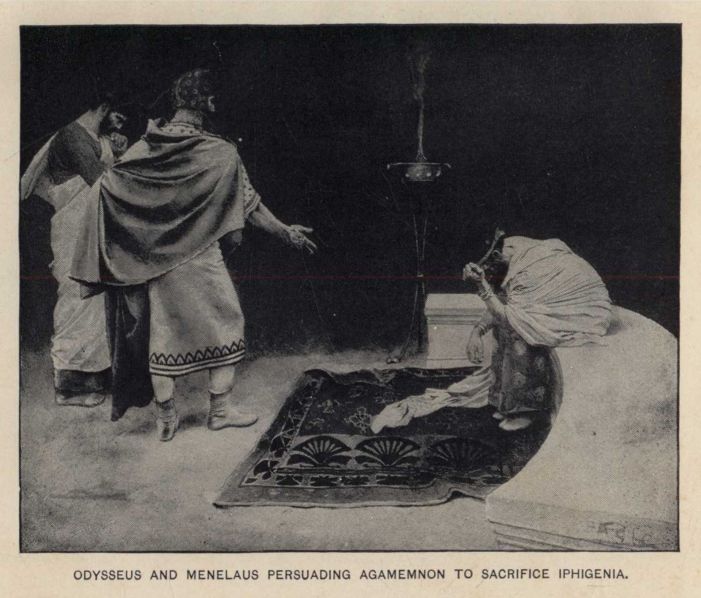
ODYSSEUS AND MENELAUS PERSUADING AGAMEMNON TO SACRIFICE IPHIGENIA.
Nevertheless the king's heart was full of sorrow, and when he was alone he planned how he might yet save his daughter. Night came, but he could not sleep; he walked the floor of his tent; he wept and lamented like one bereft of reason. At length he sat down, and wrote another letter: "Daughter of Leda, send not thy child to Aulis, for I will give her in marriage at another time." Then he called another messenger, an old and trusted servant of the household, and put this letter into his hands.
"Take this with all haste to my queen, who, perchance, is even now on her way to Aulis. Stop not by any cool spring in the groves, and let not thine eyes close for sleep. And see that the chariot bearing the queen and Iphigenia pass thee not unnoticed."
The messenger took the letter, and hasted away. But hardly had he passed the line of the tents when Menelaus saw him, and took the letter from him. And when he had read it, he went before his brother, and reproached him with bitter words.
"Before you were chosen captain of the host," said he, "you were kind and gentle, and the friend of every man. There was nothing that you would not do to aid your fellows. Now you are puffed up with pride and vain conceit, and care nothing even for those who are your equals in power. Yet, for all, you are not rid of your well-known cowardice; and when you saw that your leadership was likely to be taken away from you unless you obeyed the commands of Artemis, you agreed to do this thing. Now you are trying to break your word, sending secretly to your wife, and bidding her not to bring her daughter to Aulis."
Then Agamemnon answered, "Why should I destroy my daughter in order to win back thy wife? Let the suitors who swore an oath to King Tyndareus go with thee. In what way am I bound to serve thee?"
"Do as you will," said Menelaus, going away in wrath.
Soon after this, there came a herald to the king, saying, "Behold, your daughter Iphigenia has come as you directed, and with her mother and her little brother Orestes she rests by the spring close to the outer line of tents. And the warriors have gathered around them, and are praising her loveliness, and asking many questions; and some say, 'The king is sick to see his daughter whom he loves so deeply, and he has made up some excuse to bring her to the camp.' But I know why you have brought her here; for I have been told about the wedding, and the noble groom who is to lead her in marriage; and we will rejoice and be glad, because this is a happy day for the maiden."
Then the king was sorely distressed, and knew not what to do. "Sad, sad indeed," said he, "is the wedding to which the maiden cometh. For the name of the bridegroom is Death."
At the same time Menelaus came back, sorrowful and repentant. "You were right, my brother," said he. "What, indeed, has Iphigenia to do with Helen, and why should the maiden die for me? Send the Hellenes to their homes, and let not this great wrong be done."
"But how can I do that now?" asked Agamemnon. "The warriors, urged on by Odysseus and Calchas, will force me to do the deed. Or, if I flee to Mycenæ, they will follow me, and slay me, and destroy my city. Oh, woe am I, that such a day should ever dawn upon my sight!"
Even while they spoke together, the queen's chariot drove up to the tent door, and the queen and Iphigenia and the little Orestes alighted quickly, and merrily greeted the king.
"It is well that you have sent for me, my father," said Iphigenia, caressing him.
"It may be well, and yet it may not," said Agamemnon. "I am exceeding glad to see thee alive and happy."
"If you are glad, why then do you weep?"
"I am sad because thou wilt be so long time away from me."
"Are you going on a very long voyage, father?"
"A long voyage and a sad one, my child. And thou, also, hast a journey to make."
"Must I make it alone, or will my mother go with me?"
"Thou must make it alone. Neither father nor mother nor any friend can go with thee, my child."
"But when shall it be? I pray that you will hasten this matter with Troy, and return home ere then."
"It may be so. But I must offer a sacrifice to the gods, before we sail from Aulis."
"That is well. And may I be present?"
"Yes, and thou shalt be very close to the altar."
"Shall I lead in the dances, father?"
Then the king could say no more, for reason of the great sorrow within him; and he kissed the maiden, and sent her into the tent. A little while afterward, the queen came and spoke to him, and asked him about the man to whom their daughter was to be wedded; and Agamemnon, still dissembling, told her that the hero's name was Achilles, and that he was the son of old Peleus and the sea-nymph Thetis.
"And when and where is the marriage to be?" asked the queen.
"On the first lucky day in the present moon, and here in our camp at Aulis," answered Agamemnon.
"Shall I stay here with thee until then?"
"Nay, thou must go back to Mycenæ without delay."
"But may I not come again? If I am not here, who will hold up the torch for the bride?"
"I will attend to all such matters," answered Agamemnon.
But Clytemnestra was not well pleased, neither could the king persuade her at all that she should return to Mycenæ. While yet they were talking, Achilles himself came to the tent door, and said aloud to the servant who kept it, "Tell thy master that Achilles, the son of Peleus, would be pleased to see him."
When Clytemnestra overheard these words, she hastened to the door, and offered the hero her hand. But he was ashamed and drew back, for it was deemed an unseemly thing for men to speak thus with women. Then Clytemnestra said, "Why, indeed, should you, who are about to marry my daughter, be ashamed to give me your hand?"
Achilles was struck with wonder, and asked her what she meant; and when she had explained the matter, he said,--
"Truly I have never been a suitor for thy daughter, neither has Agamemnon or Menelaus spoken a word to me regarding her."
And now the queen was astonished in her turn, and cried out with shame that she had been so cruelly deceived. Then the keeper of the door, who was the same that had been sent with the letter, came forward and told the truth regarding the whole matter. And Clytemnestra cried to Achilles, "O son of the silver-footed Thetis! Help me and help my daughter Iphigenia, in this time of sorest need! For we have no friend in all this host, and none in whom we can confide but thee."
Achilles answered, "Long time ago I was a pupil of old Cheiron the most righteous of men, and from him I learned to be honest and true. If Agamemnon rule according to right, then I will obey him; but not otherwise. And now since thy daughter was brought to this place under pretence of giving her to me as my bride, I will see that she shall not be slain, neither shall any one dare take her from me."
On the following day, while Agamemnon sat grief-stricken in his tent, the maiden came before him carrying the babe Orestes in her arms; and she cast herself upon her knees at his feet, and caressing his hands, she thus besought him: "Would, dear father, that I had the voice of Orpheus, to whom even the rocks did listen! then I would persuade thee. O father! I am thy child. I was the first to call thee 'Father,' and the first to whom thou saidst 'My child.'"
The father turned his face away, and wept; he could not speak for sadness. Then the maiden went on: "O, father, hear me! thou to whom my voice was once so sweet that thou wouldst waken me to hear my prattle amid the songs of birds when it was meaningless as theirs. And when I was older grown, then thou wouldst say to me, 'Some day, my birdling, thou shalt have a nest of thy own, a home of which thou shalt be the mistress.' And I did answer, 'Yes, dear father, and when thou art old I will care for thee, and pay thee with all my heart for the kindness thou dost show me.' But now thou hast forgotten it all, and art ready to slay my young life."
A deep groan burst from the lips of the mighty king, but he spoke not a word. Then after a death-like silence broken only by the deep breathings of father and child, Iphigenia spoke again: "My father, can there be any prayer more pure and more persuasive than that of a maiden for her father's welfare? and when the cruel knife shall strike me down, thou wilt have one daughter less to pray for thee." A shudder shook the frame of Agamemnon, but he answered not a word.
At that moment Achilles entered. He had come in haste from the tents beside the shore, and he spoke in hurried, anxious accents.
"Behold," said he, "a great tumult has arisen in the camp; for Calchas has given out among the men that you refuse to do what Artemis has bidden, and that hence these delays and troubles have arisen. And the rude soldiers are crying out against you, and declaring that the maiden must die. When I would have stayed their anger, they took up stones to stone me,--my own Myrmidons among the rest. And now they are making ready to move upon your tent, threatening to sacrifice you also with your daughter. But I will fight for you to the utmost, and the maiden shall not die."
As he was speaking, Calchas entered, and, grasping the wrist of the pleading maiden, lifted her to her feet. She looked up, and saw his stony face and hard cold eyes; and turning again to Agamemnon, she said, "O father, the ships shall sail, for I will die for thee."
Then Achilles said to her, "Fair maiden, thou art by far the noblest and most lovely of thy sex. Fain would I save thee from this fate, even though every man in Hellas be against me. Fly with me quickly to my long-oared galley, and I will carry thee safely away from this accursed place."
"Not so," answered Iphigenia: "I will give up my life for my father and this land of the Hellenes, and no man shall suffer for me."
And the pitiless priest led her through the throng of rude soldiers, to the grove of Artemis, wherein an altar had been built. But Achilles and Agamemnon covered their faces with their mantles, and staid inside the tent. Then Talthybius the herald stood up, and bade the warriors keep silence; and Calchas put a garland of sweet-smelling flowers about the victim's head.
"Let no man touch me," said the maiden, "for I offer my neck to the sword with right good will, that so my father may live and prosper."
In silence and great awe, the warriors stood around, while Calchas drew a sharp knife from its scabbard. But, lo! as he struck, the maiden was not there; and in her stead, a noble deer lay dying on the altar. Then the old soothsayer cried out in triumphant tones, "See now, ye men of Hellas, how the gods have provided for you a sacrifice, and saved the innocent daughter of the king!" And all the people shouted with joy; and in that self-same hour, a strong breeze came down the Euripus, and filled the idle sails of the waiting ships.
"To Troy! to Troy!" cried the Hellenes; and every man hastened aboard his vessel.
How it was that fair Iphigenia escaped the knife; by whom she was saved, or whither she went,--no one knew. Some say that Artemis carried her away to the land of the Taurians, where she had a temple and an altar; and that, long years afterward, her brother Orestes found her there, and bore her back to her girlhood's home, even to Mycenæ. But whether this be true or not, I know that there have been maidens as noble, as loving, as innocent as she, who have given up their lives in order to make this world a purer and happier place in which to live; and these are not dead, but live in the grateful memories of those whom they loved and saved.
ADVENTURE XXI.
THE LONG SIEGE.
The great fleet sailed once more across the sea, piloted now by Telephus, the king of Mysia; and the ships of Achilles and those of Philoctetes of Melibœa led all the rest. When they had put a little more than half the distance behind them, they came to the isle of Chryse, where were a fair temple and altars built in honor of Athené. Here many of the heroes landed; and while some were busied in refilling the water-casks from the springs of fresh water near the shore, others went up to the temple and offered gifts and heartfelt thanks to Pallas Athené. But as Philoctetes, the cunning archer, stood near one of the altars, a water-snake came out of the rocks and bit him on the foot. Terrible, indeed, was the wound, and great were the hero's sufferings; day and night he groaned and cried aloud by reason of the bitter pain; and there was no physician that could heal him of the grievous hurt. In a few days, a noisome stench began to issue from the wound, and the hero's complainings waxed so loud and piteous that the warriors stopped their ears, so that they might not hear them. Then the chiefs took counsel as to what it were best to do with him; and, although some advised that he be cast into the sea, it was thought best to follow a milder course, and leave him alone on the isle of Lemnos. Hence, while the hero slept, Odysseus and his men carried him on shore; and they laid his great bow, even the bow of Heracles, by his side upon the sand, and put a cask of water and a basket of food within easy reach of his hand. Then they sailed away, and left him alone in his great distress and sorrow.
At length the shores of Ilios were reached, and the high towers of Troy were seen. Then the sails of the vessels were furled and laid away in the roomy holds, the masts were lowered with speed, and the oarsmen seated themselves upon the benches and rowed the ships forward until they stood in one line, stretching more than a league along the shore. But as they drew nearer the sea-beach, the heroes saw all the plain before them covered with armed men and horses and chariots drawn up to hinder their landing. And they paused, uncertain what to do; for Calchas the soothsayer had declared that he who should first step foot upon the shores of Ilios should meet a sudden death.