Front matter (continued 2)
Reading edition
"'Virtue,' said Heracles, 'I will take thee as my guide! The road of labor and honest effort shall be mine, and my heart shall no longer cherish bitterness or discontent.'
"And he put his hand into that of Virtue, and entered with her upon the straight and forbidding road which leads to the fair blue mountains on the pale and distant horizon.[1]
[1] See Note 5 at the end of this volume.
"My dear grandson, make thou the same wise choice.
"But now the fire has burned low, and it is time that both old and young should seek repose. Go now to your chamber and your couch; and pleasant dreams be yours until the new day dawns, bringing its labors and its victories."
ADVENTURE VI.
TWO FAMOUS BOAR HUNTS.
Hardly had the morning tinged the eastern sky with her yellow light, when Odysseus arose from his couch, and quickly clothed himself; for he had been awakened by the sound of hurrying feet, and many voices, and the barking of dogs, beneath his chamber window. When he went down into the great hall, he was greeted by his six stalwart uncles, all of whom were dressed for the chase, and armed with spears and knives.
"To-day we hunt the wild boar on the wooded slopes of Parnassus," said Echion, the eldest. "How glad we should be if you were old enough and strong enough to join us in the sport!"
The heart of Odysseus was stirred at once, like that of a warrior when he hears the battle-call. "I am certainly strong enough!" he cried. "I will ask my grandfather if I may go."
Autolycus smiled when the boy made known his wish. Indeed, he was expecting such a request, and would have been disappointed and displeased if it had not been made.
"Yes, go, my child," he said; "and while I sit here, bound with the fetters of old age, my blessing shall go with you."
Odysseus thanked his grandfather, and lost no time in making himself ready for the hunt. A hasty meal was eaten; and then the huntsmen, with a great number of dogs and serving-men, sallied forth, and began to climb the mountain slopes. The master of the hunt was an old, gray-bearded man, one of the last of the ancient race of heroes, whose whole life had been spent in the household of Autolycus. Old as he was, he outstrode all the other huntsmen; but Odysseus, young and supple, kept close behind him,--a dwarf following in the wake of a giant. Upward and still upward they toiled, while their comrades, with the hounds, followed slowly far below them. They passed through the belt of pine trees, and left the wooded slopes behind. There was now nothing but bare rocks before and above them. The cold winds whistled about their heads; the mountain eagles soared and screamed in the sharp morning air.
"Surely, my father," said Odysseus, "the lair of the wild boar cannot be on these bleak heights. Would it not be better to seek him among the woods of the lower slopes?"
"You are right," said the old man, stopping at last upon one of the highest crags. "I have brought you to this spot, not in search of game, but to show you what is a truly great and beautiful sight. Your tutor has told me that you once had a glimpse of the world from Mount Neritus; now look around you, and see the world itself!"
Then the lad looked; and far away on the blue horizon he saw the silvery heights of Olympus, the throne of mighty Zeus, glittering in the sunlight, and canopied with clouds. On his right he beheld Mount Helicon and the fruitful plains of Bœotia, and the blue sea of Ægæa stretching away and away towards the sunrise halls of Helios. Southward lay the Bay of Crissa, and beyond it the land of mighty Pelops, and busy Corinth, and the rich pasture-lands of Arcadia. Then turning to the west, he saw, like a mere speck on the horizon, his own loved Ithaca; while nearer were the woods of Calydon and the green headlands of Achaia. At that moment the clouds which had been hanging about the mountain-top suddenly melted away, and the sun shone out bright and clear, bathing the woods and crags in purple and gold; while at the same time the music of ten thousand voices of birds and beasts and nymphs and waterfalls was borne up from below to their delighted ears.
"Is not this a beautiful world?" asked the aged hero, baring his gray head to the cold winds. "What would you not give to have it all for your own?"
The lad answered not a word; but his eyes filled with tears as he thought of his home and of those whom he loved, far away by the green slopes of little Neritus.
"My son," then said the hero, "remember the choice of Heracles. Happiness is to be gotten from within us. It is not to be bought with silver and gold, nor yet is it to be seized upon with violence. Better have a clean conscience than to own all Hellas; better-- But hark! I hear the dogs in the dells far below us! Let us hasten down, for they have started the game."
Within a thorny thicket where grew the vines and leaves so closely that the sun's rays never struggled through them, the huge wild boar had made his lair. Hither the hounds had tracked him; and their deep baying, and the trampling of many feet among the dead leaves upon the ground, had roused the beast, and stirred him into fury. Suddenly he sprang from his lair, and gnashing his huge tusks, and foaming with fury, he charged upon his foes. The dogs fell back, afraid to come too close to an enemy so fierce and strong; and with their many-toned bays they made the echoes of Parnassus ring.
Just at this moment, the boy Odysseus rushed down into the glen, his long spear poised and ready to strike. But the great beast waited not for the stroke: he dashed furiously at the boy, who quickly leaped aside, although too late. The boar's sharp tusk struck Odysseus just above the knee, cutting a fearful gash, tearing the flesh, and even grazing the bone. But the lad, undaunted, struck manfully with his weapon. The bright spear was driven straight to the heart of the beast; with one great cry he fell, and gnashing his huge jaws helplessly he died among the withered leaves. The boy, faint with pain and the joy of victory, staggered into the arms of his stalwart uncles, who had hastened to succor him. Gently they bound up the ghastly wound, and with charms and witchery stanched the flowing blood. Then, upon a litter woven of vines and pliant twigs, they bore him down the deep glen to the broad halls of old Autolycus; and the men and boys, having flayed the grisly beast, brought afterward its head and bristly hide, and set them up as trophies in the gateway.
For many weary days, Odysseus lay helpless on a couch of pain. But his kind kinsmen, and Phemius his tutor, waited on him tenderly, and his fair grandmother Amphithea nursed him. And when the pain left him, and he began to grow strong again, he loved to lie on the bearskins at his grandfather's feet, and listen to tales of the earlier days, when the older race of heroes walked the earth.
"When I was younger than I am to-day," said the old chief, as they sat one evening in the light of the blazing brands,--"when I was much younger than now, it was my fortune to take part in the most famous boar hunt the world has ever known.
"There lived at that time, in Calydon, a mighty chief named Oineus,--and, indeed, I know not but that he still lives. Oineus was rich in vineyards and in orchards, and no other man in all Ætolia was happier or more blessed than he. He had married, early in life, the princess Althea, fairest of the Acarnanian maidens, and to them a son had been born, golden-haired and beautiful, whom they called Meleager.
"When Meleager was yet but one day old, his father held him in his arms, and prayed to Zeus and the ever-living powers above: 'Grant, Father Zeus, and all ye deathless ones, that this my son may be the foremost among the men of Hellas. And let it come to pass, that when they see his valiant deeds, his countrymen shall say, "Behold, this youth is greater than his father," and all of one accord shall hail him as their guardian king.'
"Then his mother Althea, weeping tears of joy, prayed to Pallas Athené, that the boy might grow up to be pure-minded and gentle, the hope and pride of his parents, and the delight and staff of their declining years. Scarcely had the words of prayer died from her lips, when there came into her chamber the three unerring Fates who spin the destinies of men. White-robed and garlanded, they stood beside the babe, and with unwearied fingers drew out the lines of his untried life. Sad Clotho held the golden distaff in her hand, and twirled and twisted the delicate thread. Lachesis, now sad, now hopeful, with her long white fingers held the hourglass, and framed her lips to say, 'It is enough.' And Atropos, blind and unpitying as the future always is, stood ready, with cruel shears, to clip the twist in twain. Busily and silently sad Clotho spun; and the golden thread, thin as a spider's web, yet beautiful as a sunbeam, grew longer and more golden between her skilful fingers. Then Lachesis cried out, 'It is finished!' But Atropos hid her shears beneath her mantle, and said, 'Not so. Behold, there is a brand burning upon the hearth. Wait until it is all burned into ashes and smoke, and then I will cut the thread of the child's life. Spin on, sweet Clotho!'
"Quick as thought, Althea sprang forward, snatched the blazing brand from the hearth, and quenched its flame in a jar of water; and when she knew that not a single spark was left glowing upon it, she locked it safely in a chest where none but she could find it. As she did this, the pitiless sisters vanished from her sight, saying as they flitted through the air, 'We bide our time.'[1]
[1] See Note 6 at the end of this volume.
"Meleager grew up to be a tall and fair and gentle youth; and when at last he became a man, he sailed on the ship Argo, with Jason, and Laertes your father, and the great heroes of that day, to far-off Colchis, in search of the Golden Fleece. Many brave deeds were his in foreign lands; and when he came home again to Calydon, he brought with him a fair young wife, gentle Cleopatra, daughter of Idas the boaster.
"Oineus had gathered in his harvest; and he was glad and thankful in his heart, because his fields had yielded plenteously; his vines had been loaded with purple grapes, and his orchards filled with abundance of pleasant fruit. Grateful, as men should always be, to the givers of peace and plenty, he held within his halls a harvest festival, to which the brave and beautiful of all Ætolia came. Happy was this feast, and the hours were bright with smiles and sunshine; and men forgot sorrow and labor, and thought only of the gladness of life.
"Then Oineus took of the first-fruits of his fields and his vineyards and his orchards, and offered them in thankful offerings to the givers of good. But he forgot to deck the shrine of Artemis with gifts, little thinking that the arrow-darting queen cared for any thing which mortal men might offer her. Ah, woful mistake was that! For, in her anger at the slight, Artemis sent a savage boar, with ivory tusks and foaming mouth, to overrun the lands of Calydon. Many a field did the monster ravage, many a tree uproot; and all the growing vines, which late had borne so rich a vintage, were trampled to the ground. Sadly troubled was Oineus, and the chieftains of Ætolia knew not what to do. For the fierce beast could not be slain, but with his terrible tusks he had sent many a rash hunter to an untimely death. Then the young man Meleager said, 'I will call together the heroes of Hellas, and we will hunt the boar in the woods of Calydon.'
"And so at the call of Meleager, the warriors flocked from every land, to join in the hunt of the fierce wild boar. Among them came Castor and Polydeuces, the twin brothers from Lacedæmon; and Idas the boaster, the father-in-law of Meleager, from Messene; and mighty Jason, captain of the Argo; and Atalanta, the swift-footed daughter of Iasus of Arcadia; and many Acarnanian huntsmen led by the sons of Thestios, Althea's brothers. Thither also did I, Autolycus, hasten, although men spitefully said that I was far more skilful in taking tame beasts than in slaying wild ones.
"Nine days we feasted in the halls of Oineus; and every day we tried our skill with bows and arrows, and tested the strength of our well-seasoned spears. On the tenth, the bugles sounded, and hounds and huntsmen gathered in the courtyard of the chief, chafing for the hunt. But a proud fellow named Cepheus, of Arcadia, when he saw fair Atalanta equipped for the chase, drew back disdainfully, and said,--
"'In my country, it is not the custom for heroes to go to battle or to hunt side by side with women. Woman's place is at home: her weapons are the distaff and the needle; her duty is to practise well the household virtues. If you allow this young girl to join in this hunt, then I will turn my face homeward, and seek in the Arcadian land adventures worthy of men.'
"Then Meleager angrily answered, 'In the Arcadian land, if report speaks truly, the deeds deemed worthiest of men are the watching of flocks and the tuning of the shepherd's pipe. It is fear, not bravery, that makes you seek an excuse to leave the chase of the wild boar before it is begun. You are afraid of the beast; and you are still more afraid of the maiden Atalanta, lest she should prove to be more skilled than you. Have you heard how, when an infant, she was left to perish on the Parthenian hill, and would have died, had not a she-bear cared for her until some hunters rescued her? Have you heard how, as she grew up, her beauty was greater than that of any other maiden, and how no one but Artemis, the archer-queen, could shoot the swift arrow so fair and straight? Have you heard what she did on the ship Argo, when, with Jason as our captain, we sailed to the utmost bounds of the earth, and brought home with us the fleece of gold? Have you heard how, with her own arrows, she slew the beastly centaurs, Rhoecus and Hylaeus, because they dared to make love to one so pure and beautiful? Doubtless you have heard all these things, and you are afraid to go to the field of danger with one so much nobler than yourself. Go back, then, to your sheep-tending Arcadia! No one will miss you in the chase.'
"Then Cepheus blushed, but more from shame than anger. 'I will ride with you into the wood," said he, 'and never again shall any man accuse me of having a timid heart.'
"Soon we sallied forth from the town, a hundred huntsmen, with dogs innumerable. Through the fields and orchards, laid waste by the savage beast, we passed; and Atalanta, keen of sight and swift of foot, her long hair floating in the wind behind her, led all the rest. It was not long until, in a narrow dell once green with vines and trees, but now strewn thick with withered branches, we roused the fierce creature from his lair. At first he fled, followed closely by the baying hounds. Then suddenly he faced his foes; with gnashing teeth and bloodshot eyes, he charged furiously upon them. A score of hounds were slain outright; and Cepheus, rushing blindly onward, was caught by the beast, and torn in pieces by his sharp tusks. Brave Peleus of Phthia with unsteady aim let fly an arrow from his bow, which, falling short of the mark, smote his friend Eurytion full in the breast, and stretched him lifeless upon the ground. Then swift-footed Atalanta, bounding forward, struck the beast a deadly blow with her spear. He stopped short his furious onslaught; and Amphiaraus, the hero and prophet of Argos, launching a swift arrow, put out one of his eyes. Terrible were the cries of the wounded creature, as, blinded and bleeding, he made a last charge upon the huntsmen. But Meleager with a skilful sword-thrust pierced his heart, and the beast fell weltering in his gore. Great joy filled the hearts of the Calydonians, when they saw the scourge of their land laid low and helpless. They quickly flayed the beast, and the heroes who had shared in the hunt divided the flesh among them; but the head and the bristly hide they gave to Meleager.
"'Not to me does the prize belong,' he cried, 'but to Atalanta, the swift-footed huntress. For the first wound--the true death stroke, indeed--was given by her; and to her, woman though she be, all honor and the prize must be awarded.'
"With these words, he bore the grinning head and the bristly hide to the fair young huntress, and laid them at her feet. Then his uncles, the sons of Acarnanian Thestios, rushed angrily forward, saying that no woman should ever bear a prize away from them; and they seized the hide, and would have taken it away, had not Meleager forbidden them. Yet they would not loose their hold upon the prize, but drew their swords, and wrathfully threatened Meleager's life. The hero's heart grew hot within him, and he shrunk not from the affray. Long and fearful was the struggle,--uncles against nephew; but in the end the sons of Thestios lay bleeding upon the ground, while the victor brought again the boar's hide, and laid it the second time at Atalanta's feet. The fair huntress took the prize, and carried it away with her to deck her father's hall in the pleasant Arcadian land. And the heroes, when they had feasted nine other days with King Oineus, betook themselves to their own homes.
"But the hearts of the Acarnanians were bitter towards Meleager, because of the death of the sons of Thestios, and because no part of the wild boar was awarded to them. They called their chiefs around them, and all their brave men, and made war upon King Oineus and Meleager. Many battles did they fight round Calydon, and among the Ætolian hills; yet while Meleager led his warriors to the fray, the Acarnanians fared but ill.
"Then Queen Althea, filled with grief for her brothers' untimely death, forgot her love for her son, and prayed that her Acarnanian kinsmen might prevail against him. Upon the hard earth she knelt: she beat the ground with her hands, and heaped the dust about her; and, weeping bitter tears, she called upon Hades and heartless Persephone to avenge her of Meleager. And even as she prayed, the pitiless Furies, wandering amid the darkness, heard her cries, and came, obedient to her wishes.
"When Meleager heard that his mother had turned against him, he withdrew in sorrow to his own house, and sought comfort and peace with his wife, fair Cleopatra; and he would not lead his warriors any more to battle against the Acarnanians. Then the enemy besieged the city: a fearful tumult rose about the gates; the high towers were assaulted, and everywhere the Calydonians were driven back dismayed and beaten. With uplifted hands and tearful eyes, King Oineus and the elders of the city came to Meleager, and besought him to take the field again. Rich gifts they offered him. They bade him choose for his own the most fertile farm in Calydon,--at the least fifty acres, half for tillage and half for vines; but he would not listen to them. The din of battle thickened outside the gates; the towers shook with the thundering blows of the besiegers. Old Oineus with trembling limbs climbed up the stairway to his son's secluded chamber, and, weeping, prayed him to come down and save the city from fire and pillage. Still he kept silent, and went not. His sisters came, and his most trusted friends. 'Come, Meleager,' they prayed, 'forget thy grief, and think only of our great need. Aid thy people, or we shall all perish!'
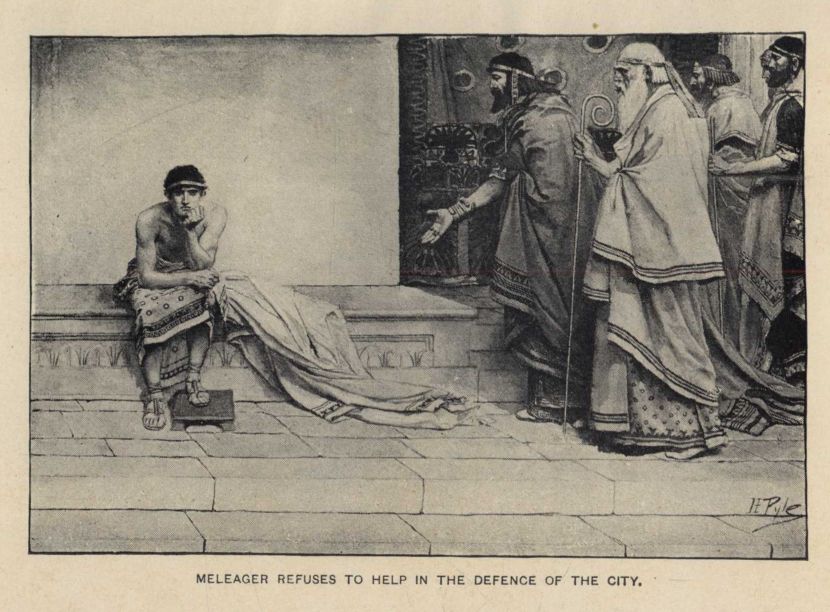
MELEAGER REFUSES TO HELP IN THE DEFENCE OF THE CITY.
"None of these prayers moved him. The gates were beaten down; the enemy was within the walls; the tide of battle shook the very tower where Meleager sat; the doom of Calydon seemed to be sealed. Then came the fair Cleopatra, and knelt before her husband, and besought him to withhold no longer the aid which he alone could give. 'O Meleager,' she sobbed, 'none but thou can save us. Wilt thou sit still, and see the city laid in ashes, thy dearest friends slaughtered, and thy wife and sweet babes dragged from their homes and sold into cruel slavery?'
"Then Meleager rose and girded on his armor. To the streets he hastened, shouting his well-known battle-cry. Eagerly and hopefully did the Calydonian warriors rally around him. Fiercely did they meet the foe. Terrible was the bloodshed. Back from the battered gates and the crumbling wall, the Acarnanian hosts were driven. A panic seized upon them. They turned and fled, and not many of them escaped the swords of Meleager's men.
"Again there was peace in Calydon, and the orchards of King Oineus blossomed and bore fruit as of old; but the gifts and large rewards which the elders had promised to Meleager were forgotten. He had saved his country, but his countrymen were ungrateful.
"Then Meleager again laid aside his war-gear, and sought the quiet of his own home, and the cheering presence of fair Cleopatra. For the remembrance of his mother's curse and his country's ingratitude weighed heavily on his mind, and he cared no longer to mingle with his fellow-men.
"Then it was that Althea's hatred of her son waxed stronger, and she thought of the half-burnt brand which she had hidden, and of the words which the fatal sisters had spoken so many years before.
"'He is no longer my son,' said she, 'and why should I withhold the burning of the brand? He can never again bring comfort to my heart; for the blood of my brothers, whom I loved, is upon his head.'
"And she took the charred billet from the place where she had hidden it, and cast it again into the flames. And as it slowly burned away, so did the life of Meleager wane. Lovingly he bade his wife farewell; softly he whispered a prayer to the unseen powers above; and as the flickering flames of the fatal brand died into darkness, he gently breathed his last.
"Then sharp-toothed remorse seized upon Althea, and the mother-love which had slept in her bosom was reawakened. Too late, also, the folk of Calydon remembered who it was that had saved them from slavery and death. Down into the comfortless halls of Hades, Althea hastened to seek her son's forgiveness. The loving heart of Cleopatra, surcharged with grief, was broken; and her gentle spirit fled to the world of shades to meet that of her hero-husband. And Meleager's sisters would not be consoled, so great was the sorrow which had come upon them; and they wept and lamented day and night, until kind Artemis in pity for their youth changed them into the birds which we call Meleagrides."
Lying on the bearskins at his grandfather's feet, and listening to stories like this, Odysseus did not feel that time was burdensome. The wound upon his knee healed slowly; and when at last he could walk again, a white scar, as long and as broad as a finger, told the story of his combat with the fierce wild boar. By this time the summer was far spent, and the bard Phemius was impatient to return to Ithaca.
"The grapes in your father's vineyard are growing purple, and his orchards are laden with ripening fruit," said he to Odysseus; "and the days are near at hand when your anxious mother will gaze with longing over the sea, expecting your return."
But there was no vessel at the port on the bay to carry them home by the nearest way; and days' and months might pass ere any ship, sent thither by Laertes, would arrive. How, then, were they to return to Ithaca?
"Here is your uncle, bold Echion, who goes to-morrow to Iolcos by the sea, carrying gifts and a message from Autolycus to old King Peleus. We will go with him."
"But Iolcos is farther still from Ithaca," said Odysseus.
"True," answered Phemius. "But from Iolcos, at this season of the year, there are many vessels sailing to Corinth and the islands of the sea. Once at Corinth, and we shall find no lack of ships to carry us across the bay of Crissa to our own loved Ithaca."
And thus the journey home was planned. It was a long and devious route by way of Iolcos and the Eubœan Sea; and no one could say how many dangers they might meet, or how many delays they should encounter. Yet nothing better could be done, if they would return before the summer ended.
The great Autolycus blessed Odysseus on departing, and gave him rich gifts of gold and priceless gems, and many words of sage advice. "I shall see thee no more," he said; "but thy name shall be spoken countless ages hence, and men shall say, 'How shrewd and far-seeing, brave in war, and wise in counsel, was Odysseus!'"
ADVENTURE VII.
AT OLD CHEIRON'S SCHOOL.
After a long, hard journey by land and sea, Odysseus and his tutor, with bold Echion, came to Iolcos. Aged Peleus, king of Phthia and the fertile plains of Iolcos, greeted them with show of heartiest welcome; for he remembered that Laertes had been his friend and comrade long years before, when together on the Argo they sailed the briny deep, and he was glad to see the son of that old comrade; and he took Odysseus by the hand, and led him into his palace, and gave him of the best of all that he had.
"Tarry with me for a month," he said. "My ships are now at sea, but they will return; and when the moon rises again full and round, as it did last night, I will send you safe to Corinth on the shores of the Bay of Crissa."
And so Odysseus and the bard staid a whole month at Iolcos, in the house of Peleus the king. There were feasting and merriment in the halls every day; and yet the time hung heavily, for the boy longed to re-behold his own loved Ithaca, and could hardly wait to see the moon grow full and round again.
"What mountain is that which looms up so grandly on our left, and whose sides seem covered with dark forests?" asked Odysseus one day, as he walked with his tutor beside the sea.
"It is famous Mount Pelion," said the bard; "and that other mountain with the steeper sides, which stands out faintly against the far horizon, is the scarcely less famed Ossa."
"I have heard my father speak of piling Pelion upon Ossa," said Odysseus, "but I cannot understand how that can be done."
"There were once two brothers, the tallest that the grain-giving earth has ever reared," said Phemius. "Their names were Otus and Ephialtes; and they threatened to make war even against the deathless ones who dwell on Mount Olympus. They boasted that they would pile Ossa on Olympus, and Pelion, with all its woods, upon the top of Ossa, that so they might make a pathway to the sky. And, had they lived to manhood's years, no one can say what deeds they would have done. But silver-bowed Apollo, with his swift arrows, slew the twain ere yet the down had bloomed upon their cheeks or darkened their chins with the promise of manhood. And so Pelion still stands beside the sea, and Ossa, in its own place, guards the lovely vale of Tempe."[1]
[1] See Odyssey, Book xi. l. 306,
"Oh, now I remember something else about Mount Pelion," cried Odysseus. "It was from the trees which grew upon its sides, that the ship Argo was built. And I have heard my father tell how Cheiron the Centaur once lived in a cave on Pelion, and taught the young heroes who came to learn of him; and how young Jason came down the mountain one day, and boldly stood before King Pelias, who had robbed old Æson, his father, of the kingdom which was rightfully his. Would that I had been one of Cheiron's pupils, and had shared the instruction which he gave to those youthful heroes!"
"The old Centaur still lives in his cave on Mount Pelion," said Phemius. "To-morrow, if King Peleus is willing, we will go and see him."
And so, the next day, the two went out of Iolcos, through vineyards and fields and olive orchards, towards Pelion, the snow-crowned warder of the shore. They followed a winding pathway, and came ere long to the foot of the mighty mountain. Above them were frowning rocks, and dark forests of pine, which seemed ready to fall upon and crush them. But among the trees, and in the crannies of the rocks, there grew thousands of sweetest flowers, and every kind of health giving herb, and tender grass for the mountain-climbing deer. Up and up they climbed, until the dark forests gave place to stunted shrubs, and the shrubs to barren rocks. Then the pathway led downward again to the head of a narrow glen, where roared a foaming waterfall. There they came to the mouth of a cave opening out upon a sunny ledge, and almost hidden behind a broad curtain of blossoming vines. From within the cave there came the sound of music,--the sweet tones of a harp, mingled with the voices of singers. Of what did they sing?
They sang of things pure and good and beautiful,--of the mighty sea, and the grain-bearing earth, and the blue vault of heaven; of faith, strong and holy; of hope, bright and trustful; of love, pure and mighty. Then the singing ceased, and the harp was laid aside.
Odysseus and the bard went quickly forward, and stood waiting beside the wide-open door. They could see, by looking in, that the low walls of the cave were adorned with shields of leather or bronze, with the antlers of deer, and with many other relics of battle or of the chase. Upon the smooth white floor were soft couches of bearskins; and upon the hearthstone in the centre blazed a bright fire of twigs, casting a ruddy, flickering light into the farthest nook and cranny of that strange room.
They had not long to wait at the door. An old man with white hair, and beard reaching to his waist, with eyes as clear and bright as those of a falcon, and with a step as firm as that of youth, came quickly forward to greet them. Odysseus thought that he had never seen a man with so noble and yet so sad a mien.
"Hail, strangers!" said the aged hero, taking their hands. "Hail, son of Laertes--for I know thee!--welcome to the home of Cheiron, the last of his race! Come in, and you shall be kindly entertained; and after you have rested your weary limbs, you shall tell me why you have come to Pelion, and what favor you have to ask of me."
Therewith he turned again into the broad cave-hall, and Odysseus and his tutor followed him. And he led his guests, and seated them on pleasant couches not far from the glowing fire upon the hearth. Then a comely youth brought water in a stone pitcher, and poured it in a basin, that they might wash their hands. And another lad brought wheaten bread, and set it by them on a polished table; and another brought golden honey in the honeycomb, and many other dainties, and laid them on the board. And when they were ready, a fourth lad lifted and placed before them a platter of venison, and cups full of ice-cold water from the mountain cataract. While they sat, partaking of these bounties, not a word was spoken in the cave; for old Cheiron never forgot the courtesy due to guests and strangers. When they had finished, he bade them stay a while upon the couches where they sat; and he took a golden lyre in his hands, and deftly touched the chords, bringing forth the most restful music that Odysseus had ever heard. He played a soft, low melody which seemed to carry their minds far away into a summer land of peace, where they wandered at will by the side of still waters, and through sunlit fields and groves, and reposed under the shelter of calm blue skies, shielded by the boundless love of the unknown Creator. When he had finished, Odysseus thought no more of the toilsome journey from Iolcos, or of the wearisome climbing of the mountain: he thought only of the wise and wonderful old man who sat before him.
"Now tell me," said Cheiron, laying his lyre aside,--"tell me what errand brings you hither, and what I can do to aid you."
"We have no errand," answered Phemius, "save to see one of the immortals, and to listen to the words of wisdom and beauty which fall from his lips. We know that you have been the friend and teacher of heroes such as have not had their peers on earth; and this lad Odysseus, who is himself the son of a hero, would fain learn something from you."
Cheiron smiled, and looked full into the young lad's face.
"I have trained many such youths as you for the battle of life," he said. "And your father, as were all the Argonauts, was well known to me. You are welcome to Mount Pelion, and to old Cheiron's school. But why do you look at my feet?"
Odysseus blushed, but could make no answer.
"I understand it," said Cheiron, speaking in a tone of sadness. "You expected to find me half man, half horse, and you were looking for the hoofs; for thus have many men thought concerning me and my race. Long time ago my people dwelt in the valleys and upon the plains of Thessaly; and they were the first who tamed the wild horses of the desert flats, and taught them to obey the hand of their riders. For untold years my fathers held this land, and they were as free as the winds that play upon the top of Pelion. Their warriors, galloping on their swift horses with their long lances ready in their hands, knew no fear, nor met any foe that could stand against them; and hence men called them Centaurs,[2] the piercers of the air. But by and by there came a strong people from beyond the sea, who built houses of stone, and lived in towns; and these made cruel war upon the swift-riding Centaurs. They were the Lapiths,[3] the stone-persuaders, and they had never seen or heard of horses; and for a long time they fancied that our warriors were monsters, half-steed, half-man, living wild among the mountains and upon the plain. And so the story has gone abroad throughout the world, that all the Centaurs, and even I, the last of the race, are hardly human, but have hoofs and manes, and live as horses live.
[2] From [Greek: kentein ten auran].
[3] From [Greek: laas peithein].
"Long and sad was the war between the Centaurs and the Lapiths; but the stone-persuaders were stronger than the piercers of the air. In time, my people were driven into the mountains, where they lived as wild men in the caves, and in the sunless gorges and ravines; and our enemies, the Lapiths, abode in the rich valleys, and held the broad pasture-lands which had once been ours. Then it chanced that Peirithous, king of the Lapiths, saw Hippodameia, fairest of our mountain maidens, and wished to wed her. Whether her father consented to the marriage, or whether the Lapiths carried her away by force, I cannot tell; but Peirithous made a great wedding feast, and to it he invited the chiefs of the Centaurs, and great Theseus of Athens, and Nestor of sandy Pylos, and many others of the noblest heroes of Hellas. Many wild and dark stories have been told of what happened at that wedding feast; but you must remember that all these stories have come from the mouths of our enemies, the stone-persuading Lapiths, and that their truth may well be doubted. Let me tell you about it, as I understand the facts to be:--
"In the midst of the feast, when the Lapiths were drunken with wine, Eurytion, the boldest of the Centaurs, rose quickly to his feet, and beckoned to his fellows. Without a word they seized upon the bride; they carried her, not unwilling, from the hall; they seated her upon a swift steed which stood ready at the door; then in hot haste they mounted, aiming to ride with their prize back to their mountain homes. But the Lapiths were aroused, and rushed from the hall ere our horsemen were outside of the gates. Fearful was the struggle which followed. Our men were armed with pine clubs only, which they had hidden beneath their cloaks, for they dared not bring weapons to the wedding feast. The Lapiths fought with spears; and with pitiless hate they slew one after another of the Centaurs, until hardly a single man escaped to the mountains. But the war ended not with that; for Peirithous, burning with anger, drove the remnant of my people out of their mountain homes, and forced them to flee far away to the lonely land of Pindus; and I, alone of all my race, was left in my cavern-dwelling on the wooded slopes of Pelion."
When Cheiron had ended his story, Odysseus saw that his eyes were filled with tears, and that his hand trembled as he reached again for his lyre, and played a short, sad melody, as mournful as a funeral song.
"Why did you not go with your kindred to the land of Pindus?" asked Phemius.
"This is my home," answered Cheiron. "The fair valley which you see yonder was once my father's pasture land. All the country that lies before us, even to the meeting of the earth and the sky, is the country of my forefathers. I have neither parents, nor brothers, nor wife, nor children. Why should I wish to go away from all that is dear to me? This is a pleasant place, and the young boys who have been my pupils have made my life very happy."
"Please tell us about your pupils," said Odysseus, moving nearer to the wise old man.
"So many boys have been under my care," said Cheiron, "that I could not tell you about them all. Some have come and been taught, and gone back to their homes; and the world has never heard of them, because their lots have been cast in pleasant places, and their lives have been spent in peace. There have been others who have made their names famous upon the earth; for their paths were beset with difficulties, and before them loomed great mountains which they must needs remove or be crushed by them. Among these latter were Heracles, doomed to a life of labor, because another had usurped the place which he should have had; young Jason, hiding from the cruel hatred of his uncle Pelias; and gentle Asclepius, bereft of a mother's love, and cast friendless upon the world's cold mercies. And there were also Peleus my grandson, who is now your host at Iolcos; and Actæon, the famous hunter; and many of the heroes who afterward sailed on the Argo, to the golden strand of Colchis. Each of these lads had a mind of his own, and tastes which it was for me to foster and to train. Heracles was headstrong, selfish, impulsive,--terrible when he did not bridle his passions; and yet his great heart was full of love for the poor, the weak, and the down-trodden, and he studied to make plans for lightening their burdens. Jason loved the water; and wrapped in his cloak, he would sit for hours on Pelion's top, and gaze with longing eyes upon the purple sea. Asclepius delighted to wander among the crags and in the ravines of Pelion, gathering herbs and flowers, and studying the habits of birds and beasts. And Actæon had a passion for the woods and the fields, and had ever a pack of swift hounds at his heels, ready for the chase of wild boar or mountain deer.
"When these lads came to me, I saw that I must give to each the food which was best fitted for his needs, and which his mind most craved. Had I dealt with all alike, and taught all the same lessons, I doubt if any would have grown to manhood's full estate. But, while I curbed the headstrong will of Heracles, I did what I could to foster his love of virtue and his inventive genius; I taught young Jason all that I knew about this wonderful earth, and the seas and islands which lie around it; I led Asclepius farther along the pathway which he had chosen, and showed him the virtues that were hidden in plants and flowers; I went with Actæon upon the chase, and taught him that there is no sport in cruelty, and that the life of the weakest creature should not be taken without good cause. Thus I moulded the mind of each of the lads according to its bent; and each one grew in stature and in strength and in beauty, before my eyes. And then there were general lessons which I gave to them all, leading them to the knowledge of those things which are necessary to the well-equipped and perfect man of our day. I taught them how to wield the weapons of warfare and of the chase; how to ride and to swim; and how to bear fatigue without murmuring, and face danger without fear. And I showed them how to take care of their own bodies, so that they might be strong and graceful, and full of health and vigor; and I taught them how to heal diseases, and how to treat wounds, and how to nurse the sick. And, more than all else, I taught them to reverence and love that great Power, so little understood by us, but whom mankind will some day learn to know.
"It was not long till Heracles went out in his might to rid the world of monsters, to defend the innocent and the helpless, and to set right that which is wrong; and, for aught I know, he is toiling still along the straight road of Virtue, towards the blue mountains of Fame. And Jason, as you know, left me, and went down to Iolcos, to claim his birthright of old Pelias; and being bidden to bring the Golden Fleece to Hellas, he built the Argo, and sailed with the heroes to far-away Colchis. It was a proud day for me, his old teacher, when he came back to Iolcos with the glittering treasure; and I trusted that a life of happiness and glory was before him. But, alas! he had forgotten my teaching, and had joined himself to evil; and Medea the witch, whom he loved, brought untold misery upon his head, and drove him ere long to an untimely death.
"Then Asclepius went out upon his mission; and everywhere that he went, he healed and purified and raised and blessed. He was the greatest conqueror among all my pupils; but he won, not by strength like Heracles, nor by guile like Jason, but through gentleness and sympathy and brotherly love, and by knowledge and skill and patient self-sacrifice; and to him men gave the highest honor, because he cured while others killed. But the powers of darkness are ever hateful towards the good; and Hades, when he saw that Asclepius snatched back to life even those who were at death's door, complained that the great healer was robbing his kingdom. And men say that Zeus hearkened to this complaint, and that he smote Asclepius with his thunderbolts. Then the face of the sun was veiled in sorrow, and men and beasts and all creatures upon the earth wept for great grief, and the trees dropped their leaves to the ground, and the flowers closed their petals and withered upon their stalks, because the gentle physician, who had cured all pains and sickness, was no longer in the land of the living. And the wrath of silver-bowed Apollo was stirred within him, and he went down to the great smithy of Hephaestus, and, with his swift arrows, slew the Cyclopes who had forged the thunderbolts for Zeus, and spared not one. Then Zeus in his turn was filled with anger; and he sent the golden-haired Apollo to Pherae, in Thessaly, to serve for a whole year as bondsman to King Admetus."[4]
[4] See Note 7 at the end of this volume.
At this moment, a tall and very handsome lad, whom Odysseus had not yet seen, came into the room. He was not more than six years old; his long amber hair fell in waves upon his shoulders; his eyes twinkled and flashed like the sunlight on the blue sea waves; he held his head erect, and he walked with a noble grace which betokened the proud soul within his breast. The eyes of Odysseus were fixed upon him, and he wondered who this noble human being could be. Cheiron saw his questioning look, and called the young lad to him.
"Odysseus," said he, "this is my great-grandchild, young Achilles, the son of King Peleus your host. Something tells me that your life and his will in after-times be strangely mingled; whether as friends or as foes, I cannot tell. You shall be friends to-day, at least, and after a while you shall go out together, and try your skill at archery. But, Achilles, you may go now and play with your fellows: I have something more to say to young Odysseus."
The lad turned, and left the room as gracefully as he had entered. Then Cheiron turned again to Odysseus and the bard.
"I was telling you about my pupils," he said; "and I will speak of but one other, for there are reasons why you should know his history. Peleus, the son of Æacus and my loved daughter Endeis, was brought to me by his mother from Ægina. There was something in the boy's face which showed that a strange, sad life was to be his; and, although he was not a promising lad, yet when he left me to go with Jason to Colchis, I felt great grief at losing him. But by and by, after the heroes had returned, I heard that Peleus had done many wicked things in Ægina, and that he had been driven into exile for his crimes. He went first to Ceyx in Thessaly, a lonely wanderer, cast off and forsaken by all his friends. And a story is told, that in his loneliness and his sorrow, he one day prayed to Zeus that he would give him companions. And Zeus heard his prayer, and great armies of ants were changed at once into men; and they did homage to Peleus, and became his subjects, and hence he is still called the King of the Myrmidons. Then he went to Phthia where Eurytion reigned. And Eurytion purified him from his crimes, and gave him his daughter Antigone in wedlock, and with her the third of his kingdom. But in an evil day they hunted the wild boar together in the woods of Calydon, and Peleus unwittingly slew his friend with an ill-aimed arrow. Then he fled from the people of Phthia, and came to Iolcos, where Acastus, the son of old Pelias, ruled. And Acastus welcomed him kindly, and purified him from the stain of Eurytion's death, and gave him of the best of all that he had, and entertained him for a long time as his guest. But Astydamia, the wife of King Acastus, falsely accused Peleus of another crime, and besought her husband to slay him. Then the heart of Acastus was sad, for he would not shed the blood of one who was his guest. But he persuaded Peleus to join him in hunting wild beasts in the woods of Pelion; for he hoped that then some way might open for him to rid himself of the unfortunate man. All day long they toiled up and down the slopes; they climbed the steep cliffs; they forced their way through brakes and briery thickets; and at last Peleus was so overwearied that he sank down on a bed of moss, and fell asleep. Then Acastus slyly took his weapons from him, and left him there alone and unarmed, hoping that the wild beasts would find and slay him. When Peleus awoke, he saw himself surrounded by mountain robbers; he felt for his sword, but it was gone; even his shield was nowhere to be found. He called aloud to Acastus, but the king was dining at that moment in Iolcos. I heard his cry, however; I knew his voice, and I hastened to his aid. The robbers fled when they saw me coming; and I led my dear but erring grandson back to my cavern, where the days of his boyhood and innocence had been spent.
"But I see that the sun is sinking in the west. I will say no more until after we have partaken of food."
With these words Cheiron arose, and left the room. Odysseus, anxious to become acquainted with the lads, arose also, and walked out into the open air. Achilles was waiting for him just outside the door, and the two boys were soon talking with each other as if they had long been friends.
ADVENTURE VIII.
THE GOLDEN APPLE.
After the evening meal had been eaten and the cave-hall set in order, the lads brought armloads of dry sticks and twigs, and threw them upon the fire. And the flame leaped up, and shone upon all around with a ruddy glow; and the great cavern was emptied of gloom, and was so filled with light and warmth that it seemed a fit place for joy and pleasure. Old Cheiron sat upon his high couch like a king upon his throne; and the five comely lads, with Odysseus, sat before him, while Phemius the bard stood leaning against the wall. After Cheiron had played a brief melody upon his harp, and the boys had sung a pleasant song, the wise old master thus began:--
"There is a cavern somewhere on Mount Pelion larger by far and a thousand times more beautiful than this; but its doorway is hidden to mortals, and but few men have ever stood beneath its vaulted roof. In that cavern the ever-living ones who oversee the affairs of men, once held high carnival; for they had met there at the marriage feast of King Peleus, and the woods and rocks of mighty Pelion echoed with the sound of their merry making. But wherefore should the marriage feast of a mortal be held in such a place and with guests so noble and so great? I will tell you.
"After Peleus had escaped from the plot which King Acastus had laid for him, he dwelt long time with me; for he feared to go down upon the plain lest the men of Iolcos should seize him by order of Acastus, or the folk of Phthia should kill him in revenge for old Eurytion's death. But the days seemed long to him, thus shut out from fellowship with men, and the sun seemed to move slowly in the heavens; and often he would walk around to the other side of the mountain, and sitting upon a great rock, he would gaze for long hours upon the purple waters of the sea. One morning as thus he sat, he saw the sea nymph Thetis come up out of the waves and walk upon the shore beneath him. Fairer than a dream was she,--more beautiful than any picture of nymph or goddess. She was clad in a robe of sea-green silk, woven by the Naiads in their watery grottos; and there was a chaplet of pearls upon her head, and sandals of sparkling silver were upon her feet.
"As Peleus gazed upon this lovely creature, he heard a voice whispering in his ear. It was the voice of Pallas Athené.
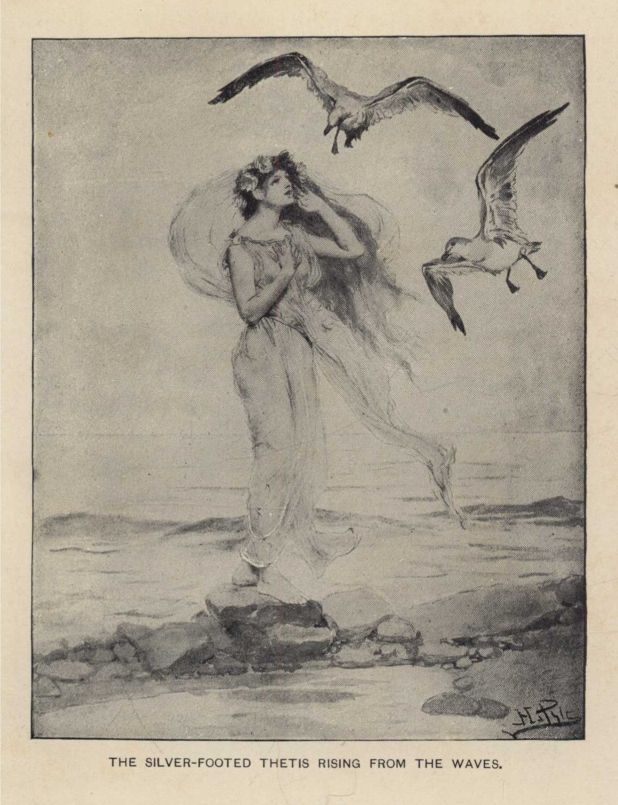
THE SILVER-FOOTED THETIS RISING FROM THE WAVES.
"'Most luckless of mortal men,' she said, 'there is recompense in store for those who repent of their wrong-doing, and who, leaving the paths of error, turn again to the road of virtue. The immortals have seen thy sorrow for the evil deeds of thy youth, and they have looked with pity upon thee in thy misfortunes. And now thy days of exile and of sore punishment are drawing to an end. Behold the silver-footed Thetis, most beautiful of the nymphs of the sea, whom even the immortals have wooed in vain! She has been sent to this shore, to be won and wedded by thee.'
"Peleus looked up to see the speaker of these words, but he beheld only a blue cloud resting above the mountain-top; he turned his eyes downward again, and, to his grief, the silver-footed Thetis had vanished in the waves. All day he sat and waited for her return, but she came not. When darkness began to fall he sought me in my cave-hall, and told me what he had seen and heard; and I taught him how to win the sea nymph for his bride.
"So when the sun again gilded the crags of Pelion, brave Peleus hid himself among the rocks close by the sea-washed shore, and waited for the coming of the silver-footed lady of the sea. In a little time she rose, beautiful as the star of morning, from the waves. She sat down upon the beach, and dallied with her golden tresses, and sang sweet songs of a happy land in the depths of the sounding sea. Peleus, bearing in mind what I had taught him, arose from his hiding-place, and caught the beauteous creature in his arms. In vain did she struggle to leap into the waves. Seven times she changed her form as he held her: by turns she changed into a fountain of water, into a cloud of mist, into a burning flame, and into a senseless rock. But Peleus held her fast; and she changed then into a tawny lion, and then into a tall tree, and lastly she took her own matchless form again.
"And Peleus held the lovely Thetis by the hand, and they walked long time together upon the beach, while the birds sang among the leafy trees on Pelion's slopes, and the dolphins sported in the sparkling waters at their feet; and Peleus wooed the silver-footed lady, and won her love, and she promised to be his bride. Then the immortals were glad; and they fitted up the great cavern on Mount Pelion for a banquet hall, and made therein a wedding feast, such as was never seen before. The vaulted roof of the cavern was decked with gems which shone like the stars of heaven; a thousand torches, held by lovely mountain nymphs, flamed from the niches in the high walls; and upon the floor of polished marble, tables for ten thousand guests were ranged.
"When the wedding feast was ready, all those who live on high Olympus, and all the immortals who dwell upon the earth, came to rejoice with King Peleus and his matchless bride; and they brought rich presents for the bridegroom, such as were never given to another man. They gave him a suit of armor, rich and fair, a wonder to behold, which lame Hephaestus with rare skill had wrought and fashioned. Poseidon bestowed on him the deathless horses, Balios and Xanthos, and a deftly-wrought chariot with trimmings of gold. And I, one of the least of the guests, gave him an ashen spear which I had cut on Pelion's top, and fashioned with my own hands.
"At the table sat Zeus, the father of gods and men; and his wife, the white-armed Here; and smile-loving Aphrodite; and gray-eyed Pallas Athené; and all the wisest and the fairest of the immortals. The Nereides, nymphs of the sea, danced in honor of Thetis their sister; and the Muses sang their sweetest songs; and silver-bowed Apollo played upon the lyre. The Fates, too, were there: sad Clotho, twirling her spindle; unloving Lachesis, with wrinkled lips ready to speak the fatal word; and pitiless Atropos, holding in her hand the unsparing shears. And around the table passed the youthful and joy-giving Hebe, pouring out rich draughts of nectar for the guests.
"Yet there was one among all the immortals who had not been invited to the wedding; it was Eris, the daughter of War and Hate. Her scowling features, and her hot and hasty manners, were ill-suited to grace a feast where all should be mirth and gladness; yet in her evil heart she planned to be avenged for the slight which had been put upon her. While the merry-making was at its height, and the company were listening to the music from Apollo's lyre, she came unseen into the hall, and threw a golden apple upon the table. No one knew whence the apple came; but on it were written these words, 'FOR THE FAIREST.'
"'To whom does it belong?' asked Zeus, stroking his brows in sad perplexity.
"The music ceased, and mirth and jollity fled at once from the banquet. The torches, which lit up the scene, flickered and smoked; the lustre of the gems in the vaulted roof was dimmed; dark clouds canopied the great hall: for Discord had taken her place at the table, uninvited and unwelcome though she was.
"'The apple belongs to me,' said Here, trying to snatch it; 'for I am the queen, and gods and men honor me as having no peer on earth.'
"'Not so!' cried white-armed Aphrodite. 'With me dwell Love and Joy; and not only do gods and men sing my praises, but all nature rejoices in my presence. The apple is mine, and I will have it!'
"Then Athené joined in the quarrel. 'What is it to be a queen,' said she, 'if at the same time one lacks that good temper which sweetens life? What is it to have a handsome form and face, while the mind is uncouth and ill-looking? Beauty of mind is better than beauty of face; for the former is immortal, while the latter fades and dies. Hence no one has a better right than I to be called the fairest.'
"Then the strife spread among the guests in the hall, each taking sides with the goddess that he loved best; and, where peace and merriment had reigned, now hot words and bitter wrangling were heard. And had not Zeus bidden them keep silence, thus putting an end to the quarrel, all Pelion would have been rent, and the earth shaken to its centre in the mêlée that would have followed.
"'Let us waste no words over this matter,' he said. 'It is not for the immortals to say who of their number is most beautiful. But on the slopes of Mount Ida, far across the sea, the fairest of the sons of men--Paris, the son of Trojan Priam--keeps his flocks; let him judge who is fairest, and let the apple be hers to whom he gives it.'
"Then Hermes, the swift-footed messenger, arose, and led the three goddesses over sea and land to distant Ida, where Paris, with no thought of the wonderful life which lay before him, piped on his shepherd's reeds, and tended his flock of sheep."
Here Cheiron paused in his story; and the five lads, who had heard it oftentimes before, bade him a kind good-night, and withdrew into an inner chamber to pass the hours in sleep. When more wood had been thrown upon the fire, and the flames leaped up high and bright towards the roof of the cave, Odysseus and Phemius sat down again before the wise old master, and asked him to finish the tale which he had begun.
"But first tell us," said Odysseus, "about that Paris, who was to award the golden apple to the one whom he should deem the fairest."
Then Cheiron smiled, and went on thus with his story:--
"On the other side of the sea there stands a city, rich and mighty, the like of which there is none in Hellas. There an old man, named Priam, rules over a happy and peace-loving people. He dwells in a great palace of polished marble, on a hill overlooking the plain; and his granaries are stored with corn, and his flocks and herds are pastured on the hills and mountain slopes behind the city. Many sons has King Priam; and they are brave and noble youths, well worthy of such a father. The eldest of these sons is Hector, who, the Trojans hope, will live to bring great honor to his native land. Just before the second son was born, a strange thing troubled the family of old Priam. The queen had dreamed that her babe had turned into a firebrand, which burned up the walls and the high towers of Troy, and left but smouldering ashes where once the proud city stood. She told the king her dream; and when the child was born, they called a soothsayer, who could foresee the mysteries of the future, and they asked him what the vision meant.
"'It means,' said he, 'that this babe, if he lives, shall be a firebrand in Troy, and shall turn its walls and its high towers into heaps of smouldering ashes."
"'But what shall be done with the child, that he may not do this terrible thing?" asked Priam, greatly sorrowing, for the babe was very beautiful.
"'Do not suffer that he shall live,' answered the soothsayer.
"But Priam, the gentlest and most kind-hearted of men, could not bear to harm the babe. So he called Archelaus, his master shepherd, and bade him take the helpless child into the thick woods, which grow high up on the slopes of Ida, and there to leave him alone. The wild beasts that roam among those woods, he thought, would doubtless find him, or, in any case, he could not live long without care and nourishment; and thus the dangerous brand would be quenched while yet it was scarcely a spark.
"The shepherd did as he was bidden, although it cost his heart many a sharp pang thus to deal barbarously with the innocent. He laid the smiling infant, wrapped in its broidered tunic, close by the foot of an oak, and then hurried away that he might not hear its cries. But the Dryads, who haunt the woods and groves, saw the babe, and pitied its helplessness, and cared for it so that it did not die. Some brought it yellow honey from the stores of the wild bees; some fed it with milk from the white goats that pastured on the mountainside; and others stood as sentinels around it, guarding it from the wolves and bears. Thus five days passed, and Archelaus the shepherd, who could not forget the babe, came cautiously to the spot to see if, mayhap, even its broidered cloak had been spared by the beasts. Sorrowful and shuddering he glanced toward the foot of the tree. To his surprise, the babe was still there; it looked up and smiled, and stretched its fat hands toward him. The shepherd's heart would not let him turn away the second time. He took the child in his arms, and carried it to his own humble home in the valley, where he cared for it and brought it up as his own son.
"The boy grew to be very tall and very handsome; and he was so brave, and so helpful to the shepherds around Mount Ida, that they called him Alexandras, or the helper of men; but his foster-father named him Paris. And as he tended his sheep in the mountain dells, he met OEnone, the fairest of the river-maidens, guileless and pure as the waters of the stream by whose banks she loved to wander. Day after day he sat with her in the shadow of her woodland home, and talked of innocence and beauty, and of a life of sweet contentment, and of love; and the maiden listened to him with wide-open eyes and a heart full of trustfulness and faith. Then, by and by, Paris and OEnone were wedded; and their little cottage in the mountain glen was the fairest and happiest spot in Ilios. The days sped swiftly by, and neither of them dreamed that any sorrow was in store for them; and to OEnone her shepherd-husband was all the world, because he was so noble and brave and handsome and gentle.
"One warm summer afternoon, Paris sat in the shade of a tree at the foot of Mount Ida, while his flocks were pasturing upon the hillside before him. The bees were humming lazily among the flowers; the cicadas were chirping among the leaves above his head; and now and then a bird twittered softly among the bushes behind him. All else was still, as if enjoying to the full the delicious calm of that pleasant day. Paris was fashioning a slender reed into a shepherd's flute; while OEnone, sitting in the deeper shadows of some clustering vines, was busy with some simple piece of needle-work. A sound as of sweet music caused the young shepherd to raise his eyes. Before him stood the four immortals, Here, Athené, Aphrodite, and Hermes the messenger; their faces shone with a dazzling radiance, and they were fairer than any tongue can describe. At their feet rare flowers sprang up, crocuses and asphodels and white lilies; and the air was filled with the odor of orange blossoms. Paris, scarce knowing what he did, arose to greet them. No handsomer youth ever stood in the presence of beauty. Straight as a mountain pine was he; a leopard skin hung carelessly upon his shoulders; his head was bare, but his locks clustered round his temples in sunny curls, and formed fit framework for his fair brows.
"Then Hermes spoke first: 'Paris, we have come to seek thy help; there is strife among the folk who dwell on Mount Olympus. Here are Here, Athené, and Aphrodite, each claiming to be the fairest, and each clamoring for this prize, this golden apple. Now we pray that you will judge this matter, and give the apple to the one whom you may deem most beautiful.'
"Then Here began her plea at once: 'I know that I am the fairest,' she said, 'for I am queen, and mine it is to rule among gods and men. Give me the prize, and you shall have wealth, and a kingdom, and great glory; and men in after-times shall sing your praises.'
"And Paris was half tempted to give the apple, without further ado, to Here the proud queen. But gray-eyed Athené spoke: 'There is that, fair youth, which is better than riches or honor or great glory. Listen to me, and I will give thee wisdom and a pure heart; and thy life shall be crowned with peace, and sweetened with love, and made strong by knowledge. And though men may not sing of thee in after-times, thou shalt find lasting happiness in the answer of a good conscience towards all things.'
"Then OEnone whispered from her place among the leaves, 'Give the prize to Athené; she is the fairest.' And Paris would have placed the golden apple in her hand, had not Aphrodite stepped quickly forward, and in the sweetest, merriest tones, addressed him.
"'You may look at my face, and judge for yourself as to whether I am fair,' said she, laughing, and tossing her curls. 'All I shall say is this: Give me the prize, and you shall have for your wife the most beautiful woman in the world.'
"The heart of OEnone stood still as Paris placed the apple in Aphrodite's hand; and a nameless dread came over her, as if the earth were sinking beneath her feet. But the next moment the blood came back to her cheeks, and she breathed free and strong again; for she heard Paris say, 'I have a wife, OEnone, who to me is the loveliest of mortals, and I care not for your offer; yet I give to you the apple, for I know that you are the fairest among the deathless ones who live on high Olympus.'
"On the very next day it happened that King Priam sat thoughtfully in his palace, and all his boys and girls--nearly fifty in number--were about him. His mind turned sadly to the little babe whom he had sent away, many years ago, to die alone on wooded Ida. And he said to himself, 'The child has been long dead, and yet no feast has been given to the gods that they may make his little spirit glad in the shadowy land of Hades. This must not be neglected longer. Within three days a feast must be made, and we will hold games in his honor.'
"Then he called his servants, and bade them go to the pastures on Mount Ida, and choose from the herds that were there the fattest and handsomest bull, to be given as a prize to the winner in the games. And he proclaimed through all Ilios, that on the third day there would be a great feast in Troy, and games would be held in honor of the little babe who had died twenty years before. Now, when the servants came to Mount Ida, they chose a bull for which Paris had long cared, and which he loved more than any other. And he would not let the beast be driven from the pasture until it was agreed that he might go to the city with it and contend in the games for the prize. But OEnone, the river nymph, wept and prayed him not to go.
"'Leave not the pleasant pasture lands of Ida, even for a day,' said she; 'for my heart tells me that you will not return.'
"'Think not so, my fair one,' said Paris. 'Did not Aphrodite promise that the most beautiful woman in the world shall be my wife? And who is more beautiful than my own OEnone? Dry now your tears; for when I have won the prizes in the games I will come back to you, and never leave you again.'
"Then the grief of OEnone waxed still greater. 'If you will go,' she cried, 'then hear my warning! Long years shall pass ere you shall come again to wooded Ida, and the hearts which now are young shall grow old and feeble by reason of much sorrow. Cruel war and many dire disasters shall overtake you, and death shall be nigh unto you; and then OEnone, although long forgotten by you, will hasten to your side, to help and to heal and to forgive, that so the old love may live again. Farewell!'
"But Paris kissed his wife, and hastened, light of heart, to Troy. How could it be otherwise but that, in the games which followed, the handsome young shepherd should carry off all the prizes?
"'Who are you?' asked the king.
"'My name is Paris,' answered the shepherd, 'and I feed the flocks and herds on wooded Ida.'
"Then Hector, full of wrath because of his own failure to win a prize, came forward to dispute with Paris.
"'Stand there, Hector,' cried old Priam; 'stand close to the young shepherd, and let us look at you!' Then turning to the queen, he asked, 'Did you ever see two so nearly alike? The shepherd is fairer and of slighter build, it is true; but they have the same eye, the same frown, the same smile, the same motion of the shoulders, the same walk. Ah, what if the young babe did not die after all?'
"Then Priam's daughter Cassandra, who has the gift of prophecy, cried out, 'Oh, blind of eye and heart, that you cannot see in this young shepherd the child whom you sent to sleep the sleep of death on Ida's wooded slopes!'
"And so it came about, that Paris was taken into his father's house, and given the place of honor which was his by right. And he forgot OEnone his fair young wife, and left her to pine in loneliness among the woods and in the narrow dells of sunny Ida."[1]
[1] See Note 8 at the end of this volume.
By this time the fire had burned low upon the hearth, and Cheiron the master would fain have ended his talk. But Odysseus was anxious to hear more.
"To-morrow," said he, "we must go back to Iolcos, for perchance the ships of Peleus may then be ready to sail. So tell us, I pray you, yet more about that strange wedding feast in the cavern halls of Pelion."
"There is little more to tell," said the master. "After the feast, King Peleus went down with his bride into Phthia; and there his Myrmidons, who had waited so long for his coming, rallied around him, ready to help him in any undertaking. And they marched upon Iolcos, and entered the gates, carrying all before them; and they slew King Acastus, and set Peleus on his throne. Thus ended this hero's days of exile; and now for seven years he has ruled Iolcos and Phthia both wisely and well; yet, though you have found him at this season of the year in Iolcos, he loves best his old home of Phthia, where dwell his Myrmidons."
"Please tell me about his son, fair young Achilles, who is here in your hall," said Odysseus.
Cheiron answered briefly by telling him how the young lad's mother, the sea nymph Thetis, had longed to make her son immortal; and how it was said that she each night threw him into the fire to purge away whatever mortal stains might cling to him; and how each day she anointed him with ambrosia, and sang him to sleep with sweet lullabies of the sea.
"But one night," added Cheiron, "King Peleus happened to see the babe lying in the fire; and in his fright he cried out, and snatched him from the coals. Then Thetis sorrowfully gave up her plan; and the boy was sent to me, that I might train him in all that goes to the making of a man. There are those who say that I feed the lad on the hearts of lions, and the marrow of bears and wild boars; and those may believe the story who wish to do so. But I have lived long enough to know that there are other and better ways of training up heroes and fitting them for the strife of battle."
And thus the long talk with Cheiron, the wise master, ended; and Odysseus retired to his couch, and was soon dreaming of far-away Ithaca and of his anxious mother, who was even then hoping for his return.
The next morning the lad and his tutor went down the mountain; and, following the pathway which Jason had taken when he went to claim his birthright of Pelias, they came, in good time, back to Iolcos by the sea. There they found that a ship was just making ready to sail for Corinth; and bidding a hasty farewell to King Peleus, and to bold Echion, who still tarried there, they embarked, and were soon well on their way. The voyage was a long and hard one; but kind Athené favored them, and Poseidon gave them smooth waters and many pleasant days upon the sea. Nor were they delayed at Corinth; for they found waiting there a ship, which Laertes had sent out on purpose to meet them and bring them home. And so, before the autumn had closed, Odysseus, much wiser and stronger than he was when he departed, gazed with glad eyes once more upon the shores of sea-girt Ithaca.
ADVENTURE IX.
THE SWINEHERD.
When Odysseus stepped ashore upon the sandy beach of Ithaca, the good people of the town, both young and old, had gathered there to welcome him; and they sang a song of greeting like that with which they were wont to meet their returning heroes. He staid only a moment to speak with them. With winged feet he hastened to the hall where his queenly mother waited for his coming. She threw her arms about him, and in the fulness of her joy wept aloud; and she kissed his head and his eyes and both his hands, and welcomed him as one saved from death.
"Thou hast come at last, Odysseus," she said. "The light is not more sweet to me. I feared that I should never see thee more, when I heard that thou hadst gone from Parnassus to distant Pelion. Come now, and sit before me as of yore, and let me look into those eyes which have been so long time away."
And Laertes, too, folded the boy in his arms, and kissed him, and plied him with a thousand questions which he could not answer. Then, in the halls of the king, a feast was made ready, and the day was given over to music and merry-making; and all the people joined in offering thanks to Pallas Athené, who had brought the wanderer safe home to his friends and his kindred.
When the evening had come, and the guests had gone to their own homes, Odysseus sat upon a low stool at his mother's feet, while she asked him many questions about her aged sire Autolycus, and about the dear home of her girlhood on the farther side of Mount Parnassus. And he told her of all that she asked him, and of the wonderful things that he had seen and heard in far-away lands and seas.
"But were you not afraid that evil would befall you, and that your eyes would never more behold fair Ithaca?" asked his mother, tenderly stroking his yellow hair.
"Nightly I prayed to Pallas Athené," answered the lad, "and she watched kindly over me every hour. Who would be afraid when shielded and led by so great a friend? Then, too, good Phemius questioned the Pythian oracle about me; and the answer was such as to make me sure of safety. It was this:--
'To home and kindred he shall safe return ere long,
With scars well-won, and greeted with triumphal song.'"
"Well," said Laertes, "the oracle doubtless spoke the truth. We know that you have returned to your home, and that you have been greeted with songs, but I fear you have yet to gain the scars."
"Not so, father," answered Odysseus. And then he showed them the great white scar which the tusk of the wild boar had made upon his knee; and he told them of the famous hunt in the woods of Parnassus, and of the days of pain and enforced quiet which he had afterward spent on an invalid's couch. And all those who listened to his story were struck with the wisdom of his thoughts; and they wondered at the choice beauty of the words which fell from his lips, soft and persuasive like the flakes of snow on a quiet day in winter.
After this, many pleasant days came and passed. The simple-hearted folk of Ithaca went about their tasks as of yore,--some tending their flocks in the mountain pastures, some gathering the autumn fruits from the overladen trees, and some twirling the spindle or plying the loom in their humble homes. King Laertes himself worked early and late in his vineyards or in his well-tilled orchard grounds; and Odysseus was often with him, as busy as he, tending his own trees and vines. For, long time before, when he was but a little child, the boy had walked through these grounds with his father, and had asked the names of the trees. And Laertes had not only answered the prattler, but had given him a whole small orchard for his own: of pear trees, thirteen; of apple trees, ten; of fig trees, forty; and he promised to give him fifty rows of vines, each of which ripened at a different time, with all manner of clusters on their boughs.
Sometimes Odysseus went out with other boys of his age, to ramble among the hills and on the wooded mountain slopes. Sometimes they played at ball in the open field, or loitered around the flowing spring whence the people of the town drew water. This well had been digged and walled by Ithacus and Neritus, the first settlers of the island; and close by it was a thicket of reeds and alders, growing green and rank from the boggy soil; while, on the rock from beneath which the ice-cold water gushed, an altar had been built, where all wayfarers laid some offering for the nymphs. This was a lovely spot; and in the heat of the day, the boys would often sit in the cool shade of the trees, and play a quiet game with pebbles, or talk about the noble deeds of the heroes.
Once they wandered far over the hills to the sheltered woodland where the swine of Laertes were kept. There, near the rock called Corax, was the spring of Arethusa, around which grew many great oak trees, yielding abundance of acorns. There the slave Eumæus lived in a humble lodge of his own building, and fed and tended his master's swine, far from the homes of other men.
When the swineherd saw Odysseus, and knew that he was the master's son, he ran to welcome him and his comrades to his lowly home. He led them to the lodge, and took them in, and strewed fragrant leaves upon the floor, and stirred the blazing fire upon the hearth. Then he hastened to the sties where the fattest young pigs were penned. Two of these he killed and dressed; and when he had cut them in pieces, he roasted the choicest parts on spits before the fire. Then he set the smoking food upon a table before Odysseus and his comrades, and sprinkled it all over with white barley-meal. After this, he mixed honey-sweet wine with water in a wooden bowl, and sat down to the feast with them. Right heartily did they eat and drink, and many were the pleasant jests that were passed among them. When they had finished, Odysseus said,--
"Swineherd Eumæus, you have fed us right nobly, and there is nothing more welcome to tired and hungry boys than plenty of well-seasoned food. Surely one who can serve so royally as you have done was not born a slave?"
"Nor indeed was I," answered Eumæus. "In my childhood I was a prince, noble as yourself. But the Fates bring strange fortunes to some men, and strangely have I been tossed about in the world."
"Do tell us," said Odysseus, "how this great change was made in your life. Was the goodly town in which your father and your lady mother dwelt, laid waste by an enemy? Or did unfriendly men find you in the fields alone, and sell you to him who would pay the goodliest price?"
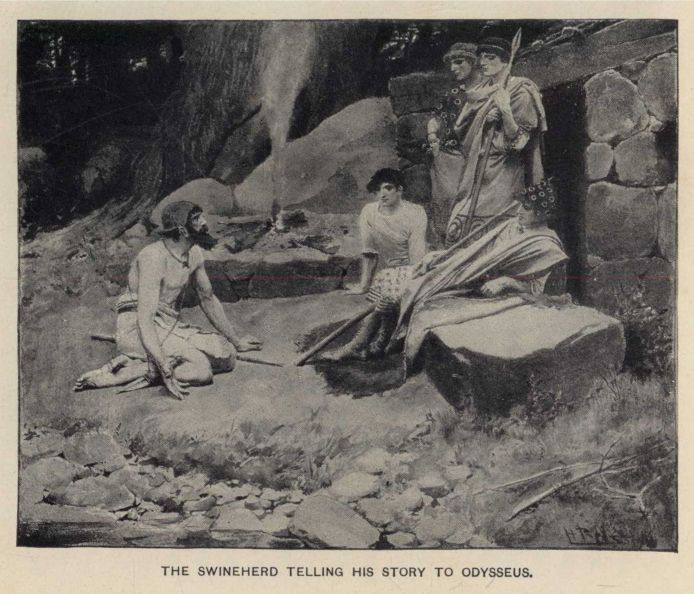
THE SWINEHERD TELLING HIS STORY TO ODYSSEUS.
"Since you ask me for my story, young master," said Eumæus, "I will tell it you. But sit you here upon this couch of goat skins while you listen, for I know that your long walk has wearied you.
"Far out in the sea there is an island called Syria, above which the sun turns in its course. It is not very thickly peopled, but it is rich in vineyards and wheatfields, and in pastures where thousands of cattle graze. There no one ever goes hungry for lack of food, and sickness never comes; but when men grow old, then silver-bowed Apollo, and Artemis his huntress sister, strike them with their noiseless arrows, and they cease to live. In that island stand two cities, fair and rich; and over them both my father is sole lord and king. There, in his white halls where care never enters, my infancy was passed; and never did I dream of the hard lot which the pitiless Fates had decreed for me.
"One day there came to our island some Phoenician merchants, shrewd seafaring men, intent on trade and profit. In their ship they brought countless trinkets to barter with our folk for corn and wine; and they moored their vessel in the harbor close to the shore. In my father's house there dwelt a Phoenician slave-woman, tall and fair, and skilled in needlework. And when the merchants knew that she spoke their language, they asked her who she was and from whence she came.
"'In Sidon I was born,' she answered, 'and Arybas my father was one of the wealthiest of Sidonian merchants. Once as I was walking on the shore, a band of Taphian sea-robbers seized me unawares, and carried me in their dark-hulled ship across the sea. They brought me to this far-distant island, and sold me, for much gold, to the man who lives in yonder palace.' And she pointed to my father's lofty dwelling.
"Then the merchants asked her if she would return with them to Sidon, where she might again behold her father and mother, and the sweet home of her girlhood. And she consented, only asking that they pledge themselves to take her safely home.
"'Now say no more,' she said; 'and should any of you meet me on the road or by the well, hold your tongues, and let no word be spoken between us. But when you have sold your goods, and have filled your ship with corn and wine, send some one to the house who shall tell me secretly. Then I will hie me to your swift-sailing vessel, bringing gold wherewith to pay my fare, and, if fortune favor, even more than gold. For I am nurse to the little son of my master, a cunning prattler whom I often take with me in my walks. I will bring him on board your ship, and when you have reached some rich foreign land you can sell him for a goodly price.'
"And thus having settled upon a plan, the Phoenician woman went back to my father's halls; and the merchants staid a whole year in our harbor, and filled their ship with grain. But when at last they were ready to sail, they sent a messenger to tell the woman. He came to our house with many trinkets, bracelets, and golden necklaces, which pleased the eyes of my lady mother and her maidens. And while they were looking, and asking the price, he signed to my Phoenician nurse, and straightway gathered up his goods, and hastened back to his fellows. When the sun went down, the woman took my hand, and led me from the house as she had often done before. Thoughtlessly I followed her to the shore where the fast-sailing ship was moored. The Phoenicians took us both on board; they hoisted the broad sail, and a brisk wind quickly carried us far away from my home and friends. On the seventh day, Artemis the archer queen smote the woman with her silent arrows, and her eyes saw no more the sweet light of heaven. Then the crew cast her forth into the sea, to be food for fishes and the sea calves; and I was left alone and stricken with grief and fear. But the swift ship brought us ere long to Ithaca, and there those who had stolen me bartered me to Laertes for a goodly price. And that is why I am your father's thrall, and dwell here lonely underneath these sheltering oaks."[1]
[1] See Note 9 at the end of this volume.
Such was the tale which the swineherd told Odysseus and his young companions as they sat together in the lodge.
"I pity thee, Eumæus," said the lad. "Thy story is indeed a sad one; and, could I do so, I would gladly send thee back to far-off Syria where thy mother sorrows even yet for thee."
"Alas!" answered the swineherd. "There is no hope. No ship will ever sail through the unknown sea-ways which lead to my boyhood's home. My life must be spent in this spot; yet I am happy in knowing that my master is the kindest of men, and that I shall be well provided for. Even a slave may find enjoyment if his heart be right; for it is the mind, and not the force of outward things, that makes us rich and free."
ADVENTURE X.
THE SEA ROBBERS OF MESSENE.
Five years passed quietly by, and brought few changes to Ithaca. The flocks still grazed in their mountain pastures; the orchard trees still bent under their loads of ripening fruit; the vines still yielded their treasures of purple and red. The simple-hearted islanders arose each day with the coming of the dawn; they went about their tasks with cheerfulness; they sang, and danced, and ate their accustomed meals, and then with the coming of night they lay down to sleep: to them, all days were alike, and life was but one pleasant round of duties. But King Laertes, as he grew older, sought more and more the quiet of his farm and garden; and, for the most part, he allowed his little kingdom to take care of itself, and his subjects to do as they pleased.
And in these five years young Odysseus had become a man. He had grown not so much in stature as in wisdom, nor yet so much in size of limb and body as in strength of bone and muscle. There was nothing in his face or figure that could be called handsome, and yet he was the pride of Ithaca. For, in all the deeds and feats most worthy of men, he was without a peer. In wrestling and leaping, in rowing and swimming, in shooting with the bow, and in handling the heavy spear, there was no one that could equal him. He was a very master of words; and when his speech warmed into earnestness, the dullest hearer was spell-bound by his eloquence. Even to the Achaian mainland and among the islands of the sea, he was famed for his far-reaching shrewdness. Indeed, his craftiness oftentimes outweighed his sense of honor; for, in that early day, to outwit one's fellows even by fraud was thought to be praiseworthy.
One evening in summer, four strange ships, with long black hulls, sailed into the harbor at Ithaca, and were moored in the deep water close to the shore. They were found to be manned by crews of seafarers from the low-lying shores of Messene; and their captain brought greetings from Orsilochus their king, and offered to barter silver and merchandise for Ithacan wool and long-horned sheep. Laertes welcomed the strangers warmly; and as the night was near, he advised that early on the morrow they should bring their wares ashore, and allow his people to bargain for what they needed most. And soon darkness covered all the ways, and Ithaca was wrapped in slumber.
When the gray dawn peeped into his chamber, and awakened him, the king arose, and looked out towards the harbor. Not one of the black-hulled ships could he see. They had silently cast their moorings, and had stolen away through the darkness. While the king looked and wondered, an old shepherd with frightened face and gestures of alarm came running in breathless haste to the palace. In a few words he told what strange things had happened. By the light of the waning moon, the sea rovers from Messene had sailed around to a little cove where the pastures slope down to the water's edge. There they had landed, and without much ado had driven a whole flock of sheep aboard their ships,--three hundred long-wooled ewes and bleating lambs, the choicest of the fields. And they had carried away not only these, but the six sleepy shepherds whose duty it had been to guard them.
An alarm was quickly sounded, and the news was passed from mouth to mouth until it was known to all. The bravest men of Ithaca hastened to the shore, where stood Odysseus and his father, ready to direct them. Their fleetest vessels, lying high upon the beach, were cleared ready to be launched. Five ships with vermilion prows were pushed into the waves; and each was manned by a score of lusty rowers, and headed towards the open sea. The long oars dipped into the water, as if all were moved by a single hand; and the vessels sped out upon their errand, like dogs of the chase intent upon a fleeing victim.
The sky was clear. The waves danced merrily in the sunlight. The wind blew gently from the shore. The crews of the Ithacan ships bent to the oars like practised seamen; but when they rounded the headlands at the foot of the bay, and came out upon the open sea, they saw no trace of the pirate fleet, nor even a single sail upon the laughing face of the deep. Whether the men of Messene had pushed straight homeward with their plunder, or whether they had put into some other cove or inlet farther down the coast, no one could guess. All that their pursuers could do was to sail close along the shore, southward towards Cephallenia, peering behind every jutting headland, and into every sheltered nook, in hopes of coming upon them.
Five days afterward, the red-prowed ships returned to Ithaca. Nothing had been seen of the sea robbers: nothing had been heard of the stolen flocks.