Front matter (continued 4)
Reading edition
I owe much to this Sister for the care and attention she gave me during my stay in Quang-Yen hospital—these were, of course, equally bestowed on all the sufferers under her charge—and it was my good fortune, five years later, to meet her under entirely different circumstances, when I recalled myself to her memory and expressed my gratitude. To-day, as I write, there comes back to me a vision of the ward at night, when, having fallen asleep after blinking at the reflection of the firelight on the polished parquet and brass knobs on the bedposts of the neighbouring cots, a gentle touch would awaken me from my first slumber, and I could see, under the white cornette, the smiling face of my nurse—en religion, Sœur Agnes—as, after lifting the mosquito-curtain, she presented to my lips a small glass containing the nightly dose of the bitter drug, while she whispered: "Tenez, mon petit St Jean—Voici votre grog."
After attending to the wants of each, and seeing that all are comfortable, Sœur Agnes would kneel down in the ward, and, with bent head and clasped hands, repeat in a soft but distinct voice the prayers for the night. Every soldier who was able to sit up in bed would do so, and nearly all those who could, murmured with her the Lord's Prayer, each in his own language. Probably most of them did so simply to please the patient religieuse, who soothed their sufferings and attended to their needs; but, be that as it may, there existed no regulation which obliged them so to do, therefore their action was spontaneous and impressive.
When the Sister had left the room, after bidding a general "good-night" to its occupants, it was very seldom that any conversation would take place. It seemed as if the majority of the men were anxious to court sleep while still under the impression left them by the saintly, self-sacrificing woman to whom they had just listened, desiring, perhaps, that it should bring to them dreams of those they loved, but of whom they never spoke. Now and again a new patient, proud of his cynicism, would scoff at his comrades, curse them for knock-kneed calotins, or go so far as to laugh aloud, or even whistle a ribald regimental ditty, during the evening prayer. They never did this twice, however, for a straight-spoken, though perhaps somewhat lurid, warning from their room-mates always sufficed to quell any desire for persistence in this breach of the etiquette of the ward. Had it been otherwise, it is certain that their suppression would have been both rapid and awesome.
On the 12th December I was called before the Repatriation Committee (Conseil de Rapatriement), the members of which—three doctors—seeing the progress I had made, decided to keep me in the hospital for another fortnight, at the end of which period, if no relapse had occurred, I could return to my corps. It is hardly necessary to state that this decision was very agreeable to me, for I had feared that these officers would order my return to Algeria; and once assured of the realisation of my desires, I improved rapidly in health and strength. Sometimes, when I suspected a slight attack of fever, I "faked" my temperature, lest the doctor who examined my "chart" each day should take another view of my case, and send me up again before the Committee. I trust, however, that this confession of my fault will bring with it forgiveness for the trick played upon my kind and trusting nurse.
During my stay at Quang-Yen I saw that the majority of the patients were men from the Infanterie de Marine. These regiments passed into the domain of the Minister of War in 1901, and are now known as L'Infanterie Coloniale. I was very surprised at their youthfulness and evident want of stamina. This corps was originally formed, like our Royal Marines, for service afloat. Since 1860 their place on board the men-of-war has been taken by sailors (fusiliers marins) who undergo a special course of training in musketry and infantry drill; and the Infanterie de Marine was formed into twelve regiments, which now garrison the naval ports on the French coast, the principal towns in the Colonies, and take part in all expeditions overseas. Before the reorganisation of the army, carried out after the Franco-German War, the men of this fine corps had won a grand reputation for courage and endurance, and the defence of the village of Bazeilles by a brigade of French marines against a division of Bavarian troops, in 1870, will ever remain one of the finest pages in the history of the struggle. General conscription and the short service system have done much to reduce the fighting value of these regiments, which were formerly composed of men who had been submitted to a most searching medical examination, and consequently stood a good chance of resisting the insalubrious climate of the Colonies, and who volunteered for a long period with the flag. To-day, the majority of these troops are town-bred, beardless boys, of from eighteen to twenty years of age, who are in these regiments because they have been unfortunate enough to draw a low number from the conscription-urn. Like all France's sons, they are brave and enthusiastic, but owing to their youth, inexperience and hurried and incomplete military training they have sometimes proved victims to sudden panic, and their but half-formed constitutions and still growing physique make them prompt sufferers to malady, fatigue and discouragement during the hardships of a tropical campaign. Several French authorities on military matters have expressed the opinion that the Government would do well to employ more seasoned material for their colonial garrisons and expeditions, and reserve these brave youths for the future battlefields of Europe, whereon may be decided the destiny of their fatherland.
Those of us who were able to get about attended the midnight mass on Christmas Eve, and the little chapel, with its interior prettily decorated by the willing efforts of the convalescent soldiers, was full to overflowing; and, though probably the thoughts of the majority present wandered away to the homeland, we joined vigorously in the joyful anthem, "Noel! Noel! Voici le Redempteur!" to the visible satisfaction of the beaming, buxom sœur supérieure and the smiling Sisters. On the 30th I found myself "Exeat"—i.e., discharged from the hospital as cured—on the deck of a little river steamer which was churning her way through the red, muddy waters of the Cua-Cam, past miles of mangrove swamp, towards Haïphong.
The weather was bright, dry and cold—a typical winter's day of this part of the world—and the pure, crisp air, reminding me of home, seemed delightfully invigorating after the stifling, damp heat of the past summer months. At Haïphong I boarded another boat, which landed me in Phulang-Thuong the next morning.
Here I found signs of the coming campaign, for several little river-steamers were discharging their cargoes of stores, ammunition and material, and hundreds of coolies were employed in transporting the goods to the big Government go-downs in the little town, where they were stored for the time being. From here large quantities of flour, tinned beef and other stores were forwarded to Nha-Nam and Bo-Ha, these forts in turn serving as bases, from which the different columns were revictualed. On my arrival, I reported at the office of the garrison major, expecting to receive orders to leave by the first opportunity for Nha-Nam, via Cao-Thuong—that is, by the same route which our detachment, just landed from the Bien-Hoa, had taken eight months previously—but information was given me by one of the military secretaries to the effect that I would have to wait a few days, pending the formation of a convoy which was to proceed in sampans, up the Song-Thuong river, to Bo-Ha, and that I would form one of the escort, to be composed of several Legionaries and a few tirailleurs.
As Bo-Ha is only about 7 miles from Nha-Nam, entailing a march of hardly two hours, and a journey in a native boat would be a new and desirable experience to me, I did not regret the delay this unexpected development was likely to create. I had not long to wait, however, for three days later our little fleet of twenty-five sampans, four of them occupied by the escort, glided away at three in the afternoon on its voyage up the river.
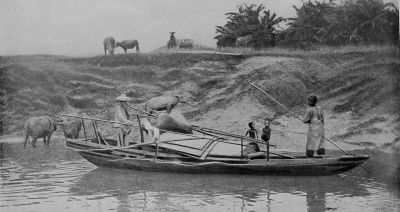
A SAMPAN ON THE RIVER NEAR PHULANG-THUONG.
These sampans are about 20 feet long, and in form somewhat resemble a house-boat, though they are smaller and possess finer lines than the floating villas one meets with on the reaches of our English rivers during the summer months. The little house, or cabin, which is placed amidships in each of these boats, is usually about 6 feet by 5, and is so low that one can only sit or lie down inside it. Forward of this cabin is a deck from which two natives work the long sweeps of hardwood. These boatmen row in a standing position, with their faces towards the bow of the boat. Aft of the cabin is a strip of deck about 3 feet long, and from that the stern rises up in much the same way as one sees them pictured in the old prints of ships in the time of the Armada. Upon this deck stands another boatman, who handles a long oar which trails behind, and with this he both rows and steers. These boats draw very little water—2 feet at the utmost, and that only when they are fully laden.
The evening was a beautiful one, so that I made the most of the journey, and lay for several hours, my loaded rifle beside me, enjoying the varied spectacle which was quite new to me. In the boat, besides myself and the three boatmen, were three tirailleurs, but these gave me no trouble, for, having consumed a big saucepanful of rice, they fell asleep on the deck, the cabin being nearly filled with tin cases, each containing thirty kilos of flour. The sleepers lay close together to obtain more warmth, for the nights were chilly at this season.
The river at this part was from 80 to a 100 yards wide; its water was very clear, and ran over a sandy bottom, studded here and there with large rocks, and between steep banks, from 20 to 25 feet high.
Along either side ran groves of tall bamboos, which seemed to salute us with a graceful nod as we glided by. Sometimes there was a break, and an old pagoda, with a quaintly-curved roof of red-brown tiles, came into view. Now the river would run through a few miles of forest and jungle, offering no sign of occupation by man. Enormous trees rose superbly from the banks of the stream, and their massive branches extended for many feet over its waters, on which their foliage threw a pleasant and picturesque shadow. From these great limbs hung numerous flexible creepers, some of them starred with orchid-like blooms of white and yellow hue. Many of these streamers swayed gently to and fro before the light breeze, while others, having grown down into the glassy waters, were held still in their cool embrace.
Our journey between these walls of verdure, the forms and tints of which were ever changing, was one of the most delightful of experiences, the charm whereof is still fresh in my memory. When night came down and blotted out all colour and outline, I turned on to my back and watched the stars as they came out one by one. For an hour or so I lay open-eyed, yet dreaming, till the monotonous chant of our boatman, with its ever-recurring chorus of "Oh! Yah! Mōt-Haï-Ba!" finally lulled me into a profound slumber. Our convoy reached Bo-Ha in safety the following morning at nine.
This fort was constructed and garrisoned in 1889, at the request of a rich and influential native chief, lord of an important village, called Dao-Quan. This native was formerly a leader of a group of bandits, and, before the invasion of the country by the French, had ravaged the Yen-Thé and defied the mandarins in Bac-Ninh. After the capture of that citadel by the troops under General de Négrier, he was wise enough to throw in his lot with the invaders, and with his irregulars he fought side by side with his new allies against the old régime. In recognition of his services to the French cause, the Government confirmed his right to administer the district he had settled in, and made him a knight of the Legion of Honour. During the years that followed the occupation of the country by the French, he remained faithful to the cause he had adopted, and refused to have anything to do with the mandarins at the court at Hué, who were, in secret, partisans of the exiled Ham-Nghi, notwithstanding many overtures and rich promises made to him. During the operations in the Yen-Thé he rendered valuable service to the military authorities by supplying coolies to the different columns, and by making use of the armed irregulars, whom he maintained at his own expense, to guard the lines of communication. After the campaign was terminated he successfully negotiated the surrender of several influential minor chieftains, who, thanks to his efforts, came in and delivered up their arms.
We left Bo-Ha at two in the afternoon, our little troop consisting of a sergeant, three Legionaries, who were bound for Nha-Nam, with ten tirailleurs and a native corporal from the garrison we had left, the latter having been lent to strengthen our effective.
When we had marched for about half an hour and had crossed the Song-Soï, a little stream which runs into the Song-Thuong a few miles below Bo-Ha, we perceived, a hundred yards ahead of us, a small detachment, consisting of six tirailleurs, led by a European mounted on a native pony. I was one of the first to catch sight of them, for at the time I was in charge of the vanguard, which was composed of two natives. When we were close enough to get a good look at them, my surprise was great on recognising in the cavalier my friend Lipthay. When our mutual greetings and congratulations were over, he told me that he was out surveying the route with a view to determining the best positions for the poles of a telegraph line about to be established between Nha-Nam and the fort we had just left.
"I have done enough for to-day," said my chum, "and can easily finish the job in a couple of hours to-morrow morning. I will go and report to the sergeant, and come back to Nha-Nam with you."
A few minutes later he was riding beside me as I walked, and I was asking him many questions concerning all that had happened since I left, and as to when the operations were likely to begin; for now that he was on the District staff I knew he was likely to be well informed on these subjects.
"Well, things have been pretty lively during the last two months," he answered. "Captain Plessier has been keeping the company at Nha-Nam busy with reconnaissances and ambuscades, but there has been no serious engagement since the little affair at Long-Thuong, at which you were present. We made a grand coup at the beginning of last month, though, for we succeeded in finding a position rendering the enemy's big fort visible; a position on which it will not be difficult to place a battery of fieldguns, able to wish a better 'bonjour' to our rebel friends than those little toy pop-guns of the mountain artillery. What a pity old De-Nam is dead! He would have been so surprised when the first 90-millimètre shells came with a flop and a bang right into his secret lair; and from quite an unexpected quarter, too. Why——"
"Bon Dieu! mon ami," I interrupted, "have pity on me and go slow. Do you mean to say the old chief is dead?"
"Dead as Cæsar," answered my friend. "He was poisoned in October by some Chinese who came down from the north to sell arms and ammunition. They were his guests, and killed him because he won back all the money he had paid them at bacquang (a native game called fan-tan in Chinese). So the spies who came to Thaï-Nguyen told us. Dans tous les cas, he is dead, and was buried inside the big fort with great state; and De-Tam, his former lieutenant, is now commander-in-chief."
"But do you really mean to say that there is such a position as you have described?" I asked, for from my experience of the manner in which the rebels concealed their forts, such a thing seemed quite impossible.
"Most certainly," replied Lipthay. "I was on it, cher ami. But I had better tell you the tale from the beginning, for you matter-of-fact Englishmen are like St Thomas, and require palpable facts." He slipped his feet out of the stirrups, so that his long legs dangled comfortably, and, after shifting the carbine slung across his back into an easy position, began his tale.
"Towards the end of November, Linh-Nghi, the informer, was sent on to us at Thaï-Nguyen. You know the man, probably?" I nodded an affirmative, and he continued: "Et bien, Lieutenant Deleuze, chief of our Intelligence Department, used to pass hours at a time with him; took him to his house, and never lost sight of the fellow for a week. Deleuze speaks the vernacular like a native—pity there are so few like him—and the pair were soon like corps et chemise. I knew there was something brewing, and was not surprised when, on the 2nd December, orders were issued for a reconnaissance en force to proceed to Nha-Nam the following day. One company of the Legion and one of tirailleurs—a column 350 strong—and, of course, Deleuze and Linh-Nghi, were with them; so was I. Major Berard himself was in command. We slept a night at Nha-Nam, and went on to Bo-Ha the next day, after taking with us the mountain-gun from the former fort. At Bo-Ha we rested, and the following morning left by a path which runs to the north-west and passes through two ruined villages, Cho-Kai and Long-Ngo, which were burnt by Colonel Frey's column in January last."
"Why, you must have been due north of where the enemy's new positions are supposed to be!" I exclaimed.
"So you would think," said my friend; "but in reality we were due west. When we had got to a point about a kilomètre beyond where Cho-Kai used to be, the enemy's scouts, stationed on the hills to our left, signalled our advance by firing their rifles. Upon this the column left the path and made a general demonstration to the south-east. Our men got in touch with the enemy, and kept them occupied for a couple of hours by feinting an attack en règle. Lieutenant Deleuze and I took Linh-Nghi with us, and slipped quietly away to the west of the path. For an hour we scrambled along through the long grass, Nghi acting as guide. Then we went off to the north, walking all the time in the valleys, and keeping to the jungle so as to escape all chance of observation. At last we reached the foot of a hill somewhat taller than the surrounding ones—it was about 800 feet high—which had neither a bush nor a tree on its steep sides, but was covered all over with high, yellow grass. Nghi whispered that we must go cautiously to the top, so up we crawled on our hands and knees and lay flat on our stomachs when we reached the summit. Then we crept along until the opposite crest was gained. We had all brought big native hats with us, which we were careful to wear. When I looked down I was surprised to see that the path to Bo-Ha ran round the foot of this hill, and our column might have come here with ease, had it not been that this would have given the enemy some idea of what we were looking for. The view was a splendid one. First about 500 mètres of tall grass and jungle, then a kilomètre of forest which ran down to the Song-Soï, for we could catch here and there the gleam of its waters; beyond this a mass of hills thickly wooded, then more hills covered with grass, and beyond, bright green blotches of cultivated land.
"The weather was so clear that I caught sight of the flag at Nha-Nam, though it was quite 12 kilomètres away, and I pointed it out to Deleuze. Linh-Nghi stretched out his hand towards the forest, and, indicating a spot close to a bend in the little river, exclaimed excitedly: 'Look! look!' As I turned to him it seemed to me that his face was drawn and yellow, and his eyes were much brighter than usual. I could see nothing in the direction he pointed to but trees; but the lieutenant, after looking through his field-glasses for more than a minute, suddenly exclaimed: 'Sapristi! oui—I see roofs!' I turned to ask Nghi a question, but refrained from speaking, for he lay with his head on his arms, his face to the earth. He was sobbing like a child, and his heaving shoulders betokened the depth of his emotion."
"Poor devil!" I interrupted.
"Yes—poor devil," repeated Lipthay; then he continued: "Deleuze passed me his glasses, and after careful searching I caught glimpses of brown thatched roofs between the trees. These belonged to the houses within the big fortified village which has been in existence for three years at least. It is situated in the dense forest at a point where the Song-Soï forms a loop. So well is it concealed that had not Linh-Nghi been with us, I am convinced we should have failed to make it out. After a few minutes our native friend got the better of his emotion, and he started giving more explanations to the lieutenant concerning the position. While he was doing so I got out my peigne (a military surveying compass), sighted the flag at Nha-Nam, and got a bearing; then I obtained an angle on the Nuï-Dot—you know, the hill to the south-west of Nha-Nam, where they have fixed up a heliographic station. Time was getting on, and there was a danger of being sighted at any moment, so we crawled down the way we had come, hurried back to the column and reported. I fancy the Major was very glad to see us again, and I am sure he must have been pleased with the information Deleuze gave him.
"The troops were called in, and the column formed up on the path and marched back to Bo-Ha. I don't think the enemy had an inkling of what we were after, and they were probably disappointed at not having succeeded in drawing our troops on into the forest, where they could have adopted their favourite tactics.
"Comments were rife among our men, for they had counted on an engagement, and, as they expressed it: 'On a arrêté la danse au moment où les violons étaient accordés.' As we were marching away I heard one fellow say: 'Bon Dieu! bon Dieu! I don't believe the old fossil knows himself what we did go out for. They might just as well have sent a few recruits from the biff (the line regiments). Why, for three long hours we did nothing but waste our ammunition on half a dozen skinny natives who were dodging about among the trees.' Quel malheur! If they had known the result obtained, they would have sung another song; but it must be kept secret, of course, until the campaign is opened, and that will not be before the beginning of March."
"Rather late, isn't it?" I asked.
"Well, you see, it will be fine and cold then," answered my friend; "and with the information we now possess I don't think the expedition ought to last more than a fortnight." He now gave me more details concerning the defensive organisation of the rebels.
Besides the big fortified village already mentioned, about 4 miles to the north of Hou-Thué (demolished by Colonel Frey's column a year before), there were numerous positions, forts and entrenchments built to defend the paths leading to it. All these obstacles were accumulated to the south and east of the main position, from which it was evident that the rebels were confident that all future attacks would come from the same direction as the preceding ones.
De-Tam possessed a force of about two thousand men, twelve hundred of whom were armed with breech loading rifles of various patterns.
It was also probable that this chief was aware that the French would commence operations against him, as soon as the weather was cool enough to allow of large bodies of European troops being moved about the country, and that in consequence he had come to some understanding with the powerful leaders of the Chinese bands in North and West Tonquin, so as to secure their assistance in case of need. Of these, the two most important were Ba-Ky and Luong-Tam-Ky, who occupied vast tracts of mountainous country to the north of the Yen-Thé, into which the French had, as yet, made no serious effort to penetrate. Both of these brigand chieftains had established their domination in these districts some time before the arrival of the Western foreigners in Tonquin.
Colonel—now General—Frey in his admirable work on the subject, compares them to the feudal lords of the Middle Ages, since they administered the territory occupied as a fief, all the inhabitants being subjected to regular taxation, wisely calculated so as not to excite discontent, and their authority was undisputed. These two leaders could dispose of from two to three thousand Chinese, armed with rifles, part of which force they would certainly be willing to place at the service of De-Tam on the payment of a stipulated sum of money. In fact, this is what actually did happen. Ba-Ky and Luong-Tam-Ky submitted to French rule in 1895, but their territory has not been occupied by the troops, for two very good reasons: first, because the district is so poor that the expense entailed would hardly be justifiable, and also owing to the fact that the region is so unhealthy that Europeans cannot remain there any length of time without falling victims to fever and dysentery.
When we reached Nha-Nam, I received a hearty greeting from my comrades, some of whom, owing to my prolonged absence, were under the impression that I had also fallen a victim to the Cho-Trang fever, as they called it. It was comforting to find myself back in my former quarters, to fall once more into the jargon of the corps and take part in the daily routine of the garrison.
Two days later Lipthay left for Thaï-Nguyen with Lieutenant Deleuze. I saw this smart intelligence officer. He was a small, brown-faced, wiry man, whose most remarkable trait was the quiet, low toned voice in which he spoke to those under him. The men told wild tales concerning his wonderful knowledge of the language and customs of the natives, whereby, it was said, he had on several occasions been able to adopt a disguise, and accompany some of the native spies on their expeditions. Whether this was exact or not I should not like to declare, but it is certain that this officer possessed a wonderful knowledge of the vernacular, and was a topographical expert of no small merit.
I had hardly time to settle down in my old quarters again, for a week after my arrival my section was sent off to Bo-Ha to strengthen the garrison in that part, which at the time consisted of a company of native troops under the orders of Captain Perrin.
One night, shortly after our arrival there—it was the 16th January, 1892—the section was suddenly called out, orders being given for each man to take with him a flannel suit, rolled up in his waterproof blanket—which was slung across the chest—and provisions for two days. We soon learned that a long night's march lay before us; for a wire had been received from the Brigade, to the effect that a portion of Ba-Ky's band was marching on Cho-Trang with the intention of rushing that outpost, and our orders were to get there as soon as possible by the nearest way. A guide was supplied by the headman of Dao-Quan, who led us away by a track slanting off to the north-east of Bo-Ha, across a wild, uncultivated region, hitherto little explored, and generally considered impracticable.
We started off at eleven, and it was easy walking for the first mile or so, but once we had left behind us the cultivated district surrounding our fort, the path went from bad to worse. We passed for several miles over a plain covered with jungle, after which the track went into the hills, and, though we kept up the pace, it was terrible work as we went now up, now down, then splashing through the icy cold water of the little streams coursing down each valley. Though the night was fairly clear it was dark, and difficult to see ahead in the gullies and dips, and we had to trust to luck sometimes when putting our foot forward.
We reached Cho-Phang, a Muong village, at a quarter past three in the morning, and a pedometer which I carried registered 18½ miles. We had now gained the rocky chain of the Nui-Dong-Nai, and thence the path ran along at the foot of these heights. We rested a quarter of an hour, and then continued our hurried tramp till we reached the Deo-Mou-Phieu pass, concerning which I have already written when describing my first journey to Cho-Trang. We passed through the cleft, going due north, and reached our destination at a few minutes past seven.
This was the hardest march it has ever been my lot to undertake, and, as already stated, we covered close upon 32 miles in about eight hours. The garrison—they were tirailleurs, for the detachment of the Legion had left more than a month before—was on the alert when we arrived, but had seen no sign of brigands. We were all glad to get inside the fort and take a few hours' rest. During the morning a telegram was received, stating that the band had taken another direction, and that all danger was passed. Desiring, no doubt, that we should not pass the night in so unhealthy a region, Captain Perrin, who had come with us, started us on our way back at two in the afternoon. We went at a moderate speed, passing the night at Cho-Thuong, where there are some wonderful caves, the entrance to which is some 60 feet from the ground. In these some of us tried to sleep, but were driven away by a host of parasites. Access was gained to these caverns by means of long bamboo ladders. When their village, which is situated at the base of the rock, is attacked by bandits, the Muongs take refuge with their women and children in these caves, where, after hoisting up the ladders, they are absolutely secure from attack. Strange to say, they succeed in getting their cattle into these shelters in time of danger, but whether they do so by the aid of ropes, or through some lower entrance known only to themselves, I was unable to ascertain.
We reached Bo-Ha at three in the afternoon on the following day.
During the next few weeks our detachment was kept very busy preparing things for the troops, which were soon to be concentrated at this point; and we spent a considerable part of our time working at the road from the landing-stage on the Song-Thuong up to the fort. This had to be widened and levelled so as to allow of the passage of field artillery.
It was very evident that the rebels were alive to the fact that operations against them were intended, for their vedettes were continually in evidence round Bo-Ha and Nha-Nam, and along the road between these forts. No movement could be made by the troops of these two garrisons without it being at once signalled by the enemy's scouts. Their methods for communicating information at a distance were really ingenious. By day they made use of a code of smoke signals, to obtain which torches composed of chopped straw, resin and gunpowder were used; at night oil lanterns with a sliding shutter attachment, or paper balloons carrying a burning rag soaked in petroleum, served the same purpose.
Stores and ammunition continued to arrive, so that temporary sheds had to be erected outside the fort, for the go-downs inside were filled to overflowing.
On the 5th and 6th March a company of the Legion from Lang-son, a battalion of Infanterie de Marine, one of Tirailleurs Tonkinois, a company of engineers, a battery of field artillery, one of mountain-guns (in all, two thousand five hundred men and twelve guns), and two thousand coolies arrived at Bo-Ha. These men, who were lodged in huts constructed of bamboo and macaw-palm, composed the first column, destined to march to the north-east and seize the hill, which had been the subject of Lipthay's discourse to me on my return from Quang-Yen, whence they would be able to attack the enemy from quite an unexpected quarter. At Nha-Nam a second column, composed of five companies of the Legion, a battalion of Infanterie de Marine, three companies of native troops, a battery of mountain guns and two mortars (two thousand eight hundred men and eight guns), was concentrated, preparatory to advancing in two groups, from the south-west, along the paths already thoroughly explored by the troops operating against Hou-Thué in the preceding year.
From Thaï-Nguyen a third force, consisting of two companies of the Legion, three of tirailleurs (one thousand and fifty men), and two mountain-guns, was to march from the west, thus striking the rebels' right flank, and joining hands with the column from Bo-Ha.
The loyal Delta provinces supplied about one thousand irregulars armed with rifles, and these, officered by their local military mandarins, had orders to cover the flanks of the different columns, and, whenever possible, maintain communication between them. A French officer was detached to control their movements.
On the 8th March General Voyron arrived at Bo-Ha with his staff, and a council-of-war was held at which all the commanders of columns and groups were present. When the General had exposed his plan of campaign, each of the officers present was provided with printed instructions concerning the tactics to be adopted, particular stress being laid on the recommendation to abstain from delivering attacks on fortified positions, unless a careful preparation for the assault had been made by artillery fire. Great enthusiasm prevailed among the soldiers of the Legion, and all were burning with a desire to be in at the finish, the men of my company being particularly keen, which is easily comprehensible, since for more than a year this unit had been continually aux prises with the enemy, and there were comrades to avenge, and sleepless nights and long marches to make good. The old soldiers were impressed by the elaborate preparations that had been made and the strength of the force employed, and they were unanimous in the opinion that this time the "Valorous and Invincible Battalions," as De-Tam pompously styled his troops, would be scattered to the four corners of Tonquin, and their lairs would become the haunt of the tiger, the panther and the bear. It is also probable that a good many of the Legionaries secretly cherished the hope of doing a little looting "on their own," for wild tales had been circulated concerning vast treasures secreted somewhere within the precincts of De-Nam's house, now occupied by his successor.
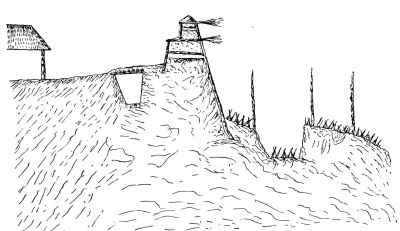
REBEL RAMPARTS FACING POINT A.
Next day two battalions of infantry and the battery of mountain-guns left Bo-Ha, and, after a forced march, occupied the hill already mentioned, which to facilitate orders was designated as Point A. As soon as this position was securely held the engineers got to work, prepared the track leading to it and cut a zigzag road up the flank of the hill to its summit, so as to permit of the heavier artillery being brought up. A thousand coolies worked with the sappers, and the task of preparing about 6 miles of road and cutting a path up the sugar-loafed hill was completed in a little over forty-eight hours; so that on the evening of the 13th a battery of six guns was established on the top of Point A, and the whole of the column, with its reserve of stores and ammunition, was entrenched at its base. The light field fortifications necessary to shelter this force were made by the infantry with the aid of the entrenching tools each soldier carried.
During these four days the enemy had not been idle, for their skirmishers maintained a constant fire on the column, the workers on the road and the passing convoys, and we suffered some casualties in consequence. At night their snipers claimed a few victims, but up to this phase of the operations the losses on our side were few.
At this time my section was chiefly employed in escorting the convoys from Bo-Ha to Point A, or in covering the working parties on the road. We sometimes slept in the fort, and sometimes in the camp with the column: this depending on which of these two places was nearest to us at the end of the day. We had several slight brushes with the enemy's scouts, none of which, however, were of any importance.
In the camp, when not on duty, I was glad to wander around from one bivouac to another. In the French infantry lines things were generally quiet, and these young soldiers, who had passed most of their time in the colony, in the garrison towns, were evidently out of their element. Most of them, when questioned on the subject, openly expressed their desire that the operations might be of very short duration, though these troops were undoubtedly as brave as their ancestors who fought at Fontenoy, Jemappes or Jena, and had the call on their patriotism been made for a supreme effort in Europe, they would have hailed the chance with enthusiasm. As it was, the prospect was one of a violent end, by the hand of an unseen foe, in some dark corner of the tropical jungle, and this to further a colonial policy in which few of them felt either interest or confidence. The ever-existing danger from the deadly malaria, the distance separating them from their patrie and their homes, and the thought that their presence was due to the brutal hazard and ill-luck attached to conscription: these were reasons hardly conducive to a liking for the hardships and risks of the campaign. Not that the morale or courage of these troops was in the least affected by this state of things, but their dislike for the expedition was evident and outspoken.
With the Legionaries it was different, and their bivouac echoed with the rollicking choruses sung by the men as they sat around the fires. Between songs they would crack jokes at each other's expense, and enter into friendly discussions as to who would be the next to "eat bananas by the roots," which was their playful way of suggesting a hurried burial in soft soil. These were grown men, vigorous and hardened, and therefore better able to resist fever, fatigue and privation than the youthful conscripts, their neighbours, who sat by the blaze and talked in subdued tones of "la chaumière et les vieux" in sunny France. The Legionary possesses a rude but kindly nature, and, like the soldier of fortune that he is, he revels in the adventurous existence he has adopted, the hazards and dangers of it being the wine of life to him. Without desire for honour or reward, without even the wish that their deeds should receive public attention, these condotieri of to-day perform incredible feats of daring and devotion. Professional soldiers they are, and they will remain unmoved by brilliant discourses concerning the glory and honour of war, except that they will express their contempt for such speeches by an occasional wink and a smile at their neighbour in the ranks. For they love deeds, not words, and, when led by an officer who possesses their confidence and whose courage is undisputed, they will be generously, almost foolishly, heroic, going to meet death with light-hearted gaiety, laying down their lives for him without a murmur.
The native troops were not unworthy of interest. Squatting round their fires on various pieces of matting they had procured from no one knew where, their turbans removed and their long hair falling almost to their waists, they agitated the paper fans, which each of them usually carried thrust in his belt, thus driving away the mosquitoes swarming around. Their small hands, beardless faces, and rolling walk as they moved about, and the quiet, singing drawl in which they spoke, left on the observer an impression that they were effeminate. It was hard to realise that under this gentle exterior these natives possessed a talent for cruelty and cunning to a degree attained by few other races. The causes and probable results of the campaign were of small importance to them, if one could judge by the mask of Oriental indifference they wore, though it was hard indeed to learn their real sentiments on any subject, for it was rarely that they betrayed their inner thoughts to a European, even though he knew their language and could converse with them. The value of these troops as a military unit is a question that has been treated in a preceding chapter.
At 6 a.m. on the 14th the battery on the hill opened a hot fire with a salvo of shrapnel aimed at what was supposed to be the centre of the fortified village; the distance given by the range-finders being 2800 mètres. The bombardment was kept up, the guns being trained at various distances so as to sweep the position and its surroundings, till nine that morning, when a dense mist rose from the intervening forest and obscured the target.
Clouds of damp vapour hung about the trees during the remainder of the day, so that all action of the guns was out of the question.
Profiting by the cover offered by the fog, the Commander-in-Chief sent out several companies of infantry towards the enemy's position, in the hope of ascertaining whether the artillery had succeeded in damaging the fortifications. The passage of these troops through the forest was opposed by the rebel skirmishers, who, however, retired into the fort when the attack was pressed home. The columns pushed forward towards the enemy's defences, the men being instructed to go slowly and take all the cover available, and it was discovered that from this side glimpses of the ramparts could be obtained at a distance of a little under 100 mètres, which was considerably more advantageous to the attacking force than had been the case at Hou-Thué, where all forward movements were executed in the dark, since the position was not visible until the assaulting troops were right upon it. This important information obtained, the reconnaissance retired, without, however, having been able to determine to what extent the fire of the guns had been effective. That same morning the second column left Nha-Nam in two groups, and, driving the enemy before them, proceeded slowly and cleared the country up to Long-Thuong and Dinh-Tep, where they halted for the night.
The force from Thaï-Nguyen also started on its way, to find itself opposed, after a march of 18 miles, by Ba-Ky's Chinese, who were entrenched in considerable force close to Mona-Luong. The first position on the road was assaulted and captured by the Legion, which suffered several losses, but inflicted severe punishment on the enemy. This column camped on the site of its success, and passed the night there. Thus the first day of active operations had been a successful one, and the advance had been general along the line of attack.
On the 15th March, the weather being fine and clear, it was found possible to renew the bombardment, and a slow, searching fire was kept up all day. In all about two thousand shells were thrown into the enemy's position.
The troops skirmished towards the fortifications, and, behind them, the engineers and coolies, with the aid of axe and saw, cleared a broad track through the forest. Dynamite was used to level the big trees, giants of the jungle, in dealing with which ordinary methods would have been too long and laborious. Towards evening a position was reached, about 200 yards from the ramparts, whence a good view of the defences could be obtained, and offering to a mountain battery a fair chance of effecting a breach. The column from Nha-Nam made slow but steady progress during the day, and succeeded in driving the enemy from several forts and entrenchments.
The force from Thaï-Nguyen also effected a cautious and successful advance, shelling and capturing trench after trench. Just before sunset we could hear their little mountain-guns hammering away at the retreating army. Before night fell a message was flashed from this column stating that it had reached a point on the road leading to our position, about 8 miles distant.
During the day the losses on our side had been small compared with the progress made; and since the commencement of the operations the total casualties of the expedition amounted to ten killed and thirty-two wounded. It was certain that the enemy had suffered severely, for more than forty of their dead had been found in and around the different positions captured.
My section had been on camp-guard duty all day, much to the disgust of all of us, and, to pass away the time when not on sentry-go, I climbed up the hill and watched events. From this position the sight was a grand one, for, as I have said, a panorama of the whole region could be obtained.
Crossing the brush-covered plain, going to and fro between the forest—that hid the enemy and our attacking force—and our camp situated at the base of the hill on which I stood, was a constant stream of humanity. Now it was a gang of coolies, under charge of a sapper, going to relieve some of their comrades who were clearing a way for the guns: then a string of more of these useful but ragged and dirty auxiliaries, trotting along in couples with a long bamboo between them, on which were suspended boxes of rifle ammunition. From the forest came a little convoy of wounded, or dead—who could tell from here? For the naked eye could just distinguish three crumpled, reclining figures, each covered with a brown army blanket, lying on the stretchers which the ambulance men carried carefully over the obstacles in their path. One of the three groups formed by the stretchers and their bearers suddenly stopped, and the burden was gently lowered to the ground. I saw a man run off to the right, something at the end of a strap swinging from his right hand, and suddenly I realised that this balancing object was a water-bottle. A kindly artillery sergeant, whose gun, close to where I had been standing, had just vomited a shell, handed me his field-glasses with a smile, and with a salute I thanked him for having guessed my eager desire. When I had adjusted the glasses, the soldier was back by the stretcher, and kneeling beside it was supporting his wounded friend's head with one hand, while with the other he held to the poor fellow's lips the flask containing the precious liquid he had been craving for. Only those who have been wounded can form a true idea of the terrible thirst that seizes hold of a man who has been stricken down; water is like new life to him, for all his anatomy seems parched up, burning, and the friend who can procure it is an angel of mercy indeed. I recognised in the wounded man and his chum two privates from the 3rd Company of the Legion, despatched from Lang-son to assist in the operations. The "parrakeet brigade" we laughingly styled them, because their brave but somewhat eccentric captain had seen fit to dress them in green drill, which he declared made his men less visible at a distance than the conventional khaki. One of the men, the stricken one, was a Prussian; his comrade an Alsatian: hereditary enemies, if some political historians are to be believed, but here there was no room for race-hatred. There was no thought of it in the Legion, and surely no better demonstration could be given of the fact than the little incident I have described. Now the belated stretcher was moving on towards a big tent situated in a corner of the camp, from the top of which floated a red-cross flag. This was the field hospital, in which the head surgeon, M. de Camprieu, and his staff of doctors and orderlies were very busy; for besides the wounded there were numerous cases of fever and dysentery to be attended to.
With the glasses I tried to pierce the shadows of the forest, but the foliage was too thick, and the only indications of the struggle that was going on there under its vast roof of leaves, and between its serried tree-trunks, were the occasional puffs of smoke filtering through the verdure, the distant rat! tat! tat! of the rifles, punctuated now and again by a sharp crack of an exploding dynamite cartridge as it splintered the massive bole of a banyan or teak.
I handed back the glasses to the kindly "non-com," and watched the artillerymen working the guns. They were firing slowly now, one a minute. A captain, standing behind the centre of the line of long-necked, vicious-looking field-pieces, gave the command: "Première pièce ... feu!" "Bang!" howled the ugly war-dog as it skidded back a yard on its locked wheels, and from the distant forest came back the sharp crack of the bursting shell, easily distinguished from the other reports arising from the wood.
The rebels were not the only sufferers from the guns, for the continued detonations had driven from their usual haunts the herds of deer which frequented the region, and in consequence the tigers, missing their prey, were prowling about empty and enraged. At night their weird "cop! cop! cop!" occasional snarl, or gruesome roar would waken the stillness of the jungle, as they roamed around our camp; and on several occasions I experienced an uncomfortable icy feeling from the back of the neck downwards when these sounds approached me during my two hours of sentry-go in the dark. Our column lost two coolies and three commissariat bullocks, both men and cattle being carried away by these "striped devils," as the natives called them. A tirailleur sentry belonging to the Thaï-Nguyen force also fell a victim to their hunger.
On the 16th a general attack was made by all our columns, and though the results of the day's work were favourable—for we had succeeded in establishing a mountain battery in a sheltered position within a short distance of the rebel ramparts, and the force from Thaï-Nguyen, after brushing aside all resistance and capturing a big fort at Mo-Trang, the existence of which was previously unknown, had joined hands with us—yet this success was marred, early in the day, by a costly disaster, overtaking one of the groups composing the southeastern column. This unit, which was commanded by a major, only escaped complete destruction and the loss of its artillery by little short of a miracle. The two guns attached to the group got stuck in a swampy rice field when coming to the assistance of the infantry, who had walked into the close and unexpected fire of an enemy strongly entrenched on a steep hill covered with dense vegetation. For some unknown reason the commander ordered the surprised and somewhat disorganised troops to assault the position. An attempt was made to execute this order, but it was unsuccessful, and the column suffered severe loss, two officers and twenty-six men being killed, and one officer and thirty-two men wounded. A company of Legionaries who were scouting in the neighbourhood fortunately created a diversion by attacking the rear of the enemy's position, and this allowed what remained of the little column, principally composed of French infantry and tirailleurs, to retire in comparative safety with their guns. Unfortunately, a certain number of the slain were left behind among the trees on the side of the hill, and these, with their rifles and ammunition, fell into the hands of the enemy. The officer responsible for this gross blunder was sent back to Hanoï, pending an enquiry, and the incident cast a passing gloom over the operations.
Though this partial success somewhat revived the already ebbing courage of De-Tam's tried and devoted veterans, large numbers of his less enthusiastic supporters were continually breaking away from his little army, and gliding between our outposts, for it was impossible to establish with the troops at the disposal of our leader a complete cordon in a district so vast and offering such good cover. Some of these small bands made their way to the south, and found refuge in the friendly villages of the lower Yen-Thé; others went north, and obtained security in the territories occupied by the Chinese chief.
The following day saw the downfall of the enemy's central position, for, after a bombardment of three hours by the guns on Point A and by the mountain batteries of the different columns, which were now on three sides of it, the defences were rushed at two points, at three in the afternoon. Though I took part in this final assault, it is hardly necessary to describe in detail the fighting. Suffice it that the rout of De-Tam's force was complete.
Once inside the fortifications one and all were struck by the immense amount of labour and skill that had been expended on their construction. The colonel in command of the artillery during the operations stated in his report that it might be roughly estimated that at least fifteen hundred coolies, working continually during nine months, must have been employed to complete these defences. The superficial area of the interior of the position was about one square mile, and upon it more than a hundred constructions had been erected, consisting of lodgings for the chiefs, barracks for the men, huts for the women and children, two fine pagodas and a big grain-store, raised from the ground on stone pillars, and containing more than 500 tons of rice when the position fell into our hands. The ramparts were splendidly constructed, and in some places three lines of marksmen, placed one above the other, could find protection behind them, being sheltered from the artillery fire by casemates. On three sides the Song-Soï served as a moat to the fort, while on the fourth a canal had been cut for the same purpose.
The enemy suffered great loss during the final development of the attack, and numerous were the bodies strewn all over their position, or hurriedly buried in the banana and areca-palm plantations surrounding some of their houses.
As an example to all insurgents, and also to put a stop to the dangerous and superstitious legends in circulation concerning the supernatural powers of De-Nam, the body of this chief was disinterred, and his remains scattered to the four winds. The skull of the famous rebel is now in the possession of a military doctor of high rank.
Unfortunately De-Tam, together with a few of his most faithful supporters, succeeded in making good his escape from the fort shortly before the troops entered. Though this chief was never again able to organise rebellion on such an elaborate scale, he nevertheless gave great trouble to the French authorities, and inflicted severe losses on the troops sent against him during the next five years.
The most important part of the operations against the Yen-Thé rebels was now terminated. During the following week the columns, split up into groups, made regular battues through the forests and jungle of the region, and many more of the rebels were captured or slain. There can be no doubt that the success of the expedition, the rapid downfall of the numerous strong positions, and the penetration by the French troops into that mysterious region—the soil of which, the natives had been led to believe, would never be violated by the foot of the Western foreigner—produced a lasting and beneficial effect on the minds of the whole of the population of Tonquin, and did more to impress on them the fact that the domination of the country by the French was irrevocable and definite, than thousands of printed manifestoes bearing the name of a President, or a Governor-General whose importance was small in the eyes of the Annamese when compared with the lustre attached to their exiled monarch.
Several of the minor chiefs, recognising the futility of further resistance, came in with their men and surrendered to the authorities in Nha-Nam and Bo-Ha; in this way, during the fortnight that followed the capture of their positions, the rebels brought in nearly two hundred rifles.
About five hundred of the enemy, who had succeeded in getting away to the south, established themselves in several villages near Dap-Cau, and pillaged the surrounding country. Their success was short-lived, however, for, though the majority of the troops were now being sent back to their respective garrisons, two thousand men and two guns were sent against them under the orders of Lieutenant-Colonel Geil, and a fortnight later, owing to the skilful tactics of this officer, the flickering embers of revolt in the lower Yen-Thé were stamped out, and the supporters of the movement scattered or slain.
CHAPTER VII
The last struggles of a rebellion—Departure of Captain Plessier—Our new commander—Man-hunting—A friend in need—A false alarm—An unexpected rise in life—On the Brigade Staff.
The remnants of the rebel forces, which had been smashed and dispersed by Colonel Geil's column in the lower Yen-Thé, fled north and rallied round their chief, De-Tam, who was hiding, together with a small number of his most trusted retainers, in one of the wildest spots in the dense forest region of the north-west of Nha-Nam, and about 10 miles from that fort. This district is known to the natives by the name of Quinh-Low.
At this time, owing to the large number of rebels we had slain or captured, or who had surrendered during the past two months, the total number of insurgents with De-Tam did not exceed two hundred. Efforts had been made by the provincial mandarins to secure the chieftain's submission. The French Government, preferring, if possible, to adopt a policy of conciliation, rather than run the risks and be burdened with the heavy expense resulting from a protracted struggle with such a brave, resourceful and mobile foe, authorised the native functionaries to offer the leader of the insurrection not only his life and liberty, but also a remunerative post in the local administration, on the condition that he would come in with his men and deliver up his arms and ammunition.
These negotiations fell through, however, for De-Tam refused all offers made to him, and wrote several letters to the French authorities in which he informed them, in his usual high-flown, bombastic style, that he would never surrender, and that he still possessed the utmost confidence in the ultimate success of the cause he represented. Notwithstanding these assertions, it is very probable that he would gladly have accepted the terms offered had he been certain of enjoying a quiet and comfortable life after his capitulation; but he was too well versed in the natural cunning of his race not to know full well that, in the event of his surrender, his very existence would be a cause of constant dread to his former associates, the mandarins of the Court of Hué, and they would most certainly find a way of ensuring his silence, by means both wily and rapid, in the use of which Orientals are experts.
From papers captured by the French troops, when they surprised the encampment at Quinh-Low a few weeks later, it was learnt that the chief had decided on the construction of a new series of defensive positions in this region, with the intention of carrying on the rebellion with something like its former success. His desires in this respect were, however, doomed to disappointment, for such was the constant activity of the troops occupying the different parts in the upper Yen-Thé that no rest or respite were allowed him or his men. When the main expedition had been broken up at the end of March, General Voyron had given orders for the permanent occupation of the fortified positions at Mo-Trang and Mona-Luong. These two forts, which had both been captured from the enemy by the Thaï-Nguyen column, were well constructed, and they required but little labour, mainly in the direction of felling the trees that were too close up to the ramparts, to make them almost impregnable when properly garrisoned. For several months after the conclusion of the principal operations, the troops from these two forts, together with the men from Nha-Nam and Bo-Ha, chased De-Tam from one hiding-place to another; and, in consequence, he was never able to establish any permanent centre of resistance.
Early in May my section was relieved by a similar detachment of the Legion from Thaï-Nguyen, and we left Bo-Ha—for good this time—and returned to our company at Nha-Nam.
On the 10th of the same month we were assembled under arms to witness the departure of Captain Plessier, who was leaving for Haïphong, whence he sailed for France a few days later. Our new commander, Captain Watrin, took over the company and escorted his predecessor as far as Cao-Thuong. Though the officer who was leaving us had always been a severe disciplinarian, unsparing in regard to the work he had required of us, yet his departure was a cause of chagrin to his Legionaries; and their rough, though heartfelt expressions of regret were numerous and outspoken. None of the officers are allowed to remain more than three consecutive years in Tonquin, though they can return there after a sojourn with their regiment in Algeria. Our Captain had completed his period of colonial service, so that he could not have remained longer with us even had he desired so to do. Officers of his stamp, that is, men whose bravery is undisputed, who are severe but also anxious for the welfare of the troops under their orders, will always be popular with the Legionaries. His successor eventually became an even greater favourite with the company, for, besides the qualities mentioned already, he had a real affection for his men, though, when the occasion required it, he tempered this sentiment with necessary sternness. He regarded his command as a family, of which he was proud to be the head, and made no show of the taciturn aloofness which had characterised his predecessor. Captain Watrin, who was about thirty-eight years of age, was a splendid specimen of humanity, for he was tall, broad-shouldered, and extremely powerful. Fair, with blue eyes and a ruddy complexion, he was a typical son of the "Lost Provinces"; and the fact of his being a native of a village near Strassburg added not a little to his popularity with the numerous Alsatians in the company. He seemed to take a real pleasure in making himself acquainted with the individual joys and sorrows of his men. Whenever the chance offered itself, he would question us discreetly concerning our private hopes and ambitions, and do his best to prove to his subordinates that he was to them not only a chief, inflexible as far as questions of discipline were concerned, but also a friend to whom they could confide their troubles, ever ready with a word of consolation or advice, and all the aid it lay in his power to render. His enquiries were probably distasteful to such of the men as possessed a past they did not care to recall; but when he perceived that a private was reluctant to confide in him, he was too tactful to insist on the subject, and would smooth matters over by a cheerful, "Et bien, mon brave. When you want a confessor, come to me. I may perhaps be able to help you."
A few weeks after his arrival he was able to address every private in his company by name, a trait which is exceedingly rare with the officers in the French army. There is no doubt that the men were very grateful to him for this detail, which certainly proved that their chief was aware the Legionary was not merely an enfant perdu, to be known only by the number stamped on each article of his kit, but that he recognised that his men, like the rest of mankind, possessed their just share of pride and passion, vice and virtue.
He very soon showed us that his military talents were of sterling quality, for in his first engagements with the enemy it was at once evident that his dispositions for the attack were taken with great coolness and forethought, and with the careful intention of avoiding all wanton loss of life. During the final rush and scrimmage he was ever to the fore, and would not be denied the place of honour at the head of the assault, which he led with no other weapon than a thick stick.
Our company was kept continually on the move during the months of May and June, reconnaissances and ambuscades being of daily occurrence. Often we would make a night march, and, operating in conjunction with parties sent out from the other forts, rush at dawn a village in which several of the rebels had passed the night, or capture an encampment situated in some out-of-the-way corner of the forest, or hidden in a narrow jungle-covered defile between tall, steep hills.
Our ambuscades were generally placed on the paths leading to the south by which supplies, coming from the few isolated villages still friendly to the rebel cause, reached the enemy. These expeditions always took place at night, for our foes no longer possessed the strength and confidence which had allowed them to move about the country by day, as they had been in the habit of doing before the downfall of their citadels. To the majority of us the excitement of these little expeditions was a source of real joy, notwithstanding the dose of fever or twinge of rheumatism that sometimes resulted. We enjoyed the silent, stealthy march through the dark, the long wait, hidden in rank jungle, with anxious eyes peering through the gloom, our fingers on the trigger, all listening intently to the thousand soft noises of the night. Every nerve would be strained to its utmost tension, every faculty keenly on the alert. The rustle of the long grass as a deer or wild hog moved cautiously through it, the breaking of a twig, the hoot of an owl, or even the sudden shrill chirp of the cicala would make the heart leap with expectation, so that its hurried throb sent the blood coursing through the arteries, and the system would tingle again under a wave of suppressed excitement. More often than not our expectation would be disappointed, for the enemy failed to put in an appearance, though now and again our patience would be rewarded by a scrimmage, and a convoy would be captured and several rebels slain or taken. Once our ambuscade was surrounded and suddenly rushed by a strong band of most determined Chinese banditti, of whose presence in the region we were unaware. It is probable that they were going south with a convoy of contraband opium. A desperate hand-to-hand struggle took place in the dark. One of our men was killed in the first charge, and several were wounded. One of the latter, a bugler, died of his injuries a few days later. It is difficult to surmise what would have been the result of the combat had not another detachment of our men, which had been posted at a small ford about half a mile away, come to our assistance, for we were completely surrounded, and owing to the blackness of the night we could hardly distinguish our foes, who were cunning enough not to make use of their rifles, attacking us instead at close quarters with their heavy swords. On finding themselves charged in the rear the Celestials withdrew, and at daybreak we found six of their dead on or near the position. All these had been slain by the bayonet, for there had been but little firing on our side since, owing to the danger of shooting our friends, it had been found necessary to keep to steel. Though our adventure lasted only a few minutes, I think those of us who escaped unhurt from the mêlée were passing thankful when it was over; for never was it better proved that if in warfare an ambuscade can cause great hurt to an enemy who comes upon it unawares, that same ambuscade is in danger of total destruction should the enemy be forewarned of its presence.
At this time, thanks to the experience they had acquired during the past year and a half, and also to their having been employed during the last three months in continually chasing the enemy from place to place, through the wildest country it is possible to imagine, the men of my company had become splendid jungle fighters. Each of them was now not only a hardened, almost fever-proof soldier, but also a good shot and an efficient scout, ever on the alert to notice each sign by the way, to catch each sound in the air, and understand their meaning. A footprint, a broken twig, a tiny streak of smoke creeping up from between the trees to the sky, the dull thud of the distant axe as it hit the wood, and the hundred and one other trifling indications of the passage of man in the tangle of forest-covered hills were at once seized upon and put to profit.
Conversant with the enemy's methods of fighting in the dark glades and sombre thickets of his favourite haunts, the Legionaries and their officers had learnt to trust no longer to the paths, but to advance silently yet swiftly through the undergrowth, taking advantage of every bit of cover, and making of each tree in the wood, each rise in the ground, a temporary rampart. Encouraged by their officers, the men took great delight in this new sport, which seemed more like a hunt, in which the quarry was man, than regular warfare. The fact of their not being continually in touch with their officers and "non-coms," and having consequently to depend sometimes on their own resources, developed their individual initiative and self-reliance; whilst the novelty of the situation gave full scope to their courage and love of adventure. Perhaps with troops possessing less stamina and morale, even these short periods of independent action would have been dangerous, but with these well-disciplined and seasoned soldiers of the Legion this new method of attack seemed rather to increase the zeal and self-confidence of the men.
The following statement, drawn up by a rebel deserter, the written translation of which still exists, most probably, in the records at the headquarters of the 2nd Brigade, will give some idea of how hard pressed were De-Tam and his faithful few by our troops at this period.
"The favourite wife of our old chief De-Nam was heavy with child when the fire from the big guns and the approach of your infantry in such great numbers obliged us to evacuate our positions. Notwithstanding her condition she accompanied De-Tam and his lieutenants De-Truat and De-Hué into the great forest at Quinh-Low. Here she gave birth to a male child, posthumous son of our former leader; this was on the second day of the fifth month" (May 26th). "At this time there were but few men with De-Tam, for the majority of our troops had been scattered all over the country, and many had gone south to their villages; thus we were but sixty men armed with rifles, and with us were seven women and two little ones. We had plenty to eat, for we drew rice from the secret hiding-places in the forest, where great store of this food had been placed many months before, by the wise orders of our Ong (Lord), who was dead. But the white soldiers left us no peace, and each day they pressed us so hard that we dared not sleep two nights in the same place. At last we found a cave, to reach which we had to descend a passage leading straight down into the earth." (In this district are to be found numerous workings of former iron mines which were abandoned several centuries ago, and are now overgrown with jungle. It is probably to one of these that the deserter made allusion.) "We had been in hiding in this place for several days when a party of soldiers, who had followed the tracks of one of our men who had been sent out to fetch water, nearly discovered our retreat. These soldiers hunted for us until sundown and remained all the night in the forest, so that, knowing this and fearing lest the cries of the young child should betray us, De-Tam ordered us to dig a hole, and in it De-Nam's son was buried alive.
"When the mother was told of what had befallen her babe—for it had been taken from her whilst she was sleeping, and she knew not where it had gone—she was stricken with much sorrow, and went away from us, weeping and complaining, into the forest, where she slew herself in the agony of her grief.
"On the morrow, when the troops had moved off a little, we succeeded in getting away further into the jungle...."
The 9th June, 1902, I happened to be with a scouting party, and came upon the body of the dead woman. It was still warm, and a native knife, embedded right up to the hilt, had pierced the heart. Like the rest of my comrades, I imagined at the time that this unfortunate creature had been murdered by the rebels; and it was only several weeks later, when assisting at the examination of the deserter mentioned above, that I learned what had really happened.
On my return to Nha-Nam in May, I had been glad to renew relations with my friend Doy-Tho; and whenever I found time to do so, I passed my evenings in his caigna, and, seated beside him as he smoked, talked over the situation.
He was always very well informed on all that was going on, though he most certainly owed much of his knowledge to his former enemy, but now devoted friend, Linh-Nghi, who, since the termination of the main operations, had been nominated to the important post of lu-thuong (headman) of the village of Long-Thuong; and, in return for the services he had rendered to the authorities, important stretches of cultivated land, formerly owned by some of the rebels, had been made over to him.
It was from Tho that I learned of the lasting impression which the rapid capture of all De-Tam's fortifications had produced upon the population of the Yen-Thé. The majority of the people, he said, were no longer moved to enthusiasm by this chiefs appeals to their patriotism, and they now possessed no confidence in the ultimate success of the movement in favour of their exiled monarch. However, my friend was never weary of repeating that, until the French succeeded in killing or capturing De-Tam, the chief would be a source of constant trouble in the region, because most of the peasants possessed such a real dread of him, that but few of the villages would dare to refuse his demands for money or rice, so long as he remained an outlaw, and had at his disposal a band of cruel and determined partisans.
Though I think that Tho was glad of my company, it was evident to me that he was chagrined at my continued refusal to become a votary of the soothing drug, which, like the majority of his compatriots, he regarded as one of the necessities of existence. His disgust at my persistence was all the more intense because it was an open secret that several of the French officers and sergeants, serving in the native regiments, smoked opium, and took but little pains to conceal the fact. He would give me as examples the names of his superiors who indulged in the pleasure procured by the subtle poison, hoping to induce me to follow their example; though, curiously enough, he would generally conclude his exhortations with quaint reflections full of irony, concerning the excess to which most of the Europeans who indulged in this passion would go; and he would then, in grandiloquent terms, replete with Oriental conceit, inform me that he was himself complete master of his own desires. He would swell with pride and delight when, to humour him, I would praise his powers of self-control, though, for the matter of that, I was convinced the length of his purse and the veto of Ba, his wife, had more to do with the number of pipes he smoked, than any check he was himself capable of imposing on his cravings.
He would speak at length on this subject, bringing out his words with a slow, drawling, sing-song cadence in which there was no indication of emotion, though now and again, when he had given an opinion he considered was possessed of more than ordinary value, he would pause somewhat longer than necessary, watching me intently the while, to see if I had fully grasped the sense of his argument and appreciated the beauty of his flowery metaphor.
"Yes, friend," he would say. "Tell me, I beg you, has not Heaven given to us men the different pleasures of life so that we shall draw from them delight wherewith to lighten our troubles and to forget our hardships? Indeed you do know, since I myself told it to you, that our wise men have long since decided that these numerous and varied pleasures can be classified according to their merits, which consist in the degree of bliss they can procure us. Each of these emotions finds its proper place in its proper section, which last is itself one of 'The Seven Joys,' even as a soldier has his appointed position in one of the four battalions of his regiment. The ancients represented 'The Seven Joys' by as many bats, because, like our pleasures, these animals flit around us in eccentric curves; though it requires but a little patience and a light blow to bring them to our feet. That is why in our pagodas, our houses and upon the altars to our ancestors you will always see, sculptured or painted, the seven bats which are 'The Seven Joys.'
"Heaven has sent us a thousand flowers—of which the most beautiful is the sacred lotus—so that we should admire their colours and shape, glory in their scent and draw great joy therefrom; also the splendour of our hills, our forests and our rivers, the beauty of our women, the love of our little ones, the pleasures of the chase, and the gladness in the slaughter of our foes, are only a few of the million joys in life, amongst which Ong-Tu-phian (Lord Opium) is not the least in importance; and these blessings have been generously accorded us by the Lord Buddha himself, and any refusal to participate in them is indeed rank blasphemy. But be warned that in all things there must be moderation, and because of our friendship, I would not see you do like the Ong-Quan-hai (lieutenant) I have already spoken of, for, if his orderly speaks not lies, this young man smokes one hundred and twenty pipes each day, which is a great foolishness indeed; for in this way his pleasure is no longer his servant, to come and go at his bidding, but rather he has become the slave of his pleasure. Neither is his case an exception, for nearly all you Western foreigners are alike in this matter, and ever you go to the extremes. Either you will not touch the drug—most probably because you are afraid of yourselves—or, if you once begin, you will increase each day the number of pipes you smoke, until your pleasure kills you, instead of remaining content with a moderate use of it."
In speaking thus Tho was but echoing the opinions of his compatriots, for the inhabitants of Indo-China, like the Chinese, are convinced of their superiority, so far as intelligence is concerned, over the European.
Partly from curiosity and also because I was determined to show this little brown man that I possessed more self-restraint than he gave me credit for, I consented one evening to make the experiment, and smoked four pipes. I was rewarded by a most violent headache, prolonged nausea, and a sleepless night crowded with waking nightmare. It is hardly necessary to add that I did not repeat the experiment; and though for some time Tho persisted in telling me that I had not given the drug a fair trial, he finally dropped the subject. But it is probable that my inability to partake of his favourite pleasure was to him another proof of the decided inferiority of the European.
About the middle of June, Lieutenant Deleuze, the intelligence officer from Thaï-Nguyen, to whom reference was made in a preceding chapter, came to us to assist in the operations that were going on, for owing to his knowledge of the vernacular, of the natives and their customs, he was able to obtain information when others, less gifted, would most certainly have failed. This officer was also instructed to complete a new map of the region, for the late expedition had brought to light the many errors and omissions contained in the former surveys of the province. My friend Lipthay accompanied the Lieutenant, for he was to assist in the topographical work.
I was pleased, indeed, to see my friend again, and was happy at being able to congratulate him on his recent promotion, for he was now a corporal; and we "wetted his stripes" on the evening of his arrival with several bottles of good wine. In confidence he informed me that I was myself to be attached to the intelligence staff of the district; and, though he disclaimed all knowledge of the cause, I soon found out that I owed this chance of promotion to his good offices.
I little knew at the time what important changes in my existence this new departure would bring me, though had I possessed that knowledge it could hardly have increased my gratitude for the "good turn" my chum had done me.
For a month I worked with Lieutenant Deleuze, and accompanied the different reconnaissances and little columns; making rough surveys of the ground covered, and bringing back the sketches to Nha-Nam, where they were amplified and checked. During these expeditions I was mounted on a native pony, and armed with a carbine instead of the longer and less handy rifle.
My new life was a most agreeable one, for not only did I escape all the drudgery of fatigue duties in the fort, but when the reconnaissance with which I might happen to be out, got in touch with the enemy, I would put away my compass and planchette and do duty as a galloper; carrying information from the scouts to the commanding officer, and going back again with orders. My mount was only 11½ hands in height, so that when I was in the saddle my feet were but a few inches from the ground, but the animal's pluck, endurance and surefootedness were extraordinary.
On the 15th July, Lipthay, together with the other members of the district staff, returned to Thaï-Nguyen. I was left behind, as my employment had only been a temporary one; but I continued to do topographical work for our Captain, and was in consequence spared the ordinary company routine.
Owing to the extreme heat which had now set in, the authorities gave orders for the suspension of all operations, except in case of great urgency, so that nothing more exciting went on than an occasional hour of drill or theoretical instruction. Having failed to capture De-Tam while it was still possible to move the troops, the authorities were now obliged to wait for cooler weather.
Within the réduit, or little citadel, of our fort, a military telegraph office had been erected, communicating with Bo-Ha and Thaï-Nguyen by wire, and with Mo-Trang and Mona-Luong by the heliograph. Two French operators, a marine and a gunner, were in charge of the station.
Since I had been detached on special service I had messed with these two telegraphists, and it was not long before we were the best of friends. Bougand, the marine, and Gremaire, the gunner, were Parisians of good family and education; and, thanks to their natural versatility and wit, we soon found means of introducing a certain amount of fun into our existence, which helped to relieve the terrible monotony of life in the fort.
By nailing a damp sheet over a window which gave upon the gun-platform, and with the aid of a powerful lamp, sometimes used for signalling at night, we started a shadow theatre. Our troupe and scenery we cut out of thick cardboard, and we were able to present adaptations of some of the most popular dramas and comedies of the day, the text and mise-en-scène of which would have been a startling revelation to the original authors.
These performances were given twice a week, and lasted from 7.30 till 9 p.m., and our audience was composed of all the Legionaries not on duty and such of the native troops as cared to attend. There was, of course, no accommodation for the spectators, who were indeed above such details; and they contented themselves with standing, or squatting, upon the hard ground to watch the show. Though some of our audience saw fit to make rude remarks concerning the tone of voice in which the feminine rôles were read, the majority were unsparing of their applause; and the appearance of the silhouettes of such famous artists as the golden-voiced Sarah or the two Coquelins brought down the house. Now and again some ready-witted interruption from one of the spectators would cause the temporary disappearance of the actors from the stage and a momentary cessation of the performance, for, unable to control our emotions or continue the dialogue, we would fall on the floor of the little mat-shed hut, where we would lie convulsed with laughter, until the noisy public threatened to pull down the house unless we continued the play.
Success ofttimes breeds foolhardiness, and in an evil hour, finding that we had exhausted the répertoire our memories offered us, of plots from the Parisian stage, we decided to draw on local incidents for the construction of our plays. At first all went well, for such farces as The De-Tam's Defeat, in which that chief, after refusing the hand of the Governor-General's daughter and a big dowry, died through incautiously tasting the contents of a tin of bully-beef, supplied by the Commissariat for the use of the troops, were successful, and produced no untoward results. But, craving for still greater popularity, we were foolish enough to put upon our stage the too transparently caricatured counterpart of one of the senior non-commissioned officers in the company of native troops, who, though an excellent soldier, was possessed of many eccentricities. This veteran resented our impudence, and we were reported and obliged to suspend our performances.
The instruments were placed in the upper storey of the little telegraph station, and I was in the habit of sitting upstairs for a couple of hours each evening with either of my friends who happened to be on duty. Here we would chat and smoke—for the messages were few and far between after eight—and while away the time till eleven.
On the evening of 22nd May I was there as usual; Bougand was on duty, and we had been exchanging opinions concerning the adjutant, who had succeeded in obtaining the clôture of our theatre, when our conversation was suddenly interrupted by a call on the Morse from Thaï-Nguyen. In the middle of the message he was receiving, my companion gave a sudden whoop of astonishment; though this did not cause me much emotion, for I was accustomed by now to his pet mania, which consisted in telling me all sorts of tall stories concerning the wires he received, and I prepared myself to greet a yarn about the capture of De-Tam, or my promotion to the much-desired dignity of a full blown corporal. When the message was finished, and he had rapped back that he had read the same correctly, he jumped up excitedly, came over to me and, holding out his hand, shouted:
"Mon vieux, I congratulate you!"
"Blagueur!" I answered. "Spare me your mouldy joke. It's much too hot to laugh, so be sensible. Let's take a glass of wine, if any remains in the bottle, and then I'll go to bed."
"I assure you——" He almost yelled it, but I would not let him go on, and taunted him with the staleness of the joke he was trying to play; till, in despair of obtaining a hearing, he rushed over to the instrument, tore off the band and handed it to me to read. To my amazement I saw, clearly printed in little blue letters upon the narrow strip of paper, beyond the possibility of a hoax, the following message:
"Major—Thaï-Nguyen, to Captain-Commanding Nha-Nam.—Send soldier Manington by first convoy to Phulang-Thuong, from whence he will proceed to Bac-Ninh to take service as secretary, Brigade Staff."
The next few minutes were exciting ones, and it was not until we had hauled Gremaire from his bed downstairs, communicated the news to him, and drowned our emotion in a jugful of wine and water, with a lemon cut up in it, that things began to assume their normal proportions.
I slept but little that night, and lay speculating as to how it was that fortune had so favoured me, for a berth on the Staff meant interesting work, extra pay and comfortable quarters; in fact, a return to partial civilisation. The change carried with it one drawback, however, which made me hesitate as to whether it would not be better for me to propose another man in my place, for I knew that promotion was very slow on the Brigade, the number of "non-coms" there being limited to three, and I was already somewhat disappointed at not receiving my "stripes" at the same time as my friend Lipthay; though this had been owing to the fact that several corporals had been sent out to the corps with the last batch of troops from Algeria, so that the vacancies had been few, and only the best had been chosen.
Next morning I was called up to the rapport, and after Captain Watrin had informed me of the order received from our Major, I told him of my fears; but he would not listen to them at length, and informed me that I must go: that he was proud that a man from his company had been chosen, and that I might congratulate myself on my good luck.
"Why, mon garçon," he said, "you have only to do your work well and keep sober—and you will do that, I know, for the honour of the company—and promotion will come in good time. In two years you will probably be a sergeant; and then, if you so choose, you will be able to go to St Maixent (the military school for sergeants who wish to become officers), and get a commission. Now go to the sergeant-major and get your feuille de route, for you will leave with the convoy to Bo-Ha to-morrow morning." Then, offering me his hand, this excellent man and true gentleman said: "Now, good luck to you; and be careful to remember always that you belong to the Legion, and that the honour of the corps is yours also."
After packing my kit and getting my papers from the sergeant-major, who chaffed me good-naturedly by saying that now that I was going to be on intimate terms with a general, he hoped I would not put on too much "side," I went round the company to say good-bye. Later I slipped away to Tho's hut in the native village, and told him of my coming departure. The little man was evidently chagrined at the news; nevertheless, he congratulated me most heartily, and made me promise to write to him, saying, with evident pride, that he was now able to read a little French, so that, with the aid of one of the native clerks in the Commissariat Department, he would be able to decipher my letters.
We had a grand dinner that evening in the little telegraph station, a tin of salmon and several bottles of beer having been purchased to swell the menu provided by our usual rations.
My friends drank to my success, and I to their health and speedy return to France; and it was late in the night before I retired to rest for the last time in the fort which had, with few intervals, been my home for the past fifteen months.
Several of my comrades were present to bid me "Godspeed" when, early the next morning, I filed out with the convoy through the gates of our position.
Together with several sick men, both Legionaries and tirailleurs, who were going down to the hospital, I left Bo-Ha that evening. We descended the river in sampans, and reached Phulang-Thuong next morning.
On the morning of the 26th July I left for Bac-Ninh with the weekly convoy to Hanoï which carried the mails. We passed through Dap-Cau at noon, and arrived at our destination at 2 p.m. The country we traversed was a big cultivated plain, dotted with villages, with here and there occasional small groups of low hills.
At Bac-Ninh there is a small citadel, built, no doubt, towards the end of the eighteenth century by one of the engineers lent by Louis XVI. to his ally, the Emperor of Annam. It is hexagonal in shape, and constructed according to the principles of Vauban. Each of its sides has a frontage of about 1000 yards, and is furnished with numerous flanking bastions and demi-lunes. There was a company of marines, a battalion of the 3rd Regiment of Tirailleurs Tonkinois, and about a thousand militia in garrison there. Inside the citadel were the houses of the General Commanding the 2nd Brigade, the Resident of the province, the officers' quarters, the barracks of the troops, the Staff offices, and the lodgings of the soldier-secretary.