Front matter (continued 2)
Reading edition
But the Ministry in Paris would not hear of such a thing. In France the mere mention of the word "Tonquin" raised a babble of excited recriminations. The public would have none of it.
In 1883, 1884 and 1885 nearly fifteen thousand of the flower of the French army had perished of disease, or had been slain by a merciless enemy.
The expedition had cost hundreds of millions of francs, and the large army of soldiers it was still necessary to maintain in the colony was of great expense each year to the metropolis. The majority of Frenchmen who had never at any time possessed serious cravings for a Colonial Empire, were tired of the whole business.
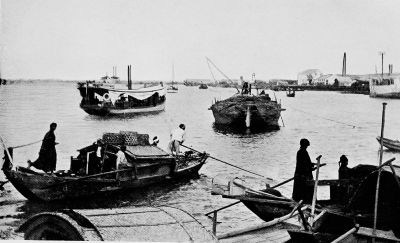
RIVER SCENE AT HAÏPHONG.
Right up to 1890 it was seriously debated in the Chamber, on different occasions, whether it would not be better to abandon this new colony. Fortunately for France she retained her rich prize.
The Tonquin question had caused a hetacomb of Ministries.
Jules Ferry, France's greatest politician since Gambetta, owed his downfall to Général de Négriers reverse at Ky-Lua, and the subsequent retreat of the army from Lang-son. Notwithstanding his undoubted talents he was never able to recover his former influence in State affairs.
In 1885 the excited Parisian mob would have torn him to pieces had he fallen into their hands.
"À bas Ferry!" "À bas le Tonkinois!" was their cry.
To-day every serious Frenchman acknowledges his respect for this great statesman, who was undoubtedly the founder of the splendid Colonial Empire his country possesses.
From 1887 to 1891, owing to the state of public opinion, it became absolutely necessary for succeeding Ministers, who had any respect for the stability of their portfolios, to adopt a special line of conduct in regard to Tonquin, which might be defined as a policy of mild procrastination.
Instructions were given to the Governors of the unhappy colony which might be summed up as, "Don't ask for more men; don't ask for more money. Do the best you can with what you have, and make no noise over it."
In consequence, the Governors were obliged to repress the legitimate aspirations of the military officers, and refused to sanction operations on an extensive scale, which, though necessary, would most probably attract public attention in France. The natural result of this situation was that during the whole of this period the relations between the civil and military powers in the colony were of the worst. In the French Chamber the Ministry would announce from time to time that the work of pacification was making rapid strides, that organised resistance was at an end, and that the occasional depredations which occurred—the importance of which, they stated, was magnified by the sensational press of the metropolis—were the acts of a few stray Chinese brigands (Voleurs de Vaches), whom the local militia and gendarmes were quite able to bring to order. In the meanwhile, the bands aforementioned, secure in the comparative inactivity of the French, continued to plunder the villages and capture the native authorities, who were liberated after payment of a ransom. In 1889 the famous Luu-Ky succeeded in carrying off three French colonists, the two brothers Rocque and Baptiste Costa. They were surprised whilst on a shooting expedition a few miles from Haïphong. They remained prisoners of the band for upwards of two months, and suffered every possible indignity and great privations. They were finally liberated on the payment of 80,000 dollars.
Encouraged by the success of their compatriots, the Chinese soldiers, who garrisoned the blockhouses and forts along the Kwang-si and Kwang-tung frontiers, would leave their uniforms behind them and pass into the provinces of Lang-son and Cao-Bang, where they would raid the rich valleys, burn the villages, drive away the cattle, slaughter the male inhabitants, and carry back the women into captivity.
In the Yen-Thé the partisans of Ham-Nghi, who were secretly encouraged by the mandarins in Hué, had raised the standard of revolt.
They occupied strong and well-fortified positions, possessed an abundance of arms and ammunition, and were ably generalled by De-Nam, a former military mandarin of the exiled Emperor, who received tribute in money or rice from the majority of the rich villages in the Upper Delta, the inhabitants of which undoubtedly sympathised with the rebels, and aided them by every means in their power.
Such was the position of affairs in the Tonquin in April, 1891.
On the morning of the 22nd April our detachment was taken on board one of the small but well-built river steamers which resemble in form the boats running on the Mississippi.
These vessels are of very light draught, owing to the numerous shallows which exist in the upper reaches of the Tonquin rivers. After dodging around for more than an hour among the innumerable high stalactite rocks, covered with dwarfed vegetation, which tend to make Along Bay one of the most curious and picturesque spots in the world, our steamer entered one of the numerous estuaries by which the Song-Thuong and Song-Cau rivers empty themselves into the sea. The banks on either side were of soft mud, covered as far as the eye could reach with mangroves.
The water, which in the bay had been of a green tint, was now of a dark red-brown, and presented a consistency of good pea-soup.
Far away to the north-east could be discerned the high spurs of the mountain range increasing in altitude, and extending towards the Kwang-si and Kwang-tung frontiers. But the sight of these was soon lost, as from one estuary we passed into another, and the landscape became one monotonous stretch of mangrove swamp over which the damp atmosphere seemed to dance in the bright sunlight. At last, after rounding a sudden curve, we caught our first glimpse of Haïphong, which, owing probably to the continued and depressing vista we had just been subjected to, had the appearance of quite a big town.
At the time of which I am writing this city had emerged from its chrysalis state of a town built of mud upon mud, and a considerable transformation was taking place.
Whatever may have been the errors made by France with regard to the economical and political administration of her colonies in the past, she was, and still is, undoubtedly our superior as a builder of towns; and the case in point may well serve as a demonstration of the fact.
In 1884, Haïphong, a Sino-Tonquinese seaport, was an agglomeration of miserable dwellings constructed for the most part of mud, bamboo and matting, inhabited by natives, with here and there a few decent brick buildings occupied by a small number of Europeans and Chinese merchants.
It was situated in a swamp, and certain quarters of the town were invaded by the high tides several times each month. During the summer the blazing tropical sun converted the place into a cesspool. It reeked with disease, and cholera and malaria were ever rampant.
Seven years later, when I first saw the city, it presented the appearance of a well-built European centre; possessed floating wharves, well-laid-out streets, fine boulevards and good roads. An excellent system of surface drainage was being laid down, and the thoroughfares and many of the buildings were already lighted by electricity.
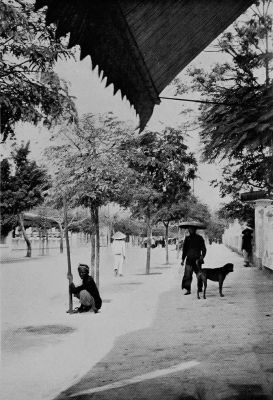
BOULEVARD PAUL PERT, HAÏPHONG.
Since 1891 Haïphong has steadily increased in area and importance, and is now an up-to-date, progressive city.
Our steamer only stayed here about an hour, the time required to draw a day's rations for the detachment.
We now learnt that our destination was Phulang-Thuong, an important town situated on the Song-Thuong, about 65 miles inland from Haïphong, at which place the depot of the 2nd Battalion of our regiment was stationed.
We were soon off again, and to our relief the aspect of the surrounding country became a more hospitable one.
The flat expanse of slime, mud and mangroves had disappeared. Now the river ran in between high artificial embankments; beyond these, on either side, could be seen a well-cultivated plain whose only limit was the horizon, and which was divided up by low banks of earth into holdings of every shape and size. It had the appearance of an enormous fantastic chess-board, on which none of the divisions were of the same dimensions and few of them rectangular. All of them, however, were of the same colour—green; not green of a uniform shade, for each field seemed to possess a different nuance of that colour, from the light, nearly yellow, tint of the freshly-planted rice, to the dark, almost brown, hue of the tobacco plant.
If the first impression one receives from the Delta landscape be a pleasing one, this is due to the novelty of the scenery, and soon wears off. Its place is taken by a sense of weariness, owing to the ever-recurring sameness of the vista; and the eyes are fatigued by the crude, garish brilliancy of the verdure, the uniform blue of an almost cloudless sky, and the painful reflection of the bright tropical sunshine on the water in the paddy fields.
The uniformity of the plains of the Delta provinces is broken by the numerous hamlets surrounded by a ditch and an embankment, on the crest of which is a dense, impenetrable thicket or hedge of live bamboo, reaching up as high as 20 or 30 feet. In the interior of these villages each hut possesses a garden or plantation which is a tangled mass of luxuriant tropical vegetation, and through this from outside one can catch but faint glimpses of the brown thatched roofs of the dwellings. Plantains, guava, persimmon and custard-apple trees abound here.
Coming straight out of this wealth of foliage are clumps of tall, stately areca palms, which, as they tower above the homesteads, seem to gaze out into the plain like sentries, whose duties it might be to warn the villagers of the approach of the yak (pirates).
Close by the majority of these hamlets, situated generally on a slight eminence, and in the shade of one or more ancient banyan trees, are fine pagodas with quaintly-sloping, red-tiled roofs, and curved eaves, the crests of these being ornamented with gruesome-looking dragons and griffins. When the village is rich the temple is surrounded by a whitewashed wall, the upper portion of which is a kind of open trellis-work in brick, with a doorway flanked by tall, curiously-shaped columns, each surmounted by a many-hued, hideous plaster genie.
It was easy to see that the population was very dense in this part of the Delta. Hard at work in the fields were many natives, the majority of whom were women. There were others winding their way along the narrow paths which top the small banks separating each holding, or on the rough roads upon the summit of the embankments which accompany the sinuosities of the river.
These were in batches of from ten to thirty individuals, each carrying upon his or her shoulder a light bamboo, 4 feet long. Suspended from both extremities was a basket containing rice, vegetables, or some other local product which they were conveying to the nearest market for sale. These natives moved at a sort of jog-trot which gives a spring to the bamboo pole they carry, thus relieving them in a measure of the weight suspended at either end.
They can carry as much as 70 pounds during eight hours each day (that is exclusive of occasional rests), and they go at an average pace of 3 miles an hour.
The Tonquinese of both sexes wear enormous hats made from the leaves of the macaw palm. Those worn by the men are pointed at the top, and bear a strong resemblance in shape to a big paper lamp-shade. The weaker sex possess a headgear circular in form and flat on the top, around the edge of which is an inverted brim which shields the face and neck of the wearer from the horizontal rays of the sun. These hats have often a diameter of as much as 30 inches.
Four hours after we left Haïphong the aspect of the country underwent a decided change, and low hills were frequent. They increased in number and height as we went on, and the river soon wound its way between the first spurs of the Bao-Day range. This is a group of hills known as the "Ninety-nine Summits," which vary considerably in height from an altitude of 600 to 1,800 feet. All of them are covered with long grass, affording an excellent pasture for the cattle belonging to the numerous villages established in the valleys.
Although it was almost dusk the view from our little steamer was a varied and pleasing one, as the river twisted and turned between these almost cone-shaped elevations. Sometimes it seemed as if a big hill had slipped right into the river and blocked the way; but the stream would narrow and go right round its base, and, as we swept by, we could look straight up the side of the slope. At such times we could not refrain from thinking of what might happen if a few enterprising rebels took up a position on the side of such a hill. They could have fired volleys on to our crowded decks, and from such an angle that we could not have replied with the machine gun fixed on the roof forward.
However, fortunately for us, nothing of the kind did happen.
We arrived at Phulang-Thuong at nine o'clock in the evening, and having disembarked were quartered in an enormous pagoda which could easily have accommodated another five hundred men.
Each soldier was provided with a straw mattress and a blanket, and it was not long before silence and sleep reigned supreme. The picquet and guard were supplied from the garrison, for we were as yet unarmed. During the next day rifles, ammunition, and a khaki campaigning kit were served out to us. At this time putties were not worn in the French army; they have, however, been adopted since the 1900-01 campaign in China.
Each man made his own cloth leggings or gaiters, which reached about half-way up the calf of the leg, and were buttoned at the side. I should here remark that the French infantryman, whilst in the Colonies, wears a white sun-helmet, similar in shape to the one served out to our own troops, and, like the latter, it has a removable cover of khaki cloth.
The rifles we received were of the "-74 Gras Model." These, however, were replaced by "-86 Lebel Model" in May of the following year. The latter is a small calibre, smokeless powder, repeating weapon.
I was included in a batch of sixty men who were to reinforce the 1st Company of the 2nd Battalion, quartered at Nha-Nam, about 21 miles to the north of Phulang-Thuong.
There is a good road between these two points, which is constructed on an embankment 4 feet above the level of the surrounding paddy fields. It has probably been in existence for several centuries, and it is certainly one of the old mandarin routes, which were made throughout lower Tonquin by order of the Emperor Le-Vrang-Tong, who reigned during the latter part of the sixteenth century.
On the morning of the 24th April our detachment crossed the Song-Thuong river by the ferry, and stepped out briskly towards our new garrison.
We were under the orders of a sergeant-major, who, owing probably to the instructions he had received, organised the little column in a strictly regulation manner: with vanguard, rear-guard and flankers. These precautions led to speculations among us as to whether we should get through our first day of service in the colony without smelling powder. The majority would certainly have hailed with delight any chance of a scrimmage, but we were destined to be disappointed in that respect—for the time being, at all events. We reached Cao-Thuong about midday, at which place we partook of a meal cooked by ourselves. On the 6th November, 1890, an important engagement had taken place here between the rebels—who occupied a strongly-fortified position—and a French column of about twelve hundred men. This combat, which may be considered the first blow struck at the partisans of the exiled Emperor Ham-Nghi, was the opening engagement in a lengthy struggle lasting nearly three years, and which transformed large, well-cultivated, densely-populated plains into desolate tracts of country, overgrown with jungle, dotted here and there with the charred and blackened ruins of once flourishing villages.
That part of Tonquin known as the Yen-Thé region is bordered on the south and west by the Song-Cau river, on the east by the Song-Thuong, and on the north by a chain of rocky heights running from Thaï-Nguyen to Vanh-Linh, which is situated a little to the north of the new railway from Phulang-Thuong to Lang-son. The southern part of it, which is generally designated as the Lower Yen-Thé, is an immense plain rising gradually to the north, and studded here and there with small isolated groups of hills, none of which exceed 500 feet in height. It is traversed by numerous streams all running into the Song-Thuong and Song-Cau rivers, and to these the district owes its wonderful fertility.
The soil of this region is composed of a dull-red clay, containing innumerable small round pebbles. It does not produce such fine rice as the black alluvial mud plains of the Delta, but it is better adapted than these for the growing of yams, tobacco, the mulberry tree and castor-oil plant.
About 20 miles north of Phulang-Thuong this plain terminates, and it is succeeded by a mass of hills which here and there enclose small marshy plains. The country is overrun by dense forests, into which a few paths, made by charcoal burners, offer the only means of penetration.
It would need a master-pen to produce an adequate description of the savage wildness of this region, which teems with game. Tigers, panthers, bears, many kinds of deer, wild pigs and boars abound; peacocks, silver-pheasants, partridges and snipe are very numerous.
For centuries past the Tonquinese have associated the Upper Yen-Thé with the mysterious and the supernatural. Native folk-lore declares that a former Emperor, thanks to a powerful magic he possessed, succeeded in driving from the lowlands a race of cruel and wicked genii. To escape complete destruction these fled into the forests, where, so runs the legend, they still live and guard the rich mineral treasures which are said to exist there.
The native of the Delta possesses a real dread of this part of the country, for, not only is the Tonquinese the most superstitious of humans, but the lowlander who comes into these regions is speedily attacked by a virulent form of paludo-hæmaturic fever, which in most cases terminates fatally.
It was owing principally to these reasons that the native troops, with the exception of the few companies recruited from the Muong tribes, were of small service during the operations which took place there.
In this maze of hills, covered by virgin forests, rank swamp and deep jungle, De-Nam established his headquarters in 1887. He was no commonplace individual, this Asiatic; indeed, when one considers his subsequent career, it is impossible to repress a sentiment of admiration for this man, who, during the four years he led the rebellion, proved himself to be a capable administrator, a talented military engineer, and a clever and a daring general.
He belonged to the literati, or educated class, and was born near Dap-Cau, a town on the Song-Cau river, in 1836. Like his father, he became a mandarin, and filled successively several important posts in the Civil Administration of his country. On the establishment of the French Protectorate he withdrew to Hué, the capital of Annam; but on the exile of Ham-Nghi he returned to his birth-place, and began secretly to organise the insurrection in the province of which he was a native, aided, as it has already been stated, by covert encouragement and subsidies from some of the high native officials at the Court.
His choice of the Yen-Thé as a centre of resistance to the French was in itself no small proof of the acumen the man possessed. Apart from the difficulties which the surface configuration of the region offered to the movements of European troops, the natives were stronger and more courageous than those of the Delta, and it was from them that the greater part of the old army of Tu-Duc was recruited. After the capture of the citadels of Son-Tay and Bac-Ninh by the French, these troops, abandoned by their Black Flag allies, returned to their homes, concealed their arms, and, with the suppleness innate in the Asiatic, became for the time being peaceful cultivators of their native soil.
Their minds were, however, deeply imbued with the delights of their past career—the satisfaction based on a sense of swaggering superiority over their unarmed compatriots, and the consequent facilities which had existed for plundering them. The long "siestas," slack discipline, and numerous pipes of opium were still causes for keen regret, and they hated the monotony and hard work attached to the pursuit of agriculture. It is, therefore, easy to imagine with what eager joy these former warriors received the whispered appeal of secret propaganda—an appeal combining the glamour of patriotism with the promise of rapine, plunder, and the other joys so dear to the majority of Orientals—and the mysterious manner in which the message was communicated to them was in itself a fascination owing to their belief in the supernatural.
In 1888 the majority of the population of the Yen-Thé were fervent partisans of De-Nam, and but few villages had refused to throw in their lot with the insurgents. All the hamlets that abstained from joining the revolt were Catholic centres, for numerous missions of the Roman Church had been established in this district for more than a century.
It was at this time that the leader of the insurrection decided on building a fortified stronghold towards the north-east of Nha-Nam. A strong fort, rectangular in shape, with flanking bastions at each corner, was constructed. Within it were placed substantial native buildings capable of accommodating from six to eight hundred men. The position chosen was in a dense forest of which just the necessary area to be covered by the defensive work was cleared. Two narrow paths only led to it, and these approaches could be raked by cross-fires from the walls and bastions. The surrounding vegetation was so thick that it was impossible to make headway outside of the two tracks; and owing to its density, and to the fact that the position was situated in a slight hollow, there were no means of obtaining a glimpse of the fortifications until the first palisade, which enclosed them at a distance of about 25 feet, was reached. There were three of these palisades, and in the grass-covered space between them were planted numerous pointed bamboo stakes, the whole forming a most serious agglomeration of auxiliary defences.
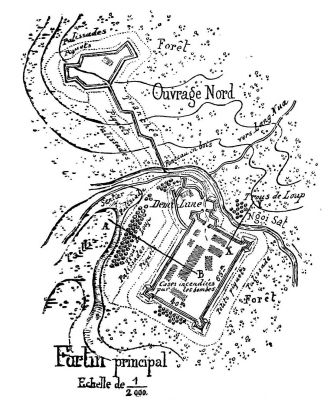
THE FORTIFIED POSITION AT HOU-THUÉ.
The preceding details may apply to the numerous other defensive works subsequently erected by the rebels, all being on the same plan, and occupying similar sites.
From Hou-Thué—for this was the name given by the natives to the citadel—De-Nam administered the whole of the province in the name of the exiled Emperor. The villages paid taxes into his treasury, and furnished rice and other requisites for his army, which at this time consisted of about two thousand five hundred men, one thousand five hundred of whom were armed with breech-loading rifles.
The unfortunate hamlets which refused their support were mercilessly pillaged and burnt, and their inhabitants massacred as an example to other recalcitrants. It must, however, be stated, in justice to the rebel chief, that he protected those who were faithful to his rule, for, on several occasions, in 1889-90, he defeated detachments of native militia sent by the Resident in Bac-Ninh to collect taxes from the peasants. During this period the attention of the French authorities was so actively engrossed by the movements of the Chinese bands in the provinces of Lang-son and Cao-Bang on the Song-Koï and Black rivers, that action in the Yen-Thé was put off until the end of 1890.
As a natural result of this policy of tergiversation, the power and prestige of De-Nam increased considerably; and so great was his confidence in the ultimate success of the insurrection, that he established a strongly-fortified position at Cao-Thuong, in which he placed a garrison under the orders of De-Tam, the most trusted and capable of his lieutenants.
This subordinate not only administered the surrounding country, and levied toll in the name of his chief, but by night he often crossed the Song-Thuong and raided the rich villages around Phulang-Thuong, the inhabitants of which had been living in security and growing rich, thanks to the close proximity of the French troops garrisoned in that town. It was frequently the lot of the unhappy Resident to watch, through the night, from his verandah, the burning houses of these unfortunates.
Patrols would be sent out, but their departure was at once signalled, and they would arrive on the scene only to find that the raiders had decamped with their spoil; and sometimes these detachments, being at a disadvantage in the gathering darkness, would be ambuscaded by the rear-guard of the enemy, and suffer severe losses.
At last, something had to be done, and a column under General Godin was sent against the rebel position at Cao-Thuong. It was with some difficulty that the fort was located, owing to it being concealed in the midst of a dense thicket. Part of the expedition was surprised, and suffered losses. Eventually, thanks to the fire of half a battery of mountain guns, the position was evacuated, and the enemy, after breaking up into small groups, succeeded in escaping northwards. No dead or wounded Tonquinese were found in the fort, but its solid construction and the judicious selection of its site was cause for great surprise to all the officers present. There can be no doubt that in this, and also during the subsequent operations against Hou Thué, the French considerably underrated the strength and military capabilities of the enemy. It would not, however, be wise for us to criticise too severely, since we have committed similar errors in most of our own colonial expeditions.
A fine village close to the enemy's fort, was found to be abandoned, and was burned. With this the operations terminated, which fact demonstrates the ignorance of the French officials concerning the extent of the rising, for they now concluded, somewhat hastily, that the centre of resistance had been destroyed.
In reality the garrison of a small outpost only had been dislodged, and the enemy returned to the position as soon as the troops had gone. They did not, however, remain there long, for shortly afterwards the authorities constructed a strong fortification on the crest of a hill which overlooked all the surrounding country, and this was occupied by a detachment of native militia, under the orders of a French officer.
Elated with the knowledge that they had slain several French and native soldiers, the rebels most probably concluded that the victory had been theirs. Certain it is that for long afterwards every minstrel in the province sang of the prowess exhibited by De-Tam's troops on that day.
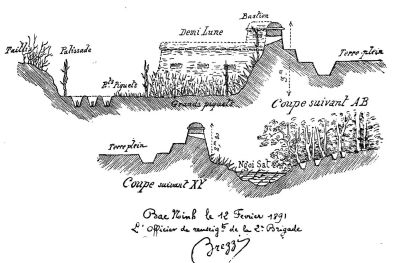
SECTIONAL SKETCH OF THE REBEL DEFENCES AT HOU-THUÉ.
Before General Godin's column was broken up, the civil authorities decided on one wise measure. To ensure the tranquillity of the region after the taking of Cao-Thuong, a position was chosen at Nha-Nam, about 8 miles further north, and a fort was built there. A company of the Foreign Legion, one of native infantry with a mountain gun, and a few artillerymen were left behind to construct the fort.
Encouraged, no doubt, by the non-discovery of their strong positions in the north, and by the trifling loss they had sustained, the rebels became more venturesome than ever. Placards declaring war on the French Government, and threatening with death all natives who remained loyal to the foreigners, were posted up in the roads, by-ways and market-places of the province. Rich villages, situated but a mile or so from the garrison towns of Dap-Cau, Bac-Ninh and Phulang-Thuong, were pillaged, burnt, and many of the inhabitants slaughtered. Almost each night would see the troops under arms, and the sky reddened with a conflagration.
The civil authorities were supposed to supply intelligence to the military, and they had secret service funds at their disposal to pay for the work, but there was never any forthcoming. The enemy, however, were better served, and not an ambuscade could be planned or a patrol sent out but they were immediately informed of the fact. Towards the end of November a perfect state of anarchy, a veritable reign of terror, existed throughout the province; and, as a last resource, the Yen-Thé was placed under martial law, and the administration of the district entrusted to the Brigadier-General in command of the 2nd Brigade at Bac-Ninh.
To such as are cognisant with the French methods of recruiting the personnel of that country's colonial civil service, there is little cause for surprise at the maladministration of Tonquin at this period of its history. To have a parent in the Ministry, a relation who was a deputy, or an electioneering agent, or to possess a friend with political influence—these were the surest means of obtaining a soft, well-paid billet under the tropics. Few, if any, of the candidates nominated knew anything about the country, its people, their customs or language prior to their arrival in it; and even to-day, when some apology for a competitive examination has become necessary—though this is not always the case—not one in fifty of France's public servants in Indo-China possesses a sound knowledge of the vernacular.
Very shortly after matters had been taken in hand by the military authorities things began to take a turn for the better, thanks to sterner measures and a better organised system of espionnage.
When information had been obtained disclosing the existence of a strong main position at Hou-Thué, a reconnaissance was sent out from Nha-Nam on the 9th December to locate the route. This action led to a vague knowledge of the whereabouts of the enemy being obtained, and a small column, under Major Fane, marched against the rebels on the 11th.
After a good deal of skirmishing and groping about in the dense forest, the detachment, which had blundered blindly on the fortifications, was very severely handled and forced to retreat.
A new expedition, a thousand strong, under the command of Lieut.-Colonel Winckel-Meyer, attacked the rebels on the 22nd December. An attempt was made to assault the stronghold.
Owing to the fact that the enemy's works were only visible at a distance of a few yards, and also to the impracticability of clearing a road for the guns through the trees and undergrowth, it was found impossible to aid the attack by a preparatory action by the artillery. For a similar reason the assaulting party were obliged to move in Indian file along two narrow paths, exposed all the time to a severe cross-fire. Under such conditions the impetus so necessary to success was impossible, progress was slow, and casualties numerous.
The foliage was so dense that the few rays of the sun which pierced through it produced an effect of dim twilight. Through this semi-obscurity, which was intensified by the clouds of powder smoke which clung to the damp vegetation, could be distinguished the countless red flashes from the enemy's rifles. The continuous rattle of the musketry, the crashing clatter of the branches and twigs severed by the hail of lead, the insulting yells of the rebels, the monotonous boom of their war-drum, the complaints of the wounded and dying, produced a sensation of fearsome nightmare.
The European troops behaved splendidly. Those who escaped the zone of fire on the paths tried their best to break through the first bamboo fence, but were shot down almost as soon as they reached it. At one point a hole was made in the enclosure, and two Legionaries got through. They made a rush for the second palisade, but before they could reach it one of them fell, and his thigh was pierced by a pointed stake. Fortunately, his comrade succeeded in carrying him back the way they had come, and escaped himself without a scratch.
Unable to stand the continued strain, a company of native troops—tirailleurs Tonkinois—retreated in disorder. Some of them actually threw away their arms, and, with turbans gone, their long hair falling in confusion over their face and shoulders, fled shrieking and panic-stricken.
Seeing that success was not possible under the circumstances, the commander of the expedition wisely ordered a retreat. The engagement had lasted barely an hour, and over a hundred of the rank and file had been killed or wounded.
When the troops retired a good many of the slain, together with their arms and ammunition, fell into the hands of the rebels.
The column withdrew to Nha-Nam, and reinforcements of men, guns and mortars were sent from Bac-Ninh. Colonel Frey, who commanded the brigade, arrived, and took over the direction of the operations, which lasted from the 30th December to the 11th January, 1891.
Trenches were opened, but progress was very slow. Eventually, a position was reached about 100 yards from the first palisade, from which a glimpse of the interior of the fort could be obtained. A battery composed of two mountain guns and as many small mortars was established, and the shells thrown from them soon caused serious loss to the enemy, and set fire to one of the thatched roofs of the numerous buildings it contained. Most of these constructions were built of bamboo and plaster, so that the conflagration spread rapidly; and towards evening the interior of the citadel was a mass of flames. The rebels displayed striking courage, for they clung to the walls, and fired incessant volleys at the guns until late into the night. Profiting by the darkness, they then evacuated the fort, after burying their dead, and retired with their wounded to positions a few miles further north.
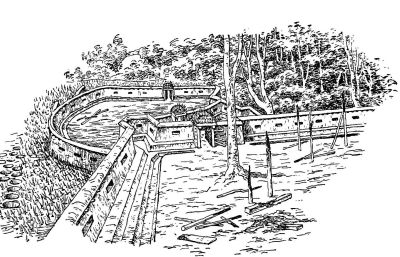
INTERIOR OF THE FORT AT HOU-THUÉ.
These positions were stronger than at Hou-Thué, and consisted of a big entrenched village, the approaches being covered by several forts and numerous rifle-pits, the importance of which was unknown to the French, so well had the secret of their construction been guarded.
On the following morning an assaulting column found the position at Hou-Thué empty, and the defences were partially destroyed by dynamite.[1] After a few reconnoitring parties had been sent out, and no trace of the enemy discovered, the civil authorities concluded that the rebellion had been squashed, and the Governor gave orders for the column to be broken up.
However, to ensure tranquillity, it was decided to maintain the garrison, and strengthen the position at Nha-Nam, situate about 3 miles south-west of Hou-Thué, on a small elevation dominating to the south, east, and west the plain which extends towards the Song-Cau and Song-Thuong rivers, and northwards of which is the mass of forest-covered hills already described.
The garrison consisted of a company of the Legion, one of native infantry, and a mountain gun. The construction of the position went on very slowly, for the military authorities were able to obtain but few coolies, and the greater part of the labour had to be performed by troops who were continually harassed by night attacks; for the rebels, encouraged, no doubt, by the failure of the French to discover their new stronghold, were soon as active as before. Fortunately, the garrison experienced small loss, for the enemy contented themselves by firing into the place at night from a distance of about 300 yards.
The strain on the men was very great, however, as three or four nights a week they were under arms in expectation of an attempt to rush the position. This was the state of affairs when our detachment arrived at Nha-Nam on the evening of the 24th April.
Our arrival at the fort caused some little excitement, and numerous were the questions asked us concerning friends in Algeria.
We were at once distributed over the company, and I found myself placed in the second squad of the first section, which was lodged in a small pagoda, situated about 10 yards inside the fort gate, and almost facing it. This building was in very good condition, and faced the south. A vacant bed was given me, the former occupant of which, having been rather severely wounded in a skirmish about a fortnight previously, was in the hospital at Phulang-Thuong. I say bed, but in reality it was an apology for the comfortable cots used in Algeria. The trestles were of wood, and placed upon these was a plank about 2 feet broad. A regulation blanket folded in two served as a mattress. A good meal was awaiting us, and, after partaking of it, I arranged my kit, and in a quiet spot, with the help of a comrade, "washed down" with a bucketful of water.
Our long tramp, and the heat, had made us comfortably tired, so we turned in early and were soon sound asleep, notwithstanding the restricted dimensions of our couches. Our slumbers were undisturbed, and the night passed without incident.
On the morrow the men who had composed our relief detachment were paraded for inspection by our company commander, Captain Plessier. He addressed us with a few words of welcome, adding some sensible advice concerning the great dangers which existed from sunstroke, fever, and the abuse of alcoholic liquors, and the best way to avoid them. After that he questioned us individually concerning our previous knowledge of building and engineering. Before he interrogated a man, the sergeant-major who stood near him reading from a list he held, would inform our commander of the name and nationality of each in turn. To my surprise he addressed me in very good English, saying:
"What was your profession before you enlisted?"
"I had not yet adopted one, sir," I answered.
"Hum! You evidently possess a good education, and we are in want of intelligent work." Then, turning to the non-commissioned officer behind him, he continued in French: "Sergeant-major! Make a note of it: this man to be put on the brick-making gang in his spare time." As he passed on to the next private he threw a quick glance at me, in which I read a kindly sense of the humour of the situation.
To another who told him he was formerly an artist, he said:
"Excellent! excellent! the very man I want. My hut and the new kitchen will be finished to-morrow, so you can set about whitewashing at once."
This officer was a man of medium height, about thirty-five years of age. He was dark, and wore a small moustache. He was well-built, very active, and seemed to be about at all hours of the day and night. Though a strict disciplinarian he was extremely just, and never inflicted a punishment unless it was merited. Owing to this, and also to his cool courage under fire, his men were devoted to him, and would have followed him anywhere.
The morning was given to us, so as to permit of our settling down in our new quarters.
That afternoon I was initiated into the rudiments of brick-making. The clay pit and yard were at the bottom of the western slope of our position, on the top of which was the réduit or citadel of our little fort. Eight Legionaries were employed at modelling the bricks and stacking them in the kiln (I was one of the gang), and ten native tirailleurs brought water from the well, chopped up the rice straw, and brought in wood for the fire. A picquet of ten men and a corporal, on the watch for snipers, protected us.
We stopped work at 5 p.m., and went up to the fort to take our evening meal, after which I hurried round our positions to take things in, and see all I could before the sun disappeared with that swiftness so startling to the newcomer in the East. In this part of the world there is no twilight.
Again we were favoured with a quiet night. At five o'clock the next morning, just before the bugle sounded the réveil, a sergeant-major came into our abode and gave us the orders for the day. My section, and another from the native regiment, were to start on a morning reconnaissance at six o'clock under the orders of our Captain; the remainder of the garrison was to continue work at the fortifications and buildings in construction. I soon learnt that this was the daily routine, each unit taking alternate turns at reconnoitring or building. A quarter before the hour indicated the section was lined up, outside our pagoda, facing the south gate of the fort.
We were in our khaki kit of cotton drill, and carried our rifles, side arms, 120 rounds of ammunition, water-bottles filled with very weak coffee, and a sort of heavy-bladed half chopper, half knife, which was in a wooden sheath suspended from the belt on the right side. This tool, which is a cross between a Gurkha kookerie and a Manila bolo, is about 18 inches long, and has a blade which is broader and heavier at the end than at the shaft. It is used to cut away the creepers, bamboos, and undergrowth, although at a pinch it makes a formidable weapon. A few minutes later the detachment of native troops who were to take part in the expedition, came from their quarters and formed up behind us. Their uniform, which was of similar texture and shade to ours, consisted of a vest, short trousers, and putties of the same pattern as those worn by the Muong tribes. The men were unshod, and as a head-dress wore a round, flat hat made of bamboo, which is known as a sakalo. This has a diameter of about 8 inches, is painted with red lacquer, and has a small brass spike in the centre. In shape it somewhat resembles an inverted soup-plate. This hat is placed on the top of the chignon-turban worn by the Tonquinese, and secured to it by red cotton streamers. On occasions like the present one, the head-dress was covered by a khaki coiffre, which not only hid the sakalo, but also fell over the neck of each soldier at the back, as a protection from the sun. They were armed with the cavalry musket and bayonet. This weapon was of the same model and calibre as the one we were then using, but it was shorter and lighter. In addition to the native "non-coms" in these regiments each section possessed two French sergeants. These, of course, wore a uniform very much the same as ours.
As I stood in the ranks curiously watching through the trellis-like palisade the red ball of the tropical sun as it rose swiftly above the horizon and lit up the plain before me with colours so brilliant that their glare seemed to burn the eyeball, I overheard the following remarks made by two comrades in proximity to me:
"Himmel! Sidi Mahomet (the sun) promises well to-day. We shall lose some fat before we get back, Bauer."
"Fat! I've none to lose," was the reply. "I found the last of mine in my boots yesterday, when we got back from Yen-Lé (a native village five miles south). That load of bamboo did it. I shall sweat my flesh away now. Pauvre Légion! Have you got a cibiche (cigarette)?"
"That load of bamboo!" said the first speaker, as he handed his chum his pouch. "Do you think I carried back the buthuong's (native headman) feather mattress? Schafskopf! An ironwood pagoda beam, my boy. Eighty kilos, if it weighed a gramme! I heard the Capitän (captain) say, 'This would make splendid doorposts, but it's too heavy,' so I tried it. Sacré nom! It was a blow. When we got here I was nearly dead. Kaput! Sweat? Why, when I went to the kitchen to get a drink of tea, Schmidt stared at me, and asked if it had been raining. Dummer Kerl! The cartridges in my pouch were quite wet. I believe the powder in them must be damp, too."
I joined in the laugh at this sally, and asked:
"Do you know which way we shall go this morning, Bauer?"
"No, I don't," he replied; "and neither does any one else. The 'old man' (le vieux) arranges such matters with himself as he takes his coffee in the morning. All I do know is that if we go south, east or west we shall each bring back a load of bamboo. Mein Gott! It does take a lot to build this place. If we go north we shall have some fun, and some one will probably get hurt."
"No such luck," said the corporal on my right; "there will be no vacancies in the cadre to-day."
As he spoke our Captain came walking down from the réduit, and a few paces behind him one of the buglers leading his mount, a small white native pony, not much bigger than a Shetland, but as beautifully formed as an Arab. Our commander carried no arms; a pair of field glasses slung over his shoulder, and a small malacca cane, constituted all his impedimenta.
He glanced at the detachment, and then said to our lieutenant:
"Monsieur Meyer, the reconnaissance will proceed in the direction of Yen-Lé." (I heard a suppressed groan from the men near me.) "The Tirailleurs will supply the vanguard."
At the word of command one of the native infantrymen left the ranks and went out of the gate at a jog-trot. Once outside, he brought down his rifle from the shoulder, slipped in a cartridge, closed the breech-bolt, and carried his arm at the slope. This man was what is known as the "point" of the column.
When he had proceeded about 40 yards, the "cover-point," composed of a corporal and four men, followed, and behind these, at an equal distance, came the vanguard; which in this case consisted of half a section under the orders of a sergeant. When another interval of 40 yards had been established, the remainder of the column proceeded, with the exception of a small rear-guard of ten men and a corporal, who followed about 100 yards behind us. As we went through the gate, Bauer said to me: "We can be thankful the demoiselles—he meant the native troops—are in front to-day; we shan't have to stretch our skittles (legs)."
Once outside the fort we slung our rifles and marched at ease.
Our road was on a narrow embankment which wound snake-like over the rice fields, and we could only proceed in Indian file.
The country here was very much like that of the Delta, which I have already described. A well-cultivated plain, studded over with villages hidden in clumps of verdure, and surrounded by tall, graceful bamboos, which bent and creaked, and whose delicate foliage rustled under the slightest breeze. The only difference was that here and there were small hills, some covered with long grass, others with a dense and luxuriant vegetation, the pleasant aspect of which broke the monotony of the landscape.
Many of the villages were occupied, and from some of them, as our little column passed by, the notabilities would come out and make obeisance, and offer refreshments to our commander. They had accepted the protection of the French authorities, and paid taxes into the treasury at Phulang-Thuong; but the mere fact that their village was not a mass of charred ruins was the best proof that they must also have been paying toll to De-Nam, and most probably supplying him with rice. Others of these hamlets openly gave proof of their hostility by barring the gates before we arrived. An order would be given and a few men would make a rush for the entrance, pull back the heavy beams placed one above the other, the ends of which fitted in slots cut in two massive posts, and break in the ironwood doors beyond.
No one was found in the place, all the inhabitants having escaped through some exit at the back of the village, generally leading into a dense jungle, where they hid with all the cattle they had time to drive before them.
The defences of these hamlets are much stronger and more elaborate than those of the Delta provinces. A double and sometimes triple embankment and bamboo hedge surrounds them. Between the first two of these are numerous deep ponds of stagnant water. Twisting, narrow lanes, just large enough to allow of the passage of the tame buffalo, divide up the interior, and make of each thick clay-walled house a veritable citadel. Leading up to each of the two or three doors, which must be passed to gain an entrance, are narrow passages through which only one man can go at a time, and these can be raked from end to end by the fire from well-placed loopholes.
I was greatly interested by what I saw that morning, and by the really clever system of defence adopted for their houses by these Asiatics. It is certain that had they offered us any serious resistance we would have suffered severe loss. That they did not, I attribute to the fact that they were fully cognisant that in such a case a gun could be brought from Nha-Nam, against which their fortifications would have stood but a poor chance. As Bauer had predicted, we ended up our morning by bringing back from Yen-Lé a load of bamboo. This we cut from the hedge of that village, which was not inhabited, for it had been burnt about two months previously, because its occupants had fired upon a passing detachment of troops. The task of carrying our load back to Nha-Nam was no light one, and much bad language was used by the way. We reached our position about midday.
Had it been possible to obtain sufficient coolies, the troops would have been spared this labour. However, it did none of us any harm, for we were well fed, and drew a daily ration of a pint of good wine and a lot of rum, so that we could stand a little extra work.
Owing to the extreme heat, unless there was urgent need of their services, the troops were kept under cover each day from 10 a.m. to 2 p.m. From then until near sunset work would be resumed on the buildings and fortifications.
On the 5th May, at 1 a.m., I had my first experience of a night attack. My squad had come off guard-duty on the evening of the 4th, and we had turned in at nine, and were soon fast asleep. White duck pants and a soft linen shirt constituted our usual sleeping costume; each man placing the end of a sheet over his bare feet to protect them from the mosquitoes. In the event of an alarm it was easy for the men to slip on their boots, buckle on their belts, seize their arms and hurry to their posts, of which each was already cognisant. A few seconds sufficed for our little garrison to be prepared to repel any attack on their position. A small light, screened from the outside, burnt in each room, and this prevented the confusion which complete obscurity would have created.
What it was exactly that awoke me it would be difficult to state. Instinctively I had sprung off my cot and was groping about for my boots, which were on the other side of it. After cursing myself for my stupidity, I found and slipped them on. Satisfied at being shod once more—a sense of weakness and inferiority dominates the white man caught barefooted—I did not wait to lace them, but buckled on my belt, took down my rifle from its peg, and hurried over to the opposite side of our pagoda to take up my place at the window, between two other men. But a few seconds had elapsed since my awakening, and now, as I stood with my head and shoulders above the opening, the butt of my rifle pressed under the arm-pit, the right hand gripping the stock with one finger on the trigger, now only did I realise what had brought me from my slumbers. Previously, my awakening intelligence had been able to concentrate itself on one object only, that of arming myself, and reaching my post as soon as possible.
There was no moon, but the night was clear, the stars ablaze. A few yards in front of us I could see the dim outline of the palisade, and, beyond it in the darkness, a grey streak of road which disappeared into the night. Along a front of perhaps 400 yards the sombre background was punctuated again and again, at a distance of about a quarter of a mile, by lightning like red flashes. Rat! tat! tat! tat!... These were Winchesters. Boom! boom!... Sniders or muzzle-loaders. Then Rat! tat! tat! again in quick, continuous succession.
With a sharp whirr, or a long drone, the bullets fly overhead. A swish and a crackle. Ah! that was lower, and has hit the palisade. Thud! Thud! they come into our good wall. A corporal blows out the light; wise man! A crack and a jingle of broken crockery—the tiles of our pagoda are getting it now. Flop! a leaden messenger has come through a window, and flattened itself against the opposite wall.
In our room all is silent. Each man stands with his finger on the trigger; a corporal is behind each squad; we are waiting for orders. In the trenches on the crest of the slope behind us, and in the brick buildings scattered over our position, our comrades, like us, are expectant, ready and confident. The enemy's fire increases, and we hear it break out on the left. The flashes from their rifles come closer and closer; some of them are now not more than 100 yards away.
A good many bullets are finding their way into our building. A tin pannikin, with a hole drilled through it, falls with a clatter from the shelf, and an earthenware jar which contained cold tea is smashed. We can hear the soft trickle of the liquid over the tiled floor.
We take all the cover we can as we peep out into the darkness. No one has been hurt, but it begins to be trying to the nerves.
A ball flicks the window-ledge, and fills our eyes and nostrils with brick-dust. "Schweine!" exclaims my neighbour, rubbing his eyes. "Silence!" says the corporal who stands just behind.
I have a growing desire to say something to somebody, and feel terribly lonely. Next I swear mentally that after counting ten I will open fire and stand all chances. I count ten; then—do nothing, and keep on waiting—it seems for hours. The whole thing lasts about thirty minutes.
At last! We hear footsteps coming down the hill, and Lieutenant Meyer appears walking at a quick pace, a bugler behind him. He comes into our quarters, and looks around in the obscurity to see that all are present. Just then some more of our tiles go to glory with a smash. He laughs lightly, and says:
"Ça chauffe, mes enfants," and a titter runs through the room. Then, turning to a "non-com": "Schmidt! go over to the guard-house" (a few paces away to our left), "and tell the corporal that when the bugle sounds, he will open a fire of six cartridges from the loopholes. You can remain there and join in." Then to us: "Attention! for independent firing! at one hundred metres——"
Every man present braces himself and jubilates. The bugler, at a sign from our officer, steps forward to the doorway and sounds the "Open fire."
In a second we are all at it. Crash! bang! bang! The sentry at the gate also joins in, and we can see the flash and hear the report of his weapon as he fires from behind his shelter of sods.
All my nervous impatience is gone, and I no longer growl at fate and speculate on my chances of being shot in the dark. I am hitting back now, and feel joyful at it. Also I seem to possess two distinct individualities, one watching the other; and the one knows that the other will be pleased if I do not hurry, as I slip another cartridge into the breech, and close the bolt with a snap. So I effect the operation in the regulation manner, though I am craving to rush through it with lightning speed, and would do so, were not my invisible double watching me so attentively. My rifle is as light as a feather as I bring it up to the shoulder. Then I peep along the barrel, and wait a second for a flash from the enemy. It is too dark to see the top sight, so when the flash comes, with a steady pull I loose off at it.
Now the bugle brays the "Cease fire," and the rattling din ceases suddenly.
Within our room all is still again, except for an occasional cough, for we are breathing powder smoke. The place is full of it, and it hangs around like a fog.
The enemy's fire on our front is almost extinct. The little there is comes from a long way off—500 or 600 yards, perhaps. An occasional twinkle and a following pop! and then it ceases altogether.
On the right of our position they are still keeping it up, till we hear the quick successive crashes of two volleys fired by our comrades from the trenches, after which it dies away and is soon finished. So ends the night alarm.
Awaiting orders we remained under arms until our captain came round, accompanied by M. Joly, our surgeon, to enquire if there were any casualties. On our lieutenant replying in the negative, we heard our commanding officer laughingly inform him that the only patient for the doctor was the sergeant-major's dog, which had been shot clean through the body. Strange to say, this animal, a liver-coloured pointer, recovered completely from its wound.
At about a quarter to two the "dismiss" was sounded, and we returned to rest again.
For the next few weeks the work of building went on apace, and by the end of May all the garrison was comfortably lodged and the defences completed. The tirailleurs laboured with us at this task; and it was whilst watching them at work that I was struck by the diversity of uses to which these natives are capable of adapting the bamboo. They used it for almost everything. Roof-beams, doorposts, window-frames and rafters were obtained from it for building purposes, and also beds, tables, chairs, matting and blinds. The whole of our position was surrounded by two barriers of bamboo, and in the space between them, about 20 feet, thousands of small pointed stakes of the same wood, boiled in castor oil to harden them, were planted in the ground. The native troops were undoubtedly cunning workmen, and were of great assistance in the construction of the fort.
They are, however, held in small respect by the Legionaries, whose opinion of them as fighters is of the poorest.
The majority of these troops, recruited in the Delta provinces—the population of which are good agriculturists, but possess no military virtues—are of small value as a fighting unit.
The few companies formed of Thos and Muongs (mountain tribes of the Tonquin) have, however, rendered great service to the army, and their courage and morale is of the best.
Unfortunately, only about one-fifth of the total strength of each regiment is composed of these highlanders.
At the beginning of 1891 the colony possessed three regiments of tirailleurs Tonkinois. Each of these corps was composed of four battalions of one thousand men. In June, 1895, a fourth regiment of three battalions was raised, and in 1902 a fifth of similar composition was added to the strength of the army in Tonquin.
Each corps possesses a cadre of French officers and "non-coms," composed as follows: a colonel and an adjutant-major for each regiment, a major to each battalion, and a captain, two lieutenants and twelve sergeants to each company.
There exists, however, a great defect in the organisation of these native corps, of important significance to those acquainted with the admirable system adopted for our Indian army, for not two per cent. of the Frenchmen who compose the cadres of the tirailleurs regiments can speak the vernacular. The disadvantages consequent on this state of things are too evident to require explanation.
CHAPTER IV
The difficulties of obtaining military intelligence—Native spies—Ambuscades—Life at Nha-Nam—Doy-Tho—De Lipthay—A tropical storm—The capture of Linh-Nghi—Monsieur de Lanessan—French colonial administration.
Owing to the fact that the majority of the population of the Yen-Thé were partisans of De-Nam, and also to the terror with which this chief had inspired the remainder, it was with the greatest difficulty that any information could be obtained concerning the organisation and movements of the rebels.
Notwithstanding the proverbial cupidity of the natives, and that all intelligence was well paid for—a Special Secret Service fund being devoted to this purpose—the military authorities found it almost impossible to learn what was going on, or what might be expected to happen. It was not until a regular system of espionage was instituted in April, 1891, that any useful knowledge could be obtained.
A score or so of men from the native regiments who had furnished some proofs of courage were chosen, and these, disguised as travelling musicians, beggars or pedlars, wandered from village to village gleaning in the meantime all the information it was possible to obtain. This they would communicate to the officers commanding the forts at Nha-Nam and Bo-Ha, or to the Intelligence Department of the Brigade at Bac-Ninh. These spies were instructed in certain signs and passwords which they used as a proof of their identity when they came to any of the centres with news; and their arrival at and departure from these places were always effected secretly and at night.
By these means it became possible to the French officers to have some idea of what was going on in the lower Yen-Thé, but the knowledge obtained concerning the strength and situation of the rebels' fortified positions in the north was extremely vague.
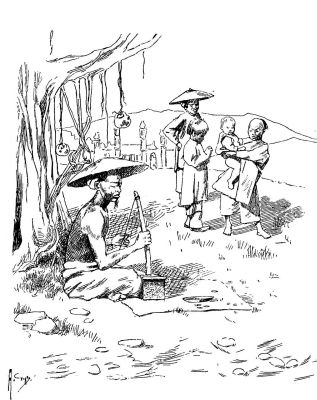
A NATIVE SPY.
Several of the spies had made attempts to penetrate into the region north of Ha-Thuong. Some were turned back; others, who had probably excited suspicion, were tortured and decapitated; but none of them succeeded in obtaining a glimpse of the strongholds, or in gaining any certitude concerning the paths which led to them.
However, thanks to these spies, it became known that important convoys of grain and food stuffs, coming from the villages near Bac-Ninh, were sent northwards twice a week, by paths which passed a little to the west of our position, and were not visible from it. The usual time for the passage of these supplies near Nha-Nam was from one to three in the afternoon, at which hour, owing to the heat, the troops were under cover.
Acting on orders received from General Voyron, who had just taken over the command of the 2nd Brigade at Bac-Ninh, small parties were sent out on several occasions in hopes of surprising the convoy.
They were concealed in one of the deserted villages along the paths supposed to be frequented by the rebels, and at points from which a good view of the track for some distance could be obtained. I took part several times in these small expeditions. One of them is perhaps worthy of mention, since it provided some excitement for all those who assisted in it.
Our detachment on this occasion consisted of eight Legionaries, and as many tirailleurs, under the order of a corporal of our regiment. We proceeded due south about 3 miles along the high road to Cao-Thuong to a fine pagoda, the wall of which skirted the highway. Just facing the entrance to the building, and at right angles to the main road which it joined, was a small path that ran across the fields to the west, and was visible for about 400 yards, afterwards turning off sharp to the left behind a range of small hillocks covered with long grass.
At the apex of the angle formed by the junction of this path and the main road was a big banyan tree with a clump of bushes at its base.
It was here that our ambuscade was placed, after a scouting party had gone through a big empty village, situated just behind the pagoda, and it was certain that there existed no sign of occupation, or trace of a recent passage of the enemy.
Six Legionaries, two natives and the corporal remained behind the pagoda wall, and through the open brickwork in the top part of it they could see across the fields. Together with four tirailleurs I was posted on the opposite side of the road. We were a little to the right of the others, our backs towards them, behind the clump of bushes at the foot of the banyan.
Perched up on one of the branches of this tree and concealed by its dense foliage was a Legionary, who, from the position he occupied, obtained a fine view to the south and west: these being the only directions from which our position could be approached, since the bamboo hedge of the village behind us skirted the road to the east for at least 500 yards, and nothing could come from the north without being seen by our sentries at Nha-Nam, who had received orders to keep a sharp look-out.
It was ten in the morning before we had settled down. Our instructions were to reserve our fire, and, if possible, capture one of the enemy alive.
The heat was terrible—this was in the second week in June, and the rains had not broken—and although, thanks to the shade from the tree above me, I could doff my helmet and profit by the occasional light puffs of breeze, just sufficient to move the airy foliage of the bamboo, it required all my energy to fight against the invading drowsiness.
From time to time I would question the man in the tree in the hope that he would announce the advent of a troop; but he disappointed me each time with a reply in the negative.
My attention was soon drawn to the four natives beside me, for I perceived that they were fast asleep. The natives possess a faculty of dropping into a sound slumber without respect to time or position; and these, though seated, their bodies bolt upright and their legs crossed before them, were snoring. The Tonquinese, like the Arabs, have a proverb which says: "A man is better sitting than standing, better asleep than sitting, and better dead than asleep." However, this was no time to ponder on the ethics of Oriental philosophy, so I applied myself to awakening these weary ones, and, after a good deal of vigorous shaking, succeeded in doing so. The corporal, who from his hiding-place had taken in the situation, adjured me, in low but energetic tones, to make use of the butt of my rifle to infuse enthusiasm into the unfortunate tirailleurs. Then all was quiet again, and our weary watching was resumed.
The time seemed to drag along with painful slowness, and the glare and heat increased in intensity. Hardly a sound disturbed the drowsy tranquillity, and had it not been for the chirping song of the cicalas and the far-away whistle of a kite, which soared above us and whose shadow flitted occasionally across the open ground in front, one could have imagined that there was nothing living for miles around.
The sun began to move westwards, and its rays struck the white wall behind me, only to be reflected with such force that I was obliged to put on my helmet to protect the back of my head. It was nearly two in the afternoon when we were startled by a short exclamation from the sentry perched above us.
"What is it?" somebody enquired.
"There is something moving," he replied, "a long way off—two kilomètres, perhaps—two men—Ah! there are some who carry baskets. Nhaques (peasants) going to market, I suppose." Then with growing excitement in his tone he continued: "I see a glitter. Got for deck!" (he was a Belgian). "The two men in front carry rifles—they are the point! Yes! Yes! the point! Further back there are more coolies with baskets, and more men with rifles—now two men on ponies."
"Where are they?" I tried to speak quietly, but could have shouted with excitement.
"On the path which runs behind the hillocks—the path which turns in here. They come from the south, and walk very quickly. Wheew!" he whistled, "there are quite sixty coolies, and as many men with guns. They have a rear-guard. The first will be on the path before us in ten minutes. Prévenez vite le caporal—Nous allons rire!"
I ran across the road behind us, through the gateway into the pagoda yard, and informed our "non-com." Though he was only half awake when I began—for the heat had been too much for him—he was quite alive to the situation before I had said many words, and almost shook hands with me in his joy at the news.
"Don't shoot," he said, "unless they are alarmed and run, then shoot straight. Let them come up on the road here and we can collar one, mais pour l'amour de Dieu! Keep an eye on your demoiselles—I have no faith in them!"
I went back to my hiding-place. Hellincks, the man in the tree, said to me:
"Hurry up! The two first will be round the corner in a minute or so."
I glanced at the tirailleurs. They were kneeling now, and throwing eager glances through the foliage. In a low voice I told them to fix bayonets and load, and noticed that the man next to me trembled like a leaf as he did so. Excitement, I thought—or was it fear? From a deep bronze his skin had changed to a dirty yellow. I should have known and taken away his weapon, but this was my first experience.
Mechanically I slipped my right hand into the pouch of my belt, took out a cartridge, and after wetting the bullet with my tongue, slipped it into the open breech of my rifle and closed it. Now nothing moved, and the only sounds that struck the ear were the song of the cicalas, the whistle of the kite, and the gentle rustle of the bamboos in the breeze.
Suddenly, round the corner of the last hillock, came a man; then, a yard or so behind, another. Though expected, their actual appearance produced an impression of surprise; perhaps because we had waited so long.
Both wore a kind of uniform of green cotton cloth, and putties of the same colour. Their long hair was rolled in a silken turban of similar hue. Hanging on his shoulders, suspended by a string which passed round the front of his neck, each man had a big palm-leaf hat.
The sun glittered on their brass cartridges fixed in a belt round the waist, and on the Winchesters which they carried on the shoulder, as a gardener carries his spade; the end of the muzzle in the hand, the butt behind them.
On they came at a sort of jog-trot, and we could hear the pad! pad! pad! of their naked feet on the hot path.
Now they were within 100 yards of us, and I fancied I could perceive a look of relief on the ugly flat features of the first as he glanced towards the pagoda.
The first of the long string of bearers with their bamboo and baskets were now visible, coming along at a jerky run. I felt something touch my left elbow, and glanced round to find that Hellincks had come down from his perch and was kneeling beside me.
The two armed men were quite near now. We could see a bead of perspiration on the face of the first as it came from his hair and trickled down his forehead. We could hear the regular, short pant of his hard breathing, note his half-open mouth, and distinguish his black-lacquered teeth.
Pad! pad! pad!—a soft puff of breeze brought to my nostrils the acrid odour of the perspiring native. Another few seconds, and by thrusting my rifle through the leaves I could have touched his breast with the muzzle.
These two will surely be ours; nothing can save them!
Unable to control himself, mastered by excitement or fear, the tirailleur on my right suddenly sprang to his feet, and shouted in the vernacular:
"Toi!" ("Stop!") "Adow di?" ("Where go you?")
From the pagoda behind us I heard an angry murmur, and could distinguish the corporal's voice: "Kill the swine! Oh, kill him!"—Hellincks cursed and groaned like a man struck with fever. I felt that I had stopped sweating, and a big lump rose from my chest into my throat, and seemed to choke me. I gave a great sob of disappointment and surprise.
The next instant we were on our feet, for Hellincks rose with me, and as he shouted, "We can yet catch one," I knew that he had a similar thought to mine. But we had hardly taken the first step forward, prior to forcing our way through the bushes and jumping down into the paddy field, than we were blinded for a second by two bright flashes from a few feet in front of us, and half deafened by the close report of the rebels' Winchesters. The linh (native soldier), the cause of all the racket, pitched head foremost into the foliage. There was no time to lose, so both of us rushed through the little cloud of smoke, through the bushes, and the next instant we were down in the field.
Fifteen, perhaps twenty, yards away I saw the backs of the two green-clad natives who were running for dear life. They were side by side in the field, for the path was littered with the baskets and bamboos of the coolies, who had disappeared as if by magic. "Too late!" I shouted. Hellincks jerked up his rifle and covered the native on the left. The next instant, acting on his example, I was peeping along my sights and bringing them in line on to the middle of the palm-leaf hat, which bumped as it hung on the receding back of the man to the right.
Before I could press the trigger Hellincks had fired, and a cloud of smoke floated across my line of vision. It was gone in a second, and I got my chance. Through the white puff from my rifle I saw a dark figure spring into the air with the pose of a marionette of which all the strings have been jerked together; and, as I brought down my weapon, jerked out the empty cartridge and reloaded, I saw a dark mass lying motionless on the damp ground amongst the bright green stalks of young rice.
"Vite! vite! you fool, mine is winged, and will escape if you do not hurry!" cried my comrade, as he started off at the double.
On we ran for about 30 yards; then Hellincks stopped, and, pointing to the ground, jerked out: "I told you so"; and I saw a small blotch the size of a man's hand, which, as the bright sunshine played upon it, glittered red like a splendid dark ruby.
"These fellows have as many lives as a cat," he continued hurriedly. "He was down and up again in a second; limped away across the path into that tall grass on the right"—pointing in that direction. "Come! we may yet have him."
On we went a few more yards, when the Belgian came a cropper, having tripped over the foot of the thing spread-eagled in the rice field. In his hurry he had passed too close. I had given it a wide berth. I came back to help him up, and had to look at it. There was a small round hole in the back of the neck, just below the base of the skull.
Hellincks scrambled up, panting. How he cursed!
"What are you staring at, man? Take his gun—quick!"
Bending down, I picked up the Winchester. In doing so I almost touched the body, and with difficulty suppressed a murmured, "I beg your pardon," because I was dominated by a sentiment of awesome respect for the thing that had been, and was no more. I wished to walk softly, on tiptoe, and felt so thankful that he had fallen face-downwards.
All this had passed in the space of a few seconds. "Come back! come back!" It was the corporal shouting to us, and there was a note of warning in his voice.
Before turning to go I glanced up, and saw a puff of white smoke arise, float for a second over the top of the hillock ahead, and I heard a report. Something struck the wet ground a little in front and to my right. A speck of mud hit me on the chin; then, along a distance of 50 yards or so, the crest was covered with smoke, and there was a rattle of musketry.
As we ran the ground and the air seemed to me to be alive, and I could not go quickly enough to please myself.
Hellincks said between pants: "We forgot the cartridges."
"Oh! d—- the cartridges!" I replied, and it was as if some one else had said it.... How far it seemed!—there were not more than 40 yards. How hot the sun was! I believe I was terribly afraid during the few seconds it took us to get back to shelter again.
How we got back I don't remember; I only know that I felt quite surprised to find myself standing, somewhat blown, behind the big tree, telling my "non-com" what had happened, and feeling very anxious not to appear flustered.
Hellincks lay panting and laughing on the grass beside the other men—three Legionaries, who were making caustic remarks concerning our running powers, and five tirailleurs. The latter were either kneeling sheltered by the tree, or extended flat on the road, their rifles ready to reply to the enemy's fire, which was increasing in intensity.
To my explanation the corporal replied:
"Bon! bon! It was the fault of that dog of a native. Pity he was not hit—killed. They shot off his sakalo, and he fainted. Three of our fellows and two tirailleurs are behind the pagoda wall to the right; they can see the enemy's position from there. Go and take command of them" (I was an élève-caporal—i.e., lance-corporal—at this time), "and follow up each volley we fire from here by another—distance, 300 yards."
I went over to my little command, my nerves steadied by the thought of the responsibility which was now mine.
I lined the men up, each before an aperture in the open brickwork of the wall, and recommended them to aim carefully, and wait for the word of command before firing.
Half sitting, half lying, with his head against the wall, was the tirailleur who had been the cause of our abortive ambuscade. The upper half of his face was scorched and blackened, and a little red stream trickled down from forehead to chin. He looked dazed and stupid, and his eyes were half closed. From his lips came a continual moan, which he interrupted every few seconds to murmur: "Tiet! Tiet!" ("Dead! Dead!")
My attention was called from him by the crash of a volley from the corporal's party.
As soon as the smoke had risen the smart rattle of our volley rang out. Three times I gave the same commands, and each detonation seemed an echo to the one from the rifles of our comrades. Then there was a pause.
The enemy's fire had slackened considerably, and the noise of the projectiles as they struck the wall and roof of the pagoda, sang overhead or clattered through the branches of the banyan, was hardly noticeable when compared to the racket they had kept up a few minutes before. From the hillocks before us only occasional puffs of smoke arose, followed by isolated reports from their rifles.
At his call I went out to our "non-com," who said:
"They seem to be sick of it, and certainly show no disposition to rush us. I wish they would try, Sacré bleu! The ground is too open for them. If we could depend on the linhs—but we can't—we might make a dash for the convoy; without them the odds are too great, so I have decided to withdraw. I will start off with this lot. When we have got away give them a volley to keep them still; and if they show any signs of moving, a little independent firing. Don't be extravagant, though. You understand?"
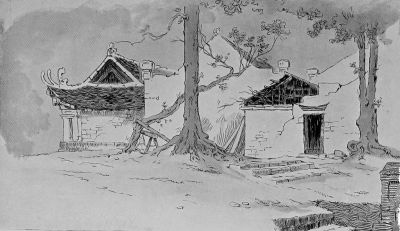
PAGODA USED FOR AMBUSH. [See page 139.]
"Yes," I answered. "But you must take that wounded linh; he would hamper me."
"Of course," he replied. "Sacré bon Dieu! I had forgotten the coward. Can he stand?"
"I don't think so."
Thereupon he told two men off to fetch the poor beggar, and I felt sorry for him when he appeared tottering, though supported by the two Legionaries.
As already explained, the banyan tree and the bushes masked the pagoda gateway, so that these movements could not be seen by the enemy.
"He'll do," said the corporal. "You two men hold on to him, and help him to keep up. Here you"—this to another tirailleur—"tell him to run his best when we go."
This was explained; and he nodded, mumbled, and would have started off alone if he had not been held. He seemed in a hurry to get away, and we all laughed.
"Now," said our chief, "the Brigade will retire by echelons." Then, with a grin and a bow to me: "You, monsieur, will cover our withdrawal with your battalion. When you hear a volley from us, double out and rejoin with your party. Good luck to you!"
"Bonne chance!" I replied, and went back to my men.
A couple of sharp orders, and the others clattered by at the double. The next minute the enemy's fire broke out with renewed vigour. They probably thought that everybody had left, for no bullets came our way.
Crash! went our volley at them, but they still kept it up: the running white men were too tempting a target.
I waited half a minute, and ordered independent firing of four cartridges per man, and joined in the fun.
This calmed them a little, and I got my men outside, sheltered behind the friendly banyan, ready for the run, as it was probable that the others would soon halt.
The road went off slightly to the right, and was hidden from view by the corner of the wall. We had not long to wait, for in a few seconds the rattle of the rifles told me it was time to start, so away we went in single file at the run. We found the first detachment sheltered behind a ridge between two fields, from whence they had fired two volleys to cover our withdrawal. No one had been hit, the only damage done being to the stock of a rifle belonging to a man who had retreated with me, which had been smashed by a rifle bullet.
There can be no doubt that the rebels were very poor shots at anything over 100 yards; and it is doubtful if any of them knew how to hit a running object. It was not for us to grumble at this, however.
Their fire ceased completely, as soon as we had joined forces. This was due, probably, to the fact that, owing to the continued sound of firing, the picquet from Nha-Nam had been sent out to meet us—though we were unaware of this, as a slight rise of the ground hid the fort from us. We moved off cautiously, and very soon met the relief. This detachment, about fifty strong, went on in hope of engaging the enemy, but were disappointed; for, although they occupied the hillocks from which we had been fired upon, the rebels had not waited for them but retreated, together with the convoy, leaving behind them but a few baskets of rice. So terminated my first experience under fire from a visible enemy.
That night we were awakened, and remained under arms for an hour, for the enemy amused themselves by treating us to a long range fire. It was a waste of ammunition, for nobody was hurt, and we did not reply. Some of my comrades suggested that this was a reprisal for our ambuscade of the afternoon. Personally, I am inclined to believe that it was a feinted attack on our position, designed to engage our attention, and ensure the passage of the belated convoy which had escaped us.
The weather now grew hotter every day, and several cases of heat, apoplexy and fever occurred in our little garrison. It is probable that the fever was due to the digging which had taken place during the construction of our fortifications. This was inevitable, of course; but it is always very dangerous to break new soil in these districts, since the surface to the depth of 3 or 4 feet is mainly composed of decayed vegetation in which the malaria microbe is abundant.
All the newcomers were, of course, victims to prickly-heat, in addition to which many of us were afflicted with small boils. These would not come one or two at a time, but sufferers were literally covered with them. I was one of the first to pay toll to this extremely painful malady. In addition to these unavoidable inconveniences, the whole company suffered from another discomfort which was a cause of deep complaint on the part of the men, since it was due to the neglect of our commissariat department. Because some trifling formality had not been executed, mosquito-nets were not served out to us till late in July, and the lack of them caused many hours of sleepless agony during the hot nights.
A surprising amount of red-tapeism still remained in the commissariat department of France's colonial army; and, though this branch was remodelled at the beginning of 1901, it is generally acknowledged that the authorities responsible for the new order of things have obtained little or no improvement in this respect.
In July the heat became tremendous; the afternoons, which were the hottest part of the day, averaging 110 degrees in the shade. The men were kept indoors from nine in the morning until three in the afternoon, and operations were restricted to short reconnaissances, which took place either in the early morning or in the evening.
These excursions were always made to the south, east or west, but not northwards, as orders had been received from the Brigade to abstain from penetrating into the enemy's country until the summer months had passed. In consequence, the garrison of Nha-Nam disposed of a good deal of leisure time, which the men made use of according to their varied tastes.
Making cloth belts embroidered with flags and other warlike devices was a favourite pastime with many; books and newspapers were in great demand, and a fortnightly convoy from Phulang-Thuong, which brought the European mail, was an incident of importance to all. A rifle range had been built about 500 yards to the west of our position, and each morning saw some unit of the garrison at practice.
Close to the fort, on the south-west side, was a small village inhabited by the camp followers, wives and children of some of the native troops. It contained one small store kept by a Chinaman, at which the troops could obtain tobacco, tinned goods, and strong drinks.
The sale of intoxicants was, however, subjected to strict regulation, any infringement of which would have entailed the peremptory closing of the storekeeper's establishment. The men not on duty were allowed to go into the village from 5 to 7 p.m. only, so that would-be topers had small facilities for over-indulgence, and cases of drunkenness were few and far between. Thirsty souls could obtain good wine from the Government stores in the fort at a very reasonable price, though this supply was with reason restricted to half a litre (a little more than a pint) a day per man.
Our diet was good, for the natives from some of the surrounding villages brought in a plentiful supply of eggs, poultry, pork, fruit and yams, which were readily purchased, as the troops received a mess-grant in addition to their daily ration of bread, fresh meat, coffee, sugar, rice and salt.
During the period of comparative inaction, and profiting by the leisure at my disposal, I made an attempt at learning the Annamese language. Progress was very slow, for the vernacular, like Chinese, is composed of a multitude of sounds, many of which are so similar to each other that only a well-trained ear can distinguish the difference; also, there exists neither alphabet nor grammar to aid the student, and success depends entirely on the possession of a good memory, and inexhaustible patience.
In writing this language the natives use the Chinese characters, each representing a sound; and the extent of knowledge of their literati class is gauged by the number of these each individual has succeeded in retaining. Thus a native who has passed examinations which prove that he possesses five thousand characters, is said to be clever; and one who has shown that he can make use of double that quantity is considered to have reached a very high standard of education indeed.
As in the Chinese and Japanese languages many words possess an honorific as well as a common form. Thus an official, in speaking to an inferior, will refer to himself by using the word tao (I); but in conversing with a superior this form of pronoun in the first person becomes toy (I). It is needless to state that this peculiarity adds considerably to the difficulties the student has to reckon with.
During my search for an insight into the native tongue I came in contact with one of the native sergeants, known as Doy-Tho (doy—sergeant, and tho—a mountaineer). This non-commissioned officer belonged to the hardy and brave mountain tribes of Northern Tonquin, mention of which has already been made.
He had distinguished himself on several occasions, and especially so during the operations against Hou-Thué in December and January.
In appearance, and in his love of danger, he bore a strong resemblance to a Gurkah; and the following account of an incident which took place during one of the attacks on the rebel stronghold, related to me by a Legionary who was present, will give the reader some insight into the character of this plucky little soldier, and indeed into that of his fellow-tribesmen, of whom he was a good example.
During one of the first engagements a section of the native regiment under the orders of a lieutenant succeeded in reaching the first palisade. From behind the trees, or lying flat on the ground, the men opened a smart fire on the rebel position, which was returned with vigour and punctuated by Oriental abuse, composed of rude remarks concerning the individual family of each tirailleur, and the graves of his ancestors.
Doy-Tho, maddened by these insults, stood up in full view of the enemy, and poured forth upon them a torrent of curses and invective.
In their admiration of his daring, and their surprise at the volubility and scope of his abuse, most of the combatants forgot to fire, and a momentary lull took place in the engagement. It lasted a few seconds only, for, lashed to fury by the stinging retorts of the speaker, every rifle on that side of the rampart was turned upon him.
His sakalo and cartridge-cases were shot away, and his clothes riddled with bullet holes; and it is probable that his body would have resembled a sieve had not his lieutenant sprung forward and dragged the howling mountaineer into safety behind a big tree. After this the rebels' fire slackened, and they shouted friendly invitations to the native troops to kill their officers and join them, saying that De-Nam would treat them well, and give one hundred dollars for every head of a French officer they would bring in.
Tho replied with renewed invective from behind the tree, where he had been ordered to remain, and each pause, made through want of breath, he punctuated with a shot from his rifle.
When the engagement was over, and the troops were retiring to Nha-Nam, the lieutenant aforementioned asked the little sergeant if he thought the promises of the rebels were bona fide ones. The nearest translation of Doy-Tho's reply in bad French was something after the following:
"Hum! they belong big liars. Suppose I bring your head, mon lieutenant, perhaps I get ten dollars only."
He and I soon became fast friends, and of an evening, before the door of the fort was closed, I would sometimes go for an hour to his caigna (native hut), and sit and talk with him whilst his wife prepared his evening meal of rice, dried fish, prawns and native salad.
While we discussed the topics of the day, his sons—two sturdy, pot-bellied brats, aged respectively five and seven, naked as they were born—would squat down on the floor of beaten clay and stare open-mouthed at me.
His meal despatched, the little sergeant would stretch himself out on a clean rice straw mat placed on a platform-like bed made of split bamboo which covered half the room. His wife would then bring in a hardwood tray, whereon was a diminutive lamp, a bamboo opium pipe with a blue clay bowl, some little skewer-like implements of silver, and a tiny box of the same metal containing the daily ration of this seductive drug.
Tho would lie on his right side, a hollow block of green-enamelled earthenware, serving as a pillow, beneath his head. His wife would stretch out opposite to and facing him. Between them was placed the tray with its little implements, and the lamp was lit.
This was the solemn moment of the day.
Tho reached out his skinny little brown hand and picked up his pipe, fondling it an instant prior to warming the bowl in the flames, his keen black eyes glancing over his favourite with the fond look of satisfaction and gratitude one sees on the face of a man who greets a well-beloved wife.
This pipe, if such it can be called (for neither in bowl nor stem did it resemble the instrument we give that name to), was of similar form to that used by all Orientals who inhale opium fumes. It consisted of a stem, about 2 feet long, of polished bamboo, about 1½ inches in diameter, the lower end being closed by an ivory cap, while the other extremity was covered by a disc of silver with a small round hole in the centre of it. To this the lips were placed when the fumes were inhaled.