QUESTIONS AND TOPICS
Reading edition
CHAPTER 31
§ 323.--a. Why were the people of South Carolina so opposed to any limitation of slavery? How did they show their opposition?
b. Had slavery disappeared in the North because people thought that it was wrong?
§§ 324, 325.--a. What suggestions were made by some in the North for the ending of slavery? What do you think of these suggestions?
b. For what did Garrison contend, and how did he make his views known? Why were these views opposed in the North?
§ 326.--a. Why were the Southerners so alarmed by Nat Turner's Rebellion?
b. What power had Congress over the mails? How would you have voted on this question?
§§ 327, 328.--a. Why is the right of petition so important? How is this right secured to citizens of the United States?
b. Why should these petitions be considered as insulting to slaveholders?
c. Why were the Southerners so afraid of any discussion of slavery?
CHAPTER 32
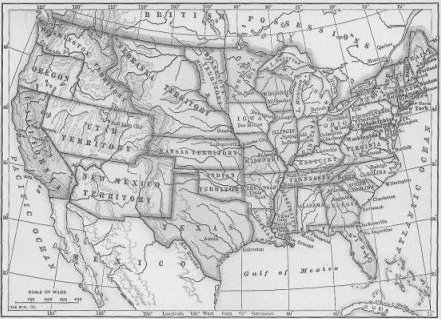
§§ 329, 330.--a. Show by the map the extent of the Mexican Republic.
b. Why did Texas wish to join the United States? What attitude had Mexico taken on slavery?
§§ 331, 332.--a. Explain carefully how the Texas question influenced the election of 1844.
b. What was the Liberty party? How did its formation make the election of Polk possible?
c. What is a "joint resolution"?
§ 333.--How did the Mexicans regard the admission of Texas? What dispute with Mexico arose? Did Mexico begin the war?
§§ 334, 335.--a. What was the plan of Taylor's campaign? Of Scott's campaign?
b. Mention the leading battles of Taylor's campaign. Of Scott's campaign.
§§ 336, 337.--a. What action did the American settlers in California take? With what result?
b. Explain by a map the Mexican cessions of 1848 and 1853.
§§ 338, 339.--a. What was the extent of Oregon in 1845?
b. How was the dispute finally settled? Explain by a map.
c. What was the extent of Oregon in 1847? Is it the same to-day?
d. Of what value was this region to the United States?
CHAPTER 33
§§ 340, 341.--a. Why was there little question whether Oregon would be slave or free?
b. Explain carefully Wilmot's suggestion. What would be the arguments in Congress for and against this "proviso"?
c. What is meant by "squatter sovereignty"? What do you think of the wisdom and justice of such a plan?
§§ 342, 343.--a. Describe the discovery of gold in California and the rush thither. What difference did one year make in the population of California?
b. What attitude did California take on the slavery question? Why?
§§ 344, 345.--a. How had the question of slavery already divided the country?
b. What extreme parties were there in the North and the South?
c. Why was the question about the territories so important?
d. What action did President Taylor take? Why? What do you think of the wisdom of this policy?
§§ 346, 347.--a. State the provisions of Clay's compromise plan. Which of these favored the North? The South?
b. What law had been made as to fugitive slaves? Why had it not been enforced? Why was the change made in 1850 so important?
c. How would you have acted had you been a United States officer called to carry out the Fugitive Slave Law?
§ 348.--a. Who was Mrs. Stowe? What view did she take of slavery?
b. Were there any good points in the slave system?
c. Why is this book so important?
CHAPTER 34
§§ 349-351.--a. Who were the candidates in 1852? Who was chosen? Why?
b. What doctrine did Douglas apply to Kansas and Nebraska?
c. Why did Chase call this bill "a violation of faith"?
d. Was Douglas a patriot? Chase? Sumner? Pierce?
§ 352.--a. Give an account of the early life and training of Abraham Lincoln.
b. What did he think of the Kansas-Nebraska Act?
§§ 353, 354.--a. What effect did the Kansas-Nebraska Act have on the settlement of Kansas?
b. Describe the election. Do you think that laws made by a legislature so elected were binding?
d. Explain the difference in the attitude of the Senate and House on the Kansas question.
§§ 355, 356.--a. How was the Republican party formed? b. Were its principles like or unlike those of the Republican party of Jefferson's time? Give your reasons.
§ 357.--a. What rights did the Supreme Court declare a slave could not possess? Was a slave a person or a thing?
b. What power does the Constitution give Congress over a territory? (Art. IV, Sec. 3.)
§ 358.--a. Explain carefully the quotations from Lincoln's speeches.
b. Was the doctrine of popular sovereignty necessarily favorable to slavery? Give illustrations to support your reasons.
c. Was Douglas's declaration in harmony with the decision of the Supreme Court?
§§ 359, 360.--a. Compare the attitude of Douglas and Buchanan upon the admission of Kansas.
b. Describe John Brown's raid. Was he a traitor?
GENERAL QUESTIONS
a. Give, with dates, the important laws as to slavery since 1783.
b. What were the arguments in favor of the extension of slavery? Against it?
c. Find and learn a poem against slavery by Whittier, Lowell, or Longfellow.
d. Make a table of elections since 1788, with the leading parties, candidates, and principal issues. Underline the name of the candidate elected.
TOPICS FOR SPECIAL WORK
a. John Brown in Kansas or at Harper's Ferry.
b. The career, to this time, of any man mentioned in Chapters 33 and 34.
c. Any one fugitive slave case: Jerry McHenry in Syracuse (A.J. May's Antislavery Conflicts), Shadrach, Anthony Burns.
SUGGESTIONS
Preparation is especially important in teaching this period. The teacher will find references to larger books in Channing's Students' History.
Show how the question of slavery was really at the basis of the Mexican War. Geographical conditions and the settlement of the Western country should be carefully noted. A limited use of the writings and speeches of prominent men and writers is especially valuable at this point.
Have a large map of the United States in the class room, cut out and fasten upon this map pieces of white and black paper to illustrate the effects of legislation under discussion, and also to illustrate the various elections.
The horrors of slavery should be but lightly touched. Emphasize especially the fact that slavery prevented rather than aided the development of the South, and was an evil economically as well as socially.
THE UNITED STATES IN 1860.