QUESTIONS AND TOPICS
Reading edition
CHAPTER 17
§§ 168, 169.--a. What were the chief weaknesses of the Confederation? Why did not Congress have any real power?
b. How did some states treat other states? Why?
§§ 170-173.--a. Explain the distress among the people.
b. Describe the attitude of the British government and give some reason for it.
c. Why did the value of paper money keep changing?
d. What were the "tender laws"? The "stay laws"?
e. Give some illustration of how these laws would affect trade.
§ 174.--a. Describe the troubles in Massachusetts.
b. What was the result of this rebellion?
§§ 175-178.--a. What common interest did all the states have?
b. What did Maryland contend? State carefully the result of Maryland's action. Describe the land cessions.
c. How did the holding these lands benefit the United States?
d. Give the provisions of the Ordinance of 1787. What was the result of the declaration as to slaves?
e. What privileges were the settlers to have? Why is this Ordinance so important?
CHAPTER 18
§§ 179-181.--a. What difficulties in the United States showed the necessity of a stronger government?
b. How could the Articles of Confederation be amended?
c. What was the important work of Madison?
d. What was the advantage of having Washington act as President of the Convention?
§§ 182, 183.--a. Explain fully the provisions of the Virginia plan. What departments were decided upon?
b. Why did New Jersey and Delaware oppose the Virginia plan? What were the great objections to the New Jersey plan?
§§ 184-186.--a. What is a compromise? What are the three great compromises of the Constitution?
b. Explain the compromise as to representation. What does the Senate represent? What the House?
c. Define apportionment. What do you think of the wisdom of the compromise as to apportionment? What of its justice?
d. Why was there a conflict over the clause as to commerce? How was the matter settled?
§§ 187-189.--a. What events at first seemed to disprove Franklin's prophecy?
b. Compare the Constitution with the Articles of Confederation and show in what respects the Constitution was much stronger.
c. Explain how the new government could control individuals.
d. What were some of the duties of the President? Of Congress? Of the Supreme Court?
§§ 190-192.--a. What is the difference between a national and a federal government? Was Henry's criticism true?
b. Study the first ten amendments and state how far they met the objections of those opposed to the Constitution.
c. Repeat the Tenth Amendment from memory.
d. How was the Constitution ratified?
e. How did the choice of Washington as first President influence popular feeling toward the new government?
GENERAL QUESTIONS
a. Why should the people have shown loyalty to the states rather than to the United States?
b. Analyze the Constitution as follows:--
EXECUTIVE. LEGISLATIVE. JUDICIARY.
Method of Appointment or Election
Term of Office.
Duties and Powers.
TOPICS FOR SPECIAL WORK
The career of any one man prominent in the Convention, as Madison, Hamilton, Franklin, Washington, Robert Morris, etc. Write a brief biography.
SUGGESTIONS TO THE TEACHER
This period should be taught very slowly and very thoroughly, as it demands much more time than any of the earlier periods. A clear understanding of the Constitution is of the most practical value, not merely to enable one to comprehend the later history, but also to enable one to understand present duties. Note carefully the "federal ratio" and the functions of the Supreme Court. Use the text of the Constitution and emphasize especially those portions of importance in the later history.
This work is difficult. It should therefore be most fully illustrated from recent political struggles. Let the children represent characters in the Convention and discuss the various plans proposed. Encourage them also to suggest transactions which might represent the working of the tender laws, the commercial warfare between the states, the "federal ratio" etc. Especially study the first ten amendments and show how they limit the power of the general government to-day.
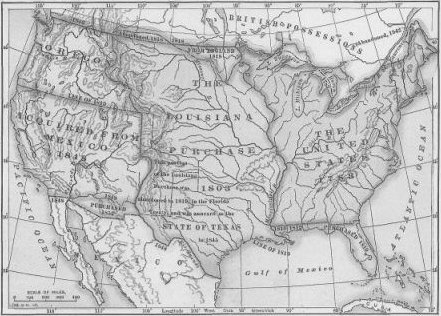
TERRITORIAL ACQUISITIONS 1783-1853.