Page 8 NATURAL RESOURCES OF WASHINGTON.
Reading edition
Probably few other states in the Union excel Washington in the great variety, abundance and value of the natural gifts prepared and ripe for the hand of man within its borders. Preceding races were content to leave its wealth to us, being themselves satisfied to subsist upon that which was at hand and ready for consumption with no effort but the effort of taking. The impenetrable forests were to them a barrier to be let alone. For the minerals within the mountains they had no use, and to gather wealth from the tillage of the soil needed too much exertion. Fish and game and fruits all ready to gather were all they sought, and the state had enough of these to attract and hold a large population. But the vision of the white man was different. His eye scanned the peaks of the Cascades with its great eternal white Rainier having its head thrust up among the clouds, and he realized that around and beneath them must be a vast hoard of the precious metals. His eye caught the dazzling grandeur of the white-capped Olympics, but he realized that they held in reserve something more substantial to his needs than scenery and hunting grounds. The impenetrable barriers of the forest-covered foothills were to him a treasure worth the struggle for an empire. He scanned the glittering waters of the bays and inlets of Puget Sound and its great open way to the Pacific Ocean and realized that it meant more to him and to his children than a place to catch a few fish. He viewed the vast plains of "barren" land within the great winding course of the Columbia river and believed it worth more than pasturage for a few bands of ponies.
The thousand tumbling water-falls that hastened the course of the rivers toward the sea meant more than resting places for the chase. No wonder the hardy pioneers whose vision saw the grandeur of Washington and comprehended its meaning dared a mighty journey, vast hardships and trying and dangerous hazards to save this empire to Uncle Sam. Washington, saved by the energy and foresight of a few, has become the Page 9 delightful home of a million and more, and their possession is one that Alexander or Napoleon would have coveted, had they known.
Plate No. 3.—Chehalis County Timber.
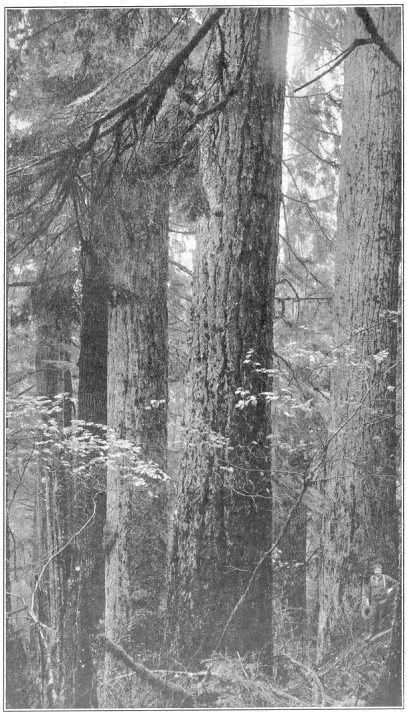
Plate No. 4.—The Logging Industry in Chehalis County.
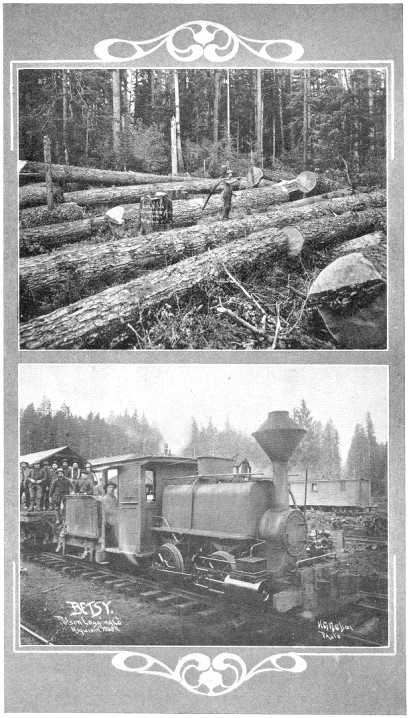
Plate No. 5.—View of Harbor, Aberdeen, Chehalis County.
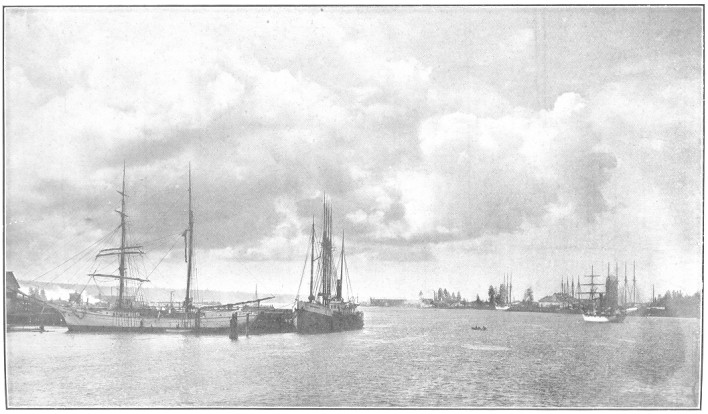
Plate No. 6.—Limb Cut from a Chelan County Peach Tree.
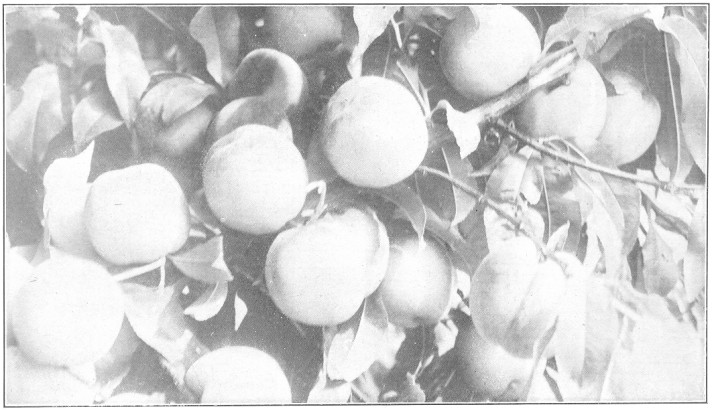
Plate No. 7.—Six-Year-Old Winesap Apple Tree on Farm of Blackmont Bros., Chelan County.
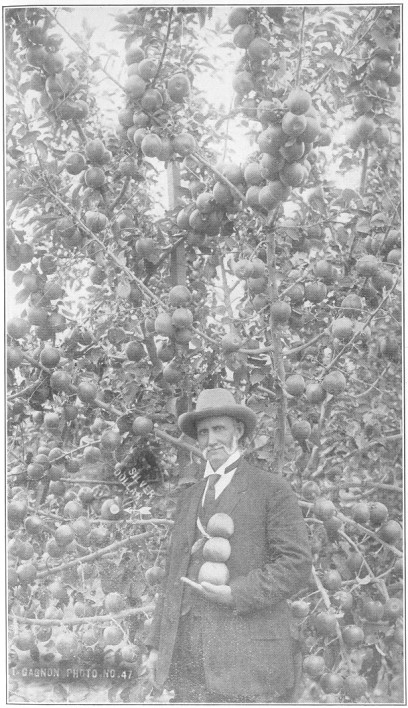
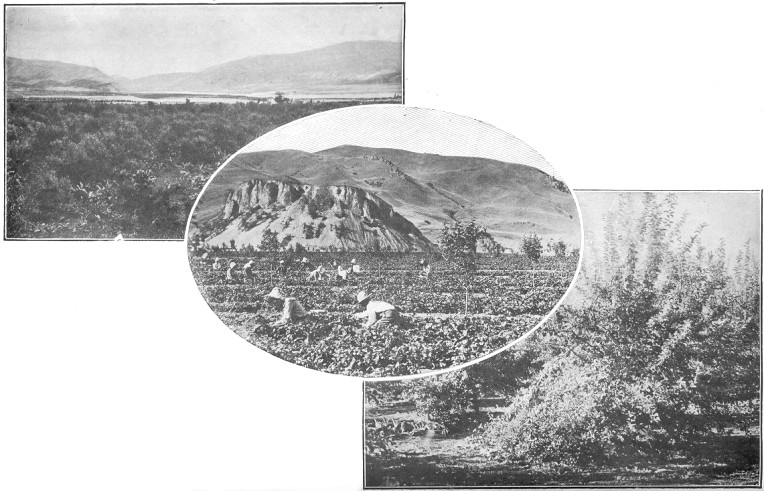
Plate No. 8.—Farm of Wm. Turner, Chelan County. From Sage Brush to Bearing Orchard, Showing How Living Is Made While Orchard Is Coming Into Bearing.
FORESTS.
From British Columbia to the majestic Columbia river and from the Cascade mountains westward to the ocean a vast forest of magnificent timber stretches out over mountain and hill and valley, covering the whole landscape of western Washington in a mantle of living green. The majestic fir trees, which, as small evergreens, adorn the lawns of other climes, here stretch their ancient heads 300 feet heavenward and give the logger a chance to stand upon his springboard and, leaving a fifteen foot stump, cut off a log 100 feet in length and 7 feet in diameter free from limbs or knots. Side by side with these giants of fir are other giants of cedar, hemlock and spruce crowded in groups, sometimes all alike and sometimes promiscuously mingled, which offer to the logger often 50,000 feet of lumber from an acre of ground.
But these great forests of western Washington are not all the forests within the state. The eastern slope of the Cascade mountains well down toward the lands of the valleys is mostly covered with timber. A belt from 30 to 50 miles wide stretching clear across the north boundary of eastern Washington is mostly a forest, while a large area in the southeastern corner of the state, probably 24 miles square, is also forest covered.
To estimate the amount of timber which can be cut from these vast forest areas is difficult; estimates are not accurate, yet it is probable that the lumber made will in time far exceed any estimate yet placed upon this chief source of the wealth of the State of Washington. Of the fir the estimate has been made that shows still standing enough timber to make 120 billion feet; for the cedar the estimate is 25 billion feet, while the same amount of 25 billion feet is credited to hemlock; 12 billion feet of spruce are claimed, 12 billion feet of yellow pine and probably 6 billion feet of other woods, including maple, alder, oak, yew, ash and many others, together forming the great mass of 200 billion feet of lumber. Where forest areas are cut off, the Page 10 sun and air at once start to life seeds which lie dormant in the shade and a new crop at once starts and the old ground is in a few years reforested in nature's prodigal way, a thousand seeds sprouting and growing where only one giant can ultimately stand.
Of these timbers, the fir, largest in quantity, is also largest in usefulness. For bridge work, shipbuilding, the construction of houses, etc. it is unsurpassed. Cedar is lighter and more easily worked and for shingles chiefly and many other special uses is superior. Spruce is fine grained, odorless and valuable for butter tubs, interior finish, shelving, etc. The hemlock is valuable not only for the tannin of its bark, but as a wood for many purposes is equal to spruce. The yellow pine, where it is plentiful is the main wood used in house construction and for nearly all farm purposes. The yellow pine is the chief timber in all eastern Washington. The harder woods, maple, alder, ash, etc., are used where available in furniture construction and for fuel, as are also all the other woods.
COAL.
Not content with covering half the surface of the state with forests for fuel, the Creator hid away under the forests an additional supply of heat and power sufficient to last its future citizens an indefinite period. The white man was not slow to find and locate the coal measures in many counties, notably in Kittitas, King, Pierce, Lewis, Whatcom and Thurston, and to put it to the task of driving his machinery. The coal measures of these counties are of vast extent, and, although little developed yet, there are 3,000,000 tons of coal mined annually in Washington. Other counties are known to have coal measures beneath their forests, but as yet they have not been opened up for commerce.
The coal already mined includes both lignite and bituminous varieties and furnishes fuel for the railroads, steamboats and power plants, giving very satisfactory results. Much of the bituminous coal makes an excellent article of coke and provides this concentrated carbon for the various plants about the state engaged in smelting iron and other metals.
Page 11 The fixed carbon of the coal ranges from 48 to 65 per cent. and the total values in carbon from 64 to 80 per cent. and the ash from 3 to 17 per cent. The coal measures underlie probably the great bulk of the foothills on both sides of the Cascades and some of the Olympics, the Blue mountains of the southeast and some of the low mountains in the northeastern part of the state.
Besides these coals already mentioned, it is known that veins of anthracite coal exist in the western part of Lewis county, the extent and value of which have not been fully determined, and, owing to the absence of transportation, are not on the market.
MINERAL ORES.
The general topography of the state suggests at once the probability of deposits of ores of the precious metals, and the cursory prospecting already done justifies the outlook. Practically the entire mountain regions are enticing fields for the prospector. Substantial rewards have already been realized by many who have chanced the hardships, and there are now in operation many mining enterprises which are yearly adding a substantial sum to the output of the wealth of the state. The ores occur chiefly in veins of low grade and great width and known as base on account of the presence of sulphur, arsenic and other elements compelling the ores to be roasted before smelting.
There are, however, some high grade ores in narrow fissures and in a few localities free milling ores and placer deposits are found. In most cases the free milling ores are the result of oxidation and will be found to be base as water level is reached in the mining process.
Mining of precious metals is being prosecuted in Whatcom, Skagit, Snohomish, King, Pierce, Lewis, Skamania, Cowlitz, Okanogan, Chelan, Kittitas, Yakima, Klickitat, Ferry and Stevens counties.
Of the metals the mines of the state are producing gold, silver, lead, copper, quicksilver, zinc, arsenic, antimony, molybdenum, Page 12 nickel, cobalt, tungsten, titanium, bismuth, sulphur, selenium, tellurium, tin and platinum.
There are also iron mines, and quarries of marble, granite, onyx, serpentine, limestone and sandstone—beds of fire clay, kaolin, fire and potter's clays, talc and asbestos and many prospects of petroleum.
Mining is suffering for the lack of transportation for the low grade ores, but prospects are excellent for relief in this regard in the near future. The era of wildcat exploitation has been relegated to the past and legitimate mining is now getting a firmer hold in the state, and we look for results within the next five years which will astonish many who think themselves well informed.
FISHERIES.
A glance at the map of the state will disclose a remarkable combination of salt and fresh waters within the jurisdiction of the state of such a character as to amaze one not familiar with it, but learned in the habits of the finny tribe in general.
The ocean is the great feeding ground. Out of its mysterious depths the millions of fish come into fresh waters fat and rich from the salt water vegetation.
Plate No. 9.—Chelan County Views.
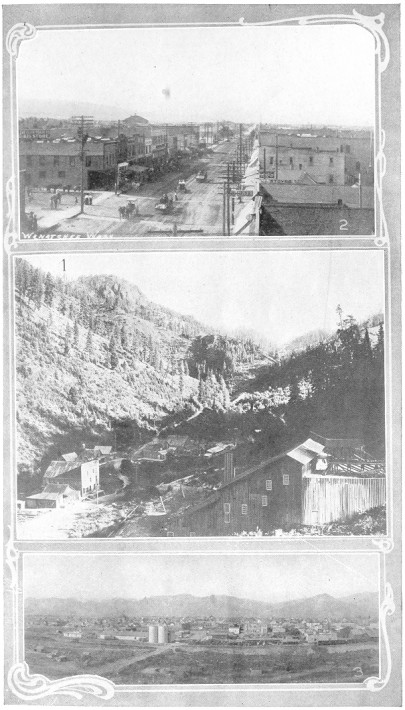
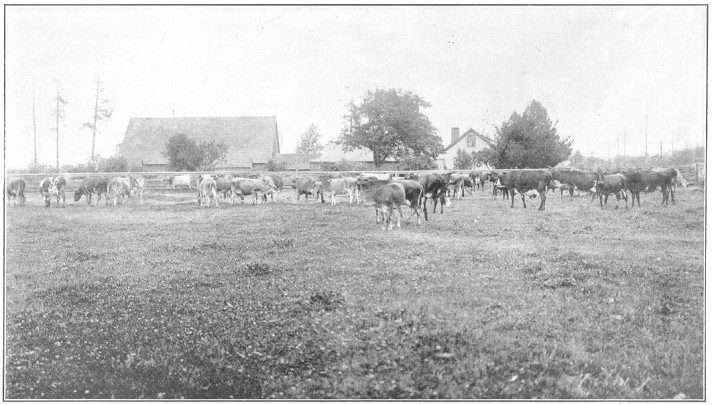
Plate No. 10.—Farm and Dairy Scene Common to Clallam County.
The great Columbia river in the south, Willapa harbor, Grays harbor, the majestic straits of Fuca and the equally majestic straits of Georgia on the north are all great open highways from the sea, not only for merchandise laden ships, but for myriads of salt water food fishes which annually traverse their bottoms. Into these open mouths flows a great network of fresh water rivers and streams, draining the entire area of the state and providing the spawning waters for the fishes from the sea not only, but for millions of strictly fresh water fishes. Not only these, but late years have proven the shore waters of the state to produce also great numbers of oysters, clams, crabs and shrimp. Nor is this all, because the proximity of the state to the ocean gives it a great advantage in profiting from the fishing industry among that class of the finny hosts who refuse to leave their salt water homes. So that from the whales of Bering sea to the speckled beauties that haunt the mountain Page 13 streams, through the long list of delectable salt and fresh water food, the fisherman of Washington has an enticing and most profitable chance to satisfy his love of sport and adventure not only, but to increase his bank account as well.
SOILS AND LANDS.
Washington is particularly blessed in having a diversity of soils, all admirably adapted to some department of agriculture and giving the state the opportunity of great diversity in the occupations of its people. The central plateau of eastern Washington, made up of level stretches and undulating hills, is all covered with a soil composed of volcanic ash and the disintegration of basaltic rocks which, together with some humus from decayed vegetation, has made a field of surpassing fertility for the production of the cereals with scant water supply; but under the magic touch of irrigation it doubles its output and makes of it not only a grain field but an orchard and garden as well. Underneath the forests of eastern Washington, along the northern border of the state and in its southeastern corner there is added a large proportion of clay, a necessary element for perpetual pasturage, and widening the field for fruit growing.
In western Washington, upon the bench lands and on the hills and foothills the forests are supported upon a gravelly soil, intermixed with a peculiar shot clay which disintegrates with successive tillage so that when the forests are removed the soil becomes ready for all the grasses and grains and fruits. In the valleys more silt and humus make up the soil, and when the cottonwoods, alders and maples are gone there is left a soil deep and strong for the truck gardener and general farmer, which will endure successive tillings for ages. At the deltas of the rivers are large reaches of level lands, some of which have to be diked to prevent the overflow of the tides, which have had added the fertility of the salts of the ocean and are probably the richest lands in the state fit for cereals and root crops, not omitting the bulbs which have made the deltas of Holland famous. There are also extensive peat beds which, scientifically Page 14 fertilized, will produce abundant returns to the intelligent farmer.
LANDS.
The lands of the state are owned, some by Indian tribes, some by the general government, some by the state, but largely by individual citizens and corporations.
Indian Lands.
Of the Indian lands most of them have been "allotted" and the balance will soon be thrown open to settlement. Of these the largest in western Washington are the Quinault and Makah reservations and in eastern Washington the great Colville reservation. This latter will in time make two or three counties of great value, being adapted to general farming, dairying, fruit growing and mining, and having an abundance of forest area for fuel and building purposes. Those in western Washington are timbered areas at present.
Government Lands.
The remnant of government lands are chiefly among the more barren areas of eastern Washington and the poorer forest lands of western Washington. The method of obtaining title to government lands is generally known, and if not, can be obtained from the general land offices, one of which is in Seattle, Olympia, Vancouver, Spokane, Waterville, Walla Walla and North Yakima. The government still holds title to nearly six million acres, and, while the best has been acquired by others, the diligent searcher can still find homesteads and desert claims worth energy and considerable expense to secure.
State Lands.
A recent estimate of the value of the state lands still in possession makes them worth 56 million dollars. They include nearly 3,000,000 acres, a large portion of which is heavily timbered. These lands may be obtained from the state through the state land commissioner by purchase outright on very easy terms, or may be leased for a term of five to ten years at a low rental, the lessee receiving virtually a first right to purchase.
These state lands are as good as any in the state and offer to the homeseeker a splendid opportunity for a start.
Page 15 In this state there are also numerous tide lands, oyster lands, and shore lands to be obtained at various prices, both from the state and from private individuals who have already acquired title from the state.
WATER POWER.
It is probable that no state in the Union is better equipped for creating power than the State of Washington. Numerous waterfalls of magnitude are already successfully utilized. Among these the most noted are the Spokane falls, capable of producing 400,000 horse power; the Snoqualmie falls, with a sheer descent of 250 feet, with a capacity of 100,000 horse power; Puyallup river at one place is furnishing about 20,000 horse power; the Cedar river has a capacity of 50,000 horse wer; the Nooksack falls with 15,000 horse power already generated; Tumwater falls with 4,000 horse power, with Chelan falls, the Meyers falls and the falls of Asotin creek all in use to limited extent. The waters of the Yakima river are also in use in part for power purposes, but more extensively for irrigation. Besides these there are many minor streams already harnessed.
But the unused water powers of the state far exceed that portion now developed. All its streams are mountain streams, excepting perhaps, the Snake and Columbia rivers. These mountain rivers in a flow of 50 to 200 miles make a descent of 2,000 to 5,000 feet in reaching sea level, providing innumerable opportunities to use the falls already created by nature, or to divert the waters and produce artificial falls.
No heritage of the state is of greater value and none more appreciated than this water power. Since the introduction of electricity as a lighting and motive force, its creation by water power looms into immense importance. The exhibition of its achievements to be seen in Washington today is amazing to the men whose vision of light and power was first with the tallow dip and four-footed beasts, and later with kerosene and steam. Electricity, created by our water falls, lights our cities and farm homes, draws our street cars and some railroad cars—pushes most of the machinery used in manufactories, to the great satisfaction and profit of our citizens.
Page 16 GAME.
The State of Washington was once a paradise for the sportsman in its every corner. Its desert lands were full of jack rabbits and sage hens; over its mountains and foothills roamed herds of elk, mountain goats, deer, and many bear, cougar and wild cats. In its timbered valleys were pheasants and grouse in plenty. Upon its waters and sloughs the wild ducks and geese were in vast flocks, while its waters teemed with salmon in many varieties, and several families of the cod tribe, sole, flounders, perch, mountain trout and other fish.
While these conditions cannot now be said to exist in full, yet at certain seasons, and in some places, the same game, animals, birds and fishes are in abundance, and the sportsman, while he may not have his "fill," may satisfy a reasonable amount of his craving for the excitement of the frontier. The state has deemed it wise to restrict the time and place within which its game can be taken and the amount a single individual shall kill. These regulations suffice partly to preserve the game from extinction and help replenish the state's treasury, and are considered wise and reasonable.
SCENERY.
If Washington is mighty in forest possession, provided with fuel for centuries in its coal beds, rich in precious metals, with great open waterways full of fish roads from the ocean and millions of fishes in its inland waters, with game upon its thousand hills and its vast plains loaded with waving grains and red with luscious fruits, still its crowning glory is its matchless scenery.
Towering above the clouds, with its head crowned with eternal snows, its sides forever glistening with icy glaciers till their feet touch the green tops of its foothills, near the center of the state, stands in imposing grandeur the highest mountain of the states—grand, old Mount Rainier.
Plate No. 11.—Fish Cannery at Port Angeles, Clallam County.
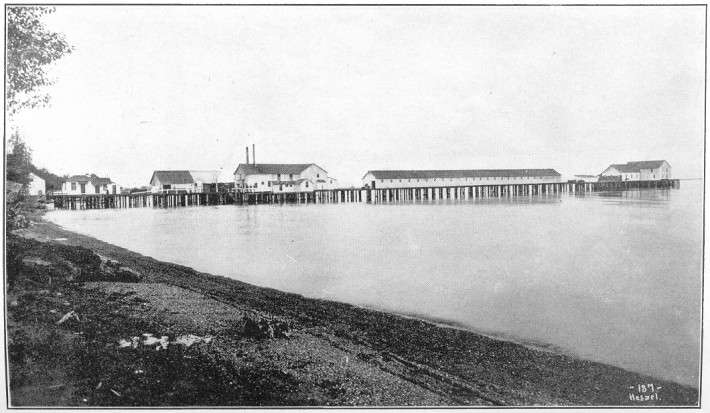
Plate No. 12.—A Forest Scene in Clallam County.
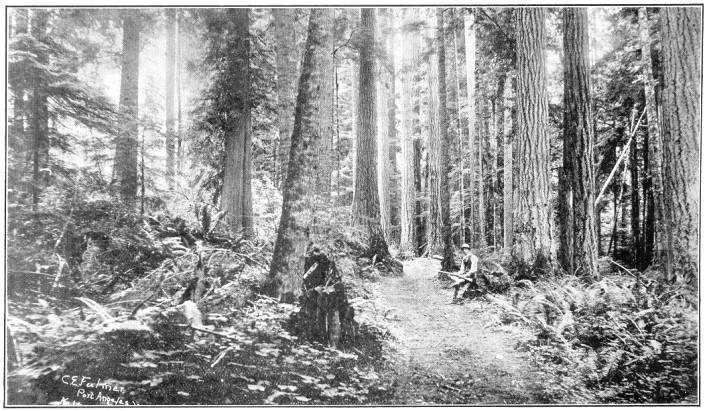
Plate No. 13.—North Bank Bridge Over the Columbia River at Vancouver, Clarke County.
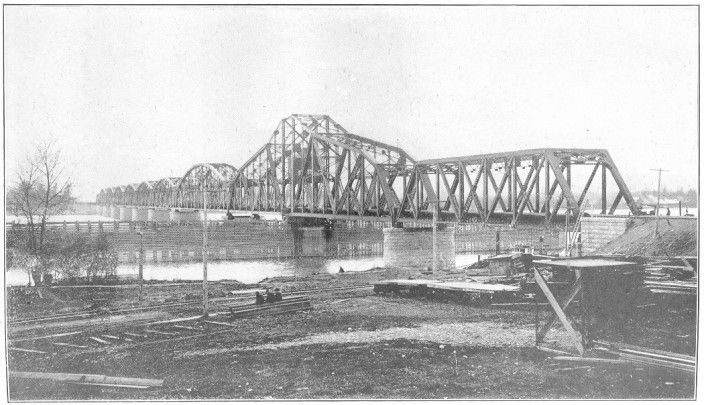
Plate No. 14.—U. S. Army Post, Vancouver, Clarke County.
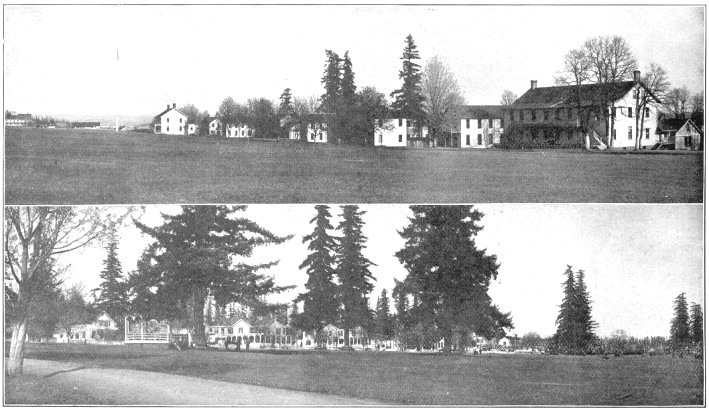
Plate No. 15.—Stock-Raising in Clarke County.
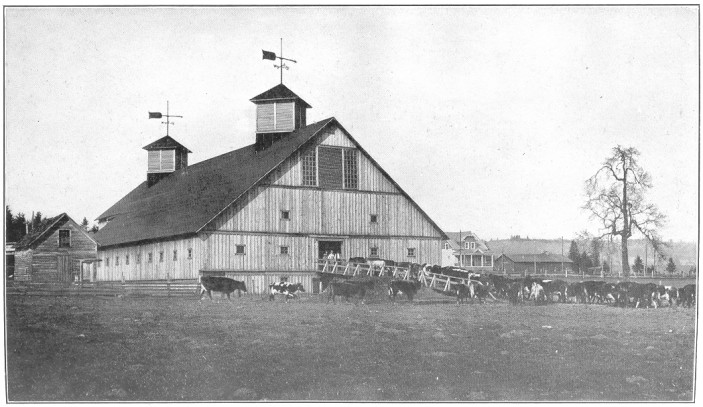
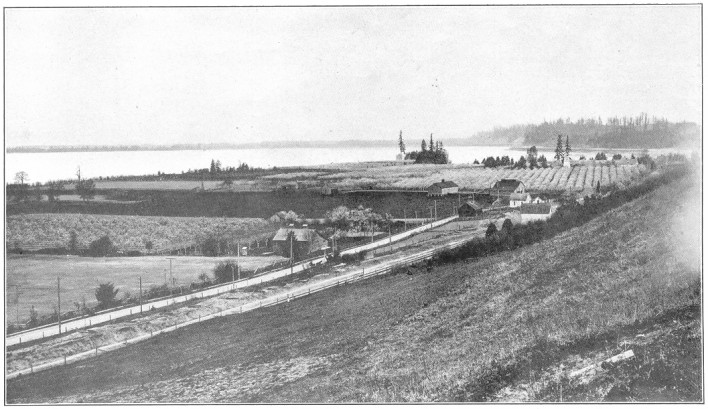
Plate No. 16.—A Clarke County Fruit Ranch.
Through its center north and south the Cascade mountains in a zigzag course lift their clustered peaks and mountain passes from four to eight thousand feet above the sea, while Mount Olympus and his colleagues higher still poke their inspiring Page 17 front heavenward. Between these two white and green clad mountain ranges, protected from the blizzards of the southwestern plains and from the hurricanes from the ocean, lie in safety the placid waters of Washington's great inland sea, matchless Puget Sound.
Where else upon the globe is such a diversified stretch of tranquil water, upon whose shores the ocean tides ebb and flow, upon whose surface the navies of the world could maneuver to their heart's content, while visible from shore to shore are the vast evergreen forests, interlaced with winding waters and stretching gently upwards till they reach the visible mountain peaks a hundred miles away, thousands of feet skyward?
Scarcely less enchanting is the view eastward from the Rainier's lofty height—a vast stretch of hill and plain almost surrounded by green mountain sides, through whose gray and green fields flow the great winding courses of the mighty Columbia and the lazy Snake rivers, while a multitude of smaller streams gleam through the forest sides of the mountains over innumerable waterfalls. Here within the foothills you gaze upon the largest lake within the state, a beauty spot to enchant alike the artist and the sportsman. Deep within its rocky sides and full of speckled beauties lying like a mirror in the stretch of green hills about it, lies Lake Chelan, and on its unruffled bosom a fleet of boats ply for fifty miles beyond its outlet till reach the mining foothills of the mountains. A hundred miles eastward, still among the scattered pines of northeastern Washington, the Spokane river tumbles in masses of foam and spray over a succession of rocky falls on its way to the Columbia, while still further on the Pend d'Oreille and upper reaches of the Columbia river flow close up among the mountains and foothills and present a series of beautiful combinations of rock, trees, hills and valleys, of forests and waterfalls of magnificent beauty. Washington in its scenery is magnificent in proportions, wonderful in its variety, grand and imposing in form and feature—picturesque—enticing—"a thing of beauty and a joy forever."