Page 18 PRINCIPAL INDUSTRIES OF WASHINGTON.
Reading edition
LUMBERING.
The description of the resources of a state naturally suggests what its industries are. The forests of western Washington inevitably lead to the lumber industry and the fertile soil of eastern Washington point as unerringly to agriculture. These are the two great industries of the state. The lumberman and the farmer are in the majority. Already there are sawmills enough in operation to cut up all the standing timber in the state within fifty years. They employ probably 100,000 men. This includes those engaged in logging and the subsidiary industries.
Of the trees the fir is pre-eminently useful, and more than half of the forests of the state are fir trees. It is of greater strength than any of the others and hence is used for all structural work where strength is of special importance. It is rather coarse grained, but when quarter sawed produces a great variety of grains very beautiful and capable of high finish and is extensively used for inside finishings for houses as well as for frame work. Its strength makes it ideal for the construction of ships. The yellow pine is strong, medium grained and well fitted for general building purposes, and is very extensively used in eastern Washington.
Cedar is very light and close grained and is chiefly used for shingles, and for this purpose has no superior. The cheaper grades are also used for boxes and sheathing for houses and many other purposes.
The spruce furnishes an odorless wood especially useful for butter tubs; for shelving and similar uses it is superior to either the fir or cedar. It is a white, close grained lumber, and appreciating in value.
The hemlock, whose bark produces tannin for the tanneries, is also a close grained light wood coming more and more into Page 19 general use, for many purposes, especially where it will not be exposed to the weather.
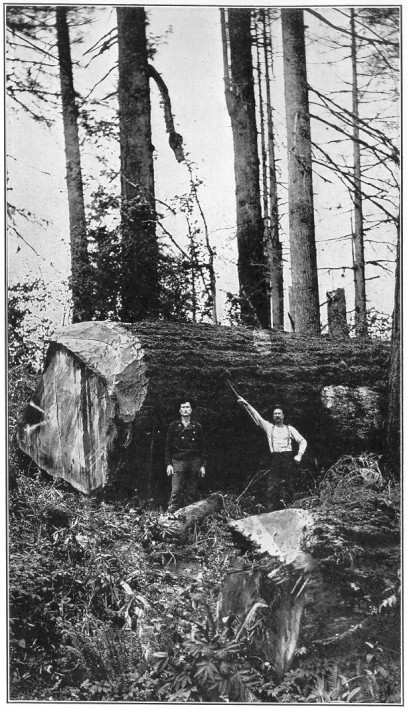
Logs frequently seven feet in diameter require big saws, and big carriers 50 to 100 feet long, and hence Washington has probably the largest sawmills in the world.
Our lumber is used at home and shipped all over the world to make bridges, ships, houses, floors, sash, doors, boxes, barrels, tubs, etc. Factories for the manufacture of wood products are scattered all over the state. Most of the sawmills and some factories are driven by steam made by burning sawdust, slabs, and other refuse of the mills. Coal and electricity, however, are both in use.
COAL MINING.
The mining of coal for foreign and domestic purposes is one of the most important of Washington's industries. The annual output of the mines is about three million tons, worth about eight million dollars; Fifty thousand tons of coke are made annually, worth at the ovens about $300,000. The coal mining industry gives employment to 6,000 men. The production of coal for 1907 was distributed as follows:
Kittitas County, tons 1,524,421
King County, tons 1,446,966
Pierce County, tons 612,539
Lewis County, tons 101,275
Thurston County, tons 33,772
Whatcom County, tons 3,160
Clallam County, tons 300
The coke nearly all comes from Pierce county.
Nearly forty different corporations and individuals are engaged in coal mining. The coals thus far commercially mined are chiefly lignite and bituminous. These coal measures lie along the base of the foothills, chiefly of the Cascade mountains. Higher up are some mines of anthracite coals, not yet on the market for lack of transportation. As far as discovered they are chiefly near the headwaters of the Cowlitz river in Lewis county. Coal forms the largest factory in furnishing steam for the mill roads. Some of the railroads, notably the Page 20 Northern Pacific and Great Northern, own their own mines and mine the coal for their own engines and shops.
It is also the main fuel supply for domestic uses, although fir and yellow pine cordwood is extensively used when the cost of transportation is not too great.
Coal is also the chief fuel used in steamboats, both those plying over inland waters and the ocean-going boats as well. Here also, however, the fir wood proves a good substitute and is used to some extent by local steamers on the Sound.
Coal is also used to create both steam and electricity for most of the large heating plants in the cities and in many factories and manufacturing plants, flour mills, elevators, etc. The fact that vast coal measures lie within 50 miles of the seaports of Puget Sound is a very important factor in insuring the construction of manufacturing establishments and the concentration of transportation in these ports.
Coal is also used in all the large cities for the manufacture of illuminating gas and as a by-product of this industry coke, coal tar, and crude creosote are produced.
The coke from the ovens goes chiefly to the smelters for the reduction of ores, both of the precious metals and iron.
METAL MINING.
The mining industry other than coal is quite rapidly reaching importance among our industries. There are in the state three large smelters, whose annual output of precious metals far surpasses in value the output of our coal mines. The ores for these values, however, do not all come from the mines of this state. Other states, British Columbia, Alaska, and some foreign countries help furnish the ores. But Washington has within its borders a great mineralized territory, not yet thoroughly prospected and very little developed, yet which materially assists in supplying these smelters with their ores.
Plate No. 17.—Ocean-Going Raft, Built at Stella, Cowlitz County, by the Oregon Rafting Company.
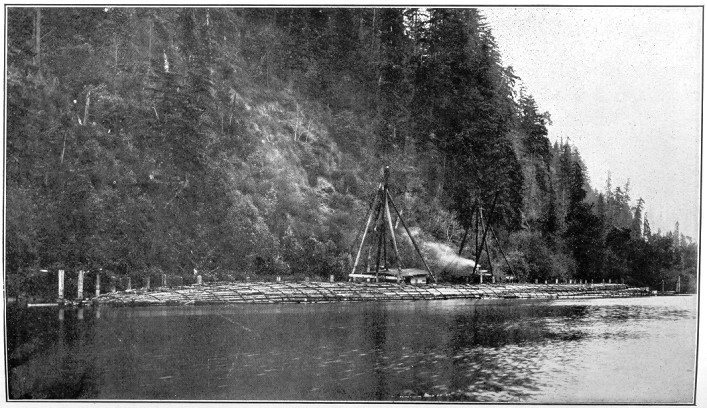
Plate No. 18.—COWLITZ COUNTY TIMBER. This Stick Was 301 Feet Long and 36 Feet in Circumference at Stump.
The smelter at Everett receives a steady supply of arsenical ores of copper, lead, gold, silver and zinc from the mines of Snohomish county which are of magnitude sufficient to make profitable the railroad which has been built to Monte Cristo Page 21 purposely for these ores. This smelter has a special plant for saving the arsenic in these ores, which materially adds to the value of its output and is said to be the only one of its kind in the nation.
Besides the mines at Monte Cristo, there are copper mines being successfully worked at Index, whose ores are shipped both to Everett and Tacoma.
At Tacoma is located one of the largest smelting and refining plants in the nation, which draws its ores from all parts of the world. At North Port in Stevens county is a smelter which is chiefly supplied with ores from this state, supplemented by those of British Columbia. At Republic in Ferry county are mines producing gold and silver ores of such extent as to have induced the building of a branch line of railroad to carry their ores to this smelter. There are also in Stevens county large deposits of silver-lead ores, which will be large producers as soon as better transportation is secured. This last statement is also true regarding many mines in other counties.
FISHING INDUSTRY.
The business of catching, preserving and selling fish gives employment probably to more than 10,000 men in this state and adds probably four million dollars annually to its wealth production. The fishes include salmon, which is the chief commercial species, cod in many varieties, halibut, salmon trout, perch, sole, flounders, smelt, herring, sardines, oysters, clams, crabs and shrimp from its salt waters, and sturgeon, trout, perch, black bass, white fish and many others from the fresh water. Great quantities of salmon and halibut are shipped in ice-packed boxes, fresh from the waters, to all parts of the nation. Of these fish, many salmon, halibut and cod are caught in Alaskan waters and brought into this state to be cured and prepared for the market.
The salmon are chiefly packed in tin cans after being cooked; the cod are handled as are the eastern cod, dried and salted. The business of handling the smelts, herring, etc., is in its infancy, as is also that of the shellfish.
Page 22 The propagation of oysters, both native and eastern, is assuming great importance in many places in the state. In Shoalwater bay, Willipa bay, Grays harbor, and many of the bays and inlets of Puget Sound, oysters are being successfully grown. In some instances oyster farms are paying as much as $1,000 per acre. The state has sold many thousand acres of submerged lands for this purpose. It has also reserved several thousand acres of natural oyster beds, from which the seed oysters are annually sold at a cheap price to the oyster farmers, who plant them upon their own lands and market them when full grown.
The native oysters are much smaller than the eastern oysters and of a distinct flavor, but command the same prices in the market.
AGRICULTURE.
Cereals.
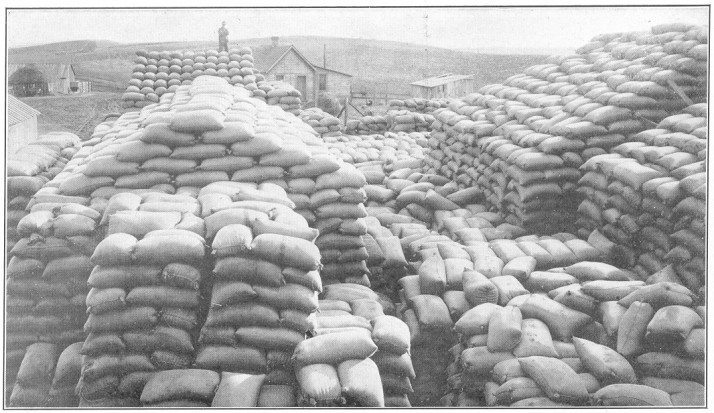
The largest and most important industry in the state is without doubt the cultivation of the soil. The great variety of the soils and climatic conditions has made the state, in different parts, admirably adapted to a large variety of farm products. Vast fields of wheat cover a large proportion of the uplands of eastern Washington, the average yield of which is greater than that of any other state in the Union.
The diked lands of western Washington produce oats at the rate of 100 to 125 bushels per acre. In some counties in southeastern Washington barley is more profitable than any other cereal, on account of the large yield and superior quality.
Corn is successfully raised in some of the irrigated lands, but is not as profitable as some other crops and hence is not an important factor in Washington's grain supply. Rye, buckwheat, and flax, are successfully grown in many localities. In western Washington, particularly, peas form an important ration for stock food and are extensively raised for seed, excelling in quality the peas of most other states.
Page 23 Hops.
Hops are a large staple product in many counties of the state. They are of excellent quality, and the yield is large and their cultivation generally profitable. The chief drawback is in the fluctuations of the market price.
Grass and Hay.
Grass here, as elsewhere, is very little talked about, although it is one of the large elements that make the profits of agriculture. Saying nothing of the vast amount of grass consumed green, the state probably produces a million tons of hay annually, averaging $10 per ton in value. Western Washington is evergreen in pasturage as well as forests and no spot in the Union can excel it for annual grass production.
East of the mountains a very large acreage is in alfalfa, with a yield exceeding six tons per acre.
Potatoes.
On the alluvial soils of western Washington and the irrigated lands of the eastern valleys, potatoes yield exceedingly heavy crops of fine tubers, often from 400 to 600 bushels per acre. All other root crops are produced in abundance.
Beets.
Extensive experiments have proved that the sugar beet can be raised profitably in many counties and sugar is now on the markets of the state, made within its borders from home-grown beets.
Truck Gardening.
Garden stuff is supplied to all the large cities chiefly from surrounding lands in proper seasons, but much is imported from southern localities to supply the market out of season. The soils utilized for this purpose are the low alluvial valley lands and irrigated volcanic ash lands. The yield from both is astonishing to people from the eastern prairie states, and even in western Washington, with its humid atmosphere and cool nights, tomatoes, squashes and sweet corn are being generously furnished the city markets. The warm irrigated lands of eastern Page 24 Washington produce abundant crops of melons, cucumbers, squashes and all other vegetables.
HORTICULTURE.
The conditions for successful fruit growing are abundant, and peculiarly adapted to produce excellence in quality and quantity in nearly all parts of the state, but some localities have better conditions for some particular fruits than others, e. g., western Washington excels in the raising of raspberries and other small fruits of that sort, its climate and soils being suited to the production of large berries and heavy yields.
Certain localities in eastern Washington excel in the yield of orchard fruits, chiefly on irrigated lands. Owing to the abundant sunshine, the fruits of eastern Washington are more highly colored than those of other sections of the state.
Taking the state as a whole, horticulture is rapidly assuming vast importance. Thousands of acres are yearly being added to the area of orchards, and remarkable cash returns are being realized from the older plantings now in full bearing.
This is true of all the common orchard fruits, apples, pears, peaches, plums, cherries, etc.
In western Washington large plantings of the small fruits are growing in favor, some of the new fruits receiving especial attention. One plantation of thirty acres is devoted exclusively to Burbank's phenomenal berry.
Grapes are being grown on both sides of the mountains, the eastern side, however, giving this fruit much more attention. Cranberries are being produced in quantities on some of the bog lands near the sea coast.
Nuts have been planted on both sides of the mountains in an experimental way, and it has been found that walnuts, chestnuts, and filberts are profitable. In the southeastern section of the state, nut growing bids fair to develop into a considerable industry.
Plate No. 19.—Royal Anne Cherry Tree, Owned by J. H. Rogers, Lexington, Cowlitz County. Circumference of this Tree Below First Limb, 72-3 Feet. Yield in 1907, 1,500 pounds.
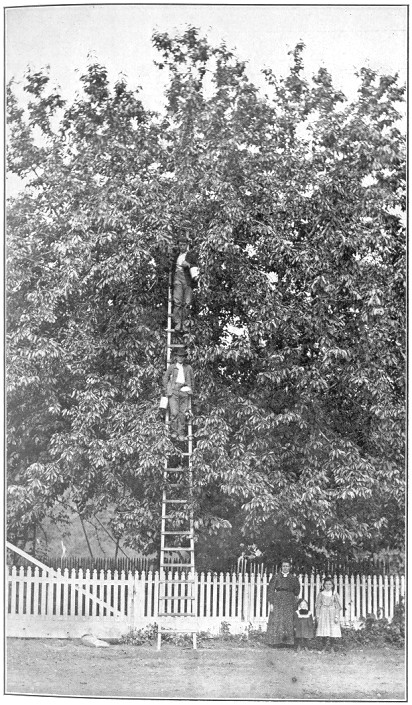
Plate No. 20.—Dairy Herd on Ranch of T. D. Dungan, Kelso, Cowlitz County.
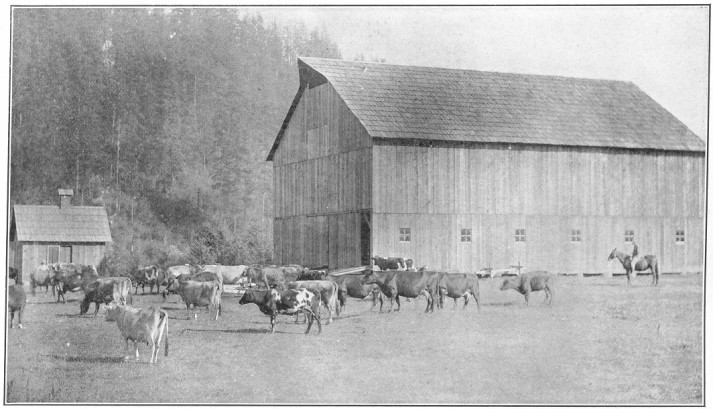
Plate No. 21.—Douglas County Fruit.
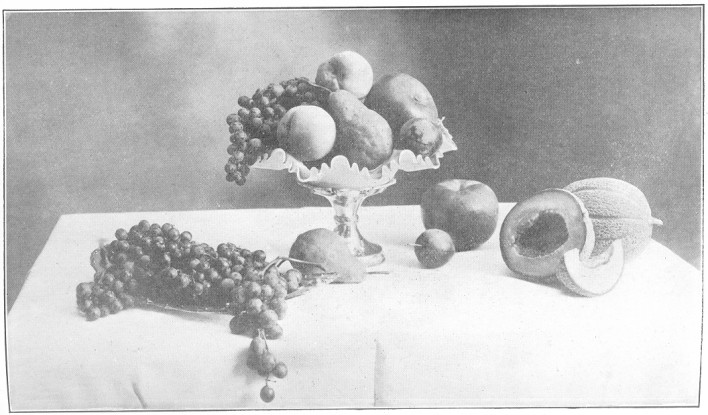
Plate No. 22.—Douglas County Wheat at Tram Waiting Shipment on Columbia River Boats.
STOCK RAISING.
The glory once enjoyed by this industry is rapidly changing color. Formerly, a predominating feature of the state was its Page 25 big herds feeding gratuitously on government lands. This condition still exists to an extent, the forests being utilized, under regulations by the government, but the herds are limited.
Individual farms and small herds are now the order of the day and, incidentally, better breeds are developing. This is true of horses, cattle and sheep. The demand for horses is chiefly for the heavy draft animals for use in the logging camps and on the streets of the cities, and the demand is fairly well supplied, chiefly in eastern Washington.
Good cows and fat steers are always in demand, and Washington's market for them is not fully supplied from the home farms. The same is true regarding sheep and hogs. The phenomenal growth of the seaport towns on Puget Sound and the difficulty in clearing the lands in western Washington combine to make the consumption exceed the home grown supply, and many are imported from neighboring states.
There is abundant room for expansion in stock raising in the state. Conditions are admirable. Grass is abundant for pasturage, hay is a prolific crop, the climate is mild, no pests afflict the cattle, and the markets are at the door and always hungry.
THE DAIRY.
There are few states in the Union equal to Washington in its possession of natural conditions suited to make dairying profitable. In all of western Washington, in the western part of eastern Washington, and in both the northeastern and southeastern sections of the state, the climate and soil conspire to make ideal grazing. Particularly is this true in the western part of the state. All the grasses grow in luxuriance, and with proper care and forethought there may be secured almost twelve months of green feed annually. The crops best adapted for use as ensilage grow well, making large yields. Timothy, clover hay and alfalfa are the standbys for winter feed so far as the coarse feed is concerned, and while mill stuffs and all grains are high in price, so are correspondingly the products of the dairy. Butter ranges from 25 cents to 40 cents per pound, and milk sells in the coast cities for 10 cents per quart.
Page 26 POULTRY.
Perhaps no part of agriculture is more profitable to the wise farmer than his barnyard fowls, and in Washington this is exceptionally true. Eggs retail in the coast towns at 25 cents to 60 cents per dozen. Turkeys at Thanksgiving time are worth from 25 cents to 30 cents per pound dressed, and other fowl in proportion. Conditions can be made as ideal for poultry raising in this state as anywhere, and with the market never satisfied, the poultry raiser has every essential to success in his favor.
BEE CULTURE.
Bee culture among the orchards and alfalfa fields of eastern Washington is a side line which should not be neglected by the farmer or horticulturist. Many are fully alert to the favorable conditions, and Washington honey is on sale in the late summer in most of the cities and towns until the supply is exhausted, and then that from other states comes in to meet the demand.
Pasturage for bees is also abundant in many parts of the western half of the state, and many a rancher among the forest trees has upon his table the products of his own apiary.
MANUFACTURING OTHER THAN LUMBER.
The State of Washington has natural products either within its own borders or nearby, to foster many manufacturing industries, besides those having lumber for their raw material.
In the Puget Sound basin are vast deposits of lime rock, which is manufactured into commercial lime, supplying the home market not only, but is being shipped also to foreign ports. These are chiefly on San Juan island.
Considerable granite of fine quality is used in building and cemetery structures, from quarries in Snohomish and Skagit counties. Sandstone is being used for building purposes and is of splendid texture. Onyx of great variety and beauty is extensively quarried in Stevens county. Marble of good quality is being sawed up to limited extent. Quarries in southeastern Alaska furnish rather a better quality and are more extensively worked.
Page 27 Clays of great variety, including fire clays and those suitable for terra cotta, are abundant, and large factories in King county are turning out common and pressed brick of many colors and fine finish, vitrified brick for street paving, terra cotta, stoneware, drain tile, sewer pipe and other kindred products.
At Concrete, a town of 1,200 people in Skagit county, two factories, employing 500 men, are daily turning out 1,400 barrels of Portland cement of fine quality, which is finding ready market in all the large cities.
At Irondale, in Jefferson county, a large plant has been in operation turning out pig iron. It is now in process of being turned into a steel plant and within a few months will be turning out steel bars and pipes for sewer, gas and other purposes. The ores are obtained from Whatcom and Skagit counties, some bog iron in the immediate vicinity and additional ores from Vancouver island. More than a half million dollars has already been invested and this will probably reach a full million when the plant is in complete operation. Although iron ores are present in the state in large quantities, no other serious effort is being made to supply the state with home made pig iron or its products. Here is a vast field awaiting brains and capital. The above represent only a few of the many lines of manufacturing that have been successfully developed in Washington.
TRANSPORTATION.
Commerce and transportation are two affinities, ever seeking each other. They have found on Puget Sound an ideal trysting place. Here the ships of the ocean reach immense placid waters, not duplicated on either side of the continent, and for this reason the railroads have come from the interior to meet them. From foreign ports all over the world ocean carriers are bringing in great loads of merchandise and passengers, and the railroads coming from the Atlantic coast across the entire continent bring like loads of merchandise and human freight, and here they are exchanged. Teas from China and Japan for cotton from Galveston and cotton goods from Massachusetts; Page 28 rice and silk, hemp, matting, tin, copper and Japanese bric-a-brac are exchanged for grain, flour, fish, lumber, fruit, iron and steel ware, paper, tobacco, etc. Merchandise of all sorts from Asia, the Philippines, South America and Australia is here exchanged for different stuffs raised or made in every part of the American continent and some from Europe. This commerce, however, is in its infancy. The Northern Pacific and Great Northern railways have fattened on it for years. All their rivals have looked on with envious eyes till now a mad rush is on among them all for vantage ground. The Milwaukee, Canadian Pacific and Burlington systems already run their trains here, while the Union Pacific and others are rushing for terminals on Puget Sound tide water. And while thus racing for the great long haul prizes, they are incidentally giving to the state a complete system of transportation in all its parts and for all its multitudinous productions.
Of almost equal importance to the state is its great fleet of local steamers which ply its inland waters, and the numerous electric lines that are rapidly uniting its cities and villages and giving a new and cheap method of migration. From the city of Spokane and radiating in every direction, electric lines are in operation and more are in course of construction, bringing the most distant points of the great "Inland Empire" into close touch with its metropolis and great distributing center. On the west side the same thing is true, only in less degree. Between these two groups of transportation facilities, and the commerce which the union of rail and tidewater has created, the citizens of Washington have found innumerable opportunities of employment.
These opportunities are increasing and broadening every year with the continued development of the state and in multiplied and varied form they await the newcomer who possesses the ability to rise to the demands of the situation.
Plate No. 23.—FERRY COUNTY VIEWS. Plant of Karamin Lumber Co., Karamin, Ferry County. (1) Track of Spokane & B. C. Railway. (2) Track of Spokane Falls & Northern Ry.
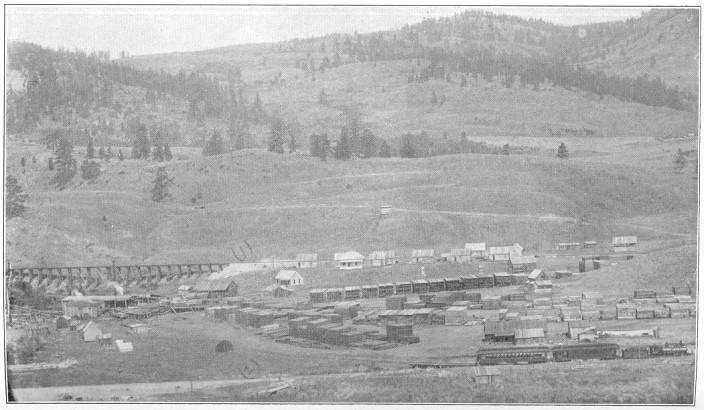
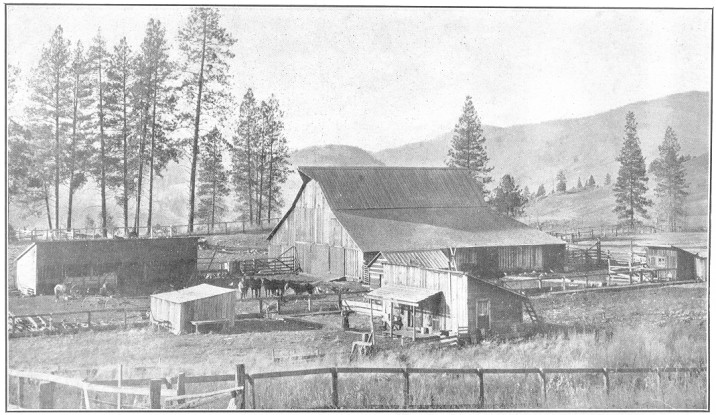
Plate No. 24.—Helphrey Ranch, Curlew, Ferry County.