Volume 5 — CHAPTER XLVII. LOUIS XIV. AND RELIGION. (continued 2)
Robert Black translation
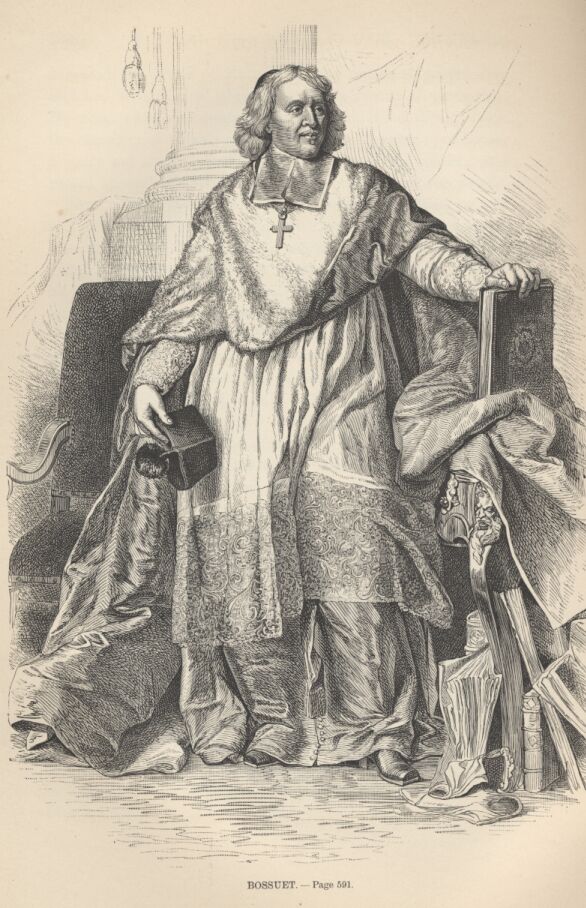
So many fires smouldering in the hearts, so many different struggles going on in the souls, that sought to manifest their personal and independent life have often caused forgetfulness of the great mass of the faithful who were neither Jansenists nor Quietists. Bossuet was the real head and the pride of the great Catholic church of France in the seventeenth century; what he approved of was approved of by the immense majority of the French clergy, what he condemned was condemned by them. Moderate and prudent in conduct as well as in his opinions, pious without being fervent, holding discreetly aloof from all excesses, he was a Gallican without fear and without estrangement as regarded the papal power, to which he steadfastly paid homage. It was with pain, and not without having sought to escape therefrom, that he found himself obliged, at the assembly of the clergy in 1682, to draw up the solemn declarations of the Gallican church. The meeting of the clergy had been called forth by the eternal discussions of the civil power with the court of Rome on the question of the rights of regale, that is to say, the rights of the sovereign to receive the revenues of vacant bishoprics, and to appoint to benefices belonging to them. The French bishops were of independent spirit; the Archbishop of Paris, Francis de Harlay, was on bad terms with Pope Innocent XI.; Bossuet managed to moderate the discussions, and kept within suitable bounds the declaration which he could not avoid. He had always taught and maintained what was proclaimed by the assembly of the clergy of France, “that St. Peter and his successors, vicars of Jesus Christ, and the whole church itself, received from God authority over only spiritual matters and such as appertain to salvation, and not over temporal and civil matters, in such sort that kings and sovereigns are not subject to tiny ecclesiastical power, by order of God, in temporal matters, and cannot be deposed directly or indirectly by authority of the keys of the church; finally, that, though the pope has the principal part in questions of faith, and though his decrees concern all the churches and each church severally, his judgment is, nevertheless, not irrefragable, unless the consent of the church intervene.” Old doctrines in the church of France, but never before so solemnly declared and made incumbent upon the teaching of all the faculties of theology in the kingdom.
Constantly occupied in the dogmatic struggle against Protestantism, Bossuet had imported into it a moderation in form which, however, did not keep out injustice. Without any inclination towards persecution, he, with almost unanimity on the part of the bishops of France, approved of the king’s piety in the revocation of the Edict of Nantes. “Take up your sacred pens,” says he in his funeral oration over Michael Le Tellier, “ye who compose the annals of the church; haste ye to place Louis amongst the peers of Constantine and Theodosius. Our fathers saw not as we have seen an inveterate heresy falling at a single blow, scattered flocks returning in a mass, and our churches too narrow to receive them, their false shepherds leaving them without even awaiting the order, and happy to have their banishment to allege as excuse; all tranquillity amidst so great a movement; the universe astounded to see in so novel an event the most certain sign as well as the most noble use of authority, and the prince’s merit more recognized and more revered than even his authority. Moved by so many marvels, say ye to this new Constantine, this new Theodosius, this new Marcieau, this new Charlemagne, what the six hundred and thirty Fathers said aforetime in the council of Chaloedon, You have confirmed the faith; you have exterminated the heretics; that is the worthy achievement of your reign, that is its own characteristic. Through you heresy is no more. God alone could have wrought this marvel. King of heaven, preserve the king of earth; that is the prayer of the churches, that is the prayer of the bishops.” Bossuet, like Louis XIV., believed Protestantism to be destroyed. “Heresy is no more,” he said. It was the same feeling that prompted Louis XIV., when dying, to the edict of March 8, 1715. “We learn,” said he, “that, abjurations being frequently made in provinces distant from those in which our newly converted subjects die, our judges to whom those who die relapsed are denounced find a difficulty in condemning them, for want of proof of their abjuration. The stay which those who were of the religion styled Reformed have made in our kingdom since we abolished therein all exercise of the said religion is a more than sufficient proof that they have embraced the Catholic religion, without which they would have been neither suffered nor tolerated.” There did not exist, there could not exist, any more Protestants in France; all who died without sacraments were relapsed, and as such dragged on the hurdle. Those who were not married at a Catholic church were not married. M. Guizot was born at Nimes on the 4th of October, 1787, before Protestants possessed any civil rights in France.
Bossuet had died on the 12th of April, 1704. When troubles began again in the church, the enemies of the Jansenists obtained from the king a decree interdicting the Reflexions morales cur le Nouveau Testament, an old and highly esteemed work by Father Quesnel, some time an Oratorian, who had become head of the Jansenists on the death of the great Arnauld. Its condemnation at Rome was demanded. Cardinal de Noailles, Archbishop of Paris, had but lately, as Bishop of Chalons, approved of the book; he refused to retract his approbation; the Jesuits made urgent representations to the pope; Clement XI. launched the bull Unigenitus, condemning a hundred and one propositions extracted from the Reflexions morales. Eight prelates, with Cardinal de Noailles at their head, protested against the bull; it was, nevertheless, enregistered at the Parliament, but not without difficulty. The archbishop still held out, supported by the greater part of the religious orders and the majority of the doctors of Sorbonne. The king’s confessor, Letellier, pressed him to prosecute the cardinal and get him deposed by a national council; the affair dragged its slow length along at Rome; the archbishop had suspended from the sacred functions all the Jesuits of his diocese; the struggle had commenced under the name of Jansenism against the whole Gallican church. The king was about to bring the matter before his bed of justice, when he fell ill. He saw no more of Cardinal de Noailles, and this rupture vexed him. “I am sorry to leave the affairs of the church in the state in which they are,” he said to his councillors. “I am perfectly ignorant in the matter; you know, and I call you to witness, that I have done nothing therein but what you wanted, and that I have done all you wanted. It is you who will answer before God for all that has been done, whether too much or too little. I charge you with it before Him, and I have a clear conscience. I am but a know-nothing who have left myself to your guidance.” An awful appeal from a dying king to the guides of his conscience. He had dispeopled his kingdom, reduced to exile, despair, or falsehood fifteen hundred thousand of his subjects, but the memory of the persecutions inflicted upon the Protestants did not trouble him; they were for him rather a pledge of his salvation and of his acceptance before God. He was thinking of the Catholic church, the holy priests exiled or imprisoned, the nuns driven from their convent, the division among the bishops, the scandal amongst the faithful. The great burden of absolute power was evident to his eyes; he sought to let it fall back upon the shoulders of those who had enticed him or urged him upon that fatal path. A vain attempt in the eyes of men, whatever may be the judgment of God’s sovereign mercy. History has left weighing upon Louis XIV. the crushing weight of the religious persecutions ordered under his reign.