Volume 5 — CHAPTER XXXV. HENRY IV., PROTESTANT KING. (1589-1593.) (continued 2)
Robert Black translation
“The court, having, as it has always had, no intention but to maintain the Catholic, Apostolic, and Roman religion, and the state and crown of France, under the protection of a most Christian, Catholic, and French king, hath ordained and doth ordain that representations shall be made, this afternoon, by President Lemaitre, assisted by a proper number of councillors of the said court, to the Duke of Mayenne, lieutenant-general of the state and crown of France, to the end that no treaty be made for the transfer of the crown to the hands of foreign princes or princesses, and that the fundamental laws of the realm be observed. . . . And from the present moment, the said court hath declared and doth declare all treaties made or hereafter to be made for the setting up of foreign prince or princess null and of no effect or value, as being made to the prejudice of the Salic law and other fundamental laws of this realm.”
It was understood that this decree excluded from the crown of France not only Philip II., the Infanta Isabella, Archduke Ernest, and all the Spanish and Austrian princes, but also all the princes of the house of Guise, “because the qualification of foreigners applied to all the princes who were not of the blood royal and who were issue of foreign houses, even though they might have been born in France and were regnicoles.”
Mayenne refused, it is not known on what pretext, to receive the communication of this decree on the same day on which it was voted by the Parliament. When President Lemaitre presented it to him the next day before a large attendance, Mayenne kept his temper, and confined himself to replying gruffly, “My first care has always been to defend the Catholic religion and maintain the laws of the realm. It seems now that I am no longer necessary to the state, and that it will be easy to do without me. I could have wished, considering my position, that the Parliament had not decided anything in a matter of such importance without consulting me. However, I will do all that I find possible for me and that appears reasonable as to the two points of your representations.” On the following day, 30th of June, Mayenne was dining with the Archbishop of Lyons, Peter d’Espinac; President Lemaitre was sent for, and the wrath of the lieutenant-general burst forth. “The insult put upon me is too palpable for me to be quiet under it; since I am played fast and loose with in that way, I have resolved to quash the decree of the Parliament. The Archbishop of Lyons is about to explain to you my feelings and my motives.”
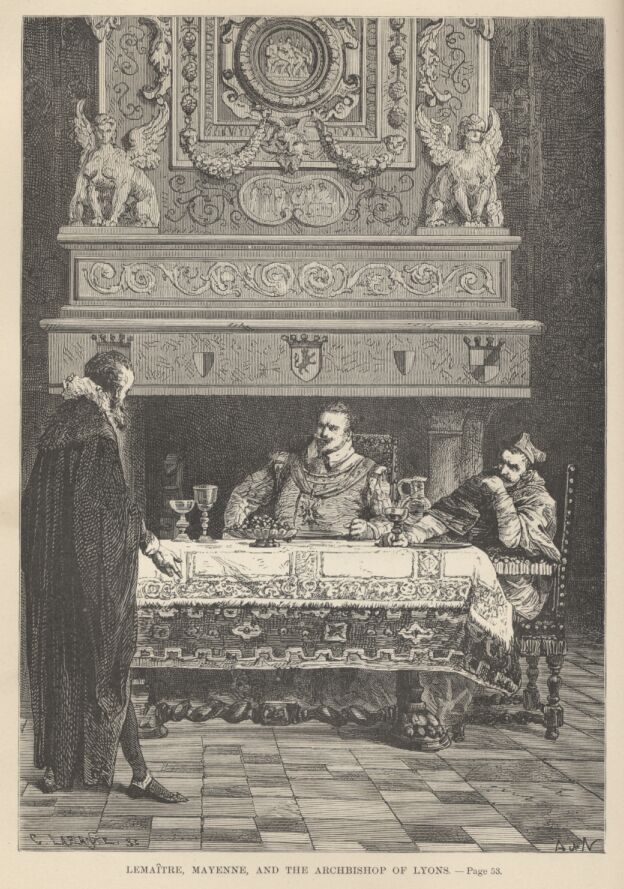
The archbishop spoke long and bitterly, dwelling upon the expression that “the Parliament had played fast and loose” with the prince. President Lemaitre interrupted him. “I cannot unmoved hear you repeating, sir, that to which my respect made me shut my eyes when the prince spoke. Looking upon me as an individual, you might speak to me in any way, you thought proper; but so soon as the body I represent here is injured by insulting terms, I take offence, and I cannot suffer it. Know then, sir, that the Parliament does not deceive or play fast and loose with anybody, and that it renders to every man his due.” The conversation was continued for some moments in this warm and serious tone; but the quarrel went no further; from the account they received of it, the Parliament applauded the premier president’s firmness, and all the members swore that they would suffer anything rather than that there should be any change in the decree. It remained intact, and Mayenne said no more about it.
During these disputes amongst the civil functionaries, and continuing all the while to make proposals for a general truce, Henry IV. vigorously resumed warlike operations, so as to bring pressure upon his adversaries and make them perceive the necessity of accepting the solution he offered them. He besieged and took the town of Dreux, of which the castle alone persisted in holding out. He cut off the provisions which were being brought by the Marne to Paris. He kept Poitiers strictly invested. Lesdiguieres defeated the Savoyards and the Spaniards in the valleys of Dauphiny and Piedmont. Count Mansfeld was advancing with a division towards Picardy; but at the news that the king was marching to encounter him, he retired with precipitation. From the military as well as the political point of view, there is no condition worse than that of stubbornness mingled with discouragement. And that was the state of Mayenne and the League. Henry IV. perceived it, and confidently hurried forward his political and military measures. The castle of Dreux was obliged to capitulate. Thanks to the four thousand Swiss paid for him by the Grand Duke of Florence, to the numerous volunteers brought to him by the noblesse of his party, “and to the sterling quality of the old Huguenot phalanx, folks who, from father to son, are familiarized with death,” says D’Aubigne, Henry IV. had recovered, in June, 1593, so good an army that “by means of it,” he wrote to Ferdinand de’ Medici, “I shall be able to reduce the city of Paris in so short a time as will cause you great contentment.” But he was too judicious and too good a patriot not to see that it was not by an indefinitely prolonged war that he would be enabled to enter upon definitive possession of his crown, and that it was peace, religious peace, that he must restore to France in order to really become her king. He entered resolutely, on the 15th of July, 1593, upon the employment of the moral means which alone could enable him to attain this end; he assembled at Mantes the conference of prelates and doctors, Catholic and Protestant, which he had announced as the preface to his conversion. He had previously, on the 13th of May, given assurance to the Protestants as to their interests by means of a declaration on the part of eight amongst the principal Catholic lords attached to his person who undertook, “with his Majesty’s authorization, that nothing should be done in the said assemblies to the prejudice of friendly union between the Catholics who recognized his Majesty and them of the religion, or contrary to the edicts of pacification.” On the 21st of July, the prelates and doctors of the conference transferred themselves from Mantes to St. Denis. On Friday, July 23, in the morning, Henry wrote to Gabriel le d’Estrees, “Sunday will be the day when I shall make the summerset that brings down the house” (le, saut perilleux). A few hours after using such flippant language to his favorite, he was having a long conference with the prelates and doctors, putting to them the gravest questions about the religion he was just embracing, asking them for more satisfactory explanations on certain points, and repeating to them the grounds of his resolution. “I am moved with compassion at the misery and calamities of my people; I have discovered what they desire; and I wish to be enabled, with a safe conscience, to content them.” At the end of the conference, “Gentlemen,” he said, “I this day commit my soul to your keeping; I pray you, take heed to it, for, wheresoever you are causing me to enter, I shall never more depart till death; that I swear and protest to you;” and, in a voice of deep emotion, his eyes dim with tears, “I desire no further delay; I wish to be received on Sunday and go to mass; draw up the profession of faith you think I ought to make, and bring it to me this evening;” when the Archbishop of Bourges and the Bishops of Le Mans and Evreux brought it to him on the Saturday morning, he discussed it apart with them, demanding the cutting out of some parts which struck too directly at his previous creed and life; and Chancellor de Chiverny and two presidents of the Parliament, Harlay and Groulart, used their intervention to have him satisfied. The profession of faith was modified. Next day, Sunday, the 25th of July, before he got up, Henry conversed with the Protestant minister Anthony de la Faye, and embraced him two or three times, repeating to him the words already quoted, “I have made myself anathema for the sake of all, like Moses and St. Paul.” A painful mixture of the frivolous and the serious, of sincerity and captious reservations, of resolution and weakness, at which nobody has any right to be shocked who is not determined to be pitiless towards human nature, and to make no allowance in the case of the best men for complication of the facts, ideas, sentiments, and duties, under the influence of which they are often obliged to decide and to act.
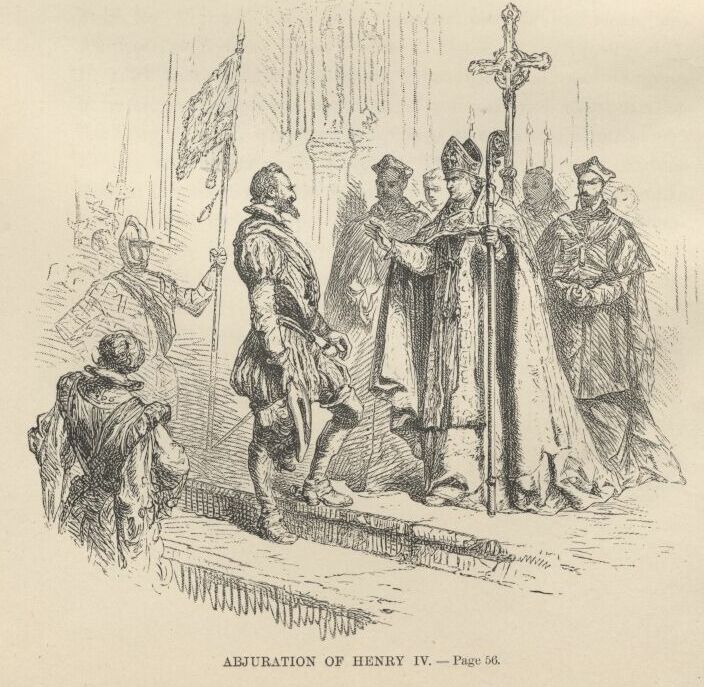
On Sunday the 25th of July, 1593, Henry IV. repaired in great state to the church of St. Denis. On arriving with all his train in front of the grand entrance, he was received by Reginald de Beaune, Archbishop of Bourges, the nine bishops, the doctors and the incumbents who had taken part in the conferences, and all the brethren of the abbey. “Who are you?” asked the archbishop who officiated. “The king.” “What want you?” “To be received into the bosom of the Catholic, Apostolic, and Roman Church.” “Do you desire it?” “Yes, I will and desire it.” At these words the king knelt and made the stipulated profession of faith. The archbishop gave him absolution together with benediction; and, conducted by all the clergy to the choir of the church, he there, upon the gospels, repeated his oath, made his confession, heard mass, and was fully reconciled with the church. The inhabitants of Paris, dispensing with the passports which were refused them by Mayenne, had flocked in masses to St. Denis and been present at the ceremony. The vaulted roof of the church resounded with their shouts of Hurrah for the king! There was the same welcome on the part of the dwellers in the country when Henry repaired to the valley of Montmorency and to Montmartre to perform his devotions there. Here, then, was religious peace, a prelude to political reconciliation between the monarch and the great majority of his subjects.