Volume 4 — CHAPTER XXXIII. CHARLES IX. AND THE RELIGIOUS WARS. (1560-1574.)
Robert Black translation
We now enter upon the era of the civil wars, massacres, and assassinations caused by religious fanaticism or committed on religious pretexts. The latter half of the sixteenth century is the time at which the human race saw the opening of that great drama, of which religious liberty is the beginning and the end; and France was then the chief scene of it. At the close of the fifteenth and at the commencement of the sixteenth centuries, religious questions had profoundly agitated Christian Europe; but towards the middle of the latter century they had obtained in the majority of European states solutions which, however incomplete, might be regarded as definitive. Germany was divided into Catholic states and Protestant states, which had established between themselves relations of an almost pacific character. Switzerland was entering upon the same course. In England, Scotland, the Low Countries, the Scandinavian states, and the free towns their neighbors, the Reformation had prevailed or was clearly tending to prevail. In Italy, Spain, and Portugal, on the contrary, the Reformation had been stifled, and Catholicism remained victorious. It was in France that, notwithstanding the inequality of forces, the struggle between Catholicism and Protestantism was most obstinately maintained, and appeared for the longest time uncertain. After half a century of civil wars and massacres it terminated in Henry IV., a Protestant king, who turned Catholic, but who gave Protestants the edict of Nantes; a precious, though insufficient and precarious pledge, which served France as a point of departure towards religious liberty, and which protected it for nearly a century, in the midst of the brilliant victory won by Catholicism. [The edict of Nantes, published by Henry IV. in 1598, was revoked by Louis XIV. in 1685.]
For more than three centuries civilized Europe has been discussing, pro or con, the question of religious liberty, but from instinct and with passion far more than with a serious understanding of what is at the bottom of things. Even in our own day it is not without difficulty that a beginning is being made to understand and accept that principle in its true sense and in all its bearings. Men were wonderfully far from it in 1560, at the accession of Charles IX., a child ten years old; they were entering, in blind confidence, upon a religious war, in order to arrive, only after four centuries of strife and misconception, at a vindication of religious liberty. “Woe to thee, O country, that hast a child for king!” said, in accordance with the Bible, the Venetian Michael Suriano, ambassador to France at that time. Around that royal child, and seeking to have the mastery over France by being masters over him, were struggling the three great parties at that time occupying the stage in the name of religion. The Catholics rejected altogether the idea of religious liberty for the Protestants; the Protestants had absolute need of it, for it was their condition of existence; but they did not wish for it in the case of the Catholics, their adversaries. The third party (tiers parti), as we call it nowadays, wished to hold the balance continually wavering between the Catholics and the Protestants, conceding to the former and the latter, alternately, that measure of liberty which was indispensable for most imperfect maintenance of the public peace, and reconcilable with the sovereign power of the kingship. On such conditions was the government of Charles IX. to establish its existence.
The death of Francis II. put an end to a grand project of the Guises, which we do not find expressly indicated elsewhere than in the Memoires of Michael de Castelnau, one of the best informed and most intelligent historians of the time. “Many Catholics,” says he, “were then of opinion that, if the authority of the Duke of Guise had continued to be armed with that of the king as it had been, the Protestants would have had enough to do. For orders had been sent to all the principal lords of the kingdom, officers of the crown and knights of the order, to show themselves in the said city of Orleans on Christmas-day at the opening of the states, for that they might be all made to sign the confession of the Catholic faith in presence of the king and the chapter of the order; together with all the members of the privy council, reporting-masters (of petitions), domestic officers of the king’s household, and all the deputies of the estates. The same confession was to be published throughout all the said kingdom, in order to have it sworn by all the judges, magistrates, and officers, and, finally, all private persons from parish to parish. And in default of so doing, proceedings were to be taken by seizures, condemnations, executions, banishments, and confiscations. And they who did repent themselves and abjured their Protestant religion were to be absolved.” [Memoires de Michel de Castelnau, book ii. chap. xii. p. 121, in the Petitot collection.] It is not to be supposed that, even if circumstances had remained as they were under the reign of Francis II., such a plan could have been successful; but it is intelligible that the Guises had conceived such an idea: they were victorious; they had just procured the condemnation to death of the most formidable amongst the Protestant princes, their adversary Louis de Conde; they were threatening the life of his brother the King of Navarre; and the house of Bourbon seemed to be on the point of disappearing beneath the blows of the ambitious, audacious, and by no means scrupulous house of Lorraine. Not even the prospect of Francis II.‘s death arrested the Guises in their work and their hopes; when they saw that he was near his end, they made a proposal to the queen-mother to unite herself completely with them, leave the Prince of Conde to execution, rid herself of the King of Navarre, and become regent of the kingdom during the minority of her son Charles, taking them, the Lorraine princes and their party, for necessary partners in her government. But Catherine de’ Medici was more prudent, more judicious, and more egotistical in her ambition than the Guises were in theirs; she was not, as they were, exclusively devoted to the Catholic party; it was power that she wanted, and she sought for it every day amongst the party or the mixtures of parties in a condition to give it her. She considered the Catholic party to be the strongest, and it was hers; but she considered the Protestant party strong enough to be feared, and to give her a certain amount of security and satisfaction: a security necessary, moreover, if peace at home, and not civil war, were to be the habitual and general condition of France. Catherine was, finally, a woman, and very skilful in the strifes of court and of government, whilst, on the field of battle, the victories, though won in her name, would be those of the Guises more than her own. Without openly rejecting the proposals they made to her under their common apprehension of Francis II.‘s approaching death, she avoided making any reply. She had, no doubt, already taken her precautions and her measures in advance; her confidante, Jacqueline de Longwy, Duchess of Montpensier and a zealous Protestant, had brought to her rooms at night Antony de Bourbon, King of Navarre, and Catherine had come to an agreement with him about the partition of power between herself and him at the death of the king her son. She had written to the Constable de Montmorency, a rival of the Guises and their foe though a stanch Catholic, to make haste to Orleans, where his presence would be required. As soon as Chancellor de l’Hospital became aware of the proposals which were being made by the Guises to the queen-mother, he flew to her and opposed them with all the energy of his great and politic mind and sterling nature. Was she going to deliver the Prince of Conde to the scaffold, the house of Bourbon to ruin, France to civil war, and the independence of the crown and of that royal authority which she was on the point of wielding herself to the tyrannical domination of her rivals the Lorraine princes and of their party? Catherine listened with great satisfaction to this judicious and honest language. When the crown passed to her son Charles she was free from any serious anxiety as to her own position and her influence in the government. The new king, on announcing to the Parliament the death of his brother, wrote to them that “confiding in the virtues and prudence of the queen-mother, he had begged her to take in hand the administration of the kingdom, with the wise counsel and advice of the King of Navarre and the notables and great personages of the late king’s council.” A few months afterwards the states-general, assembling first at Orleans and afterwards at Pontoise, ratified this declaration by recognizing the placement of “the young King Charles IX.‘s guardianship in the hands of Catherine de’ Medici, his mother, together with the principal direction of affairs, but without the title of regent.” The King of Navarre was to assist her in the capacity of lieutenant-general of the kingdom. Twenty-five members specially designated were to form the king’s privy council. [Histoire des Etats generaux, by M. Picot, t. ii. p. 73.] And in the privacy of her motherly correspondence Catherine wrote to the Queen of Spain, her daughter Elizabeth, wife of Philip II., “Madame, my dear daughter, all I shall tell you is, not to be the least anxious, and to rest assured that I shall spare no pains to so conduct myself that God and everybody may have occasion to be satisfied with me. . . . You have seen the time when I was as happy as you are, not dreaming of ever having any greater trouble than that of not being loved as I should have liked to be by the king your father. God took him from me, and is not content with that; He has taken from me your brother, whom I loved you well know how much, and has left me with three young children, and in a kingdom where all is division, having therein not a single man in whom I can trust, and who has not some particular object of his own.”
The queen-mother of France, who wrote to her daughter the Queen of Spain with such firmness of tone and such independence of spirit, was, to use the words of the Venetian ambassador John Michieli, who had lived at her court, “a woman of forty-three, of affable manners, great moderation, superior intelligence, and ability in conducting all sorts of affairs, especially affairs of state. As mother, she has the personal management of the king; she allows no one else to sleep in his room; she is never away from him. As regent and head of the government, she holds everything in her hands, public offices, benefices, graces, and the seal which bears the king’s signature, and which is called the cachet (privy-seal or signet). In the council, she allows the others to speak; she replies to any one who needs it; she decides according to the advice of the council, or according to what she may have made up her own mind to. She opens the letters addressed to the king by his ambassadors and by all the ministers. . . . She has great designs, and does not allow them to be easily penetrated. As for her way of living, she is very fond of her ease and pleasure; she observes few rules; she eats and drinks a great deal; she considers that she makes up for it by taking a great deal of exercise a-foot and a-horseback; she goes a-hunting; and last year she always joined the king in his stag-chases, through the woods and thick forests, a dangerous sort of chase for anyone who is not an excellent rider. She has an olive complexion, and is already very fat; accordingly the doctors have not a good opinion of her life. She has a dower of three hundred thousand francs a year, double that of other queens-dowager. She was formerly always in money-difficulties and in debt; now, she not only keeps out of debt, but she spends and gives more liberally than ever.” [Relations des Ambassadeurs venztzens, published by A. N. Tommaseo, t. i. pp. 427-429.]
As soon as the reign of Charles IX. and the queen-mother’s government were established, notice was sent to the Prince of Conde that he was free. He refused to stir from prison; he would wait, he said, until his accusers were confined there. He was told that it was the king’s express order, and was what Francis II. on his death-bed had himself impressed upon the King of Navarre. Conde determined to set out for La Fere, a place belonging to his brother Anthony de Bourbon, and there await fresh orders from the king. In February, 1561, he left La Fare for Fontainebleau. On his road to Paris his friends flocked to him and made him a splendid escort. On approaching the king’s palace Conde separated himself from his following, and advanced alone with two of his most faithful friends. All the lords of the court, the Duke of Guise amongst them, went to meet him. On the 15th of March he was admitted to the privy council. Chancellor de l’Hospital, on the prince’s own demand, affirmed that no charge had been found against him. The king declared his innocence in a deed signed by all the members of the council. On the 13th of June, in solemn session, the Parliament of Paris, sitting as a court of peers, confirmed this declaration. Notwithstanding the Duke of Guise’s co-operation in all these acts, Conde desired something of a more personal kind on his part.
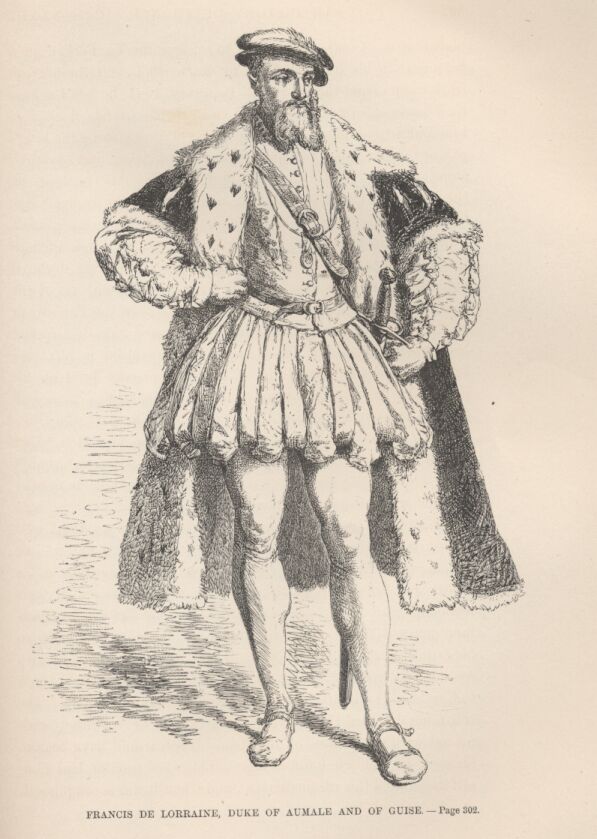
On the 24th of August, at St. Germain, in presence of the king, the queen-mother, the princes, and the court, the Duke of Guise, in reply to a question from the king, protested “that he had not, and would never have desired to, put forward anything against the prince’s honor, and that he had been neither the author nor the instigator of his imprisonment.” “Sir,” said Conde, “I consider wicked and contemptible him or them who caused it.” “So I think, sir,” answered Guise, “and it does not apply to me at all.” Whereupon they embraced, and a report was drawn up of the ceremony, which was called their reconciliation. Just as it was ending, Marshal Francis de Montmorency, eldest son of the constable, and far more inclined than his father was towards the cause of the Reformers, arrived with a numerous troop of friends, whom he had mustered to do honor to Conde. The court was a little excited at this incident. The constable declared that, having the honor to be so closely connected with the princes of Bourbon, his son would have been to blame if he had acted differently. The aged warrior had himself negotiated this reconciliation; and when it was accomplished, and the Duke of Guise had performed his part in it with so much complaisance, the constable considered himself to be quits with his former allies, and free to follow his leaning towards the Catholic party. “The veteran,” says the Duke of Autnale, “did not pique himself on being a theologian; but he was sincerely attached to the Catholic faith because it was the old religion and the king’s; and he separated himself definitively from those religious and political innovators whom he had at first seemed to countenance, and amongst whom he reckoned his nearest relatives.” In vain did his eldest son try to hold him back; a close union was formed between the Constable de Montmorency, the Duke of Guise, and Marshal de Saint-Andre, and it became the Catholic triumvirate against which Catherine de’ Medici had at one time to defend herself, and of which she had at another to avail herself in order to carry out the policy of see-saw she had adopted as her chief means of government.
Before we call to mind and estimate as they deserve the actions of that government, we must give a correct idea of the moral condition of the people governed, of their unbridled passions, and of the share of responsibility reverting to them in the crimes and shocking errors of that period. It is a mistake and an injustice, only too common, to lay all the burden of such facts, and the odium justly due to them, upon the great actors almost exclusively whose name has remained attached to them in history; the people themselves have very often been the prime movers in them; they have very often preceded and urged on their masters in the black deeds which have sullied their history; and on the masses as well as on the leaders ought the just sentence of posterity to fall. The moment we speak of the St. Bartholomew, it seems as if Charles IX., Catherine de’ Medici, and the Guises issued from their grave to receive that sentence; and God forbid that we should wish to deliver them from it; but it hits the nameless populace of their day as well as themselves, and the hands of the people, far more than the will of kings, began the tale of massacres for religion’s sake. This is no vague and general assertion; and, to show it, we shall only have to enumerate, with their dates, the principal facts of which history has preserved the memory, whilst stigmatizing them, with good reason, as massacres or murders. The greater number, as was to be expected, are deeds done by Catholics, for they were by far the more numerous and more frequently victorious; but Protestants also have sometimes deserved a place in this tragic category, and when we meet with them, we will assuredly not blot them out.
We confine the enumeration to the reign of Charles IX., and in it we place only such massacres and murders as were not the results of any legal proceeding. We say nothing of judicial sentences and executions, however outrageous and iniquitous they may have been.
The first fact which presents itself is a singular one. Admiral de Coligny’s eldest brother, Odet de Chatillon, was a Catholic, Bishop of Beauvais, and a cardinal; in 1550, he had gone to Rome and had co-operated in the election of Pope Julius III.; in 1554, he had published some Constitutions synodales (synodal regulations), to remedy certain abuses which had crept into his diocese, and, in 1561, he proposed to make in the celebration of the Lord’s Supper some modifications which smacked, it is said, of the innovations of Geneva. The populace of Beauvais were so enraged at this that they rose up against him, massacred a schoolmaster whom he tried to protect, and would have massacred the bishop himself if troops sent from Paris had not come to his assistance.
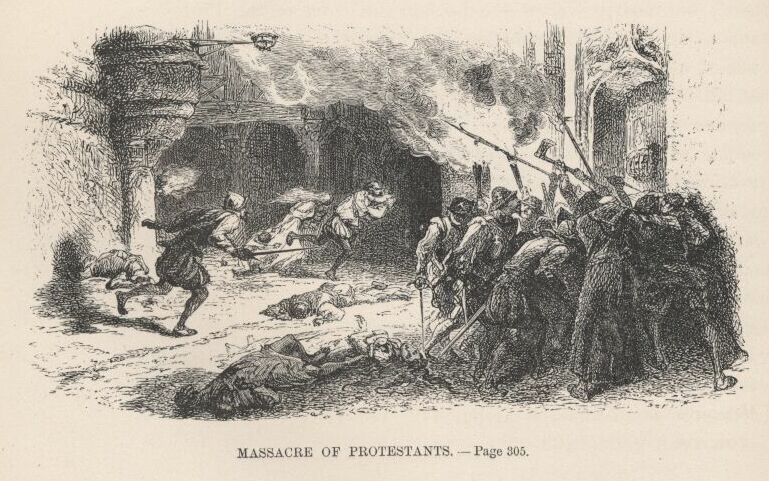
In the same year, 1561, the Protestants had a custom of meeting at Paris, for their religious exercises, in a house called the Patriarch’s house, very near the church of St. Medard. On the 27th of December, whilst the Reformed minister was preaching, the Catholics had all the bells of St. Medard rung in full peal. The minister sent two of his congregation to beg the incumbent to have the bell-ringing stopped for a short time. The mob threw themselves upon the two messengers: one was killed, and the other, after making a stout defence, returned badly wounded to the Patriarch’s house, and fell dead at the preacher’s feet. The provost of tradesmen was for having the bells stopped; the riot became violent; the house of the Reformers was stormed; and the provost’s archers had great difficulty in putting a stop to the fight. More than a hundred persons, it is said, were killed or wounded.
In 1562, in the month of February, whilst the Guises were travelling in Germany, with the object of concluding, in the interests of policy, alliances with some German Lutheran princes, disturbances broke out at Cahors, Amiens, Sens, and Tours, between the Protestants and the Catholics. Which of the two began them? It would be difficult to determine. The passions that lead to insult, attack, defence, and vengeance were mutually felt and equally violent on both sides. Montluc was sent to Guienne by the queen-mother to restore order there; but nearly everywhere he laid the blame on the Protestants. His Memoires prove that he harried them without any form of justice. “At Sauveterre,” says he, “I caught five or six, all of whom I had hanged without expense of paper or ink, and without giving them a hearing, for those gentry are regular Chrysostoms (parlent d’or).” “I was informed that at Gironde there were sixty or eighty Huguenots belonging to them of La Reole, who had retreated thither; the which were all taken, and I had them hanged to the pillars of the market-place without further ceremony. One hanged has more effect than a hundred slain.” When Montluc took Monsegur, “the massacre lasted for ten hours or more,” says he, “because search was made for them in the houses; the dead were counted and found to be more than seven hundred.” [Memoires de Montluc, t. ii. pp. 442, 443-447.]
Almost at the very time at which Montluc, who had been sent to Guienne to restore order there between the Catholics and the Protestants, was treating the latter with this shocking severity, an incident, more serious because of the rank of the persons concerned, took place at Vassy, a small town in Champagne, near which the Duke of Guise passed on returning from Germany. Hearing, as he went, the sound of bells, he asked what it meant. “It is the church of the Huguenots of Vassy,” was the answer. “Are there many of them?” asked the duke. He was told that there were, and that they were increasing more and more. “Then,” says the chronicler, “he began to mutter and to put himself in a white heat, gnawing his beard, as he was wont to do when he was enraged or had a mind to take vengeance.” Did he turn aside out of his way with his following, to pass right through Vassy, or did he confine himself to sending some of his people to bring him an account of what was happening there? When a fact which was at the outset insignificant has become a great event, it is hardly possible to arrive at any certain knowledge of the truth as to the small details of its origin. Whatever may have been the case in the first instance, a quarrel, and, before long, a struggle, began between the preacher’s congregation and the prince’s following. Being informed of the matter whilst he was at table, the Duke of Guise rose up, went to the spot, found the combatants very warmly at work, and himself received several blows from stones; and, when the fight was put a stop to, forty-nine persons had been killed in it, nearly all on the Protestant side; more than two hundred others, it is said, came out of it severely wounded; and, whether victors or vanquished, all were equally irritated. The Protestants complained vehemently; and Conde offered, in their name, fifty thousand men to resent this attack, but his brother, the King of Navarre, on the contrary, received with a very bad grace the pleading of Theodore de Beze. “It is true that the church of God should endure blows and not inflict them,” said De Beze, “but remember, I pray you, that it is an anvil which has used up a great many hammers.”
The massacre of Vassy, the name which has remained affixed to it in history, rapidly became contagious. From 1562 to 1572, in Languedoc, in Provence, in Dauphiny, in Poitou, in Orleanness, in Normandy even and in Picardy, at Toulouse, at Gaillac, at Frejus, at Troyes, at Sens, at Orleans, at Amiens, at Rouen, and in many other towns, spontaneous and disorderly outbreaks between religiously opposed portions of the populace took place suddenly, were repeated, and spread, sometimes with the connivance of the local authorities, judicial or administrative, but more often through the mere brutal explosion of the people’s passions. It is distasteful to us to drag numerous examples from oblivion; but we will cite just two, faithful representations of those sad incidents, and attested by authentic documents. The little town of Gaillac was almost entirely Catholic; the Protestants, less numerous, had met the day after Pentecost, May 18, 1562, to celebrate the Lord’s Supper. “The inhabitants in the quarter of the Chateau de l’Orme, who are all artisans or vine-dressers,” says the chronicler, “rush to arms, hurry along with them all the Catholics of the town, invest the place of assembly, and take prisoners all who were present. After this capture, they separate: some remain in the meeting-house, on guard over the prisoners; the rest go into dwellings to work their will upon those of the religion who had remained there. Then they take the prisoners, to the number of sixty or eighty, into a gallery of the Abbey of St. Michael, situated on a steep rock, at the base of which flows the River Tarn; and there, a field laborer, named Cabral, having donned the robe and cape of the judge’s deputy, whom he had slain with his own hand, pronounces judgment, and sentences all the prisoners to be thrown from the gallery into the river, telling them to go and eat fish, as they had not chosen to fast during Lent; which was done forthwith. Divers boatmen who were on the river despatched with their oars those who tried to save themselves by swimming.” [Histoire generale du Languedoc, liv. xxxviii. f. v., p. 227.] At Troyes, in Champagne, “during the early part of August, 1572, the majority of the Protestants of the town, who were returning from Esleau-Mont, where they had a meeting-house and a pastor under authorization from the king, were assailed in the neighborhood of Croncels by the excited populace. A certain number of individuals, accompanying a mother carrying a child which had just received baptism, were pursued with showers of stones; several were wounded, and the child was killed in its mother’s arms.” This affair did not give rise to any prosecution. “It is no use to think about it any longer,” said the delegate of the bailiff and of the mayor of Troyes, in a letter from Paris on the 27th of August. The St. Bartholomew had just taken place on the 24th of August. [Histoire de la Ville de Troyes, by H. Boutiot, t. iii. p. 25.]
Where they happened to be the stronger, and where they had either vengeance to satisfy or measures of security to take, the Protestants were not more patient or more humane than the Catholics. At Nimes, in 1567, they projected and carried out, in the town and the neighboring country, a massacre in which a hundred and ninety-two Catholics perished; and several churches and religious houses were damaged or completely destroyed. This massacre, perpetrated on St. Michael’s day, was called the Michaelade. The barbarities committed against the Catholics in Dauphiny and in Provence by Francis de Beaumont, Baron of Adrets, have remained as historical as the massacre of Vassy, and he justified them on the same grounds as Montluc had given for his in Guienne. “Nobody commits cruelty in repaying it,” said he; “the first are called cruelties, the second justice. The only way to stop the enemy’s barbarities is to meet them with retaliation.” Though experience ought to have shown them their mistake, both Adrets and Montluc persisted in it. A case, however, is mentioned in which Adrets was constrained to be merciful. After the capture of Montbrison, he had sentenced all the prisoners to throw themselves down, with their hands tied behind them, from the top of the citadel; one of them made two attempts, and thought better of it; “Come, twice is enough to take your soundings,” shouted the baron, who was looking on. “I’ll give you four times to do it in,” rejoined the soldier. And this good saying saved his life.
The weak and undecided government of Catherine de’ Medici tried several times, but in vain, to prevent or repress these savage explosions of passion and strife amongst the people; the sterling moderation of Chancellor de l’Hospital was scarcely more successful than the hypocritical and double-faced attentions paid by Catherine de’ Medici to both the Catholic and the Protestant leaders; the great maladies and the great errors of nations require remedies more heroic than the adroitness of a woman, the wisdom of a functionary, or the hopes of a philosopher. It was formal and open civil war between the two communions and the two parties that, with honest and patriotic desire, L’Hospital and even Catherine were anxious to avoid. From 1561 to 1572 there were in France eighteen or twenty massacres of Protestants, four or five of Catholics, and thirty or forty single murders sufficiently important to have been kept in remembrance by history; and during that space of time formal civil war, religious and partisan, broke out, stopped and recommenced in four campaigns, signalized, each of them, by great battles, and four times terminated by impotent or deceptive treaties of peace which, on the 24th of August, 1572, ended, for their sole result, in the greatest massacre of French history, the St. Bartholomew.
The first religious war, under Charles IX., appeared on the point of breaking out in April, 1561, some days after that the Duke of Guise, returning from the massacre of Vassy, had entered Paris, on the 16th of March, in triumph. The queen-mother, in dismay, carried off the king to Melun at first, and then to Fontainebleau, whilst the Prince of Conde, having retired to Meaux, summoned to his side his relatives, his friends, and all the leaders of the Reformers, and wrote to Coligny, “that Caesar had not only crossed the Rubicon, but was already at Rome, and that his banners were beginning to wave all over the neighboring country.” For some days Catherine and L’Hospital tried to remain out of Paris with the young king, whom Guise, the Constable de Montmorency, and the King of Navarre, the former being members and the latter an ally of the triumvirate, went to demand back from them. They were obliged to submit to the pressure brought to bear upon them. The constable was the first to enter Paris, and went, on the 2d of April, and burned down the two places of worship which, by virtue of the decree of January 17, 1561, had been granted to the Protestants. Next day the King of Navarre and the Duke of Guise, in their turn, entered the city in company with Charles IX. and Catherine. A council was assembled at the Louvre to deliberate as to the declaration of war, which was deferred. Whilst the king was on his way back to Paris, Conde hurried off to take up his quarters at Orleans, whither Coligny went promptly to join him. They signed, with the gentlemen who came to them from all parts, a compact of association “for the honor of God, for the liberty of the king, his brothers and the queen-mother, and for the maintenance of decrees;” and Conde, in writing to the Protestant princes of Germany to explain to them his conduct, took the title of protector of the house and crown of France. Negotiations still went on for nearly three months. The chiefs of the two parties attempted to offer one another generous and pacific solutions; they even had two interviews; but Catherine was induced by the Catholic triumvirate to expressly declare that she could not allow in France more than one single form of worship. Conde and his friends said that they could not lay down their arms until the triumvirate was overthrown, and the execution of decrees granting them liberty of worship, in certain places and to a certain extent, had been secured to them. Neither party liked to acknowledge itself beaten in this way without having struck a blow. And in the early part of July, 1562, the first religious war began.
We do not intend to dwell upon any but its leading facts, facts which at the moment when they were accomplished might have been regarded as decisive in respect of the future. In this campaign there were two; the battle of Dreux, on the 19th of December, 1562; and the murder of the Duke of Guise by Poltrot, on the 18th of February, 1563.
The two armies met in the plain of Dreux with pretty nearly equal forces, the royal army being superior in artillery and the Protestant in cavalry. When they had arrived in front of one another, the triumvirs sent to ask the queen-mother’s authority to give battle. “I am astounded,” said Catherine to her favorite adviser, Michael de Castelnau, “that the constable, the Duke of Guise, and Saint-Andre, being good, prudent, and experienced captains, should send to ask counsel of a woman and a child, both full of sorrow at seeing things in such extremity as to be reduced to the risk of a battle between fellow-countrymen.” “Hereupon,” says Castelnau, “in came the king’s nurse, who was a Huguenot, and the queen, at the same time that she took me to see the king, who was still in bed, said to me with great agitation and jeeringly, ‘We had better ask the king’s nurse whether to give battle or not; what think you?’ Then the nurse, as she followed the queen into the king’s chamber according to her custom, said several times that, as the Huguenots would not listen to reason, she would say, ‘Give battle.’ Whereupon there was, at the privy council, much discourse about the good and the evil that might result therefrom; but the resolution arrived at was, that they who had arms in their hands ought not to ask advice or orders from the court; and I was despatched on the spot to tell them from the king and the queen, that, as good and prudent captains, they were to do what they considered most proper.” Next day, at ten in the morning, the armies met. “Then every one,” says La Noue, one of the bravest amongst the Reformers’ leaders, “steadied himself, reflecting that the men he saw coming towards him were not Spaniards, or English, or Italians, but Frenchmen, that is, the bravest of the brave, amongst whom there were some who were his own comrades, relatives, and friends, and that within an hour they would have to be killing one another, which created some sort of horror of the fact, without, however, diminution of courage. . . . One thing worthy of being noted,” continues La Noue, “is the long duration of the fight, it being generally seen in battles that all is lost or won within a single hour, whereas this began about one P. M., and there was no issue until after five. Of a surety, there was marvellous animosity on both sides, whereof sufficient testimony is to be found in the number of dead, which exceeded seven thousand, as many persons say; the majority whereof were killed in the fight rather than the pursuit. . . . Another incident was the capture of the two chiefs of the armies, a thing which rarely happens, because generally they do not fight until the last moment and in extremity; and often a battle is as good as won before they come to this point. But in this case they did not put it off so long, for, at the very first, each was minded to set his men an example of not sparing themselves. The Constable de Montmorency was the first taken, and seriously wounded, having always received wounds in seven battles at which he was present, which shows the boldness that was in him. The Prince of Conde was taken at the end, also wounded. As both of them had good seconds, it made them the less fearful of danger to their own persons, for the constable had M. de Guise, and the Prince of Conde Admiral de Coligny, who showed equally well to the front in the melley. . . . Finally I wish to bring forward another matter, which will be supernumerary because it happened after the battle; and that is, the courteous and honorable behavior of the Duke of Guise victorious towards the Prince of Conde a prisoner; which most men, on one side as well as on the other, did not at all think he would have been disposed to exhibit, for it is well known how hateful, in civil wars, are the chiefs of parties, and what imputations are made upon them. Nevertheless here quite the contrary happened: for, when the prince was brought before the duke, the latter spoke to him respectfully and with great gentleness of language, wherein he could not pretend that there was any desire to pique him or blame him. And whilst the prince staid in the camp, the duke often dined with him. And forasmuch as on this day of the battle there were but few beds arrived, for the baggage had been half-plundered and dispersed, the Duke of Guise offered his own bed to the Prince of Conde, which the prince would accept in respect of the half only. And so these two great princes, who were like mortal foes, found themselves in one bed, one triumphant and the other captive, taking their repast together.” [Memoires de Francois de La Noue, in the Petitot collection; 1st series, t. xxxiv. pp. 172-178.]
The results of the battle of Dreux were serious, and still more serious from the fate of the chiefs than from the number of the dead. The commanders of the two armies, the Constable de Montmorency, and the Prince of Conde, were wounded and prisoners. One of the triumvirs, Marshal de Saint-Andre, had been killed in action. The Catholics’ wavering ally, Anthony de Bourbon, King of Navarre, had died before the battle of a wound which he had received at the siege of Rouen; and on his death-bed had resumed his Protestant bearing, saying that, if God granted him grace to get well, he would have nothing but the gospel preached throughout the realm. The two staffs (etats-majors), as we should now say, were disorganized: in one, the Duke of Guise alone remained unhurt and at liberty; in the other, Coligny, in Conde’s absence, was elected general-in-chief of the Protestants. At Paris, for a while, it was believed that the battle was lost. “If it had been,” says Montluc, “I think that it was all over with France, for the state would have changed, and so would the religion; a young king can be made to do as you please;” Catherine de’ Medici showed a facile resignation to such a change. “Very well,” she had said, “then we will pray to God in French.” When the victory became known there was general enthusiasm for the Duke. of Guise; but he took only a very modest advantage of it, being more anxious to have his comrades’ merits appreciated than his own. At Blois, as he handed the queen-mother her table-napkin at dinner-time, he asked her if he might have an audience of her after the repast. “Jesu! my dear cousin,” said Catherine, “whatever are you saying?” “I say it, madame, because I would fain show you in the presence of everybody what I have done, since my departure from Paris, with your army which you gave in charge to me together with the constable, and also present to you all the good captains and servants of the king and of yourself who have served you faithfully, as well your own subjects as also foreigners, and horsemen and foot;” whereupon he discoursed about the battle of Dreux, “and painted it so well and so to the life,” says Brantome, “that you would have said that they were still about it, whereat the queen felt very great pleasure. . . . Every one listened very attentively, without the least noise in the world; and he spoke so well that there was none who was not charmed, for the prince was the best of speakers and eloquent, not with a forced and overladen eloquence, but simple and soldierly, with a grace of his own to match; so much so that the queen-mother said that she had never seen him in such good form.” [Brantome, Tries des Brands Capitaines, t. ii. pp. 247-250.] The good form, however, was not enough to prevent the ill-humor and jealousy felt by the queen-mother and her youthful son the king at such a great success which made Guise so great a personage. After the victory of Dreux he had written to the king to express his wish to see conferred upon a candidate of his own choosing the marshal’s baton left vacant by the death of Saint-Andre. “See now,” said Charles IX. to his mother and some persons who were by, “if the Duke of Guise does not act the king well; you would really say that the army was his, and that victory came from his hand, making no mention of God, who, by His great goodness, hath given it us. He thrusts the bargain into my fist (dictates to me). Yet must I give him a civil answer to satisfy him; for I do not want to make trouble in my kingdom, and irritate a captain to whom my late father and I have given so much credit and authority.” The king almost apologized for having already disposed of the baton in favor of the Marquis de Vieilleville, and he sent the Duke of Guise the collar of the order for two of his minions, and at the same time the commission of lieutenant-general of the kingdom and commander-in-chief of the army for himself. Guise thanked him, pretending to be satisfied: the king smiled as he read his letter; and “Non ti fidar, e non sarai gabbato” (Don’t trust, and you’ll not be duped), he said in the words of the Italian proverb.
He had not to disquiet himself for long about this rival. On the 18th of February, 1563, the Duke of Guise was vigorously pushing forward the siege of Orleans, the stronghold of the Protestants, stoutly defended by Coligny. He was apprised that his wife, the Duchess Anne d’Este, had just arrived at a castle near the camp with the intention of using her influence over her husband in order to spare Orleans from the terrible consequences of being taken by assault. He mounted his horse to go and join her, and he was chatting to his aide-de-camp Rostaing about the means of bringing about a pacification, when, on arriving at a cross-road where several ways met, he felt himself struck in the right shoulder, almost under the arm, by a pistol-shot fired from behind a hedge at a distance of six or seven paces. A white plume upon his head had made him conspicuous, and as, for so short a ride, he had left off his cuirass, three balls had passed through him from side to side. “That shot has been in keeping for me a long while,” said he: “I deserve it for not having taken precautions.” He fell upon his horse’s neck, as he vainly tried to draw his sword from the scabbard; his arm refused its office.

When he had been removed to the castle, where the duchess, in tears, received him, “I am vexed at it,” said he, “for the honor of France;” and to his son Henry, Prince of Joinville, a boy of thirteen, he added, kissing him, “God grant you grace, my son, to become a good man.” He languished for six days, amidst useless attentions paid him by his surgeons, giving Catherine de’ Medici, who came daily to see him, the most pacific counsels, and taking of the duchess his wife the most tender farewells mingled with the most straightforward and honest avowals. “I do not mean to deny,” he said to her, “that the counsels and frailties of youth have led me sometimes into something at which you had a right to be offended; I pray you to be pleased to excuse me and forgive me.” His brother, the Cardinal de Guise, Bishop of Metz, which the duke had so gloriously defended against Charles V., warned him that it was time to prepare himself for death by receiving the sacraments of the church. “Ah! my dear brother,” said the duke to him, “I have loved you greatly in times past, but I love you now still more than ever, for you are doing me a truly brotherly turn.” On the 24th of February they still offered him aliment to sustain his rapidly increasing weakness but “Away, away,” said he; “I have taken the manna from heaven, whereby I feel myself so comforted that it seems to me as if I were already in paradise. This body has no further need of nourishment;” and so he expired on the 24th of February, 1563, an object, at his death, of the most profound regret amongst his army and his party, as well as his family, after having been during his life the object of their lively admiration. “I do not forget,” says his contemporary Stephen Pasquier in reference to him, “that it was no small luck for him to die at this period, when he was beyond reach of the breeze, and when shifting Fortune had not yet played him any of those turns whereby she is so cunning in lowering the horn of the bravest.”
It is a duty to faithfully depict this pious and guileless death of a great man, at the close of a vigorous and a glorious life, made up of good and evil, without the evil’s having choked the good. This powerful and consolatory intermixture of qualities is the characteristic of the eminent men of the sixteenth century, Catholics or Protestants, soldiers or civilians; and it is a spectacle wholesome to be offered in times when doubt and moral enfeeblement are the common malady even of sound minds and of honest men.
The murderer of Duke Francis of Guise was a petty nobleman of Angoumois, John Poltrot, Lord of Mere, a fiery Catholic in his youth, who afterwards became an equally fiery Protestant, and was engaged with his relative La Renaudie in the conspiracy against the Guises. He had been employed constantly from that time, as a spy it is said, by the chiefs of the Reformers—a vocation for which, it would seem, he was but little adapted, for the indiscretion of his language must have continually revealed his true sentiments. When he heard, in 1562, of the death of Anthony de Bourbon, King of Navarre, “That,” said he, “is not what will put an end to the war; what is wanted is the dog with the big collar.” “Whom do you mean?” asked somebody. “The great Guisard; and here’s the arm that will do the trick.” “He used to show,” says D’Aubigne, “bullets cast to slay the Guisard, and thereby rendered himself ridiculous.” After the battle of Dreux he was bearer of a message from the Lord of Soubise to Admiral de Coligny, to whom he gave an account of the situation of the Reformers in Dauphiny and in Lyonness. His report no doubt interested the admiral, who gave him twenty crowns to go and play spy in the camp of the Duke of Guise, and, some days later, a hundred crowns to buy a horse. It was thus that Poltrot was put in a position to execute the design he had been so fond of proclaiming before he had any communication with Coligny. As soon as, on the 18th of February, 1563, in the outskirts of Orleans, he had, to use his own expression, done his trick, he fled full gallop, so as not to bear the responsibility of it; but, whether it were that he was troubled in his mind, or that he was ill acquainted with the region, he wandered round and round the place where he had shot the Duke of Guise, and was arrested on the 20th of February by men sent in search of him. Being forthwith brought before the privy council, in the presence of the queen-mother, and put to the torture, he said that Admiral de Coligny, Theodore de Beze, La Rochefoucauld, Soubise, and other Huguenot chiefs had incited him to murder the Duke of Guise, persecutor of the faithful, “as a meritorious deed in the eyes of God and men.” Coligny repudiated this allegation point blank. Shrinking from the very appearance of hypocrisy, he abstained from any regret at the death of the Duke of Guise. “The greatest blessing,” said he, “which could come to this realm and to the church of God, especially to myself and all my house;” and he referred to conversations he had held with the Cardinal of Lorraine and the Duchess of Guise, and to a notice which he had sent, a few days previously, to the Duke of Guise himself, “to take care, for there was somebody under a bond to kill him.” Lastly, he demanded that, to set in a clear light “his integrity, innocence, and good repute,” Poltrot should be kept, until peace was made, in strict confinement, so that the admiral himself and the murderer might be confronted. It was not thought to be obligatory or possible to comply with this desire; amongst the public there was a passionate outcry for prompt chastisement. Poltrot, removed to Paris, put to the torture and questioned by the commissioners of Parliament, at one time confirmed and at another disavowed his original assertions. Coligny, he said, had not suggested the project to him, but had cognizance of it, and had not attempted to deter him. The decree sentenced Poltrot to the punishment of regicides. He underwent it on the 18th of March, 1563, in the Place de Greve, preserving to the very end that fierce energy of hatred and vengeance which had prompted his deed. He was heard saying to himself in the midst of his torments, and as if to comfort himself, “For all that, he is dead and gone,—the persecutor of the faithful,—and he will not come back again.” The angry populace insulted him with yells; Poltrot added, “If the persecution does not cease, vengeance will fall upon this city, and the avengers are already at hand.”
Catherine de’ Medici, well pleased, perhaps, that there was now a question personally embarrassing for the admiral and as yet in abeyance, had her mind entirely occupied apparently with the additional weakness and difficulty resulting to the position of the crown and the Catholic party from the death of the Duke of Guise; she considered peace necessary; and, for reasons of a different nature, Chancellor de l’Hospital was of the same opinion: he drew attention to “scruples of conscience, the perils of foreign influence, and the impossibility of curing by an application of brute force a malady concealed in the very bowels and brains of the people.” Negotiations were entered into with the two captive generals, the Prince of Conde and the Constable de Montmorency; they assented to that policy; and, on the 19th of March, peace was concluded at Amboise in the form of an edict which granted to the Protestants the concessions recognized as indispensable by the crown itself, and regulated the relations of the two creeds, pending “the remedy of time, the decisions of a holy council, and the king’s majority.” Liberty of conscience and the practice of the religion “called Reformed” were recognized “for all barons and lords high-justiciary, in their houses, with their families and dependants; for nobles having fiefs without vassals and living on the king’s lands, but for them and their families personally.” The burgesses were treated less favorably; the Reformed worship was maintained in the towns in which it had been practised up to the 7th of March in the current year; but, beyond that and noblemen’s mansions, this worship might not be celebrated save in the faubourgs of one single town in every bailiwick or seneschalty. Paris and its district were to remain exempt from any exercise of the said “Reformed religion.”
During the negotiations and as to the very basis of the edict of March 19, 1563, the Protestants were greatly divided; the soldiers and the politicians, with Conde at their head, desired peace, and thought that the concessions made by the Catholics ought to be accepted. The majority of the Reformed pastors and theologians cried out against the insufficiency of the concessions, and were astonished that there should be so much hurry to make peace when the Catholics had just lost their most formidable captain. Coligny, moderate in his principles, but always faithful to his church when she made her voice heard, showed dissatisfaction at the selfishness of the nobles. “To confine the religion to one town in every bailiwick,” he said, “is to ruin more churches by a stroke of the pen than our enemies could have pulled down in ten years; the nobles ought to have recollected that example had been set by the towns to them, and by the poor to the rich.” Calvin, in his correspondence with the Reformed churches of France, severely handled Conde on this occasion. At the moment when peace was made, the pacific were in the right; the death of the Duke of Guise had not prevented the battle of Dreux from being a defeat for the Reformers; and, when war had to be supported for long, it was especially the provincial nobles and the people on their estates who bore the burden of it. But when the edict of Amboise had put an end to the first religious war, when the question was no longer as to who won or lost battles, but whether the conditions of that peace to which the Catholics had sworn were loyally observed, and whether their concessions were effective in insuring the modest amount of liberty and security promised to the Protestants, the question changed front, and it was not long before facts put the malcontents in the right. Between 1563 and 1567 murders of distinguished Protestants increased strangely, and excited amongst their families anxiety accompanied by a thirst for vengeance. The Guises and their party, on their side, persisted in their outcries for proceedings against the instigators, known or presumed, of the murder of Duke Francis. It was plainly against Admiral de Coligny that these cries were directed; and he met them by a second declaration, very frank as a denial of the deed which it was intended to impute to him, but more hostile than ever to the Guises and their party. “The late duke,” said he, “was of the whole army the man I had most looked out for on the day of the last battle; if I could have brought a gun to bear upon him to kill him, I would have done it; I would have ordered ten thousand arquebusiers, had so many been under my command, to single him out amongst all the others, whether in the field, or from over a wall, or from behind a hedge. In short, I would not have spared any of the means permitted by the laws of war in time of hostility to get rid of so great an enemy as he was for me and for so many other good subjects of the king.”
After three years of such deadly animosity between the two parties and the two houses, the king and the queen-mother could find no other way of stopping an explosion than to call the matter on before the privy council, and cause to be there drawn up, on the 29th of January, 1566, a solemn decree, “declaring the admiral’s innocence on his own affirmation, given in the presence of the king and the council as before God himself, that he had not had anything to do with or approved of the said homicide. Silence for all time to come was consequently imposed upon the attorney-general and everybody else; inhibition and prohibition were issued against the continuance of any investigation or prosecution. The king took the parties under his safeguard, and enjoined upon them that they should live amicably in obedience to him.” By virtue of this injunction, the Guises, the Colignies, and the Montmorencies ended by embracing, the first-named accommodating themselves with a pretty good grace to this demonstration: “but God knows what embraces!” [Words used in La Harenga, a satire of the day in burlesque verse upon the Cardinal of Lorraine.] Six years later the St. Bartholomew brought the true sentiments out into broad daylight.
At the same time that the war was proceeding amongst the provinces with this passionate doggedness, royal decrees were alternately confirming and suppressing or weakening the securities for liberty and safety which the decree of Amboise, on the 19th of March, 1563, had given to the Protestants by way of re-establishing peace. It was a series of contradictory measures which were sufficient to show the party-strife still raging in the heart of the government. On the 14th of June, 1563, Protestants were forbidden to work, with shops open, on the days of Catholic festivals. On the 14th of December, 1563, it was proclaimed that Protestants might not gather alms for the poor of their religion, unless in places where that religion was practised, and nowhere else. On the 24th of June, 1564, a proclamation from the king interdicted the exercise of the Reformed religion within the precincts of any royal residence. On the 4th of August, 1564, the Reformed churches were forbidden to hold synods and make collections of money, and their ministers to quit their places of residence and to open schools. On the 12th of November, 1567, a king’s ordinance interdicted the conferring of judiciary offices on non-Catholics. In vain did Conde and Coligny cry out loudly against these violations of the peace of Amboise; in vain, on the 16th of August, 1563, at the moment of proclaiming the king’s majority, was an edict issued giving full and entire confirmation to the edict of the 19th of March preceding, with the addition of prescriptions favorable to the royal authority, as well as, at the same time, to the maintenance of the public peace; scarcely any portion of these prescriptions was observed; the credit of Chancellor de l’Hospital was clearly very much on the decline; and, whilst the legal government was thus falling to pieces or languishing away, Gaspard de Tavannes, a proved soldier and royalist, who, however, was not yet marshal of France, was beginning to organize, under the name of Brotherhood of the Holy Spirit, a secret society intended to renew the civil war “if it happened that occasion should offer for repressing and chastising them of the religion called Reformed.” It was the League in its cradle. At the same time, the king had orders given for a speedy levy of six thousand Swiss, and an army-corps was being formed on the frontiers of Champagne. The queen-mother neglected no pains, no caresses, to hide from Conde the true moving cause at the bottom of all these measures; and as “he was,” says the historian Davila, “by nature very ready to receive all sorts of impressions,” he easily suffered himself to be lulled to sleep. One day, however, in June, 1567, he thought it about time to claim the fulfilment of a promise that had been made him at the time of the peace of Amboise of a post which would give him the rank and authority of lieutenant-general of the kingdom, as his late brother, the King of Navarre, had been; and he asked for the sword of constable which Montmorency, in consequence of his great age, seemed disposed to resign to the king. Catherine avoided giving any answer; but her favorite son, Henry, Duke of Anjou, who was as yet only sixteen, repudiated this idea with so much haughtiness that Conde felt called upon to ask some explanations; there was no longer any question of war with Spain or of an army to be got together. “What, pray, will you do,” he asked, “with the Swiss you are raising?” The answer was, “We shall find good employment for them.”
It is the failing of a hypocritical and lying policy, however able, that, if it do not succeed promptly, a moment arrives when it becomes transparent and lets in daylight. Even Conde could not delude himself any longer; the preparations were for war against the Reformers. He quitted the court to take his stand again with his own party. Coligny, D’Andelot, La Rochefoucauld, La Noue, and all the accredited leaders amongst the Protestants, whom his behavior, too full of confidence or of complaisance towards the court, had shocked or disquieted, went and joined him. In September, 1567, the second religious war broke out.
It was short, and not decisive for either party. At the outset of the campaign, success was with the Protestants; forty towns, Orleans, Montereau, Lagny, Montauban, Castres, Montpellier, Uzes, &c., opened their gates to them or fell into their hands.
They were within an ace of surprising the king at Monceaux, and he never forgot, says Montluc, that “the Protestants had made him do the stretch from Meaux to Paris at something more than a walk.” It was around Paris that Conde concentrated all the efforts of the campaign. He had posted himself at St. Denis with a small army of four thousand foot and two thousand horse. The Constable de Montmorency commanded the royal army, having a strength of sixteen thousand foot and three thousand horse. Attempts were made to open negotiations; but the constable broke them off brusquely, roaring out that the king would never tolerate two religions. On the 10th of November, 1567, the battle began at St. Denis, and was fought with alternations of partial success and reverse, which spread joy and sadness through the two hosts in turn; but in resisting a charge of cavalry, led to victory by Conde, the constable fell with and under his horse; a Scot called out to him to surrender; for sole response, the aged warrior, “abandoned by his men, but not by his manhood,” says D’Aubigne, smashed the Scot’s jaw with the pommel of his broken sword; and at the same moment he fell mortally wounded by a shot through the body. His death left the victory uncertain and the royal army disorganized. The campaign lasted still four months, thanks to the energetic perseverance of Coligny and the inexhaustible spirits of Conde, both of whom excelled in the art of keeping up the courage of their men. “Where are you taking us now?” asked an ill-tempered officer one day. “To meet our German allies,” said Conde. “And suppose we don’t find them?” “Then we will breathe on our fingers, for it is mighty cold.” They did at last, at Pont-a-Mousson, meet the German re-enforcements, which were being brought up by Prince John Casimir, son of the elector-palatine, and which made Conde’s army strong enough for him to continue the war in earnest. But these new comers declared that they would not march any farther unless they were paid the hundred thousand crowns due to them. Conde had but two thousand. “Thereupon,” says La Noue, “was there nothing for it but to make a virtue of necessity; and he as well as the admiral employed all their art, influence, and eloquence to persuade every man to divest himself of such means as he possessed for to furnish this contribution, which was so necessary. They themselves were the first to set an example, giving up their own silver plate. . . . Half from love and half from fear, this liberality was so general, that, down to the very soldiers’ varlets, every one gave; so that at last it was considered a disgrace to have contributed little. When the whole was collected, it was found to amount, in what was coined as well as in plate and gold chains, to more than eighty thousand livres, which came in so timely, that without it there would have been a difficulty in satisfying the reiters. . . . Was it not a thing worthy of astonishment to see an army, itself unpaid, despoiling itself of the little means it had of relieving its own necessities and sparing that little for the accommodation of others, who, peradventure, scarcely gave them a thankee for it?” [Memoires de La Noue, in the Petitot collection, 1st Series, t. xxxiv. p. 207.]
So much generosity and devotion, amongst the humblest as well as the most exalted ranks of the army, deserved not to be useless: but it turned out quite differently. Conde and Coligny led back to Paris their new army, which, it is said, was from eighteen to twenty thousand strong, and seemed to be in a condition either to take Paris itself, or to force the royal army to enter the field and accept a decisive battle. To bring that about, Conde thought the best thing was to besiege Chartres, “the key to the granary of Paris,” as it was called, and “a big thorn,” according to La Noue, “to run into the foot of the Parisians.” But Catherine de’ Medici had quietly entered once more into negotiations with some of the Protestant chiefs, even with Conde himself. Charles IX. published an edict in which he distinguished between heretics and rebels, and assured of his protection all Huguenots who should lay down arms. Chartres seemed to be on the point of capitulating, when news came that peace had just been signed at Longjumeau, on the 23d of March. The king put again in force the edict of Amboise of 1563, suppressing all the restrictions which had been tacked on to it successively. The Prince of Conde and his adherents were reinstated in all their possessions, offices, and honors; and Conde was “held and reputed good relative, faithful subject, and servant of the king.” The Reformers had to disband, restore the new places they had occupied, and send away their German allies, to whom the king undertook to advance the hundred thousand gold crowns which were due to them. He further promised, by a secret article, that he too would at a later date dismiss his foreign troops and a portion of the French.
This news caused very various impressions amongst the Protestant camp and people. The majority of the men of family engaged in the war, who most frequently had to bear the expense of it, desired peace. The personal advantages accruing to Conde himself—made it very acceptable to him. But the ardent Reformers, with Coligny at their head, complained bitterly of others being lured away by fine words and exceptional favors, and not prosecuting the war when, to maintain it, there was so good an army and the chances were so favorable. A serious dispute took place between the pacific negotiators and the malcontents. Chancellor de l’Hospital wrote, in favor of peace, a discourse on the pacific settlement of the troubles of the year 1567, containing the necessary causes and reasons of the treaty, together with the means of reconciling the two parties to one another, and keeping them in perpetual concord; composed by a high personage, true subject, and faithful servant of the French crown. But, if the chancellor’s reasons were sound, the hopes he hung upon them were extravagant; the parties were at that pitch of passion at which reasoning is in vain against impressions, and promises are powerless against suspicions. Concluded “through the vehemence of the desire to get home again,” as La Noue says, the peace of Longjumeau was none the less known as the little peace, the patched-up peace, the lame and rickety peace; and neither they who wished for it nor they who spurned it prophesied its long continuance.
Scarcely six months having elapsed, in August, 1568, the third religious war broke out. The written guarantees given in the treaty of Longjumeau for security and liberty on behalf of the Protestants were misinterpreted or violated. Massacres and murders of Protestants became more numerous, and were committed with more impunity than ever: in 1568 and 1569, at Amiens, at Auxerre, at Orleans, at Rouen, at Bourges, at Troyes, and at Blois, Protestants, at one time to the number of one hundred and forty or one hundred and twenty, or fifty-three, or forty, and at another singly, with just their wives and children, were massacred, burned, and hunted by the excited populace, without any intervention on the part of the magistrates to protect them or to punish their murderers. The contemporary Protestant chroniclers set down at ten thousand the number of victims who perished in the course of these six months, which were called a time of peace: we may, with De Thou, believe this estimate to be exaggerated; but, without doubt, the peace of Longjumeau was a lie, even before the war began again.
During this interval Conde was living in Burgundy, at Noyers, a little fortress he possessed through his wife, Frances of Orleans, and Coligny was living not far from Noyers, at Tanlay, which belonged to his brother D’Andelot. They soon discovered, both of them, not only what their party had to suffer, but what measures were in preparation against themselves. Agents went and sounded the depth of the moats of Noyers, so as to report upon the means of taking the place. The queen-mother had orders given to Gaspard de Tavannes to surround the Prince of Conde at Noyers. “The queen is counselled by passion rather than by reason,” answered the old warrior; “I am not the sort of man to succeed in this ill-planned enterprise of distaff and pen; if her Majesty will be pleased to declare open war, I will show how I understand my duty.” Shocked at the dishonorable commands given him, Tavannes resolved to indirectly raise Conde’s apprehensions, in order to get him out of Burgundy, of which he, Tavannes, held the governorship; and he sent close past the walls of Noyers bearers of letters containing these words: “The stag is in the toils; the hunt is ready.” Conde had the bearers arrested, understood the warning, and communicated it to Coligny, who went and joined him at Noyers, and they decided, both of them, upon quitting Burgundy without delay, to go and seek over the Loire at La Rochelle, which they knew to be devoted to their cause, a sure asylum and a place suitable for their purposes as a centre of warlike operations. They set out together on the 24th of August, 1568. Conde took with him his wife and his four children, two of tender age. Coligny followed him in deep mourning; he had just lost his wife, Charlotte de Laval, that worthy mate of his, who, six years previously, in a grievous crisis for his soul as well as his cause, had given him such energetic counsels: she had left him one young daughter and three little children, the two youngest still in the nurse’s arms. His sister-in-law, Anne do Salm, wife of his brother D’Andelot, was also there with a child of two years, whilst her husband was scouring Anjou and Brittany to rally the friends of his cause and his house. A hundred and fifty men, soldiers and faithful servants, escorted these three noble and pious families, who were leaving their castles to go and seek liberties and perils in a new war. When they arrived at the bank of the Loire, they found all points in the neighborhood guarded; the river was low; and a boatman pointed out to them, near Sancerre, a possible ford. Conde went over first, with one of his children in his arms.
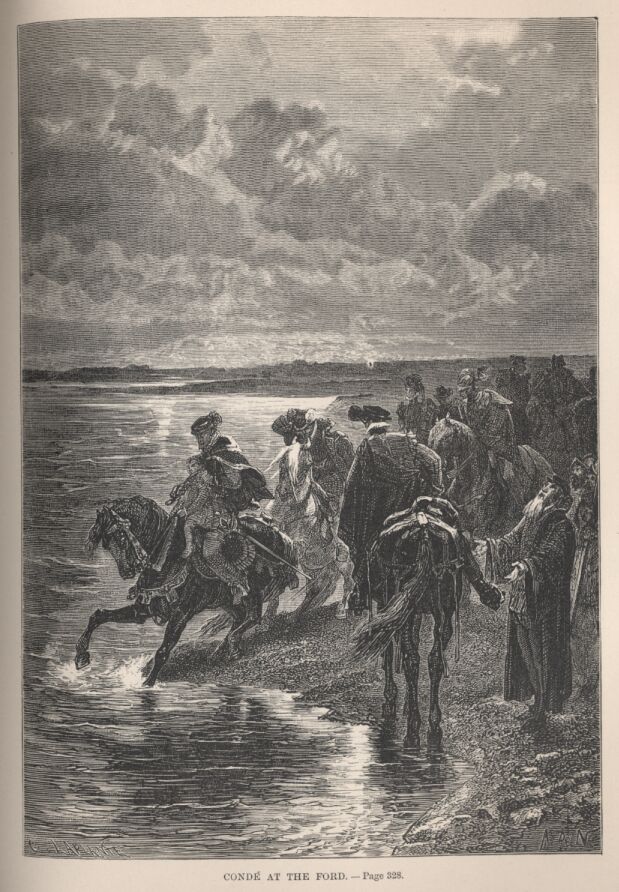
They all went over singing the psalm, When Israel went out of Egypt, and on the 16th of September, 1568, Conde entered La Rochelle. “I fled as far as I could,” he wrote the next day, “but when I got here I found the sea; and, inasmuch as I don’t know how to swim, I was constrained to turn my head round and gain the land, not with feet, but with hands.” He assembled the burgesses of La Rochelle, and laid before them the pitiable condition of the kingdom, the wicked designs of people who were their enemies as well as his own: he called upon them to come and help; he promised to be aidful to them in all their affairs, and, “as a pledge of my good faith,” said he, “I will leave you my wife and children, the dearest and most precious jewels I have in this world.” The mayor of La Rochelle, La Haise, responded by offering him “lives and property in the name of all the citizens,” who confirmed this offer with an outburst of popular enthusiasm. The Protestant nobles of Saintonge and Poitou flocked in. A royal ally was announced; the Queen of Navarre, Jeanne d’Albret, was bringing her son Henry, fifteen years of age, whom she was training up to be Henry IV. Conde went to meet them, and, on the 28th of September, 1568, all this flower of French Protestantism was assembled at La Rochelle, ready and resolved to commence the third religious war.
It was the longest and most serious of the four wars of this kind which so profoundly agitated France in the reign of Charles IX. This one lasted from the 24th of August, 1568, to the 8th of August, 1570, between the departure of Conde and Coligny for La Rochelle and the treaty of peace of St. Germain-en-Laye: a hollow peace, like the rest, and only two years before the St. Bartholomew. On starting from Noyers with Coligny, Conde had addressed to the king, on the 23d of August, a letter and a request, wherein, “after having set forth the grievances of the Reformers, he attributed all the mischief to the Cardinal of Lorraine, and declared that the Protestant nobles felt themselves constrained, for the safety of the realm, to take up arms against that infamous priest, that tiger of France, and against his accomplices.” He bitterly reproached the Guises “with treating as mere policists, that is, men who sacrifice religion to temporal interests, the Catholics inclined to make concessions to the Reformers, especially the Chancellor de l’Hospital and the sons of the late Constable de Montmorency.” The Guises, indeed, and their friends did not conceal their distrust of De l’Hospital, any more than he concealed his opposition to their deeds and their designs. Whilst the peace of Longjumeau was still in force, Charles IX. issued a decree interdicting all Reformers from the chairs of the University and the offices of the judicature; L’Hospital refused to seal it: “God save us from the chancellor’s mass!” was the remark at court. L’Hospital, convinced that he would not succeed in preserving France from a fresh civil war, made up his mind to withdraw, and go and live for some time at his estate of Vignay [a little hamlet in the commune of Gironville, near Etampes, Seine-et-Oise]. The queen-mother eagerly took advantage of his withdrawal to demand of him the seals, of which, she said, she might have need daily. L’Hospital gave them up at once, at the same time retaining his title of chancellor, and letting the queen know “that he would take pains to recover his strength in order to return to his post, if and when it should be the king’s and the queen’s pleasure.” From his rural home he wrote to his friends, “I am not downhearted because the violence of the wicked has snatched from me the seals of the kingdom. I have not done as sluggards and cowards do, who hide themselves at the first show of danger, and obey the first impulses of fear. As long as I was strong enough, I held my own. Deprived of all support, even that of the king and the queen, who dared no longer defend me, I retired, deploring the unhappy condition of France. Now I have other cares; I return to my interrupted studies and to my children, the props of my old age and my sweetest delight. I cultivate my fields. The estate of Vignay seems to me a little kingdom, if any man may consider himself master of anything here below. . . . I will tell you more; this retreat, which satisfies my heart, also flatters my vanity; I like to imagine myself in the wake of those famous exiles of Athens or Rome whom their virtues rendered formidable to their fellow-citizens. Not that I dare compare myself with those great men, but I say to myself that our fortunes are similar. I live in the midst of a numerous family whom I love; I have books; I read, write, and meditate; I take pleasure in the games of my children; the most frivolous occupations interest me. In fine, all my time is filled up, and nothing would be wanting to my happiness if it were not for the awful apparition hard by which sometimes comes, bringing trouble and desolation to my heart.”
This “apparition hard by” was war, everywhere present or imminent in the centre and south-west of France, accompanied by all those passions of personal hatred and vengeance which are characteristic of religious wars, and which add so much of the moral sufferings to the physical calamities of life. L’Hospital, when sending the seals to the queen-mother, who demanded them of him, considered it his bounden duty to give her without any mincing, and the king whom she governed, a piece of patriotic advice. “At my departure,” he says in his will and testament, “I prayed of the king and queen this thing, that, as they had determined to break the peace, and proceed by war against those with whom they had previously made peace, and as they were driving me from the court because they had heard it said that I was opposed to and ill content with their enterprise, I prayed them, I say, that if they did not acquiesce in my counsel, they would, at the very least, some time after they had glutted and satiated their hearts and their thirst with the blood of their subjects, embrace the first opportunity that offered itself for making peace, before that things were reduced to utter ruin; for, whatever there might be at the bottom of this war, it could not but be very pernicious to the king and the kingdom.” During the two years that it lasted, from August, 1568, to August, 1570, the third religious war under Charles IX. entailed two important battles and many deadly faction-fights, which spread and inflamed to the highest pitch the passions of the two parties. On the 13th of March, 1569, the two armies, both about twenty thousand strong, and appearing both of them anxious to come to blows, met near Jarnac, on the banks of the Charente; the royal army had for its chief Catherine de’ Medici’s third son, Henry, Duke of Anjou, advised by the veteran warrior Gaspard de Tavannes, and supported by the young Duke Henry of Guise, who had his father to avenge and his own spurs to win.
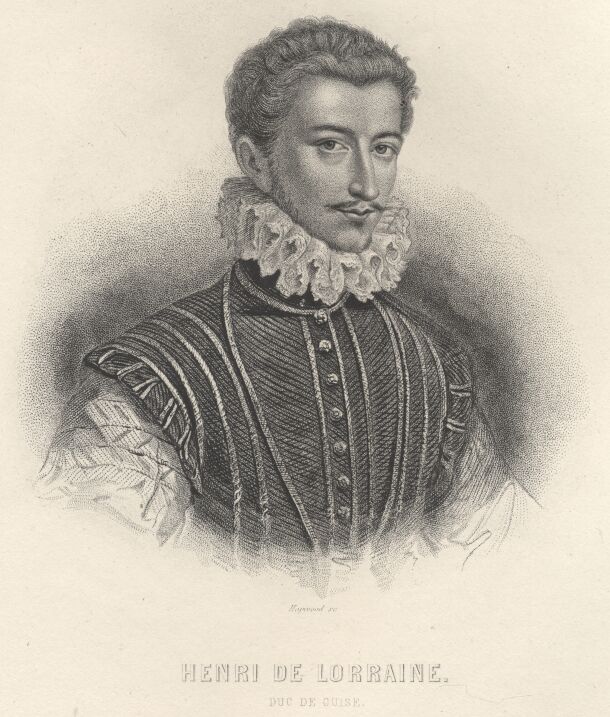
The Prince of Conde, with Admiral de Coligny for second, commanded the Protestant army. We make no pretension to explain and discuss here the military movements of that day, and the merits or demerits of the two generals confronted; the Duke of Aumale has given an account of them and criticised them in his Histoire des Princes de Conde, with a complete knowledge of the facts and with the authority that belongs to him. “The encounter on the 13th of March, 1569, scarcely deserves,” he says, “to be called a battle; it was nothing but a series of fights, maintained by troops separated and surprised, against an enemy which, more numerous to begin with, was attacking with its whole force united.”. A tragic incident at the same time gave this encounter an importance which it has preserved in history. Admiral de Coligny, forced to make a retrograde movement, had sent to ask the Prince of Conde for aid; by a second message he urged the prince not to make a fruitless effort, and to fall back himself in all haste. “God forbid,” answered Conde, “that Louis de Bourbon should turn his back to the enemy!” and he continued his march, saying to his brother-in-law, Francis de la Rochefoucauld, who was marching beside him, “My uncle has made a ‘clerical error’ (pas de clerc, a slip); but the wine is drawn, and it must be drunk.” On arriving at the battle-field, whither he had brought with him but three hundred horse, at the very moment when, with this weak escort, he was preparing to charge the deep column of the Duke of Anjou, he received from La Rochefoucauld’s horse a kick which broke one of the bones of his leg; and he had already crushed an arm by a fall. We will borrow from the Duke of Aumale the glorious and piteous tale of this incident. “Conde turned round to his men-at-arms, and showing first his injured limbs and then the device, ‘Sweet is danger for Christ and for fatherland!’ which fluttered upon his banner in the breeze, ‘Nobles of France,’ he cried, ‘this is the desired moment Remember in what plight Louis de Bourbon enters the battle for Christ and fatherland!’ Then, lowering his head, he charges with his three hundred horse upon the eight hundred lances of the Duke of Anjou. The first shock of this charge was irresistible; such for a moment was the disorder amongst the Catholics that many of them believed the day was lost; but fresh bodies of royalists arrive one after another. The prince has his horse killed under him; and, in the midst of the confusion, hampered by his wounds, he cannot mount another. In spite of all, his brave comrades do not desert him; Soubise and a dozen of them, covered with wounds, are taken; an old man, named La Vergne, who had brought with him twenty-five sons or nephews, is left upon the field with fifteen of them, ‘all in a heap,’ says D’Aubigne. Left almost alone, with his back against a tree, one knee upon the ground, and deprived of the use of one leg, Conde still defends himself; but his strength is failing him; he sees two Catholic gentlemen to whom he had rendered service, Saint-Jean and D’Argence; he calls to them, raises the vizor of his helmet, and holds out to them his gauntlets. The two horsemen dismount, and swear to risk their lives to save his. Others join them, and are eager to assist the glorious captive. Meanwhile the royal cavalry continues the pursuit; the squadrons successively pass close by the group which has formed round Conde. Soon he spies the red cloaks of the Duke of Anjou’s guards. He points to them with his finger. D’Argence understands him, and, ‘Hide your face!’ he cries. ‘Ah D’Argence, D’Argence, you will not save me,’ replies the prince. Then, like Caesar, covering up his face, he awaited death the poor soul knew only too well the perfidious character of the Duke of Anjou, the hatred with which he was hunting him down, and the sanguinary orders he would give. The guards had gone by when their captain, Montesquion, learned the name of this prisoner. ‘Slay, slay, mordioux!’ he shouted; then suddenly wheeling his horse round, he returns at a gallop, and with a pistol-shot, fired from behind, shatters the hero’s skull.” [Histoire des Princes de Conde, by M. le Duc d’Aumale, t. ii. pp. 65-72.]
The death of Conde gave to the battle of Jarnac an importance not its own. A popular ditty of the day called that prince “the great enemy of the mass.” “His end,” says the Duke of Aumale, “was celebrated by the Catholics as a deliverance; a solemn Te Deum was chanted at court and in all the churches of France. The flags taken were sent to Rome, where Pope Pius IV. went with them in state to St. Peter’s. As for the Duke of Anjou, he showed his joy and his baseness together by the ignoble treatment he caused to be inflicted upon the remains of his vanquished relative, a prince of the blood who had fallen sword in hand. At the first rumor of Conde’s death, the Duke of Montpensier’s secretary, Coustureau, had been despatched from headquarters with Baron de Magnac to learn the truth of the matter. ‘We found him there,’ he relates, ‘laid upon an ass; the said sir baron took him by the hair of the head for to lift up his face, which he had turned towards the ground, and asked me if I recognized him. But as he had lost an eye from his head, he was mightily disfigured; and I could say no more than it was certainly his figure and his hair, and further than that I was unable to speak.’ Meanwhile,” continues the Duke of Aumale, “the accounts of those present removed all doubt; and the corpse, thus thrown across an ass, with arms and legs dangling, was carried to Jarnac, where the Duke of Anjou lodged on the evening of the battle. There the body of Conde was taken down amidst the sobs of some Protestant prisoners, who kissed, as they wept, the remains of their gallant chief. This touching spectacle did not stop the coarse ribaldry of the Duke of Anjou and his favorites; and for two days the prince’s remains were left in a ground-floor room, there exposed to the injurious action of the air and, to the gross insults of the courtiers. The Duke of Anjou at last consented to give up the body of Conde to the Duke of Longueville, his brother-in-law, who had it interred with due respect at Vendome in the burial-place of his ancestors.”
When in 1569 he thus testified, from a mixture of hatred and fear, an ignoble joy at the death of Louis de Conde, the valiant chief of Protestantism, the Duke of Anjou did not foresee that, nearly twenty years later, in 1588, when he had become Henry III., King of France, he would also testify, still from a mixture of hatred and fear, the same ignoble joy at sight of the corpse of Henry de Guise, the valiant chief of Catholicism, murdered by his order and in his palace.
As soon as Conde’s death was known at La Rochelle, the Queen of Navarre, Jeanne d’Albret, hurried to Tonnay-Charente, whither the Protestant army had fallen back; she took with her her own son Henry, fifteen years old, and Henry de Bourbon, the late Prince of Conde’s son, who was seventeen; and she presented both of them to the army. The younger, the future Henry IV., stepped forward briskly. “Your cause,” said he, “is mine; your interests are mine; I swear on my soul, honor, and life, to be wholly yours.” The young Conde took the same oath. The two princes were associated in the command, under the authority of Coligny, who was immediately appointed lieutenant-general of the army. For two years their double signature figured at the bottom of the principal official acts of the Reformed party; and they were called “the admiral’s pages.” On both of them Jeanne passionately enjoined union between themselves, and equal submission on their part to Coligny, their model and their master in war and in devotion to the common cause. Queen, princes, admiral, and military leaders of all ranks stripped themselves of all the diamonds, jewels, and precious stones which they possessed, and which Elizabeth, the Queen of England, took in pledge for the twenty thousand pounds sterling she lent him. The Queen of Navarre reviewed the army, which received her with bursts of pious and warlike enthusiasm; and leaving to Coligny her two sons, as she called them, she returned alone to La Rochelle, where she received a like reception from the inhabitants, “rough and loyal people,” says La Noue, “and as warlike as mercantile.” After her departure, a body of German horse, commanded by Count Mansfeld, joined Coligny in the neighborhood of Limoges. Their arrival was an unhoped-for aid. Coligny distributed amongst them a medal bearing the effigy of Queen Jeanne of Navarre with this legend: “Alone, and with the rest, for God, the king, the laws, and peace.”
With such dispositions on one side and the other, war was resumed and pushed forward eagerly from June, 1569, to June, 1570, with alternations of reverse and success. On the 23d of June, 1569, a fight took place at Roche l’Abeille, near St. Yrieix in Limousin, wherein the Protestants had the advantage. The young Catholic noblemen, with Henry de Guise at their head, began it rashly, against the desire of their general, Gaspard de Tavannes, to show off their bravery before the eyes of the queen-mother and the Cardinal of Lorraine, both of whom considered the operations of the army too slow and its successes too rare. They lost five hundred men and many prisoners, amongst others Philip Strozzi, whom Charles IX. had just made colonel-general of the infantry. They took their revenge on the 7th of September, 1569, by forcing Coligny to raise the siege of Poitiers, which he had been pushing forward for more than two months, and on the 3d of October following, at the battle of Moncontour in Poitou, the most important of the campaign, which they won brilliantly, and in which the Protestant army lost five or six thousand men and a great part of their baggage. Before the action began, “two gentlemen on the side of the Catholics, being in an out-of-the-way spot, came to speech,” says La Noue, “with some of the (Protestant) religion, there being certain ditches between them.
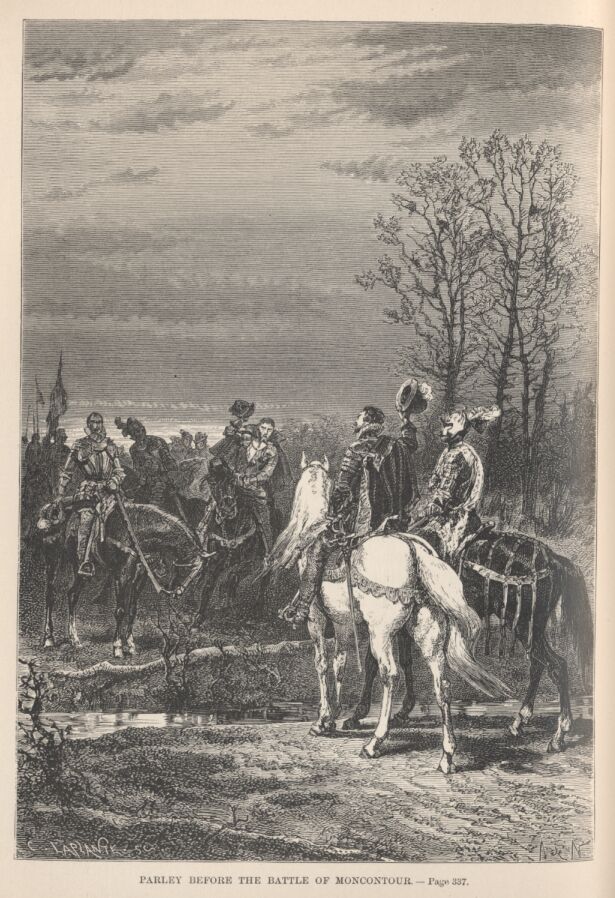
‘Sirs,’ said they, ‘we bear the marks of enemies, but we do not hate you in any wise, or your party. Warn the admiral to be very careful not to fight, for our army is marvellously strong by reason of re-enforcements that have come in to it, and it is very determined withal. Let the admiral temporize for a month only, for all the nobles have sworn and said to Monseigneur that they will not wait any longer, that he must employ them within that time, and they will then do their duty. Let the admiral remember that it is dangerous to stem the fury of Frenchmen, the which, however, will suddenly ooze away; if they have not victory speedily, they will be constrained to make peace, and will offer it you on advantageous terms. Tell him that we know this from a good source, and greatly desired to advertise him of it.’ Afterwards they retired. The others,” continues La Noue, “went incontinently to the admiral for to make their report, which was to his taste. They told it also to others of the principals; and some there were who desired that it should be acted upon; but the majority opined that this notice came from suspected persons, who had been accustomed to practise fraud and deceit, and that no account should be made of it.” The latter opinion prevailed; and the battle of Moncontour was fought with extreme acrimony, especially on the part of the Catholics, who were irritated by the cruelties, as La Noue himself says, which the Protestants had but lately practised at the fight of La Roche l’Abeille. Coligny was wounded in the action, after having killed with his own hand the Marquis Philibert of Baden; and the melley had been so hot that the admiral’s friends found great difficulty in extricating him and carrying him off the field to get his wound attended to. Three weeks before the battle, on the 13th of September, Coligny had been sentenced to death by the Parliament of Paris, and hanged in effigy on the Place de Greve; and a reward of fifty thousand gold crowns had been offered to whosoever should give him up to the king’s justice dead or alive, words added, it is said, to the decree at the desire of Charles IX. himself. Family sorrows were in Coligny’s case added to political reverses; on the 27th of May, in this same year 1569, he had lost his brother D’Andelot, his faithful comrade in his religious as well as his warlike career. “He found himself,” says D’Aubigne, “saddled with the blame due to accident, his own merits being passed over in silence; with the remnant of an army which, when it was whole, was in despair even before the late disaster; with weak towns, dismayed garrisons, and foreigners without baggage; himself moneyless, his enemies very powerful, and pitiless towards all, especially towards him; abandoned by all the great, except one woman, the Queen of Navarre, who, having nothing but the title, had advanced to Niort in order to lend a hand to the afflicted and to affairs in general. This old man, worn down by fever, endured all these causes of anguish and many others that came to rack him more painfully than his grievous wound. As he was being borne along in a litter, Lestrange, an old nobleman, and one of his principal counsellors, travelling in similar fashion, and wounded likewise, had his own litter, where the road was broad, moved forward in front of the admiral’s, and putting his head out at the door, he looked steadily at his chief, saying, with tears in his eyes, ‘Yet God is very merciful.’ Thereupon they bade one another farewell, perfectly at one in thought, without being able to say more. This great captain confessed to his intimates that these few friendly words restored him, and set him up again in the way of good thoughts and firm resolutions for the future.” He was so much restored, that, between the end of 1569 and the middle of 1570, he marched through the south and the centre of France the army which he had reorganized, and with which, wherever he went, he restored, if not security, at any rate confidence and zeal, to his party.
On arriving at Arnay-le-Duc, in Burgundy, he found himself confronted by Marshal de Cosse with thirteen thousand men of the king’s troops. Coligny had barely half as many; but he did not hesitate to attack, and on the 13th of June, 1570, he was so near victory that the road was left open before him. On the 7th of July he arrived at Charite-sur-Loire. Alarm prevailed at Paris. A truce for ten days was signed, and negotiations were reopened for a fresh attempt at peace.
“If any one, in these lamentable wars, worked hard, both with body and mind,” says La Noue, “it may be said to have been the admiral, for, as regards the greatest part of the burden of military affairs and hardships, it was he who supported them with much constancy and buoyancy; and he was as respectful in his bearing towards the princes his superiors as he was modest towards his inferiors. He always had piety in singular esteem, and a love of justice, which made him valued and honored by them of the party which he had embraced. He did not seek ambitiously for commands and honors; they were thrust upon him because of his competence and his expertness. When he handled arms and armies, he showed that he was very conversant with them, as much so as any captain of his day, and he always exposed himself courageously to danger. In difficulties, he was observed to be full of magnanimity and resource in getting out of them, always showing himself quite free from swagger and parade. In short, he was a personage worthy to re-establish an enfeebled and a corrupted state. I was fain to say these few words about him in passing, for, having known him and been much with him, and having profited by his teaching, I should have been wrong if I had not made truthful and honorable mention of him.” [Memoires de La Noue, in the Petitot collection, 1st series, t. xxxiv. p. 288.]