Volume 4 — CHAPTER XXXIII. CHARLES IX. AND THE RELIGIOUS WARS. (1560-1574.) (continued 3)
Robert Black translation
Certainly this was not what Charles IX. had calculated upon when he consented to the massacre of the Protestants. “Provided,” he had said, “that not a single one is left to reproach me.” The massacre had been accomplished almost without any resistance but that offered by certain governors of provinces or towns, who had refused to take part in it. The chief leader of French Protestantism, Coligny, had been the first victim. Far more than that, the Parliament of Paris had accepted the royal lie which accused Coligny of conspiring for the downfall of the king and the royal house; a decree, on that very ground, sentenced to condemnation the memory, the family, and the property of Coligny, with all sorts of rigorous, we should rather say atrocious, circumstances. And after having succeeded so well against the Protestants, Charles IX. saw them recovering again, renewing the struggle with him, and wresting from him such concessions as he had never yet made to them. More than ever might he exclaim, “Then I shall never have rest!” The news that came to him from abroad was not more calculated to satisfy him.
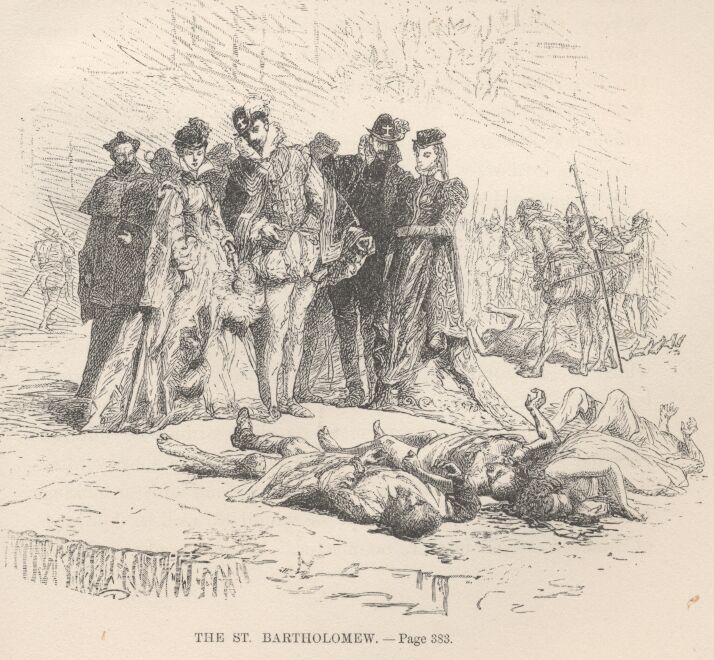
The St. Bartholomew had struck Europe with surprise and horror; not only amongst the princes and in the countries that were Protestant, in England, Scotland, and Northern Europe, but in Catholic Germany itself, there was a very strong feeling of reprobation; the Emperor Maximilian II. and the Elector Palatine Frederic III., called the Pious, showed it openly; when the Duke of Anjou, elected King of Poland, went through Germany to go and take possession of his kingdom, he was received at Heidelberg with premeditated coolness. When he arrived at the gate of the castle, not a soul went to meet him; alone he ascended the steps, and found in the hall a picture representing the massacre of St. Bartholomew; the elector called his attention to the portraits of the principal victims, amongst others that of Coligny, and at table he was waited upon solely by French Protestant refugees. At Rome itself, in the midst of official satisfaction and public demonstrations of it exhibited by the pontifical court, the truth came out, and Pope Gregory XIII. was touched by it when certain of my lords the cardinals who were beside him “asked wherefore he wept and was sad at so goodly a despatch of those wretched folk, enemies of God and of his Holiness: ‘I weep,’ said the pope, ‘at the means the king used, exceeding unlawful and forbidden of God, for to inflict such punishment; I fear that one will fall upon him, and that he will not have a very long bout of it (will not live very long). I fear, too, that amongst so many dead folk there died as many innocent as guilty.’” [Brantome, t. iv. p. 306. He attributes this language to Pope Pius V., who died four months before the St. Bartholomew. Gregory XIII., elected May 15, 1572, was pope when the massacre took place.] Only the King of Spain, Philip II., a fanatical despot, and pitiless persecutor, showed complete satisfaction at the event; and he offered Charles IX. the assistance of his army, if he had need of it, against what there was remaining of heretics in his kingdom.
Charles IX. had not mind or character sufficiently sound or sufficiently strong to support, without great perturbation, the effect of so many violent, repeated, and often contradictory impressions. Catherine de Medici had brought up her three sons solely with a view of having their confidence and implicit obedience. “All the actions of the queen-mother,” said the Venetian ambassador Sigismund Cavalli, who had for a long while resided at her court, “have always been prompted and regulated by one single passion, the passion of ruling.” Her son Charles had yielded to it without an effort in his youth. “He was accustomed to say that, until he was five and twenty, he meant to play the fool; that is to say, to think of nothing but of enjoying his heyday; accordingly he showed aversion for speaking and treating of business, putting himself altogether in his mother’s hands. Now, he no longer thinks and acts in the same way. I have been told that, since the late events, he requires to have the same thing said more than three times over by the queen, before obeying her.” It was not with regard to his mother only that Charles had changed. “His looks,” says Cavalli, “have become melancholy and sombre; in his conversations and audiences he does not look the speaker in the face; he droops his head, closes his eyes, opens them all at once, and, as if he found the movement painful, closes them again with no less suddenness. It is feared that the demon of vengeance has possessed him; he used to be merely severe; it is feared that he is becoming cruel. He is temperate in his diet; drinks nothing but water. To tire himself at any price, is his object. He remains on horseback for twelve or fourteen consecutive hours; and so he goes hunting and coursing through the woods the same animal, the stag, for two or three days, never stopping but to eat, and never resting but for an instant during the night.” He was passionately fond of all bodily exercises, the practice of arms, and the game of tennis. “He had a forge set up for himself,” says Brantome, “and I have seen him forging cannon, and horseshoes, and other things as stoutly as the most robust farriers and forgemen.” He, at the same time, showed a keen and intelligent interest in intellectual works and pleasures. He often had a meeting, in the evening, of poets, men of letters, and artists—Ronsard, Amadis Jamin, Jodelle, Daurat, Baif; in 1570 he gave them letters patent for the establishment of an Academy of poetry and music, the first literary society founded in France by a king; but it disappeared amidst the civil wars. Charles IX. himself sang in the choir, and he composed a few hunting-airs. Ronsard was a favorite, almost a friend, with him; he used to take him with him on his trips, and give him quarters in his palace, and there was many an interchange of verse between them, in which Ronsard did not always have the advantage. Charles gave a literary outlet to his passion for hunting; he wrote a little treatise entitled La Chasse royale, which was not published until 1625, and of which M. Henry Chevreul brought out, in 1857, a charming and very correct edition. Charles IX. dedicated it to his lieutenant of the hunt, Mesnil, in terms of such modest and affectionate simplicity that they deserve to be kept in remembrance. “Mesnil,” said the king, “I should feel myself far too ungrateful, and expect to be chidden for presumption, if, in this little treatise that I am minded to make upon stag hunting, I did not, before any one begins to read it, avow and confess that I learnt from you what little I know. . . . I beg you, also, Mesnil, to be pleased to correct and erase what there is wrong in the said treatise, the which, if peradventure it is so done that there is nothing more required than to re-word and alter, the credit will be firstly yours for having so well taught me, and then mine for having so well remembered. Well, then, having been taught by so good a master, I will be bold enough to essay it, begging you to accept it as heartily as I present it and dedicate it to you.”
These details and this quotation are allowable in order to shed full light upon the private and incoherent character of this king, who bears the responsibility of one of the most tragic events in French history. In the spring of 1574, at the age of twenty-three years and eleven months, and after a reign of eleven years and six months, Charles IX. was attacked by an inflammatory malady, which brought on violent hemorrhage; he was revisited, in his troubled sleep, by the same bloody visions about which, a few days after the St. Bartholomew, he had spoken to Ambrose Pare. He no longer retained in his room anybody but two of his servants and his nurse, “of whom he was very fond, although she was a Huguenot,” says the contemporary chronicler Peter de l’Estoile. “When she had lain down upon a chest, and was just beginning to doze, hearing the king moaning, weeping, and sighing, she went full gently up to the bed. ‘Ah, nurse, nurse,’ said the king, ‘what bloodshed and what murders! Ah! what evil counsel have I followed! O, my God! forgive me them and have mercy upon me, if it may please Thee! I know not what hath come to me, so bewildered and agitated do they make me. What will be the end of it all? What shall I do? I am lost; I see it well.’ Then said the nurse to him, ‘Sir, the murders be on the heads of those who made you do them! Of yourself, sir, you never could; and since you are not consenting thereto, and are sorry therefor, believe that God will not put them down to your account, and will hide them with the cloak of justice of His Son, to whom alone you must have recourse. But for God’s sake, let your Majesty cease weeping!’ And thereupon, having been to fetch him a pocket-handkerchief, because his own was soaked with tears, after that the king had taken it from her hand, he signed to her to go away and leave him to his rest.”
On Sunday, May 30, 1574, Whitsunday, about three in the afternoon, Charles IX. expired, after having signed an ordinance conferring the regency upon his mother Catherine, “who accepted it,” was the expression in the letters patent, “at the request of the Duke of Alencon, the King of Navarre, and other princes and peers of France.” According to D’Aubigne, Charles used often to say of his brother Henry, that, “when he had a kingdom on his hands, the administration would find him out, and that he would disappoint those who had hopes of him.” The last words he said were, “that he was glad not to have left any young child to succeed him, very well knowing that France needs a man, and that, with a child, the king and the reign are unhappy.”