Volume 4 — Chapter XXXVI. George III. The American War (1760-1783).
Reading edition
The House of Hanover reigned without further contest. The Stuarts had disappeared, borne forever by their misdeeds and misfortunes far from the throne of their ancestors, and the young King George III. peaceably succeeded his grandfather. Europe now, as well as England, understood the importance of the change which had just been accomplished. William III., called to the throne by the English nation, had delivered it from an odious yoke and had assured to it its religious and political liberties. He had constantly remained a foreigner in the England which he served gloriously and effectively without loving it. George I. and George II. were Germans, elevated to the throne by the national will, which was strong and wise, without sympathy and without pleasure. They had remained Germans in manners and in speech. England had grown under their rule; her institutions were strengthened and developed. At the death of George II., thanks to the illustrious man who, as an absolute master, had governed her in freedom, she had become the arbiter of Europe, predominant in America as well as in Asia. However, the English people's loyalty of feeling had never been satisfied since the downfall of the Stuarts, and the most obstinate of the Whigs, although passionately opposed to all the attempts of the Jacobite restoration, yet excused, in the depths of their heart, those who had sacrificed all to their attachment towards the hereditary monarch. George III. was at last reigning, loved and respected beforehand, and the painful trials of his life and his long reign never caused him to lose the confidence and sympathy of his people. It was the feeling of the whole nation as well as his own that the young monarch expressed when he spontaneously said, in his first speech from the throne: "Born and brought up in this country, I glory in the name of Englishman, and it will be the pleasure of my life to give happiness to a people whose fidelity and attachment to myself I regard as the security and lasting honor of my throne."
New counsels already began to spread, less violent against France than those of Mr. Pitt. The young king had cordially received his grandfather's ministers, asking them to continue in their duties under him; but he had also admitted Lord Bute to the Privy Council, and the favorite's intrigues already came in contact with those of the Duke of Newcastle. Some weeks later, at the moment of the dissolution of Parliament, Bute succeeded Lord Holderness as secretary of state. Pitt, it is said, was not consulted.
The haughty displeasure of the great minister had its influence upon the tone of the negotiations then begun with France. The Duke de Choiseul, burning to serve his country, although active, restless, and courageous, still felt the necessity of peace. He had proposed a congress. While Pitt delayed his answer, an English squadron had blockaded Bellisle. A first assault, made on the 8th of April by General Hodgson, was repulsed. The governor, M. de St. Croix, had received no assistance, and, despite an heroic resistance, he was forced to capitulate on June 7th, 1761. It was almost at the same time that news was received of the check of De Broglie and De Soubise at Minden, and of the disastrous surrender of Pondicherry. England's answer to the proposals of peace at last arrived. The Duke de Choiseul had proposed to evacuate Hesse and Hanover, demanding the restoration of Guadaloupe and Marie Galante, and of Bellisle in exchange for Minorca. He accepted the conquest of Canada and of Cape Breton, but in return he laid claim to all the captures made at sea of the French merchant ships before the declaration of war, and required an engagement that the English troops, under the orders of Prince Ferdinand of Brunswick, should not proceed to reinforce the Prussian army. The ultimatum was modest, and was a bitter trial to the patriotic pride of M. de Choiseul. Pitt's answer left no hope of peace. All the conquests, all the captures, full liberty to aid the King of Prussia—such was the language of the English minister. Dunkerque must be razed, as a lasting monument of the yoke imposed on France. "So long as I hold the reins of government," said Pitt, "another Peace of Utrecht shall never sully the annals of England."
Pitt had well estimated the exhaustion and the fatigue of France. He had not foreseen the influence which the accession of a new monarch to the throne of Spain would exert upon her alliances. Ferdinand VI. had died childless. His brother, Charles III. King of Naples, had succeeded him. He brought to his hereditary kingdom a quicker intelligence than that of the dead king, a great aversion to England (of which he had lately reason to complain), and the traditional attachment of his race for the interests and glory of France. The Duke de Choiseul was adroit enough to avail himself of these tendencies. In the distress in which the war had thrown King Louis XV., at the moment when Pitt rejected his ultimatum, insulting him by inacceptable proposals, Spain generously entered the list. The treaty, known under the name of the Family Compact, was signed at Paris on the 15th of April, 1761. Pitt immediately proposed to George III. to make sure of the Isthmus of Panama, and to attack immediately the Philippine Islands.
It was the last straw for the tottering empire of the minister who had been so long absolute in the council as well as in the Houses. The cabinet had hardly accepted the harshness of the conditions which he exacted from France. A declaration of war with Spain was rejected by a large majority. Pitt arose. "I thank you, gentlemen," said he, "for the support which you have often given me, but it is the voice of the people which has called me to public affairs. I have always considered myself as accountable to it for my conduct. I cannot then remain in a position where I shall be responsible for measures of which I have no longer the direction." Several days later Pitt placed in the king's hands the seals of office. George III. received him kindly. "Sad," he said, "to part from so illustrious a servant." The haughty minister burst into tears. "I confess, your Majesty," he said, "that I expected the signs of your displeasure. Your Majesty's kindness confounds and overwhelms me." Against the advice of his friends, Pitt accepted a pension of three thousand pounds sterling and a peerage for his wife, who became Lady Chatham. His popularity in consequence suffered a slight blow, yet it remained so great that at the annual lord mayor's dinner on the 9th of November, all looks were turned toward the fallen minister, all the applause was reserved for him, at the expense of the king and of his young wife, Charlotte de Mecklenberg-Streglitz. This popular triumph became insulting to the royal personages. "At each step," said an eye-witness, "the crowd pressed around the simple carriage where were to be found Pitt and Lord Temple. They laid hold of the wheels; they embraced the servants, and even the horses."
"Mr. Pitt will not make peace because he cannot make that which he has given the nation reason to hope for," an acute observer of the court, Bubb Doddington, had already said. On succeeding to power, Lord Bute and the tories found themselves still driven by public opinion to measures more violent than their tastes or their intentions. France had made a supreme effort to reorganize its army. In the month of January, 1762, the English government declared war on Spain, striking from the first the most disastrous blows at our faithful ally. The year had not gone by before Cuba was already in the hands of the English, the Philippine Islands ravaged, and galleons laden with Spanish gold captured by British vessels. The campaign undertaken against Portugal, always friendly to England, was productive of no result. Martinique had followed the lot of Guadaloupe, which had already been conquered by the English after an heroic resistance. The war dragged on slowly in Germany. The death of the Czarina Elizabeth and the brief occupation of the throne by the young Czar Peter III., a passionate admirer of Frederick the Great, had freed the King of Prussia from a dangerous enemy, and promised him an ally faithful as well as powerful. The hope that the Family Compact had for a time given to France was deceived. The negotiations began again. On the 3d of November, 1762, the preliminaries of peace were signed at Fontainebleau. France abandoned all her possessions in America. Louisiana, which had taken no part in the war, was ceded to Spain in exchange for Florida, which was given over to the English. Only the small islands of St. Pierre and Miquelon were reserved for the French fisheries. A special stipulation guaranteed to the Canadians freedom in Catholic worship. In exchange for engaging not to introduce troops into Bengal, France recovered Chaudernagore and the ruins of Pondicherry. Guadaloupe and Martinique became again French. The English kept Tobago, Dominique, St. Vincent, and Grenada. In Germany the places and country occupied by France were to be evacuated. Like his illustrious rival. Lord Bute insisted upon the demolition of Dunkerque.
England's success had been great, and France's humiliation profound, and yet it was not enough for the persistent hatred of Pitt, now freed from the shackles of power, and at liberty to allow full reign to his rancor against Lord Bute as well as to his animosity toward our nation. He was disabled by gout, the persistent scourge of his life; he had himself carried, wrapped in flannel, to the House of Commons. Two of his friends led him to his seat, and supported him during the first part of his speech. Exhausted, he ended by sitting down, contrary to all parliamentary usage. "I have come here at the risk of my life," he exclaimed, "to raise my voice, my hand, my arm against the preliminary articles of a peace which tarnishes the glory of the war, which betrays the dearest interests of the nation, and which sacrifices public faith while deserting our allies. France is chiefly, if not entirely, formidable to us as a maritime and commercial power. What we gain in this respect is doubly precious from the loss which results to her. America, gentlemen, has been conquered in Germany; to-day you leave to France the possibility of re-establishing her navy."
Peace was voted notwithstanding. Lord Bute had felt the need of support in the House of Commons against the thundering eloquence of Pitt. He had called Henry Fox, who lacked neither adroit eloquence nor insidious manipulations. His personal experience had taught him to judge men severely. The aged Lord Grey was asked in our time who was the last English minister susceptible of being corrupted. He unhesitatingly answered, "Lord Holland."
England had achieved a glorious peace. She was fatigued from her long efforts, and resolved henceforward to leave to the continental powers the care of settling their own quarrels. Austria and Prussia alone were left, the first to enter the lists, the only nations which retained a serious interest in the questions in dispute. Frederick the Great had based new hopes on the young czar, and a caprice of fortune had robbed him of his support. Catherine II., Princess of Anhalt-Zerbst, was on bad terms with her husband. She took advantage of the indiscretions of Peter III. to excite a military insurrection against him. He was deposed, and shortly after died in his prison. Catherine was proclaimed sovereign in his place. The new sovereign was bold, ambitious, and as unscrupulous in her greed for power as in her private life. She remained neutral between Prussia and Austria. The states were at the end of their resources, the population decimated. In ten years Berlin had lost a tenth of her population, and thirty thousand of her inhabitants owed their subsistence to public charity. The two sovereigns agreed to an interchange of conquests. All this disturbance and all this suffering ended for Germany in the maintenance of the statu quo. France was exhausted, deprived of her most flourishing colonies, degraded in her own eyes as well as in those of Europe. She had dragged Spain along in her misfortune. England alone emerged triumphant and aggrandized with booty. She had gained forever the Empire of India, and for some years at least almost the whole of civilized America obeyed her laws. She had gained what we had lost, not by the superiority of her arms, nor even of her generals, but by the natural and innate force of a free people skillfully and nobly governed.
The peace had been accepted by the nation as well as by the Houses, but ill-will existed against Lord Bute, a Scotchman and favorite, who was attacked on all sides, both in pamphlets and in Parliament. More jealous of his influence with the royal family than he was of power, Lord Bute resolved to resign. He had written to one of his friends: "Isolated in a cabinet which I have formed, having no one to support me in the House of Lords but two peers, who are friends of mine, with my two secretaries of state maintaining silence, and the Lord Chancellor, whom I placed in his position, voting and speaking against me, I find myself upon ground which is undermined beneath me, and which makes me dread not only to fall myself, but to drag my royal master with me in my fall. It is time that I should retire." George Grenville succeeded him in power, and Fox passed to the House of Lords with the title of Lord Holland.
A brother-in-law of Pitt, who had never submitted to his domination, George Grenville was bold, presumptuous, and short-sighted, violent in his methods and methodical in his administration. The defects of his temper and character caused serious embarrassments to the government which he directed, and drew down great mishaps upon England. He pursued with obstinacy John Wilkes, the pamphleteer, and proposed to apply the stamp tax to the American colonies.
John Wilkes, born in London in 1727, Member of Parliament for Aylesbury, blustering, ruined, corrupt, hideous in personal appearance, and given over to the most unbridled licentiousness of life, had sought a means of re-establishing his fortunes by founding a skillfully and audaciously edited journal, which he called The North Briton. Lord Bute had already been violently attacked by Wilkes, who was secretly encouraged, it is said, by Lord Temple; but no prosecution had been directed against him. In proroguing Parliament at the end of April, 1763, the king congratulated himself on the happy termination of the war; "so honorable," he said, "for my crown, and so happy for my people." Wilkes' journal attacked the speech in his forty-fifth number, dated April 23d. Eight days after, in spite of his parliamentary privilege, Wilkes was arrested at his own house and conducted to the Tower, where he remained some days in secret. In passing under the gloomy gate, Wilkes ironically asked to be lodged in the room which had formerly been occupied by the father of Lord Egremont, one of the ministers who had signed the order for his arrest. As soon as his friends received permission to visit him, Lord Temple and the Duke of Grafton hastened to see him. The public feeling overcame the dislike which the character of the accused generally inspired, and transports of joy broke out in the crowd when the Chief Justice, Sir Charles Pratt, firmly pronounced his acquittal. "We are all of the opinion," he said, "that a libel does not amount to a breach of the public peace. The most that can be said is that it tends to it, without being in consequence subject to the penalties of the law. I order that Mr. Wilkes be released."
For seven years to come, under different phases—sometimes in France, under pretext of obtaining cure for a wound received in a duel; sometimes in London as candidate for the House of Commons; outlawed by the Middlesex magistrates for his indecent pamphlets; chosen by the city as one of its representatives—John Wilkes was almost constantly before the public, sustained by the most diverse partisans, honest or corrupt; absorbed in those public liberties which they considered outraged in his person, or sympathetically interested in the audacious impiety which bore without blushing the banner of moral or political license. It was the error and the fault of the government to have alienated public opinion by imprudent prosecutions, thus assuring to Wilkes a popularity in no way deserved. When at last he died, in 1797, the venal and debauched pamphleteer had for a long time fallen into the obscurity and contempt from which he should never have emerged.
The Stamp Act has left its date and its ineradicable trace on the history of England, and of the world. Already for a long time under the influence of the rapid development of their prosperity and resources, the American colonies proudly defended their privileges, resenting the offensive investigations of the revenue officers, while admitting the right of the mother-country to that monopoly of commerce which they succeeded in violating by an active contraband trade. Submitting without trouble to the external taxes intended to regulate the commerce, the Americans claimed entire independence as regarded other duties. In 1692 the General Court of Massachusetts resolved that no tax could be imposed upon his Majesty's colonial subjects without the consent of the governor, the council, and the representatives assembled in General Court. It was this fundamental principle of the liberties of Great Britain, as well as of her colonies—that an English subject could not be taxed without his consent—that was openly violated in 1765 by the proposition of Mr. George Grenville. This financial expedient had been previously suggested to Sir Robert Walpole, but he answered with his usual good sense, "I have Old England already on my hands; do you suppose I wish to encumber myself in addition with New England? He will be a bolder minister than I who will assume that."
Grenville was naturally bold, as Cardinal de Retz said of Anne of Austria, because he was neither prudent nor far-sighted. He was at once absolute and without tact. The extension to the colonies of the stamp tax had been voted almost without opposition. Mr. Pitt himself had not protested. Thoughtlessly, and in consequence of the financial embarrassment brought on by the war, the English government, without systematic scheme, and without arrière pensée, had committed itself to a fatal line of policy in which the national pride was to sustain it too long. The taxes were light and could not entail any suffering on the colonists. They were the first to recognize this themselves. "What is the matter, and what are we disputing about?" said Washington in 1766. "Is it about the payment of a tax of threepence a pound on tea being too burdensome? No, it is the principle alone which we contest."
A general and speedily riotous protestation was made in 1765, in New England, in the name of the rights of the colonies, unjustly violated by the pretensions of the metropolis. At Boston the people arose and broke into the house of the distributors of stamped paper. The ships which happened to be in port lowered their flags to half-mast, in token of mourning, and the church bells sounded the funeral toll. At Philadelphia the inhabitants spiked the cannons on the ramparts. At Williamsburg the House of Burgesses of Virginia resounded with the most violent menaces, and in the midst of the discussion of the Stamp Act, Patrick Henry, who was still very young, uttered these words: "Caesar found his Brutus, Charles I. his Cromwell, and George III. … !" "Treason! treason!" cried the royalists. "And George III. will doubtless profit from their example," retorted the young orator. The remonstrance which he had proposed was voted.
The attitude of the American people and the numerous petitions which revealed it had warned Pitt of the danger. He openly attacked the cabinet and called for the repeal of the Stamp Act. "The colonists," said he, "are subjects of this kingdom, entitled equally with yourselves to the special privileges of Englishmen. They are bound by English laws, and to the same extent as we. They have a right to the liberties of this country. The Americans are the sons, and not the bastards, of England. When we agree in this House to the subsidies to his Majesty, we dispose of that which belongs to ourselves; but when we impose a tax on the Americans, what are we doing? We, the Commons of England, give what to his Majesty? Our personal property? No. We give the property of the Commons of America. It is a contradiction of terms. I demand that the Stamp Act be repealed, absolutely, completely, immediately; that the reason of the repeal shall be proclaimed. The principle on which the act was based was false. At the same time let the supreme authority of this country over her colonies be clearly affirmed in the most decided terms that can be imagined. We can bind their commerce, restrain their manufactures, and exercise our power under every form. We cannot, we should not, take the money in their pockets without their consent."
The honor of obtaining from the English Parliament the repeal of an unjust measure was reserved for a new and more moderate minister. George Grenville, beaten and overthrown, remained obstinately attached to the cause on which he had entered. "If the tax were still to impose, I should impose it," said he; "the enormous expenses that were caused by the German war have made it necessary. The eloquence which the author of this proposal brings to bear to-day against the constitutional authority of Parliament renders it indispensable. I do not envy him his applause. I take pride in your hisses. If the thing were still to do, I should begin again."
Twice already since George Grenville had taken the reins of power, the king, soon wearied of his arrogant rule, had asked Pitt to free him from it. The new reason for disagreement had just increased the bitterness between George III. and his minister. The monarch, suffering and ill, had felt the first attacks of that malady which was at recurrent intervals to cloud his faculties, and which at last plunged him into an insanity that only ended with his life. Barely recovered, the young king, with touching firmness and resignation, himself proposed to his ministers the question of a regency. The Prince of Wales was not yet three years old. The act prepared by George Grenville and his colleagues excluded the princess dowager from the regency on the ground that she was not of the royal family. The hatred and jealousy inspired by Lord Bute, which always operated strongly upon both mother and son, had suggested the singular interpretation of the legal text. For a moment the king agreed with a melancholy sweetness; but the insult offered his mother soon wounded him, and he resolved to escape at last from the tyranny which weighed upon him. Formerly he feared the junta of the great Whig lords. It appeared to him less formidable than George Grenville and the Duke of Bedford. The Duke of Cumberland, in the king's name, visited Mr. Pitt, who was sick and detained in the country. Pitt refused to assume the direction of affairs without the assistance of Lord Temple. The latter was particularly hostile to Lord Bute, and personally compromised in relation to the king. George III. would not submit. Negotiations resulted finally in the formation of a Whig cabinet, which was really honest and dull. The Marquis of Rockingham was its chief. It was in his service and as his private secretary that Edmund Burke for the first time took part in public affairs and entered Parliament.
The only important act of Lord Rockingham's ministry was the repeal of the Stamp Act, accompanied by a contradictory declarative clause which proclaimed the right of Parliament to bind by its decrees the colonies under any circumstances whatever. This fruitful seed of new dissensions passed unperceived in the first outburst of American joy and of the triumph of the friends of liberty in England. Mr. Pitt was already on the threshold of power. Lord Rockingham, involved with a new party, which was known under the name of the king's friends, saw his authority rendered powerless and his honest intentions feebly fulfilled. The king desired to get rid of the Whigs at any price, without being obliged to submit again to George Grenville. Pitt once more agreed to become prime minister, but to the great astonishment and universal regret of his friends he abandoned at the same time the supreme empire which he had exercised in the House of Commons and entered the House of Lords with the title of Lord Chatham.
The cabinet which the new earl had formed was composed of diverse and contradictory elements. His powerful hand alone could preserve unity. "Lord Chatham," said Burke, "has composed a ministry so odd and hybrid, he has put together a checker-board so curiously divided and combined, he has constructed so strange a mosaic of patriots and conservatives, of the king's friends and of republicans, of Whigs and Tories, of perfidious friends and avowed enemies, that, strange as the sight may be, he is not sure of where he can put down his foot, and is unable to keep it there."
Lord Chatham found this out himself. In spite of the haughtiness of his character, he felt that the wind of popularity did not bear him as in the past upon its powerful wings. He was sick, defiant, and jealous of his colleagues, and ill at ease at the bottom of his heart in the new atmosphere of the House of Lords. He had conceived large projects for the reform of the administration in India. He caused an investigation to be proposed in the House of Commons, and the proposition came from Alderman Beckford, who did not form part of the administration. Soon after he withdrew to the country. Strange rumors spread abroad as to his state of mind. Lady Chatham refused absolutely to allow any of his colleagues to have access to him. The discords within the cabinet increased, and the feebleness and the hitches of the government became more striking. Charles Townshend, a brilliant orator, witty and clever, had just died at the age of forty-three. Intrigues multiplied in the Houses and at court. The king renewed his entreaties to Lord Chatham. "I am ready," said he, "to go find you, if it is impossible for you to come to see me." Gout had again attacked the prime minister, replacing, we are assured, a more cruel malady. Lord Chatham finally consented to receive the Duke of Grafton. "I expected to find him very sick," writes the duke in his memoirs, "but his condition exceeded all that I had imagined. The sight of this great intellect, overwhelmed and weakened by suffering, would have profoundly affected me, even if I had not been for a long time sincerely attached to his person and his character." As a matter of fact and practically, the Duke of Grafton had become prime minister many months before Lord Chatham finally resolved, in October, 1768, to send in his resignation. Sir Charles Pratt, now Lord Camden, and the honor of the bench as well from the purity of his character as from his oratorical talent, still held up the tottering ministry. The importance of Lord North, then Chancellor of the Exchequer, continued to increase from day to day.
Melancholy is the spectacle of a great light which is going out, and of a power once supreme losing its influence over men. Lord Chatham had the good fortune to cast a final gleam before falling forever. After two years of a mysterious retreat, he reappeared in public life in 1769, and the Duke of Grafton's ministry could not withstand his attacks. Lord North, still young, and without high political ambition, of an amiable character, and personally agreeable to the king, had just accepted the heavy burden of power (January, 1770). Lord Chatham pretended to see in this new combination that persistent influence of Lord Bute which was a favorite theme for the attacks of the pamphleteers, whether it was a question of John Wilkes, or of that mysterious writer, still hidden after more than a hundred years, under the name of Junius. "Who does not know," he cried, "that Mazarin, though absent from France, was always there; and do we not know an analogous case? When I was recently called to public service, I hastened upon the wings of my zeal. I agreed to preserve a peace which I detested—a peace which I should not have made, but which I was resolved to maintain because it had been made. I was credulous, I admit, but I was taken in; I was deceived; the same mysterious influence still existed. My cruel experience has at length painfully convinced me that behind the throne there is hidden something greater than the throne itself."
The situation of affairs in America became each day more serious. On his accession to office. Lord Chatham had consented to extract a revenue from the colonies. A customs law had established taxes upon tea, glass, and paper, creating a permanent administration for collecting external imposts. The distinction which the colonists had previously established was thus turned against them, and they abandoned it forever. The time for legal fictions was past. [Footnote 1]
In truth there was already between the government of George III. and the colonies something besides a constitutional and financial question. The Americans were no longer simple subjects of the metropolis, merely struggling against such an abuse of power or such a violation of right. It was one people aroused against the oppression of another people, whatever might be the form or the name of that oppression. Still attached to the mother country by the ties of a secular fidelity, and ardently refraining from all aspirations towards independence, they were still dominated by a supreme sentiment—love for the American country, for its grandeur, its liberty, its force. "You are taught to believe that the people of Massachusetts is a rebel people, uprisen for independence," wrote Washington as late as the 9th of October, 1774. "Permit me to tell you, my good friend, that you are deceived, grossly deceived. I can assure you, as a matter of fact, that independence is neither the desire nor the interest of that colony, nor of any other on the continent, separately or collectively. But at the same time you may be sure that not one of them will ever submit to the loss of those privileges, of those precious rights which are essential to every free state, and without which liberty, property, and life are deprived of all security."
America did not fall below her destiny. "From 1767 to 1774," says Cornelis de Witt, in his history of Washington, "there were formed everywhere patriotic leagues against the consumption of English merchandise and the exportation of American products. All exchange between the metropolis and the colonies ceased. In order to drain the sources of England's riches in America, and to constrain it to open its eyes to its folly, the colonists recoiled before no privation and no sacrifice. Luxury had disappeared. Rich and poor accepted ruin rather than abandon their political rights." "I expect nothing more from the petitions to the king," said Washington, already one of the firmest champions of American liberties, "and I should oppose them if they were to suspend the non-importation agreement. As sure as I live, there is no alleviation to be expected for us except from the distress of Great Britain. I think, or at least I hope, that we retain sufficient public virtue to refuse everything except the necessities of life in order to obtain justice. That we have the right to do, and no power on earth can force us to alter our conduct before it has reduced us to the most abject slavery." … And he added, with a stern sense of justice, "As to the non-importation agreement, that is another thing. I admit that I have my doubts as to its legitimacy. We owe considerable sums to Great Britain. We can only pay them with our products. In order to have the right to accuse others of injustice we must be just ourselves; and how could we be so while refusing Great Britain to pay our debts? That is beyond my conception."
All minds were not so firm, nor all souls so just as Washington's. Resistance still continued legal, and the national effort was still retained within the limits of respect. The excitement became more lively every day, irritation more profound and more passionate. Order still reigned in almost all the colonies. Only at some principal places, and especially at Boston, the popular enthusiasm offered a pretext to the violence of George III. and his ministers. Jefferson himself, upon the eve of the drafting of the Declaration of Independence, wrote to Mr. Randolph, "Believe me, my dear sir, there is not a man in the whole British Empire who cherishes the union with Great Britain more heartily than I; but, by the God that made me, I should cease to exist sooner than accept that union on the terms which Parliament proposes. We lack neither motives nor power to declare and sustain our separation. 'Tis the will alone that fails us, and that increases little by little under the hand of our king."
When he was still Sir Charles Pratt, Lord Camden had once said, in 1759, to Franklin, who was charged with the management of the colonies' affairs in London, "In spite of all that you say of your loyalty, you Americans, I know that one day you will sever the bonds which unite you to us, and that you will raise the flag of independence." "No such idea exists, and it will never enter into the head of Americans," answered Franklin, "unless you maltreat them very scandalously." "That is true, and it is precisely one of the causes which I foresee, and which will bring about the consummation."
Lord Camden's prediction was sorrowfully fulfilled in England. Faults succeeded faults. The measures of the metropolitan government, whether indecisive or violent, increased the excitement of the colonies. All the new imposts had been abolished with the exception of the tax on tea, maintained from pride and for the purpose of sustaining a principle without hope of receiving from it a serious revenue. American resistance was immediately concentrated on the importation of tea. At the end of November, 1773, two vessels arrived from England and appeared before Boston. They were laden with tea. Their captains received orders to leave the harbor. They waited for a permit from the governor. The populace boarded them, pillaged the ships, and threw the chests of tea into the sea. George III. and his ministers had not understood the nature of the movement which was agitating America. They thought that they could chastise a riot by new rigors. The rights of the port of Boston were withdrawn, and the ancient charter of Massachusetts was rescinded. "I will tell you what the Americans have done," said Lord North; "they have maltreated the officers and subjects of Great Britain; they have despoiled our merchants, burnt our ships, refused all obedience to our laws and our authority. We have used a long patience in respect to them. It is time to adopt another line of conduct. Whatever may be the consequences, we must resign ourselves to running some risks, without which all is lost."
It was in the name of the eternal principles of justice and of liberty that Lord Chatham and his friends of the opposition protested against the measures adopted with reference to the colonies. "Liberty," said the great orator, passionately, employing in the struggle the remnant of his failing strength; "liberty is arrayed against liberty. They are indissolubly united in this great cause. It is the alliance of God and nature, immutable and eternal as the light in the firmament of heaven! Beware! Foreign war hangs over your heads by a light and fragile thread. Spain and France are watching your conduct, waiting the result of your errors. Their eyes are turned upon America, and they are more occupied with the disposal of your colonies than with their own affairs, whatever they may be. I repeat to you, my lords, if his Majesty's ministers persevere in their fatal designs, I do not say that they can alienate from him the affections of his subjects, but I affirm that they are destroying the greatness of the crown. I do not say that the king is betrayed; I say that the country is lost."
Young Charles Fox, second son of Lord Holland, who held an inferior office in the administration, had embraced the cause of the American colonies. Lord North wrote to him, on the 22d of February, "Sir—His Majesty has judged it wise to revise the Treasury Commission. I do not see your name there. [Signed] NORTH." The opposition received him into its ranks with joy. He had already given proof of the faults of his character and of the licentiousness of his life, yet at the same time he had secured the attachment of numerous and faithful friends, by his frank and open good-nature and by the generosity and sweetness of his soul. He had inspired in his adversaries a great admiration for his oratorical ability and the inexhaustible fertility of his wit. The young rival who was soon to dispute the pre-eminence with him and to vanquish him had not yet appeared on the horizon, except to sustain the feeble footsteps of his infirm father. The last time that Lord Chatham appeared in Parliament he was supported on the arm of the second William Pitt. Debates followed one another in the English Houses of Parliament. The opposition and the government exchanged proposals, which were conciliatory or perfidious, liberal or arbitrary, sustained in turn by the most eloquent voices. No measure, no speech, availed or could henceforth avail, to calm the growing irritation of the colonies. New England and Virginia, the sons of the Puritans and the descendants of the Cavaliers, marched at the head of the national movement, animated by the same spirit, however different were its manifestations. It was from Virginia that the call to arms came. Washington had said, with his usual moderation, "I do not pretend to indicate exactly what line it will be necessary to draw between Great Britain and the colonies, but I am decidedly of opinion that it will be necessary to draw one and to secure our rights definitively." Patrick Henry, less scrupulous and more ardent, uttered the war-cry. "We must fight," said he loudly, at the opening of the year 1775, at the session of the Virginia Convention; "an appeal to the sword and the God of armies is all that is left us." Already, in 1774, a general congress of all the provinces had met at Philadelphia, announcing a new session for the following year. Political resistance had henceforth found its centre. The day of armed resistance had come.
It was time for action. On the 18th of April, 1775, in the night, the choicest corps of the garrison of Boston went out of the town, by order of General Gage, governor of Massachusetts. The soldiers were as yet ignorant of their destination, but the "Sons of Liberty" had divined it. The governor had caused the gates of Boston to be shut. Some of the inhabitants, however, had found means of escape. They had spread the alarm in the country, and already the men were repairing to the posts designated beforehand. As the royal troops, approaching from Lexington, were confident of laying hands on two of the principal agitators, Samuel Adams and John Hancock, they stumbled in the night against a body of militia who guarded the way. The Americans remaining immovable before the command to withdraw, the English soldiers, led by their officers, fired. Some men fell. The war between England and America was entered on. The same evening Colonel Smith, in seeking to take possession of the supply depot formed at Concord, saw himself successively attacked by detachments hastily raised in all the villages. He retired in disorder, even as far as the shelter of the cannon of Boston. Some days later the town was besieged by an American army, and Congress, assembled at Philadelphia, appointed Washington general-in-chief of all the forces of the united colonies—"of all those which have been or which shall be raised there, and of all others which shall volunteer their services or shall join the army in order to defend American liberty and repulse every attack directed against her."
"There is a spectacle as fine as, and not less salutary than, that of a virtuous man struggling with adversity: it is the spectacle of a virtuous man at the head of a good cause and assuring its triumph. God reserved this good fortune for George Washington." [Footnote 2]
Born on the 22nd of February, on the banks of the Potomac, at Bridge's Creek in Virginia, the new general belonged to a good family of Virginia planters, descended from those country gentlemen who had formerly caused the English revolution. He lost his father at an early age, and was brought up by his mother, a distinguished woman, for whom he always preserved as much tenderness as respect. He had undergone in his youth a free and rough life as a land-surveyor. At the age of nineteen, during the war in Canada, he had taken his place in the militia of his country, and we have seen him fighting brilliantly by the side of General Braddock. When the war ended, his haughty discontent concerning a question of military rank brought him home again. His eldest brother was dead, and had left him the Mount Vernon estate. He settled there, became a great agriculturist and sportsman, was loved and esteemed of everybody, and was already the object of the confidence as well as the hopes of his fellow-citizens.
"Capable of raising himself to the highest destinies, he had been able to ignore himself without suffering from it, and to find in the cultivation of his land the satisfaction of those powerful faculties which were sufficient for the command of armies and the founding of a government. But when the occasion offered, when the necessity arrived, without effort on his part, without surprise on the part of others, the wise planter was a great man. He had in a high degree the two qualities which, in active life, render a man capable of great things. He knew how to believe firmly in his own idea, and to act resolutely according to what he thought, without fearing the responsibility of his action." [Footnote 3]
He was moved and disquieted, however, at the beginning of the struggle, the burden of which was going to weigh on his shoulders. He did not unhesitatingly accept the choice of Congress. He did not delude himself either in his own regard, or in relation to his country, and the resources which were at his disposal. "I know my unfortunate position," wrote he to one of his friends. "I know that much is expected of me; I know that, without troops, without arms, without supplies, without anything that a soldier needs, almost nothing can be done; and what is very mortifying, I know that I can only justify myself in the eyes of the world by declaring my needs, by disclosing my weakness, and by doing wrong to the cause which we serve. I am determined not to do it!" Washington had resolutely accepted the bitterness of power in the heart of a revolution. "Among great men, if there have been those who have shone with more dazzling splendor," said M. Guizot, "no one has been put to a more complete proof—that of resisting in war and in government, in the name of liberty and in the name of authority, king and people, of commencing a revolution and of finishing it."
When the new general arrived before Boston in order to take command of the confused and undisciplined masses which crowded into the American camp, he learned that an engagement had taken place on the 16th of June, on the height of Bunker's Hill, which overlooked the town. The Americans had seized the positions, and had so bravely defended themselves there that the English had lost more than a thousand men before removing their batteries. Some months later, Washington was master of all the surroundings, and General Howe, who had replaced General Gage, was obliged to evacuate Boston (17th of March, 1776).
On the day after the battle of Bunker's Hill, and as a last effort of fidelity towards the metropolis. Congress had voted (July 1, 1775) a second petition to the king, which was called the Olive Branch, and which Richard Penn was charged with conveying to England. A numerous and considerable faction in the American assemblies were strongly in favor of loyal union with the mother-country. "Gentlemen," Mr. Dickinson, deputy from Pennsylvania, had recently said, "in the reading of the project of a solemn declaration, justifying the taking up of arms, there is only a single word of which I disapprove, and it is that of Congress." "And for my part, Mr. President," said Mr. Harrison, rising, "there is in this paper only a single word of which I approve, and it is the word Congress."
The petition of the thirteen united colonies received no answer. At the opening of the session on the 25th of October, 1775, the king's speech was clearly menacing. The Duke of Grafton had tendered his resignation as keeper of the privy seal. "I ventured to communicate our apprehensions to the king," wrote he in his Memoirs. "I added that the ministers, themselves in error, were drawing his Majesty into it. The king deigned to expatiate on his projects, and informed me that a numerous body of German troops was going to be united to our forces. He appeared astonished when I replied that his Majesty would perceive too late that the doubling of these troops would only increase the humiliation without attaining the proposed end." Lord George Sackville, who had become Lord George Germaine, had been charged with the direction of American affairs. He was haughty and violent. Public sentiment, strongly excited by the taking up of arms by the Americans, began to express itself in addresses and loyal declarations. George III., his ministers and his people marched together against the rebellion of the colonies. Alone and for various reasons the Whig opposition in Parliament struggled against the rising tide of national irritation. The Prohibition bill had just been voted, interdicting all commerce with the thirteen revolted colonies, and authorizing the capture of vessels or merchandise which belonged to Americans, and should become the property of the conquerors. The arguments were as violent as the measures. The chancellor, Lord Mansfield, distinguished among all the judges, recalled the sentence of the great Gustavus to his troops during the German campaign: "My boys, you see those men down there: if you do not kill them, they will kill you."
The resolution was taken in America as well as in England. "If every one was of my opinion," wrote Washington in the month of February, 1775, "the English ministers would learn in a few words to what we wish to come. I would proclaim simply and without circumlocution our grievances and our resolve to obtain their redress. I would tell them that we have long and ardently desired an honorable reconciliation, and that it has been refused us. I would add that we have comported ourselves as faithful subjects, that the spirit of liberty is too powerful in our hearts to permit us ever to submit to slavery, and that we are firmly decided to break every bond with an unjust and unnatural government, if our serfdom alone can satisfy a tyrant and his devilish ministry; and I would say all that to them in no covert terms, but with expressions as clear as the sun's light at full noon."
The hour of independence was at last come. Already as a termination of their proclamations, instead of "God save the King!" the Virginians had adopted this proudly significant phrase, "God save the liberties of America!" Congress resolved to give its true name to the war against the metropolis, sustained for three years by the colonies. After a discussion which lasted for three days, the proposition drawn up by Jefferson for the Declaration of Independence was adopted with unanimity—"unanimity unfortunately slightly factitious." [Footnote 4]
To the solemn preamble affirming the eternal rights of peoples to liberty as well as justice, followed an enumeration of the grievances which had forever alienated from the sovereign of Great Britain the obedience of his American subjects. "We, therefore, the representatives of the United States of America assembled in general congress, invoking the Supreme Judge to witness the rectitude of our intentions, do solemnly publish and declare in the name of the good people of these colonies that the united colonies are and have a right to be free and independent states, that they are disburdened of all allegiance to the crown of Great Britain, and that every political bond between them and Great Britain is and ought to be entirely dissolved. … Full of a firm confidence in the protection of Divine Providence, we mutually devote to the maintenance of this Declaration our lives, our fortunes, and our most sacred possession, our honor."
In America the solemn Declaration of Independence did not cause a lively emotion; the lot had been cast for the Americans since the day when they had taken up arms. At the opening of Parliament on the 31st of October, King George III., while deploring the decisive act by which the rebels had broken all the bonds which attached them to the mother-country, and rejected attempts at conciliation, ended his appeal to the fidelity of the nation with these words: "A single and great advantage will flow from the frank declaration of their intentions by the rebels; we shall be henceforth united at home, and all will understand the justice and necessity of our measure. I have not, and I cannot have, in this cruel struggle, any other desire than the true interest of all my subjects. Never has a people enjoyed a good fortune more complete or a government more lenient than have the revolted provinces. Their progress in all the arts of which they are proud, give them sufficient proof of it; their number, their wealth, their strength on land and sea, which they deem sufficient to resist all the power of the mother-country, are the unexceptionable proof of it. I have no other object than to deal them the benefits of the law in the liberty which all English subjects equally enjoy, and which they have fatally exchanged for the calamities of war and the arbitrary tyranny of their chiefs."
The calamities of war indeed were weighing on the United States of America. The attempt against Canada directed by Arnold had completely failed; oftentimes during the rough campaign of 1776 Washington had believed the cause lost. He had seen himself under the necessity of abandoning positions of which he was master, in order to fall back on Philadelphia. "What would you do if Philadelphia were taken?" he was asked. "We should retreat beyond the Susquehanna River; then, if necessary, beyond the Alleghany Mountains," replied the general, without hesitation. By an unhoped-for good luck for the future destinies of America, General Howe, in spite of the reinforcements constantly arriving from Europe, allowed the war to spin out, relying on time and the rigors of the season to weary the courage of the rebel troops. He had deceived himself as to the efficacy of the national feeling, still more as to the hardihood and indomitable perseverance of the general. At the end of the campaign, Washington, suddenly assuming the offensive, had in succession beaten the royal troops at Trenton and at Princeton. This brilliant action had reinstated the affairs of Americans, and prepared the formation of a new army. On the 30th of December, 1776, Washington was invested by Congress with the full powers of a dictator. He had claimed them for a long time, with that modest and proud authority which looked simply to the patriotic end without heed of popular clamors. "If the short time left us in which to prepare and execute important measures," he had written to the President of Congress, "is employed in consulting Congress about their opportunity, so evident to all; if we wait until it has caused its decisions to reach us at a distance of a hundred and forty miles, we will lose precious time and we will fail of our end. It may be objected that I claim powers which it is dangerous to confer; but for desperate evils extreme remedies are necessary. No one, I am convinced, has ever encountered so many obstacles in his way as I."
America began to feel the need of external support in the terrible struggle she had just engaged in. Already agents had been sent to France to sound the intentions of the government in relation to the revolted colonies. M. de Vergennes leaned toward secret aid. M. Turgot advised the most strict neutrality. "Leave to the insurgents," said he, "full liberty to make their purchases in our ports, and to procure by means of commerce the supplies, even the money of which they have need. To furnish them secretly with these would be difficult of concealment, and this step would excite just complaint on the part of the English." The Minister of Foreign Affairs, under the influence of the Duke de Choiseul, had for a long time founded great hopes on the dissensions which should burst forth between England and her colonies. Faithful to tradition, the first clerk, M. de Ragneval, presented a remarkable memorandum which precluded hesitation. One million, speedily followed by other aid, was poured for the Americans into the hands of Beaumarchais, who was ardently engaged in the cause of American independence, in the service of which he had then put forth all the resources of the most fertile and busy mind. "I would never have been able to fulfill my mission here without the indefatigable, intelligent, and generous efforts of M. de Beaumarchais," wrote Silas Deane to the secret committee, whose agent he was. "The United States are more indebted to him in every respect than to any other person on this side of the ocean."
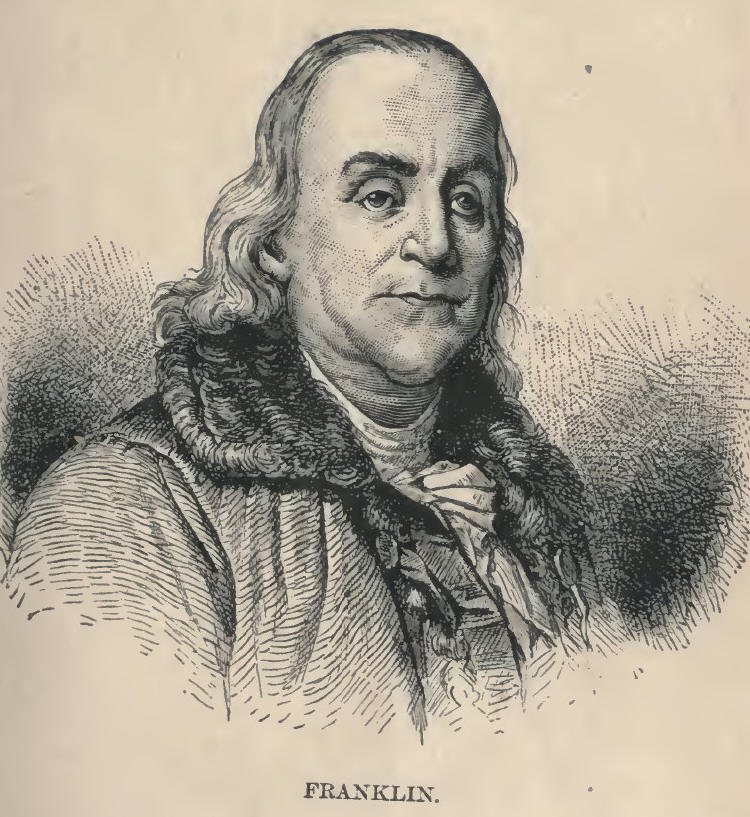
Franklin had come to join Silas Deane. Already well known in Europe, where he had fulfilled several missions, his great scientific reputation and his clever and wise devotion to his country's cause had prepared the way to a worldly success which the skillful negotiator was well able to make subserve the success of his enterprise. Soon the French government began to remit money directly to the agents of the United States. Everything tended to a recognition of their independence. In spite of the king's formal prohibition, numerous French volunteers set out to serve the cause of liberty in America. The most distinguished of all, M. de la Fayette, arrested by order of the court, had evaded the surveillance of his guards, leaving his young wife, who was on the point of her confinement, in order to embark on a ship which he had secretly purchased. He landed in America in the month of July, 1777.
England was irritated and uneasy. Lord Chatham, quite recently sick and almost dying, more implacable than ever in pursuing everywhere the influence and intervention of France, exclaimed, with the customary exaggeration of his powerful and passionate talent, "Yesterday England could yet resist the world; to-day no one is insignificant enough to show his respect for her. I borrow the words of the poet, my lords, but what his lines express is no fiction. France has insulted you: she has encouraged and sustained America; and whether America be in the right or not, the dignity of this nation demands that we repulse with disdain the officious intervention of France. The ministers and ambassadors of those whom we call rebels and enemies are received at Paris; they treat there of the reciprocal interests of France and America. Their natives are sustained there, and supplied with military resources, and our ministers allow it and do not protest. Is this sustaining the honor of a great kingdom, which formerly imposed law on the House of Bourbon?"
Franklin.
The manifest favor of France had forever enrolled Lord Chatham among the opponents of the recognition of American independence. He carried to the House a proposal to cease hostilities and enter upon a negotiation with the revolted colonies, under one sole condition, that of submission to the mother-country. In the violent discussion raised on this subject, Lord Suffolk desired to defend the cruel practices of the Indian savages who were tolerated in the service of Great Britain. Lord Chatham rose in his place, forgetting that he had lately accepted the same auxiliaries during the war against the French in Canada. "My lords," he exclaimed, "have we heard aright? Men, Christians, profane the royal majesty at the very side of the throne. God and nature have placed these arms in our hands, you are told. I do not know what ideas may be conceived of God and of nature, but I know that these abominable principles are equally contrary to religion and to humanity. What! shall the sanction of God and of nature be attributed to the cruelties of the Indian scalping-knife, to cannibal savages who torture, massacre, devour—yes, my lords, who devour the mutilated victims of their barbarous combats? And on whom have you let loose these infidel savages? On your brothers in faith, in order to devastate their country, in order to desolate their dwellings, in order to extirpate their race and their name!"
The proposals of Lord Chatham were rejected, but the situation had already changed. Shortly after the arrival of M. de la Fayette in America, the battle of Brandywine, in which he had taken part as major-general, had been disastrous to the Americans; the young volunteer had been wounded. At Germantown fate had been equally against the colonists, and they had been forced to evacuate Philadelphia, the aim of General Howe's operations. They had fallen back on Valley Forge. General Washington had cleverly established his camp there for the winter. Nevertheless, successes at other points counterbalanced and even outweighed the reverses. On the frontiers of Canada the English general Burgoyne, obstinate and presumptuous, had been defeated by General Gates. Being deceived in his hope of being succored by Howe or by Clinton, who was commanding at New York, he was left to be surrounded by the English troops. Deprived of provisions and supplies, without resources and without means of communication, Burgoyne, at the end of his strength, was, after an heroic resistance, forced to lay down arms and capitulate at Saratoga, on the 17th of October, 1777. He obtained honorable conditions, but the soldiers, while free to return to Europe, were bound not to serve any more against America. Gates was an Englishman; he did not wish to witness the humiliation of his countrymen, and he did not assist at the defile of General Burgoyne's troops. For the first time on American territory, European arms were given up. The echo was immense in Europe, and seconded Franklin's efforts at Paris. On the 6th of February, 1778, France officially recognized the independence of the United States; a treaty of alliance was concluded with the new power, which thus took rank among nations. Two months later, on the 13th of April, a French squadron, under the command of Count d'Estaing, set sail towards America, and soon hostilities were being carried on in the British Channel between the French and English ships, without declaration of war, owing to the natural pressure of circumstances and the state of feeling in the two countries.
At the very moment when France was according to the American revolt that support which she had secretly afforded it for more than two years, Lord North, forcing the hand of King George III., proposed two bills to Parliament, by which England renounced the right to levy taxes in the American colonies and recognized the legal existence of Congress. Three commissioners were to be sent to the United States to treat concerning the conditions of peace. "The humiliation and sorrow were great and were legible on all countenances," said an ocular witness; "no one gave any sign of approbation, and silence succeeded the minister's speech." The propositions were, however, voted without serious opposition. Necessity pressed upon all spirits with sad bitterness.
Public sentiment in England, as well as in Parliament, blamed the weakness of the government. Lord North felt it, and on the 14th of March, 1778, on the receipt of the French letter ironically assuring King George III. of the continuation of Louis XVI.'s peaceful intentions, the minister had advised the king to recall his ambassador from Paris and to form a new cabinet at home. It was with profound repugnance that the monarch consented to make advances to Lord Chatham; the demands of the great orator were so haughty that the negotiations remained suspended. The king made a last appeal to Lord North. "Will you abandon me in the moment of danger, like the Duke of Grafton?" he asked. The Duke of Richmond had just made a proposition for the recall of the troops fighting on land and sea in America (7th April, 1778). He relied on the support of Lord Chatham, but anti-French passion in this unbalanced and proud soul surmounted all abstract considerations of right and justice. He had formerly said, "You will never conquer America. Your efforts will continue vain and powerless. If I were an American, as I am an Englishman, so long as foreign forces marched against my country, I would never lay down my arms—never! never!" The intervention of France in the struggle had modified the views of the great minister who had so long followed her with his hatred. He desired her, above all things, to be humiliated and conquered. The recognition of American independence became impossible, encouraged as it was by the House of Bourbon. The Earl had himself carried to Westminster, supported on one side by his son William, on the other by his son-in-law, Lord Mahon. He was nothing more than the shadow of himself—pale, emaciated, and with difficulty drawn from his bed of suffering. He rose slowly, supported by his crutch and leaning heavily on his son's shoulder. His voice was hollow and failing, his words broken. The transient gleams of his genius alone animated the supreme effort. "I thank God," said he, "that I have been enabled to come here to-day to accomplish a duty and to say what has heavily weighed upon my heart. I have already one foot in the grave: I am going there soon. I have left my bed to sustain in this House the cause of my country, perhaps for the last time. I congratulate myself, my lords, that the grave has not yet closed over me, and that I yet live to raise my voice against the dismemberment of this ancient and noble monarchy. My lords, his Majesty has succeeded to an empire as vast in its extent as it is illustrious in its reputation. Shall we tarnish its lustre by the shameful abandonment of its rights and of its finest possessions? Shall the great kingdom which has survived in its entirety the descents by the Danes, the incursions of the Scots, the conquest of the Normans, which has stood firm before the threatened invasion of the Spanish army, fall to-day before the House of Bourbon? Truly, my lords, we are greater than we were. If it be absolutely necessary to choose between peace and war, if peace cannot be preserved with honor, why not declare war without hesitation? My lords, everything is better than despair; let us at least make an effort. If we are to yield, let us yield like men."
The Last Speech Of The Earl Of Chatham.
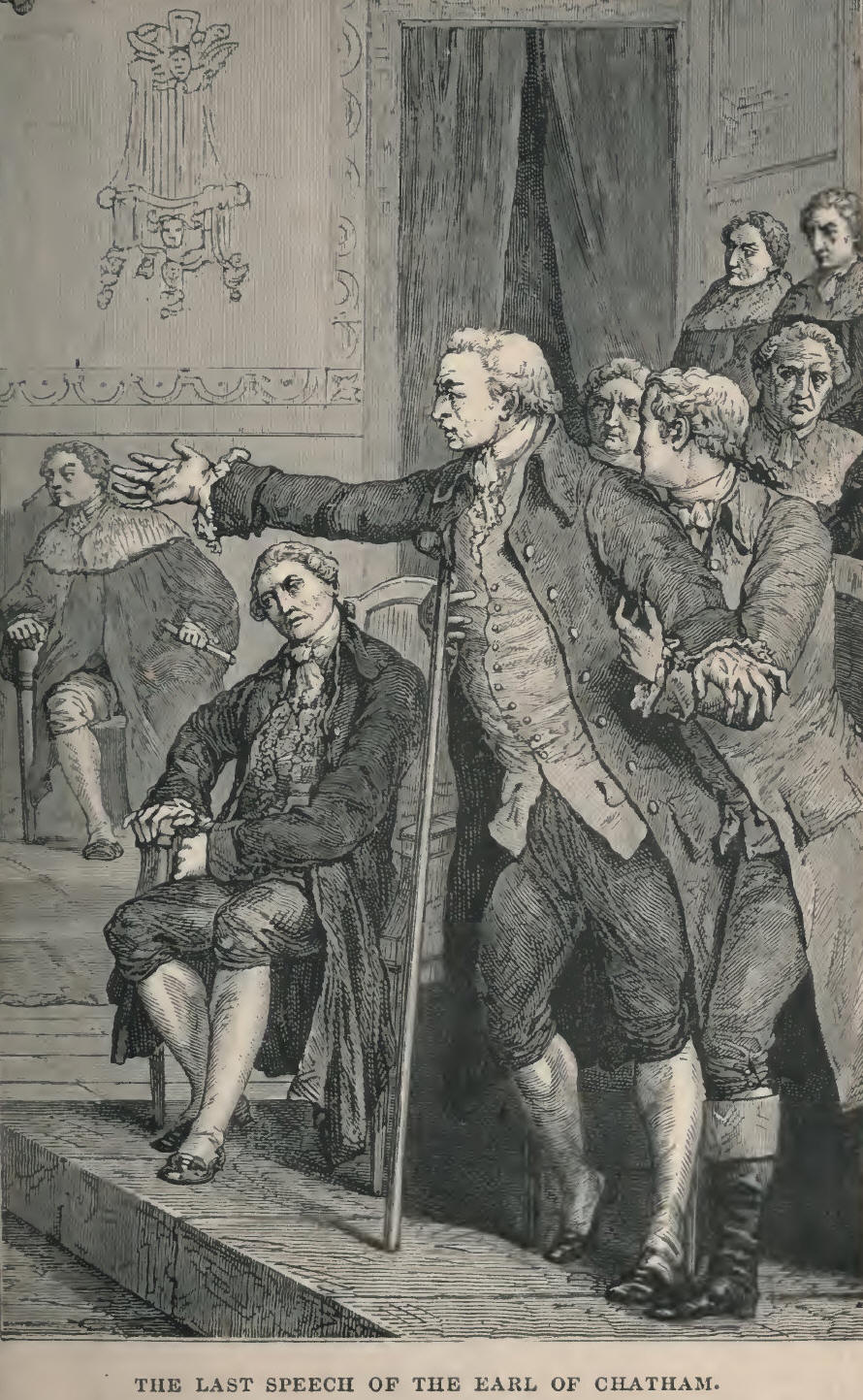
He let himself fall back on his seat exhausted and fainting. Soon he tried to rise in order to answer the Duke of Richmond; his strength failed him; for the last time the wavering flame of this great torch had flung out its brilliancy. A weakness seized him. The House, silent and anxious, surrounded him. They carried out the great orator, the illustrious adversary of France who had lately conquered her, and who was about to succumb while yet following her "with his sad and inflexible looks." [Footnote 5]
Some days later he breathed his last in his country house at Hayes, encompassed by national regret and respect, and soon afterwards was buried at the expense of the state in Westminster Abbey. He was to await his son there only twenty-seven years—that son who was the enthusiastic witness of his glory, the emulator of his eloquence and political virtues; who was greater than he in the governance of his country, and who sleeps at his feet without other monument than a simple name, "William Pitt," without other epitaph than the funeral oration which his father, with outstretched arm, seems constantly to pronounce over his tomb.
The proposals of the Duke of Richmond had been rejected, but Lord North's bills had excited great uneasiness in Washington's mind. He knew better than any one else at what price the war had been hitherto sustained; he dreaded for his country those concessions which had no effect upon his own soul. He wrote immediately to his friends, "Accept nothing that is not independence. We can never forget the outrages which Great Britain has made us suffer; a peace on other conditions would be a source of perpetual broils. If Great Britain, impelled by her love of tyranny, sought anew to bend our foreheads beneath the yoke of iron—and she would do it, be certain, for her pride and ambition are indomitable—what nation would hereafter believe in our professions of faith and lend us her aid? It is now to be feared that the proposals of England may have great effect in this country. Men are naturally friendly to peace; and more than one symptom leads me to believe that the American people are generally tired of war. If it is so, nothing is more politic than to inspire confidence in the country by putting the army on an imposing footing, and giving a greater activity to our negotiations with the European powers. I believe that at the present hour France ought to have recognized our independence, and that she is going to declare war immediately on Great Britain."
From natural taste and from English instinct, Washington did not care for France and had no confidence in her. M. de la Fayette alone had been able to make conquest of his affection and esteem. He raised himself, however, above his peculiar inclinations, and felt the need of an efficient alliance with the great continental powers which were enemies or rivals of England. Congress had just declined all negotiation with Great Britain as long as an English soldier remained on American soil. On all seas the English and French fleets obstinately engaged each other. In the naval combat in sight of Ouessant, on the 27th of July, 1778, success remained doubtful. The English were accustomed to be the conquerors, and Admiral Keppel was put on trial. The merchant shipping of France, however, suffered great loss. On all sides English vessels covered the sea.
Franklin had recently said, with penetrating foresight, "It is not General Howe who has taken Philadelphia; it is Philadelphia which has taken General Howe." The necessity of guarding this important place had obstructed the operations of the English. Upon the news of the alliance of France with the United States and of the departure of Count d'Estaing's squadron, orders had been given to evacuate the place and to fall back on New York. Howe had been actively pursued by Washington, who had gained a serious advantage over him at Monmouth. The victory would have been decisive but for a jealous disobedience on the part of General Lee. Sir Henry Clinton had taken the chief command of the English army, being more active than his predecessor, while himself insufficient to struggle against Washington. "I do not know whether they cause fear to the enemy," said Lord North, ironically; "what I do know is that they make me tremble whenever I think of them." Washington established his camp thirty miles from New York. "After two years of marches and countermarches," he exclaimed; "after vicissitudes so strange that no war, perhaps, has ever presented their like since the commencement of the world, what a subject of satisfaction and astonishment it is for us to see the two armies returned to their starting-point and the assailants reduced, in order to their defence, to recur to shovel and pickaxe."
An expedition contrived by General Sullivan against Rhode Island, which was still occupied by an English corps, had just failed, by reason of a clever manœuvre of Admiral Howe. The weather was bad, and the French admiral put into Boston to repair his damages. The cry of treason was forthwith raised; a riot greeted the Count d'Estaing: all the violence of the democratic and revolutionary spirit seemed let loose against the allies, who had lately been hailed with such warmth. The efforts of Washington, seconded by the Marquis de la Fayette, were employed to re-establish harmony. Borne away by an ill-considered reaction, Congress conceived the idea of attempting, in conjunction with France, a great expedition on Canada. Washington, being tardily consulted, refused his assent; he preserved, in respect of French policy, a prudent mistrust. "Shall we allow," wrote he to the president of Congress, "shall we allow a considerable body of French troops to enter Canada and to take possession of the capital of a province which is attached to France by all the ties of blood, manners, and religion? I fear that this would be to expose that power to a temptation too strong for every government directed by ordinary political maxims. … I believe I can read on the faces of some persons something besides the disinterested zeal of simple allies: I am willfully deceiving myself; perhaps I am too much given over to the fear of some misfortune; but above everything, sir, and putting aside every other consideration, I am averse to increasing the number of our national obligations."
The project against Canada was tacitly abandoned. The Marquis de la Fayette set out for France, ever ardently attached to the American cause, which he was soon to serve efficaciously in Paris, with the government of Louis XVI.
The English had just made a descent on Georgia, had taken possession of Savannah, and were threatening the Carolinas as well as Virginia. The Count d'Estaing was fighting in the Antilles, and had seized St. Vincent and Grenada. The Marquis de Bouillé, Governor of the Windward Islands, had taken Dominique. The English had deprived us of St. Pierre and Miquelon. The French admiral, who had just been recalled, wished to venture a final effort in favor of the Americans. He laid siege to Savannah, and was repulsed after a desperate struggle. The only advantage of the expedition was the deliverance of Rhode Island. Sir Henry Clinton, fearing a surprise on New York, had called back the garrison. Washington had just gained Stony Point, which secured the navigation of the Hudson to the Americans. Spain had at last consented to take part in the war by virtue of the Family Compact, and in order to lend aid to France. Faithful to the monarchical traditions of his house and of his nation, Charles III. had refused to recognize the independence of the United States, or to ally himself with them.
England's situation was becoming grave, and she was inwardly and profoundly uneasy concerning it. The government was weak and unequal to the burden of a struggle which became each day more obstinate; formidable petitions, sustained by the most eloquent voices—by Fox as well as by Burke—demanded an economic reform, necessitated by the ever-increasing expenses of the war. Sudden riots excited in the name of the Protestant religion, which was said to be menaced all at once, stained England and Scotland with blood. In the preceding year a law intended to free the Catholics from some legal disabilities was passed in the Houses almost without opposition. That just measure had excited a certain feeling among the masses. Lord George Gordon, a sincere fanatic whose religious passions disturbed his judgment, had headed a network of Protestants which signed petitions against the modifications effected in the penal laws against Catholics. On the 2d of June, 1780, an immense crowd, assembled at St George's Fields for the presentation of the petition, was moved to the most violent outrages against the peers suspected of being favorable to the Papists. Lord Mansfield entered the House of Lords with his coat torn and his wig in disorder; the Bishop of Lincoln with difficulty saved his life. Soon the tumult spread over the entire town: particular houses were attacked and pillaged; the bank was assailed; moral terror reigned throughout all England, menaced from within and from without, trembling at the idea of a French and Spanish invasion, and incessantly agitated by the howls of a furious populace—"No Popery!" It was a sad and ominous spectacle. "Sixty-six allied ships of line plowed the British Channel; fifty thousand men, assembled in Normandy, were preparing to pounce upon the midland counties. A simple American corsair, Paul Jones, was ravaging the Scotch coasts with impunity. The northern powers, united in Russia and Holland, threatened, arms in hand, to sustain the rights of the neutrals disregarded by the English admiralty courts. Ireland was only waiting a signal to rise; religious strife tore England and Scotland. The authority of Lord North's cabinet was shaken in Parliament as well as in the country. Popular passions carried the day in London, and this great city could be seen for nearly eight days given over to the populace, whose excesses nothing but its own weakness and shame was able to oppose." [Footnote 6]
The firmness of the king at length suppressed the riot: twenty-three culprits expiated their crimes with their lives. After long delays, the fruit of legal chicanery, Lord George Gordon was finally acquitted as not having been previously informed of the seditious projects. He pursued unshackled the course of his follies, and towards the end of his life embraced Judaism. The English Parliament had, however, the courage and honor to proudly maintain the principles of religious toleration, so brutally assailed by popular violence. Burke as well as Lord North had defended the bill of 1778. "I am the partisan of universal toleration," exclaimed Fox, "and the foe of that narrow-sightedness which brings so many people to Parliament, not that they may be freed from a burden which overwhelms them, but to entreat the Houses to chain and throttle their fellow-countrymen."
The imposing preparations of the allied powers against England had not effected other results than the Protestant riots fomented by Lord George Gordon. The two French and Spanish fleets had, from the month of August, 1779, effected a junction off the Corogne; they slowly re-entered the channel on the 31st of August. When near the Sorlingue Islands the English fleet, only thirty-seven strong, was caught sight of. The Count de Guichen, who commanded the advance guard, was already manœuvreing with the intention of cutting off the enemy's retreat. Admiral Hardy was too quick for him, and took refuge in the port of Plymouth. Some partial engagements took place; that of the Surveillante with the Quebec was glorious for the Chevalier du Couëdic, who commanded her, but without other result than this honor for the Breton sailor of having alone signalized his name in the great array of the maritime forces of France and Spain. After a hundred and four days of useless traversing of the British Channel, the immense fleet sadly returned to Brest and speedily dispersed. Admiral d'Orvilliers, who had lost his son in a skirmish, took to a religious life. The Count de Guichen upheld the honor of the French flag in a frequently successful series of battles against Admiral Rodney. The latter, crippled with debts, was detained at Paris, without being able to go back to England. "If I was free," said he one day before Marshal Biron, "I would soon have destroyed all the French and Spanish fleets." The marshal immediately paid his debts: "Go, sir," said he, with a boastful generosity to which the eighteenth century was a little subject; "the French wish to gain advantage over their enemies only by their bravery!" The first exploit of Rodney was to beat Admiral Zangara, near Cape St. Vincent, and to revictual Gibraltar, which the allied forces blockaded by land and sea.
However, the campaign of 1779 had been insignificant in America. The state of feeling there was humiliating and sad; Congress had lost its authority while decreasing in public esteem; moral strength appeared weakened; the great springs of national action were slackened in the heart of a war always hanging and dubious; a violent reaction led people's minds to indifference and their hearts towards light pleasures. Washington himself felt his influence growing less along with with the heroic resolution of his fellow-citizens. "God alone can know what will result to us from the extravagance of parties and the general laxity of public virtue," wrote he. "If I were to paint the time and men from what I see and what I know, I would say that they are invaded by sloth, dissipation, and debauchery; that speculation, peculation, and an insatiable thirst for wealth rule all the thoughts of all classes; that party disputes and private quarrels are the great matter of the day, while the interests of an empire, a heavy and ever increasing debt, the ruin of our finances, the depreciation of our paper-money, the lack of credit, all vital questions in fine, scarcely attract attention, and are set aside from day to day as if our affairs were in the most prosperous condition."
In a military sense as well as in a political, the affairs of America were drooping in sorrowful alternations. Sir Henry Clinton had known how to profit by the internal dissensions of the Union; he had rallied round him the royalists in Georgia and the Carolinas; the civil war reigned there in all its horrors, precursors and pledges of more cruel rancors yet which our days were to witness. General Lincoln had just been forced to capitulate at Charleston. Washington, all the time encamped before New York, beheld his army decimated by hunger and cold, without pay, without provisions, without shoes, obliged to live by despoiling the surrounding population. Discouragement was overtaking the firmest hearts, when, in the month of April, 1780, the Marquis de la Fayette landed anew in America. He brought the news that a French army corps was preparing to embark in order to sustain the failing strength of the Americans. By a prudent prevision of the disputes which might arise from questions of rank or nationality, the Count dc Rochambeau, who commanded the French, was to be placed under the orders of General Washington, and the auxiliary corps entirely put at his disposal. The enthusiasm of M. de la Fayette for the cause of American liberty had gained over the French court and people. He had borne upon the government of King Louis XVI., which was as yet uncertain and naturally preoccupied with the difficulties and growing expenses which the war was imposing on France. The national ardor and the rash generosity common to our character had prevailed. The campaign of 1780 was tardy and without great results, but the year 1781 was going to be decisive in the annals of the War of Independence. France was to take a glorious part in it. Washington had just suffered a serious vexation and a sad disappointment. In spite of the glaring vices of General Arnold, and of the faults which were repugnant to the austerity of character of the general-in-chief, his signal bravery and military talents had maintained him in the foremost rank among Washington's lieutenants. Accused of malversations, and lately condemned by a council of war to suffer a severe reprimand, Arnold was yet in command of the fort at West Point, the key to the upper part of the State of New York. He had taken possession of it in the month of August, 1780, under the pretext of the rest which his wounds entailed; but he had already made overtures to Sir Henry Clinton. "I am quite ready to yield myself," he had said, "in the way which can be most useful to the arms of his Majesty." The English general charged a young officer of staff to carry the acceptance of his final instructions to the perfidious general of the Union. Major André was arrested as a spy. Arnold learned of it and had time to escape, leaving behind him his young wife and his new-born infant. Washington was returning from an interview with Count de Rochambeau and had given a rendezvous to Arnold. The latter was not at the appointed place. He had been, it was said, called back to West Point. The general repaired thither. While he was crossing the river, contemplating the majesty of nature which surrounded him, he turned towards his officers. "At bottom," he said, "I am not vexed that Arnold should have preceded us; he will salute me, and the boom of the cannon will have a fine effect in the mountains." They landed, but the fort remained silent. Arnold had not appeared there for several days. Displeased but unsuspicious, Washington was beginning an inspection of the place when Colonel Hamilton brought him some important dispatches which had followed him. It was the news of the arrest of Major André and of the perfidy of Arnold. Always master of himself, the general did not betray his emotion by a change of countenance; only, turning to the Marquis de la Fayette, who was informed of the facts by Hamilton, "On whom can we depend now?" said he sadly.
The culprit was beyond reach; his ignorant and innocent wife had been seized by a despair which resembled madness. Major André was tried as a spy and condemned to suffer the fate of one. He was young, honest, and brave, brought up to another career, and driven into the army by a love disappointment. His tastes were elegant, his mind cultivated; he had not foreseen to what dangers his mission and the disguise that he had assumed, against the advice of Sir Henry Clinton, exposed him. "My mind is perfectly tranquil," he however wrote to his general when he was arrested, "and I am ready to suffer all that my faithful devotion to the king's cause can draw down on my head."
One thing alone troubled Major André's peace of mind. He dreaded the ignominy of the gibbet, and wished to die as a soldier. "Sir," wrote he to Washington, "sustained against the fear of death by the feeling that no unworthy action has sullied a life consecrated to honor, I am confident that in this supreme hour your Excellency will not refuse a prayer the granting of which can sweeten my last moments. In sympathy for a soldier, your Excellency will consent, I am sure, to adapt the form of my punishment to the feelings of a man of honor. Permit me to hope, that if my character has inspired you with some esteem, and if I am in your eyes the victim of policy and not of vengeance, I shall prove the empire of those feelings over your heart by learning that I am not to die on a gibbet."
With a harshness unexampled in his life, and of which he seemed always to preserve the silent and painful remembrance, Washington remained deaf to the noble appeal of his prisoner. He did not even do Major André the honor of answering him. "Am I then to die thus?" said the unfortunate man when he perceived the gibbet. Then immediately recovering himself, "I pray you to bear witness that I die as a man of honor," said he to the American officer charged with seeing to his punishment. Washington himself paid homage to him. "André has suffered his penalty with that strength of mind which might be expected from a man of that merit and from so brave an officer," wrote he. "As for Arnold, he lacks pluck. The world will be surprised if it do not yet see him hanged on a gibbet."
A monument was erected in Westminster Abbey to the memory of Major André, "the victim of his devotion to his king and country." His remains repose there since the year 1821. The vengeance and anger of the Americans vainly pursued General Arnold, who was henceforth occupied in the war at the head of the English troops, with all the passion of a restless hatred. Spite and wounded vanity, linked with the shameful necessities of an irregular life, had drawn him into treason. He lived twenty years after, enriched and despised by the enemies of his country. "What would you have done to me if you had succeeded in taking me?" he asked one day of an American prisoner. "We would have separated from your body that one of your limbs which had been wounded in the service of the country," answered the militia-man calmly, "and we would have hanged the rest on a gibbet."
Fresh perplexities were assailing General Washington, scarcely recovered from the sad surprise which Arnold's treason had caused him. He had pursued for almost a year the reorganization of his army, when the successive mutinies among the Pennsylvania troops threatened to reach those of New Jersey, and to extend by degrees into all the corps secretly tampered with by Sir Henry Clinton. Mr. Laurens, formerly president of Congress, and charged with negotiating a treaty of alliance and of loan with Holland, had been captured by an English ship. He was imprisoned in the Tower, when his son, an aide-de-camp of Washington, set out for France. "The country's own strength is exhausted," wrote the general-in-chief. "Alone we cannot raise the public credit and furnish the funds necessary to continue the war. The patience of the army is at an end. Without money we can make but a feeble effort, probably the last one."
As well as money, Colonel Laurens was charged to ask for a reinforcement of troops. France furnished all that her allies asked. M. Necker, clever and bold, was equal, by means of successive loans, to all the charges of the war. In a few months King Louis XVI. had lent or guaranteed more than sixteen million pounds for the United States. A French fleet, under the orders of the Count de Grasse, set out on the 21st of March, 1781. Arrived at Martinique on the 28th of April, the Count de Grasse, despite the efforts of Admiral Hood to block his passage, took the island of Tobago from the English. On the 3rd of September he brought Washington a reinforcement of three thousand five hundred men and twelve hundred thousand pounds in specie. The soldiers as well as the subsidies were intrusted to Washington personally. No dissension had ever arisen between the general and his foreign auxiliaries. By that natural authority which God had bestowed on him, Washington was always and naturally the superior and chief of all those who came near him.
After so many and so painful efforts the day of victory at last arrived for General Washington and for his country. Alternations of success and reverse had marked the commencement of the campaign of 1781. Lord Cornwallis, who commanded the English armies in the South, was occupying Virginia with considerable forces, when Washington, who had been able to conceal his designs from Sir Henry Clinton, while deceiving even his own lieutenants, passed through Philadelphia on the 4th of September, and advanced against the enemy by forced marches. The latter had been for a long time harassed by the little army of M. de la Fayette. Lord Cornwallis hastened to Yorktown. On the 30th of September the place was invested.
It was insufficiently or badly fortified, and the English troops were fatigued by a rough campaign. "This place is not in a condition to defend itself," Lord Cornwallis had said to Sir Henry Clinton, before the blockade was complete; "if you cannot come to my aid soon, you must expect the worst news." The besiegers, on the contrary, were animated by a zeal which even increased to emulation. The French and the Americans rivaled each other in ardor; the soldiers refused to take any rest; the trench was open since the 6th of October. On the 10th the town was cannonaded; on the 14th an American column, commanded by M. de la Fayette and Colonel Hamilton, attacked one of the forts which protected the approaches. It was some time since Hamilton had ceased to form part of Washington's staff, in consequence of a momentary ill-temper of the general's which was keenly resented by his sensitive and fiery lieutenant. The reciprocal attachment which even to their last day united these two illustrious men had suffered nothing from their separation. The French attacked the second fort under the command of Baron de Viomesnil, the Viscount de Noailles, and the Marquis de St. Simon, who, being sick, was carried at the head of his regiment. The resistance of the English was heroic, but almost at the same instant the flag of the Union floated over the two outposts. When the attacking columns joined each other beyond the walls, the French had made five hundred prisoners. All defence became impossible. Lord Cornwallis vainly attempted to escape; he was reduced, on the 17th of October, to sign a capitulation more humiliating than that of Burgoyne at Saratoga. Eight thousand men laid down their arms, and the English vessels which were at Yorktown and Gloucester were given up to the conquerors. Lord Cornwallis was ill with regret and fatigue. General O'Hara, who took his place, tendered his sword to the Count de Rochambeau. The latter took a step back. "I am only an auxiliary," he said, in a loud voice. The hatred which sundered the ancient compatriots, now become enemies, was profound and bitter. "I remarked," said M. de Rochambeau's chaplain, "that the English officers in laying down their arms and in passing by our lines courteously saluted the lowest French officer, while they refused that mark of politeness to American officers of the highest rank."
"In receiving the sword of the English general, Washington had secured the pledge of his country's independence. England felt it. 'Lord North received the news of the capitulation like a bullet full in the chest,' related Lord George Germaine, colonial secretary of state. He stretched out his arms without being able to say anything but 'My God, all is lost!' and he repeated this several times while striding up and down the room."
At a quite recent date, and on receipt of a private letter from M. Necker, who proposed a truce which should leave the two belligerents on American soil in possession of the territories which they occupied, King George III. had exclaimed: "The independence of the colonies is inadmissible, under its true name or disguised under the appearance of a truce." The catastrophe which consternated his ministers and his people did not, however, shake the obstinate constancy and sincere resolve of the king. "None of the members of the cabinet," he immediately wrote, "will suppose, I take it for granted, that this event can modify in anything the principles which have hitherto guided me, and which shall continue to inspire my conduct in the struggle." Only one slight indication betrayed the monarch's agitation. Contrary to his habit, he had omitted to date his letter.
Repeated checks had overtaken the English arms at other points. Embroiled with Holland, where the Republican party had got the better of the stadtholder, who was devoted to them, the English had carried war into the Dutch colonies. Admiral Rodney had taken St. Eustache, the centre of an immense commerce; he had pillaged the warehouses and loaded his vessels with an enormous mass of merchandise. The convoy which was carrying a part of the spoils to England was captured by Admiral de la Motte-Piquet; M. de Bouillé surprised the English garrison left at St. Eustache and restored the island into the hands of the Dutch. The latter had just sustained, with brilliancy, near Dogger Bank, their ancient maritime reputation. "Officers and men all have fought like lions," said Admiral Zouthemann. The firing had not commenced until the moment that the two fleets found themselves within gunshot. "It is evident after this," said a contemporary, "that the nations which fight with the most ardor are those who have an interest in not fighting at all." The vessels on both sides had suffered severe damages; they were scarcely in a seaworthy state. The glory and the losses were equal, but the English Admiral, Hyde Parker, was annoyed and discontented. King George III. came to visit on board his ship. "I wish your Majesty had younger sailors and younger ships," he said; "as for me, I am too old for the service," and he persisted in giving in his resignation. This was the only action of the Dutch during the war. [Having] Become insolent in their prosperity and riches, they justified the judgment passed on them some years later: "Holland could pay all the armies of Europe; she could not face any of them." They left to Admiral de Kersaint the care of recovering from the English their colonies of Demerara, Essequibo, and Berbice, on the coast of Guiana, as to the Bailiff de Suffren the duty of protecting the Cape of Good Hope. A little Franco-Spanish army at the same time besieged Minorca. The fleet was considerable. The English had neglected their preparations, and Colonel Murray was obliged to shut himself up in Fort St. Philip. In the mean time operations had miscarried, and the Duke de Crillon, who was in command of the besieging troops, wearied of the blockade and proposed to the commandant to deliver the place to him. The offers were magnificent; the Scotch officer answered indignantly, "M. le Duc, when the king his master ordered your brave ancestor to assassinate the Duke de Guise, he replied to Henry III., 'Honor forbids me.' You should have made the same reply to the King of Spain when he charged you to assassinate the honor of a man as well-born as the Duke de Guise or as yourself. I do not wish to have other relations with you than those of arms." Crillon understood the reproach. "Your letter," wrote he to the proud Scotchman, "has placed us both in the situation that suits us; it has increased my esteem for you. I accept your last proposition with pleasure." He himself directed the assaults, mounting the breach first. When Murray capitulated, on the 4th of February, 1782, the fortress contained only a handful of soldiers, so wasted by fatigues and privations that "the Spaniards and French shed tears on seeing them file between their ranks."