Volume 4 — Chapter XXXII. William And Mary. Establishment Of Parliamentary Government. (1688-1702).
Reading edition
King James had abandoned England, fleeing from the storm which he had raised, obstinate in his ideas and holding persistently to the hope of a return, which his people was resolved to prevent at any price. William of Orange had entered London; but he had not established his quarters at Whitehall, and he refused to take the crown by right of conquest. Shrewd and far-seeing, he did not wish to belie the promises of his declaration, or, by parading its defeat, to irritate the English army, which he hoped soon to command. He had not conquered England, which had called him to her aid and had voluntarily submitted to him; and he desired to keep the supreme power with her free consent. A provisory assembly was formed of those lords who were in London, as well as of members of the House of Commons who had sat in Parliament under the reign of King Charles II.; and the aldermen of London and a deputation of the City Council were invited to participate in the proceedings. At his departure, King James had left a letter: some peers asked to be informed of its contents. "I have seen the missive," said Godolphin, "and can assure your Lordships that you would find nothing in it which could give you any satisfaction."
Aware of the blind obstinacy of the fugitive King, the peers of the realm presented their address to the prince on the 25th of December; some days later the Commons followed their example. "Your Highness, led by the hand of God and called by the voice of the people, has saved our dearest interests," said the addresses—"the Protestant religion, which is Christianity in its primitive purity, our laws, which are the ancient titles on which rest our lives, liberties and possessions, and without which this world would be only a desert in our eyes. This divine mission has been respected by the nobility, the people, and the brave soldiers of England. They have laid down their arms at your approach." The same thanks and same requests were presented by the Scotch lords who happened to be in London; the Earl of Arran alone, son of the Duke of Hamilton, had proposed to treat with King James. "All cry, Hosanna! to-day," said the Prince of Orange to Dykvelt and his Dutch friends, who brought him the congratulations of his native country, and were delighted at the enthusiasm shown everywhere in England; "but in a day or two perhaps they will repeat quite as loudly: 'Crucify him! crucify him!'" Resolved as he was to govern England, William caught a glimpse, though he did not foresee their extent, of the difficulties and obstacles which the great enterprise he was asked to attempt would meet with in England itself. Nevertheless he accepted his mission without wavering.
On the 22nd of January, 1689, a Convention, which soon declared itself Parliament, assembled at Westminster, elected arbitrarily on circular letters sent forth in the name of the Prince of Orange. The parties were already beginning to divide; the great national unanimity which had willed and accomplished the revolution was yielding to different passions and opinions. In this supreme crisis of the government of England, the Tories, numerous in the House of Lords, weak in the House of Commons, hesitated, according to their political and religious complexions, between negotiations with King James, the establishment of a regency, leaving to the fugitive monarch the vain title of king, or the declaration that the throne was vacant, and the calling of the Princess Mary to the crown as its natural heiress. No one dared to assert the legitimacy of the Prince of Wales. Some of the Whigs, a party which included in its ranks a number of dissenters, proposed that Parliament should proclaim the nation's right to depose a prince guilty of bad government; the others, less involved in revolutionary schemes, though just as firmly resolved to deliver England from the misgovernment of King James, sought to cover the national will with a legal form. "It is said that kings have a divine right of their own," cried Sir Robert Howard; "nations also have their divine right."
On the 26th of January the House of Commons ended by passing a resolution couched as follows: "King James II., having undertaken to overthrow the Constitution of the realm by not fulfilling the original contract of King and people, has broken the fundamental laws of the Kingdom by the advice of Jesuits and other corrupt counsellors; by his voluntary retirement he has abdicated the government, in consequence of which the throne has become vacant." The form of the resolution was open to criticism; only its gist was important. The Commons soon added to their declaration of the vacancy of the throne a second equally grave resolution: "The reign of a Catholic monarch is incompatible with the security and welfare of this Protestant nation." The two resolutions were sent up to the Lords.
The Protestant declaration was unanimously voted. The King of England, head of the Anglican Church, should naturally belong to that Church. In regard to the vacancy of the throne, the Tories insisted on previously debating the question of a regency, proposed some time before by Bancroft, Archbishop of Canterbury, and now advocated by Lord Rochester and Lord Nottingham. Divided between their conviction of the dangers that King James caused the country to incur, and their sentiments of loyalty, the members of this fraction of the Tory party hoped to remain faithful to their oath of allegiance by treating the truant monarch like an invalid incapable of governing, and hence obliged to delegate his powers to the Prince of Orange. This course having been rejected, Lord Danby admitted the throne to be vacant, and demanded that the Princess Mary be declared queen, according to the principle that the throne could not remain unoccupied. The Whigs, with Halifax at their head, loudly maintained the right of the nation to choose its monarch. King James was alive, and the princess could not then be his heiress; the throne became elective, and the Prince of Orange alone was worthy of being called to it.
The discussion between the two houses, as well as that inside the House of Lords, was waxing hot; the crowd was pressing to the gates of the palace. Lord Lovelace informed the peers that he was charged with a petition demanding the immediate proclamation of the Prince and Princess of Orange as King and Queen of England. "By whom has the petition been signed?" was asked. "No man has yet put his hand to it," answered the bold nobleman, the first to meet the Prince of Orange when he landed; "but when I shall bring it here, there will be signers enough." The same threats were made to the House of Commons. The princess was detained in Holland by the state of the sea, encumbered by ice. Danby was zealously pleading her cause before the Lords, without William, who remained faithful to his promise of committing to the Convention all grave political questions, interfering in any way in the debate. One of his friends, a Dutchman, probably Dykvelt, accidentally was present at the debate; he was pressed to say what he might know of the prince's sentiments. The Dutchman held out for a long time. "I can only guess his Highness's state of mind," he said at last; "but since you want to know what I fancy, I think he would scarcely care to be his wife's gentleman of the bedchamber; but I actually know nothing at all." "I know enough, and even a little too much," retorted Danby.
Finally Burnet made up his mind to reveal what the princess had lately confided to him. "I know, for a long time," he said, "that she had determined, even in case she should have mounted the throne in the regular order of succession, to hand over her power to her husband, with the sanction of Parliament." At the same time Mary wrote to Danby: "I am the prince's wife, and I have no other desire than to remain subjected to him; the greatest wrong that could be done me would be to put me forward as his rival; and I shall never hold as friends those who would follow such a course."
In a moment the impetuous Tories maintained the rights of Princess Anne, threatened by the elevation of William of Orange; the Churchills were enlisted in her cause, though the princess was making no objections to the exaltation of her brother-in-law, when the prince summoned the leaders of both parties to the House of Lords. He summed up in a few words the various alternatives agitated in Parliament. "I have kept silent hitherto," he added; "I have used neither solicitation nor threats; I have not even let my views or desires transpire. I have neither the right nor the inclination to impose anything on the Convention. I only reserve the privilege of refusing functions which I could not perform with honor to myself or advantage to the country. I am resolved never to be regent, and I shall not accept that fraction of administrative power which the princess, raised to the throne, could entrust to me. I esteem her as much as a man can esteem a woman; but I am not so made that I can be tied to the apron-string of the best of wives. There is but one rôle which I can honorably fill: if the Houses offer me the crown for my life, I will accept it; if not, I will return without regret to my native land." The prince ended by saying that he thought it just to secure the succession to the Princess Anne and her children, in preference to the posterity which he might have by another wife than Princess Mary.
The question was decided: William and Mary were to reign together as sovereigns of England, and the government was entrusted to William. A conference between the two houses soon resulted in a vote. Lord Nottingham demanded a modification in the oaths of allegiance "I don't approve the acts of the Convention," he said, "but I want to be able to promise to obey the new sovereigns faithfully." The House of Commons had charged Somers with drawing up the Declaration of Rights. The jurist's name had for the first time resounded with éclat during the trial of the bishops, and already his rare abilities, the power and subtilty of his mind, as well as his masculine eloquence, had placed him in a high rank, destined soon to be the highest. After a firm and plain statement of the people's rights, Parliament declared William and Mary, Prince and Princess of Orange, King and Queen of England, during their lives. After them the crown devolved upon Princess Anne and her children; in their default, it reverted to the issue of William.
Princess Mary had just landed in England; she had hardly arrived at Whitehall, and already people criticised her attitude and the first indications of her character. Those who had seen her had found her in high spirits, determined to enjoy her new grandeur, forgetful of the catastrophe which hurled her father from the throne she was about to occupy. Burnet himself was shocked. "I had always noticed so much good feeling in her whole conduct," said he, "that my surprise was extreme to see her deficient in it on this occasion. Some days later I took the liberty of asking her, how it could be that the misfortunes of a father had made so little impression on her. She took my frankness in good part, as usual, and assured me that it was not for want of having felt them keenly, if she had had the air of not thinking of them; but because she had been directed in a letter to affect much gayety. It was possible that she had overdone the rôle they had made for her, so strange was it to her true disposition." On the 13th of February, the two houses betook themselves formally to Whitehall, to offer the crown to the Prince and Princess of Orange. Halifax was spokesman. "We accept with gratitude what you offer us," said William. "For my own part, I can assure you that these laws of England which I have already defended, will be the rule of my conduct. I shall apply myself constantly to develop the prosperity of the realm; and, to aid me in the task, I count upon the counsel of the two Houses, which I am inclined to put before my own." The public proclamation before the great gate of the palace was hailed by the acclamations of the crowd. The revolution was consummated; a new reign was commencing.
With the new reign began a new era. The revolution of 1688 had been singularly moderate and reasonable; it had not claimed a new right, it had not added a liberty to the rights and liberties which England then enjoyed; it had not changed a custom; it did not renounce one of the forms or ceremonies observed in the old times, and dear to the veneration of the people; it had simply proclaimed in principle and established in fact that the nation regarded its rights and liberties as its most precious treasure, that it placed them above hereditary titles and the rights of the throne. Liberal as well as legal, it demanded from the prince a certain measure of good government and of respect for the national wishes, at the same time that it unrolled from the mists of the past those grand principles of the compact of sovereign and people, which England had known how to keep and guard through perils and through oppression. The work of liberty was not yet complete; all its seeds rested in the Declaration of Rights drawn up by Somers, and solemnly accepted by the new sovereigns. The bitter time of revolutions had ended for England.
Yet the day of rest had not come. The reign of William III. was to remain constantly troublesome, disputed, stormy. The reasons of this were various and complicated. In the first place stood his birth; he was a Dutchman in heart as in race, a stranger in his tastes as in his manners to England, which never forgot the fact. Both free and Protestant, the two countries were nevertheless separated by wide divergencies. In England the Whigs and Tories divided among them the upper classes; the tendencies toward republicanism existed in the dark among a certain number of dissenters; the Anglican Church, the Presbyterians, the Catholics, were royalists by taste as by principle. In Holland, on the other hand, the mercantile patriciate remained nearly everywhere zealously attached to the republican form; the partisans of the stadtholdership of the house of Orange were counted in the army and among the great property-holders: and part of the provinces of Guelders and Friesland was equally devoted to it.
Brought up in Holland in the midst of parties which he understood and whose springs he had moved for a long time, sympathizing with the very persons there who hereditarily opposed his family and his policy, William III. found himself in England as much a stranger as he was generally considered. Cold and reserved, like a man surrounded by enemies or critics, he only had confidence in the Dutch; he lavished his personal favors on Dutchmen alone; he only opened his heart and unbent his countenance for Dutchmen. This marked preference for his native land and this eagerness to flee from the soil of his new country so soon as the summer could bring him back to Holland, were a constant reproach and source of weakness to the King of England. In Holland alone he breathed at ease; there, alone he freely spread the wings of his grand policy, more European than English, difficult to be imported by a foreign prince into a new kingdom still entirely peopled for him with secret or open enemies.
For a long time England had remained isolated from the combinations of continental politics; lowered in her own eyes and those of Europe, she had submitted, under Charles III. and James II., to the yoke of France, against which William III. proudly stood erect, demanding from England, as from Holland, the last sacrifices to sustain the cause of European independence. It was not without disquiet and a certain insular jealousy that the English saw themselves drawn into all the political complications on the continent; they had given themselves to William of Orange, but they preserved towards him a secret distrust, silently nursed by the persistent distrust of the Church of England. William was a Protestant; but, a Calvinist by conviction, accustomed to the widest toleration in his own country, which had become the refuge of all persons suffering persecution, he found himself in England confronted by the Anglican Church, which was divided in regard to him, and had partially remained faithful to the fugitive monarch he had dethroned; obliged to struggle at once against the anti-Catholic spirit which had carried him to the throne and against the intolerance towards dissenters, which was contrary to all his principles. Dutchman, European statesman, tolerant Calvinist, he met throughout England distrust and impediments which all the success of the revolution of 1688 could not dispel, and which the personal superiority of the new king never wholly succeeded in repressing.
The Church silent and sombre, the army sad and humiliated, parties keenly exasperated—such was the domestic situation of William on the morrow of his triumph, when the uprising of Ireland menaced the peace of the kingdom, and the whole government still remained to be organized. Responsible and concordant ministers did not exist then: William called around him counsellors from different sides—Whigs, Tories, trimmers; Danby, Nottingham, Halifax, Shrewsbury, Herbert, Mordaunt. Disagreements were not slow to display themselves. The Tories had alone exercised power for some years. They were more experienced and skilful in public affairs than the Whigs; the latter were for the most part sincerely devoted to the new government, jealous and suspicious toward their adversaries, who had now become their colleagues. Traps and intrigues, sometimes violent scenes, succeeded one another without intermission, fettering and retarding the march of the government, sapping the popularity of the King, to whom all parties appealed, and who tried in vain to calm them all. An attack of John Hampden on Halifax appeared so violent that somebody cried in the House of Commons: "This is called a speech: it is a libel!"
William was weary of parliamentary struggles and eager to return to the camp life, which he always preferred to politics, when he pronounced, on the 27th of January, 1690, the dissolution of Parliament. The state of his affairs in Ireland imperatively demanded his presence.
Fleeing from England and the dangers which there threatened, as he thought, his liberty and life, King James had found in France, at the court of Louis XIV., the most generous and splendid hospitality. Lodged by the king at the castle of Saint-Germain, and in every respect treated as a sovereign and equal, James II. had asked and obtained from his royal host the aid which he needed not only to exist in France, but to undertake the conquest of rebellious and Protestant England by means of Ireland, which remained Catholic and true. Civil war had already broken out in this little kingdom; the cession by James of all the civil power to the Catholics and indigenous inhabitants disquieted knots of Protestants, scattered as colonists over certain districts. The small town of Kenmore, the cities of Enniskillen and Londonderry, were filled with refugees of their religion and race, driven by the tyranny exercised upon them to that refuge which the Scotch Presbyterians had lately founded in Ulster. Tyrconnel had tried in vain to maintain an appearance of order; the Irish population, whose passions had been long aroused, would not yield to his influence. Ireland was in flames, when James II. landed at Kinsale on the 12th of March, 1689. He had embarked at Brest, accompanied by a small body of French officers under the orders of the Count de Rosen. With him Louis XIV. had sent Count d'Avaux, charged with the diplomatic part of the expedition, and with plans to be tried among the English malcontents. From the start, this clever politician, familiar with complicated continental intrigues, foresaw the trouble that the fallen monarch, whose cause he was to plead, would occasion him. "It will not be an easy thing to keep any secret with the King of England," wrote Count d'Avaux to Louis XIV.; "he has told before the sailors of the St. Michel, what he ought to have reserved for his most confidential friends. Another thing which will give us trouble is his irresolution, for he often changes his mind and does not always settle on the best course. He frequently dwells upon little things, on which he employs his whole time, and passes lightly over most essential matters. Moreover he listens to everybody, and one has to spend as much time in removing the impressions which bad advice has produced on him, as in inspiring him with correct ones." "All the troops Tyrconnel had been able to raise, were occupied with the Protestant rising in Ulster," says King James in his Memoirs; "the Catholics of the country had no arms, while the Protestants had an abundance, and the best horses in the kingdom; there were only eight small field-pieces in condition to accompany the army; no provisions or ammunition in the magazine, little powder or balls, no money in the chest, and all the officers gone to England."
To this gloomy picture of the condition of his forces in Ireland, James might have added the embarrassments about to be caused by an intractable Parliament, and the pretensions, as immoderate as they were absurd, of partisans, who thought they had a right to lay down the law for the sovereign they persisted in serving. The indigenous Irish claimed the entire independence of their country, threatening, if James refused it, to appeal to France, and place themselves thenceforth under her protection. The English exiles who accompanied the king, despising Ireland and the Irish, only aspired to reseat their sovereign on the throne of England.
"My Lord Melford is neither a good Frenchman nor a good Irishman," said Count d'Avaux; "he only thinks of England." Despite a proclamation of toleration by James, there was a general understanding to re-establish the absolute supremacy of Catholicism in Ireland; the act of establishment of Charles II. was repealed; the lands of Catholics, lately confiscated to the benefit of Protestants, returned to their original owners; one law of proscription embraced all the fugitive or refugee Protestants in the northern counties; the endowments of the Anglican Church were taken from it. The fanatics triumphed; the King was anxious and disgusted. He estimated better than his advisers, the strength of Protestantism, even in Ireland; he glanced at the effect of his measures in England. After long hesitation, which still followed him after starting and made him turn back for a moment, James set out to besiege the town of Londonderry in person.
The place was small, badly fortified, and encumbered with refugees, who had brought no provisions there. Its governor, Lundy, proved a traitor to the garrison and citizens. Before flying pusillanimously, he attempted several times to betray them to the enemy. The religious and patriotic zeal of the inhabitants triumphed over all obstacles. An Anglican clergyman, George Walker, and Major Henry Baker, had taken command of the troops in the town by the natural and legitimate ascendancy of their characters. Determined to accept no capitulation, they were braving the repeated attacks of the Irish army, as well as the cruel assaults of famine, when Lord Strabane was instructed to offer the inhabitants the royal pardon. "The people of Londonderry have done nothing that requires a pardon," replied Major Murray; "they recognize no other sovereigns but King William and Queen Mary. Your lordship might not find yourself safe, if you stayed here much longer, or if you repeated the same offers; allow me to accompany you outside our lines."
King James II. returned to Dublin. The town held out a hundred and five days, in spite of the cruelties of the Count de Rosen, who had roused the indignation of James himself, when, on the 30th of July, upon receipt of a formal order from London, Colonel Kirke, lately dispatched from England to the aid of Londonderry, made a last effort to force the barricade constructed by the enemy across the river. "If we don't deliver the brave citizens of Londonderry, the whole world will rise against us," cried Birch, in the House of Commons. "A barricade! well, let it be forced! Shall we let our brothers perish almost before our eyes?" The barricade was forced, and the population of Derry, decimated, dying, but still indomitable, at last saw the vessels, which brought the aid so long expected, advance majestically by the narrow channel which alone the drought had left navigable. Thanksgivings and cries of joy were still echoing in the town, when a line of flames already indicated the retreat of the Jacobite army. The siege of Londonderry was raised.
The same day the inhabitants of Enniskillen, who had spiritedly held their town in face of the enemy's troops, pursued the Irish in retreat to the village of Newtown Butler. There, at the foot of a hill, in front of a bog, the battle took place. "Advance or retreat?" their leader Wolseley, detailed by Kirke, had asked his improvised soldiers. "Advance! advance!" shouted the Protestants. The rout of King James's partisans was complete, and the massacre frightful. Nothing could check the violence of religious and political hatreds among a half civilized population. "The dragoons, who had fled in the morning, retreated with the rest of the cavalry without firing a pistol," wrote the Count d'Avaux, "and they all ran away in such a panic that they threw away muskets, pistols, and sabres, and most of them having run their horses to death, took off their clothes, to go quicker on foot."
While the arms of King James met with these severe checks in Ireland, he received news from England which for a moment disquieted his counsellors; but soon reanimated, by the very imminence of the danger, the natural courage of the Irish race. The illustrious Marshal Schomberg, who was driven by the revocation of the Edict of Nantes from the adopted country he had gloriously served, the lieutenant of William III. when he first set foot in England, had just embarked for Ireland at the head of a numerous body of troops. Other alarming intelligence was added to this: the last efforts of the Scotch insurrection had miscarried; and all hope of a Jacobite restoration was dying out in the hereditary kingdom of the Stuarts.
A tyranny which England had never endured had long been pressing on Scotland: an oppressive and corrupt government had met little opposition in a timid or venal Parliament; a religion hateful to the nation had been imposed on it by law. The Revolution of 1688 lent to the condition of things and of feelings in Scotland a wholly different character from that which it had assumed in England. There King James had been dethroned in the name of violated law. All legal forms had been observed in the election of the Parliament which proclaimed William and Mary. At Edinburg the reaction was violent, and passions were destructive; the Anglican pastors were maltreated and insulted. The first act of the Convention convoked by the Prince of Orange was the abolition of episcopacy. Everywhere the Presbyterians recovered power as well as liberty; everywhere the Covenanters, long kept down with an iron hand, proudly held up their heads. At the same time, at the moment when the Parliament of Scotland, after a lively debate, decided to recognize the legitimacy of the revolution by proclaiming in its towns the new sovereigns of England, an insurrection broke out in the Scottish Highlands under the conduct of Viscount Dundee, lately celebrated under the name of Graham of Claverhouse. He was sustained in his campaign in favor of King James by the Earl of Balcarras. Both had visited the Prince of Orange at London, both had claimed the protection of the government. "Take care, my lord," William had said to Balcarras, who was excusing himself for not voting for the deposition of James. "Remain inside the limits of the law; if you violate it, expect to be given up to it." Balcarras and Dundee had received the last orders of James II. "I commit to you my affairs in Scotland," the monarch had said, as he made ready to fly; "Balcarras will take care of my civil affairs and Dundee will command my troops." It was with great difficulty that the latter had been able to escape from the Convention where he had had the audacity to present himself. "Where do you purpose going?" Balcarras had asked him. "Where the shade of Montrose shall lead me," replied the intrepid partisan; and he disappeared at the head of fifty dragoons, the remnant of the famous regiments which had lately cut the Covenanters in pieces. The latter had not forgotten the fact.
The English Jacobites belonged almost entirely to the Anglican Church, being passionately and ancestrally devoted to its cause, as well as to the House of Stuart. The Irish Jacobites were Catholics and separatists, convinced that the greatness of their native country, like that of the Roman Church, depended on the restoration of King James. The Scotch Jacobites actively engaged in the struggle were Episcopalians, lately triumphant, but now oppressed in their religion, or Highlanders uniting against the power of the Clan Campbell and its chief, the Earl of Argyle, Mac Callum More, as he was called in the mountains. It was Argyle who, standing before the throne at Whitehall, had pronounced the words of the royal oath, repeated after him by the new sovereigns. At its last clause William had paused for a moment: its purport was that he should destroy all heretics and enemies of God. "I could not engage to become a persecutor," said the king aloud. "Neither the tenor of the oath nor the laws of Scotland impose this obligation on your majesty," replied one of the delegates. "It is on this condition that I swear," returned William; "and I beg you, my lords and gentlemen, to be witnesses of this."
So much moderation and prudence remained without effect upon the Highlanders. Argyle was employed in the new government. However unimportant his part in it was to be, from the capacity and character of the earl, the traditional foes of his clan, the Camerons, the Macleans, the Macgregors, naturally, went over to the other camp. When Dundee, threatened with arrest, left the little castle where he had quartered himself since fleeing from Edinburg, he found the Highlanders already risen under the command of Lochiel, chief of the Camerons, and Colin Keppoch, one of the Macdonalds. Bringing in his suite some Lowland gentlemen, capturing some Whigs, whom he carried with him as prisoners, sending the fiery cross before him, and accompanied everywhere by the terror of his name, Dundee soon found himself at the head of an army of five or six thousand men, all brave, hardy, inured to fatigue, undisciplined and tumultuous, incapable of fighting according to the ordinary rules of war, and, consequently, of making a long resistance to regular troops. "We would not have time to learn your mode of fighting," said Lochiel, "and we would have time to forget our own."
Dundee was uneasy; he asked King James to send him considerable reinforcements. He waited through the month of June, encamped at Lochaber, until the forces of General Mackay, tired of pursuing him without coming up to him, retreated into the Lowlands. The castle of Edinburg, long held by the Duke of Gordon for King James, had just capitulated. The numerous dependents of the Marquis of Athole were waiting for him to declare himself; his eldest son, Lord Murray, had embraced King William's party; the confidential agent of the marquis, Stewart of Badenoch, served King James. Lord Murray had presented himself before Blair Castle. The garrison which occupied it, in behalf of his father, refused him admittance to the fortress. He had laid siege to it, when Dundee and all the Highland chiefs descended impetuously from the mountains to the relief of the garrison.
The siege was raised when they arrived. Murray's soldiers had abandoned it; filling their caps with the water of a spring, they had drunk to the health of King James, and dispersed. But Mackay and his troops already occupied the defile of Killiecrankie, which led to the fortress. Dundee resolved to attack them. The aged Lochiel moved to and fro among the ranks of the Highlanders, whose fierce cries the echoes repeated; while the tone of the enemy was feeble and faint. "We shall carry the day," said Lochiel; "that is not the cry of men about to conquer." He charged the enemy at the head of his clan with sword in hand, and bare feet, like his soldiers.
A first discharge had not checked the forward motion of the Highlanders, and Mackay's soldiers were reloading their pieces, when the torrent of mountaineers came down upon them. Reeling, overthrown, deafened by the shouts, dazzled by the sheen of swords, the men threw away their muskets and began to fly. Mackay, intrepid in defeat, called to his aid his cavalry, dreaded by the mountaineers. Only Dundee could have rallied his troops, carried away by their eagerness to plunder. Dundee was dead in his glory, struck, it was told afterwards, by a silver button used as a ball and discharged at him by the superstition of the soldiers. "He is invulnerable to lead and iron," said the covenanters, who had not long ago seen him urging on his soldiers in the middle of a rain of balls. The intrepid soldier, the bold and skilful leader, the pitiless persecutor, had been mortally wounded while leading a small body of horse to the front. Falling from his charger, a soldier had received him in his arms. "How goes it?" asked Dundee. "Well for King James," answered the trooper, "but I grieve for your lordship." "Small matter about me, if things go well for him," murmured Dundee. These were his last words. His body, wrapped in the plaids of the Highlanders, was borne to Blair Castle.
The death of Dundee was in truth the end of the Scotch rising. Irregular and indecisive actions were continued for some time between the Highlanders and the Cameronian regiments, inflamed against each other by religious and political passions. Meantime the mountaineers returned gradually to their flocks. On separating, their chiefs declared that they remained the faithful subjects of King James, always ready to serve him.
They had ceased fighting for him when Marshal Schomberg landed at Antrim, on the 13th of August. Soon master of Carrick-Fergus, he had much difficulty in protecting the Irish regiments against the rage of the Protestant colonists. The courage of the Jacobites revived a little: twenty thousand men were assembled under the walls of Drogheda. After one day's march, Schomberg had entrenched himself in a strong position near Dundalk.
The inexperienced zeal of the Irish, as well as of the English recruits brought by Schomberg, led them to desire immediate battle; but Rosen and Schomberg were old commanders, accustomed to weigh the chances of war and the valor of armies; and neither was eager to give battle. In spite of the maladies which ravaged his army, of the bad quality of the provisions, and of the injurious rumors circulated against him in England as well as Ireland, Schomberg remained shut up in his camp at Dundalk without the enemy's daring to attack him. When he returned to the north, at the beginning of November, the Irish had taken up their winter quarters and did not disturb themselves about his retreat. "I declare," wrote the marshal, from Lisburn to William III., "that if it were not for the profound obedience I have for your majesty's orders, I should prefer the honor of being inactive at your court to the command of an army in Ireland composed as was that of the past campaign; and if I had hazarded a battle, which would have been hard to do if the enemy wished to remain in his camp, I should perhaps have lost all that you possess in this kingdom, without speaking of the consequences which might have resulted from it in Scotland, and even in England."
Europe was again in flames when Schomberg wrote thus to King William; but the true chief of the coalition against Louis XIV. was not able to leave his kingdom or to place himself at the head of the forces which he had sent to the assistance of his allies; the difficulties of parliamentary government and the war in Ireland kept him in his own dominions. The new Parliament had met on the 20th of March, 1690. The Tories were numerous, energetic and confident in it. The king committed the direction of his affairs to Danby, whom he had just made Marquis of Caermarthen. He then announced formally to the Houses his intention of crossing into Ireland. The parties had for a short time thought of interfering with this resolution. "I find they are beginning to be much distressed at my journey to Ireland," wrote William to his friend Bentinck whom he had made Duke of Portland, and who was then in Holland; "especially the Whigs, who fear to lose me too soon, before they have made what they want of me; for, as for their friendship, you know one must not count upon that in this country. I have said nothing as yet of my design to Parliament, but I propose to do so next week. Meantime I have begun to make my preparations, and everybody speaks publicly of them."
The new Commons voted that they would sustain and maintain the government of their majesties, King William and Queen Mary, with all their power, as well by their counsels as by their assistance. "I thank you for your address, gentlemen," replied William. "I have already had occasion to expose my life for the nation; rest assured I shall continue to do so in future." Yet the two Houses had resolved to subject the royal revenues to the necessity of a repeated vote. William was hurt at this; the civil lists granted to Charles II. and James II. had been granted for their lives. "The gentry of England have had confidence in King James, who was the enemy of their religion and laws," he observed to Burnet; "they distrust me, who have preserved their religion and laws." The discontent which he was quick to feel and bitter in expressing, never disturbed the justice and loftiness natural to the spirit of William III. When the Whigs proposed a bill of abjuration, intended to disquiet the consciences of a large number of moderate and honorable Tories, the king let his friends know that he had no desire to impose a painful test upon his subjects. The motion, much modified, was brought before the House of Lords. "I have taken many oaths," said old Lord Wharton, formerly colonel in the service of the Long Parliament, "and I have not kept them all: I ask God not to impute to me this sin; but I should not like to spread anew a snare into which my own soul or that of my neighbor might fall."
The Earl of Macclesfield, who had accompanied William of Orange at the time of his arrival in England, supported the words of Lord Wharton. "I am surprised," said Churchill, who had lately become Earl of Marlborough, "that your Lordship has any objection to the bill, after the part you have played in the revolution." "The noble earl exaggerates the part I have had in the deliverance of my country," retorted Macclesfield: "I have always been ready to risk my life in defence of her laws and liberties, but there are things that I should not have liked to do, even in this cause. I have been a rebel against a bad king; others have gone further than I."
Marlborough was silent; the King, who was present, became grave. Some days later, before bidding farewell to the Parliament, he transmitted to it by Lord Caermarthen an act of pardon, a free and spontaneous amnesty, to which the practice of preceding reigns had not accustomed England. The regicides who were still alive and a certain number of the most guilty satellites of King James, were alone excepted from the general pardon. These had, for the most part, sought safety upon the continent; those who were in England were informed that new crimes alone could expose them to the vengeance of the laws. The act of pardon was passed on the 20th of May; on the same date the king prorogued the Parliament, committing to the queen the cares of government. A council composed of nine persons was to assist in this important task. Four Whigs and five Tories sat in this confidential ministry. William had provided with far-seeing tenderness for all the wants of his wife. "I put my trust in God," he said to Burnet, whom he had made Bishop of Salisbury, and to whom he unveiled the melancholy state of his soul, in presence of so many troubles and dangers. "I shall complete my task or fall in its performance. The poor queen alone distresses me. If you love me, see her often; give her all the aid you can. As for myself, separated from her, I shall be very glad to find myself on horseback and under canvas once more; I am fitter to command an army than to direct your Houses of Parliament. But though I know I am doing my duty, it is hard for my wife to feel that her father confronts me on the field of battle. God grant that no harm may befall him. Pray for me, doctor."
William embarked at Highlake on the 11th of June; three days later he landed at Carrick-Fergus. The same evening he reached Belfast. Schomberg had arrived before him. At the same time James left Dublin for his camp on the northern frontier of Leicester. He was accompanied by Lauzun, who had recently come from France with four Irish regiments, equipped and drilled at the expense of Louis XIV. "For the love of God," Louvois had said to Lauzun, of whom he had a rather poor opinion, "Don't let yourself be carried away by your desire to come to blows; endeavor to tire the English, and above all maintain discipline." Careless and venturous as he was, Lauzun was astonished at the disorder which he found everywhere in Ireland. "It is a chaos like that described in Genesis," he wrote to Louvois; "I would not spend another month here for the whole world."
William III. urged on his preparations and hurried his advance, eagerly desiring to attack the enemy. Schomberg wanted to hold him back. "I have not come here to let the grass grow under my feet," said the King of England. "This country is worth making one's own," he added, as he gazed upon the beautiful, though semi-civilized places he was passing through. The valley of the Boyne, on the confines of the counties of Lowth and Meath, reminded him of the rich meadows of England. The tents of the enemy were pitched beneath Drogheda; the standards of the houses of Stuart and Bourbon floated over the walls of the town. "I am very glad to see you at last, gentlemen," said William of Orange, viewing the motions of the Jacobite army from afar; "if you escape me now, it will be my fault." One part of the army of King James was concealed by the undulations of the ground. "Strong or weak," said William, "I shall soon know which they are."
The two armies were almost equal in numbers: twenty-five or thirty thousand were mustered on either side. "Although it is true that the soldiers seem determined to do their best and are exasperated against the rebels," wrote d'Avaux, who had just returned to France with Rosen, who was superceded by Lauzun, "yet that is not the only requisite for fighting a battle. The subaltern officers are bad; and, excepting a very few, there are none to take care of the soldiers, the arms and the discipline. More confidence is placed in the cavalry, the greater part of which is good enough." William had brought with him his veteran Dutch and German regiments; representatives of all the Protestant churches of Europe were there in arms against the enemies of their liberties. None were more impetuous than the Irish Protestants, burning to avenge their recent injuries, and the French Huguenots, who flocked from all quarters against the monarch whom Louis XIV. sustained. "I am sure," the Baron d'Avejon, lieutenant colonel in King William's service, had written to Geneva, "that you will not fail to have published in all the French churches of Switzerland the obligation which rests on all refugees to come and help us in this campaign, in which the glory of God, and, consequently, the reestablishment of his Church in our country are at stake." Vain hopes! which explain the zeal of the French Protestants against the Irish and King James. Two refugees—Marshal Schomberg, and M. de Caillemotte, younger brother of Ruvigny—led them at the battle of the Boyne, exclaiming: "Forward, my children, to glory! Forward! behold our persecutors!"
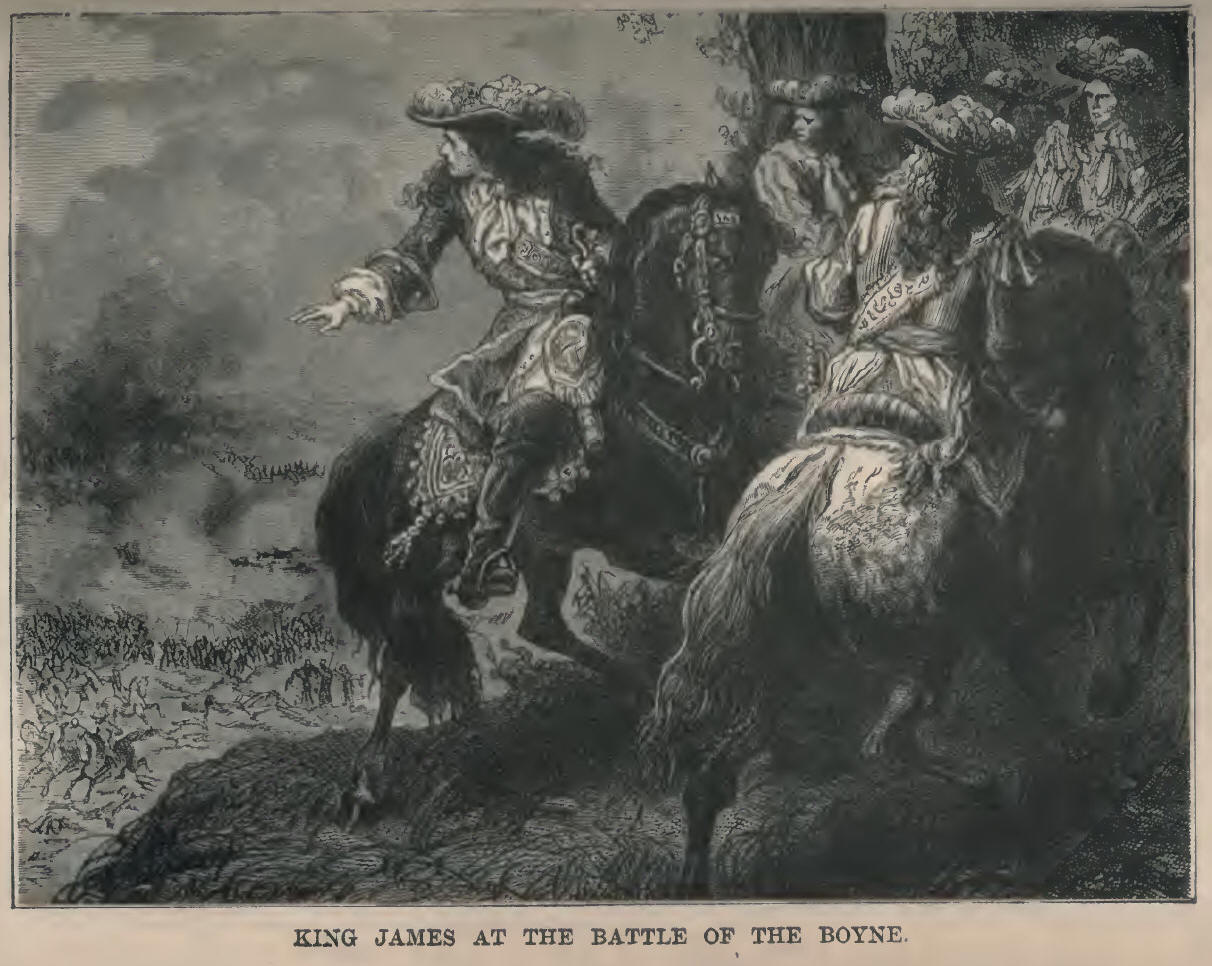
On the morning of the first of July, King William, who was wounded on the shoulder the evening before while making a reconnaissance, was on horseback from daybreak. The armies joined battle in the river. At first Schomberg had remained on the bank, directing the movement of his troops. He rallied around him the Huguenot regiments, shaken by the death of their leader Caillemotte. The moment the marshal stepped aground, after crossing the Boyne, a detachment of Irish cavalry surrounded him; he was dead when his friends succeeded in rejoining him. The native infantry had promptly taken to flight; nevertheless the regiments from France and the Irish gentlemen fought furiously. King William had entered the river at the head of the left wing, with difficulty guiding his horse with his wounded arm. He drew his sword with his left hand, and, charging at the head of the Enniskillen Protestants, he dashed upon the enemy. "You will be my guards today," he had said to the brave settlers; "I have often heard of you, let us see what you can do." The heat of battle expanded the heart of the grave and silent prince, whose unconquerable reserve his best friends frequently deplored: he moved about in every direction, receiving bullets on his pistol-butt and the top of his boot, following up the victory which at every point declared itself for him. King James had taken no part in the action; he had remained afar, viewing the combat from the heights of Dunmore. When he was certain that fortune was against him, he turned bridle, accompanied by some horsemen. In the evening he reached Dublin, bearing the news of his own defeat. Irritated and humiliated, he bitterly reproached his partisans with the cowardice of their countrymen. "I shall never in my life command an Irish army," said he. "I must now think of my safety alone; let each man do the same." Next day at sunrise he left Dublin, and on the 3d of July he took ship at Waterford. He soon landed at Brest, and related the history of the battle in detail. "From the account of the battle that I have heard the king and several of his suite give," wrote one of his first hearers, "it does not seem to me that he was very well informed of what took place in the action, and that he only knows the rout of his troops." "Those who love the King of England ought to be glad to know of his safety," said the Marshal de Luxembourg, in Germany; "but those who love his glory have to deplore the part he has played."
King James at the Battle of Boyne.
Queen Mary was more pre-occupied about her father's safety than her own glory. She wrote to her husband on the 5th of July: "I was uneasy to know what had become of the king, my father; I only dared to ask Lord Nottingham, and I have had the satisfaction of learning that he was safe and sound. I know I have no need of asking you to spare him; but add this to your clemency—let the world know that for love of me you wish no harm to befall his person."
The joy in England was complete when it was known that King William had entered Dublin on the 6th. The rumor of his death had been spread for a short time in Paris, where it had given rise to popular rejoicings. The governor of the Bastile had even had cannon fired. King James set about undeceiving the court and city. His royal illusions were not yet dispelled. "My subjects love me still," he used to say; "they await me impatiently in England." When he arrived at Versailles, his first care was to press Louis XIV. to send an army of invasion at once. "All the forces of England are in Ireland," said he; "my people will rise in my behalf." Tourville had just attempted a descent on the coasts of Devonshire, but the peasants had taken arms and the Cornish miners had emerged from the bowels of the earth to repel the invasion. The French sailors contented themselves with burning Teignmouth, and took to sea again more proud of the triumph they had lately gained (July 10) over the united English and Dutch fleets at Beachy Head, than humiliated at their check on the English coast. One cry re-echoed in all the southern countries: "God bless King William and Queen Mary!"
King William had felt deeply the disaster of his fleet. The news had reached him a few days after that of the battle of Fleurus, which had been won by the Marshal de Luxembourg from the Prince de Waldeck, commanding the allied forces. "I cannot express to you," wrote William to Heinsius, "how I am distressed at these two great great disasters which almost simultaneously have fallen upon the arms of the Republic. That of the fleet affects me the more deeply, because I have been informed that my vessels have not properly assisted those of the States, and left them in a critical position. I have ordered an inquiry to take place; the queen has given similar orders; no personal consideration shall prevent my rigorously punishing the guilty." William had a right to feel in the bottom of his soul a secret pride for his native country. The Dutch vessels had born the whole weight of the contest at Beachy Head, while the Marshal de Luxembourg wrote after the battle of Fleurus: "Prince de Waldeck will never forget the French cavalry, and I shall remember the Dutch infantry. It has done still better than the Spaniards at Rocroi."
The indignation of England was great against Admiral Herbert, created Lord Torrington, who was wrongfully accused of treason. An inquiry was held upon his conduct, and many people were found to be compromised in a Jacobite plot. Lord Clarendon, the queen's uncle, was of the number. Before his departure to Ireland the king had already had proof of his intrigues. The queen interceded for him. William had summoned Lord Rochester. "Your brother has plotted against me," he had said, "I am assured. I have been advised to except him from the amnesty, but I have been unwilling to cause this grief to the queen. It is for her sake that I forgive the past; but let Lord Clarendon take care in future; he will perceive that I am not jesting." This kind advice had not sufficed; Lord Clarendon's name was connected anew with Jacobite plots. The advisers of the queen hesitated to accuse him in her presence. "I know," said Mary, "and everybody knows as well as I, that Lord Clarendon is accused of things too grave to suffer him to be excepted from the precautionary measures." A warrant was signed for Clarendon's arrest. "I am more grieved for Lord Clarendon than people will believe," the queen wrote to her husband.
William returned to England, after meeting with a repulse before the walls of Limerick, defended by the Irish with the patriotic and sectarian zeal which had before animated the Protestant citizens of Londonderry. Lauzun and the auxiliary regiments, after withdrawing to Galway, had just embarked for France. King William bid Marlborough to make a descent upon Cork and Kinsale. The two places fell into the hands of that able general, and five weeks from his departure from Portsmouth he paid his respects to the king at Kensington. "There is not in Europe a general, having so little experience in war, who is worthier of great commands than the Earl of Marlborough," William said generously, for he did not like him. The return of the king, and his journey from Bristol to London, had been greeted with national transports of joy. He had left in Ireland the Dutch general Ginckel, a resolute and prudent man, at the head of an army, well disciplined, well equipped, and well victualled. Before the close of the following year, Ginckel had completed his task of pacifying Ireland. On the 20th of June, 1691, in spite of the presence and exertions of Saint-Ruth, who had come with reinforcements from France, he carried by storm the town of Athlone, the true key of Connaught, and the strongest place in Ireland. "His master should have him hanged for attempting to take Athlone," said the French general, "and my master can do the same to me, if I lose it." On the 12th of July Saint-Ruth was killed at the battle of Aghrim, and the Irish signally defeated. On the 26th of August, Ginckel laid siege to Limerick.
Tyrconnel had just breathed his last, old and prematurely worn out by fatigue and debauches. King James's troops were commanded by Lord Sarsfield, the most able and brilliant of the Irish officers. On the 1st of August a capitulation was signed, and was soon followed by a treaty. The Irish regiments were permitted to choose between the service of William and that of Louis XIV. A large number of soldiers went over spontaneously to France, forming in the armies of Louis XIV. and Louis XV. that Irish brigade, whose name has become famous. "Has this last campaign altered your opinion of our military qualities?" asked Sarsfield of the English officers. "To tell the truth," answered they, "we think almost the same of them as we have always thought." "Well," replied Sarsfield, "whatever bad opinion you may have of us, only let us change our king and begin again, and you will see." Ginckel was raised to the dignity of Earl of Athlone and Aghrim. King William and Parliament had ratified the terms offered by the general to the Irish; the struggle was over, the conquest consummated; the Protestant colonists, lately oppressed, became the masters, and often the oppressors of the indigenous race, which was dejected and decimated. Scotland was absorbed with the triumph of the Presbyterians, who had just legally recovered the religious supremacy in their country, to the great detriment of Episcopalians and Cameronians. The English Parliament had voted supplies generously, the Jacobite plots were exploded; the trial of Lord Torrington had ended in an acquittal, which never succeeded in erasing from the king's mind a distrust, which was merited by the dissolute life and known intemperance of the admiral. William had not waited for this first interval of domestic peace to respond to the needs of his soul, and the imperious call of political necessity. On the 18th of January, 1691, in spite of the severity of the season, he had embarked at Gravesend for Holland. "I yearn for this moment more than I can express to you," he wrote six months before to Heinsius.
The English fleet had arrived in sight of the coasts of Holland. The voyage had been unpleasant; disembarkation seemed impossible: enormous blocks of ice encumbered the channel, while a thick fog hid the land. For eighteen hours the four little ships were obliged to keep to sea. The king was, as usual, weak and suffering, yet he had wished to put off in an open boat, to gain his natal soil the quicker. The whole night was spent before he could step on dry land; the cold was intense, and the danger serious. Some of the sailors were in despair. "Fie!" said William to them, "are you afraid to die with me?" Some great British noblemen, the Dukes of Ormond and Norfolk, the Earls of Devonshire, Dorset and Monmouth, were with him; Portland and Zulestein were glad to accompany their beloved sovereign to Holland. It was only at daybreak, by the feeble light of a winter's morning, that they were able at last to land on the island of Goree. The king rested there some hours before taking the road to the Hague.
Joy beamed on the face which the English were accustomed to find stern and haughty. Heart was responding to heart; England had accepted its deliverance from the hand of William III., without affinity for him and through necessity. The Dutch loved the heir of the greatest name in their nation and of their race, the liberator of their country, the man who had carried to the throne of England the glory, the name and the manners of his Dutch fatherland. The people pressed upon his steps. "Let them alone," said the king; "let them come near me and all be my friends." A splendid reception had been prepared at the Hague: he was opposed to the pageant and the ceremonies, and murmured against this useless expenditure. "It is quite enough to have to bear the cost of the war," he observed. His countrymen spared him neither a speech nor a salvo of artillery; the joy of the population was at its height. "It would be quite another thing if Mary had accompanied me," said the king to those who congratulated him upon his triumph; "she is more popular than I."
The States-General were solemnly convened. William was more moved than he had been formerly on leaving his native country. "When I took leave of you," he said, "I informed you of my intention to cross over to England, to save, thanks to your aid, that kingdom from a deluge of evils present and to come. Providence has blessed my enterprise, and the nation has offered me the crown of the three kingdoms. I have accepted it, not from ambition, God is my witness, but to put the religion, the welfare, the peace of Great Britain beyond the power of any assault, and to be able to protect the allies, the republic in particular, against the supremacy of France. I have loved this country from my earliest youth, and, if anything could increase this love, it is the certainty that I have found a reciprocal attachment in the hearts of my countrymen. If it pleases God that I should become the instrument which Providence may deign to use in order to restore repose to Europe and re-establish security in your state, I shall have lived long enough and shall go down tranquilly to the grave."
It was at the Hague that the Congress of the Grand Alliance had met. Having become King of England, and controlling the forces of a great kingdom, William of Orange remained its chief, notwithstanding princely jealousies and rivalries, by that ascendancy of genius which had carried him to the first rank when he was as yet but the stadtholder of a petty republic. The assembled princes or their envoys were not used to hear such bold language employed against the all-powerful king of France as that of William at the opening of the Diet. "The states of Europe," said the king, "have been too long given up to a spirit of division, indolence, or attention to their private interests. We may rest assured that the interest of each is inseparable from the general interest of all. The King of France's forces are great; he will sweep away everything like a torrent. It will be vain to oppose him with murmurs and protests against injustice. It is not the resolutions of diets, or hopes founded on fanciful rumors, but powerful armies, and a firm union among the allies which can stay the common enemy in his triumphant career and in the effervescence of his power. It is with the sword that we must wrest from his hands the liberties of Europe which he aims at smothering, or we must endure the yoke of slavery forever. For my part I shall spare neither my credit, my forces nor my person, to attain this glorious result, and I shall come in the spring at the head of my troops to conquer or die with my allies."
The spring had not come yet, and Mons had been already invested on the 15th of March by a French army. Louis XIV. arrived there with the Dauphin on the 12th, and, despite the impetuous efforts of William to relieve the place in time, it capitulated almost in sight of the allied army. The vigilance of Marshal de Luxembourg baffled William's maneuvres throughout the campaign.
When he returned to England in October, the advantage was with France everywhere on the Continent. The Duke of Savoy had adhered to the Grand Alliance, but Nice had fallen into the power of Catinat. Opening the session of Parliament, the King spoke complacently of the successful issue of the war in Ireland; at the same time he warned the representatives of the nation that a great effort would be necessary against the King of France, and in order to support the Grand Alliance. The subsidies had been voted without opposition, and the House was engaged with the affairs of the East India Company, when a strange report was spread abroad: the Earl of Malborough, lately at the head of the English contingent to the allied army, while the king of England was absent, had been suddenly stripped of his employment and his dignities. The Princess Anne, who persisted in keeping her favorite with her, had to retire with her to the country. The causes of Malborough's disgrace remained a mystery, which occasioned the most diverse conjectures, and allowed the enemies of William and Mary to attribute unworthy or frivolous motives to them. The cause was grave, and the necessity absolute: the Earl of Marlborough was hatching a new treason. In the Parliament and the army all was ready to attempt a Jacobite restoration.
James II. himself wrote in November, 1692: "Last year my friends formed the design of recalling me by act of Parliament. The method was arranged, and Lord Churchill was to propose in Parliament to expel all foreigners, as well from the army and the council as from the kingdom. If the Prince of Orange had agreed to this measure, they would have had him in their hands; if he had resisted it, they would have made Parliament declare against him, and at the same time Lord Churchill with the army was to declare himself for the Parliament; the fleet was to do the same, and they were to recall me. They had commenced to move in the matter and had gained a large party, when some indiscreet subjects, thinking they were serving me, and that what Lord Churchill was doing was not for me, but for the Princess of Denmark, had the imprudence to discover the whole thing to Bentinck, and thus averted the blow."
Duke And Duchess Of Marlborough.
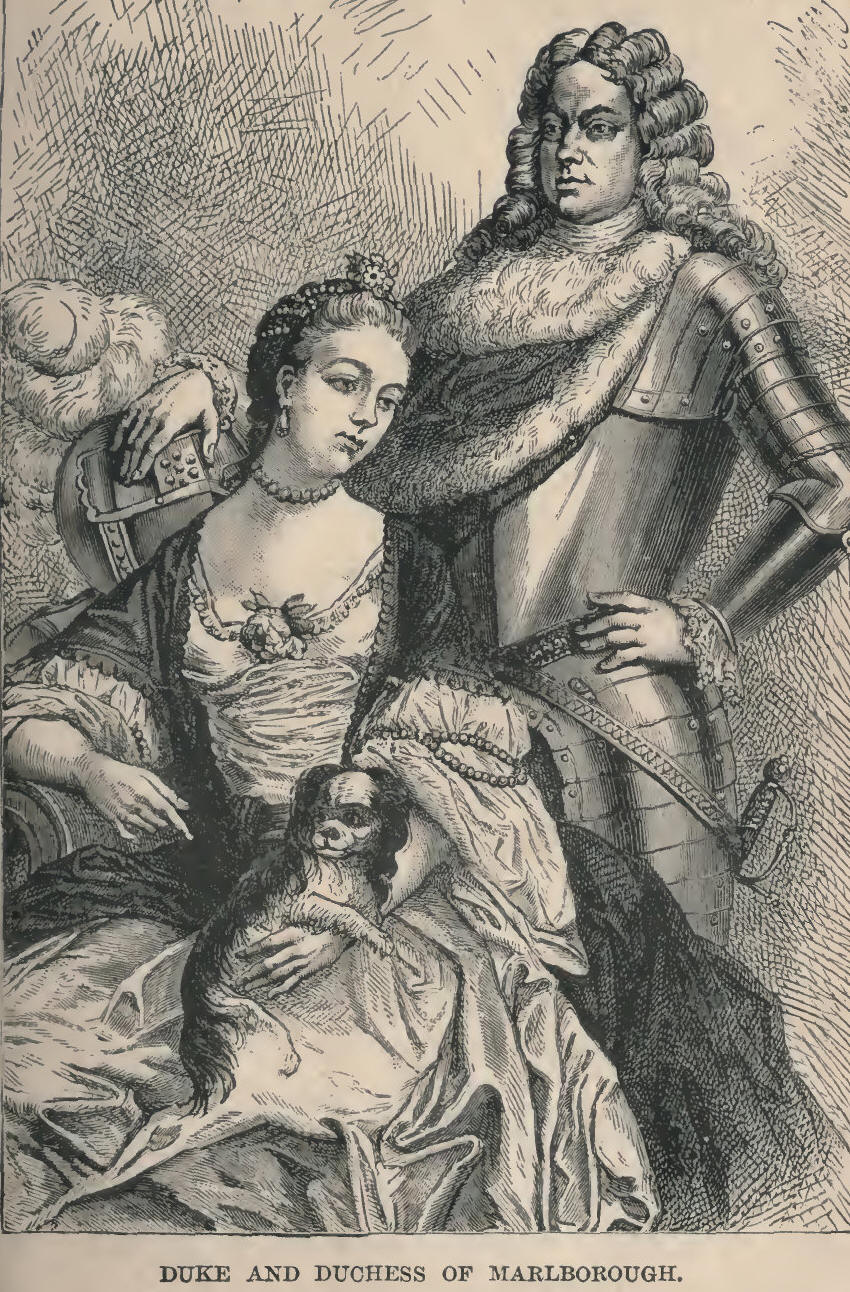
The original manuscript of Burnet's Memoirs also contains the following: "Marlborough busied himself with decrying the conduct of the king and with depreciating him in all his conversations, seeking to rouse the dislike of the English for the Dutch, who, he said, enjoyed a larger share of the king's confidence and favor than they did. It was a point on which it was easy to excite the English, too much inclined, as they are, to despise all other nations and to esteem themselves immoderately. This was the subject of all the conversations at Marlborough's residence, where English officers met incessantly. The king had told me that he had good reasons for believing also that the earl had made his peace with King James, and had opened a correspondence with France."
William III. had learned clemency in his dealings with English statesmen: the treason of Lord Clarendon and of Lord Dartmouth had been treated with mildness; when Lord Preston's plot had been discovered, and Elliot, one of the accomplices, was multiplying denunciations, the king, who was present, had touched Caermarthen's shoulder. "There is enough of this, my lord," he had said; thus imposing silence upon useless revelations about an impotent discontent against which he did not wish to be severe. Yet he feared the Earl of Marlborough's perfidy: he knew at once his rare abilities and his profound baseness, and wished to secure himself against a treason which threatened his throne and life. Through excessive magnanimity or prudence he persistently concealed the motives of his determination; but Marlborough's disgrace was to be long-lived. The silence of William left a formidable foe to France and a superlatively able head to the coalition against her, who, had the details of his treason been generally known, would have been irrecoverably ruined in the public opinion of England.
William was about to leave England to take command of the allied forces on the continent. At his departure he wished to finish the pacification of Scotland. His late deputy, Lord Melville, had allowed the Presbyterians to assume a dominating position which seriously threatened the liberty of the Episcopalians. He was replaced by Sir John Dalrymple, known in history as the Master of Stair. Eloquent and able, he had conceived the idea of detaching a certain number of Highland chiefs from the Jacobite cause by bribery. A considerable sum had been effectively spent among men proud and uncultured, but poor and exhausted by their warlike efforts and their domestic feuds. Numerous chiefs made their submission, notwithstanding the repugnance inspired by Lord Breadalbane, who was employed by the Master of Stair in these negotiations, and whom his connection with the Campbells rendered suspected by the mountaineers. On the 31st of December, 1691, Macdonald of Glencoe, or MacLean, as he was called in the Highlands, found himself almost the only one to refuse the oath of allegiance.
He made up his mind, at last, but too late. When he presented himself at Fort William, the fixed time had expired, and no magistrate was present. The old chief, alarmed at last, betook himself to Inverary; they refused for a long time to accept his submission. McLean returned to his mountains, whither an unjust and cruel vengeance was about to pursue him.
The Master of Stair had consented to become the instrument of the hereditary hate of the Campbells; it had been represented to him that this was the price of the pacification of Scotland. His orders had been issued in advance for the destruction of all the clans which should not have made their submission before the 1st of January, 1692. "Your troops will ravage all the district of Lochaber, the domains of Lochiel, Keppoch, Glengarry, and Glencoe. Your powers will be sufficient for the purpose. I hope your soldiers will not embarrass the government with prisoners." Lochiel, Keppoch and Glengarry had acted in time. All the hate of the Campbells and all the administrative zeal of the Master of Stair were turned upon Glencoe. King William signed his sentence without reading it, Burnet asserts, and amid the mass of papers which were presented to him every day. He did not, doubtless, understand its purport. "It is a charitable duty," wrote the Master of Stair, "to destroy this nest of robbers."
On the 1st of February, 1692, a detachment of Argyle's regiment entered the territory of Glencoe, peacefully, and as if animated by the most friendly intentions. "It would be better to do nothing in the matter than to do it unsuccessfully," the Master of Stair had said. "Since the thing is resolved on, it must be executed secretly and suddenly." The commander of the small body, Captain Campbell, commonly called Glenlyon from the name of his estate, had a niece married to the second son of Glencoe. The soldiers were well received and housed among the cottages.
They passed twelve days there waiting for the time when Lieutenant-colonel Hamilton should have occupied the defiles of the mountains. The 13th of February had been fixed on as the fatal day; the Highlanders had felt some uneasiness, but their guests had reassured them, "If there was any danger," Glenlyon had said to the chiefs eldest son, "should I not have warned your brother and his wife?" At the appointed hour Hamilton had not yet arrived; nevertheless the massacre began. Under every roof, beside every hearth, Glenlyon's soldiers shot down their hosts, men, women and children; the Master of Stair's orders had allowed them to spare old men above seventy. In their bloody intoxication the troops gave no quarter; the aged Glencoe perished among the first. His wife, assassinated beside him, was stripped of her jewelry, and did not expire till the next day. At every door was seen a corpse. When Hamilton appeared at the head of his troops, they plundered all the houses, and long lines of cattle were driven down the mountain passes by the light of the flames which were consuming the villages.
God does not suffer crime, though cleverly conceived, to gain a complete triumph. The passes had not been guarded; the murderers had not all arrived in time, and a large number of the Macdonalds of Glencoe succeeded in escaping, at the cost of new sufferings—exposed to hunger, cold, and unceasing dangers. They repaired to the midst of their mountains, above their ruined houses and their blood stained hearths. The cry of their calamity mounted slowly to Heaven. The Jacobites assisted in spreading it abroad: they had eagerly seized this weapon against King William. When the latter, far away and imperfectly informed, wished to open an inquiry into the authors of the crime, so many and so important persons were compromised in it, that the Master of Stair alone was removed for a time from public life. The massacre of Glencoe has remained a dark stain on the reign of William III., a sad contrast to the leniency and humanity which usually characterized his government.
Hardly had the king left England before the nation, as well as Queen Mary, was a prey to serious uneasiness. Louvois had died suddenly on the 17th of July, 1691, without Louis XIV., with whom his influence had been decreasing, appearing particularly distressed at his loss. "Tell the King of England that I have lost a good minister," was the answer he had made to King James's condolences, "but that his affairs and mine will fare none the worse for it."
Louvois would not have consented to the schemes which James was urging Louis XIV. to execute. Still convinced of the attachment of his English subjects, especially of the navy, he was for some time in correspondence with Admiral Russell, a sincere Whig, and Protestant, but morose, discontented, unreasonable and easily led away by his temperament into guilty intrigues. A camp had lately been formed on the coasts of Normandy; all the Irish regiments were there, under command of Lord Sarsfield; French forces were to join them. James called on the English people to pronounce in his favor by a manifesto so arrogant, so obstinate in the errors and faults which had caused his downfall, that the ministers of William III. had it printed and widely circulated in the kingdom.
Some English Jacobites attempted to combat the disastrous effect of the manifesto by another paper, drawn up with care and with a full knowledge of the state of feeling in England; but nobody let himself be taken in by this maneuvre. A popular movement was displayed in favor of the government; the militia responded spiritedly to the call; the coasts were covered with troops; the fleet of the allies entered the Channel. Those of the British sailors who had given hopes to King James, recovered their fidelity in presence of the enemy. "I should like to serve King James," said Admiral Russell to the Bishop of St. Asaph. "It might be done, if he was willing to let us alone; but he does not know how to act with us. Let him forget the whole past, and grant a general amnesty, and I will see what I can do for him."
The bishop tried some hints about the personal favor reserved for the admiral. The latter interrupted him: "I am not uneasy about that, I only think of the public; and don't imagine I should ever let the French conquer us on our own seas. Be it well known that I shall fight them if I meet them, were His Majesty himself on board!"
This outburst of patriotism, in a malcontent, who had lately been on the point of becoming a traitor, did not suffice to open King James's eyes: at his request the formal orders of Louis XIV. forced the hand of Admiral de Tourville, who was hesitating, to fight. He had been instructed to protect the disembarkation of the invading forces upon the English coasts; but the wind retarded his sailing from Brest. The Dutch fleet had joined the English, and Tourville wished to await the squadrons of Estrées and Rochefort.
Pontchartrain was minister of Marine as well as of Finance since Seignelay, son of Colbert, had died, in 1690. He sent this answer from Versailles to the experienced sailor, who was used to fighting from the age of fourteen: "It is not for you to discuss the king's orders; it is your business to execute them and enter the Channel. If you don't wish to do so, the king will appoint in your place some one more obedient and less cautious than you." Tourville set out and met the hostile squadrons between the capes of La Hague and Barfleur. He had forty-four vessels against ninety-nine which the English and Dutch numbered. Tourville convened his council of war; all the officers advised him to retire; but the king's command was peremptory, and the admiral gave battle. After three days' desperate resistance, aided by the most skilful maneuvering, Tourville was forced to retreat under the forts of La Hogue in the hope of stranding his vessels. King James and Marshal de Bellefonds were opposed to this. The vessels were attacked and burned by the English in sight of the French and Irish camp. The dethroned king was divided between his desire for victory and his patriotic instincts. Seeing the sailors who fought against him gallantly scaling the French vessels, he could not help exclaiming: "Oh, my brave Englishmen!" Previously, on the occasion of a trifling advantage that Tourville had gained in the Bay of Bantry, while James II. was in Ireland, when they came to announce to the latter that the French had beaten the English, the king had said, not without bitterness: "Then it is the first time." Tourville had lost a dozen vessels. The conduct of the English officers and sailors had been heroic; the admiral had himself inspected all the vessels and addressed the crews. "If your commanders betray you," he had said, "throw them overboard, and me the first!" King James counted wrongly on Rear-Admiral Carter, who had made him promises, while at the same time he warned Queen Mary of the fact. Severely wounded, Carter, who was the first to break the French lines, would not let go his sword. "Fight, fight," he said, dying, "until the ship sinks!"
The news of the victory of La Hogue caused great joy in England: it calmed the minds of the population, distracted by repeated rumors of conspiracies. The plot denounced by Fuller in February, and Young's plot in April, both invented, and the creations of false witnesses, worthy rivals of Titus Oates and Dangerfield, had disturbed men's spirits. Lord Huntingdon had been arrested; the Earl of Marlborough had been sent to the Tower for a short time: the Bishop of Rochester had been tried. Marlborough was guilty of intrigues more serious, and unknown to the public. The Bishop, rich and indolent, had nothing to do with any plot. He easily proved his innocence; the false witnesses were severely punished; and Marlborough was set at liberty, with a caution, after forty-eight hours. His accusers had done him the service of dispelling the vague suspicions that had brought his disgrace upon him.
At the close of the same year, the plot of Grandval, aimed at the King's life, was to wake again the public disquiet that was destined to be revived more than once in his reign. In Europe, as well as England, King William's courage and thoughtfulness stood in the way of many great designs, and disappointed many hopes. The sentence which condemned the criminal publicly compromised the Marquis de Barbezieux, son of Louvois, and secretary of state for war. Louis' ministers kept silence and did not refute the charge.
The fortune of war continued to favor France: Namur had capitulated on the 20th of June, and its citadel surrendered on the 30th. "The allies learned it by three salvas from the army of the Marshal de Luxembourg and that of the Marquis de Boufflers," wrote Louis XIV. in his Memoirs. "They fell into a consternation which rendered them immovable for three days; so much so that the Marshal de Luxembourg having resolved to repass the Sombre, they thought neither of annoying him on his march nor of attacking him in his retreat."
When William III. came up with Luxembourg on the 31st of August, between Enghien and Steinkerque, a new victory, due to the brilliant gallantry of the French infantry, completed the uneasiness of the allies. At the end of the year, William, always clear-sighted and often a pessimist, in spite of his unbending determination, wrote to Heinsius "I have to tell you frankly that, if we could obtain peace just now—which certainly would not be on favorable terms—we should yet have to accept it; for, to my grief, I don't see that we have anything better to expect—far from it, for things go from bad to worse. It will not, for that reason, be less needful for one to do his best; and for my part, I will do everything in my power."
The war was to continue several years more, pressing heavily on England and Holland, which almost alone were in a condition to furnish pecuniary resources to the allies. The English Houses of Parliament, sometimes lavish and sometimes penurious, always extremely touchy about the position of foreigners in the King's service, often disputed with William the reinforcements of men and moneys which he demanded for the army; thus arousing the wrath and distrust with which parliamentary debates and dissensions inspired him. He had with great difficulty kept in power Lord Nottingham, who was vigorously attacked by the Whigs, and in whom he had a just confidence, in spite of the repugnance which the earl had at first shown to the revolution. On the other hand, Somers had been entrusted with the seals, and this partial return of power into the hands of the Whigs had momentarily calmed the dissensions of the parties. Yet the session had been much agitated: the land tax and a large loan had been voted on the motion of Charles Montague. The King was gloomy and pre-occupied with the campaign which was about to open. "At a juncture when we ought to be able to make an extraordinary effort on all sides to resist the enemy," wrote he to Heinsius at the beginning of 1693, "it tries me not to be able to contribute more to the general cause. It is distressing to see that this nation only thinks of indulging its private passions, without reflecting the least on the general interests. The funds which Parliament has allowed me will not cover the necessary expenses I have to incur, so that I find myself in a very embarrassing condition. I leave you to imagine how much this, joined to the critical state of our affairs, and my inability to supply a remedy therefor, must torment me."
France was much more exhausted than England; and the losses which Tourville, Jean Bart or Duguay-Trouin caused English commerce to endure, did not prevent money flowing to London for the new loan. Yet the strong will of Louis XIV. and the effective action of a central power, had sufficed to continue the war during nearly the whole winter. On the 25th of July, 1693, the battle of Neerwinden was lost by King William in person to the Marshal de Luxembourg. Almost invariably unlucky in war, notwithstanding his conspicuous bravery, he charged sword in hand at the head of two regiments of English cavalry, which made the enemy give way, till they came to the household guard of the king. This select corps had remained motionless for four hours under the fire of the allies. William believed at one time that his gunners were aiming badly, and hastened to the batteries; the French squadrons were moving only to close their ranks as the files were carried off. The King of England uttered an exclamation of rage and admiration: "Oh, the insolent nation!" he cried. The admiration was mutual. "The Prince of Orange was near being taken after having done wonders," wrote Racine to Boileau. "It is painful for me to tell you," William informed Heinsius, "that the enemy attacked us yesterday morning, and that, after an obstinate contest, we have been defeated. We march to-morrow to encamp between Vilvorde and Malines, to rally our forces there and impede the plans of the enemy as far as possible."
Luxembourg was ill and soon afterwards died. The victory of Neerwinden brought little advantage to France. The same was the case in Italy with the success of Catinat at Marsala: the Duke of Schomberg, eldest son of the Marshal, charged there at the head of the troops paid by England. "Things have come to such a pass that it is necessary to conquer or to die," he had said, as he threw himself into the mêlee. This was his master's advice. "The crisis has been terrible," wrote the latter to Heinsius and to Portland. "God has judged it right to send me great trials in succession: I try to accept His will without murmuring and to deserve his anger less. God be praised for the issue he has granted us, and may we be able by our gratitude worthily to requite his mercy!" The strife of parties in Parliament involved, as usual, the grant of the subsidies on which the military preparations depended. "The increase of the army meets with violent opposition here," wrote William on the 4th of December; "yet I am led to hope that finally everything will turn out as I desire. May God will it!"
Power was passing away from the Tories. Lord Sunderland, who had lately emerged from his retreat, still able and engaging after his treason and shame, advised William to recall the Whigs. The king had been wearied by their arrogance and tyranny; yet he agreed to place Admiral Russell at the head of the Admiralty and to make Lord Shrewsbury Secretary of State. The latter hesitated long before accepting. He began to excuse himself before the king, pleading his ill-health. "That is not your only reason," said William; "when have you seen Montgomery?" This clever and enterprising Scot, formerly leader of the Parliament in Edinborough, had fallen into disfavor and was serving as agent in the Jacobite intrigues. Shrewsbury grew pale, and William repeated to him a part of his conversation with Montgomery. "Sire," said the earl, "since your Majesty is so well informed, you ought to know that I have not encouraged the attempts of this man to detach me from my allegiance."
The king smiled; he knew the strange weakness that weighed like an enchantment on Lord Shrewsbury's noblest qualities. "The best way to silence suspicions," he said, "is to take office. That will put me at my ease: I know that you are a man of honor, and that if you undertake to serve me, you will do so faithfully." Shrewsbury was soon made a duke, at the same time with the Earls of Bedford and Devonshire. Charles Montague, who had lately conceived the idea of a Bank of England, and helped to establish it, was named Chancellor of the Exchequer. Measures new, or renewed with persistency, were violently debated. The bill of procedure in trials for treason, the bill of disqualifications or of appointments, which interdicted the House of Commons to office-holders, and finally the often debated question of the length of Parliaments, which it was wished to limit to three years; such were the preliminary movements in parliamentary reform which delayed William's departure for the Continent. "It is a dreadful thing to be upon this island, as it were banished from the world," wrote the King of England. Some days later he arrived in Holland.
A great naval expedition was being secretly prepared at Portsmouth, intended to thwart the designs of Louis XIV. on the Mediterranean. Marlborough, always well informed, had warned King James of it. "Twelve regiments of infantry and two of marines are soon to embark, under command of Talmash, to destroy the port of Brest and the squadron which is collected there. It would be a great success for England, but nothing shall ever prevent me from letting you know what may be useful to you. I have been trying for a long time to learn this from Russell, but he has always denied it, though he has been informed of it more than six weeks. This gives me a bad opinion of the man's intentions."
On the 16th of June, 1694, the English fleet was fifteen leagues west of Cape Finisterre. Talmash proposed to disembark in the Bay of Cadsant. Lord Caermarthen, eldest son of the statesman lately made Duke of Leeds, undertook to explore the bay in his yacht. He found the approaches well defended. Talmash was resolved to attack. Caermarthen advanced, first signalling to Admiral Berkeley the difficulties which he met. Batteries were suddenly unmasked and swept the decks. Talmash was convinced that the coast was defended by peasants who would fly at the sight of the English soldiers: a well sustained fire replied to their attempts to land. The general was severely wounded in the thigh as he was being carried to his launch; the troops re-entered their boats pell-mell. The enterprise was a failure; the fleet had to return to Portsmouth. Talmash died on his arrival, declaring aloud that he had been drawn into a trap by traitors. The outwork whence the fatal bullet came is called, to this day, The Englishman's Death.
The rage and uneasiness in England were great: people said aloud that English forces ought to be commanded by Englishmen. Talmash was dead, and Marlborough ought not to remain longer in disgrace with the king. All the maneuvres and all the treacheries of the earl aimed at this. He had the audacity to present himself at Whitehall to offer his services to the queen. Lord Shrewsbury exerted himself to have the offer accepted; King William absolutely refused it. The English squadron was ravaging the coast of Normandy; Admiral Russell was keeping the fleets of Louis XIV. in check in the Mediterranean. The campaign in the Netherlands was passed in skilful marches and counter-marches, accompanied by some trifling advantages for King William, who captured Huy. When he returned to England, on the 9th of November, the queen was waiting for him at Margate, happy at meeting the man who was the only joy of her life. "Now that you have the king, don't let him go away again, madame," cried the assembled women, as the royal couple passed. She was to be the first to go away, and death was threatening her already.
Before Queen Mary, Tillotson, archbishop of Canterbury, fell sick and died, towards the middle of November. He had rendered the Church of England the great service of throwing the weight of his character and eloquence on the side of submission to the new power, by frankly and simply accepting the oaths of allegiance. He had been strongly urged to do so by Lady Russell. "The time seems to me to have come," she had written to him, in 1691, "to put in practice anew that principle of submission which you have formerly asserted so much yourself and recommended so much to others. You will be a true public benefactor, I am convinced. Reflect how few capable and upright men the present time produces, I beg you, and do not turn your resolution over endlessly in your mind: when one has considered a question in all its aspects, one only succeeds, by returning incessantly to it, in throwing oneself into new difficulties without seeing any the clearer into the matter."
Sancroft having obstinately refused the oath, Tillotson had become Archbishop of Canterbury, in 1691, to the great disgust of Compton, Bishop of London, who had hoped for the primate's see. Henceforward, the nonjuring bishops and clergy loaded Tillotson with their wrath and contempt. Gentle, sensitive, used to the admiration aroused by his eloquence and the esteem for his irreproachable life, the new archbishop suffered cruelly from the injuries of which he was the object. When he died there was found among his papers a packet of pamphlets published against him, with this phrase in his handwriting: "I pray God to pardon them; I pardon them." "I have lost the best friend I have ever had, and the best man I have ever known," wrote William to Heinsius. He loaded the widow with favors. Such was the popularity of the archbishop as a preacher, that the publisher of his sermons bought their ownership at the price of; £2,500, a sum unheard of at that period. Milton had sold the manuscript of the "Paradise Lost" for five pounds sterling, and Dryden, at that time the most illustrious of English poets, had received £1300 for his translation of Virgil's complete works.
A more poignant grief was about to strike William. He had come to Whitehall to give his assent to the bill for Triennial Parliaments, which he had once objected to. The many members of the two Houses who pressed into the hall of sessions found the King's face changed and his mood gloomy. He hastened to return to Kensington. The report spread that the queen was ill, and it was soon known that she had the small-pox.
As soon as Mary had reason to think herself stricken by the scourge which desolated households every year, she had ordered that all persons of her retinue who had not yet had the disease should leave Kensington; then, shutting herself up in her study, she had put her papers in order, burning a portion of them herself. "I have not waited for this day to prepare myself for death," she said, when the disease left her no more hope. The grief of her husband exceeded all anticipations, astonishing even those who had been constant witnesses of the absolute devotion of the queen. He did not leave her for a single instant, sleeping beside her bed and rendering her the tenderest cares. Mary had triumphed over that stern heart which neither victories nor defeats had ever been able to disturb. He could not keep in his tears, when he looked at her. When Tenison, the new Archbishop of Canterbury, had undertaken to announce her approaching end to the queen, William drew Burnet into a corner of the room. "There is no more hope," he said; "I was the happiest of men—I am the most miserable. She had no faults, not one; you knew her well, but you do not know, no one can know, her worth." Twice the dying woman wished to bid good-bye to him whom she had loved alone, and twice her voice failed her: she now thought only of eternity. Several times William had been seized with convulsions: when they bore him from the queen's chamber just before she breathed her last sigh, he had almost lost consciousness.
Mary died at thirty-two, lamented by all who had known her. "So charitable," says Evelyn, "that in the midst of the most violent political strifes, she never inquired into the views of those who asked her aid;" gentle and kind to all, often attracting censure through the fullness of her wifely devotion, which seemed to have absorbed all other affections in her soul—the only sort of tenderness that could have satisfied the reserved and proud heart of the prince her husband. She had welcomed, during her illness, the advances of her sister. When she had shut her eyes, the Princess Anne sent to ask her brother-in-law permission to see him. Somers offered to mediate between the princess and the king. He found William in his study, his head between his hands, absorbed in grief; he represented to him the necessity of putting an end to a family quarrel, of which the political consequences might become grave. "Do what you wish, my lord," replied the king; "I cannot think about anything." Yet the interview that was asked for took place. William assigned the palace of St. James to the princess for her residence. At the same time he sent her her sister's jewels; but he kept his resolution about the Earl of Marlborough. The princess's favorites were not admitted to the presence of the king, and the general remained excluded from every honorable or lucrative post. Yet Mary's death had changed all the views of Marlborough: a single life, precarious by nature, shaken by fatigues and cares, now stood in the way of the greatness of Princess Anne, and the supreme exaltation of her all-powerful adherents. The earl and his wife no longer retained their regard for the fallen monarch; they no longer admitted the legitimacy of the Prince of Wales. They patiently awaited the day of triumph; other more guilty hands were going to undertake to hasten it.
For some days William had seemed incapable of taking part in public affairs. "I thank you with all my heart for your kindness," he had replied to the condolences of the houses, "but still more for your so well appreciating our great loss: it exceeds everything that I could express, and I am not in a condition to think of anything else." He had written to Heinsius: "I tell you in confidence, I feel myself no longer capable of commanding the troops. Yet I shall try to do my duty, and I hope God will give me strength for it." The charges of corruption preferred before the houses against several prominent Tories, first roused him from his dejection. The great corporations of the city of London and the East India Company were convicted of having frequently bought the influence of the ministers. The Speaker of the House of Commons, Sir John Trevor, was the first condemned. The charges brought against the Duke of Leeds were grave. The witnesses had disappeared; the charge fell through; but public rage and indignation pronounced his sentence. He was forever lost to political life. When William set out for the Continent, on the 12th of May, 1695, the name of the Duke of Leeds had been erased from the roll of the Council entrusted henceforth with the government in the king's absence. The intelligent, firm and devoted woman, who formerly governed wisely in his name, and willingly surrendered the power into his hands, was no more. William rejected all the hints that were given him to replace her by the Princess Anne.