Volume 2 — Chapter XX. Policy And Government Of Queen Elizabeth. Her Foreign Relations (1558-1603).
Reading edition
Elizabeth was at Hatfield when Mary died, a striking proof of the distrust which reigned between the two sisters, and which banished one from the death-bed of the other. The princess was devoting herself, as usual, to the serious occupations which were dear to her. Still more learned than her sister, brought up with care by the learned Roger Ascham, Elizabeth had continued the practice of reading some Greek every day; she even translated the rhetorician Isocrates. These literary recreations were interrupted by more urgent cares when the mortal illness of her sister began to bring about her the worshippers of the rising sun. Philip II. had been careful to send her a trustworthy ambassador. The Count of Feria had seen the princess before the death of the queen, and the king believed her to be gained over to the great Catholic confederation, and compelled to rely upon him and to regulate her conduct according to his counsels. She did not consult him, however, upon the course to be followed, when she was apprised of the death of her sister. Sir William Cecil, formerly secretary of state under Edward VI., who being in disgrace under Mary, had prudently submitted to the Roman Catholic requirements, had received all his orders by anticipation. Parliament was sitting, Chancellor Heath repaired to the Houses, and there announced the accession of Queen Elizabeth, "the legitimate and rightful heir to the throne." Cries were raised of "Long live Queen Elizabeth!" Couriers were despatched by Cecil to all the sovereigns of Europe, announcing the accession, and the Lords hastened to Hatfield, to pay homage to the new sovereign. They asked her, upon arriving, what attitude she intended to assume. The Protestants, delivered from an odious yoke, were rejoicing, being convinced that, under the reign of her sister, the princess had concealed her real opinions. The Catholics, who were uneasy, counted upon the influence of Philip II. The first speech of Elizabeth did not enlighten them; it was cautious and measured, announcing no intention of abrupt changes. One indication alone, though slight in itself, soon caused people to feel from which quarter the wind blew; when the queen arrived at Highgate, the bishops came to meet her, and all kissed her hand, with the exception of Bonner, bishop of London, the principal persecutor of the Reformers, upon whom she turned her back. Notwithstanding the solemnity of the Catholic services celebrated in honour of Queen Mary and the Emperor Charles V., who had died a short time before, discreet observers saw that the queen inclined towards the party of the Reformation. Her ministers were yet more decided. Cecil, Pembroke, Northampton, and Lord John Grey, her intimate councillors, were all convinced of the immense progress which Protestantism had made during the persecution of Mary. They perceived, moreover, that the throne of their mistress rested exclusively upon Protestant principles. Subject to the Pope, England must reject Elizabeth as illegitimate, since the marriage of Henry VIII. with Anne Boleyn had not been sanctioned by the Catholic Church, and the succession would be between Lady Catherine Grey, a younger sister of the unhappy Jane, grand-daughter of Mary Tudor, and Mary Stuart, queen of Scotland, dauphiness of France, grand-daughter of Margaret Tudor, wife of James IV., king of Scotland. The legitimacy of Elizabeth and her right to the throne sprang naturally from the act of supremacy. On the occasion of the ceremony of the coronation, on the 15th of January, all the bishops, with the exception of Doctor Oglethorpe, bishop of Carlisle, refused to officiate, striking a fatal blow to Roman Catholic influence in the kingdom by the hostile attitude which they thus assumed from the outset, either by their own action, or by orders emanating from Rome. Elizabeth was, however, crowned by Oglethorpe with all the ancient ceremonies, to the passionate delight of the populace of London, still in favour of the Reformation, who followed her through the streets upon her issuing forth from the Tower, where she had been formerly detained in terror of death; nosegays rained into her carriage, and shouts of gladness resounded in all quarters. Elizabeth received them with that kindly condescension which bound the hearts of her people to her, smiling when she heard the old men in the crowd declare that she resembled King Henry. "Be ye well assured," she said to the multitude that thronged around her at the Guildhall, "I shall stand your good queen." Amidst many faults and even crimes, Elizabeth was destined to keep her promise.
The Protestants were eager to enjoy their triumph, the more eager indeed since they were a little uneasy; the queen had preserved in her chapel a crucifix and a holy-water basin; she had forbidden controversial preaching and the sermons at Paul's Cross. These measures were taken in the interest of peace and concord, it was said, but they did not satisfy the ardour of the Reformers. Lord Bacon relates that on the morrow of the coronation, one of the courtiers presented to Elizabeth a petition in favour of certain prisoners, entreating, since she had in honour of her accession delivered several captives, that she would please also to release the apostle Paul and the four evangelists so long detained in prison, in a foreign tongue, so that they could not converse with the common people. The queen gravely replied that it would be necessary first to ascertain of them whether it was agreeable to them to be released. She had, however, already authorized the reading of the liturgy in English; a commission of theologians were secretly entrusted to revise the Prayer-Book of Edward VI., before restoring it to use. Elizabeth did not approve of all the reforms practised by Cranmer; the English who had taken refuge abroad on account of their religion, and who had returned to England at her accession with a zeal increased by persecution, would soon have drawn the Church of England into a path which was not hers, if the secret tendencies of Elizabeth towards Roman Catholicism and her resolution to maintain the royal prerogative had not energetically resisted their influence. When Parliament met, on the 25th of January, 1559, the queen made no proclamation, leaving to Cecil and the keeper of the seals, Nicholas Bacon (father of the great Chancellor Bacon), the duty of making known her wishes. She allowed the bill of supremacy and the restoration of the tithes and annates to the crown to be proposed and voted. She allowed the laws of King Edward concerning religion to be put in force again as well as the prayer-book as modified by her orders, but the law for the reinstatement of the married clergy interdicted under the reign of Mary, was set aside by her desire. She was never able to approve of the marriage of priests. She also discountenanced the project for a code of canon law, being uneasy, no doubt, concerning the discussions which might spring from it. This double check dissatisfied the party ardent for the Reformation. Elizabeth subsequently asserted that the Protestants had impelled her in her course at the moment of beginning her reign. She took credit to herself; Parliament had not yet raised its head. It was under the prolonged influence of the Reformation that it was destined to foster noble instincts of liberty, and even at times to triumph over the firm will of Elizabeth.
Everything depended upon the marriage of the queen, and of this all parties were sensible. The great bulk of the nation were not so anxious about the selection of a husband as about the husband himself. They ardently desired to see the succession assured, and in the first session of Parliament in 1559, a deputation presented themselves before the queen at Whitehall, with the message, that the Commons conjured her Grace to think of marriage, in order that her posterity might reign over the kingdom. It was the first time that Elizabeth proclaimed that aversion to marriage which was definitely to triumph over so many assaults and momentary hesitations. "From my years of understanding, knowing myself a servitor of Almighty God," she said, "I chose this kind of life in which I do yet live as a life most acceptable unto Him, wherein I thought I could best serve Him, and with most quietness do my duty unto Him." Then, laying stress in a few sentences upon the difficulties which she had overcome under the reign of her sister, in remaining faithful to her resolution, she added, without promising the Commons to marry, that she would never choose any but a husband as devoted as herself to the happiness of her people. "I take your petition in good part, for it is simple and containeth no limitation of place or person. If it had been otherwise, I must have misliked it very much, and thought it in you a very great presumption, being unfit and altogether unmeet to require them that may command. And for me, it shall be sufficient that a marble stone declare that a queen, having reigned such time, lived and died a virgin." The Commons retired without having obtained anything definite. The same demand was to be repeated many times, and to receive answers of a very different kind; but until the end of her life Elizabeth took pleasure in keeping the world in suspense by her grave coquetries, in the expectation of a marriage which she never seriously desired.
While Parliament was imploring the queen to take a husband, the King of Spain. Philip II., solemnly determined, by a conscientious sacrifice, to do her the supreme honour of offering his hand. Being resolved to preserve the place which he had acquired in England, and to retain that powerful kingdom in the bosom of the Catholic Church, he had written to Feria on the 10th of January, 1559, enumerating the objections which might be made to his union with his sister-in-law, and the inconveniences and sacrifices which must result from the step; but by an act of magnanimity of which he was the first to be convinced, Philip had resolved to set aside all obstacles. "You will understand in this what service I render to our Lord; through me her allegiance will be regained to the Church." Philip ended by settling beforehand all the conditions to which Elizabeth was to conform—all the submissions which she was to make to the Pope and to the Church, before being in a position to aspire to the elevation which he destined for her. Paul IV. had ill-prepared the way for the contrition of Queen Elizabeth. In the first days of her accession, when that event had been communicated to the Holy See, as well as to all the sovereigns of Europe, the Pope abruptly replied that, the Princess being illegitimate, she was to beware of laying hands upon the crown, and to lay down the sceptre as soon as possible until he should have declared concerning her rights. This claim had not inclined the queen to appreciate the generous sacrifice of Philip; she meekly rejected the advances of the Count of Feria, asserting that the friendship of her brother of Spain was as dear to her as his love could be, and that the Pope himself could not unite her to the husband of her sister. Feria spoke of the Queen of Scotland. Elizabeth did not suffer herself to be frightened, and without positively refusing the honour which the King of Spain did her, she said laughingly, that she was afraid he might be a bad husband, since he would come to England simply to marry her, but would not sojourn there with her. The confidential letters of Philip had transpired: Feria understood that the definite reply would be unfavourable, but Elizabeth loaded the ambassador with attentions. A peace with France was negotiating at Cambray, and the queen who yet hoped to recover Calais, wanted the support of Philip for this important business. When peace was at length signed at Cateau-Cambresis and the violence of English resentment was appeased, on the 2nd of April, by the promise of the surrender of Calais at the end of eight years, Philip II. transferred to another Elizabeth the honour which he intended for his sister-in-law, by marrying the young Elizabeth of France, daughter of Henry II. "My name brings good-fortune." said the Queen of England on learning, not without ill-humor, the conditions of the treaty, with that singular coquetry which impelled her all her life to make use of every means to retain around her the suitors to whom she would grant nothing. The alliance between England and Spain still continued. "You will assure the queen that I remain her good friend," wrote Philip II. to Feria. He feared that she would turn towards the court of France, which was making great advances towards her. He might have reassured himself. France was then represented, in the eyes of Elizabeth, by Mary Stuart, and that princess had committed a mistake for ever ineffaceable in the eyes of Elizabeth, by quartering upon her escutcheon the arms of England with those of Scotland and France. The dauphin, in confirming the treaty, had also taken the title of King of England, Scotland, and Ireland, a fatal pretension which was to engender many crimes.
Parliament was dissolved when Elizabeth called upon the bishops to conform themselves to the laws which had recently been re-established. All refused with the exception of Kitchen, bishop of Llandaff, formerly a Benedictine, whose habit it was to adopt at all times the religious belief of his sovereign. A certain number of dignitaries of the Church followed the example of the bishops, who found among the lower orders of the clergy very few adherents. Several bishoprics were vacant at the accession of Elizabeth. She gave pensions to a few of the clergy who retired on account of their religion, and provided for all the livings by placing in them the greater number of the exiles driven forth by the fanaticism of Mary. The Church of England was for ever lost to the Holy See, whatever hopes the Catholics might conceive in the future. The two statutes generally known under the names of the "Act of Supremacy," and the "Act of Uniformity," debarred from all public offices the conscientious Catholics who refused to recognise the religious authority of the queen, and at the same time prohibited the practice of their worship. Then began for the Catholics a silent, minute, continual persecution, penetrating into families, maintained by espionage, always vexatious, sometimes outrageous, mingling with politics and drawing therefrom the pretext for tyranny. This oppression did not break forth at first; it was in 1561 that Sir Edward Waldegrave and his wife were sent to the Tower for having entertained in their house a Catholic priest. The bishops themselves were at first simply deposed; but their intemperate zeal having led some, towards the end of 1559, into presenting a petition which implored the queen to follow the example of her sister, of blessed memory, Elizabeth, greatly incensed, sent the petitioners to prison. Bonner was detained there until his death. The other prelates were at length released and even installed, sometimes with the Protestant bishops who had succeeded them, at other times with the rich clergy, to the great displeasure of both. The monasteries, recently reopened by Mary, were once more closed, and the crown again took possession of the property of the Church, which had been returned under the last reign. In the main, and notwithstanding a few modifications, the work of Cranmer and Edward VI. was restored. The opinion of the majority of the nation, and prudent policy, had overcome, in the mind of Elizabeth, her personal tastes and tendencies.
Political motives were about to unite her more and more with the Protestants of Europe. When she learned of the impertinent pretension of the dauphin to the title of King of England, she exclaimed, "I will take a husband who shall cause the head of the King of France to ache; he does not know what a rebuff I intend to give him." The queen had attributed to her the intention of uniting herself to the Earl of Arran, son of the former regent of Scotland, now known under the French title of Duke of Chatelleraut, heir presumptive to the throne of Scotland after the Stuarts. The Earl of Arran had ardently embraced the Protestant faith, and was in London in 1559, at the moment when Mary Stuart mortally offended "her good sister of England." He had a secret interview with the queen at Hampton Court, and immediately set out, under an assumed name, for Scotland, accompanied by Randolph, a confidential emissary of Elizabeth. The condition of Scotland had become both complicated and aggravated by the death of the King of France, Henry II. Francis II., the husband of Mary Stuart, had determined, it was said, to expend all the property of France, if necessary, to put an end to the insurrection. It was to the support of the insurgents that the Protestant policy, then represented by Cecil, wished to pledge Queen Elizabeth, in order to bring about the marriage with the Earl of Arran, who had become King of Scotland, and that union of the two crowns which Henry VIII. had contemplated by the marriage of Edward VI. with Mary Stuart.
Nowhere had the Catholic Church offered so many vulnerable points to the Reformers as in Scotland, for nowhere were the clergy so corrupt. The Protestant doctrines, in their most austere and aggressive forms, had made such great progress there, that Knox may be regarded as the real chief of the insurrection which everywhere held the regent, Mary of Guise, in check. The violence of religious passions had already occasioned the destruction of a great number of churches and monasteries; the greater part of the nobility had abandoned the regent, to form themselves into a "Congregation of the Lord," under the direction of Lord James Stuart, an illegitimate son of James V., and a brother of Mary Stuart. The troops from France alone allowed the regent to struggle against the insurgents; but the reinforcements were numerous and efficient. A French garrison had taken possession of Leith and threatened Edinburgh, when the agents of Queen Elizabeth set themselves to work, Randolph in Scotland, Sir Ralph Sadler at Berwick, where he was officially entrusted to negotiate with the delegates of the regent concerning the question of outrages upon the borders. The negotiations with the Lords of the Congregation were taking their course, still profoundly secret. Elizabeth was naturally parsimonious, and she had found the finances of England in great disorder. At the instigation of Cecil, however, she sent to Sadler considerable sums for the support of the malcontents. No blows had been struck since the recent arrangement between the regent and the great noblemen, and it was not until the month of October, 1559, that the insurgents laid siege to Leith. Hitherto Elizabeth had resolutely denied all relations with the Lords of the Congregation; but one of her agents were arrested, having in his possession a sum of two thousand pounds sterling. The hesitations and doubts of the queen often impeded the action of Cecil. She had no liking for the ardent Presbyterians. Knox, in particular, was odious to her; she had never forgiven him for a pamphlet upon female government, entitled, The First Blast of the Trumpet against the monstrous Regiment of Women, "I like not the audacity of Knox, whom you have well brought down in your answer," wrote Cecil to Sadler; "it does us no good here, and I suppress it as much as I can; however, fail not to send me what he writes." The subsidies did not suffice to maintain courage and discipline in the Scottish army. Being repulsed before Leith, the Lords of the Congregation evacuated Edinburgh, and retired during the night to Stirling. Elizabeth resolved to adopt more efficacious measures. On the 27th of February, 1560, through the agency of Maitland of Lethington, formerly secretary of the queen regent, and who had gone over to the insurgent party, she concluded a treaty of alliance with the great Scottish noblemen, for the whole duration of the marriage of the Queen of Scotland with the King of France, undertaking not to lay down arms as long as the French should remain in Scotland. An English army crossed the frontier, under the orders of Lord Grey of Wilton; an English fleet, commanded by Winter, entered the Firth of Forth; and the Lords of the Congregation having assembled all their forces, siege was laid to Leith, on the 6th of April. The siege was still in progress on the 10th of June, when the Queen Regent, Mary of Guise, expired in Edinburgh Castle, where Lord Erskine had received her, as upon neutral ground. This death precipitated the conclusion of a peace desired by both parties. The French surrendered Leith, and went aboard their vessel again, thus delivering Scotland from their presence; and a council of twelve noblemen, chosen partly by the queen, partly by Parliament, was entrusted to govern the country in the absence of the sovereign. The court of France recognized the right of Queen Elizabeth to the throne, and her good sister Mary gave up bearing the arms of England. The treaty of Edinburgh secured in Scotland the supremacy of Protestantism, which had become the religion of the majority of the population. The vote of the Scottish Parliament, in the month of August, 1560, officially severed all bonds with the court of Rome, by adopting a confession of faith drawn up by Knox and his disciples, according to the doctrines of Calvin, and striking the ecclesiastical organization at its basis, no less than the religious practices of Catholicism. Matters stood thus, when the Parliament deigned to think of the assent of the queen. Sir James Sandilands, formerly Prior of the Hospitallers, was dispatched to France to demand a ratification, which was immediately refused. It was said that the uncles of Mary, the Duke of Guise and the Cardinal of Lorraine, were making preparations for an invasion in Scotland, when the young King of France, Francis II., expired suddenly, on the 5th of December, 1560, after the reign of seventeen months. The power of Mary Stuart was suddenly eclipsed; the bright morning of her life was about to disappear behind a dark cloud heavy with misfortunes and with crimes.
While Mary, but lately queen of France, was preparing to return to her cold and rugged country, Elizabeth was keeping in check the suitors who were contending for her hand. The King of Sweden, who had been ambitious of the honour of becoming her husband when he was but heir apparent, and when she was watched at Hatfield by the spies of her sister, despatched his brother, the Duke of Finland, to renew his offer. The ambassador was courteously received, and treated with distinction by the queen; but scarcely had he been installed by order of Elizabeth in the bishop's palace at Southwark, when the King of Denmark sent his nephew, the Duke of Holstein, as a claimant to the same honour. "It is said that the Archduke Philip is on the way here," wrote Cecil, "without pomp, and, so to say, in secret. The King of Spain supports him warmly; I would, in God's name, that her Majesty might accept one, and that the rest should be honourably sent back." The Archduke Charles, son of the Emperor Ferdinand, did not come; like Elizabeth herself, he hesitated. The King of Sweden was not easily put off with refusals, but the Duke of Finland was obliged to quit without having obtained anything. The Duke of Holstein at least carried away, for his uncle, the Order of the Garter, and a pension for himself. The queen was making sport of all these suitors, taking pleasure in keeping them upon the alert by her coquetry, but more tenderly concerned for a young nobleman of her court than with all the princes who were seeking her alliance. For several months past the attention of the courtiers had been excited by the signal favour which she manifested towards Lord Robert Dudley, son of the Duke of Northumberland and brother of Lord Guilford Dudley, husband of Lady Jane Grey. The passing fancy which Elizabeth had displayed for Sir William Pickering and Lord Arundel, had given place to a more durable attachment. Lord Robert, subsequently known in history under the title of the Earl of Leicester, had taken possession of the heart of the queen. He nourished the hope of marrying her, but he had a wife, whom he kept in a secluded spot in the country. One day she fell down a staircase and broke her neck, without any one being a witness of the accident. Court rumours were unfavourable to Lord Robert. He was loudly accused of having caused the death of his wife, and the queen felt how much public opinion in England was opposed to her desire to marry the man whom she loved. Mary Stuart had returned to Scotland. Elizabeth, still uneasy at the claims of her rival to the crown, had tartly refused an authorization to pass through her dominions, which Mary had asked for, and the bitter feeling which had always existed between the princesses had only increased. The Lords of the Congregation had invoked the support of the Queen of England, when Mary Stuart refused to ratify the separation which they had determined upon between Scotland and Rome. Upon leaving, with regret, that France in which she had been reared, the young queen had scarcely set foot in her kingdom when she encountered the violent opposition of her subjects to the worship which she had sincerely at heart. Her Roman Catholic friends, among others the Bishop of Ross, had urged her to land in the Highlands, and surrounding herself with the forces of the Earl of Huntley, a fervent Catholic, to repair at once to Edinburgh. She rejected this clumsy proposal, which placed her at the outset in contention with the majority of the nation, and the plaudits of the population greeted her at Leith, on the 19th of August; but, on the first Sunday after her arrival when the fierce Protestants saw the altar prepared in Holyrood Chapel, an outcry was raised against the mass, and Lord James Stuart was obliged to remain before the door of the chapel, with his sword drawn during the whole time of the service, in order to prevent any scandal. He did not contrive to prevent a visit from Knox. The ardent and indomitable preacher repaired to the residence of the queen, now urging her by formal solicitations, now loading her with reproaches. Mary wept; but she refused to listen any longer to Knox, and the Reformer acquired the habit of referring to her from the pulpit under the name of Jezebel. The abyss was already beginning to open between Mary Stuart and her people; the crimes of both were about to render the evil irreparable.
Queen Elizabeth had opened negotiations for persuading her good sister of Scotland to publicly renounce all claim to the crown of England, but Mary demanded to be recognized as the second person of the kingdom, heiress to the throne in case of the death of Elizabeth without issue. The queen would not admit this claim; she experienced an inexpressible repugnance towards settling the succession after her decease. Mary Stuart was not destined to be the only sufferer from this mean jealousy. Elizabeth was at times more than a man, as her minister, Robert Cecil, son of the great Burleigh, said subsequently, but she also became sometimes less than a woman. She had conceived suspicions concerning Lady Catharine Grey, sister of Lady Jane, and heiress to her rights, such as they were. It was discovered that Lady Catharine had secretly married Lord Hertford, son of the Duke of Somerset, formerly Protector. She was imprisoned in the Tower, as though she had conspired against the life and power of the queen. Her husband was travelling in France; he was peremptorily recalled and thrown into prison in his turn. The marriage was declared null, and the child that had recently been born to this pair was stamped as illegitimate. Without any other pretext than state reasons the husband and wife were detained in the Tower, where Lady Catharine Grey died in 1569. The same cause had already cost the lives of two daughters of the Duchess of Suffolk; the third was shortly afterwards to pay, like them, for the royal blood which ran in her veins.
Arthur and Anthony Pole, nephews of the Cardinal, had made a vain attempt in favour of Queen Mary, whom there was a project it is said, for marrying to one of the two brothers, when they should have placed her upon the throne of England; but the queen felt no uneasiness from this source, and she pardoned all the accused persons. She could not, however, conceal from herself that the Catholic princes in general looked upon her with distrust, and would willingly seek a pretext in the illegitimacy of her birth to conspire against her in favour of the Queen of Scotland. This secret motive, far more than her religious convictions, lead her to maintain abroad the cause of the oppressed Protestants, who turned their eyes towards the Queen of England. In France, the Reformers, under the orders of the Prince of Condé and the Admiral de Coligny, had risen at the beginning of 1562, upon the violation by the Duke of Guise of the recent treaties and the massacre of the Protestants at Vassy. They immediately claimed the assistance of Queen Elizabeth. Philip II., who had sent six thousand men to support the Duke of Guise, advised him to keep out of the quarrel and to remain neutral; but Elizabeth had adopted the theory, that she was seconding the wishes of the King of France, by fighting against the Guises, who endeavoured to tyrannize over him. Under this pretext, she sent three thousand men to France, with instructions to take possession of Havre, as a pledge for the good intentions of the Huguenots towards her. At the same time she furnished money to the prince of Condé. An English detachment sent to the assistance of the besieged people in Rouen, was cut to pieces, after the capture of the town. But the garrison of Havre had been reinforced; the Earl of Warwick, brother of Lord Robert Dudley, was in command of the town; he remained firm for nine months both against treachery and the armies of the French. He only yielded to the plague, when infection had thinned his forces. Wounded and ill himself, he was concerned only for the fate of the soldiers whom he brought back when he returned to England in the month of July, 1563, bringing with him the pestilence which had triumphed over all his efforts. Thousands of victims succumbed to the plague which ravaged London during the months of September and October. Elizabeth was negotiating with Queen Catharine of Medicis. The Protestants had been vanquished, but the Duke of Guise was dead, assassinated by Poltrot. Peace was signed on the 11th of April, 1564, at Troves, and the last hope of regaining Calais vanished with the departure of the hostages whom France had given shortly before; Elizabeth received in exchange the sum of a hundred and twenty thousand crowns, a sum very useful to her treasury, which was then empty.
The Parliament of England had, nevertheless, voted considerable subsidies in the preceding year, not without repeating its constant request in favour of the marriage of the queen. The Commons had added on this occasion another petition, which sounded ill in the royal ears. In the event of her Grace having decided for ever against marriage, she was implored to permit Parliament to designate and recognize her legitimate successor. Once more Elizabeth led her people to hope that she was thinking of marriage. She was then engaged in the Scottish intrigues respecting the marriage of Mary Stuart, more probable, although as much debated as her own. Religious and political parties continued to rend Scotland asunder. The Catholics, under the order of the Earl of Huntly, had been defeated at Corrichie by the Earl of Murray, formerly Lord James Stuart, at the head of the Protestants. It was constantly repeated that such or such a one of the great opposing noblemen aspired to the hand of Queen Mary, and they were not the only aspirants. Her beauty, her charms, and the prospect of the crown of England added to the crown of Scotland, drew upon her the eyes and the ambitious hopes of a crowd of princes. The King of Spain proposed his son and heir Don Carlos, and the treaty had been sufficiently advanced by the care of the skilful ambassador of Philip in London, the Bishop of Quadra. When that prelate died, the negotiations relaxed [and] the Guises spoke of the Duke of Anjou, subsequently Henry III., of the Duke of Ferrara, and of several others; but all these claimants were Catholics, the Scottish nation was hostile to them, and Queen Elizabeth did not conceal the fact that any union with a foreign prince, opening up to her enemies the road to her dominions, would bring about war. A personal interview had been projected between the two queens. Mary was, it was said, desirous of consulting her good sister and of proceeding according to her advice, but Elizabeth, vain as she may have been and whatever care she may have taken to cause her beauty to be exalted by her courtiers, at the expense of the charms of her rival, had no wish to face the comparison; the two princesses never saw each other. The Queen of England, meanwhile, proposed for the husband of Mary Stuart, the man whom she herself loved, Lord Robert Dudley, whom she soon raised to the rank of Earl of Leicester. Did she act sincerely? Did she seriously wish to make the fortune of Leicester through the hands of Mary, when politics and her personal scruples did not allow her to raise him to her own level? None will ever know this; but the negotiations were renewed several times, Elizabeth continuing to insist upon marrying the Queen of Scotland to a great English nobleman, and refusing to hear of any but Leicester. People spoke of Lord Darnley, the eldest son of the Earl of Lennox, and grandson, by his mother, of Lady Margaret Douglas, of the Earl of Angus and of Margaret Tudor, Queen of Scotland, and aunt of Elizabeth. He was, therefore, cousin-german to Mary Stuart, and his father, for a long while exiled from Scotland, whither he had recently returned, had immediately undertaken to bring about his marriage with the queen. His birthplace was in England, and he was an English subject, but Elizabeth did not favour his pretensions. Resting her hand upon the shoulder of Leicester, she said to Melville, the skilful and faithful envoy of Mary Stuart, "What do you think of this man? Is he not a good servant? And, nevertheless, you prefer that stripling to him?" referring to Darnley who bore the sword of justice before her. Notwithstanding these objections, Darnley arrived in Scotland at the beginning of the year 1565. and was received kindly by Queen Mary. He was handsome and of good figure; his mother was skilful and intriguing. The confidants of Mary were all gained over; the queen was not opposed to this union. Lord Murray, who counted upon retaining power, counselled the marriage; Parliament did likewise. Queen Elizabeth was informed of what was happening and her anger was violent. Cecil still hoped that Mary Stuart would marry Leicester and so ward off from the head of his mistress the danger of a union which constantly occupied his thoughts. The grave objections of her "good sister" were made known to the Queen of Scotland. Elizabeth went further; the property which the Lennoxes possessed in England was confiscated, and the Countess of Lennox and her second son were sent to the Tower. Sir Nicholas Throgmorton, in whom Elizabeth had confidence was despatched to Scotland, to intrigue with the Lords of the Congregation; they were by slow degrees separating themselves from Mary, and Murray was the first to blame what he had himself advised a short time before. The preachers thundered against the possibility of a union with a Roman Catholic king. Mary was solemnly invited by the assembly of the Church to conform herself to the Protestant faith, by abolishing everywhere in her dominions the Catholic worship. Plot succeeded plot, but Mary was, she said, too much involved to draw back, and on the 12th of July, Darnley, whom the queen had recently raised to the rank of Earl of Ross and Duke of Rothsay, married Mary Stuart in Holyrood Chapel. He was proclaimed king at the Cross in the market-place of Edinburgh. The Earl of Murray and the greater part of the Lords of the Congregation immediately rose in insurrection; but before they were able to assemble their forces, the queen marched upon them at the head of the royal army, and with pistols at her saddle-bow. The lords turned their horses' heads and retired without fighting. Lord Murray and the Duke of Chatellerault only stopped in their flight when they had crossed the frontier. They were ill-received by Elizabeth, though she had encouraged them in their revolt, for she liked neither the insurgents nor those who were vanquished, and she did not intervene in their favour with Mary, who had caused a bill of attainder to be declared by her Parliament against the chiefs of the insurrection. At the same time, Mary committed the error to which she had for a long time been solicited by her uncles of Guise. She united herself to the great Catholic alliance formed several years before between France and Spain, and renewed, it was said, at Bayonne, in 1564. The continual difficulties caused by the rebellions of the great nobles, and by the intrigues of England, naturally tended to throw Mary into the arms of the Catholic sovereigns; it was a fatal blunder on the part of the Queen of Scotland, but her guilt was of another kind.
Mary, Queen Of Scots.
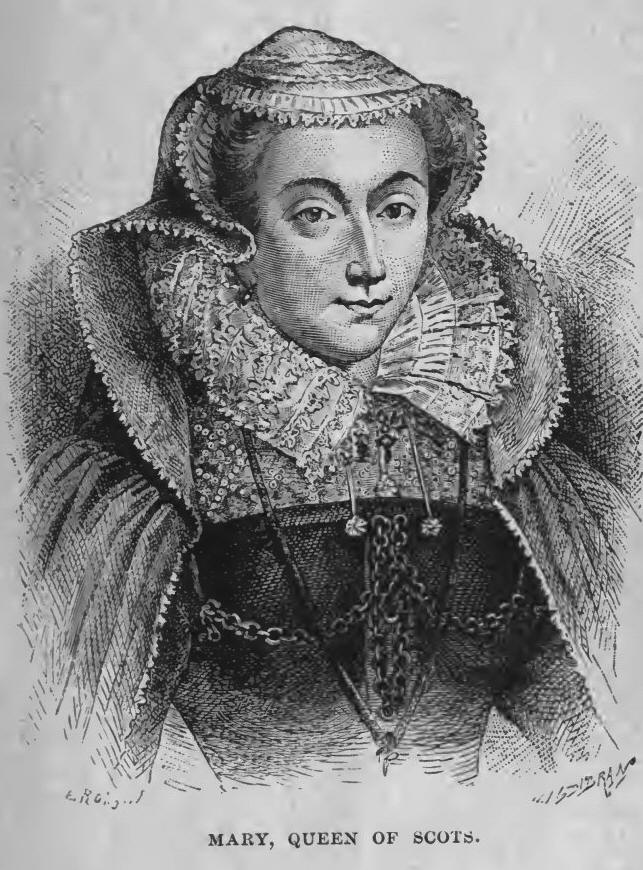
Darnley was both incompetent and unmannerly, violent and weak. The affection which he had inspired in Mary Stuart soon disappeared and gave place to contempt. She has been accused of worse still; the niece of the Guises, brought up by Catherine of Medicis, amidst all the disorder of morals which reigned at the court of France, had a bad reputation among the austere Presbyterians; they attributed the most unworthy motives to the elegant tastes for frivolous pastimes which led the queen to surround herself with young men, with foreigners and artists. No one was more suspected among the favourites of Mary than an Italian, David Rizzio, who had won her good graces by his musical talents, and to whom she had gradually confided important trusts. Rizzio had especially aroused the jealousy of Darnley; the Italian had, it was said, taken the liberty of reproaching the young king with his behaviour towards Mary; he also encouraged the queen in her refusal to confer upon Darnley the crown as her consort instead of the vain title which he bore. A plot was hatched against the life of Rizzio. At the head of the conspirators was Lord Ruthven, who had been a short time before in a dying condition, and who arose from his sick-bed to take part in a deed of blood with Lord Morton, chancellor of the kingdom. Their aim was to recall the Earl of Murray and the exiled lords, by revoking the acts passed against them by Parliament.
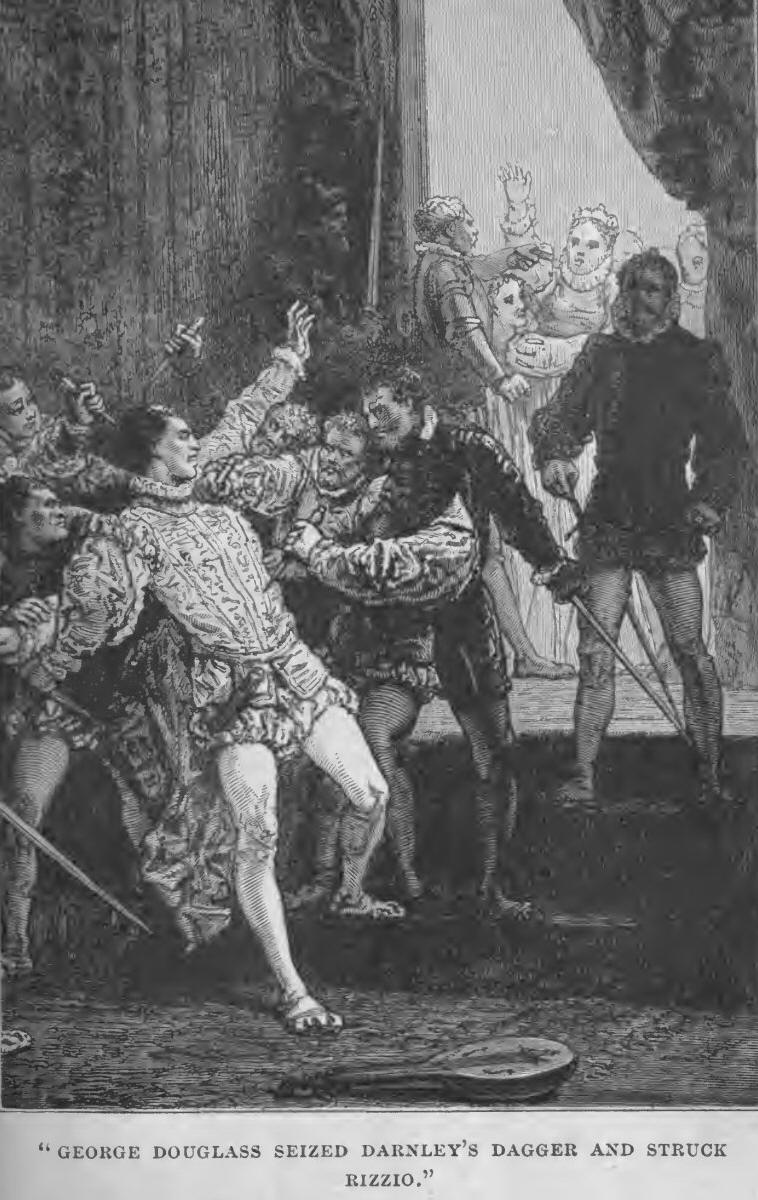
On the 9th of March, 1566, Mary was supping in her apartment with her ladies, and Rizzio was in the room, when the young king came to the palace, followed by Ruthven. The queen rose in alarm, for the other conspirators had just entered. Ruthven ordered Rizzio to leave the chamber, but Mary placed herself before her favourite, who clung to her dress. Darnley seized the hands of his wife; the table was overthrown; the unhappy Italian cried, "Mercy! justice! justice!" George Douglas drew the dagger of Darnley, and struck the secretary. Andrew Ket, one of the conspirators, presented his pistol close to the body of the queen, who implored them to spare Rizzio. He was dragged out, and was pierced by numerous dagger-thrusts in the antechamber, while Morton guarded the doors of the palace with a troop of armed men. When Mary heard that Rizzio was dead, she stood erect. "I will now dry up my tears," she said, "and I will think of revenge." Darnley endeavoured to console the queen; she suffered him to believe that she accepted his excuses, and when his brother, Lord Murray, presented himself on the morrow at Holyrood, with the banished noblemen, she received him without anger, and contrived to detach him from those who had exerted themselves on his behalf, perhaps without his knowledge. Morton and Ruthven, abandoned by Darnley and Murray, immediately took to flight, while the Earl of Bothwell and Lord Huntley were bringing to the queen an army of eighteen thousand men, that they had immediately levied. Mary was once more mistress of the situation. Two obscure accomplices in the murder of Rizzio alone bore the penalty of the crime, and on the 9th of June, 1566, the queen gave birth to a son, who was to become James VI. of Scotland, and James I. of England. Elizabeth had promised to act as godmother to the child of the Queen of Scotland. When the prince was born, Melville departed in all haste, to bear the news to London.
"George Douglass Seized Darnley's Dagger And Struck Rizzio."
Cecil was the first informed; he repaired to Greenwich; the queen was dancing after supper. "But," wrote Melville, "when the secretary of state whispered in her ear of the birth of a Prince, the merriment disappeared for the evening. Everybody was astonished at the change, but the queen sank into a chair, with her hand upon her cheek, saying to her ladies that the Queen of Scotland was the mother of a fine boy, while she was but a barren stem." On the morrow, Elizabeth had regained her composure, and she graciously congratulated the ambassador, despatching the Earl of Bedford to Scotland with her gifts, to be present at the baptism of the little prince. Darnley did not wish to take part in the ceremony; he knew that the Queen of England had forbidden her emissaries to bestow royal honours upon him.
He had, besides, other causes for dissatisfaction. A growing coldness existed between his wife and himself. The apparent reconcilliation which had followed the murder of Rizzio, had not lasted long, and Darnley thought of going away from Scotland, and travelling upon the Continent. Queen Mary had addressed a letter to the privy council of Elizabeth, claiming the recognition of her hereditary rights, a matter which had recently been mooted in the English Parliament, to the great exasperation of her Majesty. The Commons had even insisted more than usual, notwithstanding the ordinary promise of the queen to think of marriage. Elizabeth had recently been ill, and the terrors of a contested succession had drawn forth the deputies from their ordinary state of submission. When the request of Mary arrived, the queen of England abruptly imposed silence upon the Commons. "Under the pretexts of marriage and succession, many amongst you conceal hostile intentions," she said, "but I have learnt to distinguish my friends from my enemies, and take care, whoever be the sovereign who holds the reins of government, not to wear out his patience as you have done mine." She gave instructions to the Earl of Bedford to induce Mary to ratify the treaty of Edinburgh, which yet remained pending, and which contained verbally, the renunciation of the rights which Mary claimed, promising to regulate the question of the succession by a fresh treaty. Mary refused, but, in order not to exasperate her powerful rival, she consented at the request of Bedford to pardon Morton, Ruthven, and Lindsay, who had taken refuge in England after the murder of Rizzio. Darnley no doubt conceived fears at the news of the return of Morton, for he immediately left the court and sought retirement at the residence of the Earl of Lennox near Glasgow.
Scarcely had the young king arrived at his father's house when he caught the small-pox. He was in great danger, and the queen sent her physician to him, without going to see him herself, as long as he was seriously ill. She remembered, no doubt, that while in a dying condition the preceding summer, at Jedburgh, her husband had not troubled himself to go and see her. When Darnley was convalescent, Mary consented to a fresh reconciliation. She repaired to Glasgow and took the king with her to Edinburgh. She took up her residence as usual at Holyrood, but the fear of infection caused Darnley to be installed in an isolated house, where the queen went to see him. Rumours of conspiracy were already afloat; the insolent Darnley had few friends and many enemies. He was, however, warned by the Earl of Orkney that if he did not promptly quit this place, he would lose his life there, but the king had been smitten again with a capricious passion for his wife. He only saw through his eyes, and a word from the mouth of Mary soon quieted his suspicions. On the 9th of February, 1567, the queen supped with him, then left him at eleven o'clock for a ball which she was giving at Holyrood, in honour of the marriage of one of her servants. Three hours after her departure, at two o'clock in the morning, the house in which Darnley was alone with five servants, was suddenly blown up, and the body of the unhappy king was found in the garden, beside that of a page, without trace of burning or of any violence, while the other victims remained buried beneath the rubbish. No one had escaped. The blow had been struck by a sure hand. Mary was again a widow.
The public voice immediately accused the Earl of Bothwell. His violent passion for the queen was known; it was even whispered that it was mutual, notwithstanding the signs of grief shown by Mary, who remained shut up in an apartment hung with black. The details of the crime indicated long premeditation and skilful accomplices. Nearly all the ministers of the queen, Maitland especially, were implicated in the suspicions of the public. Nobody laid hands upon the principal person accused, even when the Earl of Lennox demanded his arrest. He was allowed to take possession of Edinburgh Castle before a warrant of arrest was granted against him. He appeared at the bar of the court of justice, but rather in triumph than as an accused person. The Earl of Lennox, alarmed at the attitude of the assassins of his son, had fled and taken refuge in England. Bothwell was acquitted, and bore the sceptre before the queen at the opening of Parliament. Darnley had been sleeping only one month in his bloody tomb, and already the rumour was afloat that the queen was about to marry the Earl of Bothwell, whom general opinion regarded as the murderer of her husband. Bothwell had been married six months before to the sister of the Earl of Huntley.
In the midst of this court agitated by such violent passions and tainted by such dark acts of treachery, the queen had a few faithful friends, and these warned her of the sinister rumours which circulated concerning her. Her honest envoy, Melville, relates how he took her a letter from England upon this subject; the queen showed it to the Secretary Maitland: "Bothwell will kill you," said the politician; "retire before he comes within this place." And, as Melville persisted, the queen sharply replied that matters had not yet come to that, although she refused to go into details.
Bothwell had, however, taken his precautions and secured powerful partisans. He brought together at a banquet all the principal members of Parliament, and there, protesting his innocence of the murder of Darnley, he announced his intention of marrying the queen. Whether from fear or from promises of advantage, the guests signed a document which Bothwell produced, recommending the earl for the husband of Mary, and they undertook to favour the marriage by every means. Four days later Bothwell gathered together a thousand horses. He planted himself in the way of the queen, who was returning from Stirling, between Linlithgow and Edinburgh, where she had been to see the little prince. He fell upon the royal escort, and himself laying hands upon the bridle of Mary's horse, he dragged her, with her principal councillors, into Dunbar Castle, exclaiming at the moment of the capture, "that he would marry the queen, whether people wished it or not, whether she wished it herself or not," he detained her for five days in the fortress, without her subjects attempting the slightest effort to deliver her. On the 29th of April, when she was restored to liberty, the queen appeared before the session court, announcing with shame that notwithstanding the outrages which the Earl of Bothwell had made her suffer, she was disposed to pardon him and to raise him to fresh honours. On the 15th of May, the marriage was celebrated publicly at Holyrood, according to the Protestant rites, and in private according to the Catholic rites. Bothwell had legally separated himself from his wife; the murderer had obtained the object of his crime.
Hitherto silence had been preserved as to the guilt of Bothwell, but the public conscience was shocked by the marriage. At the same time burst forth the plots which had long been in preparation to hurl Mary from the throne. Scarcely had she, whether willingly or under compulsion, concluded this odious union, when revolt suddenly threw off its mask. The great nobles had signed the engagement of Bothwell; now they loudly accused him of the murder of Darnley, manifested their fears for the life of the little prince, and announced the intention of delivering the queen from the yoke of her husband. An attempt to take possession of Bothwell's person having failed, the confederates marched upon Edinburgh, where they seized the government; but Mary rarely shrank from violence; she was resolute and quick; on the 15th of June, a month after her marriage, she was at Carbery Hill at the head of the troops that she had raised, in the face of the army of the insurgents. No blows were struck. The ambassador of France, the aged Le Croc, endeavoured to negotiate between the two parties. The forces of the confederates increased every moment; the soldiers of the queen appeared valiant. Bothwell proposed single combat to the hostile chiefs. Several accepted, but without result. It was at length agreed to allow Bothwell to proceed without obstacle, provided the queen should consent to return to her capital, where her faithful subjects surrounded her with honour and respect. Two hours later Bothwell departed at a gallop, and placed himself in safety; but Mary was a prisoner, and she was conducted to the house of the Provost of Edinburgh, where she remained shut up for twenty-four hours without being approached by any one. On the morrow, after nightfall, a numerous guard took the captive to Lochleven Castle, under the custody of William Douglas and his mother, formerly the mistress of James V. and the mother of Murray. Bothwell soon left the kingdom.
The anger of Elizabeth, at the news of the arrest of Mary, was violent and unfeigned. Not that she took much interest in the rival whose power she had incessantly endeavoured to ruin, through fear of the enterprises which she might attempt against England, but the outrage suffered by the Queen of Scotland cast a reflection upon all sovereigns. It was a blow at the regal dignity, the fruit of the pernicious principles which Knox and his adherents propagated. Sir Nicholas Throgmorton was sent to the confederate noblemen to command them to deliver their queen; but Cecil was in no such haste as his mistress to see Mary out of prison. His private instructions relaxed the ardour of the negotiator. The lords of the council had lost no time. Lord Lindsay appeared at Lochleven, the bearer of an act of abdication in favour of the little prince. The queen was invited to sign it; she refused. Lindsay took hold of her arm, and squeezing it in his iron gauntlet, "Sign," he said, "if you do not wish to die as the assassin of your husband." The queen signed without looking at the paper, merely raising her sleeve to show to those present the traces of the violence which she had just suffered. The uncouth warrior was himself ashamed. "I did not know that the flesh of women was like newly-fallen snow," he muttered; but he carried away the document. King James VI. was proclaimed and crowned on the 20th of June, and on the 22nd of August the Earl of Murray, who had returned to Scotland, after a prudent absence, was declared regent of the kingdom. He paid a visit to his sister at Lochleven, and asserted that he only accepted that office out of consideration for the prayers and tears of Mary. In the month of December, an act of the council declared the queen an accomplice in the murder of her husband, and in the abduction of her person by Bothwell. The deed was proved, it was said, by a correspondence between Mary and Bothwell, recently discovered by the Earl of Morton. The responsibility of the deposition of the queen fell entirely on her own head, and was but the just punishment of her crimes.
Justice or the violence of men might take everything from Mary Stuart, except the power of her charms. Even at Lochleven, she contrived to make partisans and win friends. On the 2nd of May, 1568, the lords of the council suddenly learnt that the queen had escaped from Lochleven, through the skill of a young man who had contrived to steal the keys. She arrived by night at Hamilton Castle, and had already revoked her abdication. A week had not elapsed before she had gathered an army around her.
The situation was critical, but the regent and his friends contrived to face the danger. As Mary advanced towards Dunbarton Castle, she encountered a body of troops, small in number, but disciplined and well armed; her partisans sprang to the combat with more zeal than strategy; they were soon defeated and put to flight. The deserted queen at first escaped the pursuit of her enemies, but she felt that she was closely pressed. The thought of the horrors of a prison chilled her with fear; she had expected death when she had been in the hands of her revolted subjects; she resolved to place herself under the protection of her good sister, Queen Elizabeth, and to proceed to England. The friends who yet surrounded her were opposed to this project. The Archbishop of St. Andrew's implored her upon his knees to abandon it; but Mary would listen to nothing; she stepped into a little fishing-boat to cross the Solway, and landed, on the 16th of May, at Workington, a fortnight after her escape from Lochleven, hence to direct her course at once towards Carlisle. Arrived there, she despatched a messenger to solicit an interview with Elizabeth. The fugitive queen was already lodged in a fortress, rather as a prisoner than as a sovereign, when she received the reply of Elizabeth to her request. The Queen of England could not see her, it was said, until she should have cleared herself of all suspicion with regard to the death of her husband.
Elizabeth had refused to grant the title of regent to Murray, and she had appeared to espouse the cause of Mary; but the policy of Cecil received too opportune an assistance from the imprudent confidence of the Queen of Scotland, to allow the opportunity to pass without profiting by it. The captive committed the mistake of asking that, if the queen could not protect her, she would at least allow her to traverse her kingdom, to go and beg the support of the foreign princes, "the King of France and the King of Spain being bound to come to her assistance on this occasion." The Catholic confederation in Scotland, at the threshold of England, was too real a danger for the wisdom of Elizabeth not to be struck with it. She consented to the proposal of Cecil, and offered to serve as arbitrator between the Queen of Scotland and her subjects, through the agency of an English commission. Mary indignantly refused. She could not and would not degrade the crown of Scotland to the condition of vassalage; she was the queen and independent. The judges who were suggested to her, had at all times fomented the agitations against her, and supported her enemies. She asked for no other favour than liberty to return to Scotland, or to repair to France. She had come to England upon the faith of the assurances of friendship which Queen Elizabeth had transmitted to her while she was at Lochleven. "Being innocent, as, thank God, I know I am, do you not (she asked) do me a wrong by keeping me here?"
In reply to this appeal, which it was difficult to reject with common justice, Mary was transferred from Carlisle to Bolton Castle. The agents of Elizabeth, in all the courts of Europe, appeared to have given the signal to each other to alarm her concerning the consequences of the liberation of the Queen of Scotland. "Her Grace now holds the wolf who wished to devour her," wrote, from Paris, Sir Henry Norris; "it is said that there is a conspiracy between the King of France, the King of Spain, and the Pope, to ruin her Majesty, and to put the Queen of Scotland in her place."
Elizabeth sent a messenger to Scotland, to call upon the regent and the confederate lords to cease hostilities; but her representations had little effect, while the manœuvres of the Scottish insurgents powerfully impressed her. She began to believe in the crime of which Mary so vigorously protested her innocence, and she demanded that the Queen of Scotland should exculpate herself in her eyes, promising to place her again upon the throne if her innocence should be proved; for, at the bottom of her heart, and in her royal sympathy for sovereigns, she had been and remained shocked at the audacity of the Scots, who had dared to dethrone their queen, whatever might have been her faults. The regent had replied to the reproaches and threats of the Queen of England, that "if Elizabeth wished to wage war against them, they would not sacrifice their lives, and would not risk their possessions, by passing as rebels in the world, when they had in their hands the means of justifying themselves, whatever regret that might occasion them."
The die was cast; the accusers of Queen Mary, her brother, Lord Murray, and his constant enemy, Lord Morton, were to come from Scotland, to be confronted with her before the commission of English judges. All parties were equally uncertain, respecting the result of the conference, for all distrusted Queen Elizabeth, who had lavished upon both sides the most contradictory promises. Mary counted upon her to replace her again upon her throne. "I have abandoned despatching my letters to the courts of France and Spain, relying upon the promises of your Grace, and wishing, if I am to be restored to the throne, that it may be solely by the means of the court of England." However, Cecil had assured Murray "that it was not intended to re-establish the Queen of Scotland, if her crime is proved, whatever her friends may say."
The conferences opened at York, upon the 4th of October. There were repeated all the arguments, there were enumerated all the facts well known in history. Mary threw the guilt of the crime not only upon Bothwell, but upon his accomplices, causing it to be clearly understood that her accusers had good reasons for making the whole weight of it fall upon her. She resolutely denied the genuineness of the letters found in her casket, of which copies only had been produced at first, and she demanded to be admitted to the queen, to defend herself in her presence. The conferences were transferred from York to Westminster. The Queen of England and her ministers felt the necessity for following more closely the dark intrigues which intersected each other in all directions around the captive queen. The secretary Maitland had opened negotiations for the marriage of the Queen of Scotland with the Duke of Norfolk, affirming that the Protestantism of the great English nobleman would reassure the reforming party in Scotland, and would definitively re-establish the throne of the Queen. It is probable that the designs of the skilful intriguer went further. He was aware of the secret discontent of the English Catholics, of the powerful friends whom Norfolk could rally around him, and he hoped no doubt to raise a revolt in England. The wisdom of Cecil saw through the manœuvre. The liberty of Mary was for ever lost, even could her innocence have been proven, which it assuredly was not. Mary in Scotland constantly threatened the throne of Elizabeth. The servants of the Queen of England were even alarmed for her life. Mary in prison was dangerous, no doubt, but the peril was less and the question of the justice of the detention of a sovereign who had voluntarily come to place herself under the protection of her relative, did not enter into the matter. On the 11th of January, 1569, after three months of conferences and intrigues, Elizabeth publicly declared to the Regent Murray that nothing had been proved against his honour or that of his partisans, but that the crimes imputed to Queen Mary had not been demonstrated with sufficient clearness to inspire her with a bad opinion of her good sister. Nevertheless, Murray returned freely to Scotland, supplied with the money which was necessary for the support of his government, and Mary remained in prison, in spite of her protestations and anger. Elizabeth several times found means of counselling her to abandon the crown and to lead a peaceful life in England, but Mary firmly replied that she was determined to die rather than to comply with such suggestions; that justice required that she should be reestablished upon her throne, after which "she would show as much clemency to the authors of her troubles, as should appear to her compatible with her honour and the good of her kingdom." The captive also protested that she would not consent to proceed further away from the frontier; but, on the 26th of January, in cold and gloomy weather, the beautiful queen was compelled to mount a wretched horse, and accompanied by a few ladies, and a small number of servants, to ride as far as Tutbury Castle in Staffordshire, a fortress belonging to the Earl of Shrewsbury. This nobleman was henceforth entrusted with her custody, a constant anxiety to the sovereign who under the influence of female jealousy had belied the nobler side of her character, and who now could find no place sufficiently strong, no jailor sufficiently vigilant to keep the prisoner whom she was unjustly detaining.
The affairs of Queen Elizabeth were as much complicated abroad as at home, and her external policy was neither frank nor sincere. The oppression of the United Provinces by the King of Spain had aroused a general discontent which brought about insurrections in the towns, and the beginning of that indomitable rebellion which was to end in the dismemberment of the Low Countries. The Prince of Orange had placed himself at the head of the oppressed people, protecting the religious and political liberties of his country, and his great struggle with the terrible Duke of Alba had begun. Everywhere the Protestants felt themselves threatened, and conspiracies recommenced in France. The Prince of Orange and the Prince of Condé both applied to Queen Elizabeth for assistance and money. The queen secretly supported them in a niggardly and unwilling fashion, though urged by Cecil, whose policy was more firm, whose intelligence was more clear-sighted, and whose views were broader than those of his mistress; but she took care loudly to protest her friendship for the King of Spain and Charles IX., while encouraging the open or secret enemies who were struggling against their power. Upon all stages and in all countries of Europe the policy of the sixteenth century continually presents that character of duplicity and falsehood which necessarily results from the absence of publicity and control, but which renders history difficult to understand, and more difficult to relate.
Amidst the embarrassments which the claimants of the succession to the crown of England caused her, Elizabeth had resumed, it, indeed, she had ever abandoned her matrimonial negotiations. The Archduke Charles was yet unmarried, and, in 1567, the queen solemnly sent the Earl of Sussex, as ambassador, to Vienna, to deal with the great question of religion. The archduke had never come to England, although he had several times been invited, and the queen declared that she would never marry a man without having seen him. Sussex lavished upon her descriptions of the person of the Archduke, not without adding to them the attraction of his domains, and of the great position which he occupied at the court of the Emperor. He assured the prince that this time the queen wished to proceed seriously in the matter, since she was free to marry whomsoever she should think fit, and she had never inclined towards any other union. The archduke felt much honoured, but when the question of religion was opened, he frankly declared that his ancestors had always professed the same religion as himself, that he knew no other, and would never change it. Elizabeth then urged the Protestant feeling of her subjects, without, however, breaking off the negotiations, which only ended on the day when the archduke married the daughter of the Duke of Bavaria.
The embarrassments of Elizabeth in England were complicated through the progress of the intrigue having for its object the marriage of Mary with the Duke of Norfolk. Elizabeth had openly spoken of it to the Duke, who had excused himself, affirming that he could never think of uniting himself to a princess who had raised claims to the throne of England, nor to a woman whose husband could not sleep peacefully upon his pillow. This allusion to the fate of Darnley had for a moment lulled the distrust of the Queen of England, but Cecil was alive to all the dangers which threatened his mistress. He had a short time before discovered the marriage of Lady Mary Grey, sister of Lady Jane and Lady Catherine. "What a mischance!" he wrote; "Sergeant Portier, the tallest and fattest of the gentlemen of the court, has conceived the idea of secretly marrying Lady Mary Grey, the shortest of all the ladies. They have been placed in separate prisons, the crime being very great." And the jealousy of Elizabeth towards any who approached the throne closely, or at a distance, was so excessive, that the unhappy Mary remained in prison until her death, without ever seeing her husband again. Deplorable end of a family doomed to the most tragic reverses!
Cecil had personal reasons for watching the intrigue for the marriage of Mary with the Duke of Norfolk. The Earl of Leicester, always jealous of the influence of the great Minister with his mistress, endeavoured secretly to undermine a power which he dared not attack face to face, and he exerted himself to attach the powerful Norfolk by urging him on in his perilous undertaking. The duke hesitated, but the Earl of Arundel and the Earl of Pembroke united themselves with Leicester. They despatched to Queen Mary articles of marriage, intended to insure the security of Elizabeth, by the total renunciation by Mary of her pretensions to the crown of England, and by an alliance, offensive and defensive, with the queen, her good sister. Mary Stuart was to allow the reformed religion to be established in Scotland, and to give her hand to the Duke of Norfolk.
People who are anxious to get out of prison are ready to accept harsh conditions, especially when they are not firmly resolved to observe them. Mary promised all that was desired with the sole reservation that the consent of Elizabeth should be obtained to the marriage. "All my misfortunes," she said, "have arisen from the anger of my sister, when I married Darnley." Leicester was counted upon to obtain this favour, and the duke wrote the most passionate letters to Mary, through the agency of the Bishop of Ross, who was still faithful to his mistress. The consent of the Kings of Spain and France had been asked for, and Murray was to propose to the Parliament of Scotland the liberation of the Queen.
He proposed it, in effect, though probably without any great sincerity. Mary had brought many misfortunes and few benefits to Scotland, and her brother had not that attachment for her which causes all other considerations to be forgotten. The articles coming from England were rejected; the question of the divorce which Bothwell had caused to be declared in Denmark was not even examined, and Queen Elizabeth was warned of what was preparing in the dark. She was at Farnham; the rumour of the marriage circulated at the court. Leicester had taken no step with regard to it as yet. Norfolk was there, not daring to go away; he dined at the table of the queen, who one day said to him, with a significant look, which reminded him of his own words, "Good evening, my lord duke; be careful upon what pillow you rest your head." Norfolk took alarm. A few days afterwards, the court was at Titchfield. Leicester fell ill; the queen hastened to his bedside, and there impelled by remorse and keeping up the farce of passion, Leicester avowed to her with tears that he had acted disloyally towards her, by endeavouring, unknown to her, to marry her rival to the Duke of Norfolk. Leicester obtained his pardon, but the royal displeasure rested upon the Duke of Norfolk. The disfavour of Elizabeth was dangerous; the Duke retired to Kenninghall, whence he was soon recalled. A French servant of Mary Stuart, arrested in Scotland, had, it is said, made fresh revelations upon the complicity of his mistress in the murder of Darnley; the servant was executed, but the imprisoned queen remained exposed to the anger and indignation of Elizabeth. An insurrection in the North was feared, for the Earls of Arundel and Pembroke had both quitted the court. Norfolk was conducted to the Tower; the Bishop of Ross was arrested, although he pleaded the privilege of an ambassador, and all the noblemen compromised in the intrigue received an order to retire to their homes. The anxieties of Elizabeth, real or feigned, were not without some foundation. The Catholics of her kingdom, groaning under a secret but cruel oppression, naturally turned towards the Queen of Scotland, in their eyes the legitimate heiress to the throne, sanctified by her misfortunes, surrounded by the double fascination of her charms and of that faith towards which she had always manifested the most sincere attachment. The Huguenots had recently suffered great disasters at the battle of Jarnac, where the Prince of Condé had been killed, and also at the battle of Moncontour. The English noblemen whom the queen had gradually allowed to pass into the service of the French Protestants were compelled to return to England, whither they brought gloomy tales of the cruelty of the victorious Catholics, and of their resolve to cause Catholicism to triumph everywhere, no matter by what means. To complete the hostility of the Continent, Queen Elizabeth, always greedy for money, had taken possession in time of peace of a fleet of Spanish galleons, bearing to the Duke of Alba the sums sent him by the King of Spain, which fleet had taken refuge upon the coast in order to escape the Huguenot vessels. It was pretended, at the court of England, that the money did not belong to Philip II., but to some Genoese and Lombard bankers, who could have no objection to lend it to Queen Elizabeth. The vessels of the English merchant navy had all become pirates, stopping and pillaging Spanish and French ships, seconding the attempts and projects of the Huguenots upon all coasts, and bringing arms and supplies to them. Some convoys setting out for La Rochelle were even accompanied by royal vessels, and the queen secretly authorized a great number of noblemen to take service in the army of the Huguenots, or in that of the Prince of Orange, while she replied to the complaints of the Spanish and French ambassadors by the assurance of her friendship for their sovereigns and of her wish to preserve the peace. Treachery was met by treachery. A conspiracy, half Spanish, half French, was preparing upon the Continent, to encourage the insurrection of the Catholics. Ridolfi, an agent sent from Italy, had communication with the Duke of Alba on passing through the Low Countries. Evil designs were secretly meditated against the life of Elizabeth, and the representations of the governor-general, who did not believe in the possibility of success, having had no effect upon his master, the intrigue was developed in the north of England; the tyranny of Elizabeth had itself paved the way for it.
Captive princes always find means of communicating with their partisans, however close may be their prison, and however strict the supervision may appear. Mary Stuart had entered into relations with all the great Catholic noblemen of Yorkshire, Durham and Northumberland. An attempt at escape had even been organized, which was to place her at the head of her little army, but the project collapsed, and, on the 16th of November, 1569, the Earls of Northumberland and Westmoreland, with a great number of noblemen and retainers, raised the standard of revolt, with the intention of marching upon Tutbury, to deliver and proclaim the captive queen. Upon the way the insurgents burnt in the churches the prayer books, while announcing everywhere that the Catholic religion was re-established, and summoning all good Catholics to join them. But Mary had already been transferred from Tutbury to Coventry. The populations did not respond to the appeal of the rebels; the southern counties took up arms against them. A goodly number of Catholics joined the royal army, assembled at York. Uneasy and irresolute, the two earls fell back upon Praby Castle. They besieged Sir George Bowes, in Barnard Castle, compelled him to capitulate, and planted themselves in the little port of Hartlepool, hoping to receive Spanish assistance through the Low Countries.
Meanwhile the Earl of Sussex, who had delayed so long at York that suspicions had been aroused as to his loyalty, was at length advancing against the rebels with the reinforcements which the Earl of Warwick had brought him. The insurgents fell back slowly towards the frontier of Scotland, and soon took refuge, without fighting, in that kingdom, the support of which they had hoped for. Elizabeth at once demanded the surrender of all the chiefs. Murray could not or would not satisfy this requirement. The Earl of Northumberland alone was in his hands. The Earl of Westmoreland, Egremont, Ratcliff, and the other great noblemen were in safety at the residences of their Scottish friends, who furnished them with means to reach the Low Countries. The regent sent his prisoner to Lochleven, saying that he would exchange him for Queen Mary; but before the negotiation had begun, even before Lord Leonard Dacre, the last of the insurgents who still held out in England, had been in his turn obliged to take refuge in Scotland, Murray was assassinated on the 22nd of January, 1570, in the streets of Linlithgow, and Queen Elizabeth wreaked her vengeance upon the counties which had taken part in the insurrection. "There are so many guilty persons to condemn," wrote the Bishop of Durham to Cecil, "that difficulty is experienced in finding enough men innocent of all rebellion, to make juries of them." A royal declaration was read in all the churches in the peaceful districts, as well as in the regions bristling with gibbets, reminding the people of the peaceful years which England had enjoyed under the reign of Elizabeth, and affirming that she claimed, as chief of the Church, no other authority than that which her predecessors had exerted, her noble father, King Henry VIII., and her dear brother, King Edward VI. She did not intend to put a constraint upon the conscience of her subjects, provided the Christian religion, as it was established in the acts of faith, should in nowise be molested, and that people should conform themselves to the laws of the kingdom, for the practice of public worship. Liberty, as understood by Queen Elizabeth, consisted in doing exactly as she commanded.
The death of Murray, the only man sufficiently skilful and influential to maintain a little order in unhappy Scotland, had again delivered up that kingdom to the dissensions of parties. The Duke of Chatellerault and the Earl of Argyle immediately took possession of the government in the name of Queen Mary; but Morton, at the head of the king's men, as the partisans of James VI. were called, had taken up arms, summoning England to his aid. Elizabeth sent him an army and a regent. She had taken back into favour the Earl of Lennox, father of Darnley, and grandfather of the little king, and despatched him to Scotland, to govern in the name of his grandson, while the English troops entered several times into Scotland, devastating all the southern counties, burning down the towns and villages, and supporting the efforts of the new regent, who was implacable in ravaging the domains of the Duke of Chatellerault and of all the family of the Hamiltons. When Sir William Drury returned to Berwick, on the 3rd of June, after the recent campaign, the ravages had been so great, that the authority of Lennox appeared to be established upon the ruin of all his adversaries.
The Catholic arms had failed as well as the Catholic conspiracies. Pope Pius V. was anxious to try the spiritual thunders of the Vatican. A bull declaring the excommunication of Elizabeth, depriving her of her pretended rights to the crown of England, and absolving her subjects from their allegiance, had been prepared for some time; it was signed after the insurrection had failed, and several copies of it were sent to the Duke of Alba; but Philip II. prohibited the publication of them in the Low Countries. On the 13th of May, 1570, however, the bull was posted upon the door of the palace of the Bishop of London. During the investigations which were immediately made in courts of law, of evil notoriety both in political and religious affairs, it was ascertained from a student under torture, that he had received a copy of the bull from a rich Catholic gentleman named Felton. The latter was arrested, and he avowed without hesitation that he had posted up the bull, but no punishment could make him reveal the names of his accomplices. Being condemned to a traitor's death, he walked to the place of execution as to a martyrdom, designating the queen by the name of "Pretender," and remaining firm in his enthusiasm until the last moment. Before his death, and while upon the scaffold, however, he asked that the pardon of Elizabeth might be solicited for aught in which he might have offended her, and sent her, as a token a magnificent ring of great value, which he took from his finger. Even among those who contended against her with the greatest tenacity, Elizabeth contrived to win from her people so sincere and loyal an affection, that condemned persons sent presents to her, and criminals whom she had caused to have a hand cut off for having written against her, seized their hats with their left hands and waved them above their heads, exclaiming, "God bless Queen Elizabeth!"
The faithful attachment of the English nation to its sovereign did not, however, prevent the progress of a new principle of liberty which grew with the independent and firm opinions of a portion of the Protestant population. Elizabeth had preserved at the bottom of her heart considerable affection for the Catholic doctrines, still more for the external practices of their worship. She loved sacerdotal garments and pompous ceremonies. She retained in her chapel some candles and a crucifix, and she had a horror of married priests. All the weight of her authority did not prevent the most fervent Protestants of her kingdom, especially among the middle classes, from being convinced that the Reformation had been too quickly checked in England, and had not been sufficiently thorough. They thus inclined more and more towards the religious practices and doctrines of the Continent in their austere simplicity. The "Puritans," as they were already called, were in bad odour with Elizabeth, and she often persecuted them, all the more because she attributed to them, and not without reason, the republican and democratic tendencies fostered in Scotland by Knox, of which she had seen the effect in the revolts against Mary Stuart. A certain number of Bishops and many great noblemen secretly inclined towards the Puritan ideas. Even Cecil was not hostile to them, although he had the royal favor more at heart than all the sects and doctrines. In the Parliament of 1571, the Puritans raised their heads for the first time. Thomas Cartwright, a distinguished professor who occupied, at Cambridge, the Margaret Professorship of Theology, maintained that the Episcopal system was opposed to the Holy Scriptures. He was suspended, but not without commotion among the public. The laws proposed to Parliament were hostile to the Catholics; they prohibited, under the penalties of treason, claiming the succession to the crown, for whomsoever it might be, during the lifetime of the Queen; they placed an absolute veto upon any communication with the Pope, and all obedience rendered to his bulls; but at the same time they required assiduity in the worship established by the State, and, four times a year, participation in the communion of the Anglican Church. This last article was abandoned by the Queen, but the Anglican worship was as odious to the Puritans as to the Catholics. They presented to Parliament seven bills for the progress of reform and the repression of abuses. The Queen, in a passion, ordered the member of the House who had proposed them, Mr. Stickland, to abstain from appearing at the sittings; but the Puritans had gained more ground than the Queen was aware of; they introduced a motion to summon Strickland to the bar, and to cause his exclusion to be explained to him, declaring that the House which could decide the right to the throne, had the privilege of occupying itself in ecclesiastical matters. The wise prudence of Elizabeth prevailed over her anger. Strickland reappeared on the morrow in Parliament, and was received with acclamations by his colleagues; but the Queen had been vanquished, and her aversion to the Puritans was thereby increased. It was the first triumph gained by the fathers of the liberties of England over the political and religious despotism winch rose in the shadow of the throne of the Tudors. At the end of the session, after the Commons had been reprimanded for their indocility, by the Lord Keeper of the Seals, Nicholas Bacon, Parker, archbishop of Canterbury, caused Mr. Wentworth, one of the great orators of the House of Commons, to be summoned, to demand of him how they had dared to suppress some of the articles of faith which had been presented to their vote. "We were too busy to have time to ascertain whether they were in conformity with the word of God," boldly replied Wentworth. "What?" said the Bishop; "you are mistaken, you must refer to us in this matter." "No," said the Puritan, "by the faith which I have in God, we will vote nothing without understanding what it relates to, for that would be to make you Pope; it will not be by our hands." Nevertheless, and notwithstanding the proud resistance of the Houses, the Bishops continued to insist upon the preservation of the new edition of the articles of faith, under thirty-nine heads, which had replaced the forty articles of Edward VI. A complete submission was required of the pastors, and they were deprived of their livings at the first refusal declared before the court of high commission, entrusted to judge all ecclesiastical disputes. "Matters will soon be ended with them," wrote Parker to Cecil, speaking of the nonconformist ministers, "for I know that they are cowards." The learned archbishop was never more completely mistaken. The courage of the Puritans was to remain firm through all persecutions. A hundred years were not destined to elapse without bringing the day of their triumph. The friends of Queen Mary had resolved upon her marriage. The Duke of Norfolk was in the Tower. People began to talk of causing the Queen of Scotland to marry her brother-in-law, the Duke of Anjou. Queen Elizabeth was alarmed, and in order to cut short this new intrigue, she made overtures on her own behalf to the Court of France. Her most skilful diplomatist, Walsingham, was sent to Paris, entrusted with this negotiation, complicated by the secret support which the queen continued to give to the Huguenots. The parley lasted for several months, but the Duke of Anjou positively refused to change his religion; people turned their eyes towards the Duke of Alençon, the youngest son of Catherine of Médicis; he had scarcely reached his eighteenth year; the queen was drawing near her fortieth. The negotiations nevertheless took their course, amusing Elizabeth by outward tokens of gallantry, in which she still took delight, and, at the same time, preventing all the assistance which the court of France might have brought to avert the unhappy fate of Mary Stuart. Charles IX. had claimed, for his sister-in-law, permission to live in France; but, piqued at the reports of the French ambassadors, upon the relations of the captive with the King of Spain, and by her correspondence with the Duke of Alba, he at length exclaimed, "Ah! the poor fool will never cease till she shall have lost her head; she will be put to death through her own fault, I see it clearly; but I am powerless in the matter." The prospect of the throne of England for the Duke of Alençon was too brilliant to be sacrificed to the interests of Mary. Queen Catherine was negotiating an alliance, offensive and defensive, with Walsingham.
Abandoned by her relatives and her friends in France, Mary Stuart had not ceased to conspire with Spain; but her agents were so closely watched, the supervision of Cecil was so strict, that several emissaries fell in succession into his hands. On one occasion, the Bishop of Ross, recently restored to liberty, contrived to substitute innocent letters for the compromising papers, which his messenger brought; but enough was soon known to make it certain that Mary was urging the Spaniards to attempt an invasion of England, and that the Duke of Alba promised to make arrangements with a person designated in cypher. Suspicion immediately fell upon the Duke of Norfolk. The plague having broken out in the Tower, he had been guarded in his house in London for fifteen months. He was taken back to his prison, and his trial began. The duke at first made a bold denial; then, when the confessions were shown him, which had been extorted by torture or fear from his servants and the agents of Queen Mary, including the Bishop of Ross, he admitted certain things, still maintaining that he had never conspired against the queen, that he had only engaged in the negotiation for the marriage, because he thought she was informed of it, and that, in marrying Queen Mary, he did nothing prejudicial to her Majesty. He formally resented all accusations of correspondence abroad or with the rebels during the insurrection. No witness was confronted with him; only the depositions, written after the tortures, were communicated to him. He was accused of having maintained relations with the Pope. Norfolk, the old pupil of Fox, the author of the Protestant martyrology, declared that he would rather be drawn by four horses than change his religion. He recalled the solicitations which the Earl of Leicester had made him, before he had become concerned in this affair. Leicester sat at the council listening without pity to the complaints of his confiding victim. He voted the death of the duke, who immediately turned toward his judges. "This is the punishment of traitors, my lords," he exclaimed: "but I am faithful to God and the queen, as I have always been. I do not desire to live and do not ask you for my life. You have this day cut me off from your company, but I hope soon to find a better one. I only beg you, my lords, to intercede with her Majesty, in order that she may have pity upon my poor orphan children." Even in his letters to the queen, full of repentance for having offended her, and for having acted in several matters without her knowledge, the duke never asked for mercy, and refused to make any confession which might drag other victims to the unhappy fate which awaited him. Norfolk had been condemned since the middle of January, and the queen had signed his sentence on the 8th of February; but during the night, she became agitated, and caused Cecil, whom she had raised to the rank of Lord Burleigh, to be summoned. She forbade him to have the sentence executed, saying that she wished to reflect again; three times the sentence was signed, and three times Elizabeth recalled it, hesitating to put to death her relative and former friend. At length Parliament intervened. The nation was profoundly agitated by rumours of plots. The documents found upon the emissaries of Mary had circulated among the public; already they saw the Duke of Alba, the ferocious butcher of the Low Countries, invade England at the head of those Spanish soldiers whose dark exploits had terrified Europe. On the 16th of May, the Commons presented to the queen a petition accepted by the Lords, demanding the execution of the duke, for the security of the country. This time the sentence was not withdrawn, and, on the 2nd of June, 1572, the Duke of Norfolk was beheaded on Tower Hill, protesting to the last his devotion to his sovereign and his attachment to the reformed faith. He refused the handkerchief with which it was proposed to bind his eyes. "I do not fear death," he said. When his head fell, the crowd wept as they had wept twenty-five years before at the death of his father, the Earl of Surrey, beheaded on the same spot, by order of King Henry VIII. Two months later, on the 22nd of August, the Duke of Northumberland, captured by treachery when he thought himself delivered at the price of an enormous ransom paid by his wife, died upon the scaffold at York. He was seized upon the vessel which was to take him to the Low Countries, and the "attainder" which overtook him, avoided the embarrassment of a trial. His father had also died upon the scaffold, upon the same day, nineteen years before.
All these prosecutions and deaths upon the scaffold tended towards the same end. Mary Stuart had been condemned before her accusation. Protestant opinion, and Protestant fears were violently excited against her. Burleigh and Walsingham were both convinced that the repose of England was only to be purchased at the price of her blood. Parliament, always ardent in such a matter, proposed to proceed against the prisoner by means of an attainder, but the queen opposed this. The Houses contented themselves with depriving Mary of her hereditary rights, and declaring her unfit to succeed to the throne of England. The captive queen was then at Sheffield, in the custody of Sir Ralph Sadler, and the Countess of Shrewsbury. None of the details of the death of the Duke of Norfolk had been spared her. She had refused to leave her apartment during all the time of the trial. Her faithful servants were everywhere losing ground in Scotland. The archbishop of St. Andrew's, seized by Lennox in Dunbar Castle, had been hanged without more ado, and the murder of Lennox himself by the Hamiltons had not sufficed to compensate for the blows to the Catholic cause. The new regent, the Earl of Mar, was less powerful than Morton, his fiercest enemy. Meanwhile Edinburgh Castle still held out for Mary, and the Highlanders recognized no other sovereign.
A crime committed far off, and for which she was in nowise responsible, was destined to condemn the unfortunate Mary to death, however long the alternations between hope and fear might be. In the night of the 23rd to the 24th of August, 1572, following the day of St. Bartholomew, the Protestants, gathered together in great numbers in Paris, upon the occasion of the marriage of the King of Navarre to Marguerite of Valois, sister of King Charles IX, were surprised and massacred, in their beds, in the streets, or while flying upon the housetops; and the same slaughter, spreading from town to town like a fire, soon extended through the whole of France. Thirty to forty thousand persons perished thus in a few days. Almost all the chiefs of the Protestants had fallen. The most illustrious, the Admiral de Coligny, was killed in his apartment, and his body thrown out of the window. It was to free themselves from the preponderating influence which he was beginning to assume over the king, that Catherine of Medicis and her son, the Duke of Anjou, formerly an aspirant to the hand of Elizabeth, now king-elect of Poland, had concerted and accomplished the massacre, for which they had only obtained the authorization of Charles IX. by dint of harassments which had almost reduced the monarch to imbecility. The public outcry was terrible in all Protestant countries, nowhere, however, more than in England, whither the fugitives, who escaped from their executioners, flocked from all quarters. The queen went into mourning, and refused for several days to receive the French ambassador, M. de La Mothe-Fénelon; but she felt no real sympathy for the French Huguenots, and the horrors which caused the blood of her subjects to boil in their veins, did not interrupt the tranquil course of her policy. Walsingham courteously thanked the king, inasmuch as his house had been spared during "the riot." The excuses and explanations of Charles IX., transmitted by his ambassador, were accepted. The project of marriage with the Duke of Alençon was not abandoned: but Walsingham gave Queen Catherine to understand that the time was not favourable for the visit of the Duke of Alençon to England, considering the extreme exasperation of the people against the Catholics.